The Pressure of Secrets in the Boaz Novels

If you want to understand the Boaz novels, pay attention to what people do with secrets.

Not only the secrets themselves.

What matters most is the pressure they create.

That is one of the forces moving through The Boaz Secrets. A secret in that world is not simply hidden information waiting to be revealed near the end of the story. It is something that has already shaped lives before the reader arrives. It has affected what people say, what they avoid, whom they trust, whom they fear, and which version of the past they have learned to live with.

That kind of secret does not sit quietly.

It works on people.

It changes rooms.

It changes families.

It changes churches.

It changes the public story a town tells about itself.

That is the kind of pressure I keep returning to in the Boaz novels. A secret may begin with one event, one choice, one sin, one crime, one betrayal, one lie, or one moment of cowardice. But in a small town, the thing hidden rarely belongs to only one person for long.

Other people become involved.

Some know the truth.

Some suspect it.

Some repeat a safer version.

Some decide it is better not to ask.

Some benefit from the silence.

Some pay for it.

That is where story begins to deepen.

A secret may give a novel suspense, but the pressure of the secret gives it weight. The reader wants to know what happened, of course. But the more important question may be this:

What has this hidden thing done to the people who kept living around it?

That question matters in The Boaz Secrets. It also matters in The Boaz Safecracker, though in a different way. In that novel, Jimmy Fred Martin opens an old safe and discovers more than valuables. He finds a letter that points toward a hidden moral history. The letter does not explain everything. It does not solve the story. It simply reveals that someone’s past has been locked away, preserved, and protected by silence.

That is enough.

In fiction, a small object can carry a great deal of pressure. A letter. A photograph. A newspaper clipping. A key. A Bible. A safe. A family story repeated so often that nobody remembers who first edited it.

The object matters because it points beyond itself.

It tells the reader there is another story underneath the visible one.

That is often how the Boaz novels work. The public story is rarely the whole story. A family may have one version. A church may have another. A town may preserve the version that protects the people it has already decided to respect. But underneath those public versions are older wounds, private bargains, quiet fears, and truths that did not disappear simply because no one said them aloud.

A small town intensifies this.

In a larger place, a person may be able to escape a secret by moving across town, changing circles, changing churches, changing schools, changing names, or disappearing into the crowd. But fictional Boaz does not offer that kind of distance. People overlap. Families are connected by marriage, church, school, work, property, memory, and old obligation.

Someone knows your parents.

Someone remembers your grandparents.

Someone knows where you sat in church.

Someone remembers who your friends were in high school.

Someone remembers what happened, or thinks he does.

That closeness can be beautiful. It can create belonging. It can create loyalty. It can feed the grieving, surround the sick, help the struggling, and keep people from disappearing.

But closeness can also trap the truth.

When a secret threatens the accepted version of a family, a church, or a respected person, the town may not need an official agreement to protect it. Silence can become communal without ever being voted on. People learn what not to ask. They learn which names make the room change. They learn which old event is always described too quickly.

That is pressure.

Not action in the obvious sense.

Pressure.

It is present when a character pauses before answering a simple question. It is present when a mother changes the subject. It is present when a pastor’s language becomes too smooth. It is present when a family meal feels normal on the surface but charged underneath. It is present when everyone knows a story has missing pieces, but no one wants the responsibility of finding them.

Those are the moments I am drawn to as a novelist.

A secret is not only a plot device. It is a test of character.

What will a person do to keep it hidden?

What will a person risk to bring it into the light?

Who is protected by silence?

Who is punished by it?

Who gets to call secrecy “mercy”?

Who gets to call exposure “truth”?

In the Boaz novels, those questions often move through families and churches because those are two of the places where people learn what matters, what is forgivable, what is shameful, and what must be defended. A church can offer real comfort. A family can offer real love. But both can also teach people to protect a version of the past that is easier to live with than the truth.

That does not make every character a villain.

It makes the story human.

Most people do not think of themselves as protecting lies. They think they are protecting peace. Protecting a child. Protecting a mother. Protecting the dead. Protecting the church. Protecting a family name. Protecting someone from pain.

Sometimes that may even be partly true.

But the secret still works on the living.

That is where the moral complication comes from. A person can keep a secret out of love and still cause harm. A person can tell the truth and still damage someone innocent. A town can think it is preserving decency while actually preserving power. A church can speak of forgiveness while avoiding accountability. A family can call silence loyalty because the other word would be fear.

This is the kind of pressure I hope readers feel when they enter the Boaz novels.

Not just the question of what happened.

The question of what what happened has been doing ever since.

That is why secrets matter in these stories. They bend lives. They distort memory. They assign roles. They decide who is believed and who is dismissed. They teach people how to behave in rooms where everyone knows more than they are saying.

In The Boaz Secrets, the title itself points toward that buried pressure. In The Boaz Safecracker, the safe makes the idea physical. But the concern reaches beyond any one book. Again and again, the Boaz novels return to the same kind of fictional territory: a town where the past is not gone, faith is not simple, family is not always safe, and memory is never neutral.

That may sound dark, but I do not think of these novels as bleak.

I think of them as attentive.

They pay attention to the pressure ordinary people live under. They pay attention to how long the past can remain active. They pay attention to the difference between a secret being hidden and a secret being harmless.

Those are not the same thing.

A hidden secret may still govern a life.

It may still decide who gets invited, who gets blamed, who gets pitied, who gets protected, and who is left carrying shame that never belonged to them.

That is why the pressure has to be felt before the secret is fully revealed. If the secret only surprises the reader, it may create a twist. But if the secret has already shaped the characters, then its revelation does more than surprise.

It explains the weather they have been living in.

That is what I want from the Boaz novels.

I want readers to feel that the town has weather. Not merely scenery. Not merely names and streets and churches and houses. Weather. The kind created by memory, belief, silence, affection, judgment, and fear.

A secret changes that weather.

Sometimes it darkens it.

Sometimes it thickens it.

Sometimes it waits for years until someone finally asks the question everyone else learned to avoid.

Then the story begins to speak.

When an Earlier Novel Still Has a Pulse

I have been rereading some of my earlier Boaz novels.

That is not as simple as it sounds.

A reader can open a novel and enter the story. A writer brings more baggage to the page. I see the story, but I also see the sentences. I see what I was trying to do. I see what I did not yet know how to do. I see places where I would revise, tighten, cut, or simply trust the scene more.

Recently, I reread The Boaz Secrets.

I loved the story again.

That surprised me a little because I also noticed problems. Some grammar issues bothered me. A few sentences needed more care. There were places where the prose could have moved more cleanly. The editor in me did not disappear simply because the author in me wanted to enjoy the book.

But even with those flaws, the story held me.

That matters.

A few nights later, I started rereading The Boaz Safecracker. Again, I expected to notice defects first. And I did notice some. But before long, I was no longer merely inspecting the pages. I was reading.

At one point, I caught myself thinking, “This is an awesome story.”

That may sound strange coming from the author. Maybe even a little too pleased with myself. But that is not how it felt. It felt more like rediscovery. It felt like finding something alive in a room I had not entered in a while.

That is what I mean by pulse.

A novel has a pulse when it still makes you want to turn the page.

Not because every sentence is perfect. Not because the author would make every same choice again. Not because the book has escaped the need for revision. But because something in the story still moves.

A character wants something.

A question has not been answered.

A secret presses against the surface.

A scene creates trouble.

A life has been disturbed.

A reader keeps going.

That is the part of the earlier novels I am trying to pay attention to now.

It is easy, as a writer, to become embarrassed by old work. The mistakes seem obvious. The habits stand out. The repetitions announce themselves. The sentences that once seemed fine now ask for a pencil. Time can make a writer harsher toward his own pages.

Some of that harshness is useful.

It means I have learned.

But if I only see the flaws, I miss something equally important. I miss the fact that those earlier books were doing real story work. They had movement. They had pressure. They had characters carrying trouble. They had questions I wanted answered even though I already knew the plot.

That is not nothing.

A novel does not survive by polish alone.

A polished page can still be dead. A flawed page can still be alive. The best work, of course, has both life and polish. But if I had to choose the first necessity, I would choose life.

Life is what makes a reader forgive a rough edge.

Life is what makes a fictional world feel inhabited rather than arranged.

Life is what makes a person say, “I’ll read one more chapter,” when he meant to turn off the light ten minutes earlier.

Rereading The Boaz Secrets reminded me of that. I did not love it because it was flawless. I loved it because the story still had force. It still carried me into the trouble. It still made me care about what had been hidden, what had been damaged, and what might finally be brought into view.

Rereading The Boaz Safecracker gave me a similar feeling, though in a different way. That novel has a strong story engine from the beginning: an older man, a safe, a crime, an old history, and consequences he cannot fully control. But what interested me most on rereading was not only the plot. It was the feeling that the story had roots.

Some of those roots were fictional.

Some came from memory.

That is true of much of my Boaz fiction. It is not autobiography in any direct or literal sense. The names are fictional. The events are reshaped. The characters are invented. But fiction often grows from remembered pressure. A place. A fear. A tone of voice. A school hallway. A family meal. A church sentence. A moment from youth that stayed alive long after the facts became less important than the feeling.

A novelist takes those fragments and changes them.

He has to.

Life does not usually arrive in story shape. Fiction gives it shape. It compresses, rearranges, disguises, sharpens, and imagines. It takes what might have been private or scattered and turns it into scenes, choices, consequences, and characters who begin to breathe on their own.

That is why rereading earlier work can feel so strange.

You are not only meeting the old book.

You are meeting the earlier self who made it.

I can see now that I was already circling certain concerns before I had fully named them. I was drawn to hidden histories. I was drawn to the difference between what people say publicly and what they carry privately. I was drawn to the way family, belief, reputation, grief, and old loyalty can shape a person long after he thinks he has moved on.

I might describe those concerns more clearly now.

But they were already there.

That encourages me.

It means the books were not empty exercises. They were attempts to pay attention. Imperfect attempts, yes, but real ones.

A writer grows partly by learning what to change. But he also grows by learning what to honor. If I returned to these earlier novels only with a red pen, I would miss the living thing inside them. If I returned only with affection, I would miss the ways I have changed. The better posture is honesty.

The books have flaws.

The books have life.

Both things are true.

That may be worth saying because readers do not experience novels the way writers do. Most readers are not measuring every sentence against what the author might have done twenty drafts later. They are asking more human questions.

Do I care?

Am I curious?

Do I believe these people enough to follow them?

Is something at stake?

Does the world of the book feel real while I am inside it?

Will I turn the page?

Those questions matter more than a writer’s private embarrassment.

When I reread The Boaz Secrets and The Boaz Safecracker, I found myself answering yes often enough to feel grateful. Yes, I cared. Yes, I was curious. Yes, I saw flaws. But yes, the stories still moved.

That does not make them perfect.

It makes them alive.

And maybe that is the invitation I would offer to readers now. Do not come to the earlier Boaz novels expecting museum pieces or polished monuments. Come expecting stories with a pulse. Stories shaped by place, memory, trouble, secrecy, doubt, grief, belief, and the long pressure of things left unresolved.

Come for the movement.

Come for the questions.

Come for the people who are trying, sometimes badly, to live with what they know and what they have hidden from themselves.

The older I get, the more I value fiction that feels lived in. Not flawless. Not sterile. Not sanded so smooth that no human hand remains visible. I want stories that carry weather. Stories where the past is close enough to touch. Stories where ordinary people are more complicated than they first appear.

That is what I found again in these earlier novels.

I found mistakes, yes.

But I also found weather.

I found movement.

I found a pulse.

And when an earlier novel still has a pulse, the writer ought to be honest enough to feel it.

The Letter in the Safe

In The Boaz Safecracker, a man opens an old safe and finds more than coins and jewelry.

That is the moment that still interests me.

The safe itself matters. It is old, heavy, hidden, and difficult to move. It belongs to a house with history, a house that has passed from one generation to another, carrying with it the weight of former owners, former stories, and former silences.

But the real discovery is not the money.

It is a letter.

A short letter. A strange letter. A letter preserved for decades. A letter written to a woman named Rebecca Rawlins and signed by a former pastor.

“Your sins are forgiven and your secret is safe with me.”

That sentence does what a good fictional object should do. It opens a door.

A reader does not yet know the secret. The character does not yet know the secret. But the sentence carries pressure. It suggests a past event, a private wound, a religious authority, a moral judgment, and a promise of silence. It also raises the question that almost always matters in the Boaz novels:

What has this town agreed not to say?

That question appears in different forms throughout my fiction.

Sometimes it is tied to a crime. Sometimes to a family. Sometimes to a church. Sometimes to an old rumor, a death, a disappearance, a betrayal, or a version of the past that respectable people have learned to repeat because the real version would cost too much.

Small-town fiction often depends on place, but place is not merely scenery.

In the Boaz novels, the town is not just where the story happens. It is one of the forces acting on the story. Boaz remembers. Boaz watches. Boaz blesses and judges. Boaz feeds the grieving and whispers about them afterward. Boaz protects some people and exposes others. Boaz can make a person feel known and trapped at the same time.

That double nature matters to me.

A small town can be loving. It can also be merciless. It can know your parents, your grandparents, your church, your reputation, your mistakes, and your place in the invisible order of things. It can hold memory with tenderness. It can also hold memory like evidence.

A secret in a place like that rarely belongs to one person.

That is why the letter in the safe matters. It is addressed to Rebecca, but it implicates more than Rebecca. It suggests a pastor who knew something. It suggests a church culture where sin, forgiveness, reputation, and control may have been tangled together. It suggests that whatever happened did not simply disappear because someone put it behind a locked door.

Locked doors are useful in fiction.

So are safes.

A safe says there is something worth protecting. It also says there is something worth hiding. The same object can hold treasure, evidence, guilt, inheritance, history, and fear. It can be practical and symbolic at the same time. A person may lock away coins, deeds, jewelry, letters, photographs, or documents. But underneath the physical contents is the deeper question:

Why did this have to be hidden?

That question is one of the engines of The Boaz Safecracker.

Jimmy Fred Martin begins with a criminal act. He is not innocent. He is not standing outside the trouble as a pure observer. He enters the house. He opens the safe. He takes what is not his. But fiction often becomes most interesting when a morally compromised character uncovers a deeper moral problem.

He does wrong and discovers wrong.

He steals valuables and finds a secret.

He opens a safe and exposes a past.

That does not excuse him. It complicates him.

I am drawn to that kind of complication because real people are rarely as neat as the stories they tell about themselves. A person can be guilty and perceptive. Respectable and dishonest. Kind and resentful. Faithful and afraid. Devout and controlling. Injured and dangerous. A small town can produce all of these contradictions because it gives people so many roles to perform.

Church member.

Parent.

Pastor.

Businessman.

Coach.

Widow.

Deacon.

Good family.

Troubled family.

Insider.

Outsider.

Believer.

Backslider.

Once those roles harden, it becomes difficult for the truth to move freely. People begin protecting not only themselves, but the version of the town they need to preserve. They protect the church. They protect the family name. They protect the memory of the dead. They protect the story that has already been told.

But buried things do not stop exerting pressure.

They wait.

That may be the central fact of the Boaz world. The past waits. It waits in houses, churches, files, court records, family stories, old newspaper clippings, yearbooks, photographs, and rooms no one has entered in years. It waits inside people too. A comment from high school. A sermon. A humiliation. A prayer. A death. A warning. A secret kept too long.

Then one day someone opens the wrong door.

Or the right one.

That is what I like about the letter in the safe. It does not explain everything. It does not solve the story. It does not give the reader a neat answer. It simply announces that a hidden moral history exists.

Someone sinned.

Someone forgave.

Someone promised secrecy.

Someone kept the letter.

And decades later, someone else found it.

That is enough to pull me forward.

I do not want fiction that merely asks, “What happened?” I want fiction that also asks, “What did what happened do to the people who had to keep living afterward?”

What did the secret do to Rebecca?

What did it do to the pastor who knew?

What did it do to the church?

What did it do to the town?

What does it do when forgiveness becomes part of a secret arrangement?

What does it do when a person’s life is shaped by something almost no one is allowed to name?

These are the questions that make a story larger than its plot.

The safecracking gives The Boaz Safecracker movement. The letter gives it depth. One pulls the reader into the immediate danger. The other opens the old wound underneath.

That is often how the Boaz novels work.

A crime may start the story, but the deeper mystery is usually moral. A secret may drive the plot, but the real pressure comes from the lives shaped around it. A town may appear ordinary, even familiar, but under the surface there are old bargains, old silences, old versions of truth that no longer hold.

The letter in the safe is small.

One sheet of paper.

A few words.

But in fiction, a small object can carry a whole world.

That is what I hope readers feel when they enter these novels. Not just suspense. Not just curiosity. Not just the desire to know who did what.

I hope they feel the pressure of a place where memory is never neutral, where faith can comfort and conceal, where families know more than they say, and where the past keeps waiting for someone to turn the dial.

The safe opens.

The letter appears.

And the town begins to speak.

Rereading The Boaz Safecracker: When Fiction Opens an Old Door

A few nights ago, I started rereading The Boaz Safecracker.

I did not begin with a formal plan. I was not preparing a lecture on the Boaz novels. I was not trying to analyze my own work as a story coach or editor. I was simply reading.

Then somewhere in the early pages, I caught myself thinking, “This is an awesome story.”

That may sound strange coming from the author. It may even sound self-congratulatory. But that is not how it felt. It felt more like surprise. Or rediscovery. Or maybe the odd experience of meeting an earlier version of myself who had managed to leave something alive on the page.

The novel begins with Jimmy Fred Martin, a sixty-four-year-old man who is about to crack his first safe.

That alone creates a question. Why now? Why this man? Why this safe? Why has a person who has lived most of his life as a lawyer, husband, insurance agent, son, church member, and respectable Boaz citizen suddenly crossed a line he cannot uncross?

But the safe is only the doorway.

Behind it is Boaz. Behind it is memory. Behind it is high school, church, family, football, old resentments, inherited belief, grief, and the peculiar power of secrets that have waited decades for someone to disturb them.

That is what pulled me back in.

The safecracking plot gives the novel movement, but the deeper pressure comes from what Jimmy Fred has carried for years. He is not merely stealing coins and jewelry. He is opening locked compartments in his own life. He is returning to old rooms. He is revisiting old voices. He is remembering what shaped him before he knew he was being shaped.

That is one of the reasons the book surprised me as I reread it.

Some fiction is invented almost entirely from the outside. A writer imagines a crime, a town, a family, a betrayal, and builds from there. But some fiction grows out of lived memory, even when the story itself is fictional. Names change. Events are reshaped. People become characters. Places are altered. Time is compressed. But the emotional truth comes from somewhere real.

The Boaz Safecracker has that kind of memory in it.

I felt it as I reread. High school days. The old pressure of belonging. Football. Church. Family meals. The sense that certain beliefs were not merely taught, but absorbed. The way a small town can know your name before it knows you. The way a boy can grow up inside a world and only later begin to understand how completely that world formed his imagination.

The novel is fiction.

But fiction is not always made from nothing.

Sometimes it is made from old weather.

That is what I kept feeling as I turned the pages. The story was not simply asking what happens when an older man becomes a safecracker. It was asking what happens when a man returns to the locked rooms of his own past.

Jimmy Fred’s grandfather worked for Mosler Safe Company. The old journals, the safe combinations, the knowledge passed from one generation to another — all of that gives the novel its machinery. But the machinery is not the whole story. The safe becomes a metaphor without ever needing to announce itself as one.

People are safes too.

Families have combinations.

Churches have locked rooms.

Small towns keep things behind walls.

Respectable people hide valuables, evidence, shame, letters, grudges, and fears. Sometimes they hide them so well that even they forget what is there. Sometimes they remember, but pretend they do not.

That is where the Boaz novels live.

Not in crime alone, and not in nostalgia alone, but in the pressure between what is publicly known and privately carried.

As I reread The Boaz Safecracker, I was reminded how much of my fiction returns to that pressure. A person does something wrong, but the wrong act is only part of the story. Beneath it are older motives. Old humiliations. Old certainties. Old sermons. Old locker rooms. Old family tables. Old comments that lodged somewhere and never went away.

The past does not have to shout to remain powerful.

Sometimes it only has to wait.

That may be why the novel still grabbed me. It begins with action — a man breaking into a house on a rainy night — but it quickly widens into something more layered. The stolen valuables matter. The secret letter matters. Rebecca Rawlins matters. Noah Waters matters. Luke matters. The church matters. Boaz High School matters. The old friendships and old wounds matter.

The plot keeps asking, “What will happen next?”

But underneath that, another question keeps forming:

“What has already happened that nobody has fully faced?”

That is the question that interests me most as a novelist.

I have always been drawn to stories where the present is being quietly governed by the past. Not because people live backward, but because they often live inside explanations they inherited before they were old enough to question them. A town teaches. A church teaches. A family teaches. Coaches teach. Pastors teach. Friends teach. Loss teaches. Silence teaches.

Years later, a person may discover that he has been carrying all of it.

In The Boaz Safecracker, Jimmy Fred’s criminal adventure is dangerous, foolish, funny at times, and morally troubling. But it is also revealing. He is not a young man chasing thrills. He is an older man with history behind him. Grief behind him. Faith behind him. Boaz behind him.

That makes his story more than a caper.

It becomes a return.

A return to a town. A return to memory. A return to old questions about belief, loyalty, justice, resentment, and truth.

Rereading the novel reminded me that fiction can preserve what ordinary memory cannot. A photograph may capture a face. A newspaper clipping may record an event. A yearbook may list names. But a novel can hold pressure. It can hold atmosphere. It can hold the feeling of sitting at a family table while everyone knows which subjects not to raise. It can hold the sound of a church sentence that once seemed unquestionable. It can hold the strange mix of affection and suffocation that a small town can create.

That is why I am glad I returned to this book.

Yes, I noticed flaws. I almost always do when I reread earlier work. There are sentences I would revise now. There are places where the grammar could be cleaner. There are choices I might sharpen if I were editing the manuscript today.

But those things did not keep me from being pulled into the story.

That matters.

A novel does not have to be perfect to be alive.

And The Boaz Safecracker is alive to me.

It is alive with old Boaz air. Alive with questions. Alive with secrets. Alive with the uncomfortable truth that a person can leave a place, question a place, criticize a place, and still carry that place in his bones.

Maybe that is why rereading it has stayed with me.

I was not only rereading a novel.

I was opening an old door.


Seventh novel

Buy the paperback.

Novel Excerpts—The Boaz Safecracker, Epilogue

The primary aim of the "Novel Excerpts" blog category is to showcase my creative writing, specifically from the novels I've written. Hopefully, these posts will provide a glimpse into my storytelling style, themes, and narrative skills. It's an opportunity to share my artistic expressions and the worlds I've created through my novels.  
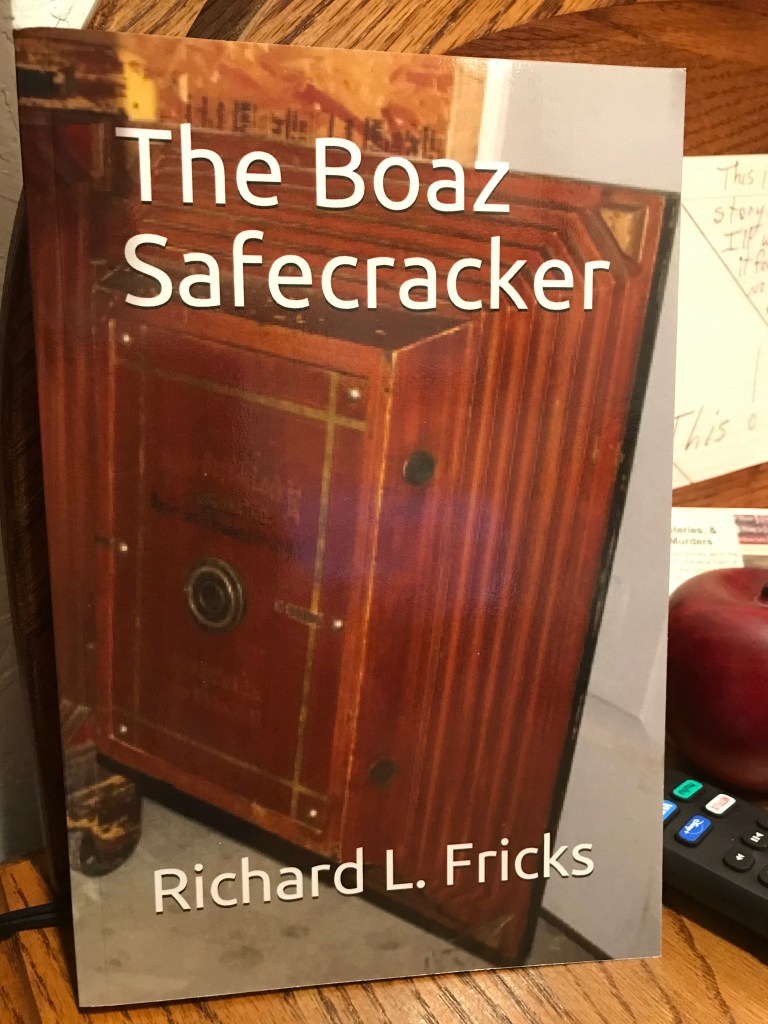
The Boaz Safecracker, written in 2019, is my seventh novel. I'll post a chapter a day over the next few weeks.

Book Blurb

Fred Martin, a 1972 graduate of Boaz High School, returns to his hometown after practicing law and living in Huntsville for over thirty-five years with two goals in mind.  First, to distance himself from the loss of Susan, his wife of thirty-seven years who died in 2013 of cancer.  And second, to partner with his lifelong friend, Noah Waters, to crack the safes of Elton Rawlins and Doug Barber, two men who got under their skin as high school football players.

Little did Fred and Noah realize the secrets the two old Mosler safes protected.  Who murdered three Boaz High School seniors in the fall of 1973?  Is a near-half-century-old plan to destroy Fred’s sister and steal the inheritance from a set of 44-year-old illegitimate twins still alive and well?  How far would Fred’s mother go to protect her family?   

What starts out as an almost innocent prank turns life-threateningly serious the more Fred learns and the more safes he cracks. All the while, he falls in love with Connie Stewart, his one-date high school classmate who may conceal a secret or two herself.

Epilogue

It was almost a month before Deidre invited me to lunch at Martin Mansion.  She now was a very rich woman.  Even though her attorney, Dalton Martin, was still knee-deep in sorting out Miss Mossie’s estate, there was no longer any doubt Deidre was entitled to half the Mosler fortune.  I suppose one could say she and Ed were even richer by my own generosity.  Friday afternoon I had signed over my interest in Martin Mansion to Deidre in exchange for a deed to my little cabin and the back forty as Dad always called it. 

The first Sunday lunch around Mother’s giant dining room table wasn’t anything akin to what was ingrained in everyone present.  Even Tyler, who had been virtually adopted by Deidre and Ed, expressed an accurate interpretation of the out-of-focus feel we all were experiencing: “Is it me, or is the room tilted away from Papa Martin’s chair.”  Initially, she was reluctant but then insisted I sit in Dad’s head-of-the-table chair.  I vigorously declined and suggested Luke take the helm.  After a lively discussion with Ed firmly acknowledging his lack of Martin blood flowing through his veins, all acquiesced and the young Luke Martin Sullivan moved from my left to my right and semi-confidently accepted his post.   It was almost like changing the guard at Buckingham Palace.

After a meal, including a respectable bowl of Mother-similar green beans and a less-acceptable coconut cake, I declined to join everyone out on the front porch.  I had already decided I would, but it was Luke and Tyler’s invitation to join them at Martin Pond that provided a face-saving exit.

“Uncle Fred, do you think Papa Martin is in Heaven?”  It was the same question he had asked me after Mother died.  I was sitting in Dad’s chair underneath the old oak on the east side of the pond.  At first, I didn’t understand Luke’s question.  He was a quarter of the way around the pond, following a casting Tyler who had already made it to the pond’s dam.

“He is if that’s what you decide to believe.”  I really didn’t want to talk about Dad.  I was just now regaining the respect I had always had for the man who sacrificed his freedom away from Martin Mansion to return and care for 90 plus year old Stonewall Martin, the ancestor I most resembled, according to Mother.

“What the heck does that mean?”  Luke said moving slowly back towards me pulling his fishing line along the edge of the pond.

“Let me ask you a question.  What would your dear mother say in response to your original question?”

Luke didn’t hesitate, “she’d say Papa Martin was not only in Heaven right now but was walking streets of gold, that he and Mama Martin had their own mansion along one of those streets.”

“I have no doubt you are correct.  Now, what do you think, what does your logical mind reveal?” 

Luke was now within five feet of me and laid down his rod and reel.  “My heart wants to believe Papa Martin is young again and happy to be with the love of his life, but my head tells me there’s a fly in the ointment.”

I guess old sayings are still being passed down one generation to the next.  “Why do you say that?”  I wanted Luke to develop the rare ability to not only think but also to express why he reached a certain conclusion.

“The facts tell me that I saw him lying in his casket.  No matter what the morticians had done to make him look good, it was all makeup, not even skin deep.  Papa’s mind and heart were dead, just like every other cell in his body.  It’s absolutely absurd to believe that his mind, soul, whatever you call it, simply floated away to Heaven after he took his last breath.”

“You’re correct.  But Luke, back to what I said earlier.  Most folks that you know believe what they’ve been taught to believe.  They truly don’t think for themselves.  God forbid they conduct an honest and thorough investigation into the actual evidence.”

“If they did, what would they find?”  Luke was listening.  His was an excellent question.

“They should find no real evidence for the existence of a god at all.  And, certainly not for the Christian Jesus of the New Testament, or of God, Yahweh, of the Old Testament.  Undoubtedly, they would argue two things.  The Bible proves their God and His son Jesus, and second, they would contend everything you see, all of nature, throughout the physical world, proves there has to be a god, really, their Christian God.”

“You’ve already explained to me, understandably I might add, how the Bible is simply man-made.  But, after hearing Pastor Robert this morning preaching on creation and how everything clearly revealed God’s handiwork, His design, you know, it makes some sense.  Luke and I had exchanged places.  He was now sitting in Dad’s chair.  I was using Luke’s line to cast for a big bass.  I really wanted to join Tyler on the other side of the pond.

“Think of it as a trap.  It’s called the argument from improbability.  Believers think it is an ace up their sleeve.  Actually, it works against their position.”

“I’m not sure I understand.”

“Christians argue that ‘the probability of life originating on Earth is no greater than the chance that a hurricane, sweeping through a scrapyard, would have the luck to assemble a Boeing 747.”  I said virtually quoting what Richard Dawkins had written in The God Delusion.

“I’m really confused now.  What you just said sounds very true.”

“You’re right.  It is very true.  What’s missing is that the argument rests on a false premise.  I mean, one had to assume life here on earth came about by chance.  Evolution isn’t about random chance.  It’s about natural selection.  Here’s the Christian’s real problem buried inside their argument from improbability.  They contend for creation, creation by design.  That there must be a designer.  But, as my hero Dawkins writes, ‘God is the Ultimate Boeing 747.’”

Luke stood and picked up the rod I had laid beside Dad’s chair.  “Oh, I see, or I think so.  If something so complex as life on earth could not come about simply by chance, and instantly if you believe in the Genesis story, then God Himself is just as improbable.  Right?”  I appreciated Luke’s concentration.  He, and I assumed Tyler on the other side of the pond now pulling in a nice bass, gave me hope others could lay aside mythical beliefs.

“Good job Luke.  Where Christians stumble is to think there are only two choices for life to exist.  One being mere chance and the other design.  I want you to learn there is normally at least one more question you need to ask.  Here, it’s simply, ‘is there another option?’  The answer is yes.  It’s called evolution: from simple to complex; life has evolved.  Dawkins calls it ‘graded ramps of slowly increasing complexity.”  I encourage you to do some serious reading on evolution.”

Luke looked over at me and said, “so, I take it you don’t believe Papa Martin is in Heaven?”

“No, I don’t believe it.  Of course, I don’t know he’s not there, but it seems highly improbable given what we know from science.  One thing I do firmly believe is that for the God of the Bible to exist He couldn’t have always existed as an all-powerful, all-knowing, and all-loving being.  He would have had to come about by some long, long process of evolving from a very simple state, likely over millions of years, into the God as described throughout the Bible.”

“Uncle Fred, you got one.  Pull.  Even though my eyes were open I hadn’t seen or felt the end of my rod bending forward.  I quickly began to reel and hold my line taut.  “Careful, you may have the Beast.”  Luke kept shouting.

Sometimes little things, like the fish I caught, pack a powerful message.  When I first saw the half-pound bass floundering in the edge of the water, my decision was made.  Ever since Dad’s funeral I had contemplated returning to Huntsville and my desk at King and Hart.  I had talked to both Bart and Jeff twice each over the past four weeks.  I now realized I was tired of pursuing the Beast, one I never would fully capture.  I wanted to explain to Luke how easy it was to get distracted from what really mattered.  Even though I would always be a Martin, I didn’t have to live in Boaz. 

As I thought, I wandered around Martin Pond, half-casting, fully happy without snagging the Beast or even another half-pounder.  I could hear Luke explaining the argument from improbability.  I didn’t catch what Tyler said in response, but it spawned a thunderous clap of laughter between the two as they gathered up their fishing gear and started walking back toward Martin Mansion.

I couldn’t help but think of Connie and Susan.  If not for the former I would still have to work.  Now, I could work because I wanted to.  Even though I still didn’t know exactly how I was going to laundry the million dollars she had stolen from First Baptist Church of Christ, I believed there was a way.  At worst, I could call on my friend Colton Mason.  He no doubt would have a few tricks up his sleeves.  My mind found satisfaction in anticipating us renewing our friendship: there was honor among thieves.

Susan, the newly discovered truths about Susan, didn’t require forgiveness.  But, I had forgiven her anyway, thanks to Pastor Robert.  She was not guilty of willingly having sex with Johnny Stewart.  The fact she had kept it a secret from me for her entire life still rubbed me the wrong way.  Truth be known, I had never fully loved anyone but Susan.  Although, things could have been different with Connie if the falling stars hadn’t collided.

I finally wound up back in Dad’s chair under the giant oak.  My thoughts continued to ponder the past four years.  It was almost midnight when I woke up from a deep sleep, still in Dad’s chair.

I left my fishing gear and felt my way back to my cabin under a moonless sky thankful that mine and Susan’s house in Huntsville had not received a single offer in nearly the four years I had it on the market.

I chuckled as I took the two steps onto my porch, and as the thought raced across my mind that someway, somewhere, somebody was looking after me.

Some traditions were impossible to shake.

THE END

Novel Excerpts—The Boaz Safecracker, Chapter 69

The primary aim of the "Novel Excerpts" blog category is to showcase my creative writing, specifically from the novels I've written. Hopefully, these posts will provide a glimpse into my storytelling style, themes, and narrative skills. It's an opportunity to share my artistic expressions and the worlds I've created through my novels.  
The Boaz Safecracker, written in 2019, is my seventh novel. I'll post a chapter a day over the next few weeks.

Book Blurb

Fred Martin, a 1972 graduate of Boaz High School, returns to his hometown after practicing law and living in Huntsville for over thirty-five years with two goals in mind.  First, to distance himself from the loss of Susan, his wife of thirty-seven years who died in 2013 of cancer.  And second, to partner with his lifelong friend, Noah Waters, to crack the safes of Elton Rawlins and Doug Barber, two men who got under their skin as high school football players.

Little did Fred and Noah realize the secrets the two old Mosler safes protected.  Who murdered three Boaz High School seniors in the fall of 1973?  Is a near-half-century-old plan to destroy Fred’s sister and steal the inheritance from a set of 44-year-old illegitimate twins still alive and well?  How far would Fred’s mother go to protect her family?   

What starts out as an almost innocent prank turns life-threateningly serious the more Fred learns and the more safes he cracks. All the while, he falls in love with Connie Stewart, his one-date high school classmate who may conceal a secret or two herself.

Chapter 69

Dad’s funeral was Saturday afternoon, two days after Deidre and I let him die.  She made me consent to letting Youth Pastor Robert Miller conduct the funeral.  I think it was some sort of long-ago but still-surviving allegiance to his grandfather, the pastor of our youth, Randy Miller, the brother of my hero and friend.

It was another week before Bobby called.  As expected, the four bullets were the ones that had been stolen from the Department of Forensic Sciences nearly half-a-century earlier, the ones that had killed Johnny Stewart.  I wasn’t surprised they had been fired by the mystery Smith & Wesson Connie had requested I remove (along with the cash) from her old Mosler.  What I wasn’t expecting from the ballistic testing was the revelation the same pistol had killed Randy Miller.  I hadn’t known that Grayson Bolton had retrieved and delivered to Bobby any paperwork related to Randy’s death in 1989.

After Bobby’s call, I was reminded Deidre had given me a small envelope with a thank-you note and a cash honorarium to give to Robert Miller, now the new pastor of First Baptist Church of Christ.  Instead of heading home from Walmart, I drove to Sparks Avenue and the church’s parking lot closest to the parsonage.  There was a large U-Haul truck backed up alongside the giant house with two men struggling to move a heavy-looking dresser down the extended loading ramp.  Pastor Miller was barking out, respectively, orders to pick the piece up and not to slide it.

The new pastor saw me and ignored my presence until the dresser was safely on level ground.  He waved the men off towards two chairs and the shade of an old oak tree beside his new home.

“Thanks again for a wonderful job at Dad’s funeral.”  I said, handing him Deidre’s envelope.  I could contort facts with the best of them.  I also knew that honey opened more mouths to truth-telling than vinegar.

Without responding, he stood, peeled back the white flap and removed the card and a check.  It seemed to take him a minute to read Deidre’s note.  I wished now I had read it.  What all was there to say other than ‘thank you for sending Dad off to bask in the glory of God until we meet again,’ or some other similar nonsense.

Robert asked me to join him under the oak, insisting the two men go raid the refrigerator in the basement until he was finished.

“Deidre said you might have some questions.  She authorized me to share my grandfather’s belief on how important it is to forgive.”  I guess that’s what Deidre had included in her long thank-you note.

I really didn’t want to hear a sermon.  I had questions I wanted to ask, but, out of respect for the youth pastor of my tender, teenage years, I listened.

Pastor Robert shared how his grandfather was a die-hard believer in journaling, in writing things down.  He apparently encouraged others to do so.  I guess Angela Ericson had taken his advice.  Robert revealed how his grandfather had recorded his sessions with a woman who had allowed hate to enter her heart.  It soon became clear the woman was my mother.  Before Robert concluded his remarks, I learned the box of mauve-colored stationary had originated with youth pastor Randy and had been a gift to mother.  I recalled the two ‘go and sin no more’ letters I had found, one in Rebecca’s safe, and one in Angela’s.  Robert wasn’t exactly clear, but I gathered his grandfather had written and handed out several almost-identical letters, including one to mother. 

The final thing Pastor Robert said to me as the two men returned from the basement was, “you can rest assured your mother was forgiven for the death of my uncle Ricky.”

I sat under the giant oak for several minutes after the pastor and his two helpers returned to the U-Haul.  Once again, I felt like a stranger to my own life, the life I had grown up beside but not fully inside. 

Walking back across the parking lot to my car, I wished I had never moved back to Boaz from Huntsville.  If I hadn’t, I probably would have been better off.  Some time it is simply better not to know the truth.  Mine and Noah’s lamebrain idea to peek underneath the top layer of Elton and Doug’s cockiness had unleashed an avalanche of secrets that forever shattered the respect I had for the Martin reputation.

In truth, I didn’t steal anything from the old Moslers I had cracked.  My safecracking had stolen my manipulated memories of a once-in-life love for Susan and revealed the putrid underbelly of a city long controlled by five powerful families.  Thoughts of the worst side of my own family weren’t much better.

Novel Excerpts—The Boaz Safecracker, Chapter 68

The primary aim of the "Novel Excerpts" blog category is to showcase my creative writing, specifically from the novels I've written. Hopefully, these posts will provide a glimpse into my storytelling style, themes, and narrative skills. It's an opportunity to share my artistic expressions and the worlds I've created through my novels.  
The Boaz Safecracker, written in 2019, is my seventh novel. I'll post a chapter a day over the next few weeks.

Book Blurb

Fred Martin, a 1972 graduate of Boaz High School, returns to his hometown after practicing law and living in Huntsville for over thirty-five years with two goals in mind.  First, to distance himself from the loss of Susan, his wife of thirty-seven years who died in 2013 of cancer.  And second, to partner with his lifelong friend, Noah Waters, to crack the safes of Elton Rawlins and Doug Barber, two men who got under their skin as high school football players.

Little did Fred and Noah realize the secrets the two old Mosler safes protected.  Who murdered three Boaz High School seniors in the fall of 1973?  Is a near-half-century-old plan to destroy Fred’s sister and steal the inheritance from a set of 44-year-old illegitimate twins still alive and well?  How far would Fred’s mother go to protect her family?   

What starts out as an almost innocent prank turns life-threateningly serious the more Fred learns and the more safes he cracks. All the while, he falls in love with Connie Stewart, his one-date high school classmate who may conceal a secret or two herself.

Chapter 68

After almost a day at the hospital, there were two things I had to do: overnight the bag of four bullets to Vanessa and go see Connie.  I had no doubt, yesterday she had sensed something had short-circuited in our relationship.  This was why she hadn’t returned my texts or calls for nearly twenty-four hours.

After I left the post office, I pondered how I wanted to manage Connie.  I had to know her side of the story before I walked away.  Damn, why the hell was trust so important to me, a man living a double life?  My plan coalesced as I turned right off Ross and onto Sandor Drive. 

My mind did a double-take when I saw her garage door open.  My heart almost stopped when I noticed Hoyle Harrison’s old Toyota Camry inside the garage parked beside Connie’s nearly new Maxima.  Something screwy was going on.

I parked behind Connie and almost headed for the laundry door entrance at the back of the garage.  Instead, I walked down the sidewalk to the front door.  It was slightly ajar, just like she had left it the first time I had come to discuss a long-term health care policy.  For some reason, I rang the doorbell.  Considerate me.

I didn’t wait long.  My most pleasant thoughts were the two of them were out back and Connie was showing Harrison her collection of roses.  That’s why she hadn’t heard the doorbell.

I eased in and announced my entry.  No response.  I walked across an over-sized den and across to the sun room.  I didn’t see a sign of either of them.  That’s when I heard the gunshot.  My mind said to keep going towards the front door and get the hell out of there but when I reached the hallway, my feelings for Connie turned me right.  What I saw when I entered the giant master bathroom was blood curdling.  No doubt it was the blood.

Harrison was lying face-up blocking the entrance to Connie’s walk-in closet.  I had no doubt he was dead; the pool of blackish blood proved no one could have survived.  Connie was sitting propped up against the back wall beside an open pocket door.  The door on the old Mosler was open.  Both racks of clothes had fallen to the floor.  Connie was still holding a pistol.  I concluded she had managed to fire it to get attention after I rang the doorbell.

Connie’s injuries weren’t as apparent as Harrison’s.  But, as I’d heard mother say a hundred times, “she’s got that death look.”

“Oh baby, what have I done to us?”  Connie whispered as I knelt beside her.  It was then I noticed a pair of jeans tied around her left thigh. 

“No, no, no.”  I stood on my knees and removed my iPhone from my right front pocket.  I dialed 911 and surprisingly, Connie slapped my phone to the floor. 

“Fred, let me die.  I deserve it.”

I retrieved the phone, backed away and dialed.  In two sentences I summarized the situation.  Seconds later, the gruff female voice said, “the police and an ambulance will be there in a few minutes.”

I saw Connie fighting to stay conscious.  Her face was white as a ghost.  “Fred, do me one final favor, take the money bag and the pistol.  Inside the safe.  I left you a letter.  Never tell.  Please know I love you.”  With those words, stated slowly, slightly above a whisper, the lovely Connie’s chin slumped against her chest.  

Favor?  She had made a request, a dying request I assumed.  No doubt she had her reasons.  I stood and stepped across Connie’s slumbering body to face the giant Mosler.  Unlike the last time I had peered inside, now there were two duffel bags smashed together at the bottom of the safe.  I didn’t see a pistol or a letter.  I quickly removed the bags and raced outside.  Against my better judgment, I locked them both inside the trunk of my car, my legal mind reminding me how much police liked searching cars. 

I knew the neighborhood was about to light up and sound off but notwithstanding the coming parade, I walked over to Harrison’s Camry and once again was surprised.  In his back seat was a cardboard box, a Houghton Mifflin Harcourt box.  Textbooks.  School.  Inside was no doubt the film cartridges from the Boaz High School safe.  At least, that was my quickest and best bet.

Less than fifteen seconds after I placed the box alongside the two duffel bags in my trunk, I heard the shrill sound of two sirens.

I lucked out.  The two young police officers virtually ignored me even though one took a brief statement.  I think it had something to do with Alfa and the recent interviews Nell and I had conducted at City Hall to implement its supplemental health care program.  Even though I was free to leave, I stuck around waiting to learn how Connie was doing.

The zipped-up bag riding on the gurney broke my heart and flooded my mind with a laundry list of good times the two of us had experienced over the past few months.  For some reason I was awash in grief, blaming myself for what seemed like a dozen deaths.

I reached out my hand and touched the dark heavy plastic of the body bag as the two EMT’s pushed it by my car.  While they were loading her in the back of the ambulance my legal mind tried to figure out what had happened.  Just a few minutes ago Connie was alive.  Although she had a gunshot wound in her thigh, she had been able to tie it off.  She had also been able to hear (I assumed) the doorbell and fire off another shot to alert me to her presence.

Just as the EMT’s backed out of the driveway the two officers exited the front door and walked over to me.  “We’re sorry for your loss Mr. Martin.”  The taller one said.  It was then I noticed the shorter one holding an evidence bag.  It contained one of Doug’s bottles, one just like the ones I had in a box on the top shelf of my kitchen pantry.  Then, it made sense, a little sense.  Connie’s death was intentional.  She had taken an overdose of Quaalude-300.  My gut knew this. 

Our conversation was cut short by the arrival of an overgrown van with “Marshall County Forensics Lab” painted on the side.  “Sorry, Mr. Martin, but we have to ask you to leave.  This is a crime scene.”  The taller officer said to my complete surprise.  Did they not know that the murder suspect could be standing right in front of them?  Unlike Huntsville, or any other large city, small towns possessed a unique but ignorant respect when it came to crime.

By 3:45 p.m., I was sitting in my kitchen with two empty duffel bags and a table full of cash, yet another Smith & Wesson 38 caliber ‘Chief’s Special,’ and a two-page mauve-colored letter hand-written by Connie and addressed to me.

The first long paragraph was how she had fallen in love with me during our first and only high school date.  She confessed to manipulating Susan and apologized.  Although her words seemed conflicted, I concluded she had truly loved me despite her deceptions.

The remaining page and a half revealed surprising details, many occurring nearly half-a-century ago.  But, initially, she described what had happened only two days earlier.  When she had met Tyler on the verge of collapse jogging down Highway 168, instead of turning around to return to Boaz, the two of them had returned to the old logging road where Pastor Caleb had ended his life.  The reason?  To retrieve the pistol.  Someway, Connie knew it could tell a story, one that involved her.

I finished reading Connie’s letter and if it was to be believed, the Smith that was resting on my kitchen table was the one that had killed Johnny Stewart.  And, Doug Barber.  I started to credit Connie’s drug delusion with her fanciful little story, but then I reread the letter and finally acknowledged that it had been written long before Harrison had showed up.

Knowing how much pride Connie had in her stellar reputation, and that of her family, I started to understand the predicament she was in.  Not only had her first cousin, Johnny Stewart, impregnated Deidre and Susan, he had done the same to her.  Of course, she blamed it on the Quaalude-300’s, vehemently denying all consent.  What was hard to picture was the level of revenge it had taken for her to pull the trigger.  Four times.

But, I had to admit her letter wasn’t perfectly coherent.  Connie’s motivation to exact revenge was also heavily influenced by the damning evidence Pastor Walter and Club Eden had on her.  According to Connie, they knew she was one of four burglars who had not only stolen the Ericson’s coins and jewelry but had taken nearly a million dollars in cash they had skimmed from church contributions and God only knew where else. 

It was the night of the Boaz-Albertville football game that changed Connie’s life forever.  Not that she needed anything else, given she was already pregnant with another one of Johnny Stewart’s babies.  It seemed she was present with Raymond Radford and his gang at the convenience store when Dad’s call came that Johnny was headed their way from Martin Mansion.  Given the gruesome details she provided, I had no doubt she had witnessed the awful beating the Club Eden men had delivered.

I guess I could say, the most startling surprise came when Connie confessed to using the gun I now possessed to shoot her first cousin four times in the chest.  She said it had been Franklin Ericson’s idea.  He had argued it was fitting given Johnny’s notorious bragging about how he had won the bet whether he could bed four high school female classmates in as many weeks. 

I was not at all satisfied with Connie’s explanation of why she had killed Doug Barber.  Her statement, “I had to do it to keep the truth from coming out,” didn’t satisfy my curiosity.  She had also left the question wide open how she acquired from the church this pistol that was lying two feet in front of me.

I got up and started packing the cash inside the duffel bags.  All I could think about was, if the Smith I had just packaged in an extra U.S. Postal Service box I had bought just this morning, was the Johnny Stewart and Doug Barber murder weapon, how did it get back to the church and accessible to Pastor Caleb for him to use in blowing off half his own head?   The only person who came to mind was Hoyle Harrison.  Of course, that was mere speculation. 

I stood on a stool and pushed the bags up onto the top shelf of my pantry closet.  I walked into the den and sat down in my Lazy Boy.  For the next two hours, I half-dosed and fully contemplated all that I still didn’t know.  It was hard to concentrate on anything, but what had motivated Principal Harrison to go to Connie’s?    I finally fell asleep without a single satisfactory explanation.

Novel Excerpts—The Boaz Safecracker, Chapter 67

The primary aim of the "Novel Excerpts" blog category is to showcase my creative writing, specifically from the novels I've written. Hopefully, these posts will provide a glimpse into my storytelling style, themes, and narrative skills. It's an opportunity to share my artistic expressions and the worlds I've created through my novels.  
The Boaz Safecracker, written in 2019, is my seventh novel. I'll post a chapter a day over the next few weeks.

Book Blurb

Fred Martin, a 1972 graduate of Boaz High School, returns to his hometown after practicing law and living in Huntsville for over thirty-five years with two goals in mind.  First, to distance himself from the loss of Susan, his wife of thirty-seven years who died in 2013 of cancer.  And second, to partner with his lifelong friend, Noah Waters, to crack the safes of Elton Rawlins and Doug Barber, two men who got under their skin as high school football players.

Little did Fred and Noah realize the secrets the two old Mosler safes protected.  Who murdered three Boaz High School seniors in the fall of 1973?  Is a near-half-century-old plan to destroy Fred’s sister and steal the inheritance from a set of 44-year-old illegitimate twins still alive and well?  How far would Fred’s mother go to protect her family?   

What starts out as an almost innocent prank turns life-threateningly serious the more Fred learns and the more safes he cracks. All the while, he falls in love with Connie Stewart, his one-date high school classmate who may conceal a secret or two herself.

Chapter 67

Harrison dropped me off at the Hospital’s main entrance and drove away like he was late for a faculty meeting.

I rode the elevator to the third floor and just as I stepped out into the hallway and turned left toward the ICU, I saw Connie.

With her raised voice I could hear her clearly even though she was at least thirty feet away: “Tyler finally woke up.  Ate nearly a dozen scrambled eggs.  He’s with Luke now, thanks to Ed.”  She kept walking towards me, looking over my shoulder like she was expecting somebody.

“I need to see Dad for a few minutes.  How was he when you checked on him?”  I figured it was a reasonable assumption that she was here to see Dad, and me.

“The nurses wouldn’t let me inside his room.  They said he was resting and didn’t need any visitors.  Why don’t you come home with me until we, you can see him again?”  Connie looked directly into my eyes.  At first, I glimpsed that little twinkle vibrating across both blue eyes.  She had developed a habit of doing that, when she wanted to play.  Then, almost in a heartbeat, a wave of dark gray plowed away the light.

I started to call her ‘Baby’ but that would be dishonest.  That human wall of protection had raised itself after Harrison and I had viewed that last cartridge.  I had experienced it before.  When someone breaks the solid cable of trust between you and them, it’s like you’ve stepped out into thin air.  “Maybe I can come later.  I really need to stay with Dad.”

“Okay, if that’s how you feel.”  And, she was gone.  I turned to look at her walking away and toward the wall of elevators.  Her shapely rear end didn’t generate a single lust.

I don’t know why Connie lied.  After I sneaked inside Dad’s room during the nurse’s shift-change, he revealed the two of them had talked.  He wouldn’t disclose the subject matter.

“Pull the chair up beside me.  I’m going to die prematurely if I don’t get this off my chest.”  Dad’s giggle sounded like Harrison’s back at the high school.

I started to resist but before I could get out a word, Dad had that look and his head had that right-leaning cock I had seen so many times.  He meant business and expected no argument.  I complied without a word.

“Son know that one bad decision can change your life forever.  My one bad one, a series of bad ones, was when I jumped in bed with Pastor Walter and Club Eden.  I mean figuratively you know.” Dad tried to sit-up a little straighter in his bed.  I reached over and pressed the up-arrow bed control.

“I may have made a bad one myself.  I’m not sure yet.”

“That bad decision points you in a new direction.  The night of the Boaz-Albertville football game in 1973 was supposed to sever my relationship with the Club forever.  Things didn’t work out quite that way.”  Dad said.  I could tell he was taking deeper breaths between phrases.

“I wish you would just let this be.  But, if you are hellbent on confessing this story, then give it to me directly, good, bad, and ugly.”  I wanted this over with.  For Dad’s sake. 

“All I had to do was tail Deidre and Johnny after the game.  I knew they would be together, even over strict orders from your mother.  It was around 11:00 p.m., and they wound up beside the city dump down King Street.  Johnny’s old Bonneville pulled into a grove of trees just beyond the gate.”

“How did that help the Club?  You were tailing them?”  I asked.

“I’m not exactly sure but from what Harrison had told me and what seemed obvious, was that Allan Floyd and Tommy Jones were targeted separately.”  I raised my left hand, slightly confused.  Dad stopped talking.

“Targeted?  Why were those two, three I guess, such a threat and needed to be targeted?”

“Son, you were in Auburn.  All hell had broken loose here in Boaz.  These three teenage boys, along with their peers, Rebecca Aldridge and Angela Ericson, were the core of a group of young people who were rebelling against tradition, you know, community norms.”

“You mean Christian fundamentalism?”  I asked.

“I’m not sure if that’s the right term, but Pastor Walter and his gang had had enough.  They, again according to Harrison, believed their entire kingdom would collapse if the Aliens, I think that’s what they were called, were able to continue to spread their anti-Christian message.  The bottom line is Club Eden chose the Boaz-Albertville football game, afterwards really, to shock the kids back into allegiance.”

“So, Floyd and Jones were killed on the backside of the stadium, across the team’s practice field just inside the woods.  That’s what I’ve heard.”

“Seems true.”

“Who shot them?”  I asked.

“Not sure, but most likely it was Doug Barber and Elton Rawlins.  The Club was too smart to actually pull any triggers.”

“But, Johnny Stewart wasn’t there, at least not at first?”

“Just as soon as Johnny dropped Deidre at home, I made the call I will forever regret.  The two of them had not seen me at the city dump, but I waited in my own grove of trees across the road until about 1:00 a.m.  I saw two cars carrying the five Club members sitting at the convenience store when I crossed Highway 431.  I called the store when I got home and told Raymond Radford that Johnny had just left.”

“They were able to apprehend Johnny, beat him to a pulp, and then transport him to his two teammates behind the stadium.  Do you know who shot him.  Four times?  I asked.”

“Son, how the heck did you know these details?”  Dad asked, cocking his head now to the left.  That was his, ‘I have a question’ pose.

“That’s a long story.  Let’s finish yours.” 

“I don’t know who shot him but speculation, mine and Harrison’s, was it wasn’t Doug or Elton.  Rumor is there was another pistol, another Smith & Wesson.  The Chief’s Special they were called.  Some guy had passed through town, holding a gun show, back around 1969 or 1970.  Sold a ton of the little darlings, bitches, whatever.”

“So, that’s where yours came from?  That gun show?”  I had to be open.  I too was ready to get some things off my chest.  I had violated Dad’s trust by breaking into his old Mosler.  Now was a good time to join Dad at the confessional alter.

“Is this related to your bad decision?”  Dad asked, surprising me a little.  He was listening.

“Maybe.  Sort of.”  We took another ten minutes or so for me to describe how I knew that his pistol, his 38 caliber Smith & Wesson, was the Ricky Miller murder weapon.  At first, Dad was reluctant to admit it but then the floodgates opened.  He ultimately confirmed what I had already unjustifiably concluded: that mother was involved with my Biology teacher and friend’s death.

“The Club, I’m not sure which member, caught your mother and Bill Stewart breaking into the Safe House.  This became the beginning of another dark cloud that hung-over Martin Mansion.  Son, your mother loved you and Deidre more than life itself.  She would have killed God, God forgive me, if she had to to protect her two darlings.”  Dad’s breathing was noticeable worse now.

“Dad, I’m going for a nurse.  No, I’ll signal for them.”  I reached for the emergency call pad on the bed alongside dad’s right side.

“No, not yet.  Let me finish.”

“Harriet and Bill did the deed.  Of course, that was after the three boys were murdered, but before the bonfire Bible burning fiasco.  That hot and bright night was the final straw that steeled your mother’s determination to eliminate the key threat to your sister’s eternal destiny.  She was sure she had already lost you, hell no, she wasn’t going to lose Deidre too.”

“Mother thought Ricky Miller was leading Deidre to hell.”  I said, intending my statement to also be a question.

“Dad gasped for breath and before I could stand or say a word, three nurses invaded his room.  Not a one of them acknowledged I was present.  As I pushed my chair back from Dad’s bed, another nurse or technician wheeled in a defibrillator.  Then, almost in unison, three blue-smocked women ordered me outside ICU.

Thursday at noon, Deidre and I, as health-care proxies, gave permission to Dr. Calhoun to remove the respirator that was keeping our dear dad alive.  We had spent the past twenty-two hours contemplating this decision.  It would have been what Dad wanted.  It was the hardest choice of our lives.

Novel Excerpts—The Boaz Safecracker, Chapter 66

The primary aim of the "Novel Excerpts" blog category is to showcase my creative writing, specifically from the novels I've written. Hopefully, these posts will provide a glimpse into my storytelling style, themes, and narrative skills. It's an opportunity to share my artistic expressions and the worlds I've created through my novels.  
The Boaz Safecracker, written in 2019, is my seventh novel. I'll post a chapter a day over the next few weeks.

Book Blurb

Fred Martin, a 1972 graduate of Boaz High School, returns to his hometown after practicing law and living in Huntsville for over thirty-five years with two goals in mind.  First, to distance himself from the loss of Susan, his wife of thirty-seven years who died in 2013 of cancer.  And second, to partner with his lifelong friend, Noah Waters, to crack the safes of Elton Rawlins and Doug Barber, two men who got under their skin as high school football players.

Little did Fred and Noah realize the secrets the two old Mosler safes protected.  Who murdered three Boaz High School seniors in the fall of 1973?  Is a near-half-century-old plan to destroy Fred’s sister and steal the inheritance from a set of 44-year-old illegitimate twins still alive and well?  How far would Fred’s mother go to protect her family?   

What starts out as an almost innocent prank turns life-threateningly serious the more Fred learns and the more safes he cracks. All the while, he falls in love with Connie Stewart, his one-date high school classmate who may conceal a secret or two herself.

Chapter 66

Harrison insisted I ride with him.  It didn’t take but a couple of minutes and he was parking us at an old run-down house on Adams Street.  He motioned for me to follow him behind the house and across a driveway between two houses facing Darnell Street.  I had to almost jog to keep up with the old but fit Harrison.  We were inside the school at exactly 12:00 noon according to my iPhone.  I was impressed and hoped I could think and move like my old principal when I was his age.

He certainly knew his way around Boaz High School.  He should, after fifty plus years.  After he disabled the alarm system (I was surprised the school board hadn’t changed the code during the five years since Harrison retired), he stopped and looked down the long hallway towards the front of the school.  “Seems like there ought to be a thousand students racing to and from class and me herding the stragglers along.  I guess it’s a good thing it’s Fall Break.”  

During the short drive from the hospital I had contemplated the best way to access the old Mosler.  I had concluded the Vocational Ag shop would likely have a torch.  Luckily, Harrison’s memory spun up a set of three numbers.  The only thing missing was the order.  I was surprised the old Mosler wasn’t better hidden.  Inside the Vocational Agriculture teacher’s office was a closet containing several file cabinets, all on rollers.  Once they were out of the way, there was a pocket door.  Harrison bumped it a couple of times to get it back on track.  Once aside, the Mosler stared at us like it was a crouching lion.

It took me five or six times to get the order right, but Harrison’s recall was perfect.  The heavy door of yet another Model T20 Mosler safe groaned slightly but didn’t pose much resistance.  I was amazed at the number Kodak Super 8 film cartridges stacked inside.  Harrison quickly ordered me to remove them and place them on the metal desk in the adjoining office.  “Put them in date order.  I’ll be right back.”  He said and was gone before I could respond.  By the time I had the thirty or forty cartridges lined up in rows and by date (starting with the oldest on the top left-hand corner of the desk), Harrison returned.  “La Belle Super 8 Cartridge Portable Projector.  Old as Moses, still on the top shelf in the Drama Department’s storage closet.  I hope it works.”

It did.  Perfectly, from what I could tell.  Although Kodak’s Super 8 movie camera wasn’t as good as the video camera on my iPhone, it was remarkably clear.  The first film Harrison selected wasn’t the oldest.  “I hope you’re ready for your Damascus Road revelation.”  I certainly didn’t know what to expect.

“Let’s start with the big picture, the view of the forest.  Get it, picture.”  Harrison giggled like a teenage girl.  “Nineteen seventy-one, December,” He said as he shifted the La Belle projector in line with where he had us sit in two straight-back wooden chairs.  The film revealed a panoramic view inside First Baptist Church of Christ’s old auditorium.  “Probably Wade.  Walter’s son.”  Harrison said as if I hadn’t graduated with the asshole. I sat and looked at a full house.  I assumed it was a Sunday morning. 

Harrison continued: “It’s right before the concert.”  I could see the giant Christmas tree hand-constructed at the front of the auditorium behind the pastor’s pulpit.  Choir members stood on multi-level rows like Christmas tree lights on any other tree.  They presented a musical the weekend before celebrating Christ’s birthday.  This had been a tradition all my growing up years.  “I can’t believe I helped spike the punch.  Damn, I was such an idiot.”  Harrison commented as the cameraman now was walking the aisles recording the faces of most everyone sitting.  Most everyone seemed at peace, almost in a daze.

“What do you mean, spike the punch?”  I asked.

“Remember the Quaalude-300?”

“I do.”

“Pastor Walter and his gang, along with the able assistance of Doug Barber, figured out how to get everyone addicted.  They called it Communion.  We, they also spiked the tea in the cafeteria before each Wednesday night’s fellowship meal.”

“You’ve got to be kidding.”  What I was watching, and hearing was surreal.

“Addicted folks are more generous with their tithes and offerings.”  Harrison said as he removed the Christmas cartridge and inserted one from my third row.  “Promise you won’t get mad at me when you see this?”

At first, I couldn’t figure out if he was serious, even whether he was asking a question or just making a statement.

Again, I quickly recognized the setting.  This time it was the backroom of the Lighthouse.  I couldn’t have mistaken it if I tried.  The giant mural of Christ hanging on His cross reaching out with an over-sized arm and hand back in time to Adam was unmistakable.  The youth group had spent nearly a year completing the forty-foot work of art.

What I didn’t immediately see was Susan and Connie.  They were sitting on the floor with their backs to the camera.  Then, that changed.  The cameraman moved around the room.

“Fall 1973.  Just a week before the triple murders.”  Harrison pointed to the empty cartridge on the edge of the desk.  It was then my mind awakened.  Why had I been so reluctant to remember?  Susan and I had already completed a year at Auburn and returned the summer of 1973 to rest and relax at Martin Mansion.  A week or so before we were set to return for our sophomore year, Susan decided to stay with Mom and Dad and attend Snead State Junior College.  At the end of our freshman year she had changed her major from architecture to education, with her sights set on becoming a high school math teacher. 

But, there was one problem.  She would have to take two quarters of calculus at Auburn.  No easy feat.  This drove her to take Lyndell Bate’s pre-calculus class at Snead during the fall of 1973.  It wasn’t a fun time for me in Auburn.  I moped about missing the love of my life.  However, what I was now watching seemed to indicate my shy and sexy Susan had found time for some extracurricular activities while away from me.

“This film drove your father over the edge.”  As Harrison said this, the cameraman turned to face the sitting Connie and Susan.  It was then I saw Johnny Stewart laying with his head across my Susan’s lap.

“You can blame Connie Stewart.”  Harrison said as though he could see inside my mind as I wondered how this had happened. 

“What the hell does that mean?”  I asked.

“Connie, the manipulator.  Susan never saw it coming.  You know the two of them were at Snead together that fall?”  I did recall Connie staying in Boaz after all three of us graduated together in May 1972.  She had told me about attending Snead for two years before transferring to the University of Alabama in Tuscaloosa. 

“Saw what coming?  Tell me what’s going on.  What happened.”

“If I hadn’t been Pastor Walter’s lap dog I would have never known.  There’s more on some of these other tapes.  The Lighthouse became a lab, a place to experiment on the effects of various dosages of Quaalude-300.”

“So, Susan became a guinea pig of sorts?”  I asked.

“Yes and no.  Sometimes the pastor had multiple goals.  With Susan he was simply protecting his daughter.  You remember Olivia?”

“I sort of do.  She was two or three years behind.  Oh, I guess she was in Rebecca and Angela’s class.  Deidre’s also.”

“I hate to say this, but I suspect this was the night your dear Susan made the mistake of her life.  But Fred, you must know, it wasn’t her decision.”

“I’m lost now for sure.”

“The sex, her getting pregnant.  You can blame the manipulator for that.  And Pastor Walter, but of course he’s dead.”  The line between the dots was drawn faster than I could say pencil.  What Dad had said wasn’t caused by his hallucinations.  He was telling me the truth.  Now, here, Harrison was confirming the same.  I was concerned I wasn’t madder than hell, but I wasn’t.  Susan had been raped.  Sex against her will, or when she was legally incompetent from the Quaaludes, was rape.  No doubt about it.

“Why would Connie be involved with this?  I just don’t get it.”  I asked.

“I’m speculating on part of this, but I suspect it was for two reasons.  First, and I’m confident of this one, Connie made a deal with the devil.  Kind of like I did, kind of like your father did but he got out of his.”

“Why would Connie need to cut a deal with Pastor Walter?”  I asked.

“You are in the dark, aren’t you?”

“Apparently so.”  I felt like such an idiot.  Not only had Johnny Stewart gotten my sister pregnant.  He had done the same thing to my own wife.

“She needed to save her neck.  You probably don’t know but the pastor and his gang found out that she was part of the burglary.  That’s when the coins and diamonds and the million dollars went missing.”

“A million dollars?”  I knew the cash stolen was a lot but not anything like this.

“Connie herself also had another motive.  You know she was bosom buddies with Rebecca Aldridge and Angela Ericson?”

“That I know.  Back to Connie’s motives.  I’m confused again.  Was there another one you started to mention?”

“Oh yea.  Connie would have done anything to breakup you and Susan.  Fred, you’re a dumb ass if you didn’t know how much Connie Stewart wanted you for her own.”

“So, the pastor was angry at Dad for him standing up to the five wealthiest and most powerful men in Boaz, and had the influence over Connie to manipulate the manipulator into arranging the perfect setting for Casanova Stewart to bed my wife?”

“I guess it was God’s gift to you and Susan that she miscarried.”  Hell, was there no limit to what Principal Harrison knew?

“We can talk more later, but we need to be going.”  Harrison said, stood, and started stacking the film cartridges.  He walked over to the old Mosler and pulled open the top drawer on the right side.  He reached in and turned back to me.  “Take these, they might come in handy someday.”  Before moving a muscle, I instantly recognized several bullets inside a clear zip-lock bag.

“Let me guess.  The four bullets that killed Johnny Stewart.  All illegally removed from the Department of Forensic Sciences by a man named Grayson Bolton.  Right?”  I asked.

“Sounds about right, but I have to admit I never knew the culprit’s name.

Neither Harrison or I said a word during our return trip to Marshall Medical Center South.

Novel Excerpts—The Boaz Safecracker, Chapter 65

The primary aim of the "Novel Excerpts" blog category is to showcase my creative writing, specifically from the novels I've written. Hopefully, these posts will provide a glimpse into my storytelling style, themes, and narrative skills. It's an opportunity to share my artistic expressions and the worlds I've created through my novels.  
The Boaz Safecracker, written in 2019, is my seventh novel. I'll post a chapter a day over the next few weeks.

Book Blurb

Fred Martin, a 1972 graduate of Boaz High School, returns to his hometown after practicing law and living in Huntsville for over thirty-five years with two goals in mind.  First, to distance himself from the loss of Susan, his wife of thirty-seven years who died in 2013 of cancer.  And second, to partner with his lifelong friend, Noah Waters, to crack the safes of Elton Rawlins and Doug Barber, two men who got under their skin as high school football players.

Little did Fred and Noah realize the secrets the two old Mosler safes protected.  Who murdered three Boaz High School seniors in the fall of 1973?  Is a near-half-century-old plan to destroy Fred’s sister and steal the inheritance from a set of 44-year-old illegitimate twins still alive and well?  How far would Fred’s mother go to protect her family?   

What starts out as an almost innocent prank turns life-threateningly serious the more Fred learns and the more safes he cracks. All the while, he falls in love with Connie Stewart, his one-date high school classmate who may conceal a secret or two herself.

Chapter 65

I was awakened by a trumpet.  Was it the seventh one before the Second Coming of Jesus Christ?  What a strange dream.  The sound wound up being my iPhone.  Before my final collapse last night, I had set the alarm to sound a horn blaring.  Just as I pressed ‘Stop,’ the phone sounded again.  This time it was a call from Bobby.

“Is it you or Jesus?”  I answered, not knowing why I would try to be funny.

“You sound like shit.  I hear you’ve had some tough days.  How’s your father?”

“I haven’t heard this morning.  Last night he was only semi-conscious.”

“I’m waiting in Huntsville to catch a plane back to Dayton.  You’re going to want to hear my update.  Take a seat.”  Bobby always liked to frame a context.

“I’m seated on the edge of my bed.  Safe enough?” 

“Grayson just called me.  You know Grayson Bolton, my friend at the Department of Forensic Sciences.”

“Yea, the friend whose owed you a big favor for years.  The guy with impeccable character, your words.”  I said, standing up and walking to the bathroom to offload last night’s coffee.

“Thanks to you our scales are now balanced.  He’s delivered a mother lode.”

“I’m ready.”  I put my iPhone on speaker and sat it on the glass shelf above the lavatory.  I leaned down and splashed water on my still-groggy face.

“We’re lucky Grayson’s a bulldog.  And, that he’s tight with Kramer Hammonds at HP White Laboratory in Maryland.  You know, Vanessa’s go-to lab.”

“Okay, what have you learned?”  I was now leaning back in my Lazy Boy growing impatient on too-much context.

“In a way, it’s still somewhat of a mystery.”

“I thought you said Graben delivered a mother lode.”

“Grayson.  Fred are you awake?”

“Sorry, keep going.”

“There’s a missing gun but I’ll get to that.  The Smith you lifted, the one from Doug Barber’s, is that what you safecracker’s call it?  Anyway, it seems it’s the weapon that killed Allan Floyd and Tommy Jones.”  I could hear in the background, ‘Flight 389 will be boarding soon for Chicago.’

“Sounds like you better hurry.  So, Grayson located the Department’s original reports?”

“Yes.  The ballistic testing on the bullets and the autopsy reports.”

“I heard the bullets were missing, some bullets?”  I recalled what Nancy Frasier had said, ‘I’ve always thought the missing bullets were stored in Boaz in someone’s safe,’ or something close to that.

“That’s part of the mystery.  We’re lucky old Grayson is dying.”

“What?  Lucky?  Not lucky for him.”  I was confused.

“Grayson came clean, a terminal diagnosis tends to trigger confessions.  At least to a limited audience.”

“I’m listening.  Do you need to catch your plane?”

“No, not yet.  Grayson told me why he couldn’t send the bullets, notice the plural, taken from Johnny Stewart.  It took him a while but, after I promised to not disclose his secret, he confessed to taking a bribe from a man in Boaz, he said he was the pastor of the largest church in town.  Money for bullets was the deal.  That was in late 1973.”

“Okay, that seems to fit what I’ve learned.  See if I’ve got this.  The pistol from Doug Barber’s safe killed Floyd and Jones, but we can’t confirm if that same Smith also killed Johnny Stewart?”  I asked, happy and unhappy at the same time.

“Now, I’m needing to go.  Two things quick.  The pistol you borrowed from the church matches the bullets recovered from both Randy Miller and Doug Barber.  The pistol you labeled Double M won the prize for Ricky Miller.”  Bobby’s words hit me like two tons of rocks.  The old Smith and Wesson stored deep inside Martin Mansion had fired the shots that ended the life of my high school Biology teacher and friend.  The man who gave me life, the knowledge and intellectual strength to leave the faith of my father.  And, Mother.

“Rows one through twelve now boarding Flight 389 for Chicago O’Hare.”  The high-pitched voice sounded scripted.   

“Fred, one final thing, back to the mystery.  In Johnny Stewart’s autopsy report, Grayson noted an oddity, maybe two.  He said, even though the bodies of Stewart, Floyd, and Jones were all found together, only Stewart’s body had been beaten, and shot multiple times.  Here’s a real strange thing.  Stewart was shot four times.  The bullets made a cross-like pattern on the left side of his chest, each bullet sliced through his heart.  I got to go.”  With that shocker, Bobby ended our call.

I sat in my Lazy Boy for nearly an hour after Bobby’s call.  My once steel-trap legal mind could still raise an interesting point or two.  If the church’s pistol, the Smith & Wesson found in the church’s safe, had killed both youth pastor Randy Miller in 1989 and Doug Barber in 2017, had the same person pulled the trigger both times?  Something told me no.  Running through a current list of church-member candidates revealed the first murderer was likely dead before 2017.  For some reason, my mind was stuck on five men, six if I included Elton Rawlins, who were captured by Angela’s through-the-window photograph.  Again, being dead would seem to prevent these six men from harming Doug or anyone else in late 2017.

Sleep almost recaptured me but I had to see Dad.  Deidre had called during my legal wanderings and had given me an update on our father and had announced she was headed home.  Dad was much improved and appeared to be enjoying a surprise visit from Hoyle Harrison, Principal Harrison.  I took another shower, dressed, and walked inside the ICU a few minutes before 10:00 a.m., exactly twelve hours after I left last night.

I nodded toward Harrison and said hello as I stepped around his chair and toward the head of Dad’s bed where I kissed him on the forehead.  I don’t recall ever kissing my father.

“Son, you remember Principal Harrison, don’t you?”  How could I forget?  Nearly half-century old memories flooded my mind.  Each one of them reminded me how much the military-style high school principal hated my guts.

“I think we’ve met.”  I could easily become a smart ass.

“Hi Fred, long time no see.  You’re looking fit to be so old.”  The ancient Harrison said, crossing his legs, sitting in the only chair in the room.

I responded in kind: “You don’t look much older than the last time I saw you.  What was it, 1972, at graduation?”  This wasn’t true.  I for sure had seen him at First Baptist Church of Christ most every time Susan and I were home from Auburn.  I had the habit of attending church with Mom even though I hated it.  Harrison was a deacon and, if memory serves, sometimes gave the financial report at the end of the Sunday night service.  Why I returned with Mom to Sunday night services, I will never know.

“Son, Hoyle and I have been catching up and relieving our consciences.”  I knew that Dad and Principal Harrison were longtime friends even though I couldn’t recall any contact between them, especially since I returned to Boaz in 2014.  “Right before you walked in we were puzzled.  Maybe you can clear away our fog.”  I couldn’t imagine what I could know that would be of interest to these two old codgers.  Harrison looked as old or older than Dad, heck, he had spent 50 years as Boaz High School principal.

I walked around Dad’s bed to the window and leaned against the window sill.  “Ask anything you want.  I’m a walking encyclopedia.”  Semi smart ass.

Harrison spoke first: what was the appeal, the real appeal, of Ricky Miller?  I know you and Noah were one of his first converts?”

“I assume you are speaking of his Christian philosophy?”  I asked intending to couch it in congenial terms, to start with at least.

“Shouldn’t you say, his un-Christian philosophy?”  Dad added.

“His position, however you label it, was simple really.  He was an intellectual, someone who reached conclusions based on the facts around him.  What I liked most about him was his willingness to change his mind.  He always said, ‘I’ll become a Jesus believer just as soon as the evidence warrants such a belief.’”

Hoyle took a turn: “Truth be known, I actually liked the man.  He was an excellent Biology teacher.  Fred, what grade were you in when Miller, Ricky, started teaching at Boaz?”

“Ninth grade.  I didn’t have Biology until the tenth grade, but Ricky was mine and Noah’s study hall monitor.  That’s how we first got to know him.  Most days, the other students in the room walked across to the library leaving the three of us together.  Contrary to what you might believe, he never tried to force his beliefs down our throats.”

“What’s funny, or strange is a better way to put it, is that you were persuaded by the man, but Deidre wasn’t.  What do you say to that?”  Dad asked.

“I can’t say anything.  If truth be known, I suspect Deidre, like a lot of folks, were too lazy, or too disinterested, to explore the issue and honestly consider the facts.  Growing up in a Christian home and church and community tends to indoctrinate a young person.”  I didn’t say it, but I also suspected that Deidre was drawn to Randy Miller and his little parties that got her paired up with Casanova Johnny Stewart.

Harrison got up from his chair and walked over beside me.  “Sit down, it’s time you learn the truth.  Your dad tells me you’ve been on a quest for quite a while.”

I complied, not sure to be thankful for the chair or what I was about to hear.  “Thanks.”

“Son, your mom and I held opposite opinions of Ricky Miller.  She hated him for the influence he had on you.  I owe him a debt of gratitude.” 

“Fred, what your dad is trying to say is that Ricky gave your dad salvation.  I wish I had taken his advice.”  Harrison’s words had no meaning to me.  Salvation?

Dad still looked bad but was no doubt operating with his full mental faculties.  “Harriet and Harrison, and Stewart, Bill Stewart, all served on the church’s finance committee for several years.  The first couple of years, when you were in ninth and tenth grade I believe, they, unknown to them, were being groomed by Pastor Walter and his four henchmen.”

I interrupted Dad, my mind flashed Angela’s photo across my eyes.  “Would those four be David Adams, Raymond Radford, Franklin Ericson, and Fitz Billingsley?”

“How in the hell would you know that?”  Harrison asked.

“It’s a long story.  Right now, I’m just a listener.

“Since they are all dead and gone I’m free to talk.  I regret not having thanked your father for trying to persuade me to get out while I could.  I’m sorry to say, I didn’t listen.”  Harrison still was flying high above the trees.

“You two have me right where you want me.  I’m thoroughly confused.”

“Pastor Walter and the other four were members of a club.  They called it Club Eden.  I never learned too much about the inner sanctuary of the club, but I do know the five men were power and money hungry.  They were masters of manipulation and, from what I’ve later learned, had their claws in several local, critically placed, men.  These men diverted money from their employers in exchange for a slice of the pie.”  Harrison took an inhaler out of his pants pocket.

“I suspect you two were not among the critically placed.  I don’t recall either of you having access to much money.”

“No, but I had access to something maybe more important.  Young people and their minds.”  Harrison said, taking in several breaths and holding them a few seconds before their release.

“Still confused.”  I said.

“Son, I don’t know why we’re dancing around the core of the apple.  My friend Harrison here agreed to transfer information on behalf of Club Eden.  He obviously had access to school records and daily access to every student at Boaz High School.  Pastor Walter and his gang were addicted to power and prestige.  Having the best and brightest young people in the church’s youth group gave Pastor Walter bragging rights all over the southeast.  He was a popular guy on the revival circuit.”

“Okay.  Seems legitimate to me.  Harrison divulging a student’s grades seems fairly innocuous.”

“I’d agree if that was the extent of it.  Harrison, you want to, so go ahead.  Get it off your chest.”  Dad seemed to be taking the lead.

“Oh hell, I don’t have much to lose.  I became principal of Boaz High School in 1960.  That’s when I met Elton Rawlins and Doug Barber.  They were juniors, two of the most conniving and dirty-minded kids I’ve ever seen.  Fast forward.  Doug was the brighter of the two, academically at least.  He graduated and went on to Auburn, became a pharmacist, and returned to Boaz to join his father at Neighborhood Pharmacy.  It was probably 1970 or 1971 that someway, Doug, Elton, and the Club Eden five discovered the multiple uses of a drug called methaqualone.  Quaalude-300 was the brand name.”

For the next twenty minutes, I was excluded from the conversation.  But, I did listen.  I became both shocked and stimulated.  So too did my little demon, especially after Harrison mentioned, for the second time, how much he’d like to revisit his old Mosler.  His words, “my old Mosler.”  Those words didn’t exactly shock me.  I already knew there was a Mosler at Boaz High School.  Thanks to Granddad and his journals.  I recall it was a 1961 entry; might have been 1962.  Neither Noah or I had ever considered cracking this safe because we both had concluded: “what items of interest could a high school safe possibly contain?”  Maybe some old photos of renovations and new construction.  For sure, a whole stack of snapshots of the new structure, still in full use, built in 1968?’  Truly exciting. 

What was now surprising, was of interest to not only Harrison, but to me.  Harrison and Dad’s five-minute borderline silly exchange over watching Super 8 film cartridges peeked my attention.  I don’t recall seeing Dad laugh so much since the last time Mom cracked a joke at Sunday lunch.  Then, his emotions turned on a dime.  I thought he was going to cry.  His and Harrison’s conversation was difficult to follow.  Apparently, Dad had been part of the original deal: hide film cartridges and money in his basement safe, just as Harrison was doing with the high school’s safe.

Harrison’s statement was puzzling at best: “Franklin, I thought you were a goner when you told Pastor Walter you were done being his puppet.”

“It was the right thing to do.  You should have followed my lead.”  Dad added.

I think Harrison knew how confused I was.  He walked over to my chair and motioned for us to exchange places.  I returned to the window sill.  “I hope the hospital isn’t recording us.  Fred, your father had some real guts.  He stood up to Walter and the entire Club Eden gang.  But, it came at a price.  Franklin, your father, cut another deal.  You have to know that no one turned their back on Club Eden.  If you did, you became river moss.”

“What deal?  I looked over at Dad, who looked like he was about to have another heart attack.”

“Son, it was the most stupid thing I ever did.  In exchange for them releasing me, I promised to do them a one-time favor.  I hate to say, but that favor cost a man his life.  Also, nearly destroyed your mother.”

I was in mid-sentence asking Dad to explain himself when nurse Greta walked in and ordered Harrison and me to leave.  “Your dad’s blood pressure has spiked.  Again.”  The timing couldn’t have been worse.

“Son, I promise to tell you the full story.  Later.”  I nodded, walked over to his bedside, and for the second time in all memory, kissed him on the forehead. 

“I love you Dad.  Forever, no matter what you say.”  With that, Harrison and I walked out of ICU and down the hallway to the waiting room.

We had just sat down after pouring us a cup of coffee when Harrison said, “your dad tells me you are pretty good cracking safes.”  I didn’t know how to take his words.  What had Dad told him?  What the heck did Dad know about my safecracking?”

“My grandfather taught me a few things while I was growing up and during the summers I stayed with him and Mama Martin in Cincinnati.  You know granddad worked for Mosler Safe Company?”

Harrison didn’t immediately respond, but just sat there looking down at his Styrofoam cup.  Then, both eyebrows raised.  “You up for a little adventure?  It will be interesting I can assure you.”

“What do you have in mind?”  I didn’t have a clue what old man Harrison was up to.

“I still have a key to the door off the lunchroom loading dock.  I also know how to handle the alarm system.  What I don’t have is the combination to that old Mosler hidden behind a false wall in the Vocational Agriculture Department.”  He looked up at me with a sly grin on his face.  “Do you think you could get us inside?  The safe that is.”

My little demon sent an electrical thrill down my spine.