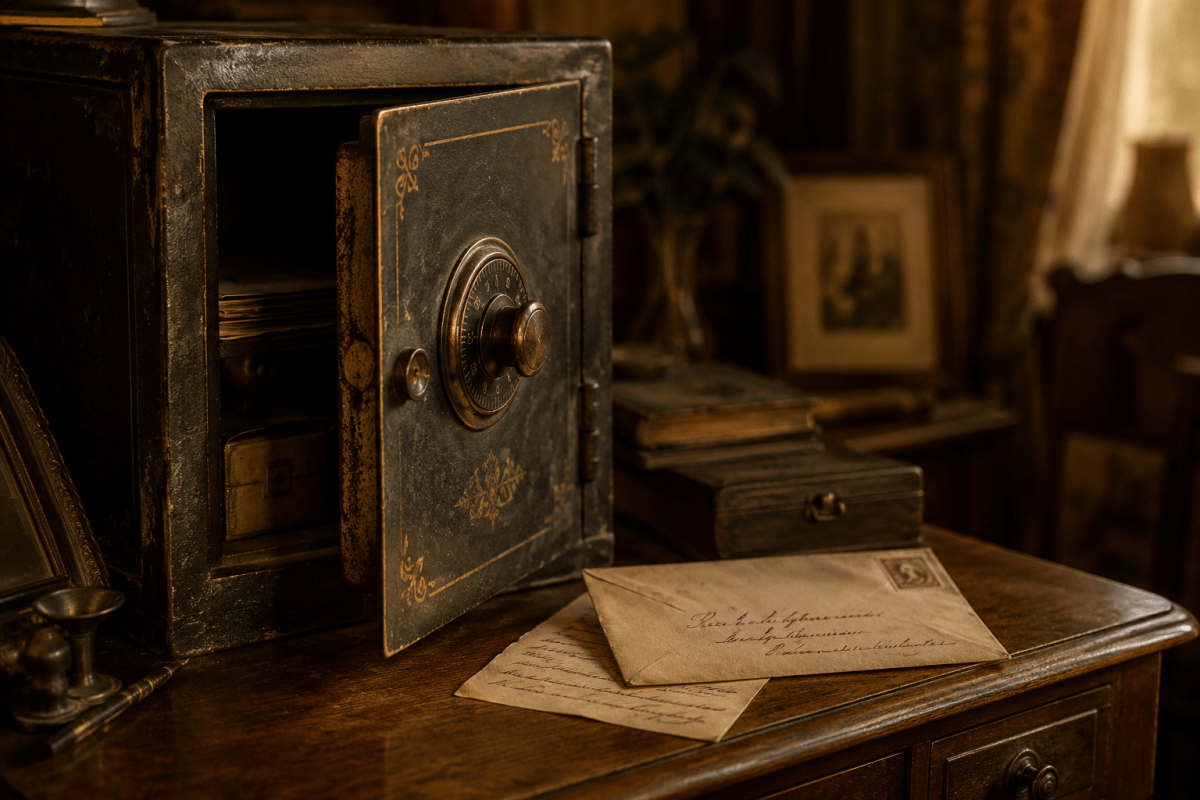
In The Boaz Safecracker, a man opens an old safe and finds more than coins and jewelry.
That is the moment that still interests me.
The safe itself matters. It is old, heavy, hidden, and difficult to move. It belongs to a house with history, a house that has passed from one generation to another, carrying with it the weight of former owners, former stories, and former silences.
But the real discovery is not the money.
It is a letter.
A short letter. A strange letter. A letter preserved for decades. A letter written to a woman named Rebecca Rawlins and signed by a former pastor.
“Your sins are forgiven and your secret is safe with me.”
That sentence does what a good fictional object should do. It opens a door.
A reader does not yet know the secret. The character does not yet know the secret. But the sentence carries pressure. It suggests a past event, a private wound, a religious authority, a moral judgment, and a promise of silence. It also raises the question that almost always matters in the Boaz novels:
What has this town agreed not to say?
That question appears in different forms throughout my fiction.
Sometimes it is tied to a crime. Sometimes to a family. Sometimes to a church. Sometimes to an old rumor, a death, a disappearance, a betrayal, or a version of the past that respectable people have learned to repeat because the real version would cost too much.
Small-town fiction often depends on place, but place is not merely scenery.
In the Boaz novels, the town is not just where the story happens. It is one of the forces acting on the story. Boaz remembers. Boaz watches. Boaz blesses and judges. Boaz feeds the grieving and whispers about them afterward. Boaz protects some people and exposes others. Boaz can make a person feel known and trapped at the same time.
That double nature matters to me.
A small town can be loving. It can also be merciless. It can know your parents, your grandparents, your church, your reputation, your mistakes, and your place in the invisible order of things. It can hold memory with tenderness. It can also hold memory like evidence.
A secret in a place like that rarely belongs to one person.
That is why the letter in the safe matters. It is addressed to Rebecca, but it implicates more than Rebecca. It suggests a pastor who knew something. It suggests a church culture where sin, forgiveness, reputation, and control may have been tangled together. It suggests that whatever happened did not simply disappear because someone put it behind a locked door.
Locked doors are useful in fiction.
So are safes.
A safe says there is something worth protecting. It also says there is something worth hiding. The same object can hold treasure, evidence, guilt, inheritance, history, and fear. It can be practical and symbolic at the same time. A person may lock away coins, deeds, jewelry, letters, photographs, or documents. But underneath the physical contents is the deeper question:
Why did this have to be hidden?
That question is one of the engines of The Boaz Safecracker.
Jimmy Fred Martin begins with a criminal act. He is not innocent. He is not standing outside the trouble as a pure observer. He enters the house. He opens the safe. He takes what is not his. But fiction often becomes most interesting when a morally compromised character uncovers a deeper moral problem.
He does wrong and discovers wrong.
He steals valuables and finds a secret.
He opens a safe and exposes a past.
That does not excuse him. It complicates him.
I am drawn to that kind of complication because real people are rarely as neat as the stories they tell about themselves. A person can be guilty and perceptive. Respectable and dishonest. Kind and resentful. Faithful and afraid. Devout and controlling. Injured and dangerous. A small town can produce all of these contradictions because it gives people so many roles to perform.
Church member.
Parent.
Pastor.
Businessman.
Coach.
Widow.
Deacon.
Good family.
Troubled family.
Insider.
Outsider.
Believer.
Backslider.
Once those roles harden, it becomes difficult for the truth to move freely. People begin protecting not only themselves, but the version of the town they need to preserve. They protect the church. They protect the family name. They protect the memory of the dead. They protect the story that has already been told.
But buried things do not stop exerting pressure.
They wait.
That may be the central fact of the Boaz world. The past waits. It waits in houses, churches, files, court records, family stories, old newspaper clippings, yearbooks, photographs, and rooms no one has entered in years. It waits inside people too. A comment from high school. A sermon. A humiliation. A prayer. A death. A warning. A secret kept too long.
Then one day someone opens the wrong door.
Or the right one.
That is what I like about the letter in the safe. It does not explain everything. It does not solve the story. It does not give the reader a neat answer. It simply announces that a hidden moral history exists.
Someone sinned.
Someone forgave.
Someone promised secrecy.
Someone kept the letter.
And decades later, someone else found it.
That is enough to pull me forward.
I do not want fiction that merely asks, “What happened?” I want fiction that also asks, “What did what happened do to the people who had to keep living afterward?”
What did the secret do to Rebecca?
What did it do to the pastor who knew?
What did it do to the church?
What did it do to the town?
What does it do when forgiveness becomes part of a secret arrangement?
What does it do when a person’s life is shaped by something almost no one is allowed to name?
These are the questions that make a story larger than its plot.
The safecracking gives The Boaz Safecracker movement. The letter gives it depth. One pulls the reader into the immediate danger. The other opens the old wound underneath.
That is often how the Boaz novels work.
A crime may start the story, but the deeper mystery is usually moral. A secret may drive the plot, but the real pressure comes from the lives shaped around it. A town may appear ordinary, even familiar, but under the surface there are old bargains, old silences, old versions of truth that no longer hold.
The letter in the safe is small.
One sheet of paper.
A few words.
But in fiction, a small object can carry a whole world.
That is what I hope readers feel when they enter these novels. Not just suspense. Not just curiosity. Not just the desire to know who did what.
I hope they feel the pressure of a place where memory is never neutral, where faith can comfort and conceal, where families know more than they say, and where the past keeps waiting for someone to turn the dial.
The safe opens.
The letter appears.
And the town begins to speak.
