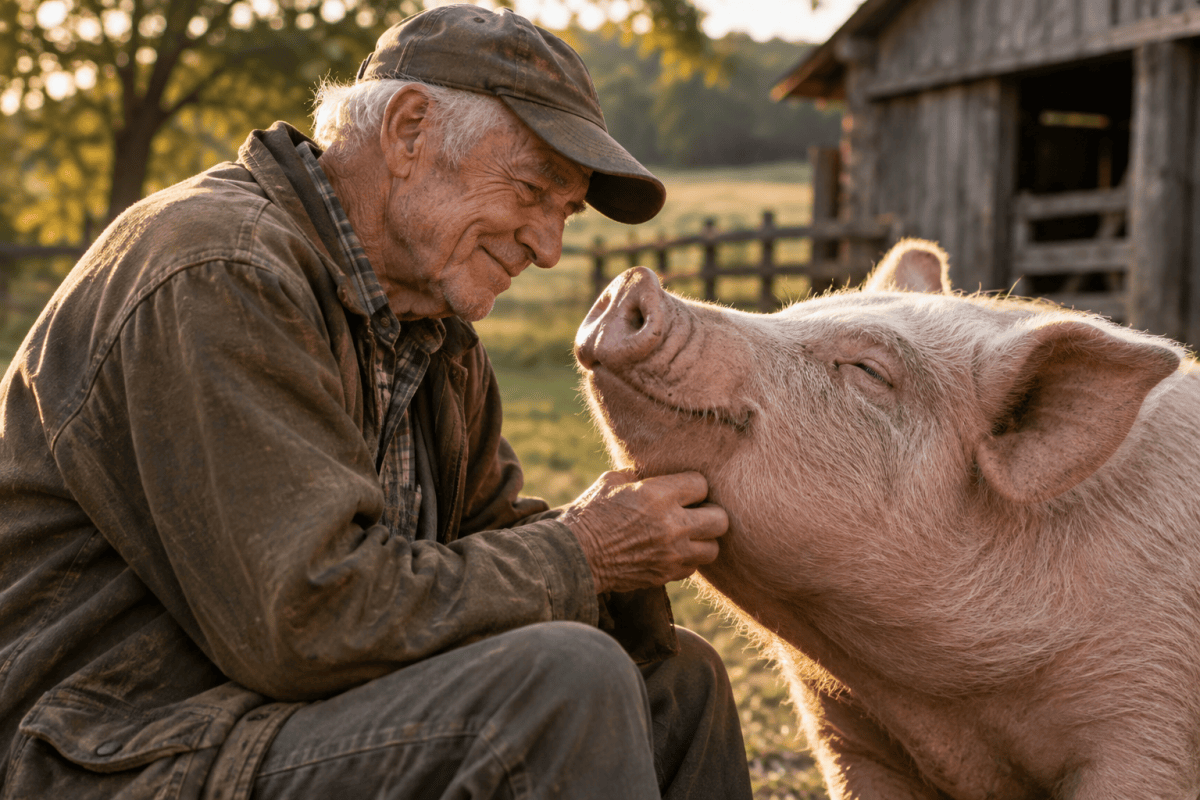
I’ve been spending a good deal of time lately with an eighty-five-year-old man who doesn’t exist.
He’s the protagonist of my seventeenth novel, The Boaz Slaughterhouse, which I’m currently developing.
He lives on a small farm in rural Alabama, where he’s raised hogs for much of his life. But farming wasn’t his principal occupation. He spent his working years as a vocational agriculture teacher, helping generations of young people understand the science, practices, and responsibilities of agriculture.
He’s an educated man, familiar with both the classroom and the barnyard. He knows livestock, not simply from textbooks or lessons he once taught, but from decades of personal experience.
And then there’s Molly.
Molly is an elderly sow, weighing somewhere between six and seven hundred pounds. She’s lived on his farm for years, and over time, their relationship has become something quite different from what most people might imagine between a farmer and a hog.
She’s become his companion.
He knows her habits. He recognizes her moods. He’s familiar with her preferences and the particular ways she responds to him.
And she knows him.
At least, that’s how I’m beginning to imagine their relationship.
As I’ve been developing these two characters, I’ve found myself thinking about how complicated human beings can be.
We tend to describe people in simple terms. A farmer. A teacher. A parent. A believer. A skeptic.
But those descriptions seldom tell us very much about what a person thinks, what matters most to him, or how he might respond when circumstances challenge the life he’s known.
My fictional farmer has spent decades learning, teaching, and practicing agriculture. He understands the traditional purposes for which livestock are raised. He’s participated in those practices himself.
And yet, his relationship with Molly has become deeply personal.
I’m interested in that combination of experiences.
Not because I’ve already decided what it means, but because it gives me something to explore as I develop his character.
One of the challenges of writing fiction is creating people who are more than collections of characteristics.
I can decide that a man is eighty-five years old, that he’s a retired teacher, that he owns a small farm, and that he’s particularly fond of an elderly sow.
Those are facts about him.
But facts alone don’t make a character believable.
I need to understand something of the life that produced him. What experiences shaped his thinking? What does he value? What does he fear losing? What assumptions has he carried through life without much examination?
And how might he respond when the circumstances of his life begin to change?
For now, I know that my farmer wants to remain on his land for whatever years he has left. He wants Molly to remain there with him.
Neither wish seems unreasonable.
But a novel needs conflict, and circumstances are developing that may make those simple desires increasingly difficult to fulfill.
That’s where the external story begins.
Beneath that story, however, lies something else.
The farmer brings eighty-five years of experiences, relationships, convictions, disappointments, and memories into the difficulties he now faces.
He won’t respond to those difficulties as I would necessarily respond. Nor should he.
He must respond as the particular man I’ve imagined would respond.
And that’s where writing fiction becomes especially interesting to me.
As an author, I bring my own experiences and beliefs to every story I write. Some of those beliefs are strongly held. But I don’t want my characters to become little more than vehicles for expressing my opinions.
I want them to be believable human beings, capable of making decisions I might disagree with, defending convictions I don’t share, and sometimes surprising me with their responses.
That requires giving them histories and perspectives of their own.
It also requires resisting the temptation to explain everything about them before the story has had an opportunity to unfold.
I’ve discovered that developing a character sometimes means asking questions for which I don’t yet have answers.
Not every question needs to become a theme. Not every contradiction needs to be resolved. And not every character needs to undergo some dramatic transformation.
Sometimes the most interesting thing about a person is the way several seemingly inconsistent qualities exist together in the same life.
As I continue developing The Boaz Slaughterhouse, I’m learning more about this elderly teacher, his farm, and his unusual companion.
I know what he wants.
I have a growing understanding of what’s standing in his way.
But there are still things about him I haven’t discovered.
And perhaps that’s as it should be.
After all, if I already knew everything about this man, there would be considerably less for me to explore as I write his story.

