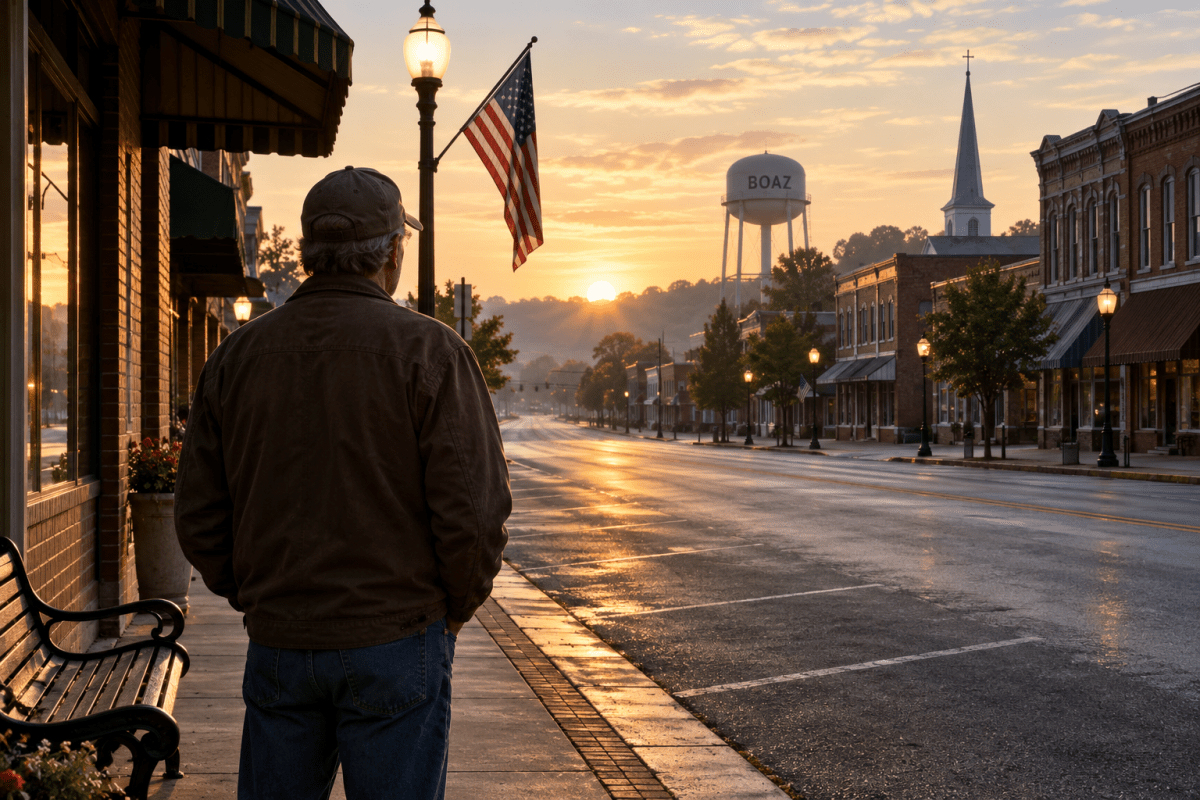
People sometimes ask why I keep returning to Boaz.
After all, there are countless small towns across America. Why this one?
The easy answer is that Boaz is familiar. I know its streets, its schools, its churches, its neighborhoods, and the rhythms of everyday life. But familiarity has never been enough reason to write a novel.
The real reason lies deeper.
Every novel I have written begins with a question that has very little to do with plot.
It begins when I wonder what story someone has been living without ever realizing it.
Not the story everyone else sees.
The quieter one beneath it.
A person may think they are protecting their family, when in reality they are protecting a secret that has shaped generations.
Someone may believe they are defending their faith, when they are actually defending an identity they inherited long before they were old enough to question it.
Another may spend years chasing success only to discover they have been pursuing someone else’s definition of a life well lived.
Those are the stories that interest me.
The mystery in my novels is rarely the deepest mystery.
The greater mystery is how ordinary people become so accustomed to the stories surrounding them that they no longer recognize those stories at all.
That is why Boaz matters.
Not because it is unique.
Because it is ordinary.
Small towns have a way of preserving stories. Families hand them down. Churches reinforce them. Schools repeat them. Businesses become part of them. Before long, an entire community begins to assume that life simply works this way because it always has.
Of course, this isn’t unique to small towns.
It happens everywhere.
Boaz simply allows me to watch it up close.
As a novelist, I’m less interested in proving someone wrong than in asking a quieter question:
Who told you this was the only story you could live?
Sometimes the answer changes everything.
I’ve come to realize that this question has quietly followed me through every Boaz novel. The crimes, the secrets, the courtroom testimony, the church conflicts, the family histories—those are not the destination. They are the circumstances that force people to stop long enough to see themselves more honestly.
When that happens, the story changes.
Not because someone else rewrites it.
Because the character finally recognizes the story they have been living all along.
Perhaps that’s why I keep returning to Boaz.
Not because it is a place filled with extraordinary people.
But because it is filled with ordinary people whose lives matter.
People very much like us.
And I suspect that’s why stories matter in the first place.
A good novel doesn’t simply entertain us for a few hours.
It quietly interrupts the story we’re already living.
When we close the book, we return to our own lives carrying a different question than the one we had when we began.
Sometimes that question stays with us.
Sometimes it changes us.
And occasionally, it helps us recognize the story beneath the story.
