Yesterday morning, I spent about three hours in Dr. Wallace’s dental chair.
The original plan, at least as I understood it, was for her to place a crown on one of my upper right teeth. But as dental work often goes, the plan changed once she got inside the real situation.
She also filled a tooth on the upper left side. Then she turned her attention back to the upper right tooth — the one intended for the crown. She numbed the area, ground the tooth down, and prepped it as much as she could. But she was not satisfied that it was quite ready for the permanent crown. As I understood her, she did not think she had gone deep enough into the gum area to permanently set the crown the way it needed to be set.
So the permanent crown was delayed.
Instead, she prepared and placed a temporary tooth on the upper right tooth — the crown tooth — while we wait for the next step.
I did not understand every technical detail. I did not need to.
That is one of the strange things about sitting in a dental chair. You are awake. You are conscious. You are listening. You are participating in your own life. But at the same time, you are surrendered in a very practical way. Someone else has the tools. Someone else has the training. Someone else is looking into a part of your body you cannot see for yourself.
Toward the end of the visit, Dr. Wallace explained what she thought we needed to do over the next few months. She went into detail. She laid out the plan. She spoke as a professional who knows her field and cares about the person in the chair.
And I said something like, “Well, my life is in your hands. I trust you. You’re the expert here.”
I meant it lightly, but I also meant it.
She smiled, or at least responded in that familiar way people do when they know where the conversation is going.
“You know what I’m going to say,” she said.
I told her to say whatever she wanted.
And she said, “Your life is in God’s hands.”
There it was.
The sentence I have heard in one form or another for most of my life.
Your life is in God’s hands.
I did not argue with her. I did not challenge her. I did not turn a dental appointment into a theological debate. I love Dr. Mary Wallace. We have a wonderful relationship. She has always treated me with kindness, skill, and care. She is a believer, and from what I have heard her say over the years, her view of life seems to sit close to the world I came out of — the Southern Baptist fundamentalist world where God is sovereign, life belongs to him, and every human moment is finally interpreted through divine ownership.
But as I sat there, numb and tired, I noticed something inside me.
Not anger.
Not ridicule.
Not even disagreement exactly.
More like clarity.
Because I had spent the early morning struggling again with Sam Harris and his Daily Meditation. I have used the Waking Up app for quite a while now, and I still find much of it valuable. I often save Sam’s short “Moments.” Many of them land well. They interrupt the day in a helpful way.
But the Daily Meditation has become harder for me.
Too often, the session moves beyond simple attention, breathing, noticing, and returning. It becomes a lesson in Sam’s deeper claim that there is no self. Thoughts appear. Sensations appear. Emotions appear. But when we look for the one who is looking, Sam says we cannot find anyone there.
No rider on the horse.
No thinker behind the thought.
No self.
And this morning, as has happened many mornings before, I found myself not meditating but arguing.
Who is being asked to follow the breath?
Who is paying close attention?
Who heard the instruction?
Who decided to sit down in the chair at 3:00 a.m.?
Who is responsible for the day ahead?
Who went to Marvin’s yesterday and decided not to buy the pre-built steps for $89 but to buy the materials and build them himself for the cabin down the runway?
If there is no self, who is living this life?
I understand part of what Sam is saying. I do not think there is a tiny ghost hidden behind my eyes, pulling levers and operating Richard like a machine. I do not think there is a little captain sitting somewhere inside my skull, separate from the body, separate from the brain, separate from experience.
But I do think there is a self.
I am a self.
Donna is a self.
Keith, my new next-door neighbor, is a self.
Brandon, who is renting our first East Hollow cabin, is a self.
Dustin and Chelsea, who have moved their cabin onto one of our East Hollow leased lots, are selves.
Each person is a separate, living, embodied center of experience. Each has a history, a memory, a body, a temperament, a pattern of choices, a web of relationships, a private inwardness no one else can fully occupy.
We can call the self a process. I am fine with that.
But a process is not nothing.
A river is a process, but it is still a river.
A family is a process, but it is still a family.
Oak Hollow Cabins is a process — land, roads, cabins, water access, agreements, work, mistakes, hopes, people moving in and making lives there — but it is still Oak Hollow.
So why should Richard disappear just because he is also a process?
That is where I find myself parting ways with Sam Harris. He may be right to question the illusion of a fixed, separate, unchanging observer behind consciousness. But I think he overstates the case when he says there is no self.
Maybe the more careful statement is this:
There is no ghostly little owner of consciousness hidden behind experience. But there is a real self — the living person whose consciousness this is.
That seems closer to reality.
My consciousness is not Keith’s consciousness. Donna’s consciousness is not mine. Her life is not mine. She grew up in her own family. She made her own choices. She became a special education teacher and spent nearly forty years helping struggling students learn to read and survive school. She has loved, suffered, endured, chosen, regretted, served, rested, and continued.
No one owns Donna more than Donna does.
No one owns me more than I do.
That does not mean we are isolated. It does not mean we are self-created. It does not mean our choices float free from biology, culture, trauma, memory, influence, habit, or circumstance. Of course we are shaped. Of course prior causes matter.
But prior causes do not erase the self.
They become part of the self.
I am the one those causes have formed. I am the one who must live from them, revise them, resist them, continue through them, and sometimes lay them down.
That is why Sam’s Daily Meditation has begun to feel, to me, less like meditation and more like a quiet argument. It is not unlike consuming political commentary. One side tells me what Trump did and why it proves he is destroying the country. Another side tells me what Trump did and why it proves he is brave, strong, and chosen for the hour. Everyone has an angle. Everyone has an interpretation. Everyone is pushing a frame.
And I have learned, slowly and imperfectly, that not every voice deserves entrance into the morning.
Not because I want to hide from reality.
Because I want to stop letting other people’s certainty colonize my attention.
That is what the Southern Baptist fundamentalist world did to me for decades.
It told me who I was before I had a chance to ask.
It told me I was a sinner.
It told me my heart was deceitful.
It told me my mind could not be trusted.
It told me my desires were dangerous.
It told me my life was not my own.
It told me I was born under judgment and could be rescued only by accepting the system’s diagnosis and cure.
And now, here comes another kind of certainty, this time dressed not in hymns and altar calls but in calm language, neuroscience, and meditation:
There is no self.
I do not want to exchange one authority structure for another.
I do not want to leave Southern Baptist certainty only to kneel before secular certainty.
That does not mean Sam Harris is the same as a preacher. He is not. There is much in his work I value. But for me, the Daily Meditation has begun to smuggle in a conclusion I do not accept. And once I notice that, I cannot unnotice it.
The practice no longer quiets the mind.
It starts the debate.
So maybe my practice needs to become much plainer.
Sit down.
Feel the chair.
Notice the body.
Notice the breath.
Let thoughts come.
Let thoughts go.
Return.
No doctrine.
No metaphysics.
No need to solve consciousness before breakfast.
No need to disappear.
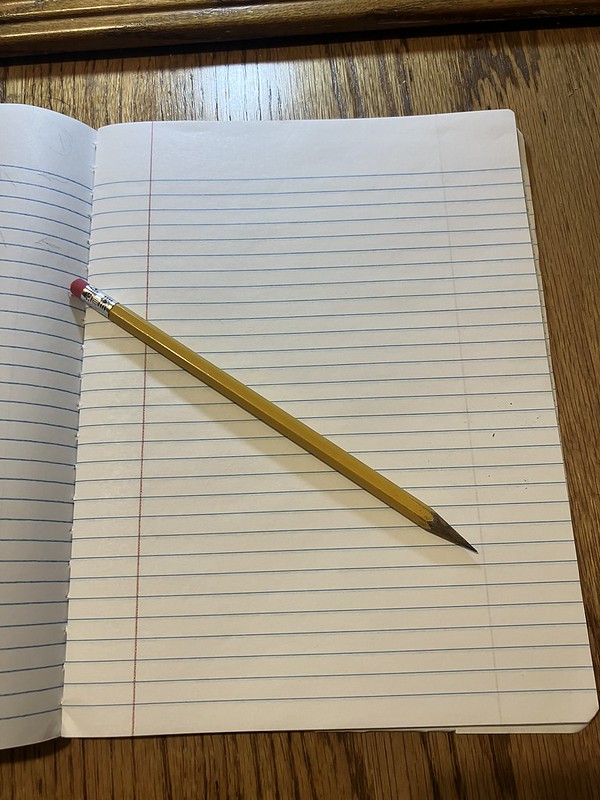
That feels much closer to The Pencil-Driven Life.
Because The Pencil-Driven Life is not about proving there is no self. It is not about finding a new theological system. It is not about replacing one master with another.
It is about living this life attentively.
The life actually here.
The dogs.
Donna in the next room.
The gravel road.
The cabin down the runway.
The lumber from Marvin’s.
The leased lots in East Hollow.
The work still waiting.
The words still wanting to be written.
The ordinary morning.
The self who is here for it.
And that brings me back to Dr. Wallace.
After she told me my life was in God’s hands, we later talked about what she was going to charge me. It sounded to me as though she was giving me some of her time and professional care. I told her I understood that. When I practiced law, there were times I helped people and did not charge them. Professionals do that sometimes. Not always. Not carelessly. But sometimes, when the person and situation call for it.
That led her to tell me about a man she knew from Mexico. He was both an architect and a lawyer, she said. A gracious man. A generous man. A wonderful person. Someone who had grown up poor and went out of his way to help others.
And then she told me he was killed by someone he was trying to help.
I did not say what passed through my mind.
But I noticed it.
If my life is in God’s hands, then so was his.
And look what happened.
That is not a cheap argument. It is not meant as a sneer. It is the problem that eventually breaks the frame for me.
When something good happens, believers say God is faithful.
When something terrible happens, believers say God is mysterious.
When the crown goes well, God guided the dentist.
When the generous man is murdered by someone he tried to help, God’s ways are higher than ours.
The system protects itself no matter what reality does.
But I cannot live there anymore.
I do not know that my life is in God’s hands.
I know that, for three hours yesterday, part of my dental life was in Dr. Wallace’s hands. Her trained, skilled, human hands.
I know that my decisions today are in my hands, in the only sense that matters: not as an uncaused soul floating above nature, but as Richard — embodied, shaped, conscious, responsible, and alive.
I know that Donna’s life is Donna’s.
I know that the man from Mexico owned his life too, and that his goodness did not protect him from tragedy.
I know that saying “God is in control” may comfort some people, but it no longer explains the world to me.
And I know this: surrendering to a good dentist is not the same as surrendering my life to a doctrine.
Trusting an expert is not the same as abandoning myself.
Letting another person help me is not the same as believing I am not real.
So this morning, I think I am ready to pause Sam’s Daily Meditation.
Not meditation.
Just that meditation.
I do not need an agenda-driven voice in my ear telling me there is no self.
I do not need a preacher, religious or secular, defining my inner life before the day begins.
I need silence.
I need breath.
I need the chair.
I need the simple practice of being here.
Not as a ghost.
Not as an illusion.
Not as a soul under judgment.
Not as a selfless field of appearances.
As Richard.
A living self.
A changing self.
A responsible self.
A pencil-driven self.
Here for this breath.
Here for this day.
Here for the life that is still, in the only way I can honestly say it, in my hands.
