The Self in the Dental Chair – Why I Am Not Trying to Disappear

Yesterday morning, I spent about three hours in Dr. Wallace’s dental chair.

The original plan, at least as I understood it, was for her to place a crown on one of my upper right teeth. But as dental work often goes, the plan changed once she got inside the real situation.

She also filled a tooth on the upper left side. Then she turned her attention back to the upper right tooth — the one intended for the crown. She numbed the area, ground the tooth down, and prepped it as much as she could. But she was not satisfied that it was quite ready for the permanent crown. As I understood her, she did not think she had gone deep enough into the gum area to permanently set the crown the way it needed to be set.

So the permanent crown was delayed.

Instead, she prepared and placed a temporary tooth on the upper right tooth — the crown tooth — while we wait for the next step.

I did not understand every technical detail. I did not need to.

That is one of the strange things about sitting in a dental chair. You are awake. You are conscious. You are listening. You are participating in your own life. But at the same time, you are surrendered in a very practical way. Someone else has the tools. Someone else has the training. Someone else is looking into a part of your body you cannot see for yourself.

Toward the end of the visit, Dr. Wallace explained what she thought we needed to do over the next few months. She went into detail. She laid out the plan. She spoke as a professional who knows her field and cares about the person in the chair.

And I said something like, “Well, my life is in your hands. I trust you. You’re the expert here.”

I meant it lightly, but I also meant it.

She smiled, or at least responded in that familiar way people do when they know where the conversation is going.

“You know what I’m going to say,” she said.

I told her to say whatever she wanted.

And she said, “Your life is in God’s hands.”

There it was.

The sentence I have heard in one form or another for most of my life.

Your life is in God’s hands.

I did not argue with her. I did not challenge her. I did not turn a dental appointment into a theological debate. I love Dr. Mary Wallace. We have a wonderful relationship. She has always treated me with kindness, skill, and care. She is a believer, and from what I have heard her say over the years, her view of life seems to sit close to the world I came out of — the Southern Baptist fundamentalist world where God is sovereign, life belongs to him, and every human moment is finally interpreted through divine ownership.

But as I sat there, numb and tired, I noticed something inside me.

Not anger.

Not ridicule.

Not even disagreement exactly.

More like clarity.

Because I had spent the early morning struggling again with Sam Harris and his Daily Meditation. I have used the Waking Up app for quite a while now, and I still find much of it valuable. I often save Sam’s short “Moments.” Many of them land well. They interrupt the day in a helpful way.

But the Daily Meditation has become harder for me.

Too often, the session moves beyond simple attention, breathing, noticing, and returning. It becomes a lesson in Sam’s deeper claim that there is no self. Thoughts appear. Sensations appear. Emotions appear. But when we look for the one who is looking, Sam says we cannot find anyone there.

No rider on the horse.

No thinker behind the thought.

No self.

And this morning, as has happened many mornings before, I found myself not meditating but arguing.

Who is being asked to follow the breath?

Who is paying close attention?

Who heard the instruction?

Who decided to sit down in the chair at 3:00 a.m.?

Who is responsible for the day ahead?

Who went to Marvin’s yesterday and decided not to buy the pre-built steps for $89 but to buy the materials and build them himself for the cabin down the runway?

If there is no self, who is living this life?

I understand part of what Sam is saying. I do not think there is a tiny ghost hidden behind my eyes, pulling levers and operating Richard like a machine. I do not think there is a little captain sitting somewhere inside my skull, separate from the body, separate from the brain, separate from experience.

But I do think there is a self.

I am a self.

Donna is a self.

Keith, my new next-door neighbor, is a self.

Brandon, who is renting our first East Hollow cabin, is a self.

Dustin and Chelsea, who have moved their cabin onto one of our East Hollow leased lots, are selves.

Each person is a separate, living, embodied center of experience. Each has a history, a memory, a body, a temperament, a pattern of choices, a web of relationships, a private inwardness no one else can fully occupy.

We can call the self a process. I am fine with that.

But a process is not nothing.

A river is a process, but it is still a river.

A family is a process, but it is still a family.

Oak Hollow Cabins is a process — land, roads, cabins, water access, agreements, work, mistakes, hopes, people moving in and making lives there — but it is still Oak Hollow.

So why should Richard disappear just because he is also a process?

That is where I find myself parting ways with Sam Harris. He may be right to question the illusion of a fixed, separate, unchanging observer behind consciousness. But I think he overstates the case when he says there is no self.

Maybe the more careful statement is this:

There is no ghostly little owner of consciousness hidden behind experience. But there is a real self — the living person whose consciousness this is.

That seems closer to reality.

My consciousness is not Keith’s consciousness. Donna’s consciousness is not mine. Her life is not mine. She grew up in her own family. She made her own choices. She became a special education teacher and spent nearly forty years helping struggling students learn to read and survive school. She has loved, suffered, endured, chosen, regretted, served, rested, and continued.

No one owns Donna more than Donna does.

No one owns me more than I do.

That does not mean we are isolated. It does not mean we are self-created. It does not mean our choices float free from biology, culture, trauma, memory, influence, habit, or circumstance. Of course we are shaped. Of course prior causes matter.

But prior causes do not erase the self.

They become part of the self.

I am the one those causes have formed. I am the one who must live from them, revise them, resist them, continue through them, and sometimes lay them down.

That is why Sam’s Daily Meditation has begun to feel, to me, less like meditation and more like a quiet argument. It is not unlike consuming political commentary. One side tells me what Trump did and why it proves he is destroying the country. Another side tells me what Trump did and why it proves he is brave, strong, and chosen for the hour. Everyone has an angle. Everyone has an interpretation. Everyone is pushing a frame.

And I have learned, slowly and imperfectly, that not every voice deserves entrance into the morning.

Not because I want to hide from reality.

Because I want to stop letting other people’s certainty colonize my attention.

That is what the Southern Baptist fundamentalist world did to me for decades.

It told me who I was before I had a chance to ask.

It told me I was a sinner.

It told me my heart was deceitful.

It told me my mind could not be trusted.

It told me my desires were dangerous.

It told me my life was not my own.

It told me I was born under judgment and could be rescued only by accepting the system’s diagnosis and cure.

And now, here comes another kind of certainty, this time dressed not in hymns and altar calls but in calm language, neuroscience, and meditation:

There is no self.

I do not want to exchange one authority structure for another.

I do not want to leave Southern Baptist certainty only to kneel before secular certainty.

That does not mean Sam Harris is the same as a preacher. He is not. There is much in his work I value. But for me, the Daily Meditation has begun to smuggle in a conclusion I do not accept. And once I notice that, I cannot unnotice it.

The practice no longer quiets the mind.

It starts the debate.

So maybe my practice needs to become much plainer.

Sit down.

Feel the chair.

Notice the body.

Notice the breath.

Let thoughts come.

Let thoughts go.

Return.

No doctrine.

No metaphysics.

No need to solve consciousness before breakfast.

No need to disappear.

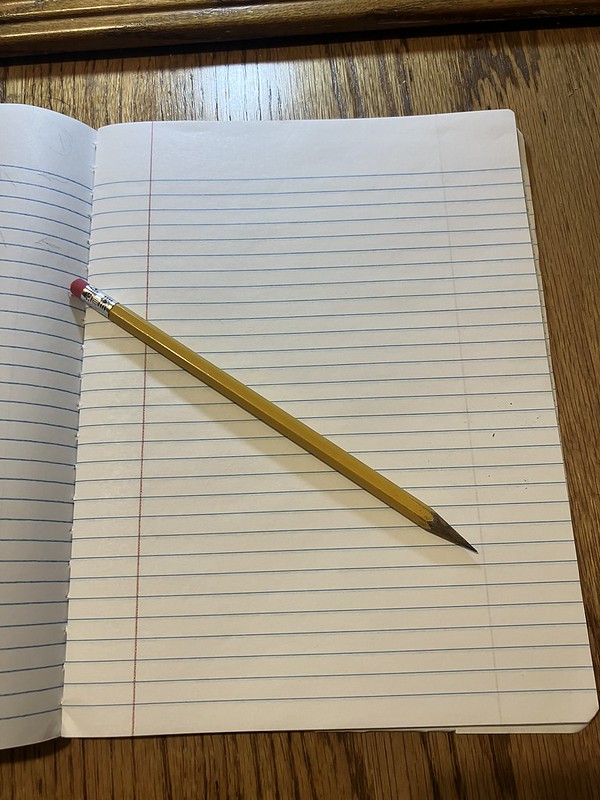
That feels much closer to The Pencil-Driven Life.

Because The Pencil-Driven Life is not about proving there is no self. It is not about finding a new theological system. It is not about replacing one master with another.

It is about living this life attentively.

The life actually here.

The dogs.

Donna in the next room.

The gravel road.

The cabin down the runway.

The lumber from Marvin’s.

The leased lots in East Hollow.

The work still waiting.

The words still wanting to be written.

The ordinary morning.

The self who is here for it.

And that brings me back to Dr. Wallace.

After she told me my life was in God’s hands, we later talked about what she was going to charge me. It sounded to me as though she was giving me some of her time and professional care. I told her I understood that. When I practiced law, there were times I helped people and did not charge them. Professionals do that sometimes. Not always. Not carelessly. But sometimes, when the person and situation call for it.

That led her to tell me about a man she knew from Mexico. He was both an architect and a lawyer, she said. A gracious man. A generous man. A wonderful person. Someone who had grown up poor and went out of his way to help others.

And then she told me he was killed by someone he was trying to help.

I did not say what passed through my mind.

But I noticed it.

If my life is in God’s hands, then so was his.

And look what happened.

That is not a cheap argument. It is not meant as a sneer. It is the problem that eventually breaks the frame for me.

When something good happens, believers say God is faithful.

When something terrible happens, believers say God is mysterious.

When the crown goes well, God guided the dentist.

When the generous man is murdered by someone he tried to help, God’s ways are higher than ours.

The system protects itself no matter what reality does.

But I cannot live there anymore.

I do not know that my life is in God’s hands.

I know that, for three hours yesterday, part of my dental life was in Dr. Wallace’s hands. Her trained, skilled, human hands.

I know that my decisions today are in my hands, in the only sense that matters: not as an uncaused soul floating above nature, but as Richard — embodied, shaped, conscious, responsible, and alive.

I know that Donna’s life is Donna’s.

I know that the man from Mexico owned his life too, and that his goodness did not protect him from tragedy.

I know that saying “God is in control” may comfort some people, but it no longer explains the world to me.

And I know this: surrendering to a good dentist is not the same as surrendering my life to a doctrine.

Trusting an expert is not the same as abandoning myself.

Letting another person help me is not the same as believing I am not real.

So this morning, I think I am ready to pause Sam’s Daily Meditation.

Not meditation.

Just that meditation.

I do not need an agenda-driven voice in my ear telling me there is no self.

I do not need a preacher, religious or secular, defining my inner life before the day begins.

I need silence.

I need breath.

I need the chair.

I need the simple practice of being here.

Not as a ghost.

Not as an illusion.

Not as a soul under judgment.

Not as a selfless field of appearances.

As Richard.

A living self.

A changing self.

A responsible self.

A pencil-driven self.

Here for this breath.

Here for this day.

Here for the life that is still, in the only way I can honestly say it, in my hands.
Unscripted — Week 7–Seven Dogs, Zero Agendas: Lessons in Unfiltered Living

Welcome to Unscripted, a weekly reflection on what it means to live without inherited stories, rigid identities, or predetermined purpose. Each Monday, I explore a different part of this shift toward presence and clarity—one moment, one breath, one pencil stroke at a time.

There are seven dogs at Oak Hollow.

They arrived at different times, from different places, carrying different histories. Some came timid. Some loud. Some cautious. Some hungry for attention. None came with a plan.

They don’t share a philosophy. They don’t know the language I use to describe this life. They don’t care whether I’m present or distracted.

And yet, they may be the most reliable teachers of presence I’ve ever lived with.

No Narrative, No Improvement Plan

The dogs don’t wake up wondering who they should be today.

They don’t rehearse yesterday. They don’t plan tomorrow. They don’t carry a storyline about progress, productivity, or meaning.

They wake up. They stretch. They step into the day exactly as it is.

If there is sun, they notice it. If there is food, they eat. If there is movement, they follow. If there is rest, they take it.

Nothing is optimized. Nothing is withheld. Nothing is postponed.

Their lives are not efficient. They are complete.

Attention Without Agenda

One of the quiet surprises of living with animals is how differently attention behaves.

When a dog looks at you, there is no strategy behind it. No expectation. No story.

The attention is total, but uninvested. Present, but unattached.

They don’t want you to be better. They don’t need you to change. They don’t expect a version of you.

They simply register what is.

Being around that kind of attention has a way of stripping things down.

The mind, so used to narrating and evaluating, slowly loses its footing. There’s nothing to perform for. Nothing to explain. Nothing to manage.

Just contact.

Time Without Measurement

Dogs don’t experience time as a problem.

They don’t divide the day into productive and wasted hours. They don’t rush toward the next thing or resist the current one.

A walk is the walk. A nap is the nap. Waiting is waiting.

Time isn’t something they spend or save. It’s something they inhabit.

Watching this, day after day, begins to loosen the grip of urgency. Not dramatically. Not all at once.

Just enough to notice how much of human life is lived somewhere other than where the body already is.

Relationship Without Identity

Each dog has a personality, but none of them carry an identity.

They don’t introduce themselves. They don’t defend who they are. They don’t live up to a role.

If one is cautious, it’s cautious. If one is playful, it plays. If one needs space, it takes it.

There’s no tension between who they were yesterday and who they are today.

They don’t remember themselves.

That absence of self-story creates a surprising kind of freedom. Not freedom from constraint, but freedom from commentary.

They live without an inner narrator explaining their lives to themselves.

Presence That Doesn’t Try

What makes the dogs such effective teachers isn’t that they are wise or calm or enlightened.

It’s that they don’t try to be anything at all.

Presence isn’t something they practice. It’s simply the condition of being alive.

Living alongside that kind of unfiltered existence does something subtle to the human nervous system. It lowers the volume. It shortens the distance between thought and experience.

You stop asking: Am I doing this right? What should this mean? Where is this leading?

You just notice: This is happening.

How This Fits the Pencil-Driven Life

The Pencil-Driven Life isn’t about becoming more disciplined or more intentional.

It’s about removing the extra layers we’ve learned to carry.

Dogs don’t erase. They don’t revise. They don’t reflect.

They simply move.

And in that movement, something essential is revealed: life doesn’t need a storyline to be fully lived.

Sometimes the clearest way back to presence isn’t through effort or insight, but through proximity—to beings who never left it.

A Small Invitation

You don’t need seven dogs. You don’t need animals at all.

But you might notice:

  • where attention already rests easily
  • where time doesn’t feel pressured
  • where you aren’t managing an identity

Stay there a little longer than usual.

No lesson required. No meaning extracted.

Just notice what it’s like to live without an agenda—even briefly.


A Closing Thought

The dogs don’t know they’re teaching anything.

They don’t care whether I understand them. They don’t need me to apply the lesson.

They simply live.

And in their living, they quietly remind me of something I keep forgetting:

Presence isn’t something to achieve. It’s what remains when nothing else is required.

The pencil is already moving.

Unscripted — Week 6 – Walking the Runway: A Daily Practice of Awareness

Welcome to Unscripted, a weekly reflection on what it means to live without inherited stories, rigid identities, or predetermined purpose. Each Monday, I explore a different part of this shift toward presence and clarity—one moment, one breath, one pencil stroke at a time.

Most mornings at Oak Hollow begin the same way.

Not because I planned it that way, but because repetition has a way of finding you when you stop resisting it.

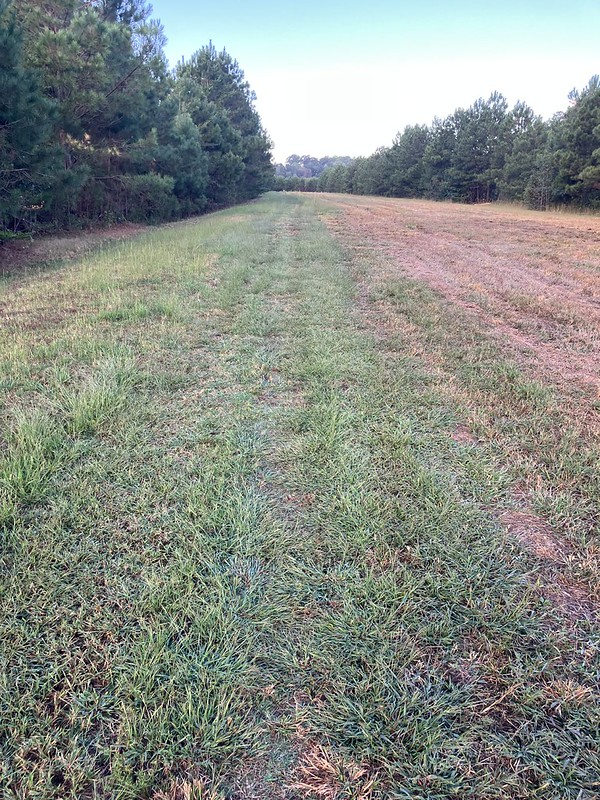
After the early hours of writing—after coffee, pages, silence—I step outside and walk the runway.

It’s a long, simple strip of grass cut into the land years ago for a different purpose. Once, it existed to lift something into the air. Now it exists for something quieter: walking, noticing, returning.

There’s nothing symbolic about it when I start walking. No intention to practice awareness. No goal to “be present.” I’m just moving my body across familiar ground.

And that’s the point.

A Practice Without Ambition

The word practice usually comes with expectations attached. Improvement. Discipline. Progress. Outcomes.

This isn’t that.

Walking the runway isn’t about achieving a state of mind or cultivating a particular feeling. It’s not meditation in disguise. It’s not exercise pretending to be spiritual.

It’s simply walking the same stretch of land, day after day, long enough for the mind to lose interest in performing.

At first, the mind does what it always does:

  • It narrates.
  • It plans.
  • It revisits old conversations.
  • It anticipates what comes next.

I don’t correct it. I don’t argue with it. I don’t try to replace it with better thoughts.

I keep walking.

Over time—sometimes minutes, sometimes not at all—the noise thins. Not because it’s been defeated, but because it no longer needs attention.

Awareness doesn’t arrive with fanfare. It shows up quietly, like noticing you’ve already been breathing.

The Runway as a Container

What makes this walk different from any other isn’t the scenery or the distance. It’s the container.

The runway doesn’t change. The trees don’t rearrange themselves. The path doesn’t offer variety or novelty.

Because the space stays constant, what changes becomes easier to see.

Some mornings:

  • the body feels heavy
  • the mind resists movement
  • the walk feels pointless

Other mornings:

  • light filters differently
  • birds are louder
  • the body moves without commentary

The runway doesn’t respond to any of this. It doesn’t reward effort or punish distraction.

It simply holds whatever shows up.

That steadiness is what allows awareness to surface—not as an idea, but as direct experience.

Awareness Is Not Something You Add

One of the quiet misunderstandings about presence is the belief that it’s something you do.

As if awareness is a skill to be developed, a habit to be installed, a discipline to master.

Walking the runway has taught me otherwise.

Awareness isn’t added to the walk. It’s what’s left when nothing else is required.

When there’s no destination, no performance, no improvement to chase, attention naturally returns to what’s already happening:

  • the rhythm of breath
  • the feeling of feet meeting ground
  • the way light shifts as clouds move

None of this needs interpretation.

The runway doesn’t ask me to understand it. It asks me to notice it.

The Body Knows Before the Mind

There are days when thought remains loud the entire walk.

Even then, something else is happening underneath.

The body walks. The arms swing. The breath adjusts.

The body doesn’t wait for clarity to proceed.

This is one of the quieter lessons the runway offers: awareness doesn’t depend on mental quiet. It depends on contact.

Feet on ground. Air on skin. Movement unfolding.

The mind may comment, but the body is already here.

A Ritual Without Meaning

I don’t walk the runway because it represents something. I walk it because it’s there.

Over time, the routine has taken on a shape of its own—not as ritual, but as rhythm.

Not sacred. Not symbolic. Just familiar.

That familiarity becomes an invitation. Not to transcend daily life, but to inhabit it more fully.

Walking the runway doesn’t make the day better. It makes the day real.

How This Fits the Pencil-Driven Life

The Pencil-Driven Life isn’t about adding practices to an already crowded life.

It’s about noticing where awareness naturally appears when you stop demanding meaning from everything you do.

For me, awareness shows up:

  • while walking the runway
  • while stacking wood
  • while feeding dogs
  • while writing early in the morning before the world asks anything of me

None of these moments are optimized. None are performed. None are shared to prove anything.

They are simply where attention settles when the pencil is allowed to move on its own.

If You’re Looking for a Runway of Your Own

You don’t need land. You don’t need a routine as specific as mine. You don’t need to call it a practice.

What you need already exists:

  • a path you walk often
  • a movement you repeat
  • a space that doesn’t demand improvement

Let it stay ordinary. Let it remain unremarkable.

Walk it without expecting awareness to arrive.

If it does, fine. If it doesn’t, fine.

The walking is enough.


A Closing Thought

The runway doesn’t teach me how to be present.

It reminds me that presence was never missing.

It was only waiting for me to stop trying to get somewhere else.

I walk. The mind talks. The body moves. The day begins.

That’s the practice.

The pencil is already moving.

Unscripted – Week 4: When Life Unravels Slowly — And Why That’s a Gift

Welcome to Unscripted — a weekly reflection on living without inherited stories, rigid identities, or predetermined purpose. Each Monday, I explore a different facet of this shift toward presence and clarity, one moment, one breath, one pencil stroke at a time.

Most of us expect change to announce itself. We imagine turning points as moments—sharp, dramatic, unmistakable. A decision. A crisis. A breaking point. Something that clearly divides before from after.

But for many of us, real change arrives differently.

It comes slowly. Quietly. Almost politely.
So gradually that we don’t recognize it as change at all.

This is the kind of unraveling that doesn’t destroy your life.
It loosens it.

And that slow unraveling, uncomfortable as it can be, may be one of the greatest gifts life offers.


The Myth of the Sudden Awakening

We tend to believe that meaningful transformation should be obvious.

That when something is truly ending, we’ll know.
That when a belief no longer fits, it will collapse under its own weight.
That clarity arrives in a single moment of insight.

Sometimes that happens.

More often, it doesn’t.

More often, life unravels in small, almost forgettable ways:

  • a question that doesn’t go away
  • a certainty that feels slightly hollow
  • a role that requires more effort than it used to
  • a belief that still works on paper but not in experience

Nothing dramatic breaks.
Nothing visibly fails.

But something quietly loosens.


When the Old Story Stops Carrying You

There is a particular discomfort that comes when a familiar story begins to lose its grip.

Not because it’s been disproven.
Not because you’ve rejected it.
But because it no longer carries the weight it once did.

You may still speak the words.
Still perform the roles.
Still meet expectations.

And yet, something underneath has shifted.

What once felt solid now feels effortful.
What once felt motivating now feels heavy.
What once felt certain now feels… thin.

This isn’t confusion.
It’s misalignment.

And misalignment doesn’t demand immediate action.
It asks for attention.


Why Slow Unraveling Is Kinder Than Sudden Collapse

A sudden collapse forces change.

A slow unraveling invites it.

When life unravels slowly, you’re given time:

  • time to notice
  • time to grieve without drama
  • time to loosen without tearing
  • time to let clarity emerge on its own

Nothing has to be burned down.
Nothing has to be replaced immediately.

The Pencil-Driven Life trusts this pace.

Just as a pencil erases lightly—without ripping the page—life often revises us gently, one line at a time.


Living Through the In-Between

The most difficult part of slow unraveling is not knowing what comes next.

You haven’t arrived somewhere new.
But you can’t fully return to where you were.

This in-between can feel unsettling.

There’s less certainty.
Less motivation to defend old positions.
Less urgency to prove anything.

And yet—more honesty.

More listening.
More willingness to pause.
More openness to not knowing.

This is not stagnation.

This is presence learning to lead.


What Presence Reveals During Unraveling

Presence doesn’t rush the unraveling process.

It doesn’t demand answers.
It doesn’t force conclusions.

It simply notices what no longer fits.

Presence allows you to stay with the discomfort long enough to learn from it—without turning it into a problem to solve.

In this space, you may begin to see:

  • which beliefs require constant reinforcement
  • which roles you’re performing out of habit
  • which identities depend on external approval
  • which expectations no longer reflect who you are

Nothing needs to be resolved immediately.

Seeing is enough.


Why This Phase Is a Gift

Slow unraveling protects you from trading one script for another.

It prevents reactionary change.
It discourages certainty dressed up as freedom.

Instead, it creates space.

Space to respond rather than react.
Space to let go without replacing.
Space to trust what’s unfolding without naming it too quickly.

This is the gift:
you’re not being pushed forward.
You’re being invited inward.


Letting the Pencil Move

The pencil doesn’t rush revisions.

It pauses.
It hovers.
It adjusts lightly.

Living without a script doesn’t mean always knowing where you’re going.
It means staying present while the next line reveals itself.

Slow unraveling teaches this better than certainty ever could.

Because it asks you to stay with what’s real—
even when it hasn’t resolved into something neat.


A Closing Thought

If your life feels like it’s unraveling slowly, gently, without spectacle—nothing may be wrong.

You may not be losing direction.
You may be loosening a story that no longer fits.

Stay with it.

Notice what’s shifting.
Notice what no longer needs defending.
Notice what feels truer when nothing is forced.

The Pencil-Driven Life isn’t built on sudden awakenings.
It’s built on honest noticing.

And sometimes, the most meaningful change arrives quietly—
line by line—
as the pencil moves.


If you’d like to receive new entries from the Unscripted series by email, you can subscribe here. Occasionally, other reflective posts may appear as well.

Unscripted — Week 1: What It Means to Live Without a Script

Welcome to Unscripted, a weekly reflection on what it means to live without inherited stories, rigid identities, or predetermined purpose. Each Monday, I explore a different part of this shift toward presence and clarity—one moment, one breath, one pencil stroke at a time.

Why losing the old storyline becomes freedom rather than loss

For most of my life, I lived by a script I didn’t write.

Not a literal script—not words typed on a page or spoken into a microphone—but a story that explained who I was supposed to be and why. A story that laid out what mattered and what didn’t. A story filled with expectations, obligations, and roles assigned long before I ever had the space or courage to question them.

You probably have a script too. Most people do.

It’s the quiet narrative running beneath everything: This is who I am.This is what I’m supposed to want.This is why my life matters.This is what success looks like.This is what I must protect at all costs.

Scripts are powerful in the way gravity is powerful. You don’t notice them until you try to step outside their pull.

For years, I didn’t. I followed the story I had inherited, edited it lightly at times, rearranged chapters here and there, but never questioned its authorship. It felt like life. It felt like purpose. It felt like meaning.

And then one day—quietly, without drama—the script stopped working.

Not because of a crisis. Not because of a grand revelation. But because something inside me simply saw through it. The storyline I had used to understand myself suddenly felt too small, too tight, too noisy. And once that unraveling began, it didn’t stop. What once felt like identity now felt like confinement.

That unraveling is what eventually became The Pencil-Driven Life.

And this post—this first post in a new chapter of writing—is an attempt to name what it actually means to live without a script.

Not as an idea. Not as a philosophy. But as a daily, lived experience.


The Feel of Life Without a Script

Most people hear “living without a script” and imagine chaos or impulsiveness or aimlessness. But it’s none of those things.

Living without a script doesn’t mean abandoning your life. It means no longer forcing life to match a predetermined storyline.

It means dropping the old belief that you must always be “on track.” It means letting go of the constant self-surveillance that comes from comparing your real life to the fictional one in your head.

It means waking up without the burden of being someone.

When you live without a script:

  • You don’t need your life to make sense on paper.
  • You stop trying to justify every choice.
  • You don’t spend your days defending an identity.
  • You no longer audition for approval—your own or anyone else’s.
  • You begin to notice what’s actually happening instead of what “should” be happening.

Freedom doesn’t arrive with fireworks. It arrives quietly, like a breath you didn’t know you were holding finally releasing.


When the Old Storyline Falls Away

Losing your script doesn’t feel like liberation at first. It feels like disorientation—like stepping outside in the morning and noticing the temperature has changed without warning.

You reach for the old storyline out of habit. You try to reassemble it. You try to reason your way back into certainty.

But eventually you see the truth: What you lost wasn’t security. It was constraint.

The old storyline told me who I was supposed to be. It told me what a “good life” looked like. It told me what counted and what didn’t. It told me what to chase and what to avoid.

Letting go of that storyline didn’t erase meaning. It revealed meaning.

Meaning wasn’t in the script. Meaning was in the moment-to-moment clarity that emerges when you’re no longer trying to live in a story.


Life as It Is, Not as It Was Written

One of the surprises of living without a script is how ordinary it feels.

Not dull—ordinary.

The ordinary becomes spectacular when you are not reaching past it for something shinier or more “meaningful.” You begin to see:

  • The way the light falls through the window in the morning
  • The simple pleasure of making coffee
  • The breath of a dog sleeping beside you
  • The grain of a board you’re sanding in the Hub
  • The frost on the runway at sunrise
  • The stillness of a cabin before the fire warms it

None of these are “achievements.” None belong in a résumé. None advance a storyline.

But they make up a life—one that unfolds with quiet clarity when you stop trying to force it to behave like a three-act structure.

And here’s the strange part:

When you stop trying to control life, the day seems to cooperate on its own terms.

You’re not fighting with time anymore. You’re not measuring yourself against an imagined version of who you “should” have been. You’re not chasing a purpose. You’re living.

Fully. Simply. Honestly.


The Script Was Never You

It takes time to see this clearly.

For years, I thought the story I had inherited—religious purpose, professional identity, certainty—was my life. I thought stepping out of that story meant stepping into danger or meaninglessness.

But the script wasn’t me. It was something placed on top of me.

When it fell away, I didn’t disappear. I appeared.

Awareness remained. Presence remained. Life remained.

The script was the illusion. The clarity beneath it was the truth.


The Pencil-Driven Life Begins Here

Living without a script isn’t rebellion. It’s not self-improvement. It’s not minimalism or philosophy or technique.

It’s the simple recognition that life does not need a storyline in order to be meaningful.

Life is meaningful because you are here to witness it.

The Pencil-Driven Life isn’t about writing a better script; it’s about noticing the movement beneath the story—moment by moment, breath by breath.

Some days, the pencil moves quickly. Some days, hardly at all. Some days, it writes things you didn’t expect. Some days, it refuses to write anything at all.

But in every case, you’re not forcing it. You’re watching. You’re present. You’re alive inside the immediacy of the moment rather than inside an inherited narrative about what your life ought to become.

This simple shift—attention instead of expectation, presence instead of purpose—is the beginning of freedom.


A Final Word for This First Monday

This new chapter on the website isn’t a rebrand; it’s a revelation of what’s been happening quietly for years.

Oak Hollow has become the place where this philosophy is lived out in real time. This blog will be where it is articulated.

If you’ve lived your life inside someone else’s script, or even inside a script you once wrote for yourself but can’t bear to follow anymore, then you are already standing at the threshold of something larger.

Not a new storyline. A new way of seeing.

There is nothing to achieve. Nothing to prove. Nothing to become.

There is only this moment—clear, unburdened, unwritten—and the life unfolding inside it.

Let’s see where the pencil moves next.

—Richard

A New Beginning at The Pencil-Driven Life

Why the website changed — and what comes next

For most of my life, I lived inside stories I didn’t write—beliefs I inherited, purposes assigned to me, expectations handed down long before I ever had a chance to choose my own path. I didn’t recognize how small that space had become until everything began to unravel.

That unraveling led me toward something quieter: presence, clarity, and the freedom to live moment by moment.

Over time, that shift grew into a philosophy, then a lived practice, and now a body of work called The Pencil-Driven Life.

If you’ve visited this website before, you may notice it looks very different.
Here’s why.


Life at Oak Hollow

Much of this transformation has taken place on our seventy-acre property in North Alabama—land we call Oak Hollow.

What began as a simple place to live has become an ongoing experiment in presence:

  • building off-grid cabins
  • creating quiet spaces to think and breathe
  • walking trails at sunrise
  • tending a greenhouse
  • caring for seven rescued dogs
  • letting each day unfold without a script

Oak Hollow isn’t a cabin rental business.
It’s where The Pencil-Driven Life is lived out in real time.

You’ll see glimpses of these moments, projects, and reflections on @thepencildrivenlife, because they’re inseparable from the philosophy itself.


What’s Changing on the Website

This site used to focus heavily on story coaching and Fictionary editing. I’m grateful for that chapter—my training sharpened the way I understand story and, ultimately, the way I understand life.

But I no longer offer story coaching as a profession.

The work ahead of me now is different:

  • writing The Pencil-Driven Life — Volume 1
  • creating the companion workbook
  • sharing daily reflections
  • continuing the Boaz novels
  • documenting the work happening at Oak Hollow
  • and exploring presence in ordinary life

Story still matters deeply—just not as a service.
It’s become a lens.


Where We Go From Here

You’ll see more writing here about:

  • presence
  • simplicity
  • letting go
  • finding clarity
  • creative life at Oak Hollow
  • writing as awareness
  • questioning inherited stories
  • living lightly and honestly

The Pencil-Driven Life isn’t about reaching a destination.
It’s about noticing what’s already here.

Thank you for walking with me into this next chapter.
Let’s see where the pencil moves from here.

—Richard