Writer / Observer / Builder — Presence, clarity, and living without a script
Author: Richard L. Fricks
Writer. Observer. Builder. I write from a life shaped by attention, simplicity, and living without a script—through reflective essays, long-form inquiry, and fiction rooted in ordinary lives. I live in rural Alabama, where writing, walking, and building small, intentional spaces are part of the same practice.
The following is an actual question given on a University of Washington chemistry mid-term. The answer by one student was so “profound” that the professor shared it with colleagues via the Internet, which is, of course, why we now enjoy it as well.
Bonus Question: Is Hell exothermic (gives off heat) or endothermic (absorbs heat)?
Most of the students wrote proofs of their beliefs using Boyle’s Law (gas cools when it expands and heats when it is compressed) or some variant.
One student, however, wrote the following:
First, we need to know how the mass of Hell is changing in time. So we need to know the rate at which souls are moving into Hell and the rate at which they are leaving. I think that we can safely assume that once a soul gets to Hell, it will not leave. Therefore, no souls are leaving.
As for how many souls are entering Hell, let’s look at the different religions existing in the world today. Most of these religions state that if you are not a member of their religion, you will go to Hell. Since there are more than one of these religions, and since people do not belong to more than one religion, we can project that all souls go to Hell. With birth and death rates as they are, we can expect the number of souls in Hell to increase exponentially.
Now, we look at the rate of change of the volume in Hell because Boyle’s Law states that in order for the temperature and pressure in Hell to stay the same, the volume of Hell has to expand proportionately as souls are added.
This gives two possibilities:
1. If Hell is expanding at a slower rate than the rate at which souls enter Hell, then the temperature and pressure in Hell will increase until all Hell breaks loose
2. If Hell is expanding at a rate faster than the increase of souls in Hell, then the temperature and pressure will drop until Hell freezes over.
So which is it?
If we accept the postulate given to me by Teresa during my Freshman year, that, “it will be a cold day in Hell before I sleep with you,” and take into account the fact that I slept with her last night, then Number 2 must be true, and thus I am sure that Hell is exothermic and has already frozen over.
The corollary of this theory is that since Hell has frozen over, it follows that it is not accepting any more souls and is therefore, extinct…leaving only Heaven, thereby proving the existence of a divine being which explains why, last night, Teresa kept shouting “Oh my God.”
How does religion get away with it? It relies on the ignorance, gullibility and, yes, the complacency of those are committed to piety. And the consequences can be calamitous. In an article I posted here in January, Humanity’s Urgent Need to Outgrow Religion, I mentioned the plan to spend big bucks to build what amounts to a theme-park at the supposed site of Jesus’ baptism—but the developers have been careful not to call it a theme park. It’s a scam, a prank, a joke, because nobody knows where Jesus was baptized, in fact the gospel of John omits any mention of Jesus setting foot in the River Jordan. Yes, John the Baptist is there, but mainly to announce that Jesus is the “lamb of God who takes way the sins of the world.”
But a baptism theme-park is a minor offense. We keep being hit with news about the cruelties, crimes, and abuses done in Jesus’ name. Three headlines of recent vintage illustrate the ongoing problem.
One:
The New York Times, 14 May 2023: He told followers to starve to meet Jesus. Why did so many do it? by Andrew Higgins. This happened in Kenya, when members of a cult founded by Paul Nthenge Mackenzie, “a former taxi driver turned televangelist” urged his followers to flee to Shakahola, “an evangelical Christian sanctuary from the fast-approaching apocalypse.”
“Instead of a haven, however, the 800-acre property, a sun-scorched wasteland of scrub and spindly trees, is now a gruesome crime scene, scattered with the shallow graves of believers who starved themselves to death — or, as Mr. Mackenzie would have it, crucified themselves so that they could meet Jesus.”
The article notes that, so far, 179 bodies have been found, and many people are still missing.
“Mr. Mackenzie’s journey from destitute taxi driver to cult leader with his own television channel began in 2002 in a stone courtyard opposite a Catholic primary school in Malindi.”
“Evangelical Christianity and freelance preachers have surged in popularity across Africa, part of a religious boom on the continent that stands in stark contrast to the rapid secularization of former colonial powers like Britain, which governed Kenya until 1963. About half of Kenyans are evangelicals, a far higher proportion than in the United States.”
Mr. Mackenzie “…said that he would stay alive to help lead his followers to ‘meet Jesus’ through starvation but that once this work was done, he, too, would starve himself to death ahead of what he said was the imminent end of the world.”
But guess who is still alive and under arrest! The venality of Mackenzie is clear from his story reported in the article. We can suspect that he promoted the scam without really believing it himself. Do Kenneth Copeland and Joel Osteen, who have become super wealthy through their “ministries,” really believe what they’re preaching? Whatever the case, they have discovered that ancient superstitions about meeting savior-Jesus work. The most natural thing in the world is that people are afraid of death—and this fear is so easily exploited. Thousands of religions have promoted so many different gimmicks to get out of dying, and the apostle Paul especially pushed the idea that Jesus would arrive on the clouds soon to rescue those who believe. It is no benefit whatever to humanity—now, in 2023—that so many minds are captive to goofy ideas: about half of Kenyans are evangelicals!
In the U.S., evangelicals have faced considerable pushback in their hostility to gay people, whose battle cry has become, “We’re mad as hell, and we’re not taking it anymore.” This resistance to hatred and abuse culminated in the Marriage Equality ruling by the Supreme Court in 2015. But conservative have the Bible on their side—they’re sure of it—because of the so-called clobber verses that show for sure that their god hates homosexuality. And armed with that certainty, some evangelicals saw Africa as a venue for advancing anti-gay hatreds and abuse.
Full disclosure here: I am gay, and just this week my husband and I celebrated our 45th anniversary. I realized my orientation as a teenager, and was curious to know how that had happened. My father was a doctor, and among his books I found Alfred Kinsey’s 1948 book, Sexual Behavior in the Human Male. There were the statistics, i.e., maybe five percentage of males are homosexual. No condemnation, no scolding: just the facts of the matter. In 1973 the American Psychiatric Association removed homosexuality from its Diagnostic Manual because evidence was lacking that same-sex attraction is a disorder. Therapists should focus on helping their clients achieve productive lives acknowledging same-sex attraction.
Despite what we now know—after exhaustive study—about homosexuality, evangelicals are sure it’s a moral evil, and irrationally champion the few Bible verses that seem to make their case, e.g. Leviticus 20:13 and Paul’s condemnation in Romans 1:26-27. They have their blinders on: they don’t follow most of the other laws in Leviticus, and they laugh off Paul’s advice to heterosexual couples: “…it is best for a man not to touch a woman…” (1 Corinthians 7:1) and “those who belong to Christ have crucified the flesh with its passions and desires” (Galatians 5:24).
Caleb Okereke’s article calls attention to the lies and misinformation perpetuated by the anti-gay campaign in Africa: “It has deep links to white evangelical Christianity and is an export of a made-in-the-USA movement and ideology that is polarizing African countries and harming and endangering LGBTQ+ people.” The article concludes:
“Proponents of ex-gay and anti-gay philosophies depend on the permanence of gay people for their message to be relevant. They require an enemy for their fight to be valid, and they go to great lengths to construct this enemy as a well-funded and all-powerful foreign movement while falsely presenting the local anti-gay movement as a grassroots underdog, despite its heavy reliance on U.S. evangelicals for publicity.”
This certainly qualifies as cruelty and abuse in the name of Jesus. How we wish evangelical would grow up. They zealously promote hate under the guise of love.
It’s a mystery to me that membership in the Catholic Church isn’t down to zero by now. These headlines have become routine for a long time, prompting Richard Carrier’s verdict:
“In actual fact the Catholic Church is an international rape factory. And has been for decades; possibly untold centuries. Religious belief not only allowed that to happen, it is still allowing it to happen, as believers refuse to leave the church, refusing to effect any substantive reform that would prevent it, refusing to find a less deadly and destructive religion to believe in and support.” (What’s the Harm: Why Religious Belief Is Always Bad, 10 September 2018)
Why in the world do believers refuse to leave the church? In the wake of this crime, cruelty, and abuse, Catholic churches in Illinois should now be empty. I have argued that, from the very first week of his papacy, beloved Pope Francis should have been holding weekly press conferences to let the world know exactly what has been accomplished to put an end to priests raping children:
· This is how many priests have been handed over to the police.
· This is how we have upgraded recruiting and training practices to screen for pedophiles.
· This is what we have done to ensure that criminal priests are not transferred to other parishes.
Above all:
· This is what we have done to teach priests about human sexuality.
In his book, In the Closet of the Vatican: Power, Homosexuality, Hypocrisy, Frédéric Martel notes that young men who loath their same-sex orientation opt for the priesthood to avoid suspicion. As soon as their decision is announced, questions about “Why don’t you have a girlfriend?” cease. But how do they not perceive what a huge mistake it is to opt to live in an all-male environment! Martel demonstrates (based on four years of research and interviews) that so many of the gays in the Vatican itself are virulently homophobic. This was sustained especially by popes John-Paul II and Benedict XVI, who brought their own versions of gay-hate with them to the Vatican from Poland and Germany. Even now the Vatican describes homosexuality as an intrinsic disorder.
So the pressure is there—for priests everywhere—to keep a lid on it, to follow the supposed ideal of Paul, “…those who belong to Christ have crucified the flesh with its passions and desires.” But this doesn’t work, hence children, for whom priests are ultimate authority figures, become the victims. How do priests explain to children what they’re about to do? “Don’t worry, Jesus is okay with this.” Do they clear their own consciences by going to confession?
By the way, in this context, “playing dress up” is not a best practice. What are they playing at? Trying to dazzle the folks who show up at church? Creating a distraction? The Vatican—to set an example for priests everywhere—should tone down theatrical ritual and absurd costuming. Its motto should not be, “There’s no business like show business.” The reputation of the Catholic church has been damaged severely, and it cannot be repaired by the over-the-top worship outfits: get back to the reality of child abuse that needs to be eliminated. And oh—here’s a thought—pay attention to the Jesus-script in the Sermon on the Mount about not giving much thought to what to wear: “Consider the lilies of the field, how they grow; they neither toil nor spin, yet I tell you, even Solomon in all his glory was not clothed like one of these” (Matthew 6:28-29). Yet the Vatican seems determined to outdo Solomon is all his glory. But instead they have accumulated so much shame.
“Critical thinking without hope is cynicism. Hope without critical thinking is naïveté.”
BY MARIA POPOVA
To live with sincerity in our culture of cynicism is a difficult dance — one that comes easily only to the very young and the very old. The rest of us are left to tussle with two polarizing forces ripping the psyche asunder by beckoning to it from opposite directions — critical thinking and hope.
Critical thinking without hope is cynicism. Hope without critical thinking is naïveté.
Finding fault and feeling hopeless about improving the situation produces resignation — cynicism is both resignation’s symptom and a futile self-protection mechanism against it. Blindly believing that everything will work out just fine also produces resignation, for we have no motive to apply ourselves toward making things better. But in order to survive — both as individuals and as a civilization — and especially in order to thrive, we need the right balance of critical thinking and hope.
A plant needs water in order to survive, and needs the right amount of water in order to thrive. Overwater it and it rots with excess. Underwater it and it dries up inside.
I thought about this recently in observing my unease — my seething cauldron of deep disappointment — with an opinion piece commenting on Arianna Huffington’s decision to continue publishing necessary reporting on “what’s not working — political dysfunction, corruption, wrongdoing, etc.” but to begin giving more light to stories that embody the “perseverance, creativity, and grace” of which we humans are capable. The writer criticizing Huffington’s decision asserted, with ample indignation, that “to privilege happy stories over ‘unhappy’ ones is to present a false view of the world.”
Let’s consider for a moment the notion of an un-false view of the world — the journalistic ideal of capital-T truth. Let’s, too, put aside for now Hunter S. Thompson’s rather accurate assertion that the possibility of objectivity is a myth to begin with. Since the golden age of newspapers in the early 1900s, we’ve endured a century of rampant distortion toward the other extreme — a consistent and systematic privileging of harrowing and heartbreaking “news” as the raw material of the media establishment. The complaint which a newspaper editor issued in 1923, lamenting the fact that commercial interest rather than journalistic integrity determines what is published as the “news,” could well have been issued today — if anything, the internet has only exacerbated the problem.
The twentieth century was both the golden age of mass media and a century marked by two world wars, the Great Depression, the AIDS crisis, and a litany of genocides. Viewed through that lens, it is the worst century humanity has endured — even worse than the bubonic plague of the Middle Ages, for those deaths were caused by bacteria indifferent to human ideals and immune to human morality. This view of the twentieth century, then, is frightening enough if true, but doubly frightening if untrue — and Steven Pinker has made a convincing case that it is, indeed, untrue. Then, in a grotesque embodiment of Mark Twain’s wry remark that the worst things in his life never happened to him, we have spent a century believing the worst about ourselves as a species and a civilization.
Carl Sagan saw in books “proof that humans are capable of working magic.” The magic of humanity’s most enduring books — the great works of literature and philosophy — lies in the simple fact that they are full of hope for the human spirit. News has become the sorcerous counterpoint to this magic, mongering not proof of our goodness and brilliance but evidence of our basest capabilities.
A related point of cynicism bears consideration: Coupled with the assertion that giving positive stories more voice distorts our worldview was the accusation that Huffington’s motives were purely mercantile — a ploy to prey on Facebook’s algorithms, which incentivize heartening stories over disheartening ones. Could it be, just maybe, not that people are dumb and shallow, and algorithms dumber and shallower, but that we’ve endured a century of fear-mongering from the news industrial complex and we finally have a way of knowing we’re not alone in craving an antidote? That we finally have a cultural commons onto which we can rally for an uprising?
We don’t get to decry the alleged distortion of our worldview until we’ve lived through at least a century of good news to even the playing field so ravaged by the previous century’s extreme negativity bias.
As for Huffington, while we can only ever speculate about another person’s motives — for who can peer into the psyche of another and truly see into that person’s private truth? — this I continue to believe: The assumptions people make about the motives of others always reveal a great deal more about the assumers than the assumed-about.
This particular brand of cynicism is especially pronounced when the assumed-about have reached a certain level of success or public recognition. Take, for instance, an entity like TED — something that began as a small, semi-secret groundswell that was met with only warmth and love in its first few years of opening up to the larger world. And then, as it reached a tipping point of recognition, TED became the target of rather petty and cynical criticism. Here is an entity that has done nothing more nor less than to insist, over and over, that despite our many imperfections, we are inherently kind and capable and full of goodness — and yet even this isn’t safe from cynicism.
Let’s return, then, to the question of what is true and what is false, and what bearing this question has — if any — on what we call reality.
The stories that we tell ourselves, whether they be false or true, are always real. We act out of those stories, reacting to their realness. William James knew this when he observed: “My experience is what I agree to attend to. Only those items which I notice shape my mind.”
What storytellers do — and this includes journalists and TED and everyone in between who has a point of view and an audience, whatever its size — is help shape our stories of how the world works; at their very best, they can empower our moral imagination to envision how the world could work better. In other words, they help us mediate between the ideal and the real by cultivating the right balance of critical thinking and hope. Truth and falsehood belong to this mediation, but it is guided primarily by what we are made to believe is real.
What we need, then, are writers like William Faulkner, who came of age in a brothel, saw humanity at its most depraved, and yet managed to maintain his faith in the human spirit. In his Nobel Prize acceptance speech, he asserted that the writer’s duty is “to help man endure by lifting his heart.” In contemporary commercial media, driven by private interest, this responsibility to work in the public interest and for the public good recedes into the background. And yet I continue to stand with E.B. White, who so memorably asserted that “writers do not merely reflect and interpret life, they inform and shape life”; that the role of the writer is “to lift people up, not lower them down.”
Yes, people sometimes do horrible things, and we can speculate about why they do them until we run out of words and sanity. But evil only prevails when we mistake it for the norm. There is so much goodness in the world — all we have to do is remind one another of it, show up for it, and refuse to leave.
Lately Daniel Mocsny wrote a few separate comments for us. Here are some of them. Enjoy!
At risk of committing the No True Scotsman fallacy, I suggest that someone who deconverts from a religion and then easily reconverts probably wasn’t entirely deconverted in the first place. And the converse applies as well: a religion may attract new converts who quickly “backslide.” Religious hucksters are aware of the backsliding tendency, so they have systems in place to combat it, such as regular church attendance, and creating an entire religious environment for their marks to inhabit. A new convert is like a seedling plant – it has not reached its adult size yet and is much more vulnerable to drought and plant predators. A church may have training courses for new converts, to catch them up on the brainwashing they missed. Atheists tend to have none of that infrastructure, as we don’t normally have our own atheist churches or local communities. This may be part of the reason that religion began declining in the USA after the Internet became widely available – now we have online atheist / freethinker communities. Atheism doesn’t have to be an entirely do-it-yourself exercise now.
Removing religion from one’s brain may be like pulling weeds from your lawn. Failing to dig out every last weed root results in weeds quickly resprouting. It takes multiple sessions of weed-pulling to get all the weeds, and even then new weed seeds are constantly arriving on the wind or in bird poop, so occasional maintenance is an ongoing need.
The falsehoods of religion have been honed by thousands of years of selection – the religions that emerge from cutthroat competition tend to have the “stickiest” lies. Overcoming them, after a lifetime of brainwashing, may require a lot of cognitive work. Reading atheist books such as those written or edited by John Loftus is a big part of this. Unfortunately, many people rarely read books, or when they do, they read useless fiction, or disinformation.
Many religions declare threats for people who doubt them. Often the threats are more immediate, such as angry gods sending plagues, storms, or hostile human enemies unless we placate them with sacrifices. The concept of an eternal afterlife of unending torture at the hands of the loving God is an idea that evolved gradually. See Bart Ehrman’s Heaven and Hell: A History of the Afterlife (2020) to learn how the concept gradually evolved within the Abrahamic tradition.
The Outsider Test for Faith always applies, of course. Probably no one among the world’s two billion Christians has ever lost sleep over the Muslim Hell, and conversely I doubt that any Muslims worry about the Christian hell. I would agree that most of the time you can’t argue an incorrect idiot into being correct, and you certainly cannot add a point to anyone’s IQ by arguing with them. But (and this is a but big enough to warrant Sir Mixalot’s scrutiny) it’s hard to win a war without showing up. The disinformation machine doesn’t worry about the difficulty of changing people’s minds. It understands that repetition is the most potent form of persuasion. Trump for example was able to fool about 30% of Americans into disblieving in our elections. For most of American history, there was no widespread doubt about our elections. People often didn’t like the outcome, but they understand that elections really do reflect the will of the people. Trump was able to destroy over 200 years of that belief in a few short years.
Christianity in the USA is losing about 1% of market share per year. So it’s clear that somebody is getting through to idiots with the voice of reason. Maybe we can speed that up a little by getting and staying in the game. Fox News doesn’t need to be the only voice they hear.
During the… COVID-19 pandemic, religious people complained loudly about the lockdowns that denied them their weekly churchy fix. Religious people have an ongoing need for group reinforcement. In contrast, once you learn some science, you don’t have to keep going back to science class every week to keep yourself convinced. Atheists may have griped about lockdowns too, but not because isolation in any way threatened to change their beliefs.
Inside every religious believer is a latent unbeliever waiting to manifest. In the modern environment, any number of potential triggers for change are constantly present. If outside influences like prayer or meddling gods cannot be excluded, then science cannot proceed – it won’t work. The same experiment will get different results depending on who was praying somewhere in the world, or on the whim of some god. Science doesn’t just assume that we only use natural explanations, it actually requires that only natural phenomena exist. Otherwise you can’t reliably replicate a result. Replication is fundamental to science, and even more important for industries built on science, which replicate the same products billions of times.
Thus the very existence of science is strong evidence against the kinds of gods people worship – gods who intervene routinely in the natural order. The burden of proof is therefore on the theist to explain how we can have science and smartphones that undeniably exist, and at the same time we have their God whose existence and behavior would make science impossible. The plain fact that during the past two centuries the intellectual elite (i.e., those who actually have some claim to expertise on matters of religion, philosophy, and science) have indeed become overwhelmingly skeptical in regard to the existence of a “conscious Creator.”
Joshi doesn’t present statistics, but it is at least anecdotally obvious that there are numerous fields of science and scholarship that are toxic to faith. The result is that people who acquire expertise in any of these fields, let alone several or all of them, rarely emerge with faith intact. At the barest minimum, the intellectually competent believer has to triangulate their way into some sort of liberal faith stripped of the most blatantly incorrect faith claims (such as Young Earth Creationism). But even the liberal believer must keep their eyes at least half-shut on their residual superstition.
If everybody could know what the intellectual elites know (that is, what the people who actually read a lot of books know), then religion would recede to the status of an oddball hobby like stamp collecting. —By Daniel Mocsny.
Biking is something else I both love and hate. It takes a lot of effort but does provide good exercise and most days over an hour to listen to a good book or podcast. I especially like having ridden.
Here’s my bike, a Rockhopper by Specialized. I purchased it November 2021 from Venture Out in Guntersville; Mike is top notch! So is the bike, and the ‘old’ man seat I salvaged from an old Walmart bike.
Here’s what I’m listening to: The Dictionary of Lost Words, by Pip Williams
Amazon abstract:
NEW YORK TIMES BESTSELLER • REESE’S BOOK CLUB PICK • “Delightful . . . [a] captivating and slyly subversive fictional paean to the real women whose work on the Oxford English Dictionary went largely unheralded.”—The New York Times Book Review
“A marvelous fiction about the power of language to elevate or repress.”—Geraldine Brooks, New York Times bestselling author of People of the Book
Esme is born into a world of words. Motherless and irrepressibly curious, she spends her childhood in the Scriptorium, an Oxford garden shed in which her father and a team of dedicated lexicographers are collecting words for the very first Oxford English Dictionary. Young Esme’s place is beneath the sorting table, unseen and unheard. One day a slip of paper containing the word bondmaid flutters beneath the table. She rescues the slip and, learning that the word means “slave girl,” begins to collect other words that have been discarded or neglected by the dictionary men.
As she grows up, Esme realizes that words and meanings relating to women’s and common folks’ experiences often go unrecorded. And so she begins in earnest to search out words for her own dictionary: the Dictionary of Lost Words. To do so she must leave the sheltered world of the university and venture out to meet the people whose words will fill those pages.
Set during the height of the women’s suffrage movement and with the Great War looming, The Dictionary of Lost Words reveals a lost narrative, hidden between the lines of a history written by men. Inspired by actual events, author Pip Williams has delved into the archives of the Oxford English Dictionary to tell this highly original story. The Dictionary of Lost Words is a delightful, lyrical, and deeply thought-provoking celebration of words and the power of language to shape the world.
I encourage you to read these articles (and watch the videos) to gain understanding and perspective concerning the historical federal case of United States of America vs. Donald J. Trump.
“We hope. We despair. We hope. We despair. This is what governs us. We have a bipolar system.”
BY MARIA POPOVA
I do loveMaira Kalman. In 2009, the celebrated visual storyteller released a wonderful and quirky illustrated twelve-part meditation on democracy in her New York Times blog. The series is now released as an equally wonderful illustrated book.
And the Pursuit of Happiness begins with Barack Obama’s inauguration on Chapter One, with each subsequent chapter representing a month in Kalman’s yearlong quest to explore the underpinnings of contemporary democracy.
In February, she travels to both costs, so the respective chapter is dedicated to Abraham Lincoln. In March, she goes to an actual town meeting, the quintessential haven of democracy. In April, she visits the Supreme Court and the office of Justice Ruth Bader Ginsburg, which prompts a rumination on women breaking social barriers. For December, she concludes with a chapter on George Washington and a thoughtful reflection on happiness itself.
Brimming with Kalman’s childlike aesthetic, delightfully kooky typography and subtle wordplay, And the Pursuit of Happiness takes you on a playful yet philosophical journey into the human side of politics and democracy — a genuine treat for eye, mind, and heart.
Biking is something else I both love and hate. It takes a lot of effort but does provide good exercise and most days over an hour to listen to a good book or podcast. I especially like having ridden.
Here’s my bike, a Rockhopper by Specialized. I purchased it November 2021 from Venture Out in Guntersville; Mike is top notch! So is the bike, and the ‘old’ man seat I salvaged from an old Walmart bike.
Here’s what I’m listening to: The Dictionary of Lost Words, by Pip Williams
Amazon abstract:
NEW YORK TIMES BESTSELLER • REESE’S BOOK CLUB PICK • “Delightful . . . [a] captivating and slyly subversive fictional paean to the real women whose work on the Oxford English Dictionary went largely unheralded.”—The New York Times Book Review
“A marvelous fiction about the power of language to elevate or repress.”—Geraldine Brooks, New York Times bestselling author of People of the Book
Esme is born into a world of words. Motherless and irrepressibly curious, she spends her childhood in the Scriptorium, an Oxford garden shed in which her father and a team of dedicated lexicographers are collecting words for the very first Oxford English Dictionary. Young Esme’s place is beneath the sorting table, unseen and unheard. One day a slip of paper containing the word bondmaid flutters beneath the table. She rescues the slip and, learning that the word means “slave girl,” begins to collect other words that have been discarded or neglected by the dictionary men.
As she grows up, Esme realizes that words and meanings relating to women’s and common folks’ experiences often go unrecorded. And so she begins in earnest to search out words for her own dictionary: the Dictionary of Lost Words. To do so she must leave the sheltered world of the university and venture out to meet the people whose words will fill those pages.
Set during the height of the women’s suffrage movement and with the Great War looming, The Dictionary of Lost Words reveals a lost narrative, hidden between the lines of a history written by men. Inspired by actual events, author Pip Williams has delved into the archives of the Oxford English Dictionary to tell this highly original story. The Dictionary of Lost Words is a delightful, lyrical, and deeply thought-provoking celebration of words and the power of language to shape the world.
The red flags in scripture are all over the place, and easy to spot. By this I mean story elements that alert readers to be suspicious. If we came across these in a Disney fantasy or in Harry Potter story, we’d say, “Very entertaining, but not to be taken seriously.” There are so many red flags in the gospels, and they show up in the first chapters of each. In Mark, a voice from the sky tells Jesus, “You are my beloved son”—right after his baptism for the forgiveness of sins. Jesus had sins? A god yelling from the sky doesn’t sound at all like a real-world event.
The first thing we find in Matthew’s gospel is a genealogy that is supposed to prove that Jesus was descended from King David, but then Matthew reports that Jesus didn’t have a human father—nullifying the value of the genealogy. It was in a dream that an angel told Joseph that Mary got pregnant by a holy spirit. Red flag: Today if anyone tells us that they get messages from a god through angels in dreams, our reaction is likely to be, yah, sure. In Luke’s first chapter as well, angels have speaking roles, revealing the destiny of John the Baptist and Jesus to their parents. Red flag: this isn’t history, it’s fantasy literature. The author of John’s gospel claims in his opening chapter that Jesus, the Galilean peasant preacher—as portrayed in the first three gospels—was present at creation. Huge red flag: here’s a theologian presenting his speculations as fact. Any curious reader should want to know how he knows this: show us the reliable, verifiable, objective evidence.
Surely the champion red flag winner is the author of the Book of Acts. He reports in his first chapter that newly alive Jesus left earth by ascending to heaven—he disappeared through the clouds. And in chapter 7, Stephen, about to be martyred, sees Jesus in heaven: “…filled with the Holy Spirit, he gazed into heaven and saw the glory of God and Jesus standing at the right hand of God. “Look,” he said, “I see the heavens opened and the Son of Man standing at the right hand of God!” (Acts 7:55-56) Christian doctrine would have us believe that this holy spirit that “filled him” is part of god—so couldn’t this ghost have done a better job helping separate fact from fiction? No: Jesus and god are not standing next to each other somewhere miles out in space. Any Christian today who has any understanding of how the Cosmos is built, i.e., that the earth orbits the sun, which orbits the galactic center—in the vacuum of space—can grasp that the Acts 1 story is naïve fiction. Why couldn’t the holy spirit have shared these insights with humans centuries ago?
I have made many posts on this blog about the Book of Acts, but I return to it now to call attention to Richard Carrier’s blog article dated 21 April 2023: How We Know Acts Is a Fake History. This augments his 25-page chapter on Acts in On the Historicity of Jesus: Why We Might Have Reason for Doubt, pp. 359-385. He wrote this new article in response to apologist Greg Boyd’s position that Acts in basically trustworthy.
How can that be? The red flag pop-up frequently in the first few chapters of Acts. In Acts 5, people are healed when Peter’s shadow falls on them, and an angel helps the apostles escape from prison (this also happens in Acts 12). In Acts 10, an angel instructs a centurion named Cornelius to summon Peter. In Acts 18, the Lord in a vision tells Paul to preach—and he will be protected. The naïve, gullible first readers of Acts may have been impressed, but informed adults today, not so much: “Very entertaining, but not to be taken seriously.” Angels, healings, visions are markers of fantasy literature.
These are surface details that should provoke skepticism about Acts, but Carrier draws attention to issues that demonstrate just how phony this book is. It is fake history. The author of Acts seemingly wasn’t aware that his story is undermined by what we find in the letters of Paul, as Carrier notes:
“If one needs Acts to be a reliable history, and not revisionist history (a.k.a. “bullshit”), one needs to ‘leave out’ all the evidence that it repeatedly contradicts the eyewitness testimony of Paul, and in precisely the ways that suit its author’s agendas, and that it mimics known tropes and features distinctive of fiction and propaganda…”
In Acts 9:26-28, we read this account of Paul’s return from Damascus—after his famous conversion experience:
“When he had come to Jerusalem, he attempted to join the disciples, and they were all afraid of him, for they did not believe that he was a disciple. But Barnabas took him, brought him to the apostles, and described for them how on the road he had seen the Lord, who had spoken to him, and how in Damascus he had spoken boldly in the name of Jesus.So he went in and out among them in Jerusalem, speaking boldly in the name of the Lord.”
In Galatians 1:16-20, however, we find what Paul himself says:
“…I did not confer with any human,nor did I go up to Jerusalem to those who were already apostles before me, but I went away at once into Arabia, and afterward I returned to Damascus. Then after three years I did go up to Jerusalem to visit Cephas [Peter} and stayed with him fifteen days,but I did not see any other apostle except James the Lord’s brother. In what I am writing to you, before God, I do not lie!”
Then there was the contentious issue of circumcision. In Galatians 2:1-3, Paul reports:
“Then after fourteen years I went up again to Jerusalem with Barnabas, taking Titus along with me. I went up in response to a revelation. Then I laid before them (though only in a private meeting with the acknowledged leaders) the gospel that I proclaim among the gentiles, in order to make sure that I was not running, or had not run, in vain. But even Titus, who was with me, was not compelled to be circumcised, though he was a Greek.”
Yet this is what we read in Acts 16:3: “Paul wanted Timothy to accompany him, and he took him and had him circumcised because of the Jews who were in those places, for they all knew that his father was a Greek.”
Carrier calls the fake historian to account:
“Acts gets the guy wrong (it was Titus, not Timothy, who was under pressure to circumcise), as well as the place and time (Acts has this happen after the event Paul himself relates, and far from Judea where it makes even less sense for any such pressure to exist)…”
“The author of Acts is inventing a story contrary to events as related by Paul. Moreover, this invented story completely contradicts Paul’s entire mission statement: Paul explicitly says he was not flexible about this, that this was his line in the sand, such that had he caved ‘the truth of the gospel’ would not ‘be preserved.’ In other words, resisting this pressure was of dire existential importance to Paul and his entire mission.”
“Acts thus gets history totally wrong here, contradicting Paul’s own eyewitness testimony, blatantly and in multiple ways. Its author was clearly uninterested in recounting anything true about Paul and his companions, actions, and mission; but to the contrary, only in ‘rewriting’ history to make Paul conform to the author’s own agenda to unify the factions of Christendom, by depicting its Jewish and Gentile wings as always in harmony and willing to cooperate.”
Late in the Book of Acts, Paul is arrested, and preparations are made to have him sent to Felix the governor (Acts 23:23): “Get ready to leave by nine o’clock tonight for Caesarea with two hundred soldiers, seventy horsemen, and two hundred spearmen.” How can that possibly have been true: an escort of this size for a crazy cult preacher? The author of Acts wanted to impress his readers: look how important Paul was!
Carrier notes that this is an “outrageous number of troops removed from their duties to protect one man.” But just as unbelievable is the text of the letter—quoted in Acts 23:26-30—that Claudius Lysias supposedly wrote to Felix. Carrier notes that it “conspicuously lacks all the details a real one would contain…”, and he provides several examples of the mistakes made by the author: “It seems far more certain Luke just made this letter up—and he didn’t know what a real one looked like so as to even produce a plausible fraud.”
This Carrier article is rich in details that illustrate just how fake Acts is. Near the beginning of the article he lists more than twenty other books of acts that didn’t make it into the canon,
“… all of which even most fundamentalists (and all actual experts) agree are bogus—making ‘bogus’ by far the normal status of any Christian ‘Acts’…Our Acts contains no indication of being any more honest or reliable; to the contrary, it’s rife with indications of being no better. Indeed, we have two entire versions of it, one some ten percent longer—and scholars cannot honestly tell which is actually the original. That is how freely Christians were willing to doctor it to suit their wishes. In actual fact, faking histories was the norm for Christians; even beyond the damning example of the entire Acts genre, the religion was always awash with forgery and lies.”
Forgery and lies—and extremism. On 5 May 2023, here on this blog, I argued that core Christian beliefs qualify it as a cult. There is one story especially in Acts that offers a perfect snapshot of a cult. In Acts 5 we find the story of Ananias and Sapphira, a couple who sold a field, but didn’t give all the money to the church: Ananias “brought only a part and laid it at the apostles’ feet” (Acts 5:2). Peter flew into a rage, scolding Ananias for lying to the holy spirit, because Satan was in his heart. Ananias dropped dead on the spot, and was buried immediately. A few hours later Sapphira showed up and received the same scolding—and she dropped dead too, and right away was buried beside her husband. The story closes with verse 11: “And great fear seized the whole church and all who heard of these things.” There is not a hint here that Peter—yes, that Peter, the rock upon which the church was built—had been too severe. I’m sure not many laypeople today who read this story would say, “Well, how cool is that, it’s okay with me.”
Cults thrive because they encourage “great fear” among their devotees, which means undivided loyalties. It’s no surprise if Acts and Luke were written by the same guy: the Jesus-script in Luke 14:26 stipulates that hatred of family and even life itself is required of those who follow their cult hero.
Serious Bible study requires in-depth homework, as is provided by this Carrier article. He includes dozens of links to other sources, and thoroughly exposes the cheap tricks of apologists who desperately want Acts to be reliable history. What a pity that it’s hard enough to get laypeople to even read the gospels and Acts, let alone do any penetrating study of these documents.
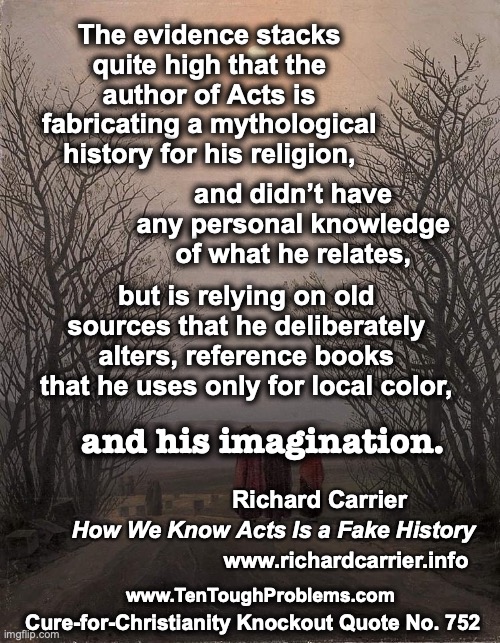
Carrier tells it like it is:
“The evidence stacks quite high that the author of Acts is fabricating a mythological history for his religion, and didn’t have any personal knowledge of what he relates, but is relying on old sources that he deliberately alters, reference books that he uses only for local color, and his imagination. There is simply no way a companion of Paul wrote this, or anyone of his generation. Indeed he conspicuously never claims he was—and since he would have claimed any authority he actually had, his silence proves he couldn’t claim this.”
I encourage you to read these articles (and watch the videos) to gain understanding and perspective concerning the historical federal case of United States of America vs. Donald J. Trump.


































 Richard L. Fricks

