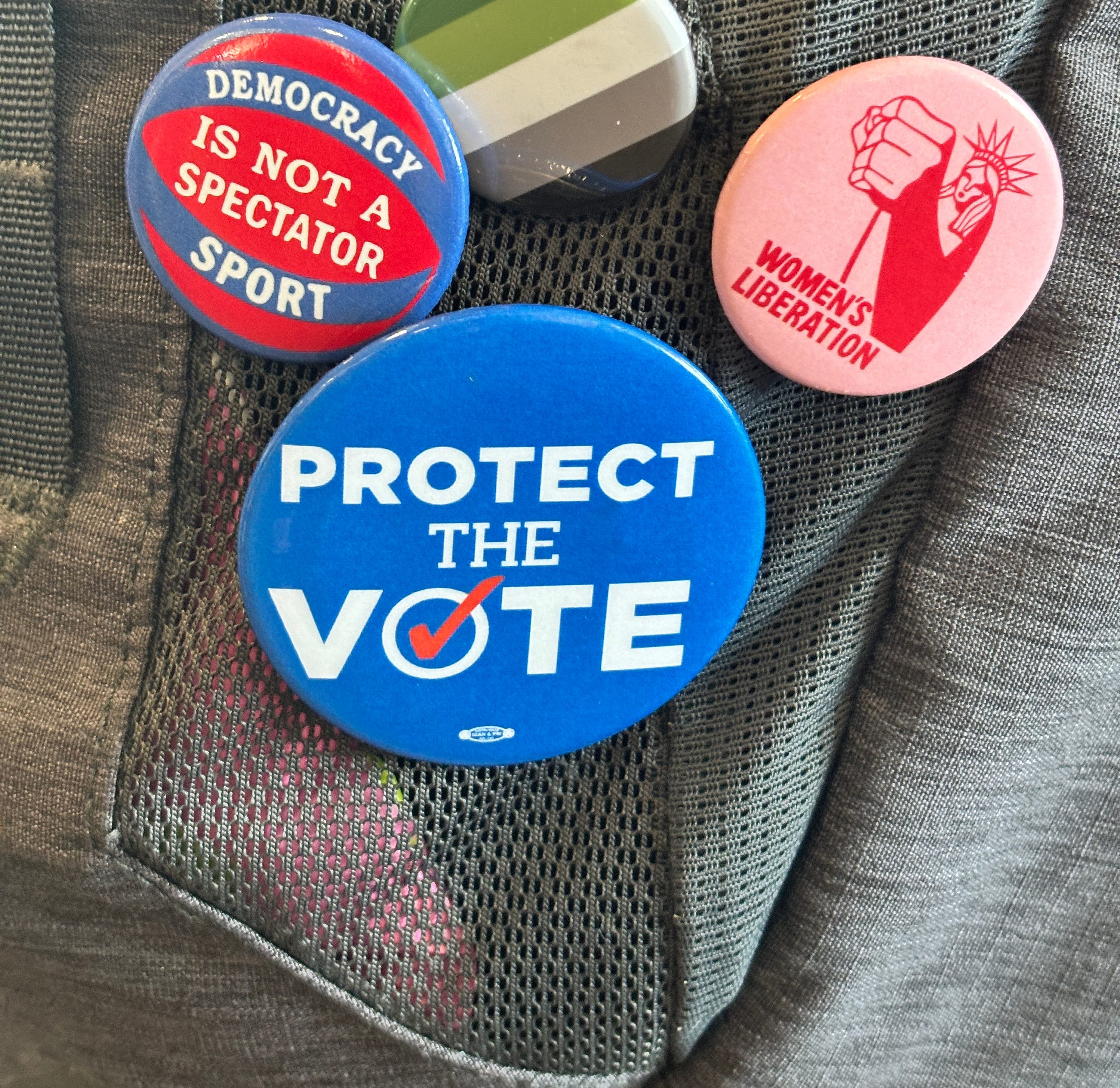
In the middle of all the high stakes political maneuvering going on in Washington, we shouldn’t overlook the importance of a little civil discourse in our own lives. Like the elegantly simple statement being made by the woman in front of me in line at the airport this morning who was nice enough to let me snap a photo.
These simple reminders help people who understand that democracy is on the ballot know that they aren’t alone. They are also seeds that we plant for people who are still trying to decide whether and how to vote.
It’s hard to understand how anyone could still be on the fence, but we don’t have to figure that out. What we need to understand is the importance of meeting people where they are and, rather than expressing surprise that they’re undecided, trying to counter some of the disinformation that’s circulating and may be keeping them on the ledge, with facts.
Last week, one of the favorite Republican political myths, that Biden is too old to be president while Trump is capable and vibrant, resurfaced.
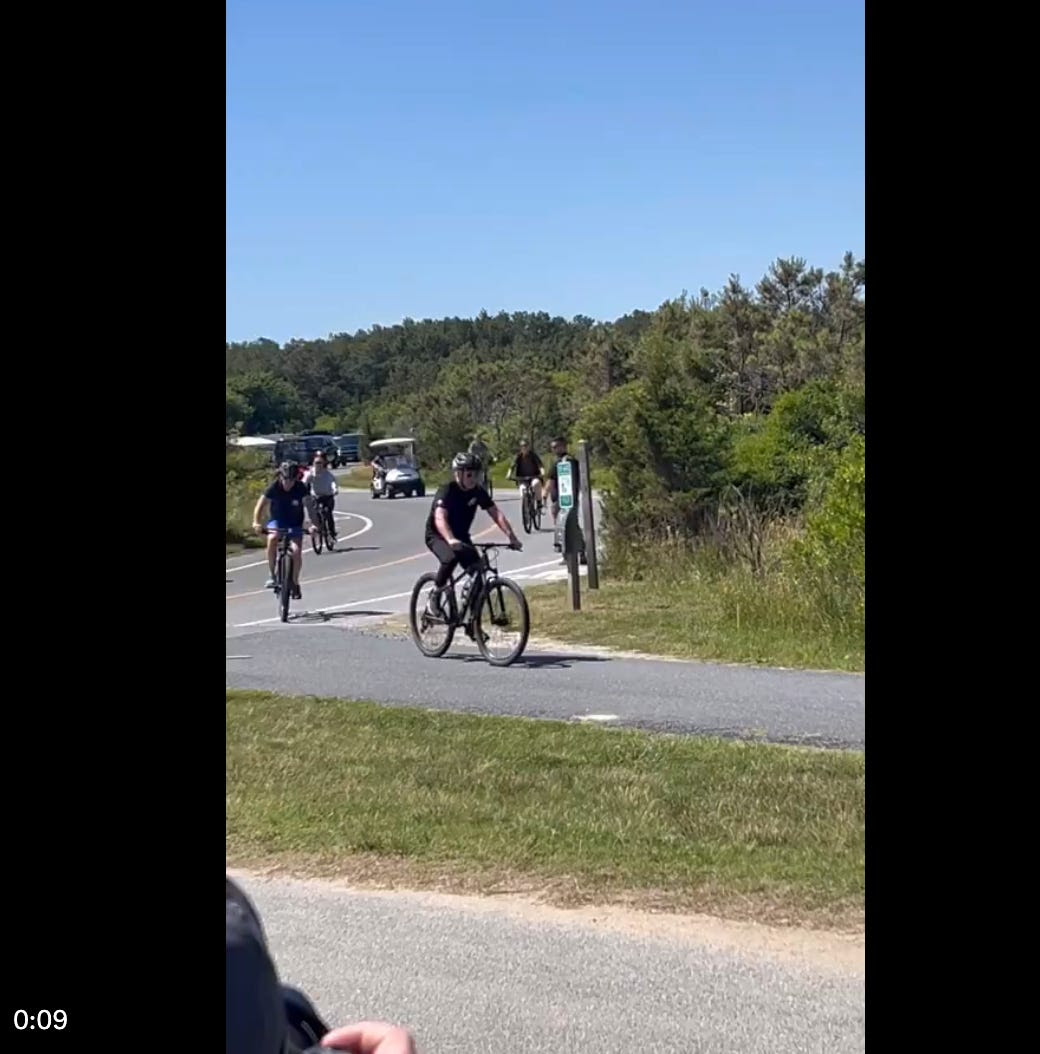
Joe Biden out for a ride on June 1, 2024 in Rehoboth, Delaware.
Seen Trump on a bicycle lately?
Biden is 81 years old. Trump turned 78 on Friday. It’s not a significant difference in age. While both of them occasionally have to reach for a word, as so many perfectly capable people do as they grow older, the similarities stop there. But the narratives being told about the candidates’ age and ability are very different and don’t match the reality that anyone who takes the time to can readily observe.
Biden flew to Europe for the D-Day anniversary, then home, then back to Europe for the G7 Summit, and held up to the rigors of travel well. His foreign policy expertise was on full display as he deftly handled key allies amid Putin’s war in Ukraine.
What did the President’s political opponents make of his trips? Right-wing media outlets circulated video, now all over social media, that makes it appear that Biden wandered off at the G7 summit while all the leaders were gathered. But that’s not what happened. The actual video shows Biden walking over to congratulate parachutists who were part of the celebration.
You might ask fence-sitters to consider, why would anyone do this? If Biden really isn’t up to the job, right-wingers wouldn’t have to make up a story, deceptively edit video, and push it out. If they’d make up a story like that, what else are they lying about? And perhaps most importantly, why are they lying to you?
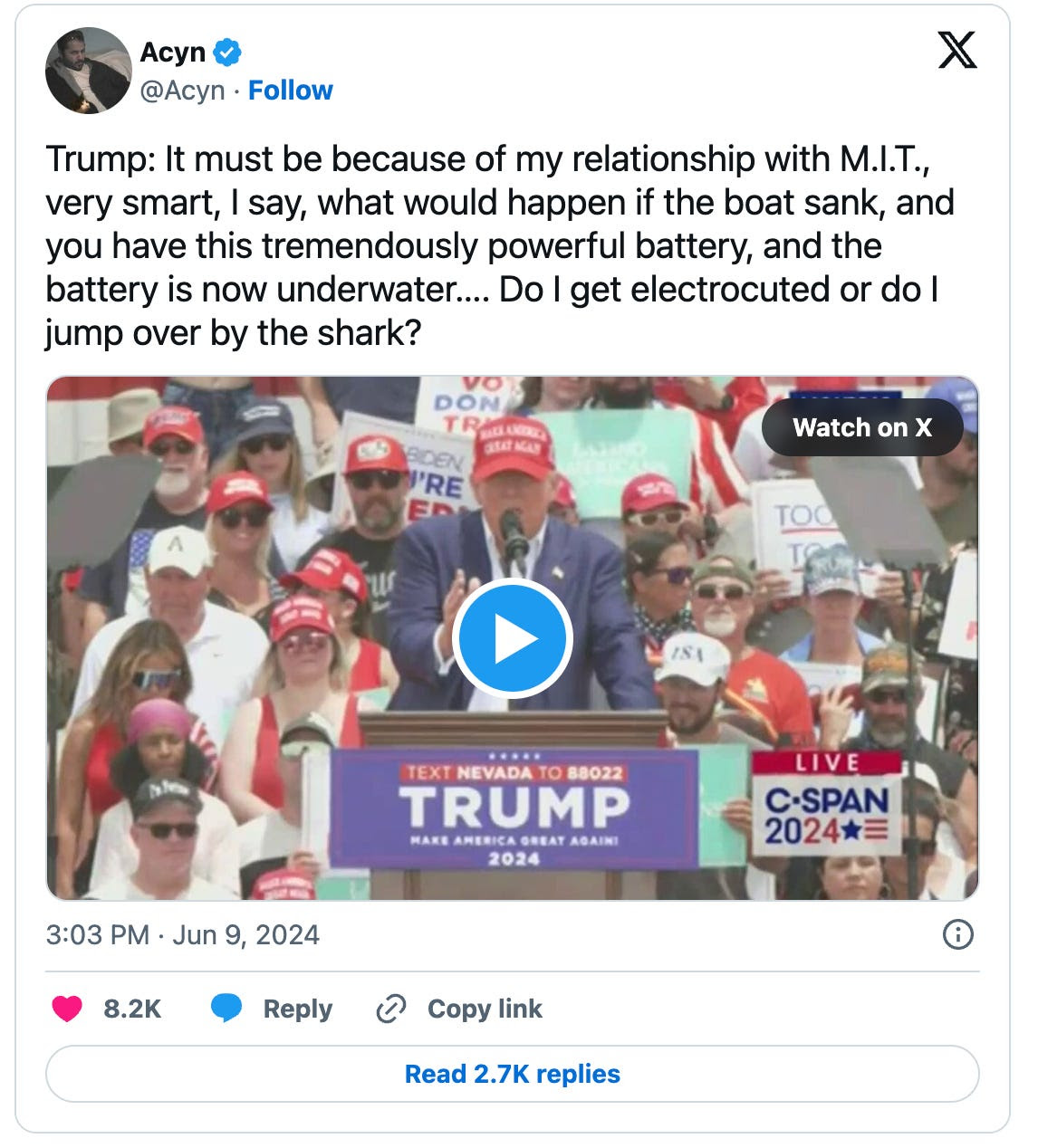
What was Trump doing while Biden was supporting our key European alliances? His teleprompter went down during a campaign speech in Nevada with awkward results.
“I’ll take electrocution every single time,” Trump said. “I’m not getting near the shark.” Okay. I’ll take the guy who is handling American business over the guy babbling about sharks every time. And maybe if some of the folks who haven’t made up their minds yet knew about it, they would too.
It’s a good time to try out a little civil discourse and encourage people to look up the actual facts and video for themselves—they don’t have to take your word for it. You can explain what is actually happening to them, but tell them to check it out for themselves. One of the benefits of having truth on your side is that you can do that. Trump’s claims about Biden don’t withstand daylight.
The GOP is still beating the “Biden crime family” dead horse when in fact, their efforts to provoke criminal investigation or impeachment have all spectacularly and publicly failed. Their key witness lied to the FBI and faces prosecution—they seem to have forgotten his existence. And despite the strong push to “get” Hunter Biden, which produced the gun charges he was just convicted on and the tax charges he still faces, no evidence surfaced that implicated President Biden in international corruption or fraud schemes MAGA Republicans have been pushing. Last September, three-fifths of American voters believed the unproven but widely repeated allegations that Joe Biden was involved in corruption. Since then, those allegations have gone from being unproven to disproven. There were even suggestions that the failed GOP witness, Alexander Smirnov, was peddling lies for Russia.
Anyone who is turned off from voting because they hear Joe Biden was as corrupt as Trump? Turns out it was all a mirage, a very successful public relations coup for Republicans.
That’s an important point to share. Suggest that your friends examine what they see on social media carefully, because it’s not all true. Concerned about Gaza? It’s worth it for a voter for whom that issue is important to take a look at the differences between Biden’s and Trump’s positions and decide which they feel better serves their concerns. Worried about climate change? Trump’s recent meeting with Big Oil—the one where he asked them to to donate $1 billion to his campaign while promising he would terminate Biden’s policies on electric vehicles, wind energy, and other plans to decrease reliance on fossil fuels—is informative. Do they really want to trust the guy who is calling for a revenge presidency? The guy who blithely attacks Joe Biden for being old, while the press seems to give him a pass on far worse.
The key point is this: democracy is the system that unlocks all of our other rights. In its absence, those rights fade away. How you are able to live your life could come down to the whims of a ruler who has only his own self-interest in mind. People still get to vote this November. They should exercise that right carefully, and cherish it, especially if they want to be able to do it in the future.
A little civil discourse can go along way. Don’t hesitate to practice. And please share the newsletter—it’s free—with folks you think might benefit from being encouraged to think and fact check for themselves.
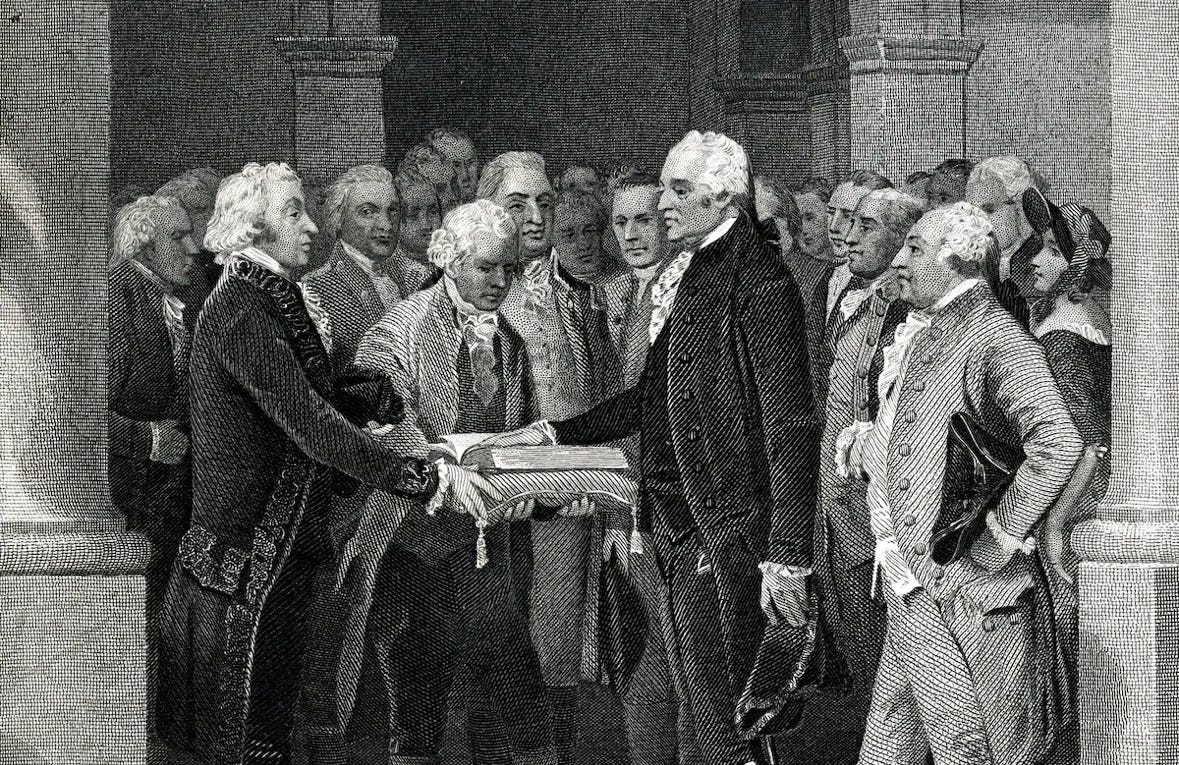
Engraving from 1869 commemorating the first inauguration of President George Washington on April 30, 1789
American greatness has been fueled and sustained by qualities of character that are timeless and sorely needed during these days of national crisis. There should be no mistake about this being a moment of crisis or blindness about its cause, or who specifically is responsible.
The three greatest American presidents — Washington, Lincoln and Franklin Roosevelt — collectively created America, saved the Union, ended slavery, and saved the world from tyranny. Each man’s greatest achievements and service were fueled by their exceptional character and dedication to virtue.
Washington was a man of exceptional humility, who repeatedly walked away from power to set in motion a new epoch of history. He was an example of the restraint necessary to sustain a republic. His actions awed the world, as well as the people of our young nation. When he passed he was eulogized as first in war, first in peace and first in the hearts of his countrymen.
Lincoln demonstrated iron strength, indomitability, fortitude and magnanimity. His second inaugural is the greatest speech in America’s secular canon. Its words are transcendent.
He makes clear that the cause of war was the moral catastrophe of slavery. His determination is absolute.
Fondly do we hope ~ fervently do we pray ~ that this mighty scourge of war may speedily pass away. Yet, if God wills that it continue until all the wealth piled by the bondsman’s two hundred and fifty years of unrequited toil shall be sunk and until every drop of blood drawn with the lash shall be paid by another drawn with the sword as was said three thousand years ago so still it must be said ‘the judgments of the Lord are true and righteous altogether.’
So is his grace and magnanimity:
With malice toward none with charity for all with firmness in the right as God gives us to see the right let us strive on to finish the work we are in to bind up the nation’s wounds, to care for him who shall have borne the battle and for his widow and his orphan ~ to do all which may achieve and cherish a just and lasting peace among ourselves and with all nations.
Franklin Roosevelt had the gift of faith, and because of it, he possessed a bottomless wellspring of optimism. Because of it, he was fearless — and made his nation so. His last inaugural address was the shortest in history. It stood at 544 words, but remains remarkable nonetheless as a declaration of moral purpose around a national purpose. FDR was a man without doubt by the end. His faith was in us, and it was not misplaced then or now. Here is what he said:
Mr. Chief Justice, Mr. Vice President, my friends, you will understand and, I believe, agree with my wish that the form of this inauguration be simple and its words brief.
We Americans of today, together with our allies, are passing through a period of supreme test. It is a test of our courage–of our resolve–of our wisdom–our essential democracy.
If we meet that test–successfully and honorably–we shall perform a service of historic importance which men and women and children will honor throughout all time.
As I stand here today, having taken the solemn oath of office in the presence of my fellow countrymen–in the presence of our God– I know that it is America’s purpose that we shall not fail.
In the days and in the years that are to come we shall work for a just and honorable peace, a durable peace, as today we work and fight for total victory in war.
We can and we will achieve such a peace.
We shall strive for perfection. We shall not achieve it immediately–but we still shall strive. We may make mistakes–but they must never be mistakes which result from faintness of heart or abandonment of moral principle.
I remember that my old schoolmaster, Dr. Peabody, said, in days that seemed to us then to be secure and untroubled: “Things in life will not always run smoothly. Sometimes we will be rising toward the heights–then all will seem to reverse itself and start downward. The great fact to remember is that the trend of civilization itself is forever upward; that a line drawn through the middle of the peaks and the valleys of the centuries always has an upward trend.”
Our Constitution of 1787 was not a perfect instrument; it is not perfect yet. But it provided a firm base upon which all manner of men, of all races and colors and creeds, could build our solid structure of democracy.
And so today, in this year of war, 1945, we have learned lessons– at a fearful cost–and we shall profit by them.
We have learned that we cannot live alone, at peace; that our own well-being is dependent on the well-being of other nations far away. We have learned that we must live as men, not as ostriches, nor as dogs in the manger.
We have learned to be citizens of the world, members of the human community.
We have learned the simple truth, as Emerson said, that “The only way to have a friend is to be one.” We can gain no lasting peace if we approach it with suspicion and mistrust or with fear.
We can gain it only if we proceed with the understanding, the confidence, and the courage which flow from conviction.
The Almighty God has blessed our land in many ways. He has given our people stout hearts and strong arms with which to strike mighty blows for freedom and truth. He has given to our country a faith which has become the hope of all peoples in an anguished world.
So we pray to Him now for the vision to see our way clearly–to see the way that leads to a better life for ourselves and for all our fellow men–to the achievement of His will to peace on earth.
Eighty-two days later he was dead.
The Warning with Steve Schmidt is a reader-supported publication. To receive new posts and support my work, consider becoming a free or paid subscriber.
Upgrade to paid
Harry Truman had been vice president for just 82 days when he was received by Eleanor Roosevelt in her study in the White House on April 12, 1945. He had been playing poker in Speaker Sam Rayburn’s hideaway when a call came summoning him back to the White House.
Harry, the president is dead.
Truman responded:
Is there anything I can do for you?
Eleanor Roosevelt, a giant of the 20th century, replied:
No, Mr. President. Is there anything I can do for you? You are the one in trouble now.
Truman, a decorated combat veteran of the First World War, recalled his emotions this way, telling reporters the following day:
I felt like the moon, the stars and all the planets had fallen on me.
Why did he feel that way? What burden was thrust upon him?
It was the burden imposed by the most solemn oath that exists in American public life. Thirty-five words long, it is specifically proscribed in the US Constitution, and was taken for the first time on March 4, 1789, by George Washington. When Truman raised his hand, he was the 32nd person in American history to swear it. When he did, he became president of the United States of America. His styling was simple and unadorned. “Mr. President” is what we call the person who swears that oath. Here it is:
I do solemnly swear to faithfully execute the office of President of the United States and to the best of my ability preserve, protect and defend the Constitution of the United States.
When it is sworn, executive power is either renewed or transferred. For 223 years, including through civil war, world war, assassination, economic depression and presidential resignation, it was peacefully transferred.
The first time it was peacefully transferred occurred in 1797. John Adams was fully aware that the unprecedented event was regarded with amazement. He recognized the significance of the moment and spoke about the “great uncertainty” that had followed the revolution and the establishment of the republic. The achievement was fresh, new, extraordinary and filled with promise and peril. This is how Adams described the achievement that would utterly transform world history and human civilization:
But this is very certain, that to a benevolent human mind there can be no spectacle presented by any nation more pleasing, more noble, majestic, or august, than an assembly like that which has so often been seen in this and the other Chamber of Congress, of a Government in which the Executive authority, as well as that of all the branches of the Legislature, are exercised by citizens selected at regular periods by their neighbors to make and execute laws for the general good. Can anything essential, anything more than mere ornament and decoration, be added to this by robes and diamonds? Can authority be more amiable and respectable when it descends from accidents or institutions established in remote antiquity than when it springs fresh from the hearts and judgments of an honest and enlightened people? For it is the people only that are represented. It is their power and majesty that is reflected, and only for their good, in every legitimate government, under whatever form it may appear. The existence of such a government as ours for any length of time is a full proof of a general dissemination of knowledge and virtue throughout the whole body of the people. And what object or consideration more pleasing than this can be presented to the human mind? If national pride is ever justifiable or excusable it is when it springs, not from power or riches, grandeur or glory, but from conviction of national innocence, information, and benevolence.
In the midst of these pleasing ideas we should be unfaithful to ourselves if we should ever lose sight of the danger to our liberties if anything partial or extraneous should infect the purity of our free, fair, virtuous, and independent elections. If an election is to be determined by a majority of a single vote, and that can be procured by a party through artifice or corruption, the Government may be the choice of a party for its own ends, not of the nation for the national good. If that solitary suffrage can be obtained by foreign nations by flattery or menaces, by fraud or violence, by terror, intrigue, or venality, the Government may not be the choice of the American people, but of foreign nations. It may be foreign nations who govern us, and not we, the people, who govern ourselves; and candid men will acknowledge that in such cases choice would have little advantage to boast of over lot or chance.
The peaceful transfer of power is at the core of the American system of government and way of life. Its endurance was mistakenly interpreted by most of the country as permanence. It is not an inherited right. It marks renewal and recommitment to the core of the American revolution and the ideals that animate America. When power is transferred in America, it is a powerful and profound moment.
It is important to understand the desecration and chaos Trump and his mob have wrought with their attack against America. They have normalized conspiracy. They have made the truth and lie equal in a public square contaminated by the toxic sewage of division, propaganda and misinformation. They have assaulted the essence of America through a conspiracy to seize power that was bestowed by the American people on Joe Biden. The treachery is historic, unprecedented and ongoing. The days ahead will test America’s spirit, resolve and democracy.
Below are the moments when power was transferred. Listen to select words of the inaugural speeches of America’s Democratic and Republican presidents. Do you see the continuity and the majesty of what Trump and his filthy accomplices desecrated?
When President Donald J. Trump’s eldest son took the stage outside the Georgia Republican Party headquarters two days after the 2020 election, he likened what lay ahead to mortal combat.
“Americans need to know this is not a banana republic!” Donald Trump Jr. shouted, claiming that Georgia and other swing states had been overrun by wild electoral shenanigans. He described tens of thousands of ballots that had “magically” shown up around the country, all marked for Joseph R. Biden Jr., and others dumped by Democratic officials into “one big box” so their authenticity could not be verified.
Mr. Trump told his father’s supporters at the news conference — who broke into chants of “Stop the steal!” and “Fraud! Fraud!” — that “the number one thing that Donald Trump can do in this election is fight each and every one of these battles, to the death!”
Over the two months that followed, a vast effort unfolded on behalf of the lame-duck president to overturn the election results in swing states across the country. But perhaps nowhere were there as many attempts to intervene as in Georgia, where Fani T. Willis, the district attorney of Fulton County, is now poised to bring an indictment for a series of brazen moves made on behalf of Mr. Trump in the state after his loss and for lies that the president and his allies circulated about the election there.
Mr. Trump has already been indicted three times this year, most recently in a federal case brought by the special prosecutor Jack Smith that is also related to election interference. But the Georgia case may prove the most expansive legal challenge to Mr. Trump’s attempts to cling to power, with nearly 20 people informed that they could face charges.
It could also prove the most enduring: While Mr. Trump could try to pardon himself from a federal conviction if he were re-elected, presidents cannot pardon state crimes.
Perhaps above all, the Georgia case assembled by Ms. Willis offers a vivid reminder of the extraordinary lengths taken by Mr. Trump and his allies to exert pressure on local officials to overturn the election — an up-close portrait of American democracy tested to its limits.
There was the infamous call that the former president made to Brad Raffensperger, Georgia’s Republican secretary of state, during which Mr. Trump said he wanted to “find” nearly 12,000 votes, or enough to overturn his narrow loss there. Mr. Trump and his allies harassed and defamed rank-and-file election workers with false accusations of ballot stuffing, leading to so many vicious threats against one of them that she was forced into hiding.
They deployed fake local electors to certify that Mr. Trump had won the election. Within even the Justice Department, an obscure government lawyer secretly plotted with the president to help him overturn the state’s results.
And on the same day that Mr. Biden’s victory was certified by Congress, Trump allies infiltrated a rural Georgia county’s election office, copying sensitive software used in voting machines throughout the state in their fruitless hunt for ballot fraud.
The Georgia investigation has encompassed an array of high-profile allies, from the lawyers Rudolph W. Giuliani, Kenneth Chesebro and John Eastman, to Mark Meadows, the White House chief of staff at the time of the election. But it has also scrutinized lesser-known players like a Georgia bail bondsman and a publicist who once worked for Kanye West.
As soon as Monday, there could be charges from a Fulton County grand jury after Ms. Willis presents her case to them. The number of people indicted could be large: A separate special grand jury that investigated the matter in an advisory capacity last year recommended more than a dozen people for indictment, and the forewoman of the grand jury has strongly hinted that the former president was among them.
If an indictment lands and the case goes to trial, a regular jury and the American public will hear a story that centers on nine critical weeks from Election Day through early January in which a host of people all tried to push one lie: that Mr. Trump had secured victory in Georgia. The question before the jurors would be whether some of those accused went so far that they broke the law.
A recording of Mr. Trump talking to Brad Raffensperger, secretary of state of Georgia, was played during a hearing by the Jan. 6 Committee last October. Credit…Alex Wong/Getty Images
Unleashing ‘Hate and Fury’
It did not take long for the gloves to come off.
During the Nov. 5 visit by Donald Trump Jr., the Georgia Republican Party was already fracturing. Some officials believed they should focus on defending the seats of the state’s two Republican senators, Kelly Loeffler and David Perdue, who were weeks away from runoff elections, rather than fighting a losing presidential candidate’s battles.
But according to testimony before the Jan. 6 committee by one of the Trump campaign’s local staffers, Mr. Trump’s son was threatening to “tank” those Senate races if there was not total support for his father’s effort. (A spokesman for Donald Trump Jr. disputed that characterization, noting that the former president’s son later appeared in ads for the Senate candidates.)
Four days later, the two senators called for Mr. Raffensperger’s resignation. The Raffensperger family was soon barraged with threats, leading his wife, Tricia, to confront Ms. Loeffler in a text message: “Never did I think you were the kind of person to unleash such hate and fury.”
Understand Georgia’s Investigation of Election Interference
Card 1 of 5
A legal threat to Trump. Fani Willis, the Atlanta area district attorney, has been investigating whether former President Donald Trump and his allies interfered with the 2020 election in Georgia. The case could be one of the most perilous legal problems for Trump. Here’s what to know:
What are prosecutors looking at? In addition to Trump’s call to Raffensperger, Willis has homed in on a plot by Trump allies to send fake Georgia electors to Washington and misstatements about the election results made before the state legislature by Rudy Giuliani, who spearheaded efforts to keep Trump in power as his personal lawyer. An election data breach in Coffee County, Ga., is also part of the investigation.
The potential charges. Experts say that Willis appears to be building a case that could target multiple defendants with charges of conspiracy to commit election fraud or racketeering-related charges for engaging in a coordinated scheme to undermine the election. The grand jury, which recently concluded its work, recommended indictments for multiple people, the forewoman of the jury said.
Four other battleground states had also flipped to Mr. Biden, but losing Georgia, the only Deep South state among them, seemed particularly untenable for Mr. Trump. His margin of defeat there was one of the smallest in the nation. Republicans controlled the state, and as he would note repeatedly in the aftermath, his campaign rallies in Georgia had drawn big, boisterous crowds.
By the end of November, Mr. Trump’s Twitter feed had become a font of misinformation. “Everybody knows it was Rigged” he wrote in a tweet on Nov. 29. And on Dec. 1: “Do something @BrianKempGA,” he wrote, referring to Gov. Brian Kemp of Georgia, a Republican. “You allowed your state to be scammed.”
But these efforts were not gaining traction. Mr. Raffensperger and Mr. Kemp were not bending. And on Dec. 1, Mr. Trump’s attorney general, William P. Barr, announced that the Department of Justice had found no evidence of voting fraud “on a scale that could have effected a different outcome in the election.”
A Show for Lawmakers
It was time to turn up the volume.
Mr. Giuliani was on the road, traveling to Phoenix and Lansing, Mich., to meet with lawmakers to convince them of fraud in their states, both lost by Mr. Trump. Now, he was in Atlanta.
Even though Mr. Trump’s loss in Georgia had been upheld by a state audit, Mr. Giuliani made fantastical claims at a hearing in front of the State Senate, the first of three legislative hearings in December 2020.
Rudolph Giuliani at a legislative hearing at the Georgia State Capitol in Atlanta in December 2020.Credit…Rebecca Wright/Atlanta Journal-Constitution, via Associated Press
He repeatedly asserted that machines made by Dominion Voting Systems had flipped votes from Mr. Trump to Mr. Biden and changed the election outcome — false claims that became part of Dominion defamation suits against Fox News, Mr. Giuliani and a number of others.
Mr. Giuliani, then Mr. Trump’s personal lawyer, also played a video that he said showed election workers pulling suitcases of suspicious ballots from under a table to be secretly counted after Republican poll watchers had left for the night.
He accused two workers, a Black mother and daughter named Ruby Freeman and Wandrea Moss, of passing a suspicious USB drive between them “like vials of heroin or cocaine.” Investigators later determined that they were passing a mint; Mr. Giuliani recently admitted in a civil suit that he had made false statements about the two women.
Other Trump allies also made false claims at the hearing with no evidence to back them up, including that thousands of convicted felons, dead people and others unqualified to vote in Georgia had done so.
John Eastman, a lawyer advising the Trump campaign, claimed that “the number of underage individuals who were allowed to register” in the state “amounts allegedly up to approximately 66,000 people.”
That was not remotely true. During an interview last year, Mr. Eastman said that he had relied on a consultant who had made an error, and there were in fact about 2,000 voters who “were only 16 when they registered.”
But a review of the data he was using found that Mr. Eastman was referring to the total number of Georgians since the 1920s who were recorded as having registered before they were allowed. Even that number was heavily inflated due to data-entry errors common in large government databases.
The truth: Only about a dozen Georgia residents were recorded as being 16 when they registered to vote in 2020, and those appeared to be another data-entry glitch.
Trump supporters protesting election results at State Farm Arena in Atlanta in the days following the 2020 election.Credit…Audra Melton for The New York Times
The President Calling
In the meantime, Mr. Trump was working the phones, trying to directly persuade Georgia Republican leaders to reject Mr. Biden’s win.
He called Governor Kemp on Dec. 5, a day after the Trump campaign filed a lawsuit seeking to have the state’s election results overturned. Mr. Trump pressured Mr. Kemp to compel lawmakers to come back into session and brush aside the will of the state’s voters.
Mr. Kemp, who during his campaign for governor had toted a rifle and threatened to “round up illegals” in an ad that seemed an homage to Mr. Trump, rebuffed the idea.
Two days later, Mr. Trump called David Ralston, the speaker of the Georgia House, with a similar pitch. But Mr. Ralston, who died last year, “basically cut the president off,” a member of the special grand jury in Atlanta who heard his testimony later told The Atlanta Journal Constitution. “He just basically took the wind out of the sails.”
By Dec. 7, Georgia had completed its third vote count, yet again affirming Mr. Biden’s victory. But Trump allies in the legislature were hatching a new plan to defy the election laws that have long been pillars of American democracy: They wanted to call a special session and pick new electors who would cast votes for Mr. Trump.
Never mind that Georgia lawmakers had already approved representatives to the Electoral College reflecting Biden’s win in the state, part of the constitutionally prescribed process for formalizing the election of a new president. The Trump allies hoped that the fake electors and the votes they cast would be used to pressure Vice President Mike Pence not to certify the election results on Jan. 6.
Mr. Kemp issued a statement warning them off: “Doing this in order to select a separate slate of presidential electors is not an option that is allowed under state or federal law.”
The Fake Electors Meet
Rather than back down, Mr. Trump was deeply involved in the emerging plan to enlist slates of bogus electors.
Mr. Trump called Ronna McDaniel, the head of the Republican National Committee, to enlist her help, according to Ms. McDaniel’s House testimony. By Dec. 13, as the Supreme Court of Georgia rejected an election challenge from the Trump campaign, Robert Sinners, the Trump campaign’s local director of Election Day operations, emailed the 16 fake electors, directing them to quietly meet in the capitol building in Atlanta the next day.
Mr. Trump’s top campaign lawyers were so troubled by the plan that they refused to take part. Still, the president tried to keep up the pressure using his Twitter account. “What a fool Governor @BrianKempGA of Georgia is,” he wrote in a post just after midnight on Dec. 14, adding, “Demand this clown call a Special Session.”
Ronna McDaniel, chair of the Republican National Committee, at a news conference following the election in 2020.Credit…Al Drago for The New York Times
Later that day, the bogus electors met at the Statehouse. They signed documents that claimed they were Georgia’s “duly elected and qualified electors,” even though they were not.
In the end, their effort was rebuffed by Mr. Pence.
In his testimony to House investigators, Mr. Sinners later reflected on what took place: “I felt ashamed,” he said.
A Guide to the Various Trump Investigations
Confused about the inquiries and legal cases involving former President Donald Trump? We’re here to help.
Key Cases and Inquiries: The former president faces several investigations at both the state and the federal levels, into matters related to his business and political careers. Here is a close look at each.
What if Trump Is Convicted?: Will any of the proceedings hinder Trump’s 2024 presidential campaign? Can a convicted felon even run for office? Here is what we know, and what we don’t know.
Moves in the White House
With other efforts failing, the White House chief of staff, Mark Meadows, got personally involved. Just before Christmas, he traveled to suburban Cobb County, Ga., during its audit of signatures on mail-in absentee ballots, which had been requested by Mr. Kemp.
Mr. Meadows tried to get into the room where state investigators were verifying the signatures. He was turned away. But he did meet with Jordan Fuchs, Georgia’s deputy secretary of state, to discuss the audit process.
During the visit, Mr. Meadows put Mr. Trump on the phone with the lead investigator for the secretary of state’s office, Frances Watson. “I won Georgia by a lot, and the people know it,” Mr. Trump told her. “Something bad happened.”
Byung J. Pak, the U.S. attorney in Atlanta at the time, believed that Mr. Meadows’s visit was “highly unusual,” adding in his House testimony, “I don’t recall that ever happening in the history of the U.S.”
In Washington, meanwhile, a strange plot was emerging within the Justice Department to help Mr. Trump.
Mr. Barr, one of the most senior administration officials to dismiss the claims of fraud, had stepped down as attorney general, and jockeying for power began. Jeffrey Clark, an unassuming lawyer who had been running the Justice Department’s environmental division, attempted to go around the department’s leadership by meeting with Mr. Trump and pitching a plan to help keep him in office.
Mr. Trump, his daughter Ivanka Trump and Mark Meadows, his chief of staff, leaving the White House en route to Georgia in January 2021.Credit…Pool photo by Erin Scott
Mr. Clark drafted a letter to lawmakers in Georgia, dated Dec. 28, falsely claiming that the Justice Department had “identified significant concerns” regarding the state’s election results. He urged the lawmakers to convene a special session — a dramatic intervention.
Richard Donoghue, who was serving as acting deputy attorney general, later testified that he was so alarmed when he saw the draft letter that he had to read it “twice to make sure I really understood what he was proposing, because it was so extreme.”
The letter was never sent.
One Last Call
Still, Mr. Trump refused to give up. It was time to reach the man who was in charge of election oversight: Mr. Raffensperger, Georgia’s secretary of state.
On Jan. 2, he called Mr. Raffensperger and asked him to recalculate the vote. It was the call that he would later repeatedly defend as “perfect,” an hourlong mostly one-sided conversation during which Mr. Raffensperger politely but firmly rejected his entreaties.
“You know what they did and you’re not reporting it,” the president warned, adding, “you know, that’s a criminal — that’s a criminal offense. And you know, you can’t let that happen. That’s a big risk to you.”
Mr. Raffensperger was staggered. He later wrote that “for the office of the secretary of state to ‘recalculate’ would mean we would somehow have to fudge the numbers. The president was asking me to do something that I knew was wrong, and I was not going to do that.”
Mr. Trump seemed particularly intent on incriminating the Black women working for the county elections office, telling Mr. Raffensperger that Ruby Freeman — whom he mentioned 18 times during the call — was “a professional vote-scammer and hustler.”
“She’s one of the hot items on the internet, Brad,” Mr. Trump said of the viral misinformation circulating about Ms. Freeman, which had already been debunked by Mr. Raffensperger’s aides and federal investigators.
Trump-fueled conspiracy theories about Ms. Freeman and her daughter, Ms. Moss, were indeed proliferating. In testimony to the Jan. 6 committee last year, Ms. Moss recounted Trump supporters forcing their way into her grandmother’s home, claiming they were there to make a citizen’s arrest of her granddaughter; Ms. Freeman said that she no longer went to the grocery store.
Then, on Jan. 4, Ms. Freeman received an unusual overture.
Trevian Kutti, a Trump supporter from Chicago who had once worked as a publicist for Kanye West, persuaded Ms. Freeman to meet her at a police station outside Atlanta. Ms. Freeman later said that Ms. Kutti — who told her that “crisis is my thing,” according to a video of the encounter — had tried to pressure her into saying she had committed voter fraud.
“There is nowhere I feel safe. Nowhere,” Ms. Freeman said in her testimony, adding, “Do you know how it feels to have the president of the United States target you?”
Cathy Latham, center, in a light blue shirt, in the elections office in Coffee County, Ga., while a team working on Mr. Trump’s behalf made copies of voting equipment data in January 2021.Credit…Coffee County, Georgia, via Associated Press
‘Every Freaking Ballot’
On Jan. 7, despite the fake electors and the rest of the pressure campaign, Mr. Pence certified the election results for Mr. Biden. The bloody, chaotic attack on the Capitol the day before did not stop the final certification of Biden’s victory, but in Georgia, the machinations continued.
In a quiet, rural county in the southeastern part of the state, Trump allies gave their mission one more extraordinary try.
A few hours after the certification, a small group working on Mr. Trump’s behalf traveled to Coffee County, about 200 miles from Atlanta. A lawyer advising Mr. Trump had hired a company called SullivanStrickler to scour voting systems in Georgia and other states for evidence of fraud or miscounts; some of its employees joined several Trump allies on the expedition.
“We scanned every freaking ballot,” Scott Hall, an Atlanta-area Trump supporter and bail bondsman who traveled to Coffee County with employees of the company on Jan. 7, recalled in a recorded phone conversation. Mr. Hall said that with the blessing of the Coffee County elections board, the team had “scanned all the equipment” and “imaged all the hard drives” that had been used on Election Day.
A law firm hired by SullivanStrickler would later release a statement saying of the company, “Knowing everything they know now, they would not take on any further work of this kind.”
Others would have their regrets, too. While Mr. Trump still pushes his conspiracy theories, some of those who worked for him now reject the claims of rigged voting machines and mysterious ballot-stuffed suitcases. As Mr. Sinners, the Trump campaign official, put it in his testimony to the Jan. 6 committee last summer, “It was just complete hot garbage.”
By then, Ms. Willis’s investigation was well underway.
“An investigation is like an onion,” she said in an interview soon after her inquiry began. “You never know. You pull something back, and then you find something else.”
Danny Hakim is an investigative reporter. He has been a European economics correspondent and bureau chief in Albany and Detroit. He was also a lead reporter on the team awarded the 2009 Pulitzer Prize for Breaking News. More about Danny Hakim
Richard Fausset is a correspondent based in Atlanta. He mainly writes about the American South, focusing on politics, culture, race, poverty and criminal justice. He previously worked at The Los Angeles Times, including as a foreign correspondent in Mexico City. More about Richard Fausset
Special Counsel Jack Smith’s indictment reveals how far Donald Trump and his cronies were willing to go to overturn the election. American democracy had a very narrow escape indeed in 2020.
Reading Time: 5 MINUTES
Throughout his long life of wealth and privilege, Donald Trump has dodged consequences time and again. Could this finally be the case that brings him to heel?
At the start of 2023, progressives could have been forgiven for feeling cynical. At that point, it had been over two years since the election, and despite his numerous and well-documented acts of criminality, he was facing no charges. It seemed a foregone conclusion that, yet again, he would thumb his nose at the law and get off scot-free.
However, that pessimism was premature. While it took an unacceptably long time, the machinery of the justice system is finally creaking into action.
In the last few months, Trump has been hit with a flurry of indictments. He’s now facing criminal charges in New York (for his hush-money payments to a sex worker, in violation of election law); in federal court in Florida (for stealing classified documents and refusing to return them); and possibly soon in Georgia (for his felonious attempt at strong-arming the Secretary of State to “find” more votes for him).
But this is the big one. Special Counsel Jack Smith has filed felony charges against Trump for his attempts to overturn the 2020 election, including his role in inciting the deadly January 6 insurrection.
What’s in the indictment
There’s little in this indictment we didn’t already know. Most of it recounts the evidence gathered by the Congressional January 6 Commission. But it’s both informative and terrifying to see it in one place.
In late 2020, when it was clear that he had lost, Trump started spreading lies that the election was fraudulent, despite being told by his own advisors that there was no basis for believing this. A Trump campaign advisor complained about having to defend “conspiracy shit beamed down from the mothership”.
He filed a blizzard of groundless lawsuits, all of which were thrown out, and pressured Republican legislatures in swing states to override their own voters and award him the election. This effort failed as well.
The crux of the scheme, and of Jack Smith’s criminal charges, is this: When his other strategies to steal the election floundered, Trump came up with a last-ditch plan to rig the Electoral College. He conspired with his supporters to draw up fake electoral-vote certificates, hand them to Vice President Mike Pence on the floor of Congress, and have him reject the real electoral votes and count the fake ones.
Conspiracy against rights
To be perfectly clear: This isn’t free speech; this is a crime. It’s a scheme to use forged versions of official documents to change the outcome of a legal proceeding. This is like printing counterfeit dollar bills and trying to use them in a store, or forging a dead person’s will and giving it to a lawyer to read to the heirs because you don’t like what’s in the real one.
(Fittingly, one of the charges stemming from this plan is “conspiracy against rights”, first passed into law in the Ku Klux Klan Act of 1870.)
However, Pence wouldn’t go along with the plan. He insisted that the Vice President had no power to arbitrarily pick and choose electoral votes (because of course he doesn’t—if he did, no incumbent president would ever lose reelection). Trump berated him for being “too honest”, but Pence didn’t give in.
I despise Pence for being a soulless theocrat whose heart pumps sour milk instead of blood, but I have to grudgingly give him credit for this. He refused to go along with Trump’s lawbreaking, and he held firm on that stance despite enormous pressure.
However, not everyone in Trump’s circle was so principled. The most hair-raising line of the indictment is a transcript of a conversation between White House deputy counsel Patrick Philbin and a person identified as “Co-conspirator #4″—widely believed to be Jeffrey Clark, a Trump crony in the Justice Department.
Philbin argued that if Trump succeeded with his scheme, there would be riots in every major American city. Clark/Co-conspirator 4 said:
“…that’s why there’s an Insurrection Act.”
Sit with these words for a minute.
We know—even if it’s come to seem less shocking through sheer repetition—that the president of the United States schemed to steal an election, in plain sight, and remain in office against the will of the voters. We now know, in addition, that the conspirators expected mass protest from the American people, and that they were at least considering calling out the military to put the protests down by force.
A second Civil War
As I said at the time, it’s no exaggeration to say that a competent fascist could have overthrown the United States government in 2020. We came right up to the edge of killing democracy and turning the country over to a military junta.
It’s possible the military would have refused to follow these orders if Trump had given them—but at minimum, we’d have been plunged into a massive constitutional crisis. And what would have happened if some branches of the military had gone along with the scheme while others refused? Blue states claiming Trump wasn’t president while red states claimed he was? It could have ignited a second Civil War.
Either way, we escaped by the skin of our teeth. We know the next and final act of the drama: when everything else failed, Trump gathered a mob of his followers in Washington, D.C., riled them up with more lies about a stolen election, and incited them to assault the Capitol. The mob overwhelmed the Capitol police, broke into the building while Congress fled in a panic, and ransacked the halls of government until law enforcement regrouped and chased them out. They failed to disrupt the election, but if they had captured Pence or any member of Congress, we know what they intended. They built a gallows.
A norm not to be broken lightly
There’s good reason not to prosecute former presidents. It’s not a norm to be broken lightly. Otherwise, we risk becoming a banana republic where every new president persecutes and jails his opposition. It’s not hyperbole to say that this norm has helped America have smooth handovers of power for the last two centuries, something other nations have struggled with.
But there have to be limits to what we’re willing to tolerate. Otherwise, a president could commit crimes with impunity. There may still be reason to overlook minor offenses, but extraordinary crimes demand an extraordinary response.
We approached this precipice once before, with a different Republican president. However, with Nixon, it mattered that the entire political apparatus was united against him. He resigned because Congressional Republicans made it clear to him that they’d support impeachment. Without the party behind him, he had no prospect of political survival. Rightly or wrongly, Ford’s decision to pardon him was likely motivated by the belief that there was no further harm he could do.
The situation we’re facing is very different. With a handful of principled exceptions—many of whom have already lost their seats in primaries—the Republican Party has fallen into line behind Trump. They’re still excusing his flagrant lawbreaking and his attempted coup. Even his political rivals, who’d benefit most if he were removed from the board, continue to attack and denounce Democrats for prosecuting him. Whatever the outcomes of the criminal trials, he’s all but certain to be the 2024 nominee.
Can our democracy survive when one of its two major parties has embraced insurrection and authoritarianism? Perhaps, but only if it’s apparent to everyone that there will be consequences. The United States has to deliver a strong message that attacks on the fabric of our society will be punished. Otherwise, he and others like him will just be emboldened to try again.
There’s no question about whether Trump committed the acts he’s charged with. Of course, the real hurdle is finding a jury willing to convict him. But that’s no reason not to try. On the contrary, justice demands we make the attempt. To give up before we start would be to concede that the rich and politically influential are above the law, whereas if we try him, there’s at least a chance. And if the prosecutors succeed, they may just save American democracy in the bargain.
Perhaps it is best to start by looking back at the moment immediately before Donald Trump descended via escalator in Trump Tower into the 2016 presidential race on June 16, 2015.
Two thousand nine hundred and seventy-two days have passed since then, and the end stage of a great American travesty and tragedy is at hand. What lies beyond it is unclear because behind us is a vast wreckage field where shards of shattered trust and the jagged edges of obliterated integrity lay scattered. The American people have lost faith in their society, and become estranged from the nation’s most important institutions. They disdain the media, politics, politicians, political parties, powerful tech companies, billionaires, corporations and a system where there seems to be one set of rules for people at the top, and one for everyone else.
Trump’s rise is a symptom, not the cause, of America’s current cancer. A man like Trump simply does not get elected to the presidency of a stable and healthy country. He is a marker of decay and a catalyst for it. His presidency was a vicious cycle of degradations, national humiliations, collaboration, betrayal, failure and incandescent cowardice. It has led us here — to this epic hour where the citizens of the United States must make a decision for the future that will either begin an era of renewal and reform, or one that cripples American democracy and murders the republic born in 1776. Whatever the choice may be, it will be made by this generation of Americans on the eve of America’s 250th anniversary of independence.
Maybe we wouldn’t have gotten here if there wasn’t so much arrogant disdain for the achievements of our ancestors and the magnificence of their most noble acts. There has never been a just or perfect era in America’s story. Instead, there has been the opportunity for progress and the expansion of justice handed to each generation of free citizens who can all claim the legacy of America’s founding. The unfolding story of American liberty is among mankind’s greatest achievements. Understanding the story and knowing the details is essential to its survival and continuation. Let us talk about George Washington. Washington is America’s most important and wisest teacher. His lessons were about humility. There is great strength through authentic humility. America should remember this:
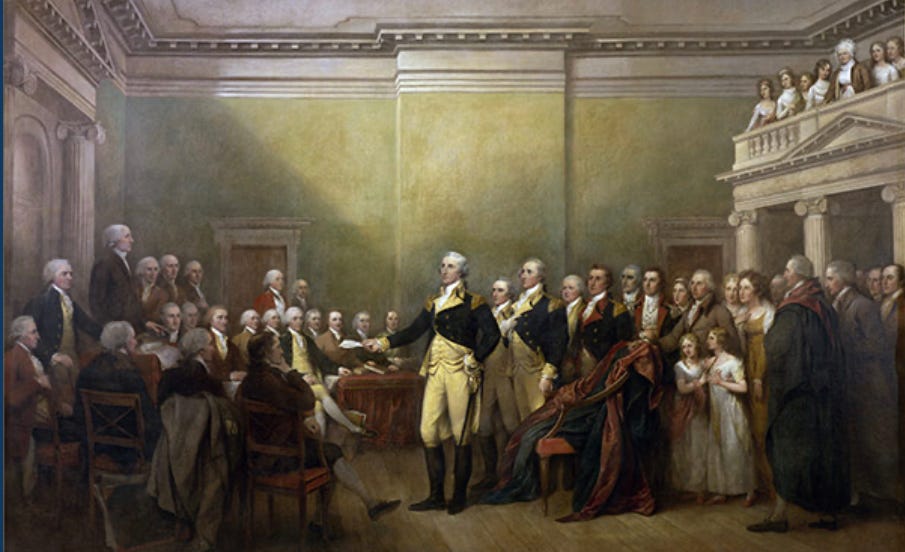
This painting by John Trumbull of General Washington resigning his commission hangs in the rotunda of the United States Capitol. Notice the chair larger than the rest draped with a cloak. It symbolizes Washington’s act of resigning from his position of power. Turnbull considered this to be amongst the “highest moral lessons ever given to the world.”
Washington entered the chambers of the Maryland State House where the Congress of the Confederation had convened for a highly scripted ceremony that had been meticulously planned down to the last detail. The date was December 23, 1783, and Washington had come to lay down his power. He could have been Caesar. Instead, he became president six years later when his country called him to service again. Washington could have been a tyrant or a king. He chose a different path because of the magnificence of his character.
The Warning with Steve Schmidt is a reader-supported publication. To receive new posts and support my work, consider becoming a free or paid subscriber.
Upgrade to paid
The great tragedy of this moment is that Trump’s delusions simply needed to be repudiated with the truth. Yet there was none to be found on a vast desert of MAGA cowardice, where the essence of the American system was left undefended lest it piss Trump off. The fear of mean tweets is all it took to undo the act of humility that made the nation spring to life.
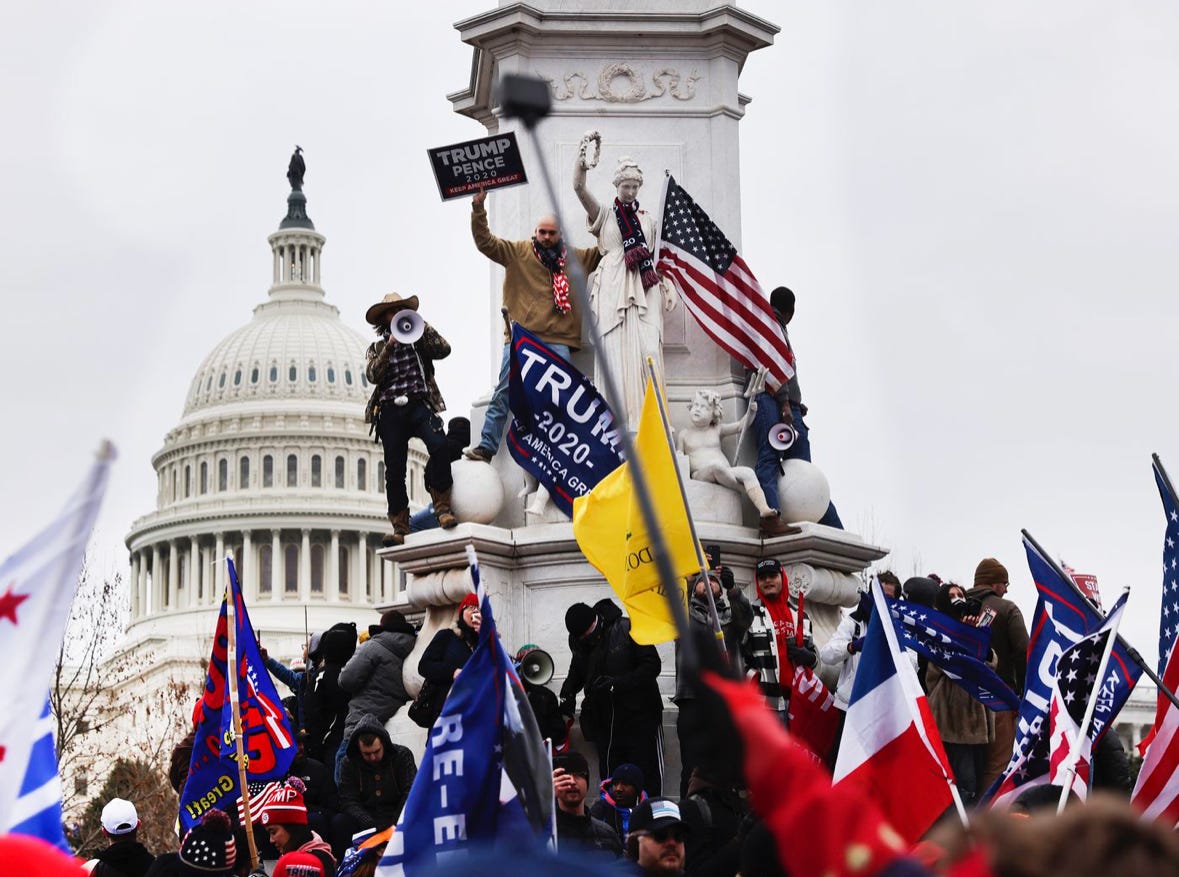
When Trump sent his mob to reverse Washington’s submission to Congress and make him dictator, they paraded past the old painting of George Washington. The criminals who attacked on Trump’s orders smeared excrement on the walls of the Capitol and urinated on the floors of the US Senate and House. They desecrated America’s capitol and founding with treachery and venom. It was a despicable act, and it was created by Trump. It was his moment. His actions were a declaration of repudiation against what Washington fought to create. Shameful doesn’t begin to describe it.
We the people must not tolerate it any longer. It is time to move on to a new era and leave Donald Trump behind. There is no way to support Trump and maintain loyalty to America. They are antithetical propositions and the hour of choosing has arrived. Soon we will know.
Donald Trump tried to overthrow the American republic because he lost an election. Nearly every single Republican member of Congress helped him do it by suborning his ceaseless and premeditated lies. They stoked the fires of incitement that led to Trump’s coup as his collaborators and partners. Ambition and fear overwhelmed their duty and patriotism.
The wretched truth is that with scant exceptions the entirety of the Republican Party from its elected officials, party officials, donors, activists and volunteers abandoned America in favor of their faction. George Washington’s fears had come to pass just as his warnings went unheeded by this generation of Americans. In his farewell address on September 17, 1796, he said the following:
However [political parties] may now and then answer popular ends, they are likely in the course of time and things, to become potent engines, by which cunning, ambitious, and unprincipled men will be enabled to subvert the power of the people and to usurp for themselves the reins of government, destroying afterwards the very engines which have lifted them to unjust dominion.
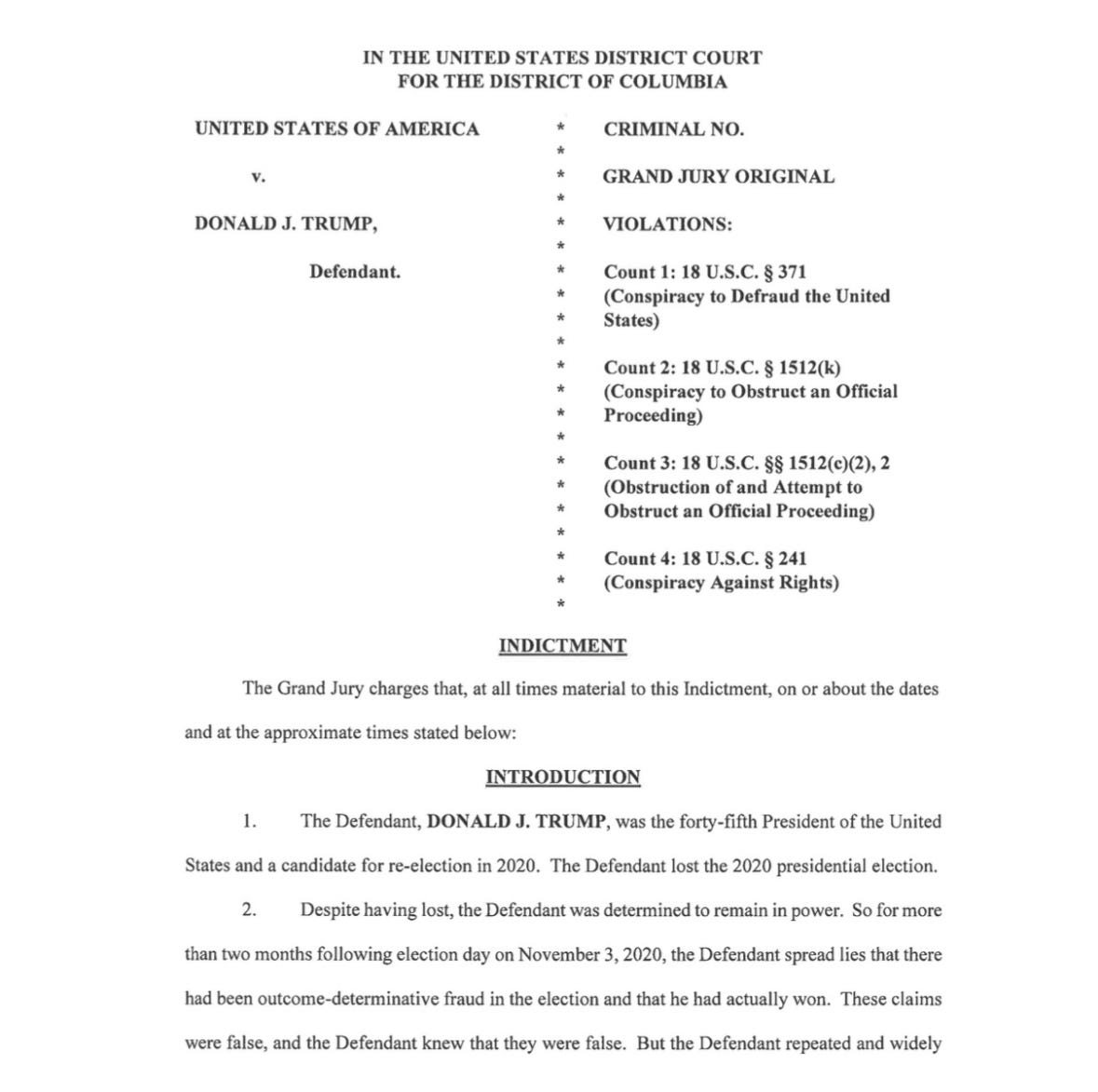
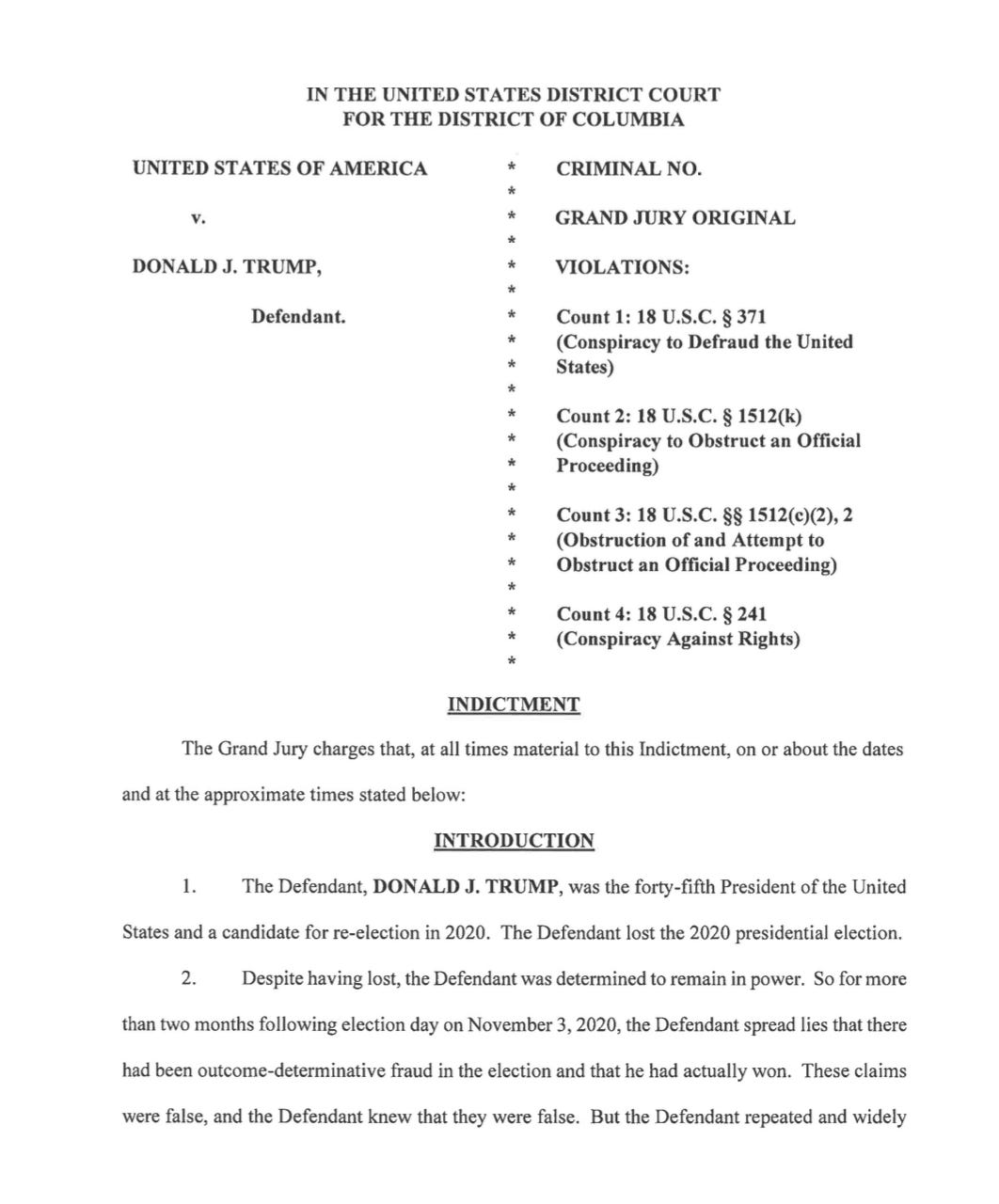
Every American has an absolute obligation and duty to read the details of the most important criminal indictment in American history carefully and thoroughly. The language is stark, vivid and declarative. The indictment rejects the jaundiced notion that there is dispute around the details of the election. Instead, it boldly embraces reality in a way that the overwhelming majority of the American media has refused to do so on a consistent basis. It declares flatly and directly:
He absolutely did lose the 2020 presidential election. Yet, he wanted power. What he did was try and take it through a conspiracy of lies and thuggery. Though he knew he lost, he didn’t care. What followed was the most reprehensible actions in American history by an American president. They represent a betrayal of stupendous dimensions. What Donald Trump did was amoral, illegal and nearly cataclysmic.
The Warning with Steve Schmidt is a reader-supported publication. To receive new posts and support my work, consider becoming a free or paid subscriber.
Upgrade to paid
Donald Trump desecrated the sacrifices and patriotism of the men and women who laid down their lives so America could endure and survive. He tried to take America away from all of us. Donald Trump isn’t just a failed and seditious president and an accused criminal, he is an abomination and every loyal citizen should be enraged by what he did. He assaulted our ancestors and our descendants, while trying to burn down our way of life and taking our right to choose our leaders from us. It cannot be forgiven, excused, rationalized or minimized. The propaganda of Fox News and all of its derivative media cannot hide the simple truth. Trump tried to destroy the United States. He is a domestic enemy.
We must not allow the ambitions of one man and his cabal to destroy the American way of life. It cannot happen. It must be fiercely opposed. Donald Trump and his cause are a national cancer, and it remains deeply embedded in our politics. This age of extremism must yield, or democracy will be lost.
The only thing that matters is that the Republican frontrunner doesn’t believe in democracy. He is running on a platform of revenge and retribution.
Everything is on the line in 2024. Will it be America’s last election not decided in advance?
Let’s hope not, and let’s work very hard to make sure it isn’t.
First off tonight, I want to thank all of you who sent emails and left comments about my Mom. I appreciate all of them, I’ve read through them and continue to read them. I’ve gained a lot of strength from your support, and I’m touched and honored by the stories you’ve shared. Thank you from the bottom of my heart.
Today, Tuesday, August 1, 2023, was the day the Justice Department indicted the wretch of a former president for trying, and damn near succeeding, in preventing American voters from determining the outcome of the presidential election in 2020. It’s about time.
The January 6 investigation was massive, and it’s remarkable Jack Smith got to this point so quickly. He owes a huge debt of gratitude to the House January 6 Committee, which did prosecutors’ work, unearthing much of the evidence that was used to indict. In a very real sense, prosecutors in this case stand on the shoulders of the members of the House who insisted on pursuing the investigation and made Americans believe that accountability for the former president was possible.
The conduct, the swarm of different angles Trump worked to try and steal the election, makes for a complicated prosecution. It was a massive effort at political interference in the constitutional processes that make our country a republic. The factual basis for the charges, even though we’ve lived through the events themselves, is not simple like the Mar-a-Lago classified documents case is. There you can readily wrap your mind around the basics and understand Trump kept classified documents he wasn’t entitled to and obstructed the government’s efforts to get them back. You can’t do the January 6 investigation in one sentence like that. Trump had a lot of moving parts in play to try and hold onto power, some legal, and many others not.
So the question has always been, how would Jack Smith make sense of it all, organize the conduct, and charge this case? It has to be done in a way that, legally speaking, is air tight—there’s no point in fighting for a conviction that you lose on appeal—but it also has to make sense out of a morass. For instance, we all understand now that there was a scheme to use fake slates of electors to try and interfere with the count of votes under the Electoral CountAct. But in the wake of the election, as news of an event here and another there began to emerge, we didn’t have the roadmap we have now for understanding the component pieces, which include efforts in swing states, the attempt to pervert DOJ, the pressure campaign on Pence, and so on. That’s the challenge: draft an indictment that will make compelling sense to 12 jurors in a courtroom who get to hear all the evidence and make a decision based on it. Which of Trump’s many crimes do you charge him with?
Now we know.
Tonight, I want to give you a bit of a guide for reading the indictment for yourself. I think it’s important to do that. Set aside an hour or two, or find ten minutes here and there over the course of the next week. You’ll understand it better if you read it for yourself. The indictment is written in a manner that makes it clear prosecutors wanted it to be comprehensible to anyone who wanted to read it.
The indictment is a speaking indictment—the story of the three conspiracies that are charged is told in detail.
First off, you get some framing in the introductory paragraphs. The government alleges that Trump “spread lies” and that he “knew that they were false.” And it sets up some parameters: Trump could legally lie about the election and say it was tainted by fraud. That’s okay—what I would call awful but lawful. He could challenge the results in court and seek recounts. But DOJ draws the line in paragraph 4 and says that what he can’t do is pursue “unlawful means of discounting legitimate votes and subverting the election results.” In other words, some of what he did, the lawsuits for instance, was lawful. His lies to the public were distasteful and inappropriate but still, not crimes. But then Trump crossed the line into criminal. That’s the conduct, we learn in the introduction, that we’re going to hear about in the rest of the indictment.
It’s done artfully; it clarifies that this isn’t about going after Trump for his speech, which is arguably (at least in his view) protected by the First Amendment. It’s about his conduct, illegal conduct. In the opening lines of the indictment, prosecutors effectively gut the First Amendment defense Trump has been floating for the last two years.
There is only one defendant, Donald Trump. That’s likely a strategy for streamlining the process to get the case to trial as quickly as possible. He has six uncharged and therefore unnamed (but as good as identified) co-conspirators. We’ll get to them in a moment. The indictment alleges three separate conspiracies:
one to defraud the United States by interfering with the lawful processes that are used to collect, count, and certify the presidential election (18 USC § 371)
one to obstruct the January 6 congressional proceeding in which the results are counted and certified (18 USC § 1512)
one to defeat citizens’ right to vote and have their votes counted (18 USC § 241)
It alleges that each conspiracy was fostered by the “widespread mistrust the Defendant was creating through pervasive and destabilizing lies about election fraud.” There is also one substantive charge of obstruction related to the second conspiracy.
The penalties are serious. 18 USC § 371 carries a five-year maximum. The two charges under 18 USC § 1512 each have a 20-year maximum penalty. And the maximum penalty for violating 18 USC § 241 is 10 years. While the sentencing guidelines often set a lower range the judge is advised to sentence within, here, and especially if Trump has picked up one or more prior convictions before he’s sentenced, there is serious time associated with conviction on any one of these charges.
Here’s the trick to understanding the indictment. Because the same facts underlie each of the charges, the government sets them out only once, in the first count. Then it adopts them as the factual basis for each of the next three charges. That means that the first count, which begins on page 3, takes up the bulk of the indictment. It concludes on page 42. But once you’ve read it, you have the facts and the key aspects of each of the conspiracies that are charged. If you want a refresher on the basics of conspiracy law before you get started, we did that here at Civil Discourse, back in July of 2022, with chicken videos to explain the finer points of the law: “Conspiracy! Understanding the basics (with chickens).”
First, we get the “purpose of the conspiracy.” This is a standard inclusion in conspiracy indictments. In essence, here, it’s the purpose of all three conspiracies. The government alleges Trump’s purpose “was to overturn the legitimate results of the 2020 presidential election by using knowingly false claims of election fraud to obstruct the federal government functions by which those results are collected, counted, and certified.” The plain, legal prose is so dry that it almost masks what this is about: a president who wanted to take away the right of Americans to vote.
The next section clarifies who the “co-conspirators” referred to throughout the indictment are. But because they aren’t charged in the indictment, DOJ policy says they can’t be identified by name. Instead, we get descriptions that all but identify them after informing us that Trump “enlisted co-conspirators to assist him in his criminal efforts to overturn the legitimate results of the 2020 presidential election and retain power.” I’ve added their likely identities in italics following the language describing them from the indictment:
a. “Co-Conspirator 1, an attorney who was willing to spread knowingly false claims and pursue strategies that the Defendant’s 2020 re-election campaign attorneys would not.” Rudy Giuliani
b. “Co-Conspirator 2, an attorney who devised and attempted to implement a strategy to leverage the Vice President’s ceremonial role overseeing the certification proceeding to obstruct the certification of the presidential election.” Trump lawyer JohnEastman, whose communications were disclosed after a judge found the crime–fraud exception meant the attorney–client privilege should be set aside
c. “Co-Conspirator 3, an attorney whose unfounded claims of election fraud the Defendant privately acknowledged to others sounded ‘crazy.’ Nonetheless, the Defendant embraced and publicly amplified Co-Conspirator 3’s disinformation.” “Kraken” lawyer Sidney Powell
d. “Co-Conspirator 4, a Justice Department official who worked on civil matters and who, with the Defendant, attempted to use the Justice Department to open sham election crime investigations and influence state legislatures with knowingly false claims of election fraud.” DOJ environmental lawyer and AG wannabe Jeffrey Bossert Clark
e. “Co-Conspirator 5, an attorney who assisted in devising and attempting to implement a plan to submit fraudulent slates of presidential electors to obstruct the certification proceeding.” Kenneth Chesebro, another lawyer involved in devising the fake electors scheme
f. “Co-Conspirator 6, a political consultant who helped implement a plan to submit fraudulent slates of presidential electors to obstruct the certification proceeding.” Identity unclear
Next up is a section entitled “Federal Government Function” that manages to explain, in one paragraph, how the electoral college system works. It will also make you wonder why we still use this godforsaken system that unduly focuses presidential selection power in less populated parts of the country, but we’ll leave that for another day. Like all conspiracy indictments, this one has an involved section on “Manner and Means,” which is an overview that explains how they did it. Here, it’s a helpful summary of all the conduct that’s laid out next. There is the use of fake fraud claims to try and subvert the outcome of state elections, the fraudulent slates of electors, the attempted subversion of DOJ, the pressure campaign on Vice President Mike Pence, and Trump’s exploitation of the violence at the Capitol on January 6 to try and convince Congress to delay certification of the vote.
Before the indictment dives into the details of those means of effectuating the conspiracies, we get a section you don’t normally see in indictments, where the government sets forth its evidence that Trump knew the fraud claims he was making about the election were false. We discussed the importance of the government being able to use circumstantial evidence to establish what was going on inside of Trump’s mind, notably, that he knew he’d lost the election but lied about it. The government uses three and one half pages of the indictment to set out its evidence in that regard in detail. With that important detail established, we then get a detailed layout of each of the “Manner and Means” of executing the conspiracy, and it’s here that you may want to spend some time. Most of the contours are familiar; we know about the events in Georgia, for instance, but some of the detail is informative, and it’s an excellent refresher to make sure you remember the details you first learned while watching the January 6 Committee hearings.
So we get a speaking indictment, or as MSNBC anchor Ari Melber quipped tonight, a shouting indictment. We still have some unanswered questions. The status of the unindicted co-conspirators isn’t clear. Often, people identified that way are cooperators, but that doesn’t appear to be the case here. It seems likely that some or all of these people will face charges in the future. Their crimes are set out clearly in the indictment, and there’s little rationale other than expediency, a weak one at best, for permitting them to escape accountability for their conduct. But there are other people who appear to be working with the government. Mike Pence, after trying to fight off his subpoena with all sort of excuses, testified and would seem to be the only possible source of information about his personal conversations with Trump, which includes this fascinating passage in paragraph 90:
On January 1, the Defendant called the Vice President and berated him because he had learned that the Vice President had opposed a lawsuit seeking a judicial decision that, at the certification, the Vice President had the authority to reject or return votes to the states under the Constitution. The Vice President responded that he thought there was no constitutional basis for such authority and that it was improper. In response, the Defendant told the Vice President, “You’re too honest.” Within hours of the conversation, the Defendant reminded his supporters to meet in Washington before the certification proceeding, tweeting, “The BIG Protest Rally in Washington, D.C., will take place at 11.00 A.M. on January 6th. Locational details to follow. StopTheSteal! [emphasis added.]
Still more interesting is the question of Mark Meadows’ status. In paragraph 28, there is information that seems like it would have to have come from him: “On December 23, a day after the Defendant’s Chief of Staff personally observed the signature verification process at the Cobb County Civic Center and notified the Defendant that state election officials were ‘conducting themselves in an exemplary fashion’ and would find fraud if it existed, the Defendant tweeted that the Georgia officials administering the signature verification process were trying to hide evidence of election fraud and were ‘[t]errible people!’” If Meadows is actually cooperating, in the sense that he’s finally decided to share everything he knows about Trump with prosecutors, that would be big. But there’s little additional information in the indictment to suggest that. Prosecutors aren’t obligated to reveal all of their evidence, but in the event they want to convince some of the six unindicted co-defendants to cooperate, they might want to show off a little more evidence to help them understand the peril of their situation if they don’t. Five of them, after all, are lawyers, and all quite capable of assessing the evidence. It’s surprising we don’t get more here if Meadows is in fact on board.
So, take some time when you can, and read the indictment for yourself! Encourage others to do it, too. Most importantly, don’t accept the defeatist mentality that no Trump supporters can take in the information and change their minds. While his hardcore base may not, there are others who may support him for policy or political reasons, but who, when confronted with the hard facts about his complicity, including Count Four where he is charged with a conspiracy to interfere with Americans’ right to vote, may finally decide they’ve had enough.
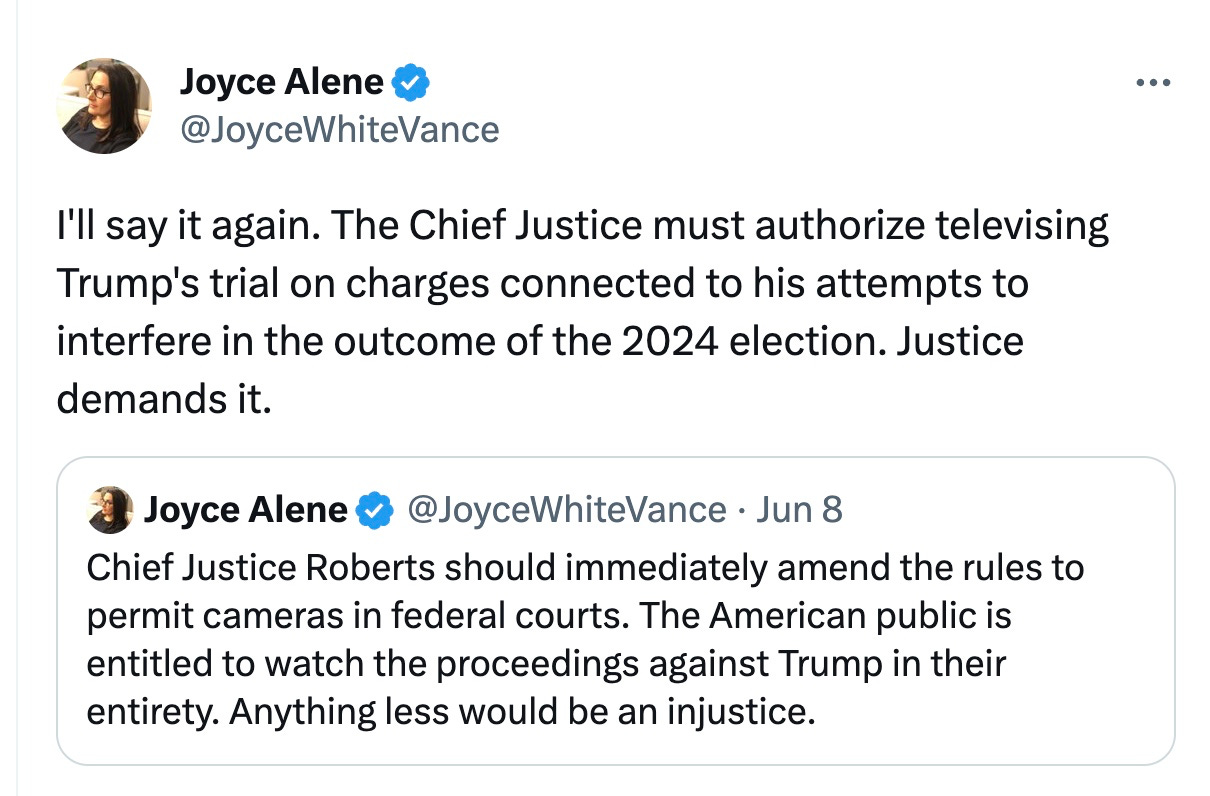
Finally, cameras in the courtroom. Chief Justice Roberts could ensure these proceedings were made publicly available. He can order that there be cameras in the courts. And he should. That final charge makes it clear that we are all victims of this crime. We have the right to watch the proceedings.
Because this isn’t a case about classified information. We’ll see more of the proceedings in public, and it should kick into gear more quickly, with arraignment scheduled for Thursday afternoon. The Judge, Obama appointee Tanya Chutkan, confirmed in the Senate by a vote of 95-0 in 2014, has signaled she means business with that prompt kickoff. But given the time it takes to get cases to trial in the District of Columbia’s courts, often over a year and a half, we’ll have to wait to see if there’s even a prospect of this case, so highly important and certain to be aggressively litigated, getting to trial ahead of the election.
Today was one of the good days for people who believe in the Republic. No man should be above the law. Trump is finding out that democracy and the Constitution are for real.
We’re in this together,
Joyce
p.s.: If you’re not already a paid subscriber and you’re enjoying Civil Discourse, I hope you’ll consider up-subscribing (if that’s a word). But we live in challenging times, and I understand that not everyone can or wants to buy a paid subscription. I’m happy to have you here either way! I’m glad we’re all committed to saving the Republic. Tonight, it feels like we’re making progress.
The “Gadget,” the first atomic bomb, explodes in Los Alamos, New Mexico, on July 16, 1945 (Corbis via Getty Images)
“Now I am become death, the destroyer of worlds.” — J. Robert Oppenheimer
‘Oppenheimer’ is an extraordinary and stunning movie. Seventy-eight years have passed since the Trinity test site outside of Los Alamos, New Mexico. It marked the beginning of a new epoch in history, where mankind harnessed the powers of the gods and became capable of triggering Armageddon.
Matt Damon plays General Leslie Groves, the architect of the Manhattan Project. He perfectly captures 2023 America’s lassitude towards the weapons that remain poised to destroy human civilization. Here is what Damon said:
How did I forget about this? It’s like the Cold War ended and my brain played a trick on me and said, ‘OK, let’s put that away, you don’t have to worry about that anymore’ — which is absurd.
But as soon as Russia invaded Ukraine “suddenly overnight it became the most important thing for us all to think about again.
Damon is one of the greatest actors of his generation, and among the most thoughtful as well. His comments aren’t an expression of vapidity or disinterest, but rather a spot-on assessment of how the overwhelming number of Americans think about the weapons that can destroy 10,000 years of human civilization and history in an instant.
I’ve written about this subject before. General Douglas MacArthur was the first person to speak directly to the existential issues raised by the dawn of the nuclear weapons age. They remain dire and true 78 years later.
Even though nuclear weapons have not been deployed in combat since 1945 does not mean that they no longer exist. There are thousands of them under the control of the following nations: United States, Russia, China, UK, France, Israel, North Korea, Pakistan and India. The most nuclear arsenal in the world belongs to the United States, and it consists of three elements. The United States can deliver its nuclear weapons to any spot on Earth via airplane, land-based intercontinental ballistic missile and submarine-launched intercontinental ballistic missile. The weapons are under the command and control of the US Armed Forces, and can be launched on orders from the president of the United States. Since Harry Truman, the following Americans have held the unilateral power to destroy the world: Dwight Eisenhower, John Kennedy, Lyndon Johnson, Richard Nixon, Gerald Ford, Jimmy Carter, Ronald Reagan, George H.W. Bush, Bill Clinton, George W. Bush, Barack Obama, Donald Trump and Joe Biden. One of these men is unlike the others.
Upgrade to paid
During the hectic days after January 6, Speaker Nancy Pelosi famously queried Joint Chiefs Chairman Mark Milley about the security of America’s nuclear arsenal. Milley responded that he had everything under control. Overwhelmingly, the American media and people yawned at the news, and believed what Milley told Pelosi — which is absolutely not true. The chairman of the Joint Chiefs of Staff isn’t part of the decision-making process when it comes to Armageddon. The president alone has that authority.
Everything in the American government is designed to move slowly — except one thing. The launch of the nuclear weapons are the exception. Should the president give the order, it will be carried out by highly-trained professionals who will not hesitate to execute it. In fact, right now, in this second, they are at their duty posts at the bottom of a silo, under the seas or in the air, awaiting the order.
What Matt Damon said is true for most of us in 2023 because no sane society would choose Donald Trump as the person to hold the power of extinction. Yet, we did.
The world came extremely close to nuclear war in October of 1962. Perhaps the only reason it didn’t was the profound wisdom, steeliness and courage of John Kennedy. Today, we have replaced wisdom with a deluded moral infancy and addlement that makes a mockery of the life and death issues that rest on the president’s desk.
We live in a cynical time in which there is so much evil operating in plain sight all over the world. Yet, after 78 years of having the power to destroy the planet, mankind has not pulled the trigger. It is a blink of an eye and an eternity all at once. What lies ahead is unknown, but it will be dangerous and deadly. What keeps us safe is judgement and morality. When that disappears all that is left is the mushroom cloud.
Why have we stopped believing these weapons exist — like all weapons — to be used?
‘Oppenheimer’ helps us remember the world in which we live. I recommend that you go to see it.



 by
by