I’ve written sixteen novels, and over the years I’ve become increasingly aware of something about the relationship between my life and my fiction.
The stories I want to tell today aren’t necessarily the same stories I would have wanted to tell ten or twenty years ago.
I suppose that shouldn’t be surprising. People change. Their experiences accumulate. Things they once regarded as unimportant become difficult to ignore. Beliefs they once accepted without question begin to seem less certain. And sometimes an experience causes them to reconsider something they’ve believed for most of their lives.
Recently, I’ve experienced such a change in my understanding of animals and the suffering human beings cause them.
It’s a subject I’ve begun thinking about almost every day.
I grew up in rural Alabama, where raising animals for food was an ordinary part of life. My grandfather raised hogs, and I remember watching him slaughter them. I wasn’t particularly troubled by what I witnessed. It was simply something people did, and I accepted it as part of the world in which I lived.
For much of my adult life, I continued accepting the raising and killing of animals for food without giving serious thought to what those animals experienced.
That has changed.
I’ve become increasingly troubled by the suffering we impose on animals, particularly when we have alternatives that don’t require taking their lives. I’ve begun paying attention to things I previously overlooked: the intelligence and emotional lives of animals, their ability to experience fear and distress, and the ways we’ve learned to regard some animals as companions while treating others primarily as sources of food.
These concerns have begun changing how I live. I’ve stopped eating animal products, and I’ve found myself thinking more seriously about the moral responsibilities we have toward other living creatures.
But something else has happened.
My changing understanding of animals has begun influencing the fiction I want to write.
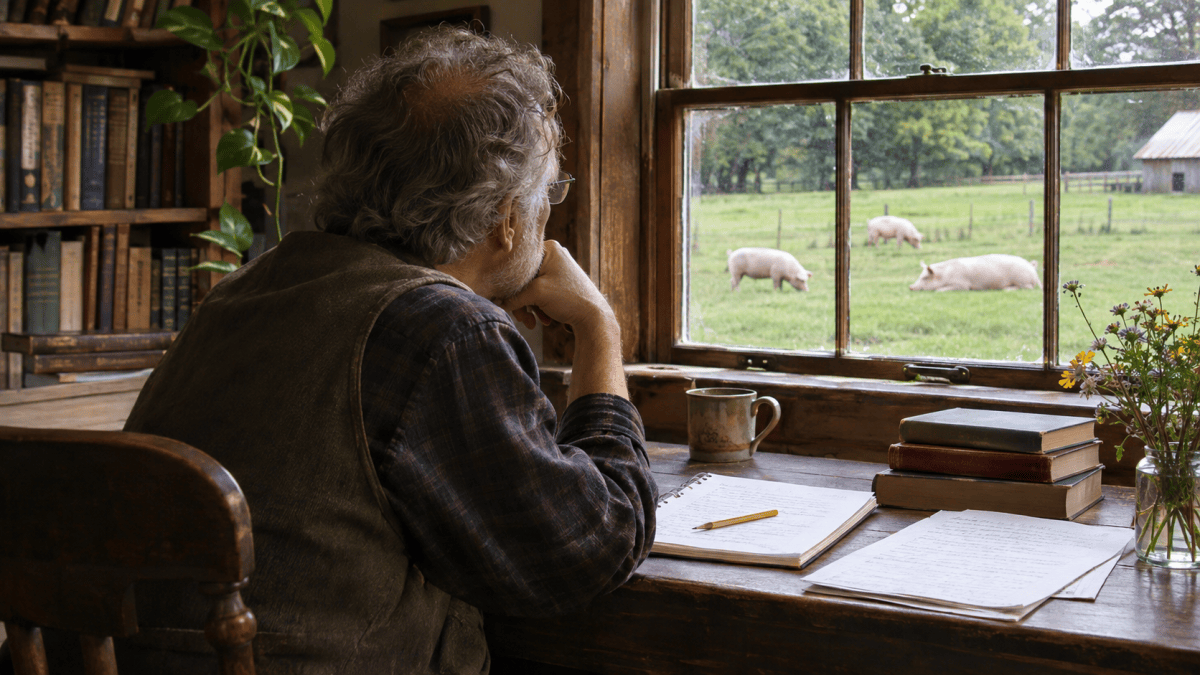
I’m currently developing The Boaz Slaughterhouse, my seventeenth novel. Its protagonist is an eighty-five-year-old retired vocational agriculture teacher who has raised hogs for much of his life. He lives on a small Alabama farm with Molly, an elderly sow who has become his beloved companion.
The novel is taking shape around his determination to remain on the farm with Molly despite circumstances that threaten their future together.
I didn’t create this character simply to argue that people should stop eating animals. I created him because I’ve become interested in the complicated relationship human beings have with animals and the ways our experiences can challenge assumptions we’ve carried throughout our lives.
The farmer has his own history. His education, professional experiences, family relationships, and personal convictions have shaped the man he has become. He won’t necessarily think about animals as I do, and I don’t want him to become a fictional spokesman for my beliefs.
But the questions that led me to imagine him are questions I might never have asked twenty years ago.
I’ve encountered something similar in another area of my life.
For approximately sixty years, I lived within a religious tradition whose teachings I largely accepted. Eventually, I began examining those beliefs more critically, and over time my understanding of religion changed considerably.
That experience was not simply a matter of exchanging one set of conclusions for another. It involved questioning assumptions that had shaped my understanding of myself and the world for much of my life.
Those questions have also found their way into my fiction.
In The Boaz Superstition, my most recently published novel, a psychiatrist and former Christian apologist returns to the deeply religious Alabama community he once left behind. His investigation into the circumstances surrounding a teenager’s death brings him into conflict with people whose convictions and explanations differ sharply from his own.
The novel grew partly from my interest in how deeply held beliefs influence human behavior, particularly when those beliefs intersect with fear, suffering, and the authority we allow others to exercise over our lives.
Again, I didn’t want to write a novel that merely announced my conclusions about religion. I wanted to create fictional people whose beliefs mattered to them, whose circumstances challenged those beliefs, and whose decisions carried consequences.
More recently, something else reminded me how unexpectedly our experiences can influence the stories we’re developing.
I watched a documentary about Natalee Holloway, the eighteen-year-old Alabama girl who disappeared during a graduation trip to Aruba in 2005 and was murdered.
The documentary affected me deeply. I felt sadness for Natalee, anger toward the man responsible for her death, and particular sorrow for her mother, Beth Holloway, who spent years searching for answers about what happened to her daughter.
After watching it, I found myself thinking about The Boaz Skeleton, another novel I’m developing. It’s a Connor Ford mystery involving the discovery of skeletal remains and a disappearance nearly thirty years earlier.
I’d been concentrating primarily on the mystery itself: what happened, who was responsible, and how Connor might uncover the truth.
But the documentary caused me to think more seriously about the family of the missing man, particularly his mother, who has spent decades without knowing what became of her son.
The circumstances of Natalee Holloway’s murder won’t become part of my novel. Her family’s suffering is real, and I have no desire to turn their tragedy into fictional entertainment.
But encountering that suffering reminded me of something I needed to consider more carefully in my own story.
A murder doesn’t end with the death of the victim. Its consequences continue through the lives of people who loved that person.
I might have reached that understanding while developing the novel anyway. But the documentary brought the question into sharper focus.
And that, I think, illustrates something important about the relationship between living and writing.
The things that influence our fiction don’t always arrive as fully developed story ideas. Sometimes they begin as discomfort, curiosity, compassion, anger, or an unanswered question.
We encounter something that troubles us. We begin thinking about it. Perhaps our understanding changes. And eventually we find ourselves imagining people and circumstances through which those concerns might be explored.
Of course, there’s a danger in allowing personal convictions to influence fiction too directly.
A novelist who becomes determined to persuade readers of a particular conclusion may create characters who exist primarily to express the author’s opinions. Their conversations become arguments, their choices become predictable, and the story loses much of what makes fiction interesting.
I want to avoid that.
But I also don’t believe a novelist should suppress the questions that matter most to him simply because they involve moral convictions or controversial subjects.
If I’m troubled by animal suffering, why shouldn’t that concern influence the stories I imagine? If my understanding of religion has changed, why shouldn’t I explore the experiences of fictional people confronting questions about belief? If another family’s tragedy causes me to think more deeply about grief and uncertainty, why shouldn’t that awareness help me develop more believable characters?
The challenge is to allow those concerns to give rise to stories without requiring the stories to deliver predetermined answers.
My characters need room to be human. They need histories, loyalties, fears, contradictions, and reasons for believing what they believe. They should be capable of making decisions I disagree with, and readers should be able to understand those decisions even when they find them troubling.
Perhaps most importantly, the stories must remain stories.
Readers deserve engaging characters, meaningful conflicts, and circumstances that make them want to discover what happens next. Whatever questions lie beneath a novel, the novel itself must be worth reading.
I don’t know whether the novels I’m writing today will be better than those I wrote ten years ago.
But I know they’re emerging from a somewhat different understanding of the world.
There are things I once accepted that I now question. There are forms of suffering I once overlooked that I now find difficult to ignore. And there are questions I wouldn’t have thought to ask when I began writing fiction.
I suspect those changes will continue influencing the people I imagine and the stories I tell.
Perhaps that’s inevitable.
After all, the person writing the novel isn’t quite the same person he was when he wrote the last one.

