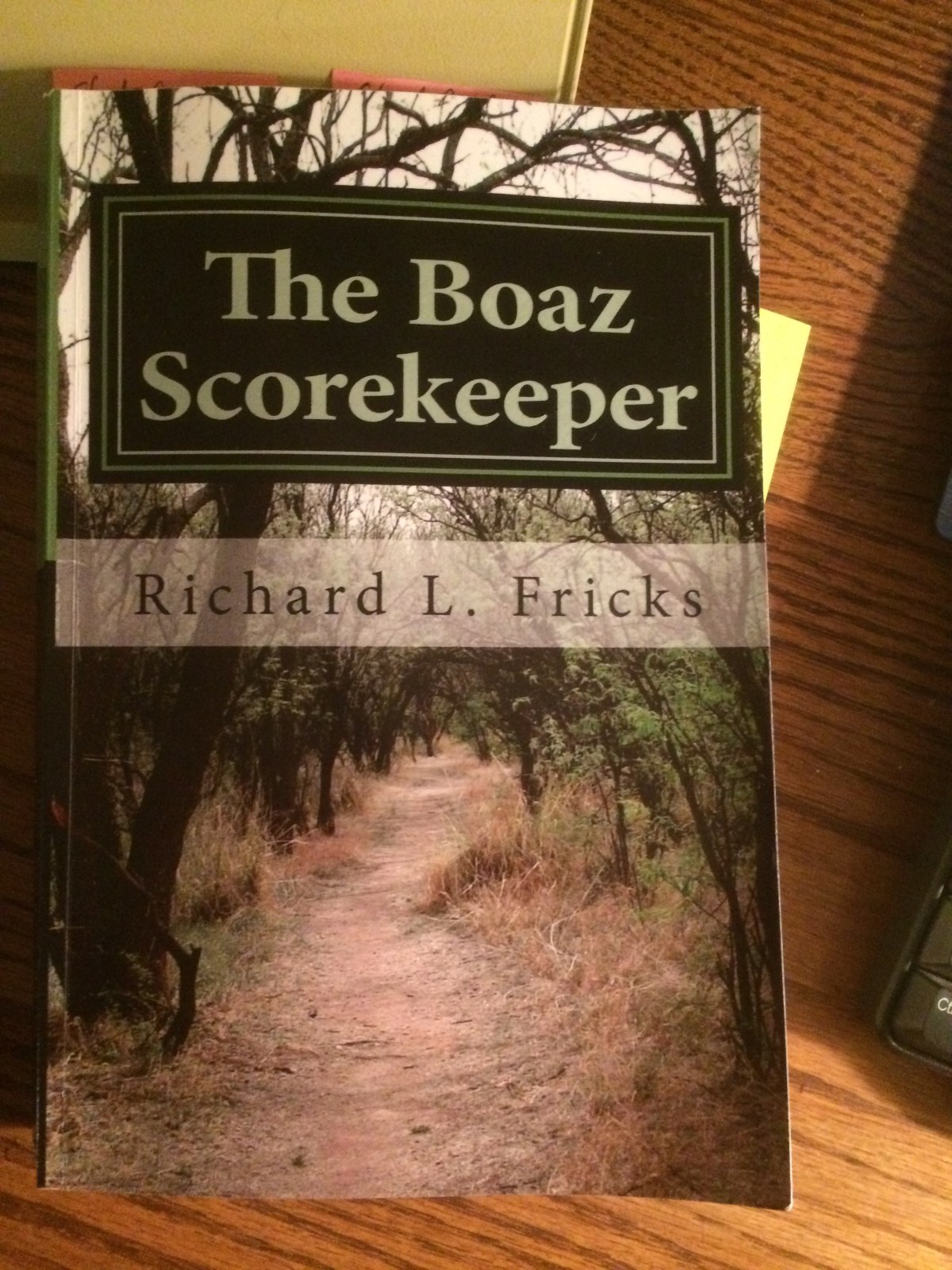
The Boaz Scorekeeper, written in 2017, is my second novel. I'll post it, a chapter a day, over the next few weeks.
On March 21st, 1997, a human skull was found when a bulldozer was clearing a spot for Stan and Jessica Jennings new house in the Pebblebrook subdivision being developed by Ericson Real Estate. Matt called with the news and speculated this could be Wendi and Cindi Murray’s way of showing up to demand justice. I told him I hoped he was right but I doubted it was true. It simply appeared unbelievable especially after Matt learned that the bulldozer operator had been clearing the wrong lot. Matt heard that the Jennings had met with Wilcox Construction Company’s owner, Brad Vickers, a week earlier. They had discussed exactly what they wanted done: which trees to remove, which to leave, and the location and dimensions of a partial basement included in their house plans. Brad was sick the day he was supposed to start work and sent his son Bradley. Someway he confused Lot signs 31 and 13 and wound up on the wrong side of Pebble Lane, the most remote street in the 300-acre subdivision.
Lot 13 became an official crime scene when the State’s forensic team unearthed two complete skeletons. Two weeks later, the State Lab released the results of their testing. Finally, after almost 25 years, the Douglas High School twin sisters had been found. Their graves had opened and Wendi and Cindi had walked out demanding justice.
What gave me absolute clarity that it was time to return to Boaz was what happened next. After my trial and before I left Boaz for Atlanta in 1973, I had met with Wendi and Cindi’s parents. Someway over the years they began to trust me, that I had had no part in their daughter’s pain and suffering. We had formed a mutually sad but satisfying relationship. Even though we rarely talked we did exchange Christmas cards every year. But, I was still shocked when Matt called me three days later telling me that the Murray’s had hired him to file a lawsuit against Wade Tillman, James Adams, Randall Radford, Fred Billingsley, and John Ericson. He said that Alabama law allowed such a delayed lawsuit based on newly discovered evidence that the plaintiff could not have reasonably discovered earlier.
Matt asked me to make sure I was sitting down. He described how he had, on a hunch, investigated the ownership of the subdivision property. County records revealed that Franklin Ericson, John’s father, had purchased the property in 1970 and had pretty much ignored it other than using the front 25 acres to maintain a few head of cattle. Also, Matt said that Lot 13 had been purchased by Boaz Land Company, an LLC (Limited Liability Company) that had two members, John Ericson and Wade Tillman. Before I could say anything, Matt said, “these discoveries are the clearest reasons you will ever have to justify moving to Boaz.” Without hesitation, I agreed.
Three weeks later Karla, Lewis, and I left Atlanta for Boaz and an unimaginable life. I should have been happy but was overwhelmed with grief over an incident I had been unable, until now, to even mention. It was the third anniversary of the suspicious fire that had destroyed the home place built by my great-grandfather in 1899, and that had killed my dear Mom and Dad. All during the drive home all I could think was that Lewis would never know the joy of experiencing life at Tannerville with grandparents who were the most joyous and happy couple I had ever known.
Biking is something I both love and hate. The conflicting emotions arise from the undeniable physical effort it demands. However, this exertion is precisely what makes it an excellent form of exercise. Most days, I dedicate over an hour to my cycling routine, and in doing so, I’ve discovered a unique opportunity to enjoy a good book or podcast. The rhythmic pedaling and the wind against my face create a calming backdrop that allows me to fully immerse myself in the content. In these moments, the time spent on the bike seems worthwhile, as I can’t help but appreciate the mental and physical rewards it offers.
I especially like having ridden. The post-biking feeling is one of pure satisfaction. The endorphin rush, coupled with a sense of accomplishment, makes the initial struggle and fatigue worthwhile. As I dismount and catch my breath, I relish the sensation of having conquered the challenge, both physically and mentally. It’s a reminder that the things we sometimes love to hate can often be the ones that bring us the most fulfillment. In the end, the love-hate relationship with biking only deepens my appreciation for the sport, as it continually pushes me to overcome my own limitations and embrace the rewards that follow the effort.
My bike
A Rockhopper by Specialized. I purchased it November 2021 from Venture Out in Guntersville; Mike is top notch! So is the bike. The ‘old’ man seat was salvaged from an old Walmart bike (update: seat replaced, new photo to follow, someday).
Something to consider if you’re not already cycling.
I encourage you to start riding a bike, no matter your age. Check out these groups:
Don’t miss the #1 New York Times bestselling blockbuster and Reese Witherspoon Book Club Pick that’s sold over 2 million copies–now an Apple TV+ limited series starring Jennifer Garner!
The “page-turning, exhilarating” (PopSugar) and “heartfelt thriller” (Real Simple) about a woman who thinks she’s found the love of her life—until he disappears.
Before Owen Michaels disappears, he smuggles a note to his beloved wife of one year: Protect her. Despite her confusion and fear, Hannah Hall knows exactly to whom the note refers—Owen’s sixteen-year-old daughter, Bailey. Bailey, who lost her mother tragically as a child. Bailey, who wants absolutely nothing to do with her new stepmother.
As Hannah’s increasingly desperate calls to Owen go unanswered, as the FBI arrests Owen’s boss, as a US marshal and federal agents arrive at her Sausalito home unannounced, Hannah quickly realizes her husband isn’t who he said he was. And that Bailey just may hold the key to figuring out Owen’s true identity—and why he really disappeared.
Hannah and Bailey set out to discover the truth. But as they start putting together the pieces of Owen’s past, they soon realize they’re also building a new future—one neither of them could have anticipated.
With its breakneck pacing, dizzying plot twists, and evocative family drama, The Last Thing He Told Me is a “page-turning, exhilarating, and unforgettable” (PopSugar) suspense novel.
“Commit to making the time to attend to what really matters to you.”
***
The Art of Noticing
Simple and uncommon exercises to reveal what’s hidden in plain sight.
In The Art of Noticing, Rob Walker—a journalist, author, and educator—invites us to attend carefully and playfully to everyday curiosities that most of us tend to overlook.
“Fending off distraction isn’t quite the same thing as making the most of our attention.” By engaging the senses, Rob says, we can enrich our daily lives with meaning, boost creativity, and even “reframe the way we take in the world.”
***
Rob Walkeris a journalist and author. He is a longtime contributor to The New York Times, and a columnist for Fast Company. His recent books are The Art of Noticing, and Lost Objects, co-edited with Joshua Glenn. He is on the faculty of the Products of Design program at the School of Visual Arts. You can find his newsletter at robwalker.substack.com.
In her book, The Not-So-Intelligent Designer: Why Evolution Explains the Human Body and Intelligent Design Does Not (2016), Abby Hafer gives a by turns amusing and horrifying account of numerous obvious goofs in the human body that any competent designer would fix. (Or be sued by the victims.) These are all elegantly explained by evolution, and count as evidence for it. Since evolution typically proceeds by small increments of genetic change, which are often as small as a change to a single nucleotide, the corresponding changes to the phenotype are also often small adjustments to what is already there. Evolution cannot “see” that a better solution may be far away in the design space, requiring large-scale modification of the genome at many positions simultaneously. What’s worse, these modifications would have to occur in multiple individuals at the same time, to maintain a breeding population! For more about the evolutionary design space, see Daniel Dennett’s Darwin’s Dangerous Idea (1995).
An egregious example of bad evolutionary “design” is the recurrent laryngeal nerve, which is a bad-enough mistake in humans, but reaches comical proportions in giraffes. As all tetrapod vertebrates have a similar arrangement, it would have been even more comical in the longer-necked sauropod dinosaurs. The nerve would have been as long as 28m (92 ft) in Supersaurus, almost all of which was an unnecessary detour.
But I’ll focus on whales today, specifically their superhuman resistance to choking and cancer, two serious killers of humans.
Hafer explains how whales have two completely separate tubes for breathing and swallowing, respectively. Humans, in contrast, breathe and swallow through a shared tube, the pharynx, and must correctly route air, food, and liquid to the proper branch (the trachea which sends air to the lungs, and the esophagus that sends food and drink to the stomach). A moveable flap of cartilage called the epiglottis stops food from entering the larynx. That is, when everything works. But it’s very easy for people to accidentally inhale food, causing them to choke. Without some prompt means of clearing the airway, the choking human can rapidly suffocate and die. Whales don’t have this problem; they can’t choke on anything entering through their mouth. They’d have to introduce foreign objects into their blowhole. That isn’t a typical risk for a whale, whereas humans court death with every meal. According to Bard, “an estimated 5,057 people died from choking in the United States in 2020. Of these deaths, 78% were adults aged 65 years or older. Food was the most common cause of choking deaths, followed by small objects such as toys and coins.”
Hafer mentions cancer in other contexts, but she doesn’t mention Peto’s paradox. (I first learned about that by reading Principles of Evolutionary Medicine (2016) during my book version of pandemic doomscrolling. Incidentally, emerging fields of science such as evolutionary medicine, evolutionary psychology, etc., show that science creates actual value – there are no creationist counterparts.) According to the English Wikipedia, Peto’s paradox is “the observation that, at the species level, the incidence of cancer does not appear to correlate with the number of cells in an organism. For example, the incidence of cancer in humans is much higher than the incidence of cancer in whales, despite whales having more cells than humans. If the probability of carcinogenesis were constant across cells, one would expect whales to have a higher incidence of cancer than humans. Peto’s paradox is named after English statistician and epidemiologist Richard Peto, who first observed the connection.” Also see Bard’s take on cancer in humans and whales. Whales apparently have several different adaptations that make them far more resistant to cancer than humans are. Researchers are trying to figure out the whales’ advantage, with the goal of giving humans what God neglected to give them. Cancer is considered a disease of aging, in that cancer rates tend to increase rapidly with age, although cancer can strike humans of any age, including, cruelly, children. (Theodicy is a whole ‘nother challenge for folks who believe in an omni-God, addressed in other blog posts and in John W. Loftus’ books, but I’ll stick to whales here.) Some whale species have long lifespans, with the bowhead whale able to live for over 200 years. For a whale to live that long, it must have robust and durable systems for resisting cancer, far outclassing the human’s endowment.
Before modern science, human thinkers such as Plato and Aristotle flattered themselves with their scala naturae (“Ladder of Being”). The notion was further developed by medieval Christians as their great chain of being. That is “a hierarchical structure of all matter and life, thought by medieval Christianity to have been decreed by God. The chain begins with God and descends through angels, humans, animals and plants to minerals.” Further, “the higher the being is in the chain, the more attributes it has, including all the attributes of the beings below it.”
Well, whales have some desirable attributes that humans clearly lack, such as their vastly superior resistance to choking and cancer. This is another example of how faith fails. Modern science began around 400 years ago, based on the radical idea that people should test their claims against evidence. It was radical then, and is still radical to a lot of people, although much of the educated class at least pays lip service to the idea. Before modern science, even educated people had some strange views of Man’s place in the universe. Jennifer Nagel explains how modern thinking is very different than medieval thinking. However, large chunks of medieval thinking persist in the faith community, which has become an odd chimera of the two. On the one hand, most persons of faith lead modern lives, consuming the benefits of technologies made possible by scientific thinking. At the same time, they function like cognitive fossils, bringing a medieval perspective where it suits them. It is both a strength and weakness of science that almost anyone can consume the benefits of science, including science deniers.
In any case, the next time you hear a person of faith claiming to have been “fearfully and wonderfully made” (Psalm 139:14) and presenting their own rockin’ body as evidence of God’s love for us, you can point out that when it comes to choking and cancer, God apparently loves the whales more.
The Boaz Scorekeeper, written in 2017, is my second novel. I'll post it, a chapter a day, over the next few weeks.
Over the years, I had several times entertained the notion of returning to Boaz. In 1987 when Lewis was born, I realized that I had already practiced seven years in Atlanta, two more than the minimum I had agreed with Matt. But, at that time, I had two cases that chained my focus.
In late summer 1992, I had a weird cloud of nostalgia hover over me raining down feelings of revenge I had never experienced. The 20th anniversary of Wendi and Cindi’s death had occurred in May. Also, it didn’t help that Randall and Fred had been elected to the First Baptist Church of Christ’s deacon board. Nor, the fact James Adams was elected Mayor. An afternoon spent with Matt over the Labor Day weekend, disabused me of this strong pull. Although he still wanted us to practice law together, at some point he argued that revenge was an irrational reason to ground my decision. Once again, I listened to the wise Matt and followed his advice.
In January 1993, Mama El died. She was 92 and just went to sleep. The doctor said, “her heart finally gave out.” I think it finally gave up. After Gramp’s death in 1965, Mama El lost her way. To an outsider, she adjusted well. She continued her daily life pretty much as before: gardening and canning, and church and church and church. That was all pretty much a front. In her heart, she was the loneliest person I’ve ever known. Alone, late at night, even in the coldest weather, she would sit out on the back porch looking over the garden, across the pasture, and to the oak grove on the southeast corner of the pond where Gramp’s had died. I’ve often wondered whether Wendi and I would have had such a love affair if she had lived. There was no other romance like Gramp’s and Mama El’s. But, just like for Wendi and me, God or fate or something had other plans for Gramp’s and Mama El. After Mama El’s funeral and before Karla, Lewis, and I returned to Atlanta, I almost decided it was time to move home. I thought, I wanted to live in my own home, breathe the air Mama El breathed, and sit in her chair on the porch with her throw over my lap. She was, in a way, the architect of my inner life growing up. Like Gramp’s was for my outer life. But, we didn’t move back. Law and life in Atlanta kept getting in the way.
In 1995 Matt called and told me he had been diagnosed with brain cancer. Karla and I were in Orlando on a week’s vacation. The two of us spent the next several days walking around Disney World discussing what all we had to do before we could move. Karla loved her teaching job and although reluctant, she bravely agreed to once again resign her position and follow me. By the time we returned to Atlanta, Matt called with the good news that he had been misdiagnosed and only had a small non-cancerous tumor that doctors believed would not give him any problems and that hopefully would eventually dissolve. Again, I had no clear reason to return to Boaz.
Biking is something I both love and hate. The conflicting emotions arise from the undeniable physical effort it demands. However, this exertion is precisely what makes it an excellent form of exercise. Most days, I dedicate over an hour to my cycling routine, and in doing so, I’ve discovered a unique opportunity to enjoy a good book or podcast. The rhythmic pedaling and the wind against my face create a calming backdrop that allows me to fully immerse myself in the content. In these moments, the time spent on the bike seems worthwhile, as I can’t help but appreciate the mental and physical rewards it offers.
I especially like having ridden. The post-biking feeling is one of pure satisfaction. The endorphin rush, coupled with a sense of accomplishment, makes the initial struggle and fatigue worthwhile. As I dismount and catch my breath, I relish the sensation of having conquered the challenge, both physically and mentally. It’s a reminder that the things we sometimes love to hate can often be the ones that bring us the most fulfillment. In the end, the love-hate relationship with biking only deepens my appreciation for the sport, as it continually pushes me to overcome my own limitations and embrace the rewards that follow the effort.
My bike
A Rockhopper by Specialized. I purchased it November 2021 from Venture Out in Guntersville; Mike is top notch! So is the bike. The ‘old’ man seat was salvaged from an old Walmart bike (update: seat replaced, new photo to follow, someday).
Something to consider if you’re not already cycling.
I encourage you to start riding a bike, no matter your age. Check out these groups:
Don’t miss the #1 New York Times bestselling blockbuster and Reese Witherspoon Book Club Pick that’s sold over 2 million copies–now an Apple TV+ limited series starring Jennifer Garner!
The “page-turning, exhilarating” (PopSugar) and “heartfelt thriller” (Real Simple) about a woman who thinks she’s found the love of her life—until he disappears.
Before Owen Michaels disappears, he smuggles a note to his beloved wife of one year: Protect her. Despite her confusion and fear, Hannah Hall knows exactly to whom the note refers—Owen’s sixteen-year-old daughter, Bailey. Bailey, who lost her mother tragically as a child. Bailey, who wants absolutely nothing to do with her new stepmother.
As Hannah’s increasingly desperate calls to Owen go unanswered, as the FBI arrests Owen’s boss, as a US marshal and federal agents arrive at her Sausalito home unannounced, Hannah quickly realizes her husband isn’t who he said he was. And that Bailey just may hold the key to figuring out Owen’s true identity—and why he really disappeared.
Hannah and Bailey set out to discover the truth. But as they start putting together the pieces of Owen’s past, they soon realize they’re also building a new future—one neither of them could have anticipated.
With its breakneck pacing, dizzying plot twists, and evocative family drama, The Last Thing He Told Me is a “page-turning, exhilarating, and unforgettable” (PopSugar) suspense novel.
Upgraded writing room in the barn (now known as the Pencil Pit): big desk used in law practice (HEAVY!); ‘Beauty Bar’ (antique) included in old downtown building purchased in 1999 (story is it was purchased from a pharmacy in Gadsden and was there for decades). Figurines in ‘Beauty Bar’ were mother’s.
Most wonderful characteristic of the Pencil Pit–no internet.
Take a photo without a camera. Curate your own public art. See where your mind goes.
***
The Art of Noticing
Simple and uncommon exercises to reveal what’s hidden in plain sight.
In The Art of Noticing, Rob Walker—a journalist, author, and educator—invites us to attend carefully and playfully to everyday curiosities that most of us tend to overlook.
“Fending off distraction isn’t quite the same thing as making the most of our attention.” By engaging the senses, Rob says, we can enrich our daily lives with meaning, boost creativity, and even “reframe the way we take in the world.”
***
Rob Walkeris a journalist and author. He is a longtime contributor to The New York Times, and a columnist for Fast Company. His recent books are The Art of Noticing, and Lost Objects, co-edited with Joshua Glenn. He is on the faculty of the Products of Design program at the School of Visual Arts. You can find his newsletter at robwalker.substack.com.
Having previously linked to some reasons why philosophical apologetics is not changing very many minds, especially the most sophisticated philosophy that every serious philosophical apologist loves to recommend, because it says that they understand it! Congrats to you!! A lot of it is obtuse and obfuscationist though. As it’s practiced today, it isn’t that helpful if one wants to change minds. After all, the more sophisticated that philosophy is, the more sophisticated the reader is. At that level it doesn’t change the minds of sophisticated readers because they are already entrenched in what they think. It also has a way of being turned around as a pat on the back! Just see how William Lane Craig responds to a very detailed and knowledgeable question about philosophical apologetics at his website, Reasonable Faith. Craig wrote:
I include your question here for the instruction and encouragement of our Reasonable Faith readers. You have masterfully surveyed for us the current philosophical landscape with respect to atheism. You give our readers a good idea of who the principal players are today.
I hope that theists, especially Christian theists, who read your account will come away encouraged by the way Christian philosophers are being taken seriously by their secular colleagues today.
The average man in the street may get the impression from social media that Christians are intellectual losers who are not taken seriously by secular thinkers. Your letter explodes that stereotype. It shows that Christians are ready and able to compete with their secular colleagues on the academic playing field.
I am in wholehearted agreement with you. I actually find it very sad to see a discipline (the philosophy of religion) I have cherished for many years being debased and distorted by so-called Christian philosophers. Like you, I have now finally and happily found my place in the atheist community. I’m slowly making my way through your “Unapologetic book”, it’s quite fascinating, loving the Nietzschean hammer style.
In Unapologetic I’m taking up the late great Dr. Hector Avalos’s call to end biblical studies as we know them, in a book he wrote that I highly recommend, just as I recommend all of his works! You can read though excerpts of his book here. I am making that same call when it comes to the philosophy of religion. Hector approved of it, telling me (per email):
My proposal is “to end biblical studies as we know it” (The End of Biblical Studies, p. 15), which means in its current religionist and apologetic orientation. So I am for ending the philosophy of religion if its only mission is to defend religion and theism. So, akin to my vision of the end of biblical studies, I would say that the only mission of the philosophy of religion is to end the philosophy of religion as we know it.
He also wrote this blurb for it:
Unapologetic is probably my favorite monograph by John Loftus. It deserves a gold medal for undertaking the Olympian task of explaining in clear and accessible prose why the area known as Philosophy of Religion should be ejected from modern academia and our intellectual life. Pretending that we have good arguments for God is about as useless as pretending we have good arguments for Zeus.
It’s even worse when we consider what some atheists say, like Seth Andrews above. Massimo Pigliucci, a professor of philosophy at City College of New York, who holds Ph.D.s in both biology and philosophy, tweeted: “I’m sorry but I can’t any longer take seriously any essay or paper that itself takes talk of god seriously. It’s simply a non starter” [March 28, 2023]. In response, “The Real Atheology Podcast” tweeted “given the serious work done by many Theistic philosophers, I have to disagree with your comments here.” Pigliucci responded: “I don’t consider any theologian to be ‘serious.’ They may be, and often are, analytically rigorous. But so is the concept of p-zombies. And yet I think it’s a waste of time.” Pigliucci again tweeted: “Consider, for instance, the Medieval Scholastics. They were rigorous and did a lot of work. But it was, as David Hume famously put it, only a bunch of sophistry and illusions. Why? Because it was based on indefensible assumptions and lack of empirical evidence” [March 30, 2023].
For a few years Keith Parsons called it quits regarding the philosophy of religion, saying:
Over the past ten years I have published, in one venue or another, about twenty things on the philosophy of religion. I have a book on the subject, God and Burden of Proof, and another criticizing Christian apologetics, Why I am not a Christian. During my academic career I have debated William Lane Craig twice and creationists twice. I have written one master’s thesis and one doctoral dissertation in the philosophy of religion, and I have taught courses on the subject numerous times. But no more. I’ve had it.
I now regard “the case for theism” as a fraud and I can no longer take it seriously enough to present it to a class as a respectable philosophical position—no more than I could present intelligent design as a legitimate biological theory. BTW, in saying that I now consider the case for theism to be a fraud, I do not mean to charge that the people making that case are frauds who aim to fool us with claims they know to be empty. No, theistic philosophers and apologists are almost painfully earnest and honest; I don’t think there is a Bernie Madoff in the bunch. I just cannot take their arguments seriously any more, and if you cannot take something seriously, you should not try to devote serious academic attention to it. I’ve turned the philosophy of religion courses over to a colleague. LINK.
While I’m at it, I recommend anything David Madison writes for very good reasons. He maintains the largest and most extensive list of atheist books I know [Scroll down]. Any of them is better than than a given apologetics book, if for no other reason than that they are right! Unfortunately, given the number of these books, many of which I have not read, I’m sure I’m overlooking some really powerful books in my recommended list.
Nearly every sophisticated philosopher and apologist looks down their noses on the so-called New Atheists. I don’t. So far I have defended Christopher Hitchens and Richard Dawkins. Recently over at The Secular Frontier website, Bradley Bowen has done an excellent job of showing why sophisticated philosophers and apologists think Dawkins’s book is a failure. But scroll down to read my response in the comments under his take down.
William Patterson has also defended Dawkins’s book! His paper was published in the Journal of Liberal Religion. He introduces his three main points by saying:
In the previous issue of this journal Jason Giannetti launched a vigorous attack against Richard Dawkins‟s best-selling book “The God Delusion.” Giannetti assailed Dawkins on three primary grounds: his understanding and definition of God, his understanding of truth, and his interpretation of religious morality. In response, I will address each of these three areas in turn and demonstrate how Giannetti’s critiques of Dawkins fail. [PDF].
I don’t have much expertise in online YouTube content creators, and I must exclude select papers in the journals, and other websites and blog posts other than mine, since there are so very many of them to choose from. I’m simply recommending the best books of what I know, and it’s only as good as my knowledge as an author myself. Some of these books led me away from the Christian faith. I’m recommending just a few important ones that have the potential to change the minds of college students and educated people in the pulpit or pews, even though this can be a very difficult and largely fruitless goal.
To begin with I recommend all thirteen books of mine and the authors in them, especially Why I Became an Atheist, The Christian Delusion, Christianity is not Great, The Outsider Test for Faith, How to Defend the Christian Faith: Advice from an Atheist, Christianity in the Light of Science, The Case against Miracles, and God and Horrendous Suffering, although it surely is self-serving to do so! All of the chapters I wrote in my books reference many other books for further research. There were so many of them mentioned in my magnum opus, Why I Became an Atheist, that I offered a “recommended” bibliography, not an complete one. It might’ve added 30-40 pages more to an already massive book. Besides, even if I didn’t write anything in my anthologies I would still highly recommend those books. If nothing else, I was able to get the best of the best atheist and agnostic scholars to write chapters for my anthologies. [What’s the real difference between them when it comes to rejecting revealed religions? Nothing!] I highly recommend these authors and their books, even though I’m not going to recommend them separately below. Those books are awesome, even if you don’t read a word I wrote in them. I’ve written several posts that describe these thirteen books, where I offer some excerpts, and share the blurbs of readers who recommend them, most of which received high praise from Christian scholars, which is very rare. See for yourselves.
Boghossian’s book stands squarely in agreement with George H. Smith’s previous book, which I recommend titled: “Atheism: The Case Against God”, for which see my defense of it.
Michael Shermer, The Believing Brain: From Ghosts and Gods to Politics and Conspiracies—How We Construct Beliefs and Reinforce Them as Truths, and also, Why People Believe Weird Things.
Israel Finklestein, & Neil Asher Silberman, “The Bible Unearthed: Archaeology’s New Vision of Ancient Israel and the Origin of Its Sacred Texts.”
On God, Goodness, and Morality
Anything by Phil Zuckerman. Books like “Faith No More: Why People Reject Religion,” “Living the Secular Life: New Answers to Old Questions”, “Society without God: What the Least Religious Nations Can Tell Us About Contentment,” “What It Means to Be Moral: Why Religion Is Not Necessary for Living an Ethical Life.”
Greg Epstein, “Good Without God: What a Billion Nonreligious People Do Believe”.
Michael Werner, “What Can You Believe If You Don’t Believe in God?”
Dan Barker, “God: The Most Unpleasant Character in All Fiction.”
Michael Shermer, “The Moral Arc: How Science Makes Us Better People” and “The Science of Good and Evil: Why People Cheat, Gossip, Care, Share, and Follow the Golden Rule.”
Biblical Criticism:
Richard Friedman, “Who Wrote the Bible?”
Robert J. Miller, “Helping Jesus Fulfill Prophecy”.
Thomas Paine, “The Age of Reason”.
Francesca Stavrakopoulou, “God: An Anatomy”.
Almost anything from Richard Carrier, especially his book, “On the Historicity of Jesus: Why We Might Have Reason for Doubt.”
Thom Stark’s book, “The Human Faces of God.” While it appears as if he’s arguing just against the Christian doctrine of inerrancy (and does a superb job of it), he’s doing far more than that. He argues there are not only “scientific and historical problems” in the Bible, but also that there are “moral, ethical, theological, and ideological problems” with it (p. 208). He goes into some detail on a few of the issues found in my books, mostly in the Old Testament.
Bart D. Ehrman’s book, “Jesus Interrupted.” This is my favorite Ehrman book where he argues that the New Testament is a human, not divine book.
Randel Helms, “Gospel Fictions”, and “The Bible Against Itself: Why the Bible Seems to Contradict Itself”.
Paul Tobin’s magnum opus, “The Rejection of Pascal’s Wager: A Skeptic’s Guide to the Bible and the Historical Jesus.” He might be surprised his book is on this list but it’s deserved. This is a massive book. It will help deprogram you out of some things about the Bible and Jesus you previously believed.
G.A. Wells, “Cutting Jesus Down to Size: What Higher Criticism Has Achieved and Where It Leaves Christianity”.
Books on the Virgin Birth of an Incarnate Baby god:
Robert Price, “The Case Against The Case For Christ: A New Testament Scholar Refutes the Reverend Lee Strobel.”
Uta Ranke-Heinemann, “Putting Away Childish Things: The Virgin Birth, the Empty Tomb, and Other Fairy Tales You Don’t Need to Believe to Have a Living Faith.”
Robin Lane Fox, “The Unauthorized Version: Truth and Fiction in the Bible.”
I know I’m missing some that I just forgot to mention and should be included, so I invite other suggestions.
Lastly, I may put out a book of papers I’ve begun publishing at Internet Infidels. I have some more papers to write. If I get them done you can consider this another book I’m recommending. LINK. No promises.
————–
John W. Loftus is a philosopher and counter-apologist credited with 13 critically acclaimed books, including The Case against Miracles, God and Horrendous Suffering, and Varieties of Jesus Mythicism. Please support DC by sharing our posts, or by subscribing,donating, or buying our books at Amazon. As an Amazon Associate John earns a small amount of money from any purchases made there. Buying anything through them helps fund the work here, and is greatly appreciated!
The Boaz Scorekeeper, written in 2017, is my second novel. I'll post it, a chapter a day, over the next few weeks.
Although I had doubts about Christianity as early as the eighth grade, I kept them buried deep until that fateful night when Wendi and I sat around the fire and shared our souls. She fully believed in the God of the Bible, and was honest and respectful in listening to me share my doubts, and in offering her thoughts on how I might be confused.
Even more than our fireside discussion, the evil she experienced later that night, and the false accusation conspiracy and subsequent trial I endured, had fed my doubts a steady diet for too many years for them not to establish deep roots. I had listened to preaching all my life extol the beauty and magnificence of the Creator God, how he was all-knowing, all-powerful, all-loving, and ever-present. Try as I did, I never could reconcile that God with the God who had allowed my first love, the precious Wendi, to suffer multiple rapes and then what had to be a terrifying death at the hands of the Flaming Five—not to mention what fear, pain, and suffering I had endured for nearly six months in the Marshall County Jail. No, the God that I had experienced was either incapable of coming to the aid of his children or simply didn’t care. Of course, this wasn’t my true position. It was that I didn’t believe the God of the Bible existed at all. I was just too much of a coward to admit it.
My near atheism didn’t keep me from attending church. After moving to Atlanta to attend college and up until Karla and I married, the only time I would go to church was during the rare weekends I was home. After we married, we joined First Baptist Church of Atlanta. She joined because she was and remained until her death, a faithful and committed Christian. I joined because of my love and respect for Karla, but just as importantly, I enjoyed the music (not the words) and the irrationality that spewed forth from the preacher most every Sunday.






























 Richard L. Fricks