In their strange cosmogony predating Copernicus by two millennia, the ancient Greek scientific sect of the Pythagoreans placed at the center of the universe a ball of fire. It was not hell but the heart of creation. Hell, Milton told us centuries and civilizations later, is something else, somewhere else: “The mind is its own place,” he wrote in Paradise Lost, “and in it self can make a Heav’n of Hell, a Hell of Heav’n.”
Grief and despair, heartache and humiliation, rage and regret — this is the hellfire of the mind, hot as a nova, all-consuming as a black hole. And yet, if are courageous enough and awake enough to walk through it, in it we are annealed, forged stronger, reborn.
That is what the non-speaking autistic poet Hannah Emerson celebrates in her shamanic poem “Center of the Universe,” found in her extraordinary collection The Kissing of Kissing (public library), song of the mind electric, great bellowing yes to life.
CENTER OF THE UNIVERSE by Hannah Emerson
Please try to go to hell frequently because you will find the light there
yes yes — please try to kiss the ideas that you find there yes yes — please
try to get that it is the center of the universe yes yes — please
try to help yourself by kissing the hot hot hot life that is born there yes yes — please
try to yell in hell yes yes — please try to free yourself by pouring yourself
into the gutter all guttural guttural yell yes yes yes — please try to get that you
become the being that you came there to be yes yes — please try to go to the great
great great fire that you created because you become the light that the fire makes
inside of you yes yes — please try to kiss yourself for going there
yes yes — please get that you are reborn there yes yes — please
[First Published August 2022] I’ve written three books to educate believers on how to honestly seek the truth and defend it: 1) The Outsider Test for Faith: How to Know Which Religion is True. In it I show honest believers how to approach their faith consistently without any double standards or special pleading.
2) How to Defend the Christian Faith: Advice from an Atheist. In it I show Christian apologists how to correctly defend their faith, if it can be defended at all. Apologists should read it before writing another sentence in defense of their faith. In it I challenge apologists to stop doing what they’re doing if they’re honest about defending their Christian faith. The risk is that if they stop it they cannot defend their faith at all. But the risk is worth it if they’re serious about knowing and defending the truth.
3) Unapologetic: Why Philosophy of Religion Must End. In it I show philosophers of religion and other intellectuals how to properly discuss and debate religious beliefs. What I cannot teach however, is to desire the truth. That comes from within. Taken together these three books are the antidote to the faith virus. The problem is almost none of them desire the truth, comparatively speaking. Here’s hoping a few honest believers are reading who desire the truth.
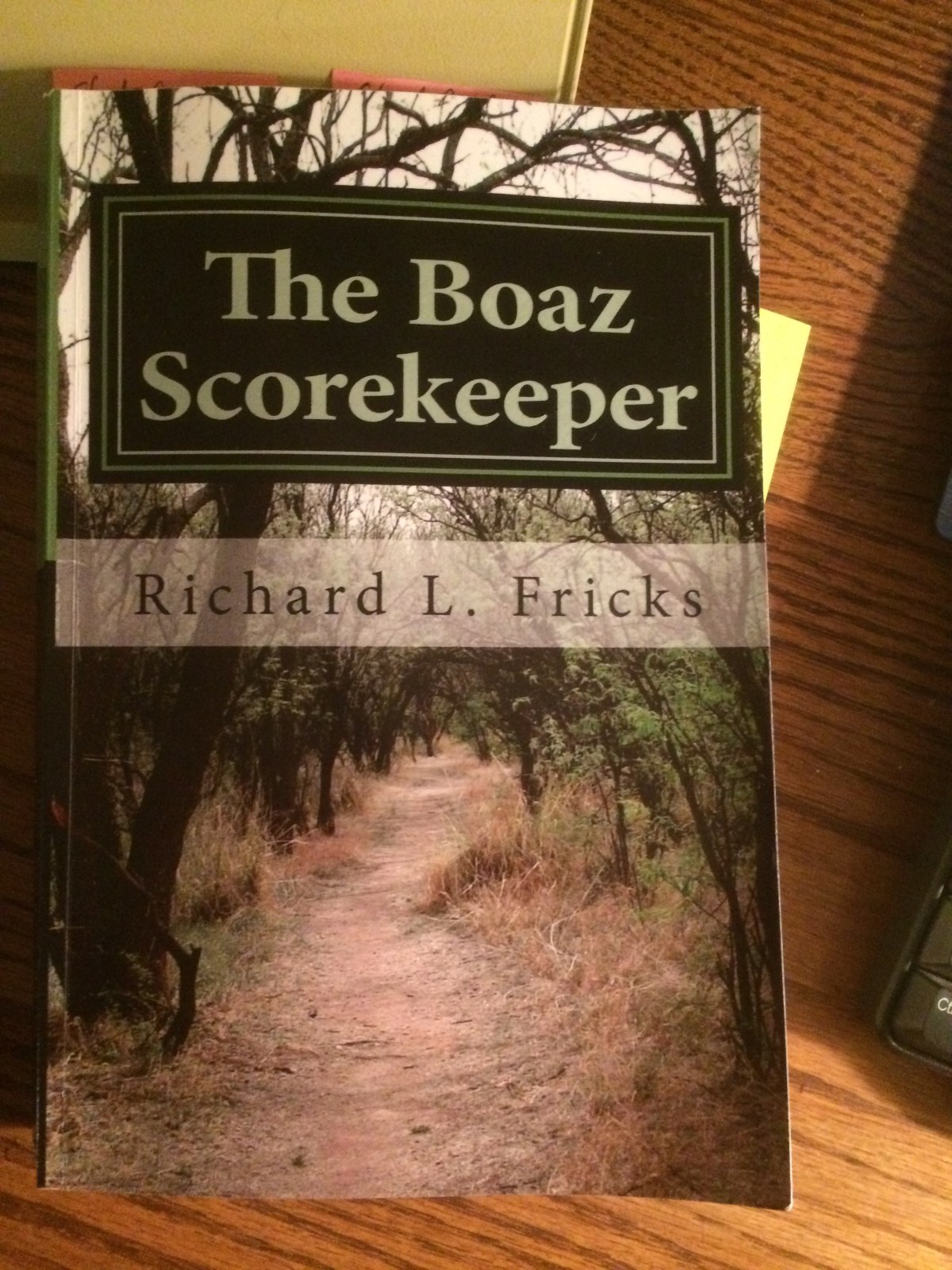
The Boaz Scorekeeper, written in 2017, is my second novel. I'll post it, a chapter a day, over the next few weeks.
When Karla, Lewis, and I moved back from Atlanta we visited Clear Creek Baptist Church for several weeks. It just wasn’t the same without Brother G. And the more I investigated the Murray’s wrongful death case, the more I realized that the walls of First Baptist Church of Christ held a library full of secrets, many of which were likely relevant to Wendi and Cindi’s justice.
The first Sunday we visited we attended only the worship hour. We thought it best to tip toe into the cool waters before jumping off the high dive into the deep and lurking waters of Sunday School.
By the end of summer 1997, the Murray’s wrongful death lawsuit against the Flaming Five was well known throughout Marshall County. It was perpetual talk, from old men sipping coffee at Grumpy’s Diner, to women of all ages getting their hair done at the ten assorted beauty salons scattered across Boaz.
I could not have imagined a colder welcome. We walked in and were guided by an usher to the back of the middle section. Only two older ladies gave us a smile and a handshake during the fellowship song before preaching began. However, I did feel the other four hundred or so eyes staring at me with each painting my face equally evil alongside the ever-roving Satan. Particularly burning were the dark eyes glaring down on me from the choir loft. Randall Radford stood like a statue in the center of the back row with uncharacteristically drooping shoulders. I guessed he had rather be on the golf course than worshipping here together. As other people mingled, shook hands, and sang “Victory in Jesus,” I saw James Adams, Fred Billingsley, and John Ericson, along with their wives and parents, anchoring the front half of the center section.
Pastor Walter Tillman, Wade’s father, was out of town leaving the preaching to his equally competent son. Wade announced that his father would continue his series on Marriage the following Sunday and that he had been led to preach on the grace and wisdom of Jesus. I noticed the church bulletin had titled Wade’s sermon as “Saved from Stones.” I recognized the scripture verses next to the sermon title knowing they described how Jesus had handled the woman caught in adultery. Wade’s eyes caught mine when he asked the congregation to stand for him to read John 8:1-11:
“Jesus went unto the mount of Olives. And early in the morning he came again into the temple, and all the people came unto him; and he sat down, and taught them. And the scribes and Pharisees brought unto him a woman taken in adultery; and when they had set her in the midst, They said unto him, Master, this woman was taken in adultery, in the very act. Now Moses in the law commanded us, that such should be stoned: but what sayest thou? This they said, tempting him, that they might have to accuse him. But Jesus stooped down, and with his finger wrote on the ground, as though he heard them not. So, when they continued asking him, he lifted up himself, and said unto them, He that is without sin among you, let him first cast a stone at her. And again, he stooped down, and wrote on the ground. And they which heard it, being convicted by their own conscience, went out one by one, beginning at the eldest, even unto the last: and Jesus was left alone, and the woman standing in the midst. When Jesus had lifted up himself, and saw none but the woman, he said unto her, Woman, where are those thine accusers? hath no man condemned thee? She said, No man, Lord. And Jesus said unto her, Neither do I condemn thee: go, and sin no more.”
I would have given half a year’s salary to have known what Wade had truly thought as he had read these verses. I would never know but I did learn how talented he was behind the pulpit. Wade presented a powerful three-point sermon that would please any Southern Baptist preacher. He analogized the woman’s plight and problem to a broad array of modern day issues, including a major exam at school, a struggling business, and the loss of a loved one. Wade acknowledged that life in America didn’t include being stoned for adultery, yet we felt as though it did. He argued that we all face problems that to us cause us to run away if nothing more than in our minds. He proclaimed that there is a better way. He led us through how Jesus stood between the guilty woman and the ready stones of her accusers. Wade encouraged us to notice how the woman didn’t continue to run, that she stood, weak-kneed no doubt, and faced the mighty wave rolling her way, and rested in the mighty wisdom of Christ.
It was a moving sermon and the entire congregation sat silent lapping up every word. I couldn’t help but think, something that I knew Christians were warned against doing, that this scripture wasn’t even part of the earliest Greek manuscripts from which the Bible was taken. I had long concluded that the Bible was simply a man-made book and Wade’s verses, like so many others, had simply been added hundreds of years later. I wondered how otherwise educated and rational people could believe the Bible was the inerrant, infallible Word of God. Of course, I knew why. They, like me, all my growing up years, had been told one side of the story. They had never been told the truth. And, like so much of life itself, many are not interested in the truth.
While exiting the auditorium, I shook Fitz Billingsley’s hand. I hadn’t seen Fred’s father since I was in the 11th grade when my Dad had taken me to First State Bank to co-sign a promissory note for me to buy my first car, a 1968 Chevrolet Corvair. I’m sure Fitz would not have shaken my hand in most any other circumstance. But here, he was one of two deacons stationed at the back door charged with extending the right hand of fellowship as God’s people marched outside and onward to share with neighbors and friends how Jesus was always near, saving them from stones.
Biking is something I both love and hate. The conflicting emotions arise from the undeniable physical effort it demands. However, this exertion is precisely what makes it an excellent form of exercise. Most days, I dedicate over an hour to my cycling routine, and in doing so, I’ve discovered a unique opportunity to enjoy a good book or podcast. The rhythmic pedaling and the wind against my face create a calming backdrop that allows me to fully immerse myself in the content. In these moments, the time spent on the bike seems worthwhile, as I can’t help but appreciate the mental and physical rewards it offers.
I especially like having ridden. The post-biking feeling is one of pure satisfaction. The endorphin rush, coupled with a sense of accomplishment, makes the initial struggle and fatigue worthwhile. As I dismount and catch my breath, I relish the sensation of having conquered the challenge, both physically and mentally. It’s a reminder that the things we sometimes love to hate can often be the ones that bring us the most fulfillment. In the end, the love-hate relationship with biking only deepens my appreciation for the sport, as it continually pushes me to overcome my own limitations and embrace the rewards that follow the effort.
My bike
A Rockhopper by Specialized. I purchased it November 2021 from Venture Out in Guntersville; Mike is top notch! So is the bike. The ‘old’ man seat was salvaged from an old Walmart bike (update: seat replaced, new photo to follow, someday).
Something to consider if you’re not already cycling.
I encourage you to start riding a bike, no matter your age. Check out these groups:
Don’t miss the #1 New York Times bestselling blockbuster and Reese Witherspoon Book Club Pick that’s sold over 2 million copies–now an Apple TV+ limited series starring Jennifer Garner!
The “page-turning, exhilarating” (PopSugar) and “heartfelt thriller” (Real Simple) about a woman who thinks she’s found the love of her life—until he disappears.
Before Owen Michaels disappears, he smuggles a note to his beloved wife of one year: Protect her. Despite her confusion and fear, Hannah Hall knows exactly to whom the note refers—Owen’s sixteen-year-old daughter, Bailey. Bailey, who lost her mother tragically as a child. Bailey, who wants absolutely nothing to do with her new stepmother.
As Hannah’s increasingly desperate calls to Owen go unanswered, as the FBI arrests Owen’s boss, as a US marshal and federal agents arrive at her Sausalito home unannounced, Hannah quickly realizes her husband isn’t who he said he was. And that Bailey just may hold the key to figuring out Owen’s true identity—and why he really disappeared.
Hannah and Bailey set out to discover the truth. But as they start putting together the pieces of Owen’s past, they soon realize they’re also building a new future—one neither of them could have anticipated.
With its breakneck pacing, dizzying plot twists, and evocative family drama, The Last Thing He Told Me is a “page-turning, exhilarating, and unforgettable” (PopSugar) suspense novel.
This is the fourth of nine installments in the animated interlude season of The Universe in Verse in collaboration with On Being, celebrating the wonder of reality through stories of science winged with poetry. See the rest here.
THE ANIMATED UNIVERSE IN VERSE: CHAPTER FOUR
Months before Edwin Hubble finally published his epoch-making revelation about Andromeda, staggering the world with the fact that the universe extends beyond our Milky Way galaxy, a child was born under the star-salted skies of Washington, D.C., where the Milky Way was still visible before a century’s smog slipped between us and the cosmos — a child who would grow up to confirm the existence of dark matter, that invisible cosmic glue holding galaxies together and pinning planets to their orbits so that, on at least one of them, small awestruck creatures with vast complex consciousnesses can unravel the mysteries of the universe.
Night after night, Vera Rubin (July 23, 1928–December 25, 2016) peered out of her childhood bedroom and into the stars, wonder smitten with the beauty of it all — until she read a children’s book about the trailblazing astronomer Maria Mitchell, who had expanded the universe of possibility for half of our species a century earlier. The young Vera was suddenly seized with a life-altering realization: Not only was there such a thing as a professional stargazer, but it was a thing a girl could do.
Vera Rubin as an undergraduate at Vassar, 1940s
In 1965 — exactly one hundred years after Maria Mitchell was appointed the first professor of astronomy at Vassar, which Vera Rubin had chosen as her training ground in astronomy — she became the first woman permitted to use the Palomar Observatory. Peering through its colossal eye — the telescope, devised the year Rubin was born, had replaced the one through which Hubble made his discovery as the world’s most powerful astronomical instrument — she was just as wondersmitten as the little girl peering through the bedroom window, just as beguiled by the beauty of the cosmos. “I sometimes ask myself whether I would be studying galaxies if they were ugly,” she reflected in her most personal interview. “I think it may not be irrelevant that galaxies are really very attractive.”
Galaxies had taken Rubin to Palomar, and galaxies — the riddle of their rotation, which she had endeavored to solve — became the key to her epochal confirmation of dark matter. One of the most mesmerizing unsolved puzzles in astronomy, dark matter had remained only an enticing speculation since the Swiss astrophysicist Fritz Zwicky had first theorized it when Vera was five.
A generation later, a small clan of astronomers at Cambridge analyzed the deepest image of space the Hubble Space Telescope had yet captured — that iconic glimpse of the unknown, revealing a universe “so brutal and alive it seemed to comprehend us back” — to discern the origin of the mysterious dark matter halo enveloping the Milky Way. Spearheading the endeavor was an extraordinary young astronomer back to work during a remission of a rare terminal blood cancer ordinarily afflicting the elderly.
Rebecca Elson, 1987
Nursed on geology and paleontology on the shores of a prehistoric lake, Rebecca Elson (January 2, 1960–May 19, 1999) was barely sixteen and already in college when she first glimpsed Andromeda through a telescope. Instantly dazzled by its “delicate wisp of milky spiral light floating in what seemed a bottomless well of empty space,” she became a scientist but never relinquished the pull of the poetic dimensions of reality. During her postdoctoral work at Princeton’s Institute for Advanced Study, Elson found refuge from the narrow patriarchy of academic science in a gathering of poets every Tuesday evening. She became a fellow at a Radcliffe-Harvard institute for postgraduate researchers devoted to reversing “the climate of non-expectation for women,” among the alumnae of which are Anne Sexton, Alice Walker, and Anna Deavere Smith. There, in a weekly writing group, she met and befriended the poet Marie Howe, whose splendid “Singularity” became the inspiration for this animated season of The Universe in Verse.
It was then — twenty-nine and newly elected the youngest astronomer in history to serve on the Decennial Review committee steering the course of American science toward the most compelling unsolved questions — that Elson received her terminal diagnosis.
Throughout the bodily brutality of her cancer treatment, she filled notebooks with poetic questions and experiments in verse, bridging with uncommon beauty the creaturely and the cosmic — those eternal mysteries of our mortal matter that make it impossible for a consciousness born of dead stars to fathom its own nonexistence.
Rebecca Elson lived with the mystery for another decade, never losing her keen awareness that we are matter capable of wonder, never ceasing to channel it in poetry. When she returned her borrowed stardust to the universe, a spring shy of her fortieth birthday, she left behind nearly sixty scientific papers and a single, splendid book of poems titled A Responsibility to Awe (public library) — among them the staggering “Theories of Everything” (read by Regina Spektor at the 2019 Universe in Verse) and “Antidotes to Fear of Death (read by Janna Levin at the 2020 Universe in Verse).
Permeating Elson’s poetic meditations, the mystery of dark matter culminates in one particular poem exploring with uncommon loveliness what may be the most touching paradox of being human — our longing for the light of immortality as creatures of matter in a cosmos governed by the dark sublime of dissolution.
LET THERE ALWAYS BE LIGHT (SEARCHING FOR DARK MATTER) by Rebecca Elson
For this we go out dark nights, searching For the dimmest stars, For signs of unseen things:
To weigh us down. To stop the universe From rushing on and on Into its own beyond Till it exhausts itself and lies down cold, Its last star going out.
Whatever they turn out to be, Let there be swarms of them, Enough for immortality, Always a star where we can warm ourselves.
Let there be enough to bring it back From its own edges, To bring us all so close we ignite The bright spark of resurrection.
Previously on The Universe in Verse: Chapter 1 (the evolution of life and the birth of ecology, with Joan As Police Woman and Emily Dickinson); Chapter 2 (Henrietta Leavitt, Edwin Hubble, and the human hunger to know the cosmos, with Tracy K. Smith); Chapter 3 (trailblazing astronomer Maria Mitchell and the poetry of the cosmic perspective, with David Byrne and Pattiann Rogers).
In recent months, Donald Trump has been talking about bringing back the anti-Muslim immigration ban from his single term in office.
His white evangelical fanbase loves it. Almost ten years into their decline, they are more touchy than ever about losing credibility and cultural power.
Say whatever you like about Donald Trump. If it’s negative, it’s probably true. But don’t say he doesn’t know how to work a sympathetic crowd. In recent campaign speeches, Trump has been telling his crowds of followers about how he plans to handle immigrants from, presumably, Muslim-dominated countries: he’d keep out those who “don’t like our religion” and “hate America.”
This flatly illegal, completely unconstitutional, human-rights-violating promise appears to have played well to his fanbase, who are overwhelmingly white evangelical Christians who claim to adore the rule of law, the Constitution, and the Bill of Rights. They certainly haven’t rejected him on the basis of that promise! It demonstrates well their priorities amid their religion’s ongoing decline: to defend what turf they can, and grab what temporal power they can before their cultural power fades too much to grab anything with it at all.
Donald Trump and the last screech of white evangelicalism
“I will implement strong ideological screening of all immigrants,” the former president vowed. “If you hate America, if you want to abolish Israel, if you don’t like our religion (which a lot of them don’t), if you sympathize with jihadists, then we don’t want you in our country and you are not getting in.”“Trump Says He’ll Ban Immigrants Who ‘Don’t Like Our Religion’,” Ryan Bort, Rolling Stone
The idea of “ideological screening” should alarm any American who cares about human rights. This is a religion test, which our laws specifically do not allow. But the kind of people who support Donald Trump don’t care. For all their fetishizing of America, its Founding Fathers, its history, and its laws, somehow his fanbase is totally fine with this kind of screening.
I’m not surprised. Donald Trump’s entire existence as a political candidate is predicated entirely on his biggest fanbase’s complete hypocrisy.
Donald Trump is still pandering about ‘our religion’
For months now, Donald Trump has been making the rounds at political rallies. He wants to be president again. That means he needs to raise support in the only real core fanbase he has: white evangelical Christians.
This group comprises somewhere between 5%-35% of Americans depending on who you consult, but they are reliable voters. According to Pew Research, he received 77% of this group’s votes in 2016, then 84% in 2020. Obviously, lots of other sorts of people also voted for him, but they tend to be the understanding sort who don’t mind him pandering so hard to this one group.
In May this year, he went off the rails ranting about immigration. Again. That’s always been a concern for conservatives generally, and white evangelical Christians in particular. Considering their stated beliefs, it’s ironic in the extreme that they’d oppose immigration and despise immigrants like they do. In fact, one 2015 evangelical-run study discovered that 90% of evangelical respondents didn’t base their beliefs about immigration on the Bible at all. (Franklin Graham even drilled down on this exact point in 2017. In response, the Washington Post humiliated him with a Bible study. Other Christians have written similar rebukes.)
Here as elsewhere, evangelicals’ unstated beliefs speak far more loudly than any vocal belief statements they could ever issue. They don’t want a Pastor-in-Chief. No, they want a tribalistic strongman who will prevent more non-Christians from entering the United States, since such immigration only dilutes their numbers and power. They want a ruler who flouts behavioral rules, flaunts his degeneracy and ignorance, and says out loud all the horrific stuff they dare not whisper.
Most of all, they want a ruler who will raise them to the rulership over America that they think they deserve, and one who will punish their enemies until they are strong enough to do it themselves.
As he did almost ten years ago, Donald Trump promises to be that ruler.
When ‘our religion’ is only the religion of a shrinking percentage of Americans
As noted earlier, the percentage of evangelicals in America is very far from a majority. Depending on the definition you use and the authorities and studies you consult, they range from 5% of Americans to 35%. But they vote very reliably. That fact makes them a desirable bloc to own for conservative politicians.
Most desirably of all, they respond extremely well to fearmongering, fake news, and tribalistic jingoism. In their own minds, they’ve got a lot to be afraid of—their own increasing cultural irrelevance most of all.
Christianity itself is cruising quickly toward losing its majority status in America. At present, about 63% of Americans claim Christian affiliation. When Pew Research modeled religious switching in future decades, though, they found that most estimates had that percentage dropping to 35-46% by 2070. Meanwhile, the percentage of “Nones” (the religiously unaffiliated who claim “none of the above” as their religion) only continues to rise. In Pew’s model, they go from 30% currently to 41-52% by 2070.
Add non-Christian immigration to the mix, and white evangelicals become irrelevant even more quickly. So I can easily understand why white evangelicals bitterly oppose immigration, even if it clashes hilariously with their stated beliefs in a literal, inerrant, completely timeless and divine Bible.
Donald Trump knows that white evangelicals don’t want no meltin’ pots
Kristin Kobes du Mez, a brilliant writer whose work I adore, linked evangelicals’ opposition to immigration to “militant masculinity” in 2018. It’s not in me to gainsay her. She’s got a deep understanding of that exact facet of white evangelicalism. As she wrote:
It is incredibly difficult to disrupt a cohesive worldview of this sort, particularly one that is inherently suspicious of opposing views and is fueled by a victimization narrative, one backed by a multi-billion-dollar spiritual-industrial complex, and one that has direct and exclusive avenues of communication to hundreds of millions of eager consumers.“Understanding White Evangelical Views on Immigration,” Kristin Kobes du Mez, Harvard Divinity Bulletin
I’d just add this: That “cohesive worldview” is not just militantly macho. It also reflects white evangelicals’ increasing sense of tribalism.
In sociology, it is not a good thing for a group to behave in tribalistic ways. Such a group tends to be dysfunctionally authoritarian. That means that it cannot fulfill its own stated goals, nor even protect its own members from in-group abuse. Instead, the group is a conduit for power. Its followers cluster around a chosen charismatic leader who dispenses power to those lower on the power ladder. Those below the leader jockey and infight for favor.
To maintain their hold on power, the leaders of these groups need to flex their power often. They do this in a variety of ways:
Betraying those who are no longer useful
Visibly disobeying the group’s rules and allowing favored underlings to disobey them as well
Painting outsiders to the group as their mortal enemies
Stomping on critics and apostates with both feet
Being inconsistent with rule enforcement and creation
Destroying any heretics’ reputations and relationships as they leave the group
Making followers do things they don’t want to do, from church chores to abusive sexual favors
But this flexing works best if group members feel they can’t ever leave. If they’re sure they’ll never recover emotionally or financially from such a move, then they’re far less likely to take the risk.
So in a lot of ways, tribalism in Christianity works best in an environment where the local tribe leaders wield a lot of cultural power. If their power gets too diluted, people feel safer in leaving. And the more non-Christians enter the United States, the more diluted white evangelicals—along with their vision of ideal American culture—become in the population as a whole.
The last thing tribalistic white evangelicals want is a melting-pot America. Rather, they desire a solidly Christian America (full of their own preferred kind of Christian, naturally) that turns non-Christians of all kinds into pariahs until they bend the knee.
Compassion and empathy destroy tribalism
Another serious problem evangelicals have with immigration is simply the way that knowing people from the outgroup can destabilize a dysfunctional-authoritarian ingroup. Right now, Trump can frighten his fanbase by identifying Muslim immigrants as terrorists. He can paint them as scary Others who don’t know how to America right.
But once Americans get to know outsiders, they stop being outsiders.
By now, there are about 3.85 million Muslims in the United States, according to a 2023 Pew Research report. In the past 20-ish years, the number of mosques has grown from 1209 to 2769. (And, as they always have, Republicans tend to think they, as a group, face more discrimination than Muslims do.) Muslims are also running for—and winning—public office. They’re far more visible now than they ever were. A 2017 Pew Research survey even found that most Americans were significantly warming up to Muslims, though the war in Israel might now be changing things for the worse.
Still, that visibility has to be scaring the knickers off of white evangelicals. They don’t want to see Muslims praying on their knees on public sidewalks, or to take college classes alongside women in headscarves, or see their kids making friends with Muslim kids.
(I can’t think of evangelicals encountering headscarves without thinking of that cringey side plot from the first “God’s Not Dead” movie involving a young Muslim convert who adores Franklin Graham—who if you’ll recall is very anti-immigration.)
White evangelicals don’t want any reminders that they no longer represent the cultural standard of America, nor are even its Designated Adults. What they want is quiet, effortless mastery and recognized superiority, not having to share and play nicely with the other children on the playground.
Even if it destroys their witness, to use the Christianese, they can’t let go of their tribalism. Jesus’ direct orders be damned! Bible blahblah is all well and good, but this is real life we’re talking about. Like everyone else, white evangelicals know that when real life starts happening, they have to step into the real world to deal with it.
The new age of evangelical power-grabs
Over the past few years, I’ve noticed a sharp change in how white evangelicals present themselves and sell their only product (active membership in their own group).
Just a decade ago, evangelicals tried to engage outsiders in one-sided non-versations. They traveled to schools to deliver sales pitches. They ran pseudo-charity efforts like Beach Reach that were really about indoctrination. Online, they seemed acutely aware that they were selling something. Sure, very few people cared to buy it anymore. But they still felt compelled by Jesus to SELL SELL SELL WITHOUT MERCY.
To an extent, they still do that stuff, yes. But they’ve really shifted their emphasis. Now, they seem much more like an overtly theocratic, totalitarian political group with a thin coat of Jesus frosting. Aware that nobody wants to buy their product on its own merits, they have turned from wheedling and fake non-versations to outright insults and sneers toward those who reject their control-grabs. This behavior seems to bolster their own self-image, even as it wrecks their tribe’s credibility every time they act out.
When I encounter them, I can’t help but think that my first pastor, a genial old Pentecostal leader in our denomination, would have had their hides for mistreating people the way they do.
Again, this is real life we’re talking about, though, not Bible blahblah. Evangelicals may give lip service to Jesus’ sheer power and miracle-working all they like. In the real world, they’re aware that if they don’t punish their enemies, Jesus sure won’t do it for them.
I’ve known this about evangelicals for a long, long time. In a way, I’m glad Trump has come along to unmask them.
I suspect that the further white evangelicals decline in cultural power and credibility, the more and the worse they’ll act out. I just hope the rest of the world is ready to listen when they tell us who they truly are.
The Boaz Scorekeeper, written in 2017, is my second novel. I'll post it, a chapter a day, over the next few weeks.
We put our furniture and other belongings in storage and lived with Karla’s parents until we rented a house on College Avenue in Boaz. It was an older house, but with ample room for the three of us. It was within easy walking distance of Matt’s office in Scott Plaza.
I didn’t waste any time. Three days after leaving Atlanta I reported for work. On the ride in from Rodentown, where the Jacobson’s lived, I was thankful Matt had called last night and given me an overview of what to expect. I really liked him saying, “welcome to Bearden and Tanner, Attorneys at Law.”
Matt had a small but busy solo practice. After I arrived, the number of lawyers had instantly grown by 100 percent. But, if you counted Tina, the law firm had legal knowledge approaching the big firm I had just resigned from in Atlanta. Her name was Tina Bonds. She was the heavy lifter who wore a multitude of hats including secretary, paralegal, bookkeeper, Internet snoop, and professional gopher.
In our phone call yesterday Matt had given me the rundown on ‘Tiny,’ as she called herself. He warned me that Tina and only Tina could refer to her as ‘Tiny.’ Tina Guthrie Bonds was the daughter of Big Jim Guthrie, the most famous lawyer in North Alabama for over sixty years. He practiced in Gadsden from the early 1930s until five years ago when he died of a heart attack making a closing argument in an automobile accident case in the Honorable Donald Stewart’s courtroom. Big Jim was 88.
Tina graduated from Etowah High School in 1963. At eighteen she already had eight years’ experience working in a law office. Since she was ten years old Big Jim had her scanning caselaw books searching for some barn burner legal principle he could use to bushwhack an opposing attorney. ‘Tiny’ was Big Jim’s invention. He said there was nothing tiny about her. She was tall like him and between her ears lay the “most fertile mind ever to darken the halls of Etowah High.” By the time Tina was in 9th grade, she was sitting beside Big Jim at counsel feeding him cross-examination questions that often caused even the judges to shake their heads in disbelief.
It took only ten years for the perfect duo to run ashore. About half of Big Jim’s clients were blacks but he didn’t see the color of their skin. His only concern was for their inalienable rights. Tina dating a black man named Robbie changed Big Jim’s vision. The short of it was most unfortunate. It likely severed the two best legal minds ever to team up in Alabama. Tina and Robbie were arrested in the Fall of 1972 by Boaz Police when they were passing through returning from a trip to Huntsville. The patrol officer didn’t like the feisty Tina and put her in cuffs for speeding, obstruction of justice, and ‘smart-assing’ a police officer. Two days later Matt had received a call from Big Jim himself. He said he wouldn’t come to his daughter’s rescue but knew she might need a second chair because she would never plea out.
Two weeks later Tina moved to Boaz and became the anchor for new-to-Boaz attorney Matt Bearden. Robbie came along too but had a change of mind a month later after weekly pull-overs by the Boaz Police. Tina said goodbye and wished him well.
Tina had a double front office spending most of her time in the one only partially seen by clients waiting out in her front receptionist office. The dark room, as it was called, was like a war zone. Her large oak desk in the middle of the room contained the only semblance of organization and neatness. Along the edges of the six-foot desk were stacks of multi-colored files forming a giant U. Within the U was the protected zone where only one file could be open at a time. A two-foot square computer monitor sat on an attached side table that was six inches or so lower than the desk top. An ancient oak chair without rollers was Tina’s favorite for sitting here to draft the standard motions for the various divorce, bankruptcy, criminal, and custody cases that Matt handled. He drafted the more complex motions and sent them over to Tina via the office’s intranet.
Along the walls in Tina’s back office were floor to ceiling shelves that were in total disarray although she warned me not to even touch anything on the shelves. Southeastern Reporters, forms books, and what looked like full collections of John Grisham, James Patterson, and Lawrence Block were just a few of what I saw during my first office tour. Along the front window were two six-foot tables that Tina said were for case intake and bookkeeping. In front of the shelves along the wall behind her giant oak desk were two card tables where a recent tornado had camped out. She said, “the civil table is Discovery in and out. The criminal table is Discovery in and out.” I didn’t question her.
After an hour with Tina, Matt finally came out of his office and directed me to a cramped little office next to a large back room that served quadruple duty as file center, kitchen, utility, and recreation headquarters, complete with ping-pong and pool tables.
My office was empty except for an old five-foot oak kitchen table, a leather chair, a computer desk, and one metal bookcase. A telephone was on the table. “Sorry about your office. I’m looking for us another place, maybe we can buy something before too long.” Matt said.
Tina brought me the Murray file and I spent the rest of the morning reading a memorandum that Tina had drafted, and reviewing the complete transcripts of the case, State of Alabama vs. Micaden Lewis Tanner. Vividly reliving the darkest days of my life had spun my mind and stomach leaving me both sick and hungry. At 12:00 noon Matt took me to lunch at the Food Basket in Albertville.
Biking is something I both love and hate. The conflicting emotions arise from the undeniable physical effort it demands. However, this exertion is precisely what makes it an excellent form of exercise. Most days, I dedicate over an hour to my cycling routine, and in doing so, I’ve discovered a unique opportunity to enjoy a good book or podcast. The rhythmic pedaling and the wind against my face create a calming backdrop that allows me to fully immerse myself in the content. In these moments, the time spent on the bike seems worthwhile, as I can’t help but appreciate the mental and physical rewards it offers.
I especially like having ridden. The post-biking feeling is one of pure satisfaction. The endorphin rush, coupled with a sense of accomplishment, makes the initial struggle and fatigue worthwhile. As I dismount and catch my breath, I relish the sensation of having conquered the challenge, both physically and mentally. It’s a reminder that the things we sometimes love to hate can often be the ones that bring us the most fulfillment. In the end, the love-hate relationship with biking only deepens my appreciation for the sport, as it continually pushes me to overcome my own limitations and embrace the rewards that follow the effort.
My bike
A Rockhopper by Specialized. I purchased it November 2021 from Venture Out in Guntersville; Mike is top notch! So is the bike. The ‘old’ man seat was salvaged from an old Walmart bike (update: seat replaced, new photo to follow, someday).
Something to consider if you’re not already cycling.
I encourage you to start riding a bike, no matter your age. Check out these groups:
Don’t miss the #1 New York Times bestselling blockbuster and Reese Witherspoon Book Club Pick that’s sold over 2 million copies–now an Apple TV+ limited series starring Jennifer Garner!
The “page-turning, exhilarating” (PopSugar) and “heartfelt thriller” (Real Simple) about a woman who thinks she’s found the love of her life—until he disappears.
Before Owen Michaels disappears, he smuggles a note to his beloved wife of one year: Protect her. Despite her confusion and fear, Hannah Hall knows exactly to whom the note refers—Owen’s sixteen-year-old daughter, Bailey. Bailey, who lost her mother tragically as a child. Bailey, who wants absolutely nothing to do with her new stepmother.
As Hannah’s increasingly desperate calls to Owen go unanswered, as the FBI arrests Owen’s boss, as a US marshal and federal agents arrive at her Sausalito home unannounced, Hannah quickly realizes her husband isn’t who he said he was. And that Bailey just may hold the key to figuring out Owen’s true identity—and why he really disappeared.
Hannah and Bailey set out to discover the truth. But as they start putting together the pieces of Owen’s past, they soon realize they’re also building a new future—one neither of them could have anticipated.
With its breakneck pacing, dizzying plot twists, and evocative family drama, The Last Thing He Told Me is a “page-turning, exhilarating, and unforgettable” (PopSugar) suspense novel.



























 by
by 

