Write to Life blog

Drafting–Breakfast in Pittsburgh

When the bus driver shut down the engine Millie tapped Molly on the hand. “Wake up. Breakfast time.” The kid could sleep through a tornado.
Molly, startled, inclined her seat, removed her ear buds, and shook her curly hair out of her eyes. “I’m starving,” she said looking at her mother.
“Sally Ann’s your best option.” The anorexic-looking girl across the aisle was standing and politely waiting for Molly and Millie.

“Say again,” Millie said, smiling at the young girl who looked like she hadn’t eaten in years.

Molly glanced at her mom, unplugged her iPhone from its charger underneath the seat, and stuffed it into her book bag. “It’s a restaurant.” Molly whispered to her mother.

The girl motioned for Millie and Molly to go first. “The reviews advise staying away from The Pitts. That’s the fast-food joint inside the bus station.”

The three exited the bus and walked inside the rear double-doors of the terminal. The lobby was large, much bigger than Toledo’s, and, so far, much cleaner. The gray and black floors looked like they’d just been waxed. “How far away is Sally’s?” Millie asked, not that hungry but knew Molly was, as always.

“It’s just two blocks north on 11th street. I’m going. Join me if you like. My treat. By the way, I’m Tracey.” This confused Millie. Anorexic’s are opposed to eating. And, why would this skinny, yet attractive girl who neither her or Molly knew, offer to buy their breakfast?

“I’m Molly. This is Millie, my mom.” Molly grabbed her mother’s hand and squeezed, knowing she needed to take charge as Millie battled depression. “Sounds good to me.” Molly said, shifting her book bag to her other shoulder.

Tracey led the way across the lobby, out the main entrance, and onto 11th street. Nothing much was said during their five minute walk.

The restaurant was small, and crowded. Six booths and an eight-stool counter. Not an available seat anywhere. For a minute, the three stood inside the front door, staring at the menu on the back wall taped to the metal hood above the griddle, and pondering whether to leave or wait. “Take ours.” An older man said from two booths away. “Come on Mildred, time to let these nice folks have our table.” The woman, probably his wife, looked like Millie felt: alone, sad, helpless. “You’re lucky. Food’s great. Come here every day.” It took another minute or two for the man to coax his wife from her seat, slip on a wide red scarf, and lead her outside. Millie couldn’t help but think how lucky the two seniors were, to have each other, hopefully after a long, satisfying life together.

“Where are you headed?” Molly broke the silence after the waitress filled their water glasses and took their orders. Millie removed her phone from her purse and started typing Matt a long text. She’d promised to update him every day.

“The Big Apple.” Tracey said, pouring half a Splenda into her water glass, then two shakes of salt. “New York City,” she added to clarify, but you probably know that already.” She stirred and used a spoon to test her concoction.

“What do you do there?” Molly was uninhibited.

“I teach meditation, also known as mindfulness.” Oh my, Millie thought about the Moonies along Canal Street she’d see every Thursday afternoon during her walk to her psychiatrist.

“Sounds like woo-woo to me.” Molly had no filter. Millie eyed her daughter, shaking her head sideways.

Carrie Borders was a Moonie, and she was a paralegal at Winston and Strawn. She occupied a cubicle in Millie’s quadrant, and like her, reported to law partner Kimbal Deitrich.

Tracey chewed slowly as though garnering time to frame her response. “I teach Zen. It’s nothing to do with the metaphysical. Simply put, it’s an exploration into the nature of the mind, a tool to open completely to our lives.”

Millie wasn’t especially spiritual but for the last year had attended a small church in their neighborhood. The unspoken reason was to create more time on weekends away from Colton. She ate a bite of her bran muffin and recalled Friday’s at Winston and Strawn.

Once per week, if their schedule allowed, the paralegal staff was allowed to dress casual. Carrie would always wear a t-shirt that read, “I’m a Moonie and I love it”. Millie had tried to avoid Carrie as much as possible but sometime she’d be stuck with her in a conference room indexing depositions. There, Millie learned a near-complete history of the Unification Church. It’s founder Sun Myung Moon, was allegedly a Messiah, second only to Jesus, wholly sinless. Moon’s purpose, as was all his followers, was to replace Christianity with his mission which was, in essence, to unite all humans into one family under God bringing peace throughout the earth. Woo-woo for sure, Millie had always concluded.

Molly ordered a refill of orange juice and continued peppering Tracey. “Where have you been? Did your car breakdown?”

Tracey pushed back her oatmeal bowl and forked a slice of pineapple. “I love your inquisitive daughter.” Her eyes met Millie’s and lingered a long while. “Two or three times per year I go on retreat. I always travel by Greyhound. For me, it keeps me rooted to life, real people, and real dependency. But mainly, I’m selfish. Riding the bus creates a lot of time to meditate without having to worry about driving.”

Molly interrupted Tracey. “Where was your retreat. This time?”

The waitress delivered their ticket and waited. Tracey removed a card from her pants pocket and handed it to the voluptuous red head. “Ottawa, Illinois, One River Zen. The center is a beautiful Queen Anne Victorian built in 1890, situated on the scenic banks of the Illinois River.”

“How long are retreats?”

“They vary. At One River they’re either a weekend or a week. Mine was the latter.” Tracey ate two bites of cantaloupe, and swallowed some water.

“Does meditation cause you to be so skinny?” Again, absolutely no filter.

“Molly, that’s too personal, borderline offensive.” Millie hoped her daughter would grow out of this.

“Oh, I love it.” Tracey replied. “So natural. She’s got a bright future.”

“Millie activated her cell. “We best be going. It’s almost 5:45. We don’t want to miss our ride.”

The food had been better than great. Even Millie bragged on the eggs, although she’d only taken a bite from Molly’s plate, who had wolfed down a southwestern omelet and a side order of bacon. Tracey’s appetite was equally as strong as Molly’s although she chose oatmeal, fruit, and unbuttered toast.

Millie was surprised she ate anything at all.

Maya Angelou on Writing and Our Responsibility to Our Creative Gifts

“I believe talent is like electricity. We don’t understand electricity. We use it.”

Here’s the link to this article.

BY MARIA POPOVA

Maya Angelou on Writing and Our Responsibility to Our Creative Gifts

“Be a good steward of your gifts,” the poet Jane Kenyon urged in what remains some of the finest advice on writing and life ever committed to words. Our gifts come unbidden — that is what makes them gifts — but with them also comes a certain responsibility, a duty to live up to and live into our creative potential as human beings. “Talent is insignificant. I know a lot of talented ruins,” James Baldwin admonished in his advice on writing. “Beyond talent lie all the usual words: discipline, love, luck, but most of all, endurance.” That durational willingness to work at our gifts, to steward them with disciplined devotion, is our fundamental responsibility to them — our fundamental responsibility to ourselves.

Maya Angelou (April 4, 1928–May 28, 2014) considers what that means and what it takes in a wonderful 1983 interview, included in Black Women Writers at Work (public library).

Maya Angelou

She reflects:

I try to live what I consider a “poetic existence.” That means I take responsibility for the air I breathe and the space I take up. I try to be immediate, to be totally present for all my work.

[…]

My responsibility as a writer is to be as good as I can be at my craft. So I study my craft… Learning the craft, understanding what language can do, gaining control of the language, enables one to make people weep, make them laugh, even make them go to war. You can do this by learning how to harness the power of the word. So studying my craft is one of my responsibilities. The other is to be as good a human being as I possibly can be so that once I have achieved control of the language, I don’t force my weaknesses on a public who might then pick them up and abuse themselves.

With an eye to the abiding mystery of our creative gifts, she adds:

I believe talent is like electricity. We don’t understand electricity. We use it. Electricity makes no judgment. You can plug into it and light up a lamp, keep a heart pump going, light a cathedral, or you can electrocute a person with it. Electricity will do all that. It makes no judgment. I think talent is like that. I believe every person is born with talent.

When asked how she fits her art into her life, Angelou responds:

Writing is a part of my life; cooking is a part of my life. Making love is a part of my life; walking down the street is a part of it. Writing demands more time, but it takes from all of these other activities. They all feed into the writing. I think it’s dangerous to concern oneself too damned much with “being an artist.” It’s more important to get the work done. You don’t have to concern yourself with it, just get it done. The pondering pose — the back of the hand glued against the forehead — is baloney. People spend more time posing than getting the work done. The work is all there is. And when it’s done, then you can laugh, have a pot of beans, stroke some child’s head, or skip down the street.

Complement with Susan Sontag on writing and what it means to be a decent human being and Olga Tokarczuk’s magnificent Nobel Prize acceptance speech about storytelling and the art of tenderness, then revisit Maya Angelou on courage and facing evilidentity and the meaning of life, and her cosmic clarion call to humanity.

01/17/23 Biking & Listening

Biking is something else I both love and hate. It takes a lot of effort but does provide good exercise and most days over an hour to listen to a good book or podcast. I especially like having ridden.

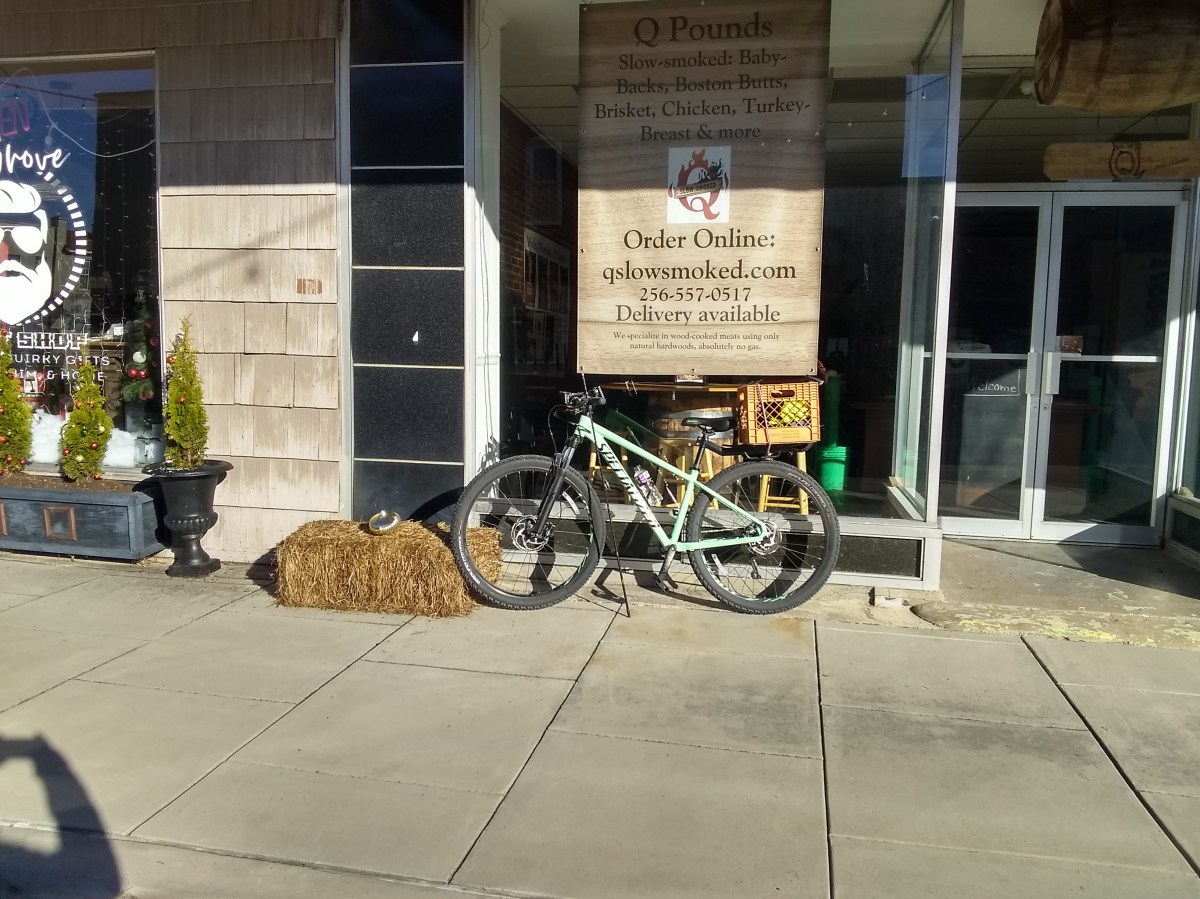
Here’s my bike, a Rockhopper by Specialized. I purchased it November 2021 from Venture Out in Guntersville; Mike is top notch! So is the bike, and the ‘old’ man seat I salvaged from an old Walmart bike.

Here’s a link to today’s bike ride. It’s what I call my pistol route, which is my goal every day. But, sometimes cold weather says otherwise.

Here’s a few photos taken along my route:

Here’s what I’m currently listening to: The First Deadly Sin, by Lawrence Sanders

Sanders was a tremendously talented writer.

Amazon abstract:

The #1 New York Times–bestselling author introduces readers to “a great detective, a detective’s detective,” New York cop Edward X. Delaney (Kirkus Reviews).

New York Police Department Captain Edward Delaney is called to the scene of a brutal murder. A Brooklyn councilman was struck from behind, the back of his skull punctured and crushed with an unknown weapon. The victim wasn’t robbed, and there’s no known motive. The commissioner appoints Delaney to head up a clandestine task force, but soon this effort ignites an internecine war of departmental backstabbing.   Distracted by the serious illness of his wife, Barbara, Delaney begins his secret investigation. Then the killer claims another victim—slain in the exact same way, leaving the strange puncture wound. As more young men are found murdered, Delaney starts putting the pieces together. Soon, he’s faced with a cop’s dilemma: He knows who the killer is, but the man is untouchable. That’s when Delaney lays a trap to bring a monster to justice . . .

Learn more–read this great review on Amazon by Pennydreadful

I feel I may have cheated when reading this book because I read it in gosh, too many years ago to count. However, Sanders’s Deadly Sin series were the first stories that put my heart to pounding and made me wish I could write. Recently, I wanted to see if that belief was still true, and darned if it isn’t.

Lawrence Sanders quite simply is a master. Of characterization, of research, of police procedure, of getting inside the characters’ (and readers’ heads). His set up might indeed be frowned upon today. He starts the book with several chapters surrounding the antagonist, and then we meet Captain Edward X. Delaney and several chapters pertain to him and the politics surrounding a police captain with a critically ill wife.

But a killer is on the streets of New York City, and soon Captain Delaney is torn. Torn between sitting by his wife’s bedside and putting a madman away. Naturally it’s not as simple as that because politics and a power struggle are afoot, and a new kind of police reorganization affects the department all the way to the mayors’ office.

Edward X Delaney’s wife takes a turn for the worse, and he tries to resign. A police commissioner persuades him to take a leave of absence. But in the midst of all the politics and turmoil affecting the police department, the commissioner convinces Delaney to work in secret and independently while using his years of detective experience to find the killer who is walking the streets of New York and murdering unsuspecting men with an ice ax.

To accomplish this private investigation, Captain Delaney must do much of the leg work and research himself. To do this he recruits civilians to aid him in this quest, including a bedridden mountain climber, a 70+ retired curator dying to be of assistance and the widow of one of Blank’s victims [Blank is the suspect]. Much of the case is done thanks to these people when the city is in a full-blown panic because of the new administrations’ blunders and inability to catch the killer.

Captain Delaney is called back to work. And with police resources given him, he makes every effort to stop a killer from killing again.

A masterpiece of writing.

Drafting–Youngstown to Pittsburgh—Millie

Millie squeezed Molly’s hand and wondered if by daylight she would extend another act of kindness and love. The feelings of guilt and worthlessness were always the first signs the manic stage was over, that her body, mind, soul, and spirit had peaked and she was spiraling downward, out of control. She prayed, doubting it would do any good.

Six months ago Dr. Maharaja prescribed Latuda for Millie’s depression, worried that some of her symptoms fit a schizophrenia diagnosis, especially the voices she occasionally heard. Millie opened her purse, removed the bottle of Latuda pills, and placed one under her tongue. She didn’t want to wait until tonight to take one as prescribed. Now was tonight, she told herself as the bus picked up speed heading for Pittsburgh.

Five minutes later Millie couldn’t decide if she was dreaming or simply exploring her memories. Either way, the guilt and worthlessness were center stage, wrapping her inside a heavy cloak of mistakes that engulfed her reality.

Millie had grown up as the only child in a happy household on the outskirts of Sanford, North Carolina. Her father wanted her to follow in his footsteps and become a lawyer. Although a good student at Lee County High School, Millie was an outdoorsy girl who liked to build things and, she wanted to travel. Uncle Dennis, her mother’s brother, was an expert welder and advised his niece to do what he’d done twenty-years earlier. He’d spent half-a-day at the high school and then rode a bus to Central Carolina Community College to learn to weld. After graduating he’d joined the local union and become a journeyman welder. “My job has taken me all over the country. If you want to see inside a nuclear silo, then become a journeyman welder. And, that’s what Millie did, to the consternation of her father.

In late summer 2006, a year after graduating from Lee County High School, Millie was given a four-month assignment at Belews Creek Steam Station in Stokes County, N.C. There, she met a dark-haired lumberjack figured man from North Alabama named Michael Lewis Tanner. Like Lewis, it was Millie’s fifth assignment as a union welder since turning eighteen. The two worked along with a hundred others side-by-side at the Duke Energy power plant during the day. Three weeks after meeting, simple and easy conversation and mutual attraction triggered a passionate romance. Time, touch, and talk came to a standstill when December came and new assignments appeared. Alabama Power’s Greene County Electric Generating Plant in Demopolis, Alabama for Millie. Nisource, Inc.’s Schahfer Generating Station in Wheatfield, Indiana for Lewis.

After a month of separation and a call or two per week, Millie sensed Lewis’ feelings were quickly waning and their intimacy had been nothing more than curiosity for the two nineteen year old inexperienced lovers. Then, Millie learned she was pregnant. This changed everything for Millie. There was never a doubt, she would become a mother and somehow raise her child; she would marry Lewis and they’d love their daughter (it had to be a girl) like her parents had loved her. But, a week later, when Millie finally got the courage to tell Lewis, he was cold, uncaring, and seemingly unwilling to shoulder any degree of responsibility. This had been the last time Millie and Lewis had talked, until August the second 2007, the day after Molly Leigh Anderson was born.

This time, Lewis was kind, sympathetic, open to a friendship, and willing to bear some of the costs of raising their daughter. However, things had changed for him. He was now a long-haul truck driver for J.B. Hunt, having completed his training in early July. The open road was now his life, and he’d come home, at most, once a month.

Lewis wasn’t the only one who’s life had taken a detour. In late April, after the Greene County job in Demopolis, Alabama ended, six months pregnant Millie returned to Sanford and her parents home. This time, she listened to her father, “picking up roots every three or four months is not the life for you and our grandchild. You need to go back to school, maybe become a teacher. You can live here with me and your mom and commute to my alma mater.”

The University of North Carolina at Chapel Hill had to wait, but Central Carolina Community College was the place to start. It took Millie a year to complete the associate’s degree she’d begun as a high school junior, plus, during this time, she’d had Molly and begun working for her father at his law firm. The latter had silenced her desire to become a teacher and seeded a growing interest in someday becoming a lawyer.

However, by Fall 2009, a smothering home environment and mounting tension with her mother over the raising of young Molly was fueling Millie’s impatience and need to blaze a new trail. Her sympathetic father came to the rescue and moved his daughter an hour away to Chapel Hill and paid the full tuition for the school’s Paralegal Certificate Program although it was mostly taught online.

Millie was startled to wakefulness when the loud speaker above her head announced the need for a detour. “Sorry ladies and gentlemen, we’ve got to exit here to avoid an overturned truck up ahead.” She raised her chair to upright and squinted down the bus’s center aisle. She couldn’t see anything but the white dashed lines in the road.

“A live-haul chicken truck turned over at the Franklin Park exit.” The anorexic-looking girl across the aisle declared holding a weird looking device attached via cables to her ears. The two met eyes and Millie semi-smiled and nodded her head as though saying thank-you for the update.

She activated her cell phone. It was 4:50 AM, and she was suddenly hungry. As she knew Molly was although she was still in a deep sleep, ear buds in, as though she hadn’t heard the blaring intercom.

Millie affixed her own ear buds, activated an Art Pepper playlist, and reclined her chair. She wanted to complete the journey she’d started over an hour ago.

In January 2010, certified as a paralegal by the North Carolina Bar Association, Millie was contacted by a legal recruiting firm based in Chicago. A week later—over the objection of her father who wanted Molly and Millie to return to Sanford and work with him—Millie flew to the windy city and interviewed with three law firms. By far her first choice was Quinn Law Offices but they didn’t extend an offer. With some hesitation, she settled on Winston and Strawn, the oldest firm in Chicago.

It was at a deposition a year later that Millie and Matthew Quinn met for the second time. Her professionalism and graceful assistance during the next hour prompted his phone call the next day. Three weeks later, Millie moved to the seventeen floor of Grant Thornton Tower and became a paralegal apprentice for the man who would become her number one fan and supporter.

For the next five years, all had gone as perfect as Millie could have wished or imagined, including the 2013 purchase of a cozy home on S. Princeton Avenue, and Molly’s exceptional adjustment and ongoing thriving at Harvard Elementary School.

Life was near perfect for the hardworking, hard-playing mother-daughter team until Millie met Colton Lee Atwood. Even after he moved in, life remained good. For the first year. Then, all hell broke loose.

“Greyhound Bus welcomes you to Pittsburgh. We’ll have an hour layover. Plenty of time for a good breakfast,” the bus driver’s deep voice resonated over the intercom.

Bloom: The Evolution of Life on Earth and the Birth of Ecology (Joan As Police Woman Sings Emily Dickinson)

How flowers gave rise to life on Earth and made possible the human consciousness that came to see a world “thronged only with Music.”

Here’s a link to this article.

BY MARIA POPOVA

This is the first of nine installments in the animated interlude season of The Universe in Verse in collaboration with On Being, celebrating the wonder of reality through stories of science winged with poetry. See the rest here.

THE ANIMATED UNIVERSE IN VERSE: CHAPTER ONE

Two hundred million years ago, long before we walked the Earth, it was a world of cold-blooded creatures and dull color — a kind of terrestrial sea of brown and green. There were plants, but their reproduction was a tenuous game of chance — they released their pollen into the wind, into the water, against the staggering improbability that it might reach another member of their species. No algorithm, no swipe — just chance.

But then, in the Cretaceous period, flowers appeared and carpeted the world with astonishing rapidity — because, in some poetic sense, they invented love.

Once there were flowers, there were fruit — that transcendent alchemy of sunlight into sugar. Once there were fruit, plants could enlist the help of animals in a kind of trade: sweetness for a lift to a mate. Animals savored the sugars in fruit, converted them into energy and proteins, and a new world of warm-blooded mammals came alive.

Without flowers, there would be no us.

No poetry.

No science.

No music.

Darwin could not comprehend how flowers could emerge so suddenly and take over so completely. He called it an “abominable mystery.” But out of that mystery a new world was born, governed by greater complexity and interdependence and animal desire, with the bloom as its emblem of seduction.

In 1866, the young German marine biologist Ernst Haeckel — whose exquisite illustrations of single-celled underwater creatures had enchanted Darwin — gave that interdependence a name: He called it ecology, from the Greek oikos, or “house, and logia, or “the study of,” denoting the study of the relationship between organisms in the house of life.

A year earlier, in 1865, a young American poet — a keen observer of the house of life who made of it a temple of beauty — composed what is essentially a pre-ecological poem about ecology.

Emily Dickinson at seventeen. (Amherst College Archives & Special Collections)

She had awakened to the interdependent splendor of the natural world as a teenager, when she composed a different kind of ecological poem: In a large album bound in green cloth, she painstakingly pressed, arranged, and labeled in her neat handwriting 424 wildflowers she had gathered from her native New England — some of them now endangered, some extinct.

This herbarium — which survives — became Emily Dickinson’s first formal exercise in composition, and although she came to reverence the delicate interleavings of nature in so many of her stunning, spare, strange poems, this one — the one she wrote in 1865, just before Ernst Haeckel coined ecology — illuminates and magnifies these relationships through the lens of a single flower and everything that goes into making its bloom — this emblem of seduction — possible: the worms in the soil (which Darwin celebrated as the unsung agriculturalists that shaped Earth as we know it), the pollinators in the spring air, all the creatures both competing for resources and symbiotically aiding each other.

And, suddenly, the flower emerges not as this pretty object to be admired, but as this ravishing system of aliveness — a kind of silent symphony of interconnected resilience.

To bring Emily Dickinson’s masterpiece to life is a modern-day poet of feeling in music — also a keen observer of the house of life, also a passionate lover of nature, also an emissary of aliveness through art.

She is a composer, a multi-instrumentalist classically trained as a violinist, and above all a singer and writer of songs with uncommon sensitivity to the most poetic dimensions of life.

Here is Joan As Police Woman with Emily Dickinson and the centuries-old pressed flowers from her actual herbarium.

BLOOM
by Emily Dickinson

Bloom — is Result — to meet a Flower
And casually glance
Would cause one scarcely to suspect
The minor Circumstance
Assisting in the Bright Affair
So intricately done
Then offered as a Butterfly
To the Meridian —
To pack the Bud — oppose the Worm —
Obtain its right of Dew —
Adjust the Heat — elude the Wind —
Escape the prowling Bee
Great Nature not to disappoint
Awaiting Her that Day —
To be a Flower, is profound
Responsibility —

HOW WE MADE IT

Every true artist is a miniaturist of grandeur, determined to make every littlest thing the very best it can be — not out of egoic grandiosity but out of devotion to beauty, devotion paid for with their time and thought, those raw materials of life. When I invited the uncommonly gifted and uncommonly minded Joan As Police Woman to bring the poem to life in a typical Universe in Verse reading, this true artist instead transformed it into a soulful song — an homage that would have gladdened the poet, who in her teenage years took regular music lessons and practiced piano for two hours a day, and who grew up to believe that, in its most transcendent stillness, the world is “thronged only with Music.”

From the start, I envisioned using the teenage poet’s herbarium — a forgotten treasure at the intersection of art and science, one of my favorite discoveries during the research for the Dickinson chapters of Figuring — as the raw material for the animation art. Having collaborated on a handful of previous animated poems, I invited Ohara Hale — artist, musician, poet, illustrator, animator, maker of nature-reverent children’s books, choreographer of beauty and feeling across a multitude of art-forms — to work her visual magic on the poem-song.

In a small wood cabin at the foot of a Spanish volcano, she set about reanimating — in both senses of the word — Emily Dickinson’s spirit through her herbarium.

Ohara composed all the creatures — the bee, the caterpillar, the butterflies, the human hand — from fragments of the poet’s centuries-old pressed flowers: digitized, restored, retraced by hand, and atomized into new life-forms. Individual petals, leaves, and stamens make the wings, body, and antennae of each butterfly. Layers of petals, sepals, and anthers stripe and behair the body of the bee. A large leaf folds unto itself to shape the hand that wrote this poem and nearly two thousand others — poems that have long outlived the living matter that felt and composed them, poems that have helped generations live.

Strewing the animation are words from the poem, hand-lettered by the polymathic Debbie Millman in a style based on surviving museum samples of Emily Dickinson’s handwriting from the period in which she composed the herbarium.

In a lovely way, the art mirrors the music it serves. Joan’s composition is itself a time-traveling masterwork of layering: voice upon keys upon strings, feeling-tone upon feeling-tone, classical heritage beneath thoroughly original sensibility — all of it so consonant with the central poetic image, all of it “so intricately done,” all of it a triumph of that “profound responsibility” we have to the ecosystem of art and ideas abloom in the spacetime between Emily Dickinson and us.

It has been an honor to collaborate with these uncommonly gifted women on honoring an uncommonly gifted artistic ancestor and celebrating our common evolutionary ancestry with all life-forms in nature.

01/16/23 Biking & Listening

Biking is something else I both love and hate. It takes a lot of effort but does provide good exercise and most days over an hour to listen to a good book or podcast. I especially like having ridden.

Here’s my bike, a Rockhopper by Specialized. I purchased it November 2021 from Venture Out in Guntersville; Mike is top notch! So is the bike, and the ‘old’ man seat I salvaged from an old Walmart bike.

Here’s a link to today’s bike ride. It’s what I call my pistol route, which is my goal every day. But, sometimes cold weather says otherwise.

Here’s what I’m currently listening to:

Making Sense of the Foundations of Morality

About this episode:

January 5, 2023

In this episode, we try to trace morality to its elusive foundations. Throughout the compilation we take a look at Sam’s “Moral Landscape” and his effort to defend an objective path towards moral evaluation.

We begin with the moral philosopher Peter Singer who outlines his famous “shallow pond” analogy and the framework of utilitarianism. We then hear from the moral psychologist Paul Bloom who makes the case against empathy and points out how it is more often a “bug” in our moral software than a “feature.” Later, William MacAskill describes the way a utilitarian philosophy informs his engagement with the Effective Altruism movement.

The moral psychologist Jonathan Haidt then puts pressure on Sam’s emphasis on rationality and objective pathways towards morality by injecting a healthy dose of psychological skepticism into the conversation.

After, we hear a fascinating exchange with the historian Dan Carlin where he and Sam tangle on the fraught issues of cultural relativism.

We end by exploring the intersection of technological innovation and moral progress with the entrepreneur Uma Valeti, whom Sam seeks out when he encounters his own collision with a personal moral failure.

About the Series

Filmmaker Jay Shapiro has produced The Essential Sam Harris, a new series of audio documentaries exploring the major topics that Sam has focused on over the course of his career.

Each episode weaves together original analysis, critical perspective, and novel thought experiments with some of the most compelling exchanges from the Making Sense archive. Whether you are new to a particular topic, or think you have your mind made up about it, we think you’ll find this series fascinating.

Drafting—Colton finds Millie’s note

Something was up. No lights downstairs, upstairs, anywhere. The front porch light was always on when he returned from work on Friday nights, even if Millie and Molly were gone on a jog or a walk. Colton turned off S. Princeton into his driveway. Hadn’t he promised Millie they’d go out tonight?

He parked and walked up the stairs. The front door was locked. It shouldn’t be. Both of them knew he didn’t like fiddling with keys. Where’s Molly? Hadn’t he called Millie at work and left a message with Catherine that he wanted Molly to go out with them tonight?

Inside, he flipped on the overhead light and walked to the kitchen for a beer. He closed the refrigerator and saw a note laying on the table. There was one sheet of paper ripped from a spiral bound notebook. Colton pulled back his chair and sat. It was Millie’s writing. He glanced at the back side. It was blank but there were two airline tickets underneath.

The flight was today. O’Hare to Houston, with a 4:00 PM arrival. He downed half his Bud, and read the note. Twice. It wasn’t a surprise Millie and Molly had fled. The surprise was that it had taken them so long to leave. The other two women he’d lived with hadn’t lasted a year.

Colton finished his beer, slung the bottle toward the sink, and grabbed another. He drawled out a deep burp and yelled, “you fucking bitch.” An equally loud laugh erupted. “Stupid, stupid. You think I’m buying what you’re selling, that you and Molly have gone to Houston?” He picked up one of the tickets and looked again. Maybe she’s trying that reverse psychology trick on me.

The only thing that bothered him was not knowing how to reach her. Without her testimony the DA had him over a barrel, a barrel shaped like an eight by eight jail cell.

Six months ago Colton and Sandy, his best bud, met two gorgeous University of Chicago sophomores at Mitchell’s Tap, their favorite hangout. Two games of darts and a half-hour of dancing had led to a few drinks but unequal desires. Ellen and Gina’s excuse for leaving was they had to study. Colton’s temper flared. Hell, it was Friday night. Who studies on Friday night? He figured the girls had played them, just wanted to flirt and enjoy some free drinks. It’s our age, Sandy had offered. “At least fifteen years older.” The two young lasses had left without a mere thank you. Rejection was something neither man could manage.

After quickly dismissing the thought of more darts, Colton and Sandy had tailed Ellen and Gina outside to the parking lot and on to an older house on South Morgan Street. There, inside, the women refused to come to the door. They obviously didn’t understand the two men standing on their porch would not be so easily deterred.

An hour later, the men returned donning ski masks and wielding a crowbar. The rear door was easily breached. The women resisted at first but soon surrendered, doing what they were told, hoping they’d live to see Monday morning classes.

Before the night was over, Colton and Sandy had taken everything they came for. The sixteen hundred cash was a bonus but cost Ellen a finger. To start with. Shortly before dawn, a distant siren and a ringing land line scared them off, but not before tying the women up, dousing the place with five gallons of gasoline Colton kept in the bed of his truck, and tossing lite matches in both bedrooms. After retrieving his truck from Mitchell’s Tap, Colton had driven home and awakened a sleeping Millie. Molly was at Alisha’s for a sleepover.

At first, Millie didn’t ask a question, just wondered silently why Colton was so disheveled with two scratches on his fact. “I may need you to provide an alibi.” Millie refused to tell anyone that he’d returned from Mitchell’s at 10:30 PM. She changed her mind when Colton threatened Molly.

Two weeks ago, the DA had secured an indictment against him and Sandy for burglary, robbery, rape, sodomy, false imprisonment, and arson. Colton’s defense attorney and investigator had subsequently learned that somehow Gina had managed to escape the burning house, but had hid out for nearly a week before approaching the police. No doubt, Gina was the DA’s key witness and was saying it had to be the two men she and Ellen had partied with at Mitchell’s earlier that night. City detectives had no trouble identifying Colton Lee Atwood and J. Sanford Brown. Unfortunately for the DA, there was no physical evidence Colton and Sandy were the perpetrators.

Colton tossed the second beer bottle in the sink and grabbed two more. He’d been in trouble before but nothing like this. At least he could be thankful he’d worn a condom when he’d fucked the tight-bodied Gina. But, he knew her testimony would be enough to put him and Sandy into the lion’s den of a trial, and without Millie’s alibi, the two of them could spend the rest of their lives in prison.

Colton swore he’d find Molly and Millie. If she refused to fully cooperate, he’d kidnap Molly and hold her until Millie lied that he was at home before 11:00 PM and stayed there all night. Colton knew Molly was the key to his freedom. The sweet, sexually maturing little girl was Millie’s weakness. She wouldn’t dare hesitate to protect the most important person in her world.

01/15/23 Biking & Listening

Biking is something else I both love and hate. It takes a lot of effort but does provide good exercise and most days over an hour to listen to a good book or podcast. I especially like having ridden.

Here’s my bike, a Rockhopper by Specialized. I purchased it November 2021 from Venture Out in Guntersville; Mike is top notch! So is the bike, and the ‘old’ man seat I salvaged from an old Walmart bike.

Here’s a link to today’s bike ride. It’s what I call my pistol route, which is my goal every day. But, sometimes cold weather says otherwise.

Here’s what I’m currently listening to: The First Deadly Sin, by Lawrence Sanders

Sanders was a tremendously talented writer.

Amazon abstract:

The #1 New York Times–bestselling author introduces readers to “a great detective, a detective’s detective,” New York cop Edward X. Delaney (Kirkus Reviews).

New York Police Department Captain Edward Delaney is called to the scene of a brutal murder. A Brooklyn councilman was struck from behind, the back of his skull punctured and crushed with an unknown weapon. The victim wasn’t robbed, and there’s no known motive. The commissioner appoints Delaney to head up a clandestine task force, but soon this effort ignites an internecine war of departmental backstabbing.   Distracted by the serious illness of his wife, Barbara, Delaney begins his secret investigation. Then the killer claims another victim—slain in the exact same way, leaving the strange puncture wound. As more young men are found murdered, Delaney starts putting the pieces together. Soon, he’s faced with a cop’s dilemma: He knows who the killer is, but the man is untouchable. That’s when Delaney lays a trap to bring a monster to justice . . .

Learn more–read this great review on Amazon by Pennydreadful

I feel I may have cheated when reading this book because I read it in gosh, too many years ago to count. However, Sanders’s Deadly Sin series were the first stories that put my heart to pounding and made me wish I could write. Recently, I wanted to see if that belief was still true, and darned if it isn’t.

Lawrence Sanders quite simply is a master. Of characterization, of research, of police procedure, of getting inside the characters’ (and readers’ heads). His set up might indeed be frowned upon today. He starts the book with several chapters surrounding the antagonist, and then we meet Captain Edward X. Delaney and several chapters pertain to him and the politics surrounding a police captain with a critically ill wife.

But a killer is on the streets of New York City, and soon Captain Delaney is torn. Torn between sitting by his wife’s bedside and putting a madman away. Naturally it’s not as simple as that because politics and a power struggle are afoot, and a new kind of police reorganization affects the department all the way to the mayors’ office.

Edward X Delaney’s wife takes a turn for the worse, and he tries to resign. A police commissioner persuades him to take a leave of absence. But in the midst of all the politics and turmoil affecting the police department, the commissioner convinces Delaney to work in secret and independently while using his years of detective experience to find the killer who is walking the streets of New York and murdering unsuspecting men with an ice ax.

To accomplish this private investigation, Captain Delaney must do much of the leg work and research himself. To do this he recruits civilians to aid him in this quest, including a bedridden mountain climber, a 70+ retired curator dying to be of assistance and the widow of one of Blank’s victims [Blank is the suspect]. Much of the case is done thanks to these people when the city is in a full-blown panic because of the new administrations’ blunders and inability to catch the killer.

Captain Delaney is called back to work. And with police resources given him, he makes every effort to stop a killer from killing again.

A masterpiece of writing.

The Universe in Verse–introduction to the 2021-2022 season

I encourage you to travel with me throughout the universe over the next few weeks. We should go ahead and thank Maria Popova and her many connections for what they’ve been up to.

Here’s how Maria describes this marvelous ‘spaceship’ she calls “The Universe in Verse.”

An annual charitable celebration of the wonder of reality through stories of science winged with poetry, born in 2017 as part celebration of life and part protest against the assault on science, nature, and reality — that is, on life — in the era of “alternative facts” and vanishing environmental protections.  

Maria Popova

Here’s a link to the following article. I’d encourage you to save it. I’ll try to post something from this multi-year journey every few days.

ANIMATED INTERLUDE SEASON (2021-2022)

The Universe in Verse was born in 2017 as part celebration of the wonder of life and the splendor of reality, and part protest against the assault on science and nature — that is, on life and reality — in the era of “alternative facts” and vanishing environmental protections. An act of resistance and an act of persistence. Fierce insistence on the felicitous expression of nature in human nature, with our capacity for music and mathematics, for art and hope.

Spring after spring, it remained a live gathering and a labor of love. Then, in the gatherless disorientation of the pandemic, I joined forces with my friends at On Being to reimagine the spirit of The Universe in Verse in a different incarnation — a season of perspective-broadening, mind-deepening, heart-leavening stories about science and our search for truth, enlivened by animated poems with original music: emblems of our longing for meaning.

Carrying the animations are stories about relativity and the evolution of flowers, about entropy and space telescopes, about dark matter and the octopus consciousness, illustrated with poems new and old, by Emily Dickinson and Richard Feynman, by W.H. Auden and Tracy K. Smith, by Marilyn Nelson and Edna St. Vincent Millay, brought to life by a human constellation strewn across spacetime and difference: twenty-nine largehearted artists, musicians, writers, scientists, and other weavers of wonder, who have poured their time and talent into this improbable labor of love. The total distance between them exceeds the circumference of the globe. Half a century stretches between the youngest and the eldest.

Among them are Yo-Yo Ma, Joan As Police Woman, David Byrne, Sophie Blackall, Amanda Palmer, Janna Levin, Ohara Hale, Maira Kalman, Debbie Millman, Toshi Reagon, Daniel Bruson, Zoë Keating, Garth Stevenson, Sy Montgomery, Jherek Bischoff, Edwina White, James Dunlap, Marissa Davis, Tom McRae, Topu Lyo, Gautam Srikishan, Lottie Kingslake, Kelli Anderson, Liang-Hsin Huang, and Patti Smith.

Released over the course of the season, each of the nine chapters begins with a science story and ends with an animated poem chosen to illuminate the scientific fact with the sidewise gleam of feeling. Two of the poems (including the one in the opening chapter) are set to song, and seven are soulful readings scored with original music by a different composer. Each miniature totality is brought to life by a different performer and shimmers with visual magic by a different artist. Each is a portable cosmos of gladness at the chance-miracle of aliveness: all of us, suspended here in this sliver of spacetime, with our stories and our poems and each other.


Highlights from the previous seasons can be seen here.

Writing and snake-handling

Yesterday, I finally focused on a task I’d been postponing for days. It was time for a new tag line for my website.

Even though my web address is my name, a year or so ago I’d given it a title that meant a lot to me personally: The Pencil Driven Life. I’d coined this phrase much earlier. Initially, it was created as a response to Rick Warren’s book, The Purpose Driven Life.

In it, Warren claims that God creates every human with a purpose. This comes about before each person is conceived. Although I once believed this, I no longer do. The Pencil Driven Life is simply the reverse, the opposite of Warren’s position. I now believe that there’s insufficient reason to believe Warren’s God exists. Thus, what naturally follows is that every person creates his or her own meaning; it comes from within, not from without. Each person decides what he wants to pursue. And, there’s no better creative tool than the lowly pencil. Properly used, this wonderful tool is a pathway to clarify one’s thinking and choosing what matters. It’s all about individual choice, not some supernatural force superimposing his/her/its choice.

My old tag line was: Reading and writing will change your life for the good. I wanted to make myself more clear. At bottom, I wanted my new tag line to express what I’d personally discovered since changing my religious beliefs, and starting a regular writing practice in 2015.

After an hour or so of thinking, doodling, considering various words and their definitions, and reviewing what many others have said about why they write, this is the current result: Writing is a tool for thinking, for discovering the truth obscured by a cluttered, unquestioning, and gullible mind.

Consider these words and their definitions (quotation marks omitted):
Cluttered–filled or scattered with a disorderly accumulation of objects or rubbish;
Unquestioning–not inclined to ask questions, being without doubt or reserve;
Gullible–naive and easily deceived or tricked.

Look carefully at the following quote. I don’t think anyone–ever–has better illustrated the necessity of writing.

I write entirely to find out what I’m thinking, what I’m looking at, what I see and what it means. What I want and what I fear.

Joan Didion

Note the meaning of necessity—“the condition of being essential or indispensable.” To Joan and many others, including me, writing is essential to a good life.

If we want to think better we need to start writing. Don’t believe this? Then, take this test. Sit down, alone, with as few distractions as possible. Start observing your mind. It won’t take long to discover it’s a mess (“dirty and disorderly”). Thoughts start appearing. You can’t stop them and most of them vanish as rapidly as they appear. It’s chaotic, disorderly. I close my eyes and my first thought is a snake story. More on this later.

None of this means writing isn’t messy. It is. Try it. You’ll soon conclude it’s a arduous process. The difference between initial thoughts and first scribblings, and a cogent representation of what you’re looking at, of what you’re seeing, and of what it means, is in the focusing, the determination, the doggedness of the rewriting.

Ernest Hemingway once said, “the only kind of writing is rewriting.” And, in the same vein, Robert Graves said, “there is no such thing as good writing, only good rewriting.” I’m certain Joan Didion would agree. It was not in her “easily deceived” mind or in her first marks on the page, but in her rewriting that she discovered what truly was obscured inside the cluttered back-room of her mind. I think it goes without saying that rewriting involves a ton of questioning.

Let’s talk about snakes. Today, I saw a 2014 abcNews article titled, “Snake-Handling Pentecostal Pastor Dies From Snake Bite.” Here’s the link. I encourage you to read it and watch the embedded video.

In a separate Google search, here’s what this pastor, Jamie Coots, said some years before his death in response to the question, “What does the Bible mean by taking up serpents?”

Takin’ up serpents, to me, it’s just showin’ that God has power over something that he created that does have the potential of injuring you or takin’ your life.

Jamie Coots

Was Mr. Coots correct? Let’s say we’d heard about snake handling, and learned that those who practiced it believed it’s how Jesus wanted Christians to demonstrate their faith. Maybe we’ve done some reading on the topic and even sat in a service at Full Gospel Tabernacle in Jesus Name in Middlesboro, Ky.

We’re back home now and want to sort things out–we want to find out what we’re thinking, what we’re looking at, what we see and what it means. What we want and what we fear. We grab a pencil and notepad and start brainstorming, jotting down a number of questions. Such as, what does the Bible actually say? And, what happened to Pastor Coots? Was he a true believer?

The abcNEWS article referenced Mark 16:18, so we look it up. As an aside, I recalled my beliefs from my sixty years as a Southern Baptist fundamentalist, and, after considering the above article and video, I quickly discover I’d never been as ‘fundamentalist’ as Jamie Coots.

For better context, here’s Mark 16:15-18 in the King James Version:

15 And he said unto them, Go ye into all the world, and preach the gospel to every creature.
16 He that believeth and is baptized shall be saved; but he that believeth not shall be damned.
17 And these signs shall follow them that believe; In my name shall they cast out devils; they shall speak with new tongues;
18 They shall take up serpents; and if they drink any deadly thing, it shall not hurt them; they shall lay hands on the sick, and they shall recover.

For comparison, here’s the passage in the New International Version:

15 [Jesus] said to them, “Go into all the world and preach the gospel to all creation.
16 Whoever believes and is baptized will be saved, but whoever does not believe will be condemned.
17 And these signs will accompany those who believe: In my name they will drive out demons; they will speak in new tongues;
18 they will pick up snakes with their hands; and when they drink deadly poison, it will not hurt them at all; they will place their hands on sick people, and they will get well.

The first thing we note is the problem of interpreting verse 18. Ignoring the ‘taking up’ versus ‘picking up’ in the first part of this verse, it seems the subject is changed to drinking deadly poison. Do we assume it means the person with the snake in hand somehow drinks some of the snakes venom? That seems odd given what we know about how the venom is transferred via the snake’s bite. Oddly, it seems to say something else, that some other person, if they drink deadly poison, the result will be positve. “[I]t will not hurt them.”

For now, let’s skip over this and hypothesize Mark is saying a true believer can handle snakes and not be harmed. And, even further (since it’s all in the same verse; probably not the best assumption), the true believer’s action of snake handling will give them power to heal sick folks.

As to our question whether Mr. Coots was a true believer, it appears he either wasn’t or there’s something else going on. Again, look at the Coots quote from above: “Takin’ up serpents, to me, it’s just showin’ that God has power over something that he created that does have the potential of injuring you or takin’ your life.” We might ask ourselves concerning Coots, what happened to God’s power?

Can we conclude Jesus’ promise applies only to “believers”? True believers are saved. The snakes will not harm true believers. Why not scribble a note to the side of our paper: Right now I have grave doubts what I’m reading here in Mark represents reality.

We dig a little deeper. Let’s look back at our NIV Bible. At the end of Mark 16:8, there’s a footnote:

“Mark 16:8 Some manuscripts have the following ending between verses 8 and 9, and one manuscript has it after verse 8 (omitting verses 9-20): Then they quickly reported all these instructions to those around Peter. After this, Jesus himself also sent out through them from east to west the sacred and imperishable proclamation of eternal salvation. Amen.”

Here’s verses 9-20 in the NIV:

9 When Jesus rose early on the first day of the week, he appeared first to Mary Magdalene, out of whom he had driven seven demons. 10 She went and told those who had been with him and who were mourning and weeping. 11 When they heard that Jesus was alive and that she had seen him, they did not believe it. 12 Afterward Jesus appeared in a different form to two of them while they were walking in the country. 13 These returned and reported it to the rest; but they did not believe them either. 14 Later Jesus appeared to the Eleven as they were eating; he rebuked them for their lack of faith and their stubborn refusal to believe those who had seen him after he had risen. 15 He said to them, “Go into all the world and preach the gospel to all creation. 16 Whoever believes and is baptized will be saved, but whoever does not believe will be condemned. 17 And these signs will accompany those who believe: In my name they will drive out demons; they will speak in new tongues; 18 they will pick up snakes with their hands; and when they drink deadly poison, it will not hurt them at all; they will place their hands on sick people, and they will get well.” 19 After the Lord Jesus had spoken to them, he was taken up into heaven and he sat at the right hand of God. 20 Then the disciples went out and preached everywhere, and the Lord worked with them and confirmed his word by the signs that accompanied it.

Two observations. First, it’s reasonable to conclude these verses were added to later manuscripts to support Jesus and a supernatural resurrection (see especially vs. 19). The second observation is that these highly questionable verses include our snake handling promise, including the promise such handlers will have special powers to heal sick folks.

It appears reasonable to question whether Mr. Coots sole authority for his Christian snake-handling beliefs, for his God-inspired way to demonstrate his faith, shouldn’t even be included in the Bible. Of course, this assumes the Bible, without these verses is the inerrant, infallible word of God. I wanted show it here but it doesn’t take much research to conclude Mark didn’t write the book of Mark. The author or authors are anonymous. But, we’ll leave that alone for now.

It seems our first draft raised some serious issues, none of which will likely be resolved to everyone’s satisfaction, especially to folks like Jamie Coots.

But, what about you? Will you stake your life on Rick Warren’s Bible? Believing God created and ordained you for a specific purpose in this life? Believing God that you’ll come to no harm handling those diamondback rattlers?

Or, is it more likely that if you do lean toward trusting in Warren’s Bible, you’ll at least ignore Mark 16:18 and cherry pick other verses to decide what you believe?

Ending thoughts. Why didn’t earlier manuscripts include verses 9-20? And, was Jamie Coots more likely to become a snake-handling Christian because of his ancestors (recall, both his father and grandfather were snake-handlers)? If so, does this indicate where we are born and to what parents and what they believe may be the primary reason we believe as we do.

Finally, can writing help us make better choices? Recall my new tag line: Writing is a tool for thinking, for discovering the truth obscured by a cluttered, unquestioning, and gullible mind.

Want a life with fewer snakes? Then, write to life.


For additional insight into Mark 16, read David Madison’s article, The Colossal Embarrassment of Mark 16.