
Penciling from pain to purpose


Hold on a minute. Merriam Webster states there are two definitions for addiction. Here they are:
“1: a strong and harmful need to regularly have something (such as a drug) or do something (such as gamble). He has a drug addiction. His life has been ruined by heroin addiction.
2: an unusually great interest in something or a need to do or have something. He devotes his summers to his surfing addiction.”
Forget the first one. My post title refers only to the second. I’m addicted to writing fiction and you should be too. Gosh, that’s emphatic, assessing your situation without knowing your specific ailments.
On December the first, I announced I wasn’t going to blog anymore, at least for the time being. But, remember, I’m an addict. In fact, my addiction is two-pronged: an unquenchable need to write fiction, and the same desire to convince you to do the same. Why? Because writing fiction will transform your life. My website title and tag line says it this way: The Pencil Driven Life [g]ives you a mission & transforms your wounds, traumas, & mistakes into a life of meaning & purpose.
I’d like to share with you several points from an article I read the other day. But, first, let me address changes I’ve made. First, as stated above, the title of my website is now The Pencil Driven Life. This phrase has been around for a while because it encapsulates my life over the past six years. Until recently, this phrase was the title of my blog. Now, that’s changed to Write to Life.
In a nutshell, the Write to Life blog is intended to reveal the answer to “Why write fiction?” Catchy uh? Seriously, my blog’s title is meant to convey at least two meanings: you and I have a right to life. And, we can write our way to life, real life, which, ties directly to my website title, The Pencil Driven Life. This Life is all about reading and writing fiction, which, if we’re serious, will enable us to write our way to a wonderful life (note, I’m not saying you’ll become rich financially) of peace, contentment, and compassion.
One other change I’ll mention before we look at that article. I’ve created the Fiction Writing School. No, this isn’t a formal brick and mortar school. In fact, it’s not formal at all. It’s a site you can visit by clicking on the Writing School menu option (or, clicking here) anytime and find connections to five-star authors and teachers I’ve found to truly ‘know their fiction writing stuff.’ In addition, I include links to articles and YouTube episodes and channels I’ve found useful and important. Periodically, I’ll also include my own fiction writing advice or instruction. At least once per week, I’ll update the ‘School’s’ offerings. In a nutshell, the Fiction Writing School is intended to reveal the answer(s) to,“How to write fiction?”
Now, let me address that article I mentioned: “The Therapeutic Benefits of Writing a Novel,” by Jessica Lourey. I loved her story because it was my story. Now, I’m certainly not saying that the shock I encountered was anything as bad as what Jessica did: she lost her husband to suicide. But, living a lie for fifty-six years (not counting the first five years of my life) and slowly over the last six years learning the truth, isn’t a bed of roses. My shock, translated: being a diehard Southern Baptist Fundamentalist most all my life, then learning (albeit slowly) there’s little to any credible evidence for its truthfulness.
My intent in transitioning to the real benefits of writing a novel is simply to say, we all, you, me, and everyone we know, has experienced a shock (or two or three) that is hard to shack off and recover from. In a most accurate sense, every new novelist starts at the same place–we each bring wounds to the page. Plus, I think it’s safe to say, we all want things to be better, we each want a way to offload the pain we carry around like a saddle on our backs. In Jessica’s words, “I needed to get it out of my head or it was going to destroy me. Channeling it into fiction seemed like the safest method.”
Fictionalizing your own painful experiences is a way to unbuckle that saddle. Offloading what happened to you onto the written page and inside your imagined characters creates space in your own head for more healthy thoughts. This paves the way to healing.
Jessica says there are two key elements that make this possible, “creating a coherent narrative and shifting perspective.” In fiction writing parlance, these are plot and point of view.
Of course, you can write a novel about most anything, but, if the main purpose is to heal, or, at least, begin the healing process, then the novel will be about events and circumstances surrounding your own painful experience. We could call it “your wound.”
I like what Jessica says in this regard, “The power of this process is transformative. Writing fiction allows you to become a spectator to life’s roughest seas. It gives form to your wandering thoughts, lends empathy to your perspective, allows you to cultivate compassion and wisdom by considering other people’s motivations, and provides us practice in controlling attention, emotion, and outcome. We heal when we transmute the chaos of life into the structure of a novel, when we learn to walk through the world as observers and students rather than wounded, when we make choices about what parts of a story are important and what we can let go of.”
In a not-so-logical way, my first novel was transformative. As stated above, I reached the point I was ready to explode, not so much that I was angry at any one else, I was angry with myself for never questioning what I believed. So, I channeled my anger into a young adult book (probably thinking I wish I’d had this book when I was a kid, and hoping that every teenager would read it). My novel was an in-your-face type reply to the half-century I’d wasting believing a fairy tale.
God and Girl is about Ruthie, the teenage daughter of Southern Baptist preacher Joseph Brown. She is a good kid, and loves her faith, and her family. Then, during the summer after her eighth grade, she meets Ellen Ayers who’s just moved to town and, like Ruthie, will be a ninth grader at Boaz High School where Ellen’s mom will begin teaching Biology. Ruthie and Ellen fall passionately in love. That’s all I’ll say about my little story, but, you get the picture (God and Girl). Writing my first novel was no doubt therapeutic and began my journey to recovery and healing.
To gather every nugget available, click and read, “The Therapeutic Benefits of Writing a Novel.” Please read it once, twice, or three times.
Then, start pondering that novel anchoring your life to the bottomless pit of despair. You know it, you feel it every day. It greets you when you wake every morning (assuming you slept), it makes you stumble when crossing the kitchen for your first cup of coffee, it punches you in the gut more than once before mid-morning. I’ll stop, but it doesn’t.
What your painful wound needs is a way out, and you need it too. Could letting it escape through your mind and fingers, and gluing it to the written page, begin your journey to recovery and on to healing?
Think about it. And yes, it’s okay to reread “The Therapeutic Benefits of Writing a Novel.”
In early September, I started a series about Beemgee’s story development tool. Although I no longer provide book coaching services, I still wholeheartedly encourage you to write, particularly, a novel. From my experience, writing will change your life.
In hopes you have an interest in learning the craft of fiction writing, I will continue this series but limit my posts to what Beemgee provides without injecting my thoughts, comments, and opinions (well, maybe a few every once in a while).
Now to Beemgee/Character/Action.
“The action is what the character does in response to the task. The action is usually the character’s attempt at solving the external problem. Action here refers to acting as in doing (not in the sense of pretending to on stage or screen, and not as in action-movies either). The reader/audience gets to know and care about a character through what the character does. Action might be representative of the archetype of which the character may be an example. This means that while a character does lots of things in a story (i.e. performs a succession of individual acts), there might be an overriding connection that can be summed up in one verb. As in, the good guy FIGHTS the bad guy. Usually the action leads to conflict, even if it is peaceful, like loving, because it is in opposition to another character’s action. Often for main characters, there is one central action which is indicative of their true nature. For a protagonist, such a key deed is well-placed in the centre of the story, at the midpoint.”
If you want to read Beemgee’s, “The Character Action that Pivots the Plot,” click here.
Sign up for my Myths, Mysteries & Murders readers’ group for news, special offers, and to receive a FREE digital copy of The Boaz Scorekeeper: dl.bookfunnel.com/i9qbcspivt.
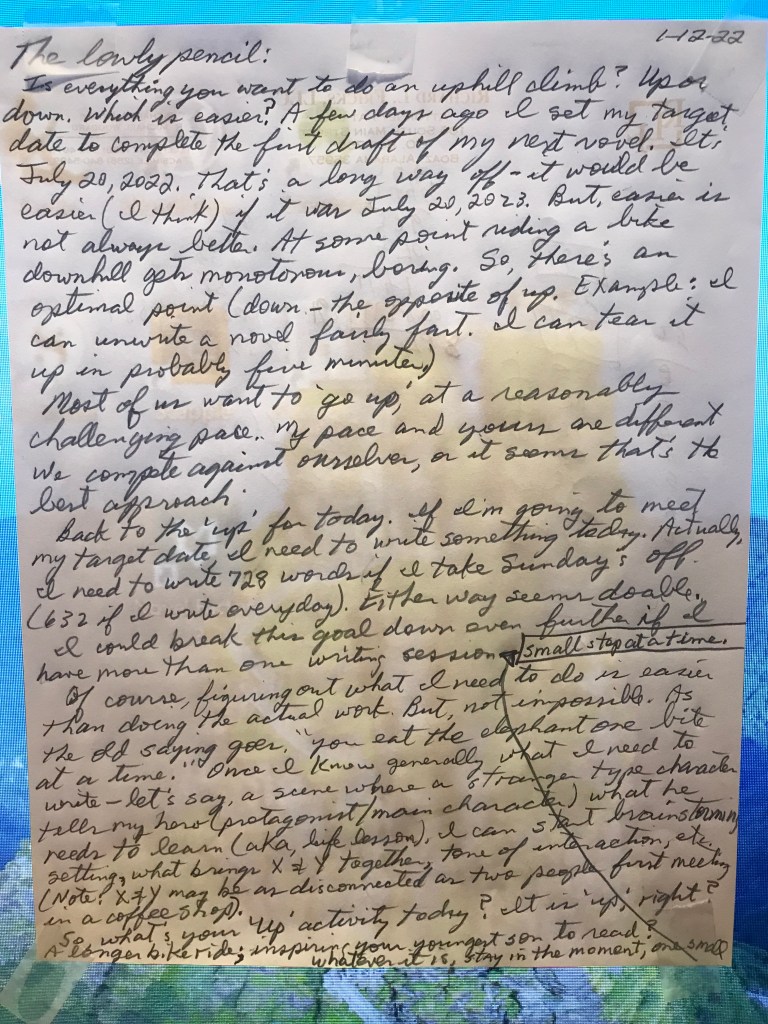
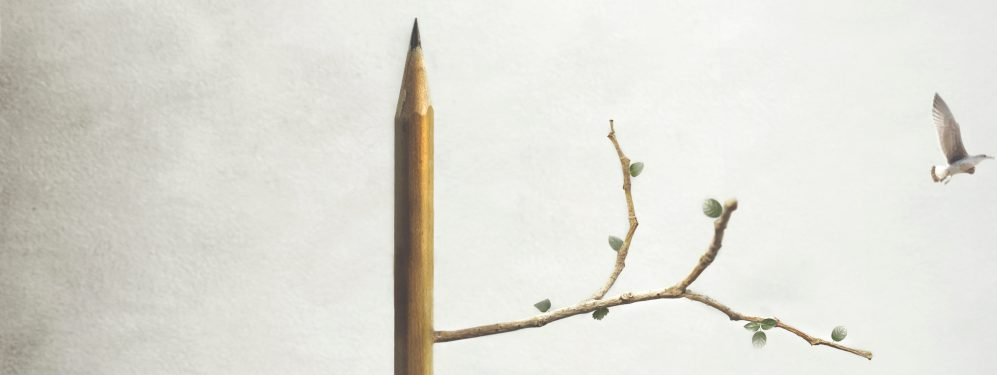
Today, are you weak and heavy-laden? If so, let me introduce you to the best friend you could hope for. One who can and will bear your griefs, trials, temptations, and troubles. One who can and will bring you joy and happiness, and provide a safe haven at your beck and call. Sorry, I’m not referencing an old gospel song. Gladly, I bring you something more powerful and enduring. It’s nothing more than the lowly pencil.
More particularly, the pencil is a bridge to life, one of meaning and purpose. As you know, The Pencil Driven Life is my blog. You’ve also figured out I use the word pencil symbolically, to represent all writing instruments, be it pencil, pen, stylus, or keyboard (physical or digital). Dictation via voice recorder along with smoke signals are included though transcription to paper or e-book form is required for both!
The instrument itself is of secondary importance. The point (ha) is to transport your thoughts, ideas, and words all the way from your brain to your notebook or hard-drive. This journey illustrates the pencil is a bridge to life, one of meaning and purpose. But, it doesn’t happen automatically. You have to walk across the bridge. Better still, grab your bike and peddle across the bridge. Take note, I didn’t promise the bridge was short. You have a lot of peddling to do.
Hopefully, I haven’t muddled things so much you’re not getting the idea. The pencil, the actual writing, is analogous to the walking or peddling across the bridge from where you are to the place you want to be. That place of joy and happiness, of meaning and purpose (I didn’t say a land absent trials and troubles), that place where you find that friend you’ve always wanted, one who will never leave or forsake you.
Think of writing as peddling. Do a little research. Peddling a bicycle can produce electricity. Of course, the setup has to be properly engineered. Thank goodness you don’t need to be an engineer or other type technical genius to produce the electricity that powers your life across the bridge to real life.
Let’s look at four benefits you’ll obtain if you’ll commit to peddling, uh, writing. You could think of these as way stations along your journey across that metaphorical bridge.
I’ll cover the first leg of our journey in this post, followed by the other three over the next couple of weeks.
By writing you’ll travel far and wide, gaining experiences you’ll never have in real life. Here’s my title for this phase. Electrify your life: Secret yourself for eventful experiences.
Before we proceed, let me clarify a couple of things. I’m speaking of creative writing, AKA, fiction writing. My ultimate aim is to convince you to write your own novel, but to start with short snippets count. Second, you’ll never become a writer unless you are a reader. Think about it. At a minimum, you’ll read and reread what you’ve written. But, you must read more broadly than that (again, I’m speaking of novel reading).
Here’s the point. Experiences change us. Your own personal experiences, like the one you had the other day out walking when your foot slipped off the rock and you got all wet when you fell into the creek.
Further, the experiences we have by reading about them are just as good. Research seems solid in concluding our brains make no difference in these two types. Whether we got all wet literally or figuratively, it’s the same.
So, what’s the importance of gaining experiences through reading. It puts us in the place of the character. Studies have shown readers become the protagonist or other key character in a novel. They hurt when he hurts. They laugh when he laughs. They’re afraid when he’s afraid. However, at little cost or threat to life or limb, the reader learns what he or she would do in a similar situation.
Want to know how Rachel feels as she rides the train into London and looks through the window at one particular house set back from the tracks and imagines the lives of Jessie and Jason (Rachel doesn’t know their real names) the current occupants? Want to know how you would feel and act if you were living Rachel’s life: divorced, dissatisfied, childless, virtually homeless (she rents a spare bedroom from former classmate Kathy), and mesmerized by Jessie and Jason who live a few houses from where she (Rachel) used to live when married to Tom? If you really want to know, then read The Girl on The Train by Paula Hawkins.
Of course, this is just one of a zillion novels you could read. Want to know how you’d act and feel in a certain situation? Then go find a novel that provides that or similar scenario.
The more you read, the more your brain will change. Why? Because you will have been more places. You will have had more experiences. Do you think you’d be the same person today as you are if you had gone to Yale Medical School, followed by a residency in neurosurgery at Stanford? Read When Breath Becomes Air by Paul Kalanithi if you want a new experience. Note, I never said you cannot read nonfiction!
Now, back to your lowly pencil. Your own writing is a massive gateway to an unending line of wonderful and horrible experiences. You decide which type today, which type tomorrow. You have the power of the sword in your hand. With every alphabetic slash and jab you create or destroy lives and worlds, you bring sadness or happiness, you foreshadow events that ultimately connect Jess and Jason, a love affair like no other.
Wield your sword as you see fit. At 9:00 am you can be enjoying a mocha latte at the Caféothèque of Paris and by 10:00 you’ll be exiting your plane in Jackson Hole, Wyoming readying yourself to meet your father to discuss why he’s giving your sister his ranch in Dubois.
Never forget, experiences change us.

Please provide your email address if you would like to receive The Pencil Driven Life blog posts.
Quite a bold statement isn’t it? Yes. It’s meant to be. Frankly, it’s the type of statement that gives me pause. Why? It begs for opposing argument.
This confession aside, let’s ‘play like’ my title represents life’s two-sided coin. Either you wither or you write.
We’ve all heard, and mostly understood, the word wither. In its non-plant context, it means, “cease to flourish; fall into decay or decline.” Its not a real life scenario any normal person would choose.
Let me regress a little. I almost chose as my title, “Life: Cotton Candy or Sweet Potatoes?” This certainly would have hooked you. Right? So, what was my intent?
Let’s talk slang. Cotton candy: “something that is attractive but inconsequential” (Google search). Do you, do I, want to be beautiful but lacking worth or importance? Again, I suspect most normal people would answer ‘no.’
Now to a better choice. And, to more slang. Sweet potatoes: “sweet potato in Korean is used to describe someone who is frustrating or slow to catch on with the conversation” (Google search). I lied didn’t I. This isn’t better. Actually, it’s worse. Here, I bet you and I both had rather be beautiful than this sweet potato dope.
It now seems my alternate title wasn’t anything like my two-side coin title. In fact, both cotton candy and sweet potatoes makes us wish for a better alternative.
Now, we’re almost back to where I was headed after defining ‘wither.’ But, let me first share a real live example. “I don’t use Walmart’s self-checkout because it cost too many jobs.” I heard this yesterday. It was said in a casual conversation, so casual I don’t remember the context.
Now, let me be clear. I don’t know if the claim is accurate. I do know it’s the type of statement I avoid like the plague. The reason(s) I suspect is that I’m a writer. And, a lawyer. So, it’s my background and training. Notice, I didn’t say “because I am so smart.” FYI, I’m just an average Joe.
You see, many (most?) folks aren’t great talkers. They spout out claims as though they’ve been scientifically proved.
I’m sorry to be so pedantic but the Walmart claim prompted me to pursue some cursory research.
At Quora (okay, okay, hold your taters) A.C. responds to the self-checkout system, “Initially, probably quite a few. But since self-checkout became prevalent, companies have opened many new stores, partly because they know they won’t have to employ as many checkers as before.
This is similar to how the number of bank tellers and the amount they are paid has actually gone up due to ATMs. Banks have said specifically that they open many more branches because they don’t have to employ as many tellers, resulting in a net gain of tellers jobs.”
And to the same question, J.M. (yes, from Quora) says, “I get a lot of people telling me they don’t like self check outs because it takes away jobs. I still have my job as a cashier. From my experience it hasn’t affected any of the cashiers. None of us have had to move to different departments because of self check out. I have been saying this to many people. There’s enough people who don’t want to scan their own stuff to still keep the cashiers doing their jobs. So no they aren’t taking away jobs.”
Okay, sorry. Yes, I admit A.C. and J.M. could be wrong. My point is, at least what I want it to be, is that life and issues aren’t so simple. Most of us know so very little we have very little right to make such broad claims.
Then why do I do the opposite, “Wither or write, you decide?” Please don’t be such a sweet potato. The answer is, writing reveals life isn’t black and white. It lets you explore the possible, pealing back the masks we all wear.
Let’s see about that.
Free advice: You should be reading Brain Pickings, Maria Popova’s online journal. In her own words, “Brain Pickings [includes] a free Sunday digest of the week’s most interesting and inspiring articles across art, science, philosophy, creativity, children’s books, and other strands of our search for truth, beauty, and meaning.
Remember, reading is vitally important for many reasons, like being a good antidote for having a cotton candy or sweet potato mind. As Stephen King declares, “If you don’t have time to read, you don’t have the time (or the tools) to write. Mark Twain spoke to the value of reading: “A person who won’t read has no advantage over one who can’t read.”
Returning to Brain Pickings. Yesterday, Maria posted, “The Unbearable Lightness of Being Opaque to Ourselves: Milan Kundera on Writing and the Key to Great Storytelling.”
You and I can learn a lot about writing, particularly novel writing. And, Maria’s words (and quotes) seem to support my title, “Wither or write, your choice.”
Maria: ” … the novel, the story, the poem, the song are each a model, an imagistic impression of the world not as it is but as the maker pictures it to be, inviting us to step into this imaginary world in order to better understand the real, including ourselves.”
Our imaginations, in story form at least, helps us understand reality.
Maria quoting Kundera: “Every novel says to the reader, ‘Things are not as simple as they seem.’ That is the novel’s eternal truth, but it grows steadily harder to hear amid the din of easy, quick answers that come faster than the question and block it off.”
Does this remind you of, “I don’t use Walmart’s self-checkout because it cost too many jobs.” Things are not simple, even the statements that appear so. Things are far from black and white. If anything, the world, reality, life, is a landscape of gray. And, don’t miss Kundera’s later point. If we live on the surface we will constantly be bombarded with “easy, quick answers.” We’ll grow deaf. And dumb. Sorry for my embellishment but it seems reasonably implied.
Let’s look at another Kundera quote: “A novel examines not reality but existence. And existence is not what has occurred, existence is the realm of human possibilities, everything that man can become, everything he’s capable of. Novelists draw up the map of existence by discovering this or that human possibility. But… to exist means ‘being-in-the-world.’ Thus both the character and his world must be understood as possibilities… [Novels] thereby make us see what we are, and what we are capable of.”
In four words, what is a novel? A work of fiction. It’s made up, wholly from the imagination. So, what good is it since it doesn’t explore reality?
It’s good because it explores existence, what could happen in the future. As Kundera says, “existence is the realm of human possibilities.” So, why is this important? Fiction writing, novel writing, offers solutions to future problems. How Billy Character mentally responded and physically reacted to the imagined scene presents value to us in the real world.
At a minimum, novel writing and novel reading makes you and me more empathetic (btw, that’s pretty much a proved fact; do your own research).
Let’s say you choose to write a novel. The protagonist is a doctor. He works for an organization that delivers needed medical care around the world, specifically inside those third world, war torn countries where poverty is widespread and spreading like a cancer.
Here’s a short snippet from your writing.
“Doctor, this way.” Claudia the head nurse led me inside a tent. I could hear what sounded like firecrackers or bombs bursting on the mountaintop beyond the river. If I didn’t know better, I’d think I was with Susie in Hyde Park watching a Fourth of July fireworks celebration taking part over Lake Michigan.
“How bad is it?” I said as the weary nurse walked faster toward the exam room.
“Five kids die every minute.”
“Uh? I responded in disbelief.”
Claudia stopped, turned, and looked into my eyes, a tear rolling down her right cheek. “Not just here in Yemen, but around the world. Five innocent kids die every minute from malnourishment.” I made a mental note to explore her statistic and other opportunities to make a difference.
Let’s step back. Could Kundera be right? “[Novels] thereby make us see what we are, and what we are capable of.”
My hypothesis: I’ll never know the full extent of what I am or what I’m capable of until I see the possibilities, through the eyes of someone else, someone wholly the product of the writer’s imagination.
I choose to write. Do you?

I need to take a break from my three-act story structure series for at least a week. Why? To persuade you to start writing.
There are many good reasons, but the one I want to focus on today is that writing will improve your thinking.
Three quotes from legendary writers:
“I write because I don’t know what I think until I read what I say.”
Flannery O’Connor
“I write entirely to find out what I’m thinking, what I’m looking at, what I see and what it means. What I want and what I fear.”
Joan Didion
“Think before you speak. Read before you think.”
Fran Lebowitz
To me, it’s clear from these quotes that mere thoughts are lacking; they are insufficient for critical thinking. They are unpredictable, disjointed, and often incomprehensible, and frequently false. It’s like having thirty food items in your shopping cart at Walmart and concluding all point to one and only one recipe, or that the order you pulled each item off the shelf is mandating you shouldn’t get the Covid vaccine. Huh?
Imperfect as my examples are, surely writing and ordering one’s thoughts on paper is better than spouting broad generalizations (AKA, meaningless statements), or gross untruths.
If you’re unconvinced writing will improve your thinking, take a few moments, even a few days, to listen to what those around you are saying. Start with those physically in your presence, say those around the water-cooler or conference table at work. Then, consider those you’re listening to on the radio, the TV, or via a podcast. Finally, consider the statements you hear while watching (and listening to) videos, whether YouTube, Facebook, or Twitter.
Of course, you also need to contemplate written statements. It doesn’t take long to find a Boob. Again, look at Facebook or Twitter.
Once you’ve conducted this experiment, I assume you will agree there is much need for improved thinking. You are interested in the truth, aren’t you?
If you are, then ask yourself: “why do you want me to write fiction, more particularly, a novel?” Good question. Not to be rhetorical, but one answer is to help you improve your thinking and view of the world. Just because you make up your entire story doesn’t mean it isn’t true. It’s true in the world you create. Rabbit trail: conduct a little research on the correlation between empathy and reading fiction. Start with the following introductory quotes.
Reading fiction is important. It is a vital means of imagining a life other than our own, which in turn makes us more empathetic beings. Following complex story lines stretches our brains beyond the 140 characters of sound-bite thinking, and staying within the world of a novel gives us the ability to be quiet and alone, two skills that are disappearing faster than the polar icecaps.
Ann Patchett
You should never read just for “enjoyment.” Read to make yourself smarter! Less judgmental. More apt to understand your friends’ insane behavior, or better yet, your own. Pick “hard books.” Ones you have to concentrate on while reading. And for god’s sake, don’t let me ever hear you say, “I can’t read fiction. I only have time for the truth.” Fiction is the truth, fool! Ever hear of “literature”? That means fiction, too, stupid.
John Waters
Let’s dig a little deeper. I’d say without words/language we cannot learn anything. Of course, there are those who would disagree, saying that revelation is a way of knowing. Even if it is (which I do not believe) words are not absent.
A religious person might say, “I know God answered my prayer. See, here’s my car key I lost.” Ask yourself, were words used in the prayer? Probably? Even if not, was God’s response not in words? Let’s say He responded with a simple impression, a subliminal message of sorts, “they are in the kitchen garbage can.” Regardless, the person (the one praying) ‘understood’ where to look, and it wasn’t at the bottom of the swimming pool. Sorry, I digressed. For arguments sake, let’s agree, words are important.
Obviously, they are important to the writer. Let’s say that in the not-so-distant past you made the following spur of the moment verbal statement: “I’d kill that son-of-a-bitch if I could get away with it.” The three friends who heard you laughed, and either ordered another drink or engaged in conversation over which college the up-and-coming football star Arch Manning will choose.
However, later that night, as you were driving home, that spur of the moment declaration reappeared in your thoughts. Unlike what your three friends concluded, you were telling the truth. “If I could get away with it, I’d kill that son-of-a-bitch.”
But why? Most likely, that guy wronged you, or you have concluded that he did. His action might have been a perceived wrong, albeit slight in the grand scheme of things, but to you it was MAJOR. Further, the guy may not have a clue how you feel.
It’s revenge you’re after. And, you have the words and language to express it. You know what a wrong is (at least you have your definition in those scrambled thoughts in your head). You know what revenge is. Finally, you know what you mean by “get away with it.” As to the later, you likely mean, “not getting arrested, tried, convicted, and sentenced to prison.”
Before you shop at Walmart for a pistol, a tarp, fifty feet of rope, and a pick and shovel, why not start writing? Even better, why not start writing a novel about James Anderson (a made-up name) who’s itching to kill Paul Daniel (a made-up name). It seems Paul dishonored James’ sister back in high school half a century ago. James has hated him ever since. Plus, a few weeks ago local citizens elected Paul to the City’s zoning board, which is critical to James’ financial success.
You get the idea. Before you do something risky (murder the guy who spawned the fictional James Anderson), why not explore it in a safer environment? Why not follow a world-famous writer’s personal admonition: “I write entirely to find out what I’m thinking, what I’m looking at, what I see and what it means. What I want and what I fear.” Joan Didion.
It could be you learn something, something that changes your mind. You might learn, because the fictional James learned, there’s more to “getting away with it” than staying off the police’s radar. Think about it. You murder someone. Do you think you will ever be free, mentally free, from the haunting? When you wake each morning, won’t you ask yourself, “will today be the day, they (the police) discover the evidence and clues I left behind?” Surely you believe you will make a few mistakes while you plan or execute your crime.
Back to your novel. Don’t forget that as writers it’s nearly impossible to exclude ourselves fully from our characters. Many experts say there is some part of an author in every character he creates. This could be unintentional, but it doesn’t have to be.
Of course, you don’t have to write an entire novel to learn something or improve your thinking. Here’s another experiment. Start keeping a journal. At the end of each day, recall and record a few of the statements you made during your waking hours. Choose one and analyze it in writing. Maybe you conclude your statement was true but you want to explore your reasoning. What makes that statement true? “Sue is as bad as Carl.” True? Here’s another example (I’m not saying it’s true!): “the Covid vaccine is just another way for the government to control the people.”
The goal is to start writing. If you do, at a minimum, you might discover what you are thinking. In the process, you might also learn that your thinking is flawed. And that’s always good to know.
In conclusion, and at the risk of diluting my main subject (actually, it doesn’t) I recommend you read the following article, “The Surprising Power of Reading Fiction: 9 Ways it Make Us Happier and More Creative.” You can find it here:
https://buffer.com/resources/reading-fiction/
In sum, this article argues that your life will improve if you become an active fiction reader. One thing the article doesn’t address is the importance of reading for a writer. The infamous Stephen King said it best, “If you don’t have time to read, you don’t have the time (or the tools) to write. Simple as that.”
Think about it. Every fiction book you’ve read or will ever read has an author. And that guy or gal had a day they wrote for the first time. You depend on others for everything you read (other than your own writing!). Why not become the one who gives someone else the benefit of your creativity, the stories only you can write?
I promise you one thing, if you will start reading and writing fiction, your life will improve. Here’s two ways: you will hone your critical thinking skills, and you will become more empathetic.
Not only does reading and writing fiction benefit you, it benefits the world.

In this post, I will attempt to define and contextualize the word ‘novel.’
Novel, story, narrative: what’s the difference?
It’s probably unnecessary to consider this question because in contemporary terms, and for most practical purposes, the three are virtually synonymous. But, having a ‘legal mind’ forces me to start at ground zero.
First, I’ll summarize what I’ll be attempting to say throughout this post. A novel is a description of imaginary people and related events arranged in a logical sequence to reveal a particular point of view or set of values.
In other words, a novel is a story. And, you already know a lot about story. It’s simply the telling of an event to a listener and the latter experiences or learns something just because he heard/read the story. A story can be either true or false.
A novel is a particular type of story, one that is ALWAYS fictional (not true in the sense it actually happened). Whereas a story or narrative can be either fiction (false) or non-fiction (true). A novel is always made-up, mostly from the author’s imagination, or an actual event, one either experienced, observed, or learned via reading, hearing, or by some other means.
In my last post, as to what was intended as an actual event, I provided an example of a guy who got snookered by a friend. A novel can be built (via fictionalization) around this, or it can become a memoir (an account of the author’s personal experiences), or an autobiography (a biography of yourself).
Merriam-Webster provides a good definition for the novel: “an invented prose narrative that is usually long and complex and deals especially with human experience through a usually connected sequence of events.” Notice that the word ‘narrative’ is used to define the word ‘novel.’
Before we look at ‘narrative,’ let’s flesh out Webster’s words. Invented obviously means it’s fiction. It’s made-up, created if you will. It’s made-up prose. Prose writing is ordinary writing, as distinguished from verse. Here’s an example of prose writing (the last sentence I wrote yesterday in my current novel-in-progress): “By twilight, with the goats fed and my impatience firing, I packed a bag and headed to Lillian’s vacant oasis.”
When I hear ‘verse,’ I think of poetry. Here’s a stanza of mine from a long ago poem:
“You melted my heart and mended my mind.
You gave me love and time,
a once in life discovery.
A unique couple, moonstruck but fiery.”
Not that good, but you get the idea.
One other thing about Webster’s definition. A novel is ALWAYS long—between 60,000 and 100,000 words. Compare that to a short story (another work of fictional prose) which typically runs between 5,000 to 10,000 words.
“A short story is a love affair, a novel is a marriage. A short story is a photograph; a novel is a film.”
Lorrie Moore
A novel is normally “complex and deals especially with human experience ….” This means there is a lot going on: the characters (likely, many), most all with differing wishes, desires, and conflicts. Plus, there are usually one or more subplots that are happening, all necessarily related to the main plot. Of course, not all novels deal with ‘human experience,’ but I’d wager that most do. Likely, because most people read fiction for two primary reasons: to be entertained, and to learn from experience without the experiencing part (I’ll leave you to figure that out).
“A novel must show how the world truly is, how characters genuinely think, how events actually occur. A novel should somehow reveal the true source of our actions.”
Kevin Hood, Becoming Jane
And, yes, I know there’s a lot more in this component of Webster’s definition that needs attention but today, we just don’t have the time.
Now we come to the word narrative. Recall, a novel is a story, a made-up one. Narrative is simply how you tell this made-up story. It is, “a spoken or written account of connected events,” to quote Google. But, narrative is much more.
A quote from Guillaume Wiatr (Principal and Founder of MetaHelm) excellently encapsulates the difference between story and narrative: “People will pay for a story, but people will die for a narrative.” I think what Guillaume means is that a story can grab our attention, entertaining us for the moment, but a narrative (how the story is told) can change us for a lifetime, “[i]t shifts the way we think, for good or for the worst[,]” again quoting Guillaume. He also says this in different words: “Someone died, and that was very wrong[,] starts a narrative that can turn into a revolution.”
Reconsider my summary definition from the beginning of this section: “A novel is a description of imaginary people and related events arranged in a logical sequence to reveal a particular point of view or set of values.” The underlined portion is the heart of narrative. To me, narrative produces theme, it reveals the meaning the writer has explored throughout his entire novel. He’s done this “… [b]y using characters, setting, dialog, plot or a combination of all of these elements[,]” as K.M Weiland says in writing your story’s THEME, a book I highly recommend.
Now that we’ve laid a foundation for understanding the literary form known as the novel, we must look at story structure. Knowing the framework of the ‘building’ you are trying to construct is imperative for writing a novel worth reading. I wish I had learned this much sooner.
We will look at story structure in my next post, but first, you need to understand what you’re getting into (writing a novel) is a challenging but highly rewarding endeavor. With only minor inconveniences as described by one of the greatest writers of all time:
“Writing a novel is a terrible experience, during which the hair often falls out and the teeth decay. I’m always irritated by people who imply that writing fiction is an escape from reality. It is a plunge into reality and it’s very shocking to the system.” ― Flannery O’Connor, Mystery and Manners: Occasional Prose
Flannery O’Connor, Mystery and Manners: Occasional Prose
Sign up for my Myths, Mysteries & Murders readers group and receive a FREE digital copy of The Boaz Scorekeeper: https://dl.bookfunnel.com/r6dwwflvxx. If you have already signed up, send me a message and I’ll forward you a copy.


 Richard L. Fricks