04/23/23 Biking & Listening

Biking is something else I both love and hate. It takes a lot of effort but does provide good exercise and most days over an hour to listen to a good book or podcast. I especially like having ridden.

Here’s my bike, a Rockhopper by Specialized. I purchased it November 2021 from Venture Out in Guntersville; Mike is top notch! So is the bike, and the ‘old’ man seat I salvaged from an old Walmart bike.

Here’s today’s ride.

Here’s a few photos taken along my route:

A few days ago I started listening to The Witch Trials of J.K. Rowling

Here’s the link to the episode on Spotify.


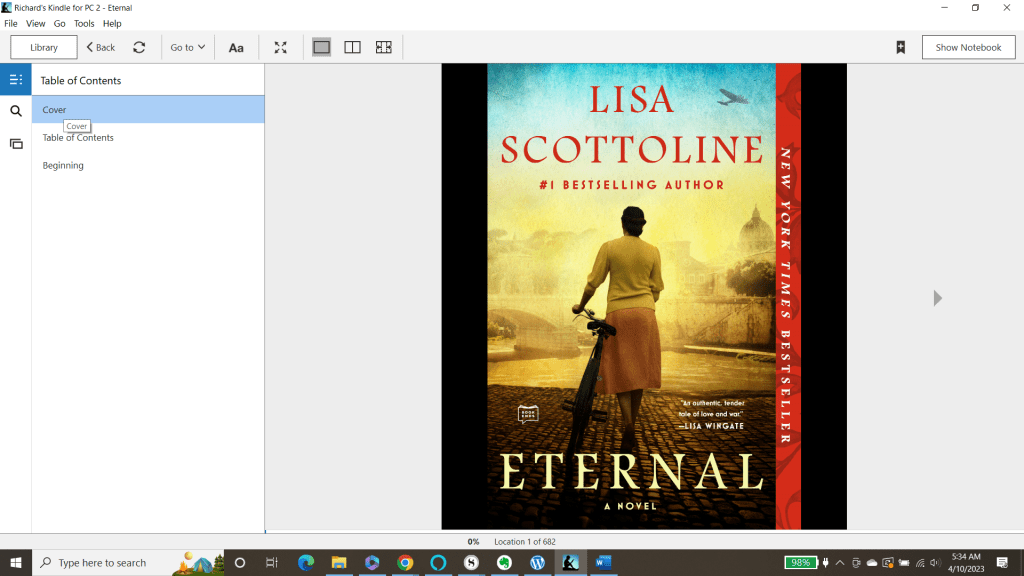
I’m also listening to Eternal, by Lisa Scottoline:

Amazon Abstract

NEW YORK TIMES BESTSELLER
 
#1 bestselling author Lisa Scottoline offers a sweeping and shattering epic of historical fiction fueled by shocking true events, the tale of a love triangle that unfolds in the heart of Rome…in the creeping shadow of fascism.


What war destroys, only love can heal.

Elisabetta, Marco, and Sandro grow up as the best of friends despite their differences. Elisabetta is a feisty beauty who dreams of becoming a novelist; Marco the brash and athletic son in a family of professional cyclists; and Sandro a Jewish mathematics prodigy, kind-hearted and thoughtful, the son of a lawyer and a doctor. Their friendship blossoms to love, with both Sandro and Marco hoping to win Elisabetta’s heart. But in the autumn of 1937, all of that begins to change as Mussolini asserts his power, aligning Italy’s Fascists with Hitler’s Nazis and altering the very laws that govern Rome. In time, everything that the three hold dear–their families, their homes, and their connection to one another–is tested in ways they never could have imagined.

As anti-Semitism takes legal root and World War II erupts, the threesome realizes that Mussolini was only the beginning. The Nazis invade Rome, and with their occupation come new atrocities against the city’s Jews, culminating in a final, horrific betrayal. Against this backdrop, the intertwined fates of Elisabetta, Marco, Sandro, and their families will be decided, in a heartbreaking story of both the best and the worst that the world has to offer.

Unfolding over decades, Eternal is a tale of loyalty and loss, family and food, love and war–all set in one of the world’s most beautiful cities at its darkest moment. This moving novel will be forever etched in the hearts and minds of readers.

Do Scientists Pray? Einstein Answers a Little Girl’s Question about Science vs. Religion

Here’s the link to this article.

“Everyone who is seriously involved in the pursuit of science becomes convinced that some spirit is manifest in the laws of the universe, one that is vastly superior to that of man.”

BY MARIA POPOVA

Whether in their inadvertently brilliant reflections on gender politics or in their seemingly simple but profound questions about how the world works, kids have a singular way of stripping the most complex of cultural phenomena down to their bare essence, forcing us to reexamine our layers of assumptions. Take, for instance, the age-old tension between science and religion, which has occupied the minds of luminaries from Galileo to Carl Sagan, as well as some of today’s most renowned scientific minds. The enormous cultural baggage of the question didn’t stop a little girl from New York named Phyllis from posing it to none other than the great Albert Einstein (March 14, 1879–April 18, 1955) in a 1936 letter found in Dear Professor Einstein: Albert Einstein’s Letters to and from Children (public library | IndieBound) — the same delightful collection that gave us Einstein’s encouraging words to women in science.

Albert Einstein by Yousuf Karsh

The Riverside Church

January 19, 1936

My dear Dr. Einstein,

We have brought up the question: Do scientists pray? in our Sunday school class. It began by asking whether we could believe in both science and religion. We are writing to scientists and other important men, to try and have our own question answered.

We will feel greatly honored if you will answer our question: Do scientists pray, and what do they pray for?

We are in the sixth grade, Miss Ellis’s class.

Respectfully yours,

Phyllis

Only five days later, Einstein wrote back — isn’t it lovely when cultural giants respond to children’s sincere curiosity? — and his answer speaks to the same spiritual quality of science that Carl Sagan extolled decades later and Ptolemy did millennia earlier. Six years prior, Einstein had explored that very subject, in far more complicated language and mind-bending rhetoric, in his legendary conversation with the Indian philosopher Tagore.

January 24, 1936

Dear Phyllis,

I will attempt to reply to your question as simply as I can. Here is my answer:

Scientists believe that every occurrence, including the affairs of human beings, is due to the laws of nature. Therefore a scientist cannot be inclined to believe that the course of events can be influenced by prayer, that is, by a supernaturally manifested wish.

However, we must concede that our actual knowledge of these forces is imperfect, so that in the end the belief in the existence of a final, ultimate spirit rests on a kind of faith. Such belief remains widespread even with the current achievements in science.

But also, everyone who is seriously involved in the pursuit of science becomes convinced that some spirit is manifest in the laws of the universe, one that is vastly superior to that of man. In this way the pursuit of science leads to a religious feeling of a special sort, which is surely quite different from the religiosity of someone more naive.

With cordial greetings,

your A. Einstein

Complement this with the difference between curiosity and wonder when it comes to science and scripture and Einstein on the secret to learning anything, then treat yourself to Dear Professor Einstein in its heart-warming entirety.

Portrait of Einstein by Yousuf Karsh

04/22/23 Biking & Listening

Biking is something else I both love and hate. It takes a lot of effort but does provide good exercise and most days over an hour to listen to a good book or podcast. I especially like having ridden.

Here’s my bike, a Rockhopper by Specialized. I purchased it November 2021 from Venture Out in Guntersville; Mike is top notch! So is the bike, and the ‘old’ man seat I salvaged from an old Walmart bike.

Here’s today’s ride.

Here’s a few photos taken along my route:

Today, I listened to the following Making Sense Podcast episode: What Do We Know About Our Minds? A Conversation with Paul Bloom

Here’s the link. A subscription is required to listen to the entire episode.

APRIL 20, 2023

Sam Harris speaks with Paul Bloom about the state of psychological science. They discuss fiction as a window onto the mind, recent developments in AI, the tension between misinformation and free speech, bullshitting vs lying, truth vs belonging, reliance on scientific authority, the limits of reductionism, consciousness vs intelligence, Freud, behaviorism, the unconscious origins of behavior, confabulation, the limitations of debate, language, Koko the gorilla, mental health, happiness, behavioral genetics, birth-order effects, living a good life, the remembered and experiencing selves, and other topics.

Paul Bloom is Professor of Psychology at the University of Toronto, and Brooks and Suzanne Ragen Professor Emeritus of Psychology at Yale University. Paul Bloom studies how children and adults make sense of the world, with special focus on pleasure, morality, religion, fiction, and art. He has won numerous awards for his research and teaching. He is past-president of the Society for Philosophy and Psychology, and co-editor of Behavioral and Brain Sciences. He has written for scientific journals such as Nature and Science, and for popular outlets such as The New York TimesThe GuardianThe New Yorker, and The Atlantic Monthly. He is the author of seven books, including his latest Psych: The Story of the Human Mind.

Website: paulbloom.net

Twitter: @paulbloomatyale


Tomorrow, I’ll continue listening to Eternal, by Lisa Scottoline:

Amazon Abstract

NEW YORK TIMES BESTSELLER
 
#1 bestselling author Lisa Scottoline offers a sweeping and shattering epic of historical fiction fueled by shocking true events, the tale of a love triangle that unfolds in the heart of Rome…in the creeping shadow of fascism.


What war destroys, only love can heal.

Elisabetta, Marco, and Sandro grow up as the best of friends despite their differences. Elisabetta is a feisty beauty who dreams of becoming a novelist; Marco the brash and athletic son in a family of professional cyclists; and Sandro a Jewish mathematics prodigy, kind-hearted and thoughtful, the son of a lawyer and a doctor. Their friendship blossoms to love, with both Sandro and Marco hoping to win Elisabetta’s heart. But in the autumn of 1937, all of that begins to change as Mussolini asserts his power, aligning Italy’s Fascists with Hitler’s Nazis and altering the very laws that govern Rome. In time, everything that the three hold dear–their families, their homes, and their connection to one another–is tested in ways they never could have imagined.

As anti-Semitism takes legal root and World War II erupts, the threesome realizes that Mussolini was only the beginning. The Nazis invade Rome, and with their occupation come new atrocities against the city’s Jews, culminating in a final, horrific betrayal. Against this backdrop, the intertwined fates of Elisabetta, Marco, Sandro, and their families will be decided, in a heartbreaking story of both the best and the worst that the world has to offer.

Unfolding over decades, Eternal is a tale of loyalty and loss, family and food, love and war–all set in one of the world’s most beautiful cities at its darkest moment. This moving novel will be forever etched in the hearts and minds of readers.

About the Holy Bible, by Robert G. Ingersoll (1894): Part III, The Ten Commandments

This is a very long article. I’ll post it by part.

Here’s the link to the full article.

III: The Ten Commandments

Some Christian lawyers—some eminent and stupid judges—have said and still say, that the Ten Commandments are the foundation of all law.

Nothing could be more absurd. Long before these commandments were given there were codes of laws in India and Egypt—laws against murder, perjury, larceny, adultery and fraud. Such laws are as old as human society; as old as the love of life; as old as industry; as the idea of prosperity; as old as human love.

All of the Ten Commandments that are good were old; all that were new are foolish. If Jehovah had been civilized he would have left out the commandment about keeping the Sabbath, and in its place would have said: “Thou shalt not enslave thy fellow-men.” He would have omitted the one about swearing, and said: “The man shall have but one wife, and the woman but one husband.” He would have left out the one about graven images, and in its stead would have said: “Thou shalt not wage wars of extermination, and thou shalt not unsheathe the sword except in self-defence.”

If Jehovah had been civilized, how much grander the Ten Commandments would have been.

All that we call progress—the enfranchisement of man, of labor, the substitution of imprisonment for death, of fine for imprisonment, the destruction of polygamy, the establishing of free speech, of the rights of conscience; in short, all that has tended to the development and civilization of man; all the results of investigation, observation, experience and free thought; all that man has accomplished for the benefit of man since the close of the Dark Ages—has been done in spite of the Old Testament.

Let me further illustrate the morality, the mercy, the philosophy and goodness of the Old Testament:

The Story of Achan

Joshua took the City of Jericho. Before the fall of the city he declared that all the spoil taken should be given to the Lord.

In spite of this order Achan secreted a garment, some silver and gold.

Afterward Joshua tried to take the city of Ai. He failed and many of his soldiers were slain. Joshua sought for the cause of his defeat and he found that Achan had secreted a garment, two hundred shekels of silver and a wedge of gold. To this Achan confessed.

And thereupon Joshua took Achan, his sons and his daughters, his oxen and his sheep—stoned them all to death and burned their bodies.

There is nothing to show that the sons and daughters had committed any crime. Certainly, the oxen and sheep should not have been stoned to death for the crime of their owner. This was the justice, the mercy, of Jehovah!

After Joshua had committed this crime, with the help of Jehovah he captured the city of Ai.

The Story of Elisha

“And he went up thence unto Bethel, and as he was going up by the way there came forth little children out of the city and mocked him, and said unto him, “Go up, thou baldhead.””

“And he turned back and looked at them, and cursed them in the name of the Lord. And there came forth two she-bears out of the wood and tore forty and two children of them.”

This was the work of the good God—the merciful Jehovah!

The Story of Daniel

King Darius had honored and exalted Daniel, and the native princes were jealous. So they induced the king to sign a decree to the effect that any man who should make a petition to any god or man except to King Darius, for thirty days, should be cast into the den of lions.

Afterward these men found that Daniel, with his face toward Jerusalem, prayed three times a day to Jehovah.

Thereupon Daniel was cast into the den of lions; a stone was placed at the mouth of the den and sealed with the king’s seal.

The king passed a bad night. The next morning he went to the den and cried out to Daniel. Daniel answered and told the king that God had sent his angel and shut the mouths of the lions.

Daniel was taken out alive and well, and the king was converted and believed in Daniel’s God.

Darius, being then a believer in the true God, sent for the men who had accused Daniel, and for their wives and their children, and cast them all into the lions den.

“And the lions had the mastery of them, and brake all their bones in pieces, or ever they came at the bottom of the pit.”

What had the wives and little children done? How had they offended King Darius, the believer in Jehovah? Who protected Daniel? Jehovah! Who failed to protect the innocent wives and children? Jehovah!

The Story of Joseph

Pharaoh had a dream, and this dream was interpreted by Joseph.

According to this interpretation there was to be in Egypt seven years of plenty, followed by seven years of famine. Joseph advised Pharaoh to buy all the surplus of the seven plentiful years and store it up against the years of famine.

Pharaoh appointed Joseph as his minister or agent, and ordered him to buy the grain of the plentiful years.

Then came the famine. The people came to the king for help. He told them to go to Joseph and do as he said.

Joseph sold corn to the Egyptians until all their money was gone—until he had it all.

When the money was gone the people said: “Give us corn and we will give you our cattle.”

Joseph let them have corn until all their cattle, their horses and their flocks had been given to him.

Then the people said: “Give us corn and we will give you our lands.”

So Joseph let them have corn until all their lands were gone.

But the famine continued, and so the poor wretches sold themselves, and they became the servants of Pharaoh.

Then Joseph gave them seed, and made an agreement with them that they should forever give one fifth of all they raised to Pharaoh.

Who enabled Joseph to interpret the dream of Pharaoh? Jehovah! Did he know at the time that Joseph would use the information thus given to rob and enslave the people of Egypt? Yes. Who produced the famine? Jehovah!

It is perfectly apparent that the Jews did not think of Jehovah as the God of Egypt—the God of all the world. He was their God, and theirs alone. Other nations had gods, but Jehovah was the greatest of all. Be hated other nations and other gods, and abhorred all religions except the worship of himself.

Einstein on Why We Are Alive

Here’s the link to this article.

The meaning of human existence in five lines.

BY MARIA POPOVA

Given my soft spot for big thinkers’ answers to young people’s questions about life, I was thrilled when reader Dave Anderson shared the story of his mother’s exchange with none other than Albert Einstein. When Marion Block Anderson, an altogether exceptional woman, was a freshman at Oberlin College in 1951, she reached out to “the quintessential modern genius” and asked him, “Why are we alive?” She later told Dave about the impetus for her letter:

We were having one war after another — first we had the First World War, then we had the Second World War and I just couldn’t see any point to the whole thing. So I wrote him a letter and I said, “What’s the point of living with what we’re going through here — having one war after another?”

Lo and behold, Einstein wrote back. While short, his letter extends with exquisite precision both the answer to the question about the meaning of life and his views on religion:

Einstein, in fact, had the admirable habit of actually responding to many of the letters he received from his young admirers, the best of which are collected in Dear Professor Einstein: Albert Einstein’s Letters to and from Children (public library) — the same compendium that gave us Einstein’s heartening response to a little girl who wanted to be a scientist and his timeless answer to a child who wanted to know whether scientists pray.

Also see Einstein’s little-known correspondence with Freud on war and human nature and his remarkable conversation with Indian philosopher Tagore on truth, beauty, science, and spirituality.

04/21/23 Biking & Listening

Biking is something else I both love and hate. It takes a lot of effort but does provide good exercise and most days over an hour to listen to a good book or podcast. I especially like having ridden.

Here’s my bike, a Rockhopper by Specialized. I purchased it November 2021 from Venture Out in Guntersville; Mike is top notch! So is the bike, and the ‘old’ man seat I salvaged from an old Walmart bike.

Here’s today’s ride.

Here’s a few photos taken along my route:

Today, I listened to the following Making Sense Podcast episode: What Do We Know About Our Minds? A Conversation with Paul Bloom

Here’s the link. A subscription is required to listen to the entire episode.

APRIL 20, 2023

Sam Harris speaks with Paul Bloom about the state of psychological science. They discuss fiction as a window onto the mind, recent developments in AI, the tension between misinformation and free speech, bullshitting vs lying, truth vs belonging, reliance on scientific authority, the limits of reductionism, consciousness vs intelligence, Freud, behaviorism, the unconscious origins of behavior, confabulation, the limitations of debate, language, Koko the gorilla, mental health, happiness, behavioral genetics, birth-order effects, living a good life, the remembered and experiencing selves, and other topics.

Paul Bloom is Professor of Psychology at the University of Toronto, and Brooks and Suzanne Ragen Professor Emeritus of Psychology at Yale University. Paul Bloom studies how children and adults make sense of the world, with special focus on pleasure, morality, religion, fiction, and art. He has won numerous awards for his research and teaching. He is past-president of the Society for Philosophy and Psychology, and co-editor of Behavioral and Brain Sciences. He has written for scientific journals such as Nature and Science, and for popular outlets such as The New York TimesThe GuardianThe New Yorker, and The Atlantic Monthly. He is the author of seven books, including his latest Psych: The Story of the Human Mind.

Website: paulbloom.net

Twitter: @paulbloomatyale


Tomorrow, I’ll continue listening to Eternal, by Lisa Scottoline:

Amazon Abstract

NEW YORK TIMES BESTSELLER
 
#1 bestselling author Lisa Scottoline offers a sweeping and shattering epic of historical fiction fueled by shocking true events, the tale of a love triangle that unfolds in the heart of Rome…in the creeping shadow of fascism.


What war destroys, only love can heal.

Elisabetta, Marco, and Sandro grow up as the best of friends despite their differences. Elisabetta is a feisty beauty who dreams of becoming a novelist; Marco the brash and athletic son in a family of professional cyclists; and Sandro a Jewish mathematics prodigy, kind-hearted and thoughtful, the son of a lawyer and a doctor. Their friendship blossoms to love, with both Sandro and Marco hoping to win Elisabetta’s heart. But in the autumn of 1937, all of that begins to change as Mussolini asserts his power, aligning Italy’s Fascists with Hitler’s Nazis and altering the very laws that govern Rome. In time, everything that the three hold dear–their families, their homes, and their connection to one another–is tested in ways they never could have imagined.

As anti-Semitism takes legal root and World War II erupts, the threesome realizes that Mussolini was only the beginning. The Nazis invade Rome, and with their occupation come new atrocities against the city’s Jews, culminating in a final, horrific betrayal. Against this backdrop, the intertwined fates of Elisabetta, Marco, Sandro, and their families will be decided, in a heartbreaking story of both the best and the worst that the world has to offer.

Unfolding over decades, Eternal is a tale of loyalty and loss, family and food, love and war–all set in one of the world’s most beautiful cities at its darkest moment. This moving novel will be forever etched in the hearts and minds of readers.

About the Holy Bible, by Robert G. Ingersoll (1894): Part II, Is the Old Testament Inspired?

This is a very long article. I’ll post it by part.

Here’s the link to the full article.

II: Is the Old Testament Inspired?

If it is, it should be a book that no man—no number of men—could produce.

It should contain the perfection of philosophy.

It should perfectly accord with every fact in nature.

There should be no mistakes in astronomy, geology, or as to any subject or science.

Its morality should be the highest, the purest.

Its laws and regulations for the control of conduct should be just, wise, perfect, and perfectly adapted to the accomplishment of the ends desired.

It should contain nothing calculated to make man cruel, revengeful, vindictive or infamous.

It should be filled with intelligence, justice, purity, honesty, mercy and the spirit of liberty.

It should be opposed to strife and war, to slavery and lust, to ignorance, credulity and superstition.

It should develop the brain and civilize the heart.

It should satisfy the heart and brain of the best and wisest.

It should be true.

Does the Old Testament satisfy this standard?

Is there anything in the Old Testament—in history, in theory, in law, in government, in morality, in science—above and beyond the ideas, the beliefs, the customs and prejudices of its authors and the people among whom they lived?

Is there one ray of light from any supernatural source?

The ancient Hebrews believed that this earth was the center of the universe, and that the sun, moon and stars were specks in the sky.

With this the Bible agrees.

They thought the earth was flat, with four corners; that the sky, the firmament, was solid—the floor of Jehovah’s house.

The Bible teaches the same.

They imagined that the sun journeyed about the earth, and that by stopping the sun the day could be lengthened.

The Bible agrees with this.

They believed that Adam and Eve were the first man and woman; that they had been created but a few years before, and that they, the Hebrews, were their direct descendants.

This the Bible teaches.

If anything is, or can be, certain, the writers of the Bible were mistaken about creation, astronomy, geology; about the causes of phenomena, the origin of evil and the cause of death.

Now, it must be admitted that if an infinite Being is the author of the Bible, he knew all sciences, all facts, and could not have made a mistake.

If, then, there are mistakes, misconceptions, false theories, ignorant myths and blunders in the Bible, it must have been written by finite beings; that is to say, by ignorant and mistaken men.

Nothing can be clearer than this.

For centuries the church insisted that the Bible was absolutely true; that it contained no mistakes; that the story of creation was true; that its astronomy and geology were in accord with the facts; that the scientists who differed with the Old Testament were infidels and atheists.

Now this has changed. The educated Christians admit that the writers of the Bible were not inspired as to any science. They now say that God, or Jehovah, did not inspire the writers of his book for the purpose of instructing the world about astronomy, geology, or any science. They now admit that the inspired men who wrote the Old Testament knew nothing about any science, and that they wrote about the earth and stars, the sun and moon, in accordance with the general ignorance of the time.

It required many centuries to force the theologians to this admission. Reluctantly, full of malice and hatred, the priests retired from the field, leaving the victory with science.

They took another position;

They declared that the authors, or rather the writers, of the Bible were inspired in spiritual and moral things; that Jehovah wanted to make known to his children his will and his infinite love for his children; that Jehovah, seeing his people wicked, ignorant and depraved, wished to make them merciful and just, wise and spiritual, and that the Bible is inspired in its laws, in the religion it teaches and in its ideas of government.

This is the issue now. Is the Bible any nearer right in its ideas of justice, of mercy, of morality or of religion than in its conception of the sciences? Is it moral?

It upholds slavery—it sanctions polygamy.

Could a devil have done worse?

Is it merciful?

In war it raised the black flag; it commanded the destruction, the massacre, of all—of the old, infirm. and helpless—of wives and babes.

Were its laws inspired?

Hundreds of offenses were punished with death. To pick up sticks on Sunday, to murder your father on Monday, were equal crimes. There is in the literature of the world no bloodier code. The law of revenge—of retaliation—was the law of Jehovah. An eye for an eye, a tooth for a tooth, a limb for a limb.

This is savagery—not philosophy.

Is it just and reasonable?

The Bible is opposed to religious toleration—to religious liberty. Whoever differed with the majority was stoned to death. Investigation was a crime. Husbands were ordered to denounce and to assist in killing their unbelieving wives.

It is the enemy of Art. “Thou shalt make no graven image.” This was the death of Art.

Palestine never produced a painter or a sculptor.

Is the Bible civilized?

It upholds lying, larceny, robbery, murder, the selling of diseased meat to strangers, and even the sacrifice of human beings to Jehovah.

Is it philosophical?

It teaches that the sins of a people can be transferred to an animal—to a goat. It makes maternity an offence for which a sin offering had to be made.

It was wicked to give birth to a boy, and twice as wicked to give birth to a girl.

To make hair-oil like that used by the priests was an offence punishable with death.

The blood of a bird killed over running water was regarded as medicine.

Would a civilized God daub his altars with the blood of oxen, lambs and doves? Would he make all his priests butchers? Would he delight in the smell of burning flesh?

A Simple Intervention to Increase Your Well-Being and Lower Depression from the Founding Father of Positive Psychology

Here’s the link to this article.

You’ll need pen, paper, and a silencer for cynicism.

BY MARIA POPOVA

A Simple Intervention to Increase Your Well-Being and Lower Depression from the Founding Father of Positive Psychology

“When [a man] has fair health, a fair fortune, a tidy conscience and a complete exemption from embarrassing relatives,” Henry James wrote in his diary“I suppose he is bound, in delicacy, to write himself happy.” More than a mere philosophical contemplation, however, James’s observation presages the findings of modern psychology in the quest to reverse-engineer the art-science of happiness. No one has addressed the eternal question of what begets happiness with more rigor and empirical dedication than Dr. Martin Seligman, founding father of Positive Psychology — a movement premised on countering the traditional “disease model” of psychology, which focuses on how to relieve suffering rather than how to amplify well-being. Seligman, whom I first had the pleasure of encountering at my alma mater, the University of Pennsylvania, and who was once elected President of the American Psychological Association by the largest vote in the organization’s history, remains one of the most influential psychologists in the study of happiness. In his excellent and highly revisitable book Flourish: A Visionary New Understanding of Happiness and Well-being (public library), Seligman offers a simple practice that promises to enhance your well-being and lower your depression — the “Gratitude Visit.” Though to the cynical eye the exercise might appear both old-fashioned and overly self-helpy, it is rooted in decades of Seligman’s acclaimed research and brings to practical life some of modern psychology’s most important findings. Seligman takes us through the practice:

Close your eyes. Call up the face of someone still alive who years ago did something or said something that changed your life for the better. Someone who you never properly thanked; someone you could meet face-to-face next week. Got a face?

Gratitude can make your life happier and more satisfying. When we feel gratitude, we benefit from the pleasant memory of a positive event in our life. Also, when we express our gratitude to others, we strengthen our relationship with them. But sometimes our thank you is said so casually or quickly that it is nearly meaningless. In this exercise … you will have the opportunity to experience what it is like to express your gratitude in a thoughtful, purposeful manner.

Your task is to write a letter of gratitude to this individual and deliver it in person. The letter should be concrete and about three hundred words: be specific about what she did for you and how it affected your life. Let her know what you are doing now, and mention how you often remember what she did. Make it sing! Once you have written the testimonial, call the person and tell her you’d like to visit her, but be vague about the purpose of the meeting; this exercise is much more fun when it is a surprise. When you meet her, take your time reading your letter.

This somewhat self-consciousness-inducing exercise, Seligman promises, will make you happier and less depressed a mere month from now.

He then suggests a complementary second practice — the “What-Went-Well Exercise,” also known as “Three Blessings” — based on the interventions he and his team at the Positive Psychology Center and the University of Pennsylvania have validated in the random-assignment, placebo-controlled experiments they have been conducting since 2001 to study changes in life-satisfaction and depression levels. He contextualizes the value of this exercise amidst our worry-culture and age of anxiety:

We think too much about what goes wrong and not enough about what goes right in our lives. Of course, sometimes it makes sense to analyze bad events so that we can learn from them and avoid them in the future. However, people tend to spend more time thinking about what is bad in life than is helpful. Worse, this focus on negative events sets us up for anxiety and depression. One way to keep this from happening is to get better at thinking about and savoring what went well.

For sound evolutionary reasons, most of us are not nearly as good at dwelling on good events as we are at analyzing bad events. Those of our ancestors who spent a lot of time basking in the sunshine of good events, when they should have been preparing for disaster, did not survive the Ice Age. So to overcome our brains’ natural catastrophic bent, we need to work on and practice this skill of thinking about what went well.

He then offers his empirically tested antidote:

Every night for the next week, set aside ten minutes before you go to sleep. Write down three things that went well today and why they went well. You may use a journal or your computer to write about the events, but it is important that you have a physical record of what you wrote. The three things need not be earthshaking in importance (“My husband picked up my favorite ice cream for dessert on the way home from work today”), but they can be important (“My sister just gave birth to a healthy baby boy”).

Next to each positive event, answer the question “Why did this happen?” For example, if you wrote that your husband picked up ice cream, write “because my husband is really thoughtful sometimes” or “because I remembered to call him from work and remind him to stop by the grocery store.” Or if you wrote, “My sister just gave birth to a healthy baby boy,” you might pick as the cause … “She did everything right during her pregnancy.”

Writing about why the positive events in your life happened may seem awkward at first, but please stick with it for one week. It will get easier.

For those of us able to quiet our inner culturally-conditioned cynic who judges and dismisses such practices, Seligman promises that we’ll be “less depressed, happier, and addicted to this exercise six months from now.”

Flourish offers an invaluable existential boost in its entirety. Complement it with Seligman on happiness, depression, and the meaningful life, then revisit these seven superb reads on the art-science of happiness.