04/25/23 Biking & Listening

Biking is something else I both love and hate. It takes a lot of effort but does provide good exercise and most days over an hour to listen to a good book or podcast. I especially like having ridden.

Here’s my bike, a Rockhopper by Specialized. I purchased it November 2021 from Venture Out in Guntersville; Mike is top notch! So is the bike, and the ‘old’ man seat I salvaged from an old Walmart bike.

Here’s today’s ride.

Here’s a few photos taken along my route:

A few days ago I started listening to The Witch Trials of J.K. Rowling

Here’s the show link on Spotify.

Here’s the link to the episode I listened to today.


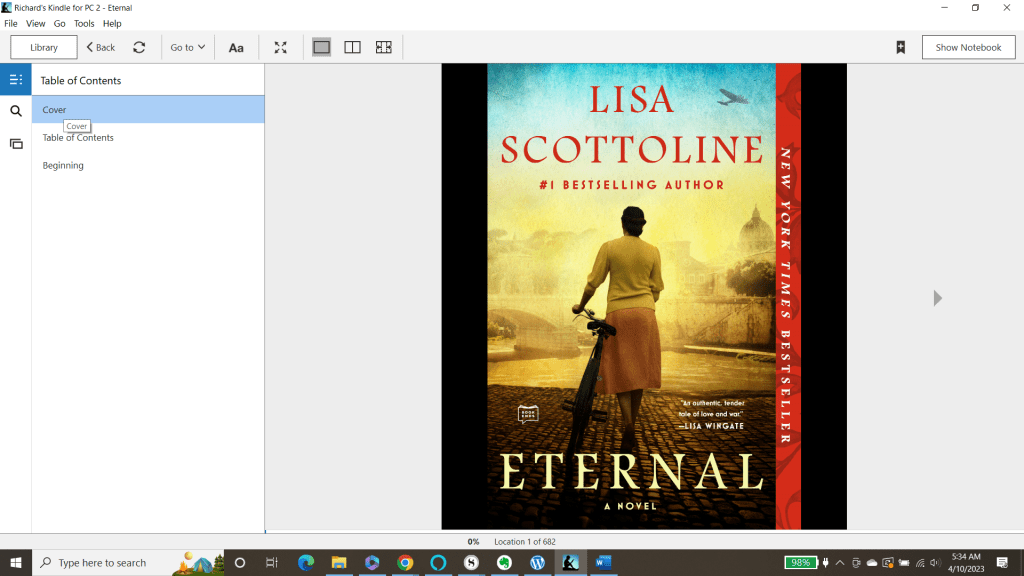
I’m also listening to Eternal, by Lisa Scottoline:

Amazon Abstract

NEW YORK TIMES BESTSELLER
 
#1 bestselling author Lisa Scottoline offers a sweeping and shattering epic of historical fiction fueled by shocking true events, the tale of a love triangle that unfolds in the heart of Rome…in the creeping shadow of fascism.


What war destroys, only love can heal.

Elisabetta, Marco, and Sandro grow up as the best of friends despite their differences. Elisabetta is a feisty beauty who dreams of becoming a novelist; Marco the brash and athletic son in a family of professional cyclists; and Sandro a Jewish mathematics prodigy, kind-hearted and thoughtful, the son of a lawyer and a doctor. Their friendship blossoms to love, with both Sandro and Marco hoping to win Elisabetta’s heart. But in the autumn of 1937, all of that begins to change as Mussolini asserts his power, aligning Italy’s Fascists with Hitler’s Nazis and altering the very laws that govern Rome. In time, everything that the three hold dear–their families, their homes, and their connection to one another–is tested in ways they never could have imagined.

As anti-Semitism takes legal root and World War II erupts, the threesome realizes that Mussolini was only the beginning. The Nazis invade Rome, and with their occupation come new atrocities against the city’s Jews, culminating in a final, horrific betrayal. Against this backdrop, the intertwined fates of Elisabetta, Marco, Sandro, and their families will be decided, in a heartbreaking story of both the best and the worst that the world has to offer.

Unfolding over decades, Eternal is a tale of loyalty and loss, family and food, love and war–all set in one of the world’s most beautiful cities at its darkest moment. This moving novel will be forever etched in the hearts and minds of readers.

Flannery O’Connor on Dogma, Belief, and the Difference Between Religion and Faith

Here’s the link to this article.

“For me a dogma is only a gateway to contemplation and is an instrument of freedom and not of restriction.”

BY MARIA POPOVA

As humans, we are wired to cling tightly to our beliefs, even the most delusional, and to automatically dismiss conflicting evidence. This is especially true in areas where our beliefs are particularly charged, such as politics and religion. For those of us skeptical of organized religion, who find transcendence in nature and spirituality in science, who fall closer to the atheism end of the belief spectrum, it’s especially challenging to consider perspectives on faith that come from the other end. But something magical happens when we allow the walls of the psyche to soften and become permeable, if only for a moment, to another’s experience of the world — little compares to the self-transcendence that such receptivity invites.

One of the most extraordinary meditations on religion and the role of spirituality in society comes from beloved author Flannery O’Connor (March 25, 1925–August 3, 1964), whose writing blended her Catholic faith with strong secular themes of ethics and moral philosophy, and nowhere does her singular spirit shine more luminously than in The Habit of Being: Letters of Flannery O’Connor (public library).

In July of 1955, when she was thirty, O’Connor received a letter from a young woman, initially unknown to her, who later chose to remain anonymous upon the publication of the letters. Both hungry for conversation and intrigued by the woman’s intensity of conviction, the author felt compelled to reply, and so began a nine-year epistolary friendship that continued until O’Connor’s death in 1964 from complications due to lupus. The letters to “A.” are among the most extraordinary in the collection, exploring with remarkable dignity and dimensionality matters of faith and religion, the difference between the two, and the role of spirituality in O’Connor’s writing and her personhood.

Flannery O’Connor by De Casseres

In her first letter to the young woman, dated July 20, 1955, O’Connor writes:

I am very pleased to have your letter. Perhaps it is even more startling to me to find someone who recognizes my work for what I try to make it than it is for you to find a God-conscious writer near at hand. The distance is 87 miles but I feel the spiritual distance is shorter.

I write the way I do because (not though) I am a Catholic. This is a fact and nothing covers it like the bald statement. However, I am a Catholic peculiarly possessed of the modern consciousness, that thing Jung describes as unhistorical, solitary, and guilty. To possess this within the Church is to bear a burden, the necessary burden for the conscious Catholic. It’s to feel the contemporary situation at the ultimate level. I think that the Church is the only thing that is going to make the terrible world we are coming to endurable; the only thing that makes the Church endurable is that it is somehow the body of Christ and that on this we are fed. It seems to be a fact that you have to suffer as much from the Church as for it but if you believe in the divinity of Christ, you have to cherish the world at the same time that you struggle to endure it. This may explain the lack of bitterness in the stories.

Lamenting the triteness of reviews that call A Good Man Is Hard to Find “brutal and sarcastic,” O’Connor wryly notes:

The stories are hard but they are hard because there is nothing harder or less sentimental than Christian realism. I believe that there are many rough beasts now slouching toward Bethlehem to be born and that I have reported the progress of a few of them, and when I see these stories described as horror stories I am always amused because the reviewer always has hold of the wrong horror.

In the next letter, dated August 2, O’Connor apologizes for responding so promptly that it forces a pace beyond her correspondent’s time budget, then arms up the conversation with a similarly sweet and self-deprecating remark about the creative life:

I myself am afflicted with time, as I do not work out on account of an energy-depriving ailment and my work in, being creative, can go on only a few hours a day. I live on a farm and don’t see many people. My avocation is raising peacocks, something that requires everything of the peacock and nothing of me, so time is always at hand.

Flannery O’Connor and her peacocks

She then resumes the question of “Christian realism,” about which her correspondent seems to feel particularly strongly:

I believe too that there is only one Reality and that that is the end of it, but the term, “Christian Realism,” has become necessary for me, perhaps in a purely academic way, because I find myself in a world where everybody has his compartment, puts you in yours, shuts the door and departs. One of the awful things about writing when you are a Christian is that for you the ultimate reality is the Incarnation, the present reality is the Incarnation, and nobody believes in the Incarnation; that is, nobody in your audience. My audience are the people who think God is dead. At least these are the people I am conscious of writing for.

In considering the misinterpretation and misapplication of dogma, O’Connor makes an allusion that would later inspire the title of the fantastic posthumous collection of her essays and writings, Mystery and Manners:

Dogma can in no way limit a limitless God. The person outside the Church attaches a different meaning to it than the person in. For me a dogma is only a gateway to contemplation and is an instrument of freedom and not of restriction. It preserves mystery for the human mind. Henry James said the young woman of the future would know nothing of mystery or manners. He had no business to limit it to one sex.

O’Connor has a way of letting her subtle wit slip in through the backdoor of even her most serious convictions:

I won’t ever be able entirely to understand my own work or even my own motivations. It is first of all a gift, but the direction it has taken has been because of the Church in me or the effect of the Church’s teaching, not because of a personal perception or love of God. For you to think this would be possible because of your ignorance of me; for me to think it would be sinful in a high degree. I am not a mystic and I do not lead a holy life. Not that I can claim any interesting or pleasurable sins (my sense of the devil is strong) but I know all about the garden variety, pride, gluttony, envy and sloth, and what is more to the point, my virtues are as timid as my vices. I think sin occasionally brings one closer to God, but not habitual sin and not this petty kind that blocks every small good. A working knowledge of the devil can be very well had from resisting him.

However, the individual in the Church is, no matter how worthless himself, a part of the Body of Christ and a participator in the Redemption. There is no blueprint that the Church gives for understanding this. It is a matter of faith and the Church can force no one to believe it. When I ask myself how I know I believe, I have no satisfactory answer at all, no assurance at all, no feeling at all. I can only say with Peter, Lord I believe, help my unbelief. And all I can say about my love of God, is, Lord help me in my lack of it. I distrust pious phrases, particularly when they issue from my mouth. I try militantly never to be affected by the pious language of the faithful but it is always coming out when you least expect it. In contrast to the pious language of the faithful, the liturgy is beautifully flat.

In another letter from a week later, O’Connor writes:

In the face of anyone’s experience, someone like myself who has had almost no experience, must be humble. I will never have the experience of the convert, or of the one who fails to be converted, or even in all probability of the formidable sinner; but your effort not to be seduced by the Church moves me greatly. God permits it for some reason though it is the devil’s greatest work of hallucination. Fr. [Jean] de Menasce told somebody not to come into the Church until he felt it would be an enlargement of his freedom. This is what you are doing and you are right, but do not make your feeling of the voluptuous seductive powers of the Church into a hard shell to protect yourself from her. I suppose it is like marriage, that when you get into it, you find it is the beginning, not the end, of the struggle to make love work.

She adds:

I think most people come to the Church by means the Church does not allow, else there would be no need their getting to her at all. However, this is true inside as well, as the operation of the Church is entirely set up for the sinner; which creates much misunderstanding among the smug.

Cartoon by Flannery O’Connor. Click images for details.

O’Connor ends with an intimation that not only bespeaks her lucid, intelligent approach to the subject, but also calls to mind Buckminster Fuller’s scientific revision of The Lord’s Prayer with a sentiment that would’ve gladdened Carl Sagan:

I have some long and tall thoughts on the subject of God’s working through nature, but I will not inflict them on you now. I find I have a habit of announcing the obvious in pompous and dogmatic periods. I like to forget that I’m only a storyteller.

The Habit of Being: Letters of Flannery O’Connor is a gorgeous and revelational read in its totality, emanating the timeless beauty of an inner life cut tragically short by an untimely death. Complement it with O’Connor on why the grotesque appeals to us and her little-known satirical cartoons.

About the Holy Bible, by Robert G. Ingersoll (1894): Part V: Was Jehoval a God of Love?

This is a very long article. I’ll post it by part.

Here’s the link to the full article.

V: Was Jehoval a God of Love?

Did these words come from the heart of love?—”When the Lord thy God shall drive them before thee, thou shalt smite them and utterly destroy them; thou shalt make no covenant with them, or show mercy unto them.”

“I will heap mischief upon them. I will send mine arrows upon them; they shall be burned with hunger and devoured with burning heat and with bitter destruction.”

“I will send the tooth of beasts upon them, with the poison of serpents of the dust.”

“The sword without, and terror within, shall destroy both the young man and the virgin; the suckling also with the man of gray hairs.”

“Let his children be fatherless and his wife a widow; let his children be continually vagabonds and beg; let them seek their bread also out of their desolate places; let the extortioner catch all that he hath, and let the stranger spoil his labor; let there be none to extend mercy unto him, neither let there be any to favor his fatherless children.”

“And thou shalt eat the fruit of thine own body—the flesh of thy sons and daughters.”

“And the heaven that is over thee shall be brass, and the earth that is under thee shall be iron.”

“Cursed shalt thou be in the city, and cursed shalt thou be in the field.”

“I will make my arrows drunk with blood.”

“I will laugh at their calamity.”

Did these curses, these threats, come from the heart of love or from the mouth of savagery?

Was Jehovah god or devil?

Why should we place Jehovah above all the gods?

Has man in his ignorance and fear ever imagined a greater monster?

Have the barbarians of any land, in any time, worshiped a more heartless god?

Brahma was a thousand times nobler, and so was Osiris and Zeus and Jupiter. So was the supreme god of the Aztecs, to whom they offered only the perfume of flowers. The worst god of the Hindus, with his necklace of skulls and his bracelets of living snakes, was kind and merciful compared with Jehovah.

Compared with Marcus Aurelius, how small Jehovah seems. Compared with Abraham Lincoln, how cruel, how contemptible, is this god.

04/24/23 Biking & Listening

Biking is something else I both love and hate. It takes a lot of effort but does provide good exercise and most days over an hour to listen to a good book or podcast. I especially like having ridden.

Here’s my bike, a Rockhopper by Specialized. I purchased it November 2021 from Venture Out in Guntersville; Mike is top notch! So is the bike, and the ‘old’ man seat I salvaged from an old Walmart bike.

Here’s today’s ride.

Here’s a few photos taken along my route:

A few days ago I started listening to The Witch Trials of J.K. Rowling

Here’s the link to the episode on Spotify.


I’m also listening to Eternal, by Lisa Scottoline:

Amazon Abstract

NEW YORK TIMES BESTSELLER
 
#1 bestselling author Lisa Scottoline offers a sweeping and shattering epic of historical fiction fueled by shocking true events, the tale of a love triangle that unfolds in the heart of Rome…in the creeping shadow of fascism.


What war destroys, only love can heal.

Elisabetta, Marco, and Sandro grow up as the best of friends despite their differences. Elisabetta is a feisty beauty who dreams of becoming a novelist; Marco the brash and athletic son in a family of professional cyclists; and Sandro a Jewish mathematics prodigy, kind-hearted and thoughtful, the son of a lawyer and a doctor. Their friendship blossoms to love, with both Sandro and Marco hoping to win Elisabetta’s heart. But in the autumn of 1937, all of that begins to change as Mussolini asserts his power, aligning Italy’s Fascists with Hitler’s Nazis and altering the very laws that govern Rome. In time, everything that the three hold dear–their families, their homes, and their connection to one another–is tested in ways they never could have imagined.

As anti-Semitism takes legal root and World War II erupts, the threesome realizes that Mussolini was only the beginning. The Nazis invade Rome, and with their occupation come new atrocities against the city’s Jews, culminating in a final, horrific betrayal. Against this backdrop, the intertwined fates of Elisabetta, Marco, Sandro, and their families will be decided, in a heartbreaking story of both the best and the worst that the world has to offer.

Unfolding over decades, Eternal is a tale of loyalty and loss, family and food, love and war–all set in one of the world’s most beautiful cities at its darkest moment. This moving novel will be forever etched in the hearts and minds of readers.

About the Holy Bible, by Robert G. Ingersoll (1894): Part IV, What is it All Worth?

This is a very long article. I’ll post it by part.

Here’s the link to the full article.

IV: What is it All Worth?

Will some Christian scholar tell us the value of Genesis?

We know that it is not true—that it contradicts itself. There are two accounts of the creation in the first and second chapters. In the first account birds and beasts were created before man.

In the second, man was created before the birds and beasts.

In the first, fowls are made out of the water.

In the second, fowls are made out of the ground.

In the first, Adam and Eve are created together.

In the second, Adam is made; then the beasts and birds, and then Eve is created from one of Adam’s ribs.

These stories are far older than the Pentateuch.

Persian: God created the world in six days, a man called Adama, a woman called Evah, and then rested.

The Etruscan, Babylonian, Phoenician, Chaldean and the Egyptian stories are much the same.

The Persians, Greeks, Egyptians, Chinese and Hindus have their Garden of Eden and the Tree of Life.

So the Persians, the Babylonians, the Nubians, the people of Southern India, all had the story of the fall of man and the subtle serpent.

The Chinese say that sin came into the world by the disobedience of woman. And even the Tahitians tell us that man was created from the earth, and the first woman from one of his bones.

All these stories are equally authentic and of equal value to the world, and all the authors were equally inspired.

We know also that the story of the flood is much older than the book of Genesis, and we know besides that it is not true.

We know that this story in Genesis was copied from the Chaldean. There you find all about the rain, the ark, the animals, the dove that was sent out three times, and the mountain on which the ark rested.

So the Hindus, Chinese, Parsees, Persians, Greeks, Mexicans and Scandinavians have substantially the same story.

We also know that the account of the Tower of Babel is an ignorant and childish fable.

What then is left in this inspired book of Genesis? Is there a word calculated to develop the heart or brain? Is there an elevated thought—any great principle—anything poetic—any word that bursts into blossom?

Is there anything except a dreary and detailed statement of things that never happened?

Is there anything in Exodus calculated to make men generous, loving and noble?

Is it well to teach children that God tortured the innocent cattle of the Egyptians—bruised them to death with hailstones—on account of the sins of Pharaoh?

Does it make us merciful to believe that God killed the firstborn of the Egyptians—the firstborn of the poor and suffering people—of the poor girl working at the mill—because of the wickedness of the king?

Can we believe that the gods of Egypt worked miracles? Did they change water into blood, and sticks into serpents?

In Exodus there is not one original thought or line of value.

We know, if we know anything, that this book was written by savages—savages who believed in slavery, polygamy and wars of extermination. We know that the story told is impossible, and that the miracles were never performed. This book admits that there are other gods besides Jehovah. In the 17th chapter is this verse: “Now I know that the Lord is greater than all gods, for, in the thing wherein they dealt proudly, he was above them.”

So, in this blessed book is taught the duty of human sacrifice—the sacrifice of babes.

In the 22d chapter is this command: “Thou shalt not delay to offer the first of thy ripe fruits and of thy liquors: the first-born of thy sons thou shalt give unto me.”

Has Exodus been a help or a hindrance to the human race?

Take from Exodus the laws common to all nations, and is there anything of value left?

Is there anything in Leviticus of importance? Is there a chapter worth reading? What interest have we in the clothes of priests, the curtains and candles of the tabernacle, the tongs and shovels of the altar or the hair-oil used by the Levities?

Of what use the cruel code, the frightful punishments, the curses, the falsehoods and the miracles of this ignorant and infamous book?

And what is there in the book of Numbers—with its sacrifices and water of jealousy, with its shewbread and spoons, its kids and fine flour, its oil and candlesticks, its cucumbers, onions and manna—to assist and instruct mankind? What interest have we in the rebellion of Korah, the water of separation, the ashes of a red heifer, the brazen serpent, the water that followed the people uphill and down for forty years, and the inspired donkey of the prophet Balaam? Have these absurdities and cruelties—these childish, savage superstitions—helped to civilize the world?

Is there anything in Joshua—with its wars, its murders and massacres, its swords dripping with the blood of mothers and babes, its tortures, maimings and mutilations, its fraud and fury, its hatred and revenge—calculated to improve the world?

Does not every chapter shock the heart of a good man? Is it a book to be read by children?

The book of Joshua is as merciless as famine, as ferocious as the heart of a wild beast. It is a history—a justification—a sanctification of nearly every crime.

The book of Judges is about the same, nothing but war and bloodshed; the horrible story of Jael and Sisera; of Gideon and his trumpets and pitchers; of Jephtha and his daughter, whom he murdered to please Jehovah.

Here we find the story of Samson, in which a sun-god is changed to a Hebrew giant.

Read this book of Joshua—read of the slaughter of women, of wives, of mothers and babes—read its impossible miracles, its ruthless crimes, and all done according to the commands of Jehovah, and tell me whether this book is calculated to make us forgiving, generous and loving.

I admit that the history of Ruth is in some respects a beautiful and touching story; that it is naturally told, and that her love for Naomi was deep and pure. But in the matter of courtship we would hardly advise our daughters to follow the example of Ruth. Still, we must remember that Ruth was a widow.

Is there anything worth reading in the first and second books of Samuel? Ought a prophet of God to hew a captured king in pieces? Is the story of the ark, its capture and return of importance to us? Is it possible that it was right, just and merciful to kill fifty thousand men because they had looked into a box? Of what use to us are the wars of Saul and David, the stories of Goliath and the Witch of Endor? Why should Jehovah have killed Uzzah for putting forth his hand to steady the ark, and forgiven David for murdering Uriah and stealing his wife?

According to “Samuel”, David took a census of the people. This excited the wrath of Jehovah, and as a punishment he allowed David to choose seven years of famine, a flight of three months from pursuing enemies, or three days of pestilence. David, having confidence in God, chose the three days of pestilence; and. thereupon, God, the compassionate, on account of the sin of David, killed seventy thousand innocent men.

Under the same circumstances, what would a devil have done?

Is there anything in first and Second Kings that suggests the idea of inspiration?

When David is dying he tells his son Solomon to murder Joab—not to let his hoar head go down to the grave in peace. With his last breath he commands his son to bring down the hoar head of Shimei to the grave with blood. Having uttered these merciful words, the good David, the man after God’s heart, slept with his fathers.

Was it necessary to inspire the man who wrote the history of the building of the temple, the story of the visit of the Queen of Sheba, or to tell the number of Solomon’s wives?

What care we for the withering of Jeroboam’s hand, the prophecy of Jehu, or the story of Elijah and the ravens?

Can we believe that Elijah brought flames from heaven, or that he went at last to Paradise in a chariot of fire?

Can we believe in the multiplication of the widow’s oil by Elisha, that an army was smitten with blindness, or that an axe floated in the water?

Does it civilize us to read about the beheading of the seventy sons of Ahab, the putting out of the eyes of Zedekiah and the murder of his sons? Is there one word in First and Second Kings calculated to make men better?

First and Second Chronicles is but a re-telling of what is told in First and Second Kings. The same old stories—a little left out, a little added, but in no respect made better or worse.

The book of Ezra is of no importance. He tells us that Cyrus, King of Persia, issued a proclamation for building a temple at Jerusalem, and that he declared Jehovah to be the real and only God.

Nothing could be more absurd. Ezra tells us about the return from captivity, the building of the Temple, the dedication, a few prayers, and this is all. This book is of no importance, of no use.

Nehemiah is about the same, only it tells of the building of the wall, the complaints of the people about taxes, a list of those who returned from Babylon, a catalogue of those who dwelt at Jerusalem, and the dedication of the walls.

Not a word in Nehemiah worth reading.

Then comes the book of Esther: In this we are told that King Ahasueras was intoxicated; that he sent for his Queen, Vashti, to come and show herself to him and his guests. Vashti refused to appear.

This maddened the king, and he ordered that from every province the most beautiful girls should be brought before him that he might choose one in place of Vashti.

Among others was brought Esther, a Jewess. She was chosen and became the wife of the king. Then a gentleman by the name of Haman wanted to have all the Jews killed, and the king, not knowing that Esther was of that race, signed a decree that all the Jews should be killed.

Through the efforts of Mordecai and Esther the decree was annulled and the Jews were saved.

Haman prepared a gallows on which to have Mordecai hanged, but the good Esther so managed matters that Haman and his ten sons were hanged on the gallows that Haman had built, and the Jews were allowed to murder more than seventy-five thousand of the king’s subjects.

This is the inspired story of Esther.

In the book of Job we find some elevated sentiments, some sublime and foolish thoughts, something of the wonder and sublimity of nature, the joys and sorrows of life; but the story is infamous.

Some of the Psalms are good, many are indifferent, a few are infamous. In them are mingled the vices and virtues. There are verses that elevate, verses that degrade. There are prayers for forgiveness and revenge. In the literature of the world there is nothing more heartless, more infamous, than the 109th Psalm.

In the Proverbs there is much shrewdness, many pithy and prudent maxims, many wise sayings. The same ideas are expressed in many ways—the wisdom of economy and silence, the dangers of vanity and idleness. Some are trivial, some are foolish, and many are wise. These proverbs are not generous—not altruistic. Sayings to the same effect are found among all nations.

Ecclesiastes is the most thoughtful book in the Bible. It was written by an unbeliever—a philosopher—an agnostic. Take out the interpolations, and it is in accordance with the thought of the nineteenth century. In this book are found the most philosophic and poetic passages in the Bible.

After crossing the desert of death and crime, after reading the Pentateuch, Joshua, Judges, Samuel, Kings and Chronicles—it is delightful to reach this grove of palms, called the “Song of Solomon”. A drama of love—of human low; a poem without Jehovah—a poem born of the heart and true to the divine instincts of the soul.

“I sleep, but my heart waketh.”

Isaiah is the work of several. Its swollen words, its vague imagery, its prophecies and curses, its ravings against kings and nations, its laughter at the wisdom of man, its hatred of joy, have not the slightest tendency to increase the well-being of man.

In this book is recorded the absurdist of all miracles. The shadow on the dial is turned back ten degrees, in order to satisfy Hezekiah that Jehovah will add fifteen years to his life.

In this miracle the world, turning from west to east at the rate of more than a thousand miles an hour, is not only stopped, but made to turn the other way until the shadow on the dial went back ten degrees! Is there in the whole world an intelligent man or woman who believes this impossible falsehood?

Jeremiah contains nothing of importance—no facts of value; nothing but fault-finding, lamentations, croakings, wailings, curses and promises; nothing but famine and prayer, the prosperity of the wicked, the ruin of the Jews, the captivity and return, and at last Jeremiah, the traitor, in the stocks and in prison.

And Lamentations is simply a continuance of the ravings of the same insane pessimist; nothing but dust and sackcloth and ashes, tears and howls, railings and revilings.

And Ezekiel—eating manuscripts, prophesying siege and desolation, with visions of coals of fire, and cherubim, and wheels with eyes, and the type and figure of the boiling pot, and the resurrection of dry bones—is of no use, of no possible value.

With Voltaire, I say that any one who admires Ezekiel should be compelled to dine with him.

Daniel is a disordered dream—a nightmare.

What can be made of this book with its image with a golden head, with breast and arms of silver, with belly and thighs of brass, with legs of iron, and with feet of iron and clay; with its writing on the wall, its den of lions, and its vision of the ram and goat?

Is there anything to be learned from Hosea and his wife? Is there anything of use in Joel, in Amos, in Obadiah? Can we get any good from Jonah and his gourd? Is it possible that God is the real author of Micah and Nahum, of Habakkuk and Zephaniah, of Haggai and Malachi and Zechariah, with his red horses, his four horns, his four carpenters, his flying roll, his mountains of brass and the stone with four eyes?

Is there anything in these “inspired” books that has been of benefit to man?

Have they taught us how to cultivate the earth, to build houses, to weave cloth, to prepare food?

Have they taught us to paint pictures, to chisel statues, to build bridges, or ships, or anything of beauty or of use? Did we get our ideas of government, of religious freedom, of the liberty of thought, from the Old Testament? Did we get from any of these books a hint of any science? Is there in the “sacred volume” a word, a line, that has added to the wealth, the intelligence and the happiness of mankind? Is there one of the books of the Old Testament as entertaining as “Robinson Crusoe,” “The Travels of Gulliver”, or “Peter Wilkins and his Flying Wife”? Did the author of Genesis know as much about nature as Humboldt, or Darwin, or Haeckel? Is what is called the Mosaic Code as wise or as merciful as the code of any civilized nation? Were the writers of Kings and Chronicles as great historians, as great writers, as Gibbon and Draper? Is Jeremiah or Habakkuk equal to Dickens or Thackeray? Can the authors of Job and the Psalms be compared with Shakespeare? Why should we attribute the best to man and the worst to God?

Thoroughly Conscious Ignorance: How the Power of Not-Knowing Drives Progress and Why Certainty Stymies the Evolution of Knowledge

Here’s the link to this article.

“It’s a wonderful idea: thoroughly conscious ignorance.”

BY MARIA POPOVA

“Allow yourself the uncomfortable luxury of changing your mind,” I reflected in the first of my 7 life lessons from 7 years of Brain Pickings — a notion hardly original and largely essential in life, yet one oh so difficult to adopt and embody. This concept lies at the heart of Stuart Firestein’s excellent book Ignorance: How It Drives Science, one of the best science reads of 2012. In this fantastic TED talk, Firestein, chair of the Department of Biological Sciences at Columbia University and head of the neuroscience lab there, challenges our common attitudes towards knowledge, points out the brokenness of much formal education, and explores what Richard Feynman so poetically advocated — the growth-value of remaining uncertain — in science, and, by extension, in life:

Ignorance has a lot of bad connotations [but] I mean a different kind of ignorance. I mean a kind of ignorance that’s less pejorative, a kind of ignorance that comes from a communal gap in our knowledge, something that’s just not there to be known or isn’t known well enough yet or we can’t make predictions from, the kind of ignorance that’s maybe best summed up in a statement by James Clerk Maxwell, perhaps the greatest physicist between Newton and Einstein, who said, “Thoroughly conscious ignorance is the prelude to every real advance in science.” I think it’s a wonderful idea: thoroughly conscious ignorance.

[…]

So I’d say the model we want to take is not that we start out kind of ignorant and we get some facts together and then we gain knowledge. It’s rather kind of the other way around, really. What do we use this knowledge for? What are we using this collection of facts for? We’re using it to make better ignorance, to come up with, if you will, higher-quality ignorance.

Ignorance remains a must-read. Complement it with Richard Feynman on the universal responsibility of scientists, then see how this mindset manifests in other domains of culture, from poetry to psychology to film.

HT The Dish