“Death is nothing to us.” What Do YOU Think?

Here’s the link to this article by Bart Ehrman.

April 27, 2023

I quote:

“You need to realize that death is nothing to us.   Everything that is good and bad in our lives comes from the experiences of our senses.  But death brings an end to our senses/experiences.  And so having the right understanding – that death is nothing to us – makes our mortality enjoyable, not because we will live forever but because we don’t pointlessly long to live forever.  For there are no terrors in life for the one who fully understands that there are no terrors in not living.

It is absurd for people who fear death — not because it is afflicting them now but because they expect it will be horrible when it comes.  For this allegedly most awful thing – death  — is actually nothing to us:   when we exist, we are not dead, but when we are dead, we no longer exist.  And so death is completely irrelevant – both to those who are living and to those who are dead.  Those who are living are not experiencing it and those who are dead no longer exist.”

These are not my words – just my idiomatic translation of the words of the Greek philosopher Epicurus, in his letter to an unknown person named Menoecus (taken from Diogenes Laertius, Lives of Eminent Philosophers).  Epicurus has had a millenia-long bad reputation as a complete “hedonist.”  But almost all his bad reputation is ill-deserved.  He was a great philosopher with a view of life and how to live it that has a LOT to commend it.  In fact, it is a view that many of us have today, based on scientific views that are analogous to those most of us share (VERY different as well, since he was living, well, 2300 years ago!).

Short story: Epicurus believed that people’s false religious views cause completely unnecessary psychological trauma and pain, and that life could be very much enjoyed apart from superstition and fear of death.

Here I’ll give his views in a nutshell:

  • The world was not created by divine beings but is made up of atoms that are tiny, indivisible particles that combine in various ways, and we are all – rocks, plants, animals, humans, gods – made up of them. The atoms come together for a time and will disperse and recombine again later in various ways.
  • As indicated, the gods too made up of particles and are the height of perfection, completely undisturbed and at rest – and have Zero involvement with us. They are what they are, existing in perfection and peace. (Epicurus lived in a polytheistic world; almost no one was an “atheist” in our sense.  So naturally he assumed there were gods.  But he was accused of being an atheist because he maintained the gods had nothing to do with us and we have absolutely nothing to fear from the gods.)
  • Life is a gift and life is short. It’s not a gift *from* someone/something.  It’s just something we’re incredibly lucky to have.  And we won’t have it for long.  So we should enjoy it.
  • The goal of life is therefore enjoyment, for as long as we can.
  • That means we should strive for “pleasure.” This is especially where Epicurus got into hot water with other philosophers.
  • The Greek word for pleasure is hēdon, from which we get our world “hedonism.”  Our modern use of the term, though, conjures up the wrong idea, at least with respect to Epricurus.  Our view of a “hedonist” is someone who strives for all the physical pleasure that can be found – drinking bouts, endless orgies, drugs, careless and carefree riotous living that is completely self-centered, uncaring, reckless, anti-social, and harmful to self and others.
  • That’s the opposite of what Epicurus meant. He explicitly and vehemently argues *against* that kind of lifestyle — precisely because it is indeed harmful to self and others.  How can a lifestyle that leads to serious additions, depression, and isolation be “good”?   That kind of life strives to resist a meaningful existence.   It is strictly to be avoided.
  • What then is “pleasure”? For one thing, it is the fulfilling richness that can come from knowing what is good for you and meaningful.  That involves simple pleasures of friends, interesting and meaningful discussions, reading, thinking, trying to understand the world and life and our place in it, enjoying meals together, and relishing the time we have for as long as we have it and realizing we won’t have it forever and don’t need to have it forever.
  • Above all, a life of pleasure is a life without pain. We should take good care of ourselves, treat ourselves well, and not put ourselves in positions of threat and danger.  We should do our best to avoid bodily pain.  And – in Epicurus’s view – when we do experience pain we should realize that most pains are endurable and do not need to affect our mental states if we have the right attitudes toward them; moreover, pains that seem unendurable do not last long (again, that’s just his view).
  • The same applies to mental anguish and pains, which are often worse than physical.
  • Because we are made up of atoms that will return whence they came, there is no life after death. Our souls disperse with our bodies.  It is absurd to feel anguish about death.  It will come whatever our fears are, and when it comes, we will have no fear.  We won’t suffer.  We won’t regret dying, we won’t be upset, we won’t be terrified, we certainly won’t feel any pain.  We won’t have any bodies.  We won’t have any minds.  Our atoms have dispersed.  We won’t exist any more.
  • So there is nothing to fear or even regrate. That’s how it should be.  It’s how nature works.  Fearing that it will happen makes no sense.  We won’t mind when it does happen, so why should we mind before it does?  There won’t be any pain or anguish then, so why should we feel pain and anguish about a future of no pain and anguish?
  • Death is nothing to us.

So, those are the views of Epicurus in a nutshell.  I’ve long been attracted to them.   I’m interested in your thoughts.  What do you think?

About the Holy Bible, by Robert G. Ingersoll (1894): Part VII: The New Testament

This is a very long article. I’ll post it by part.

Here’s the link to the full article.

VII: The New Testament

Who wrote the New Testament?

Christian scholars admit that they do not know. They admit that, if the four gospels were written by Matthew, Mark, Luke and John, they must have been written in Hebrew. And yet a Hebrew manuscript of any one of these gospels has never been found. All have been and are in Greek. So, educated theologians admit that the Epistles, James and Jude, were written by persons who had never seen one of the four gospels. In these Epistles—in James and Jude—no reference is made to any of the gospels, nor to any miracle recorded in them.

The first mention that has been found of one of our gospels was made about one hundred and eight years after the birth of Christ, and the four gospels were first named and quoted from at the beginning of the third century, about one hundred an seventy years after the death of Christ.

We now know that there were many other gospels besides our four, some of which have been lost. There were the gospels of Paul, of the Egyptians, of the Hebrews, of Perfection, of Judas, of Thaddeus, of the Infancy, of Thomas, of Mary, of Andrew, of Nicodemus, of Marcion and several others.

So there were the Acts of Pilate, of Andrew, of Mary, of Paul and Thecla and of many others; also a book called the Shepherd of Hermas.

At first not one of all the books was considered as inspired. The Old Testament was regarded as divine; but the books that now constitute the New Testament were regarded as human productions. We now know that we do not know who wrote the four gospels.

The question is, Were the authors of these four gospels inspired?

If they were inspired, then the four gospels must be true. If they are true, they must agree.

The four gospels do not agree.

Matthew, Mark and Luke knew nothing of the atonement, nothing of salvation by faith. They knew only the gospel of good deeds—of charity. They teach that if we forgive others God will forgive us.

With this the gospel of John does not agree.

In that gospel we are taught that we must believe on the Lord Jesus Christ; that we must be born again; that we must drink the blood and eat the flesh of Christ. In this gospel we find the doctrine of the atonement and that Christ died for us and suffered in our place.

This gospel is utterly at variance with the other three. If the other three are true, the gospel of John is false. If the gospel of John was written by an inspired man, the writers of the other three were uninspired. From this there is no possible escape. The four cannot be true.

It is evident that there are many interpolations in the four gospels.

For instance, in the 28th chapter of Matthew is an account to the effect that the soldiers at the tomb of Christ were bribed to say that the disciples of Jesus stole away his body while they, the soldiers, slept.

This is clearly an interpolation. It is a break in the narrative.

The 10th verse should be followed by the 16th. The 10th verse is as follows:

“Then Jesus said unto them, “Be not afraid; go tell my brethren that they go unto Galilee and there shall they see me.””

The 16th verse:

“Then the eleven disciples went away unto Galilee into a mountain, where Jesus had appointed them.”

The story about the soldiers contained in the 11th, 12th, 13th, 14th and 15th verses is an interpolation—an afterthought—long after.
The 15th verse demonstrates this.

Fifteenth verse: “So they took the money and did as they were taught. And this saying is commonly reported among the Jews until this day.

Certainly this account was not in the original gospel, and certainly the 15th verse was not written by a Jew. No Jew could have written
this: “And this saying is commonly reported among the Jews until this day.”

Mark, John and Luke never heard that the soldiers had been bribed by the priests; or, if they had, did not think it worth while recording. So
the accounts of the Ascension of Jesus Christ in Mark and Luke are interpolations. Matthew says nothing about the Ascension.

Certainly there never was a greater miracle, and yet Matthew, who was present—who saw the Lord rise, ascend and disappear—did not think
it worth mentioning.

On the other hand, the last words of Christ, according to Matthew, contradict the Ascension: “Lo I am with you always, even unto the end
of the world.”

John, who was present, if Christ really ascended, says not one word on the subject.

As to the Ascension, the gospels do not agree.

Mark gives the last conversation that Christ had with his disciples, as follows:

“Go ye into all the world and preach the gospel to every creature. He that believeth and is baptized shall be saved; but he that believeth
not shall be damned. And these signs shall follow them that believe: In my name shall they cast out devils; they shall speak with new tongues.
They shall take up serpents, and if they drink any deadly thing it shall not hurt them; they shall lay hands on the sick and they shall recover.
So, then, after the Lord had spoken unto them, he was received up into heaven and sat on the right hand of God.”

Is it possible that this description was written by one who witnessed this miracle?

This miracle is described by Luke as follows.

“And it came to pass while he blessed them he was parted from them and carried up into heaven.”

“Brevity is the soul of wit.”

In the Acts we are told that: “When he had spoken, while they beheld, he was taken up, and a cloud received him out of their sight.”

Neither Luke, nor Matthew, nor John, nor the writer of the Acts, heard one word of the conversation attributed to Christ by Mark. The fact is
that the Ascension of Christ was not claimed by his disciples.

At first Christ was a man—nothing more. Mary was his mother, Joseph his father. The genealogy of his father, Joseph, was given to show
that he was of the blood of David.

Then the claim was made that he was the son of God, and that his mother was a virgin, and that she remained a virgin until her death.

Then the claim was made that Christ rose from the dead and ascended bodily to heaven.

It required many years for these absurdities to take possession of the minds of men.

If Christ rose from the dead, why did he not appear to his enemies? Why did he not call on Caiaphas, the high priest? Why did he not make
another triumphal entry into Jerusalem?

If he really ascended, why did he not do so in public, in the presence of his persecutors? Why should this, the greatest of miracles, be
done in secret. in a corner?

It was a miracle that could have been seen by a vast multitude—a miracle that could not be simulated—one that would have convinced
hundreds of thousands.

After the story of the Resurrection, the Ascension became a necessity. They had to dispose of the body.

So there are many other interpolations in the gospels and epistles.

Again I ask: Is the New Testament true? Does anybody now believe that at the birth of Christ there was a celestial greeting; that a star led
the Wise Men of the East; that Herod slew the babes of Bethlehem of two years old and under?

The gospels are filled with accounts of miracles. Were they ever performed?

Matthew gives the particulars of about twenty-two miracles, Mark of about nineteen, Luke of about eighteen and John of about seven.

According to the gospels, Christ healed diseases, cast out devils, rebuked the sea, cured the blind, fed multitudes with five loaves and
two fishes, walked on the sea, cursed a fig tree, turned water into wine and raised the dead.

Matthew is the only one that tells about the Star and the Wise Men—the only one that tells about the murder of babes.

John is the only one who says anything about the resurrection of Lazarus, and Luke is the only one giving an account of the rising from the
dead the widow of Nain’s son.

How is it possible to substantiate these miracles?

The Jews, among whom they were said to have been performed, did not believe them. The diseased, the palsied, the leprous, the blind who were
cured, did not become followers of Christ. Those that were raised from the dead were never heard of again.

Does any intelligent man believe in the existence of devils? The writer of three of the gospels certainly did. John says nothing about Christ
having cast out devils, but Matthew, Mark and Luke give many instances.

Does any natural man now believe that Christ cast out devils? If his disciples said he did, they were mistaken. If Christ said he did, he was insane
or an impostor.

If the accounts of casting out devils are false, then the writers were ignorant or dishonest. If they wrote through ignorance, then they were
not inspired. If they wrote what they knew to be false, they were not inspired. If what they wrote is untrue, whether they knew it or not, they
were not inspired.

At that time it was believed that palsy, epilepsy, deafness, insanity and many other diseases were caused by devils; that devils took
possession of and lived in the bodies of men and women. Christ believed this, taught this belief to others, and pretended to cure diseases by
casting devils out of the sick and insane. We know now, if we know anything, that diseases are not caused by the presence of devils. We know,
if we know anything, that devils do not reside in the bodies of men.

If Christ said and did what the writers of the three gospels say he said and did, then Christ was mistaken. If he was mistaken, certainly he
was not God. And if he was mistaken, certainly he was not inspired.

Is it a fact that the Devil tried to bribe Christ?

Is it a fact that the Devil carried Christ to the top of the temple and tried to induce him to leap to the ground?

How can these miracles be established?

The principals have written nothing, Christ has written nothing, and the Devil has remained silent.

How can we know that the Devil tried to bribe Christ? Who wrote the account? We do not know. How did the writer get his information? We do
not know.

Somebody, some seventeen hundred years ago, said that the Devil tried to bribe God; that the Devil carried God to the top of the temple and
tried to induce him to leap to the earth and that God was intellectually too keen for the Devil.

This is all the evidence we have.

Is there anything in the literature, of the world more perfectly idiotic?

Intelligent people no longer believe in witches, wizards, spooks and devils, and they are perfectly satisfied that every word in the New
Testament about casting out devils is utterly false.

Can we believe that Christ raised the dead?

A widow living in Nain is following the body of her son to the tomb. Christ halts the funeral procession and raises the young man from
the dead and gives him back to the arms of his mother.

This young man disappears. He is never heard of again. No one takes the slightest interest in the man who returned from the realm of death.
Luke is the only one who tells the story. Maybe Matthew, Mark and John never heard of it, or did not believe it and so failed to record it.

John says that Lazarus was raised from the dead; Matthew, Mark and Luke say nothing about it.

It was more wonderful than the raising of the widow’s son. He had not been laid in the tomb for days. He was only on his way to the grave,
but Lazarus was actually dead. He had begun to decay.

Lazarus did not excite the least interest. No one asked him about the other world. No one inquired of him about their dead friends. When he
died the second time no one said: “He is not afraid. He has traveled that road twice and knows just where he is going.”

We do not believe in the miracles of Mohammed, and yet they are as well attested as this. We have no confidence in the miracles performed by
Joseph Smith, and yet the evidence is far greater, far better.

If a man should go about now pretending to raise the dead, pretending to cast out devils, we would regard him as insane. What, then, can we
say of Christ? If we wish to save his reputation we are compelled to say that he never pretended to raise the dead; that he never claimed to have
cast out devils.

We must take the ground that these ignorant and impossible things were invented by zealous disciples, who sought to deify their leader.

In those ignorant days these falsehoods added to the fame of Christ. But now they put his character in peril and belittle the authors of the gospels.

Can we now believe that water was changed into wine? John tells of this childish miracle, and says that the other disciples were present, yet
Matthew, Mark and Luke say nothing about it.

Take the miracle of the man cured by the pool of Bethseda. John says that an angel troubled the waters of the pool of Bethseda, and that whoever
got into the pool first after the waters were troubled was healed.

Does anybody now believe that an angel went into the pool and troubled the waters? Does anybody now think that the poor wretch who got in first
was healed? Yet the author of the gospel according to John believed and asserted these absurdities. If he was mistaken about that he may have been
about all the miracles he records.

John is the only one who tells about this pool of Bethseda. Possibly the other disciples did not believe the story.

How can we account for these pretended miracles?

In the days of the disciples, and for many centuries after, the world was filled with the supernatural. Nearly everything that happened was
regarded as miraculous. God was the immediate governor of the world. If the people were good, God sent seed time and harvest; but if they were
bad he sent flood and hail, frost and famine. If anything wonderful happened it was exaggerated until it became a miracle.

Of the order of events—of the unbroken and the unbreakable chain of causes and effects—the people had no knowledge and no thought.

A miracle is the badge and brand of fraud. No miracle ever was performed. No intelligent, honest man ever pretended to perform a miracle, and
never will.

If Christ had wrought the miracles attributed to him; if he had cured the palsied and insane; if he had given hearing to the deaf, vision to
the blind; if he had cleansed the leper with a word, and with a touch had given life and feeling to the withered limb; if he had given pulse and
motion, warmth and thought, to cold and breathless clay; if he had conquered death and rescued from the grave its pallid prey—no word would
have been uttered, no hand raised, except in praise and honor. In his presence all heads would have been uncovered—all knees upon the ground.

Is it not strange that at the trial of Christ no one was found to say a word in his favor? No man stood forth and said: “I was a leper, and
this man cured me with a touch.” No woman said: “I am the widow of Nain and this is my son whom this man raised from the dead.”

No man said: “I was blind, and this man gave me sight.”

All silent.

Maya Angelou on Identity and the Meaning of Life

Here’s the link to this article.

“Life loves the liver of it. You must live and life will be good to you.”

BY MARIA POPOVA

The light of the world has grown a little dimmer with the loss of the phenomenal Maya Angelou (April 4, 1928–May 28, 2014), but her legacy endures as a luminous beacon of strength, courage, and spiritual beauty. Angelou’s timeless wisdom shines with unparalleled light in a 1977 interview by journalist Judith Rich, found in Conversations with Maya Angelou (public library) — the same magnificent tome that gave us the beloved author’s conversation with Bill Moyers on freedom — in which Angelou explores issues of identity and the meaning of life.

Reflecting on her life, Angelou — who rose to cultural prominence through the sheer tenacity of her character and talent, despite being born into a tumultuous working-class family, abandoned by her father at the age of three, and raped at the age of eight — tells Rich:

I’ve been very fortunate… I seem to have a kind of blinkers. I just do not allow too many negatives to soil me. I’m very blessed. I have looked quite strange in most of the places I have lived in my life, the stages, spaces I’ve moved through. I of course grew up with my grandmother: my grandmother’s people and my brother are very very black, very lovely. And my mother’s people were very very fair. I was always sort of in between. I was too tall. My voice was too heavy. My attitude was too arrogant — or tenderhearted. So if I had accepted what people told me I looked like as a negative yes, then I would be dead. But I accepted it and I thought, well, aren’t I the lucky one.

She later revisits the question of identity, echoing Leo Buscaglia’s beautiful meditation on labels, as she reflects on the visibility her success granted her and the responsibility that comes with it:

What I represent in fact, what I’m trying like hell to represent every time I go into that hotel room, is myself. That’s what I’m trying to do. And I miss most of the time on that: I do not represent blacks or tall women, or women or Sonomans or Californians or Americans. Or rather I hope I do, because I am all those things. But that is not all that I am. I am all of that and more and less. People often put labels on people so they don’t have to deal with the physical fact of those people. It’s easy to say, oh, that’s a honkie, that’s a Jew, that’s a junkie, or that’s a broad, or that’s a stud, or that’s a dude. So you don’t have to think: does this person long for Christmas? Is he afraid that the Easter bunny will become polluted? … I refuse that… I simply refuse to have my life narrowed and proscribed.

To be sure, beneath Angelou’s remarkable optimism and dignity lies the strenuous reality she had to overcome. Reflecting on her youth, she channels an experience all too familiar to those who enter life from a foundation the opposite of privilege:

It’s very hard to be young and curious and almost egomaniacally concerned with one’s intelligence and to have no education at all and no direction and no doors to be open… To go figuratively to a door and find there’s no doorknob.

And yet Angelou acknowledges with great gratitude the kindness of those who opened doors for her in her spiritual and creative journey. Remembering the Jewish rabbi who offered her guidance in faith and philosophy and who showed up at her hospital bedside many years later after a serious operation, Angelou tells Rich:

The kindnesses … I never forget them. And so they keep one from becoming bitter. They encourage you to be as strong, as volatile as necessary to make a well world. Those people who gave me so much, and still give me so much, have a passion about them. And they encourage the passion in me. I’m very blessed that I have a healthy temper. I can become quite angry and burning in anger, but I have never been bitter. Bitterness is a corrosive, terrible acid. It just eats you and makes you sick.

Painting by Basquiat from Angelou’s ‘Life Doesn’t Frighten Me.’ Click image for more.

At the end of the interview, Angelou reflects on the meaning of life — a meditation all the more poignant as we consider, in the wake of her death, how beautifully she embodied the wisdom of her own words:

I’ve always had the feeling that life loves the liver of it. You must live and life will be good to you, give you experiences. They may not all be that pleasant, but nobody promised you a rose garden. But more than likely if you do dare, what you get are the marvelous returns. Courage is probably the most important of the virtues, because without courage you cannot practice any of the other virtues, you can’t say against a murderous society, I oppose your murdering. You got to have courage to do so. I seem to have known that a long time and found great joy in it.

The totality of Conversations with Maya Angelou is a powerful portal into the beloved writer’s soul. Complement it with Angelou on home, belonging, and (not) growing up, her children’s verses about courage illustrated by Basquiat, and her breathtaking reading of “Phenomenal Woman.”

04/26/23 Biking & Listening

Biking is something else I both love and hate. It takes a lot of effort but does provide good exercise and most days over an hour to listen to a good book or podcast. I especially like having ridden.

Here’s my bike, a Rockhopper by Specialized. I purchased it November 2021 from Venture Out in Guntersville; Mike is top notch! So is the bike, and the ‘old’ man seat I salvaged from an old Walmart bike.

Here’s today’s ride.

Here’s a few photos taken along my route:

A few days ago I started listening to The Witch Trials of J.K. Rowling

Here’s the show link on Spotify.

Here’s the link to the episode I listened to today.


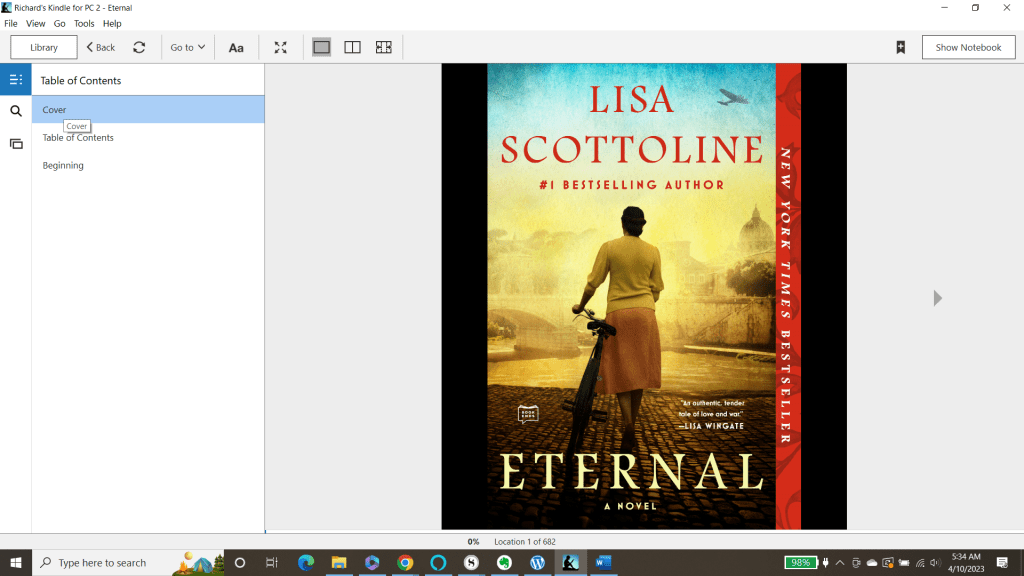
I’m also listening to Eternal, by Lisa Scottoline:

Amazon Abstract

NEW YORK TIMES BESTSELLER
 
#1 bestselling author Lisa Scottoline offers a sweeping and shattering epic of historical fiction fueled by shocking true events, the tale of a love triangle that unfolds in the heart of Rome…in the creeping shadow of fascism.


What war destroys, only love can heal.

Elisabetta, Marco, and Sandro grow up as the best of friends despite their differences. Elisabetta is a feisty beauty who dreams of becoming a novelist; Marco the brash and athletic son in a family of professional cyclists; and Sandro a Jewish mathematics prodigy, kind-hearted and thoughtful, the son of a lawyer and a doctor. Their friendship blossoms to love, with both Sandro and Marco hoping to win Elisabetta’s heart. But in the autumn of 1937, all of that begins to change as Mussolini asserts his power, aligning Italy’s Fascists with Hitler’s Nazis and altering the very laws that govern Rome. In time, everything that the three hold dear–their families, their homes, and their connection to one another–is tested in ways they never could have imagined.

As anti-Semitism takes legal root and World War II erupts, the threesome realizes that Mussolini was only the beginning. The Nazis invade Rome, and with their occupation come new atrocities against the city’s Jews, culminating in a final, horrific betrayal. Against this backdrop, the intertwined fates of Elisabetta, Marco, Sandro, and their families will be decided, in a heartbreaking story of both the best and the worst that the world has to offer.

Unfolding over decades, Eternal is a tale of loyalty and loss, family and food, love and war–all set in one of the world’s most beautiful cities at its darkest moment. This moving novel will be forever etched in the hearts and minds of readers.

About the Holy Bible, by Robert G. Ingersoll (1894): Part VI: Jehovah’s Administration

This is a very long article. I’ll post it by part.

Here’s the link to the full article.

VI: Jehovah’s Administration

He created the world, the hosts of heaven, a man and woman—placed them in a garden. Then the serpent deceived them, and they were cast out and made to earn their bread.

Jehovah had been thwarted.

Then he tried again. He went on for about sixteen hundred years trying to civilize the people.

No schools, no churches, no Bible, no tracts—nobody taught to read or write. No Ten Commandments. The people grew worse and worse, until the merciful Jehovah sent the flood and drowned all the people except Noah and his family, eight in all.

Then he started again, and changed their diet. At first Adam and Eve were vegetarians. After the flood Jehovah said: “Every moving thing that liveth shall be meat for you”—snakes and buzzards.

Then he failed again, and at the Tower of Babel he dispersed and scattered the people.

Finding that he could not succeed with all the people, he thought he would try a few, so he selected Abraham and his descendants. Again he failed, and his chosen people were captured by the Egyptians and enslaved for four hundred years.

Then he tried again—rescued them from Pharaoh and started for Palestine.

Then he changed their diet, allowing them to eat only the beasts that parted the hoof and chewed the cud. Again he failed. The people hated him, and preferred the slavery of Egypt to the freedom of Jehovah. So he kept them wandering until nearly all who came from Egypt had died. Then he tried again—took them into Palestine and had them governed by Judges.

This, too, was a failure—no schools, no Bible. Then he tried kings, and the kings were mostly idolaters.

Then the chosen people were conquered and carried into captivity by the Babylonians.

Another failure.

Then they returned, and Jehovah tried prophets—howlers and wailers—but the people grew worse and worse. No schools, no sciences, no arts, no commerce. Then Jehovah took upon himself flesh, was born of a woman, and lived among the people that he had been trying to civilize for several thousand years. Then these people, following the law that Jehovah had given them in the wilderness, charged this Jehovah-man—this Christ—with blasphemy; tried, convicted and killed him.

Jehovah had failed again.

Then he deserted the Jews and turned his attention to the rest of the world.

And now the Jews, deserted by Jehovah, persecuted by Christians, are the most prosperous people on the earth. Again has Jehovah failed.

What an administration!

Tolstoy Reads from His ‘Calendar of Wisdom’ in a Rare Recording Shortly Before His Death

Here’s the link to this article.

The beloved Russian author, shortly before his death, on the object of life.

BY MARIA POPOVA

“I’m only interested in people engaged in a project of self-transformation,” Susan Sontag famously confessed in her collected meditations on love. And yet, one some level, in ways both resolute and subtle, almost all of us are on a constant quest to get better at life.

In March of 1884, Leo Tolstoly (September 9, 1828–November 20, 1910) began what became his A Calendar of Wisdom: Daily Thoughts to Nourish the Soul, Written and Selected from the World’s Sacred Texts (public library) — a Tumblr-like compendium of notable ideas about the meaning of life, which took him twenty years to complete. In this rare audio from 1909, recorded four years after the book was finalized and a year before Tolstoy passed away, the beloved author reads a passage from the book that bespeaks that universal pursuit of self-improvement:

https://w.soundcloud.com/player/?visual=true&url=https%3A%2F%2Fapi.soundcloud.com%2Ftracks%2F77798820&show_artwork=true&maxheight=1000&maxwidth=680

That the object of life is self-perfection, the perfection of all immortal souls, that this is the only object of my life, is seen to be correct by the fact alone that every other object is essentially a new object. Therefore, the question whether thou hast done what thou shoudst have done is of immense importance, for the only meaning of thy life is in doing in this short term allowed thee, that which is desired of thee by He who or That which has sent thee into life. Art thou doing the right thing?

Imbibe some of the wisdom Tolstoy collected in the book, including his own meditations on knowledge and life, here, then revisit his journey of finding meaning in a meaningless world.