
Author: Richard L. Fricks
Richard L. Fricks is a novelist, former attorney and CPA, Fictionary Certified StoryCoach Editor, and creator of The Pencil-Driven Life. He lives in rural North Alabama near Boaz, where much of his fiction and reflection remain rooted. His work explores story, inherited purpose, faith and doubt, family pressure, moral contradiction, consciousness, ordinary life, and the practice of beginning again with a pencil.
About the Holy Bible, by Robert G. Ingersoll (1894): Part IX: Is Christ Our Example?
This is a very long article. I’ll post it by part.
Here’s the link to the full article.
IX: Is Christ Our Example?
He never said a word in favor of education. He never even hinted at the existence of any science. He never uttered a word in favor of
industry, economy or of any effort to better our condition in this world. He was the enemy of the successful, of the wealthy. Dives was sent
to hell, not because he was bad, but because he was rich. Lazarus went to heaven, not because he was good, but because he was poor.
Christ cared nothing for painting, for sculpture, for music—nothing for any art. He said nothing about the duties of nation to nation,
of king to subject; nothing about the rights of man; nothing about intellectual liberty or the freedom of speech. He said nothing about
the sacredness of home; not one word for the fireside; not a word in favor of marriage, in honor of maternity.
He never married. He wandered homeless from place to place with a few disciples. None of them seem to have been engaged in any useful
business, and they seem to have lived on alms.
All human ties were held in contempt; this world was sacrificed for the next; all human effort was discouraged. God would support and protect.
At last, in the dusk of death, Christ, finding that he was mistaken, cried out: “My God My God! Why hast thou forsaken me?”
We have found that man must depend on himself. He must clear the land; he must build the home; he must plow and plant; he must invent; he must
work with hand and brain; he must overcome the difficulties and obstructions; he must conquer and enslave the forces of nature to the end that
they may do the work of the world.
Great Wide Earth – A Talk
Listen to a profound personal account of awakening from a modern Zen master.
Here is today’s Meditation.
Remembering Aaron Swartz: David Foster Wallace on the Meaning of Life
Here’s the link to this article.
“Worship your intellect, being seen as smart — you will end up feeling stupid, a fraud, always on the verge of being found out.”
BY MARIA POPOVA
I recently attended the heartbreaking memorial for open-access activist Aaron Swartz, who for the past two years had been relentlessly and unscrupulously prosecuted for making academic journal articles freely available online and who had taken his own life a week prior. A speaker at the service read a piece by one of Aaron’s personal heroes, David Foster Wallace — an excerpt from Wallace’s famous Kenyon College commencement address, the only public talk he ever gave on his views of life, which was eventually adapted into a slim book titled This Is Water: Some Thoughts, Delivered on a Significant Occasion, about Living a Compassionate Life (public library).

I’ve written about the speech previously, but the particular excerpt read at Aaron’s memorial resonates with chilling clarity in light of recent meditations on the meaning of life, how to find one’s purpose, morality vs. intelligence, and whether money can really buy happiness. Wallace remarks:
If you worship money and things — if they are where you tap real meaning in life — then you will never have enough. Never feel you have enough. It’s the truth. Worship your own body and beauty and sexual allure and you will always feel ugly, and when time and age start showing, you will die a million deaths before they finally plant you. On one level, we all know this stuff already — it’s been codified as myths, proverbs, clichés, bromides, epigrams, parables: the skeleton of every great story. The trick is keeping the truth up-front in daily consciousness. Worship power — you will feel weak and afraid, and you will need ever more power over others to keep the fear at bay. Worship your intellect, being seen as smart — you will end up feeling stupid, a fraud, always on the verge of being found out. And so on.
https://w.soundcloud.com/player/?url=http%3A%2F%2Fapi.soundcloud.com%2Ftracks%2F59517060
Also speaking at the memorial, data visualization godfather Edward Tufte captured the essence of Aaron’s character:

Aaron’s unique quality was that he was marvelously and vigorously different. There’s a scarcity of that.
Hear This Is Water in its entirety, with notable excerpts, here. Help fight the broken system that mauled Aaron here. Honor his legacy with a contribution to Creative Commons here.
Portrait: Aaron Swartz by Fred Benenson under Creative Commons
04/28/23 Biking & Listening

Biking is something else I both love and hate. It takes a lot of effort but does provide good exercise and most days over an hour to listen to a good book or podcast. I especially like having ridden.
Here’s my bike, a Rockhopper by Specialized. I purchased it November 2021 from Venture Out in Guntersville; Mike is top notch! So is the bike, and the ‘old’ man seat I salvaged from an old Walmart bike.

Here’s a link to today’s bike ride. This is my pistol ride.
Here’s a few photos taken along my route:


























Here’s what I listened to today:
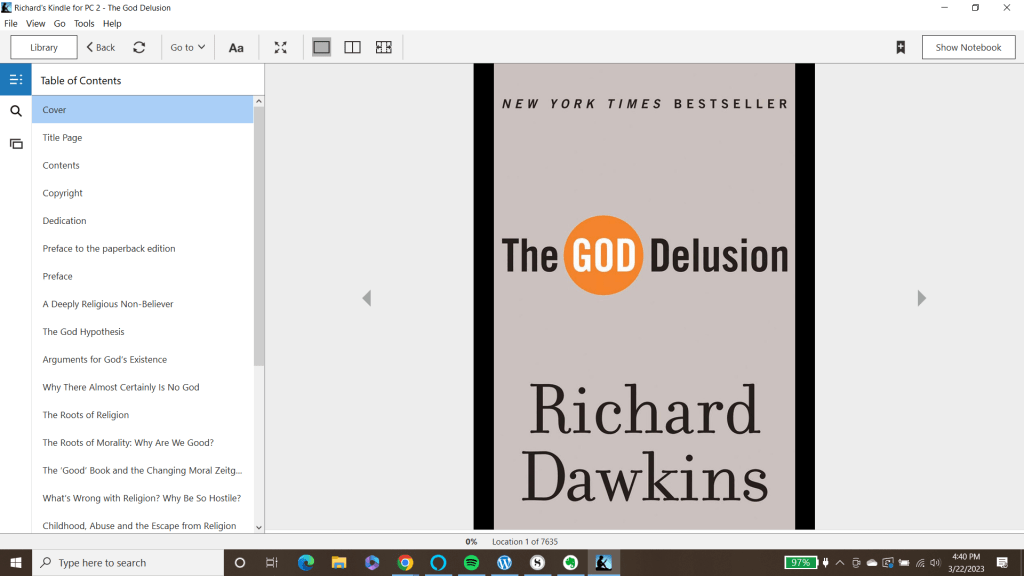
The God Delusion, by Richard Dawkins.
Amazon Abstract
A preeminent scientist — and the world’s most prominent atheist — asserts the irrationality of belief in God and the grievous harm religion has inflicted on society, from the Crusades to 9/11.
With rigor and wit, Dawkins examines God in all his forms, from the sex-obsessed tyrant of the Old Testament to the more benign (but still illogical) Celestial Watchmaker favored by some Enlightenment thinkers. He eviscerates the major arguments for religion and demonstrates the supreme improbability of a supreme being. He shows how religion fuels war, foments bigotry, and abuses children, buttressing his points with historical and contemporary evidence. The God Delusion makes a compelling case that belief in God is not just wrong but potentially deadly. It also offers exhilarating insight into the advantages of atheism to the individual and society, not the least of which is a clearer, truer appreciation of the universe’s wonders than any faith could ever muster.
5th Foundational Falsehood of Creationism
About the Holy Bible, by Robert G. Ingersoll (1894): Part VIII: The Philosophy of Christ
This is a very long article. I’ll post it by part.
Here’s the link to the full article.
VIII: The Philosophy of Christ
Millions assert that the philosophy of Christ is perfect—that he was the wisest that ever uttered speech.
Let us see:
Resist not evil. If smitten on one cheek turn the other.
Is there any philosophy, any wisdom in this? Christ takes from goodness, from virtue, from the truth, the right of self-defence. Vice becomes
the master of the world, and the good become the victims of the infamous.
No man has the right to protect himself, his property, his wife and children. Government becomes impossible, and the world is at the mercy of
criminals. Is there any absurdity beyond this?
Love your enemies.
Is this possible? Did any human being ever love his enemies? Did Christ love his, when he denounced them as whited sepulchers,
hypocrites and vipers?
We cannot love those who hate us. Hatred in the hearts of others does not breed love in ours. Not to resist evil is absurd; to
love your enemies is impossible.
Take no thought for the morrow.
The idea was that God would take care of us as he did of sparrows and lilies. Is there the least sense in that belief?
Does God take care of anybody?
Can we live without taking thought for the morrow? To plow, to sow, to cultivate, to harvest, is to take thought for the morrow. We plan
and work for the future, for our children, for the unborn generations to come. Without this forethought there could be no progress, no civilization.
The world would go back to the caves and dens of savagery.
If thy right eye offend thee, pluck it out. If thy right hand offend thee, cut it off.
Why? Because it is better that one of our members should perish than that the whole body should be cast into hell.
Is there any wisdom in putting out your eyes or cutting off your hands? Is it possible to extract from these extravagant sayings the smallest
grain of common sense?
Swear not at all; neither by Heaven, for it is God’s throne; nor by the Earth, for it is his footstool; nor by Jerusalem, for it is his holy
city.
Here we find the astronomy and geology of Christ. Heaven is the throne of God, the monarch; the earth is his footstool. A footstool that
turns over at the rate of a thousand miles an hour, and sweeps through space at the rate of over a thousand miles a minute!
Where did Christ think heaven was? Why was Jerusalem a holy city? Was it because the inhabitants were ignorant, crud and superstitious?
If any man will sue thee at the law and take away thy coat let him have thy cloak also.
Is there any philosophy, any good sense, in that commandment? Would it not be just as sensible to say: “If a man obtains a judgment
against you for one hundred dollars, give him two hundred.”
Only the insane could give or follow this advice.
Think not I come to send peace on earth. I came not to send peace, but a sword. For I am come to set a man at variance against his father, and
the daughter against her mother.
If this is true, how much better it would have been had he remained away.
Is it possible that he who said, “Resist not evil,” came to bring a sword? That he who said, “Love your enemies,” came to
destroy the peace of the world?
To set father against son, and daughter against father—what a glorious mission!
He did bring a sword, and the sword was wet for a thousand years with innocent blood. In millions of hearts he sowed the seeds of hatred and
revenge. He divided nations and families, put out the light of reason, and petrified the hearts of men.
And every one that hath forsaken house, or breathren, or sisters, or father, or mother, or wife, or children, or lands, for my name’s sake,
shall receive an hundredfold, and shall inherit everlasting life.
According to the writer of Matthew, Christ, the compassionate, the merciful, uttered these terrible words. Is it possible that Christ offered
the bribe of eternal joy to those who would desert their fathers, their mothers, their wives and children? Are we to win the happiness of heaven
by deserting the ones we love? Is a home to be ruined here for the sake of a mansion there?
And yet it is said that Christ is an example for all the world. Did he desert his father and mother? He said, speaking to his mother:
“Woman, what have I to do with thee?”
The Pharisees said unto Christ: “Is it lawful to pay tribute unto Caesar?”
Christ said: “Show me the tribute money.”They brought him a penny. And he saith unto them: “Whose is the image and the
superscription? “They said: “Caesar’s.” And Christ said: “Render unto Caesar the things that are Caesar’s.”
Did Christ think that the money belonged to Caesar because his image and superscription were stamped upon it? Did the penny belong to Caesar or
to the man who had earned it? Had Caesar the right to demand it because it was adorned with his image?
Does it appear from this conversation that Christ understood the real nature and use of money?
Can we now say that Christ was the greatest of philosophers?
Richard Feynman on the Meaning of Life
Here’s the link to this article.
The elusive art of finding the open channel.
BY MARIA POPOVA
“The world of learning is so broad, and the human soul is so limited in power! We reach forth and strain every nerve,” pioneering astronomer Maria Mitchell wrote in her diary in 1854, “but we seize only a bit of the curtain that hides the infinite from us.” The meaning of life has indeed been pondered by some of history’s greatest luminaries. For Carl Sagan, it was about our significant insignificance in the cosmos; for Annie Dillard, about inhabiting impermanence; for Anaïs Nin, about living and relating to others “as if they might not be there tomorrow”; for Henry Miller, about the mesmerism of the unknown; for Leo Tolstoy, about finding knowledge to guide our lives; for David Foster Wallace, about learning how to stay truly conscious.

Now comes a fine addition from Richard Feynman (May 11, 1918–February 15, 1988), found in The Pleasure of Finding Things Out: The Best Short Works of Richard P. Feynman (public library) — which also gave us The Great Explainer’s wisdom on the universal responsibility of scientists, the role of scientific culture in modern society, and the Zen of science, titled after the famous film of the same name.
Feynman writes:
Through all ages men have tried to fathom the meaning of life. They have realized that if some direction or meaning could be given to our actions, great human forces would be unleashed. So, very many answers must have been given to the question of the meaning of it all. But they have been of all different sorts, and the proponents of one answer have looked with horror at the actions of the believers in another. Horror, because from a disagreeing point of view all the great potentialities of the race were being channeled into a false and confining blind alley. In fact, it is from the history of the enormous monstrosities created by false belief that philosophers have realized the apparently infinite and wondrous capacities of human beings. The dream is to find the open channel.
What, then, is the meaning of it all? What can we say to dispel the mystery of existence?
If we take everything into account, not only what the ancients knew, but all of what we know today that they didn’t know, then I think that we must frankly admit that we do not know.
But, in admitting this, we have probably found the open channel.
The Pleasure of Finding Things Out is the kind of read you return to again and again, only to find new layers of meaning. Complement it with Feynman on science vs. religion, good and evil, the universal responsibility of scientists, and his little-known art.
Seamless Tomb
Sense the hidden dynamism and peace of being alive, right now.
Here is today’s Meditation.
04/27/23 Biking & Listening

Biking is something else I both love and hate. It takes a lot of effort but does provide good exercise and most days over an hour to listen to a good book or podcast. I especially like having ridden.
Here’s my bike, a Rockhopper by Specialized. I purchased it November 2021 from Venture Out in Guntersville; Mike is top notch! So is the bike, and the ‘old’ man seat I salvaged from an old Walmart bike.
Here’s a few photos taken along my route:
A few days ago I started listening to The Witch Trials of J.K. Rowling

Here’s the show link on Spotify.
Here’s the link to the episode I listened to today.
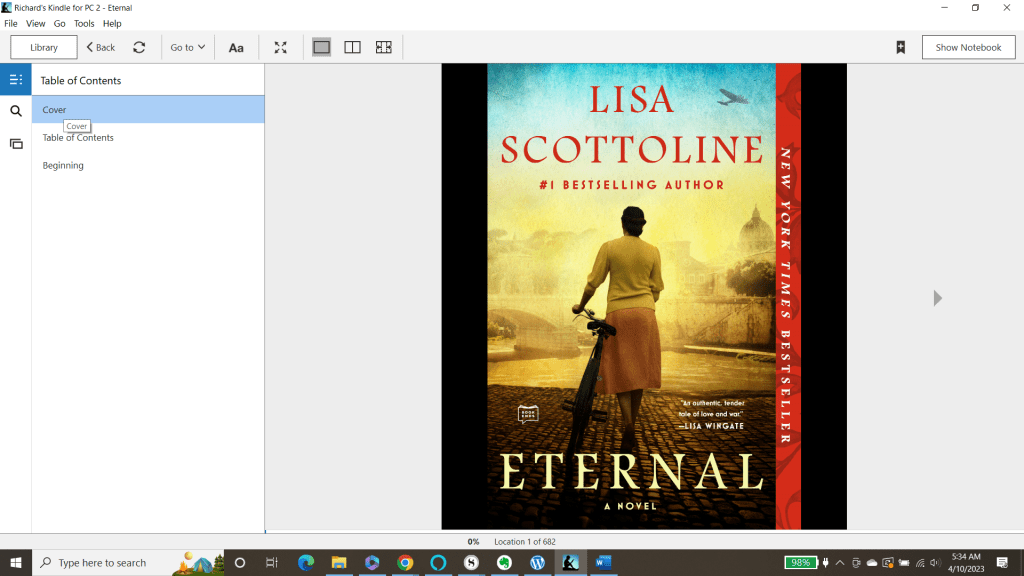
I also finished listening to Eternal, by Lisa Scottoline:
Amazon Abstract
NEW YORK TIMES BESTSELLER
#1 bestselling author Lisa Scottoline offers a sweeping and shattering epic of historical fiction fueled by shocking true events, the tale of a love triangle that unfolds in the heart of Rome…in the creeping shadow of fascism.
What war destroys, only love can heal.
Elisabetta, Marco, and Sandro grow up as the best of friends despite their differences. Elisabetta is a feisty beauty who dreams of becoming a novelist; Marco the brash and athletic son in a family of professional cyclists; and Sandro a Jewish mathematics prodigy, kind-hearted and thoughtful, the son of a lawyer and a doctor. Their friendship blossoms to love, with both Sandro and Marco hoping to win Elisabetta’s heart. But in the autumn of 1937, all of that begins to change as Mussolini asserts his power, aligning Italy’s Fascists with Hitler’s Nazis and altering the very laws that govern Rome. In time, everything that the three hold dear–their families, their homes, and their connection to one another–is tested in ways they never could have imagined.
As anti-Semitism takes legal root and World War II erupts, the threesome realizes that Mussolini was only the beginning. The Nazis invade Rome, and with their occupation come new atrocities against the city’s Jews, culminating in a final, horrific betrayal. Against this backdrop, the intertwined fates of Elisabetta, Marco, Sandro, and their families will be decided, in a heartbreaking story of both the best and the worst that the world has to offer.
Unfolding over decades, Eternal is a tale of loyalty and loss, family and food, love and war–all set in one of the world’s most beautiful cities at its darkest moment. This moving novel will be forever etched in the hearts and minds of readers.
 Richard L. Fricks