Novelist / Story Coach / Observer — Fiction rooted in Boaz, Alabama
Author: Richard L. Fricks
Richard L. Fricks is a novelist, former attorney and CPA, Fictionary Certified StoryCoach Editor, and creator of The Pencil-Driven Life. He lives in rural North Alabama near Boaz, where much of his fiction and reflection remain rooted. His work explores story, inherited purpose, faith and doubt, family pressure, moral contradiction, consciousness, ordinary life, and the practice of beginning again with a pencil.
Biking is something else I both love and hate. It takes a lot of effort but does provide good exercise and most days over an hour to listen to a good book or podcast. I especially like having ridden.
Here’s my bike, a Rockhopper by Specialized. I purchased it November 2021 from Venture Out in Guntersville; Mike is top notch! So is the bike, and the ‘old’ man seat I salvaged from an old Walmart bike.
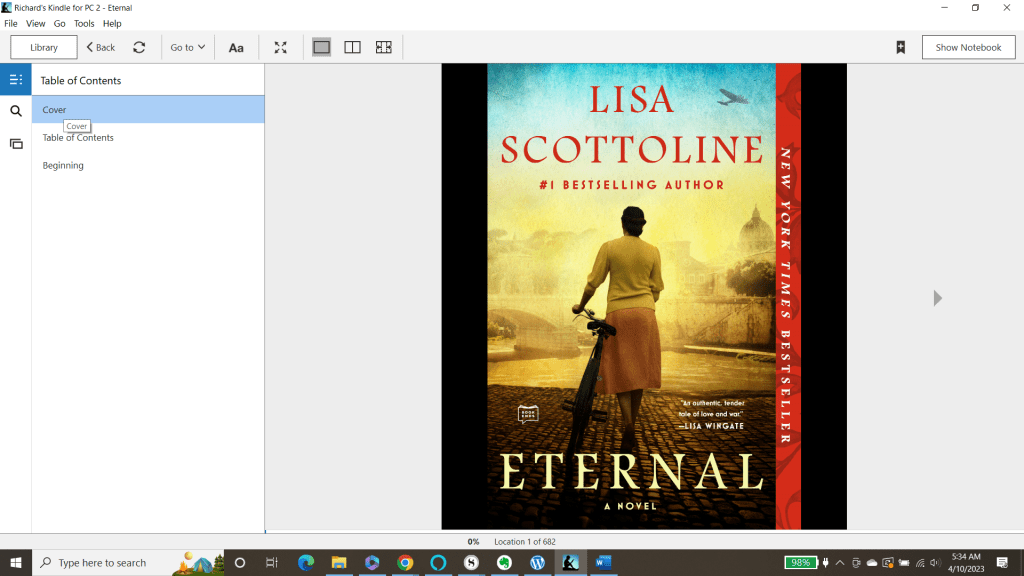
#1 bestselling author Lisa Scottoline offers a sweeping and shattering epic of historical fiction fueled by shocking true events, the tale of a love triangle that unfolds in the heart of Rome…in the creeping shadow of fascism.
What war destroys, only love can heal.
Elisabetta, Marco, and Sandro grow up as the best of friends despite their differences. Elisabetta is a feisty beauty who dreams of becoming a novelist; Marco the brash and athletic son in a family of professional cyclists; and Sandro a Jewish mathematics prodigy, kind-hearted and thoughtful, the son of a lawyer and a doctor. Their friendship blossoms to love, with both Sandro and Marco hoping to win Elisabetta’s heart. But in the autumn of 1937, all of that begins to change as Mussolini asserts his power, aligning Italy’s Fascists with Hitler’s Nazis and altering the very laws that govern Rome. In time, everything that the three hold dear–their families, their homes, and their connection to one another–is tested in ways they never could have imagined.
As anti-Semitism takes legal root and World War II erupts, the threesome realizes that Mussolini was only the beginning. The Nazis invade Rome, and with their occupation come new atrocities against the city’s Jews, culminating in a final, horrific betrayal. Against this backdrop, the intertwined fates of Elisabetta, Marco, Sandro, and their families will be decided, in a heartbreaking story of both the best and the worst that the world has to offer.
Unfolding over decades, Eternal is a tale of loyalty and loss, family and food, love and war–all set in one of the world’s most beautiful cities at its darkest moment. This moving novel will be forever etched in the hearts and minds of readers.
Somebody ought to tell the truth about the Bible. The preachers dare not, because they would be driven from their pulpits. Professors in colleges dare not, because they would lose their salaries. Politicians dare not. They would be defeated. Editors dare not. They would lose subscribers. Merchants dare not, because they might lose customers. Men of fashion dare not, fearing that they would lose caste. Even clerks dare not, because they might be discharged. And so I thought I would do it myself.
There are many millions of people who believe the Bible to be the inspired word of God—millions who think that this book is staff and guide, counselor and consoler; that it fills the present with peace and the future with hope—millions who believe that it is the fountain of law, Justice and mercy, and that to its wise and benign teachings the world is indebted for its liberty, wealth and civilization—millions who imagine that this book is a revelation from the wisdom and love of God to the brain and heart of man—millions who regard this book as a torch that conquers the darkness of death, and pours its radiance on another world—a world without a tear.
They forget its ignorance and savagery, its hatred of liberty, its religious persecution; they remember heaven, but they forget the dungeon of eternal pain. They forget that it imprisons the brain and corrupts the heart. They forget that it is the enemy of intellectual freedom. Liberty is my religion. Liberty of hand and brain—of thought and labor, liberty is a word hated by kings—loathed by popes. It is a word that shatters thrones and altars—that leaves the crowned without subjects, and the outstretched hand of superstition without alms. Liberty is the blossom and fruit of justice—the perfume of mercy. Liberty is the seed and soil, the air and light, the dew and rain of progress, love and joy.
I: The Origin of the Bible
A few wandering families—poor, wretched, without education, art or power; descendants of those who had been enslaved for four hundred years; ignorant as the inhabitants of Central Africa, had just escaped from their masters to the desert of Sinai. Their leader was Moses, a man who had been raised in the family of Pharaoh and had been taught the law and mythology of Egypt. For the purpose of controlling his followers he pretended that he was instructed and assisted by Jehovah, the God of these wanderers.
Everything that happened was attributed to the interference of this God. Moses declared that he met this God face to face; that on Sinai’s top from the hands of this God he had received the tables of stone on which, by the finger of this God, the Ten Commandments had been written, and that, in addition to this, Jehovah had made known the sacrifices and ceremonies that were pleasing to him and the laws by which the people should be governed.
In this way the Jewish religion and the Mosaic Code were established.
It is now claimed that this religion and these laws were and are revealed and established for all mankind.
At that time these wanderers had no commerce with other nations, they had no written language, they could neither read nor write. They had no means by which they could make this revelation known to other nations, and so it remained buried in the jargon of a few ignorant, impoverished and unknown tribes for more than two thousand years.
Many centuries after Moses, the leader, was dead many centuries after all his followers had passed away—the Pentateuch was written, the work of many writers, and to give it force and authority it was claimed that Moses was the author.
We now know that the Pentateuch was not written by Moses.
Towns are mentioned that were not in existence when Moses lived.
Money, not coined until centuries after his death, is mentioned.
So, many of the laws were not applicable to wanderers on the desert—laws about agriculture, about the sacrifice of oxen, sheep and doves, about the weaving of cloth, about ornaments of gold and silver, about the cultivation of land, about harvest, about the threshing of grain, about houses and temples, about cities of refuge, and about many other subjects of no possible application to a few starving wanderers over the sands and rocks.
It is now not only admitted by intelligent and honest theologians that Moses was not the author of the Pentateuch, but they all admit that no one knows who the authors were, or who wrote any one of these books, or a chapter or a line. We know that the books were not written in the same generation; that they were not all written by one person; that they are filled with mistakes and contradictions. It is also admitted that Joshua did not write the book that bears his name, because it refers to events that did not happen until long after his death.
No one knows, or pretends to know, the author of Judges; all we know is that it was written centuries after all the judges had ceased to exist. No one knows the author of Ruth, nor of First and Second Samuel; all we know is that Samuel did not write the books that bear his name. In the 25th chapter of First Samuel is an account of the raising of Samuel by the Witch of Endor.
No one knows the author of First and Second Kings or First and Second Chronicles; all we know is that these books are of no value.
We know that the Psalms were not written by David. In the Psalms the Captivity is spoken of, and that did not happen until about five hundred years after David slept with his fathers.
We know that Solomon did not write the Proverbs or the Song; that Isaiah was not the author of the book that bears his name; that no one knows the author of Job, Ecclesiastes, or Esther, or of any book in the Old Testament, with the exception of Ezra.
We know that God is not mentioned or in any way referred to in the book of Esther. We know, too, that the book is cruel, absurd and impossible.
God is not mentioned in the Song of Solomon, the best book in the Old Testament.
And we know that Ecclesiastes was written by an unbeliever.
We know, too, that the Jews themselves had not decided as to what books were inspired—were authentic—until the second century after Christ.
We know that the idea of inspiration was of slow growth, and that the inspiration was determined by those who had certain ends to accomplish.
What language and symbolism have to do with mood and how light exposure and sleep shape our mental health.
BY MARIA POPOVA
“Depression is a disorder of the ‘I,’ failing in your own eyes relative to your goals,” legendary psychologist Martin Seligman observed in his essential treatise on learned optimism. But such a definition of depression, while true, appears somehow insufficient, overlooking the multitude of excruciating physical and psychological realities of the disease beyond the sense of personal failure. Perhaps William Styron came closer in his haunting memoir of depression, Darkness Visible, where he wrote of “depression’s dark wood,” “its inexplicable agony,” and the grueling struggle of those afflicted by it who spend their lives trying to trudge “upward and outward out of hell’s black depths.” And yet for all their insight into its manifestations, both the poets and the psychologists have tussled rather futilely to understand depression’s complex causes and, perhaps most importantly in terms both scientific and humanistic, its cures.
That’s precisely what psychologist Jonathan Rottenberg sets out to do in The Depths: The Evolutionary Origins of the Depression Epidemic (public library) — an ambitious, rigorously researched, and illuminating journey into the abyss of the soul and back out, emerging with insights both practical and conceptual, personal and universal, that shed light on one of the least understood, most pervasive, and most crippling pandemics humanity has ever grappled with. (A sobering note to the hyperbole-wary: At any given point, 22% of the population exhibit at least one symptom of depression and the World Health Organization projects that by 2030, depression will have led to more worldwide disability and lives lost than any other affliction, including cancer, stroke, heart disease, accidents, and even war.)
Rottenberg takes a radical approach to depression based not on a disease model of the mind but on the evolutionary science of mood — a proposition that flies in the face of our cultural assumptions that have rendered the very subject of depression a taboo. He puts this bind in perspective:
Because depression is so unpleasant and so impairing, it may be difficult to imagine that there might be another way of thinking about it; something this bad must be a disease. Yet the defect model causes problems of its own. Some sufferers avoid getting help because they are leery of being branded as defective. Others get help and come to believe what they are repeatedly told in our system of mental health: that they are deficient.
[…]
People still feel inclined to whisper when they talk about depression. Depression has no “Race for the Cure”; this condition rarely spawns dance marathons, car washes, or golf tournaments. Consequently, the lacerating pain of depression remains uncomfortably private.
Rather than subscribing to this broken deficiency model of depression, Rottenberg argues that affective science — the empirical study of mood — lies at the heart of understanding the condition. Defining moods as “internal signals that motivate behavior and move it in the right direction,” he argues that our bodies are “a collection of adaptations, evolutionary legacies that have helped us survive and reproduce in the face of uncertainty and risk” and paints the backdrop of understanding depression:
The mood system … is the great integrator. It takes in information about the external and internal worlds and summarizes what is favorable or unfavorable in terms of accomplishing key goals related to survival and reproduction.
[…]
Once a goal is embarked upon, the mood system monitors progress toward its attainment. It will redouble effort when minor obstacles arise. If progress stops entirely because of an insuperable obstacle, the mood system puts the brakes on effort.
Under this model, mood has an evolutionary function as a mediator of survival strategies. Rottenberg cites a number of experiments, which have indicated that negative mood incites one’s psychoemotional arsenal when a task becomes too challenging. For instance, when study participants are deliberately put in a negative mood and asked to perform a difficult task, their blood pressure spikes — a sign that the body is being mobilized for extra alertness and effort. But if the task is made insurmountably difficult, so much so that success stops being possible, the spike no longer occurs and the mood system dials down the effort. In that sense, mood — the seedbed of depression — isn’t an arbitrary state that washes over us in a whim, but a sieve that separates the goals worth pursuing from those guaranteed to end in disappointment.
Rottenberg argues that our relationship to the mood system is shaped by the way we talk about it and is mired in toxic cultural constructs that bleed into our language:
One of the amazing things about the mood system is how much of it operates outside of conscious awareness. Moods, like most adaptations, developed in species that had neither language nor culture. Yet words are the first things that come to mind when most people think about moods. We are “mad,” we are “sad,” we are “glad.” So infatuated are we with language that both laypeople and scientists find it tempting to equate the language we use to describe mood with mood itself.
This is a big mistake. We need to shed this languagecentric view of mood, even if it threatens our pride to accept that we share a fundamental element of our mental toolkit with rabbits and roadrunners. Holding to a myth of human uniqueness puts us in an untenable position. For one thing, it would mean that we deny mood to those humans who have not yet acquired mood language (babies) or have lost mood language (Alzheimer’s patients). Toddlers, goats, and chimps all lack the words to describe the internal signals that track their efforts to find a mate, food, or a new ally; their moods can shape behavior without being named. Language is not required for moods. All that is needed is some capability for wakeful alertness and conscious perception, including the perception of pain and pleasure, which is certainly present in all mammals.
Still, Rottenberg cautions, “what we say about our feelings is only one window on mood” — we need, instead, to examine a variety of evidence in the mind, brain, and behavior to paint a dimensional picture of mood and depression. In fact, part of the puzzle lies in the crucial difference between feelings, or emotions, and moods — emotions are more instantaneous and short-lived responses compared to moods, which take longer to germinate and longer to wither out. Moods, Rottenberg explains, “are an overall summary of the various cues around us [and usually] are harder to sort out.” Our deeper reliance on moods rather than feelings is one of the things that make us human and different from other species, a difference empowered by our use of language and symbolism:
Our heavy reliance on symbolic representation also makes the precipitants of low mood more idiosyncratic in our species than in others. We become sad because Bambi’s mother dies, because there are starving people a continent away, because of a factory closing, because of a World Series defeat in extra innings. Though there is a core theme of loss that cuts across species, humans’ capacity for language enables a larger number of objects to enter, and alter, the mood system.
And yet for all our emotional sophistication, we remain strikingly blind to many of the real triggers and causes of moods, instead falling back on our penchant for psychological storytelling. Rottenberg ties this back to depression:
Despite our deep yearning to explicate moods, the average person cannot see many of the most important influences on mood. As the great integrator, the mood system is acted on by many potential objects, and many of the forces that act on mood are hidden from conscious awareness (such as stress hormones or the state of our immune system). Left to our own devices, the stories we tell ourselves about our moods often end up being just that. Stories.
[…]
We must understand the ultimate sources of depression if we are ever to get it under control. To do so, we need to step back and replace the defunct defect model with a completely different approach. The mood science approach will be both historical and integrative: historical because we cannot understand why depressed mood is so prevalent until we understand why we have the capacity for low mood in the first place, and integrative because a host of different forces (many hidden) simultaneously act on people to impel them into the kinds of low moods that breed serious depression.
But before we are tempted to file away low moods as an affliction to be treated, Rottenberg offers a necessary neutrality disclaimer, pointing out that both high and low moods have their advantages and disadvantages:
We are born with the capacity for both high and low moods because each has, on average, presented more fitness benefits than costs. Just as being warm blooded can be a liability, high moods are increasingly understood as having a “dark side,” sometimes enabling rash, impulsive, and even destructive behavior. Likewise the capacity for low mood is accompanied by a bundle of benefits and costs. Seen this way, depression follows our adaptation for low mood like a shadow — it’s an inevitable outcome of a natural process, neither wholly good nor entirely bad.
So what might be the evolutionary advantages of low moods? Several theories exist. One proposes that low moods help dampen agitation in confrontation, thus de-escalating conflicts — when a loser yields rather than fighting to the death, he or she is able to survive rather than perish. Another paints low mood as a “stop mechanism” that, just like the task studies suggested, prevent the person from exerting effort towards a goal that is either unattainable or dangerous. A different theory conceptualizes low mood as a tool for making better decisions, putting us in more contemplative mindsets better suited for analyzing our environment and solving particularly hard problems.
In fact, the latter is something repeatedly confirmed by experiments, most notably in the pioneering work of psychologists Lyn Abramson and Lauren Alloy, who termed this role of low mood depressive realism. Their work has inspired multiple other experiments, including this 2007 study:
Australian psychologist Joseph Forgas found that a brief mood induction changed how well people were able to argue. Compared to subjects in a positive mood, subjects who were put in a negative mood (by watching a ten-minute film about death from cancer) produced more effective persuasive messages on a standardized topic such as raising student fees or aboriginal land rights. Follow-up analyses found that the key reason the sadder people were more persuasive was that their arguments were richer in concrete detail [suggesting that] sad mood, at least of the garden variety, makes people more deliberate, skeptical, and careful in how they process information from their environment.
These positive uses of negative moods may seem at first counterintuitive, but Rottenberg reminds us that “multiple utilities are the hallmark of an adaptation.” He puts things in perspective:
One way to appreciate why these states have enduring value is to ponder what would happen if we had no capacity for them. Just as animals with no capacity for anxiety were gobbled up by predators long ago, without the capacity for sadness, we and other animals would probably commit rash acts and repeat costly mistakes.
In support of this conception, Rottenberg cites a wonderfully poetic passage by Lee Stringer from his essay “Fading to Gray,” found in the altogether fantastic 2001 volume Unholy Ghost: Writers on Depression:
Perhaps what we call depression isn’t really a disorder at all but, like physical pain, an alarm of sorts, alerting us that something is undoubtedly wrong; that perhaps it is time to stop, take a time-out, take as long as it takes, and attend to the unaddressed business of filling our souls.
(What gorgeous language, “the unaddressed business of filling our souls” — rather than an affliction, isn’t that the ever-flowing lifeblood of human existence?)
Still, Rottenberg is careful to point out that severe depression, far from being evolutionarily beneficial, is absolutely crippling, marked by “distorted thinking that appears to be the polar opposite of depressive realism.” In fact, what is perhaps most perplexing about the condition is that scientists don’t yet have a litmus test for when low mood tips over from beneficial to perilous, no point on the mood spectrum that clearly delineates the normal from the diseased. Rottenberg proposes that mood science is the key to honoring the nuance of that spectrum. He differentiates between milder periods of low mood, which he terms shallow depression, and periods wherein the low mood is both long-lasting and severe, which he calls deep depression, and writes:
Shallow depression is adaptive, whereas deep depression is a maladaptive disease.
The strongest evidence for this spectrum model, rather than a binary division between wellness and disease, comes from the fact that shallow and deep depression share a set of risk factors, suggesting that mood, which varies along a continuum of intensity, is the common denominator. Rottenberg puts it elegantly:
Ignoring this would be like a weather forecaster using separate models to predict warm days and very hot days rather than considering general factors that predict temperature.
So what, exactly, seeds low mood? Rottenberg points to three distinct but interconnected triggers: explainability, evolutionary significance, and timing. He writes:
Modern psychological theories postulate that we recover more quickly from a bad event if we can readily explain it. We would expect, then, that events that generate mixed feelings and/or confusing thoughts would be a powerful impetus toward persistent low mood.
[…]
Events that present irresolvable dilemmas on themes that have evolutionary significance — like mate choice — are fertile seeds for low mood.
When the bad things happen also matters. Extensive research demonstrates that early life traumas, such as physical or sexual abuse, lay the groundwork for a slow creep of depression and anxiety.
He cites the example of a middle-aged woman suffering from lifelong “low-grade depression” and anxiety, who grew up with an alcoholic father in a household that vetoed any discussion of feelings. When a neighbor molested her at the age of thirteen, she kept the trauma to herself, believing that her mother would blame her and her father would explode in a rage. Rottenberg explains how these early experiences provide the psychoemotional backdrop for our adult lives:
Jan’s chronic feelings of anxiety and sadness are natural, the product of an intact mood system. In a world in which a child’s primary attachment figures — parents — are emotionally unavailable and unable to help when a trusted neighbor turns into an attacker, the mood system is ever forward looking. It assumes that, if the worst has already happened, it can and will happen again. Best to be prepared. Anxious moods scanning for danger (especially in relationships) and sad moods analyzing what was lost and why serve as the last lines of defense against further ruin.
Triggers notwithstanding, Rottenberg points out that individual temperament is an essential component in people’s mood responses to the same events. He cites a study conducted after the 9/11 attacks which found that a month later Lower Manhattan residents who had been there on September 11 experienced wildly different degrees of depressive symptoms, ranging from crippling major depression to hardly any symptoms compared to their respective state on September 10.
This variation, once more, can be traced back to early childhood. Rottenberg cites the work of psychologist Jerome Kagan who has spent decades studying infants and found that temperament can be detected as early as in nine-month-olds, who exhibit “reasonably consistent and strong fear reactions to a variety of potentially threatening situations.” These early differences in temperament, Rottenberg argues, are likely to be heavily influenced by genes.
And yet, just like the mood spectrum, temperament isn’t a black-and-white game but an evolutionarily wise strategy:
Experiments by evolutionary biologist David Sloan Wilson also demonstrate that there is no “single best temperament.” In one condition, Wilson dropped metal traps into a pond containing pumpkinseed sunfish. A subset of the fish showed boldness and interest in investigating a novel object. This was a really bad move, as they were immediately caught, and had Dr. Wilson been a real predator, it would have meant the end of their genes. Another group of fish were wary and stayed back from the traps; they were not caught. This situation favored the wary fish.
In a subsequent condition, all the fish were scooped up, brought into a new environment, and then carefully observed. Here the previously wary fish had great difficulty adapting to novelty. They were slower than their bold compatriots to begin feeding, taking five more days to start eating. In this situation the survival of the bold fish was favored.
Noting that the single most indicative depression-prone personality trait is neuroticism, Rottenberg adds:
Like depression itself, temperaments that seed depression are neither wholly good nor wholly bad.
Pointing to two distinct sets of influences on mood — forces that make us vulnerable to long periods of shallow depression and ones that deepen existing shallow depression — Rottenberg makes a poignant observation about our culture’s growing fetishism of happiness:
Our expectations about happiness have changed dramatically, and as they rise, ironically, are making low moods harder to bear than ever before.
Mood is about the mundane. Day-to-day routines — how we spend our time, how we care for our bodies and minds — continually shape our moods and can have a strong influence on whether low mood persists. Routines that build up physical and mental resources can raise mood. Other routines, woven into the fabric of modern life, are grossly misaligned with evolutionary imperatives and have the potential to seed low mood. Many of our most familiar routines seem almost perversely designed to wreak havoc on the mood system.
One mundane influence on mood is daily light exposure. After all, mood evolved in the context of a rotating earth, with its recurrent twenty-four-hour cycle of light and dark phases. Our species is diurnal, and the best chance of finding sustenance and other rewards was in the light phase (think about the challenge of identifying edible berries or stalking a mammoth). Consequently, we are configured to be more alert during the day than at night. Consistent with the link between light and mood, some clinically serious low mood is triggered by the seasonal change of shorter daylight hours. The onset of seasonal affective disorder, a subtype of mood disorder, is usually in winter.
Our newfound reliance on indoor light has effectively turned most people into cave dwellers. Artificial light is much fainter and provides fewer mood benefits than sunlight. When small devices that measure light exposure and duration were attached to adults in San Diego, one of the sunniest cities in the United States, it was discovered that the average person received only fifty-eight minutes of sunlight a day. What’s more, those San Diegans who received less light exposure during their daily routines reported more symptoms of depression.
(My reliance on this light-therapy device, which has gotten me through many dreary New York winters, suddenly seems less trivial and less of a placebo effect.)
As a champion of sleep, I especially appreciate the sobering evidence Rottenberg cites from a number of sleep studies:
Mood is lower after even one night of sleep deprivation. Moreover, brief experimental sleep restriction induces bodily changes that mimic some aspects of depression. It’s important to ponder the consequences of sleep deprivation now happening on a mass scale: more than 40 percent of Americans between the ages of thirteen and sixty-four say they rarely or never get a good night’s sleep on weeknights, and a third of young adults probably have long periods of at least partial sleep deprivation on an ongoing basis. Over the last century average nightly sleep duration has fallen. In 1910 Americans slept an average of approximately nine hours; that average had dropped to seven hours by 2002.
Part of the answer to the riddle of low mood, then, lies in contemporary routines that increasingly feature less light, less rest, and more activities that are out of kilter with the body’s natural rhythm.
In the rest of The Depths, Rottenberg, who has battled depression himself for much of his life, goes on to explore how the multiple seeds of the condition cross-pollinate each other, why other species may hold the key to understanding human depression, and what we can do, both as a culture and as individuals, to loosen the grip of this unrelenting oppressor. Complement it with this simple and effective exercise to increase your well-being and lower depression from Martin Seligman, founding father of Positive Psychology, then revisit this provocative read on how antidepressants affect identity-formation.
Biking is something else I both love and hate. It takes a lot of effort but does provide good exercise and most days over an hour to listen to a good book or podcast. I especially like having ridden.
Here’s my bike, a Rockhopper by Specialized. I purchased it November 2021 from Venture Out in Guntersville; Mike is top notch! So is the bike, and the ‘old’ man seat I salvaged from an old Walmart bike.
#1 bestselling author Lisa Scottoline offers a sweeping and shattering epic of historical fiction fueled by shocking true events, the tale of a love triangle that unfolds in the heart of Rome…in the creeping shadow of fascism.
What war destroys, only love can heal.
Elisabetta, Marco, and Sandro grow up as the best of friends despite their differences. Elisabetta is a feisty beauty who dreams of becoming a novelist; Marco the brash and athletic son in a family of professional cyclists; and Sandro a Jewish mathematics prodigy, kind-hearted and thoughtful, the son of a lawyer and a doctor. Their friendship blossoms to love, with both Sandro and Marco hoping to win Elisabetta’s heart. But in the autumn of 1937, all of that begins to change as Mussolini asserts his power, aligning Italy’s Fascists with Hitler’s Nazis and altering the very laws that govern Rome. In time, everything that the three hold dear–their families, their homes, and their connection to one another–is tested in ways they never could have imagined.
As anti-Semitism takes legal root and World War II erupts, the threesome realizes that Mussolini was only the beginning. The Nazis invade Rome, and with their occupation come new atrocities against the city’s Jews, culminating in a final, horrific betrayal. Against this backdrop, the intertwined fates of Elisabetta, Marco, Sandro, and their families will be decided, in a heartbreaking story of both the best and the worst that the world has to offer.
Unfolding over decades, Eternal is a tale of loyalty and loss, family and food, love and war–all set in one of the world’s most beautiful cities at its darkest moment. This moving novel will be forever etched in the hearts and minds of readers.
Wisdom on overcoming the greatest human frustration from the pioneer of Eastern philosophy in the West.
BY MARIA POPOVA
“How we spend our days is, of course, how we spend our lives,” Annie Dillard wrote in her timeless reflection on presence over productivity — a timely antidote to the central anxiety of our productivity-obsessed age. Indeed, my own New Year’s resolution has been to stop measuring my days by degree of productivity and start experiencing them by degree of presence. But what, exactly, makes that possible?
This concept of presence is rooted in Eastern notions of mindfulness — the ability to go through life with crystalline awareness and fully inhabit our experience — largely popularized in the West by British philosopher and writer Alan Watts (January 6, 1915–November 16, 1973), who also gave us this fantastic meditation on the life of purpose. In the altogether excellent 1951 volume The Wisdom of Insecurity: A Message for an Age of Anxiety (public library), Watts argues that the root of our human frustration and daily anxiety is our tendency to live for the future, which is an abstraction. He writes:
If to enjoy even an enjoyable present we must have the assurance of a happy future, we are “crying for the moon.” We have no such assurance. The best predictions are still matters of probability rather than certainty, and to the best of our knowledge every one of us is going to suffer and die. If, then, we cannot live happily without an assured future, we are certainly not adapted to living in a finite world where, despite the best plans, accidents will happen, and where death comes at the end.
Alan Watts, early 1970s (Image courtesy of Everett Collection)
What keeps us from happiness, Watts argues, is our inability to fully inhabit the present:
The “primary consciousness,” the basic mind which knows reality rather than ideas about it, does not know the future. It lives completely in the present, and perceives nothing more than what is at this moment. The ingenious brain, however, looks at that part of present experience called memory, and by studying it is able to make predictions. These predictions are, relatively, so accurate and reliable (e.g., “everyone will die”) that the future assumes a high degree of reality — so high that the present loses its value.
But the future is still not here, and cannot become a part of experienced reality until it is present. Since what we know of the future is made up of purely abstract and logical elements — inferences, guesses, deductions — it cannot be eaten, felt, smelled, seen, heard, or otherwise enjoyed. To pursue it is to pursue a constantly retreating phantom, and the faster you chase it, the faster it runs ahead. This is why all the affairs of civilization are rushed, why hardly anyone enjoys what he has, and is forever seeking more and more. Happiness, then, will consist, not of solid and substantial realities, but of such abstract and superficial things as promises, hopes, and assurances.
Watts argues that our primary mode of relinquishing presence is by leaving the body and retreating into the mind — that ever-calculating, self-evaluating, seething cauldron of thoughts, predictions, anxieties, judgments, and incessant meta-experiences about experience itself. Writing more than half a century before our age of computers, touch-screens, and the quantified self, Watts admonishes:
The brainy modern loves not matter but measures, no solids but surfaces.
[…]
The working inhabitants of a modern city are people who live inside a machine to be batted around by its wheels. They spend their days in activities which largely boil down to counting and measuring, living in a world of rationalized abstraction which has little relation to or harmony with the great biological rhythms and processes. As a matter of fact, mental activities of this kind can now be done far more efficiently by machines than by men — so much so that in a not too distant future the human brain may be an obsolete mechanism for logical calculation. Already the human computer is widely displaced by mechanical and electrical computers of far greater speed and efficiency. If, then, man’s principal asset and value is his brain and his ability to calculate, he will become an unsaleable commodity in an era when the mechanical operation of reasoning can be done more effectively by machines.
[…]
If we are to continue to live for the future, and to make the chief work of the mind prediction and calculation, man must eventually become a parasitic appendage to a mass of clockwork.
To be sure, Watts doesn’t dismiss the mind as a worthless or fundamentally perilous human faculty. Rather, he insists that it if we let its unconscious wisdom unfold unhampered — like, for instance, what takes place during the “incubation” stage of unconscious processing in the creative process — it is our ally rather than our despot. It is only when we try to control it and turn it against itself that problems arise:
Working rightly, the brain is the highest form of “instinctual wisdom.” Thus it should work like the homing instinct of pigeons and the formation of the fetus in the womb — without verbalizing the process or knowing “how” it does it. The self-conscious brain, like the self-conscious heart, is a disorder, and manifests itself in the acute feeling of separation between “I” and my experience. The brain can only assume its proper behavior when consciousness is doing what it is designed for: not writhing and whirling to get out of present experience, but being effortlessly aware of it.
And yet the brain does writhe and whirl, producing our great human insecurity and existential anxiety amidst a universe of constant flux. (For, as Henry Miller memorably put it, “It is almost banal to say so yet it needs to be stressed continually: all is creation, all is change, all is flux, all is metamorphosis.”) Paradoxically, recognizing that the experience of presence is the only experience is also a reminder that our “I” doesn’t exist beyond this present moment, that there is no permanent, static, and immutable “self” which can grant us any degree of security and certainty for the future — and yet we continue to grasp for precisely that assurance of the future, which remains an abstraction. Our only chance for awakening from this vicious cycle, Watts argues, is bringing full awareness to our present experience — something very different from judging it, evaluating it, or measuring it up against some arbitrary or abstract ideal. He writes:
There is a contradiction in wanting to be perfectly secure in a universe whose very nature is momentariness and fluidity. But the contradiction lies a little deeper than the mere conflict between the desire for security and the fact of change. If I want to be secure, that is, protected from the flux of life, I am wanting to be separate from life. Yet it is this very sense of separateness which makes me feel insecure. To be secure means to isolate and fortify the “I,” but it is just the feeling of being an isolated “I” which makes me feel lonely and afraid. In other words, the more security I can get, the more I shall want.
To put it still more plainly: the desire for security and the feeling of insecurity are the same thing. To hold your breath is to lose your breath. A society based on the quest for security is nothing but a breath-retention contest in which everyone is as taut as a drum and as purple as a beet.
He takes especial issue with the very notion of self-improvement — something particularly prominent in the season of New Year’s resolutions — and admonishes against the implication at its root:
I can only think seriously of trying to live up to an ideal, to improve myself, if I am split in two pieces. There must be a good “I” who is going to improve the bad “me.” “I,” who has the best intentions, will go to work on wayward “me,” and the tussle between the two will very much stress the difference between them. Consequently “I” will feel more separate than ever, and so merely increase the lonely and cut-off feelings which make “me” behave so badly.
Happiness, he argues, isn’t a matter of improving our experience, or even merely confronting it, but remaining present with it in the fullest possible sense:
To stand face to face with insecurity is still not to understand it. To understand it, you must not face it but be it. It is like the Persian story of the sage who came to the door of Heaven and knocked. From within the voice of God asked, “Who is there” and the sage answered, “It is I.” “In this House,” replied the voice, “there is no room for thee and me.” So the sage went away, and spent many years pondering over this answer in deep meditation. Returning a second time, the voice asked the same question, and again the sage answered, “It is I.” The door remained closed. After some years he returned for the third time, and, at his knocking, the voice once more demanded, “Who is there?” And the sage cried, “It is thyself!” The door was opened.
We don’t actually realize that there is no security, Watts asserts, until we confront the myth of fixed selfhood and recognize that the solid “I” doesn’t exist — something modern psychology has termed “the self illusion.” And yet that is incredibly hard to do, for in the very act of this realization there is a realizing self. Watts illustrates this paradox beautifully:
While you are watching this present experience, are you aware of someone watching it? Can you find, in addition to the experience itself, an experiencer? Can you, at the same time, read this sentence and think about yourself reading it? You will find that, to think about yourself reading it, you must for a brief second stop reading. The first experience is reading. The second experience is the thought, “I am reading.” Can you find any thinker, who is thinking the thought, I am reading?” In other words, when present experience is the thought, “I am reading,” can you think about yourself thinking this thought?
Once again, you must stop thinking just, “I am reading.” You pass to a third experience, which is the thought, “I am thinking that I am reading.” Do not let the rapidity with which these thoughts can change deceive you into the feeling that you think them all at once.
[…]
In each present experience you were only aware of that experience. You were never aware of being aware. You were never able to separate the thinker from the thought, the knower from the known. All you ever found was a new thought, a new experience.
What makes us unable to live with pure awareness, Watts points out, is the ball and chain of our memory and our warped relationship with time:
The notion of a separate thinker, of an “I” distinct from the experience, comes from memory and from the rapidity with which thought changes. It is like whirling a burning stick to give the illusion of a continuous circle of fire. If you imagine that memory is a direct knowledge of the past rather than a present experience, you get the illusion of knowing the past and the present at the same time. This suggests that there is something in you distinct from both the past and the present experiences. You reason, “I know this present experience, and it is different from that past experience. If I can compare the two, and notice that experience has changed, I must be something constant and apart.”
But, as a matter of fact, you cannot compare this present experience with a past experience. You can only compare it with a memory of the past, which is a part of the present experience. When you see clearly that memory is a form of present experience, it will be obvious that trying to separate yourself from this experience is as impossible as trying to make your teeth bite themselves.
[…]
To understand this is to realize that life is entirely momentary, that there is neither permanence nor security, and that there is no “I” which can be protected.
And therein lies the crux of our human struggle:
The real reason why human life can be so utterly exasperating and frustrating is not because there are facts called death, pain, fear, or hunger. The madness of the thing is that when such facts are present, we circle, buzz, writhe, and whirl, trying to get the “I” out of the experience. We pretend that we are amoebas, and try to protect ourselves from life by splitting in two. Sanity, wholeness, and integration lie in the realization that we are not divided, that man and his present experience are one, and that no separate “I” or mind can be found.
To understand music, you must listen to it. But so long as you are thinking, “I am listening to this music,” you are not listening.
The Wisdom of Insecurity is immeasurably wonderful — existentially necessary, even — in its entirety, and one of those books bound to stay with you for a lifetime.
Biking is something else I both love and hate. It takes a lot of effort but does provide good exercise and most days over an hour to listen to a good book or podcast. I especially like having ridden.
Here’s my bike, a Rockhopper by Specialized. I purchased it November 2021 from Venture Out in Guntersville; Mike is top notch! So is the bike, and the ‘old’ man seat I salvaged from an old Walmart bike.
#1 bestselling author Lisa Scottoline offers a sweeping and shattering epic of historical fiction fueled by shocking true events, the tale of a love triangle that unfolds in the heart of Rome…in the creeping shadow of fascism.
What war destroys, only love can heal.
Elisabetta, Marco, and Sandro grow up as the best of friends despite their differences. Elisabetta is a feisty beauty who dreams of becoming a novelist; Marco the brash and athletic son in a family of professional cyclists; and Sandro a Jewish mathematics prodigy, kind-hearted and thoughtful, the son of a lawyer and a doctor. Their friendship blossoms to love, with both Sandro and Marco hoping to win Elisabetta’s heart. But in the autumn of 1937, all of that begins to change as Mussolini asserts his power, aligning Italy’s Fascists with Hitler’s Nazis and altering the very laws that govern Rome. In time, everything that the three hold dear–their families, their homes, and their connection to one another–is tested in ways they never could have imagined.
As anti-Semitism takes legal root and World War II erupts, the threesome realizes that Mussolini was only the beginning. The Nazis invade Rome, and with their occupation come new atrocities against the city’s Jews, culminating in a final, horrific betrayal. Against this backdrop, the intertwined fates of Elisabetta, Marco, Sandro, and their families will be decided, in a heartbreaking story of both the best and the worst that the world has to offer.
Unfolding over decades, Eternal is a tale of loyalty and loss, family and food, love and war–all set in one of the world’s most beautiful cities at its darkest moment. This moving novel will be forever etched in the hearts and minds of readers.





























 Richard L. Fricks