Writer / Observer / Builder — Presence, clarity, and living without a script
Author: Richard L. Fricks
Writer. Observer. Builder. I write from a life shaped by attention, simplicity, and living without a script—through reflective essays, long-form inquiry, and fiction rooted in ordinary lives. I live in rural Alabama, where writing, walking, and building small, intentional spaces are part of the same practice.
“The things we want are transformative, and we don’t know or only think we know what is on the other side of that transformation… Never to get lost is not to live.”
BY MARIA POPOVA
“On how one orients himself to the moment,”Henry Miller wrote in reflecting on the art of living, “depends the failure or fruitfulness of it.” Indeed, this act of orienting ourselves — to the moment, to the world, to our own selves — is perhaps the most elusive art of all, and our attempts to master it often leave us fumbling, frustrated, discombobulated. And yet therein lies our greatest capacity for growth and self-transcendence.
Rebecca Solnit, whose mind and writing are among the most consistently enchanting of our time, explores this tender tango with the unknown in her altogether sublime collection A Field Guide to Getting Lost (public library).
Solnit writes in the opening essay:
Leave the door open for the unknown, the door into the dark. That’s where the most important things come from, where you yourself came from, and where you will go. Three years ago I was giving a workshop in the Rockies. A student came in bearing a quote from what she said was the pre-Socratic philosopher Meno. It read, “How will you go about finding that thing the nature of which is totally unknown to you?” I copied it down, and it has stayed with me since. The student made big transparent photographs of swimmers underwater and hung them from the ceiling with the light shining through them, so that to walk among them was to have the shadows of swimmers travel across your body in a space that itself came to seem aquatic and mysterious. The question she carried struck me as the basic tactical question in life. The things we want are transformative, and we don’t know or only think we know what is on the other side of that transformation. Love, wisdom, grace, inspiration — how do you go about finding these things that are in some ways about extending the boundaries of the self into unknown territory, about becoming someone else?
Illustration from ‘Where You Are: A Collection of Maps That Will Leave You Feeling Completely Lost.’ Click image for details.
Certainly for artists of all stripes, the unknown, the idea or the form or the tale that has not yet arrived, is what must be found. It is the job of artists to open doors and invite in prophesies, the unknown, the unfamiliar; it’s where their work comes from, although its arrival signals the beginning of the long disciplined process of making it their own. Scientists too, as J. Robert Oppenheimer once remarked, “live always at the ‘edge of mystery’ — the boundary of the unknown.” But they transform the unknown into the known, haul it in like fishermen; artists get you out into that dark sea.
But unlike the dark sea, which obscures the depths of what is, of what could be seen in the present moment, the unknown spills into the unforeseen. Solnit turns to Edgar Allan Poe, who argued that “in matters of philosophical discovery … it is the unforeseen upon which we must calculate most largely,” and considers the deliberate juxtaposition of the rational, methodical act of calculation with the ineffable, intangible nature of the unforeseen:
How do you calculate upon the unforeseen? It seems to be an art of recognizing the role of the unforeseen, of keeping your balance amid surprises, of collaborating with chance, of recognizing that there are some essential mysteries in the world and thereby a limit to calculation, to plan, to control. To calculate on the unforeseen is perhaps exactly the paradoxical operation that life most requires of us.
The poet John Keats captured this paradoxical operation elegantly in his notion of “negative capability,” which Solnit draws on before turning to another literary luminary, Walter Benjamin, who memorably considered the difference between not finding your way and losing yourself — something he called “the art of straying.” Solnit writes:
To lose yourself: a voluptuous surrender, lost in your arms, lost to the world, utterly immersed in what is present so that its surroundings fade away. In Benjamin’s terms, to be lost is to be fully present, and to be fully present is to be capable of being in uncertainty and mystery. And one does not get lost but loses oneself, with the implication that it is a conscious choice, a chosen surrender, a psychic state achievable through geography. That thing the nature of which is totally unknown to you is usually what you need to find, and finding it is a matter of getting lost.
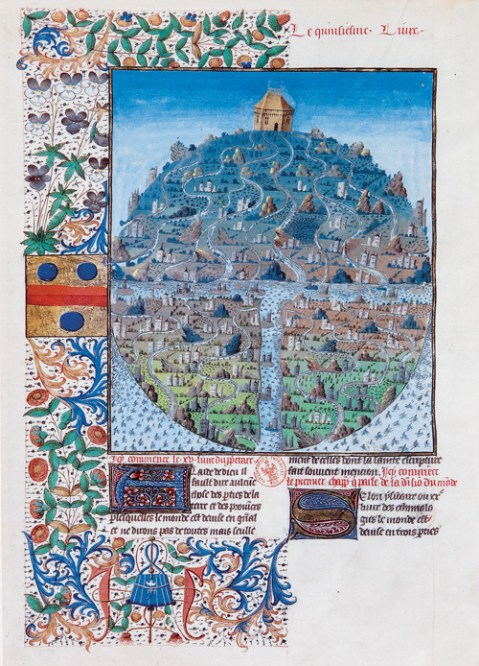
T and O map by Bartholomaeus Angelicus, 1392, from Umberto Eco’s ‘The Book of Legendary Lands.’ Click image for details.
The word “lost” comes from the Old Norse los, meaning the disbanding of an army, and this origin suggests soldiers falling out of formation to go home, a truce with the wide world. I worry now that many people never disband their armies, never go beyond what they know. Advertising, alarmist news, technology, incessant busyness, and the design of public and private space conspire to make it so.
Taking back the meaning of lost seems almost a political act, a matter of existential agency that we ought to reclaim in order to feel at home in ourselves. Solnit writes:
There’s another art of being at home in the unknown, so that being in its midst isn’t cause for panic or suffering, of being at home with being lost.
[…]
Lost [is] mostly a state of mind, and this applies as much to all the metaphysical and metaphorical states of being lost as to blundering around in the backcountry.
The question then is how to get lost. Never to get lost is not to live, not to know how to get lost brings you to destruction, and somewhere in the terra incognita in between lies a life of discovery.
Illustration for ‘Mapping Manhattan.’ Click image for details.
During a recent vacation, I went horseback riding on a California ranch, home to a tight-knit equine community. Midway along the route, my horse glimpsed his peer across the field, carrying another rider on a different route, and began neighing restlessly upon the fleeting sight. Our guide explained that the horses, despite being extraordinarily intelligent beings, had a hard time making sense of seeing their friends appear out of nowhere, then disappear into the distance. Falling out of sight held the terror of being forever lost. My horse was calling out, making sure his friend was still there — that neither was lost. Underneath the geographic disorientation, one can imagine, lies a primal fear of losing control.
Despite the evolutionary distance, this equine disposition bears a disorienting similarity to the duality of our own relationship to the concept of lost — losing something we care about, losing ourselves, losing control — which Solnit captures beautifully:
Lost really has two disparate meanings. Losing things is about the familiar falling away, getting lost is about the unfamiliar appearing. There are objects and people that disappear from your sight or knowledge or possession; you lose a bracelet, a friend, the key. You still know where you are. Everything is familiar except that there is one item less, one missing element. Or you get lost, in which case the world has become larger than your knowledge of it. Either way, there is a loss of control. Imagine yourself streaming through time shedding gloves, umbrellas, wrenches, books, friends, homes, names. This is what the view looks like if you take a rear-facing seat on the train. Looking forward you constantly acquire moments of arrival, moments of realization, moments of discovery. The wind blows your hair back and you are greeted by what you have never seen before. The material falls away in onrushing experience. It peels off like skin from a molting snake. Of course to forget the past is to lose the sense of loss that is also memory of an absent richness and a set of clues to navigate the present by; the art is not one of forgetting but letting go. And when everything else is gone, you can be rich in loss.
I was reeling from so many sources by now. I’d just graduated from college and had a nice shiny degree that was more or less useless by itself. I was married to a handsome and impossibly fervent minister husband who had some measure of respect in our denomination. I had a decent little job doing something I enjoyed tolerably enough. I was a busy bee all right. But beneath that surface happiness, tension roiled like a stormcloud and nothing was what it seemed. I needed answers about prayer, and I needed them now.
We all have a number of props and supports for our religious ideas. Mine were as varied as anybody else’s. But they were getting knocked out from under me at a frightening pace.
Probably the very last one I had was that the Bible’s god was faithful to his people and an omnimax being who loved us (“omnimax” means omnipotent, omnipresent, omniscient, and omnibenevolent–omni-everything, if you will). And the best way for me to evaluate that claim was to examine my god’s response to prayer.
God loves prayer. All through the Bible, his people are told to pray and God listens to those prayers. We are also told that God uses prayers as a barometer of our needs and desires, and responds to those prayers in ways that will benefit his followers. Among many other exhortations, we have Jesus in Luke 18:1 telling us that we should always be praying. Out of every single thing that a Christian is almost always totally sure of, it’s that his or her god hears those prayers and cares about each and every one. If I found out that prayer wasn’t what it seemed, not much was going to be left.
The Bible Verses
First we’ll lay out the verses:
Mark is usually thought to be the first Gospel written (see Markan Priority), though this isn’t a totally universal idea. I think it’s first, so I’m starting there. In Mark, we see these passages:
Mark 11:23-4: Whosoever shall say unto this mountain, Be thou removed, and be thou cast into the sea; and shall not doubt in his heart, but shall believe that those things which he saith shall come to pass; he shall have whatsoever he saith. Therefore I say unto you, What things soever ye desire, when ye pray, believe that ye receive them, and ye shall have them.” There’s a bit of weaseling and fine print here (the stipulation is that the praying person have absolute faith that he or she will receive whatever is requested) that is absent in later-written Matthew, but overall the intention seems clear: if you just believe enough, you’ll get whatever you want.
Mark 16:17 follows up the general trend this way: “These signs shall follow them that believe; in my name shall they cast out devils; they shall speak with new tongues; they shall take up serpents; and if they drink any deadly thing, it shall not hurt them; they shall lay hands on the sick, and they shall recover.” So about those snake handlers who keep dying of snake bites… In my church, we regarded ourselves as a bit more sophisticated than that. My first Pentecostal pastor (remember, the good egg who discouraged Biff from running off to Waco) refused to handle snakes, and refused to let anybody in the congregation do it either. And I never once saw or heard of any group out there deliberately drinking poisons just to show the miraculous power of God, which if you think about it is *way* more impressive than handling snakes which might or might not bite. Why was that, I wondered that night as I pored over my study Bible? Why wasn’t snake handling and poison-drinking more popular? Why didn’t anybody do it in perfect safety, knowing the Bible flat-out said they could do this as a specific sign and testament given by Jesus Christ himself? (Now I know this passage is in all likelihood a later addition to Mark and as likely to have been said by Jesus himself as a Transformers quote, but at the time, I took it all as one big piece.)
Matthew 7 has Jesus telling us all about how we will be given whatever we ask for: “Ask and it shall be given you; seek, and ye shall find; knock, and it shall be opened unto you. For every one that asketh receiveth; and he that seeketh findeth, and to him that knocketh it shall be opened.” Well, that sounds really strong, doesn’t it? No less than the savior of humankind is saying that whatever we want, we’ll get, and he isn’t using any fine print here at all. (HelLO prosperity gospel! We’ll be discussing this concept in detail at some point.)
In Matthew 17, Jesus expands on this mysticism thusly: “If ye have faith as a grain of mustard seed, ye shall say unto this mountain, Remove hence to yonder place; and it shall remove; and nothing shall be impossible unto you.” Well, that sounds pretty positive too, doesn’t it? He doubles down on it in Matthew 21 when he’s just gotten done cursing that fig tree (you know, the one that wasn’t doing anything wrong at all except being out of season when Jesus had a major munchie fit for figs): “If ye have faith, and doubt not, ye shall not only do this which is done to the fig tree, but also if ye say unto this mountain, Be thou removed, and be thou cast into the sea; it shall be done. And all things, whatsoever ye shall ask in prayer, believing, ye shall receive.” Now, note that the fig tree cursing is a specific power he’s telling believers they’ll have. So all those Christians saying a prayer didn’t get answered because it was “selfish” have some explaining to do.
In Matthew 18:18-20, we even get a look at how powerful groups of Christians are (is there a word for a group of Christians, like a flock of geese or a lamentation of swans? “Congregation” is too specifically churchy): “Whatsoever ye shall bind on earth shall be bound in heaven: and whatsoever ye shall loose on earth shall be loosed in heaven. Again I say unto you, That if two of you shall agree on earth as touching any thing that they shall ask, it shall be done for them of my Father which is in heaven. For where two or three are gathered together in my name, there am I in the midst of them.” So whatever the magic power is of one Christian praying, it’s even more powerful when more than one gets together and prays. In almost every one of the church services I attended throughout the Protestant system, this verse got invoked, by the way–especially when the church prayed for one particular thing (like that pastor’s healing of brain cancer).
John’s probably the last of the gospels, and it has the strongest of all the assurances. In John 14, we see this: “He that believeth on me, the works that I do shall he do also; and greater works than these shall he do; because I go unto my Father. And whatsoever ye shall ask in my name, that will I do, that the Father may be glorified in the Son. If ye shall ask any thing in my name, I will do it.” Straightforward enough.
But now let’s look at the weaseling out of these strong assurances in the rest of the Bible:
1 John 3:22: “Whatsoever we ask, we receive of him, because we keep his commandments, and do those things that are pleasing in his sight.” So a Christian who sins won’t get what’s requested. Well, that’s about all of us, because nobody’s righteous but Jesus (Romans 3:10, but see this writeup which mysteriously we didn’t know about as Christians).
Philippians 4:19: “But my God shall supply all your need according to his riches in glory by Jesus Christ.” Well, that implies that if we don’t need it, we won’t get it.
James 1:5-7: “If any of you lack wisdom, let him ask of God, that giveth to all men liberally, and upbraideth not; and it shall be given him. But let him ask in faith, nothing wavering. For he that wavereth is like a wave of the sea driven with the wind and tossed. For let not that man think that he shall receive any thing of the Lord.” Another one that implies that faith is required. All right.
James 4:3: “Ye ask, and receive not, because ye ask amiss, that ye may consume it upon your lusts.” If you don’t get what you asked for, you probably were asking in the wrong spirit–you just wanted it out of some selfish or sinful impulse (you know, like wanting figs out of season). So it’s your fault. That does kind of knock the prosperity gospel Christians right in the nads and it’s definitely not in keeping with Jesus’ earlier assurances that he’d do whatever we asked, especially if we asked in groups, but it’s a pretty standard deflection I heard to explain away the problem.
James 5:13-18:” Is any among you afflicted? Let him pray. Is any merry? Let him sing psalms. Is any sick among you? Let him call for the elders of the church; and let them pray over him, anointing him with oil in the name of the Lord: and the prayer of faith shall save the sick, and the Lord shall raise him up; and if he have committed sins, they shall be forgiven him. . . The effectual prayer of a righteous man availeth much.” This one predicts healings aplenty and reaffirms that righteousness is required. Seems like a poisoned well excuse, doesn’t it? If someone doesn’t get what was requested, there’s probably some taint involved.
The only requirements I can see in the Gospels is that whoever’s praying for something needs to be very very fervent in believing that whatever is being requested will happen. The later books of the New Testament add a few stipulations, but overall, the insistence is there that yes, God answers prayers.
The Reality of the Bible Verses.
But that’s not how it works.
That’s not how it works at all.
And this “yes/no/later” thing that Christians repeat like a mantra isn’t mentioned in any of these verses. Ever. I didn’t even see how such a concept could be inferred from these verses. Either God answered the prayer every single time by giving the praying person what was requested, or in the later weasel words, God flat refuses due to some inadequacy on the part of the petitioner–not out of the person’s best interest, but out of inadequacy. What I’d been told about prayer just wasn’t true if the Bible was any kind of guide in the matter.
As I studied, I wondered again to myself: just when had I stopped asking for anything really supernatural? Every time I got in my car, I prayed that I’d get to my destination “safely and unharmed,” as I had learned from the older members of my church. When I went to the mall with Christian friends, they prayed that we’d get a good parking spot (and one year, on Christmas Eve, we did! Right up front! It was a miracle!). I prayed that work would go smoothly, that God would bless me in general, that God would bring my errant family to salvation (not a single one was saved yet).
But when I prayed for specific things, did I really get them? No, not normally, not any more than I might get them with random chance or my own hard work. Were parking spots really a miracle? Why would God let me get to work without a car accident when tons of other people, many who presumably prayed the same sort of way, did not get to their destinations safely? When Biff had invaded Pastor Daniel’s deathbed vigil, I tell you he’d have been quite positive he could bring about Daniel’s healing–but he got thrown out by the very people who should have most known that prayer worked. And I can tell you that thousands upon thousands of Christians banded together to beg God for Daniel’s healing, only to be denied. Are we to assume that they were all inadequate in some way?
Forget all the rationalizations. Forget all the fine print (because whoa Nelly there is a lot of fine print). Forget all the justifications for why. Just look at the situation.
The god this Bible described says over and over again that he is a wonder-working god. This god says he listens to prayer. He answers prayer. No “yes/no/later” bullshit. Yes. If you believe, yes. The later books of the Bible, written long after Jesus didn’t return as he’d said he would, were clearly scrambling for explanations for why prayers weren’t getting answered (and settled on the approach Christians would use for centuries to come: “It’s all your fault”).
I never once while a Christian ever heard of any supernatural answer to prayer that was accompanied by credible, objective evidence for the claim. I never saw evidence of supernatural healing. I never saw any mountains moved. I never experienced a single “answered prayer” that couldn’t be explained easily by some other means. And 2000 years after these promises were made, we’ve still got slavery, murder, disease, and a host of other things that prayer was specifically said to be able to stop. Not a single mountain has been moved. Nobody’s ever documented any big-time healing. No amputees have been regenerated. No missing eyeballs brought back. No dead people raised. No poison drunk safely. Reality simply did not conform to what the Bible promised.
When had I stopped bothering to ask for anything that big? I already suspected in my heart of hearts, I realized as I studied, that prayer was a waste of time. Once I’d been positive about it, yes. I knew that. But somewhere along the way I learned the hard lessons that all Christians learn, and I’d internalized those doublespeak arguments meant to stop my thinking about it and make me content to labor in delusion. Now that I wasn’t bound by those old thought-stoppers, I could think about the matter honestly for the first time.
And I rejected it all in one fell swoop. It made no sense, and I was not obligated to keep twisting and contorting my mind to accept all these contradictions and complete fallacies. Nothing held me anymore–there was no fear left in me, and whatever love I’d felt had dissolved over time and with repeated disappointments (something that was happening simultaneously with my “godly” marriage).
With the sadness of a mourner at a funeral, I closed my Bible. Biff would be home soon from his lying–er, witnessing session at the Crisis Pregnancy Center. Tomorrow was Sunday. I didn’t know what I was going to do at this point. I couldn’t just not go–I was a minister’s wife. But I couldn’t hold the truth in any longer. My eyes had been opened. I’d made my saving roll to disbelieve at last, at last, at last. I couldn’t force myself to believe again any more than you, reader, could force yourself to believe once more in Santa. I’d seen too much, learned too much, suffered too much. This religion was not true (the question of “well, is it valid then at least?” hadn’t occurred to me), and I would no longer ally myself with lies.
A Long and Scary Night.
I was in bed by the time Biff got home. I don’t remember talking to him or anything else that happened. I don’t think I slept a wink all night. I didn’t weep, though; I was out of tears. I had spent them all earlier that night. I was over Christianity, and just as you know when a romantic relationship is well and truly over, I knew this “relationship” I’d built in my own head was over too.
All night long, I tossed and turned. Later I would read about the philosopher Epicurus who presented a dilemma called “The Problem of Evil” that illustrated perfectly what was going on in my head in a far more primitive and less eloquent form. If God really was omnipotent, then he certainly could easily do anything one of his followers asked. If he really were omnibenevolent, then I couldn’t see any rational reason why he wouldn’t do simple things like heal disease or end war or violence that might hurt his children (and “well you know God, he’s just so confusing sometimes” thought terminators didn’t cut it anymore, remember?). If he really were omniscient, then it didn’t make sense why he even needed his beloved spouse to even need to ask him for anything–he should know already. The truth was clear: there was no way that the god I’d worshiped all this time was omnimax. I couldn’t trust the Bible’s history or science, and I couldn’t trust Christianity’s assertions about his power, love, or grace. I wasn’t that sad by the time morning came, really; I felt a curious sense of detachment from myself that liberated me and freed me. I felt like I hadn’t eaten in many days and had hit that stage in starvation when the human body just doesn’t feel hungry anymore.
I felt gaunt and wrung-out. But I also felt a strange exhilaration. I didn’t have to bash my brains out trying to reconcile those things which are not by their nature reconcilable. I no longer had to struggle to understand that which makes no sense whatsoever. Slowly I began to feel strength coursing back into my body as my liberation became more and more clear. I was free. And I would never be enslaved again.
As the grey morning light began its creep across my bedroom floor toward the bed, I realized I could just not go to church. I could just skip out. I could just quit going. And nobody could make me go if I didn’t want to go. That is where you first joined me in this blog, dear reader; this very bedroom and this very dawn is where you first met me. I had just closed an old book full of mold and fungus and rot, and I’d just made a new beginning that was fresh and clean and full of hope. And this new beginning is where we shall start our journey together. Thank you for making it with me.
XXX
This was a huge post for me, and like all big projects, it didn’t happen without help. I’d like to give a grateful tip of the hat to Why Won’t God Heal Amputees?, which very devastatingly and sensitively covers the argument against prayer’s effectiveness in greater (and probably way more eloquent and relevant) detail. I used the site as a gathering-point for many of the Bible verses as I don’t pretend to remember them all now. I’d also like to thank Skeptic’s Annotated Bible, which has such a great search function and such helpful collections of the Bible’s various flaws and absurdities. I wish these sites had existed when I was a Christian; their existence would have made my transition a lot easier and faster. I encourage those who question and doubt to check those sites out.
Biking is something else I both love and hate. It takes a lot of effort but does provide good exercise and most days over an hour to listen to a good book or podcast. I especially like having ridden.
Here’s my bike, a Rockhopper by Specialized. I purchased it November 2021 from Venture Out in Guntersville; Mike is top notch! So is the bike, and the ‘old’ man seat I salvaged from an old Walmart bike.
Here’s what I’m listening to: The Dictionary of Lost Words, by Pip Williams
Amazon abstract:
NEW YORK TIMES BESTSELLER • REESE’S BOOK CLUB PICK • “Delightful . . . [a] captivating and slyly subversive fictional paean to the real women whose work on the Oxford English Dictionary went largely unheralded.”—The New York Times Book Review
“A marvelous fiction about the power of language to elevate or repress.”—Geraldine Brooks, New York Times bestselling author of People of the Book
Esme is born into a world of words. Motherless and irrepressibly curious, she spends her childhood in the Scriptorium, an Oxford garden shed in which her father and a team of dedicated lexicographers are collecting words for the very first Oxford English Dictionary. Young Esme’s place is beneath the sorting table, unseen and unheard. One day a slip of paper containing the word bondmaid flutters beneath the table. She rescues the slip and, learning that the word means “slave girl,” begins to collect other words that have been discarded or neglected by the dictionary men.
As she grows up, Esme realizes that words and meanings relating to women’s and common folks’ experiences often go unrecorded. And so she begins in earnest to search out words for her own dictionary: the Dictionary of Lost Words. To do so she must leave the sheltered world of the university and venture out to meet the people whose words will fill those pages.
Set during the height of the women’s suffrage movement and with the Great War looming, The Dictionary of Lost Words reveals a lost narrative, hidden between the lines of a history written by men. Inspired by actual events, author Pip Williams has delved into the archives of the Oxford English Dictionary to tell this highly original story. The Dictionary of Lost Words is a delightful, lyrical, and deeply thought-provoking celebration of words and the power of language to shape the world.
A month or two after the David Koresh compound went up in smoke, my church got some horrible, horrible news. Our co-pastor had late-stage brain cancer.
Daniel was an awesome man (our sign-language ministry even had a sign for him–the “D” symbol run over the top of the head like a lion’s mane). His wife was the lead pastor’s daughter, a slender and beautiful young woman, and they had two generally fervent sons in their teens who didn’t show any signs of becoming stereotypically rebellious “preacher’s kids.” When our lead pastor began to feel like he was getting a bit old to be doing all-night prayer meetings, he asked Daniel to come in to help lessen the burden. He’d only been our co-pastor for a short while, maybe six months or a year, before out of nowhere we learned he had cancer. And it was that super-fast-moving sort too. Immediately he went into treatment, with surgery and all that, and just as immediately the “prayer wagon” got rolling.
It’s not an exaggeration to say that tens of thousands, if not hundreds of thousands of people were praying for his recovery. As I’ve mentioned, our pastor was one of the Big Name Fans in our denomination; we had ties to mission churches all over the world as well. I was one of the people who spent quite some time on her knees praying for Daniel’s recovery. Even Biff, who very rarely prayed anywhere but in church, prayed for him. We were absolutely convinced that God would heal him. Why wouldn’t he? Daniel was doing marvelous things for God; he had a family to support; he was an amazing person in every single way.
C’mon. You don’t need to ask what happened next. Daniel died a miserable death from cancer. Of course he did. What were you expecting? If there’s any disease worse than cancer, if there’s any disease that proves there can’t possibly be a loving god in this universe with ultimate power, I don’t know what else it might be if it isn’t this one (well, okay, maybe filoviruses, but still, cancer is horrible). Daniel left behind a grieving widow and two confused sons, and a world full of fundamentalists scrambling to explain why God hadn’t answered our prayers. This scrambling for the contortions required to make it totally okay that God had let Daniel die so horribly was even worse for me than the fear of his death, the crushing disappointment when he died, and the mourning for his remaining family and friends. I’d never lost anybody before, so Daniel’s death hit me hard. And I couldn’t accept the doublespeak. As Calvin said in Calvin and Hobbes, “Either it’s mean or it’s arbitrary, and either way, it gives me the heebie-jeebies.”
At this point I noticed something strange. I’d pretty much stopped asking God for anything. Anything at all. Until I was asked specifically to pray for Daniel, it’d been a long time since I’d actually petitioned or beseeched God for anything. I praised him, yes. I told him about my day and explored my thoughts with him. I thanked him for things I thought he’d done (a minister told me once that I had the most thankful and grateful spirit he’d ever encountered). I felt what I thought was his presence in me. But I did not usually ask him for anything. Why should I, I thought? Either what I wanted was God’s will anyway, in which case it was going to happen regardless of what I said about the matter, or else it wasn’t, in which case I sure wasn’t going to strong-arm God into doing something that wasn’t his will. I perceived that God didn’t care about popularity contests or even very sincere petitioning; he was going to do whatever he thought best anyway. And it seemed hugely immoral of a “parent” to demand his “children” ask him for the basics of their lives–what father demands his children beg him for dinner every day before they’re allowed food to eat? Or for healthcare? Or for their very lives or those of their own children? Or to spare them from car accidents or abuse? Any deity who values and encourages those sorts of supplications now seems downright malevolent to me. At the time it just seemed pointless at best and a setup for disappointment at worst. If God’s will was so totally unknowable and mysterious, there seemed to be no way whatsoever to know if a request was actually in his plan or not.
I’d begun to perceive that Christians tend to treat God like a combo ATM machine and errand boy, ordering him around and demanding stuff of him. Even worse, I’d begun to see how hugely impotent preachers looked when they triumphantly shouted “I claim a healing in the name of Jesus Christ!” when they didn’t know even the tiniest bit about whether or not that healing was going to happen at all. It sounded mighty fine, yes, but the results were decidedly not supernatural in the least. When the healing didn’t happen, or it only sort of half-happened if you squinted and tilted your head and looked at it just the right way, they either ignored that they’d ever made the claim, I mean completely ignored it like it never happened as the soul-sick bunnies at Strawberry’s warren did in Watership Down, or else blew it up into some huge evidence of their god’s “wonder-working” power. The whole predatory charade was starting to sicken me and make me question just how much else in this religion was a charade.
Right after Daniel’s death, Biff told me we were going to start attending another pastor’s church. Brother Gene had just gotten married for the first time rather late in life to a sweet older lady who’d also “saved herself” until rather late in life, and they’d decided to start a little storefront church. They needed parishioners, and Gene had asked my husband to please consider joining up. Their church was in our general stomping grounds and we were on friendly terms with both of them, so it seemed like a no-brainer. I was not consulted about this move, but I didn’t especially care where I went to church by this time. Plus, I really liked Gene and his wife, who were nice folks who were obviously in love. I was content to let Biff dictate this move.
It was a pretty little church. Obviously the pastor’s wife had decorated it; she’d used the most tasteful and popular hues of the day: dusty rose carpet, cream walls, and pink chairs, with periwinkle accents all over and artificial flowers everywhere. It looked a bit like a wedding reception hall. I don’t think the congregation got bigger than about 20 people all told in the year or two we attended, but I liked the place and the people involved with it.
About six months later, when Biff and I attended our original church for a revival, though, I got a big shock.
He was off doing his usual bombastic routine at the altar and I was in the pew clapping to the music and enjoying the wash of emotions and goodwill from all the people up at the front, when a woman came up to me. I vaguely knew her by sight; she was an older woman in the inner circle of the Cool Kids’ Club. She wasn’t someone I normally talked to because of our age difference and the simple fact that I didn’t think she approved of me much. She began to make friendly conversation with me about Gene’s church before dropping a bombshell.
“I guess I’m not surprised you two went there, after what Biff did at Daniel’s deathbed vigil.”
I stopped cold and stared at her. “What do you mean?” I asked, a lump forming in my stomach.
She looked surprised. “He didn’t tell you? He invaded Daniel’s hospital room with a bottle of oil and wanted to pray over him for healing the night he died.” She went on to share that Biff’s demands had really disturbed and rattled the lead pastor and his wife (Daniel’s in-laws, remember) and Daniel’s distraught family. They’d more or less thrown him out on his ear. That night Daniel had died. The very next Sunday we were at Gene’s church.
Somehow Biff hadn’t told me about this incident.
The world froze. We talk about it as a metaphor, but it really felt like the world froze right then as I absorbed her words.
I looked up toward the altar where Biff was praying with people and babbling in “tongues.” He was already glistening with sweat from his exertions as he rocked someone back and forth who was about to get “infilled” as dozens of Christians surrounded them both and prayed over Biff’s victim. This command performance was his favorite part of going to church, but he never got to do that at Gene’s church; everybody there was already Christian, and Gene wasn’t that kind of emotional pastor. Plus, the sort of emotional catharsis that feels wonderful in big crowds feels a bit bizarre in small ones. Biff also fancied himself a “youth minister,” but Gene’s church only had two kids in it. In a flash of insight I realized what a mismatch Biff was for Gene’s church, yet my husband never complained or suggested returning to our original church home. Now I understood why that might be.
Biff hadn’t told me about going to Daniel’s hospital room at all. He’d never even mentioned it. He hadn’t said a word. He’d gone to the church that night, he’d said, while I stayed home studying. He’d presented our move to Gene’s church as just a logical step to support our friends in their effort to plant a new church.
I wasn’t that angry about his deception–remember, I liked Gene and his wife and that little church, and I had known for quite some time that Biff was a deceiver and liar; it wasn’t shocking at all that he might omit important details if those details made him look really bad. But I was more disturbed than I could say about one thing that loomed in my mind above all else.
Of all people, the pastor and his wife, Daniel’s in-laws, Daniel’s wife, Daniel’s kids, they should have known that prayer worked. Of all people, they above all should have welcomed a man of deep faith and conviction coming in to anoint a sick man to heal him. Whatever else you could say about Biff, and believe me you could say a lot about him that wasn’t really complimentary, he was so far past “rock-solid” in this religion thing that he probably wouldn’t even register on the scales of sincerity. But the people in that room had thrown him out.
Now I see that of course they reacted that way. Biff’s behavior was hugely disrespectful at a time when they were trying to say goodbye in as dignified a manner as they could to a much-beloved friend and family member. I knew exactly how Biff would have stomped in there and how dramatically he’d have declared his intentions. It would have been a Hollywood-worthy scene. My “now” eye sees the scene and cringes, and I totally understand why they did what they did. But at the time, their reaction destroyed something I’d been clinging to very hard.
When push came to shove, the people who preached the most about the power of prayer didn’t really believe prayer worked. They knew Biff’s actions wouldn’t heal Daniel and they knew that Daniel was doomed despite all their prayers and “claims of healing” of God. Just as every other sane person in the world did, they lived their actual everyday lives with all the human assurances necessary to get through the day: insurance, medicine, jobs, etc. We all talked a really big game about prayer and what it could do, but none of us really believed it. Not even me; I hadn’t even bothered asking for some time. When people actually tried to live the words out by refusing medical care for themselves or something, we rightly called those people nutbars and made sure their kids at least weren’t suffering for their parents’ zealotry.
I saw these things in a split-second while the church lady prattled on in fake sympathy about how embarrassed everybody had been for Biff, and how happy they all were to see Biff back here to make up with Daniel’s family, and of course nobody held it against him that he’d tried his best to help. I don’t even remember what-all she said specifically. I was dazed–shell-shocked. I wonder today if she knows how much she had to do with my later deconversion; even today I have no idea whatsoever just what her goal was in telling me what she did. (If you have a reasonable guess, you’re welcome to comment it. You know as much about the situation now as I ever did.)
On the way home, I decided that it was high time I did a Bible study asking for discernment regarding prayer, and soon you will hear what led me to decide not to go back to church on that fateful morning not long after this day.
Oh, and I asked Biff about what’d happened at Daniel’s deathbed vigil, but I could tell this was a really tender, sore topic for my husband. I very quickly dropped it, and we never mentioned it again, not even in fights, not even at the peak of my apostasy. I understood completely and even today don’t hold against him that he didn’t want to discuss the matter.
I encourage you to read these articles (and watch the videos) to gain understanding and perspective concerning the historical federal case of United States of America vs. Donald J. Trump.
“The search for meaning, much like the search for pleasure, must be conducted obliquely. Meaning ensues from meaningful activity: the more we deliberately pursue it, the less likely are we to find it.”
BY MARIA POPOVA
“The sole purpose of human existence,” Carl Jung wrote in his notebooks, “is to kindle a light in the darkness of mere being.” In a universe devoid of purpose in the human sense, in which we are but a cosmic accident, the darkness of mere being can easily overwhelm us — and yet we go on striking the match of meaning. “However vast the darkness,” Stanley Kubrick urged in a 1968 interview, “we must supply our own light.”
Yalom has done for psychotherapy what Oliver Sacks has done for neurology, using case studies as a storytelling springboard for contemplating some of the largest and most perennial human questions. Through the stories of ten patients, he examines what the four main aspects of psychotherapy — the inevitability of death, the freedom to shape our own lives, our ultimate aloneness, and the absence of any obvious meaning or sense to life.
The last of the four, which Yalom considers the existential human dilemma of “a being who searches for meaning and certainty in a universe that has neither,” is both the most elusive and the most fertile, for embedded in it are the other three. He writes:
If death is inevitable, if all of our accomplishments, indeed our entire solar system, shall one day lie in ruins, if the world is contingent (that is, everything could as well have been otherwise), if human beings must construct the world and the human design within that world, then what enduring meaning can there be in life? … We are meaning-seeking creatures. Biologically, our nervous systems are organized in such a way that the brain automatically clusters incoming stimuli into configurations. Meaning also provides a sense of mastery: feeling helpless and confused in the face of random, unpatterned events, we seek to order them and, in so doing, gain a sense of control over them. Even more important, meaning gives birth to values and, hence, to a code of behavior: thus the answer to why questions (Why do I live?) supplies an answer to how questions (How do I live?).
Art from a vintage children’s-book adaptation of Voltaire’s philosophical homage to Newton and the human condition. Click image for more.
The search for meaning, much like the search for pleasure, must be conducted obliquely. Meaning ensues from meaningful activity: the more we deliberately pursue it, the less likely are we to find it; the rational questions one can pose about meaning will always outlast the answers. In therapy, as in life, meaningfulness is a by-product of engagement and commitment, and that is where therapists must direct their efforts — not that engagement provides the rational answer to questions of meaning, but it causes these questions not to matter.
Art by Jean-Pierre Weill from ‘The Well of Being.’ Click image for more.
In both therapy and life, this sidewise gleam of meaning requires cultivating a comfort level with uncertainty and continually asking what Hannah Arendt so memorably termed the “unanswerable questions” that make us human; it then requires that, to paraphrase Rilke’s immortal words, we live those questions. Yalom writes:
The capacity to tolerate uncertainty is a prerequisite… The powerful temptation to achieve certainty through embracing an ideological school and a tight therapeutic system is treacherous: such belief may block the uncertain and spontaneous encounter necessary for effective therapy.
[…]
I must assume that knowing is better than not knowing, venturing than not venturing; and that magic and illusion, however rich, however alluring, ultimately weaken the human spirit.
Biking is something else I both love and hate. It takes a lot of effort but does provide good exercise and most days over an hour to listen to a good book or podcast. I especially like having ridden.
Here’s my bike, a Rockhopper by Specialized. I purchased it November 2021 from Venture Out in Guntersville; Mike is top notch! So is the bike, and the ‘old’ man seat I salvaged from an old Walmart bike.
Here’s what I’m listening to: The Dictionary of Lost Words, by Pip Williams
Amazon abstract:
NEW YORK TIMES BESTSELLER • REESE’S BOOK CLUB PICK • “Delightful . . . [a] captivating and slyly subversive fictional paean to the real women whose work on the Oxford English Dictionary went largely unheralded.”—The New York Times Book Review
“A marvelous fiction about the power of language to elevate or repress.”—Geraldine Brooks, New York Times bestselling author of People of the Book
Esme is born into a world of words. Motherless and irrepressibly curious, she spends her childhood in the Scriptorium, an Oxford garden shed in which her father and a team of dedicated lexicographers are collecting words for the very first Oxford English Dictionary. Young Esme’s place is beneath the sorting table, unseen and unheard. One day a slip of paper containing the word bondmaid flutters beneath the table. She rescues the slip and, learning that the word means “slave girl,” begins to collect other words that have been discarded or neglected by the dictionary men.
As she grows up, Esme realizes that words and meanings relating to women’s and common folks’ experiences often go unrecorded. And so she begins in earnest to search out words for her own dictionary: the Dictionary of Lost Words. To do so she must leave the sheltered world of the university and venture out to meet the people whose words will fill those pages.
Set during the height of the women’s suffrage movement and with the Great War looming, The Dictionary of Lost Words reveals a lost narrative, hidden between the lines of a history written by men. Inspired by actual events, author Pip Williams has delved into the archives of the Oxford English Dictionary to tell this highly original story. The Dictionary of Lost Words is a delightful, lyrical, and deeply thought-provoking celebration of words and the power of language to shape the world.
I encourage you to read these articles (and watch the videos) to gain understanding and perspective concerning the historical federal case of United States of America vs. Donald J. Trump.
“The grounds for hope are in the shadows, in the people who are inventing the world while no one looks, who themselves don’t know yet whether they will have any effect…”
I’ve found no more lucid and luminous a defense of hope than the one Rebecca Solnit launches in Hope in the Dark: Untold Histories, Wild Possibilities (public library) — a slim, potent book penned in the wake of the Bush administration’s invasion of Iraq; a book that has grown only more relevant and poignant in the decade since.
Rebecca Solnit (Photograph: Sallie Dean Shatz)
We lose hope, Solnit suggests, because we lose perspective — we lose sight of the “accretion of incremental, imperceptible changes” which constitute progress and which render our era dramatically different from the past, a contrast obscured by the undramatic nature of gradual transformation punctuated by occasional tumult.
Each of our lifetimes brims with personal evidence of these collective cultural shifts: At the time I was born, no one imagined that the Cold War would end and a girl raised in communist Bulgaria would make a life for herself reading and writing about books in English while facing the Manhattan skyline; a mere decade ago, it seemed inconceivable that a distributed tribe of strangers would raise a million dollars for refugees in another part of the world via an instantaneous global communication system of 140-character neo-telegrams; just a couple of years ago, it was hard to imagine that the day would come when all of us would be able to marry the people we love.
Solnit writes:
There are times when it seems as though not only the future but the present is dark: few recognize what a radically transformed world we live in, one that has been transformed not only by such nightmares as global warming and global capital, but by dreams of freedom and of justice — and transformed by things we could not have dreamed of… We need to hope for the realization of our own dreams, but also to recognize a world that will remain wilder than our imaginations.
Imagine the world as a theater. The acts of the powerful and the official occupy center stage. The traditional versions of history, the conventional sources of news encourage us to fix our gaze on the stage. The limelights there are so bright they blind you to the shadowy spaces around you, make it hard to meet the gaze of the other people in the seats, to see the way out of the audience, into the aisles, backstage, outside, in the dark, where other powers are at work. A lot of the fate of the world is decided onstage, in the limelight, and the actors there will tell you that no other place matters.
What is onstage is a tragedy, the tragedy of the inequitable distribution of power and of the too-common silence of those who settle for being audience while paying the price of the drama. Traditionally, the audience is supposed to choose the actors, and the actors are quite literally supposed to speak for us. This is the idea behind representative democracy. In practice, various reasons keep many from participating in the choice, other forces — like money — subvert that choice, and onstage too many of the actors find other reasons — lobbyists, self-interest, conformity — to fail to represent their constituents.
Hope, Solnit observes, dies when we choose to watch the unfolding drama in resignation and abdicate all responsibility, pointing a blaming finger at those in the limelight. (Lest we forget, Joseph Brodsky put it best: “A pointed finger is a victim’s logo.”)
She considers the disposition of the hopeless:
They speak as though we should wait for improvement to be handed to us, not as though we might seize it. Perhaps their despair is in some ways simply that they are audience rather than actors.
Our most radiant horizon of hope, Solnit argues, lies in the darkness beyond the limelight:
The grounds for hope are in the shadows, in the people who are inventing the world while no one looks, who themselves don’t know yet whether they will have any effect, in the people you have not yet heard of who will be the next Cesar Chavez, the next Noam Chomsky, the next Cindy Sheehan, or become something you cannot yet imagine. In this epic struggle between light and dark, it’s the dark side — that of the anonymous, the unseen, the officially powerless, the visionaries and subversives in the shadows — that we must hope for. For those onstage, we can just hope the curtain comes down soon and the next act is better, that it comes more directly from the populist shadows.
For decades, Christians have lamented their inability to pray regularly. And for decades, they’ve tried dishonest reframing to make prayer sound infinitely more exciting and effective than it really is.
If there’s one universal complaint I’ve heard from Christians, one monolithic sore spot that seems to affect almost all of them, it is their inability to establish prayer habits. Even the most fervent and gung-ho of them willingly admit that their prayer lives are lacking.
But instead of stressing the real-world good of cultivating such a habit, Christians tend to try to drill down harder on the imaginary aspects of what they’re doing.
In the modern day, Christians believe that their god actually listens to their prayers. Many even believe that he responds to them in some way: giving them comfort, answering their questions, telling them what to do next, and more. They’ve even defined different kinds of prayer:
Praise and adoration
Petition (asking for stuff)
Intercession (asking for stuff still, but for someone else)
Confession (apologizing for stuff so they don’t go to Hell)
Thanksgiving (for the stuff they think their god did for them)
In times of great stress, Christians learn that they should pray for help and comfort. (I recently saw The Taking of Pelham One Two Three (1974). One hostage character prayed almost the entire way through the movie. This wasn’t particularly played for laughs.)
But Christians also learn that they should pray all the rest of the time too, and to cultivate what they call a prayer life. Their leaders teach them that prayer is a sublime and fulfilling experience—a sort of red Bat-Phone call straight to Heaven.
And the problem: Christians tend to neglect prayer
Despite centuries of consistent education on this topic, Christians don’t pray much at all. A 2021 Pew Research survey found that the number of Christians claiming to pray daily fell from 58% in 2007 to 45% in 2021. Meanwhile, the number of people saying they seldom or never pray rose from 18% in 2007 to 32% in 2021. Those are some serious shifts!
I use the word “claiming” up there on purpose. I’m pretty sure that Christians not only vastly inflate how much prayer they do, but that they also count any kind of prayer as prayer. That means quick blessings over their meals, ritualistic requests for divine protection before they start driving anywhere, or the brief little prayers they say over social media entreaties. These are simple magical invocations, no different from Wiccans saying “so mote it be.” And they’re certainly not what Christian leaders mean when they talk about cultivating a prayer life.
I can absolutely assure you that 45% of Americans are not actually getting on their knees in their war room to pray for hours on end for Republicans to win the next election and Aunt Nancy’s Stage IV cancer to go into spontaneous remission—much less to tell Jesus for hours at a time how wonderful he is.
Even in the most fervent evangelical circles, it’s always perfectly safe to lament one’s neglect of prayer. Usually, this confession prompts everyone listening to nod along in chagrined silence.
The stakes for neglecting prayer
One evangelical site, The Gospel Coalition (TGC), understands exactly what the stakes are here:
It’s shameful but true. Christians have long struggled to exercise their most astounding privilege: permission to approach the throne of grace and talk to God, communicating with the One who makes and rules the world, who creates and redeems, who loves with an everlasting love that has overcome the power of sin, death, and the Devil. Though such a privilege takes our breath away when rightly understood, it is all-too-often neglected, taken for granted, and performed as if what we profess about God isn’t true.The Gospel Coalition
That last bit is the most telling: “performed as if what we profess about God isn’t true.”
Whatever Christians say they believe about prayer, their actual behavior reveals the truth. They’re well aware that prayer doesn’t actually spark miracles, get them tangible help in their lives, or offer them any gods standing by to take their calls—much less waiting on pins and needles to respond to them.
But their writer shoots himself in the foot by making a testable truth claim about the results of regular long-form prayer:
Imagine what would happen if we inched our way closer to prayer without ceasing. Imagine if we cultivated the faith, godly discipline, and habit of communicating with God as if he really were with us all the time, ruling our lives and our world in the way Scripture says.The Gospel Coalition
If only. But he’s right about one thing:
We must imagine this result, because there really aren’t any real-world examples he can point out to us.
Why Christians spend so little time on prayer, according to Christians
There’s no shortage of guesses in the Christ-o-sphere about why Christians have such a problem with prayer. One pastor begins his list of guesses with the usual confession:
Over the years I have been amazed at the paltry desire I’ve felt to pray. I am especially aware of this aversion just prior to the times that I’ve specifically set aside to pray, whether in private or with others.Daniel Henderson
His guesses about why this is the case include demons and Bad Christians™, of course:
“The independence of the flesh.” (In Christianese, the flesh means the material world, our bodies, and our very human desires and motivations.)
“The relentless attack of the enemy.” (In Christianese, the enemy always means demons. They are—as Umberto Eco once defined fascism so well—both enormously powerful and ridiculously weak.)
“The busyness of our modern lives.” (He name-drops Charles Spurgeon, who gaslit evangelicals for decades to come by defining prayer as “a saving of time.”)
“The unpleasant memory of previous experiences.” (He goes on to explain that anyone who turns Christians off to prayer meetings is just a Bad Christian™ who has forgotten what Original First-Century Christianity is all about.)
Overall, his guesses can be found repeated all throughout the Christ-o-sphere. TGC adds an interesting new guess in their own post: “Surely,” he asserts, “this has a great deal to do with our lack of understanding about the nature of prayer.” (Even his own cited sources don’t come close to supporting that guess!)
And don’t call us Shirley.
The solution: Reframing prayer as exciting!
As you might have noticed already, Christians have a couple of different strategies for dealing with this lack of prayer in their ranks. TGC’s writer thought that the solution was simply (re-)telling Christians what he thinks the Bible says about prayer.
(Here, I’ll note only this: My last real act as a Christian, besides one last agonized prayer, was studying what the Bible says about prayer. That’s when I finally understood that it looks nothing like how Christians describe it, and nothing like reality either. Just like that, one of the most important taps feeding my faith pool turned off.)
But most Christians go another route. They try to make prayer sound incredibly exciting, rewarding, and magically effective. In other words, they reframe prayer. We’ve already seen one such attempt in the quotes I’ve offered above.
There’s nothing wrong with reframing, as long as the results are still true and accurate. It can be a healthy way to get past a problem. Sometimes people just need another way to look at a situation. When it’s done to manipulate, though, and it describes something that isn’t true or accurate, then there’s a lot wrong with it. Then, it becomes gaslighting.
In this case, Christians already know that prayer is boring, unrewarding, and the opposite of effective. They’ve done enough prayer to know! They’ve watched themselves do it!
Reframing in action
In 2019, a Calvinist evangelical, Derek Rishmawy, tried hard to reframe prayer:
There are many reasons I don’t pray: distraction, busyness, or the sense that I should be doing something. These are all terrible, of course, but I think the saddest reason is simply boredom. If you’ve grown up in church or simply acclimatized to the secular air we breathe, prayer can appear as small potatoes. It’s something good you know you’re supposed to do because God, like your Great Aunt Suzy, would like you to call more often. But there is little urgency or anticipation.
How much would change, I wonder, if we looked to the story of Moses and the burning bush as our paradigm for prayer?Derek Rishmawy, Christianity Today
He ends with a crescendo of reframed enthusiasm:
Certainly, there is no place for lethargy or boredom. To pray is to enter the Temple, the high and exalted place, where the Holy One dwells in majestic light (Isa. 57:15). It is to call on the name of Yahweh, the fear of Israel (Isa. 8:13).
Considering the One we are praying to, there should be an exhilarating rush of adrenaline and a quickening of the pulse when we take God’s name on our lips. [. . .] Prayer is nothing less than an intimate encounter with the voice from the Flame.Derek Rishmawy, Christianity Today
Impressive, eh? But I wonder how well this reframing attempt worked for him. Does he still find it difficult to find time to pray, even after positioning prayer in this impossibly grandiose way? I bet he does, because back in my Pentecostal days decades ago, my crowd did the exact same thing. And yet we still had trouble finding time to pray.
When the reframing attempt draws a picture that the target knows isn’t true, then it becomes dishonest. The Bible can talk about burning bushes all it wants. Any Christian who’s done more than a few prayer sessions knows perfectly well that it doesn’t feel even a little like “an intimate encounter with the voice from the Flame.” That Bible story describes an encounter that looks like the polar opposite of prayer.
Christians’ dishonest reframing attempts might even backfire by making their targets curious, as I once was, about what the Bible really says about prayer.
When rubber meets the road, Christians vote with their time
We make time for that which is important to us. If we say we know something is terribly important, but we don’t make time for it, that should tip us off about our real priorities.
Sure, we do this all the time with stuff we know is actually good for us. Right now, gym members are likely still dealing with the “resolutioners” who flood their facilities every January. In a few more weeks, most of those folks will be gone.
Exercise is important. It’s one of the best ways humans have to stay happy, healthy, and long-lived. In the moment of exercising, our bodies release all kinds of feel-good chemicals. We’re meant to be active. Our bodies suffer greatly when we’re not. And yet somehow our busy lives get in the way of doing the thing.
One activity similar to prayer, meditation, appears to have real benefits for those practicing it. Practiced in a similar way, prayer might accomplish similar benefits. But I doubt Christians would ever officially adopt that style of prayer, even if they evolve singly, Christian by Christian, informal redefinitions that inch closer to the truth of the matter (as I also did).
By now, Christians have developed a cultural view of prayer that is both impossibly lofty and completely removed from even their own reality. Nothing else will please most of them. So dishonest reframing it is and shall be forevermore!
Christians will keep dishonestly reframing prayer to try to motivate themselves to do it more often, and they will still keep having trouble finding time to pray. Truly, there’s nothing new under the sun.



 by
by 

























 Richard L. Fricks