Biking is something else I both love and hate. It takes a lot of effort but does provide good exercise and most days over an hour to listen to a good book or podcast. I especially like having ridden.
Here’s my bike, a Rockhopper by Specialized. I purchased it November 2021 from Venture Out in Guntersville; Mike is top notch! So is the bike, and the ‘old’ man seat I salvaged from an old Walmart bike.
Here’s what I’m listening to: The Dictionary of Lost Words, by Pip Williams
Amazon abstract:
NEW YORK TIMES BESTSELLER • REESE’S BOOK CLUB PICK • “Delightful . . . [a] captivating and slyly subversive fictional paean to the real women whose work on the Oxford English Dictionary went largely unheralded.”—The New York Times Book Review
“A marvelous fiction about the power of language to elevate or repress.”—Geraldine Brooks, New York Times bestselling author of People of the Book
Esme is born into a world of words. Motherless and irrepressibly curious, she spends her childhood in the Scriptorium, an Oxford garden shed in which her father and a team of dedicated lexicographers are collecting words for the very first Oxford English Dictionary. Young Esme’s place is beneath the sorting table, unseen and unheard. One day a slip of paper containing the word bondmaid flutters beneath the table. She rescues the slip and, learning that the word means “slave girl,” begins to collect other words that have been discarded or neglected by the dictionary men.
As she grows up, Esme realizes that words and meanings relating to women’s and common folks’ experiences often go unrecorded. And so she begins in earnest to search out words for her own dictionary: the Dictionary of Lost Words. To do so she must leave the sheltered world of the university and venture out to meet the people whose words will fill those pages.
Set during the height of the women’s suffrage movement and with the Great War looming, The Dictionary of Lost Words reveals a lost narrative, hidden between the lines of a history written by men. Inspired by actual events, author Pip Williams has delved into the archives of the Oxford English Dictionary to tell this highly original story. The Dictionary of Lost Words is a delightful, lyrical, and deeply thought-provoking celebration of words and the power of language to shape the world.
I encourage you to read these articles (and watch the videos) to gain understanding and perspective concerning the historical federal case of United States of America vs. Donald J. Trump.
“We hope. We despair. We hope. We despair. This is what governs us. We have a bipolar system.”
BY MARIA POPOVA
I do loveMaira Kalman. In 2009, the celebrated visual storyteller released a wonderful and quirky illustrated twelve-part meditation on democracy in her New York Times blog. The series is now released as an equally wonderful illustrated book.
And the Pursuit of Happiness begins with Barack Obama’s inauguration on Chapter One, with each subsequent chapter representing a month in Kalman’s yearlong quest to explore the underpinnings of contemporary democracy.
In February, she travels to both costs, so the respective chapter is dedicated to Abraham Lincoln. In March, she goes to an actual town meeting, the quintessential haven of democracy. In April, she visits the Supreme Court and the office of Justice Ruth Bader Ginsburg, which prompts a rumination on women breaking social barriers. For December, she concludes with a chapter on George Washington and a thoughtful reflection on happiness itself.
Brimming with Kalman’s childlike aesthetic, delightfully kooky typography and subtle wordplay, And the Pursuit of Happiness takes you on a playful yet philosophical journey into the human side of politics and democracy — a genuine treat for eye, mind, and heart.
Biking is something else I both love and hate. It takes a lot of effort but does provide good exercise and most days over an hour to listen to a good book or podcast. I especially like having ridden.
Here’s my bike, a Rockhopper by Specialized. I purchased it November 2021 from Venture Out in Guntersville; Mike is top notch! So is the bike, and the ‘old’ man seat I salvaged from an old Walmart bike.
Here’s what I’m listening to: The Dictionary of Lost Words, by Pip Williams
Amazon abstract:
NEW YORK TIMES BESTSELLER • REESE’S BOOK CLUB PICK • “Delightful . . . [a] captivating and slyly subversive fictional paean to the real women whose work on the Oxford English Dictionary went largely unheralded.”—The New York Times Book Review
“A marvelous fiction about the power of language to elevate or repress.”—Geraldine Brooks, New York Times bestselling author of People of the Book
Esme is born into a world of words. Motherless and irrepressibly curious, she spends her childhood in the Scriptorium, an Oxford garden shed in which her father and a team of dedicated lexicographers are collecting words for the very first Oxford English Dictionary. Young Esme’s place is beneath the sorting table, unseen and unheard. One day a slip of paper containing the word bondmaid flutters beneath the table. She rescues the slip and, learning that the word means “slave girl,” begins to collect other words that have been discarded or neglected by the dictionary men.
As she grows up, Esme realizes that words and meanings relating to women’s and common folks’ experiences often go unrecorded. And so she begins in earnest to search out words for her own dictionary: the Dictionary of Lost Words. To do so she must leave the sheltered world of the university and venture out to meet the people whose words will fill those pages.
Set during the height of the women’s suffrage movement and with the Great War looming, The Dictionary of Lost Words reveals a lost narrative, hidden between the lines of a history written by men. Inspired by actual events, author Pip Williams has delved into the archives of the Oxford English Dictionary to tell this highly original story. The Dictionary of Lost Words is a delightful, lyrical, and deeply thought-provoking celebration of words and the power of language to shape the world.
The red flags in scripture are all over the place, and easy to spot. By this I mean story elements that alert readers to be suspicious. If we came across these in a Disney fantasy or in Harry Potter story, we’d say, “Very entertaining, but not to be taken seriously.” There are so many red flags in the gospels, and they show up in the first chapters of each. In Mark, a voice from the sky tells Jesus, “You are my beloved son”—right after his baptism for the forgiveness of sins. Jesus had sins? A god yelling from the sky doesn’t sound at all like a real-world event.
The first thing we find in Matthew’s gospel is a genealogy that is supposed to prove that Jesus was descended from King David, but then Matthew reports that Jesus didn’t have a human father—nullifying the value of the genealogy. It was in a dream that an angel told Joseph that Mary got pregnant by a holy spirit. Red flag: Today if anyone tells us that they get messages from a god through angels in dreams, our reaction is likely to be, yah, sure. In Luke’s first chapter as well, angels have speaking roles, revealing the destiny of John the Baptist and Jesus to their parents. Red flag: this isn’t history, it’s fantasy literature. The author of John’s gospel claims in his opening chapter that Jesus, the Galilean peasant preacher—as portrayed in the first three gospels—was present at creation. Huge red flag: here’s a theologian presenting his speculations as fact. Any curious reader should want to know how he knows this: show us the reliable, verifiable, objective evidence.
Surely the champion red flag winner is the author of the Book of Acts. He reports in his first chapter that newly alive Jesus left earth by ascending to heaven—he disappeared through the clouds. And in chapter 7, Stephen, about to be martyred, sees Jesus in heaven: “…filled with the Holy Spirit, he gazed into heaven and saw the glory of God and Jesus standing at the right hand of God. “Look,” he said, “I see the heavens opened and the Son of Man standing at the right hand of God!” (Acts 7:55-56) Christian doctrine would have us believe that this holy spirit that “filled him” is part of god—so couldn’t this ghost have done a better job helping separate fact from fiction? No: Jesus and god are not standing next to each other somewhere miles out in space. Any Christian today who has any understanding of how the Cosmos is built, i.e., that the earth orbits the sun, which orbits the galactic center—in the vacuum of space—can grasp that the Acts 1 story is naïve fiction. Why couldn’t the holy spirit have shared these insights with humans centuries ago?
I have made many posts on this blog about the Book of Acts, but I return to it now to call attention to Richard Carrier’s blog article dated 21 April 2023: How We Know Acts Is a Fake History. This augments his 25-page chapter on Acts in On the Historicity of Jesus: Why We Might Have Reason for Doubt, pp. 359-385. He wrote this new article in response to apologist Greg Boyd’s position that Acts in basically trustworthy.
How can that be? The red flag pop-up frequently in the first few chapters of Acts. In Acts 5, people are healed when Peter’s shadow falls on them, and an angel helps the apostles escape from prison (this also happens in Acts 12). In Acts 10, an angel instructs a centurion named Cornelius to summon Peter. In Acts 18, the Lord in a vision tells Paul to preach—and he will be protected. The naïve, gullible first readers of Acts may have been impressed, but informed adults today, not so much: “Very entertaining, but not to be taken seriously.” Angels, healings, visions are markers of fantasy literature.
These are surface details that should provoke skepticism about Acts, but Carrier draws attention to issues that demonstrate just how phony this book is. It is fake history. The author of Acts seemingly wasn’t aware that his story is undermined by what we find in the letters of Paul, as Carrier notes:
“If one needs Acts to be a reliable history, and not revisionist history (a.k.a. “bullshit”), one needs to ‘leave out’ all the evidence that it repeatedly contradicts the eyewitness testimony of Paul, and in precisely the ways that suit its author’s agendas, and that it mimics known tropes and features distinctive of fiction and propaganda…”
In Acts 9:26-28, we read this account of Paul’s return from Damascus—after his famous conversion experience:
“When he had come to Jerusalem, he attempted to join the disciples, and they were all afraid of him, for they did not believe that he was a disciple. But Barnabas took him, brought him to the apostles, and described for them how on the road he had seen the Lord, who had spoken to him, and how in Damascus he had spoken boldly in the name of Jesus.So he went in and out among them in Jerusalem, speaking boldly in the name of the Lord.”
In Galatians 1:16-20, however, we find what Paul himself says:
“…I did not confer with any human,nor did I go up to Jerusalem to those who were already apostles before me, but I went away at once into Arabia, and afterward I returned to Damascus. Then after three years I did go up to Jerusalem to visit Cephas [Peter} and stayed with him fifteen days,but I did not see any other apostle except James the Lord’s brother. In what I am writing to you, before God, I do not lie!”
Then there was the contentious issue of circumcision. In Galatians 2:1-3, Paul reports:
“Then after fourteen years I went up again to Jerusalem with Barnabas, taking Titus along with me. I went up in response to a revelation. Then I laid before them (though only in a private meeting with the acknowledged leaders) the gospel that I proclaim among the gentiles, in order to make sure that I was not running, or had not run, in vain. But even Titus, who was with me, was not compelled to be circumcised, though he was a Greek.”
Yet this is what we read in Acts 16:3: “Paul wanted Timothy to accompany him, and he took him and had him circumcised because of the Jews who were in those places, for they all knew that his father was a Greek.”
Carrier calls the fake historian to account:
“Acts gets the guy wrong (it was Titus, not Timothy, who was under pressure to circumcise), as well as the place and time (Acts has this happen after the event Paul himself relates, and far from Judea where it makes even less sense for any such pressure to exist)…”
“The author of Acts is inventing a story contrary to events as related by Paul. Moreover, this invented story completely contradicts Paul’s entire mission statement: Paul explicitly says he was not flexible about this, that this was his line in the sand, such that had he caved ‘the truth of the gospel’ would not ‘be preserved.’ In other words, resisting this pressure was of dire existential importance to Paul and his entire mission.”
“Acts thus gets history totally wrong here, contradicting Paul’s own eyewitness testimony, blatantly and in multiple ways. Its author was clearly uninterested in recounting anything true about Paul and his companions, actions, and mission; but to the contrary, only in ‘rewriting’ history to make Paul conform to the author’s own agenda to unify the factions of Christendom, by depicting its Jewish and Gentile wings as always in harmony and willing to cooperate.”
Late in the Book of Acts, Paul is arrested, and preparations are made to have him sent to Felix the governor (Acts 23:23): “Get ready to leave by nine o’clock tonight for Caesarea with two hundred soldiers, seventy horsemen, and two hundred spearmen.” How can that possibly have been true: an escort of this size for a crazy cult preacher? The author of Acts wanted to impress his readers: look how important Paul was!
Carrier notes that this is an “outrageous number of troops removed from their duties to protect one man.” But just as unbelievable is the text of the letter—quoted in Acts 23:26-30—that Claudius Lysias supposedly wrote to Felix. Carrier notes that it “conspicuously lacks all the details a real one would contain…”, and he provides several examples of the mistakes made by the author: “It seems far more certain Luke just made this letter up—and he didn’t know what a real one looked like so as to even produce a plausible fraud.”
This Carrier article is rich in details that illustrate just how fake Acts is. Near the beginning of the article he lists more than twenty other books of acts that didn’t make it into the canon,
“… all of which even most fundamentalists (and all actual experts) agree are bogus—making ‘bogus’ by far the normal status of any Christian ‘Acts’…Our Acts contains no indication of being any more honest or reliable; to the contrary, it’s rife with indications of being no better. Indeed, we have two entire versions of it, one some ten percent longer—and scholars cannot honestly tell which is actually the original. That is how freely Christians were willing to doctor it to suit their wishes. In actual fact, faking histories was the norm for Christians; even beyond the damning example of the entire Acts genre, the religion was always awash with forgery and lies.”
Forgery and lies—and extremism. On 5 May 2023, here on this blog, I argued that core Christian beliefs qualify it as a cult. There is one story especially in Acts that offers a perfect snapshot of a cult. In Acts 5 we find the story of Ananias and Sapphira, a couple who sold a field, but didn’t give all the money to the church: Ananias “brought only a part and laid it at the apostles’ feet” (Acts 5:2). Peter flew into a rage, scolding Ananias for lying to the holy spirit, because Satan was in his heart. Ananias dropped dead on the spot, and was buried immediately. A few hours later Sapphira showed up and received the same scolding—and she dropped dead too, and right away was buried beside her husband. The story closes with verse 11: “And great fear seized the whole church and all who heard of these things.” There is not a hint here that Peter—yes, that Peter, the rock upon which the church was built—had been too severe. I’m sure not many laypeople today who read this story would say, “Well, how cool is that, it’s okay with me.”
Cults thrive because they encourage “great fear” among their devotees, which means undivided loyalties. It’s no surprise if Acts and Luke were written by the same guy: the Jesus-script in Luke 14:26 stipulates that hatred of family and even life itself is required of those who follow their cult hero.
Serious Bible study requires in-depth homework, as is provided by this Carrier article. He includes dozens of links to other sources, and thoroughly exposes the cheap tricks of apologists who desperately want Acts to be reliable history. What a pity that it’s hard enough to get laypeople to even read the gospels and Acts, let alone do any penetrating study of these documents.
Carrier tells it like it is:
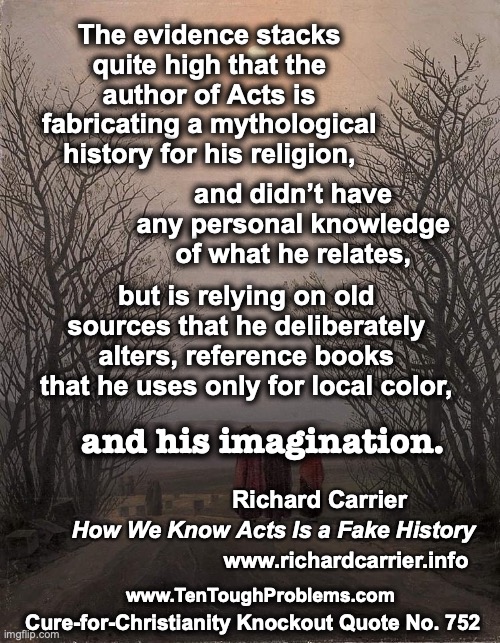
“The evidence stacks quite high that the author of Acts is fabricating a mythological history for his religion, and didn’t have any personal knowledge of what he relates, but is relying on old sources that he deliberately alters, reference books that he uses only for local color, and his imagination. There is simply no way a companion of Paul wrote this, or anyone of his generation. Indeed he conspicuously never claims he was—and since he would have claimed any authority he actually had, his silence proves he couldn’t claim this.”
I encourage you to read these articles (and watch the videos) to gain understanding and perspective concerning the historical federal case of United States of America vs. Donald J. Trump.
“There is no love of life without despair of life.”
BY MARIA POPOVA
“Those who prefer their principles over their happiness,”Albert Camus (November 7, 1913–January 4, 1960) wrote in his notebook toward the end of his life, “they refuse to be happy outside the conditions they seem to have attached to their happiness.” Indeed, our principles tend to harden into habits and although habits give shape to our inner lives, they can mutate into the rigidity of routine and create a kind of momentum that, rather than expanding our capacity for happiness, contracts it. In the trance of routine and principled productivity, we end up showing up for our daily lives while being absent from them.
Few things things break us out of our routines and awaken us to the living substance of happiness more powerfully than travel. Camus knew this. Decades earlier, when he was only twenty-two and still a long way from becoming the second-youngest recipient of the Nobel Prize in Literature, he explored this human perplexity with unparalleled intellectual elegance and spiritual grace in a gorgeous essay titled “Love of Life,” eventually included in his posthumously published collection Lyrical and Critical Essays (public library).
Recounting the sight of a young woman dancing deliriously in a Spanish cabaret, Camus — whose entire life was undergirded by the ethos that happiness is our moral obligation — writes:
Without cafés and newspapers, it would be difficult to travel. A paper printed in our own language, a place to rub shoulders with others in the evenings enable us to imitate the familiar gestures of the man we were at home, who, seen from a distance, seems so much a stranger. For what gives value to travel is fear. It breaks down a kind of inner structure we have. One can no longer cheat — hide behind the hours spent at the office or at the plant (those hours we protest so loudly, which protect us so well from the pain of being alone). I have always wanted to write novels in which my heroes would say: “What would I do without the office?” or again: “My wife has died, but fortunately I have all these orders to fill for tomorrow.” Travel robs us of such refuge. Far from our own people, our own language, stripped of all our props, deprived of our masks (one doesn’t know the fare on the streetcars, or anything else), we are completely on the surface of ourselves. But also, soul-sick, we restore to every being and every object its miraculous value. A woman dancing without a thought in her head, a bottle on a table, glimpsed behind a curtain: each image becomes a symbol. The whole of life seems reflected in it, insofar as it summarizes our own life at the moment. When we are aware of every gift, the contradictory intoxications we can enjoy (including that of lucidity) are indescribable.
But this contact with absolute bliss, Camus cautions, necessitates an equal capacity for contact with absolute despair:
There lay all my love of life: a silent passion for what would perhaps escape me, a bitterness beneath a flame. Each day I would leave this cloister like a man lifted from himself, inscribed for a brief moment in the continuance of the world… There is no love of life without despair of life.
Echoing Kierkegaard’s unforgettable admonition — “Of all ridiculous things the most ridiculous seems to me, to be busy,” the Danish philosopher wrote in contemplating our greatest source of unhappiness — Camus considers how the trance of productivity robs us of the very presence necessary for happiness:
Life is short, and it is sinful to waste one’s time. They say I’m active. But being active is still wasting one’s time, if in doing one loses oneself. Today is a resting time, and my heart goes off in search of itself. If an anguish still clutches me, it’s when I feel this impalpable moment slip through my fingers like quicksilver… At the moment, my whole kingdom is of this world. This sun and these shadows, this warmth and this cold rising from the depths of the air: why wonder if something is dying or if men suffer, since everything is written on this window where the sun sheds its plenty as a greeting to my pity? I can say and in a moment I shall say that what counts is to be human and simple. No, what counts is to be true, and then everything fits in, humanity and simplicity. When am I truer than when I am the world? My cup brims over before I have time to desire. Eternity is there and I was hoping for it. What I wish for now is no longer happiness but simply awareness.
[…]
The great courage is still to gaze as squarely at the light as at death. Besides, how can I define the link that leads from this all-consuming love of life to this secret despair? If I listen to the voice of irony, crouching underneath things, slowly it reveals itself. Winking its small, clear eye, it says: “Live as if …” In spite of much searching, this is all I know.
Biking is something else I both love and hate. It takes a lot of effort but does provide good exercise and most days over an hour to listen to a good book or podcast. I especially like having ridden.
Here’s my bike, a Rockhopper by Specialized. I purchased it November 2021 from Venture Out in Guntersville; Mike is top notch! So is the bike, and the ‘old’ man seat I salvaged from an old Walmart bike.
Here’s what I’m listening to: The Dictionary of Lost Words, by Pip Williams
Amazon abstract:
NEW YORK TIMES BESTSELLER • REESE’S BOOK CLUB PICK • “Delightful . . . [a] captivating and slyly subversive fictional paean to the real women whose work on the Oxford English Dictionary went largely unheralded.”—The New York Times Book Review
“A marvelous fiction about the power of language to elevate or repress.”—Geraldine Brooks, New York Times bestselling author of People of the Book
Esme is born into a world of words. Motherless and irrepressibly curious, she spends her childhood in the Scriptorium, an Oxford garden shed in which her father and a team of dedicated lexicographers are collecting words for the very first Oxford English Dictionary. Young Esme’s place is beneath the sorting table, unseen and unheard. One day a slip of paper containing the word bondmaid flutters beneath the table. She rescues the slip and, learning that the word means “slave girl,” begins to collect other words that have been discarded or neglected by the dictionary men.
As she grows up, Esme realizes that words and meanings relating to women’s and common folks’ experiences often go unrecorded. And so she begins in earnest to search out words for her own dictionary: the Dictionary of Lost Words. To do so she must leave the sheltered world of the university and venture out to meet the people whose words will fill those pages.
Set during the height of the women’s suffrage movement and with the Great War looming, The Dictionary of Lost Words reveals a lost narrative, hidden between the lines of a history written by men. Inspired by actual events, author Pip Williams has delved into the archives of the Oxford English Dictionary to tell this highly original story. The Dictionary of Lost Words is a delightful, lyrical, and deeply thought-provoking celebration of words and the power of language to shape the world.
Because every one of these churches allows and supports adultery.
Ninety percent of the 12,700 SBC delegates were heard chanting: “we must obey scripture.”
[Jesus] said to them, “Whoever divorces his wife and marries another commits adultery against her; and if she divorces her husband and marries another, she commits adultery.” (Mark 10:11-12, NRSV)
“In a review of both religious and general population data, researchers concluded that divorce rates among Christians are similar to those of the general population, indicating that marital dissolution is not necessarily due to a particular faith commitment.” From Google search: comparison of rate of divorce between Christians and non-christians.
Conclusion: it’s reasonable to conclude every one of these 47,000 churches has at least one man or woman member who has committed adultery.
From the Baptist Faith and Message:
I. The Scriptures
The Holy Bible was written by men divinely inspired and is God’s revelation of Himself to man. It is a perfect treasure of divine instruction. It has God for its author, salvation for its end, and truth, without any mixture of error, for its matter. Therefore, all Scripture is totally true and trustworthy. It reveals the principles by which God judges us, and therefore is, and will remain to the end of the world, the true center of Christian union, and the supreme standard by which all human conduct, creeds, and religious opinions should be tried. All Scripture is a testimony to Christ, who is Himself the focus of divine revelation.
Disclaimer–This is satire; there was no such vote. But, it seems, there should have been based on the SBC’s scriptural premise of ousting churches with female pastors.
I’m sometimes asked by religious friends why I make such a big deal over evolution in particular. Some suggest that secular types beat the drum for evolution only because it’s a sharp stick in the religious eyeball.
The question itself is a good one. The answer is even better.
It’s not just because evolution is true. That’s never enough. It’s also true that George Washington had no middle name, but I’m unlikely to devote much of my life force to opposing someone who insists that yes he did, and it was Steve, and that only Martha called him George, and only when she was drunk. Even if this hypothetical Stevist insisted on teaching the middle name in American History classes, I might think it was bananas, but I have other fish to fry.
Evolution, on the other hand—that’s a fish I choose to fry. It’s an idea that I want my kids and as many others as possible to know and care about. Because the story I’m about to tell is centered on evolution in schools, I want to start with a quick list of why it’s important:
First, it is an everything-changer. If knowing about evolution hasn’t changed almost everything about the way you see almost everything, dig in deeper with the help of people like Stephen Jay Gould (Wonderful Life and Full House), Richard Dawkins (Blind Watchmaker, River out of Eden, The Selfish Gene, Climbing Mount Improbable) and Daniel Dennett (Darwin’s Dangerous Idea).
Second, it inspires immense, transcendent awe and wonder to grasp that you are a cousin not just to apes, but to sponges and sequoias and butterflies and blue whales.
Third, it annihilates the artificial boundaries between us and the rest of life on Earth.
Fourth, it puts racial difference in proper perspective as utter trivia.
Fifth, when taken as directed, it constitutes one of the four grandest-ever swats of humility to the pompous human tookus.
Sixth, it contributes enormously to our understanding of how and why things work the way they do.
Seventh, that understanding has led in turn to incredible advances in medical science, agriculture, environmental stewardship, and more.
The list goes on.
When my older daughter Erin was in eighth grade, she came home from school one day and sat in front of me with evident drama.
“Guess what.”
“Uh, Norway fell into the sea. You can burp the alphabet. Am I close?”
“Dad, stop.” She leaned forward. “We started evolution in science today.”
A tickle of dread went down my spine. I’m a busy boy. No jonesing for a fracas.
“And?”
“And it’s awesome. He’s teaching all about it, just like you would. He explained what theory really means, and said that the evidence is incredibly strong for evolution, and when kids started saying, ‘But the Bible says blah blah blah,’ he just put his hand up and said, ‘You can talk about that with your minister. In this class, we are learning about science, about what we know.”
I had never seen her so jazzed about a class experience. She knows what a crapshoot it is, knows that she has less than a 50-50 chance of learning about evolution in any depth in the classroom. She lucked out.
So what’s a parent to do? Most, including me, will do a nice cartoon wipe of the brow and go back to the next thing on the plate. That’s a mistake. It’s also simply wrong.
We’re happy to fire off a blistering corrective to the teachers who fall down on the job and take our kids with them. But we’ve got to get just as good and consistent at complimenting the good.
It’s not just a question of good manners. If we really care about quality in the classroom, it’s imperative.
Praise the good
Imagine you’re a biology teacher. The evolution unit is approaching, again, and you know for certain you will get a half dozen scolding emails from angry parents the moment the word crosses your lips. Again. If you’ve never received a note of thanks for tackling the topic honestly, it’s easy to feel isolated and beleaguered. Who could blame you for gradually de-emphasizing the topic until it disappears completely? Even a teacher with the best of intentions can be worn to a nub from years of self-righteous tirades.
And those of us who sit silently, never lifting a finger to reinforce good teaching when we see it, deserve what we get.
I finally woke up to this when Erin was in sixth grade, and I started making a point of shooting off a message of thanks to teachers who rocked my kids’ worlds. This is especially important for middle and high school teachers, who are much less likely to hear any positive feedback through parent conferences and the other frequent contacts elementary teachers get.
When Erin was working her way through a much better-than-average comparative religion unit in social studies, I dashed off a note of appreciation to the teacher, who nearly passed out from the shock. When Connor told me his high school science teacher spent some time explaining what “theory” really means in science, I shot him some kudos. And when Erin came home with this story of courage and integrity, I sent a message expressing my deep and detailed appreciation…and cc’ed the principal.
The teacher replied, telling me how gratifying it was to hear the support. “It’s a passion of mine,” he said. Even passion can be pummeled out of someone. But now, the next time he approaches that unit, he’ll hear not only angry shouts ringing in his ears, but a little bit of encouragement from someone who took the time to make it known.
I’m better at this than I once was, but I’m still about three times as likely to pipe up when I’m pissed as when I’m impressed.
When she was in elementary school, my youngest daughter Delaney wanted to be a scientist.
When Charlie’s Playhouse, a company that made evolution toys and games, announced an Evolution & Art Contest that fall, she was all over it. Imagine an island with a unique environment. Choose an existing animal to put on the island. Fast forward a million years or so and imagine how the animal would evolve as a result of that environment. Draw a picture of the evolved animal. Awesome.
Soon the sketches were flying. Finally, with just days to go before the deadline, Laney showed me her entry.
Used by permission of Delaney McGowan
“The island has purple polka-dotted trees and bushes and quiet predators,” she explained. “And the only food is hard nuts. So after a long, long time, the monkeys evolve to have purple polka dots, huge ears to hear the predators, and sharp teeth to crack the nuts.”
She might not know an allele if it jumped up and mutated all over her, but her grasp of natural selection outstrips that of most adults. And she got this grasp not through lectures but by observing the results of natural selection all around us, and caring enough to think about it.
If I’m out on a walk in the woods with my own daughter and we see a deer with protective coloration, I’ll often say, “Look—you can barely see it. What if I was an animal trying to find a deer to eat? That one wouldn’t be very easy to find. And its babies would have the same coloring, so I’ll bet they’d be hard to find, too.”
[Then] imagine a poor adaptation. “Hey, what if it was bright pink? I think I’d have a pink one for supper every night, they’d be so easy to catch.” I step on a twig and the deer bolts away. “Ooh, fast too! I’ll bet I’d have to eat slow pink ones every night. Soon there wouldn’t be any slow pink ones left because I’d have eaten them all!”
When she did eventually encounter allele frequencies, cladistics, the modern synthesis and all the rest in high school, it glided (glode?) into place on the foundation she had laid for it. The key when she was young was to keep her engaged.
Winning the national contest for her age group didn’t hurt that one bit. She nearly passed out in excitement. We let her teacher know about it, and he showered her with kudos, then forwarded the news to the front office.
The call
The next week we received a call. It was Ms. Warner, an assistant administrator at the school. Becca answered. I didn’t know who she was talking to, but it was obviously good news of some sort.
Until it wasn’t.
When she hung up, she was clearly upset.
“Laney’s going to be interviewed by the principal on the Eagle News” — that’s a closed-circuit TV program that starts each school day — “about winning the Charlie’s Playhouse contest.”
I waited.
“But Ms. Warner said they’re not going to call it an ‘Evolution & Art’ contest — just an ‘Art’ contest. When I asked why, she said, ‘Because evolution is not in the curriculum.’ I said yes it is, it’s in the high school curriculum, and she said, ‘But it’s not in the elementary curriculum, so it’ll just be described as an ‘Art’ contest.’”
The heat started in my neck and spread to my ears, then into my face. Becca began swearing a blue streak. I sat down and wrote the most fabulously profane email of my life to a friend. Venting is good. Not sure if I was madder about the ignorance or the cowardice or the dishonesty — or the fact that this educator was dismissing the truly exceptional nature of what Laney did.
It wasn’t an art contest, you see. Delaney’s accomplishment had been scientific, not artistic. The drawing is lovely, but it’s just a way of expressing her grasp of the science. To have her school — savor that for a moment, her school — not only disregard her achievement, but send her the message that it’s something to be hidden, to be ashamed of…
I know what you’re thinking. Yes, this is Georgia. But as I’ve said before, in the four years we’ve been here, I’ve had far more opportunity to be pleasantly surprised than not. In addition to living in an area even more culturally and religiously diverse than the one we left in Minneapolis, our kids are getting an incredible education in top-ranked schools.
After many years in the national basement, Georgia’s latest science standards are excellent. And when it comes to the teaching of evolution itself, it ranks in the top tier of the Fordham study (see maps) — above Oregon, New Hampshire, Minnesota, Wisconsin, Connecticut, and 24 other states.
Science standards don’t have to be in the South to go south. As Lawrence Lerner put it in the NCSE Journal,
Although there is a disproportionate concentration of ill-treatment of evolution in the Bible Belt, geography is neither a necessary nor a sufficient condition for such treatment. Georgia and South Carolina, for instance, treated evolution very well while New Hampshire and Wisconsin did not.Lawrence Lerner, “Good, Bad, and Lots of Indifferent: State K-12 Science Standards,” Reports of the National Center for Science Education, vol. 28 no. 3
The most relevant anti-science spectrum in the US (and elsewhere) is not North-South, but urban-suburban-rural. The suburbs of Atlanta have more in common with the suburbs of Philadelphia than either has in common with the small towns in its own state. The quality of science education tends to drop in sync with population density.
But that’s on paper. As Ms. Warner and Mr. Taylor clearly show, individuals in the system will do their level best to undercut even the best standards.
A deeply depressing Penn State study found that only 28 percent of high school biology teachers consistently implement National Research Council recommendations calling for introduction of evidence that evolution occurred. About 13 percent of biology teachers explicitly advocate creationism in the classroom, while 60 percent use at least one of three strategies to avoid controversy: (1) pretending that evolution applies only on the molecular level; (2) telling students it does not matter if they really ‘believe’ in evolution, only that they know it for the test; and/or (3) “teaching the controversy,” which one researcher noted “tells students that well-established concepts can be debated in the same way we debate personal opinions.”
According to the researchers, these conflict-avoiders “may play a far more important role in hindering scientific literacy in the United States than the smaller number of explicit creationists.”























 Richard L. Fricks