Write to Life blog

The Boaz Scorekeeper–Chapter 29

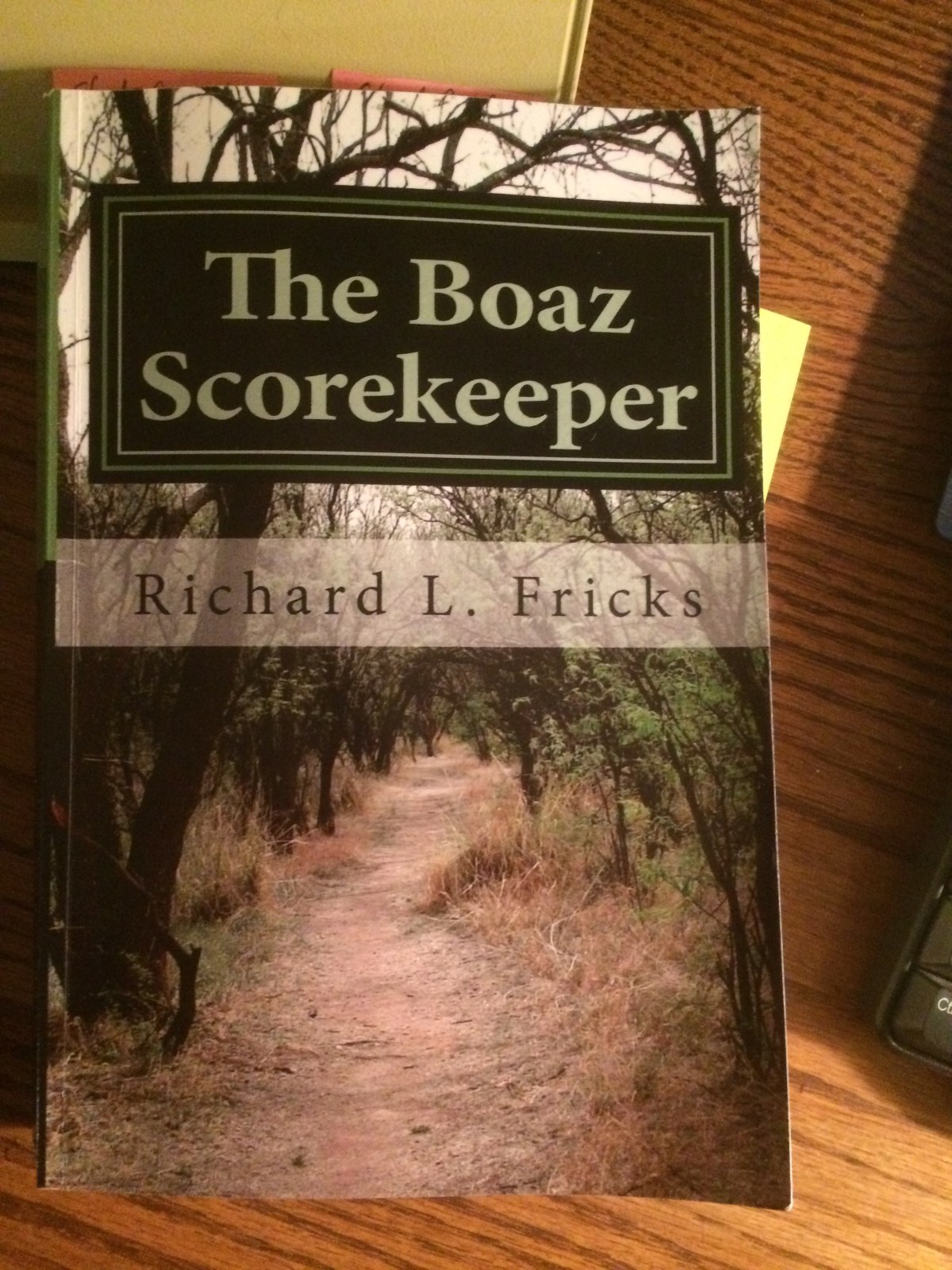
The Boaz Scorekeeper, written in 2017, is my second novel. I'll post it, a chapter a day, over the next few weeks.

After Sara Adams’ deathbed confession I filed notice of my intent to take the deposition of David Carl Adams.  The next day his attorney, Tommy Brunner from Gadsden, called me.  He said, as a courtesy he was letting me know that he was filing a Motion to Strike since I had no reasonable expectation of discovering any relevant evidence and that I should know that the Alabama Rules of Civil Procedure did not allow mere fishing expeditions.  I thanked him for his call and asked whether he knew a good criminal defense attorney, that his client was going to need one.  He acted shocked.  I gave him the short version.  He argued that since Mrs. Adams was now dead that the Prosecutor could not use her testimony.  It would be hearsay.  I agreed with him but let him know that Drake vs. Allbright would allow my affidavit to serve as the needed stepping stone to David’s deposition in a civil case.  He said that I was correct if I had a corroborating witness that placed me and Mrs. Adams together at the time of the conversation.  I assured Tommy that Loree Neilson was that witness.

The day before David’s deposition I felt like fishing.  The kind Tommy Brunner spoke about.  For years I had wondered who owned Club Eden.  I felt David’s deposition might be a good opportunity to learn.  Even though the Club was relevant as to where the graduation party took place I had mixed feelings whether a question about its ownership could slip by and generate a response.  I thought it was worth a shot so I drove to the Etowah County Courthouse, Land Records Division, to see if I could develop a chain of title for Club Eden’s property at Aurora Lake.

I succeeded after two hours of reviewing plat maps, and with the help of Francis Frasier, an older heavy-set woman with silky red hair, who claimed to have worked in “these dusty dungeons” for over sixty years.  We found a March 1892 deed from Larson Kittle to a company named The Garden, Ltd.  The transfer included 288 acres along the south side of what became the Aurora Lake reservoir.  There was no way to tell who owned The Garden company.  Francis suggested I call the Secretary of State in Montgomery.  She let me borrow her phone and the nice lady who answered had me an answer in less than five minutes. 

The Garden, Ltd. was formed in 1890.  There were five shareholders: Earnest Adams, Morton Tillman, Samuel Radford, Franklin Billingsley, and Joseph Ericson.  I had no doubt these were the grandfathers, no, great grandfathers of the Flaming Five.

During David’s deposition, I had just explored Sara’s statements including the direct question whether he had killed Wendi Murray.  Of course, he denied any such thing. I asked him if Walter Tillman was with him when he killed her.  Again, he denied all involvement.  Out of the blue I asked David if he was a shareholder in The Garden, Ltd.  To my surprise he said yes.  Again, to my astonishment he answered every question I could pose related to the Aurora Lake real estate.  He said that he had inherited his shares from his father, Eugene, when he died in 1965. He also confirmed that the other shares were owned by Walter Tillman, Raymond Radford, Fitz Billingsley, and Franklin Ericson. When I asked about the name, The Garden, Ltd., and the purpose of this organization, David said he didn’t know.  He also denied any knowledge about Club Eden.

A short while later I ended the deposition feeling I had wasted my time. David had been well coached, maybe a little too well coached.  I couldn’t help but believe that he was lying.

I had dropped by the restroom on my way out of Tommy’s law office not wanting to engage in small talk as everyone was leaving.  When I came out, Ralph Summerford, Wade Tillman’s lawyer, asked if he could buy me a cup of coffee saying that he had something I would want to hear.

We walked around the corner to a little diner on Chestnut Avenue.  Ralph said that he was now representing Wade’s father, Walter, and wanted to make a deal.  I asked him what he had in mind.  Ralph said Walter would cooperate with me and Matt and pay $50,000 in exchange for confidentiality and an immunity agreement from the Prosecutor.  Ralph asked if we could talk off the record.  I agreed.  Walter had admitted that he was present when David ended Wendi’s life.  Ralph said that Walter had tried to stop David and encouraged him to go to the authorities before doing anything stupid. 

I told Ralph that he knew my clients could not grant Walter any type of immunity, that would have to come from the District Attorney.  Ralph said that he knew that but my encouragement might be enough to convince the DA, especially if Walter would agree to testify against David.  I asked Ralph what Walter could offer concerning my client’s wrongful death case.  If I took the deal, there would be no testimony from Walter Tillman but he would provide us with names and documents that would lead us to Club Eden and enough evidence that Matt and I should be able to tie David and the other three, Raymond Radford, Fitz Billingsley, and Franklin Ericson, and all members of the Flaming Five, to the deaths of Wendi and Cindi Murray. 

I told Ralph that if he would draft the agreement, including the exact evidence that Walter had, that Matt and I would discuss it.  I agreed with Ralph that if we failed to reach an agreement, Matt and I would treat these negotiations with strict confidence.

Two days later and right before 8:00 a.m., Ralph hand-delivered a packet to my office asking me to review the agreement draft and for an opportunity to meet before he drove back to Birmingham.  I told him I had a motion docket in Albertville at 9:00 and could meet with him after lunch.

When Ralph arrived at 1:30, Matt and I had spent nearly two hours reviewing the agreement along with several exhibits.  The first exhibit was a copy of the organizing document for Club Eden.  It was dated June 23, 1899.  The initial club members were Earnest Adams, Morton Tillman, Samuel Radford, Franklin Billingsley, and Joseph Ericson.  The Club was formed for promoting and directing business operations and community life in Boaz, Alabama, and to enhance fellowship and progress among members.  The second exhibit was a copy of Club Eden’s bylaws.  All members were required to take an oath swearing to never disclose Club “business or non-business, or anything even remotely related to the Club.”   Punishment included the branding of a cross on the forehead, and the option of death by hanging but only by unanimous decision. 

Another exhibit stated that The Garden, Ltd. was formed in 1890 to purchase and manage the real estate that would become the headquarters of Club Eden. The Club was not officially documented until 1899. 

Walter detailed the names and membership dates for all members since Club Eden was officially formed.  This list included five generations.  I quickly noticed that I was the only member from outside the Adams, Tillman, Radford, Billingsley, and Ericson families.  Also, I noted that the Flaming Five’s sons were now members having all taken the oath last year, 1996, when the oldest of the youngest generation was 15. 

Walter described in another exhibit that after each of their sons came home that Saturday morning that all ten of them met at the Church’s fellowship hall.  They drove three cars, Wade and John’s Blazers, and James’ van, to Little Cove Road.  The girls’ blue Plymouth was parked about 200 feet down a little lane, barely wide enough to ride a bicycle without scrapping outcropping limbs.  The two girls were another fifty feet or so down a ravine with limbs and leaves and rocks piled over and around them. David, Franklin, Raymond and Fitz carried the two girls up the embankment and down to James’ van.  That’s when they noticed one of the girls was still alive.  James said that it was Wendi.  Nothing was done to her there.  The rest of them wiped down the inside of the Plymouth with bleach and water that they had brought.  They piled into the three vehicles and drove to Franklin’s farm on Martin Road.

Walter then described how John had pulled a front-end loader out of the barn and Raymond and Fitz pulled the girls from the back of James’ van and put them in the front bucket of the loader. John drove the tractor to the backside of their property and David then dug a hole while the rest stood around watching.  When David finished, he motioned for Walter to come over.  They talked for quite a while about having a type of ceremony for the girls.  Walter finally agreed to say a prayer but he didn’t want everybody there.  David made everybody else go back to the barn and wait on him and Walter.  When they were gone Walter said a prayer and David smothered Wendi.  He used the front-end loader to push them into the hole and to pile dirt over them.  David also pushed a dead tree over the grave that was on the ground nearby.  They then scattered a ton of leaves over the grave.  David and Walter walked back to the barn and without another word being said all ten of them got in the three vehicles, drove to the Church, where they all went their separate ways.  

After reviewing all the exhibits, I noted a few discrepancies compared to statements made by Cynthia Radford and Sara Adams.  I chose to ignore them, and instead, to read the agreement.  It was simple.  In exchange for the information contained in the packet and $50,000, my clients would release Walter from all liability related to the deaths of Wendi and Cindi Murray.  Also, Matt and I would agree, on behalf of the Murrays, to encourage the District Attorney to grant Walter immunity from all prosecution in exchange for his truthful testimony.

I told Ralph that I felt like my clients would agree but obviously I had to have their approval.  I promised him that I would meet with them as soon as possible.  When Ralph was leaving, I told him that I had a question.  Without letting me finish, he said, “I know you want to know why Walter didn’t try to include his son Wade in these negotiations.”  I told him he was correct.  Ralph said that he and Walter had discussed it but both had quickly agreed that there was no way in Hell, those were Walter’s words per Ralph, that the Murrays would agree.  They would feel there was no amount large enough to appease for the actions of one of the five who had murdered their daughters.  And, Ralph said, Walter barely could barely scrape together the $50,000. 

Ralph left and I went to my office and stood by my window looking out at a mostly empty parking lot and a bubbling water fountain.  The sun was at just the right angle to refract colored lights through the spewing water.  I couldn’t help but associate water with life.  Jesus said He was the Bread of Life.  Wasn’t He also the Water of Life?  I became angry when I wondered where this Supernatural being, this all-powerful and all-loving God, had been when Wendi and Cindi needed Him the most.  Truthfully, if He is real, He was just as responsible for the deaths of those two precious girls as the Flaming Five and their fathers.  How dark and foreboding this little community in North Alabama seemed, after hearing Pastor Walter describe the horror he and other faithful members of the First Baptist Church of Christ had so quickly and easily managed.
11/12/23 Biking & Listening

Here’s today’s bike ride.

Why I ride

Biking is something I both love and hate. The conflicting emotions arise from the undeniable physical effort it demands. However, this exertion is precisely what makes it an excellent form of exercise. Most days, I dedicate over an hour to my cycling routine, and in doing so, I’ve discovered a unique opportunity to enjoy a good book or podcast. The rhythmic pedaling and the wind against my face create a calming backdrop that allows me to fully immerse myself in the content. In these moments, the time spent on the bike seems worthwhile, as I can’t help but appreciate the mental and physical rewards it offers.

I especially like having ridden. The post-biking feeling is one of pure satisfaction. The endorphin rush, coupled with a sense of accomplishment, makes the initial struggle and fatigue worthwhile. As I dismount and catch my breath, I relish the sensation of having conquered the challenge, both physically and mentally. It’s a reminder that the things we sometimes love to hate can often be the ones that bring us the most fulfillment. In the end, the love-hate relationship with biking only deepens my appreciation for the sport, as it continually pushes me to overcome my own limitations and embrace the rewards that follow the effort.

My bike

A Rockhopper by Specialized. I purchased it November 2021 from Venture Out in Guntersville; Mike is top notch! So is the bike. The ‘old’ man seat was salvaged from an old Walmart bike (update: seat replaced, new photo to follow, someday).


Something to consider if you’re not already cycling.

I encourage you to start riding a bike, no matter your age. Check out these groups:

Cycling for those aged 70+(opens in a new tab)

Solitary Cycling(opens in a new tab)

Remember,

Photo by Suzy Hazelwood on Pexels.com


Novel I’m listening to:

The Last Thing He Told Me, by Laura Dave

Amazon abstract:

Don’t miss the #1 New York Times bestselling blockbuster and Reese Witherspoon Book Club Pick that’s sold over 2 million copies–now an Apple TV+ limited series starring Jennifer Garner!

The “page-turning, exhilarating” (PopSugar) and “heartfelt thriller” (Real Simple) about a woman who thinks she’s found the love of her life—until he disappears.

Before Owen Michaels disappears, he smuggles a note to his beloved wife of one year: Protect her. Despite her confusion and fear, Hannah Hall knows exactly to whom the note refers—Owen’s sixteen-year-old daughter, Bailey. Bailey, who lost her mother tragically as a child. Bailey, who wants absolutely nothing to do with her new stepmother.
As Hannah’s increasingly desperate calls to Owen go unanswered, as the FBI arrests Owen’s boss, as a US marshal and federal agents arrive at her Sausalito home unannounced, Hannah quickly realizes her husband isn’t who he said he was. And that Bailey just may hold the key to figuring out Owen’s true identity—and why he really disappeared.

Hannah and Bailey set out to discover the truth. But as they start putting together the pieces of Owen’s past, they soon realize they’re also building a new future—one neither of them could have anticipated.

With its breakneck pacing, dizzying plot twists, and evocative family drama, The Last Thing He Told Me is a “page-turning, exhilarating, and unforgettable” (PopSugar) suspense novel.


Podcasts I’m listening to:


Here’s a few photos from along my pistol route:

H Is for Hawk: Helen Macdonald on Love, Loss, Time, and Our Improbable Allies in Healing

Here’s the link to this article.

BY MARIA POPOVA

H Is for Hawk: Helen Macdonald on Love, Loss, Time, and Our Improbable Allies in Healing

Every once in a while — perhaps thrice a lifetime, if one is lucky — a book comes along so immensely and intricately insightful, so overwhelming in beauty, that it renders one incapable of articulating what it’s about without contracting its expansive complexity, flattening its dimensional richness, and stripping it of its splendor. Because it is, of course, about everything — it might take a specific something as its subject, but its object is nothing less than the whole of the human spirit, mirrored back to itself.

H Is for Hawk (public library) by Helen Macdonald is one such book — the kind one devours voraciously, then picks up and puts down repeatedly, unsure how to channel its aboutness in a way that isn’t woefully inadequate.

For a necessary starting point, here’s an inadequate summation: After her father’s sudden and soul-splitting death, Macdonald, a seasoned falconer, decides to wade through the devastation by learning to train a goshawk — the fiercest of raptors, “things of death and difficulty: spooky, pale-eyed psychopaths,” capable of inflicting absolute gore with absolute grace. Over the course of that trying experience — which she chronicles by weaving together personal memory, natural history (the memory of our planet), and literary history (the memory of our culture) — she learns about love and loss, beauty and terror, control and surrender, and the myriad other dualities reconciling which is the game of life.

British goshawk by Archibald Thorburn, 1915 (public domain)

Macdonald writes:

Here’s a word. Bereavement. Or, Bereaved. Bereft. It’s from the Old English bereafian, meaning ‘to deprive of, take away, seize, rob.’ Robbed. Seized. It happens to everyone. But you feel it alone. Shocking loss isn’t to be shared, no matter how hard you try.

Out of that aloneness a singular and paradoxical madness is born:

I knew I wasn’t mad mad because I’d seen people in the grip of psychosis before, and that was madness as obvious as the taste of blood in the mouth. The kind of madness I had was different. It was quiet, and very, very dangerous. It was a madness designed to keep me sane. My mind struggled to build across the gap, make a new and inhabitable world… Time didn’t run forwards any more. It was a solid thing you could press yourself against and feel it push back; a thick fluid, half-air, half-glass, that flowed both ways and sent ripples of recollection forwards and new events backwards so that new things I encountered, then, seemed souvenirs from the distant past.

This discontinuity of time in the universe of grief recurs throughout the book:

The archaeology of grief is not ordered. It is more like earth under a spade, turning up things you had forgotten. Surprising things come to light: not simply memories, but states of mind, emotions, older ways of seeing the world.

Rippling through Macdonald’s fluid, immersive prose are piercing, short, perfectly placed deliverances, in both senses of the word: there is the dark (“What happens to the mind after bereavement makes no sense until later.”), the luminous (“I’d halfway forgotten how kind and warm the world could be.”), the immediate (“Time passed. The wavelength of the light around me shortened. The day built itself.”), the timeless (“Those old ghostly intuitions that have tied sinew and soul together for millennia.”), and the irrepressibly sublime (“Looking for goshawks is like looking for grace: it comes, but not often, and you don’t get to say when or how.”).

American goshawk by Robert Ridgway, 1893 (public domain)

Choosing a goshawk, a creature notoriously difficult to tame, became Macdonald’s way of learning to let grace come unbidden, a letting that demanded a letting go — of compulsive problem-solving, of the various control strategies by which we try to bend life to our will, of the countless self-contortion and self-flagellation techniques driving the machinery of our striving. Recounting the frustration of failing to get her goshawk, Mabel, to obey her commands — frustration familiar to anyone who has ever anguished over any form of unrequited intentionality — Macdonald writes:

I flew her later in the day. I flew her earlier. I fed her rabbit with fur and rabbit without. I fed her chicks that I’d gutted and skinned and rinsed in water. I reduced her weight. I raised it. I reduced it again. I wore different clothes. I tried everything to fix the problem, certain that the problem couldn’t be fixed because the problem was me. Sometimes she flew straight to my fist, sometimes straight over it, and there was no way of knowing which it would be. Every flight was a monstrous game of chance, a coin-toss, and what was at stake felt something very like my soul. I began to think that what made the hawk flinch from me was the same thing that had driven away the man I’d fallen for after my father’s death. Think that there was something deeply wrong about me, something vile that only he and the hawk could see.

Macdonald peers directly into the black hole of fury, a familiar rage directed as much at the rebuffer as at the rebuffed self:

The anger was vast and it came out of nowhere. It was the rage of something not fitting; the frustration of trying to put something in a box that is slightly too small. You try moving the shape around in the hope that some angle will make it fit in the box. Slowly comes an apprehension that this might not, after all, be possible. And finally you know it won’t fit, know there is no way it can fit, but this doesn’t stop you using brute force to try to crush it in, punishing the bloody thing for not fitting properly. That was what it was like: but I was the box, I was the thing that didn’t fit, and I was the person smashing it, over and over again, with bruised and bleeding hands.

And yet somehow, Macdonald unboxes herself as she trains Mabel into control and Mabel trains her into the grace of surrender, of resting into life exactly as it is rather than striving for some continually unsatisfying and anguishing version of how it ought to be. She captures this beautifully in the closing vignette — an earthquake, quite an uncommon occurrence in England, rattles her house and sends her panic-stricken into Mabel’s quarters, terrified at the thought that earthquakes alarm wildlife and often cause animals to flee. Macdonald writes:

I race downstairs, three steps at a time, burst through the door and turn on the light in her room. She is asleep. She wakes, pulls her head from her mantle-feathers and looks at me with clear eyes. She’s surprised to see me. She yawns, showing her pink mouth like a cat’s and its arrowhead tongue with its black tip. Her creamy underparts are draped right down over her feet, so only one lemony toe and one carbon-black talon are exposed. Her other foot is drawn high up at her chest. She felt the tremors. And then she went back to sleep, entirely unmoved by the moving earth. The quake brought no panic, no fear, no sense of wrongness to her at all. She’s at home in the world. She’s here. She ducks her head upside down, pleased to see me, shakes her feathers into a fluffy mop of contentment, and then, as I sit with her, she slowly closes her eyes, tucks her head back into her feathers, and sleeps. She is not a duke, a cardinal, a hieroglyph or a mythological beast, but right now Mabel is more than a hawk. She feels like a protecting spirit. My little household god. Some things happen only once, twice in a lifetime. The world is full of signs and wonders that come, and go, and if you are lucky you might be alive to see them. I had thought the world was ending, but my hawk had saved me again, and all the terror was gone.

H Is for Hawk is an unsummarizably spectacular read in its totality, the kind that lodges itself in your mind, heart, and spirit with equal gravity and grace. Complement it with these gorgeous 19th-century drawings of raptors, then revisit Sy Montgomery on how an octopus illuminates the wonders of consciousness and Maira Kalman on what a dog taught her about the meaning of human life.

The Boaz Scorekeeper–Chapter 28

The Boaz Scorekeeper, written in 2017, is my second novel. I'll post it, a chapter a day, over the next few weeks.

Wednesday, November 22, 1997 was the second worse day of my life.  It was the day before Thanksgiving and I was in the library researching the admissibility of an excited utterance for a murder case I was working on out of Dekalb County.  Tina tapped on the door, stuck her head in and said, “there is a Loree Nielson here that wants to see you.”  I immediately recalled the day Tina had announced Cynthia Radford’s phone call.  I hoped Ms. Nielson’s personal visit would be a similarly good surprise.  I was not disappointed.

I had Tina bring her into the library.  Loree was the sister of James Adams and the daughter of David and Sara Adams.  Loree told me that her mother lay dying at Gadsden Memorial Hospital and had asked Loree to see if I could come speak with her.  The only thing Loree knew was that it concerned the two girls who went missing 25 years ago.

I drove my car following Loree in hers. I met with Mrs. Adams.  She thanked me for coming and told me that she had to confess a secret before she died.  She kept asking me to forgive her.  Much to my satisfaction, the story Mrs. Adams gave me started off much like the one Cynthia Radford had described.  Their sons had both come home late Saturday morning distraught and panicked.  David, her husband, left with James and didn’t return for several hours.  He made her promise that she would never tell anyone what had happened.  David told her that all ten of them, the Flaming Five and each of their fathers, met, took two vehicles, and drove to Little Cove Road where the two girls and their car were hidden.  Surprisingly, one of the girls was still alive.  The fathers quickly assessed the life-altering trouble their five sons were in and took control.

Franklin Ericson said they could not leave the bodies with their car and suggested they take them to his farm off Martin Road.  That’s what they did, leaving the little blue Plymouth Valiant hidden off Little Cove Road.  Ericson had a front-end loader that he had rented to deepen a dried-up pond.  He used it to dig a hole on the back side of the property.  David Adams and Walter Tillman stayed behind and made everyone else leave.  David told Mrs. Adams that he could not bury Wendi alive.  He said that one of the boys had identified her as the one who was still living.  David told Mrs. Adams how he had used an old cushion from the tractor to smother Wendi.  Then, Pastor Tillman said a prayer and David buried the two girls.  He used Franklin’s front-end loader to push the trunk of a fallen tree over the grave.

Mrs. Adams told me that her secret had haunted her ever since James had shared the horrible news that fateful Saturday morning.

Sara Adams died Thanksgiving morning around 7:00 a.m.  After I had met with her on Wednesday, I had returned to the office and tried to find a court reporter who would meet me at the hospital to properly record her testimony.  The earliest I could arrange was Friday morning.  However, that was an appointment Sara failed to keep.

I thought all weekend about what Wendi must have gone through.  First, she was struck repeatedly with a shovel.  Then, refusing to die while choosing to fight with the hope she could survive a most horrible nightmare, she was smothered to death and pushed into a forgotten grave.

I knew that David Adams was a murderer and Pastor Tillman just as guilty.  But, I also knew that even though they could be prosecuted, it was unlikely they would ever be convicted.  What admissible evidence would the prosecutor have?  Neither David or the Pastor would confess.  Who else knew exactly what had happened after these two criminals had made the others leave?  Even if the Flaming Five and the other three fathers knew, they would never breathe a word.  I even doubted whether Loree knew.  Her mother would only talk with me after Loree had left the room.

After spending most of the long Thanksgiving weekend holed up in my study at home, I decided I would keep this information to myself.  I wouldn’t even share it with Matt.  I knew if I did he would tell me I had to share Mrs. Adams’ story with the District Attorney.  I also knew in my heart that getting justice for Wendi and Cindi would not come from the Marshall County criminal justice system.  I could only hope that Bill and Nellie Murray would win their wrongful death lawsuit letting the world know the truth about the Flaming Five.

11/11/23 Biking & Listening

Here’s today’s bike ride.

Why I ride

Biking is something I both love and hate. The conflicting emotions arise from the undeniable physical effort it demands. However, this exertion is precisely what makes it an excellent form of exercise. Most days, I dedicate over an hour to my cycling routine, and in doing so, I’ve discovered a unique opportunity to enjoy a good book or podcast. The rhythmic pedaling and the wind against my face create a calming backdrop that allows me to fully immerse myself in the content. In these moments, the time spent on the bike seems worthwhile, as I can’t help but appreciate the mental and physical rewards it offers.

I especially like having ridden. The post-biking feeling is one of pure satisfaction. The endorphin rush, coupled with a sense of accomplishment, makes the initial struggle and fatigue worthwhile. As I dismount and catch my breath, I relish the sensation of having conquered the challenge, both physically and mentally. It’s a reminder that the things we sometimes love to hate can often be the ones that bring us the most fulfillment. In the end, the love-hate relationship with biking only deepens my appreciation for the sport, as it continually pushes me to overcome my own limitations and embrace the rewards that follow the effort.

My bike

A Rockhopper by Specialized. I purchased it November 2021 from Venture Out in Guntersville; Mike is top notch! So is the bike. The ‘old’ man seat was salvaged from an old Walmart bike (update: seat replaced, new photo to follow, someday).


Something to consider if you’re not already cycling.

I encourage you to start riding a bike, no matter your age. Check out these groups:

Cycling for those aged 70+(opens in a new tab)

Solitary Cycling(opens in a new tab)

Remember,

Photo by Suzy Hazelwood on Pexels.com


Novel I’m listening to:

The Last Thing He Told Me, by Laura Dave

Amazon abstract:

Don’t miss the #1 New York Times bestselling blockbuster and Reese Witherspoon Book Club Pick that’s sold over 2 million copies–now an Apple TV+ limited series starring Jennifer Garner!

The “page-turning, exhilarating” (PopSugar) and “heartfelt thriller” (Real Simple) about a woman who thinks she’s found the love of her life—until he disappears.

Before Owen Michaels disappears, he smuggles a note to his beloved wife of one year: Protect her. Despite her confusion and fear, Hannah Hall knows exactly to whom the note refers—Owen’s sixteen-year-old daughter, Bailey. Bailey, who lost her mother tragically as a child. Bailey, who wants absolutely nothing to do with her new stepmother.

As Hannah’s increasingly desperate calls to Owen go unanswered, as the FBI arrests Owen’s boss, as a US marshal and federal agents arrive at her Sausalito home unannounced, Hannah quickly realizes her husband isn’t who he said he was. And that Bailey just may hold the key to figuring out Owen’s true identity—and why he really disappeared.

Hannah and Bailey set out to discover the truth. But as they start putting together the pieces of Owen’s past, they soon realize they’re also building a new future—one neither of them could have anticipated.

With its breakneck pacing, dizzying plot twists, and evocative family drama, The Last Thing He Told Me is a “page-turning, exhilarating, and unforgettable” (PopSugar) suspense novel.


Podcasts I’m listening to:


Here’s a few photos from along my pistol route:

Artist Louise Bourgeois on How Solitude Enriches Creative Work

Here’s the link to this article.

BY MARIA POPOVA

“Nourish yourself with grand and austere ideas of beauty that feed the soul… Seek solitude,” young Delacroix counseled himself in 1824. Keats saw solitude as a sublime conduit to truth and beauty. Elizabeth Bishop believed that everyone should experience at least one prolonged period of solitude in life. Even if we don’t take so extreme a view as artist Agnes Martin’s assertion that “the best things in life happen to you when you’re alone,” one thing is certain: Our capacity for what psychoanalyst Adam Phillips has termed “fertile solitude” is absolutely essential not only for our creativity but for the basic fabric of our happiness — without time and space unburdened from external input and social strain, we’d be unable to fully inhabit our interior life, which is the raw material of all art.

That vital role of solitude in art and life is what the great artist Louise Bourgeois (December 11, 1911– May 31, 2010) explores in several of the letters and diary entires collected in Louise Bourgeois: Destruction of the Father / Reconstruction of the Father: Writings and Interviews, 1923–1997 (public library) — an altogether magnificent glimpse of one of the fiercest creative minds and most luminous spirits of the past century.

Louise Bourgeois at her studio, New York, 1946. (Louise Bourgeois Archive)

In September of 1937, 25-year-old Bourgeois writes to her friend Colette Richarme — an artist seven years her senior yet one for whom she took on the role of a mentor — after Richarme had suddenly left Paris for respite in the countryside:

After the tremendous effort you put in here, solitude, even prolonged solitude, can only be of very great benefit. Your work may well be more arduous than it was in the studio, but it will also be more personal.

A few months later, Bourgeois reiterates her counsel:

Solitude, a rest from responsibilities, and peace of mind, will do you more good than the atmosphere of the studio and the conversations which, generally speaking, are a waste of time.

Illustration by Isabelle Arsenault from Cloth Lullaby: The Woven Life of Louise Bourgeois by Amy Novesky, a children's book about the beloved artist's early life and how it shaped her art.
Illustration by Isabelle Arsenault from Cloth Lullaby: The Woven Life of Louise Bourgeois by Amy Novesky, a children’s book about the beloved artist’s early life and how it shaped her art.

For Bourgeois, aloneness was the raw material of art — something she crystallized most potently half a century later, in a diary entry from the summer of 1987:

You are born alone. You die alone. The value of the space in between is trust and love. That is why geometrically speaking the circle is a one. Everything comes to you from the other. You have to be able to reach the other. If not you are alone…

Complement the immeasurably insightful Louise Bourgeois: Destruction of the Father / Reconstruction of the Father with Bourgeois on art, integrity, and the key to creative confidence and this almost unbearably lovely picture-book about her early life, then revisit Edward Abbey’s enchanting vintage love letter to solitude.

The allure of tribalism in dangerous times

Here’s the link to this article.

Avatar photoby ADAM LEE NOV 06, 2023

Two rows of black and white pawns on a chessboard | The allure of tribalism in dangerous times
Credit: Pixabay

Overview:

Moral codes based on tribalism—defining the in-group and the out-group, whether by culture, religion or race—offer no solution to the Israel-Palestine conflict or any of the other wars wracking our world. The only path to peace is a morality based on empathy and universal humanity, yet it seems further from our grasp than ever.

Reading Time: 5 MINUTES

[Previous: An ouroboros of hate: How religion makes peace impossible]

Israel’s invasion of Gaza is raging across the Middle East like a wildfire. And like any other blaze, it’s sending up embers that fall back to earth, where they ignite new violence.

In Russia, bottled-up social pressure and discontent has found an outlet in the form of antisemitic hate. Last week, we saw terrifying video of an angry mob storming an airport in the Dagestan region, hunting for Jews on a just-arrived flight from Israel. They didn’t find any, but that’s all that stopped this from becoming a pogrom.

But we shouldn’t be so quick to look down on backward nations like Russia. In both the US and Europe, there’s been a rash of antisemitic attacks under the bigoted logic that all Jews everywhere bear collective responsibility for what the Israeli government does.

At the same time, it’s not only Jews who are targets of hate. The editor of a scientific journal was fired for quoting a satire from The Onion that implicitly criticized Israel. In Illinois, a 6-year-old Palestinian boy was murdered and his mother was stabbed. At Stanford University, a driver hit a Muslim student with his car in an apparently deliberate attack.

The government agencies that track such things report an uptick in both antisemitic and anti-Muslim bias crimes. Who should we sympathize with, when there’s ample evidence of persecution and victimization everywhere we look? Do we have to choose who to support based on who’s suffered the most, like some grotesque Olympics of pain?

Our moral codes weren’t built for this

What we need is a moral code built on recognition of our common humanity. We need an ethics that treats all people as fundamentally alike, and all deserving of equal rights, whatever their culture and whichever side of the border they happen to be standing on.

Most moral codes don’t do this. For the most part, the moral codes that guide us today come from times when the family or the village or the tribe was the only unit of society. They’re small and parochial, looking no further than the next hilltop. In those times, the outside world was a strange and frightening place. Banding together promised safety, and to be outside the group spelled doom.

This kind of thinking is the animating idea behind nationalism, religious orthodoxy, and cultural tribalism. These concepts of morality are different on the surface, but underneath, they’re fundamentally alike. They’re all about the in-group versus the out-group. The only thing that varies is the criteria for who’s in and who’s out.

This mindset splits the world into binary opposites. Everyone is either an ally or an enemy, a good person or an evildoer, a saint or a sinner. It’s appealingly straightforward, which makes it satisfying. Tribalism is one of those tendencies that just hits the right buttons in the human brain.

(We often conceive of justice as a set of scales, but I fear that metaphor can lead us astray into dangerously simplistic thinking. After all, scales tip one way or the other. There’s no outcome in between.)

But when we encounter a case that crosses those tidy lines, it creates uncomfortable cognitive dissonance. What happens when a person, or a people, is a genuine victim of persecution, but also an oppressor? What happens when “our side” is inflicting harm, or when there are kind, innocent people on the other side?

That doesn’t fit into a framework of right-or-wrong, in-or-out tribalism. So, these moral systems don’t try to account for it. Instead, they steamroll it into a convenient two-dimensional portrait. Whatever harm the bad guys commit is further evidence of their wickedness. Whatever harm the good guys commit is rational and justified (or alternatively, lies and propaganda made up by the enemy in a bid for sympathy).

The flattening tendency of tribalism obliterates nuance from every conflict. No one wants to be in the middle, where every side is lobbing bombs at you. Thus, everyone gets pushed to pick one side or the other, to join a team, to declare our allegiance and wave the flag.

And, the longer these debates go on, the more entrenched all sides become. The battle lines are drawn, positions harden, and resentment curdles. People start to believe, not just that they’re on the right side, but that the right side is obvious. They start to believe that everyone who doesn’t see the world the same way as they do is a puppet of imperialists, or an apologist for genocide, or a settler colonialist, or a secret Nazi.

Empathy gymnastics

Whenever I consider what’s to be done, I always go back to empathy. I said in my last column that it doesn’t offer an easy solution to this conflict. And yet, it’s the only guide we have. If there’s any way out, it will only be discovered by the embrace of mutual understanding. It will never be achieved by force of arms on either side.

Israel is the refuge of a people who were expelled from their ancestral homeland and endured centuries of brutal persecution. The Jews were scattered across the earth, forced to live among those who despised them. They were scapegoated by vicious conspiracy theories, prevented from owning land, often forbidden to practice their own religion. Ultimately, they were targeted for extermination in the worst slaughter of the 20th century.

You can’t understand Israel without grasping that bone-deep history of trauma. You can’t grasp the roots of this conflict without hearing the echo of “Never again” in the back of every Jewish person’s mind. They have very good reason to want to protect themselves, without ever having to rely on anyone else’s mercy or goodwill.

At the same time, Israelis need to understand that their current situation is of their own making. Israel will never be safe until it learns to live together in peace with its neighbors. Not only have they not done that, they’ve forced the Palestinians to live under hellish conditions.

If there’s ever going to be an end to these conflicts, the Palestinians need a realistic hope of a better future. Just as the Jews do, they deserve safety, stability, and the chance to control their own destiny. They can’t stay confined and oppressed forever, with no chance of things ever getting better for them.

Otherwise, no informed observer of human nature would expect them to respond with anything other than destructive nihilism and religious zealotry. Historically, the Jews rebelled many times against oppressive foreign rulers. How can they not expect others to do the same?

This is less a perspective flip than a perspective cartwheel. Whichever side you look at it from, it demands the overturning of sacred beliefs. It’s a gymnastic feat of empathy, and perhaps most people aren’t capable of it. But if we’re not capable of it, then this bloodshed will go on forever.

A crutch we no longer need

In the olden days, one could argue, tribalism was the only option. After all, belief in universal brotherhood was no good to anyone if the invaders from over the next hill didn’t share that view. When culture and language and religion were much deeper rifts that separated humans from each other, cleaving to the tribe was the only way to survive.

But that survival instinct is a crutch we no longer need. We live in a world where anyone can travel anywhere, learn about any culture, translate any language. We know more about each other than we ever have. We no longer have any excuse for treating other humans as aliens or dangerous creatures. By all rights, we should find it easier to get along.

Instead, millions cling fiercely to their tribalisms, even when we no longer have any need for them. Because of these imaginary distinctions, real human beings are hating each other, shedding blood, waging war, killing, and dying. It’s a tragic absurdity that should have no place in a rational world.

The Boaz Scorekeeper–Chapter 27

The Boaz Scorekeeper, written in 2017, is my second novel. I'll post it, a chapter a day, over the next few weeks.

The Friday after Labor Day, Tina buzzed me over the intercom and said a Cynthia Radford was on the phone claiming to have important information.  I took the call.

She said she was the ex-wife of Raymond Radford and asked if we could meet.  She said it was important to meet in secret and asked me to come to her lake house in Guntersville.  She suggested we meet in the Marshall Medical Center North parking lot and she would drive us to her cabin.  I told her I needed to know what this was about. She said she might have information that could help Matt and me with our wrongful death case against the Flaming Five.  She used that phrase. 

Over coffee at her kitchen table she thanked me for coming and said I had to make her a promise before she would tell me what she knew.  I told her I wouldn’t know unless she was more specific.  She asked me if her son Randall could ever be prosecuted again for the deaths of Wendi and Cindi Murray?  I told her no, since Randall’s case had been dismissed by the prosecutor back in 1973.  I thought she would catch my lie but she didn’t.  It was wrong of me not to be truthful and explain that double jeopardy didn’t attach until an actual trial had begun.  That certainly hadn’t been the case.  Instead of being truthful, I rationalized, believing that real justice might be fulfilled if I learned what Cynthia had to say.

She said that she divorced Raymond in 1976 but their troubles started several years earlier.  She told me that he had protected Randall by helping dispose of the bodies and covering up their deaths.  She also said that Wade, James, Fred, and John’s fathers also were involved.

I asked her why she had not disclosed this information before.  She said because she was trying to protect Randall, just like Raymond did, but just in a different way.  She described how Randall had come home late Saturday morning all panicky.  He first told us that there had been an accident and two girls were killed.  After Raymond asked him why he hadn’t gone to the police Randall came clean saying that he would go to jail if they found out what he, John, and James had done.  Randall was rather incoherent but he did say that he and the others had done a very stupid thing and felt like they had to get rid of the evidence.  He told us that the two girls and their car were hidden in some woods down Little Cove Road.  Raymond and Randall left and didn’t return for several hours.

Cynthia stated that Raymond and the other fathers were involved in moving and burying the two girls.  She said that she had never known where the graves were but said that it made sense when the bodies were discovered at Pebblebrook.  She asked me if I thought it was God that had caused Bradley Vickers to bulldoze the wrong lot.  I told her that I doubted that was what happened.

Cynthia then told me how she found out about Raymond’s involvement with bribing Nyra, Darla, Gina, and Rickie. She said Randall had told her that Raymond and the other four fathers coerced the cheerleaders to give false testimony in exchange for college funding and periodic payments over ten years to begin after the Flaming Five had been cleared of all criminal charges. Fred’s father, Fitz, had handled the money and the payments.

Cynthia went on to tell me how Raymond had gotten involved with Darla’s mother eventually marrying her after divorcing Cynthia.  I could tell that Cynthia was greatly motivated by revenge from having been scorned by Raymond.  She told me that she hoped the Murray’s lawsuit bankrupted Radford Hardware and Building Supply.

Two weeks later I had Cynthia retell her story on the record. She submitted to a deposition in our law office.  Raymond’s attorney, Kerry Fox, was dumbfounded.  I almost felt sorry for him.  Not only were the stellar reputations of the Flaming Five and their fathers in the cross-hairs, but the assets of five rock solid institutions were exposed to hurricane-force winds.