Biking is something I both love and hate. The conflicting emotions arise from the undeniable physical effort it demands. However, this exertion is precisely what makes it an excellent form of exercise. Most days, I dedicate over an hour to my cycling routine, and in doing so, I’ve discovered a unique opportunity to enjoy a good book or podcast. The rhythmic pedaling and the wind against my face create a calming backdrop that allows me to fully immerse myself in the content. In these moments, the time spent on the bike seems worthwhile, as I can’t help but appreciate the mental and physical rewards it offers.
I especially like having ridden. The post-biking feeling is one of pure satisfaction. The endorphin rush, coupled with a sense of accomplishment, makes the initial struggle and fatigue worthwhile. As I dismount and catch my breath, I relish the sensation of having conquered the challenge, both physically and mentally. It’s a reminder that the things we sometimes love to hate can often be the ones that bring us the most fulfillment. In the end, the love-hate relationship with biking only deepens my appreciation for the sport, as it continually pushes me to overcome my own limitations and embrace the rewards that follow the effort.
My bike
A Rockhopper by Specialized. I purchased it November 2021 from Venture Out in Guntersville; Mike is top notch! So is the bike. The ‘old’ man seat was salvaged from an old Walmart bike (update: seat replaced, new photo to follow, someday).
Something to consider if you’re not already cycling.
I encourage you to start riding a bike, no matter your age. Check out these groups:
Don’t miss the #1 New York Times bestselling blockbuster and Reese Witherspoon Book Club Pick that’s sold over 2 million copies–now an Apple TV+ limited series starring Jennifer Garner!
The “page-turning, exhilarating” (PopSugar) and “heartfelt thriller” (Real Simple) about a woman who thinks she’s found the love of her life—until he disappears.
Before Owen Michaels disappears, he smuggles a note to his beloved wife of one year: Protect her. Despite her confusion and fear, Hannah Hall knows exactly to whom the note refers—Owen’s sixteen-year-old daughter, Bailey. Bailey, who lost her mother tragically as a child. Bailey, who wants absolutely nothing to do with her new stepmother.
As Hannah’s increasingly desperate calls to Owen go unanswered, as the FBI arrests Owen’s boss, as a US marshal and federal agents arrive at her Sausalito home unannounced, Hannah quickly realizes her husband isn’t who he said he was. And that Bailey just may hold the key to figuring out Owen’s true identity—and why he really disappeared.
Hannah and Bailey set out to discover the truth. But as they start putting together the pieces of Owen’s past, they soon realize they’re also building a new future—one neither of them could have anticipated.
With its breakneck pacing, dizzying plot twists, and evocative family drama, The Last Thing He Told Me is a “page-turning, exhilarating, and unforgettable” (PopSugar) suspense novel.
When my atheist engineer grandfather died, my atheist engineer grandmother leaned over the body in the hospice bed that had contained half a century of shared life and love, cradled the cranium in which his stubborn and sensitive mind had dwelt, and whispered into the halogen-lit ether:
“Where did you go, my darling?”
Whatever our beliefs, these sensemaking playthings of the mind, when the moment of material undoing comes, we — creatures of moment and matter — simply cannot fathom how something as exquisite as the universe of thought and feeling inside us can vanish into nothingness.
Even if we understand that dying is the token of our existential luckiness, even if we understand that we are borrowed stardust, bound to be returned to the universe that made it — a universe itself slouching toward nothingness as its stars are slowly burning out their energy to leave a cold austere darkness of pure spacetime — this understanding blurs into an anxious disembodied abstraction as the body slouches toward dissolution. Animated by electrical impulses and temporal interactions of matter, our finite minds simply cannot grasp a timeless and infinite inanimacy — a void beyond being.
Pillars of Creation, Eagle Nebula, Messier 16. Infrared photograph. NASA / Hubble Space Telescope. (Available as a print and as stationery cards.)
Even Walt Whitman, who could hold such multitudes of contradiction, could not grasp the void. “I will make poems of my body and of mortality,” he vowed as a young man as he reverenced our shared materiality in his timeless declamation that “every atom belonging to me as good belongs to you.” It was easy, from the shimmering platform of his prime, to look forward to becoming “the uncut hair of graves” upon returning his own atoms to the grassy ground one day.
But then, when that day loomed near as he grew old and infirm, “the poet of the body and the poet of the soul” suddenly could not fathom the total disbanding of his atomic selfhood, suddenly came to “laugh at what you call dissolution.”
And then he did dissolve, leaving us his immortal verses, verses penned when his particles sang with the electric cohesion of youth and of health, verses that traced with their fleshy finger the faint contour of an elemental truth: “What invigorates life invigorates death.”
“Thoughts, silent thoughts, of Time and Space and Death.” Art by Margaret C. Cook from a rare English edition of Walt Whitman’s Leaves of Grass. (Available as a print)
I wish I could have given my grandmother, and given the dying Whitman, the infinitely invigorating Mr g: A Novel About the Creation (public library) by the poetic physicist Alan Lightman — a magical-realist serenade to science, coursing with symphonic truth about our search for meaning, our hunger for beauty, and what makes our tender, transient lives worth living.
Toward the end of the novel, Mr g watches, with heartache unknown in the Void predating the existence of universes and of life, an old woman on her deathbed, the film of her long and painful and beautiful life unspooling from the reel of memory, leaving her grief-stricken by its terminus, shuddering with defiant disbelief that this is all.
“How can a creature of substance and mass fathom a thing without substance or mass?” wonders Mr g as he sorrows watching her succumb to the very laws he created. “How can a creature who will certainly die have an understanding of things that will exist forever?”
And then, as a faint smile washes across her face, she does die. Lightman writes:
At that moment, there were 3,147,740,103,497,276,498,750,208,327 atoms in her body. Of her total mass, 63.7 percent was oxygen, 21.0 percent carbon, 10.1 percent hydrogen, 2.6 percent nitrogen, 1.4 percent calcium, 1.1 percent phosphorous, plus a smattering of the ninety-odd other chemical elements created in stars.
In the cremation, her water evaporated. Her carbon and nitrogen combined with oxygen to make gaseous carbon dioxide and nitrogen dioxide, which floated skyward and mingled with the air. Most of her calcium and phosphorous baked into a reddish brown residue and scattered in soil and in wind.
But then we see that every atom belonging to her — or, rather, temporarily borrowed by her — truly does belong to everything and everyone, just as you and I are now inhaling the same oxygen atoms that once inflated Walt Whitman’s lungs with the lust for life:
Released from their temporary confinement, her atoms slowly spread out and diffused through the atmosphere. In sixty days’ time, they could be found in every handful of air on the planet. In one hundred days, some of her atoms, the vaporous water, had condensed into liquid and returned to the surface as rain, to be drunk and ingested by animals and plants. Some of her atoms were absorbed by light-utilizing organisms and transformed into tissues and tubules and leaves. Some were breathed in by oxygen creatures, incorporated into organs and bone.
In a passage evocative of the central sentiment in Ursula K. Le Guin’s spare, stunning poem “Kinship,” he adds:
Pregnant women ate animals and plants made of her atoms. A year later, babies contained some of her atoms… Several years after her death, millions of children contained some of her atoms. And their children would contain some of her atoms as well. Their minds contained part of her mind.
Will these millions of children, for generations upon future generations, know that some of their atoms cycled through this woman? It is not likely. Will they feel what she felt in her life, will their memories have flickering strokes of her memories, will they recall that moment long ago when she stood by the window, guilt ridden and confused, and watched as the tadr bird circled the cistern? No, it is not possible. Will they have some faint sense of her glimpse of the Void? No, it is not possible. It is not possible. But I will let them have their own brief glimpse of the Void, just at the moment they pass from living to dead, from animate to inanimate, from consciousness to that which has no consciousness. For a moment, they will understand infinity.
And the individual atoms, cycled through her body and then cycled through wind and water and soil, cycled through generations and generations of living creatures and minds, will repeat and connect and make a whole out of parts. Although without memory, they make a memory. Although impermanent, they make a permanence. Although scattered, they make a totality.
Here we are, you and me, Walt and Alan, my grandmother who is and my grandfather who is no more — each of us a trembling totality, made of particles both absolutely vulnerable and absolutely indestructible, hungering for absolutes in a universe of relatives, hungering for permanence in a universe of ceaseless change, famished for meaning, for beauty, for emblems of existence.
Out of these hungers, out of these contradictions, we make everything that invigorates life with aliveness: our art and our music, our poems and our mathematics, our novels and our loves.
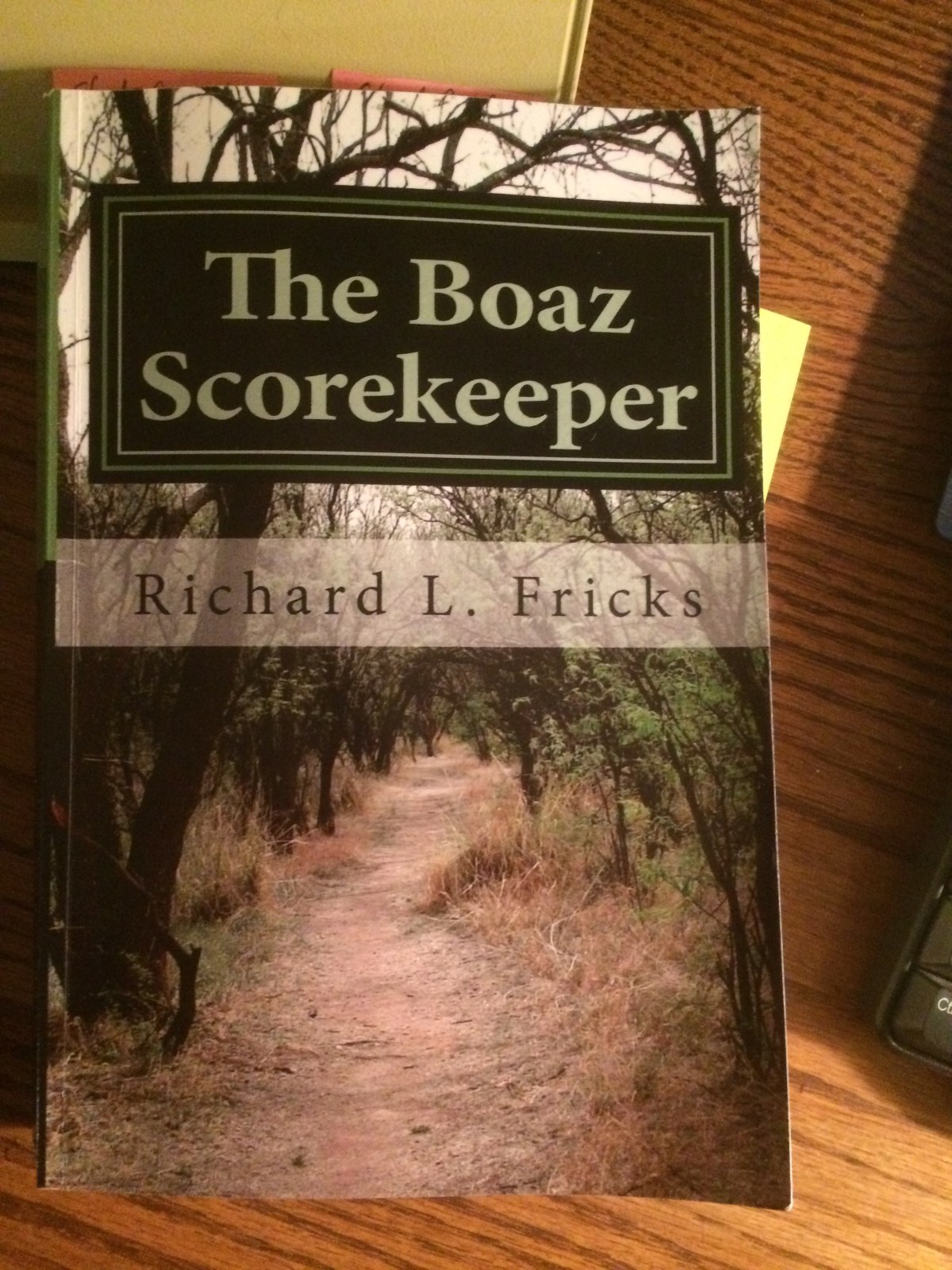
The Boaz Scorekeeper, written in 2017, is my second novel. I'll post it, a chapter a day, over the next few weeks.
The first chance I had to visit Mr. Maples was Thursday afternoon. I didn’t have any trouble finding where he lived. Matt had fished in his pond when he was a kid.
I had not called ahead. I figured my chance for talking with Harold was increased by a surprise visit. A middle-aged lady, who I later learned was Bea Rogers, Harold’s caregiver, answered the door bell. I gave her my business card and told her I needed a few minutes with Mr. Maples. She first said that he did not accept visitors. I told her that I thought he would make an exception for me since I was a lawyer and was there to decide whether my decision to include him in a lawsuit on behalf of the Sand Mountain Bank was the correct decision. I told her that he didn’t have to speak to me now if he had rather have the Sheriff come pick him up and take him to the county courthouse for a formal deposition. I did take a little liberty by enlisting the Sheriff’s help at this point. Ms. Rogers left me standing outside the front door on the porch to go discuss my offer with Harold. It took her nearly five minutes to return.
She invited me in and led me to a glassed-in room on the back of the house. With the afternoon sun and a five-brick gas heater, it felt like 125 degrees in the room, but Harold still had a heavy coverlet over his legs as he sat in a lounge chair. I introduced myself and told him that my purpose in coming was to make a friend and an ally and not an enemy. I told him about Matt and me buying the building downtown where the Sand Mountain Bank had started its operations in 1931. I also told him that I had figured out that he had embezzled 25% of the City’s occupational tax monies. I was surprised that he didn’t offer more resistance.
“What tipped you off?”
“I found one of your journals in a box upstairs in a storage room. It was in a wooden box with a bunch of receipts journals from 1972. It had a monthly entry detailing the ‘Occ tax’ and ‘CE’s share.’ I was familiar with Club Eden and figured that’s what ‘CE’ stood for. Actually, it was just a guess at first.”
“I’ve wondered for years what happened to that particular journal. When the bank moved I brought all my other personal journals home. I had kept them in my office in an old safe that Ron Garrett, the Bank’s President, gave me in the late 30’s when he renovated his office and bought a newer safe. By the way, you haven’t told me how you really figured out what I was doing.” Harold said.
“My law partner’s father worked for Majestic Mobile Homes as a bookkeeper in the Fifties. He said that the Boaz City Council had passed a 2% occupational tax in late 1945 and the Sand Mountain Bank was awarded the fiduciary contract. Every employer within the City limits had to file a monthly report and withhold 2% from each employee’s paycheck. The employer then had to remit this, along with the report, to the Bank by the 20th of the month following the withholding month. Truth is, I never figured out how you were diverting the money. Care to tell me?”
“You probably know that one of the Adams’ has held the Mayor’s job forever, probably seventy-five or eighty years. When the occupational tax started, Eugene Adams was the Mayor and I assume you know that he was a member of the Club.”
“I do.”
“Eugene set up an account at First State Bank of Boaz and was the only signatory. After the tax program started, I would write two checks per month. One to the City’s general fund for 75% of the tax, and one to the City’s fund at First State. It was surprising that no one ever asked to see the actual payroll tax reports. It didn’t hurt that Eugene was always doing favors for the City’s bookkeeper.”
“What happened to the tax funds in the account at First State Bank?”
“Again, I assume you know that Fitz Billingsley’s father, Farris Billingsley, was a Club member?”
“Yes, I do.”
“Eugene would write a monthly check to a rotating list of City vendors and Farris would cash the check. He would remove 10% for a tithe and then divide the remaining money into six parts, giving me a part and each of the five Club members a part.”
“Why on earth did he pay a tithe?”
“Are you a heathen? The tithe is the Lord’s. The money we received from the occupational tax was our earnings. We owed it to the Lord.”
“That’s about the strangest reasoning I’ve ever heard. But, I have another question.” I said with no doubt a puzzled look on my face.
“How did you get involved with the Club and this embezzlement scheme?”
“I was a plant from day one. What I mean is Eugene and the other four Club members approached me in 1930 when the Sand Mountain Bank was being organized. You might imagine that Farris’ First State Bank was against another bank in town. They tried to come up with a way to stop it altogether but it was probably the only time they were beaten. But, it didn’t stop them from conniving. I made a deal with them and applied for the bookkeeping job. I got the job. Of course, it didn’t hurt that I was highly qualified. By the way, the tax scheme was not the only creation I came up with.”
“I bet. But, for now I need to ask you another question.” I pulled out Journal 15 and opened to the first entry concerning Vincent Prader. “What did you mean here when you wrote, ‘Vincent Prader opened acct. $1,200.00. Needs lesson.’?”
“You do know that to open a new business in Boaz you have to have the Club’s approval and blessing?”
“I am beginning to recognize that.” I said.
“Most every business in Boaz is under the Club’s thumb. There are a lot of small, mom and pop businesses that have sprouted but they have little staying power. They are really a diversion. The Club can take them out most any time. The problem arises for new businesses if they are a direct competition to the Club, better put, to the Club members personal businesses. Vincent Prader had Boaz in the palm of his hand. What I mean is the citizens, almost the entire community, loved him. Gosh, he was a true war hero. But, Adams Chevrolet had a monopoly on new and used car sales in the City. The Club was committed to protecting its own. When I learned that Prader was investigating opening a Volkswagen dealership I told Fitz. And, to make matters even worse, the Club members hated Germans, rightly so because of the war. They would never stand for a German made car being sold in Boaz, Alabama.”
“What did they do?”
“I knew I had to keep the Club satisfied so I would offer advice to show them how much a team player I was. These tips usually earned me a nice bonus at the end of the year. You do see don’t you how that with me at the Sand Mountain Bank and with Fitz at First State Bank we pretty much were in the heartbeat of the Boaz economy. A banker knows more about the folks in the community than the preacher does.”
“So, what happened to Prader?” I asked.
“He and his wife, Helga Katz, moved back to Germany.”
“You know this for a fact?”
“Son, that’s code for they disappeared.”
“The Club killed them, didn’t it?”
“I have no knowledge of that.”
“Why do I think you are lying to me?”
“That’s your problem not mine.”
“Let’s see about that. There is no statute of limitations for murder. It sure looks like you conspired with the Club to murder Vincent Prader. I know you are old but do you really want to be arrested, go through a long trial, and end up spending your last days in a cold and damp jail cell?”
“I wouldn’t live a month in prison. Can we make a deal?”
“We can if you will be completely truthful with me. I need to know everything you know about the criminal activities of the Club and its members.” I said.
Harold’s caregiver came in and gave him his afternoon medicine and a small glass of water. She looked at me with a ‘are-you-about-done-look’ and said. “Harold needs his rest, you need to be wrapping this up.”
Harold ignored her and said, “There are two other murders that I’ve heard about. I don’t have any direct proof for either of them. I am confident that Vincent Prader and his wife are buried somewhere in a secret grave. I’m not as sure about the other two murders.”
“Tell me what you have heard.” I said.
“I don’t know much because they were before my involvement with the Club but they seem to fit its pattern. In 1901 Leroy Jones and his family moved to Boaz from Gadsden. From all I gathered, they were a loving, God-fearing family that wanted nothing more than to earn a living and raise a family. Problems started when they tried to attend First Baptist Church of Christ, and when Leroy tried to enroll his children in the Boaz schools. But, the triggering event was when Rudolph discovered his daughter was overly frisky with Leroy’s son Toby. Long story short is the Club was not about to have a black family living in Boaz.”
“So, they moved back to Gadsden?”
“Well, Leroy’s wife and daughter did. Sally, I think that was the daughter’s name. Leroy was found hanging from a big oak tree down close to Nedmore Store. Toby didn’t do any better.”
“Courtesy of the Club?”
“If I had to bet, yes. But, that’s just my opinion, not based on knowledge.”
“What about the other murder you mentioned?”
“It was 1926, same type of thing happened when a homosexual couple moved into town. By the time the Club found out about the two men’s sexual orientation, they had already leased a building for a flower shop. Actually, they had already received an initial shipment to stock their store.”
“What happened?”
“Seems the couple had a sudden change of plans and sold the shop to Benjamin Ericson’s girlfriend, the woman who became his wife.”
“Do you have a similar opinion about what happened to the homosexual couple?”
“I do, definitely.”
“One other question before I go. What made you decide to break your oath to the Club?”
“I didn’t take an oath.”
“You were or are a member of Club Eden, right?”
“No, absolutely not. You have to be a Tillman, an Adams, a Radford, a Billingsley, or an Ericson to be a member of that Club.”
“Do you know if the Club had any other ‘Harold Maples’ types that it dealt so closely with?”
“I feel confident there were many other little sheep like myself, but I don’t know. The Club is rather secretive if you know what I mean.”
“I do. Back to our deal. I will need you to submit to a deposition. It can take place here if you like.”
“Is that absolutely necessary. I’ve told you everything I know.”
“And, I appreciate that but all that will simply be hearsay coming from me. Why are you so reluctant? Does the Club still control you?”
“The Club is always in control. I’m just trying to weigh which is worse, prison or moving back to Germany if you know what I mean.”
“What if I talked to the District Attorney and he got you protection?”
“Oh, the hell with it, set up the deposition. I am 93 years old. I’ve lived a good life. It’s time to put an end to all this.”
“Thank you for your time today. I’ll be in touch.” I said as Harold pulled another coverlet from the floor across his legs.
I left and headed back to the office feeling that I had probably talked with Harold Maples for the last time.
Biking is something I both love and hate. The conflicting emotions arise from the undeniable physical effort it demands. However, this exertion is precisely what makes it an excellent form of exercise. Most days, I dedicate over an hour to my cycling routine, and in doing so, I’ve discovered a unique opportunity to enjoy a good book or podcast. The rhythmic pedaling and the wind against my face create a calming backdrop that allows me to fully immerse myself in the content. In these moments, the time spent on the bike seems worthwhile, as I can’t help but appreciate the mental and physical rewards it offers.
I especially like having ridden. The post-biking feeling is one of pure satisfaction. The endorphin rush, coupled with a sense of accomplishment, makes the initial struggle and fatigue worthwhile. As I dismount and catch my breath, I relish the sensation of having conquered the challenge, both physically and mentally. It’s a reminder that the things we sometimes love to hate can often be the ones that bring us the most fulfillment. In the end, the love-hate relationship with biking only deepens my appreciation for the sport, as it continually pushes me to overcome my own limitations and embrace the rewards that follow the effort.
My bike
A Rockhopper by Specialized. I purchased it November 2021 from Venture Out in Guntersville; Mike is top notch! So is the bike. The ‘old’ man seat was salvaged from an old Walmart bike (update: seat replaced, new photo to follow, someday).
Something to consider if you’re not already cycling.
I encourage you to start riding a bike, no matter your age. Check out these groups:
Don’t miss the #1 New York Times bestselling blockbuster and Reese Witherspoon Book Club Pick that’s sold over 2 million copies–now an Apple TV+ limited series starring Jennifer Garner!
The “page-turning, exhilarating” (PopSugar) and “heartfelt thriller” (Real Simple) about a woman who thinks she’s found the love of her life—until he disappears.
Before Owen Michaels disappears, he smuggles a note to his beloved wife of one year: Protect her. Despite her confusion and fear, Hannah Hall knows exactly to whom the note refers—Owen’s sixteen-year-old daughter, Bailey. Bailey, who lost her mother tragically as a child. Bailey, who wants absolutely nothing to do with her new stepmother.
As Hannah’s increasingly desperate calls to Owen go unanswered, as the FBI arrests Owen’s boss, as a US marshal and federal agents arrive at her Sausalito home unannounced, Hannah quickly realizes her husband isn’t who he said he was. And that Bailey just may hold the key to figuring out Owen’s true identity—and why he really disappeared.
Hannah and Bailey set out to discover the truth. But as they start putting together the pieces of Owen’s past, they soon realize they’re also building a new future—one neither of them could have anticipated.
With its breakneck pacing, dizzying plot twists, and evocative family drama, The Last Thing He Told Me is a “page-turning, exhilarating, and unforgettable” (PopSugar) suspense novel.
A major challenge in this time of declining Christian belief is finding a
hot button issue that keeps gullible followers enraged and engaged and dropping their Social Security dollars here and there into collection plates. For decades, one reliable sales pitch for evangelicals and Catholics was the specter of the homosexual menace, but as recently noted, “When the Supreme Court declared a constitutional right of same-sex marriage nearly eight years ago, social conservatives were set adrift. The ruling stripped them of an issue they had used to galvanize rank-and-file supporters and big donors. And it left them searching for a cause that — like opposing gay marriage — would rally the base and raise the movement’s profile on the national stage. “We knew we needed to find an issue that the candidates were comfortable talking about,” said Terry Schilling, the president of American Principles Project, a social conservative advocacy group. “And we threw everything at the wall.” I’m sure Schilling really meant to say, “We threw everything at the wall after much prayer and deliberation.”
In any case, Schilling’s prayers were answered: the transexual panic “had driven in thousands of new donors to the American Principles Project, most of them making small contributions.”[1]
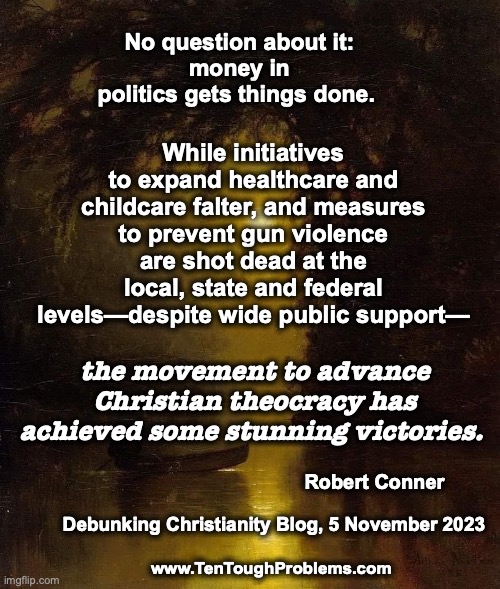
No question about it: money in politics gets things done. While initiatives to expand healthcare and childcare falter, and measures to prevent gun violence are shot dead at the local, state and federal levels—despite wide public support—the movement to advance Christian theocracy has achieved some stunning victories. A case in point is the rise of the Alliance Defending Freedom (ADL), launched in early 1994 by a coterie of evangelical leaders that included millionaire preachers D. James Kennedy, James Dobson, Don Wildmon and Bill Bright, founder of the Campus Crusade for Christ. The ADL, designated an “anti-LGBTQ hate group” by the Southern Poverty Law Center, enjoys 501(c) tax exemption; it’s treated like a church, or in evangelical speak, a “legal ministry” whose basic purpose is to obliterate the separation of church and state. In 2011, tax filings pegged the ADL’s worth at $35 million which rose to $48 million by fiscal year 2015. By 2021, the ADL reported $104.5 million according to filings with the IRS.[2]
The Real Christian™ fixation on things sexual — divorce, pornography, abortion, and all things LGBTQ — is a boondoggle for lawyers, lobbyists, and “expert” witnesses. Case in point, Dr. Daniel Weiss, an endocrinologist, “said in a deposition that Do No Harm paid him about $8,000, at $325 an hour, for submitting written testimony in states like Indiana, Utah, North Dakota and Wyoming in support of bans on gender-affirming care for minors…The Indiana Attorney General’s office paid Weisss $49,691 for four weeks of consulting, according to records obtained by HuffPost.” Before its fascination with anti-trans legislation, Do No Harm “initially concentrated on fighting diversity efforts in medicine, bringing lawsuits against a health journal for offering an unpaid mentorship to people of color and challenging California’s implicit bias training for physicians.”[3]
The new anti-trans gold rush has drawn prospectors from the far corners of Baptistland. “The president of Trinity International University this week sent out a fundraising letter complaining about cultural acceptance of transgender people and linking acceptance to the recent mass shooting that left six people dead in Nashville, Tenn.” In response to Nicholas Perrin’s fanciful claim, David Cramer, a Trinity alumnus and seminary professor, said,
“This letter is flippant, calloused and dangerous. It reads like a fundraising letter for a right-wing political action group instead of a place of theological education.”[4]
Noting that outfits such as the Alliance Defending Freedom, the Family Research Council and the American Principles Project “are behind a multi-million-dollar effort targeting LGBTQ rights,” a recent report details their strategy:
“The groups have provided templates and support for similarly worded [“parents’ rights”] bills that seek to ban minors from attending drag shows, prevent trans youth from receiving gender-affirming care, and restrict their participation in high school sports.”
The push to interpret human sexuality theologically has paid off: “Many Republicans have embraced that agenda, touting a ‘protect the children’ platform for 2024 that targets school policies on gender identity and how racial issues are taught.”[5] “Several states have introduced [Alliance Defending Freedom] model legislation requiring schools to get parental consent for any lessons about gender identity; a lawyer affiliated with A.D.F. helped draft a Florida measure that L.G.B.T. advocates call the ‘Don’s Say Gay’ law…In an internal briefing, the head of its legislative effort said that A.D.F. had ‘authored’ at least a hundred and thirty bills in thirty-four states last year; more than thirty were passed into law.”[6]As of this writing, 85 anti-trans bills have passed out of 583 proposed in 49 states. Clearly business is booming.
With espousing segregation now off limits as a campaign and fundraising tactic and 70% of the public — including 55% of Republicans — in favor of civil rights for LGBTQ Americans, religious fundamentalists appeared to score a long-awaited victory when the Supreme Court overturned Roe v. Wade, but 85% of the American public supports abortion, in at least some circumstances which puts the theocrats in the awkward position of the dog that caught the car.
So far the Dobbs decision has the makings of a pyrrhic victory; the prayer warriors need to pivot, but do they have anywhere left to go? Robert P. Jones, the CEO of the Public Religion Research Institute, summed up the problem this way:
“As someone who writes social science, I can’t tell you how many sentences I’ve begun with the words, ‘with the lone exception of white evangelical Protestants.’ Whether it is on immigration, LGBTQ issues, abortion — white evangelical Christians are increasingly outliers to the middle of the country, not just to the left…They have shrunk by nearly a third just over the last decade. Today, they are 14.5 percent of the population. And as they have shrunk, they have been hemorrhaging young people…It’s that dynamic that is driving the fundraising. There’s a kind of last-stand desperation, an apocalyptic feeling that if we don’t do something now, we will lose the country. And if we don’t do something to win it back, there will never be another opportunity.”[7]
Evangelicals — particularly those of pale complexion — understandably fear Elvis has left the building. Tidings from Western Europe and large parts of North America would tend to confirm their fears.[8] True to form, their response has been apocalyptic: burn it to the ground. Society will be reordered to reflect their “christendomic” view that the right wing of the fundamentalist church is the state and to achieve this end various “legal ministries” are quietly positioning lawyers. “Our research indicates that many of these individuals have clerked for multiple state judges, federal judges, state attorneys general, and are in the midst of working their way upwards in the echelons of government. While there does appear to be a fair gender balance amongst known Blackstone alumni, of the ones we were able to identify, they were overwhelmingly white and, of course, exclusively Christian.”[9] Current polling shows that 31% of white evangelical Protestants believe “true American patriots may have to resort to violence to save the country.”[10]
But even those who expect the unexpected didn’t see Mike Johnson coming. The new Speaker of the House — elected unanimously by his Republican colleagues — has an interesting history to say the least. “Few would especially remember the role he played within the larger story of Southern Baptist higher education in recent years.” Louisiana Christian University planned to open a law school “named after Judge Paul Pressler, one of the principal architects of the ‘conservative resurgence’ in the Southern Baptist Convention.” Johnson “was named dean of the forthcoming Pressler School of Law…clearly instituted to be a training ground of Christian lawyers who would unite constitutional originalism with social conservatism and the defense of religious privilege.”
The Pressler School of Law never opened. The Southern Association of Colleges warned the school “for significant non-compliance with multiple standards of accreditation” and in 2012 “denied an ascent from Level III to Level V accreditation that would allow the proposed law school to confer degrees.”[11] Needless to say, Johnson’s appointment at the misbegotten not-a-law-school is unmentioned on his résumé.
Nevertheless, the newly elected speaker has quite the CV: “He defended Donald Trump at both of his impeachment hearings, helped plot the Jan. 6 attempted coup, and holds hardline positions on everything from abortion to LGBTQ rights. He worked for the [Alliance Defending Freedom] from 2002 until 2010, penning op-eds against marriage equality and endorsing briefs filed by the ADF meant to criminalize sexual activity between consenting adults.”[12] No evangelical prayer warrior’s bona fides would be complete without a defense of “young Earth creationism” and Johnson can check that box as well. Johnson represented creationist Ken Ham, helping his Ark Encounter, which claims people and dinosaurs lived at the same time, “secure millions in state tourism subsidies.” Regarding Ham’s Ark exhibit, Johnson proclaimed it “is one way to bring people to this recognition…that what we read in the Bible are actual historical events” and praised the Creation Museum for “doing maybe the best work right now in our generation of pointing people to the truth.”[13] “Hours before the Capitol insurrection on January 6, 2021, Johnson posted on X, “We MUST fight for election integrity, the Constitution, and the preservation of our republic! It will be my honor to help lead that fight in the Congress today.” Later that day, Johnson was among the 147 Republicans that voted to overturn the election…Over a year after January 6, 2021, Johnson ‘continued to argue that he and his colleagues had been right to object to the election results’ on his religious podcast Truth Be Told. When asked in a press conference on Tuesday about his involvement in attempting to overturn the 2020 election, Johnson did not answer. The Republicans surrounding him ‘drown[ed] out [the reporter’s] question with laughter and booing.’”[14] Whatever the eventual fate of American democracy, we can take at least some consolation, knowing as we must, that the stage is now set for more rounds of Christian “fundraising,” and that the careers of preachers and pols, as well as other shysters and shills are, at least for the moment, secure.
[1] Adam Nagourney & Jeremcy W. Peters, “How a Campaign Against Transgender Rights Mobilized Conservatives,” The New York Times, April 16, 2023.
[2] Adam Gabbatt, “Revealed: Christian legal non-profit funds US anti-LGBTQ+ and anti-abortion organizations,” The Guardian, June 30, 2023.
[3] Molly Redden, “This Billionaire Hedge Funder Is Quietly Financing Anti-Trans Advocacy Across the U.S.,” huffpost.com, October 26, 2023.
[4] Mark Wingfield, “Evangelical university president seeks to raise money by casting blame on transgender people,” baptistnews.com, April 18, 2023.
[5] Russell Contreras, “The forces behind anti-trans bills across the U.S,” axios.com, October 23, 2023.
[6] David D. Kirkpatrick, “The Next Targets for the Group That Overturned Roe,” newyorker.com, October 2, 2023.
[7] Stuart Richardson, “Groups opposed to gay rights rake in millions as states debate anti-LGBTQ bills, nbcnews.com, March 23, 2022.
[8] Robert Conner, The Death of Christian Belief, 2023.
[9] Sofia Resnick & Sharona Coutts, “Not the Illuminati: How Fundamentalist Christians Are Infiltrating State and Federal Government,” rewirenewsgroup.com, May 13, 2014.
[10] Fiona André, “Poll: More religious Americans support the use of political violence,” religionnews.com, October 25, 2023.
[11] Christopher Schelin, “New speaker of the House once led never-opened Paul Pressler School of Law, baptistnews.com, October 25, 2023.
[12] Spencer MacNaughton, “Inside the Alliance Defending Freedom, the Anti-LGBTQ Org Where Mike Johnson Spent Almost a Decade,” rollingstone.com, October 29, 2023.
[13] Liz Skalka & Paul Blumenthat, “New House Speaker Thinks Creationist Museum Is ‘Pointing People To The Truth,” huffpost.com, October 26, 2023.
[14] Judd Legum, Tesnim Zekeria & Rebecca Crosby, “What everyone should know about the new House Speaker, Mike Johnson,” popularinformation@substack.com, October 26, 2023.
The Boaz Scorekeeper, written in 2017, is my second novel. I'll post it, a chapter a day, over the next few weeks.
I arrived home, unloaded the truck and set fire to the product of our day’s demolitions. Karla had cooked my favorite meal of pinto beans, cornbread, fried potatoes, and coconut pie. Even though I was tired, after supper, Karla and I took turns playing chess with Lewis. We were fortunate he was still at the age he would spend real quality time with his parents.
At 10:45 p.m., Lewis called it quits after capturing Karla’s King. He went to bed and Karla started reading her Sunday School lesson. I pulled my feet up in my lounging chair and dozed off. At midnight, Karla kissed my forehead and said goodnight. I got up and walked to the kitchen and saw Journal 15 laying on the counter. I drank a glass of water and brought the journal back to my chair. I was no longer sleepy.
All I knew before I started to read was Fitz and Harold were apparently friends and he was a bookkeeper at the Sand Mountain Bank. And, according to Fitz, a very creative bookkeeper. I assumed the letter had been written by Fitz Billingsley given the oddity of his first name. I didn’t know Harold’s last name. I was puzzled. I had found Journal 15 in an old storage room, a hidden one at that, of the Sand Mountain Bank, Fitz’ First State Bank of Boaz only competitor. I became even more puzzled when I read the first journal entry, dated January 21, 1946, one I assume was written by Harold:
Period: December 1945
Gross Wages $57,927.96
Tax $1,158.56
No. Workers 1049
Avg. No. Hours 227.28
Avg. Mo. Earnings $55.22
Avg. Hourly Rate $.2430
CE’s share $289.64
Tithe $28.96
This appeared to be some type of payroll tax report. For some reason, I flipped to the back of the journal and in the middle of the next to the last page was this entry:
Period: November 1946
Gross Wages $60,374.18
Tax $1,207.48
No. Workers 1093
Avg. No. Hours 226.13
Avg. Mo. Earnings $55.22
Avg. Hourly Rate $.2442
CE’s share $301.87
Tithe $30.19
I flipped back to the front and was even more confused after reading the second journal entry. It was dated February 3, 1946: “Vincent Prader opened acct. $1,200.00. Needs lesson.”
Even though it was nearly 11:00 p.m., I called Matt and read him these three entries. He had me calculate the tax as a percentage of the gross wages. In both entries, it was 2%. Matt said that sounded like the City’s occupational tax that started at the end of the war. I asked him did he have any idea who Harold was. He didn’t even pause to think but said, “Harold Maples. He is a landmark, worked 50 years at least for the Sand Mountain Bank. Started as a bookkeeper and stayed in that position all those years. The man has staying power that’s for sure. I bet he is nearly a 100 years old. As far as I know he still lives in the old home place where he grew up, down College Avenue.”
Matt and I speculated for a while about Harold and Fitz’ relationship. I told him it appeared that Journal 15 was personal to Harold and was not a part of the official banking records like the red and green journals I had found. He asked why then was the black journal in with these official journals. I said I didn’t have a clue. We hung up, leaving me just as confused and aggravated that I hadn’t asked Matt about Vincent Prader. I called Matt back but he couldn’t remember. I called it a night and went to bed.
Matt and I worked nearly all-day Sunday removing three layers of vinyl from the reception room floor. We didn’t venture up into the upstairs storage room.
Monday, before going into the law office, I dropped by the library and had Barbara Mills, the head librarian since the Boaz Library was formed in 1929, show me how to use the microfiche machine. I told her I wanted to review all issues of the 1945 and 1946 Sand Mountain Reporter, the oldest newspaper in the area. After an hour or so I found an article with the headline, “Invincible Prader Returns a Hero.” After reading the article I learned ‘Invincible’ was a nickname for Vincent Prader. He was a highly decorated army hero who returned home in mid-December 1945. Vincent had grown up south of Boaz in the Red Apple community and had graduated Boaz High School May 20, 1940, volunteering for the Army two days later. The article went on to describe how Prader had single-handedly fought four Germans to save his friend Malcom Jackson of Memphis. The article said Prader and his German born wife, Helga, were planning on opening a Volkswagen auto dealership in Boaz.
At 10:00 a.m., Barbara stuck her head in the cramped little media room and said that Matt had called and that my 10:30 appointment was already there. I closed my notebook and turned off the microfiche machine. When I was nearly to the Library exit, I turned and asked Barbara if she knew anything about a Vincent and Helga Prader. She said, “yes, sadly so. Vincent returned from World War II a hero and bought the Miller property on North Main to operate a Volkswagen dealership. A few days before it opened, right after a load of Beetle cars were delivered, I think it was around Thanksgiving 1946, he and his wife went missing. They never were found. I can’t believe you don’t remember. Oh, sorry. That was before your time. The bottom line is that story rocked Boaz for years.”
As I drove to the law office, I had a gut feeling that Fitz Billingsley and Harold Maples had taught Vincent and his wife a lesson. If possible, I was going to pay Mr. Maples a friendly visit.
Biking is something I both love and hate. The conflicting emotions arise from the undeniable physical effort it demands. However, this exertion is precisely what makes it an excellent form of exercise. Most days, I dedicate over an hour to my cycling routine, and in doing so, I’ve discovered a unique opportunity to enjoy a good book or podcast. The rhythmic pedaling and the wind against my face create a calming backdrop that allows me to fully immerse myself in the content. In these moments, the time spent on the bike seems worthwhile, as I can’t help but appreciate the mental and physical rewards it offers.
I especially like having ridden. The post-biking feeling is one of pure satisfaction. The endorphin rush, coupled with a sense of accomplishment, makes the initial struggle and fatigue worthwhile. As I dismount and catch my breath, I relish the sensation of having conquered the challenge, both physically and mentally. It’s a reminder that the things we sometimes love to hate can often be the ones that bring us the most fulfillment. In the end, the love-hate relationship with biking only deepens my appreciation for the sport, as it continually pushes me to overcome my own limitations and embrace the rewards that follow the effort.
My bike
A Rockhopper by Specialized. I purchased it November 2021 from Venture Out in Guntersville; Mike is top notch! So is the bike. The ‘old’ man seat was salvaged from an old Walmart bike (update: seat replaced, new photo to follow, someday).
Something to consider if you’re not already cycling.
I encourage you to start riding a bike, no matter your age. Check out these groups:
Don’t miss the #1 New York Times bestselling blockbuster and Reese Witherspoon Book Club Pick that’s sold over 2 million copies–now an Apple TV+ limited series starring Jennifer Garner!
The “page-turning, exhilarating” (PopSugar) and “heartfelt thriller” (Real Simple) about a woman who thinks she’s found the love of her life—until he disappears.
Before Owen Michaels disappears, he smuggles a note to his beloved wife of one year: Protect her. Despite her confusion and fear, Hannah Hall knows exactly to whom the note refers—Owen’s sixteen-year-old daughter, Bailey. Bailey, who lost her mother tragically as a child. Bailey, who wants absolutely nothing to do with her new stepmother.
As Hannah’s increasingly desperate calls to Owen go unanswered, as the FBI arrests Owen’s boss, as a US marshal and federal agents arrive at her Sausalito home unannounced, Hannah quickly realizes her husband isn’t who he said he was. And that Bailey just may hold the key to figuring out Owen’s true identity—and why he really disappeared.
Hannah and Bailey set out to discover the truth. But as they start putting together the pieces of Owen’s past, they soon realize they’re also building a new future—one neither of them could have anticipated.
With its breakneck pacing, dizzying plot twists, and evocative family drama, The Last Thing He Told Me is a “page-turning, exhilarating, and unforgettable” (PopSugar) suspense novel.



























 At that moment, there were 3,147,740,103,497,276,498,750,208,327 atoms in her body. Of her total mass, 63.7 percent was oxygen, 21.0 percent carbon, 10.1 percent hydrogen, 2.6 percent nitrogen, 1.4 percent calcium, 1.1 percent phosphorous, plus a smattering of the ninety-odd other chemical elements created in stars.