Write to Life blog

Teachings of Jesus that Christians Dislike and Ignore, Number 2

By David Madison 2/24/23.

Here’s the link to this article.

They just say NO to their Lord and Savior
Weird scripture has given rise to weird versions of Christianity. In Mark 16 the resurrected Jesus assures those who believe that they will be able to “pick up snakes”—as well as drink poison, heal people by touch, speak in tongues, and cast out demons (Mark 16:17-18). So there are indeed Christian sects today that make a big deal of handling snakes, and on occasion we read that a   snake-handling preacher has died. These folks didn’t get the word that this text is found in the fake ending of Mark—that is, verses 16:9-20 are not found in the oldest manuscripts of the gospel; these were added later by an unknown crank. Most Christians today, we can assume, do not rank these among their favorite Bible verses. 

Indeed there are many verses that the devout pretend aren’t there, because these verses have a strong cult flavor.  I’m sure that the community of the faithful today are shocked to hear their religion called a cult—they wince at this designation. But they don’t pick up on this fact because they are unaware of so many embarrassing verses, especially in Jesus-script in the gospels. Unaware is one way to put it, obtuse is also appropriate. Or they’re just careless, in the sense of not taking care to read the gospels. If they took seriously the claim that the gospels are the word of their god, why don’t they binge-read these basic four documents, to discover as much detail as possible about their lord and savior?

The clergy are thankful they don’t. Their parishioners might soon appreciate why the word cult works pretty well in describing early Christianity. New Testament scholars noticed this a long time ago. But most church folks are unaware of their writings, and are happy to worship Jesus as presented to them by the church, since they were toddlers. 

One of the signs of cult fanaticism is the demand for absolute loyalty. Another is weird belief about how a god is going to intervene in human history. One manifestation of this at the time of Jesus was messianism: belief that god would send a mighty holy hero who would put things right. For believers in first century Palestine, this included throwing out the Romans, and this would be a cataclysmic event with widespread death and suffering. The early Jesus cult embraced this idea, savoring the idea that their god would get even. This idea of vengeance—and the demand for absolute devotion to the cult—ended up in Jesus-script. It doesn’t fit at all with carefully nurtured Sunday School image of Jesus that so many of the devout adore today.  

It is quite common for Christians today to give high ratings to family values. They are confident that Jesus placed high value on family love and loyalty—hence his severe condemnation of divorce. But in Matthew’s 10th chapter we find Jesus counseling his disciples on the problems they’ll face as a consequence of following him. However, this reads more like a warning—written by Matthew well after Jesus had died—to those who belonged to the Jesus cult. Nonetheless this is presented as Jesus-script, often printed in red as a guarantee that these are authentic words of Jesus:

 “Do not think that I have come to bring peace to the earth; I have not come to bring peace but a sword.For I have come to set a man against his father, and a daughter against her mother, and a daughter-in-law against her mother-in-law,and one’s foes will be members of one’s own household” (Matthew 10:34-36). In Mark 13:12-13 we find a similar warning: “Sibling will betray sibling to death and a father his child, and children will rise against parents and have them put to death,and you will be hated by all because of my name. But the one who endures to the end will be saved.” 

The next couple of verses derail even more into cult fanaticism, i.e., the holy leader expects a supreme level of devotion: “Whoever loves father or mother more than me is not worthy of me, and whoever loves son or daughter more than me is not worthy of me, and whoever does not take up the cross and follow me is not worthy of me” (Matthew 10:37-38).

If the author of Luke’s gospel was aware of this Jesus-script, he clearly wasn’t happy with it. He wanted the meaning to be bluntly clear: “Whoever comes to me and does not hate father and mother, wife and children, brothers and sisters, yes, and even life itself, cannot be my disciple” (Luke 14:26). Luke felt that the word hate would make the point better, i.e., that the cult expected undivided loyalty. Not only hatred of family was required, but even of life itself.

Why isn’t this verse a deal breaker? If you’ve been taught for years to adore Jesus, but then discover this verse (and even the milder one in Matthew), why not head for the exit? Is this the holy hero you really want? The most common response to this text I’ve heard is, “Oh, Jesus couldn’t have meant that!” This is based on the idealized image of Jesus firmly lodged in pious brains. But the Greek word for hate is right there? How do these excuse-makers know—some 2,000 years after the fact—what Jesus was thinking? What’s the data to back up this claim? Isn’t Luke supposed to be reliable reporter—according to Christian theology? He quoted Jesus using the word hate.

It’s not hard to spot the maneuvering used by church authorities to disguise the plain meaning of the text. In the Revised Standard Version, the editors chose this heading for Luke 14:25-33: The Cost of Discipleship. Most of the devout probably assume that following Jesus makes demands on their lives, so this heading gives no offense. But an honest heading would have been, The Cult Fanaticism Displayed by Jesus. We could put it bluntly to churchgoers: do you indeed love Jesus so much that you hate your family? To keep people in the dark, some modern translations simple remove the word hate. The Message Bible’s version of Luke 14:26: “Anyone who comes to me but refuses to let go of father, mother, spouse, children, brothers, sisters—yes, even one’s own self!—can’t be my disciple.” 

Does “let go” of family members and even life itself render this text more acceptable? Even more contemptable: this is not a translation. This is a paraphrase to disguise the meaning of Luke’s Jesus-script. Plainly stated: this “translator” is lying; he doesn’t want readers to know what’s in the Bible. When cult fanaticism is so obvious, cover it up

What’s the reason for not heading for the exit? There can be major consequences for leaving the church, for saying out loud that you no longer believe. This is alarming for those who still embrace Jesus, and they often shun those who have made the brave decision. Or they declare that eternal punishment in fire is the reward for disbelief: “Whoever believes in the Son has eternal life; whoever disobeys the Son will not see life but must endure God’s wrath” (John 3:36). “The one who believes and is baptized will be saved, but the one who does not believe will be condemned” (Mark 16:16).

Even before Matthew and Luke had created their strident Jesus script about “loving Jesus more than family” and “hating family to be a disciple,” Mark presented a story of Jesus identifying true believers as his real family:

“Then his mother and his brothers came, and standing outside they sent to him and called him. A crowd was sitting around him, and they said to him, ‘Your mother and your brothers are outside asking for you.’ And he replied, ‘Who are my mother and my brothers?’And looking at those who sat around him, he said, ‘Here are my mother and my brothers! Whoever does the will of God is my brother and sister and mother.’” (Mark 3:31-35).

The Revised Standard Version editors calls this section: The True Kindred of Jesus, endorsing Jesus slighting his family.

Whoever does the will of God. Cult leaders are always confident that they know what their god wants, and they attract loyal followers who take their word for it. This cult mentality prevails today among Christians who know for sure that their god hates abortion, gay marriage, and separation of church and state. They are eager to gain power and enforce their cult fanaticism, while being blind to their own faults. I’m baffled that the Catholic Church gets away with what it does. It might qualify as the most dangerous cult in the world for this major sin: maintaining a priesthood infiltrated with men who rape children. And coverup seems to be a primary response. 

Here is another example of Luke going beyond Matthew in cult fanaticism. In Matthew 8:19-22, we read:

“A scribe then approached [Jesus] and said, ‘Teacher, I will follow you wherever you go.’ And Jesus said to him, ‘Foxes have holes, and birds of the air have nests, but the Son of Man has nowhere to lay his head.’ Another of his disciples said to him, ‘Lord, first let me go and bury my father.’ But Jesus said to him, ‘Follow me, and let the dead bury their own dead.’”

Luke added this, 9:60-62:

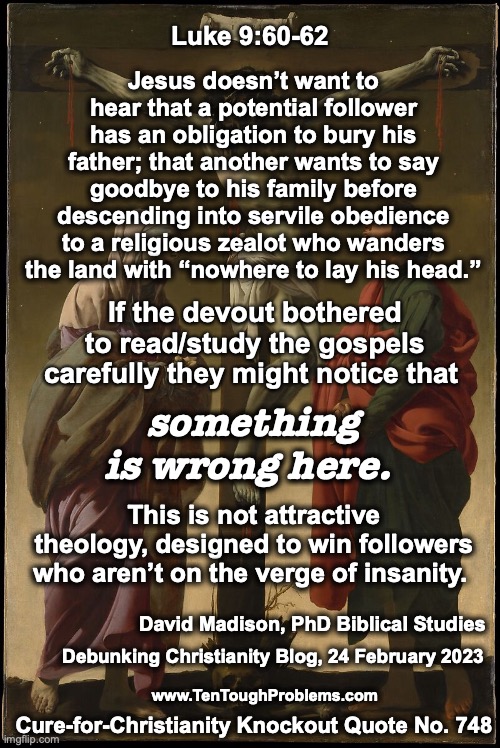
“And Jesus said to him, ‘Let the dead bury their own dead, but as for you, go and proclaim the kingdom of God.’ Another said, ‘I will follow you, Lord, but let me first say farewell to those at my home.’And Jesus said to him, ‘No one who puts a hand to the plow and looks back is fit for the kingdom of God.’”

The cult hero is obsessed with his understanding of the kingdom of god, in this case: if you want to say goodbye to your family, you’re not fit for the kingdom. How is this not cult fanaticism? We have to assume that most churchgoers just aren’t paying close attention. How do they really feel about this? Jesus doesn’t want to hear that a potential follower has an obligation to bury his father; that another wants to say goodbye to his family before descending into servile obedience to a religious zealot who wanders the land with “nowhere to lay his head.” If the devout bothered to read/study the gospels carefully—which in this case means examining the Matthew and Luke texts side by side—they might notice that something is wrong here. This is not attractive theology, designed to win followers who aren’t on the verge of insanity. 

And speaking of insanity, here’s one of my favorite gospel quotes, Mark 3:20-21:

“Then he went home, and the crowd came together again, so that they could not even eat. When his family heard it, they went out to restrain him, for people were saying, ‘He has gone out of his mind.’”

This is not found in the other gospels. We indeed wonder what the author of Mark could have meant by “out of his mind”—Mark who portrayed Jesus as an exorcist. Which is hardly surprising: the ancient world embraced all manner of superstitions. Mark, by the way, knew nothing of the extravagant birth narratives found in Luke and Matthew. When the shepherds visited the manger to see the newborn Jesus, and reported the message of the singing angels (that this Jesus was a savior, the messiah), “… Mary treasured all these words and pondered them in her heart” (Luke 2:19). Wouldn’t she—and the family—have expected out-of-the-ordinary behavior when Jesus set out to proclaim his message?

When we take a close look at all the Jesus-script in the gospels, there is so much that is disappointing—and even alarming, when it reflects apocalyptic delusions. In preparing my 2021 book, Ten Things Christians Wish Jesus Hadn’t Taughtmy list of not-so great—even bad—Jesus sayings came to 292

In this article I’ve focused on a few verses that reflect the extremism of the gospel authors. Article Number 1 in this series is here.

David Madison was a pastor in the Methodist Church for nine years, and has a PhD in Biblical Studies from Boston University. He is the author of two books, Ten Tough Problems in Christian Thought and Belief: a Minister-Turned-Atheist Shows Why You Should Ditch the Faith (2016; 2018 Foreword by John Loftus) and Ten Things Christians Wish Jesus Hadn’t Taught: And Other Reasons to Question His Words (2021). The Spanish translation of this book is also now available. 

His YouTube channel is here. He has written for the Debunking Christianity Blog since 2016.

The Cure-for-Christianity Library©, now with more than 500 titles, is here. A brief video explanation of the Library is here

02/28/23 Biking & Listening

Biking is something else I both love and hate. It takes a lot of effort but does provide good exercise and most days over an hour to listen to a good book or podcast. I especially like having ridden.

Here’s my bike, a Rockhopper by Specialized. I purchased it November 2021 from Venture Out in Guntersville; Mike is top notch! So is the bike, and the ‘old’ man seat I salvaged from an old Walmart bike.

Here’s a link to today’s bike ride. This is my pistol ride.

Here’s a few photos taken along my route:

Here’s what I’m currently listening to: The Fourth Deadly Sin, by Lawrence Sanders

Sanders was a tremendously talented writer.

Amazon abstract:

When a Manhattan psychiatrist is murdered, a retired detective returns to the job, in a thriller by the #1 New York Times–bestselling “master of suspense” (The Washington Post).

On a rainy November night, Dr. Simon Ellerbee stares out the window of his Upper East Side psychiatry office, miserably wishing he could seek counseling for the problems in his seemingly perfect life. He hears the door buzzer and goes to answer it, but flinches when he sees his unexpected guest. Minutes later, he’s dead, his skull crushed by repeated blows from a ball-peen hammer. Once the doctor was down, the killer turned over the body and smashed in Ellerbee’s eyes.  With no leads and a case getting colder by the hour, the New York Police Department calls in former chief Edward Delaney. His search for the truth raises more questions than answers: Who had Ellerbee let into his office? Why were there two sets of wet footprints on the carpeting of the doctor’s townhouse? What caused Ellerbee’s odd personality transformation over the past year? And who murdered, then symbolically mutilated, the prominent Manhattan psychiatrist?

A Sample Five Star Review

Errol Mortland

5.0 out of 5 stars The Best Bubble Gum Ever!

Reviewed in the United States on August 6, 2017

If you’re tired of streaming or cleaning for the moment and need to pass some time, you won’t go wrong with the four Deadly Sins series from Lawrence Sanders. I zip through all of them every other year, in sequence. They’re great reads, and I’ve always pictured George C. Scott as Edward X. Delaney (Frank Sinatra in the movie version of the First in pretty insipid, but apparently he owned the rights).

The Fourth is the murder is Dr Simon Ellerbee, you get the usual palette of suspects, and retired Chief of Detectives gets his crew and does his stuff. If Hemingway wrote crime suspense set in NYC, it’d be like this. I love short descriptive sentences. Not sure I recall seeing “ears like slabs of veal” in this one. If you love New York, Mr Sanders captures its essence like a great musical conductor. The “Sins” series is the best, followed by the “Commandments.” The Arch McNally stuff which followed that is okay, even though they kept the series going after Mr Sanders died in 1998. I just find that disrespectful. I only regret there wasn’t a Fifth Deadly Sin.

Writing Journal—Tuesday writing prompt

Your gamer protagonist discovers that the person he’s been talking to in a chat room is a murderer. Worse, the person seems to know his real name. Write the exchange and your protagonist’s reactions and thoughts. 

One Stop for Writers

Guidance & Tips

Write the scene of discovery (i.e., tell a story), or brainstorm and create a list of related ideas.

Here’s five story elements to consider:

  • Character
  • Setting
  • Plot
  • Conflict
  • Resolution

Never forget, writing is a process. The first draft is always a mess.

The first draft of anything is shit.

Ernest Hemingway

02/27/23 Biking & Listening

Biking is something else I both love and hate. It takes a lot of effort but does provide good exercise and most days over an hour to listen to a good book or podcast. I especially like having ridden.

Here’s my bike, a Rockhopper by Specialized. I purchased it November 2021 from Venture Out in Guntersville; Mike is top notch! So is the bike, and the ‘old’ man seat I salvaged from an old Walmart bike.

Here’s a link to today’s bike ride. This is my pistol ride.

Here’s a few photos taken along my route:

Here’s what I’m currently listening to: The Fourth Deadly Sin, by Lawrence Sanders

Sanders was a tremendously talented writer.

Amazon abstract:

When a Manhattan psychiatrist is murdered, a retired detective returns to the job, in a thriller by the #1 New York Times–bestselling “master of suspense” (The Washington Post).

On a rainy November night, Dr. Simon Ellerbee stares out the window of his Upper East Side psychiatry office, miserably wishing he could seek counseling for the problems in his seemingly perfect life. He hears the door buzzer and goes to answer it, but flinches when he sees his unexpected guest. Minutes later, he’s dead, his skull crushed by repeated blows from a ball-peen hammer. Once the doctor was down, the killer turned over the body and smashed in Ellerbee’s eyes.  With no leads and a case getting colder by the hour, the New York Police Department calls in former chief Edward Delaney. His search for the truth raises more questions than answers: Who had Ellerbee let into his office? Why were there two sets of wet footprints on the carpeting of the doctor’s townhouse? What caused Ellerbee’s odd personality transformation over the past year? And who murdered, then symbolically mutilated, the prominent Manhattan psychiatrist?

A Sample Five Star Review

Errol Mortland

5.0 out of 5 stars The Best Bubble Gum Ever!

Reviewed in the United States on August 6, 2017

If you’re tired of streaming or cleaning for the moment and need to pass some time, you won’t go wrong with the four Deadly Sins series from Lawrence Sanders. I zip through all of them every other year, in sequence. They’re great reads, and I’ve always pictured George C. Scott as Edward X. Delaney (Frank Sinatra in the movie version of the First in pretty insipid, but apparently he owned the rights).

The Fourth is the murder is Dr Simon Ellerbee, you get the usual palette of suspects, and retired Chief of Detectives gets his crew and does his stuff. If Hemingway wrote crime suspense set in NYC, it’d be like this. I love short descriptive sentences. Not sure I recall seeing “ears like slabs of veal” in this one. If you love New York, Mr Sanders captures its essence like a great musical conductor. The “Sins” series is the best, followed by the “Commandments.” The Arch McNally stuff which followed that is okay, even though they kept the series going after Mr Sanders died in 1998. I just find that disrespectful. I only regret there wasn’t a Fifth Deadly Sin.

Review of Eternal Life

Here’s the link to this article written by Taylor Carr on October 31, 2022.


[This book review is a slightly modified version of a review originally published on the author’s Versteht blog.]

Review: John Shelby Spong. 2010. Eternal Life: A New Vision. New York, NY: HarperOne. 288 pp.

The fear of death has been a major struggle for human beings all throughout history, and we have found a variety of ways to cope with this uncomfortable fact. Religion is perhaps one of the most intricate and potent of these ways. Our world religions are man-made institutions designed to give comfort from this fear in the form of purpose, meaning, and life that transcend death. Embracing these realizations, Eternal Life: A New Vision argues for the necessity of abandoning traditional theistic religion for the adoption of a more humanist, life-centered perspective. Moving beyond religion, beyond theism, and beyond Heaven and Hell, a new paradigm is proposed for understanding death, life after death, and eternity.

John Shelby Spong is the retired Episcopal Bishop of Newark and one of the leading voices in progressive Christianity. He has been a visiting lecturer at many churches and universities throughout the English-speaking world, a frequent critic of fundamentalist doctrines like those of literalism and inerrancy, and he is a strong proponent of equality in gender, race, and orientation as well. Eternal Life: A New Vision is Spong’s 20th book, published in 2009, and some of his other writings are Rescuing the Bible from Fundamentalism (1991), Why Christianity Must Change or Die (1999), The Sins of Scripture (2005), and Jesus for the Non-Religious (2007).

I. The Foundations of Religion

Throughout the book we are given Spong’s thoughts and observations amidst the narratives of his personal journey and the greater journey of the human species. Spong identifies self-consciousness as the primary struggle that has led us into religious explanations. Although we do not (or cannot) know for certain what the evolution of self-consciousness was like for our distant ancestors, it was likely a confusing and perhaps even disturbing experience. Prior to such an awareness, we operated exclusively by instinct—a “survival mentality,” as Spong calls it. We had no conception of time, space, or mortality, so when our ancestors developed self-consciousness, they were thrown headfirst into a strange alien world of feelings and experiences they had never had before. Suddenly they were able to have memories, to anticipate the future, to feel loneliness, and much more.
With this newfound perception came new questions. Conceiving of mortality, we began to ask, what am I? What happens when I die? Conceiving of space, we began to ask, where am I? Why am I here? Conceiving of time, we began to ask, where did I come from? Where am I going? These are questions of no small significance, capable of producing enough anxiety in us that we have even coined a term for this inner battle: an existential crisis. To manage our anxiety, we developed ways of coping with our new sensation of self-consciousness. The most powerful of these ways was religion, which claimed to offer answers for all of our existential questions. Anything we did not understand was explained by positing the involvement of other self-conscious beings—ones more mighty than ourselves—the gods.

Religion, Spong contends, is nothing more than a human construct. We designed the gods to explain what we could not understand. We created them in our image, accounting for the wide variety of deities in their different habitats today. Our systems of religion are an attempt at manipulating the divine to achieve what we could not understand and could not achieve ourselves. This traditional theistic brand of religion is dead, according to Spong:

There is no supernatural God who lives above the sky or beyond the universe. There is no supernatural God who can be understood as animating spirit, Earth Mother, masculine tribal deity or external monotheistic being. There is no deity whom we can flatter into acting favorably or manipulate by being good. There are no record books and no heavenly judge keeping them to serve as the basis on which human beings will be rewarded or punished.[1]

II. Out With the Old

Spong pronounces the death of traditional theism on the grounds of the discoveries of science, the insight of Nietzsche, and the revelations of higher criticism. While most Christians today do not hold to the idea of God as being literally above the sky, a strong case can be made that this is nonetheless what the god of the Bible is. What sense does it make, our author asks, for Jesus to descend from the sky to give the Great Commission? How could one build a tower tall enough to reach God in Heaven except under the old three-tiered cosmological model? How could God pour down manna on the Israelites unless he existed just above the sky? What was the point of Jesus’ ascension aside from returning to the God beyond the clouds?

First in the scientific discoveries to undermine this was Galileo’s theory of heliocentrism. With only empty space surrounding our planet, not even located at the center of the universe, there was no longer an ‘up there’ where God could be. Believers reinterpreted their scripture, however, changing their tune to declare that God is not ‘up there,’ but still ‘out there’ somewhere, wherever there may be. The next blow came from Newton, Spong states, who explained all the operations of the universe as natural laws, leaving God with nothing to do. Once again, though, some believers reinterpreted their views to say that God governs the natural laws by which things operate, even if he does allow for miracles to interrupt those laws from time to time. Here the author makes a great point in noting that a God who governs the laws of the universe cannot rightly be discharged from responsibility for the natural disasters those laws often entail. Finally, Spong argues that Darwin disrupted the view of humans as exalted creations of an external God. As just another species in the animal kingdom, questions of souls and sinful behavior would become troubling topics.

Nietzsche declared the death of God as a way of expressing the collapse of Christian values and theistic absolutes. Spong also takes this to imply that an external, supernatural and intervening deity does not exist. As a result, he believes we must find a new approach to purpose, meaning, and eternity that is divorced from traditional religion and the theistic paradigm. All of this would be further solidified with the rise of higher criticism, as the scriptures themselves came to be revealed not as the infallible and inspired word of God, but as the work of human authors prone to human errors.

Why allow religion to die? As previously explained, religion is constructed on gaps in our understanding, it’s constructed on fear, and it is used for control. Nothing about the common theisms like Christianity, Islam, or Judaism is life-affirming, as they all endorse some degree of denial of our human nature in favor of conformity with an external, non-natural being. Religion cannot be the truth if enough of the edifice crumbles and several of its claims are found untrue. We must move beyond the God of theism because, as Spong explains,

Religion in the past was a search for security…. I must seek to embrace insecurity as one of the essential marks of our humanity and strive to help people understand that it is no longer a vice, but a doorway into a new understanding of our humanity. The religion of the past sought to locate meaning and purpose in an external deity. That effort succeeded only in robbing life here and now of its own intrinsic worth, meaning and purpose. The religion of the past sought an answer to the unique human awareness of death by postulating a realm in which death is overcome. I seek to find a doorway into the eternal by going deeply into this life. (p. 143)

Spong does not declare that the end of religion spells the end of meaning or purpose. The reality of a religionless world, he states, is to conclude “that purpose is what we give to life, meaning is what we invest in life and the hope of something beyond the grave is only the pious dream of the childhood of our humanity, a dream that we must now abandon in our new maturity.” However, our author does not seem content to leave things here, but pursues a “new possibility” instead.

III. In With the New

The first twelve chapters of Eternal Life I did not find disagreeable practically at all. There is much to relate to, even for an atheist, in Spong’s telling of his own life experiences, as well as his paraphrasing of the human journey. He appears to know a great deal of science, theology, philosophy, and history, and his discussion of the evolution of self-consciousness, its probable impact on our ancestors, and the role this played in the formation of religion is quite insightful. I find myself sympathetic even to his interpretations of scripture and his deep desire to gather something meaningful from the ashes of religion. Even so, what Spong proposes in place of theism is not nearly as strong as his initial arguments and conclusions.

Chapter thirteen begins with a description of the unity in our universe. We are all stardust, as Spong points out, made up of elements forged from the explosions of stars. DNA is common to all living things. From such realizations, he asks, “is it not possible to postulate that consciousness is also a single whole, which emerged within the universe, and which can be accessed on a variety of levels by creatures of varying capacities?” (p. 146) Spong does go on to postulate this ten pages later, where he surmises, “‘God’ is more a glimpse into the meaning of the totality of human experiences, where we recognize that we are part of an ultimate grasping after a universal consciousness with which we are one and in which we are whole.”

Spong’s new vision of God sounds a bit like the description of The Force in the Star Wars movies. “It’s an energy field created by all living things. It surrounds us and penetrates us. It binds the galaxy together.” Where Jesus fits into this is also somewhat obtuse: “Jesus was a human being who was so whole, so free and so loving that he transcended all human limits, and that transcendence helped us to understand and even to declare that we had met God in him.” (p. 208) In other words, God may be thought of as transcendent universal consciousness, and Jesus is responsible for showing us this path to God.

Firstly, I have to take issue with Spong’s comments leading up to his question of a single and whole consciousness. In neither example is there evidence of a real connection between beings. We may have all began as stardust, loosely speaking, but evolution gradually produced very different and distinctive beings from that stardust. Spong accepts so much of what science tells us about ourselves, except for what it tells us of consciousness. He seems to hold a dualistic position, that mind (consciousness) and brain are separate, yet I believe this is like suggesting that one can run a computer program without the use of any hardware. We have all heard of how physical trauma to the brain can cause a person to lose consciousness, and neuroscience has revealed how certain emotions and thoughts correlate to certain regions of the brain, thus it is likely that consciousness is a product of the brain, confined to the brain.

Secondly, I find it interesting that Spong spends an entire chapter arguing for the meaning of Jesus and the resurrection under his new vision, after going through various criticisms of the New Testament passages that cast Christ in a supernatural light. If the miracle stories are all hogwash, what makes Spong so sure that his interpretation is the accurate reading of the New Testament? It seems that he simply wants to view Jesus as a peaceful and loving liberator of sorts, which is supported by the Bible about as much as the Bible supports the opposite view.

In the final chapter, Spong discusses life beyond death. Eternity is reimagined into “embracing the finite” and being “held in the bonds of love” with family, friends, and others. Intriguingly, Spong professes a belief that this life is not the end of life, but expresses an inability to articulate the concept, leaving it at that. The book concludes with a wonderful benediction to “live fully, to love wastefully, to be all that you can be and to dedicate yourselves to building a world in which everyone has a better opportunity to do the same.”

IV. Afterthoughts

There is a lot I admire in Eternal Life, and many sentiments I share with Spong. His understanding of faith as “the task of living, loving and being” (p. 203) is something I cannot and would not argue with in principle. However, I believe that the labels applied by Spong to numerous concepts are often pointless and sometimes even confused. If the divine is fully experiencing the human, why call it the divine in the first place? What stands to be gained from calling the totality of human experience, and the sense of transcendent unity, God? Of course, Spong’s goal is to radically change Christianity, which will mean radically changing Christianity’s core concepts, yet I see this merely as an attempt to ease the transition out of a system which is already in the process of collapsing—to salvage something of worth from a long devotion to it, if only as a memento. As Spong notes of religion, “It becomes clear that we believe these things not because we are convinced that they are true, but because we have a deep need for them to be true.” The same might be said for his new vision.

Eternal Life is an eloquent and interesting read, though not likely to persuade atheists or committed fundamentalists.

Note

[1] John Shelby Spong, Eternal Life: A New Vision (New York, NY: HarperOne, 2010), pp. 121-122.

Writing Journal—Monday writing prompt

Your character is called to a town she’s never been to at the bequest of a close friend who has just lost her husband. After the funeral ends, your character spots a gravestone with her exact name and next week’s date. Write what happens next. 

One Stop for Writers

Guidance & Tips

Write the scene of discovery (i.e., tell a story), or brainstorm and create a list of related ideas.

Here’s five story elements to consider:

  • Character
  • Setting
  • Plot
  • Conflict
  • Resolution

Never forget, writing is a process. The first draft is always a mess.

The first draft of anything is shit.

Ernest Hemingway

Cosmic Insignificance Therapy

Are you feeling stressed? Have more to do than you could ever accomplish? Or, not enough to do? Do you have regrets over past failures? Whatever your situation today, listen to this short episode by Oliver Burkeman from the Waking Up APP.

I’ve found it to be SIGNIFICANT to me, so much, I’ve listened to it two days in a row.

https://screencast-o-matic.com/watch/c0nt6xVyCTo

Do We Suffer Because We Have “Free Will”?

Here’s the link to this article written by Bart Ehrman on February 26, 2023.

In my previous posts I discussed a class I once taught at Rutgers University on how the various biblical authors deal with the problem of suffering – the problem of how there can be such horrible suffering in a world that is said to be controlled by an all-loving and all-powerful God (who therefore wants the best for people and is able to provide it).  Many of my students, as I pointed out, think that there’s an easy answer:  we suffer because of “free will.”  If we weren’t free to love and hate, to do good and do harm, we would just be robots or computers, not humans.  If God wanted to create humans, as opposed to machines, necessarily we have to be free to hurt others.  And many people do so, often in horrendous ways.

Does that solve the problem?  Naturally we dealt with that issue in my class.  Here is how I discussed those conversations in my book on suffering, God’s Problem: How The Bible Fails to Answer our Most Important Question – Why We Suffer (Oxford University Press, 2008).

*******************************

It was, in fact, fairly easy to show my students some of the problems with this standard modern explanation that suffering comes from free will.  Yes, you can explain the political machinations of the competing political forces in Ethiopia (or in Nazi Germany or in Stalin’s Soviet Union or in the ancient worlds of Israel and Mesopotamia) by claiming that humans had badly handled the freedom given to them.  But how can you explain drought?  When it hits, it is not because someone chose not to make it rain.  Or how do you explain hurricanes that destroy New Orleans?  Or tsunamis that kill hundreds of thousands overnight?  Or earthquakes, or mudslides, or malaria, or dysentery?  And so on.

Moreover, the claim that free will stands behind all suffering has always been a bit problematic, at least from a thinking perspective.  Most people who believe in God-given free will also believe in an afterlife.  Presumably people in the afterlife will still have free will (they won’t be robots then either, will they?).  And yet there won’t be suffering (allegedly) then. Why will people know how to exercise free will in heaven if they can’t know how to exercise it on earth?

In fact, if God gave people free will as a great gift, why didn’t he give them the intelligence they need to exercise it so that we could all live happily and peaceably together?  You can’t argue that he wasn’t able to do so, if you want to argue he was all powerful.  Moreover, if God sometimes intervenes in history in order to counteract the free will decisions of others — for example, when he destroyed the Egyptian armies at the Exodus (they freely had decided to oppress the Israelites) or when he fed the multitudes in the wilderness in the days of Jesus (people who had chosen to go off to hear him without packing a lunch), or when he counteracted the wicked decision of the Roman governor Pilate to destroy Jesus by raising the crucified Jesus from the dead — if he intervenes sometimes to counteract free will, why does he not do so more of the time?  Or indeed, all of the time.

At the end of the day, one would have to say that the answer is a mystery.  We don’t know why free will works so well in heaven but not on earth.  We don’t know why God doesn’t provide the intelligence we need to exercise free will.  We don’t know why he sometimes contravenes the free exercise of the will and sometimes not.  But the problem is that if in the end the question is resolved by saying it is a mystery, then we no longer have an answer.  We are admitting there is no answer.  The solution of free will, in the end, ultimately leads to the conclusion that we can’t understand, even though we imagine we are giving an answer.

As it turns out, that is one of the common answers asserted by the Bible.  We just don’t know why there is suffering.  But other answers in the Bible are just as common — in fact, even more common.  In my class at Rutgers I wanted to explore all these answers, to see what the Biblical authors thought about such matters, and to evaluate what they had to say.

Based on my experience with the class, I decided at the end of the term that I wanted to write a book about it, a study of suffering and biblical responses to it.  But the more I thought about it, the more I realized that I wasn’t ready to write the book.  I was just 30 years old at the time, and although I had seen a lot of the world, I recognized that I had not seen nearly enough of it.  A book like this requires years of thought and reflection, and a broader sense of the world and fuller understanding of life.

I’m now twenty years older [OK, with this blog post thirty-five years older!], and I still may not be ready to write the book.  It’s true, I’ve seen a lot more of the world over these years.  I’ve experienced a lot more pain myself, and have seen the pain and misery of others, sometimes close up: broken marriages, failed health, cancer taking away loved ones in the prime of life, suicide, birth defects, children killed in car accidents, homelessness, mental disease — you can make your own list of your past twenty years.  And I’ve read a lot: genocides and ethnic cleansings not only in Nazi Germany but also in Cambodia, Rwanda, Bosnia, and now Darfur; terrorist attacks, massive starvation, epidemics ancient and modern, mudslides that kill 30,000 Columbians in one fell swoop, droughts, earthquakes, hurricanes, tsunamis.

Still, even with twenty years of additional experience and reflection, I may not be ready to write the book.  But I suppose in another twenty years, with the horrible suffering in store for this world, I may still feel the same way.  So I’ve decided to write it now.

02/26/23 Biking & Listening

Biking is something else I both love and hate. It takes a lot of effort but does provide good exercise and most days over an hour to listen to a good book or podcast. I especially like having ridden.

Here’s my bike, a Rockhopper by Specialized. I purchased it November 2021 from Venture Out in Guntersville; Mike is top notch! So is the bike, and the ‘old’ man seat I salvaged from an old Walmart bike.

Here’s a link to today’s bike ride. This is my pistol ride.

Here’s a few photos taken along my route:

Here’s what I’m currently listening to: The Fourth Deadly Sin, by Lawrence Sanders

Sanders was a tremendously talented writer.

Amazon abstract:

When a Manhattan psychiatrist is murdered, a retired detective returns to the job, in a thriller by the #1 New York Times–bestselling “master of suspense” (The Washington Post).

On a rainy November night, Dr. Simon Ellerbee stares out the window of his Upper East Side psychiatry office, miserably wishing he could seek counseling for the problems in his seemingly perfect life. He hears the door buzzer and goes to answer it, but flinches when he sees his unexpected guest. Minutes later, he’s dead, his skull crushed by repeated blows from a ball-peen hammer. Once the doctor was down, the killer turned over the body and smashed in Ellerbee’s eyes.  With no leads and a case getting colder by the hour, the New York Police Department calls in former chief Edward Delaney. His search for the truth raises more questions than answers: Who had Ellerbee let into his office? Why were there two sets of wet footprints on the carpeting of the doctor’s townhouse? What caused Ellerbee’s odd personality transformation over the past year? And who murdered, then symbolically mutilated, the prominent Manhattan psychiatrist?

A Sample Five Star Review

Errol Mortland

5.0 out of 5 stars The Best Bubble Gum Ever!

Reviewed in the United States on August 6, 2017

If you’re tired of streaming or cleaning for the moment and need to pass some time, you won’t go wrong with the four Deadly Sins series from Lawrence Sanders. I zip through all of them every other year, in sequence. They’re great reads, and I’ve always pictured George C. Scott as Edward X. Delaney (Frank Sinatra in the movie version of the First in pretty insipid, but apparently he owned the rights).

The Fourth is the murder is Dr Simon Ellerbee, you get the usual palette of suspects, and retired Chief of Detectives gets his crew and does his stuff. If Hemingway wrote crime suspense set in NYC, it’d be like this. I love short descriptive sentences. Not sure I recall seeing “ears like slabs of veal” in this one. If you love New York, Mr Sanders captures its essence like a great musical conductor. The “Sins” series is the best, followed by the “Commandments.” The Arch McNally stuff which followed that is okay, even though they kept the series going after Mr Sanders died in 1998. I just find that disrespectful. I only regret there wasn’t a Fifth Deadly Sin.

Mental Meanderings—A Look-Back at Yesterday (Saturday–022523)

Family and I spent most of yesterday afternoon working at the restaurant installing metal siding over the deteriorating cedar boards. It looks much better and will shed water much better than the old.

The heavy steel firewood racks were a chore to move out of the way. But, with chain and Jeremy’s truck, we did it.

Yesterday, I also pondered a decision to focus these mental meanderings to my daily novel writing, including screenshots with thoughts I had the prior day while drafting my current work-in-progress. My hope would be to encourage others to commit to the daily slog of eating an elephant one bite at a time.