
A Pop-Quiz for Christians, Number 4

By David Madison

08/12/2022

Here’s the link to this article.

The questions are getting tougher   
Wouldn’t it be cool if Christians could settle their differences? What an embarrassment that they can’t agree on what their god is like and how he/she wants to be worshipped? Isn’t 30,000-plus different Christian brands a scandal? I’ve known strident evangelicals who are certain that Catholics are their worst enemy. 

Wouldn’t it be cool if Christians could suppress their urge to build more churches? Does the world really need more? There is so much hunger and poverty: why not put funds where they’re desperately needed? Yes, Jesus was a carpenter—supposedly—but was that an endorsement of construction-without-end?

Wouldn’t it be cool if Christians were in the habit of binge-reading their Bibles? Aren’t the gospels, especially, supposed to be the word of their god? If the devout really believed that, wouldn’t they be able to quote wide swaths of Matthew, Mark, Luke, and John by heart?

We know for sure that Christian bickering over who is right will never end, nor will the building of new churches cease—even as congregations die out and old churches are converted for other uses. But is it futile to hope that churchgoers can be coaxed to read their Bibles? My ulterior motive, of course, is that careful Bible-reading can do as much as anything else to undermine faith. If people really think about what they’re reading, and are provoked to serious study—to question everything—the Bible takes a big hit. Its status as the Word of God loses credibility. 

I’ve created these Pop-Quizzes for Christians in the hope they’ll be seen by churchgoers who don’t make a habit of Bible reading. The questions are meant to provoke suspicions: “Gee, I never realized that,” and “How does that possibly make sense?” But I’m just quoting the Bible, folks!

So here is Pop-Quiz Number 4, with the first question related to science. Here are links to the previous quizzes: Pop-Quiz 1   Pop-Quiz 2   Pop-Quiz 3   and A Christian Flunks Pop-Quiz 3 

Question 1:

There are thousands of genetic disorders/diseases—glitches and goofs as genes are passed along—that cause horrendous human suffering. What are the implication of this for the claim that human life was intelligently designed by an all-powerful, loving god? 

Question 2: 

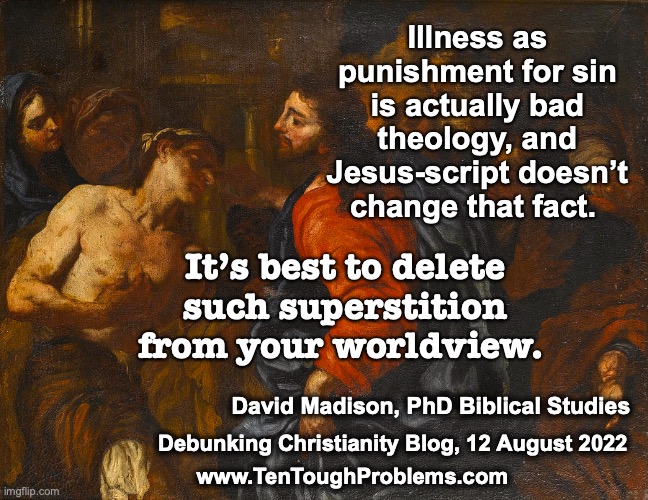
Let’s continue with the issue of illness. Do Christians today commonly assume that illness is a way that their god punishes people? My guess is that they don’t. If a friend or relative gets sick—especially something like cancer—our first impulse is not to ask, “What horrible sins has he/she committed.” Yet we find the illness/sin link in Jesus script. In Mark’s gospel (2:1-12) Jesus heals a paralytic—by forgiving his sins. In John 5:2-18, Jesus heals a man who had been sick for 38 years: “…you have been made well! Do not sin any more, so that nothing worse happens to you.” (v. 14) Are you okay with this idea that the god of Jesus gets even with sin by inflicting illness? How does that work in your theology? 

Question 3:

The consensus of mainstream Bible scholars is that the letters of the apostle Paul were written well before the gospels. His first letter to the Corinthians can perhaps be dated to 53-54 CE. The gospel of Mark—chronologically the first of the four in the NT—seems to have been written in the wake of the first Jewish-Roman War that ended in 73 CE. Please compare the words of the Eucharist found in 1 Corinthians 1:11 with those reported in Mark, which was written twenty years later:

Corinthians 1, 11:23-26:

“For I received from the Lord what I also handed on to you, that the Lord Jesus on the night when he was betrayed took a loaf of bread,and when he had given thanks, he broke it and said, ‘This is my body that is for you. Do this in remembrance of me. In the same way he took the cup also, after supper, saying, ‘This cup is the new covenant in my blood. Do this, as often as you drink it, in remembrance of me.’  For as often as you eat this bread and drink the cup, you proclaim the Lord’s death until he comes.”

Mark 14:22-25:

“While they were eating, he took a loaf of bread, and after blessing it he broke it, gave it to them, and said, ‘Take; this is my body.’ Then he took a cup, and after giving thanks he gave it to them, and all of them drank from it. He said to them, ‘This is my blood of the covenant, which is poured out for many.Truly I tell you, I will never again drink of the fruit of the vine until that day when I drink it new in the kingdom of God.’”

Paul never met Jesus, he was not at the last supper; he claimed that he received these words “from the Lord”—by which he meant his visions of Jesus. What are the implications when we see these texts side-by-side? What conclusions can we draw from these words of Paul predating the gospels? 

Question 4:

The Christian Bible contains both the Old and New Testament. The whole thing is God’s Word. But because of the terrible temper the Old Testament god—and great stretches of rules for sacrificing animals the right way—it is quite common for the devout to claim that the New Testament is their primary guide to life. But explain how that is possible, when there’s Jesus script forbidding this attitude: 

“Do not think that I have come to abolish the Law or the Prophets; I have come not to abolish but to fulfill. For truly I tell you, until heaven and earth pass away, not one letter, not one stroke of a letter, will pass from the law until all is accomplished.Therefore, whoever breaks one of the least of these commandments and teaches others to do the same will be called least in the kingdom of heaven, but whoever does them and teaches them will be called great in the kingdom of heaven. For I tell you, unless your righteousness exceeds that of the scribes and Pharisees, you will never enter the kingdom of heaven.”  (Matthew 5:17-20)

Answers and Comments

Question 1:

When believers pray for their god to heal someone—and even organize prayer marathons to be more effective—the assumption must be that their god can work on the cellular level in the human body to knock out illness. If that is so, we have to wonder how an all-knowing god is so negligent. Why isn’t god paying close attention to all the glitches and goofs that cause genetic disorders/diseases—and using his almighty power to clean them up, before they can do damage? The claim that our bodies have been intelligently designed by a loving creator doesn’t make sense when we see that genetic glitches happen, and cause so much suffering. But, full stop: the errors in human anatomy have been well documented, which destroys the intelligent-design claim. For example, see Abby Hafer’s book, The Not-So-Intelligent Designer: Why Evolution Explains the Human Body and Intelligent Design Does Not.

Question 2:

“Are you okay with this idea that the god of Jesus gets even with sin by inflicting illness? How does that work in your theology?” We have all seen really nice, good people who have suffered terribly from horrible diseases. The devout commonly retreat to “it’s a mystery” —rather than speculate on the terrible hidden sins the person must have committed. But the truly honest approach would include admitting that the gospels—with the Jesus-scripts I quoted—reflect first century superstitions about illness and sin: a god is going to get even with you for sinning. Such superstitions had deep roots in the ancient thinking. The prophet Isaiah had no patience with the sinful pride of high society ladies: “…the Lord will afflict with scabs the heads of the daughters of Zion, and the Lord will lay bare their scalps and heads.” (Isaiah 3:17) 

By the way, unless the god is right there (whispering in your ear?) to explain which sins caused the suffering, what’s the point? Illness as punishment for sin is actually bad theology, and Jesus-script doesn’t change that fact. It’s best to delete such superstition from your worldview. 

Question 3:

The eucharist is described in 1 Corinthians 11 and Mark 14. “What are the implications when we see these texts side-by-side? What conclusions can we draw from the words of Paul predating the gospels?” Yes, this requires study and extra effort. Curiosity has to kick in: when were these two documents written? How might they be related? Since none of the gospels had been written when Paul was so active in his promotion of the new Jesus sect, how did he find out about Jesus? What did he find out? Not much, apparently; we search in vain in his letters for details about the life, ministry, preaching, and miracles of Jesus of Nazareth. He even brags about not consulting the people who had actually known Jesus:

“For I want you to know, brothers and sisters, that the gospel that was proclaimed by me is not of human origin, for I did not receive it from a human source, nor was I taught it, but I received it through a revelation of Jesus Christ.” (Galatians 1:11-12)

And he tells his readers exactly how he found out the wording of the eucharist: “For I received from the Lord what I also handed on to you…” That is, by way of his private revelations/visions (we could call them hallucinations) of Jesus, whom he was confident was not dead, but alive. Hardly a surprise at a time when there were other ancient cults that believed in dying-and-rising gods. 

Given Paul’s intensive missionary zeal, which included writing long letters advocating the faith, it’s not a stretch to suppose that Mark had Paul’s text of the eucharist in 1 Corinthians 11—which he didn’t learn from any human source—in front of him when he wrote his gospel. This is one of the implications of the side-by-side comparison of these texts. Mark wasn’t writing history at all; he was passing along Paul’s theology. Mark added the setting, i.e., a last supper, with Jesus surrounded by disciples; that part was missing in Paul’s vision. Here’s some important homework on this issue: Tom Dykstra’s book, Mark Canonizer of Paul: A New Look at Intertexuality in Mark’s Gospel (2012). 

Readers have to pay close attention to notice such things; they have to be curious, and be willing to question everything. New Testament scholars—both devout and secular—have sharpened these skills. But most of the laity, as surveys have shown, read the Bible casually, if at all. They are trained by priests and preachers not to question everything. Thus they miss important clues that the New Testament itself plays a major role in falsifying Christianity.   

Question 4:

“…it is quite common for the devout to claim that the New Testament is their primary guide to life. But explain how that is possible, when there’s Jesus script forbidding this attitude…”

Supposedly, for Christians the Bible is the holy word of their god. In fact, there are many texts in both the Old and New Testament that the faithful wish were not there. But it just won’t do to rank the Old Testament as inferior. God’s genocide in the Noah story? Jesus promised that, at the coming of the kingdom of god, there will be as much suffering as at the time of Noah. How is that better? The god of the Old Testament promised to punish and wipe out those who broke his laws. The god of the New Testament added eternal fire after death as punishment. How is that better? 

Matthew’s Jesus-script includes the insistence that “not one stroke of a letter, will pass from the law…”  But we can see Matthew’s motivation: almost from the beginning of the Jesus sect, there were those who wanted it to remain a Jewish sect—Matthew was so inclined. The apostle Paul thought otherwise, and preached to the Gentiles. He downplayed the importance of the law, one primary example being the elimination of circumcision as a condition for converting to Christ. In the long run, Paul’s side won that battle. 

But it won’t do to downgrade the Old Testament—how dare you anyway if it’s still part of god’s holy word? It’s right there on the church altar every Sunday! This amounts to picking and choosing what you like, depending on your own religious sensibilities. That is, you are judging the Holy Bible, you are deciding which parts are holy. Bear this in mind, however: even those early Christians who downplayed the law looked to the Old Testament to prove that Jesus was the messiah. They hunted for texts they were sure applied to Jesus, even though there is no mention whatever of a Jesus of Nazareth who would one day be the messiah. Nevertheless, so many stories of Jesus in the gospels are based on Old Testament models. The apostle Paul especially scoured the ancient texts for proof of his version of the Christ. 

As I’ve said many times, the Bible—especially the gospels—is a minefield. Every step you take, the ground under your feet may explode. Which is why I say to Christians, “How about we go for a walk?” 

David Madison was a pastor in the Methodist Church for nine years, and has a PhD in Biblical Studies from Boston University. He is the author of two books, Ten Tough Problems in Christian Thought and Belief: a Minister-Turned-Atheist Shows Why You Should Ditch the Faith (2016; 2018 Foreword by John Loftus) and Ten Things Christians Wish Jesus Hadn’t Taught: And Other Reasons to Question His Words (2021). His YouTube channel is here. He has written for the Debunking Christian Blog since 2016.

The Cure-for-Christianity Library©, now with more than 500 titles, is here. A brief video explanation of the Library is here

Drafting novel #12. Day 92 (102022)

Why am I doing this? Find the answer here.

Today’s live, onscreen recording:

Click the following link to view and listen to today’s recording.

https://screencast-o-matic.com/watch/c36Y3eVueqw


Fiction writing websites I’ve found helpful

Angela Ackerman & Becca Puglisi’s, One Stop for Writers

Angela & Becca’s, Writers Helping Writers

H.R. D’Costa’s website, Scribe Meets World

My own website, Fiction Writing School

Anne Rainbow’s website, Scrivener Virgin

Scrivener website, Literature and Latte

John Truby’s website, Truby’s Writers Studio

K.M. Weiland’s website, Helping Writers Become Authors

A Christian Flunks Pop-Quiz Number 3

By David Madison

07/15/22

Here is the link to this article.

It’s a big fat F

So far I have posted three Pop-Quizzes for Christians here on the DC Blog (One    Two   Three). My motive has been to coax, to prod Christians to read the Bible, to study the gospels especially. Surveys have shown that most can’t be bothered. I encourage readers to share these pop-quizzes with their church-going friends and relatives. 

A few weeks after Pop-Quiz Number 3 was posted, a Christian who identifies as Oreo Pagus offered his comments on the post. The first question on the quiz is about science: What was Carl Sagan referring to when he described The Pale Blue Dot. Oreo Pagus gave the correct answer: Planet Earth, about which Sagan had observed:

“Our posturings, our imagined self-importance, the delusion that we have some privileged position in the Universe, are challenged by this point of pale light. Our planet is a lonely speck in the great enveloping cosmic dark. In our obscurity, in all this vastness, there is no hint that help will come from elsewhere to save us from ourselves.”

Oreo quoted the last sentence, then added this observation: “Perhaps our planet’s small size and apparent isolation in the universe may actually point to its vast importance, negating Sagan’s observation while validating the Christian worldview.”

Apparent isolation? Earth’s vast importance? Validating the Christian worldview? How is our isolation “apparent”? It would take more that 80,000 years for a spacecraft from earth—traveling at the speed of earth satellites, i.e., 18,000 mph—to reach the star nearest our sun. It would have been appropriate for Oreo to provide the precise data demonstrating that earth’s “vast importance” is based on its small size, and how this validates “the Christian worldview.”

But no, Oreo picked up on these words in the Sagan quote: “…there is no hint that help will come from elsewhere to save us from ourselves.” From this he switched directly to Jesus:

“The New Testament more than hints that we can’t save ourselves. Jesus of Nazareth said human conflict would one day get to the point of crisis that if he didn’t return to Earth, there would be no one left alive! The current number of nuclear weapons certainly have the ability to destroy all life on Earth many times over.” 

He added Jesus-script found in Matthew 24:22, “If those days had not been cut short, no one would survive, but for the sake of the elect those days will be shortened.” Oreo then included a list of nine nations possessing nuclear weapons. 

And he provided a link to a statement by theologian Krista Bontrager, who counters Sagan with—wait for it—Bible quotes, e.g., 

Genesis 1:16: “God made the two great lights—the greater light to rule the day and the lesser light to rule the night—and the stars.”

Psalm 8:3: “When I look at your heavens, the work of your fingers, the moon and the stars that you have established…”

Isaiah 45:12: “I made the earth and created humankind upon it; it was my hands that stretched out the heavens, and I commanded all their host.”

Bontrager concludes her argument: “The Creator’s interventions implies [sic] not only that our planet is the result of purposeful design, but also that the Earth itself has a meaning and purpose by providing a home for humanity. It also furnishes the venue for the Creator to bring about the salvation of His creation.”

Why These Answers Get a Flunking Grade

1.     It’s quite a shock that Oreo would turn to perhaps the worst theology in the New Testament to make his case for Christianity. Matthew 24, which he quotes, is based on Mark 13, and is a brutal promise—a frightful prediction—that god plans to get even with sinners, i.e., most of humanity. It will be a time of panic and terror. In Matthew 24:37-39, Jesus promises there will be as much suffering when he come as there was at the time of Noah. 

Oreo wrote that Jesus said “…human conflict would one day get to the point of crisis that if he didn’t return to Earth, there would be no one left alive!” But he ignores the timing promised in the texts. In Mark 14:62—script created by Mark—Jesus promised at his trial that those attending would see him coming on the clouds. At the end of Mark 13, we find this urgent warning: “But about that day or hour no one knows, neither the angels in heaven nor the Son, but only the Father. Beware, keep alert, you do not know when the time will come….And what I say to you I say to all: Keep awake.” In other words, god’s revenge would happen soon, and the apostle Paul was just as confident about this. These ancient authors would have been stunned to know that Christians two thousand years later are still waiting! 

So is planet Earth “vastly important” to god because there are billions of humans here to punish? Is that good theology? And, by the way, is that the Christian worldview? We can suspect that many devout Christians would like to distance themselves from Mark 13 and Matthew 24. They find ways to tone down these texts, change them into metaphors—or something—toavoid such horrible theology, i.e., most of humanity will be obliterated while the Christian remnant survives. 

2.     Oreo seems unaware that Jesus-script in the gospels cannot be taken at face value, that is, as actual words of Jesus. We have no way at all to verify any of the deeds or words of Jesus mentioned in the gospels. So it’s no use to point to any verse and claim, “This is what Jesus said, that settles it.” 

Devout New Testament scholars have indulged in endless speculation about how to figure out which “words of Jesus” might be authentic. Which words could have derived from eyewitnesses, which might have been based on “reliable” oral tradition? But all this remains speculation. There is no contemporaneous documentation at all (e.g., letters, diaries, transcriptions) by which to verify anything reported in the gospels, written decades after the events depicted. Scholars have suggested various “criteria of authenticity,” but these too are speculation, and have been disputed. It does no good to claim authenticity because the gospels were inspired by a god: so they must be true. Other religions—those that Christians ignore and don’t believe in—justify their “truths” on exactly the same basis. Christian scriptures must be critiqued as rigorously as any other documents from the ancient world, and when that is done, we can see how far short they fall as history. 

3.     Krista Bontrager has given us theobabble. In the form, first of all, of Bible quotes, which will appeal to clueless lay readers. There are many creation myths from the ancient world; would she quote from any of them to prove the existence of the other gods? What feeble, amateurish methodology! Then she wrote that god’s interventions imply “…not only that our planet is the result of purposeful design, but also that the Earth itself has a meaning and purpose by providing a home for humanity.” 

Her god’s interventions have been hit-and-miss. Was this god busy elsewhere in the galaxy when the Holocaust happened—to his chosen people? 

So many critics have pointed out the lack of purposeful design (see especially, Abby Hafer’s The Not-So-Intelligent Designer: Why Evolution Explains the Human Body and Intelligent Design Does Not). What is the “meaning and purpose” of a home for humanity that is filled with ongoing terrors? Hurricanes, tornadoes, volcanoes, earthquakes, tsunamis, thousands of genetic diseases, virulent microbes, and plagues have ravaged humans for millennia. A god is to be congratulated for setting things up this way? (See also, John Loftus’ essay, “On Making Excuses for God,” in his 2021 anthology, God and Horrendous Suffering.) Bontrager heightens her theobabble with the claim that earth provides “the venue for the Creator to bring about the salvation of His creation.” How can the massacre of most of humanity—when Jesus arrives to bring his kingdom—be construed as “the salvation of his creation”? If creation had been set up properly to begin with, why would it even need salvation?

More Reasons for the Flunking Grade

Surely any student who answers just one question—and poorly at that—while ignoring all the other questions, deserves a big fat F. There are four more questions on Pop Quiz 3, all about the gospels, but Oreo declined to answer them. Again, my primary purpose in these pop quizzes is to prod Christians to study—bring critical thought—to the gospels. 

Question 2 is about a few questionable things in Mark’s gospel, and one part especially applies to Oreo’s approach: “How do you incorporate the theology of Mark, Chapter 13 into your understanding of a loving God?” The devout have to carefully cherry-pick Bible texts to argue that their god is loving. Even John 3 is a minefield, i.e., after verse 16, “God so loved the world…” we find verse 18, “those who do not believe are condemned already” and verse 36, “whoever disobeys the Son will not see life but must endure God’s wrath.” As we have seen, Mark 13 is brutal theology, and many Christians just turn their backs on it, dismissing it any way they can.  

Question 3 is about Matthew’s very bad habit of misquoting Old Testament texts, wanting to convince/fool his readers that they apply to Jesus. These are an embarrassment to even devout scholars, but lay people are almost never alerted to Matthew’s faulty approach by priests and preachers.   

Questions 4 and 5 are about two post-resurrection Jesus episodes, the Emmaus Road story, found only in Luke; and the Doubting Thomas story, found only in John. I asked in each case: “Discuss the elements in the story that don’t look like history—and the factors that rule out its status as history.” Believes should try to grasp exactly why historians are reluctant to take these accounts seriously. Again: Christian scriptures are not exempt from the rules that historians use to establish authenticity. I also asked, “How do these stories conflict with the apostle Paul’s understanding of resurrection?” They are problematic even theologically.  

Oreo chose not to engage on these issues. Instead he came up with a Pop Quiz for Atheists:

1. Are you a hard/strong/positive atheist or a soft/weak/negative atheist? Why that type of atheist? 2. What kind of evidence (s) would you need to even consider the possibility that the Triune God of the Bible really exists? 3. What kind of evidence (s) would you need to even consider the possibility that Jesus of Nazareth really was “God manifest in the flesh” (I Timothy 3:16) when he was living on earth?

I’m happy to take Oreo’s pop quiz.

1. Are you a hard/strong/positive atheist or a soft/weak/negative atheist? Why that type of atheist?

I am a hard/strong/positive atheist. In my 2016 book, Ten Tough Problems in Christian Thought and Belief, I address the many problems that hobble Christianity; any one of them is enough to falsify the faith. Taken together the case against it is overwhelming. The books by John Loftus, especially the one mentioned above, God and Horrendous Suffering, show that belief in an omni-god is not sustainable. Here’s the positive: Anything that can help people escape belief in ancient superstitions (e.g., eat Jesus and you get eternal life, John 6:53-57) is positive, hence we should also encourage those who point out how silly astrology is—and belief in fortune telling and contacting the dead through séances. 

2. What kind of evidence (s) would you need to even consider the possibility that the Triune God of the Bible really exists?                                                                                                                 

It would be a good idea to address this question first to other devout theists, such as Jews and Muslims, who despite their deep piety, do not believe in a Triune God. Our request to Christians remains the same: please show us where we can find reliable, verifiable, objective data about god(s), and theists must agree, “Yes, that’s where to find it.” This never happens, because theists have never been able to agree on whose scriptures, visions, mediations are genuinely from god(s). Are Christians willing to expand their Bibles to include the Qur’an and the Book of Mormon? Indeed, do they embrace the accounts about their god in the Old Testament (of course they don’t).

3. What kind of evidence (s) would you need to even consider the possibility that Jesus of Nazareth really was “God manifest in the flesh” (I Timothy 3:16) when he was living on earth? 

It’s basically the same answer: “Please show us where we can find reliable, verifiable, objective data about god(s), and theist must agree, “Yes, that’s where to find it.” But also, the many negatives about Jesus in the gospels would have to explained, removed, discounted. A “god manifest in the flesh” would not have been wrong about so much; see my website, BadThingsJesusTaught, which includes a list of 292 bad, mediocre, and alarming Jesus quotes in four categories: (1) preaching about the end time, (2) scary extremism, (3) bad advice and bad theology, and (4) the unreal Jesus of John’s gospel. Moreover, “when he was living on earth” begs the question: did Jesus really exist? Instead of a knee-jerk reaction, “Of course he did, don’t be silly,” Christians should inform themselves on the substantial reasons why there is doubt—many of them based on the New Testament itself. 

And, by the way, I Timothy 3:16 qualifies fully as theobabble. It says that their god-in-the-flesh was “…seen by angels,proclaimed among gentiles,  believed in throughout the world, taken up in glory.”

In the next month or so, I’ll published Pop Quiz for Christian, Number 4. What’s the harm in trying to get Christians to read the gospels? In the hope, of course, that they’ll see the incoherence of Christian theology. It didn’t work with Oreo—at least he refused to rise of the challenge of honestly facing the issues that critical Bible study presents.   

David Madison was a pastor in the Methodist Church for nine years, and has a PhD in Biblical Studies from Boston University. He is the author of two books, Ten Tough Problems in Christian Thought and Belief: a Minister-Turned-Atheist Shows Why You Should Ditch the Faith (2016; 2018 Foreword by John Loftus) and Ten Things Christians Wish Jesus Hadn’t Taught: And Other Reasons to Question His Words (2021). His YouTube channel is here. He has written for the Debunking Christian Blog since 2016.

The Cure-for-Christianity Library©, now with more than 500 titles, is here. A brief video explanation of the Library is here

Drafting novel #12. Day 91 (101922)

Why am I doing this? Find the answer here.

Today’s live, onscreen recording:

Click the following link to view and listen to today’s recording.

https://screencast-o-matic.com/watch/c36q0yVtWLt


Resources referred to in today’s onscreen recording

My blog post, Story Structure, an Introduction

Book: Structuring your novel by K.M. Weiland

Book: That Anatomy of Story by John Truby

Fiction writing websites I’ve found helpful

Angela Ackerman & Becca Puglisi’s, One Stop for Writers

Angela & Becca’s, Writers Helping Writers

H.R. D’Costa’s website, Scribe Meets World

My own website, Fiction Writing School

Anne Rainbow’s website, Scrivener Virgin

Scrivener website, Literature and Latte

John Truby’s website, Truby’s Writers Studio

K.M. Weiland’s website, Helping Writers Become Authors

A Pop-Quiz for Christians, Number 3

By David Madison

06/17/22

Here’s the link to this article.

Confusion and incoherence in Jesus theology

One of the handiest tools for showing that Christianity is wrong—that its theology is confused and incoherent—is the Bible itself. I have seen so much resistance among church-goers to reading the Bible, even casually (say, just one chapter a day), let alone studying it carefully, thoughtfully, critically. Is this hypocrisy, or just laziness? If the devout really, truly believed that the Bible is their god’s word—more than a thousand pages of his wisdom and guidance—why don’t they obsess about reading it? 

For many of us who have left Christianity, there is no mystery about this neglect. My constant appeal for years to my Christian acquaintances has been: please read the Bible. When my book was published last summer, Ten Things Christians Wish Hadn’t Taught, I gave copies to some of my devout—openly, aggressively devout—friends. What was the response? Silence. They didn’t want to think about it, and they certainly didn’t want to read the Jesus quotes that I discuss in detail in the book. They want to trust their priests and ministers, and draw comfort from the ceremonies and rituals, while Jesus in stained-glass gazes down on them. No thought required.

What can we do to jar these worshippers out of their complacency? Probably nothing, but this is my third article in the series, A Pop-Quiz for Christians, trying to get them to wake up and smell—not the coffee—but the confusion and incoherence at the core of Christian theology. Just a little Bible study can do the trick—as well a casting a brief glance at science. Pop-Quiz Number 1 is here; Pop-Quiz Number 2 is here.

Now, Pop-Quiz Number 3, with just one question about science at the outset.

Question 1: What was the astronomer Carl Sagan referring to when he mentioned “The Pale Blue Dot”? How was the image obtained, and what are the implications of his comments for theology? 

Question 2

(1)  What is the primary message of Mark’s gospel? (2) How would you explain the lack of ethical teaching in Mark? (3) How do you incorporate the theology of Mark, Chapter 13 into your understanding of a loving God?

Question 3:

The author of Matthew’s gospel wrote quite a few things that New Testament scholars—and theologians too—find embarrassing. Explain why this is the case with Matthew 1:22-23; Matthew 2:13-15; Matthew 27:52-53.

Question 4:

Read carefully Luke 24:13-35, the story of Jesus appearing, after his resurrection, to two disciples who were walking on the road to Emmaus. Discuss the elements in the story that don’t look like history—and the factors that rule out its status as history. 

Question 5:

Read carefully John 20:24-29, the story of Doubting Thomas, also a post-resurrection story of Jesus. Again, discuss the elements in the story that don’t look like history—and the factors that rule out its status as history. How do these stories conflict with the apostle Paul’s understanding of resurrection? 

ANSWERS

Answer, Question 1:

In 1990, the Voyager Spacecraft 1, when it was 3.7 billion miles from our sun, took a photo of Planet Earth. It was dubbed a Pale Blue Dot, but it is almost undetectable in the vastness of space. This provides dramatic illustration that the ancient concept of the cosmos—the one that prevailed when the Bible was written—is false, i.e., earth at the center of creation, with a god residing close overhead. Carl Sagan commented:

“Look again at that dot. That’s here. That’s home. That’s us. On it everyone you love, everyone you know, everyone you ever heard of, every human being who ever was, lived out their lives.” Moreover, the inhabitants of this planet came up with “…thousands of confident religions, ideologies, and economic doctrines…” But most important—and of relevance especially to confident Christian theology:

“Our posturings, our imagined self-importance, the delusion that we have some privileged position in the Universe, are challenged by this point of pale light. Our planet is a lonely speck in the great enveloping cosmic dark. In our obscurity, in all this vastness, there is no hint that help will come from elsewhere to save us from ourselves.”  (emphasis added)

Christian theologians have tried, over the centuries, to modify and improve the Bible concept of God, but as our knowledge of the cosmos advances, that task has become increasingly difficult. Well, no: impossible. Our continual appeal to Christians is: show us where we can find reliable, verifiable, objective evidence for the deity you believe in and worship. So far, they have not delivered. 

Answer, Question 2:

The primary message of Mark’s gospel is the imminent arrival of the kingdom of God. In Mark 1:14-15 we read: “…Jesus came to Galilee proclaiming the good news of God and saying, ‘The time is fulfilled, and the kingdom of God has come near; repent, and believe in the good news.’” And at his trial, in Mark 14, Jesus promised those present that they would see him coming on the clouds of heaven. In this gospel Jesus is presented as an apocalyptic prophet, i.e., he proclaims that the end of the age is near. Recent studies have suggested that Mark was influenced especially by the apostle Paul’s belief that the arrival of Jesus on the clouds was “any day now.” For this reason the author of the gospel might have felt little need to add ethical teaching—since the world was about to be transformed. Later, when Matthew copied most of Mark’s gospel, he added what we know as the Sermon on the Mount, perhaps to make up for this deficiency. 

The full terror of the apocalyptic message is presented in Mark, Chapter 13. As the kingdom arrives there will great calamity and suffering, and it’s about to happen. There is the warning at the end of the chapter to remain alert, keep awake. There are indeed Jesus cults within Christianity even now that look forward to the upheaval that their Jesus will bring. But I’m pretty sure that, outside these extremist groups, most Christians are stumped by Mark 13. They’re certainly not comfortable with it, because it doesn’t fit with their image of Jesus as lord and savior. There is too much in Mark that drags down the faith, which is the subject of an article I published here on the DCBlog in 2018, Getting the Gospels Off on the Wrong Foot: The Strange Jesus in Mark’s Gospel.

Answer, Question 3:

The author of Matthew’s gospel had an approach to scripture that many contemporary Christians would find bizarre: he simply ignored the context of the ancient stories, and landed on words he was sure had predictive significance. In Matthew 1:22-23, the author quotes Isaiah 7:14 to prove that the virgin birth of Jesus had been predicted hundreds of years before. Here’s basic homework for Christians: read all of Isaiah, chapter 7, and decide for yourselves: does it have anything whatever to do with Jesus? Matthew also made a mistake: he consulted the Greek translation of Isaiah 14, which incorrectly translated the original Hebrew, i.e., which reads young woman, not virgin.

Mark told his story of Jesus without a virgin birth; in his gospel Jesus is designated “son of God” at his baptism—and John’s gospel omits it as well. But apparently Matthew was persuaded that the virgin birth of other sons of gods—it was a common idea in the ancient world—was worth attaching to his Jesus story. Interestingly, when Luke wrote his virgin birth story, he ignored Matthew’s Isaiah quote. He might have thought it was inappropriate—just as we do. 

And speaking of Luke’s birth story, when we compare it with Matthew’s, we find more evidence that Matthew just made stuff up. Luke’s birth story includes details about the baby Jesus being presented at the Jerusalem Temple, and praised by a prophet and prophetess. Then this: 

“When they had finished everything required by the law of the Lord, they returned to Galilee, to their own town of Nazareth.The child grew and became strong, filled with wisdom, and the favor of God was upon him. (Luke 2:39-40)

This cannot be reconciled with Matthew’s bizarre report that Mary and Joseph fled to Egypt to protect Jesus from Herod, which is found in 2:13-15, and nowhere else in the New Testament. Why in the world would Matthew tell such a story, which is extremely unlikely? If Herod had been hunting for the baby Jesus, his parents could have hidden out among the peasantry in their own country. But, once again, Matthew had been hunting in the Old Testament for a text he could apply to Jesus; he landed on Hosea 11:1: “When Israel was a child, I loved him, and out of Egypt I called my son.” The text in Hosea plainly says that the child called out of Egypt was Israel, and much of Hosea 11 is a complaint about the disobedience of Israel; Matthew cared nothing at all about context. Luke omits mention of this detour to Egypt—as Joseph and Mary were on their way home to Nazareth! —because it is just too absurd.

Perhaps Matthew’s most ridiculous make-believe episode is a truly dangerous one for the credibility of the Christian faith. He reports (27:52-53) that, at the moment Jesus died on the cross, 

“The tombs also were opened, and many bodies of the saints who had fallen asleep were raised.After his resurrection they came out of the tombs and entered the holy city and appeared to many.”

This is magical thinking, i.e., the death of Jesus brought many people back to life (sounds a lot like Harry Potter, right?), but not only that, these newly alive dead people toured Jerusalem on Easter morning. None of the other gospels report any such thing, nor do any of the historians of the time. Matthew just drops this bit of nonsense into his story, without any follow-up: did these zombies head back to their tombs a few hours or days later? Even conservative scholars have conceded this is a tall tale, but that inevitably raises the question: Is the resurrection of Jesus itself a tall tale? Especially since the Jesus resurrection stories are so incoherent and contradictory. 

Answers, Questions 4 and 5:

These two questions can be considered together. Luke’s account of the disciples on the Emmaus Road, and John’s story of Doubting Thomas are found only in those gospels. Why would that be, since they are both so amazing? The former appears to be a literary creation based on a couple of verses in the fake ending of Mark’s gospel (16:12-13): “After this he appeared in another form to two of them, as they were walking into the country.And they went back and told the rest, but they did not believe them.” In another form: in Luke’s story, Jesus is unrecognized when he walks with the two disciples, and later, when he’s having a meal with them, at the moment when he is recognized—poof! —he vanishes. In John’s Doubting Thomas episode, we’re told that, “Although the doors were shut, Jesus came and stood among them and said, ‘Peace be with you.’”  (John 20:26) Robert Conner has pointed out, in his book, Apparitions of Jesus: The Resurrection as Ghost Story, that the gospel authors borrowed elements from contemporary ghost folklore as they created their resurrection accounts. Which brings us to another fundamental problem with these solitary episodes in Luke and John: they were written decades after the supposed events, and cannot be verified by contemporaneous documentation

We can suspect, moreover, that the apostle Paul would have been shocked by these stories. He would have said No Way! A newly alive dead Jesus who sat down to eat with disciples—and who invited Thomas to stick his finger in his sword wound? In I Corinthians 15, Paul is emphatic that it is spiritual bodies that are resurrected, not dead flesh that was put into the ground—or a tomb:

“So it is with the resurrection of the dead. What is sown is perishable; what is raised is imperishable.It is sown in dishonor; it is raised in glory. It is sown in weakness; it is raised in power.It is sown a physical body; it is raised a spiritual body. If there is a physical body, there is also a spiritual body.”   (vv. 42-44) Paul, in all his letters, never mentions the story of the Empty Tomb on Easter morning, probably for two reasons: (1) it hadn’t been invented yet by the later gospel writers, (2) a revived body walking out of a tomb wasn’t at all what Paul meant by a spiritual body.

Conner has noted another curiosity: In Mark’s gospel, Jesus predicts his death and resurrection three times (8:31; 9:31; 10:33-34), but when the women who had gone to the tomb reported the resurrection to the disciples, Luke reports (24:11): “But these words seemed to them an idle tale, and they did not believe them.” When the Emmaus Road disciples told the others that they’d seen Jesus, “…they did not believe them.” Conner is stumped—as we all should be: Why were the disciples so clueless? Why didn’t they wait at the tomb to see this happen? How was such an important event not witnessed by anyone? The Doubting Thomas episode seems to have been designed to encourage belief without evidence, which has been the approach (the gimmick) of religious leaders forever, across the spectrum: “Jesus said to him, ‘Have you believed because you have seen me? Blessed are those who have not seen and yet have come to believe.’” (John 20:19) 

This gimmick still works today, i.e., so many folks believe in their Jesus under the influence of priests and preachers (“…just take our word for it!”), without bothering to actually read the gospels, study them carefully, and above all, question everything. My goal with these Pop-Quizzes is to encourage Christians to do just that. When this happens, the confusion and incoherence in Jesus theology are not hard to spot. 

David Madison was a pastor in the Methodist Church for nine years, and has a PhD in Biblical Studies from Boston University. He is the author of two books, Ten Tough Problems in Christian Thought and Belief: a Minister-Turned-Atheist Shows Why You Should Ditch the Faith (2016; 2018 Foreword by John Loftus) and Ten Things Christians Wish Jesus Hadn’t Taught: And Other Reasons to Question His Words (2021). His YouTube channel is here. He has written for the Debunking Christian Blog since 2016.

The Cure-for-Christianity Library©, now with more than 500 titles, is here. A brief video explanation of the Library is here

Bible god Is Not a god ANYONE Would Want

By David Madison

10/07/22

Here is the link to this article.

…except those who are okay with supernatural evil

I was a Bible nerd even in my high school days, and continued to be one in college, when I made the decision to go to seminary. What a thrill that was: to study the Bible and God at the graduate level. But early in my seminary years I learned a troubling lesson—from my theology professors themselves: it is impossible to come up with a coherent theology of the Bible. For the simple reason that the Bible’s ideas about god are an incoherent, uncomplimentary mess.     Theologians themselves know that there are a thousand and one embarrassing Bible verses, so many of them relating to what Bible god is like and wants. This is one of the reasons that Christianity itself has fractured into thousands of different brands: so many disagreements about its god.

Many of the embarrassing Bible verses are, in fact, about how bad, vicious, and vindictive Bible god is. This is no surprise, since the original Yahweh was a tribal deity in competition with others, and had to protect his turf. Christian apologists face the challenge of making this god look good, despite the plain meaning of the texts. They don’t want this god either. They work hard to make their idealized, supposedly refined concept of god conform to Bible god (David 

Hayward’s cartoon nails it).

I suspect many of the devout Christian laity don’t read the Bible because, after dipping into it here and there—yes, even in the New Testament—they are shocked by what they find. Since their early years in Sunday School and catechism, they have been nurtured on images of their god carefully curated by preachers and priests; the bad Bible god is kept out of sight. Well, except for fanatical Christians who want their god to get even for all the sin in the world.

There are so many ways Bible god falls far short of what we would expect of a god who deserves to be worshipped. Dan Barker has provided invaluable help on this, e.g., with his 2018 book, God: The Most Unpleasant Character in All Fiction (to date, 508 reader reviews, 74% Five Stars). But I also highly recommend his essay, “Supernatural Evil,” in John Loftus’ 2021 anthology, God and
Horrendous Suffering
.

God so loved the world? Well, not quite—in fact, far from it, when we can see how much damage Christian theology has caused the world. Just in terms of inhibiting human understanding of how the world works. Barker opens his essay with a description of what happened in Lisbon, Portugal on 1 November 1755. 

“The fall air was crisp and clear, and the sea was calm. The bustling metropolis was brimming with visitors and residents who packed dozens of churches for the Feast of All Saints. Around 9:45 a.m., while worshippers were praying, the city was rocked by a massive earthquake, ten times as strong as the one that destroyed San Francisco in 1906. Most of the churches were demolished, immediately killing thousands who were trapped inside.” (p. 388)

There were more earthquakes and tsunamis too, 

“But that wasn’t the worst. The fires that broke out grew into a roaring inferno that blazed for days through the rubble, incinerating trapped survivors, impeding rescue efforts, and destroying many structures that had withstood the quakes.”  (p.388)

How can this not be a serious challenge to belief in an idealized, refined concept of god: on a holy day, thousands of people were crushed to death in churches where they’d gone to pray. This brings to mind another horror 189 years later: when German soldiers were retreating from France in 1944, they massacred 643 civilians in the village, Oradour-sur-Glane. The men were herded into barns that were set on fire, while 247 women and 205 children were locked into the church and machine-gunned to death. 

Anyone whose mind had not been sabotaged by Christian theology has to wonder if this deity—in whose churches these victims died—isn’t weak and negligent, or simply wasn’t paying attention. Historian Barbara Tuchman, is her analysis of the Black Plague in the 14th century, noted that the suffering had been so massive that traditional explanations, e.g., god was punishing sin, were no longer convincing. They just didn’t work. If god wasn’t involved at all, Tuchman notes, “…then the absolutes of a fixed order were loosed from their moorings.” (p. 129, A Distant Mirror: The Calamitous 14thCentury)

But Bible god plays a major role in keeping people trapped in bad theology. Barker points out that clerics at the time preached that sin was the cause, that god had gone into full punishment mode. Pope Benedict XIV urged churches in Italy to pray earnestly to avoid similar disasters. Sin was behind it all: “When England learned of the disaster, they immediately banned masquerade balls, presumably because they led to great sinning.” (p. 389)

Barker notes that the disaster “…sparked a huge debate about the problem of evil. The Age of Reason was beginning to flex its muscles against the Age of Faith.” (p. 389) There were thinkers who indeed sensed that the fixed Christian order was loosed from its mooring; Barker quotes Voltaire, who “would have none of this. He mocked those callous explanations: ‘And can you then impute a sinful deed to babies who on their mothers’ bosoms bleed?’ Was Portugal more evil than other countries? ‘Lisbon is shattered,’ he wrote, ‘and Paris dances.’” (p. 389)

But Bible god fuels the anger of preachers who hate sin. Barker includes a sampling of Bible texts that reinforce the idea that god is a punisher who inflicts suffering, e.g., Jeremiah 49:37, “I will bring disaster upon them, my fierce anger, declares the Lord. I will send the sword after them, until I have consumed them,” and Jeremiah 45:5, “And do you seek great things for yourself? Seek them not, for behold, I will bring disaster upon all flesh, declares the Lord.”

There are three features of Bible god that spoil Christian theology: (1) This god behaves like a furious toddler when it doesn’t get its way. (2) This god keeps a close watch on everything that every person does, says, and even thinks—or so plenty of Bible texts claim. I suspect that many of the devout don’t live as if this is true. (3) This furious toddler gets upset over trivia, instead of over great moral issues. Barker illustrates this in a major section of his essay. 

He illustrates the trivia in his discussion of idolatry, breaking the sabbath, interracial marriage, and general disobedience. Bible god can’t tolerate “his people” worshipping other gods—bowing down before idols—and goes into jealous rages when this happens. Of course, there are religious fanatics today who use this as a guide for behavior, but most of the folks who function in the modern world are far more tolerant. There are so many different religions, so many different ways of worshipping a variety of gods; the basic good practice to follow is “live and let live.” In my hometown—back in the 1940s and 1950s—there was a substantial religious divide: Catholics were adamant that Protestants were wrong, and vice versa, but everyone would have been horrified if the god they worshipped burned down the opposing churches—or commanded them to do so. 

Bible god’s jealousy, by the way, found expression in his defective Ten Commandments: the first three are “all about him.” He insisted on being the focus of attention and respect. Those first three commandments should have been knocked off the list to make room for a few that are conspicuously missing: prohibition of slavery, racism, misogyny, and marching off to war, one of the most grievous human faults.      

In our world today, one of those basic ten commandments—about keeping the sabbath—is almost universally ignored. Bible god would not be pleased. “Six days shall work be done, but on the seventh day you shall have a holy Sabbath of solemn rest to the Lord; whoever does any work on it shall be put to death.”  (Exodus 35:2) And there’s the horrible story we find in Numbers 15: a man was discovered picking up sticks on the sabbath:  

“Then the Lord said to Moses, ‘The man must surely be put to death; all the congregation shall stone him with stones outside the camp.’So, as the Lord commanded Moses, all the congregation brought him outside the camp and stoned him with stones, and he died.” (Numbers 15:35-36)

Yes, the death penalty. The furious toddler is at it again. This makes sense only in the context of ancient tribal religious practice, as Barker notes: “Keeping the sabbath has nothing to do with morality, but it is such an egregious ‘crime’ against God that it merits the death penalty.” (p. 399)

I once read a Christian apologist’s excuse for Bible god commanding that even children should be put to death when the Israelites conquered the land promised to them by their tribal deity. “Those children,” the apologist argued, “would have grown up to be a corrupting influence on the chosen people.” 

Barker calls attention as well to the ban on mixed marriages, forbidden for the same reason. “After idolatry and breaking the sabbath, the next most common crime associated with ‘evil’ is marrying outside of God’s chosen people. ‘Do not intermarry with them,’ we are warned in Deuteronomy 7:3.” Barker includes a long quote from Nehemiah (13:23-30), his rant against mixed marriages, which includes the words: “And I confronted them and cursed them and beat some of them and pulled out their hair.” Barker calls attention to the damage done by belief in Bible god: “Nehemiah ran around like a deranged street preacher, beating up people, cursing them and pulling out their hair! And for what? For choosing whom to marry. Is this sane? Is this moral?” (p. 400)

Nehemiah’s rage about mixed marriages—his desire to dissolve them—draws attention to another aspect of Bible theology incoherence. In Jesus-script we find condemnation of divorce, which includes the words, “What therefore God hath joined together, let not man put asunder.” (Mark 10:9) The strong implication of this is that all marriages, wherever and whenever, have been ordained by god: he has done the joining together. This has to be a major theological mistake, given all the bad marriages that have happened. 

Barker provides a comprehensive list of the bad attributes/habits of Bible god. He notes that Richard Dawkins took a lot of heat for his accusation that god “…is arguably the most unpleasant character in all fiction…” Which turned out to the title of Barker’s book, and in this essay he lists 27 of the faults and flaws of Bible god, including jealouscontrol freakgenocidalbullycurse hurling—and scriptural references for them all. 

Apologists will rush to Bible god’s defense: think of all the good Bible verses about god—and of course these do exist. Martin Luther King popularized a verse from the Book of Amos that was his call for racial justice: “But let justice roll down like water and righteousness like an ever-flowing stream.” (Amos 5:24) However, readers have to step gingerly around so many of the horrible verses about god, including Jesus-script that warns about eternal punishment in fire, and that there will be as much suffering at the arrival of his kingdom as during the time of Noah. Yes, the furious toddler is right there in the New Testament. We end up with theological incoherence, which excludes the possibility of any sound, convincing theology of the Bible.

Theologians and philosophers have long discussed/debated about moral evil and natural evil. Moral evil derives from human wickedness, natural evil from what our biosphere inflicts upon us. But Barker calls attention to what has to be a third category: suffering willfully inflicted by Bible god behaving as a furious toddler: on purpose causing pain and destruction as punishment. In the wake of Hurricane Ian there has been speculation about who or what Bible god was getting even with. Hence the title of Barker’s essay, Supernatural evil:

“If the maleficent God who boasted ‘I create evil’ actually exists—thank goodness he doesn’t— then earthquakes, hurricanes, blizzards, droughts, wildfires, floods, tornadoes and viral pandemics should be understood as neither moral evil nor natural evil but as ‘supernatural evil.’” (p. 407) 

Whenever we bump into religious fanatics who are okay with Bible god, maybe the best practice is to stay as far away as possible from them.

David Madison was a pastor in the Methodist Church for nine years, and has a PhD in Biblical Studies from Boston University. He is the author of two books, Ten Tough Problems in Christian Thought and Belief: a Minister-Turned-Atheist Shows Why You Should Ditch the Faith (2016; 2018 Foreword by John Loftus) and Ten Things Christians Wish Jesus Hadn’t Taught: And Other Reasons to Question His Words (2021). His YouTube channel is here. He has written for the Debunking Christianity Blog since 2016.

The Cure-for-Christianity Library©, now with more than 500 titles, is here. A brief video explanation of the Library is here

Pop Quiz for Christians, Number 2

By David Madison

03/18/2022

Here’s the link to this article.

Would your devout friends get passing grades?

In 1927 Bertrand Russell delivered a lecture at the town hall in Battersea, England. The topic was Why I Am Not a Christian, and this is now the title of a book that includes several of his writings. In 2011 Richard Carrier published a 92-page book with the same title. Russell was one of the great minds of the Twentieth Century; Carrier is one of the top Jesus scholars of our time. I’m pretty sure that Christian book stores don’t carry either of these book—i.e., there isn’t a section, “Books Written by Our Atheist Critics.” Devout believers may boast that their faith is unshakeable, but we suspect otherwise. They might identify with the fellow who cried out to Jesus, “I believe, help my unbelief!” (Mark 9:24) Thus they keep their distance from anything that might puncture faith.

But there is great irony here: it’s not just atheist authors that Christians have to worry about. The Bible itself plays a major role in destroying belief in a good, competent god. Seth Andrews has fantasized about running a TV quiz show called Hell If I Know, played by devout contestants whose ignorance of the Bible is exposed (see his new book, Christianity Made Me Talk Like an Idiot!). My fantasy involves giving Christians Pop Quizzes to help them grasp how much they don’t know about their own faith. So this is Pop Quiz Number 2. Pop Quiz Number 1 is here

The first question is about science, then the rest are about the Bible.

Questions

Science

1.     What is the primary preoccupation of cosmologists, and what fields do they specialize in? What are they trying to find out? Name two of the tools/instruments that have proved most helpful in their work. 

Religion

2.     Where do we find the Sermon on the Mount? That is, in which of the gospels? Why do you think this famous sermon is missing from other gospels? List five of the teaching in this famous sermon that you disagree with (come on—be honest!).  

3.     Name four of the major differences between the gospel of Mark and the gospel of John. Why do you think they differ so much?

4.     “Our Father, who art in heaven, hallowed by thy name, thy kingdom come…” These are the opening words of The Lord’s Prayer. They are a fundamental part of Christian piety. Try to analyze these words, however, as someone who isn’t so used to them. Identify four possible objections to the beliefs reflected here.

5.     Some scholars have expressed doubt that Jesus existed. They identify as Mythicists, suggesting that Jesus was a mythical figure originally, and that the gospels are fictional accounts created decades after the new sect got its start. As farfetched as this may seem to devout believers, name three issues—found in the New Testament itself—that prompt suspicion that Jesus didn’t actually exist. 

Answers

Question One: 

Cosmologists are applying their brain power to finding out how the cosmos began. They are astronomers and physicists. Important tools in this search have been (1) The Wilkinson Microwave Anisotropy Probe, (2) the European Space Agency’s Planck Mission, (3) The Hubble Space Telescope. The James Webb Space Telescope, launched recently, has the capacity to collect even more data.  

Comment:

Cosmologists know that “God did it” is a non-answer, because it provides no evidence for what actually happened and how—especially the version found in Genesis, “And God said, ‘Let there be light.’” That is a form of magical thinking common in the ancient world: a god speaks and something happens. Cosmologists are looking for actual data upon which to base solid answers. That requires hunting for the data using the tools mentioned above. This important work of cosmologists is far beyond the horizon of awareness of most of the devout, probably because “God did it” is a curiosity stopper. What amazing tools—those mentioned above—these scientists have created to figure out what’s happening in the universe. By looking at a patch of space no larger than the scoop of the Big Dipper—where the naked eye sees a few twinkling stars—the Hubble telescope photographed more than a million galaxies. This is far beyond the imaginings of the ancient theologians who believed that god’s realm was above the Earth and below the Moon. And, by the way, the cosmologists have found no data supporting the god idea. See especially the essay by Sean Carroll, Why (Almost) All Cosmologists Are Atheists.

Question Two:

The Sermon on the Mount is found in the gospel of Matthew, chapters 5-7. The author of Luke’s gospel broke it up, abbreviated it, and said that it took place on a “level place.” It is absent from the gospels of Mark and John. In just five verses in Matthew’s version, 5:28-42, we find several commands that Christians would choose not to obey, which I have bolded:

You have heard that it was said, ‘An eye for an eye and a tooth for a tooth.’ But I say to you, Do not resist an evildoer. But if anyone strikes you on the right cheek, turn the other also;and if anyone wants to sue you and take your coat, give your cloak as well; and if anyone forces you to go one mile, go also the second mile.Give to everyone who begs from you, and do not refuse anyone who wants to borrow from you

Also, 6:19: Do not store up for yourselves treasures on earth, and 6:25: Therefore, I tell you, do not worry about your life, what you will eat or what you will drink or about your body, what you will wear. Is not life more than food, and the body more than clothing?

Comment:

The Sermon on the Mount is commonly considered the gold standard for ethical teaching, yet much in it is ignored by Christians. The author of Mark’s gospel probably had never heard of this sermon, and his focus was the imminent kingdom of God that Jesus was soon to bring to earth; John left it out because his major passion was Jesus, the guarantor of eternal life, i.e., belief in that was the key to salvation. We can see that each gospel author had his own agenda, and Matthew felt that Mark—from whom he copied extensively—had to be strengthened. But Richard Carrier reminds us that speeches for heroes in ancient epics were commonly made up; the Sermon on the Mount, he says, is

“…a well-crafted literary work that cannot have come from some illiterate Galilean. In fact, we know it originated in Greek, not Hebrew or Aramaic, because it relies on the Septuagint text of the Bible for all its features and allusions…These are not the words of Jesus. This famous sermon as a whole also has a complex literary structure that can only have come from a writer, not an everyday speaker.”  (pp. 465-466, On the Historicity of Jesus: Why We Might Have Reason for Doubt)

Question Three:

1)    In Mark’s gospel, Jesus is baptized by John the Baptist; in John’s gospel it doesn’t happen. 2) In Mark’s gospel, the words of the Eucharist are spoken at the Last Supper; in John’s gospel these words are omitted. 3) The huge monologues of Jesus in John’s gospel are missing from Mark’s gospel; how could Mark have missed all this Jesus-script? 4) The whole of Mark’s account of Jesus could have played out in just three or four weeks, while John’s gospel presents it as a three-year ministry. 

Comment:

It is commonly understood by most New Testament scholars that Mark’s gospel was written first, and John’s last—maybe forty or fifty years apart. This allowed for considerable theology inflation to have happened during those decades—and John excelled at theology inflation: he even has Jesus present at creation, which couldn’t have been further from the mind of Mark’s author. Again, each gospel author had his own agenda—and imagination. These major differences certainly cast down on the claim that these authors were inspired by a god to write “the truth” about Jesus.  

Question Four:

Yes, it is a major challenge to step back from the Lord’s Prayer to analyze it critically and objectively. 

Comment:

But here’s what can emerge when that happens: (1) assigning to God a human gender label, i.e., father, is a vestige of ancient thinking about God—projecting human traits onto gods, making them in our image—and this has a played a major role in the misogyny that has plagued Christianity: god is male.  (2) placing God “in heaven” also reflects ancient concepts about heaven being a realm located spatially above the earth. Theologians have tried to redefine heaven as a spiritual reality with no specific location, which most of the devout—who are attached to The Man Upstairs—probably find hard to identify with: they want heaven to be up there, otherwise it might just be too mysterious. (3) hallowed be thy name. These are perhaps the most jarring words in this opening of the prayer: why is it necessary to remind a god that its name is holy? What’s the point? This seems to be stroking the divine ego, and also reflects the ancient custom of fashioning gods after tribal chieftains. (4) thy kingdom come. This reflects the theology Mark especially, i.e., there Jesus’ primary role is to usher in the kingdom of God—soon. So it’s no surprise that the Jesus-script in Matthew included asking his disciples to pray for the kingdom to come. Here we are 2,000 years later, and it hasn’t happened.

Question Five:

The indignation index usually goes up when Christians hear the suggestion that Jesus didn’t exist. How dare people say that! But rather than flaming out, isn’t it better to be able to engage intelligently in the debate? 

Comment: 

Here are three factors—among others—that prompt doubt about the historicity of Jesus.  

(1) The gospel authors cite none of their sources. No matter how cherished the gospels are, there is no contemporaneous documentation to validate any of their stories, i.e., letters, diaries, transcripts.  Nobody who lived at the same time Jesus did wrote anything about him that has been preserved. This wildly popular preacher—so the gospels tell us—left no mark at the time. Which is really strange. Jesus is not there where he’s supposed to be. 

(2) The earliest New Testament documents—at least by the dating currently assigned to them (or guessed at) by scholars—proclaim the message of Jesus Christ, lord and savior, with scant mention of Jesus of Nazareth, his preaching and ministry. It’s almost as if there were no story to tell. Why are the epistles largely silent about the peasant preacher from Galilee? Why so little interest? That has caused a lot of anguish among devout scholars. 

(3) Careful analysis of the gospels allows identification of plenty of sources that the authors did use (which fail as contemporaneous documentation), e.g., stories from the Old Testament, borrowings from Greek literature (after all, the gospels were written by Greek-educated authors), and the abundant surrounding religious traditions from which the gospel authors could draw, including miracle folklore. Other gods were said to be born of virgins, other dying-and-rising gods assured salvation for their followers. The gospels are chock full of such miracles, fantasies, and magical thinking. It has proved very hard for New Testament scholars to sift through all these elements to identify the “real Jesus stuff”—if there is any. The gospel writers give no clue—no real data—whatever that they derived their stories about Jesus from eyewitnesses (despite Luke’s claim at the opening of his gospel)—and no contemporaneous documentation is cited. This is not the right way to write history. 

****** 

Of course, it’s rough for devout folks—who have been taught to adore the gospels and love their Jesus—to face these issues head on. Among other things, it requires a lot of homework, both reading the gospels super carefully, super critically, and reading the books that address these issues honestly. At the end of the second paragraph of the Introduction to the Cure-for-Christianity Library, you’ll find the names of several mythicist scholars. 

Okay, I admit it: a Pop Quiz for Christians is a form of entrapment. No preacher or priest, no Sunday School or catechism teacher, ever says, “Please fact check everything I’ve told you. Find out the opposing views.” But every question on my two Pop Quizzes is a challenge: do the research, question everything. “I believe, help my unbelief” isn’t good enough—that’s giving the benefit of the doubt to the ecclesiastical establishment. Find out if unbelief isn’t the better, more sensible, way to go.  

David Madison was a pastor in the Methodist Church for nine years, and has a PhD in Biblical Studies from Boston University. He is the author of two books, Ten Tough Problems in Christian Thought and Belief: a Minister-Turned-Atheist Shows Why You Should Ditch the Faith (2016; 2018 Foreword by John Loftus) and Ten Things Christians Wish Jesus Hadn’t Taught: And Other Reasons to Question His Words (2021). He has written for the Debunking Christian Blog since 2016.

The Cure-for-Christianity Library©, now with more than 500 titles, is here. A brief video explanation of the Library is here.

Drafting novel #12. Day 89 (101722)

Why am I doing this? Find the answer here.

Today’s live, onscreen recording:

Click the following link to view and listen to today’s recording.

https://screencast-o-matic.com/watch/c36brNVtLxu


Slow-writing isn’t bad. Watch, starting at 2:15

Other fiction writing resources I’ve found helpful

H.R. D’Costa’s website, Scribe Meets World

My own website, Fiction Writing School

Anne Rainbow’s website, Scrivener Virgin

Scrivener website, Literature and Latte

John Truby’s website, Truby’s Writers Studio

K.M. Weiland’s website, Helping Writers Become Authors