I drove to the nearest Dollar General–the one by Four-Way Express–last Tuesday for some cough drops and vapor rub. Eddie went with me (he’s the black lab I rescued May 24th). When we arrived I fastened his leash to his collar and opened the driver’s side door. As usual, he jumps out and I struggle to hold onto him. After coaxing him back into the car I walk inside the DG.
After I wander around a while I find the Hall’s Cough Drops but not the Vick’s–that’s the brand I want because that’s what Mother always used when I was a kid. I walk to the cashier, an older lady (defined by her long gray hair) with semi-thick glasses. I asked for the Vick’s. She offered to show me where it was.
Unsurprisingly, I’d missed it since it was with the other ‘Health Aids.’ She returned to her post and I pondered the purchase. Confused, I chose not to purchase this boxed item. It didn’t look like what I remembered Mother buying.
I kept the cough drops and returned to the Cashier. There were two customers ahead of me. The first transaction was quick and the thick girl departed. I asked myself if I looked as homeless as she did. Probably. I’d chosen comfortable and worn clothes to my new and stylish garments. Joke.
The Cashier was now dealing with the second customer, a man, maybe 6 foot 2, wearing blue-jeans, a dark sweatshirt, and a pair of well work cowboy boots. He looked as though he might have just gotten off a cattle drive. He laid his cell phone on the counter and removed a pile of cash from his front right pocket. He started to count the money, arranging it in stacks. I guessed, one hundred dollar stacks.
From the carefully selected screen showing on his cell phone and his methodical counting and stacking of cash on the counter I imagined he was attempting to transfer money to a prepaid debit card. Obviously, I could be wrong. Just as a guess, the Cashier could be his mother and he was repaying her for some old debt. I digress, this was not likely what was happening.
I continued to wait. The cashier, now, is recounting the money. One stack at a time. The fifth stack, or, it might have been the sixth, was trouble. She recounted it two times. I could tell this stack had some five dollar bills in it. The Cashier conducted the third count of the fifth (sixth?) stack backwards. The man reached into his left front pocket and pulled out a handful of coins and started laying them out in more stacks, actually not stacks, but circles, each coin laying on the counter and segregated into distinct categories.
The Cashier displayed her best confused look but didn’t give up. She plunged into a recount of all five (six?) stacks, for now ignoring the piles of coins. To me it seemed like hours had transpired. In truth, it had only been a few minutes. I decided I didn’t need these particular Hall’s cough drops after all. I turned and placed the small bag on the candy rack behind me and walked out. Eddie was waiting patiently in the driver’s seat.
I drove us to Walgreen’s in Boaz for a different bag of Hall’s cough drops and a container of Vick’s vapor rub, the type Mother bought and used on me as a kid, maybe sixty years ago.
During mine and Eddie’s ride home I realized how proud my dearly departed mother would be if she knew how patient and diligent I’d been taking care of my three-day old cold, and for rescuing this black tornado.
By Robert Conner, with interpolations by David Madison[Note from David Madison: This article was written by Robert Conner, who asked me to review it and add whatever comments I wanted. I contributed about 15 percent of what you’re about to read.]
Here’s the link to this article. Part 1 is here. Part 2 is here. In the era in which Christianity appeared, a clear majority accepted visions and the appearance of ghosts as real events, and lived in the expectation of omens, prophetic dreams, and other close encounters of the supernatural kind. Like many people of the present, they were primed for self-delusion, expecting the inexplicable, accepting the uncanny. Given the mass of contradictions and implausibility in the resurrection stories, who bears the greater burden of proof, the apologist who claims the gospels record eyewitness history or the skeptic who can point to modern “sightings” such as apparitions of the Virgin Mary?
[Note from David Madison: This article was written by Robert Conner, who asked me to review it and add whatever comments I wanted. I contributed about 15 percent of what you’re about to read.]
Part 1 is here. If you still have questions, that’s understandable. For starters, if a hoard of dead men proved Jesus had risen, why didn’t Jesus His Own Damn Self just show up in Jerusalem? What could have been more convincing than Jesus Himself back from the dead, clothed in shining raiment, appearing to the Jewish and Roman leaders? After all, when the high priest asked Jesus, “Are you the Christ, the son of the Blessed One?” didn’t Jesus finally break silence and tell the court, “I am! And you (plural) will see the son of man seated at the right hand of power and coming with the clouds of heaven!” (Mark 14:61-62) Whatever happened to all that I’ll-show-you-and-then-you’ll-be-sorry blow and jive from Jesus’ trial? Why didn’t Jesus appear post mortem to his persecutors and settle the question of his resurrection then and there, once and for all, as he promised at his trial?
Click the following link to view and listen to today’s recording (sorry I ran into some time restraints that prevented me from offering my storyboarding idea I’ve been working on–and mentioned in the video below).
By Robert Conner, with Interpolations by David Madison[Note from David Madison: This article was written by Robert Conner, who asked me to review it and add whatever comments I wanted. I contributed about 15 percent of what you’re about to read.]
Reflections on keeping the soul intact and alive and worthy of itself.
BY MARIA POPOVA
The Marginalian was born as a plain-text newsletter to seven friends on October 23, 2006, under the outgrown name Brain Pickings. Substack was a decade and a half beyond the horizon of the cultural imagination. The infant universe of social media was filled with the primordial matter of MySpace. I was a college student still shaken with the disorientation of landing alone in America at the tail end of my teens, a world apart from my native Bulgaria, still baffled by the foreignness of fitted sheets, brunch, and “How are you?” as a greeting rather than a question. I was also living through my first episode of severe depression and weaving, without knowing it, my own lifeline to survival out of what remains the best material I know: wonder.
Once a week, I dispatched my ledger of curiosity — a brief digest of interesting, inspiring, or plainly wondrous things I had encountered on the internet, at the library, or in the city, from exquisite sixteenth-century Japanese woodblocks to a fascinating new neuroscience study to arresting graffiti on the side of a warehouse.
It was sweet, at first, when my friends kept asking to add their girlfriends or parents to the list, who in turn asked to add their own friends, until it exceeded the time I had for such administration.
I had the obvious idea to make a website of it, so that anyone who wanted to read could just visit it without any demands on my time. The only trouble was that I didn’t know how to make a website. (Blogging platforms as we now know them were not a thing, and even the rudimentary options that existed required some HTML proficiency.) We have a way of not always knowing whether the hard way is the easiest way or vice versa. In addition to my full college course load and the four jobs I was working to pay for it, I decided to take a night class and learn to code — it seemed the simplest solution for maximal self-reliance. I calculated that if I replaced two meals a day with canned tuna and oatmeal — the white label brand from the local grocery store in West Philly — in a few weeks I could pay for the coding class. And so I did. A crude website was born, ugly as a newborn aardvark.
Eventually, when email newsletter delivery services became available and affordable to my bootstrapped budget, the website got a newsletter, coming full circle. To this day, it goes out weekly, carrying into a far vaster digital universe a spare selection of the writings I publish on the website throughout the week.
In those early years, working my banal day jobs hostage to my visa and the demands of my metabolism, not once did it occur to me that this labor of love would become both the pulse-beat of my life and the sole source of my livelihood. And yet, in a baffling blur of time and chance — the anthropocentric term for which is luck — the seven friends somehow became several million readers without much effort on my behalf beyond the daily habit of showing up for the blank page. (There is, of course, nothing singular or surprising about this — Earth carves canyons into rock with nothing more than a steadfast stream. Somehow we keep forgetting that human nature is but a fractal of nature itself.)
Several years in, I thought it would be a good exercise to reflect on what I was learning about life in the course of composing The Marginalian, which was always a form of composing myself. Starting at year seven, I began a sort of public diary of learnings — never revising those of the previous years, only adding some newly gleaned understanding with each completed orbit, the way our present selves are always a Russian nesting doll containing and growing out of the irrevisible selves we have been.
And now, at year sixteen, here they all are, dating back to the beginning.
Art by Debbie Millman for The Marginalian
1. Allow yourself the uncomfortable luxury of changing your mind. Cultivate that capacity for “negative capability.” We live in a culture where one of the greatest social disgraces is not having an opinion, so we often form our “opinions” based on superficial impressions or the borrowed ideas of others, without investing the time and thought that cultivating true conviction necessitates. We then go around asserting these donned opinions and clinging to them as anchors to our own reality. It’s enormously disorienting to simply say, “I don’t know.” But it’s infinitely more rewarding to understand than to be right — even if that means changing your mind about a topic, an ideology, or, above all, yourself.
2. Do nothing for prestige or status or money or approval alone. As Paul Graham observed, “prestige is like a powerful magnet that warps even your beliefs about what you enjoy. It causes you to work not on what you like, but what you’d like to like.” Those extrinsic motivators are fine and can feel life-affirming in the moment, but they ultimately don’t make it thrilling to get up in the morning and gratifying to go to sleep at night — and, in fact, they can often distract and detract from the things that do offer those deeper rewards.
3. Be generous. Be generous with your time and your resources and with giving credit and, especially, with your words. It’s so much easier to be a critic than a celebrator. Always remember there is a human being on the other end of every exchange and behind every cultural artifact being critiqued. To understand and be understood, those are among life’s greatest gifts, and every interaction is an opportunity to exchange them.
4. Build pockets of stillness into your life. Meditate. Go for walks. Ride your bike going nowhere in particular. There is a creative purpose to daydreaming, even to boredom. The best ideas come to us when we stop actively trying to coax the muse into manifesting and let the fragments of experience float around our unconscious mind in order to click into new combinations. Without this essential stage of unconscious processing, the entire flow of the creative process is broken. Most important, sleep. Besides being the greatest creative aphrodisiac, sleep also affects our every waking moment, dictates our social rhythm, and even mediates our negative moods. Be as religious and disciplined about your sleep as you are about your work. We tend to wear our ability to get by on little sleep as some sort of badge of honor that validates our work ethic. But what it really is is a profound failure of self-respect and of priorities. What could possibly be more important than your health and your sanity, from which all else springs?
5. As Maya Angelou famously advised, when people tell you who they are, believe them. Just as important, however, when people try to tell you who you are, don’t believe them. You are the only custodian of your own integrity, and the assumptions made by those that misunderstand who you are and what you stand for reveal a great deal about them and absolutely nothing about you.
6. Presence is far more intricate and rewarding an art than productivity. Ours is a culture that measures our worth as human beings by our efficiency, our earnings, our ability to perform this or that. The cult of productivity has its place, but worshipping at its altar daily robs us of the very capacity for joy and wonder that makes life worth living — for, as Annie Dillard memorably put it, “how we spend our days is, of course, how we spend our lives.”
7. “Expect anything worthwhile to take a long time.” This is borrowed from the wise and wonderful Debbie Millman, for it’s hard to better capture something so fundamental yet so impatiently overlooked in our culture of immediacy. The myth of the overnight success is just that — a myth — as well as a reminder that our present definition of success needs serious retuning. The flower doesn’t go from bud to blossom in one spritely burst and yet, as a culture, we’re disinterested in the tedium of the blossoming. But that’s where all the real magic unfolds in the making of one’s character and destiny.
8. Seek out what magnifies your spirit. Patti Smith, in discussing William Blake and her creative influences, talks about writers and artists who magnified her spirit — it’s a beautiful phrase and a beautiful notion. Who are the people, ideas, and books that magnify your spirit? Find them, hold on to them, and visit them often. Use them not only as a remedy once spiritual malaise has already infected your vitality but as a vaccine administered while you are healthy to protect your radiance.
9. Don’t be afraid to be an idealist. There is much to be said for our responsibility as creators and consumers of that constant dynamic interaction we call culture — which side of the fault line between catering and creating are we to stand on? The commercial enterprise is conditioning us to believe that the road to success is paved with catering to existing demands — give the people cat GIFs, the narrative goes, because cat GIFs are what the people want. But E.B. White, one of our last great idealists, was eternally right when he asserted half a century ago that the role of the writer is “to lift people up, not lower them down” — a role each of us is called to with increasing urgency, whatever cog we may be in the machinery of society. Supply creates its own demand. Only by consistently supplying it can we hope to increase the demand for the substantive over the superficial — in our individual lives and in the collective dream called culture.
10. Don’t just resist cynicism — fight it actively. Fight it in yourself, for this ungainly beast lays dormant in each of us, and counter it in those you love and engage with, by modeling its opposite. Cynicism often masquerades as nobler faculties and dispositions, but is categorically inferior. Unlike that great Rilkean life-expanding doubt, it is a contracting force. Unlike critical thinking, that pillar of reason and necessary counterpart to hope, it is inherently uncreative, unconstructive, and spiritually corrosive. Life, like the universe itself, tolerates no stasis — in the absence of growth, decay usurps the order. Like all forms of destruction, cynicism is infinitely easier and lazier than construction. There is nothing more difficult yet more gratifying in our society than living with sincerity and acting from a place of largehearted, constructive, rational faith in the human spirit, continually bending toward growth and betterment. This remains the most potent antidote to cynicism. Today, especially, it is an act of courage and resistance.
11. A reflection originally offered by way of a wonderful poem about pi: Question your maps and models of the universe, both inner and outer, and continually test them against the raw input of reality. Our maps are still maps, approximating the landscape of truth from the territories of the knowable — incomplete representational models that always leave more to map, more to fathom, because the selfsame forces that made the universe also made the figuring instrument with which we try to comprehend it.
12. Because Year 12 is the year in which I finished writing Figuring (though it emanates from my entire life), and because the sentiment, which appears in the prelude, is the guiding credo to which the rest of the book is a 576-page footnote, I will leave it as it stands: There are infinitely many kinds of beautiful lives.
13. In any bond of depth and significance, forgive, forgive, forgive. And then forgive again. The richest relationships are lifeboats, but they are also submarines that descend to the darkest and most disquieting places, to the unfathomed trenches of the soul where our deepest shames and foibles and vulnerabilities live, where we are less than we would like to be. Forgiveness is the alchemy by which the shame transforms into the honor and privilege of being invited into another’s darkness and having them witness your own with the undimmed light of love, of sympathy, of nonjudgmental understanding. Forgiveness is the engine of buoyancy that keeps the submarine rising again and again toward the light, so that it may become a lifeboat once more.
14. Choose joy. Choose it like a child chooses the shoe to put on the right foot, the crayon to paint a sky. Choose it at first consciously, effortfully, pressing against the weight of a world heavy with reasons for sorrow, restless with need for action. Feel the sorrow, take the action, but keep pressing the weight of joy against it all, until it becomes mindless, automated, like gravity pulling the stream down its course; until it becomes an inner law of nature. If Viktor Frankl can exclaim “yes to life, in spite of everything!” — and what an everything he lived through — then so can any one of us amid the rubble of our plans, so trifling by comparison. Joy is not a function of a life free of friction and frustration, but a function of focus — an inner elevation by the fulcrum of choice. So often, it is a matter of attending to what Hermann Hesse called, as the world was about to come unworlded by its first global war, “the little joys”; so often, those are the slender threads of which we weave the lifeline that saves us.
Delight in the age-salted man on the street corner waiting for the light to change, his age-salted dog beside him, each inclined toward the other with the angular subtlety of absolute devotion.
Delight in the little girl zooming past you on her little bicycle, this fierce emissary of the future, rainbow tassels waving from her handlebars and a hundred beaded braids spilling from her golden helmet.
Delight in the snail taking an afternoon to traverse the abyssal crack in the sidewalk for the sake of pasturing on a single blade of grass.
Delight in the tiny new leaf, so shy and so shamelessly lush, unfurling from the crooked stem of the parched geranium.
I think often of this verse from Jane Hirshfield’s splendid poem “The Weighing”:
So few grains of happiness measured against all the dark and still the scales balance.
Yes, except we furnish both the grains and the scales. I alone can weigh the blue of my sky, you of yours.
Click the following link to view and listen to today’s recording (sorry about the quality of today’s video–I had trouble with the Screencast-O-Matic software).
Reading the Bible to spot the incoherence of theology
Many years ago I met a young man who had been raised in an evangelical Bible-belt family. He told me that a common way to greet friends was, “How is your walk with the Lord going today?” Perhaps this derives from the old hymn, I Come to the Garden Alone, with the lyrics, “And he walks with me, and he talks with me, and he tells me I am his own…” They know that Jesus is their friend. Since the Bible is god’s own word—without error or flaw—these are the Christians most likely to actually read the Bible. Inevitably, however, they run into Bible verses and stories that undermine, and even destroy, the Jesus-is-my-friend concept. Hence there are thousands of Christian apologists—including some very famous ones—whose mission in life is to spin the alarming Bible texts in the most positive ways, making everything “come out okay.”
There are also so many Christians for whom Bible reading/study is not a priority. Surveys have shown that they can’t be bothered, probably because so much of the Bible is tedious and obscure. Their embrace of Jesus is based on his depiction in ritual, worship, stained glass—and on carefully chosen Bible texts read and preached about from the pulpit. “Take this Jesus on faith,” they are told by priests and ministers; they commonly recite ancient creeds that secure the sanctity of their Jesus, which doesn’t require much thought, and certainly no curiosity.
I suspect it’s rare for a priest or minister, from the pulpit, to given study assignments. For example: “I want you all, before next Sunday, to read the gospel of Mark carefully—yes, ALL of it—and write down your questions and concerns, the things you find troubling, and bring them for me to read.” That’s asking for trouble! One of my motivations for devising these Pop-Quizzes for Christians is to push them into Bible study: be curious, ask questions, find out that so much in the New Testament doesn’t make sense.
So here are a few questions that require looking beneath the neat packaging offered by the clergy. Let’s start with a question about science, one that has high impact on belief in the Bible god.
Question One:
Why is this one of the most important photographs ever taken? Who took it, marking what important discovery? What are the possible implications of this discovery for belief in a personal god? —that is, a god who watches everything that every human being does. Hint: to learn about this photo, do a Google search: Edwin Hubble Andromeda VAR
Question Two:
Why is the virgin birth of Jesus a minority opinion in the New Testament? Name the only places it is mentioned in the New Testament.
Question Three:
What conclusion may we draw from reading Acts 9:26-28 and Galatians 1:15-20 back-to-back?
Acts:
“When he had come to Jerusalem, he attempted to join the disciples, and they were all afraid of him, for they did not believe that he was a disciple. But Barnabas took him, brought him to the apostles, and described for them how on the road he had seen the Lord, who had spoken to him, and how in Damascus he had spoken boldly in the name of Jesus.So he went in and out among them in Jerusalem, speaking boldly in the name of the Lord.”
Galatians:
“But when the one who had set me apart before I was born and called me through his grace was pleased to reveal his Son to me, so that I might proclaim him among the gentiles, I did not confer with any human, nor did I go up to Jerusalem to those who were already apostles before me, but I went away at once into Arabia, and afterward I returned to Damascus.Then after three years I did go up to Jerusalem to visit Cephas and stayed with him fifteen days,but I did not see any other apostle except James the Lord’s brother.In what I am writing to you, before God, I do not lie!”
Question Four:
Where do we find the story of the conversion of the apostle Paul to Christianity? Hint: it’s never mention in Paul’s letters. Why is it missing there?
Question Five:
In Romans 13, Paul claims that all government leaders are appointed by God. Can you spot two major embarrassments in Paul’s argument that have long vexed Christian theologians?
Question Six:
The apostle Paul claimed, “And those who belong to Christ Jesus have crucified the flesh with its passions and desires.” (Galatians 5:24) Do married Christians pay attention to this? Why not, if the Bible is God’s Word? Paul was certainly the champion missionary of his time. How can his opinion be ignored?
Answers and Comments
Question One:
In 1920, at the Smithsonian Museum of Natural History, astronomers Harlow Shapley and Curtis Heber debated the size of the universe. Shapley argued that our galaxy was the whole universe, while Heber suggested that distant smudges of light were actually other galaxies far beyond our own. About four years later, Edwin Hubble, using one of the most powerful telescopes of the time, identified Cepheid Variable stars (which allow correct calibrations of distance) in what we now know as the Andromeda galaxy. This was dramatic proof that our Milky Way galaxy is one of many galaxies—in fact, as we now know—one of hundreds of billions of galaxies. This is why Hubble’s photographic plate with “VAR!” written on it, is indeed one of the most important photos ever taken. For the first time ever, our position, our status in the Cosmos was known.
Thus the Cosmos imagined by the authors of the Bible was disproved, i.e., our planet as the center of a god’s attention, with that god located above the clouds—and dominating a spiritual realm located below the moon. This god was close enough to savor the aroma of burnt animal sacrifices, and to watch everything every human did; it even knew all human thoughts, and was ready to punish. It would be so cool if Hubble’s VAR! photograph could be mounted beside every picture of Jesus holding a lamb, beside every crucifix—as a reminder that the Bible god cannot be rescued from its ancient past.
Question Two:
Today, especially in Catholic brands of Christianity, the Virgin Mary remains high profile and big business. She’s Queen of Heaven and has put in thousands of appearances around the globe. But in the very earliest days of Jesus belief, she wasn’t even on the map. In all of Paul’s letters—and in those forged in his name—the virgin birth of Jesus is not mentioned; these are the oldest Christian documents we have. The author of Mark’s gospel apparently knew nothing about it, and the author of John’s gospel—who surely was familiar with the earlier gospels—didn’t feel it was worth mentioning.
So it is a minority opinion, found only in Matthew and Luke. And just exactly how would they have known that Jesus was virgin-born? Matthew says that Joseph got this information in a dream—how’s that for credible evidence! —and Luke imagined that an angel brought the news to Mary. Curious readers, those inclined to critical thinking, know this doesn’t work. John Loftus, on Christmas day in 2016, wrote on this blog:
“How might anonymous gospel writers, 90+ years later, objectively know Jesus was born of a virgin? Who presumably told them? The Holy Spirit? Why is it that God always speaks to individuals in private, subjective, unevidenced whispers? Those claims are a penny a dozen.”
Question Three:
Yes, do please compare Acts 9:26-28 and Galatians 1:15-20. These Galatians verses are Paul’s own words about the aftermath of his conversion. The text in Acts was written decades later by an author who created narrative to portray the event—or more correctly, to dramatize the event. He was an early expert in special effects, e.g., blinding lights and voices from the sky, with Paul being struck blind. None of which is reported by Paul in Galatians, or anywhere else in his letters. Critical historians have long been skeptical about the Book of Acts. The author never mentions his sources, and there are too many elements of fantasy literature, i.e., roles given to holy spirits and angels. Moreover, the author depicts Paul being welcomed by the original disciples, while Paul is emphatic that this didn’t happen. When Acts 9 and Galatians 1 are read back-to-back, it’s clear someone is lying.
Question Four:
The dramatic narrative of Paul’s conversion “on the road to Damascus” is found in Acts 9, 22, and 26—and these don’t all agree on the details, which has provoked considerable scholarly debate. But in all of his writings, Paul doesn’t include this event. He mentions going to Arabia after his conversion, then returning to Damascus. So his being in Damascus seems authentic, which makes it even more puzzling that he never wrote about the very public revelation of Jesus “on the road” described in Acts. Again, we can chalk this up to author’s fantasy-writing skills. Moreover, a competent historian would have cited his sources, e.g., did he have access to diaries or letters that the other witnesses may have written?
Question Five:
The Christianity advocated by Paul is not the one that is embraced by so many of the devout today. Our response to so much that he wrote must be, “What was he thinking?” The first four verses of Romans 13 are a shock:
“Let every person be subject to the governing authorities, for there is no authority except from God, and those authorities that exist have been instituted by God. Therefore whoever resists authority resists what God has appointed, and those who resist will incur judgment. For rulers are not a terror to good conduct but to bad. Do you wish to have no fear of the authority? Then do what is good, and you will receive its approval,for it is God’s agent for your good. But if you do what is wrong, you should be afraid, for the authority does not bear the sword in vain! It is the agent of God to execute wrath on the wrongdoer.”
So, no matter who has risen to power, God arranged it? We have the long perspective of history to know how wrong this is. But, poor Paul, he thought history was about to end with the arrival of Jesus on the clouds. For anyone with the slightest sympathies for democracy—respect for the “will of the people”—finds this blanket endorsement of those in power an embarrassment. And here’s a second embarrassment: Paul seems not to have known that the Roman authorities executed Jesus! “…for the authority does not bear the sword in vain! It is the agent of God to execute wrath on the wrongdoer.” So that was the case with Jesus, executed by the wrath of God? Throughout his letters, Paul shows so little awareness of the life of Jesus; he cared only for what he received from his private “revelations.” He seems to have missed the detail about Jesus being put to death by Roman officials.
Question Six:
I’m sure this is another example of Paul’s version of Christianity being out of sync with how the devout behave today. “And those who belong to Christ Jesus have crucified the flesh with its passions and desires.” So married Christians have to be talked into having sex because they’re no longer interested, since they believe in/belong to Jesus? Do Christian marriage counselors have to think of ways to overcome lack of sexual desire that has been crucified? Again, poor Paul, he was clueless: the only thing he cared about was getting ready to meet Jesus in the air when he arrived on the clouds (see I Thessalonians 4:17). If you belong to Jesus, nothing else matters, especially sex.
Yes, what a great thing Bible study is! When done honestly—with curiosity and critical thinking fully engaged—the incoherence of Christian theology is not at all hard to spot. Which has kept the professional apologists busy for centuries.
Wouldn’t it be cool if Christians could settle their differences? What an embarrassment that they can’t agree on what their god is like and how he/she wants to be worshipped? Isn’t 30,000-plus different Christian brands a scandal? I’ve known strident evangelicals who are certain that Catholics are their worst enemy.
Wouldn’t it be cool if Christians could suppress their urge to build more churches? Does the world really need more? There is so much hunger and poverty: why not put funds where they’re desperately needed? Yes, Jesus was a carpenter—supposedly—but was that an endorsement of construction-without-end?
Wouldn’t it be cool if Christians were in the habit of binge-reading their Bibles? Aren’t the gospels, especially, supposed to be the word of their god? If the devout really believed that, wouldn’t they be able to quote wide swaths of Matthew, Mark, Luke, and John by heart?
We know for sure that Christian bickering over who is right will never end, nor will the building of new churches cease—even as congregations die out and old churches are converted for other uses. But is it futile to hope that churchgoers can be coaxed to read their Bibles? My ulterior motive, of course, is that careful Bible-reading can do as much as anything else to undermine faith. If people really think about what they’re reading, and are provoked to serious study—to question everything—the Bible takes a big hit. Its status as the Word of God loses credibility.
I’ve created these Pop-Quizzes for Christians in the hope they’ll be seen by churchgoers who don’t make a habit of Bible reading. The questions are meant to provoke suspicions: “Gee, I never realized that,” and “How does that possibly make sense?” But I’m just quoting the Bible, folks!
There are thousands of genetic disorders/diseases—glitches and goofs as genes are passed along—that cause horrendous human suffering. What are the implication of this for the claim that human life was intelligently designed by an all-powerful, loving god?
Question 2:
Let’s continue with the issue of illness. Do Christians today commonly assume that illness is a way that their god punishes people? My guess is that they don’t. If a friend or relative gets sick—especially something like cancer—our first impulse is not to ask, “What horrible sins has he/she committed.” Yet we find the illness/sin link in Jesus script. In Mark’s gospel (2:1-12) Jesus heals a paralytic—by forgiving his sins. In John 5:2-18, Jesus heals a man who had been sick for 38 years: “…you have been made well! Do not sin any more, so that nothing worse happens to you.” (v. 14) Are you okay with this idea that the god of Jesus gets even with sin by inflicting illness? How does that work in your theology?
Question 3:
The consensus of mainstream Bible scholars is that the letters of the apostle Paul were written well before the gospels. His first letter to the Corinthians can perhaps be dated to 53-54 CE. The gospel of Mark—chronologically the first of the four in the NT—seems to have been written in the wake of the first Jewish-Roman War that ended in 73 CE. Please compare the words of the Eucharist found in 1 Corinthians 1:11 with those reported in Mark, which was written twenty years later:
Corinthians 1, 11:23-26:
“For I received from the Lord what I also handed on to you, that the Lord Jesus on the night when he was betrayed took a loaf of bread,and when he had given thanks, he broke it and said, ‘This is my body that is for you. Do this in remembrance of me. In the same way he took the cup also, after supper, saying, ‘This cup is the new covenant in my blood. Do this, as often as you drink it, in remembrance of me.’ For as often as you eat this bread and drink the cup, you proclaim the Lord’s death until he comes.”
Mark 14:22-25:
“While they were eating, he took a loaf of bread, and after blessing it he broke it, gave it to them, and said, ‘Take; this is my body.’ Then he took a cup, and after giving thanks he gave it to them, and all of them drank from it. He said to them, ‘This is my blood of the covenant, which is poured out for many.Truly I tell you, I will never again drink of the fruit of the vine until that day when I drink it new in the kingdom of God.’”
Paul never met Jesus, he was not at the last supper; he claimed that he received these words “from the Lord”—by which he meant his visions of Jesus. What are the implications when we see these texts side-by-side? What conclusions can we draw from these words of Paul predating the gospels?
Question 4:
The Christian Bible contains both the Old and New Testament. The whole thing is God’s Word. But because of the terrible temper the Old Testament god—and great stretches of rules for sacrificing animals the right way—it is quite common for the devout to claim that the New Testament is their primary guide to life. But explain how that is possible, when there’s Jesus script forbidding this attitude:
“Do not think that I have come to abolish the Law or the Prophets; I have come not to abolish but to fulfill. For truly I tell you, until heaven and earth pass away, not one letter, not one stroke of a letter, will pass from the law until all is accomplished.Therefore, whoever breaks one of the least of these commandments and teaches others to do the same will be called least in the kingdom of heaven, but whoever does them and teaches them will be called great in the kingdom of heaven. For I tell you, unless your righteousness exceeds that of the scribes and Pharisees, you will never enter the kingdom of heaven.” (Matthew 5:17-20)
Answers and Comments
Question 1:
When believers pray for their god to heal someone—and even organize prayer marathons to be more effective—the assumption must be that their god can work on the cellular level in the human body to knock out illness. If that is so, we have to wonder how an all-knowing god is so negligent. Why isn’t god paying close attention to all the glitches and goofs that cause genetic disorders/diseases—and using his almighty power to clean them up, before they can do damage? The claim that our bodies have been intelligently designed by a loving creator doesn’t make sense when we see that genetic glitches happen, and cause so much suffering. But, full stop: the errors in human anatomy have been well documented, which destroys the intelligent-design claim. For example, see Abby Hafer’s book, The Not-So-Intelligent Designer: Why Evolution Explains the Human Body and Intelligent Design Does Not.
Question 2:
“Are you okay with this idea that the god of Jesus gets even with sin by inflicting illness? How does that work in your theology?” We have all seen really nice, good people who have suffered terribly from horrible diseases. The devout commonly retreat to “it’s a mystery” —rather than speculate on the terrible hidden sins the person must have committed. But the truly honest approach would include admitting that the gospels—with the Jesus-scripts I quoted—reflect first century superstitions about illness and sin: a god is going to get even with you for sinning. Such superstitions had deep roots in the ancient thinking. The prophet Isaiah had no patience with the sinful pride of high society ladies: “…the Lord will afflict with scabs the heads of the daughters of Zion, and the Lord will lay bare their scalps and heads.” (Isaiah 3:17)
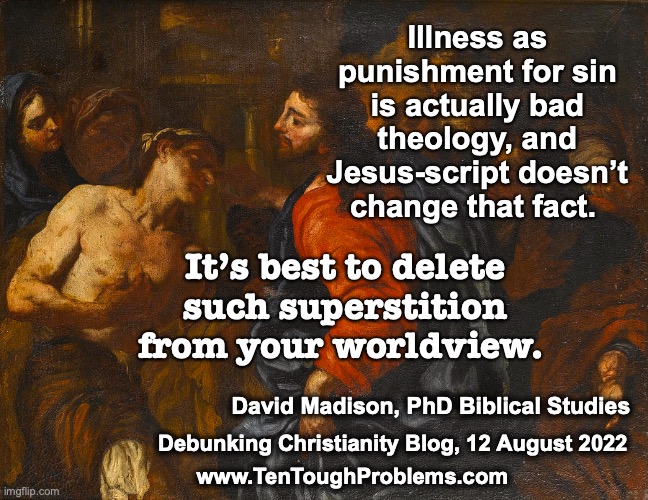
By the way, unless the god is right there (whispering in your ear?) to explain which sins caused the suffering, what’s the point? Illness as punishment for sin is actually bad theology, and Jesus-script doesn’t change that fact. It’s best to delete such superstition from your worldview.
Question 3:
The eucharist is described in 1 Corinthians 11 and Mark 14. “What are the implications when we see these texts side-by-side? What conclusions can we draw from the words of Paul predating the gospels?” Yes, this requires study and extra effort. Curiosity has to kick in: when were these two documents written? How might they be related? Since none of the gospels had been written when Paul was so active in his promotion of the new Jesus sect, how did he find out about Jesus? What did he find out? Not much, apparently; we search in vain in his letters for details about the life, ministry, preaching, and miracles of Jesus of Nazareth. He even brags about not consulting the people who had actually known Jesus:
“For I want you to know, brothers and sisters, that the gospel that was proclaimed by me is not of human origin, for I did not receive it from a human source, nor was I taught it, but I received it through a revelation of Jesus Christ.” (Galatians 1:11-12)
And he tells his readers exactly how he found out the wording of the eucharist: “For I received from the Lord what I also handed on to you…” That is, by way of his private revelations/visions (we could call them hallucinations) of Jesus, whom he was confident was not dead, but alive. Hardly a surprise at a time when there were other ancient cults that believed in dying-and-rising gods.
Given Paul’s intensive missionary zeal, which included writing long letters advocating the faith, it’s not a stretch to suppose that Mark had Paul’s text of the eucharist in 1 Corinthians 11—which he didn’t learn from any human source—in front of him when he wrote his gospel. This is one of the implications of the side-by-side comparison of these texts. Mark wasn’t writing history at all; he was passing along Paul’s theology. Mark added the setting, i.e., a last supper, with Jesus surrounded by disciples; that part was missing in Paul’s vision. Here’s some important homework on this issue: Tom Dykstra’s book, Mark Canonizer of Paul: A New Look at Intertexuality in Mark’s Gospel(2012).
Readers have to pay close attention to notice such things; they have to be curious, and be willing to question everything. New Testament scholars—both devout and secular—have sharpened these skills. But most of the laity, as surveys have shown, read the Bible casually, if at all. They are trained by priests and preachers not to question everything. Thus they miss important clues that the New Testament itself plays a major role in falsifying Christianity.
Question 4:
“…it is quite common for the devout to claim that the New Testament is their primary guide to life. But explain how that is possible, when there’s Jesus script forbidding this attitude…”
Supposedly, for Christians the Bible is the holy word of their god. In fact, there are many texts in both the Old and New Testament that the faithful wish were not there. But it just won’t do to rank the Old Testament as inferior. God’s genocide in the Noah story? Jesus promised that, at the coming of the kingdom of god, there will be as much suffering as at the time of Noah. How is that better? The god of the Old Testament promised to punish and wipe out those who broke his laws. The god of the New Testament added eternal fire after death as punishment. How is that better?
Matthew’s Jesus-script includes the insistence that “not one stroke of a letter, will pass from the law…” But we can see Matthew’s motivation: almost from the beginning of the Jesus sect, there were those who wanted it to remain a Jewish sect—Matthew was so inclined. The apostle Paul thought otherwise, and preached to the Gentiles. He downplayed the importance of the law, one primary example being the elimination of circumcision as a condition for converting to Christ. In the long run, Paul’s side won that battle.
But it won’t do to downgrade the Old Testament—how dare you anyway if it’s still part of god’s holy word? It’s right there on the church altar every Sunday! This amounts to picking and choosing what you like, depending on your own religious sensibilities. That is, you are judging the Holy Bible, you are deciding which parts are holy. Bear this in mind, however: even those early Christians who downplayed the law looked to the Old Testament to prove that Jesus was the messiah. They hunted for texts they were sure applied to Jesus, even though there is no mention whatever of a Jesus of Nazareth who would one day be the messiah. Nevertheless, so many stories of Jesus in the gospels are based on Old Testament models. The apostle Paul especially scoured the ancient texts for proof of his version of the Christ.
As I’ve said many times, the Bible—especially the gospels—is a minefield. Every step you take, the ground under your feet may explode. Which is why I say to Christians, “How about we go for a walk?”