A medieval book curse. The text on the right reads: “Book of Our Lady Ter Doest donated by Lord Dean Joseph of St. Donaas in Bruges. Whoever takes it away or alienates or tears out a sheet, be damned. Amen.” Credit: Bruges Public Library
Overview:
When books were rare and precious objects, their owners protected them with curses to deter thieves and vandals. We should adopt that same attitude of repugnance toward modern-day censors.
Reading Time: 5 MINUTES
We take it for granted that books are common objects. It’s easy to find one on any subject you want to read about.
You can patronize your favorite bookstore, where the shelves are stacked floor to ceiling with books. You can borrow a treasure trove of books from your local public library for free. Or you can buy anything you want from an online bookseller with an infinite virtual catalog and have it on your doorstep in a few days.
This casual abundance makes it easy to overlook how good we’ve got it. Book lovers of past eras had a much harder time. Until very recently in human history, books were rare and precious treasures.
Before Gutenberg
For thousands of years, from the dawn of literacy until the invention of movable type (1450 in Europe, and several centuries earlier in China), the only way to copy a scroll or a book was by hand, one letter a time.
It was a slow, arduous task requiring the labor of trained scribes. Imagine a medieval scriptorium: rows of monks working by candlelight in unheated rooms, writing with quill pens and ink they made themselves from local pigments. Imagine the straining eyes, the aching backs, the cramping hands. One marginal note, written in a medieval manuscript by the copyist, gives a sense of the labor involved: “Now I’ve written the whole thing. For Christ’s sake, give me a drink!”
Even the parchment that books were written on was a valuable commodity. It was made from calfskin, and it might require the slaughter of dozens or hundreds of calves to yield enough for an entire book. There was good reason not to waste it. This led to the creation of palimpsests: a book whose previous writing was erased, washed or scraped off, so that the precious parchment could be reused for something new.
These palimpsests are a treasure trove for modern scholars. With multispectral imaging, we can read the older, nearly-invisible traces of letters underneath the newer writing. Some ancient manuscripts are only known from these remnants.
Because books were so laborious to produce, the copyists made each one an object of beauty. Many surviving ancient texts are illuminated manuscripts, decorated with elaborate border art and illustrations, sometimes made with gold or silver leaf. A particularly elaborate book like the Lindisfarne Gospels might have taken as long as ten years to craft.
All the work required meant that books were luxuries of the very rich. And to top it all off, books were fragile. Unlike, say, a marble statue or an iron tool, they could easily be destroyed by fire, by water, by rot, or by simple thoughtless vandalism. All that staggering labor could be erased in moments—and often was. (The sum total of written material in Old English comes from a mere four books that survived the centuries.)
Naturally, people who owned books were fiercely protective of them. After you’d gone to the trouble of getting a book copied for your collection, you’d be more than a little piqued if someone borrowed it and never gave it back.
“Let him be fried in a pan”
This inspired one of my favorite literary inventions: the book curse.
Scribes would write these curses at the beginning or end of a book. Like Egyptian pharaohs’ curses on anyone who desecrated their tombs, they promised an awful fate for anyone who stole the book, damaged it, mutilated it, or borrowed it and didn’t return it to the owner.
A short book curse might threaten book thieves with excommunication, damnation or general wrath of God, like this one: “May the sword of anathema slay / If anyone steals this book away.”
However, they could also be longer and more inventive. A more detailed one went like this:
“If anyone take away this book, let him die the death; let him be fried in a pan; let the falling sickness and fever seize him; let him be broken on the wheel and hanged. Amen.”Marc Drogin, Anathema: Medieval Scribes and the History of Book Curses, quoted in Atlas Obscura
“To steal this book, if you should try, It’s by the throat you’ll hang high. And ravens then will gather ’bout To find your eyes and pull them out. And when you’re screaming ‘oh, oh, oh!’ Remember, you deserved this woe.”
Medieval people were seriously hardcore about protecting their books.
The evil of book burners
Of course, book curses weren’t magic spells. They had no power outside the superstitious fear they inspired in potential thieves. On the other hand, that’s why the concept is brilliant. The kind of person who’d want to steal a book, presumably, also cares deeply for the written word. That’s the same kind of person who’d be most likely to believe that words have supernatural power to inflict harm on wrongdoers.
Aside from antiques and rare editions, books aren’t so scarce anymore. On the contrary, we’re positively drowning in words. There are more books published than anyone could read in a lifetime. For the first time in history, our biggest problem isn’t finding books, but choosing which ones to read.
We live in a world those candlelit medieval scribes could scarcely have imagined. Even still, there’s something we can learn from them. The lengths they went to to safeguard their precious books—and the violent hatred they felt for thieves and vandals—is an attitude we’d do well to reclaim.
In those ancient times, it was a special kind of evil to burn or otherwise destroy a book. To do so would be to consign countless hours of labor, sweat and devotion to the flames. It was all too possible to erase a book from existence by destroying every copy.
Nowadays, book burning and censorship are merely symbolic acts. The internet enables endless digital replication, perpetual archiving and virtually free distribution, all protected by encryption if necessary. It makes wannabe book destroyers’ efforts perfectly futile. Anyone with a modicum of technical knowledge, or a little bit of money, can read any book they want with very little effort.
Even so, we should hold to the view that to burn a book—literally or metaphorically—is one of the worst crimes you can commit. To keep knowledge out of the hands of those who come seeking it is a grave sin, in the secular sense of the word. Only those with truly depraved souls would attempt such a deed.
Books are accelerators
A book is a distillation of knowledge. It condenses months or years of research into a product that can be read and absorbed in a few hours. Because of this wonderful power, books were the first accelerators that sped up the pace of human progress. The more and more widely we read, the better equipped we are to comprehend the world and to see through others’ eyes. We can each be the beneficiary of many lifetimes’ worth of progress, far more than any one individual could rediscover on their own.
It’s this acceleration that book burners and book censors want to prevent. They want to keep us all tied to a single view of the world, a single set of ideas. Every book that challenges the status quo, that proposes new ways of seeing, is a mortal threat to them. When they come knocking to take the books from our hands, we know what to say to them, courtesy of our medieval forebears. We ought to have our book curses at the ready for any who want to defile the temple of knowledge.
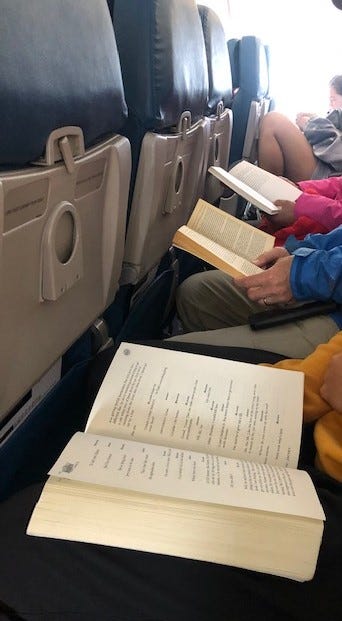
Our recent transatlantic flight from Switzerland back to Canada proved to be an “accidental detox” for passengers, as to the horror of most, there were no screens on the seat backs, and no charging ports for devices. After the first gasps of surprise and dismay (especially of parents with small children) subsided, a wonderful scene unfolded. I had no idea so many people still read books! The photo below is the view across the row from me. The plane was humming with conversation; two men behind me who had never met before, struck up a conversation (a joy to listen to Scottish accents) and shared beers and stories, children played paper games, and our family rotated through reading Thomas Hardy, Seinfeld scripts, Ian McEwan, C.S. Lewis, and Calvin and Hobbes (something for every age and interest). It seemed like a flight in a time machine, where people still remembered how to converse, play, read books, and spend time away from black mirrors.
to wonder further, “We Gen-X and older have a default to go back to. What do we do for people born after 1995 who don’t?”
Thinking about this question more deeply, I realized that the offspring of the digital age have grown up as attentional and relational ferals. Many have grown up isolated from deep attention from a very young age, have social behaviour stilted by online interactions, and suffer from emaciated language skills. While the “accidental detox” flight did ignite some hope in me regarding people’s ability to engage their minds differently, this scene could only occur because people were left no other choice. I am also quite sure that that everyone quickly reverted to their usual patterns of distraction as soon as they were off that flight.
There are a myriad of things that make us human. But the ability to pay attention lies at the core. Relationships require attentive listeners; learning takes dedicated attention to grow knowledge and skills; reading demands attention to words, meaning, and context; work demands attention to produce carefully crafted products or services; democracy involves attention to truth and opposing positions; faith requires attention for prayer, silence, and reading scripture. Attention is it.
When deep attention has to compete with hyper attention (fractured attention that quickly zips from one point of focus to the next), it is akin to throwing a dolphin into a tank filled with piranhas and hoping that they will find a way to coexist. Although we are prone to fool ourselves, there cannot really exist a “healthy balance” between dolphins and piranhas.
I discussed this attentional issue in a couple of earlier articles (such as TikTok-Time is running out for saving our children’s brains), relating accumulating research on the detrimental effects of digital device use, especially on children and youth. In this Wall Street Journal article, Michael Manos, clinical director of the Center for Attention and Learning at Cleveland Clinic states that, “Directed attention is the ability to inhibit distractions and sustain attention and to shift attention appropriately…If kids’ brains become accustomed to constant changes, the brain finds it difficult to adapt to a non-digital activity where things don’t move quite as fast.”
The current generation is habituated to switching tasks every few seconds. Indeed in 2017, before the new crop of social media apps, a study found that even undergraduates, who are more cerebrally mature than K–12 students and therefore have stronger impulse control, “switched to a new task on average every 19 seconds when they were online.” 19 seconds. I cannot think of one coherent task that only takes 19 seconds to fully complete. Even brushing your teeth takes longer.
Paul Bennett, the director of Halifax-based firm Schoolhouse Institute and adjunct professor of education at Saint Mary’s University explains that, “the more time young people spend in constant half-attentive task switching, the harder it becomes for them to maintain the capacity for sustained periods of intense concentration. A brain habituated to being bombarded by constant stimuli rewires accordingly, losing impulse control. The mere presence of our phones socializes us to fracture our own attention. After a time, the distractedness is within us.” Near constant distraction by phones and other tech has serious side-effects, especially for reading. No wonder that by 2016, just 16 percent of 12th-grade students read a book or magazine on a daily basis.
This post is not intended as a lament, but as a starting point for rehabilitating attentional ferals of the digital age, whether they be young or old. All of us who use digital devices are affected by the easy lure of hyper attention, and if our aim is — as
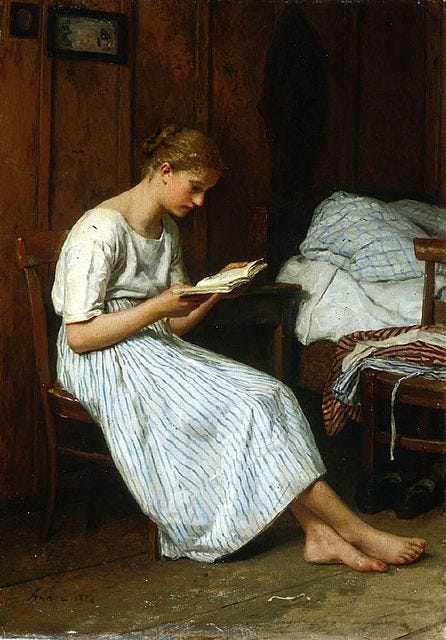
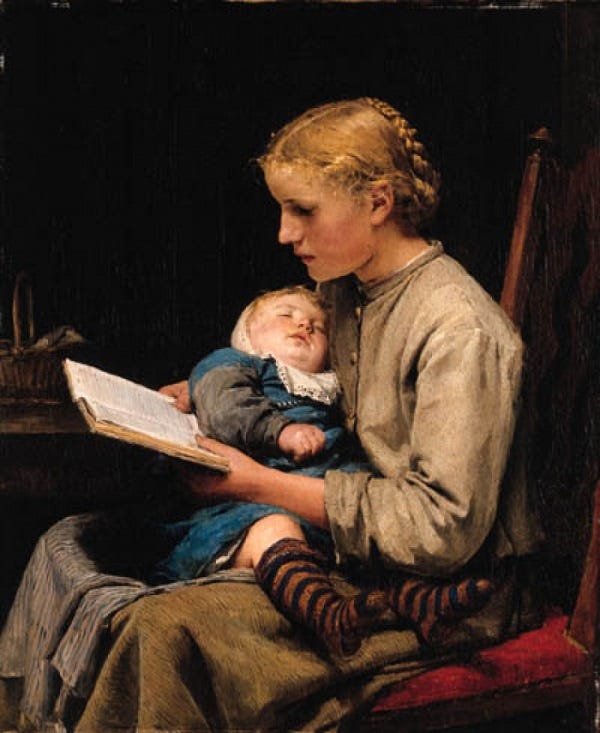
The Artist’s Wife Reading by Albert Bartholomé, 1883
On eating books
In order to reclaim our attention, deciding to start with a digital detox can be a helpful first step (see From Feeding Moloch to Digital Minimalism for a concrete game plan). With regard to actually training the mind to refocus and develop deep attention, reading books provides the best rehabilitation. This not only for attention’s sake, but because books allow us to dig our minds into the humus of time, people, and civilization as a whole.
In his essay In Defense of Literacy, Wendell Berry explains the importance of reading books as follows:
I am saying then, that literacy – the mastery of language and the knowledge of books – is not an ornament, but a necessity. It is impractical only by the standards of quick profit and easy power. Longer perspective will show that it alone can preserve in us the possibility of an accurate judgement of ourselves and the possibilities of correction and renewal. Without it, we are adrift in the present, in the wreckage of yesterday, in the nightmare of tomorrow.
In other words, without the knowledge of books and mastery of language, the nightmare of tomorrow may well turn us into what
refers to as “thin humans”, forever on the surface of things, “the surface of time, by forcing too much hurry and efficiency; the surface of relationships, which will be shallower and more functional; the surface of information, which will keep us credulous; the surface of our own thoughts and feelings, which will keep us alienated from our own depths.”
In contrast, extensive knowledge of books and the wisdom transmitted through the authors behind them expands us into a fuller, more rooted human being. We gain intellectual nourishment, personal insights, and a deeper understanding of the world around us from tasting, eating, and digesting books. In An Experiment in Criticism, C.S. Lewis explains,
“Those of us who have been true readers all our life seldom fully realise the enormous extension of our being which we owe to authors,” … “We realise it best when we talk with an unliterary friend. He may be full of goodness and good sense but he inhabits a tiny world. In it, we should be suffocated. The man who is contented to be only himself, and therefore less a self, is in prison. My own eyes are not enough for me, I will see through those of others.
According to Susan Wise Bauer, men and women have been undertaking self-education based on reading and discussing books for centuries: “Any literate man [or woman, we would add] can rely on self-education to train and fill the mind. All you need are a shelf full of books, a congenial friend or two who can talk to you about your reading, and a ‘few chasms of time not otherwise appropriated’”.
to share theirs in turn). He richly describes the path of his self-education and details his “orca-sized time blocks” devoted to reading. Notably he admitted to being a slow reader, affirming that reading fast has nothing to do with being well-read. In The Well-Educated Mind, Susan Wise Bauer supports this notion by stating, “The idea that fast reading is good reading is a twentieth-century weed, springing out of the stony farmland cultivated by the computer manufacturers…The speed ethic shouldn’t be transplanted into an endeavour that is governed by very different ideals.”
discusses Maryanne Wolf’s research on the importance of reading tangible books. This includes the way in which a book provides cues to the embodied mind:
….visual placement on a page or the shifting weight of one side of the book against the other as we make our way through it – which subtly scaffold our comprehension and retention. And, and of course, the book is not also the gateway to countless other forms of media the way a smartphone, tablet, or even internet-connected e-reader might be. In these ways, the affordances of the books might be uniquely suited to sustaining deep reading.
Reading a book on any kind of screen keeps your mind in “device mode” and will likely lead to greater struggles maintaining attention. On that note, keeping devices away from your body and out of reach and sight helps to redirect your mind toward the book in hand. Devices are subconsciously associated with the regular dopamine-drips most of us have grown accustomed to; physical books take you into a different realm and cast off avenues for distraction. My daughter commented that she enjoys reading physical copies because she views them as a form of a gift by the author, complete with design, type-face, weight, and feel of the pages. She experiences this as an opening, a portal to the story that does not exist with devices.
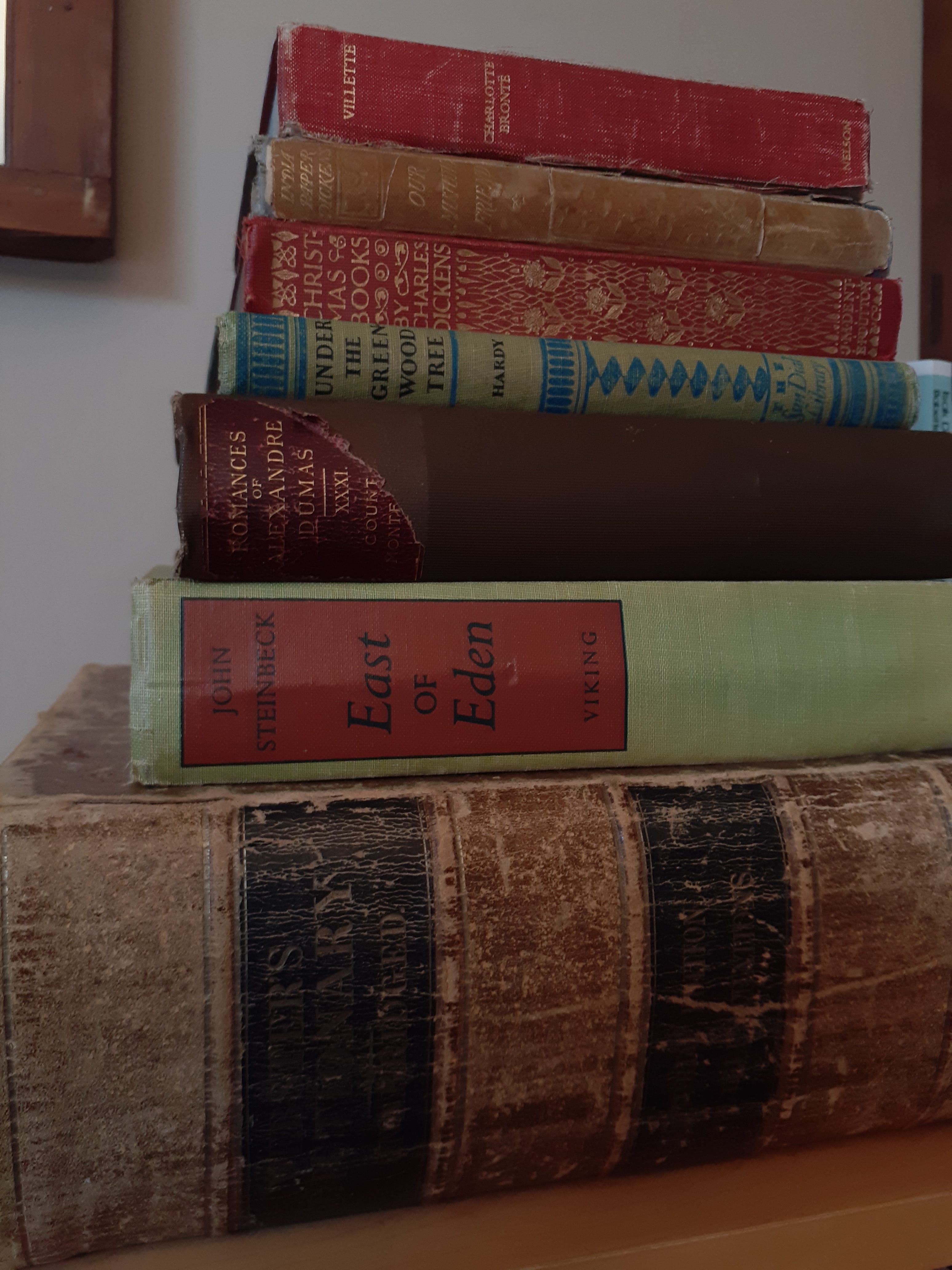
Also, to me, the feel and beauty of tangible books is simply irresistible. Here are some of my favourites:
Webster’s Dictionary (1859 pictorial edition), East of Eden by Steinbeck (first edition), The Count of Monte Cristo by Dumas (1894 ed.), Under the Green Wood Tree by Hardy (first edition), Christmas Books by Charles Dickens, Our Mutual Friend by Charles Dickens, Villette by Charlotte Brontë
Read old books
Getting started on reading any book is the main goal, but the ideal is to work toward reading classic books. In the God in the Dock collection of essays, C.S. Lewis explains why reading old books is of particular importance:
“…if he must read only the new or only the old, I would advise him to read the old. And I would give him this advice precisely because he is an amateur and therefore much less protected than the expert against the dangers of an exclusive contemporary diet. A new book is still on its trial and the amateur is not in a position to judge it…. “If you join at eleven o’clock a conversation which began at eight you will often not see the real bearing of what is said.”
Classics differ especially in the attention that they demand from their readers. Deep reading of dense, complex prose is demanding, but provides rich rewards cognitively, aesthetically, and emotionally. Classics also provide a measuring stick for the depth, language, and complexity that makes a book worthwhile. This is in stark contrast to modern books, which are often filled with twaddle
Where can parents get started if their child shows no interest in classics?
Lead by example. By putting away a device or turning off Netflix and instead picking up a book, you set a tone to be followed.
Have a regular quiet time in the afternoon where everyone reads. We have done this since our first child was born and still continue with this practice over 17 years later.
Make books available in the home. I always have been fond of being surrounded by books and we thus have 17 bookshelves throughout our home including in all bedrooms, the living room, and the library.
If the reading level seems to complex for your child, try Classic Starts which provide a simplified version of the story.
Use Librivox and allow the child to listen to the story (while maybe reading along).
Read aloud to your child. When the kids were little we used to start our mornings on the couch, reading through a pile of classic picture books before breakfast. When they were older we would do read-aloud time of longer classics in the afternoons and evenings.
If you are interested in introducing your child to Charles Dickens, I created a Classic Learner’s Edition of A Christmas Carolwhich includes the unabridged original text, a 40 min. read-aloud version, deep and varied classical vocabulary study, and Victorian parlour games.
It is a good rule, after reading a new book, never to allow yourself another new one till you have read an old one in between. If that is too much for you, you should at least read one old one to every three new ones.
C.S. Lewis
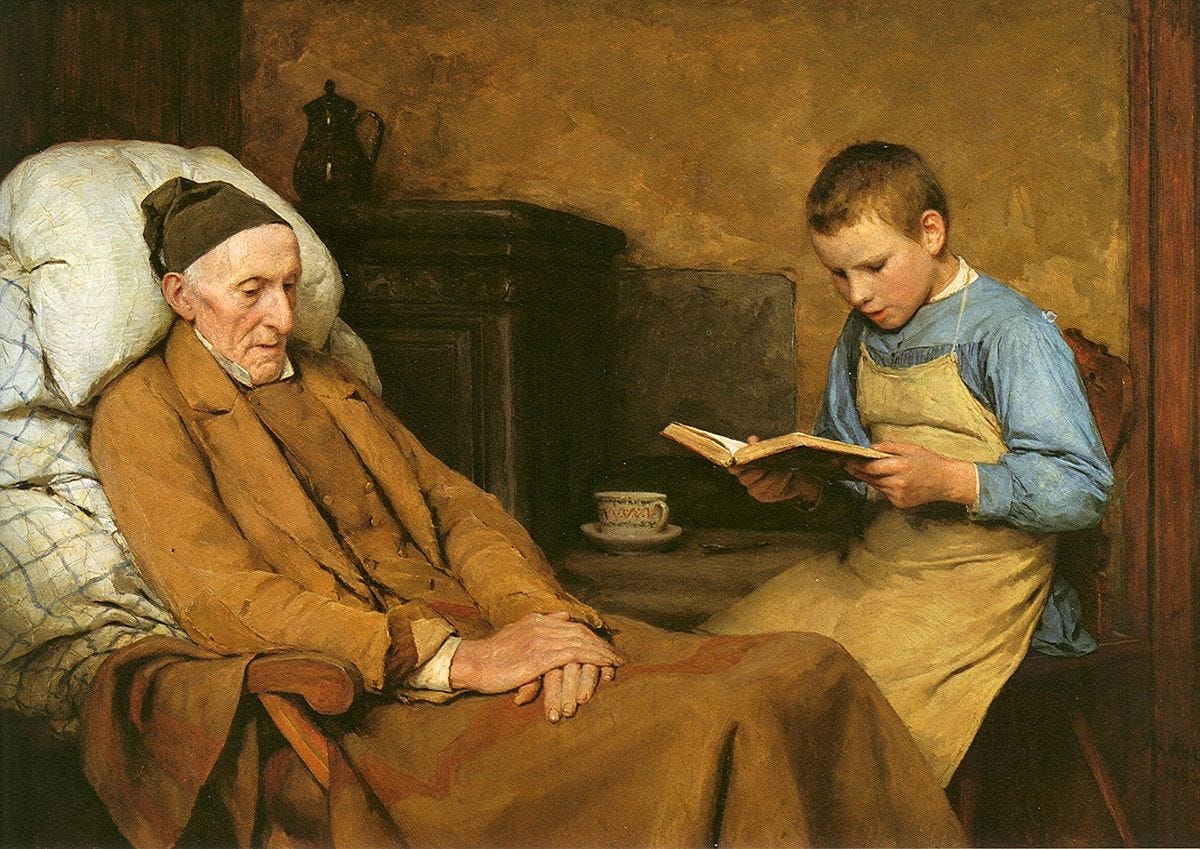
Die Andacht des Grossvaters by Albert Anker, 1893
Get familiar with classic vocabulary
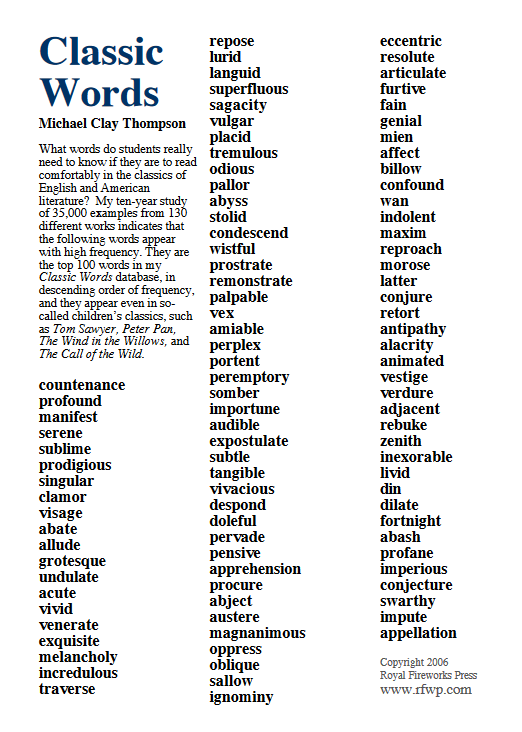
When embarking on the journey to read classics, many readers feel daunted by the complexity of advanced vocabulary richly peppered throughout older books. As a second language learner, I recall reading the Hobbit for the first time with a German-English dictionary in one hand, and the novel in the other. I thus have an appreciation for struggling through texts, and an even greater appreciation for the work by educator Michael Clay Thompson, who wondered over 20 years ago what the best words in the English language were.
As an educator who develops language arts curricula for gifted children, Thompson began marking advanced vocabulary in every English language classic that he read, a task which eventually developed into a ten-year study of 35,000 examples from 135 different works. From his research he distilled the top 100 words that appear with high frequency in classic works of English and American literature.
This list is profoundly useful and my students have often thanked me for introducing them to these essential classic words. I have developed the following worksheets that help you or your student master the top 100 classic words.
, you are most likely familiar with Susan Wise Bauer’s The Well-Trained Mind. For adults who crave a classical education that they never received, she wroteThe Well-Educated Mind. It provides a guide and plan to read the “Great Books”, and allows you to “read chronologically through six types of literature: fiction; autobiography; history and politics; drama; poetry; and science and natural history.” She is an ambitious (and at times intimidating) author, and I do not suggest that you have to follow her proposed method (which includes reading each book three times – has anyone actually ever done this?), but her book lists are immensely useful and the accompanying commentary is illuminating.
Mensa Excellence in Reading Program provides wonderfully extensive reading lists students starting with kindergarten all the way to high school. The books can be read independently by the student, read aloud by the parent, or listened to as an audiobook (also, when a student completes a reading list, they receive a certificate of achievement and t-shirt). You can find the lists here:
Memoria Press Supplemental Reading List This is one of my favourite reading lists: a superb collection of books sorted according to grade/lexile levels.The recommended books for grades 3-up are in three categories: (1) classics (2) light reading (3) informational reading.
Read Aloud Revival Book Lists – These are incredibly extensive lists that encourage reading together and falling in love with books:) These lists include some classics but also contemporary book choices. Here is a selection (there are still more groups on the site):
Learning Resource Center (CLRC) Reading Lists are divided in to early elementary, late elementary, and middle school. They are not exhaustive lists but a selection of excellent books that “we have enjoyed with our own children and with many children whom we have taught over the years”. They provide a good foundation in the joy of reading and listening to stories and set the stage for the appreciation of many great classical epics in later years.
Finally there are many excellent substack writers who provide book reviews, inspiration, and guided reading groups. A few that have come to my attention are
? How do you help create reading habits in your children? I would love to hear your thoughts in the comments below !
If you found this post helpful (or hopeful), found the vocabulary worksheets or readings lists useful, consider supporting my work by becoming a paid subscriber, or simply show your appreciation with a ‘like’ or ‘share”.
Twaddle is to literature as a Twinkie is to nutrition; maybe tasty but would you feed it to your child as a wholesome diet? Twaddle is reading-made-easy, second-rate, stale, predictable, scrappy, weak, diluted, silly, insignificant. You get the idea.
Reading is one area where homeschoolers seem to particularly excel, reading on average two grade levels above their peers. In one U.S. study, Dr. Brian Ray utilized 15 independent testing services, to obtain information from 11,739 homeschooled students from all 50 states, Guam, and Puerto Rico, who took three well-known tests—California Achievement Test, Iowa Tests of Basic Skills, and Stanford Achievement Test. The study found that while public school students scored at the 50th percentile, homeschool students came in at the 89th percentile. Interestingly, the findings also revealed “that issues such as student gender, parents’ education level, and family income had little bearing on the results of homeschooled students.”
I generally read about three concurrent books – one at the breakfast table (non-fiction), one for the couch in the afternoon (fiction), and one to take along for appointments or while at the climbing gym with my youngest (fiction / non-fiction).
I have almost worked my way through the ‘novel’ section of The Well-Trained Mind, and I keep to a mostly classic book diet with a P.D. James palate cleanser from time to time.
Subscribe to School of the Unconformed
By Ruth Gaskovski · Launched 6 months ago
Family, education, and navigating daily life in the Machine Age. Committed to staying grounded in reality, spreading seeds of truth, beauty, and goodness. Swiss polyglot, homeschooler, lover of classic books. Homeschool advisor — Richard Syrett Show.
I encourage all my Southern Baptist friends (and others) to read this excellent book.
Here’s a quote:
Personal feelings about your relationship with any deity — no matter how deep — are not proof that what you believe is true.
Madison, David; Sledge, Tim. GUESSING ABOUT GOD (Ten Tough Problems in Christian Belief Book 1) (p. 34). Insighting Growth Publications Inc.. Kindle Edition.
Amazon abstract
In this first book of his Ten Tough Problems series, David Madison shares three critical problems in Christian belief.
Problem One: God is invisible and silent. This fact forces humanity to rely on ineffective ways of knowing God — common knowledge, sacred books, visions, prayer, personal feelings, and theologians. But all these sources of God knowledge fall short as evidenced by a world of disagreement, not just between Christians and other religions, but within Christianity itself.
Problem Two: The Bible disproves itself. In Chapter 2, Madison narrows his focus down to the world’s most famous book. He shows how two hundred years of critical scholarship — something most Christians know nothing about — have revealed the Bible to be full of archaic ideas, moral failures, and contradictions. He makes a convincing case that all these flaws rob us of any confidence that claims of biblical revelation can be taken seriously.
Problem Three: We can only guess who Jesus was. In Chapter 3, Madison turns his magnifying glass on the four Gospels and finds them severely lacking in their attempts to provide a clear understanding of who Jesus was and what he had to say. These Gospels not only contradict one another, but when reviewed under Madison’s guidance, prompt the honest reader to request, “Will the real Jesus please stand up?”
Combining rigorous scholarship with engaging personal reflections, this book offers understanding and help for individuals struggling with tough questions about belief. And the most pressing question it provides for the reader is: How could a deity competent enough to create this Universe be such a massively poor communicator who leaves humanity Guessing about God.
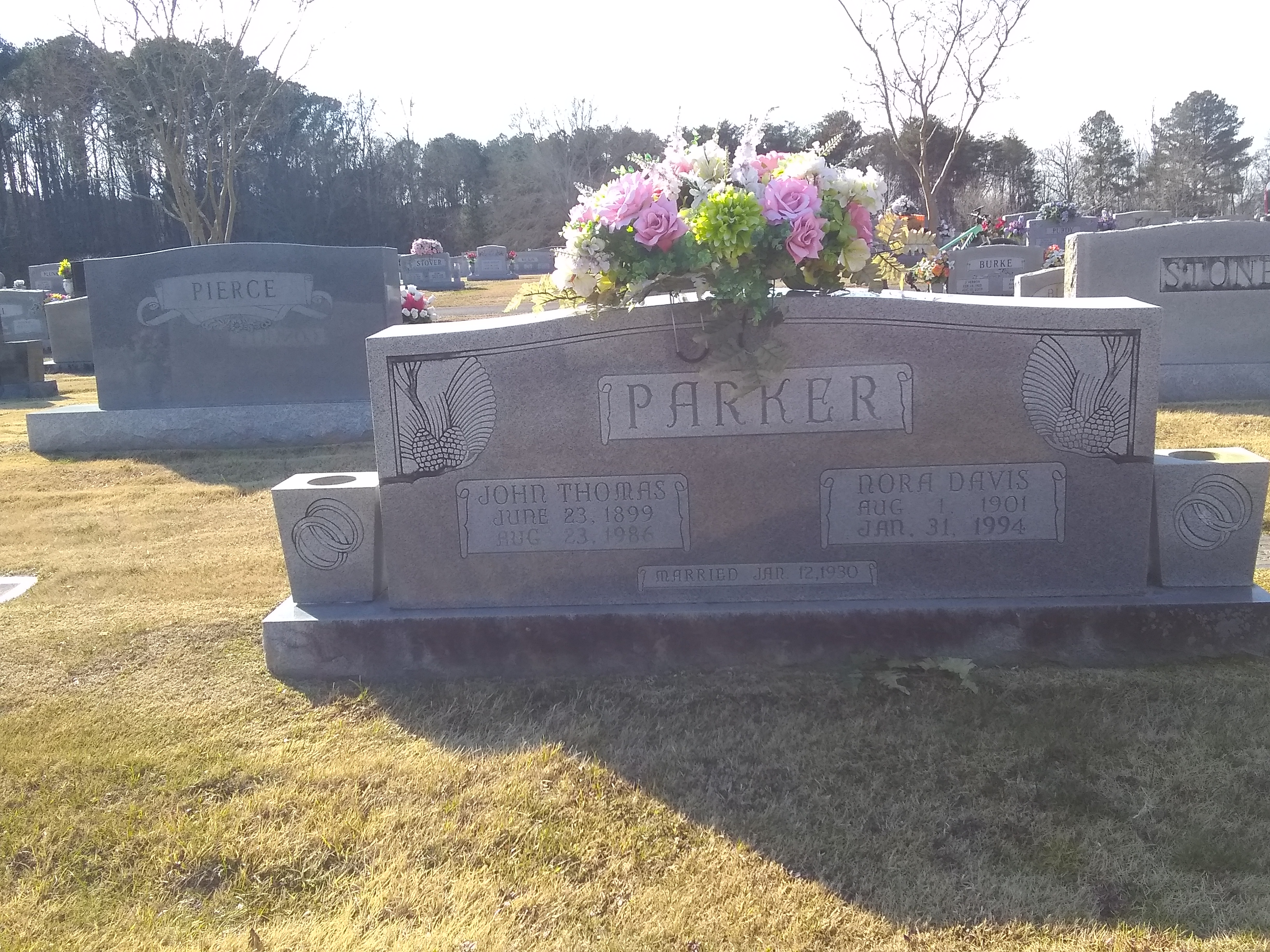
Yesterday, ate at Speedy Gonzales. Today, visited parents and grandparents at Hillcrest Cemetery (not sure what happened to my photo of Mother’s footstone.
Listening
I continue to listen to Jodi Picoult’s wonderful book.
Book abstract from Amazon
#1 NEW YORK TIMES BESTSELLER • With richly layered characters and a gripping moral dilemma that will lead readers to question everything they know about privilege, power, and race, Small Great Things is the stunning new page-turner from Jodi Picoult.
SOON TO BE A MAJOR MOTION PICTURE
“[Picoult] offers a thought-provoking examination of racism in America today, both overt and subtle. Her many readers will find much to discuss in the pages of this topical, moving book.”—Booklist (starred review)
Ruth Jefferson is a labor and delivery nurse at a Connecticut hospital with more than twenty years’ experience. During her shift, Ruth begins a routine checkup on a newborn, only to be told a few minutes later that she’s been reassigned to another patient. The parents are white supremacists and don’t want Ruth, who is African American, to touch their child. The hospital complies with their request, but the next day, the baby goes into cardiac distress while Ruth is alone in the nursery. Does she obey orders or does she intervene?
Ruth hesitates before performing CPR and, as a result, is charged with a serious crime. Kennedy McQuarrie, a white public defender, takes her case but gives unexpected advice: Kennedy insists that mentioning race in the courtroom is not a winning strategy. Conflicted by Kennedy’s counsel, Ruth tries to keep life as normal as possible for her family—especially her teenage son—as the case becomes a media sensation. As the trial moves forward, Ruth and Kennedy must gain each other’s trust, and come to see that what they’ve been taught their whole lives about others—and themselves—might be wrong.
With incredible empathy, intelligence, and candor, Jodi Picoult tackles race, privilege, prejudice, justice, and compassion—and doesn’t offer easy answers. Small Great Things is a remarkable achievement from a writer at the top of her game.
Praise for Small Great Things
“Small Great Things is the most important novel Jodi Picoult has ever written. . . . It will challenge her readers . . . [and] expand our cultural conversation about race and prejudice.”—The Washington Post
“A novel that puts its finger on the very pulse of the nation that we live in today . . . a fantastic read from beginning to end, as can always be expected from Picoult, this novel maintains a steady, page-turning pace that makes it hard for readers to put down.”—San Francisco Book Review
#1 NEW YORK TIMES BESTSELLER • With richly layered characters and a gripping moral dilemma that will lead readers to question everything they know about privilege, power, and race, Small Great Things is the stunning new page-turner from Jodi Picoult. SOON TO BE A MAJOR MOTION PICTURE “[Picoult] offers a thought-provoking examination of racism in America today, both overt and subtle. Her many readers will find much to discuss in the pages of this topical, moving book.”—Booklist (starred review) Ruth Jefferson is a labor and delivery nurse at a Connecticut hospital with more than twenty years’ experience. During her shift, Ruth begins a routine checkup on a newborn, only to be told a few minutes later that she’s been reassigned to another patient. The parents are white supremacists and don’t want Ruth, who is African American, to touch their child. The hospital complies with their request, but the next day, the baby goes into cardiac distress while Ruth is alone in the nursery. Does she obey orders or does she intervene? Ruth hesitates before performing CPR and, as a result, is charged with a serious crime. Kennedy McQuarrie, a white public defender, takes her case but gives unexpected advice: Kennedy insists that mentioning race in the courtroom is not a winning strategy. Conflicted by Kennedy’s counsel, Ruth tries to keep life as normal as possible for her family—especially her teenage son—as the case becomes a media sensation. As the trial moves forward, Ruth and Kennedy must gain each other’s trust, and come to see that what they’ve been taught their whole lives about others—and themselves—might be wrong. With incredible empathy, intelligence, and candor, Jodi Picoult tackles race, privilege, prejudice, justice, and compassion—and doesn’t offer easy answers. Small Great Things is a remarkable achievement from a writer at the top of her game. Praise for Small Great Things “Small Great Things is the most important novel Jodi Picoult has ever written. . . . It will challenge her readers . . . [and] expand our cultural conversation about race and prejudice.”—The Washington Post “A novel that puts its finger on the very pulse of the nation that we live in today . . . a fantastic read from beginning to end, as can always be expected from Picoult, this novel maintains a steady, page-turning pace that makes it hard for readers to put down.”—San Francisco Book Review
Wrought iron words are carefully selected, soft but tough, malleable, forged to the scalding point in the writer’s mind, then poured onto the page. With tong and hammer he rolls, stretches, shapes, and orders the words into snippets, sentences, and paragraphs. Meaning fused into life, just waiting to be discovered.
Richard L. Fricks
This morning’s reading session was fruitful. In the following article, author Jessica Lourey asks us to read written words and life like a writer. This is great advice and I encourage you to read it through, take good notes, and feed your narrative detective some PIE.
“Learning to read like a writer is a practice in self-awareness and critical analysis. You need to be mindful when you really like a book/ movie/ song, or, even more telling, when you are actively turned off by one. Reading like a writer requires you to get in touch with that self-awareness and hone it by asking questions. I’m going to call that piece your narrative detective—its job is to solve the mystery of the narrative, looking at the ways it is and isn’t succeeding—and I’m going to encourage you to feed it PIE every time you read anything: a menu, a short story, the interpretive plaque next to the world’s biggest redwood tree. A book.
Here are the ingredients to the PIE:
P—Prepare. Prepare with pen and paper. Always have your notebook and something to write with nearby when you read. Your goal is to be prepared for insight. In addition to reading for pleasure, you will now use words as research and write down what you learn. If you prefer, you can dictate into a recorder or type into the Notes section of your phone.
I—Immerse. Get inside the words, the sentences, the story arc. Don’t simply stay on the surface of what you’re reading, no matter how shallow it seems. Go deep.
E—Examine. Examine. If that cereal box makes you excited to eat the sugar doodles, ask yourself what it is about the words and their formatting is doing that for you. If you read that redwood plaque and walk away feeling smart, ask yourself how it pierced your busy mind.
If—especially if—you’re reading a novel, and you connect with a character, or you find yourself yanked out of the story, or you read a sentence twice to savor the citrus taste of it, or anything else of note happens, study that situation like a lover’s face. Write down what you think is happening (“main character makes stupid choices,” “too many adverbs,” “lots of smells make me feel like I’m right there,” “each chapter ends with a hook,” etc.) because transcribing information flips a switch in our brain, waking up the records guy who then goes over to pick up what you wrote and file it somewhere so you can access it later.
When you feed your narrative detective PIE, she begins to internalize the language and rhythm of story. This level of observation is how most novelists learned to craft their stories. They didn’t go to college to learn to be writers. They read to learn to be writers. In fact, the first MFA in Creative Writing wasn’t offered until 1936, five years after the New York Times Bestseller List premiered. Agatha Christie, Mark Twain, and Jane Austen wrote their masterpieces well before that. And most of the current New York Times best-selling authors didn’t go to college for creative writing. J. K. Rowling’s degree is in French. Robert Ludlum studied acting. Ray Bradbury barely graduated high school. The amazing Maya Angelou earned fifty honorary degrees in her lifetime, but she gave birth three weeks after graduating high school and never attended college.
When it came to writing books, all of these writers learned by reading. You read like a writer to notice how good writing happens so you can emulate it and how bad writing happens so you can avoid it. You learn to understand how a story is strung together, how one particular scene leads to another, to observe how characters are built. I particularly encourage reading in the genre you wish to write in because those stories will have their own unique seasonings. Also, if you have the time and interest, I encourage you to check out Francine Prose’s exquisite Reading Like a Writer: A Guide for People Who Love Books and for Those Who Want to Write Them for a deeper guided practice on the art of reading like a writer.
It’s not only words that you need to pay more attention to on this healing odyssey. You should also start to read life like a writer. This is a little bit of a cheat, conflating reading words with reading people, but only a little because when it comes to writing well, inviting your narrative detective to real-life situations and feeding her PIE is just as important as bringing her to written words.
You can’t take a person you know, whole cloth, and shove them into a story. One, they’ll struggle. Two, real people are too big and clumsy for stories. They’re inconsistent and often dull if rendered whole. You can—and must—instead take pieces of people, settings, situations and transform them into a story.
So walk this world with a pen and notebook in hand, immerse yourself in life, examine why people make the choices they make. Consider what parts work, and which don’t, and what you can take away from that to write a compelling novel. Eavesdrop. Hang out with people who think differently than you do. Seek art, particularly art that makes you uncomfortable. Ask yourself “why” a lot, and then ask yourself “what if.” Start answering both questions. And most importantly, read as if your life depends on it.”
— Rewrite Your Life: Discover Your Truth through the Healing Power of Fiction by Jessica Lourey
Wrought iron words are carefully selected, soft but tough, malleable, forged to the scalding point in the writer’s mind, then poured onto the page. With tong and hammer, he rolls, stretches, shapes, and orders the words into snippets, sentences, and paragraphs. Meaning fused into life, just waiting to be discovered.
Richard L. Fricks
We all need to be more empathetic, more open-minded and accepting (aka, less judgmental), more creative, and more courageous.
The good thing is, we can accomplish all this without a brain (or heart) transplant.
Look at what I discovered during this morning’s reading session:
“Researchers have found tangible benefits to reading fiction…
Immersing yourself in a good novel increases your understanding of self and others. Studies suggest this is due to something called embodied cognition, in which your brain thinks your body is doing something it isn’t.… Specific to reading fiction, your brain drops you into the body of the protagonist, experiencing what they experience, which expands your capacity to put yourself in another’s shoes.
In addition to increasing empathy, neurobiological research proves that reading fiction changes the biology of the brain, making it more receptive and connected.
Reading novels also makes you more creative and open-minded, gives you psychological courage, and keeps your brain active and healthy.
The therapeutic value of reading novels is so profound that it has birthed something called bibliotherapy, in which clients are matched with a literary fiction designed to address what is ailing them, from mild depression to a troubled intimate relationship to a desire to find a work/ family balance.
Anyone who belongs to a book club has likely experienced a version of fiction’s healing powers. The value of reading is even more significant if you’re a writer. Imagine being a chef who eats only chicken nuggets, a carpenter who refuses to look at buildings, or an orchestra conductor who doesn’t listen to anything but commercial jingles.
Such is the problem for a writer who doesn’t read regularly and widely. Books are the maps to your craft. According to Stephen King, ‘If you don’t have the time to read, you don’t have the time (or the tools) to write. Simple as that.’ I agree.”
From Rewrite Your Life: Discover Your Truth through the Healing Power of Fiction by Jessica Lourey.

 by ADAM LEE




















 Richard L. Fricks