

Penciling from pain to purpose
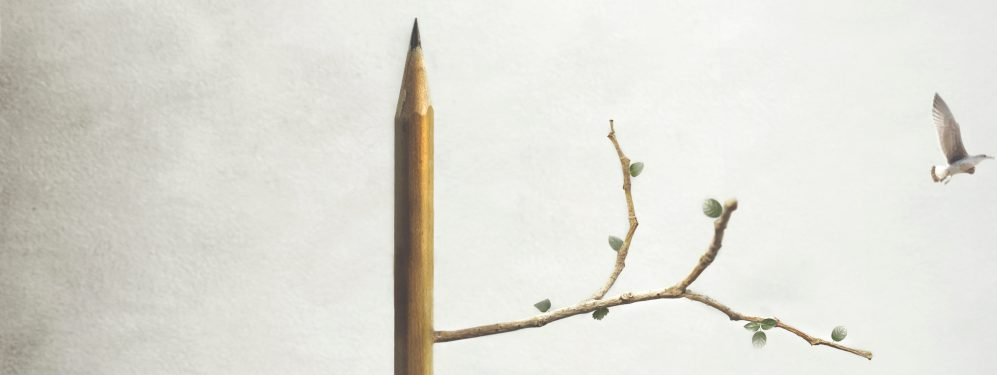
With pencil, you can always erase.
Sue Monk Kidd

The worst thing you can do is censor yourself as the pencil hits the paper. You must not edit until you get it all on paper. If you can put everything down, stream-of-consciousness, you’ll do yourself a service.
Stephen Sondheim

Map out your future – but do it in pencil. The road ahead is as long as you make it. Make it worth the trip.
Jon Bon Jovi
Do you have hands? Excellent. That’s a good start. Can you hold a pencil? Great. If you have a sketchbook, open it and start by making a line, a mark, wherever. Doodle
Chris Riddell

It is the very mutability of the pencil mark that enables one to keep thinking in process.
Peter Saville
I’ve spent the last three weeks contemplating a big change in my focus. My decision to discontinue my book coaching services is the result. This endeavor was consuming too much of my time and diminishing my drive, efforts, and resources to create my own novels.
For those who desire to learn more about the craft of writing, I offer the following links to the best resources I know: http://scribemeetsworld.com/, https://www.helpingwritersbecomeauthors.com/, https://www.beemgee.com/, https://onestopforwriters.com/, https://writershelpingwriters.net/, literatureandlatte.com, and evernote.com. I’m sure there are many others but the above are my favorites and most often used.
From now on, Sanity Snippets will be snapshots of my daily life, those things I’m doing—such as reading, writing, biking, photographing, and gardening—to maintain sanity while living in the most regressive state imaginable. Alabama.
This decision doesn’t mean I will stop encouraging others to pick up their pencil and start writing. Nothing has changed in that regard; I fully maintain that writing changed my life for the better, and it will yours. I’ll continue my attempts to motivate you to try writing, but now, will do so more informally, and without, of course, any hint to use my fee-based coaching services.
In my second paragraph, I intimated a strongly held belief that Alabama is a regressive state. I don’t intend for this blog to become a rant. However, I don’t live in a vacuum. Life goes on all around us and unless we live with our heads stuck in a desert hole, we cannot ignore the reality all around. To be regressive means to regress, and that means “movement backward to a previous and especially worse or more primitive state or condition.”
For now, all I’ll say is I sincerely believe my conclusion is fully rational—after living 49 years since graduating high school, and reading enough books (on both sides of the issues) to fill a library—the main contributing factors to this regressive state is the incestuous relationship between the Republican Party and Christian fundamentalism, not to say that each, on its own, cannot swiftly and securely return us all to the darkest of the dark ages.
Now, to today’s Sanity Snippet.
I normally start my morning with two to three hours of reading. Usually, by 7:00 a.m. at the latest, but often by 5:00. As the talented fiction writer Stephen King said, “If you want to be a writer, you must do two things above all others: read a lot and write a lot.” I wholeheartedly agree. However, I’d like to make an amendment. If you want to learn and mature into an empathetic human being, you must read both fiction and nonfiction. And a lot of each.
I’m currently reading a book everyone should read: Enlightenment NOW, The Case for Reason, Science, Humanism, and Progress, by Steven Pinker. Per Google, “The Enlightenment, also known as the Age of Reason, was an intellectual and cultural movement in the eighteenth century that emphasized reason over superstition and science over blind faith.” The years 1715 to 1789 are oft-cited as the time-frame for this ‘Age.’ However, and thank goodness, yesterday was a day of enlightenment, as is today, and hopefully tomorrow will be the same (not to say superstition and faith aren’t energetic antagonists).
I think Mr. Pinker also believes the hard, cold facts give hope that 1789 was not the end of progress. Thus, our focus should be on reason, science, and humanism if we want the good trends to continue. Read what he said in response to an audience member’s question, “Why should I live?” (note, the question came after Pinker had discussed how most scientists conclude ‘that mental life consists of patterns of activity in the tissues of the brain.’):
“In the very act of asking that question, you are seeking reasons for your convictions, and so you are committed to reason as the means to discover and justify what is important to you. And there are so many reasons to live! As a sentient being, you have the potential to flourish. You can refine your faculty of reason itself by learning and debating. You can seek explanations of the natural world through science, and insight into the human condition through the arts and humanities. You can make the most of your capacity for pleasure and satisfaction, which allowed your ancestors to thrive and thereby allowed you to exist. You can appreciate the beauty and richness of the natural and cultural world. As the heir to billions of years of life perpetuating itself, you can perpetuate life in turn. You have been endowed with a sense of sympathy—the ability to like, love, respect, help, and show kindness—and you can enjoy the gift of mutual benevolence with friends, family, and colleagues. And because reason tells you that none of this is particular to you, you have the responsibility to provide to others what you expect for yourself. You can foster the welfare of other sentient beings by enhancing life, health, knowledge, freedom, abundance, safety, beauty, and peace. History shows that when we sympathize with others and apply our ingenuity to improving the human condition, we can make progress in doing so, and you can help to continue that progress.” Pinker, Steven (2018-02-12T22:58:59). Enlightenment Now. Penguin Publishing Group. Kindle Edition.
And this is my position too. Unless we “emphasize [] reason over superstition and science over blind faith,” we, as a society (and individually), will regress.
Grab a copy of Enlightenment Now.
For a taste of what you’ll learn, carefully study this graph showing the gigantic decrease in worldwide poverty over the past hundred plus years (and no, superstition or blind faith is not the cause).
Today, are you weak and heavy-laden? If so, let me introduce you to the best friend you could hope for. One who can and will bear your griefs, trials, temptations, and troubles. One who can and will bring you joy and happiness, and provide a safe haven at your beck and call. Sorry, I’m not referencing an old gospel song. Gladly, I bring you something more powerful and enduring. It’s nothing more than the lowly pencil.
More particularly, the pencil is a bridge to life, one of meaning and purpose. As you know, The Pencil Driven Life is my blog. You’ve also figured out I use the word pencil symbolically, to represent all writing instruments, be it pencil, pen, stylus, or keyboard (physical or digital). Dictation via voice recorder along with smoke signals are included though transcription to paper or e-book form is required for both!
The instrument itself is of secondary importance. The point (ha) is to transport your thoughts, ideas, and words all the way from your brain to your notebook or hard-drive. This journey illustrates the pencil is a bridge to life, one of meaning and purpose. But, it doesn’t happen automatically. You have to walk across the bridge. Better still, grab your bike and peddle across the bridge. Take note, I didn’t promise the bridge was short. You have a lot of peddling to do.
Hopefully, I haven’t muddled things so much you’re not getting the idea. The pencil, the actual writing, is analogous to the walking or peddling across the bridge from where you are to the place you want to be. That place of joy and happiness, of meaning and purpose (I didn’t say a land absent trials and troubles), that place where you find that friend you’ve always wanted, one who will never leave or forsake you.
Think of writing as peddling. Do a little research. Peddling a bicycle can produce electricity. Of course, the setup has to be properly engineered. Thank goodness you don’t need to be an engineer or other type technical genius to produce the electricity that powers your life across the bridge to real life.
Let’s look at four benefits you’ll obtain if you’ll commit to peddling, uh, writing. You could think of these as way stations along your journey across that metaphorical bridge.
I’ll cover the first leg of our journey in this post, followed by the other three over the next couple of weeks.
By writing you’ll travel far and wide, gaining experiences you’ll never have in real life. Here’s my title for this phase. Electrify your life: Secret yourself for eventful experiences.
Before we proceed, let me clarify a couple of things. I’m speaking of creative writing, AKA, fiction writing. My ultimate aim is to convince you to write your own novel, but to start with short snippets count. Second, you’ll never become a writer unless you are a reader. Think about it. At a minimum, you’ll read and reread what you’ve written. But, you must read more broadly than that (again, I’m speaking of novel reading).
Here’s the point. Experiences change us. Your own personal experiences, like the one you had the other day out walking when your foot slipped off the rock and you got all wet when you fell into the creek.
Further, the experiences we have by reading about them are just as good. Research seems solid in concluding our brains make no difference in these two types. Whether we got all wet literally or figuratively, it’s the same.
So, what’s the importance of gaining experiences through reading. It puts us in the place of the character. Studies have shown readers become the protagonist or other key character in a novel. They hurt when he hurts. They laugh when he laughs. They’re afraid when he’s afraid. However, at little cost or threat to life or limb, the reader learns what he or she would do in a similar situation.
Want to know how Rachel feels as she rides the train into London and looks through the window at one particular house set back from the tracks and imagines the lives of Jessie and Jason (Rachel doesn’t know their real names) the current occupants? Want to know how you would feel and act if you were living Rachel’s life: divorced, dissatisfied, childless, virtually homeless (she rents a spare bedroom from former classmate Kathy), and mesmerized by Jessie and Jason who live a few houses from where she (Rachel) used to live when married to Tom? If you really want to know, then read The Girl on The Train by Paula Hawkins.
Of course, this is just one of a zillion novels you could read. Want to know how you’d act and feel in a certain situation? Then go find a novel that provides that or similar scenario.
The more you read, the more your brain will change. Why? Because you will have been more places. You will have had more experiences. Do you think you’d be the same person today as you are if you had gone to Yale Medical School, followed by a residency in neurosurgery at Stanford? Read When Breath Becomes Air by Paul Kalanithi if you want a new experience. Note, I never said you cannot read nonfiction!
Now, back to your lowly pencil. Your own writing is a massive gateway to an unending line of wonderful and horrible experiences. You decide which type today, which type tomorrow. You have the power of the sword in your hand. With every alphabetic slash and jab you create or destroy lives and worlds, you bring sadness or happiness, you foreshadow events that ultimately connect Jess and Jason, a love affair like no other.
Wield your sword as you see fit. At 9:00 am you can be enjoying a mocha latte at the Caféothèque of Paris and by 10:00 you’ll be exiting your plane in Jackson Hole, Wyoming readying yourself to meet your father to discuss why he’s giving your sister his ranch in Dubois.
Never forget, experiences change us.

Please provide your email address if you would like to receive The Pencil Driven Life blog posts.
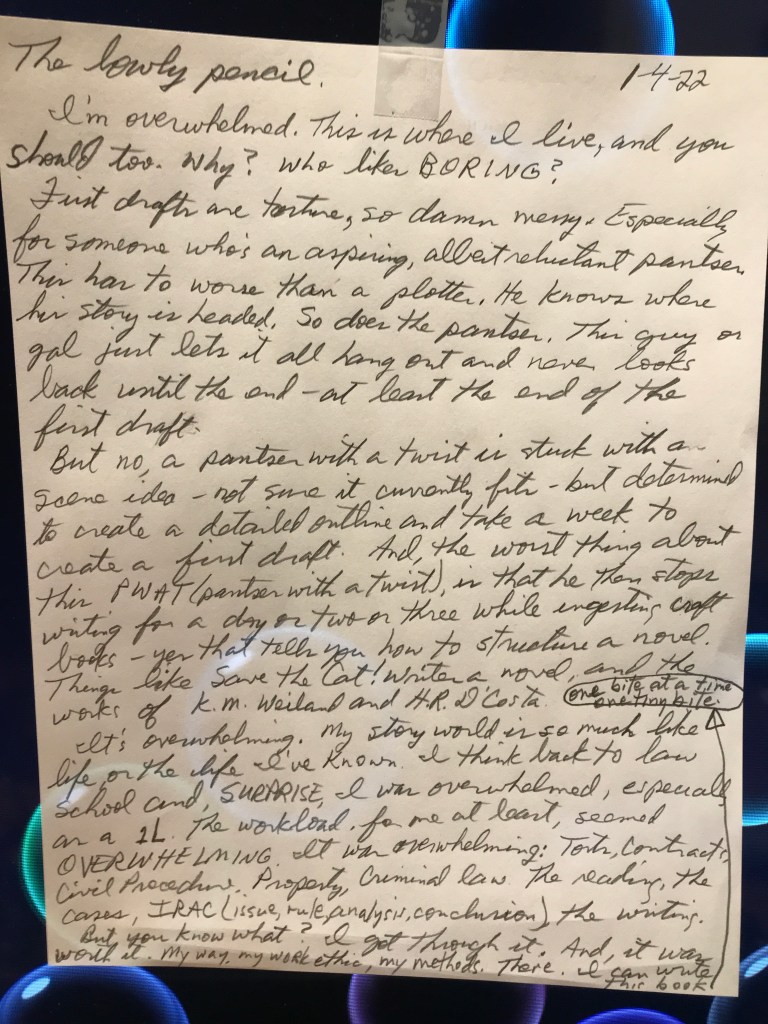
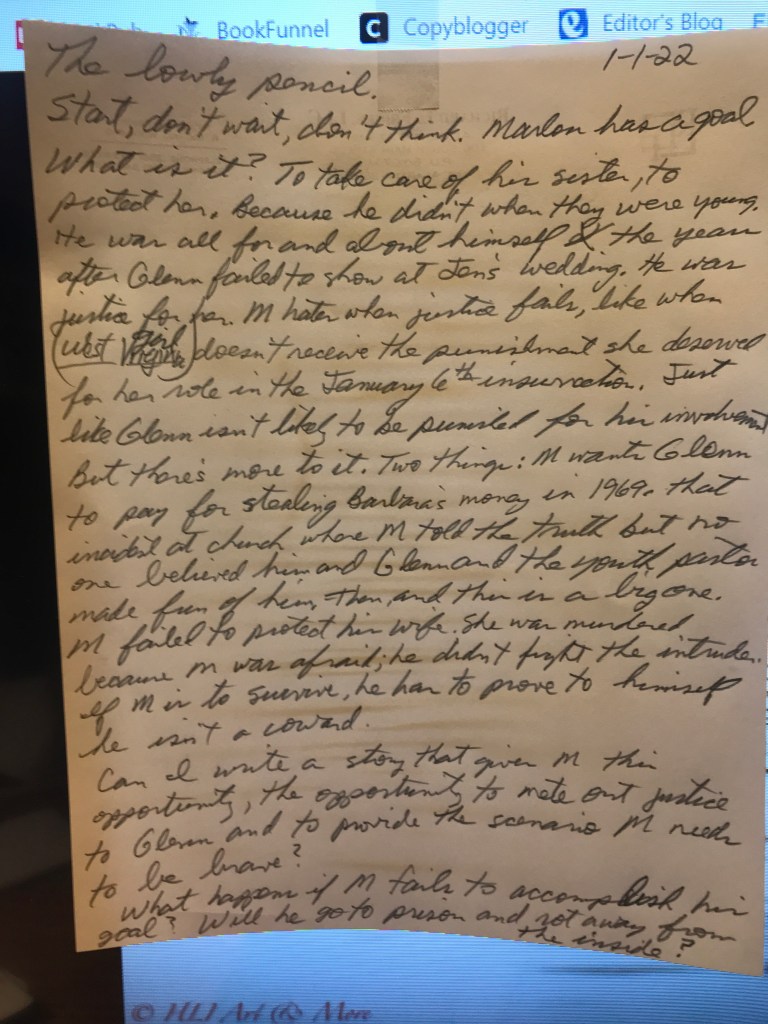
I’m trying something different. This week I started drafting a new novel. Using pen and paper (reminder: buy a box of #2 pencils). This comes close to literalizing my blog title, “The Pencil Driven Life.”
As an aside, I’m really not postured to start a new novel. I’m still editing my current work in progress, The Boaz Stranger. Over time, I’ve learned it’s better to complete an active project before attacking another. This is just the way I roll. There are many great writers who work on multiple projects at a time (not literally!). Two other things that make my pen and paper adventure so radical are my months-long craft study and near-full commitment to becoming a plotter. Instead, I had a vague idea about a guy seeking revenge and started pantsing. Come to think of it, I’ve pantsed every book I’ve written so far. Oh well.
Creating your drafts with pen (or pencil) and paper is not required. Since I started writing in 2015, I’ve always used a computer and the best software I’ve found, Scrivener. Now, after four days (I missed yesterday) I’m doubtful I’ll continue my different approach. But, that doesn’t mean it was fruitless.
Here are some things I learned. To start with, obviously, you can be anywhere and naked of all electronic devices and still write. Of course you need a pen or pencil and some paper; a pocket-sized notepad will do (as will a lump of charcoal and a tree limb stripped of its bark, but I digress into speculation). Secondly, there is real freedom by disconnecting from technology. I felt a needed distance between the creative side of my brain and that old demon who’s always saying shit like, “is that the best word here?” or “that is so lame and you’ve got it out of order. Move it before ‘Jack rolled down the hill.'”
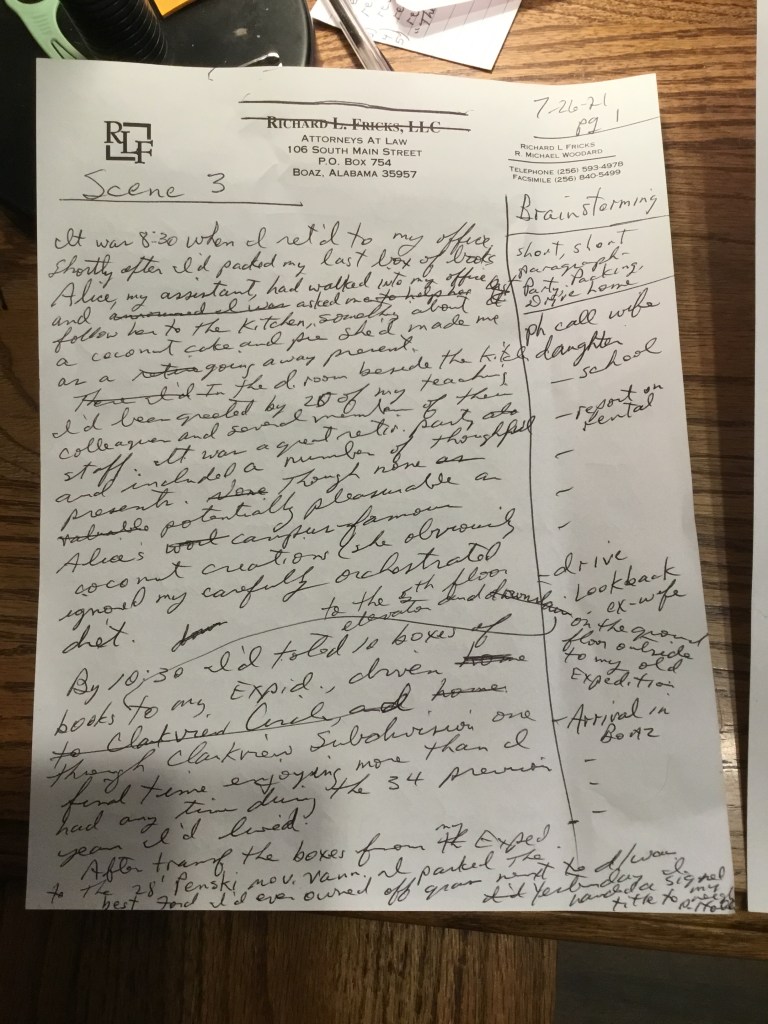
It was refreshing to strike words and phrases. It was more refreshing drawing arrows, from here to there, and jotting down ideas in the margins–all things that’s more difficult with technology. And here’s another treat, a big one: I didn’t feel the need to be grammatically correct. Incomplete sentences were good enough to capture the jist of my thoughts.
However, one thing I didn’t like about my pen and paper adventure–transcribing my scribblings to Scrivener. There are three primary reasons. The quality of my penmanship made some words unclear. It seemed like I was wasting time by plowing similar ground twice. And, when I finished the task I felt like a slob. My usual writing method is to work slow and methodical, editing as I go (which always gives me a feeling of accomplishment). This merging of both sides of my brain is both good and bad, probably mostly bad but again, it’s the way I roll. So far.
Any way you look at it, writing is a messy business. No doubt I’m a slow learner but there’s one thing I’m chewing on as I conduct this little lookback. It’s okay to start anywhere. It’s okay to create rough drafts. Those so rough they will likely take many rewrites to start making sense, even more before the words start to flow into an enjoyable and intriguing story. Someone said (sorry, I don’t want to look it up), “writing is rewriting.” I’m saying that too. But, you have to start.
Which brings me to the real point I want to make. You are kidding yourself about the wonderfulness and greatness of your life if you are not writing. And reading. I know that’s bold and maybe not fully true for you or anyone else. But, it’s true for me and I should know given the tons of things I’ve tried over my sixty-six plus years.
Proof (kinda): even though my hand-written draft doesn’t yet include this thought, it’s in my head. What is it? James Aldridge (my protagonist) is going to connect with Micaden Tanner, my protagonist in my second novel. Sorry, you’ll have to read The Boaz Scorekeeper to learn about and understand one of my favorite characters. Btw, this book is free if you subscribe to my readers group.
Sign up for my Myths, Mysteries & Murders readers’ group for news, special offers, and to receive a FREE digital copy of The Boaz Scorekeeper: https://dl.bookfunnel.com/i9qbcspivt.
Here’s some of this week’s scribbling, and transcribing:
In this post, I will attempt to define and contextualize the word ‘novel.’
Novel, story, narrative: what’s the difference?
It’s probably unnecessary to consider this question because in contemporary terms, and for most practical purposes, the three are virtually synonymous. But, having a ‘legal mind’ forces me to start at ground zero.
First, I’ll summarize what I’ll be attempting to say throughout this post. A novel is a description of imaginary people and related events arranged in a logical sequence to reveal a particular point of view or set of values.
In other words, a novel is a story. And, you already know a lot about story. It’s simply the telling of an event to a listener and the latter experiences or learns something just because he heard/read the story. A story can be either true or false.
A novel is a particular type of story, one that is ALWAYS fictional (not true in the sense it actually happened). Whereas a story or narrative can be either fiction (false) or non-fiction (true). A novel is always made-up, mostly from the author’s imagination, or an actual event, one either experienced, observed, or learned via reading, hearing, or by some other means.
In my last post, as to what was intended as an actual event, I provided an example of a guy who got snookered by a friend. A novel can be built (via fictionalization) around this, or it can become a memoir (an account of the author’s personal experiences), or an autobiography (a biography of yourself).
Merriam-Webster provides a good definition for the novel: “an invented prose narrative that is usually long and complex and deals especially with human experience through a usually connected sequence of events.” Notice that the word ‘narrative’ is used to define the word ‘novel.’
Before we look at ‘narrative,’ let’s flesh out Webster’s words. Invented obviously means it’s fiction. It’s made-up, created if you will. It’s made-up prose. Prose writing is ordinary writing, as distinguished from verse. Here’s an example of prose writing (the last sentence I wrote yesterday in my current novel-in-progress): “By twilight, with the goats fed and my impatience firing, I packed a bag and headed to Lillian’s vacant oasis.”
When I hear ‘verse,’ I think of poetry. Here’s a stanza of mine from a long ago poem:
“You melted my heart and mended my mind.
You gave me love and time,
a once in life discovery.
A unique couple, moonstruck but fiery.”
Not that good, but you get the idea.
One other thing about Webster’s definition. A novel is ALWAYS long—between 60,000 and 100,000 words. Compare that to a short story (another work of fictional prose) which typically runs between 5,000 to 10,000 words.
“A short story is a love affair, a novel is a marriage. A short story is a photograph; a novel is a film.”
Lorrie Moore
A novel is normally “complex and deals especially with human experience ….” This means there is a lot going on: the characters (likely, many), most all with differing wishes, desires, and conflicts. Plus, there are usually one or more subplots that are happening, all necessarily related to the main plot. Of course, not all novels deal with ‘human experience,’ but I’d wager that most do. Likely, because most people read fiction for two primary reasons: to be entertained, and to learn from experience without the experiencing part (I’ll leave you to figure that out).
“A novel must show how the world truly is, how characters genuinely think, how events actually occur. A novel should somehow reveal the true source of our actions.”
Kevin Hood, Becoming Jane
And, yes, I know there’s a lot more in this component of Webster’s definition that needs attention but today, we just don’t have the time.
Now we come to the word narrative. Recall, a novel is a story, a made-up one. Narrative is simply how you tell this made-up story. It is, “a spoken or written account of connected events,” to quote Google. But, narrative is much more.
A quote from Guillaume Wiatr (Principal and Founder of MetaHelm) excellently encapsulates the difference between story and narrative: “People will pay for a story, but people will die for a narrative.” I think what Guillaume means is that a story can grab our attention, entertaining us for the moment, but a narrative (how the story is told) can change us for a lifetime, “[i]t shifts the way we think, for good or for the worst[,]” again quoting Guillaume. He also says this in different words: “Someone died, and that was very wrong[,] starts a narrative that can turn into a revolution.”
Reconsider my summary definition from the beginning of this section: “A novel is a description of imaginary people and related events arranged in a logical sequence to reveal a particular point of view or set of values.” The underlined portion is the heart of narrative. To me, narrative produces theme, it reveals the meaning the writer has explored throughout his entire novel. He’s done this “… [b]y using characters, setting, dialog, plot or a combination of all of these elements[,]” as K.M Weiland says in writing your story’s THEME, a book I highly recommend.
Now that we’ve laid a foundation for understanding the literary form known as the novel, we must look at story structure. Knowing the framework of the ‘building’ you are trying to construct is imperative for writing a novel worth reading. I wish I had learned this much sooner.
We will look at story structure in my next post, but first, you need to understand what you’re getting into (writing a novel) is a challenging but highly rewarding endeavor. With only minor inconveniences as described by one of the greatest writers of all time:
“Writing a novel is a terrible experience, during which the hair often falls out and the teeth decay. I’m always irritated by people who imply that writing fiction is an escape from reality. It is a plunge into reality and it’s very shocking to the system.” ― Flannery O’Connor, Mystery and Manners: Occasional Prose
Flannery O’Connor, Mystery and Manners: Occasional Prose
Sign up for my Myths, Mysteries & Murders readers group and receive a FREE digital copy of The Boaz Scorekeeper: https://dl.bookfunnel.com/r6dwwflvxx. If you have already signed up, send me a message and I’ll forward you a copy.




 Richard L. Fricks
