Writer / Observer / Builder — Presence, clarity, and living without a script
Author: Richard L. Fricks
Writer. Observer. Builder. I write from a life shaped by attention, simplicity, and living without a script—through reflective essays, long-form inquiry, and fiction rooted in ordinary lives. I live in rural Alabama, where writing, walking, and building small, intentional spaces are part of the same practice.
Biking is something I both love and hate. The conflicting emotions arise from the undeniable physical effort it demands. However, this exertion is precisely what makes it an excellent form of exercise. Most days, I dedicate over an hour to my cycling routine, and in doing so, I’ve discovered a unique opportunity to enjoy a good book or podcast. The rhythmic pedaling and the wind against my face create a calming backdrop that allows me to fully immerse myself in the content. In these moments, the time spent on the bike seems worthwhile, as I can’t help but appreciate the mental and physical rewards it offers.
I especially like having ridden. The post-biking feeling is one of pure satisfaction. The endorphin rush, coupled with a sense of accomplishment, makes the initial struggle and fatigue worthwhile. As I dismount and catch my breath, I relish the sensation of having conquered the challenge, both physically and mentally. It’s a reminder that the things we sometimes love to hate can often be the ones that bring us the most fulfillment. In the end, the love-hate relationship with biking only deepens my appreciation for the sport, as it continually pushes me to overcome my own limitations and embrace the rewards that follow the effort.
My bike
A Rockhopper by Specialized. I purchased it November 2021 from Venture Out in Guntersville; Mike is top notch! So is the bike. The ‘old’ man seat was salvaged from an old Walmart bike (update: seat replaced, new photo to follow, someday).
Something to consider if you’re not already cycling.
I encourage you to start riding a bike, no matter your age. Check out these groups:
Don’t miss the #1 New York Times bestselling blockbuster and Reese Witherspoon Book Club Pick that’s sold over 2 million copies–now an Apple TV+ limited series starring Jennifer Garner!
The “page-turning, exhilarating” (PopSugar) and “heartfelt thriller” (Real Simple) about a woman who thinks she’s found the love of her life—until he disappears.
Before Owen Michaels disappears, he smuggles a note to his beloved wife of one year: Protect her. Despite her confusion and fear, Hannah Hall knows exactly to whom the note refers—Owen’s sixteen-year-old daughter, Bailey. Bailey, who lost her mother tragically as a child. Bailey, who wants absolutely nothing to do with her new stepmother.
As Hannah’s increasingly desperate calls to Owen go unanswered, as the FBI arrests Owen’s boss, as a US marshal and federal agents arrive at her Sausalito home unannounced, Hannah quickly realizes her husband isn’t who he said he was. And that Bailey just may hold the key to figuring out Owen’s true identity—and why he really disappeared.
Hannah and Bailey set out to discover the truth. But as they start putting together the pieces of Owen’s past, they soon realize they’re also building a new future—one neither of them could have anticipated.
With its breakneck pacing, dizzying plot twists, and evocative family drama, The Last Thing He Told Me is a “page-turning, exhilarating, and unforgettable” (PopSugar) suspense novel.
Connect to strangers, friends, and colleagues through writing, listening, and learning.
***
The Art of Noticing
Simple and uncommon exercises to reveal what’s hidden in plain sight.
In The Art of Noticing, Rob Walker—a journalist, author, and educator—invites us to attend carefully and playfully to everyday curiosities that most of us tend to overlook.
“Fending off distraction isn’t quite the same thing as making the most of our attention.” By engaging the senses, Rob says, we can enrich our daily lives with meaning, boost creativity, and even “reframe the way we take in the world.”
***
Rob Walkeris a journalist and author. He is a longtime contributor to The New York Times, and a columnist for Fast Company. His recent books are The Art of Noticing, and Lost Objects, co-edited with Joshua Glenn. He is on the faculty of the Products of Design program at the School of Visual Arts. You can find his newsletter at robwalker.substack.com.
Even a casual reading of the Ten Commandments (either Exodus 20 or Deuteronomy 5) should make anyone skeptical that a supposedly good, competent god had anything to do with it. Here was this god’s big opportunity—alone with Moses on the mountaintop—to let humanity know the best moral principles to follow. Many ethicists have noticed three crucial items that are missing: (1) Thou shalt not engage in warfare; (2) Thou shalt not enslave other human beings; (3) Thou shalt not mistreat or undervalue other human beings because of the color of their skin. These omissions are surely an indication of defective, indeed bad theology.
Slavery and racism have brought so much pain and suffering to the world. But war has been, by far, the greatest destroyer, especially as weapons have become more and more advanced—very smart people have been hired by military leaders to create devastating killing machines. This prompts us to doubt, on another level entirely, that a good god was involved in the creation of humans.
Our brains are wired for aggression, territoriality, in-group loyalties—hence our endless willingness to go to war. Those who believe in a creator god have to admit that this has to be one of his biggest screwups. In Genesis 6:5-6 we read that god realized his failure:
“Yahweh saw that the wickedness of humans was great in the earth and that every inclination of the thoughts of their hearts was only evil continually.And Yahweh was sorry that he had made humans on the earth, and it grieved him to his heart.”
How could the wickedness of humans not have been god’s own design flaw? The author of Genesis was unaware that he was writing bad theology—and it got much worse with the story of the flood: god decided to kill everyone and everything on earth—with the exception of one family, and animals on the ark: “Yahweh said, ‘I will blot out from the earth the humans I have created—people together with animals and creeping things and birds of the air—for I am sorry that I have made them.’” (verse 8)
How in the world can an all-wise god have made such a huge mistake? More bad theology—and the author of Genesis had no idea he made this goof. His god was modeled on tribal chieftains.
The biggest challenge theologians face is to uphold the goodness of god in the face of so much suffering. Of course, the flood genocide in Genesis is fiction, but wars, genocides, and plagues have been constants in human history. An early version of the chapter on suffering in my book, Ten Tough Problems in Christian Thought and Belief, I had titled, Easy Acceptance of the Very Terrible. I dropped it because a few of my critical readers didn’t like it. But I still think this title sums up pretty well the goal of Christian apologists: to persuade the faithful that belief in god is not damaged by very terrible events that have happened for millennia—and that happen every day.
Author Franz Kiekeben has offered extensive comments on this in an article posted here on 19 October 2023 by John Loftus: The Reality of Senseless Suffering. In his opening paragraph he notes ways in which god may be excused for allowing suffering: “…the suffering serves some greater purpose…or it may be that certain types of suffering are the only way to bring about something of immense value.” Kiekeben goes into great detail analyzing these suggestions, offering this comment at one point:
“This section therefore surveys the main suggestions that have been advanced in defense of God-condoned senseless suffering. Perhaps the simplest among them is that based on God’s supposed inscrutability. As is often said, God works in mysterious ways. Some therefore appeal to our ignorance of his purposes and intentions in order to argue that we may simply be incapable of understanding why he permits senseless suffering. Who are we to say God could not allow such a thing? This suggestion, however, misses the point of the problem. One does not need to understand what God’s reasons might be in order to see the incompatibility of a perfect being with that of suffering that is not justified.”
There is an endless list of suffering, or horrible catastrophes—very terrible indeed—that rule out a good god who has compassion for humanity. Last October I published an article here titled, World War I: Why Didn’t It Put an End to Belief in God? That orgy of killing went on for four years: “…on average, more than 11,000 people lost their lives every single day of the conflict,” reports Holger Afflerbach, in an article titled “Did They Really Have to Fight to the Finish?” in the September 2023 issue of BBC History Magazine (p. 36, Vol. 24, No. 9).
Human pride got in the way of shortening the war: “…the enormity of human sacrifices rendered the proposal to end the war completely unattractive. Leaders on all sides were keenly aware that something positive had to come out of the war—and only military victory could provide it.” (p. 36) There was another calamity that followed: the war contributed to the Spanish Flu Pandemic (1918-1920) that killed 25 to 50 million people—some estimates put the death toll much higher. The treaty that ended World War I was a brutal one, and fueled the hatreds that brought on World War II, with even greater loss of life.
How can we have any tolerance for the feeble excuse that god works in mysterious ways? Mysterious indeed for a loving, caring, competent, all-powerful deity. “This is my father’s world” has a very hollow ring. Indeed, Keikeben’s sums up his article: “…the most reasonable conclusion is that there is senseless suffering. If so, then God does not exist.”
The Christian god—from what we read in the New Testament—keeps a close eye on every human: nothing escapes his notice. He keeps tracks of our words and thoughts.
So here’s a thought experiment: how do the devout account for these four horrible events that have happened during my lifetime (and this is a very short list)?
(1) On 10 July 1944, 462 women and children were murdered in a church in rural France. I described this event in an article here a few months ago: God’s Bad Habit of Oversleeping(here’s a 5-minute video I did about it as well). God was not able to somehow prevent this massacre in his church?
(2) On 25 July 2000, 109 people were burned to death when the Concorde burst into flames on takeoff from Charles de Gaulle Airport. A strip of metal had fallen off another plane and remained on the runway. It was hit by the Concorde and punctured a fuel tank. A decent gust of wind arranged by the Almighty could have swept the metal strip out of the way.
(3) On 26 December 2004, the Indian Ocean tsunami killed 225,000 people, many of them babies, toddlers, and children. How does it make sense that the powerful, miracle-working god described in the Bible—who parted the Red Sea—couldn’t have stopped the undersea earthquake?
(4) On 12 December 2012, Adam Lanza killed 20 kids and 6 adult staff at the Sandy Hook School in Connecticut. Was it beyond god’s almighty power to arrange for Adam to have a flat tire and crash off the road on his way to the school? Cops could have discovered his weapons…off to jail for him.
It’s very hard to argue that any of these events happened to bring about a higher good. Indeed the higher good argument is guesswork, speculation, wishful thinking, on the part of theologians who have no evidence whatever—reliable, verifiable, objective evidence—that their god works in this way. The excuse-making is tiring.
Here’s the hard work for devout folks in this thought experiment: never forgetting for a moment the horror/terror that the victims faced, and without resorting to the excuse that god works in mysterious ways or has a bigger plan, explainwhy your god just watched these things happen. Maybe your faith in this god is unwarranted. One pious woman I know, ten days after the Sandy Hook School massacre, with a nervous smile said, “God must have wanted more angels.” What more alarming example of easy acceptance of the very terrible could there be? She was willing to make her god co-murderer with the gunman.
Earlier this week, John Loftus posted here an excerpt titled, “The Parable of the Mysterious Witness,” from John C. Wathey’s book, The Illusion of God’s Presence: The Biological Origins of Religious Longing. It’s a quick read, so I won’t give away the punch line of the parable. But here’s the crucial conclusion:
“…for the believer in the omniscient, omnipotent, and benevolent personal god, every horrendous act of evil in the real world, every natural disaster, every injury, illness, and genetic defect that causes senseless suffering has just such a mysterious witness: God himself.” (p. 39)
Devout Christians: please face the implications of horrendous suffering for your cherished ideas about god.
There are other knockout blows, which I indicated in my subtitle. I’ll mention two briefly.
(1) The Bible is an embarrassment. Many people have abandoned the faith because of the awful things they find in the Bible, the Genesis flood genocide being just one. Most of the Bible is ignored by the laity, above all because it is boring/tedious. Ask any churchgoer how his/her understanding of god has been enhanced by the book of Ezekiel, or even by Paul’s Letter to the Romans. Don’t be surprised by the awkward silence that follows.
Scholar Hector Avalos got it right:
“If we were to go verse by verse, I suspect that 99 percent of the Bible would not even be missed.” (The End of Christianity, edited by John Loftus, p. 109) That is: those laypeople who do put time into Bible reading must be puzzled that so much of it has so little relevance to their piety or their daily lives. Yet, somehow, this ancient book is still touted as the Word of God.
(2) The scandal of Christianity splintering into thousands of different, conflicting brands—many of which hate the others—can be traced to the lack of reliable, verifiable, objective evidence for god(s). Revelations, scriptures, visions, prayers, meditations: theologians and clergy are disastrously split—they cannot agree—on the supposed “information” about their god derived from these sources. Because they aren’t sources at all: they are products of imagination. As is the case with hundreds of other gods whom humans have imagined, worshipped and adored, Yahweh—and the more polished versions that theologians have come up with over the centuries—will one day be considered a fossil, a relic from the past.
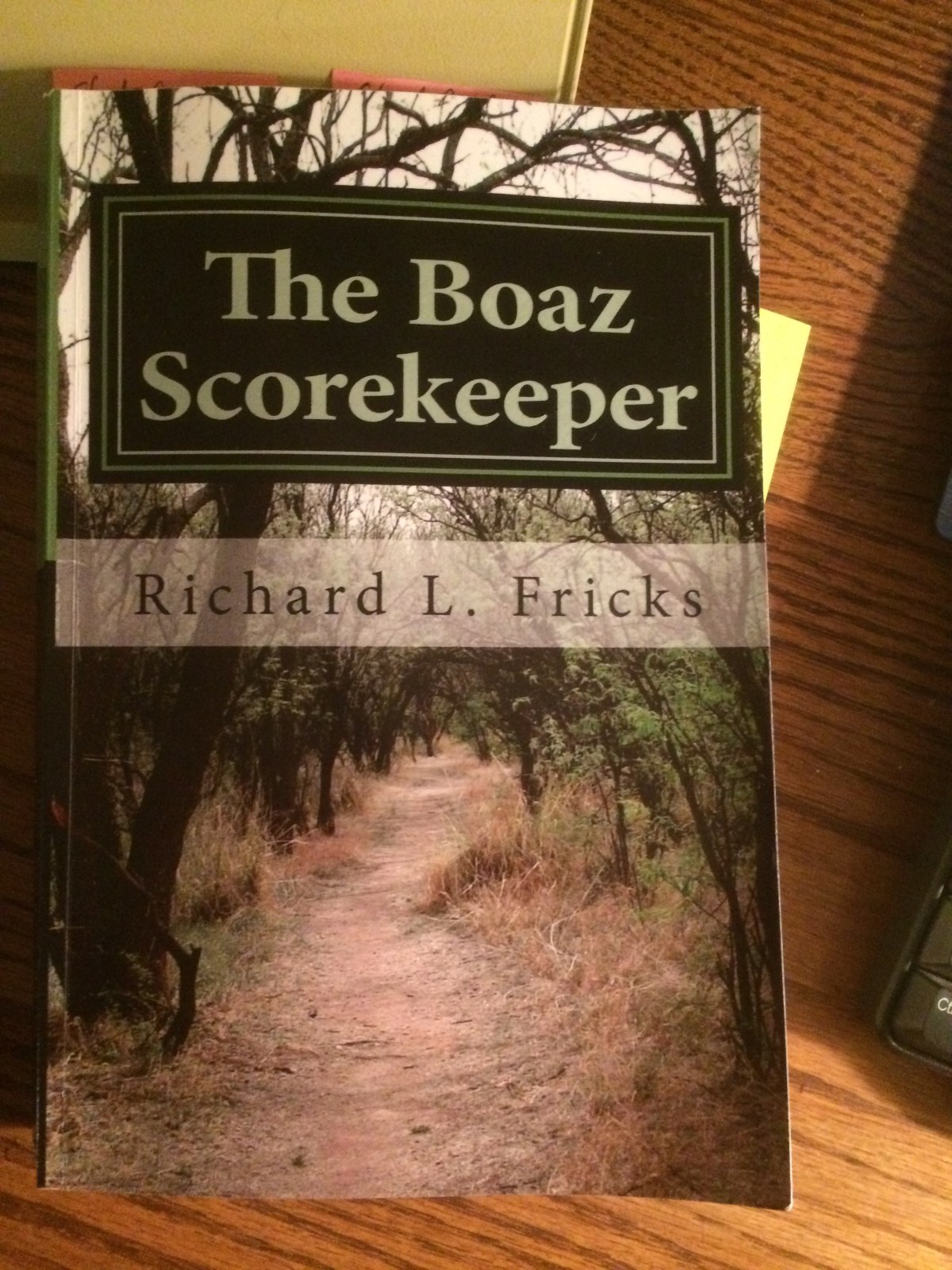
The Boaz Scorekeeper, written in 2017, is my second novel. I'll post it, a chapter a day, over the next few weeks.
I married Karla Jacobson in 1986. It had taken me nearly 15 years to tenderly and reverently bury my dear Wendi in a holy shrine in the back of my mind. This didn’t mean I would ever forget her. I would die with her on my mind, even if my death wouldn’t come for another fifty or sixty years. But now, I had to move on with my life. Even though I had only a few hours with Wendi, those moments seeded a lifetime of simple but precious memories. She was my first love and shaped my heart. Looking back on that fateful night in May 1972, I could easily see the framework of my life taking shape. Sitting around the fire that night, Wendi had shared how Cindi had made her come along with her and that Cindi was in a sense an oxymoron.
She was outwardly devoted to her preacher father, the Bible, and God, yet loved to party. Wendi thought it was rather funny that Cindi acted as though she had such a strong faith in God but believed her life would be more meaningful and fulfilling if she shared her body and soul with every good-looking guy she met. Wendi shared how she had some doubts about God but wholly believed in saving herself for her husband. She shared her dream of marrying young and having a big family with a dozen kids as she put it. Looking back, I could see and know that but for the evil that the Flaming Five perpetrated on Wendi that night, she and I would have gone on to marry. That conclusion was good and real, totally opposite of the evil that she had endured.
Karla came into my life just as unexpected as Wendi. Karla was from Boaz and was a year behind me in High School. We had never dated during our school years but had been friends. We both attended Clear Creek Baptist Church and were leaders in the Beta Club. After working nearly nonstop for six months at Downs, Gambol & Stevens, I took two weeks off during Christmas 1980 to come home to visit my parents. Mother made me, as she always had done, go to the Church’s annual Christmas program. She even made me stay over for the coffee and cake get-to-gather.
Karla was there with her parents and we stood along the back wall of the Fellowship Hall watching the younger kids exchange Christmas presents. Karla and I caught each other up on what had happened in our lives over the past eight years. She was in her fourth year as a kindergarten teacher in Albertville, single, and still living at home with her parents. As the gathering was winding down I kind of shocked myself when I asked her if she would like to meet the next day for coffee. Looking back, I know why I asked her. My mind had told me while Karla and I were talking that it was Wendi I was talking to. Karla and Wendi could have been sisters. They were both tall and slender, with curly black hair and blue eyes.
Karla and I hit it off. I think we saw each other every day I was home during that two-week visit. Over the next couple of years, we saw each other as often as we could, usually at least once per month. Karla drove a few times to Atlanta to see me and spend the weekend. After three years or so I asked her to marry me and move to Atlanta. I believe she truly wanted to but it took her two more years before she could muster the strength and courage to leave her job at Albertville Elementary School. She kept saying she was too much a small-town girl for a big city like Atlanta. Receiving a job offer to teach at Venetian Hills Elementary School probably was the tipping point in my favor. Partner Clayton Stevens was instrumental in arranging for Karla’s job. He represented the Atlanta School Board. It helped knowing the right people.
We were married on June 10th, 1986 at Clear Creek Baptist Church. Our only child, Michael Lewis Tanner, was born October 23rd, 1987.
Biking is something I both love and hate. The conflicting emotions arise from the undeniable physical effort it demands. However, this exertion is precisely what makes it an excellent form of exercise. Most days, I dedicate over an hour to my cycling routine, and in doing so, I’ve discovered a unique opportunity to enjoy a good book or podcast. The rhythmic pedaling and the wind against my face create a calming backdrop that allows me to fully immerse myself in the content. In these moments, the time spent on the bike seems worthwhile, as I can’t help but appreciate the mental and physical rewards it offers.
I especially like having ridden. The post-biking feeling is one of pure satisfaction. The endorphin rush, coupled with a sense of accomplishment, makes the initial struggle and fatigue worthwhile. As I dismount and catch my breath, I relish the sensation of having conquered the challenge, both physically and mentally. It’s a reminder that the things we sometimes love to hate can often be the ones that bring us the most fulfillment. In the end, the love-hate relationship with biking only deepens my appreciation for the sport, as it continually pushes me to overcome my own limitations and embrace the rewards that follow the effort.
My bike
A Rockhopper by Specialized. I purchased it November 2021 from Venture Out in Guntersville; Mike is top notch! So is the bike. The ‘old’ man seat was salvaged from an old Walmart bike (update: seat replaced, new photo to follow, someday).
Something to consider if you’re not already cycling.
I encourage you to start riding a bike, no matter your age. Check out these groups:
Don’t miss the #1 New York Times bestselling blockbuster and Reese Witherspoon Book Club Pick that’s sold over 2 million copies–now an Apple TV+ limited series starring Jennifer Garner!
The “page-turning, exhilarating” (PopSugar) and “heartfelt thriller” (Real Simple) about a woman who thinks she’s found the love of her life—until he disappears.
Before Owen Michaels disappears, he smuggles a note to his beloved wife of one year: Protect her. Despite her confusion and fear, Hannah Hall knows exactly to whom the note refers—Owen’s sixteen-year-old daughter, Bailey. Bailey, who lost her mother tragically as a child. Bailey, who wants absolutely nothing to do with her new stepmother.
As Hannah’s increasingly desperate calls to Owen go unanswered, as the FBI arrests Owen’s boss, as a US marshal and federal agents arrive at her Sausalito home unannounced, Hannah quickly realizes her husband isn’t who he said he was. And that Bailey just may hold the key to figuring out Owen’s true identity—and why he really disappeared.
Hannah and Bailey set out to discover the truth. But as they start putting together the pieces of Owen’s past, they soon realize they’re also building a new future—one neither of them could have anticipated.
With its breakneck pacing, dizzying plot twists, and evocative family drama, The Last Thing He Told Me is a “page-turning, exhilarating, and unforgettable” (PopSugar) suspense novel.
Embrace novelty by changing things up—your routes, schedules, and more.
***
The Art of Noticing
Simple and uncommon exercises to reveal what’s hidden in plain sight.
In The Art of Noticing, Rob Walker—a journalist, author, and educator—invites us to attend carefully and playfully to everyday curiosities that most of us tend to overlook.
“Fending off distraction isn’t quite the same thing as making the most of our attention.” By engaging the senses, Rob says, we can enrich our daily lives with meaning, boost creativity, and even “reframe the way we take in the world.”
***
Rob Walkeris a journalist and author. He is a longtime contributor to The New York Times, and a columnist for Fast Company. His recent books are The Art of Noticing, and Lost Objects, co-edited with Joshua Glenn. He is on the faculty of the Products of Design program at the School of Visual Arts. You can find his newsletter at robwalker.substack.com.
The Boaz Scorekeeper, written in 2017, is my second novel. I'll post it, a chapter a day, over the next few weeks.
After three months of spending every weekday night attending a formal Bar Review course, and cramming every waking moment on weekends, I passed the Georgia Bar on my first attempt. Ted Ingram and I were the only two associates to pass. This, I believe, was one reason Partner Greg Gambol asked the two of us to join him in representing 43-year-old Terry Lynn Gaines. But, there was a bigger reason. Two weeks earlier junior partner Clay Watkins had surprised the Firm with his announcement he was returning to his hometown of Black Mountain, North Carolina to take over the family lumber mill after his father’s cancer diagnosis. Gambol faced an immediate need for help with the Gaines capital murder case he had conditionally accepted just two days before Watkins announced his resignation.
The Gaines case not only posed a staffing problem for Greg, it also offered a solid logistical issue. Greg led the Firm’s active criminal defense practice and had to manage his time carefully. Loganville is 100 miles east of Atlanta and is located mostly in Walton County, although a small portion of the city lies within Gwinnett County.
Our client’s father, Walt Lee Gaines, had heard of Greg and the Firm a few years earlier when Greg won the highly publicized Cobb County Case, State of Georgia vs. Brandon Ray Kilgore. Kilgore had been charged with murdering three people with a hammer and confessed on video. Greg was successful in using an expert in false memories, and having the taped confession ruled inadmissible greatly weakening the State’s case. Surprisingly, Kilgore was acquitted, even though there was evidence Kilgore was present at the scene.
The Gaines family was prominent in Loganville and throughout Walton and Gwinnett Counties. They had lived there for over 100 years and owned a host of diversified businesses including a chain of convenience stores, a mobile home manufacturing plant, two restaurants, and a commercial construction company.
Terry Lynn Gaines was, as the old saying goes, the black sheep of the family. However, he was a star of Southern Baptist Fundamentalism. Terry had received a whole lot of Georgia press due to his rants and demonstrations against homosexuals. His mantra was Leviticus 20:13: “If a man also lie with mankind, as he lieth with a woman, both of them have committed an abomination: they shall surely be put to death; their blood shall be upon them.” Gaines had recently been indicted for the murder of Victor Albert Semmes of Monroe, Georgia. It was 15 miles east of Gaines’ hometown, and was the county seat for Walton County.
Due to an emergency dental appointment, associate Ted Ingram was unable to go with Greg Gambol and me on our first trip to visit Terry. Before we went inside the Detention Center to meet him, Walt Gaines confronted us in the parking lot and insisted that Greg accept a $50,000 retainer and agree to represent his son. Greg finally agreed but with one condition—that if he didn’t believe Terry wanted our services or if Greg felt we were just not a good fit, then we could void the contract and refund the retainer. Walt agreed.
Our meeting that day with Terry Lee Gaines was my first ever with a criminal defendant. I had met with clients of partners Ralph Downs and Clayton Stevens who had engaged the Firm as plaintiffs in civil cases, such as auto accidents and medical malpractice. Terry was a short man with broad shoulders, big hands and curly blond hair. He looked younger than the 43 years as stated on the arrest report.
After we introduced ourselves and informed him that his father had hired us to represent him he thanked us for agreeing to be his lawyers and promised he would always tell us the truth. Then, he just blurted out, “I was obedient to God when I killed Victor Semmes.” Greg told Terry that he had a constitutional right to be silent and that the Prosecutor could not force him to testify. Greg went into a long speech about attorney-client confidentiality and the illegality of a lawyer putting on knowingly false testimony. Terry told us not to worry that he didn’t intend to testify at trial. He said it would not be necessary since the State would be unable to prove his guilt.
I asked Terry why he felt that way (on the drive over Greg had given me permission to interact with Terry any way I wanted, since Ted and I would be meeting with him more than Greg would). He said that the only link the Prosecutor had between him and Victor was an argument the two of them had outside the Monroe Post Office. Terry said that his group, “Death to Fags” was legally marching that day when Victor and two of his friends shouted across the parking lot to them that “God loves homosexuals and bigots.” Terry said that he walked over to Victor and they got into a pushing and shoving match, but it ended when the cops showed up. Three days later Victor’s body was found leaning up against the Civil War Memorial on the front lawn of the County Courthouse.
Terry said that two days after their altercation at the Post Office, he lucked-up and saw Victor coming out of Dave’s Cards and Gifts on South Broad. “He drove his car south to Criswell Park and parked by the lake. There was no one else there. I pulled on a pair of leather gloves and parked behind him blocking him in. Victor had locked himself in his car by the time I reached his door. I had a hammer in my truck so I busted his window and hit him a few times with the hammer. I had him out of the car and in the back of my truck in just a couple of minutes. I hit him a few more times with my hammer and tied him up. I drove to my father’s farm and hid my truck in a grove of trees by the pond. Early the next morning I deposited his body at the Courthouse.” Greg asked Terry if he had given a statement to the police. He said, “absolutely not.”
Over the next 14 months Ted and I spent a lot of time with Terry. His story never wavered. His favorite thing to talk about was his faith in God and Christ. He had complete confidence that he was justified in killing Victor Semmes. Although the Prosecutor tried his best he never discovered the truth of what happened to Victor Semmes, nor did he discover Terry’s truck, gloves, or hammer.
At trial, the strength of the Prosecutor’s case was a man who said he witnessed Terry abducting and beating Victor at Criswell Park. The man claimed to be fishing on the other side of the pond from where the incident took place. We put on an expert in eyewitness testimony who convincingly showed the difficulty of accurately identifying Terry Lynn Gaines from the distance and angle the man was at from across the pond.
Despite the eyewitness testimony, the jury rendered a not guilty verdict. Media theory was that the longstanding good reputation of Terry’s family throughout Walton County, and the local hatred for homosexuals were the real reasons why the jury refused to convict a local hero of sorts. Whatever the reasons, the case left Greg, Ted, and me with several questions. Terry had told us that he was not driving his own truck. However, he would never tell us what happened to the truck, the gloves, or the hammer he used to commit the murder.
This case was very troubling to me. Although I knew and understood that the criminal defendant had no duty to prove his innocence and that he had a constitutional right to sit silent at trial and not put forth any evidence at all, I understood that it was the Prosecutor’s full responsibility to prove the guilt of the accused beyond a reasonable doubt. I believed in these principles. However, before this case, I had never given serious thought about the victim’s family and the seeming dishonest role the criminal defense attorney was playing to prevent them from obtaining justice for their loved one. I think I relived Wendi’s death and imagined the choking grief that her family had endured for almost ten years. To truly know that the man you are representing has so viciously murdered another human being felt horribly repulsive. I forever wondered whether the lawyers who had represented Randall, James, and John had known how they had raped, murdered, and hidden two sweet and innocent sisters.
There was another reason the case of Terry Lynn Gaines gave me trouble. It was God. How could a loving God have such hatred for homosexuals that he instructed his followers to put them to death? And more insane, how could modern day folks become so indoctrinated that they believed such nonsense written by iron age peasants over 2,000 years ago? These two questions watered those lingering doubts I had long had whether the God of the Bible was in fact ‘the Lord Almighty, the God of the armies of Israel.’
Biking is something I both love and hate. The conflicting emotions arise from the undeniable physical effort it demands. However, this exertion is precisely what makes it an excellent form of exercise. Most days, I dedicate over an hour to my cycling routine, and in doing so, I’ve discovered a unique opportunity to enjoy a good book or podcast. The rhythmic pedaling and the wind against my face create a calming backdrop that allows me to fully immerse myself in the content. In these moments, the time spent on the bike seems worthwhile, as I can’t help but appreciate the mental and physical rewards it offers.
I especially like having ridden. The post-biking feeling is one of pure satisfaction. The endorphin rush, coupled with a sense of accomplishment, makes the initial struggle and fatigue worthwhile. As I dismount and catch my breath, I relish the sensation of having conquered the challenge, both physically and mentally. It’s a reminder that the things we sometimes love to hate can often be the ones that bring us the most fulfillment. In the end, the love-hate relationship with biking only deepens my appreciation for the sport, as it continually pushes me to overcome my own limitations and embrace the rewards that follow the effort.
My bike
A Rockhopper by Specialized. I purchased it November 2021 from Venture Out in Guntersville; Mike is top notch! So is the bike. The ‘old’ man seat was salvaged from an old Walmart bike (update: seat replaced, new photo to follow, someday).
Something to consider if you’re not already cycling.
I encourage you to start riding a bike, no matter your age. Check out these groups:
Don’t miss the #1 New York Times bestselling blockbuster and Reese Witherspoon Book Club Pick that’s sold over 2 million copies–now an Apple TV+ limited series starring Jennifer Garner!
The “page-turning, exhilarating” (PopSugar) and “heartfelt thriller” (Real Simple) about a woman who thinks she’s found the love of her life—until he disappears.
Before Owen Michaels disappears, he smuggles a note to his beloved wife of one year: Protect her. Despite her confusion and fear, Hannah Hall knows exactly to whom the note refers—Owen’s sixteen-year-old daughter, Bailey. Bailey, who lost her mother tragically as a child. Bailey, who wants absolutely nothing to do with her new stepmother.
As Hannah’s increasingly desperate calls to Owen go unanswered, as the FBI arrests Owen’s boss, as a US marshal and federal agents arrive at her Sausalito home unannounced, Hannah quickly realizes her husband isn’t who he said he was. And that Bailey just may hold the key to figuring out Owen’s true identity—and why he really disappeared.
Hannah and Bailey set out to discover the truth. But as they start putting together the pieces of Owen’s past, they soon realize they’re also building a new future—one neither of them could have anticipated.
With its breakneck pacing, dizzying plot twists, and evocative family drama, The Last Thing He Told Me is a “page-turning, exhilarating, and unforgettable” (PopSugar) suspense novel.
“What, among everything you encounter, could be made better, somehow?”
***
The Art of Noticing
Simple and uncommon exercises to reveal what’s hidden in plain sight.
In The Art of Noticing, Rob Walker—a journalist, author, and educator—invites us to attend carefully and playfully to everyday curiosities that most of us tend to overlook.
“Fending off distraction isn’t quite the same thing as making the most of our attention.” By engaging the senses, Rob says, we can enrich our daily lives with meaning, boost creativity, and even “reframe the way we take in the world.”
***
Rob Walkeris a journalist and author. He is a longtime contributor to The New York Times, and a columnist for Fast Company. His recent books are The Art of Noticing, and Lost Objects, co-edited with Joshua Glenn. He is on the faculty of the Products of Design program at the School of Visual Arts. You can find his newsletter at robwalker.substack.com.
The Boaz Scorekeeper, written in 2017, is my second novel. I'll post it, a chapter a day, over the next few weeks.
The law firm of Downs, Gambol & Stevens offered me a job a few weeks before I graduated from law school. They said they felt, after observing me for the two semesters I had clerked for them, that I would make a good fit. I thanked them for their generous offer but told them I had always planned on returning to Boaz to practice with Matt.
However, my carefully laid plans changed radically the day I graduated. Matt had surprised me earlier that morning when he showed up at my apartment. He took me to breakfast and we mainly just hung out without talking seriously about anything. My parents arrived just in time for us to walk to Glenn Memorial Auditorium for me and my 125 other classmates to receive our J.D diplomas. After a nice dinner with my parents they returned to Boaz but Matt stayed the night. We sat out on my tiny balcony overlooking Peavine Creek right off Clifton Road and brainstormed a new case he had just taken in.
Around midnight, while I was dozing and trying to tell Matt I needed to go to bed, out of the blue he said, “Micaden, I can’t offer you a job right now.” He said he had thought a lot about me coming to work for him and decided that it was unfair for me if he didn’t encourage me to experience law practice from the perspective of a large firm in a big city. More specifically, he said he would never forgive himself if he didn’t try his best to persuade me to practice alongside Greg Gambol. Matt believed Greg was the best, if not one of the best, criminal defense attorneys in the nation. I hadn’t realized until now that Greg and Matt were law school classmates. They both had served as editors on the school’s Crime and Punishment Law Review and had become close friends. After they graduated they had gone their separate ways but had stayed in touch over the years. I knew that without Matt I would never have been selected to clerk for Downs, Gambol, & Stevens.
Matt said I needed to stay in Atlanta for at least five years. He planned on practicing in Boaz another 20 to 25 years, at least until he was 70 or 75 years old, assuming his health allowed him to. He stated that the experience I gained by working with Greg would make the firm of Bearden and Tanner much stronger.
At first, I fully opposed his idea but caved in after he asked me to do this as a favor to him. He told me about his experience with another big Atlanta firm after he graduated from Emory’s Law School in 1960, the year I turned six. He said that he believed those ten years developed and honed his skills and that without that experience he seriously doubted he would have been able to provide the level of legal service he had provided to me in my case. Matt asked me to consider this as full payment for his services for representing me in my kidnapping and murder case. I felt ashamed that I hadn’t thought about the sacrifice that Matt had made for me. Matt had responded so unselfishly when my Dad called him after my arrest. Matt had agreed to take my case without a large retainer, allowing my parents to pay what they could, when they could. They had paid a few thousand dollars over the years but not anything like the amount of fees Matt had diligently and honestly earned. Ultimately, I had no choice.
The next morning Matt arranged for us to meet Greg Gambol. As Matt drove us downtown I could hear Sheriff Brown say, “Tanner, you are under arrest for the kidnapping and murder of Wendi and Cindi Murray.” I felt sad that yet again a surprise had knocked at the door of my life and I had no ability to resist. I hoped Matt’s surprise was better than Brown’s. As Matt pulled into the parking deck across from Greg’s office I felt ashamed that I had associated these two events. Matt had been my salvation. It had been his wisdom and ability to persuade that had pulled me from the jaws of depression and despair and had led me, step by step, to victory. Now again, Matt was the visionary, who marshaled us both to ignore disappointment and embark upon another long journey towards a worthy goal. As I sat and listened to Matt argue with Greg why he should hire me I realized how blessed I was to have such an advocate.
Greg renewed his offer and I accepted. I was now the newest associate at Downs, Gambol & Stevens.
I spent the first three months—along with three other new associates—shadowing the Firm’s named partners and studying for the Bar Exam. In a large firm, a new lawyer doesn’t take on new cases. He simply assists the responsible lawyer. A new lawyer is merely an apprentice. I mainly conducted legal research and writing. In law school, I had learned the IRAC method of analyzing a legal issue: issue, rule, analysis, and conclusion. The analysis component was where the relevant law was applied to the facts of the case the firm was dealing with. The partner would give me the legal issue or question to answer. It was my job to determine what rule or law applied to the issue. This normally required days and days, sometimes 100 hours or more, in the Firm’s law library, searching for the relevant statutes (if any) and applicable case law. Once I felt I had exhausted the search I would outline my argument to determine if there were any logical fallacies leading me to the conclusion that I had already roughly formed in my mind. Once my outline was solid, I drafted a memorandum. This was a formal document laying out in detail how the relevant law required the conclusion I had reached after considering counter-arguments the other side would naturally posit.


























 Richard L. Fricks