Writer / Observer / Builder — Presence, clarity, and living without a script
Author: Richard L. Fricks
Writer. Observer. Builder. I write from a life shaped by attention, simplicity, and living without a script—through reflective essays, long-form inquiry, and fiction rooted in ordinary lives. I live in rural Alabama, where writing, walking, and building small, intentional spaces are part of the same practice.
In the stillness of the Pencil Pit, my sanctuary nestled within the barn, I find myself reflecting on the curious blend of dreams and realities that have filled my recent nights and days. The quiet here is a stark contrast to the vibrant, sometimes puzzling narratives that my mind weaves in sleep, and the tangible, earthy tasks of the waking hours.
Last night, the world of dreams took an unexpected turn. I found myself wandering the aisles of Walmart, a mundane setting transformed by the appearance of an old friend who passed away from Covid. There he was, as real as the memories we shared, yet distant, a part of a world I could no longer reach. I awoke before I could ask him about his experience, left only with the echo of his presence and a lingering sense of unfinished conversation. It’s curious how dreams can resurrect the past, blurring the lines between what was and what could have been.
This encounter with a ghost of sorts was in stark contrast to yesterday’s activities. Jon and I tackled the old pine tree that had been lying in the backyard for months. It was the same one that fell mid-summer across our gravel road, which we had to pull with the tractor for half a mile. Cutting it up, piece by piece, felt like dismantling a monument to nature’s unexpected turns. Each slice of the chainsaw through the wood was a reminder of the resilience and impermanence of life.
The day’s work didn’t end there. With our trusty 1975 John Deere tractor, Jon and I reclaimed a 16-foot hog panel, once entangled in vines, from the woods. This panel–with a 4×4 attached lengthwise–which we used to drag behind the disc harrow for garden prep in spring, was a relic of past labors and seasons. Wrestling it from the grasp of nature, which had claimed it as its own, was a testament to the ongoing dance between human endeavor and the wildness of the land.
In these morning hours, as I write, the threads of dreams and the day’s work intertwine. They speak of loss and recovery, of the past re-emerging in unexpected ways, and of the relentless cycle of nature and time. The fallen tree, the reclaimed hog panel, and the dream of my departed friend – each tells a story of change, resilience, and the enduring connections that shape our lives.
Here, in the Pencil Pit, surrounded by the tools of my craft and the quiet of the early day, I find a space to ponder these experiences. It’s a place where dreams can be unraveled, and the day’s work can be understood as part of a larger, ever-unfolding story. As the light filters through the barn windows, casting shadows that dance across the floor, I’m reminded that our lives are a tapestry of the tangible and the ethereal, the physical and the remembered, each strand woven by the hands of time.
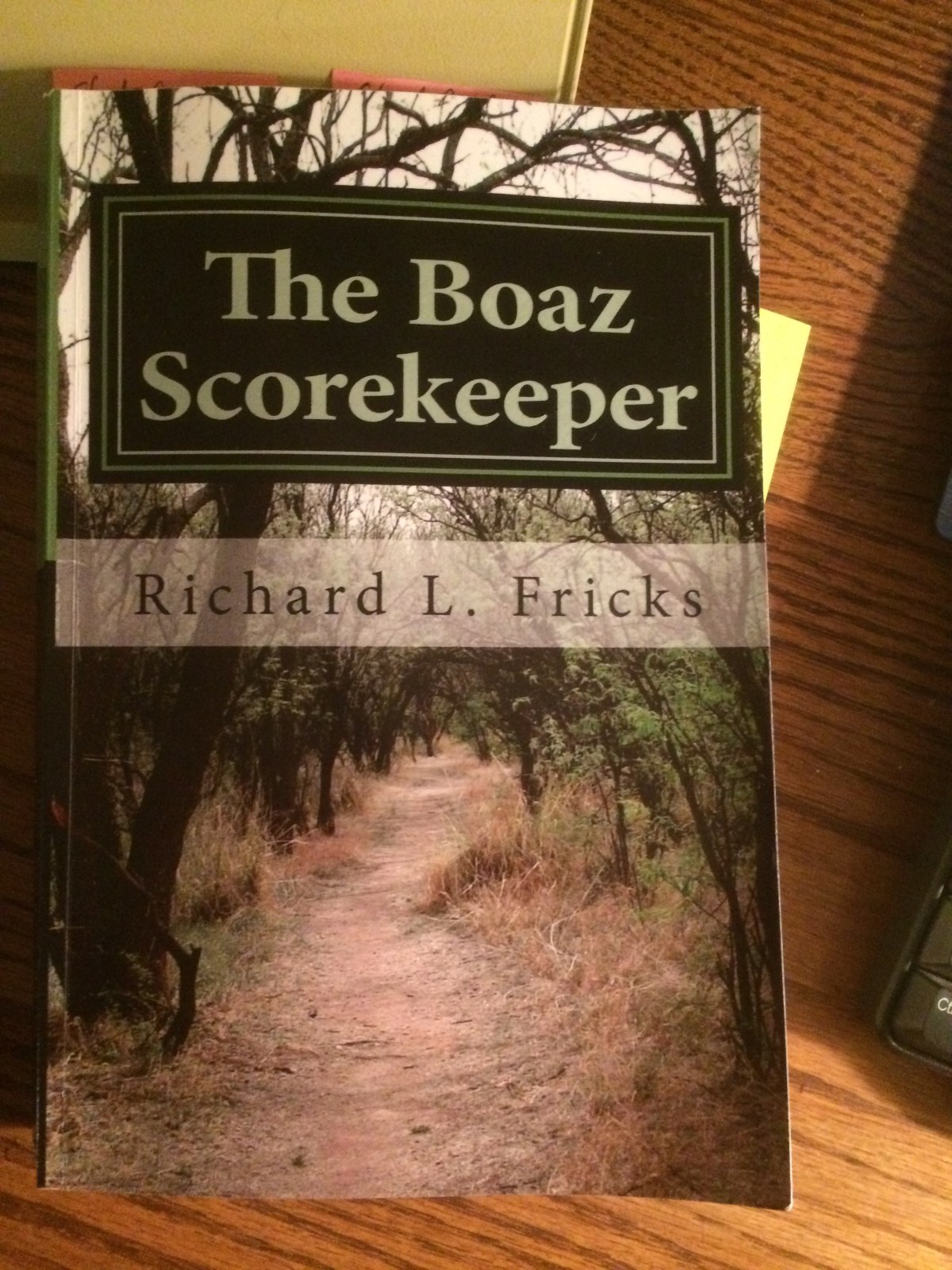
The Boaz Scorekeeper, written in 2017, is my second novel. I'll post it, a chapter a day, over the next few weeks.
We returned from our Kentucky fantasy land field trip late Wednesday after spending most of the day in Nashville touring the Cheekwood Estate and Gardens with its Georgian mansion, 55 acres of cultivated gardens, and art museum. I figured this event was an add-on since it had been on last year’s schedule but had to be canceled due to an outbreak of the flu across Nashville.
I dropped Karla and Kaden off at Hickory Hollow and drove to the office. On the way, I decided to detour past John Ericson’s home. When I turned on Capstone Drive I remembered that John and his wife no longer lived in the white colonial nestled in the far back corner of Dogwood Lane. Several years ago, they had purchased a 100-acre tract that bordered the south side of Boaz Country Club and accessed it via the extra lot that was south of their home on Dogwood Lane. I had heard they built a sprawling plantation style home with Olympic size swimming pool and tennis courts. The only way to see their current home was to travel down the long, paved driveway that started on Dogwood Lane. I finally realized that if I was going to mete out justice to John Ericson I could not afford to act spontaneously. Every move I made had to be carefully considered. I had to have a plan.
Biking is something I both love and hate. The conflicting emotions arise from the undeniable physical effort it demands. However, this exertion is precisely what makes it an excellent form of exercise. Most days, I dedicate over an hour to my cycling routine, and in doing so, I’ve discovered a unique opportunity to enjoy a good book or podcast. The rhythmic pedaling and the wind against my face create a calming backdrop that allows me to fully immerse myself in the content. In these moments, the time spent on the bike seems worthwhile, as I can’t help but appreciate the mental and physical rewards it offers.
I especially like having ridden. The post-biking feeling is one of pure satisfaction. The endorphin rush, coupled with a sense of accomplishment, makes the initial struggle and fatigue worthwhile. As I dismount and catch my breath, I relish the sensation of having conquered the challenge, both physically and mentally. It’s a reminder that the things we sometimes love to hate can often be the ones that bring us the most fulfillment. In the end, the love-hate relationship with biking only deepens my appreciation for the sport, as it continually pushes me to overcome my own limitations and embrace the rewards that follow the effort.
My bike
A Rockhopper by Specialized. I purchased it November 2021 from Venture Out in Guntersville; Mike is top notch! So is the bike. The ‘old’ man seat was salvaged from an old Walmart bike (update: seat replaced, new photo to follow, someday).
Something to consider if you’re not already cycling.
I encourage you to start riding a bike, no matter your age. Check out these groups:
NATIONAL BESTSELLER • The Girl with the Dragon Tattoo series continues: Lisbeth Salander must face the most important battle of her life, and will finally put her past to rest in this thriller that will “leave Salander’s legion of followers clamoring for more” (The Wall Street Journal). • Also known as the Millennium series
Mikael Blomkvist is trying to reach Lisbeth Salander—the fierce, unstoppable girl with the dragon tattoo. He needs her help unraveling the identity of a man who died with Blomkvist’s phone number in his pocket—a man who does not exist in any official records and whose garbled last words hinted at knowledge that would be dangerous to important people. But Lisbeth has disappeared. She’s sold her apartment in Stockholm. She’s gone dark. She’s told no one where she is. And no one is aware that at long last she’s got her primal enemy, her twin sister, Camilla, squarely in her sights.
Look for the latest book in the Girl with the Dragon Tattoo series, The Girl in the Eagle’s Talons, coming soon!
"Cognitive Clarity" blog posts are about cultivating a culture of thoughtful and informed discourse. They encourage readers to think deeply, question boldly, and approach the world with an open yet discerning mind.
It can be asserted with little fear of contradiction that every literate
adult the world over has a mental image of Jesus of Nazareth. After all, Christianity is the largest religion — an estimated 2.4 billion adherents — and has existed for 2000 years. For centuries, laymen and scholars alike assumed the gospel stories were history and that Jesus and his apostles were verifiably historical characters like Caesar Augustus (Luke 2:1), Herod the Great (Matthew 2:1), or Tiberius Caesar and Pontius Pilate (Luke 3:1-2). However, in the early twentieth century, when German scholars began to question the reliability of the New Testament texts, that assumption came under challenge, particularly after 1909 when the philosopher Christian Heinrich Arthur Drews published Die Christusmythe, The Christ Myth, that claimed there was no reliable independent evidence for the Jesus of the gospels — Jesus, Drews asserted, was a product of the imagination. Could Drews have been right all along?
Whatever one may think of Drew’s claims, one is certainly true: there is no independent evidence for Jesus outside the text of the New Testament. As always, scholars are divided about specifics, including about when Jesus died — assuming Jesus was a real person to begin with. The majority opinion, based on the gospels, favors a date between April, CE 30, and April, CE 33, but as Helen Bond has argued convincingly, the gospel accounts were meant to establish early Christian theology, not to record Jesus’ history.[1] There is little evidence to suggest the gospel accounts contain any eyewitness testimony: the gospel writers never name themselves within their texts, speak in the first person, suggest that they were either observers or participants in the events they relate, or cite their sources. Matthew and Luke clearly depended on the gospel of Mark — Matthew quotes or paraphrases 600 of the 661 verses in Mark and follows Mark’s timeline. Luke followed suit, using about 65% of Mark as his source.
At this point the Christian apologist will typically cite the historian Josephus, particularly the crown jewel of Historical Jesus texts, the endlessly debated Testimonium Flavianum of Antiquities, Book 18, Chapter 3, 3:
“About this time there lived Jesus, a wise man, if indeed one ought to call him a man. For he was one who performed surprising deeds and was a teacher of such people as accept the truth gladly. He won over many of the Jews and many of the Greeks. He was the Christ. And when, upon the accusation of the principal men among us, Pilate had condemned him to the cross, those who had first come to love him did not cease. He appeared to them spending a third day restored to life, for the prophets of God had foretold these things and a thousand other marvels about him. And the tribe of the Christians, so called after him, has still to this day not disappeared.”
Two recently published analyses of the Testimonium come to radically different conclusions. Based on a comparison of the Testimonium and the writings of the church official Eusebius, Ken Olson concluded,
“Both the language and the content [of the Testimonium] have close parallels in the work of Eusebius of Caesarea, who is the first author to show any knowledge of the text…The most likely hypothesis is that Eusebius either composed the entire text or rewrote it so thoroughly that it is now impossible to recover a Josephan original.”
Olson concludes that the Testimonium “has its most plausible Sitz-im-Leben in the pagan-Christian controversies of the fourth century.”[2]
On the other hand, Gary Goldberg performed a meticulous comparison of the Testimonium and Luke 24:18-24, documenting “thirty-one ordered content parallels” between the two texts. Goldberg concluded, “…by the simplest estimate (a normal distribution), the probability that the Emmaus-TF correspondences are due to chance is about one in ten thousand…The study shows Josephus closely following a Christian source…”[3]
In short, two close examinations of the text of the Testimonium have concluded that (1) it is a Eusebian forgery invented to bolster the early Christian claim of Jesus’ divine status, or (2) it is a word-for-word paraphrase of the Road to Emmaus story in the gospel of Luke. Quite clearly, the Testimonium is not an independent historical confirmation of the Jesus of the gospels. Additionally, as I have noted elsewhere, “…competent scholars arguing in good faith often reach radically different conclusions based on the available evidence…The evidence, such as it is, is textual; later historians who reported that Jesus had been crucified were repeating what they’d read or been told, not what they’d seen.”[4] The problem of flimsy evidence within the New Testament text, including outright forgery, is now so well documented as to need no further comment.[5] The evidence for Jesus is the New Testament. Full stop.
New Testament scholars are in wide agreement that Mark was the earliest gospel, written around the year 70 CE, decades after Jesus’ death. As if a lapse of 40 years between the life of Jesus and the composition of the first known gospel wasn’t problem enough, according to the church historian Eusebius, “[Mark] had not heard the Lord, nor had he followed him.”[6] On the best evidence, the gospels were not even composed in Palestine where the events they purport to relate took place. It is conjectured that Mark was written in Rome, Matthew in Syria, and John was perhaps composed in Asia Minor.
Even worse for the study of Christian origins, in 66 CE the First Jewish-Roman War resulted in the destruction of Jewish towns in Galilee and Judea which culminated in the destruction of Jerusalem and the Second Temple in 70 CE. By the time the war ended with the fall of Masada in 73 CE, the Jewish population of Palestine, obviously including potential eyewitnesses to the career of Jesus, had been decimated, scattered, and enslaved. Even assuming Jesus of Nazareth was a historical person, time and circumstances were working overtime to eradicate any evidence of his life and career. What would his soi-disant biographers do to fill this memory hole? A close reading of the gospels suggests they invented their stories.
Unlike history, the gospels are written from the standpoint of an omniscient narrator — like a novelist, the gospel writer knows not only the actions of his characters, but their inner thoughts and emotional state, as well as the content of their private conversations. Matthew, writing an estimated 85 years after Jesus’ birth, ostensibly knows the circumstances of Jesus’ conception, including the contents of a dream. (Matthew 1:20) Not to be outdone, Luke claims that, “Mary treasured up all these things and pondered them in her heart.” (Luke 2:19) Matthew claims to know the precise event that led the Pharisees to withdraw and begin to plot Jesus’ death, (Matthew 12:14) and John — writing 70 years after the fact — is mysteriously informed that the Pharisees “…said to one another, ‘See, this is getting us nowhere. Look how the whole world has gone after him!’” (John 12:19)
So where did Mark — his true identity is unknown, but following convention we’ll call him Mark — get his information? Decades ago, when I was studying the New Testament at university, the standard answer to “where they got it” was still “oral tradition,” but given the proven unreliability both of memory and oral transmission, scholars have questioned that explanation and suggested a different source: the theology of Paul of Tarsus.
The number of scholars who have proposed this connection is quite impressive and appears to be growing: Pérez I. Díaz,[7] Hollander,[8] Eurell,[9] Smith,[10] Nelligan,[11] and particularly Richard Carrier[12] to name but a few. However, using Paul to get to Jesus presents a problem very nicely summarized by David Madison:
“In the earliest of the New Testament documents, penned long before the Gospels, Jesus of Nazareth isn’t there. That is, the epistles of Paul and others don’t speak at all about Jesus of Nazareth. Their focus is a divine Christ. There seems to be no awareness of Jesus’s preaching and parables, his miracles, his disputes with religious authorities, or even the Passion narratives. It’s almost as if the real Jesus hadn’t been invented yet, which would not happen until the Gospels had been created. The focus of the epistles — with Paul being the giant presence — is salvation through believing in a resurrected Jesus. Inexplicably, they skip over everything else.”[13]
The first person known to have mentioned Jesus is Paul of Tarsus. And regarding the source of his information, Paul is perfectly clear: “visions and revelations from the Lord.” (2 Corinthians 12:1) After his conversion — which he never describes — Paul did not hie himself to Jerusalem to confer with Jesus’ family or followers. His ego on full display, Paul claims,
“…when God, who set me apart from my mother’s womb and called me by his grace, was pleased to reveal his Son in me so that I might preach him among the Gentiles, my immediate response was not to consult any human being. I did not go up to Jerusalem to see those who were apostles before I was, but I went into Arabia. Later I returned to Damascus.” (Galatians 1:15-17)
Paul didn’t need no stinking history: “I want you to know, brothers, that the gospel I preached is not of human origin. I did not receive it from any man, nor was I taught it; rather, I received it by revelation from Jesus Christ.” (Galatians 1:11-12) Unlike generations of New Testament scholars assiduously questing after the “historical Jesus,” Paul declares, “Even though we once regarded Christ according to the flesh, we regard him thus no longer.” (2 Corinthians 5:16) This is hardly the sort of attitude that would favor the loving preservation of Jesus’ every word and deed.
Paul believed that Jesus had previously existed “in the form of God…but emptied himself, taking the form of a slave, being made in the likeness of men.” (Philippians 2:6-7) According to Paul, God “…promised beforehand through his prophets in the holy scriptures regarding his son, who as to his earthly life was a descendant of David, and through the spirit of holiness was appointed the son of God in power by his resurrection from the dead.” (Romans 1:2-4) When he rose from the dead, Jesus “became a life-giving spirit” and returned to whence he had come: “the second [Adam] is from heaven.” (1 Corinthians 15:45, 47) The earliest Christians believed Jesus had descended from heaven: “He who descended is the very one who ascended higher than the heavens.” (Ephesians 4:10) The man known as Jesus had a previous existence in heaven: “The Son is the image of the invisible God…He is before all things…” (Colossians 1:15, 17)
Paul is certain he and his fellow believers will soon be joined with their Lord, “for the trumpet will sound, and the dead will be raised imperishable, and we shall be changed. For this perishable body must put on the imperishable, and this mortal body must put on immortality.” (1 Corinthians 15:51-53) In short, Paul has precisely nothing to tell us about “historical Jesus.” Paul was convinced that the time remaining until Jesus’ return was so short that married Christians should live as if celibate: “the time is short. From now on those who have wives should live as if they do not…” (1 Corinthians 7:29) Given the urgency of the moment, what possible reason could there be to preserve the details of Jesus’ career, assuming that anyone clearly remembered them?
As noted by Madison, “Proving the Bible’s authenticity by quoting from the Bible is closed-loop reasoning…no matter how high the level of confidence in the Bible in a particular part of the world, no document on the planet can be self-authenticating.”[14] In all likelihood, the Judean church and its members were swept away in the maelstrom of the Roman invasion; like the epistle ascribed to James, Paul’s letters are addressed to believers “scattered among the nations.” (James 1:1) The earliest Christians for whom we have evidence lived in expectation of imminent deliverance[15] and evince no interest in “authenticating” the life and career of Jesus of Nazareth. The stories of the gospels cannot be verified by any contemporaneous sources. Insofar as anyone can confirm, they are pious confections written for the edification of credulous believers. We are left with a stark conclusion: the entire evidence for the life of Jesus is the magic self-authenticating New Testament.Robert Conner is the author of The Death of Christian Belief; The Jesus Cult: 2000 Years of the Last Days; Apparitions of Jesus: The Resurrection as Ghost Story; The Secret Gospel of Mark; and Magic in Christianity: From Jesus to the Gnostics.
[1] Helen K. Bond, “Dating the Death of Jesus: Memory and the Religious Imagination,” New Testament Studies, 59/4 (2013), 461-475.
[2] Ken Olson, “A Eusebian Reading of the Testimonium Flavianum,” in Eusebius of Caesarea: Traditions and Innovations, Helenic Studies Series 60 (2013) 97-114.
[3] Gary J. Goldberg, “Josephus’s Paraphrase Style and the Testimonium Flavianum,” Journal for the Study of the Historical Jesus, 20/1 (2021) 1-32.
[4] Robert Conner, The Death of Christian Belief (2023), 48, 56.
[5] Bart D. Ehrman, Forged: Writing in the Name of God — Why the Bible’s Authors Are Not Who We Think They Are, 2010.
[6] Eusebius, Ecclesiastical History, III, 39, 15.
[7] Mar Pérez I. Díaz, Jesus in the Light of Paul’s Theology, Mohr Siebeck, 2020.
[8] Harm W. Hollander, “The Words of Jesus: From Oral Traditions to Written Records in Paul and Q,” Novum Testamentum 42/4 (2000), 340-357.
[9] John-Christian Eurell, “Paul and the Jesus Tradition: Reconsidering the Relationship Between Paul and the Synoptics,” Journal of Early Christian History, 12/2 (2022), 1-16.
[10] David Oliver Smith, Matthew, Mark, Luke, and Paul: The Influence of the Epistles on the Synoptic Gospels, Resource, 2011.
[11] Thomas Nelligan, The Quest for Mark’s Sources: An Exploration of the Case for Mark’s Use of First Corinthians, Pickwick, 2015
[12] Richard Carrier, Jesus from Outer Spance: What the Earliest Christians Really Believed about Christ, Pitchstone, 2020.
[13] David Madison, Guessing About God, 144-145, Insighting Growth Publications, 2023.
I sat in the Pencil Pit, staring at the blank page. The early morning light filtered in through the barn window, illuminating specks of dust floating gently in the air. It was quiet except for the scratching of chickens outside.
Writer’s block had firmly planted itself between me and the page again. I knew I needed to write my regular Morning Mental Meanderings blog post, but no words came. I reread the quote by Charles Bukowski that I had scribbled down last night – “writing about a writer’s block is better than not writing at all.”
With a sigh, I picked up my favorite #2 pencil and began:
I gazed at the empty page, willing words to flow but finding none. Bukowski’s advice rattled around in my head…maybe writing about the block itself would help dislodge it. My mind felt stuffed with cotton, mute and tangled. I longed for the relief that came with a free flowing stretch of typing on my old typewriter, when the words tumble out almost faster than my arthritic fingers can catch them.
But for now, there was only the oppressive blankness glaring back at me. The vast whiteness seemed to mock me. You call yourself a writer? After decades as a small town lawyer, you thought retirement would make you an author overnight? What a joke. I shook my graying head and shifted in the creaky wooden chair. The morning sunlight felt harsh now instead of comforting. The chickens’ cackling sounded more smug by the minute.
With a deep breath, I lowered my eyes to the hateful blank page again. Bukowski was right – just acknowledging the block was better than ignoring it and giving up completely. The words would come again, eventually. I just had to sit with the discomfort and not lose hope.
Dipping my #2 pencil once more, I began drafting a description of the fickle muse’s abandonment. Might as well make use of the empty time by writing ABOUT not writing…
The Boaz Scorekeeper, written in 2017, is my second novel. I'll post it, a chapter a day, over the next few weeks.
As often happens in life, or it seems to me, the nudge I needed to turn left or right, or jump up or down onto a different path, came totally out of the blue, and from a source I could never have imagined.
In early April 2017 Karla asked me to go with her to Williamstown, Kentucky to see Ken Ham’s Ark Encounter. It was a last-minute request. She and twelve of her middle-school-age Sunday School students, along with thirty or so senior adults, were leaving Monday on a three-day field trip. Karla’s co-teacher, Joan Headrick, who had planned on going and assisting, had left yesterday on an emergency trip to Orlando, Florida. Karla had solicited help from everyone she could think of including her friend, Sandra, a cashier at Eaglemart. I reluctantly agreed.
For Karla, teaching was her life. If spending eight or more hours per day with a room full of 13-year-old eighth graders was not enough, she had taught The Young Seekers Sunday School class at First Baptist Church of Christ since shortly after we moved back from Atlanta. Karla, unlike me, has remained loyal to her faith in Christ. She is a true Christian fundamentalist. She believes every word of the Bible. To her, it is wholly without error. It is Holy correct, God’s Word.
Not only did Karla supervise twelve boisterous middle-schoolers, she had promised Kaden he could come along. After Susan died in 2015, Karla and I had just about raised Kaden. Not long after she passed away, Lewis’ truck driving job started keeping him out of town for two to three weeks at a time and two-year-old Kaden moved in with Karla and me. Kaden was now approaching the age of four and had an infatuation with dinosaurs. Karla simply could not say no. And neither could I.
Monday morning came way too soon. Karla, Kaden, and I pulled into the church parking lot at 6:00 a.m. The church had hired a plush tour bus to haul all 55 of us. It was already there and half-filled with people and luggage. Karla had failed to tell me that John Ericson and James Adams, and eight high school Juniors and Seniors, were also going on our little field trip. By 7:00 a.m. we were rolling, and by the time we turned north on Highway 431, I learned that ten of Karla’s students and all eight of the high school students with John and James were part of the Upward Bound basketball program. For nearly twenty years, the Flaming Five had grown this basketball and Bible program into a youth program that drew student-players from a five-county area. Upward Bound had transformed First Baptist Church of Christ into a mega church in a minor town.
Ark Encounter was not only the nudge I needed to, as Christians often say, ‘put legs on my prayers,’ it was a violent push. Just seeing the giant ark from the parking lot, before ever even taking one step inside, told me I was about to experience an ‘encounter’ unlike anything Ken Ham would have ever desired. One could simply look at the enormity of the wooden vessel and easily and reasonably conclude that it would never survive the boisterous waves of a worldwide flood. I wasn’t the only one who thought this. I had spent most of the weekend reading, and a lot of that time reading what scientists and other experts said about Noah’s Ark. This wasn’t the first time I had reviewed this material. After the deaths of Bill and Nellie, and after my revelation of sorts, what I called ‘My Awakening,’ I had invested about as much time reading secular materials as I had in practicing law. My whole experience with the Murrays had caused me to flee Christianity. Not that I quit going to church with Karla but I did start learning something outside what preachers and Sunday School teachers were spouting.
In short, the Noah’s Ark story is fiction. It is wholly imaginary. One doesn’t have to be a scientist to reach this conclusion, but to me, a reading of the science materials makes it more interesting. The sea-worthiness of the vessel itself is not the only problem. The ark wasn’t big enough to hold the thousands of species alive at the time. And, the word ‘time’ is a big problem itself. Ken Ham, and millions of other Christians, believe the earth is around 6,000 years old. They also believe dinosaurs and humans lived at the same time. This belief is clearly depicted throughout the Ark Encounter exhibit. Scientists know the earth is around 4.6 billion years old, with the universe some 13 billion years old. Also, they know that dinosaurs lived around 65 million years ago, with modern humans existing, at most, only 200,000 years. And, I shouldn’t fail to say that there is absolutely no evidence that there was ever a worldwide flood. That’s because, such thing is scientifically impossible.
As we purchased our tickets, we were divided into groups and assigned a guide. Karla, her twelve students, Kaden, and myself were in one group. Before we started the tour, John had the idea of keeping all the Upward Bound students together in one group. The combined group of 20 was too large for one guide but the Encounter wanted to be accommodating so we were assigned a second guide. It was wonderful. I had to tag along with John Ericson.
I choose to keep my mouth shut and wandered along behind our large group. But, I did keep my ears and eyes open. The students, and Kaden, were quickly immersed into another world. The two guides were patient, stopping and spending extra time at most every exhibit. They spouted out their version of ‘truth,’ extolling their scientists for clear but controversial explanations for how Noah and his eight-member family fed and watered hundreds of animals. I noticed how the guides skipped over how the workers handled the impossible problem posed by animal waste and a sufficient supply of fresh water. I also noted how the guides didn’t mention that the scientists who worked for Ken Ham’s organization were in the minor minority of scientists who held to these controversial stories. In fact, the truth is, Ham’s scientists are not truly scientists at all. But, the theory that triumphed today for these young undeveloped minds was the old catchall: when we don’t know, clearly God did it.
As the day ended and we exited the Ark, John called our group aside and gave the young people his heartfelt message. “Before we load back on the bus and head to our hotel I wanted to tell you how much I have enjoyed today with each of you. We have had a great day and a rich experience of learning how God works, how He takes care of His children. For me, this giant ship, the Ark, just confirms the truth of the Bible. Please allow your experience today to strengthen your commitment to God and your belief that God’s Word is perfectly true. Each of you students, whether you are involved in our Upward Bound program or not, are facing great temptations ahead. The world will try to tell you that the Bible is not true, that there was no Noah’s Ark. But, you are blessed to have seen an exact replica of that vessel that saved mankind. I urge you to put your trust in God and His Word and build your life on the truth. Never forget that God is faithful, He is merciful, and that He is near to each of us, just a prayer away. You can depend on God.”
As Karla, Kaden, and I walked back to the bus I couldn’t contain myself. “I think I am about to throw up. I think I’ve caught the plague.” Karla looked at me with puzzled eyes but finally understood I was referring to John’s speech. Kaden was too young to absorb my meaning but did ask, “Papa, what’s a plague?” After explaining to Kaden, we rode in silence back to our hotel.
I gathered our luggage and told Karla and Kaden I needed to skip dinner and stay in our room. The hotel had agreed to provide soup and sandwiches for our group in one of its banquet rooms. I rode the elevator to our room on the third floor and laid down across one of the beds.
I couldn’t think of anything but John and his stupid little speech. Even according to his version of the truth, why wouldn’t someone ask why God had to kill thousands or millions of people? Were they all sinners? Weren’t there any children living at the time? Did they all deserve to die? I knew that John’s truth didn’t sell as well if God’s merciless side was brought up.
The students were just like me. They were at the early stages of being brainwashed, just like I was when I was a child being forced to listen to these lies. From the time I was born, my mother had made sure I was beside her on a pew at Clear Creek Baptist Church. I grew up hearing about Noah’s Ark, the parting of the Red Sea, and of course all the miracles Jesus performed in the New Testament. My favorite of all time was the story of Jesus raising Lazarus from the dead after he had been dead four days and ‘stinketh.’
John surely didn’t believe what he had told these young boys and girls. But, did he? Maybe he did. John is not stupid. I had never thought any of my fellow church members were stupid, but I did grow to believe they were very ignorant. Why wouldn’t they be? Just like me up until 1998 when I had my awakening, they had been brought up hearing only the Bible stories. I had never in my life heard a preacher or a Sunday School teacher say, “today, class, we are going to fully explore the truth about evolution.” Or, Noah’s Ark for that matter. This approach to teaching would never work in Christian churches. One-sided explanations were mandated.
The biggest problem I was having with John’s speech was how neatly it fit with injustice. John believed that a person, a Christ believer, can escape punishment. All sinners can be saved no matter what they have done. Embedded in John’s statements was his belief that one can live like the devil and still receive God’s mercy. John didn’t say it exactly this way but that’s what he meant. How could he believe anything else? John had firsthand experience of lying, deceiving, and manipulating the justice system. He knew for a fact that one can rape and murder and avoid punishment from the criminal justice system. And, he knew from his Christian teaching, from the mouths of Pastor Walter and all the Sunday School teachers he had listened to all his life at First Baptist Church of Christ, that God loves His children and is faithful to take care of them, always forgiving their sins, and always answering their prayers.
Am I the only one who sees John’s hypocrisy? No doubt John had fully escaped accountability from mankind’s laws. Yet, he was truly a rapist and a murderer. I knew the Bible was completely man-made but even assuming it was true, John would never be held accountable for his crimes by God’s laws. I was wrong in telling Karla and Kaden that I had caught the plague. It was John who had the plague and he was doing his best to spread his infection to every young person who joined and participated in the Upward Bound basketball and Bible program. Plagues were historically one of the most horrendous killers of mankind. I was just one man, wholly without skills and resources to stop the spread of the Christian plague, but I could stop this one man, John Ericson, from continuing to infect these twenty-young people, and hundreds more in the future.
Nineteen years ago, I had an awakening as I watched the construction of our home at Hickory Hollow. It was revealed to me that if Wendi and Cindi, and their parents, were to ever get justice, it was up to me. Yet, I had done nothing for all those years even though my mind never changed. Now, here at the Ark Encounter, I had been vividly reminded that my slothfulness in pursuing my purpose not only continued to delay justice for the Murrays, it also was allowing the Flaming Five to continue to spread injustice. Not one of these precious young people deserved a daily dose of this plague.
I can only do what one man can do. But, I will do that. I can only focus on one of the Flames at a time. John Ericson, justice is coming your way.
Biking is something I both love and hate. The conflicting emotions arise from the undeniable physical effort it demands. However, this exertion is precisely what makes it an excellent form of exercise. Most days, I dedicate over an hour to my cycling routine, and in doing so, I’ve discovered a unique opportunity to enjoy a good book or podcast. The rhythmic pedaling and the wind against my face create a calming backdrop that allows me to fully immerse myself in the content. In these moments, the time spent on the bike seems worthwhile, as I can’t help but appreciate the mental and physical rewards it offers.
I especially like having ridden. The post-biking feeling is one of pure satisfaction. The endorphin rush, coupled with a sense of accomplishment, makes the initial struggle and fatigue worthwhile. As I dismount and catch my breath, I relish the sensation of having conquered the challenge, both physically and mentally. It’s a reminder that the things we sometimes love to hate can often be the ones that bring us the most fulfillment. In the end, the love-hate relationship with biking only deepens my appreciation for the sport, as it continually pushes me to overcome my own limitations and embrace the rewards that follow the effort.
My bike
A Rockhopper by Specialized. I purchased it November 2021 from Venture Out in Guntersville; Mike is top notch! So is the bike. The ‘old’ man seat was salvaged from an old Walmart bike (update: seat replaced, new photo to follow, someday).
Something to consider if you’re not already cycling.
I encourage you to start riding a bike, no matter your age. Check out these groups:
In the quiet sanctuary of the Pencil Pit this morning, warmed by a new heater, my mind wanders back to the contrasting experiences of confinement that I encountered yesterday. The solitude of this barn, my chosen place of reflection, starkly contrasts with the stories of enforced and tragic confinements I absorbed.
An article I read yesterday from The New York Times about the crisis in Gaza lingered in my thoughts. Children like Khaled Joudeh, trapped not only in the physical rubble of a war-torn region but also in a situation far beyond their control or understanding. The image of Khaled, grieving beside his family, encapsulates a confinement of the most harrowing kind – trapped in a cycle of violence and loss, a life dictated by forces outside one’s control.
As I drove to Lowe’s yesterday, the narrative of confinement continued, this time through the podcast recounting Amanda Knox’s ordeal. Her story – one of wrongful accusation and years spent in an Italian jail – is a different kind of confinement. It’s a mental and physical imprisonment, compounded by the weight of injustice and misunderstanding. Knox’s voice, recounting her experiences, was a stark reminder of how freedom, something we often take for granted, can be so fragile.
These stories of confinement, both physical and metaphorical, make me reflect on the nature of freedom. In my barn, the Pencil Pit, I find a liberating solitude, a space where my thoughts and words are free to roam. This freedom, however, is a privilege, one that many, like the children in Gaza or Knox in her cell, are brutally denied.
It leads me to ponder the resilience of the human spirit in the face of such trials. There’s a certain strength, an indomitable will, that both Khaled and Knox exhibit – a refusal to be completely subdued by their circumstances. Yet, the unfairness of their situations, the pain of being confined and constrained by external forces, is deeply troubling.
As I sit here, my thoughts are a mix of gratitude for my own freedom and a deep empathy for those who are unjustly confined. These reflections are not just idle musings; they are a call to awareness and action. They remind me that while some of us have the luxury to build our sanctuaries, others are fighting battles for their basic freedoms.
Today’s mental meandering is a somber journey through the extremes of human experience. It is a recognition of the spaces we occupy – some chosen, some imposed – and the profound impact they have on our lives. In the Pencil Pit, surrounded by the early morning tranquility, I’m reminded that every word I write, every thought I explore, is a testament to the freedom that I have, and a tribute to those who are unjustly deprived of theirs.



























 Richard L. Fricks