Writer / Observer / Builder — Presence, clarity, and living without a script
Author: Richard L. Fricks
Writer. Observer. Builder. I write from a life shaped by attention, simplicity, and living without a script—through reflective essays, long-form inquiry, and fiction rooted in ordinary lives. I live in rural Alabama, where writing, walking, and building small, intentional spaces are part of the same practice.
That year, Marie Howe — one of our great living poets, who awakens the creaturely conscience of the next generation in her ecopoetry class at Sarah Lawrence College — premiered a kindred poem that stilled the crowd constellating at Pioneer Works before erupting into a thousand-bodied standing ovation. While inspired by Stephen Hawking (who had just returned his stardust to the universe several weeks earlier) and titled after his trailblazing work on black holes and singularities — work that shines a sidewise gleam on the origin of everything — the poem is at bottom a stunning meditation on the interconnectedness of belonging across space and time, across selves and species, across the myriad artificial unbelongings we have manufactured as we have drifted further and further from our elemental nature. Its closing line is an invocation, an incantation, ending with a timeless word of staggering resonance today: home.
As we now stand on a profound precipice two years later — facing our deeply interconnected ecology of being on this shared cosmic home as we look back on fifty years of Earth Day built on Carson’s legacy, facing the most intimate meaning of home in our isolated shelters scattered across this “small and lonely planet” — the poem pulsates with a whole new meaning, as all great poems do in the veins of time.
And so, as a special treat for the 2020 Universe in Verse, streaming on April 25 into millions of homes around this sole shared home, I teamed up with SALT Project — a kindred clan of visual storytellers, who have won some hearts and won some Emmys with their soulful shorts ranging from book trailers to bird migration documentaries — to bring Howe’s “Singularity” to life in a transcendent short film, illustrated by paper collage artist Elena Skoreyko Wagner and featuring original music by the heroic cellist Zoë Keating, who was present in atoms at the 2018 show when “Singularity” premiered and who also composed the score for “Antidotes to Fear of Death” — the headlining miracle of a poem for the 2020 show.
It is with exuberant joy and gratitude that I share, as a special taste of the 2020 Universe in Verse, this symphony of beauty and perspective, over which so many talented women have labored with so much heart and generosity of spirit .
SINGULARITY by Marie Howe
(after Stephen Hawking)
Do you sometimes want to wake up to the singularity we once were?
so compact nobody needed a bed, or food or money —
nobody hiding in the school bathroom or home alone
pulling open the drawer where the pills are kept.
For every atom belonging to me as good Belongs to you. Remember?
There was no Nature. No them. No tests
to determine if the elephant grieves her calf or if
the coral reef feels pain. Trashed oceans don’t speak English or Farsi or French;
would that we could wake up to what we were — when we were ocean and before that
to when sky was earth, and animal was energy, and rock was liquid and stars were space and space was not
at all — nothing
before we came to believe humans were so important before this awful loneliness.
Can molecules recall it? what once was? before anything happened?
No I, no We, no one. No was No verb no noun only a tiny tiny dot brimming with
But the red and gold cover tempted me like the devil himself. Loudspeakers announced flight numbers in monotone stability while my heart committed vertigo. I stepped closer to the display table. Blasphemy! I glimpsed the name of the author, Thich Nhat Hanh. Liar! I picked up the book with quaking fingers. Damned!
I was 20 years old and had never read nonfiction from anywhere but a Christian bookstore. Hudson Booksellers might as well have been the Tree of Knowledge. The innocuous paperback in my sweaty palms felt like holding the crevice to a canyon of no return, and I imagined demons rubbing their hands like gleeful flies as I read the back cover, giving Satan a foothold. The demon-flies buzzed ecstatic.
Knowing I might be a goner but praying for the protection of angels anyway, I opened the book mid-flight and braced. Nothing bad happened. Not even a bump of turbulence. I read the monk’s meditations on Christlike Buddhism with a pounding heart.
Thich Nhat Hanh did not suggest Jesus and Buddha had been literal brothers. Rather, he presented Christ’s teachings alongside the Buddha’s in a way that made it impossible for me to deny their similarities. My mind exploded with questions above an autumn patchwork of fields. Other religions cared about the teachings of Jesus? I’d been forbidden from even thinking of exploring other faiths. Was it possible reincarnation was real? That the soul didn’t simply reside in heaven or hell when we died but recycled on some cosmic mission? Was it further possible that Jesus was actually Buddha in another body?
My thoughts screeched to a halt. God might allow the plane to crash if I pondered any more blasphemy.
But back in LA, my curiosity only intensified. Going Home was my gateway drug to intellectual sovereignty. Questions I’d never dared to ask drove me to the library in search of other spiritual texts, which led to psychological texts, which led to books on quantum theory and astrophysics and histories of the world. Although I feared the expansion of my mind, my need to know what was real took precedent. I wanted to know the truth. Each book I read in search of answers only left me with more questions.
Thich Nhat Hanh was the first author to open me to the world of theoretical exploration. As a Buddhist monk, he may not have intended for his work to encourage the eventual embrace of nonbelief—of outright atheism, which is where I find myself today. But I like to think that what the Vietnamese monk and I have in common is the courage to question.
Stepping outside the boundaries of my former faith liberated me from its fear-driven clutches. The slope was indeed as slippery as everyone warned it would be, but instead of leading into flames, it led me to freedom.
Journalist, LGBTQ and freethought activist
BARRY DUKE
Abook you’ve never heard of changed my life.
In the late sixties, while working as a reporter on The Star newspaper in South Africa, I got a tip-off from a furious librarian. She’d been ordered by the Publications Control Board to remove copies of Black Beauty from her shelves.
At the time, SA had the most draconian censorship laws in the world, but the Board operated under a cloak of semi-secrecy, and items it banned – ranging from the movie Zulu to posters proclaiming “Black is Beautiful” – were listed only in The Government Gazette, a publication few ever read.
The only publication created to encapsulate a full list of all banned items – around 50,000 books, movies and even classical statuettes – was Jacobsen’s Index to Objectionable Literature, which could only be found in libraries.
I had never heard of it until I got that call, and I scurried off to the library where I spent hours extracting examples from Jacobsen’s of lunacies perpetrated by the censors, headed by an antiquated Calvinist called Jannie Kruger, who – please don’t laugh – was later awarded an honorary doctorate in literature!
I was so fired up by Jacobsen’s that I implored my editor to allow me to write a weekly column that would pull no punches in ridiculing the censors’ decisions, and I was given the green light to do just that.
It was a short-lived column. Kruger was livid and was instrumental in having legislation passed that made it a criminal offense to criticize his Board.
However, an entertainment magazine, TimeOut, invited me to restart the column for its readers. Soon after, the magazine was banned outright.
While scouring the pages of Jacobsen’s I learned that The Freethinker magazine I now edit was on the banned list, as were all publications deemed to “promote” atheism.
From that point on, I used Jacobsen’s to point me to publications I desperately wanted to read, and I drew up a list that I sent to friends and relatives abroad, begging them to post them to me. And they dutifully obliged.
In particular, as an ardent science fiction fan, I wanted to read some of the banned novels written by atheist Harry Harrison, especially his virulently anti-Christian The Streets of Ashkelon (1962). It is now available online, and tells of the horrors unleashed by a Christian missionary on a far-off planet.
When I was forced to leave the country for my involvement with the banned African National Congress and the Communist Party – a warrant had been issued for my arrest in 1973 – I sought asylum in the UK.
There, two incredible things inspired by Jacobsen’s happened. I began writing for The Freethinker, and became friends with Harrison, who had left the US and was living a few miles from me. He was a regular at the Mitre Pub in Brighton, where a group of science-fiction fans and writers regularly met.
Jacobsen’s, a book no-one’s ever heard of, had changed the course of my life.
Author, folklorist, sex educator JEANA JORGENSEN
Ifirst read Cunt: A Declaration of Independenceby Inga Musciowhen I was 16 or 17 years old, and I knew immediately that I would have to wait a couple of years for my younger sister to be old enough to read it. This was the book that cemented my feminism, that had me experimenting with sea sponges and other menstrual contraptions rather than buying tampons and pads, and that taught me to speak of these topics without shame.
I already knew something was wrong with the world; it was one reason I retreated into books as a child, being slow to seek out friends and a social life as a teen. I knew that my life was comparatively comfy, that hardship would take a while to find my middle-class Californian family. But I knew that difficulties and judgments awaited me, and Cunt helped me put a finger on why: because I share the condition, along with roughly half of humanity, of being a woman. My mere existence in certain spaces would be enough to invite disparaging comments about my intellectual or sexual worth, or even to invite assault. My reproductive rights would be constantly embattled. My role in society would be constantly questioned. After all, why would cunt be a bad word, if not to demonize women’s bodies, sexualities, and selves?
As a teenager, I had already settled on some form of agnosticism, so I knew the bullshit most religions peddled about womanhood needn’t apply to me. And yet.
Religion is only one source for misogyny; plenty of other arenas of culture uphold tired gender roles, from the law and medicine to the educational system and entertainment. Even benevolent, humorous forms of sexism are detrimental: anyone who firmly believes in an essential, eternal, universal difference between genders is likely contributing to women’s inequality, and Cunt taught me that. From frank discussion of abortion to masturbation to rape, the book was a revelation. Somehow, I never took a women’s studies class in college, but I arrived at grad school ready for a gender studies PhD minor, and that’s in large part thanks to Cunt.
Rereading Cunt now, I appreciate Muscio’s spunky voice, seeing in it the seeds of my own at-times irreverent blogging voice. I see the unfortunate exclusion of transgender and non-binary people (many of whom are impacted by misogyny) in the 1st edition of the book, which Muscio attempted to remedy in the 2nd edition. I see the ways in which Muscio points readers towards understanding the intersectional oppression of women due to race, social status, and citizenship. All these concepts have become a part of me, have influenced how I walk in the world.
Cunt taught me to question patriarchal authority, to seek common cause with fellow women and other oppressed folk, and to give a giant middle finger to anyone who implies that feminine things are tinged with shame. Cunt was indeed a declaration of independence for my teenage self – and I’ve not looked back.
ALICE GRECZYN
Alice Greczyn is an actress, author, and the founder of Dare to Doubt, a resource site for people detaching from belief systems they come to find harmful. She’s Midwest-raised and LA-based. More by Alice Greczyn
JEANA JORGENSEN
FOXY FOLKORIST Studied folklore under Alan Dundes at the University of California, Berkeley, and went on to earn her PhD in folklore from Indiana University. She researches gender and sexuality in fairy… More by Jeana Jorgensen
BARRY DUKE
Veteran journalist and free speech activist Barry Duke was, for 24 years, editor of The Freethinker magazine, the second oldest continually active freethought publication in the world, established by G.W…. More by Barry Duke
Biking is something else I both love and hate. It takes a lot of effort but does provide good exercise and most days over an hour to listen to a good book or podcast. I especially like having ridden.
Here’s my bike, a Rockhopper by Specialized. I purchased it November 2021 from Venture Out in Guntersville; Mike is top notch! So is the bike, and the ‘old’ man seat I salvaged from an old Walmart bike.
Here’s what I’m listening to: The Dictionary of Lost Words, by Pip Williams
Amazon abstract:
NEW YORK TIMES BESTSELLER • REESE’S BOOK CLUB PICK • “Delightful . . . [a] captivating and slyly subversive fictional paean to the real women whose work on the Oxford English Dictionary went largely unheralded.”—The New York Times Book Review
“A marvelous fiction about the power of language to elevate or repress.”—Geraldine Brooks, New York Times bestselling author of People of the Book
Esme is born into a world of words. Motherless and irrepressibly curious, she spends her childhood in the Scriptorium, an Oxford garden shed in which her father and a team of dedicated lexicographers are collecting words for the very first Oxford English Dictionary. Young Esme’s place is beneath the sorting table, unseen and unheard. One day a slip of paper containing the word bondmaid flutters beneath the table. She rescues the slip and, learning that the word means “slave girl,” begins to collect other words that have been discarded or neglected by the dictionary men.
As she grows up, Esme realizes that words and meanings relating to women’s and common folks’ experiences often go unrecorded. And so she begins in earnest to search out words for her own dictionary: the Dictionary of Lost Words. To do so she must leave the sheltered world of the university and venture out to meet the people whose words will fill those pages.
Set during the height of the women’s suffrage movement and with the Great War looming, The Dictionary of Lost Words reveals a lost narrative, hidden between the lines of a history written by men. Inspired by actual events, author Pip Williams has delved into the archives of the Oxford English Dictionary to tell this highly original story. The Dictionary of Lost Words is a delightful, lyrical, and deeply thought-provoking celebration of words and the power of language to shape the world.
“There is no human being on earth capable of declaring with certitude who he is.”
BY MARIA POPOVA
It takes a great sobriety of spirit to know your own depths — and your limits. It takes a special grandeur of spirit to know the limits of your self-knowledge.
A recent brush with those limits reminded me of a short, stunning essay by Jorge Luis Borges (August 24, 1899–June 14, 1986) titled “The Mirror of Enigmas,” found in his Labyrinths (public library) — the 1962 collection of stories, essays, and parables that gave us his timeless parable of the divided self and his classic refutation of time.
Titling the essay after St. Paul’s famous cryptic statement Videmus nunc per speculum in aenigmate — loosely translated as We now see through a mirror, enigmatically — Borges considers the tribe of thinkers who have perched their efforts to reconcile knowledge and mystery, the scientific and the spiritual, on the assumption that “the history of the universe — and in it our lives and the most tenuous detail of our lives — has an incalculable, symbolical value.” With his characteristic poetic precision, he condenses this common and somewhat tired hypothesis:
The outer world — forms, temperatures, the moon — is a language humans have forgotten or which we can scarcely distinguish.
No one, Borges argues, has taken this precarious hypothesis to more surefooted ground than the French novelist, poet, and philosophical pamphleteer Léon Bloy (July 11, 1846–November 3, 1917).
Digging through the surviving fragments of Bloy’s written thought, he surfaces a passage emblematic of Bloy’s uncommon physics of the metaphysical — an 1894 passage fomented by his interest in the teachings of St. Paul. Translated by Borges himself, Bloy writes:
[St. Paul’s statement] would be a skylight through which one might submerge himself in the true Abyss, which is the soul of man. The terrifying immensity of the firmament’s abyss is an illusion, an external reflection of our own abysses, perceived “in a mirror.” We should invert our eyes and practice a sublime astronomy in the infinitude of our heart… If we see the Milky Way, it is because it actually exists in our souls.
A century before Milan Kundera considered the eternal challenge of knowing what we really want in his classic novel The Unbearable Lightness of Being, Bloy shines a sidewise gleam on the elemental self-opacity with and within which we live:
Everything is a symbol, even the most piercing pain. We are dreamers who shout in our sleep. We do not know whether the things afflicting us are the secret beginning of our ulterior happiness or not.
These ideas haunted Bloy, animated his pamphlets, his poems, his novels, then culminated in his 1912 book-length essay The Soul of Napoleon — a philosophical prose poem that sets out, as Borges puts it, “to decipher the symbol Napoleon, considered as the precursor of another hero — man and symbol as well — who is hidden in the future.” Bloy, translated again by Borges, writes in this uncommon work:
Every man* is on earth to symbolize something he is ignorant of and to realize a particle or a mountain of the invisible materials that will serve to build the City of God.
[…]
There is no human being on earth capable of declaring with certitude who he is. No one knows what he has come into this world to do, what his acts correspond to, his sentiments, his ideas, or what his real name is, his enduring Name in the register of Light… History is an immense liturgical text where the iotas and the dots are worth no less than the entire verses or chapters, but the importance of one and the other is indeterminable and profoundly hidden.
But as you contemplate these existential immensities, you face the limits of contemplation — the limits of meaning-making in relation to elemental truth.
Borges recognized this, closing the essay with by acknowledging “it is doubtful that the world has a meaning… even more doubtful that it has a double or triple meaning.”
I recognized this upon sitting down in for morning meditation in my garden after a nightlong storm and watching an almost otherworldly deposit roll onto the cushion: a tiny, perfect robin egg, improbable and sorrowful in its displaced blue beauty.
Singing Only Is by Maria Popova. (Available as a print.)
I considered climbing the neighbor’s colossal tree to find the storm-shaken nest and reinstate the egg. (Perfectly, the tree is an Ailanthus altissima, known as “tree-of-heaven” in its native China — a migrant now rooted in Brooklyn, like me.)
But then I considered this chance-event as the product of the same impartial forces that deposited the exact spermatozoid of my father’s onto my mother’s ovum at the exact moment to produce the chance-event of my particular configuration of atoms animated by this particular consciousness that just is, the consciousness mourning the robin that will never be. To call one expression of chance good and another bad is mere human hubris — the hubris of narrative and interpretation superimposed on an impartial universe devoid of why, awash in is.
No one knows the meaning of why anything comes to be, or doesn’t. Here is this pale blue orb, dropped from the tree-of-heaven onto a tiny Brooklyn point on the face of this Pale Blue Dot, itself a “mote of dust suspended in a sunbeam” within an immense and impartial universe, conceived in the creation myths and early scientific theories of our meaning-hungry ancestors as a great cosmic egg.
Here I am, and here you are, and here is the robin’s egg in its near-life collision with chance. To ask for its meaning is as meaningless a question as to demand the meaning of a color or the meaning of a bird. On this particular day, at this particular moment — the only locus of aliveness we ever have — the contour of meaning comes in shades of blue, singing only is.
Human harms should require forgiveness to come from human victims. With belief in God, believers can end up being morally lazy.
Crimes or harm to others can take on many different forms, but some can be particularly heinous. Far be it for me to constrain your imagination in detailing any such horrible harms. Instead, let us more closely consider the ramifications of causing harm to others.
Forgiveness is often defined as something like “a conscious, deliberate decision to release feelings of resentment or vengeance toward a person or group who has harmed you, regardless of whether they actually deserve your forgiveness.”
The problem for believers is that God is at the center of everything. Everything.
So when a harm is leveled against another human, it’s really leveled against God. Ultimately. A “sin” against a human is more importantly a sin against God, and it’s God from whom we supposedly want forgiveness. As a typical apologetics website claims:
To be forgiven by God means that your sins have been removed, and restoration has taken place. By God’s gracious gift of forgiveness through Christ, any wrong you have done is not held against you. God is eager to forgive and provides forgiveness to you through faith in Jesus Christ. It’s your choice to receive it.
Rape, murder, genocide, racial abuse…whatever the harm, it is not to the victims or their families that we turn to for forgiveness, but to the real victim: God.
Seeking forgiveness from God, then, is arguably a cop-out and morally lazy…
There is something thoroughly distasteful in this. The concern for what God thinks rather than the real and tangible victim seems rather unsavory. And this is made all the worse by the fact that, if we did believe in such a deity, we would still never know if it had actually forgiven us. Instead we ourselves, or the local priest, would assure us that God had done so to assuage us of guilt and make right the horrific harm we might have done.
To another human. That harm, sin, crime, wrong, was done to a fellow human. Who might still be suffering and far from being in a place to forgive us themselves.
Seeking forgiveness from God, then, is arguably a cop-out and morally lazy because it essentially involves making stuff up. And it can also excuse habitually uncorrected behaviors, “It’s okay, God will forgive me.”
I often wonder about sex-abusing priests: Do they really believe in God given that they continually commit such crimes? Most probably, because forgiveness is easy when it is essentially the perpetrator deciding by proxy that God has given them forgiveness. This then excuses the harmer from ever properly facing their crimes in the form of their victim. The “real victim” is God—that abstract entity that exists in their mind.
Thus, seeking God’s forgiveness can act as an excuse for not having to deal with the human realities of causing pain and harm to others.
Joshua Butler recently published a book explaining evangelicals’ extended metaphor about sex and marriage. It has caused an absolute uproar in evangelicalism due to its shoddy theology, its obsession with men’s pleasure, and the ease with which its message can be used to rationalize abuse.
Reading Time: 14 MINUTES
Recently, evangelical pastor Joshua Butler resigned from his church position. This resignation was sparked by his new book about marriage. And that book’s caused an absolute uproar. Now, with evangelicals’ current nonstop sex and sex-abuse scandals, you’d think someone might have stopped him before the book ever came close to publication. You’d think someone might have told the guy much earlier that his ideas perpetuated some really sickening and toxic dynamics between spouses.
But nobody did. Really, nobody even could have. Here’s why nobody stopped him, and why Joshua Butler isn’t backing down at all.
Everyone, meet Joshua Butler—and his weird sex book
I first ran across Joshua Butler in an evangelical book, Before You Lose Your Faith (2021). It’s a collection of evangelical talking points, strawmen, and fallacious arguments that its creators hope will short-circuit deconstruction and deconversion. Butler’s chapter of the book poorly addressed dealbreaker questions involving Hell.
Butler first rose to prominence through his first church, Imago Dei Community in Portland, Oregon. He’s exactly that kind of evangelical that evangelicals envision as best-case examples of their faith: a socially-conscious culture warrior who embraces evangelical misogyny and bigotry as the most perfect plan a god could possibly devise for humanity. They think he makes their vast cruelty sound divinely loving and compassionate.
In 2018, Butler wrote movingly of his decision to accept an offer to be the co-lead pastor of Redemption Church of Tempe, Arizona. Naturally, he couched the decision as a divine order. In his post, Butler repeatedly asserted that he thought Jesus was calling him there—and that his wife, a real live prophet, had foreseen this major change.
He lasted in Arizona for about five years.
Incidentally, neither his old church nor his new one appears on the master list of Southern Baptist member churches. Redemption certainly seems to be generally of the same mind on a lot of topics, though. In particular, they share the same alarming view of church discipline that all too many Southern Baptist church leaders like to push on their flocks.
This past March, Butler’s newest book, Beautiful Union, came out. Its subtitle reveals that it offers the usual standard-issue evangelical talking points about sex: “How God’s Vision for Sex Points Us to the Good, Unlocks the True, and (Sort of) Explains Everything.”
An introduction to evangelicals’ beloved marriage metaphor: the Bride of Christ
Many hardline evangelical authors offer sites like The Gospel Coalition (TGC) teaser excerpts from their upcoming books. TGC always seems happy to print them. This particular author was no exception to that rule, either. The site published his teaser excerpt on March 1st, 2023.
I want need to stress this point beyond all possible others:
Nothing Joshua Butler says about sex is new or unique. Evangelicals have pushed all of these talking points for decades. All Butler did was regurgitate these tired old talking points back to an audience well-used to hearing them. He just did it in a way they really liked, and then he went into way more detail than that audience is used to hearing.
Evangelicals like to imagine that married-people sex is a metaphor for Jesus Christ and his Church, which is Christianese for the collective group of Christians everywhere. Often, they also describe the Church as a body, and yes, they really do think of it like that. It’s like Voltron: there’s all these separate machines that can do stuff completely separately, but then they can also come together to do the Christian equivalent of kicking some giant monster’s ass into the next galaxy.
(Feel free to speculate about the rabidly anti-gay nature of evangelicals while their men are apparently completely okay with being the Bride of Christ. Over the years, a lot of folks certainly have.)
So Christians are the bride in the marriage, and Jesus is the husband. That’s how evangelical men rationalize their insistence on virginal brides, and also how they rationalize their extremely misogynistic treatment of those brides. After all, Jesus doesn’t take orders from Christians, now does he?
If you’ve never been evangelical or tangled much with evangelicals, you likely have no idea just how deep this metaphor goes. (<– Pun very much intended.) But it is integral to evangelicalism. It goes all the way from the nitty gritty sticky act of sex itself all the way to parenting and household chore distribution. Evangelicals like to imagine this metaphor as governing every single facet of marriage.
Of course, this metaphor also governs how churches operate. But here, we’re just looking at its treatment of marriage.
Joshua Butler’s ideas about sex aren’t unique at all, nor even new
If you read Butler’s post over at TGC, you will find nothing new there. He offers the usual testimony format:
Act I: He had unapproved sex. Alas, that kind of sex failed to make him happy.
Act II: Moment of epiphany. He figured out that evangelicals’ rules for sex are perfect for all humans.
Act III: A cosmic reversal of Act I. He discovers that evangelicals’ version of sex is awesome!
Here is the climax of the essay (<– Pun unintended, but I’m letting it ride):
This is a picture of the gospel. Christ arrives in salvation to be not only with his church but within his church. Christ gives himself to his beloved with extravagant generosity, showering his love upon us and imparting his very presence within us. Christ penetrates his church with the generative seed of his Word and the life-giving presence of his Spirit, which takes root within her and grows to bring new life into the world.Joshua Butler, TGC
The next two paragraphs detail how the Bride of Christ anticipates and responds to this divine penetration. In the last, we learn: “Their union brings forth new creation.”
Interestingly, the essay doesn’t actually tell us that Butler began following those rules and finally experienced joyful, satisfying sex for the first time. Instead, he pushes a very typical evangelical narrative line: Correct behavior and great results always follow correct beliefs, as the night the day. His implication is that now that he knows exactly what sex means in religious metaphor form, he is now prepared to have satisfying, loving sex with his wife.
I want to stress once again that absolutely nothing in this essay was new to me as an ex-Christian and ex-Pentecostal. It’s gross, but it’s definitely not new. Indeed, these were all standard-issue marriage teachings in the 1980s and 1990s. In somewhat sanitized form, I even heard versions of all of this stuff preached at wedding ceremonies.
All Butler did was take that tired metaphor way, way, way further than evangelicals were used to hearing. As Ph.D scholar Laura Robinson asked in her Twitter thread:
So… that’s it? In conclusion, sex is all about marriage, female purity, and male sexual gratification?
But that’s literally exactly what every other pastor says about sex! Why did Josh write an ENTIRE NEW BOOK about this? He adds nothing!Laura Robinson, Twitter thread, March 1
Indeed. I think Butler managed to make even evangelical men who’d grown up hearing this metaphor their entire lives feel uncomfortable.
Joshua Butler must have thought the world was now his oyster…
Even more amazingly, we learn in that archived post, TGC had already tapped him to lead a special seven-week-long online course called “The Beauty of the Christian Sexual Ethic.”
I’m not that surprised that they seemed to like this guy so much. After all, they’ve hosted Butler’s bad arguments about other topics for a while now, and they’re the ones who organized and published Before You Lose Your Faith.
If we imagine the thing this way, I’ll wager most men will insist on continuing to imagine themselves, not as the bride, but as Jesus. And there’s the first problem. If we forget the limits of the analogy, men are going to think they’re like Jesus in a way that women are not like Jesus. And men may also think that Jesus is like whatever sinful twisting of masculinity their culture upholds. [. . .]
It’s a euphoric ode to the glories of ejaculation, which the article characterizes as “gift” and “sacrificial offering.”Beth Felker Jones, March 5
Meanwhile, Laura Robinson neatly summarized it:
In sex, a man is generous by providing semen. Correspondingly, a woman is hospitable by providing a place for semen. [. . .]
Josh apparently thinks the analogy between atoning blood, the Holy Spirit, Jesus Christ, revelation, and semen is so clear it does not require elaboration.@LauraRbnsn, March 1
Jones also noted the potential for abuse within this metaphor:
The giver/receiver paradigm carries dangerous baggage. Giver/receiver can easily be rephrased as “active/passive” or “Lord/subject.” This can be weaponized; we’re sinners, after all. The built-in asymmetry of power lends itself to abuse, too often telling women to submit in inhuman situations.Beth Felker Jones, March 5 (Archive)
This is absolutely correct. And it’s exactly why evangelical leaders push this metaphor so hard. Indeed, a large number of evangelical women pointed out that their husbands and churches had used this exact metaphor as their permission slip to abuse anyone under their power. All that separate but equal, complementary spheres blahblah evangelicals spout breaks down once anybody remembers why that concept is no longer acceptable under law.
Eventually, TGC realized they’d made a drastic mistake with Butler’s excerpt
If you go to the original URL of Butler’s TGC post now, you won’t see a single bit of Butler’s excerpt. (So I thank you, quick-witted archivist, whoever you are.)
Instead, you’ll see an abject apology from TGC’s president, Julius Kim—and the news that Butler has resigned from the Keller Center and that the planned online sex course won’t be happening at all.
However, it’s unlikely that theology arguments and women’s pain had much, if anything, to do with TGC’s decision-making. Evangelicals have faced both of those for decades now, and it hasn’t had any impact on their misogyny.
Instead, one Christian site, Dissenter, claims that TGC only began to second-guess the wisdom of running that excerpt after they began getting tons of pushback from evangelicals who found the metaphors a little too extended for comfort (<– Pun sort of intended).
Dissenter also notes that some of the big-name Christians who contributed endorsements to Butler’s book have publicly withdrawn those endorsements. Given how endorsements work in the evangelical publishing world, it’s almost certain that those folks hadn’t even read the book. Some of those Christians were also associated with TGC, meaning they’re likely hardline, ultraconservative, Calvinist culture-warrior evangelicals like the site itself is.
TGC might have a fight ahead of them to reestablish their reputation with evangelicals. This incident has even earned a mention at a site that lists examples of “Deception in the Church.” Considering TGC’s positioning, that’s got to smart.
Joshua Butler is not backing down, either
In response to the furor, Joshua Butler resigned last week from his co-lead pastor position at Redemption Church. (They’ve already removed his photo from their staff page.) Butler sent his former congregation a letter about his decision that speaks volumes about why he resigned—and what he plans to do next:
We have found ourselves in an impossible situation. On the one hand, I feel called to step more into these public conversations. I desire to be humble, charitable, winsome, and wise. There are some mistakes I’ve made I wish to own but also deep convictions I hold that I wish to contribute to the broader conversation. [. . .]
I want to affirm that I am committed to a process of repair with any members of Redemption who desire it. For some of you, my lack of greater pastoral nuance in areas of the excerpt evoked pain, particularly for some women with histories of sexual abuse. I want to apologize for not showing greater consideration for how my words in this section could be heard from within your shoes. I’m truly sorry.
I’ve worked with the publisher to make revisions to the excerpt based on a dozen additional sensitivity reviews I commissioned this last month from women (including sexual abuse survivors, counselors, and those who grew up in purity culture). These revisions will be incorporated into the next printing of my book.From Joshua Butler’s resignation letter, presented by this Tweeter (archive)
There is a lot of Christianese in this letter, and it’s doing a lot of heavy lifting. Let’s unpack it like a radioactive knapsack to see what Joshua Butler is telling his former congregation.
The Christianese that tells us everything
Christianese is a context-heavy language that uses jargon and group-specific memes to convey loads of information in few words. We find it mostly in hardline Catholic and evangelical circles. (I’ve noticed that the more off-limits and objectively-false the group’s beliefs, behavior, and goals are, the more Christianese they use.)
“I felt called” is a blatant appeal to authority. Evangelicals believe that Jesus Christ himself hands them assignments, which they term callings. The process of handing them the assignment is Jesus calling them. When evangelicals say they “felt called,” they mean Jesus has asked them to do something. So Jesus told Butler to talk more about his weird evangelical sex ideas. If someone disagrees, then they are disagreeing with the wisdom and judgment of their Savior.
“… humble, charitable, winsome, and wise.” I award him a Miss Congeniality point for using an Oxford comma. However, these are all beloved evangelical self-descriptions. “Winsome,” especially, is seen as a very Jesus-y attribute. To evangelicals, it means presenting ideas in a way that wins people’s hearts. Butler, then, is pushing hard on the purity of his motivations.
“There are some mistakes I’ve made I wish to own…” Evangelicals love to hype up how totally accountable they are for their behavior (and by contrast, how much they think heathens hate to be accountable). When they talk like this, they mean accountability to Jesus, not to people. In reality, no evangelical wants to really own their mistakes. It’d open them to attacks. In this case, real accountability would require a lot more than gaining buy-in from a bunch of sensitivity readers and a carefully-couched not-pology worded in the most ego-defending way imaginable.
“Deep convictions” are related to callings. Evangelicals think that Jesus himself hands certain opinions to his best, most dedicated followers. They call these divinely-given opinions convictions. Similarly, when they talk about feeling convicted, they mean that Jesus has personally made them feel guilty about something.
“Pastoral nuance” is what most other people would call empathy and common sense. In this case, Butler concedes that as a pastor, he perhaps should have known better than to push the particular ideas he did without tons and tons of qualifications and asterisked conditions.
What this Christianese means
Dude’s coming out swinging.
He’s not sorry for what he wrote, only in how he worded it. The basic concepts remain, in his opinion, completely correct. He just forgot to make the usual evangelical mouth-noises about not taking Jesus’ metaphor as permission to abuse—which I guarantee every abusive evangelical husband has already heard and enthusiastically supports, because they would never.
Or a really, really big umbrella. This diagram often made the rounds in my Pentecostal church in the 80s and 90s.
However, Butler’s church isn’t willing to go down fighting with him. They clearly don’t want any part of the media firestorm that has already come Butler’s way.
And I’m guessing that they most especially don’t want to be known as a church that implicitly signs off on, condones, or agrees with Butler’s extremely extended metaphor about the divine power and cosmic value of men’s orgasms or their ejaculate and ejaculation.
That said, I’ve no doubt in the world that Butler’s message to evangelical men will find a receptive audience. (<– Pun unintended, but c’mon.)
Why evangelical marriage metaphors break down so spectacularly in real life
Joshua Butler is not the first person whose attempt to wrestle with evangelical metaphors has run afoul of reality. With great regularity, evangelical marriage and sex books do exactly the same thing.
[Blogger Sheila Wray] Gregoire says she’s heard from hundreds of women who say one of the book’s main themes — that giving a husband “unconditional respect” can lead to a happy marriage — contributed to abuse in their marriages. She wants Focus on the Family, which originally published the book in partnership with Integrity Publishing, to drop its endorsement.Religion News Service
Please note that evangelicals often slide between two completely different meanings of “respect.” Often, they do this within the same sentence. The word can mean either complete deference or polite civility. Context alone will show you which flavor of the word is meant; in this case, it’s obvious that “unconditional respect” means complete deference.
In the case of power-hungry evangelical men, they deserve next to no deference. But most of them ache for it, thanks to their membership in an extremely toxic, dysfunctional authoritarian system. Deference means safety as well as personal power that can be flexed at will. These men all believe that the women around them should show them this deference, which they have earned simply by accident of birth. Their wives should show them even more deference.
Unwarranted power is a poison that rots the spirit. Power without real accountability is a curse to everyone who comes into contact with the person holding it. And the power given to evangelical men in marriage is both of these.
How evangelicals rationalize the abuse caused by their teachings
In response, Eggerichs simply said that, gosh, any book’s advice could be misused by bad-faith actors. His publisher, Focus on the Family, issued a statement along similar lines:
“The fact of the matter is that we believe Mrs. Gregoire has seriously misread and misjudged various aspects of Love & Respect, and we further maintain that its central message aligns both with Scripture and with the common-sense principles of healthy relationships.”Religion News Service
They further stated that the examples of abuse that Gregoire and other women described were clear examples of “one or both spouses misapplying the text, not as the result of the book’s actual message.”
Of course. I’d expect them to say nothing else.
Evangelicalism is a broken system. Its groups long ago lost their ability to achieve their own stated goals. Instead, evangelical leaders use this system as a means of amassing power at members’ expense.
In broken systems, their message is always perfect. It can’t be questioned or criticized. If anyone has trouble with making the message work the way the system’s masters say it should work, that never reflects a problem with the message. People are the only weak link in that entire sequence, so they must have done something wrong in applying the message.
So naturally, if any woman faces spousal abuse after her husband absorbs messages like the ones found in Butler’s and Eggerichs’ books, her husband just misapplied the message.
Real accountability requires the examination of the message that keeps getting used to rationalize abuse. If it’s so easy to misapply even by the very most devout and pious of all real true Christians, then it can’t possibly be all that divine.
But the evangelical world is facing unprecedented scrutiny and pressure
Joshua Butler didn’t tell evangelicals anything new in his book. However, the evangelical world has changed significantly in the last five years, and I don’t think Butler ever got that memo.
Between the nonstop sex scandals and the abuse crises being revealed, evangelicals are more sensitive these days to misogyny and doctrines that encourage abuse. They’re not sensitive enough to question their broken system as a whole yet, but they have begun to realize that concepts like “the Bride of Christ” only open the door to abuse within marriage. They’re starting to understand why representation at all levels of power is so important in preventing abuse and encouraging real accountability. And they’re noticing that in systems like theirs, powerful networks exist to prevent that accountability from ever striking too close to home.
An entire book about how women perform hospitality for men by acting as receptive receptacles for men’s divine gift of semen might have been a bridge too far even for some of the extremists among them. Even TGC regulars couldn’t stomach that.
And the things evangelicals will never, ever ask Joshua Butler
As we’ve already read in his 2018 essay about heading for Arizona, Butler prays about all of his decisions. He even tells us that his wife is a real live “prophet,” which means in Christianese that she gets divine messages straight from Jesus. I’m assuming that every other person associated with his sex book prayed about getting involved with it. And I’m assuming that Julius Kim and TGC pray about their hiring and publishing decisions.
In The Hunt for Red October, there’s a line in it that perfectly describes evangelicals. Admiral Painter listens to Jack Ryan’s excited chatter about intercepting Captain Ramius in his state-of-the-art submarine. Then, he asks a direct question:
Painter means that a man like Ramius wouldn’t even have begun his trip without knowing ahead of time exactly what he’d be doing with the crew, the sub, the route, and everything else. The Americans don’t need to worry about any of that stuff, because Ramius has already figured it all out. All they have to do is help him with his plan.
Evangelicals are much the same way. Though I don’t think they pray nearly as often as they claim to do, I do think that they pray before every major decision. We’ve got TGC, publishers, endorsement writers, editors, proofreaders, family members, church congregations, and who even knows who else—and not one of those hundreds, even maybe thousands of people heard a peep out of their ceilings about this book’s serious flaws.
So why did Jesus fail to tell a single one of these praying Christians that this sex book and its TGC excerpt would be such a stunning disaster? How is it even possible that so many people in so many different organizations utterly failed to notice how easily Butler’s writing could be bent toward rationalizing abuse?
I mean, non-believers already know why. Evangelicals, however, might consider wondering a bit about the matter.
Biking is something else I both love and hate. It takes a lot of effort but does provide good exercise and most days over an hour to listen to a good book or podcast. I especially like having ridden.
Here’s my bike, a Rockhopper by Specialized. I purchased it November 2021 from Venture Out in Guntersville; Mike is top notch! So is the bike, and the ‘old’ man seat I salvaged from an old Walmart bike.
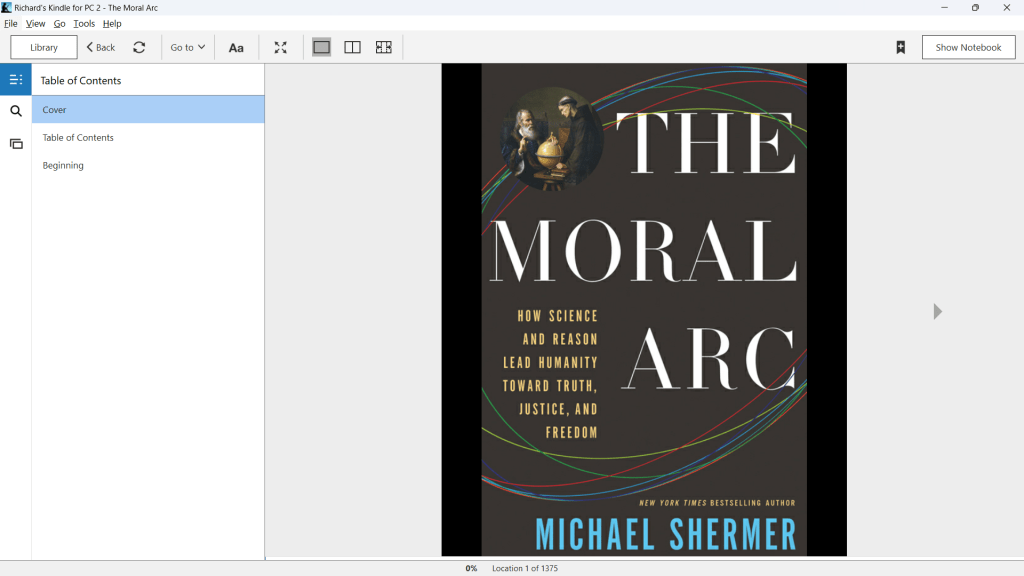
Here’s what I’m listening to: The Moral Arc, by Michael Shermer
Amazon abstract:
Bestselling author Michael Shermer’s exploration of science and morality that demonstrates how the scientific way of thinking has made people, and society as a whole, more moral
From Galileo and Newton to Thomas Hobbes and Martin Luther King, Jr., thinkers throughout history have consciously employed scientific techniques to better understand the non-physical world. The Age of Reason and the Enlightenment led theorists to apply scientific reasoning to the non-scientific disciplines of politics, economics, and moral philosophy. Instead of relying on the woodcuts of dissected bodies in old medical texts, physicians opened bodies themselves to see what was there; instead of divining truth through the authority of an ancient holy book or philosophical treatise, people began to explore the book of nature for themselves through travel and exploration; instead of the supernatural belief in the divine right of kings, people employed a natural belief in the right of democracy.
In The Moral Arc, Shermer will explain how abstract reasoning, rationality, empiricism, skepticism–scientific ways of thinking–have profoundly changed the way we perceive morality and, indeed, move us ever closer to a more just world.
“Everything depends on the individual human being, regardless of how small a number of like-minded people there is… on each person… creatively making the meaning of life a reality in his or her own being.”
BY MARIA POPOVA
“To decide whether life is worth living is to answer the fundamental question of philosophy,” Albert Camus wrote in his classic 119-page essay The Myth of Sisyphus in 1942. “Everything else… is child’s play; we must first of all answer the question.”
Sometimes, life asks this question not as a thought experiment but as a gauntlet hurled with the raw brutality of living.
That selfsame year, the young Viennese neurologist and psychiatrist Viktor Frankl (March 26, 1905–September 2, 1997) was taken to Auschwitz along with more than a million human beings robbed of the basic right to answer this question for themselves, instead deemed unworthy of living. Some survived by reading. Some through humor. Some by pure chance. Most did not. Frankl lost his mother, his father, and his brother to the mass murder in the concentration camps. His own life was spared by the tightly braided lifeline of chance, choice, and character.
Viktor Frankl
A mere eleven months after surviving the unsurvivable, Frankl took up the elemental question at the heart of Camus’s philosophical parable in a set of lectures, which he himself edited into a slim, potent book published in Germany in 1946, just as he was completing Man’s Search for Meaning.
As our collective memory always tends toward amnesia and erasure — especially of periods scarred by civilizational shame — these existential infusions of sanity and lucid buoyancy fell out of print and were soon forgotten. Eventually rediscovered — as is also the tendency of our collective memory when the present fails us and we must lean for succor on the life-tested wisdom of the past — they are now published in English for the first time as Yes to Life: In Spite of Everything (public library).
Frankl begins by considering the question of whether life is worth living through the central fact of human dignity. Noting how gravely the Holocaust disillusioned humanity with itself, he cautions against the defeatist “end-of-the-world” mindset with which many responded to this disillusionment, but cautions equally against the “blithe optimism” of previous, more naïve eras that had not yet faced this gruesome civilizational mirror reflecting what human beings are capable of doing to one another. Both dispositions, he argues, stem from nihilism. In consonance with his colleague and contemporary Erich Fromm’s insistence that we can only transcend the shared laziness of optimism and pessimism through rational faith in the human spirit, Frankl writes:
We cannot move toward any spiritual reconstruction with a sense of fatalism such as this.
Liminal Worlds by Maria Popova. (Available as a print.)
Today every impulse for action is generated by the knowledge that there is no form of progress on which we can trustingly rely. If today we cannot sit idly by, it is precisely because each and every one of us determines what and how far something “progresses.” In this, we are aware that inner progress is only actually possible for each individual, while mass progress at most consists of technical progress, which only impresses us because we live in a technical age.
Insisting that it takes a measure of moral strength not to succumb to nihilism, be it that of the pessimist or of the optimist, he exclaims:
Give me a sober activism anytime, rather than that rose-tinted fatalism!
How steadfast would a person’s belief in the meaningfulness of life have to be, so as not to be shattered by such skepticism. How unconditionally do we have to believe in the meaning and value of human existence, if this belief is able to take up and bear this skepticism and pessimism?
[…]
Through this nihilism, through the pessimism and skepticism, through the soberness of a “new objectivity” that is no longer that “new” but has grown old, we must strive toward a new humanity.
Sophie Scholl, upon whom chance did not smile as favorably as it did upon Frankl, affirmed this notion with her insistence that living with integrity and belief in human goodness is the wellspring of courage as she courageously faced her own untimely death in the hands of the Nazis. But while the Holocaust indisputably disenchanted humanity, Frankl argues, it also indisputably demonstrated “that what is human is still valid… that it is all a question of the individual human being.” Looking back on the brutality of the camps, he reflects:
What remained was the individual person, the human being — and nothing else. Everything had fallen away from him during those years: money, power, fame; nothing was certain for him anymore: not life, not health, not happiness; all had been called into question for him: vanity, ambition, relationships. Everything was reduced to bare existence. Burnt through with pain, everything that was not essential was melted down — the human being reduced to what he was in the last analysis: either a member of the masses, therefore no one real, so really no one — the anonymous one, a nameless thing (!), that “he” had now become, just a prisoner number; or else he melted right down to his essential self.
In a sentiment that bellows from the hallways of history into the great vaulted temple of timeless truth, he adds:
Everything depends on the individual human being, regardless of how small a number of like-minded people there is, and everything depends on each person, through action and not mere words, creatively making the meaning of life a reality in his or her own being.
Frankl then turns to the question of finding a sense of meaning when the world gives us ample reasons to view life as meaningless — the question of “continuing to live despite persistent world-weariness.” Writing in the post-war pre-dawn of the golden age of consumerism, which has built a global economy by continually robbing us of the sense of meaning and selling it back to us at the price of the product, Frankl first dismantles the notion that meaning is to be found in the pursuit and acquisition of various pleasures:
Let us imagine a man who has been sentenced to death and, a few hours before his execution, has been told he is free to decide on the menu for his last meal. The guard comes into his cell and asks him what he wants to eat, offers him all kinds of delicacies; but the man rejects all his suggestions. He thinks to himself that it is quite irrelevant whether he stuffs good food into the stomach of his organism or not, as in a few hours it will be a corpse. And even the feelings of pleasure that could still be felt in the organism’s cerebral ganglia seem pointless in view of the fact that in two hours they will be destroyed forever. But the whole of life stands in the face of death, and if this man had been right, then our whole lives would also be meaningless, were we only to strive for pleasure and nothing else — preferably the most pleasure and the highest degree of pleasure possible. Pleasure in itself cannot give our existence meaning; thus the lack of pleasure cannot take away meaning from life, which now seems obvious to us.
He quotes a short verse by the great Indian poet and philosopher Rabindranath Tagore — the first non-European to win the Nobel Prize, Einstein’s onetime conversation partner in contemplating science and spirituality, and a man who thought deeply about human nature:
I slept and dreamt that life was joy. I awoke and saw that life was duty. I worked — and behold, duty was joy.
In consonance with Camus’s view of happiness as a moral obligation — an outcome to be attained not through direct pursuit but as a byproduct of living with authenticity and integrity — Frankl reflects on Tagore’s poetic point:
So, life is somehow duty, a single, huge obligation. And there is certainly joy in life too, but it cannot be pursued, cannot be “willed into being” as joy; rather, it must arise spontaneously, and in fact, it does arise spontaneously, just as an outcome may arise: Happiness should not, must not, and can never be a goal, but only an outcome; the outcome of the fulfillment of that which in Tagore’s poem is called duty… All human striving for happiness, in this sense, is doomed to failure as luck can only fall into one’s lap but can never be hunted down.
At this point it would be helpful [to perform] a conceptual turn through 180 degrees, after which the question can no longer be “What can I expect from life?” but can now only be “What does life expect of me?” What task in life is waiting for me?
Now we also understand how, in the final analysis, the question of the meaning of life is not asked in the right way, if asked in the way it is generally asked: it is not we who are permitted to ask about the meaning of life — it is life that asks the questions, directs questions at us… We are the ones who must answer, must give answers to the constant, hourly question of life, to the essential “life questions.” Living itself means nothing other than being questioned; our whole act of being is nothing more than responding to — of being responsible toward — life. With this mental standpoint nothing can scare us anymore, no future, no apparent lack of a future. Because now the present is everything as it holds the eternally new question of life for us.
Frankl adds a caveat of tremendous importance — triply so in our present culture of self-appointed gurus, self-help demagogues, and endless podcast feeds of interviews with accomplished individuals attempting to distill a universal recipe for self-actualization:
The question life asks us, and in answering which we can realize the meaning of the present moment, does not only change from hour to hour but also changes from person to person: the question is entirely different in each moment for every individual.
We can, therefore, see how the question as to the meaning of life is posed too simply, unless it is posed with complete specificity, in the concreteness of the here and now. To ask about “the meaning of life” in this way seems just as naive to us as the question of a reporter interviewing a world chess champion and asking, “And now, Master, please tell me: which chess move do you think is the best?” Is there a move, a particular move, that could be good, or even the best, beyond a very specific, concrete game situation, a specific configuration of the pieces?
What emerges from Frankl’s inversion of the question is the sense that, just as learning to die is learning to meet the universe on its own terms, learning to live is learning to meet the universe on its own terms — terms that change daily, hourly, by the moment:
One way or another, there can only be one alternative at a time to give meaning to life, meaning to the moment — so at any time we only need to make one decision about how we must answer, but, each time, a very specific question is being asked of us by life. From all this follows that life always offers us a possibility for the fulfillment of meaning, therefore there is always the option that it has a meaning. One could also say that our human existence can be made meaningful “to the very last breath”; as long as we have breath, as long as we are still conscious, we are each responsible for answering life’s questions.
The fact, and only the fact, that we are mortal, that our lives are finite, that our time is restricted and our possibilities are limited, this fact is what makes it meaningful to do something, to exploit a possibility and make it become a reality, to fulfill it, to use our time and occupy it. Death gives us a compulsion to do so. Therefore, death forms the background against which our act of being becomes a responsibility.
[…]
Death is a meaningful part of life, just like human suffering. Both do not rob the existence of human beings of meaning but make it meaningful in the first place. Thus, it is precisely the uniqueness of our existence in the world, the irretrievability of our lifetime, the irrevocability of everything with which we fill it — or leave unfulfilled — that gives our existence significance. But it is not only the uniqueness of an individual life as a whole that gives it importance, it is also the uniqueness of every day, every hour, every moment that represents something that loads our existence with the weight of a terrible and yet so beautiful responsibility! Any hour whose demands we do not fulfill, or fulfill halfheartedly, this hour is forfeited, forfeited “for all eternity.” Conversely, what we achieve by seizing the moment is, once and for all, rescued into reality, into a reality in which it is only apparently “canceled out” by becoming the past. In truth, it has actually been preserved, in the sense of being kept safe. Having been is in this sense perhaps even the safest form of being. The “being,” the reality that we have rescued into the past in this way, can no longer be harmed by transitoriness.
In the remainder of the slender and splendid Yes to Life, Frankl goes on to explore how the imperfections of human nature add to, rather than subtract from, the meaningfulness of our lives and what it means for us to be responsible for our own existence. Complement it with Mary Shelley, writing two centuries ago about a pandemic-savaged world, on what makes life worth living, Walt Whitman contemplating this question after surviving a paralytic stroke, and a vitalizing cosmic antidote to the fear of death from astrophysicist and poet Rebecca Elson, then revisit Frankl on humor as lifeline to sanity and survival.
“Life is wasted when we make it more terrifying, precisely because it is so easy to do so.”
BY MARIA POPOVA
In a world pocked by cynicism and pummeled by devastating news, to find joy for oneself and spark it in others, to find hope for oneself and spark it in others, is nothing less than a countercultural act of courage and resistance. This is not a matter of denying reality — it is a matter of discovering a parallel reality where joy and hope are equally valid ways of being. To live there is to live enchanted with the underlying wonder of reality, beneath the frightful stories we tell ourselves and are told about it.
Having lost his mother to suicide, having lived through two World Wars, the Belgian surrealist artist René Magritte (November 21, 1898–August 15, 1967) devoted his life and his art to creating such a parallel world of enchantment.
The Lovers II by René Magritte, 1928
In a 1947 interview included in his Selected Writings (public library) — the first release of Magritte’s manifestos, interviews, and other prose in English, thanks to the heroic efforts of scholar Kathleen Rooney — he reflects:
Experience of conflict and a load of suffering has taught me that what matters above all is to celebrate joy for the eyes and the mind. It is much easier to terrorize than to charm… I live in a very unpleasant world because of its routine ugliness. That’s why my painting is a battle, or rather a counter-offensive.
Magritte revisits the subject in his manifesto Surrealism in the Sunshine, indicting the cultural tyranny of pessimism and fear-mongering — a worldview we have been sold under the toxic premise that if we focus on the worst of reality, we are seeing it more clearly and would be prepared to protect ourselves from its devastations. A quarter century before the great humanistic philosopher and psychologist Erich Fromm insisted that “pessimism [is] an alienated form of despair,” Magritte writes:
We think that if life is seen in a tragic light it is seen more clearly, and that we are then in touch with the mystery of existence. We even believe that we can reach objectivity thanks to this revelation. The greater the terror, the greater the objectivity.
This notion is the result of philosophies (materialist or idealist), that claim that the real world is knowable, that matter is of the same essence as mind, since the perfect mind would no longer be distinct from the matter it explains and would thus deny it. The man on the street is unknowingly in harmony with this idea: he thinks there is a mystery, he thinks he must live and suffer and that the very meaning of life is that it is a dream-nightmare.
Our mental universe (which contains all we know, feel or are afraid of in the real world we live in) may be enchanting, happy, tragic, comic, etc.
We are capable of transforming it and giving it a charm which makes life more valuable. More valuable since life becomes more joyful, thanks to the extraordinary effort needed to create this charm.
Life is wasted when we make it more terrifying, precisely because it is so easy to do so. It is an easy task, because people who are intellectually lazy are convinced that this miserable terror is “the truth”, that this terror is knowledge of the “extra-mental” world. This is an easy way out, resulting in a banal explanation of the world as terrifying.
Creating enchantment is an effective means of counteracting this depressing, banal habit.
Biking is something else I both love and hate. It takes a lot of effort but does provide good exercise and most days over an hour to listen to a good book or podcast. I especially like having ridden.
Here’s my bike, a Rockhopper by Specialized. I purchased it November 2021 from Venture Out in Guntersville; Mike is top notch! So is the bike, and the ‘old’ man seat I salvaged from an old Walmart bike.
Here’s what I’m listening to: The Moral Arc, by Michael Shermer
Amazon abstract:
Bestselling author Michael Shermer’s exploration of science and morality that demonstrates how the scientific way of thinking has made people, and society as a whole, more moral
From Galileo and Newton to Thomas Hobbes and Martin Luther King, Jr., thinkers throughout history have consciously employed scientific techniques to better understand the non-physical world. The Age of Reason and the Enlightenment led theorists to apply scientific reasoning to the non-scientific disciplines of politics, economics, and moral philosophy. Instead of relying on the woodcuts of dissected bodies in old medical texts, physicians opened bodies themselves to see what was there; instead of divining truth through the authority of an ancient holy book or philosophical treatise, people began to explore the book of nature for themselves through travel and exploration; instead of the supernatural belief in the divine right of kings, people employed a natural belief in the right of democracy.
In The Moral Arc, Shermer will explain how abstract reasoning, rationality, empiricism, skepticism–scientific ways of thinking–have profoundly changed the way we perceive morality and, indeed, move us ever closer to a more just world.



 by
by 



























 by
by 
 by
by 



 Richard L. Fricks