The Boaz Stranger–Chapter 31

After breakfast, Lillian took a shower, and I called Sophia who was elated to hear from me. She vowed she’d turned the heat down last Tuesday after cleaning the house. It took at least five minutes for her to conclude she understood exactly where Rachel’s diaries were located, how many there were, and the exact mailing service I wanted her to use. I could tell she was a little frustrated with her English skills, but mostly her concerns were overdoing exactly what I wanted. She agreed she’d do this just as soon as school was out. Her elation returned when I promised to add an extra hundred dollars (plus shipping cost) to this week’s pay.

In the same two seconds, I said goodbye and received a call from “Unknown.” If it had been an 800 number, I wouldn’t have answered. Sometimes I wasn’t logical. “Hello.”

“Mr. Harding?”

“Yes.”

“This is Avery Proctor. We met yesterday.”

“I remember.” It was DA Garrison’s chief investigator. “What can I do for you?”

“The DA wanted me to call and ask a favor.”

“Okay. I’ll try.”

“Do you think you could take a photo of Ray Archer’s tag? The stills you brought don’t fully disclose the tag number. He parked the Vet at a weird angle.”

“You’re referring to the red corvette?” I could hear others talking in the background.

“That’s right. Pam is an absolute stickler for details. But she wanted to stress you shouldn’t take any risk.” My first thought was to decline. I assumed Ray parked his Corvette at the Lodge, inside the garage. I quickly concluded, based on all that Ray now knew, it could be dangerous going to his home. “If she wasn’t so crunched for time, she wouldn’t ask, but our entire team has a conflict: me, Mark at the Sheriff’s office, your investigator, even Joe and his assistant.”

“Well, I can try. Maybe I’ll get lucky. By the way, what’s my deadline?”

“I’m sure Pam prefers you not to look at it that way, like it’s imperative. However, her plan is for ADA Vincent to be at the Magistrate’s office ready to apply for warrants no later than 3:00 PM today. Again, don’t put yourself in a confrontation position.”

Investigator Proctor said it would be okay to send him a digital copy and not to worry about having the photos developed. He gave me his email address and again strongly advised me to, “think before you shoot.” Neither the joke nor laughter created an apple pie and football image.

He ended the call just as Lillian descended the stairs dressed in tight jeans and a baggy, crimson-colored sweatshirt. I shared DA Garrison’s requested favor and received a puzzled look, scrunched forehead, and squinted eyes.

Lillian’s response surprised me. “Good news. We can go to the Lodge after we leave Ray’s office.” She removed a scrunchie from her jeans and returned to the kitchen table. There was something mesmerizing about watching her pull back her silky brown hair.

“Maybe the corvette will be at his office.”

“No way. It’ll be at the Lodge. He always drives the Suburban to work.” Lillian scanned her iPhone for a long minute. “He’s at the office or will be shortly.”

“How do you know?”

“Facebook. Anna. Ray’s secretary. She’s like a fountain, always spewing subtle clues. Today’s post, ‘Workday,’ along with a GIF of a man operating a jackhammer, means she’ll be busy and not play Solitaire or surf the web like she loves to do.”

“Whatever. Grab your camera while I take a quick shower. Let’s get this done.” Maybe I was taking this too seriously. Lillian had half-a-century with the son-of-a-bitch.

“I see you’re worried, so I’ll verify.” Lillian shushed me toward my bedroom and finger-tapped her iPhone. Halfway down the hall, I heard her tell somebody she was coming by and to make sure her check was ready. I showered and changed without finding an answer to my nagging question: how would Ray respond to me spending so much time with his wife? I couldn’t wait until his arrest.

***

Lillian insisted we take the Aviator. There were several boxes of books she’d left in Ray’s garage. She insisted I drive. “You drop me off in front of Ray’s office and circle the block. I’ll be outside before you complete one loop.” I’d seen his building when Kent and I tried to visit Jackie Fraiser on Thanksgiving.

Turning onto Mcville Road, I remembered the corner building had been a church when I was growing up. The post office was next door. The Sand Mountain Bank was beside it. “I’m such a lucky woman.” Lillian said, as I crawled through the stop sign at Beulah Road.

“Uh?”

“Few wives get paid when their husband screws another woman.” I didn’t know how to respond to the shocking statement. I glanced toward the Jane Seymour look-alike but didn’t tarry. “Micaden Tanner’s idea.”

I stared at the road and sped up, barely secreting an “uh-mm.” Lillian would fill in the blanks if she wanted to.

“He’s brilliant. We’re fortunate to have him on our team.” I couldn’t disagree with that assessment.

“I agree, Micaden is impressive.”

“If you didn’t know, Ray’s always been a philanderer. My opportunity came when he was on the verge of selling the pharmacy chain. He was in the spotlight, and I was ready to get out, at least to cause him some pain. Micaden suggested I demand a redo of our prenup. Long story short, Ray loved his reputation more than his money. He promised, in writing mind you, to pay me $50,000 every time he had an affair. That’s when I hired Connor Ford to keep tabs on my pussy-loving husband.”

“You paint a vivid picture.” And I thought I’d met some interesting characters in the thousands of cases I’d read over the years. Lillian was head of the line.

“Today’s check is $150,000. It should be 200K, but I gave him a twenty-five percent discount.” I cut my eyes her way and nodded. We rode the remaining few miles in welcomed silence.

Ray’s dark blue Suburban was on the street in front of his office. I stopped without pulling into a parking spot. “I’ll drive at normal speed. Be careful.” I still didn’t like the idea of Lillian confronting Ray, especially over money. Hopefully, it won’t be that big of a deal.

In less than three minutes, I returned. Lillian was waiting behind the Suburban. She hopped in, holding a number ten envelope in her hand. It was already open. “When Ray’s arrested, I’ll treat you to a steak, but we best go out of town.”

 I smiled. Sort of. “Any trouble?”

“No Ray in sight. Anna handed me the envelope and volunteered her boss was with Mayor King at City Hall.”

“Good. Ray may be near seventy but he’s still a powerful man.” I crossed Highway 168, remembering how he’d stabbed my forehead at the Hunt House with his long-pointed finger. I imagined he would have beaten me to a pulp if it hadn’t been for Ted King.

***

I’d never been to Skyhaven Drive. The mountainside subdivision was three miles south of Boaz. Charles Cooley, a high school classmate’s father, developed it in the early seventies. The Lodge set at the peak and provided an enviable view of Pleasant Valley below.

I took the right fork of the concrete driveway that led to a three-car attached garage along the north side of the rock and cypress house. All three doors were closed. There was another garage, this one detached, a hundred feet to the west and down a gently sloping yard.

“The corvette will be there.” Lillian said, cocking her thumb to her right toward the detached garage, with its two doors similarly closed. “Come on.”

I exited the Aviator and followed her across the yard. “Are they locked?” I said as she walked around the side of the building and disappeared.

I heard her say, “Wait.”

In less than a minute, I heard metal clanking and saw the right-side door opening. The corvette’s rear tag appeared. Lillian started snapping photos with her iPhone, including several random ones around the inside of the garage. She must have noticed my puzzled look. “No need for my fancy Nikon.”

“That’ll make it easier to email the photos to the DA.”

She lowered the door and disappeared again. When she walked around the corner, she motioned me to follow her up the hill to a sidewalk that led to the rear deck of the house. “I want my books.”

“I thought you said they were in the garage.” Lillian ignored me and started punching buttons on the security pad next to the back door.

“They are, but those three doors are locked. Plus, we need to grab my recorders.”

“Whoa, whoa. This isn’t a good idea. What if Ray shows up and we’re inside the house?” It was a dumb question. One I already knew the answer.

“It won’t take but a minute, now come on.” For some stupid reason, I ignored my best judgment, any judgment, and followed Lillian. She opened a set of bottom cabinet doors in the middle of the kitchen island before I could walk fully inside. She first knelt and felt around the underside of a stainless-steel sink, then transitioned into lying flat on her back and inching her head inside the cabinet. “Here it is. Whew, I thought he’d found it.”

“Hurry. Where’s the other one?” I knew Lillian said she’d hidden two devices. She held up her right hand for my help in standing. With her left, she tossed me the cell-phone sized device.

“It’s in the master.” The teenager acting woman was around the island, across a giant great room, and circling a spiral staircase when I heard a deep baritone horn.

“Shit.” I again followed Lillian and the direction of the outside blare. I peeped through the blinds next to the front door.

“It’s just the UPS guy.” I kept following my ears down an L-shaped hallway into an over-sized bedroom. Lillian was atop the bed on her knees, reaching behind a row of leather-wrapped biographies.

“Risky place to leave a bug.”

“Not really. Ray’s not a reader. These are all for show, whose I’m not sure.” I could see inside two connecting rooms. One was the master bathroom. The other looked like an office or study, given the large wooden desk and chair.

Lillian clutched the recorder and rolled to the other side of the king-size bed. “We need to do one more thing. Come on.” Oh my god, wonder woman trolling for trouble.

This time, I eased to a window and its opened wood blinds. All I could see was a circular drive and a forest of trees beyond. When I found Lillian, she was sitting at Ray’s desk prowling through the bottom right-hand drawer. “What are you doing? Let’s get your books and go.”

I scanned the room while Lillian ignored me. There were no windows, but two mounted deer heads cast a dark light from the wood-paneled walls. Although the photons weren’t real, my thoughts were. It takes a dark individual to kill other sentient beings and showcase them, even inside a private room.

“Okay, got it.” She slammed the drawer and grabbed my hand as she jogged past. “Come on. I thought you were in a hurry.” I obeyed.

We exited the master, made a U-turn around the spiraling staircase and jogged down another hallway lined with photographs, paintings, and plaques of the only person I hated. “Ego walls,” I noted.

The moment we entered the laundry room, we both froze at the sound of an automatic garage door. “Oh shit, it’s Ray.”

Lillian’s transformation was instant. She turned to me with a gapping mouth and hollow eyes, her face ghostlike. Shocked was the best description. “Okay, here’s the plan.” My quick decision reminded me of long-gone days in court: objections or follow-up questions rooted in seconds, not minutes. “I’ll go out the back door while you distract Ray.” I eased backwards and scanned the ego wall for the framed newspaper article, including a photograph of Ray and Lillian. “Here, tell him you’re sorry for not asking, but you wanted this picture.” I nodded affirmatively while retreating to the kitchen. “You can do this. Go now, I’ll be hiding in the Aviator.”

Lillian finally gave me a weak thumbs up and opened the door to the garage. I turned and hustled to the kitchen and outside to the rear deck, descending the steps two at a time. My ears were on alert as I raced the sidewalk to the north end of the house. Maybe I expected screaming or gunshots, but there were neither. Exhausted, I eased into a row of shrubbery at the corner. In this position, I could hear Ray’s loudmouth from inside the open garage but couldn’t understand his words. I turned the corner and hugged the wall towards Ray’s Suburban parked halfway inside the garage’s nearest stall.

“And what the fuck were you and that dumb ass Lee Harding doing at Ted’s cabin Friday night?” I peeked around the wall and saw Lillian standing at the bottom of the utility room stairs, holding the framed picture. There weren’t two feet separating her and Ray. He loved to intimidate. No doubt he was angry. Both hands were by his side, rapidly opening and closing like he was preparing to fight.

Wonder woman lost her cool. “I’ll answer if you tell me why the fuck you burned down the Hunt House.” Oh my gosh Lillian. What are you doing? I thought about sprinting around Ray’s Suburban and on to the Aviator. I leaned back against the outside wall, shook my head sideways, and stared into the beaming sun.

“Don’t you fucking accuse me of anything.” Fuck was a popular word. Then, I heard glass breaking. I peeked again. Ray had grabbed the framed article and slammed it against the stairs. He hurled the twisted remains against the rear wall and rammed his right index finger into Lillian’s forehead. Much harder than he had me outside the Hunt House. She fell backwards and awkwardly slid down the steps onto the garage floor.

I didn’t hesitate half a second. I ran as fast as I could toward Ray. He heard me coming and turned just as I did my own ramming. It was like hitting a stone wall, but my momentum caught him off guard just before he could brace. The two of us tumbled ten feet and crumbled to the floor before impacting the wall. My shoulder cried out in pain, reminding me it was nowhere near healed. Ray was fast to be so big. He was on his feet in no time. His right foot centered on my upper stomach while I used all fours to stand. If it hadn’t been for Lillian, the beast would have killed me.

Later, she told me the moment she saw me running towards Ray, she’d seen a set of golf clubs leaning against the wall beside the steps. She’d grabbed a six iron and shellacked Ray’s neck before he could kick me twice. She’d used her best baseball style swing.

We waited ten minutes to determine whether Ray would live or die. He lived but moaned and groaned a lot as he labored to reach a sitting position against the wall. “Don’t you ever lay a hand on Lillian, or I’ll blow your fucking head off.” My anger, boldness, and growing stupidity prompted Lillian to demand our withdrawal and exit.

During the drive to Kyla’s, I kept verbally kicking myself for allowing this to happen. I knew there could be multiple consequences, one being mine and Lillian’s arrest, another being Ray’s next murder.

“Thank you for coming to my rescue. I’ll never forget.” Lillian said as we turned right at Walgreen’s.

08/17/23 Biking & Listening

Biking is something else I both love and hate. It takes a lot of effort but does provide good exercise and most days over an hour to listen to a good book or podcast. I especially like having ridden.

Here’s my bike, a Rockhopper by Specialized. I purchased it November 2021 from Venture Out in Guntersville; Mike is top notch! So is the bike, and the ‘old’ man seat I salvaged from an old Walmart bike.

Here’s a link to today’s bike ride.


Something to consider if you’re not already cycling.

I encourage you to start riding a bike, no matter your age. Check out these groups:

Cycling for those aged 70+(opens in a new tab)

Solitary Cycling(opens in a new tab)

Remember,

Photo by Suzy Hazelwood on Pexels.com

Listened to


Here’s a few photos from along my pistol route:

Do you ever think about the Boomers?

Here’s the link to this article. A must read. Be sure and watch each video clip.

STEVE SCHMIDT

SSBN Fleet Ballistic Missile Submarine

Do you ever think about the Boomers? I don’t very often, but I suspect I do more than most — which is barely at all.  I wonder why the overwhelming majority of Americans never think about them and their potential. It’s almost as if they don’t exist at all. But of course they do.

Boomers, of course, are the nickname for America’s fleet of nuclear-powered ballistic missile submarines, which are the most powerful weapons of war in the history of human civilization. Here are their names:

USS Henry M. Jackson (SSBN 730), Bangor, WA

USS Alabama (SSBN 731), Bangor, WA

USS Alaska (SSBN 732), Kings Bay, GA

USS Nevada (SSBN 733), Bangor, WA

USS Tennessee (SSBN 734), Kings Bay, GA

USS Pennsylvania (SSBN 735), Bangor, WA

USS West Virginia (SSBN 736), Portsmouth, VA

USS Kentucky (SSBN 737), Bangor, WA

USS Maryland (SSBN 738), Kings Bay, GA

USS Nebraska (SSBN 739), Bangor, WA

USS Rhode Island (SSBN 740), Kings Bay, GA

USS Maine (SSBN 741), Bangor, WA

USS Wyoming (SSBN 742), Kings Bay, GA

USS Louisiana (SSBN 743), Bangor, WA

Aboard them are men and women from all 50 US states and territories. They are US Navy sailors, and are in the business of deterrence, which means they will be the first to know if Armageddon is at hand. After that, they will be the first to wonder what happens next.
The Warning with Steve Schmidt is a reader-supported publication. To receive new posts and support my work, consider becoming a free or paid subscriber.

Upgrade to paid

Let’s watch Commanding Officer John Gage of the USS Pennsylvania contemplate the end of human civilization and what it would be like aboard the ship that fired the missiles after the fact. Before watching though, are you at all interested in the personality type of the man who is wearing the silver oak leaves on his collar? What makes him tick? What is unique about his character, judgement and intellect that would interest the US Navy in turning over the keys to the most potent weapon that ever existed and the lives of those under his command?

Let’s watch:

Here is a remarkable scene from the fire control room aboard the ship. Notice the ages of the crew and the diversity. For those unfamiliar with naval rank, the Black man with two silver bars on his collar is in charge. He is a lieutenant. Look at the bridge of the ship and the faces. Right now, at this exact second, there is a crew of Americans in a ballistic missile submarine lurking, hidden, in each of the world’s oceans. They are training, preparing and readying. They are preparing to execute an order they simultaneously pray they will never receive. Let’s watch the captain explain the process by which he would launch nuclear weapons from his ship via ballistic missiles:

The commander in chief is the president of the United States. The crew will follow his orders and they will fire the missiles. The American people choose the person who can give that order. Why don’t we ever talk about that? Why aren’t politicians ever asked about it? It is real.

Let’s watch Martha Raddatz of ABC News talk to some of the women crew aboard the USS Maine. Listen to her describe the deadliest weapon in the world:

When you see the young Lieutenant Jg Erin Chandler handle the nuclear launch key what do you see?

What is it that a citizen owes her and her shipmates? How should we think about the young people who will hand the keys to the captain, who will launch the missiles that will annihilate civilization? Don’t we owe them wisdom and circumspection in our voting choice? Don’t we owe ourselves, our children and their descendants someone more stable, secure and trustworthy than Donald Trump?

Here is another question raised by the broad indifference Americans seem to have towards the country in which our descendants will live. When do we stop caring at all about what happens, and when? Is it after our grandkids? We don’t care what happens to their kids and their grandkids? Is it too far forward after that? Never let it be said that selfishness doesn’t kill in America.

Marjorie Taylor Greene thinks she might be vice president in the next Trump administration. She told The Atlanta Constitution-Journal about her ambitions, saying the following about potentially running for the Senate:

I haven’t made up my mind whether I will do that or not. I have a lot of things to think about. Am I going to be a part of President Trump’s Cabinet if he wins? Is it possible that I’ll be VP?

Now watch the captain talk about how the hidden submarine communicates with the commander in chief, receives its orders and prepares to fire. Lest there be any doubt around whether the order to fire would be disobeyed the captain will put your mind to rest. The missiles will be fired:

Donald Trump controls the Republican Party at an institutional level. Fully. He is unambiguously the boss. He is an accused felon facing nearly 100 criminal charges that include being at the center of the greatest criminal conspiracy in American history. He is running on a platform of retribution, revenge, threat and division. His intimations toward violence and chaos will inspire the results he hopes for.

We should all think about Boomers and the awesome responsibility of their crews and officers. We should think about their commander in chief. We live in an age of disgrace and unfitness that is both epic and conquerable. Moving past it requires zero tolerance for the extremism and cult of personality that has broken faith with American values in the name of Donald Trump. They have betrayed an idea for a person, and the surrender of a political party’s elected members to the whims of a despot has been as pathetic as it had been despicable. Whatever cowardice it represents, it will be viewed as unpardonable by history. The harsh judgement ahead will scorn the cowardice that allowed a fascist movement to plant, root and thrive on American soil in the first quarter of the twenty-first century.

America’s politics is covered as a game by much of the American media, which brings the same slimy touch to the endeavor of politics that wife beater and Trump fanboy Dana White brings to the UFC. It’s not a game. It’s life and death. This era must end. It is dangerous beyond any measure.

We should all think about our Boomers. We should think about the young men and women aboard them. They will survive the first wave. It is said that when the missiles launch, the survivors will envy the dead. In the end, there is only one American who is ever given the power and discretion to launch the weapons of extinction. That person is the president of the United States of America. What type of sick society would ever invest that power again in a man like Donald Trump.? What type of broken media would pretend the powers of the office don’t exist? What type of people are we?

In the end, we will know. America gets the chance to vote on its own euthanasia.

Did Jesus of Nazareth Rise from the Dead?

Here’s the link to this article.

Robert Shaw | July 30, 2022 | Kiosk Article

Bible: New Testament | Christianity | History of Religion | Jesus | Resurrection ]


The majority of biblical scholars, and those with an interest in the origins of Christianity, see the crucifixion of Jesus of Nazareth as a historical reality. While it is important to recognize a vociferous and often well-informed ‘Jesus mythicism’ movement whose members hold that none of the events in Jesus’ life actually happened, the Crucifixion passes a number of tests used by historians. First, references to it appear in independent sources, and while one must be very cautious indeed when considering the hugely hagiographic Gospels, renowned chroniclers such as Tacitus[1] and Josephus[2] refer to it. The Crucifixion is also historically consistent with practices within the Roman Empire; those who were deemed to be a threat to Roman order were summarily nailed to a cross and left to die. Most convincingly, Jesus’ execution passes the so-called ‘criterion of embarrassment.’ This suggests that statements are more likely to be true if they are embarrassing to those making them and are unlike what they would be expected to invent. For the early Christians to have invented the detail of the Crucifixion seems implausible. Jesus was meant to have led Israel into a new golden age, not to be ignominiously killed by its enemy, the Romans. The Crucifixion also requires no supernatural beliefs and so does not demand that we suspend our belief that the laws of biology apply at all times.

The Resurrection is a different matter. Ultimately, organisms cannot come back to life if all biological functions have ceased for a few days. For this reason, the necessary position for humanists to take is that the events following the Crucifixion did not happen as the Bible portrays: that a human verified to be dead by a Roman centurion (Mark 15:44), wrapped in cloth, and placed in a tomb with a rock rolled in front of its entrance (Mark 15:46) was able, two days later, to revive, roll the stone away, and leave (Mark 16:4-6). It helps us, however, to have a hypothesis for the events following the Crucifixion, particularly as many of the early followers of Jesus seem to have genuinely believed and testified to the fact that he had risen from the dead.

In fact, they did not kill him, nor did they crucify him, but it appeared to them as if they did. (Qur’an 4:157)

Interestingly, one of the first attempts at supplying a naturalistic explanation for the Resurrection comes from the early days of Islam. Muslims to this day have believed that Jesus was a mere prophet, unblessed with divine powers. The most common interpretation of the above verse from the Qur’an is that someone resembling Jesus was crucified, thus providing us with an explanation as to why he was seen following the Crucifixion; it was not him on the cross, but either a willing volunteer, a stooge, or a victim of Roman mistaken identity. Another hypothesis based around the idea that Jesus did not die on the cross—the ‘swoon hypothesis’—had its first famous exponent in the form of maverick German biblical scholar Karl Friedrich Bahrdt. In the 1700s he proposed that it was actually Jesus who was crucified, but that a combination of drugs and resuscitation by Joseph of Arimathea (a follower to whom the body was subsequently entrusted) enabled him to cheat death.[3]

There is evidently a state of being when someone can appear to be dead, when the heartbeat is undetectable, though he/she is still technically alive. In the modern era, methods of determining death are of course more exact, but even as late as 1895, the physician J. C. Ouseley claimed that as many as 2,700 people were buried prematurely each year in England and Wales for this reason alone.[4] Many give the fact that the Gospels say that Jesus was only on the cross for six hours as evidence for this hypothesis—it would generally take people a couple of days before they finally expired. However, there are alternative explanations as to why Jesus was reported to have been on the cross for a short space of time. One is that the flogging that he had received prior to being crucified hastened his death (John 19:1Mark 15:15, & Matthew 27:26). It could also be suggested that he was merely reported to have been on the cross for a short time to make events compliant with Jewish law. Not only would leaving him overnight have meant that anointing would have to take place on the Sabbath—which would have involved work in contravention of the Ten Commandments (Exodus 20:8)—but there was also a law in the Torah that a body should not be “left on a tree overnight” (Deuteronomy 21:22).

However, the swoon hypothesis fails, as it takes as given the historically inconsistent assertion that Pontius Pilate, the Roman governor who presided over the province of Judaea from 27 to 37 CE (and over the Crucifixion), would allow a body to be taken down from a cross and given a burial. First, one of the purposes of crucifixion was to act as a deterrent to anybody who even harbored thoughts that they might challenge the power of Rome. To this end, crucified corpses would be left on crosses for days for all to see, with birds of prey feasting on the remains. Victims were then typically ‘buried’ in a crude common grave. Second, for Pilate to allow someone to be taken down prematurely is at odds with what we can learn about his character from the sources available to us. The Gospels paint the picture of Pilate as an amenable and weak figure. However, their writers wanted to make Jesus’ Jewish opponents guilty for the sentencing of Jesus, so it was necessary to depict Pilate as being so easily swayed by them.

Two other sources may give us a more accurate description of Pilate. Philo of Alexandria, a Jew who chronicled 1st-century Jewish life in the Levant, describes Pilate as “a man of inflexible, stubborn and cruel disposition” and recalls an incident that may have occurred in the very same year as the Crucifixion itself. Pilate had commissioned some golden shields to be made honoring the then-emperor Tiberius, which he displayed at his palace in Jerusalem. Local Jews protested at the tribute to a figure regarded as a deity, or at least a ‘son of god,’ by Romans, and requested their removal. Pilate flatly refused. He refused again when members of King Herod’s family intervened, only eventually agreeing to move them out of Jerusalem when the Emperor himself intervened after being petitioned by the Herodians.[5] The Jewish historian Josephus tells of Pilate using treasure looted from the Jewish temple in Jerusalem to pay for an aqueduct. Pilate had those taking part in the subsequent protest beaten with clubs, with many dying from the brutality of the punishment or through being trampled by horses.[6] Both events suggest that Pilate was a much more intransigent figure, unsympathetic or even ignorant of Jewish sensitivities. The suggestion that he would show compassion towards a Jewish sect’s wishes towards a leader that he had put to death for sedition seems implausible.

That said, the Resurrection was not completely an invention of the Gospel writers, writing as they did at least thirty years after the events that they claim to recount. The Resurrection was not a late addition to the legends about Jesus. Instead, it was a tradition that can be traced back to the very roots of Christianity. Our very first Christians scriptures were written in the 50s CE by Paul, who, although he had never met Jesus in his lifetime, became a key player in the early development of Christianity. Paul mentioned the Resurrection of Jesus throughout his writings, and it is clear that in his letters to churches based around the Mediterranean that it was a firmly established belief. However, there are a number of other aspects of later Christian beliefs that he did not seem to know about, such as the Virgin Birth and the Ascension (Jesus’ bodily return to Heaven after the Resurrection). Paul also made no mention of any of Jesus’ miracles, and the only quote in any of his writings is where Jesus asked his followers to partake in the breaking of bread and drinking of wine in remembrance of him (1 Corinthians 11:24-25).

Similarly, there was no mention of what many of us recognize as the key elements of the Christian account of the resurrection of Jesus in Paul’s writings. There was no mention of the taking down of the body from the cross, the tomb, the stone, the visit two days later by followers, the stone being rolled away, or the earthquakes and the presence of angelic beings (Matthew 28:2). There was no talk of the discourse and meetings that Jesus is said to have subsequently had with his disciples (Matthew 28Luke 24John 20 & John 21), or any reference to the Ascension.

[H]e appeared to Cephas [St. Peter], then to the twelve [disciples]. Then he appeared to more than five hundred brothers and sisters at one time, most of whom are still alive, though some have died. Then he appeared to James, then to all the apostles. Last of all, as to one untimely born, he appeared also to me. (1 Corinthians 15:5-8)

Paul does not mention these traditions because ultimately they did not yet exist. The renowned New Testament professor and theologian Rudolf Bultmann remarked: “the accounts of an empty tomb are legends, of which Paul as yet knew nothing.”[7] Another important point to consider is that Paul’s quote above does not reveal any distinction between the Resurrection experiences of the disciples—men who spent their time with Jesus during his earthly life—and those of his own; his encounter with the risen Jesus is not distinct from that of the disciples. And to Paul, the body that Jesus was resurrected in was “not natural,” but “spiritual” (see 1 Corinthians 15:44), and one with which he did not record any interactions, by either himself or anybody else. One can almost envisage the viewings of Jesus as akin to a ghostly apparition; this was perhaps the only way that he could be seen by followers who were cognizant of the fact that Jesus could not be resurrected in his earthly body—it would have simply been too badly damaged after days (not hours) on the cross.

In the Gospels, written at least thirty years after the event, Jesus becomes essentially a reanimated human body after the Resurrection, able to talk with disciples and eat fish—so possessive of a material digestive system and vocal tract—and with a body whose crucifixion wounds could be touched by Thomas (John 20:27). The writers of the later book of Acts, said to have been written by the same author who wrote Luke’s gospel, had to deal with the fact that Paul could not have experienced this type of risen Jesus; Paul was not part of the inner circle of the Jesus movement until some years after the Crucifixion, and was certainly not around within the forty-day window that the Book of Acts says was afforded to other followers before the Ascension (Acts 1:3). Paul is therefore depicted as seeing Jesus as a light in the sky while he is traveling on the road to Damascus some years later (Acts 9:3-9).

One of the methods used by historians to determine historical truth is to show a preference to those sources that originate closest to the time of the events that they report. As Torsten Thurén states in his highly regarded 1997 book Source Criticism, “the closer a source is to the event that it purports to describe, the more one can trust it to give an accurate historical description of what actually happened.”[8] Therefore, if we are to find any kernel of truth in the Resurrection narratives in the Bible, it must be in Paul’s initial nebulous, vision-type experiences that he suggests are experienced both by Jesus’ closest contemporary followers and by himself, a later convert. The later Gospel accounts (that disagree with each other in a number of ways) can be dismissed as fanciful invention.

In his book How Jesus Became God[9], Bart Ehrman gives three criteria that make such visions of the deceased much more common. All of them are met in the case of the death of Jesus of Nazareth. They happen when “the deceased was especially beloved; when his or her death was sudden, unexpected, or violent; and when the visionary feels guilt.” With regards to the latter, the criterion of embarrassment might suggest that there might be some truth in the Bible accounts of disciples deserting Jesus in the hours approaching the Crucifixion (see Mark 14:50 & Matthew 26:56)—an act about which Jesus’ followers may have experienced considerable guilt, thus exacerbating their visionary experiences further. Such postdeath encounters with the dead are very, very real to those undergoing them. They explain why Jesus’ early followers insisted so fervently on the resurrection of Jesus as an event grounded in reality, helping to make it such a widely held belief almost two thousand years later.

Notes

[1] Tacitus, The Annals, trans. F. Goodyear, T. Woodman, and R. Martin (Cambridge, UK: Cambridge University Press, 1972). (Originally written 2nd century CE.)

[2] Josephus, Jewish Antiquities (Cambridge, MA: Harvard University Press, 1998). (Originally written 93-94 CE.)

[3] More details about the swoon hypothesis can be found on Wikipedia.

[4] Jan Bondeson, Buried Alive: The Terrifying History of our Most Primal Fear (New York, NY: Norton, 2001).

[5] Philo, The Complete Works of Philo, trans C. D. Yonge (Peabody, MA: Hendrickson, 1991). (Originally written 1st century CE.)

[6] Josephus, Jewish Antiquities.

[7] Rudolf Bultmann, Theologie des Neuen Testaments (Tübingen, Germany: Mohr/Siebeck, 1984).

[8] Torsten Thurén, Källkritik (Stockholm, Sweden: Almqvist & Wiksell, 1997).

[9] Bart Ehrman, How Jesus Became God (New York, NY: Harper Collins, 2014).

The Boaz Stranger–Chapter 30

Goats drink a lot of water, even in colder weather, I thought as I waited for their trough to fill. Hopefully, this will be my third and last day to care for the five Nubians.

Kyla had left Friday afternoon and traveled to Atlanta to pick up a former co-worker before they headed to the Smoky Mountains. She promised to return by late afternoon.

The goats hadn’t been the only ones I’d babysat. Lillian had dropped by at sunset Saturday and insisted she stay. I could hardly decline after hearing her latest recording. She was correct in concluding our lives were in danger, but I disagreed that she was the only one responsible for getting us into this mess. In fact, the initial idea of staking out Ted King’s cabin had been my own. I felt both guilt and an impending sense of foreboding.

I turned off the faucet and heard my new roommate yell something from the front porch. I looked her way. She was standing with a cup of coffee and her back to the open storm door. She wore a thin pink housecoat and the same toboggan from Friday night. Our short co-habitation felt odd, maybe even wrong, for several reasons. I almost regretted the respect she’d shown for my Friday night hesitancy. But respect and thoughtful restraint are two different things. Although there had been no actual kissing, holding, or lovemaking, an intersecting theme flooded my mind that pointed in the same direction.

“What?” She’d said something about a phone call. I was halfway to the front porch when she repeated her earlier statement. “The DA lady wants to talk to you.” Dang, she’s early. It was barely daylight.

I walked to the carport, kicked off Dad’s muddy work boots, slipped on my house shoes, and headed inside.

Governor Williams had recently appointed Marshall County District Attorney Pam Garrison to fill the spot vacated by the death of former DA Charles Abbott. A good thing, according to Micaden, was Pam had only recently returned to her hometown of Albertville after a forty-year career in Atlanta, the last half spent as a Fulton County prosecutor. It was unlikely local politics had entangled her. I grabbed my iPhone from the kitchen table and realized if it weren’t for Micaden, I wouldn’t be receiving this call.

“Good morning, sorry to keep you waiting.” Pam and Micaden had worked for the same Atlanta law firm after they graduated from Emory University’s School of Law in 1977. Of course, this didn’t mean she would convey favors, but hopefully it meant she’d follow the law.

“No problem.” It sounded like classical music playing in the background. “Lee, if you will, get me all of Rachel’s diaries.” DA Pam’s request didn’t surprise me. I’d contemplated the same yesterday afternoon when I handed her the diary I’d discovered inside a Hunt House wall.

The last thirty-six hours had been a whirlwind. After the shock of listening to Lillian’s last Lodge recording, I’d called Micaden. It hadn’t taken ten minutes, including my recap of everything relevant to Ray and Buddy as arsonists, for my lawyer to slip into his grand master mode. He’d contacted Connor in Gatlinburg, who contacted Mark Hale in the Sheriff’s Department. Then Mark contacted Avery Proctor, the District Attorney’s chief investigator, who’d obviously communicated with DA Pam. Finally, she closed the loop back to her old friend Micaden.

At noon yesterday, all of us had met in the DA’s conference room (Connor via video) for Pam and Avery to listen to all recordings, review the Hunt House lawsuit documents, and inspect the seventy-five still shots from Ted’s cabin Lillian had traveled to the Gadsden Walmart for development and printing. Pam’s assistant district attorney, Greg Vincent, had also joined the meeting.

Three and a half hours later, the DA concluded the evidence justified the issuance of arrest warrants. After a brief break and before our meeting disbanded, Micaden had requested permission to address one of Marshall County’s oldest cold cases: the disappearance and presumed death of Kyle Bennett. Maybe Micaden had read my mind during the three plus hour meeting. I had kept thinking we needed to use full disclosure with the woman who had been so open-minded and gracious.

I’d often heard shocks or surprises come in triplet. DA Pam’s response to Micaden’s request had baffled him and me. It seems ever since she’d arrived, cold cases had become a popular topic, including one that occurred only a few weeks before Kyle disappeared. Eerily, the two had similar characteristics. Sharon Teague, an Albertville High School rising senior and cheerleader, had gone missing during late summer or early fall of 1969, around the time Pam Garrison herself began her freshman year at the same school.

After Micaden provided a summary (including Rachel’s diaries) of why he, Connor, and I believed Ray Archer had committed the crime of kidnapping and murdering Kyle, DA Pam had responded rather cold and disinterested. But she had asked me to read the diary I’d found behind the wall inside the Hunt House.

As Lillian attempted breakfast in a foreign kitchen, I finally responded to Pam’s question. “It’s not that I don’t want you to read them (in part, it was), but I’ve been reluctant to have them shipped, afraid they’d get lost in the mail.”

“I understand your hesitation and cannot grasp what’s it’s like to lose your spouse in such a tragic way. However, from strictly a legal viewpoint, I cannot properly consider the diaries value until I read every page.” What DA Pam was saying without putting it into words was Rachel’s diaries (assuming the court ruled them admissible) could do more harm than good. It wouldn’t be the first time a sharp defense attorney turned a prosecutor’s star witness or smoking gun document into a pile of smoldering ashes.

DA Pam and I ended our conversation with me reluctantly promising to deliver Rachel’s remaining journals. Right now, the prospects of Ray being brought to justice for Kyle’s death seemed remote. Especially since we didn’t have a murder weapon, and it appeared Rachel’s writings might be the key to Ray’s exoneration.

I would call Sophia and ask her to package and mail my late wife’s long hidden scribblings.

***

I poured two glasses of grape juice while Lillian redialed Kyla’s new toaster. The first attempt had produced four slices of charcoal. “I like mine burnt,” I joked. At least the bacon smelled good.

Lillian offered a slight smile and her customary eyeroll as she removed two plates from the oven. “I hope you like southwestern omelets.” I kept quiet and figured the pink-clad cook had her own unique cooking style.

“I do.” I carried the juice to the table and sat. Lillian followed with egg and pepper aromas wafting from the still-opened oven.

We ate in silence, interrupted only by the ding of the toaster. Lillian’s meal impressed me, including the sauteed onions and peppers inside the omelet, and the brown sugar sprinkled on the bacon. But I avoided the bread, not burnt this time but overly brown.

“How well do you know Jane?” I asked as the two of us washed the dirty dishes.

“I’ve known her all my life, but you knew that.”

“Describe her, not her physically, but her character, her personality.” Before I asked my questions, I wanted to learn Lillian’s thoughts.

“To be blunt, I’ve never really liked her, even though she probably doesn’t know that. Truth be known, I’d bet Rachel felt the same.” I was listening carefully, but my mind was also straying. It felt weird being here with Lillian. It was almost like we were playing house. I wondered what life would have been like if we’d married or at least gotten engaged before Ray had swooped in, or Rachel and I connected at the University of Virginia. “Plus, she’s a manipulator of sorts. You know she loves chess.”

“The game of chess?”

“Yes.”

“That’s surprising, the manipulator thing.” I found an empty coffee can under the sink and drained the skillet grease, while Lillian wiped the table. “Question, and it may sound silly, but do you think Jane has a thing for Ray?”

Without hesitation, “oh gosh yeah. Now you’ve got me curious. Why do you ask that?”

“Kent seemed to think Jane might protect Ray. Plus, the last recording. I’ve been contemplating the differences between what Jane told me and what Ray said Jane told him.”

“I think I understand. But explain yourself.” I couldn’t help but notice Lillian’s cleavage as she leaned down to return the coffee can under the sink. Again, the never-to-fade, long-ago image of the naked goddess in Kyla’s bedroom flooded my mind. In a weird way, it was refreshing to know I hadn’t lost my libido, but I had to maintain focus. For Kyle and Rachel’s sake.

“You heard Ray’s recap of his and Jane’s conversation on Saturday afternoon’s recording: that Ray had dropped Kyle off first, and that Rachel’s abortion was before she returned to China. Notice, these two things all favor Ray. I mean, if he was being accused of doing something bad, like murder. What Ray’s recap didn’t include were two other things.” I rinsed the skillet and reached for the drying towel. Lillian and I bumped shoulders.

“What two things?”

“Jane made a couple of remarks during our phone conversation. The first one seemed out of place.”

“What was that?” Lillian closed the oven and drained the dishwater.

“She said that when they dropped Kyle off at the end of his driveway, she and Rachel made fun of Jackie Fraiser’s car. They called it the ‘blue moon.’”

“That seems odd, given your question. Why would that be relevant?”

“Here’s my theory. Jane and Ray talked after he had breakfast with Kent. Remember, I told you what Kent said.”

“I do. He thinks he caught Ray in a lie.”

“It’s like Jane wanted to emphasize that Jackie was home much earlier than normal. Therefore, Ray was telling the truth in his conversation with Kent.”

“Let me see if I understand. Ray’s witness statement says he and Rachel dropped Kyle off around 9:00 p.m., but Kent thinks it was much later because he, Ray, admitted Jackie’s car was already home. So, if Jackie had come home from the Spinning Mill much earlier than usual, there wouldn’t be a conflict in Ray’s statements.”

“Right. Again, Jane protected Ray, but she didn’t tell Ray that she mentioned Jackie’s car to me.”

“It’s a little confusing but I see your point.” Lillian edged toward me as I wiped down the sink. The woman always smelled of Lavender and she hadn’t yet taken her morning shower. “So, what was the second thing?”

“To me it’s wholly irrelevant.”

“No way. You remember the rule: you bring up a subject you don’t get to avoid explanation.”

She was correct. This practice among Kyla, Lillian, and me was a tradition even in high school. “When I told Jane about finding the diaries, she blamed Rachel for her own journaling addiction.”

“That sounds like Jane. In Bible study, she often mentions her diaries. She’s a firm believer in confessing her sins in writing.”

I laughed out loud, but then remembered during the last year or so of Rachel’s life, it obsessed her. What she believed wrong, what she called disobedience, was amazing. It could be as innocuous as eating a 150-calorie glazed cookie. Amazing, and sad.

08/16/23 Biking & Listening

Biking is something else I both love and hate. It takes a lot of effort but does provide good exercise and most days over an hour to listen to a good book or podcast. I especially like having ridden.

Here’s my bike, a Rockhopper by Specialized. I purchased it November 2021 from Venture Out in Guntersville; Mike is top notch! So is the bike, and the ‘old’ man seat I salvaged from an old Walmart bike.

Here’s a link to today’s bike ride.


Something to consider if you’re not already cycling.

I encourage you to start riding a bike, no matter your age. Check out these groups:

Cycling for those aged 70+(opens in a new tab)

Solitary Cycling(opens in a new tab)

Remember,

Photo by Suzy Hazelwood on Pexels.com

Listened to


Here’s a few photos from along my pistol route:

Little Donny Four-Indictments fucked around in Georgia and now he’s finding out

Here’s the link to this article.

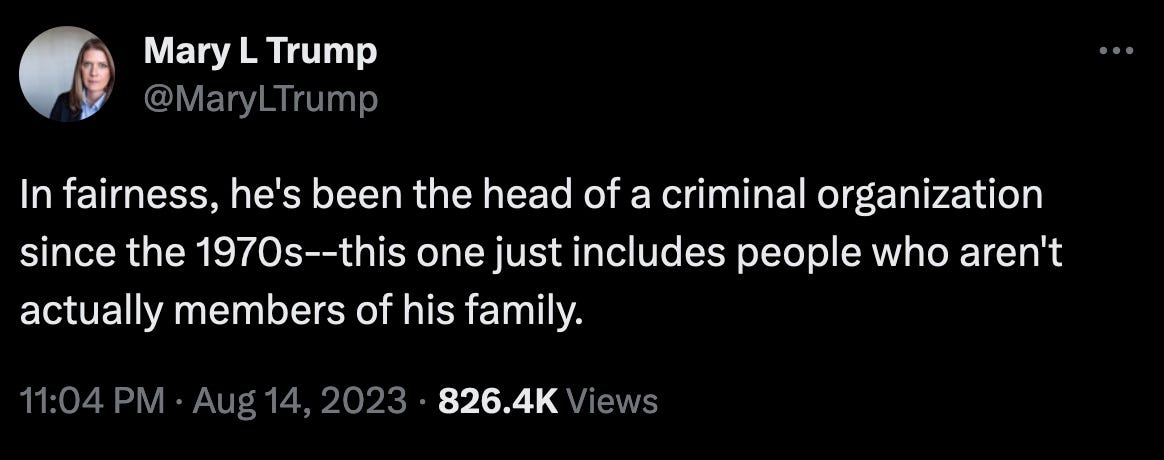
mob boss Donald Trump and 18 of his criminal co-conspirators have been indicted on a total of 41 counts

JEFF TIEDRICH

AUG 15, 2023

holy shit, life just got a whole lot worse for the quadrice-indicted twice-impeached popular-vote-losing insurrection-leading judge-threatening witness-tampering serial-sexual-predating draft-dodging casino-bankrupting daughter-perving hush-money-paying real-estate-scamming ketchup-hurling justice-obstructing classified-war-plan-thieving weather-map-defacing paper-towel-flinging tax-cheating evidence-destroying charity-defrauding money-laundering fluorescent tangerine jackass currently hiding under the bed in his shitty New Jersey golf-motel-and-ex-wife-cemetery.

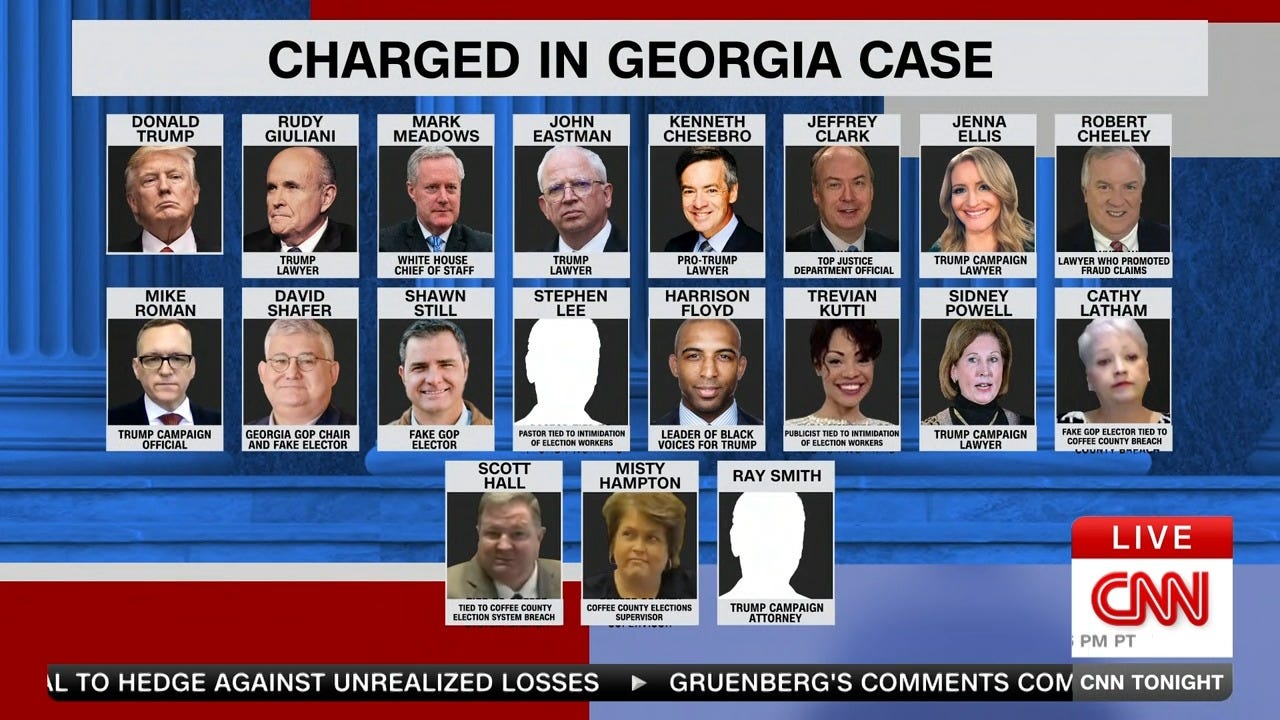
mob boss Little Donny Fuckface and 18 of his criminal co-conspirators have been indicted on a total of 41 counts for engaging in racketeering in an attempt to overturn the 2020 presidential election.

Upgrade to paid

the list of Trump’s Georgia co-conspirators reads like a who’s-who of America’s most-unctuous shitheels. Rudy Giuliani. John Eastman. Sidney Powell. Mark Meadows. Jeffrey Clark. Kenneth Chesebro. Jenna Ellis.

all of them had their fingers in the election fuckery pie and now all of them are sinking in a legal sargasso of shit.

the 13 charges that apply specifically to Trump include racketeering, forgery, election fraud, false statements, perjury, and soliciting public officers to violate their oaths.

the most serious charge is the first one: racketeering, or, more specifically, violation of the Georgia RICO Act.

a good explainer of Georgia’s RICO laws can be found here. but let’s skip ahead to the part you all want to know about.

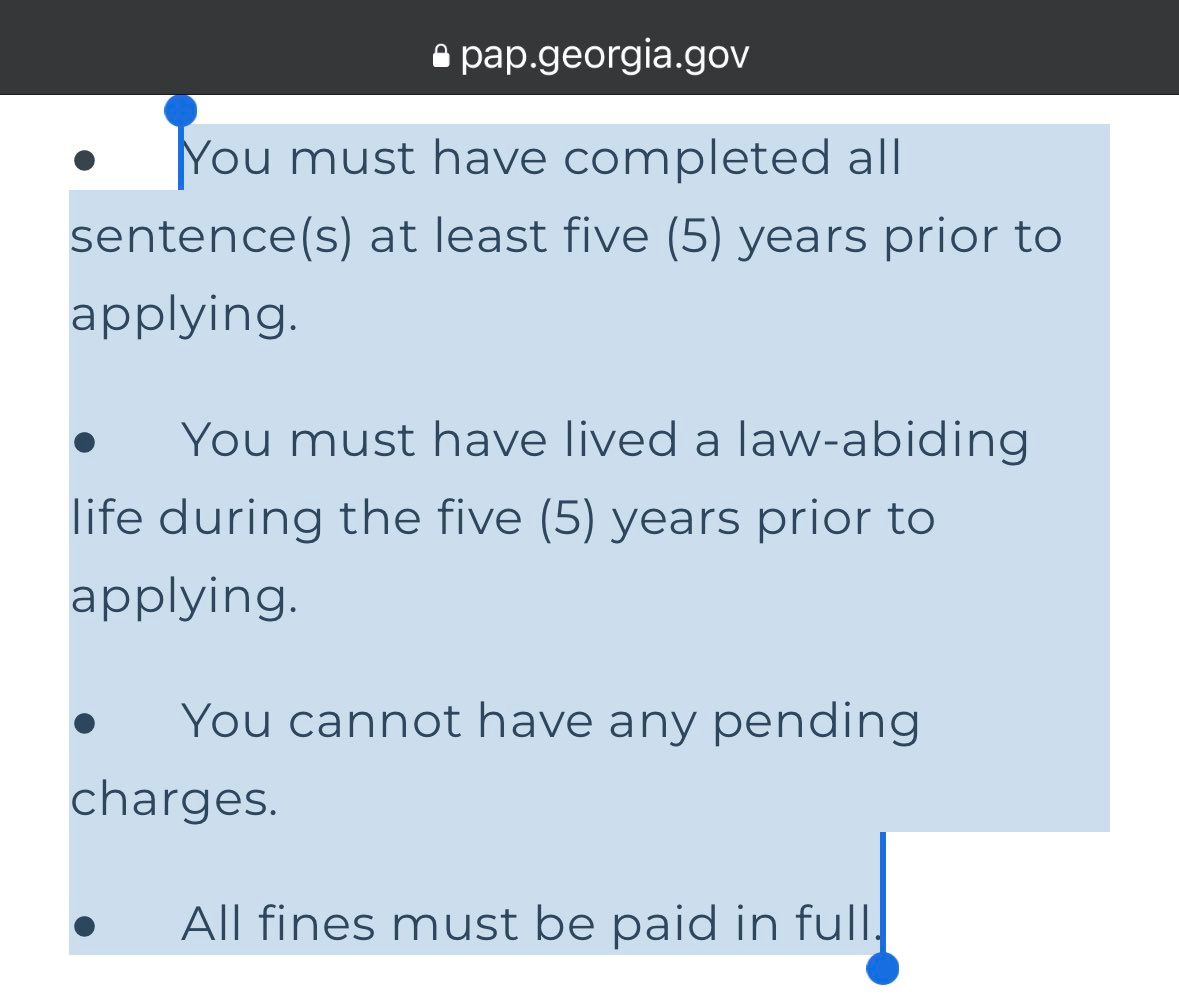
In Georgia, it’s a felony conviction that carries a prison term of five to 20 years; a fine of $25,000 or three times the amount of money gained from the criminal activity, whichever is greater; or both a prison sentence and a fine.

here’s the beauty part: there is no get-out-of-deep-shit-free card in Georgia. Republican Governor Brian Kemp has no power to summarily pardon Trump and send him on his merry way.

and it gets better: Trump can’t even apply for a pardon until 5 years after he completes his sentence.

don’t you hate it when being a no-mercy tough-on-crime Republican comes back to bite you on the ass?


hey, let’s check in with the email lady and see how she’s doing.

yeah, us too, Hillary. us too.


here’s a thought: Lindsey Graham skated. the indictment does not mention him at all. did he flip on Donald?


I can’t repeat this enough: none of this had to happen. none of it. Donny could have taken his loss like a mature adult and fucked off and gone home. he could have quietly returned the documents he stole, and right now he could be golfing and laundering Saudi money and fleecing his gullible worshipers and getting his stupid face on Fox News — and not worrying about spending the rest of his miserable life sinking deeper into a big fucking legal hell of his own making.


Donald, if you’re out there reading this, can I ask a personal favor? can you please fucking learn how to spell indicted?


an arrest warrant has been issued for Donald Trump. he has been given until August 25th to turn himself in.

there will be a mug shot and fingerprints.

and — unlike Manhattan and Florida and DC — the whole arraignment will be televised.

Georgia law requires that cameras be allowed during judicial proceedings with a judge’s approval. Cameras are seen as an important aspect of transparency.

settle in and pass the popcorn. this is going to get good.

everyone is entitled to my own opinion is a reader-supported publication. To receive new posts and support my work, consider becoming a free or paid subscriber.

Upgrade to paid

The Boaz Stranger–Chapter 29

It was 3:00 PM Saturday afternoon before Spectrum’s serviceman arrived. He was thirty minutes late but had called Ted to let him know. “Sorry, last night’s storm has us scrambling.” The fireplug shaped woman surprised Ted as she exited her pickup. Terrie had sounded like a man over the phone.

The temperature was hovering at freezing, so Ted went inside the cabin. Terrie wanted to check the panel first. She walked to the side of the house and quickly noticed the incoming cable had been severed.

“That was easy to diagnose.” Terrie said, joining Ted in the great room.

“How so?”

“Someone clipped your line; cut it in half.” Terrie pulled her right hand across her throat to dramatize her words.

“Damn. Probably the same person who took my whiskey. And left the front door unlocked.” The service lady gave both affirmative and negative nods, one after the other.

“Well, I can’t help you there, but I can splice your incoming and have you going in fifteen minutes.” Terrie exited the cabin while Ted watched, confused. He wondered if the Spectrum rep was a trans: a male trying to become a female, or the opposite.

Ted shook his head and walked to the rear of the cabin. He opened the blinds and looked through the sliding glass door across the porch and to the over-sized and barren fire pit. He closed his eyes and recalled the many times he and his buddies had drank beer and delivered bullshit stories of their female conquests. But, what he’d truly love is to return to younger days, a simple life with Julie, even if they didn’t have an extra dime.

The suction from the front storm door and a triple ding from his iPhone startled Ted. He turned. “Done already?”

“Yep. You should be good to go, but let’s check.” Terrie walked in front of the giant screen TV and picked up the remote sitting atop the entertainment center. After a few seconds, Ted watched Alabama’s quarterback Mac Jones complete a thirty-yard pass against Auburn. “Just in time to watch the massacre.” Terrie flipped a few channels before activating Netflix. It wouldn’t connect. “Where’s your router?” Ted pointed to the master bedroom and waited for a quick minute. “That should do it.”

Ted walked Terrie outside and watched him, her, drive away, waving an Alabama hat outside the driver’s side window. Back inside, Ted removed his iPhone and sat on the couch, intent on watching at least the first half. What he heard changed everything.

 The break in Wi-Fi service had delayed his cell notifications. When Julie had left him and before she moved into the cabin, Ted had hired a friend from Atlanta to install two devices. One was a video camera hidden inside a smoke alarm. The second was an audio recorder secluded inside a largemouth bass mounted next to an eight-point buck above the front door.

Ted would have to remove the memory card from the video device and insert it into a PC before reviewing its contents. However, the audio was already on his phone, sent via email after Terri restored his Internet service. Ted opened the clip and pressed PLAY. The voices were clear but unfamiliar. One was a female; one was a male. Ted replayed the recording three times:

Female: “I see you like playing in the mud.” Long pause.

Male: “Don’t we need to remove the recorders?” Minimal pause.

Female: “Done. Now, come on. I can’t wait to weigh our catch.”

“Oh shit,” was all Ted could say. He stood and pulled a dining room chair to the doorway leading to the master bedroom. He climbed up, reached for the smoke detector, and opened its outer door. Inside was another door. Ted removed the memory card and stepped off the chair, nearly falling as he questioned and doubted whether the female voice was Julie’s, and whether she had found a new playmate.

During the return drive to his house, he concluded it was unlikely his former lover knew about the recorders. So, what was the man’s voice referring to?

All Ted could say as he parked in front of his sprawling mansion was, “shit, shit, shit, if it’s not Julie, who the hell could it be?”

***

Ted was more confused after watching the video. The woman inside his cabin could be Julie. The two were the same or similar height. But something was off. The woman on the screen was too thick. Ted admitted the camouflaged outfit could be the difference, especially if it was double or triple layered. Of course, identification would have been easier if the woman hadn’t blackened her face. Woman? Ted questioned his gender analysis; maybe the figure was a man.

After an unsuccessful attempt to call Ray, Ted had driven to Julie’s house. Her car was missing. He thought about calling but decided against it. Instead, he checked Julie’s Facebook Page. Last night, contemporaneous with the date/time stamp on both the audio and video recordings, Julie was enjoying a meal at Cotton Row in Huntsville. Somewhat tentatively, Ted concluded his estranged wife wasn’t the intruder. Maybe Ray would know.

It was 5:30 PM when Ted parked outside the Lodge’s triple-car garage. Ray was unloading groceries. “We need to talk. Now.”

“Why didn’t you call?” Ray said, motioning for Ted to grab some Walmart bags from the back of the Suburban.

“I did. Both your cell and your land line.”

“I don’t enjoy talking when I’m in such a public place. Too many eavesdroppers around.”

After two more trips each, Ted sat at the breakfast bar while Ray put away the groceries. “You hit the nail on the head.”

“Uh?” Ray glanced at Ted before shoving a box of dishwasher detergent underneath the sink.

“Someone was inside the cabin last night, both before and after we arrived.”

“Holy shit. How do you know?”

Over the next hour, Ted and Ray reviewed and discussed the two recordings. According to Ray, there was little doubt the woman on the video was Lillian. The main giveaway was the knitted Deerhunter toboggan he had given her for Christmas two years ago. The second giveaway was the female voice from the audio recording. “I’d know that voice anywhere.”

“Then, who’s the man?” Ted asked, accepting a Budweiser from Ray.

“Now that I’ve spoken to Jane, I think I know. It’s Lee Harding.” Ray removed his iPhone from his shirt pocket, clicked a couple of buttons, and laid it on the counter next to the sink. “Listen to what she said.”

Jane had reported that Lee had called her this morning. He relayed that he had found several of Rachel’s diaries. Lee had asked two questions. One concerned Jane’s knowledge of what happened the night Kyle had gone missing, particularly whether Ray and Rachel had dropped Jane off at her house while Kyle was still in Ray’s truck. The second concerned Rachel’s pregnancy and abortion. Jane had been certain of both her responses. She had sworn that Ray had first dropped Kyle at the end of his driveway before driving to her house further down King Street. She had also sworn that Rachel had her abortion before she and her family returned to China in the middle of tenth grade.

“It’s good to hear Jane is still on your side but what I don’t understand is why Lee and Lillian would come to my cabin.” Ted said, shaking his head.

“We have to assume they heard every word uttered after we arrived, including my argument with Buddy.” Ray paused and took two long draws of his beer. “Thank God there was no mention of the Hunt House.”

Ted stood and pushed the bar stool back under the counter. “Ray, promise you’ll protect me. From the recordings, I’m just along for the ride. I had nothing to do with you and Buddy.”

“You dumb fuck. It was your place. You were there. You’re guilty by association.” Ray’s declaration spurred Ted to stand, walk toward the giant fireplace in the den, and return to the kitchen. Ted was clearly worried.

“I think we better protect each other. We both are at risk of going to prison. You for the fiasco with your Albertville cheerleader and the Hunt House fire, among a long list of other things, and me for financial corruption.”

“And you for arson.” Ray added.

“The hell you say. All I did was manipulate the police.” Ted had placed an anonymous call to the Boaz dispatcher who’d sent three patrol cars to a domestic violence inspired shooting outside Barry’s Barbecue south of town. This had provided safe passage for Buddy and Eric’s visit to Thomas Avenue and the Hunt House.

 “That’s conspiracy to commit a crime you dumb ass.” Ray hated lawyers but had always been fascinated by the law.

“Come on, let’s go to The Shack and eat a steak. While we can.” Ray nodded, flipped off the kitchen lights, and followed Ted outside.

***

Lillian’s iPhone vibrated. For the past two hours, she had napped on her couch under a throw. She reached for the coffee table and read the text notification. Device A triggered an hour ago. She tossed her heavy Afghan aside and sat up.

She pressed PLAY. Lillian didn’t recognize the voice who said, “You hit the nail on the head.” The second voice was clearly Ray.

Lillian stood after the third statement. “Damn, that has to be Ted King.”

She rewound and replayed the words that scared her to death: “Someone was inside the cabin last night, both before and after we arrived.” Lillian listened and re-listened for thirty minutes, alternately rewinding and fast-forwarding at critical spots. Finally, she stood and walked through the kitchen, across the back porch, and toward the pond, dreading and postponing her call to Lee. “What a fucking mess I’ve made. I’ve just given Ray the motivation to kill Lee and me.

08/15/23 Biking & Listening

Biking is something else I both love and hate. It takes a lot of effort but does provide good exercise and most days over an hour to listen to a good book or podcast. I especially like having ridden.

Here’s my bike, a Rockhopper by Specialized. I purchased it November 2021 from Venture Out in Guntersville; Mike is top notch! So is the bike, and the ‘old’ man seat I salvaged from an old Walmart bike.

Here’s a link to today’s bike ride.


Something to consider if you’re not already cycling.

I encourage you to start riding a bike, no matter your age. Check out these groups:

Cycling for those aged 70+(opens in a new tab)

Solitary Cycling(opens in a new tab)

Remember,

Photo by Suzy Hazelwood on Pexels.com

Listened to


Here’s a few photos from along my pistol route:

No, it’s not ‘workism’ that’s killing the church

Here’s the link to this article.

Avatar photoby ADAM LEE

AUG 14, 2023

Times Square, cluttered with crowds and ads | Workism isn't the church's real problem
Credit: Pixabay

Overview:

Americans are overworked and overly devoted to the hustle, but that’s not why organized religion is declining. Church apologists trying to explain their decline always look outward, never inward at themselves.

Reading Time: 6 MINUTES

[Previous: Church isn’t the answer to hustle culture]

Christianity in America is suffering an unprecedented decline.

Once-thriving congregations are shrinking and graying. Parishes are being consolidated. Closed-down churches are being reborn as bookstores and breweries, concert halls and apartments.

Surveys find that nonreligious Americans—or “nones”—now constitute about 30% of the population, outnumbering every single Christian denomination. If current trends continue, nones could be a majority by 2070.

The decline has become so obvious that even Christian propagandists can’t sweep it under the carpet. So they’re in search of explanations, preferably explanations that absolve them of blame. In the Atlantic, orthodox apologist Jake Meador proposes one:

Contemporary America simply isn’t set up to promote mutuality, care, or common life. Rather, it is designed to maximize individual accomplishment as defined by professional and financial success. Such a system leaves precious little time or energy for forms of community that don’t contribute to one’s own professional life or, as one ages, the professional prospects of one’s children. Workism reigns in America, and because of it, community in America, religious community included, is a math problem that doesn’t add up.“The Misunderstood Reason Millions of Americans Stopped Going to Church.” Jake Meador, The Atlantic, 29 July 2023.

Meador paints a picture of a society that worships work above all else. He argues that high-stress jobs, inflexible schedules, and the capitalist drive to use every moment “productively” have severed the bonds of community. People are isolated, stressed, and exhausted. They’re so immersed in the hustle mindset that they drift away from religion because they can’t conceive of spending time on something that doesn’t make money.

To the churches and their defenders, this is a comforting story. It allows them to tell themselves that they haven’t been rejected. They’ve merely been pushed aside by the hustle and bustle of modern life. It holds out the promise that, if they can cut through the noise and make themselves heard, they can persuade young people to come back.

However, this face-saving explanation has a flaw.

The evidence, drawn from polls and interviews, paints a different picture. It’s not the case that young people have drifted away from church because they’re too busy with their side hustles and their TikToks. Rather, millions have chosen to cut ties with organized religion because they have stark disagreements with its moral teachings—and because the churches allow no room for dissent or difference of opinion.

The churches’ problem isn’t that they’re drowned out in the din and can’t make themselves heard. On the contrary, we hear them loud and clear.

A case in point is Charles Chaput, the archbishop of Philadelphia. In 2016, he urged liberal Catholics to quit the church. According to Chaput, people who call themselves Catholic but support abortion, contraception or LGBTQ rights are faithless liars. He declared that the church would be better off without them. Like other conservatives, he prefers a smaller, more ideologically pure church to a larger one with more diversity of opinion.

And young people are taking him at his word. According to a Pew survey, two-thirds of former Catholics left the church, not because they’re too busy, but because they stopped believing in its teachings.

Sixty years behind the times and going backward

On issue after issue, the pattern is the same. The churches’ problem isn’t that they’re drowned out in the din and can’t make themselves heard. On the contrary, we hear them loud and clear. The problem is that they’ve doubled down on moral stances that are the polar opposite of what young people believe and care about.

The second wave of feminism was more than sixty years ago, yet many churches still reject the most basic notions of gender equality. America’s two largest Christian denominations, Roman Catholic and Southern Baptist, refuse to allow women to take any leadership role. Just this year, the Southern Baptist Convention expelled two churches—including Rick Warren’s Saddleback Church—for the sin of hiring women as pastors. Women who speak out against this gross inequality have been flooded with harassment and hate mail.

To appease the religious minority that believes this, Christian churches have set themselves against the vast majority.

Above all else is the question of abortion. The repeal of Roe was a painful wake-up call, jolting women with the realization that their right to control their own bodies is slipping away. Young people recognize that opposition to abortion is motivated by religion. The churches have been loud and proud in their support of abortion bans, whereas nonbelievers are almost unanimously pro-choice.

And the religious right isn’t planning to stop there. They’re pushing for even more radical restrictions of women’s rights. Their next frontier is trying to scrap no-fault divorce, which would keep people trapped in abusive or unhappy marriages. Almost 70% of divorces are initiated by women, so this is another anti-feminist idea in thin disguise.

Putting people back in boxes

You can tell a similar story about LGBTQ rights. Millennials like me, who came of age in the early 2000s, remember the Christian crusade against gay and lesbian rights, especially same-sex marriage. The Nashville Statement, signed by more than 150 evangelical leaders, declared their eternal opposition to LGBTQ rights in every form.

Of course, they didn’t win that battle. Marriage equality is a reality, delivered by the Supreme Court and reinforced by Congressional legislation. Americans support LGBTQ rights by enormous majorities. More than two-thirds of Americans support marriage equality, including majorities in 47 of 50 states. Three-quarters say LGBTQ people should be protected from discrimination.

However, anti-gay Christians haven’t given up. They’re still fighting a rearguard action, claiming a religious right to discriminate against LGBTQ people. In red states, Christian legislators are banning books with gay characters and passing Don’t Say Gay laws.


READ: The Atlantic accidentally reveals Christianity’s growing irrelevance


In fact, the Christian opposition to gay rights has only grown more vicious. A tragic example was Urban Christian Academy, a private Christian school in Kansas City that provided underprivileged children with a tuition-free education. When the school updated its mission statement to affirm LGBTQ rights, angry religious donors pulled their support. The school lost nearly all its funding and was forced to close its doors.

Transgender people face even more brutal persecution. Wherever they have power, religious conservatives want to police their bathroom use; deny them access to gender-affirming medical care; even take away children from transgender families. So virulent is their opposition to anything and everything that smacks of weakening the gender binary, a Christian university fired two (cisgender) employees merely for putting their pronouns in their e-mail signatures.

As with women’s rights and gay rights, attacks on transgender people are rooted in a religious belief that sex and gender are strictly binary and fixed at birth, and for people to want to break out of these boxes goes against the will of God. However, to appease the religious minority that believes this, Christian churches have set themselves against the vast majority. An April 2023 poll—by Fox News, no less!—finds that 86% of Americans say political attacks on transgender kids are a serious problem.

Insular and hostile

The root cause of these culture-war clashes is that most churches, especially evangelical churches, have turned insular and hostile. They’re dens of conservatism—and not traditional small-government conservatism, but radical, norm-breaking Trumpian conservatism.

Russell Moore, a former top official of the Southern Baptist Congregation, made waves recently when he spoke about pastors whose congregants scorn the literal teachings of Jesus as “liberal talking points” and “weak”.

As churches grow more fanatical, they’re also receding further from objective reality. Many pastors complain that QAnon and other noxious conspiracy theories are swallowing up their congregations. Surveys find that as many as 50% of white evangelicals are QAnon believers.

Most churches, especially evangelical churches, have turned insular and hostile.

The few prominent Christians who aren’t caught up in the tide of conspiracies have lamented how gullible their fellow believers are. Evangelical author Ed Stetzer said in 2017 that “the spreading of these conspiracies are hurting our witness and making Christians look, yet again, foolish.”

However, no one heeded him. The plague of conspiracy beliefs only got worse—so much so that by 2020, he was pleading, “If you still insist on spreading such misinformation, would you please consider taking Christian off your bio so the rest of us don’t have to share in the embarrassment?”

Looking in the mirror

Is hustle culture a real problem? Yes. Have some people stopped attending church because they’re too busy? Almost certainly.

However, Christian apologists use this as a way to avoid looking in the mirror. They want to believe that Christianity’s decline isn’t their fault. That way, they don’t have to do anything differently. Or, at worst, the problem is that they haven’t been faithful enough—so they need to do what they’ve always been doing, just more and harder. (In his column, Meador follows suit: “[A] vibrant, life-giving church requires more, not less, time and energy from its members.”)

This inability to introspect is a widespread problem in institutional Christianity. The arrow of causality is fixed pointing outward; they never turn it back upon themselves. For all they talk about repentance, they’re consistently unwilling to consider that they might have made any mistakes of their own that they need to atone for.

None of this means that there aren’t any other problems in American society. As a culture, we do work too much—some of us by choice, others very much not by choice—and overvalue wealth and success at the expense of everything that makes life meaningful.

If Christians are serious about resisting hustle culture, their help would be welcome. They could join atheists in calling for a stronger safety net, an expanded sense of mutuality, and more guarantees for workers’ rights and leisure time. It would go a long way to repair their reputation; it might even reverse their decline.

But for the churches to truly commit to this goal, rather than merely using it to shift the blame, would require real change on their part. It would require more compassion, more tolerance, and a greater willingness to reconsider long-held dogmas than they’ve displayed until now.