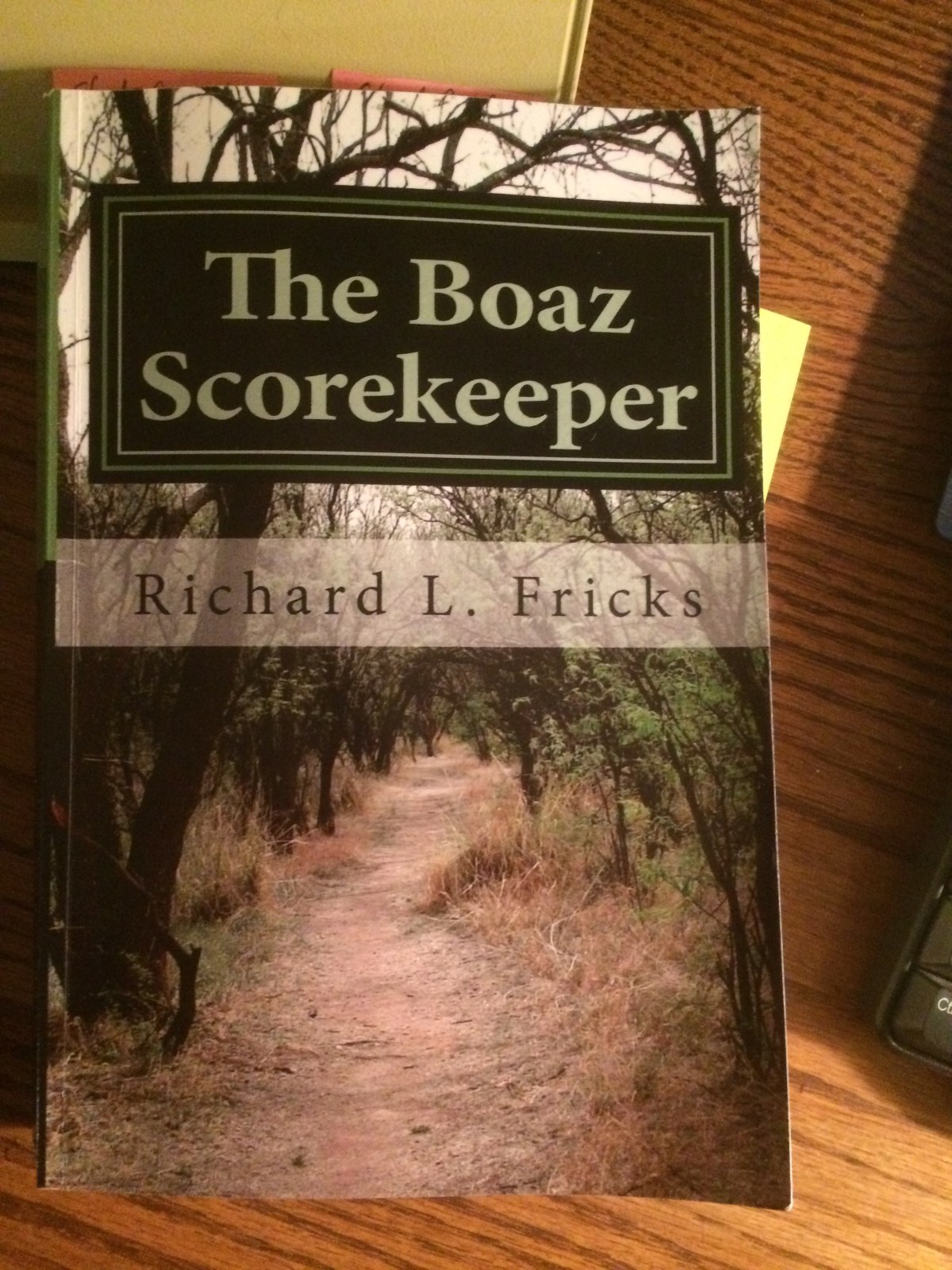
The Boaz Scorekeeper, written in 2017, is my second novel. I'll post it, a chapter a day, over the next few weeks.
Over the years, I had several times entertained the notion of returning to Boaz. In 1987 when Lewis was born, I realized that I had already practiced seven years in Atlanta, two more than the minimum I had agreed with Matt. But, at that time, I had two cases that chained my focus.
In late summer 1992, I had a weird cloud of nostalgia hover over me raining down feelings of revenge I had never experienced. The 20th anniversary of Wendi and Cindi’s death had occurred in May. Also, it didn’t help that Randall and Fred had been elected to the First Baptist Church of Christ’s deacon board. Nor, the fact James Adams was elected Mayor. An afternoon spent with Matt over the Labor Day weekend, disabused me of this strong pull. Although he still wanted us to practice law together, at some point he argued that revenge was an irrational reason to ground my decision. Once again, I listened to the wise Matt and followed his advice.
In January 1993, Mama El died. She was 92 and just went to sleep. The doctor said, “her heart finally gave out.” I think it finally gave up. After Gramp’s death in 1965, Mama El lost her way. To an outsider, she adjusted well. She continued her daily life pretty much as before: gardening and canning, and church and church and church. That was all pretty much a front. In her heart, she was the loneliest person I’ve ever known. Alone, late at night, even in the coldest weather, she would sit out on the back porch looking over the garden, across the pasture, and to the oak grove on the southeast corner of the pond where Gramp’s had died. I’ve often wondered whether Wendi and I would have had such a love affair if she had lived. There was no other romance like Gramp’s and Mama El’s. But, just like for Wendi and me, God or fate or something had other plans for Gramp’s and Mama El. After Mama El’s funeral and before Karla, Lewis, and I returned to Atlanta, I almost decided it was time to move home. I thought, I wanted to live in my own home, breathe the air Mama El breathed, and sit in her chair on the porch with her throw over my lap. She was, in a way, the architect of my inner life growing up. Like Gramp’s was for my outer life. But, we didn’t move back. Law and life in Atlanta kept getting in the way.
In 1995 Matt called and told me he had been diagnosed with brain cancer. Karla and I were in Orlando on a week’s vacation. The two of us spent the next several days walking around Disney World discussing what all we had to do before we could move. Karla loved her teaching job and although reluctant, she bravely agreed to once again resign her position and follow me. By the time we returned to Atlanta, Matt called with the good news that he had been misdiagnosed and only had a small non-cancerous tumor that doctors believed would not give him any problems and that hopefully would eventually dissolve. Again, I had no clear reason to return to Boaz.
Biking is something I both love and hate. The conflicting emotions arise from the undeniable physical effort it demands. However, this exertion is precisely what makes it an excellent form of exercise. Most days, I dedicate over an hour to my cycling routine, and in doing so, I’ve discovered a unique opportunity to enjoy a good book or podcast. The rhythmic pedaling and the wind against my face create a calming backdrop that allows me to fully immerse myself in the content. In these moments, the time spent on the bike seems worthwhile, as I can’t help but appreciate the mental and physical rewards it offers.
I especially like having ridden. The post-biking feeling is one of pure satisfaction. The endorphin rush, coupled with a sense of accomplishment, makes the initial struggle and fatigue worthwhile. As I dismount and catch my breath, I relish the sensation of having conquered the challenge, both physically and mentally. It’s a reminder that the things we sometimes love to hate can often be the ones that bring us the most fulfillment. In the end, the love-hate relationship with biking only deepens my appreciation for the sport, as it continually pushes me to overcome my own limitations and embrace the rewards that follow the effort.
My bike
A Rockhopper by Specialized. I purchased it November 2021 from Venture Out in Guntersville; Mike is top notch! So is the bike. The ‘old’ man seat was salvaged from an old Walmart bike (update: seat replaced, new photo to follow, someday).
Something to consider if you’re not already cycling.
I encourage you to start riding a bike, no matter your age. Check out these groups:
Don’t miss the #1 New York Times bestselling blockbuster and Reese Witherspoon Book Club Pick that’s sold over 2 million copies–now an Apple TV+ limited series starring Jennifer Garner!
The “page-turning, exhilarating” (PopSugar) and “heartfelt thriller” (Real Simple) about a woman who thinks she’s found the love of her life—until he disappears.
Before Owen Michaels disappears, he smuggles a note to his beloved wife of one year: Protect her. Despite her confusion and fear, Hannah Hall knows exactly to whom the note refers—Owen’s sixteen-year-old daughter, Bailey. Bailey, who lost her mother tragically as a child. Bailey, who wants absolutely nothing to do with her new stepmother.
As Hannah’s increasingly desperate calls to Owen go unanswered, as the FBI arrests Owen’s boss, as a US marshal and federal agents arrive at her Sausalito home unannounced, Hannah quickly realizes her husband isn’t who he said he was. And that Bailey just may hold the key to figuring out Owen’s true identity—and why he really disappeared.
Hannah and Bailey set out to discover the truth. But as they start putting together the pieces of Owen’s past, they soon realize they’re also building a new future—one neither of them could have anticipated.
With its breakneck pacing, dizzying plot twists, and evocative family drama, The Last Thing He Told Me is a “page-turning, exhilarating, and unforgettable” (PopSugar) suspense novel.
Upgraded writing room in the barn (now known as the Pencil Pit): big desk used in law practice (HEAVY!); ‘Beauty Bar’ (antique) included in old downtown building purchased in 1999 (story is it was purchased from a pharmacy in Gadsden and was there for decades). Figurines in ‘Beauty Bar’ were mother’s.
Most wonderful characteristic of the Pencil Pit–no internet.
Take a photo without a camera. Curate your own public art. See where your mind goes.
***
The Art of Noticing
Simple and uncommon exercises to reveal what’s hidden in plain sight.
In The Art of Noticing, Rob Walker—a journalist, author, and educator—invites us to attend carefully and playfully to everyday curiosities that most of us tend to overlook.
“Fending off distraction isn’t quite the same thing as making the most of our attention.” By engaging the senses, Rob says, we can enrich our daily lives with meaning, boost creativity, and even “reframe the way we take in the world.”
***
Rob Walkeris a journalist and author. He is a longtime contributor to The New York Times, and a columnist for Fast Company. His recent books are The Art of Noticing, and Lost Objects, co-edited with Joshua Glenn. He is on the faculty of the Products of Design program at the School of Visual Arts. You can find his newsletter at robwalker.substack.com.
Having previously linked to some reasons why philosophical apologetics is not changing very many minds, especially the most sophisticated philosophy that every serious philosophical apologist loves to recommend, because it says that they understand it! Congrats to you!! A lot of it is obtuse and obfuscationist though. As it’s practiced today, it isn’t that helpful if one wants to change minds. After all, the more sophisticated that philosophy is, the more sophisticated the reader is. At that level it doesn’t change the minds of sophisticated readers because they are already entrenched in what they think. It also has a way of being turned around as a pat on the back! Just see how William Lane Craig responds to a very detailed and knowledgeable question about philosophical apologetics at his website, Reasonable Faith. Craig wrote:
I include your question here for the instruction and encouragement of our Reasonable Faith readers. You have masterfully surveyed for us the current philosophical landscape with respect to atheism. You give our readers a good idea of who the principal players are today.
I hope that theists, especially Christian theists, who read your account will come away encouraged by the way Christian philosophers are being taken seriously by their secular colleagues today.
The average man in the street may get the impression from social media that Christians are intellectual losers who are not taken seriously by secular thinkers. Your letter explodes that stereotype. It shows that Christians are ready and able to compete with their secular colleagues on the academic playing field.
I am in wholehearted agreement with you. I actually find it very sad to see a discipline (the philosophy of religion) I have cherished for many years being debased and distorted by so-called Christian philosophers. Like you, I have now finally and happily found my place in the atheist community. I’m slowly making my way through your “Unapologetic book”, it’s quite fascinating, loving the Nietzschean hammer style.
In Unapologetic I’m taking up the late great Dr. Hector Avalos’s call to end biblical studies as we know them, in a book he wrote that I highly recommend, just as I recommend all of his works! You can read though excerpts of his book here. I am making that same call when it comes to the philosophy of religion. Hector approved of it, telling me (per email):
My proposal is “to end biblical studies as we know it” (The End of Biblical Studies, p. 15), which means in its current religionist and apologetic orientation. So I am for ending the philosophy of religion if its only mission is to defend religion and theism. So, akin to my vision of the end of biblical studies, I would say that the only mission of the philosophy of religion is to end the philosophy of religion as we know it.
He also wrote this blurb for it:
Unapologetic is probably my favorite monograph by John Loftus. It deserves a gold medal for undertaking the Olympian task of explaining in clear and accessible prose why the area known as Philosophy of Religion should be ejected from modern academia and our intellectual life. Pretending that we have good arguments for God is about as useless as pretending we have good arguments for Zeus.
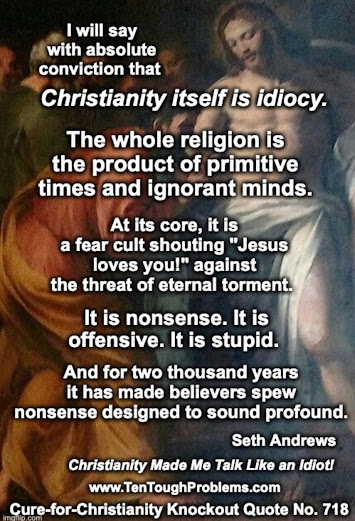
It’s even worse when we consider what some atheists say, like Seth Andrews above. Massimo Pigliucci, a professor of philosophy at City College of New York, who holds Ph.D.s in both biology and philosophy, tweeted: “I’m sorry but I can’t any longer take seriously any essay or paper that itself takes talk of god seriously. It’s simply a non starter” [March 28, 2023]. In response, “The Real Atheology Podcast” tweeted “given the serious work done by many Theistic philosophers, I have to disagree with your comments here.” Pigliucci responded: “I don’t consider any theologian to be ‘serious.’ They may be, and often are, analytically rigorous. But so is the concept of p-zombies. And yet I think it’s a waste of time.” Pigliucci again tweeted: “Consider, for instance, the Medieval Scholastics. They were rigorous and did a lot of work. But it was, as David Hume famously put it, only a bunch of sophistry and illusions. Why? Because it was based on indefensible assumptions and lack of empirical evidence” [March 30, 2023].
For a few years Keith Parsons called it quits regarding the philosophy of religion, saying:
Over the past ten years I have published, in one venue or another, about twenty things on the philosophy of religion. I have a book on the subject, God and Burden of Proof, and another criticizing Christian apologetics, Why I am not a Christian. During my academic career I have debated William Lane Craig twice and creationists twice. I have written one master’s thesis and one doctoral dissertation in the philosophy of religion, and I have taught courses on the subject numerous times. But no more. I’ve had it.
I now regard “the case for theism” as a fraud and I can no longer take it seriously enough to present it to a class as a respectable philosophical position—no more than I could present intelligent design as a legitimate biological theory. BTW, in saying that I now consider the case for theism to be a fraud, I do not mean to charge that the people making that case are frauds who aim to fool us with claims they know to be empty. No, theistic philosophers and apologists are almost painfully earnest and honest; I don’t think there is a Bernie Madoff in the bunch. I just cannot take their arguments seriously any more, and if you cannot take something seriously, you should not try to devote serious academic attention to it. I’ve turned the philosophy of religion courses over to a colleague. LINK.
While I’m at it, I recommend anything David Madison writes for very good reasons. He maintains the largest and most extensive list of atheist books I know [Scroll down]. Any of them is better than than a given apologetics book, if for no other reason than that they are right! Unfortunately, given the number of these books, many of which I have not read, I’m sure I’m overlooking some really powerful books in my recommended list.
Nearly every sophisticated philosopher and apologist looks down their noses on the so-called New Atheists. I don’t. So far I have defended Christopher Hitchens and Richard Dawkins. Recently over at The Secular Frontier website, Bradley Bowen has done an excellent job of showing why sophisticated philosophers and apologists think Dawkins’s book is a failure. But scroll down to read my response in the comments under his take down.
William Patterson has also defended Dawkins’s book! His paper was published in the Journal of Liberal Religion. He introduces his three main points by saying:
In the previous issue of this journal Jason Giannetti launched a vigorous attack against Richard Dawkins‟s best-selling book “The God Delusion.” Giannetti assailed Dawkins on three primary grounds: his understanding and definition of God, his understanding of truth, and his interpretation of religious morality. In response, I will address each of these three areas in turn and demonstrate how Giannetti’s critiques of Dawkins fail. [PDF].
I don’t have much expertise in online YouTube content creators, and I must exclude select papers in the journals, and other websites and blog posts other than mine, since there are so very many of them to choose from. I’m simply recommending the best books of what I know, and it’s only as good as my knowledge as an author myself. Some of these books led me away from the Christian faith. I’m recommending just a few important ones that have the potential to change the minds of college students and educated people in the pulpit or pews, even though this can be a very difficult and largely fruitless goal.
To begin with I recommend all thirteen books of mine and the authors in them, especially Why I Became an Atheist, The Christian Delusion, Christianity is not Great, The Outsider Test for Faith, How to Defend the Christian Faith: Advice from an Atheist, Christianity in the Light of Science, The Case against Miracles, and God and Horrendous Suffering, although it surely is self-serving to do so! All of the chapters I wrote in my books reference many other books for further research. There were so many of them mentioned in my magnum opus, Why I Became an Atheist, that I offered a “recommended” bibliography, not an complete one. It might’ve added 30-40 pages more to an already massive book. Besides, even if I didn’t write anything in my anthologies I would still highly recommend those books. If nothing else, I was able to get the best of the best atheist and agnostic scholars to write chapters for my anthologies. [What’s the real difference between them when it comes to rejecting revealed religions? Nothing!] I highly recommend these authors and their books, even though I’m not going to recommend them separately below. Those books are awesome, even if you don’t read a word I wrote in them. I’ve written several posts that describe these thirteen books, where I offer some excerpts, and share the blurbs of readers who recommend them, most of which received high praise from Christian scholars, which is very rare. See for yourselves.
Boghossian’s book stands squarely in agreement with George H. Smith’s previous book, which I recommend titled: “Atheism: The Case Against God”, for which see my defense of it.
Michael Shermer, The Believing Brain: From Ghosts and Gods to Politics and Conspiracies—How We Construct Beliefs and Reinforce Them as Truths, and also, Why People Believe Weird Things.
Israel Finklestein, & Neil Asher Silberman, “The Bible Unearthed: Archaeology’s New Vision of Ancient Israel and the Origin of Its Sacred Texts.”
On God, Goodness, and Morality
Anything by Phil Zuckerman. Books like “Faith No More: Why People Reject Religion,” “Living the Secular Life: New Answers to Old Questions”, “Society without God: What the Least Religious Nations Can Tell Us About Contentment,” “What It Means to Be Moral: Why Religion Is Not Necessary for Living an Ethical Life.”
Greg Epstein, “Good Without God: What a Billion Nonreligious People Do Believe”.
Michael Werner, “What Can You Believe If You Don’t Believe in God?”
Dan Barker, “God: The Most Unpleasant Character in All Fiction.”
Michael Shermer, “The Moral Arc: How Science Makes Us Better People” and “The Science of Good and Evil: Why People Cheat, Gossip, Care, Share, and Follow the Golden Rule.”
Biblical Criticism:
Richard Friedman, “Who Wrote the Bible?”
Robert J. Miller, “Helping Jesus Fulfill Prophecy”.
Thomas Paine, “The Age of Reason”.
Francesca Stavrakopoulou, “God: An Anatomy”.
Almost anything from Richard Carrier, especially his book, “On the Historicity of Jesus: Why We Might Have Reason for Doubt.”
Thom Stark’s book, “The Human Faces of God.” While it appears as if he’s arguing just against the Christian doctrine of inerrancy (and does a superb job of it), he’s doing far more than that. He argues there are not only “scientific and historical problems” in the Bible, but also that there are “moral, ethical, theological, and ideological problems” with it (p. 208). He goes into some detail on a few of the issues found in my books, mostly in the Old Testament.
Bart D. Ehrman’s book, “Jesus Interrupted.” This is my favorite Ehrman book where he argues that the New Testament is a human, not divine book.
Randel Helms, “Gospel Fictions”, and “The Bible Against Itself: Why the Bible Seems to Contradict Itself”.
Paul Tobin’s magnum opus, “The Rejection of Pascal’s Wager: A Skeptic’s Guide to the Bible and the Historical Jesus.” He might be surprised his book is on this list but it’s deserved. This is a massive book. It will help deprogram you out of some things about the Bible and Jesus you previously believed.
G.A. Wells, “Cutting Jesus Down to Size: What Higher Criticism Has Achieved and Where It Leaves Christianity”.
Books on the Virgin Birth of an Incarnate Baby god:
Robert Price, “The Case Against The Case For Christ: A New Testament Scholar Refutes the Reverend Lee Strobel.”
Uta Ranke-Heinemann, “Putting Away Childish Things: The Virgin Birth, the Empty Tomb, and Other Fairy Tales You Don’t Need to Believe to Have a Living Faith.”
Robin Lane Fox, “The Unauthorized Version: Truth and Fiction in the Bible.”
I know I’m missing some that I just forgot to mention and should be included, so I invite other suggestions.
Lastly, I may put out a book of papers I’ve begun publishing at Internet Infidels. I have some more papers to write. If I get them done you can consider this another book I’m recommending. LINK. No promises.
————–
John W. Loftus is a philosopher and counter-apologist credited with 13 critically acclaimed books, including The Case against Miracles, God and Horrendous Suffering, and Varieties of Jesus Mythicism. Please support DC by sharing our posts, or by subscribing,donating, or buying our books at Amazon. As an Amazon Associate John earns a small amount of money from any purchases made there. Buying anything through them helps fund the work here, and is greatly appreciated!
The Boaz Scorekeeper, written in 2017, is my second novel. I'll post it, a chapter a day, over the next few weeks.
Although I had doubts about Christianity as early as the eighth grade, I kept them buried deep until that fateful night when Wendi and I sat around the fire and shared our souls. She fully believed in the God of the Bible, and was honest and respectful in listening to me share my doubts, and in offering her thoughts on how I might be confused.
Even more than our fireside discussion, the evil she experienced later that night, and the false accusation conspiracy and subsequent trial I endured, had fed my doubts a steady diet for too many years for them not to establish deep roots. I had listened to preaching all my life extol the beauty and magnificence of the Creator God, how he was all-knowing, all-powerful, all-loving, and ever-present. Try as I did, I never could reconcile that God with the God who had allowed my first love, the precious Wendi, to suffer multiple rapes and then what had to be a terrifying death at the hands of the Flaming Five—not to mention what fear, pain, and suffering I had endured for nearly six months in the Marshall County Jail. No, the God that I had experienced was either incapable of coming to the aid of his children or simply didn’t care. Of course, this wasn’t my true position. It was that I didn’t believe the God of the Bible existed at all. I was just too much of a coward to admit it.
My near atheism didn’t keep me from attending church. After moving to Atlanta to attend college and up until Karla and I married, the only time I would go to church was during the rare weekends I was home. After we married, we joined First Baptist Church of Atlanta. She joined because she was and remained until her death, a faithful and committed Christian. I joined because of my love and respect for Karla, but just as importantly, I enjoyed the music (not the words) and the irrationality that spewed forth from the preacher most every Sunday.
Biking is something I both love and hate. The conflicting emotions arise from the undeniable physical effort it demands. However, this exertion is precisely what makes it an excellent form of exercise. Most days, I dedicate over an hour to my cycling routine, and in doing so, I’ve discovered a unique opportunity to enjoy a good book or podcast. The rhythmic pedaling and the wind against my face create a calming backdrop that allows me to fully immerse myself in the content. In these moments, the time spent on the bike seems worthwhile, as I can’t help but appreciate the mental and physical rewards it offers.
I especially like having ridden. The post-biking feeling is one of pure satisfaction. The endorphin rush, coupled with a sense of accomplishment, makes the initial struggle and fatigue worthwhile. As I dismount and catch my breath, I relish the sensation of having conquered the challenge, both physically and mentally. It’s a reminder that the things we sometimes love to hate can often be the ones that bring us the most fulfillment. In the end, the love-hate relationship with biking only deepens my appreciation for the sport, as it continually pushes me to overcome my own limitations and embrace the rewards that follow the effort.
My bike
A Rockhopper by Specialized. I purchased it November 2021 from Venture Out in Guntersville; Mike is top notch! So is the bike. The ‘old’ man seat was salvaged from an old Walmart bike (update: seat replaced, new photo to follow, someday).
Something to consider if you’re not already cycling.
I encourage you to start riding a bike, no matter your age. Check out these groups:
Don’t miss the #1 New York Times bestselling blockbuster and Reese Witherspoon Book Club Pick that’s sold over 2 million copies–now an Apple TV+ limited series starring Jennifer Garner!
The “page-turning, exhilarating” (PopSugar) and “heartfelt thriller” (Real Simple) about a woman who thinks she’s found the love of her life—until he disappears.
Before Owen Michaels disappears, he smuggles a note to his beloved wife of one year: Protect her. Despite her confusion and fear, Hannah Hall knows exactly to whom the note refers—Owen’s sixteen-year-old daughter, Bailey. Bailey, who lost her mother tragically as a child. Bailey, who wants absolutely nothing to do with her new stepmother.
As Hannah’s increasingly desperate calls to Owen go unanswered, as the FBI arrests Owen’s boss, as a US marshal and federal agents arrive at her Sausalito home unannounced, Hannah quickly realizes her husband isn’t who he said he was. And that Bailey just may hold the key to figuring out Owen’s true identity—and why he really disappeared.
Hannah and Bailey set out to discover the truth. But as they start putting together the pieces of Owen’s past, they soon realize they’re also building a new future—one neither of them could have anticipated.
With its breakneck pacing, dizzying plot twists, and evocative family drama, The Last Thing He Told Me is a “page-turning, exhilarating, and unforgettable” (PopSugar) suspense novel.
Connect to strangers, friends, and colleagues through writing, listening, and learning.
***
The Art of Noticing
Simple and uncommon exercises to reveal what’s hidden in plain sight.
In The Art of Noticing, Rob Walker—a journalist, author, and educator—invites us to attend carefully and playfully to everyday curiosities that most of us tend to overlook.
“Fending off distraction isn’t quite the same thing as making the most of our attention.” By engaging the senses, Rob says, we can enrich our daily lives with meaning, boost creativity, and even “reframe the way we take in the world.”
***
Rob Walkeris a journalist and author. He is a longtime contributor to The New York Times, and a columnist for Fast Company. His recent books are The Art of Noticing, and Lost Objects, co-edited with Joshua Glenn. He is on the faculty of the Products of Design program at the School of Visual Arts. You can find his newsletter at robwalker.substack.com.
Even a casual reading of the Ten Commandments (either Exodus 20 or Deuteronomy 5) should make anyone skeptical that a supposedly good, competent god had anything to do with it. Here was this god’s big opportunity—alone with Moses on the mountaintop—to let humanity know the best moral principles to follow. Many ethicists have noticed three crucial items that are missing: (1) Thou shalt not engage in warfare; (2) Thou shalt not enslave other human beings; (3) Thou shalt not mistreat or undervalue other human beings because of the color of their skin. These omissions are surely an indication of defective, indeed bad theology.
Slavery and racism have brought so much pain and suffering to the world. But war has been, by far, the greatest destroyer, especially as weapons have become more and more advanced—very smart people have been hired by military leaders to create devastating killing machines. This prompts us to doubt, on another level entirely, that a good god was involved in the creation of humans.
Our brains are wired for aggression, territoriality, in-group loyalties—hence our endless willingness to go to war. Those who believe in a creator god have to admit that this has to be one of his biggest screwups. In Genesis 6:5-6 we read that god realized his failure:
“Yahweh saw that the wickedness of humans was great in the earth and that every inclination of the thoughts of their hearts was only evil continually.And Yahweh was sorry that he had made humans on the earth, and it grieved him to his heart.”
How could the wickedness of humans not have been god’s own design flaw? The author of Genesis was unaware that he was writing bad theology—and it got much worse with the story of the flood: god decided to kill everyone and everything on earth—with the exception of one family, and animals on the ark: “Yahweh said, ‘I will blot out from the earth the humans I have created—people together with animals and creeping things and birds of the air—for I am sorry that I have made them.’” (verse 8)
How in the world can an all-wise god have made such a huge mistake? More bad theology—and the author of Genesis had no idea he made this goof. His god was modeled on tribal chieftains.
The biggest challenge theologians face is to uphold the goodness of god in the face of so much suffering. Of course, the flood genocide in Genesis is fiction, but wars, genocides, and plagues have been constants in human history. An early version of the chapter on suffering in my book, Ten Tough Problems in Christian Thought and Belief, I had titled, Easy Acceptance of the Very Terrible. I dropped it because a few of my critical readers didn’t like it. But I still think this title sums up pretty well the goal of Christian apologists: to persuade the faithful that belief in god is not damaged by very terrible events that have happened for millennia—and that happen every day.
Author Franz Kiekeben has offered extensive comments on this in an article posted here on 19 October 2023 by John Loftus: The Reality of Senseless Suffering. In his opening paragraph he notes ways in which god may be excused for allowing suffering: “…the suffering serves some greater purpose…or it may be that certain types of suffering are the only way to bring about something of immense value.” Kiekeben goes into great detail analyzing these suggestions, offering this comment at one point:
“This section therefore surveys the main suggestions that have been advanced in defense of God-condoned senseless suffering. Perhaps the simplest among them is that based on God’s supposed inscrutability. As is often said, God works in mysterious ways. Some therefore appeal to our ignorance of his purposes and intentions in order to argue that we may simply be incapable of understanding why he permits senseless suffering. Who are we to say God could not allow such a thing? This suggestion, however, misses the point of the problem. One does not need to understand what God’s reasons might be in order to see the incompatibility of a perfect being with that of suffering that is not justified.”
There is an endless list of suffering, or horrible catastrophes—very terrible indeed—that rule out a good god who has compassion for humanity. Last October I published an article here titled, World War I: Why Didn’t It Put an End to Belief in God? That orgy of killing went on for four years: “…on average, more than 11,000 people lost their lives every single day of the conflict,” reports Holger Afflerbach, in an article titled “Did They Really Have to Fight to the Finish?” in the September 2023 issue of BBC History Magazine (p. 36, Vol. 24, No. 9).
Human pride got in the way of shortening the war: “…the enormity of human sacrifices rendered the proposal to end the war completely unattractive. Leaders on all sides were keenly aware that something positive had to come out of the war—and only military victory could provide it.” (p. 36) There was another calamity that followed: the war contributed to the Spanish Flu Pandemic (1918-1920) that killed 25 to 50 million people—some estimates put the death toll much higher. The treaty that ended World War I was a brutal one, and fueled the hatreds that brought on World War II, with even greater loss of life.
How can we have any tolerance for the feeble excuse that god works in mysterious ways? Mysterious indeed for a loving, caring, competent, all-powerful deity. “This is my father’s world” has a very hollow ring. Indeed, Keikeben’s sums up his article: “…the most reasonable conclusion is that there is senseless suffering. If so, then God does not exist.”
The Christian god—from what we read in the New Testament—keeps a close eye on every human: nothing escapes his notice. He keeps tracks of our words and thoughts.
So here’s a thought experiment: how do the devout account for these four horrible events that have happened during my lifetime (and this is a very short list)?
(1) On 10 July 1944, 462 women and children were murdered in a church in rural France. I described this event in an article here a few months ago: God’s Bad Habit of Oversleeping(here’s a 5-minute video I did about it as well). God was not able to somehow prevent this massacre in his church?
(2) On 25 July 2000, 109 people were burned to death when the Concorde burst into flames on takeoff from Charles de Gaulle Airport. A strip of metal had fallen off another plane and remained on the runway. It was hit by the Concorde and punctured a fuel tank. A decent gust of wind arranged by the Almighty could have swept the metal strip out of the way.
(3) On 26 December 2004, the Indian Ocean tsunami killed 225,000 people, many of them babies, toddlers, and children. How does it make sense that the powerful, miracle-working god described in the Bible—who parted the Red Sea—couldn’t have stopped the undersea earthquake?
(4) On 12 December 2012, Adam Lanza killed 20 kids and 6 adult staff at the Sandy Hook School in Connecticut. Was it beyond god’s almighty power to arrange for Adam to have a flat tire and crash off the road on his way to the school? Cops could have discovered his weapons…off to jail for him.
It’s very hard to argue that any of these events happened to bring about a higher good. Indeed the higher good argument is guesswork, speculation, wishful thinking, on the part of theologians who have no evidence whatever—reliable, verifiable, objective evidence—that their god works in this way. The excuse-making is tiring.
Here’s the hard work for devout folks in this thought experiment: never forgetting for a moment the horror/terror that the victims faced, and without resorting to the excuse that god works in mysterious ways or has a bigger plan, explainwhy your god just watched these things happen. Maybe your faith in this god is unwarranted. One pious woman I know, ten days after the Sandy Hook School massacre, with a nervous smile said, “God must have wanted more angels.” What more alarming example of easy acceptance of the very terrible could there be? She was willing to make her god co-murderer with the gunman.
Earlier this week, John Loftus posted here an excerpt titled, “The Parable of the Mysterious Witness,” from John C. Wathey’s book, The Illusion of God’s Presence: The Biological Origins of Religious Longing. It’s a quick read, so I won’t give away the punch line of the parable. But here’s the crucial conclusion:
“…for the believer in the omniscient, omnipotent, and benevolent personal god, every horrendous act of evil in the real world, every natural disaster, every injury, illness, and genetic defect that causes senseless suffering has just such a mysterious witness: God himself.” (p. 39)
Devout Christians: please face the implications of horrendous suffering for your cherished ideas about god.
There are other knockout blows, which I indicated in my subtitle. I’ll mention two briefly.
(1) The Bible is an embarrassment. Many people have abandoned the faith because of the awful things they find in the Bible, the Genesis flood genocide being just one. Most of the Bible is ignored by the laity, above all because it is boring/tedious. Ask any churchgoer how his/her understanding of god has been enhanced by the book of Ezekiel, or even by Paul’s Letter to the Romans. Don’t be surprised by the awkward silence that follows.
Scholar Hector Avalos got it right:
“If we were to go verse by verse, I suspect that 99 percent of the Bible would not even be missed.” (The End of Christianity, edited by John Loftus, p. 109) That is: those laypeople who do put time into Bible reading must be puzzled that so much of it has so little relevance to their piety or their daily lives. Yet, somehow, this ancient book is still touted as the Word of God.
(2) The scandal of Christianity splintering into thousands of different, conflicting brands—many of which hate the others—can be traced to the lack of reliable, verifiable, objective evidence for god(s). Revelations, scriptures, visions, prayers, meditations: theologians and clergy are disastrously split—they cannot agree—on the supposed “information” about their god derived from these sources. Because they aren’t sources at all: they are products of imagination. As is the case with hundreds of other gods whom humans have imagined, worshipped and adored, Yahweh—and the more polished versions that theologians have come up with over the centuries—will one day be considered a fossil, a relic from the past.
The Boaz Scorekeeper, written in 2017, is my second novel. I'll post it, a chapter a day, over the next few weeks.
I married Karla Jacobson in 1986. It had taken me nearly 15 years to tenderly and reverently bury my dear Wendi in a holy shrine in the back of my mind. This didn’t mean I would ever forget her. I would die with her on my mind, even if my death wouldn’t come for another fifty or sixty years. But now, I had to move on with my life. Even though I had only a few hours with Wendi, those moments seeded a lifetime of simple but precious memories. She was my first love and shaped my heart. Looking back on that fateful night in May 1972, I could easily see the framework of my life taking shape. Sitting around the fire that night, Wendi had shared how Cindi had made her come along with her and that Cindi was in a sense an oxymoron.
She was outwardly devoted to her preacher father, the Bible, and God, yet loved to party. Wendi thought it was rather funny that Cindi acted as though she had such a strong faith in God but believed her life would be more meaningful and fulfilling if she shared her body and soul with every good-looking guy she met. Wendi shared how she had some doubts about God but wholly believed in saving herself for her husband. She shared her dream of marrying young and having a big family with a dozen kids as she put it. Looking back, I could see and know that but for the evil that the Flaming Five perpetrated on Wendi that night, she and I would have gone on to marry. That conclusion was good and real, totally opposite of the evil that she had endured.
Karla came into my life just as unexpected as Wendi. Karla was from Boaz and was a year behind me in High School. We had never dated during our school years but had been friends. We both attended Clear Creek Baptist Church and were leaders in the Beta Club. After working nearly nonstop for six months at Downs, Gambol & Stevens, I took two weeks off during Christmas 1980 to come home to visit my parents. Mother made me, as she always had done, go to the Church’s annual Christmas program. She even made me stay over for the coffee and cake get-to-gather.
Karla was there with her parents and we stood along the back wall of the Fellowship Hall watching the younger kids exchange Christmas presents. Karla and I caught each other up on what had happened in our lives over the past eight years. She was in her fourth year as a kindergarten teacher in Albertville, single, and still living at home with her parents. As the gathering was winding down I kind of shocked myself when I asked her if she would like to meet the next day for coffee. Looking back, I know why I asked her. My mind had told me while Karla and I were talking that it was Wendi I was talking to. Karla and Wendi could have been sisters. They were both tall and slender, with curly black hair and blue eyes.
Karla and I hit it off. I think we saw each other every day I was home during that two-week visit. Over the next couple of years, we saw each other as often as we could, usually at least once per month. Karla drove a few times to Atlanta to see me and spend the weekend. After three years or so I asked her to marry me and move to Atlanta. I believe she truly wanted to but it took her two more years before she could muster the strength and courage to leave her job at Albertville Elementary School. She kept saying she was too much a small-town girl for a big city like Atlanta. Receiving a job offer to teach at Venetian Hills Elementary School probably was the tipping point in my favor. Partner Clayton Stevens was instrumental in arranging for Karla’s job. He represented the Atlanta School Board. It helped knowing the right people.
We were married on June 10th, 1986 at Clear Creek Baptist Church. Our only child, Michael Lewis Tanner, was born October 23rd, 1987.
































 Richard L. Fricks