08/08/23 Biking & Listening

Biking is something else I both love and hate. It takes a lot of effort but does provide good exercise and most days over an hour to listen to a good book or podcast. I especially like having ridden.

Here’s my bike, a Rockhopper by Specialized. I purchased it November 2021 from Venture Out in Guntersville; Mike is top notch! So is the bike, and the ‘old’ man seat I salvaged from an old Walmart bike.

Here’s a link to today’s bike ride.


Something to consider if you’re not already cycling.

I encourage you to start riding a bike, no matter your age. Check out these groups:

Cycling for those aged 70+(opens in a new tab)

Solitary Cycling(opens in a new tab)

Remember,

Photo by Suzy Hazelwood on Pexels.com

Halfway through today’s ride I started listening to:

Here’s a link to this show notes page.


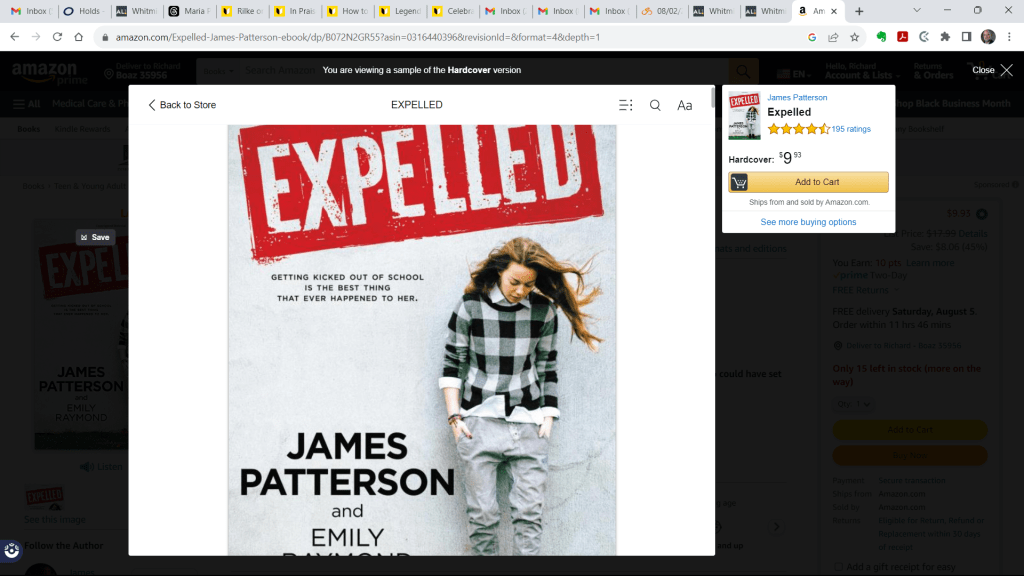
Here’s the novel I’m listening to: Expelled by James Patterson

Amazon Abstract

One viral photo.
Four expelled teens.
Everyone’s a suspect.

Theo Foster’s Twitter account used to be anonymous – until someone posted a revealing photo that got him expelled. No final grade. No future.

Theo’s resigned himself to a life of misery in a dead-end job when a miracle happens: Sasha Ellis speaks to him. She was also expelled for a crime she didn’t commit, and now he has the perfect way to keep her attention: find out who set them up.

To uncover the truth, Theo has to get close to the suspects. What secrets are they hiding? And how can he catch their confessions on camera…?


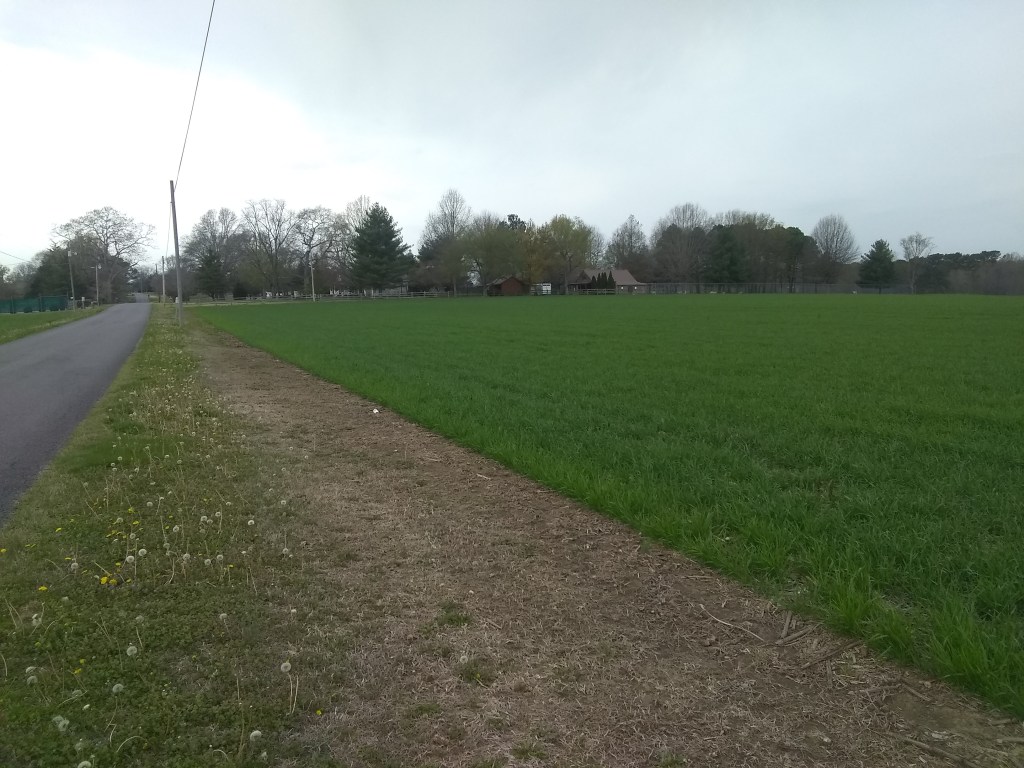
Here’s a few photos from along my pistol route:

Religion as Undue Influence

Here’s the link to this article.

John MacDonald | February 28, 2023 | Kiosk Article


If we approach the phenomenon of religious life through the lens of brainwashing and indoctrination, or what is more commonly called undue influence, a rich organizer opens up for study. Undue influence is the most established term used in the legal system for brainwashing-type phenomena. I look at these ideas through the lens of Steven Alan Hassan’s doctoral dissertation “The Bite Model of Authoritarian Control: Undue Influence, Thought Reform, Brainwashing, Mind Control, Trafficking and the Law” (2020).

One of the most important lenses to see cultic undue influence is “illusion of choice,” where it feels like you are making choices, but really you aren’t. We see a prime example of this in Christianity with the idea of “Christ in you,” and “he (Christ) who is in you is greater than he who is within the world.” We can see a full expression of this with Jehovah’s Witnesses, where it is not the individual thinking, but the individual as a vehicle for the ideology. Hassan comments:

Businesses are penalized by law for fraudulent claims or omitting vital information, but religions are exempt from this fundamental obligation. For example, the Watchtower Society’s members have to spend time every month proselytizing, and they do so by offering to study the Bible. However, those approached may be unaware that the Bible the Jehovah’s Witnesses use is denounced by Jewish and Christian scholars as theologically unsound. They should be warned. Jehovah’s Witnesses use their own “New World Translation” which lacks Biblical scholarship (Phillips, 2015). Furthermore, potential recruits are urged to be baptized by the Watchtower Society yet are seldom informed that the group forbids blood transfusions and has a practice of disfellowshipping (shunning). Members may be shunned if the elders believe a member has sinned, even for petty acts like sending a birthday card to a nonmember. Researchers assert that if an organization is to have the benefits of non-profit status, it should be required to be transparent and practice informed consent. Deceptive recruitment violates people’s religious freedom and should be illegal, and the organization’s leadership penalized. This means that a way to legally define and measure undue influence must be found. Members should have the freedom to question the leaders, the doctrine, and the policies and have the freedom to leave the religion with harassment, threats, or experiencing trauma (2020, p. 9).

Cults operate by deconstructing one’s sense of self and belief systems to then create the person anew out of that fertile soil, which Hassan characterizes as “to drastically reinterpret their life’s history, radically alter their world view, accept a new version of reality and causality, and develop a dependency on the organization, thereby being turned into a deployable agent of the organization operating the thought reform program” (Hassan, 2020, p. 3). And this is exactly how religions work—in Christianity’s case demonizing what the apostle Paul called your fleshly/worldly nature, seeing that nature as evil and replacing it with a new spiritual nature.

The replacement religious ideology is arbitrary, but because the mind is usually on autopilot, it is not scrutinized as such and so remains intact. In Thinking, Fast and Slow Daniel Kahneman, who won the Nobel Prize in Behavior Economics, says with Amos Tversky that it was “demonstrated that most human beings depend on unconscious heuristics to make fast decisions and, only when necessary, use slow, conscious data analysis” (Hassan, 2020, p. 13). Thoughtful critique necessitates going to the core of the religious beliefs of the individual, not getting weighed down in the periphery, or with random insults.

Hassan points out we can see analogous cases where people have been subjected to undue influence in other areas:

The Brandle/Heisler/Steigel model:

This model is based on domestic violence relationships, stalking, and sexual assault. It assumes that undue influence parallels these other religious situations.

There are eight factors:

  1. The victim was kept unaware.
  2. The victim was isolated from others and information.
  3. The Influencer tried to create fear.
  4. The influencer preyed on vulnerabilities.
  5. The influencer tried to create dependencies.
  6. The influencer attempted to make victims lose faith in their own beliefs.
  7. The influencer tried to induce shame and secrecy.
  8. The influencer performed intermittent acts of kindness.

(Hassan, 2020, p. 18)

It should be obvious to anyone that this is the very heart of Christianity. The potential convert is supposed to do a thorough self-inventory until they come to see how broken they are, which then provides the ground for the reconstructive starting point: the Sinner’s prayer. Religious self-help groups function in the same way, like through the 12 Steps of Alcoholics Anonymous (AA) getting you to start alcohol abstinence by admitting that you are completely lost in an addiction that you can’t fight unless you let God transform you.

There is no difference between a religion and a cult, just that religion is a cult grown larger. In this way, we can see the features of the brainwashed cult member achieved in religion. Hassan comments:

The “thought reform” or “cult” model of Margaret Thaler Singer, PhD developed from her work on the tactics used by cults and cult leaders and has been widely referenced. The model proposes six stages: creating isolation, fostering a siege mentality, inducing dependency, promoting a sense of powerlessness, manipulating fears and vulnerabilities, and keeping the victim unaware and uninformed. The model also specifies certain tactics as follows:

  1. keeping the victim unaware of what is going on and what changes are taking place;
  2. controlling the victim’s time and, if possible, physical environment;
  3. creating a sense of powerlessness, covert fear, and dependency;
  4. suppressing much of the person’s old behavior and attitudes;
  5. instilling new behavior and attitudes; and
  6. putting forth a closed system of logic, allowing no real input or criticism.

Hassan argues that Robert J. Lifton has been instrumental in identifying the most effective look-fors in identifying environments of brainwashing/undue influence. To begin with, we can see the hallmark of the religious mindset in the first of the eight concepts below: that the in-group has the only way to view reality.

(1) Milieu Control

Milieu control involves seeing the group way as the correct and only way: “I am the way and truth and life: No one comes to the father but through me,” Jesus says. “There is often a sequence of events, such as seminars, lectures, and group encounters, which becomes increasingly intense and increasingly isolated, making it extremely difficult both physically and psychologically for one to leave” (Lifton, 1961 p. 421).

(2) Mystical Manipulation

One only needs to watch Steve Martin’s movie Leap of Faith (1992) to see the lengths to which the divine is created out of whole cloth. This can range from overt lies to overemphasizing the importance of coincidence. Yes, it’s unlikely that you will experience a healing that defies medical explanation, but in a planet of 8 billion, it’s not odd that someone will hit the lottery. Really illustrating this is that the probability of you existing at all comes out to 1 in 102,685,000—yes, that’s a 10 followed by 2,685,000 zeroes! The odds of you being alive are basically zero, but we know that there is nothing miraculous about you existing. Ali Binazir explains that there is an extremely unlikely chain of events that would have to occur for you to exist (Spector, 2012).

Typical with religions and cults is to identify specific persons as being mouthpieces for God, such as Billy Graham, and cultists trust the “prophet’s” revelations infinitely more than that of the next person, as the cult leader is said to be a mediator for God. Hassan adds:

This can be understood as a misattribution error in the person influenced—that he or she wrongly attributes “divine” forces to what is basically trickery. The person thinks the influencer is reading their mind, or that there are magical forces at work, for why things happened the way they did. Another example is a person who comes to a cult “Bible study” but does not realize that the person who invited him was instructed to learn all about his background and report it to the leader. So, when the Bible study is conducted, key teachings would be made, designed to give the new person the subjective feeling that God knew “all about him” and his struggles and was directing him to become involved. (2020, p. 29)

(3) Demand for Purity

Historically, one of the traits that has been useful for control is inspiring guilt. A culture of purity thus fosters dependence and obedience. Cults specifically target the weak and broken because they are more open to the idea that they are fundamentally flawed, and so are ripe soil in which to plant the new ideology. This is what Jesus means when he says “blessed are the poor in spirit,” which has nothing to do with money, but rather with the blessednes of those who feel spiritually broken and destitute and who thus crave a new approach to life. The apostle Paul talks about how the law was given to make the hidden sin nature conspicuous, for this would awaken the Law written on our hearts and inspire repentance. Hassan comments: “Establishing impossible standards for performance, creates an environment of guilt and shame. No matter how hard a person tries, he always falls short, feels bad, and works even harder” (2020, p. 29).

(4) The Cult of Confession

Religion is egotism, such as the idea that my being tempted by someone who isn’t my wife is part of a cosmic battle for a tug of war between God and the Devil for my soul. For what’s the alternative? The alternative is that I am an insignificant evolutionary accident. The cult is interested in every aspect of the person’s life and sees the person’s thoughts and deeds as very important and in need of cultivation. Hassan says there is “a breakdown of healthy boundaries of self/group where the cult or controller believes it is their right to know absolutely everything about the individual’s life, and this person has no right to keep any secrets which includes negative thoughts and feelings about the controller” (2020, p. 31).

(5) Sacred Science

Of course, it is obvious that religions were once cults, and cults are bizarre and silly, so you see the increased drive in religion to legitimize themselves as real science. Hassan says: “The belief that the group’s dogma is absolutely scientifically and morally true, with no room for questions or alternative viewpoints, sacred science can offer considerable security to young people because it greatly simplifies the world” (2020, p. 31).

(6) Loading the Language

A large part of entrenching someone in the religious mindset is to orient the language about it. We see this, for instance, in politicians working God into their speeches, as though it legitimized them to admit that they were superstitious. Hassan comments:

Unlike a healthy use of a large vocabulary to help navigate the world, a person influenced by thought reform has a vastly reduced set of words and concepts. The term loading the language refers to a reification of language—words or images becoming sacred or divine. A much-simplified language may seem cliché-ridden but can have enormous appeal and psychological power in its very simplification. Because every issue in one’s life—and these are often very complicated young lives—can be reduced to a single set of principles that have an inner coherence, one can claim the experience of truth and feel it. (2020, p. 32)

Stephen Colbert famously satirized “truthiness,” the idea that the truth value of something comes from its sounding true rather than being true. Jacques Derrida called this the metaphysics of presence.

(7) Doctrine over Person

Ultimately, what happens to many religious people is that their experience contradicts religious dogma and predictions, which births doubt. Talk of an all-loving and all-powerful God who has a plan for your life is fine and nice, but it is also egotism, and hardly squares with a world where 3-year-old children regularly die from cancer and starvation. The argument to God from beauty—”How can you look at the beauty of a sunset and there not be a divine artist?”—is analogous, and we can ask if a spider finds the sunset beautiful, too. Likewise, doubts are placed in the mind of a schizophrenic about his delusion that he is in a secret relationship with Drew Barrymore when he goes to the bar expecting to meet up with her and she doesn’t show up. Hassan comments: “The pattern of doctrine over person occurs when there is a conflict between what one feels oneself experiencing and what the doctrine or dogma says one should experience” (2020, p. 33).

(8) Dispensing of Existence

I’ve always wondered about Christian women dating secular men. What are they going to do without them in the afterlife? (Of course, Jesus responds that there is no marriage in the afterlife!) Members of the out-group, especially former members of the cult, are seen as being a defective use of a human life, and so are demonized, which can inspire all forms of negative responses from cult members.

Analysis

Deconstructing or deprogramming an underlying narrative is neither true nor false. A child being a good friend in school is neither correct nor incorrect, it’s just that the individual and the system functions in a healthier manner (to use Friedrich Nietzsche’s model) if the child is being friendly. So, if a child is being a problem, it may be that the underlying narrative is that the child sees naughty children get more attention from the teacher than well-behaved children and so becomes the center of attention. Deconstruction here involves identifying and challenging the underlying narrative. The naughty child is “correct” in that his underlying narrative yields the results that he wants (attention from the teacher and peers), but his approach is unhealthy and causes systemic (classroom) and individual stress. The child needs to be deprogrammed of his unhealthy attention-seeking narrative and taught that there are healthy ways to get attention. The same holds true for religion. The Christian approach is predicated on the assumption that the Christian interpretation of the evidence makes the most sense, and alternative interpretations are trivialized. So it’s a kind of egotism, which we already knew because the individual has to believe that the author of all reality cares what little insignificant you thinks and does, and there is a war between the forces of good and the forces of darkness to win what you believe.

To see the interpretive underlying narrative, the believer has to assume his religion is correct, because otherwise every act of worship could be angering the true deity (Pascal’s wager be damned!). But there is a deeper internal underlying narrative. Who’s to say? Since we’re only guessing without evidence, perhaps God sent Jesus to preach love of meekness, poverty, master (God), and enemy as a test to see who has the true warrior spirit of wealth and power, so that whoever follows Jesus fails the test and goes to Hell, while whoever maintains warrior values despite Jesus’ empty threats of Hell actually proves their warrior hearts and gains paradise. There are no uninterpreted facts from the point of view of deconstruction/deprogramming, and so weight needs to be restored to other possible interpretations to lessen the force of the popular narrative. Derrida wasn’t just being a jerk or obscure, he was arguing that restoring weight to marginalized interpretations is the way to justice—for example, when we see the violence the previously valued traditional definition of marriage does to LGBTQ+ rights, it’s an occasion to deconstruct the traditional definition and reconstruct it in a more just, inclusive way.

Religiosity is fundamentally irrational, guessing without sufficient evidence, and apologists often point to gaps in scientific knowledge to insert God in that gap, though 100% of the mysteries of reality that have been solved, have been solved by science, not God. To believe in theism means to believe that God can do anything—except appear and say hi and remove all doubt!

Because religion ultimately rests on a foundation of superstition, the secularist needs to be like a sleuth with liberal theists, wading through the theists’ “naturalistic smokescreen” to get to the superstitious elements, frameworks, and foundations. If the liberal theist does not believe in life after death, this is not an issue to focus on. Remember, religion always needs to legitimize itself, because unconsciously it knows that it is illegitimate, and so will bend over backward to present itself as a science. We should not infer that someone is wise about the existential religious questions just because they are a liberal theistic critical historian of religion. To give an analogy: someone can be competent on the piano, but not on the violin. Regarding liberal theists, Richard Carrier comments:

But even liberal-minded, progressive Christians like Justin Brierley are still echoing ancient anti-empirical sentiments. Of course the reason the “response” to this observed defect in Christianity is still never to promote actually reliable methods is that that erodes faith—for reasons only obvious to atheists. Reliable methods + correct information + time = atheism…. That this is fundamental to Christianity is proved by how it infects even its liberals. As I just noted, even Justin Brierley “lets his Bible tell him to consider as ‘blessed’ those who choose to believe things without evidence,” explicitly citing John 20:2, thus demonstrating that the ancient Christian Bible’s anti-intellectualism is corrupting the minds even of its most liberal of devotees. And that’s a problem. This is why all religion is bad for us. As I wrote before, Brierley’s “religion has literally taught him to praise the rejection of evidence-based reasoning,” which is “dangerous as all hell,” a “disastrously bad effect” of his religion on his mind. And we see this across the whole of modern Christendom. It still preaches hostility to sound inductive logic, and elevates in its place completely unempirical deductive systems of logic instead, the ones most easily corrupted to sell anything as true. And even when Christians pay lip service to sound methods of inductive logic, they completely misuse them, rendering them totally unsound. (Carrier, 2022)

References

Carrier, Richard. (2022, June 1). “A Primer on Christian Anti-Intellectualism.” Richard Carrier Blogs. <https://www.richardcarrier.info/archives/20432&gt;.

Hassan, Steven Alan. (2020). “The Bite Model of Authoritarian Control: Undue Influence, Thought Reform, Brainwashing, Mind Control, Trafficking and the Law.” (Publication No. 28263630) [Doctoral dissertation, Fielding Graduate University]. ProQuest Dissertations and Theses Global.

Lifton, Robert Jay (1961). Thought Reform and the Psychology of Totalism: A Study of “Brainwashing” in China. W. W. Norton & Company.

Spector, Dina. (2012, June 11). “The Odds Of You Being Alive are Incredibly Small.” Business Insider. <https://www.businessinsider.com/infographic-the-odds-of-being-alive-2012-6&gt;.

You may regret reading this

Here’s the link to this article.

Avatar photoby ADAM LEE JUL 31, 2023

A man doubled over, holding his head in regret | You may regret reading this
Credit: Alex Green, Pexels

Overview:

The religious right’s legislative strategy of the moment is to restrict abortion and gender transition because some people might later regret them. But why don’t they apply that same logic to other major life decisions?

Reading Time: 5 MINUTES

“Abortion regret” has been a linchpin of the anti-choice strategy for decades. Before they had the power to ban abortion, conservative legislators tried to guilt and shame women out of seeking termination. They spread bogus narratives and required doctors to read scripts full of misinformation that abortion causes depression. They even floated the idea of allowing women to sue their doctors, even years later, if they changed their minds and decided getting an abortion wasn’t the right decision.

More recently, the religious right has adopted the same strategy with transgender people. Conservative pundits say that a small number of people who transition regret the choice and try to undo it. They consider this an adequate reason to ban or severely restrict surgery and hormones for everyone.

Now, it should be said: if conservatives really stand for “freedom”, then whether or not people regret these things should be irrelevant. Real freedom means having the right to make our own choices and then live with the consequences. It doesn’t mean paternalistically restricting people’s choices in the belief that we know better than they do.

However, there’s a better argument to prove that this is a bad-faith strategy. Namely, they aren’t trying to discourage people from making other decisions that millions regret, because those choices line up with the conservative vision of the world.

Let’s look at some examples:

Getting married. Although Christian conservatives treat marriage as the ideal state of human existence, actual humans seem to disagree. In 2021, the U.S. had 1,985,000 marriages and 689,000 divorces, or slightly more than one divorce for every three marriages.

Clearly, a large fraction of people regret getting married. Does that mean we should ban marriage, or make it harder for people to marry? Should we have legally required premarital counseling, or mandated waiting periods?

By Republican logic, the answer would be yes. However, conservatives aren’t pushing for this, but the opposite. The next step in their culture war is seeking to repeal no-fault divorce laws. In other words, they want to make divorce harder. Instead of making it easy for people to undo a choice that they regret, conservatives want to force them to live with it. They want to keep people stuck in marriages that they don’t want to be in.

A fact that probably has a lot to do with this is that 70% of divorces are initiated by women. The Republican opposition to abortion and LGBTQ rights are just prongs of their overarching goal, which is the restoration of patriarchy. They want to bring back a world where straight white men ruled over everyone else, and getting rid of anything that allows women to be independent brings that goal closer.

Getting a tattoo. In most states, you can get tattooed the day you turn 18. But while a tattoo is permanently etched into the skin, most of us grow, mature and change over the course of our lives. A tattoo that feels deeply meaningful to a person when they’re young may seem dated or downright embarrassing to them ten or twenty years later.

According to one survey, about one in four people with tattoos regret getting them. Should we consider outlawing or restricting tattoos to stop this regret?

Cosmetic surgery. Although conservatives are fixated on transgender people getting hormones and sex-change operations, millions of cisgender people also get surgery that alters their bodies. They get liposuction, breast implants, tummy tucks, calf implants, facelifts, chin implants, nose jobs, lip fillers, hair plugs, Botox injections, and more. We might also call these “gender-affirming” procedures, insofar as they bring people closer to what they consider the ideal appearance for their gender.

Some cosmetic surgeries are done to fix serious defects or disfiguring injuries, but others are merely for vanity. Even teenagers are getting these operations. (One hair-raising example that I’d never heard of before and that I came across while researching this article: doctors giving estrogen to girls to keep them from growing too tall.)

By some figures, the regret rate for plastic surgery is almost two-thirds. There’s no shortage of stories about celebrities who get addicted to surgery and regret the results.

If protecting kids is the goal, shouldn’t Republicans be slapping harsh restrictions on these procedures? Putting onerous regulations on plastic surgery clinics? Calling for prosecution of parents who allow their kids to get it?

Getting knee surgery. Research suggests that as many as 20% of knee-replacement patients are dissatisfied with the results. That’s a shockingly high percentage for major surgery, far higher than reported regret rates for abortion or gender transition.

As with plastic surgery, you’d think that conservatives would be against this. Should we force elderly patients to go through counseling and a waiting period? Requiring orthopedic doctors to read scripts about how these operations are dangerous and unlikely to go well?

Playing football. What parent would choose to inflict brain damage on their children? But that, like it or not, is the consequence of playing tackle football and other violent sports.

The brain is soft and squishy as a bowl of Jello. Whenever a person takes a hard hit to the head, their brain slams against the inside of their skull, bruising and tearing the delicate connections. Even hits that don’t cause concussions, when they’re repeated thousands of times, cause cumulative damage.

CTE—chronic traumatic encelopathy—is the result. The symptoms aren’t pretty: dementia, mood swings, impulsive and violent behavior, and suicidal tendencies. Athletes with CTE, and their families and loved ones, undoubtedly rue their choice to play these sports. To save people from this suffering and regret, we should give serious thought to banning football and any other sport that entails frequent blows to the head.

Buying a home. According to a 2022 survey by Zillow, 75% of recent homebuyers have regrets. Some people regret buying a house that was too expensive or needed too much maintenance, others that they didn’t look longer or search harder before buying.

What is the government doing to protect people from these regrets? Should homebuyers be able to sue sellers if they regret their decision? If this isn’t something the state should intervene in, why does it have an interest in other, equally consequential decisions?

Joining a religion. In the last few decades, there’s been a spiritual exodus in America. Millions of people are leaving the religions they grew up in. Some are switching to other faiths, while others are giving up on organized religion entirely. Of these ex-believers, many speak eloquently about the trauma they suffered from abusive, controlling, high-demand belief systems.

If you join a church and later decide it didn’t meet your needs, or even that it inflicted psychological or physical harm on you, should you be able to sue that church to compensate you for your regret? If not, why not?

Having children. In a society that holds family as a sacred ideal, it’s intensely taboo to admit this, or even to talk about it. Nevertheless, surveys consistently find that a minority of parents regret having children:

When American parents older than 45 were asked in a 2013 Gallup poll how many kids they would have if they could “do it over,” approximately 7 percent said zero. In Germany, 8 percent of mothers and fathers in a 2016 survey “fully” agreed with a statement that they wouldn’t have children if they could choose again (11 percent “rather” agreed). In a survey published in June, 8 percent of British parents said that they regret having kids. And in two recent studies, an assistant psychology professor at SWPS University, Konrad Piotrowski, placed rates of parental regret in Poland at about 11 to 14 percent, with no significant difference between men and women. Combined, these figures suggest that many millions of people regret having kids.“The Two Reasons Parents Regret Having Kids.” Gail Cornwall, The Atlantic, 31 August 2021.

Regretful parents cite all manner of concerns: from a lack of free time and money, to exhaustion and burnout, to the especially grueling challenges of raising special-needs children. Some people regret having kids with an absent or abusive partner, while others never wanted kids but had them to appease a partner who did.

Having children is the most personal decision a person can make. No other choice has such immense and intimate consequences, whether for better or for worse. That’s why it’s so abhorrent for any outside force to interfere in it, one way or the other. It shows the extreme hypocrisy of political parties that cite “regret” as a reason to ban abortion, but feel no concern about forcing people to have children whether they want to or not.

The Boaz Stranger–Chapter 21

“Lee, Lee, wake up.” It was Mom, and we were in Panama City. My twelve-year-old self had been at the beach outside our hotel, lying on my stomach for hours. Mom, Dad, Kyla, and Lillian had gone to a mall and left me alone. “You need to take this.”

I opened my eyes and wondered why Kyla looked so old, and why I needed the pill and glass of water she was holding. “Sunburned?” I knew that’s what it was because I’d already seen myself in bed in this very room for a week after we’d returned from vacation. How was I still on the beach and why was Kyla’s hair streaked with gray?

“Lee, you’re dreaming. Sit up and take this.” The old Kyla raised her voice. She set the pill and the glass on my nightstand and started tugging at my tee shirt. She forgot my shoulder.

“Shit.” 2020 rushed inside my old bedroom like a wave at high tide. “What time is it?”

“Almost midnight.” It was then I noticed Kyla’s face matched that of a ghost. She had some sort of white cream smeared everywhere there weren’t eyeballs or a mouth. Her night gown reminded me of Mother. “Your prescription says you can take one pill every four to six hours as needed for pain. You’ve been groaning and moaning ever since Lillian left.”

That last fact was confusing. It wasn’t connected to anything else I knew other than Lillian had delivered me home. Painfully, I sat against the headboard and realized I was nearly naked. Underwear and a tee-shirt. The weird thing is I had no memory of undressing and crawling into bed. Heck, I didn’t recall walking inside Kyla’s house at all. I swallowed the pill. “I’m sorry to be so much trouble.”

Typical Kyla. “Why start now?” Without missing a beat, sis continued. “Mark it down in your little book. Tomorrow we’re going to have a talk about what’s going on. You hear?”

I nodded. “Okay.”

“If Lillian’s theory is correct, you’re fighting a losing battle and a mild head wound and a bruised shoulder are the least of your troubles.”

I was in no mood for this conversation, but ‘theory’ had my attention. “What did Lillian say?”

“Later. You get some rest. I’m headed upstairs but here’s a whistle if you need me.” Kyla left. I inched my body back horizontally.

I was asleep before she was halfway up the stairs. The Vicodin kicked in soon afterwards, followed by a speed of light return to 1970. During the next several hours, I experienced a virtual replay of my last two years of high school.

Lillian was the first girl I ever saw naked. In person. It was New Year’s Day 1970. Until that experience, I had always viewed my sister’s best friend as just a member of our household, like Mom, Dad, Kyla, and Kyle. She was part of the family, just another sister. I think it was my infatuation with Rachel that had blinded me to the metamorphosis happening right before my eyes.

Our pond froze six inches deep. According to Dad, it was the worst ice storm since March 1960. Lillian and Kyle had already spent two nights at Harding Hillside. After a big breakfast on the first day of the new year, Mom suggested we bundle up and get some exercise. That seemed to connect with Lillian and Kyla. They quickly raced from the kitchen to her upstairs bedroom. Mom asked me to grab her camera from her desk. Years earlier, she’d fashioned an office of sorts from an upstairs closet.

When I entered the hallway, Kyla’s door was open, and I heard laughing and singing but continued. It didn’t take a minute to find Mom’s camera. I tiptoed back to Kyla’s room, planning on executing one of my best scare tactics. When I peeked my head around the door frame, the most unbelievably gorgeous site of my young life met me. Apparently, Kyla was changing inside her walk-in closet, but there stood Lillian facing away, towards Kyla’s bed and the room’s sole window. I even recall how the incoming light created a shadow on the floor that matched Lillian’s hour-glass figure.

She must have heard my mind revving like a car engine. She turned and saw me, doing nothing except slipping inside the thermal top she was holding. I’ll never forget her smile and her boobs, not to mention anything else. That day, I learned Lillian was a young goddess. She might have a teenage mind and a queen-size Southern drawl, but her body was the epitome of a Playboy’s luscious centerfold.

My dreaming, hallucinating was more like it, had continued nonstop until 4:37 a.m. according to the digital clock/radio on my nightstand.

It might have been a hard fall on the ice that morning that changed the directory of my life and my Vicodin adventures. It wasn’t my head slamming against the pond’s concrete surface when I was showing out for who? No, not Mom and Dad. Instead, it was the unplanned and totally unexpected experience of seeing the naked Lillian that changed the trajectory of my life. At least for the next two years.

I doubt if I would have ever had the courage to ask Lillian for a date. I was more of a nerd; no way am I a narcissist. That was my understanding of what a guy had to be to have the courage to ask out the prettiest girl in the universe. Yes, that’s how star struck I was. Fortunately, I didn’t have to conjure up the courage or attempt the impossible transformation toward loving myself to the extreme. On the twentieth day of January, Lillian asked me to the Valentine’s Dance.

It seemed like a five-minute fight to crawl out of bed. There were four of us entangled, me, of course, along with a sheet, a thermal blanket, and a quilt. The latter was one of Mother’s beautiful designs. I wondered why I was sweating.

At 4:59, I exited my bedroom and inched toward the kitchen. Exhausted, but proud. Somehow, I’d been able to slip inside the sweat-suit Kyla had left hanging over my rocker, not to mention my bathroom adventure of off-loading pee, washing my face, and brushing my teeth.

***

Kyla was sitting at the kitchen table sipping coffee and reading Chambers, her since-middle-school devotional. Kyla’s faith had always been a strong flame. I’d also read Oswald Chambers’ My Utmost for His Highest. That daily practice stopped when Rachel killed herself. My faith had weakened since my youth, flickered after her overdose, and slithered away to hide under the proverbial basket after she hung herself. That eventually prompted my research into the overwhelming facts of pain and suffering. Ultimately, the truth of reality doused my faith forever.

“Fresh coffee.” Sis said without raising her eyes.

“Thanks.”

“Why are you up so early?” I poured a cup and wondered if Kyla was wishing I hadn’t disturbed her.

“Too tired and worn out to sleep.”

“Uh?” Kyla said, laying Chambers face down on the table.

“The bananas were too ripe.” Why couldn’t we siblings have a normal conversation, absent the jokes, digs, and sarcasm? Before she responded, other than giving me her best quizzical look, I leaned back against the kitchen sink and shared street slang for Vicodin and Dr. Claburn’s hilarious story.

I thought about sharing a few of my late-night hallucinations but concluded that was off-limits for brother-sister talks. Kyla motioned me to join her at the table. “Promise me you won’t be mad if I tell you I snooped inside your briefcase.”

My mind had slowed a million degrees since last night’s light speed wanderings. Briefcase? It was on the back seat of the Explorer. It’s still in the Walmart parking lot. “Uh?” Kyla and I learned this word when we were quite young.

“After Lillian and I got you in bed.” Sis stopped and released her trademark yelp. It only appeared in those rare foot-in-mouth moments. “Man, did that sound sexual.”

“I understand. The two of you stripped me down. I don’t remember being gratified.”

“Ugh, that’s a mental picture I’ll burn. Listen, big brother. After you zoned out, Lillian suggested she return to Walmart and secure your vehicle. She had seen your briefcase lying in the seat. Also, she worried about the back door. It’s badly damaged. It doesn’t fully close.”

“So, the two of you preyed on my vulnerability, concocting a scheme to steal my money?” The Harding siblings are far from normal.

“Shut up and play civil. It was an innocent mistake. Well, mostly. When she grabbed the briefcase’s handle, the contents went flying. Apparently, you hadn’t snapped it shut the last time you used it. Long story short is that Lillian couldn’t help but see Rachel’s diary and a receipt from Micaden Tanner’s office. After she returned, the two of us talked, even engaged in a little speculation.” Kyla walked to the coffeemaker and refilled her cup. “Want more?”

“No. So, I might as well be interested in the story you two thieves have conjured.” My phrasing was still off.

“Lee, where in heck did you get a gun and why did you give it to Micaden Tanner?” Kyla’s question wasn’t bad. She’d already reasoned I could not have cleared airline security with a pistol in tow. But, not to credit smart sister too much, it appears she hadn’t connected the Hunt House to the mystery gun.

Oh well, I might as well take in some new partners. Over the next half-hour, I painted Kyla a rough picture of what I’d pieced together since finding Rachel’s basement-concealed diaries. This included search and discovery at the Hunt House Friday night. I started not to mention Rachel’s pregnancy and abortion, but these were the moon, the mountain, and the merciless ocean of the landscape I was painting. After relaying that Ray Archer must have killed Kyle Bennett, I warned Kyla about discussing these details with Lillian. I also promised to fabricate a story about the pistol.

“Big brother, I know you’re a little slow but hear me out before you write off your first lover.”

I wanted to lasso that calf and tie it up, neck and legs (the Vicodin?), but shook my head sideways instead. Kyla could be wrong on so many levels. “I assume we’re speaking of Lillian.”

“Well, duh, who else? Okay, let’s move along. The married woman who’s always had your back left here a little before midnight. While you were tossing and turning, moaning and groaning, she was a dog after a bone.”

“Did she find it?” At most, I guessed Lillian had followed up with the Boaz Police officer who had dropped by the ER. The sharp pain erupted from my shoulder when I made too-quick-a-reach for the sugar bowl. I hoped Lillian had not broken her promise to stay mum. My mind was still several thousand degrees below optimum processing.

“She did. With some help. Lillian is not dumb, nor is she untrustworthy. She called and got her investigator out of bed, and he awakened one of his contacts. You can read the email she sent about an hour ago.” Kyla pointed to the couch. Until now, I hadn’t noticed her laptop.

“Investigator?” Why would Lillian need an investigator? A couple of vague reasons started revealing themselves.

“Oh, sorry. Lillian said not to give you any of her personal information. She didn’t know if she could trust you.”

“Uh?”

“I’m kidding, you dote.” Kyla stood and retrieved her laptop. “Do you want to know the name, address, and phone number of the owner of a 2014 blue Chevrolet Silverado?”

“Shit, Lillian doesn’t fool around.” Five thousand degrees.

“Let’s not go there. Derrick Hart’s your man. Well, he’s the owner of tag number ‘USA4GOD.’” Kyla turned her laptop screen so I could see. Lillian’s email was open.

I scanned the three short paragraphs and then reread them more closely. Two things caught my attention. The first was the name of Lillian’s investigator: Connor Ford. Interesting that she was using the same guy Micaden had recommended I use. The second was Lillian’s admonition to Kyla for her to keep quiet about anything related to the tag number. I liked her last statement: “Lee will know what to do. Remember, he plays chess; we play checkers.” The Vicodin almost triggered another hallucination.

I looked over the laptop’s screen at Kyla. She was shaking her head sideways. “Do I want to know what you’re thinking?” She and Rachel had always said I over-think everything. “You need to give this information to the police. They can hunt him down and charge him with attempted murder. Right?”

I wasn’t interested in Kyla’s question. What I needed to know was something far more personal. “Sis, this might be uncomfortable for you, but I have to know. So, be honest. How long have you known about Rachel’s high school pregnancy and abortion?”

I wasn’t expecting such a quick and hurtful response. “Since eleventh grade.” Kyla’s eyes teared as she mouthed the words, “I’m sorry.”

“One last question, for now. I know you have things to do.” Today was Thanksgiving, and Kyla had volunteered to help with the community meal at the church. She used a napkin to wipe her eyes. “To your knowledge, who else was aware of Rachel’s situation?”

This time she paused, like she was alphabetizing a long list of names. “Jane, Lillian, and me. Ray and Rachel, of course, and their parents.”

“Kyle Bennett?”

Kyla shook her head. “Not that I know.”

Modern Liberalism Born of Enlightenment Thought

Here’s the link to this article.

James A. Haught | March 31, 2023 | Kiosk Article

Ethics-Morality | Freethought | Philosophy | Politics | Rationalism ]


Values that later grew into liberalism began stirring in the epoch now known as the Enlightenment, starting more than three centuries ago, chiefly in England and France. It was an era when kings still ruled brutally by “divine right,” and the church still sought to execute “heretics” holding irregular beliefs, or jail skeptics for blasphemy. Most people were agricultural serfs, working on lands inherited by wealthy barons and counts. The bottom-rung majority had virtually no rights.

But the Enlightenment roused a new way of thinking: a sense that all people should have some control over their lives, a voice in their own destiny. Absolute power of authorities—either the throne or the cathedral—was challenged. Reformers asserted that human reason and the scientific method can improve society and benefit nearly everyone.

The 1600s were a time of ugly intolerance, much of it stemming from alliances between church and throne. In England’s notorious Star Chamber, controlled by the Anglican archbishop, Puritan and Presbyterian dissenters were forced to testify against themselves, then sentenced to have their ears cut off or their faces branded with markings such as S. L. (for seditious libeler). One victim, John Lilburne, became a public hero because he wrote pamphlets claiming that all people deserved “freeborn rights” not subject to king or church.

Europe was emerging from horrors of religious wars and massacres between Catholics and Protestants. Catholic France persecuted Huguenot Protestants. Jews were attacked cruelly and banned from certain nations, including England. Sporadic executions of “heretics” and “witches” still occurred. England’s last accused witch was put to death in 1684. A few others were executed around Europe and the New World for another century.

This was the background that helped spawn Enlightenment reform.

England was shattered by civil war in the 1640s between Parliament and Puritans on one side versus King Charles I and Anglicans on the other. Charles was beheaded and the power of kings was reduced—expanding an erosion that began four centuries earlier when barons forced King John to sign the Magna Carta, yielding certain rights.

By the late 1600s, some thinkers began pondering society and government.

Thomas Hobbes (1588-1679) wrote Leviathan asserting that people need a “social contract” to secure safe lives. In a dog-eat-dog natural state, he said, everyone suffers from “continual fear and danger of violent death; and the life of man [is] solitary, poor, nasty, brutish and short.” Therefore, he said, people must yield power to a sovereign government to enforce order and protect them. Hobbes supported a king as the sovereign—but the tide away from absolute kings already was flowing. Hobbes raised awareness that the social order is made by humans, not by God.

In his many writings, Hobbes repeatedly affronted the clergy. A bishop accused him of atheism, possibly punishable by death. The allegation subsided, then flared again. Nearing 80 years old, Hobbes hastily burned some of his papers and eluded prosecution.

John Locke (1632-1704) hatched notions of democracy, arguing that all people, male and female, deserve a degree of equality. He dismissed the divine right of kings, and advocated separation of church and state to avert religious conflict.

John Milton (1608-1674) was more than an epic poet who wrote in four languages. He also supported popular government and attacked state-mandated religion. When Parliament imposed censorship on writings, he defied a licensing requirement and published an Areopagitica pamphlet claiming that all thinking people are entitled to free expression of their beliefs. “Books are not absolutely dead things,” he said. “He who destroys a good book kills reason itself.” The principle of free speech and free press was furthered.

In France, Baron de Montesquieu (1689-1755) championed democracy and envisioned an elected government with power divided between executive, legislative and judicial branches.

Francois Marie Arouet (1694-1788)—”that consuming fire called Voltaire,” as Will Durant called him—was a brilliant French writer who became a heroic champion of human rights. Endlessly, he denounced cruelties of bishops and aristocrats. Here’s an example: In the devout town of Abbeville, a teen-age youth, Francois de la Barre, was accused of marring a crucifix, singing impious songs and wearing his hat while a church procession passed. He was sentenced to have his tongue torn out, his head chopped off, and his remains burned. Voltaire wrote bitter protests against this savagery. He helped appeal the youth’s case to Parliament, which showed “mercy” by affording the blasphemer a quick death by beheading—with a copy of Voltaire’s Philosophical Dictionary nailed to his body.

Voltaire’s protest writings roused ferment across Europe and won reversal of a few cases. He freed Jean Espinas, who had spent 23 years aboard a penal galley ship because he sheltered a fugitive Protestant minister for one night. Likewise, he freed Claude Chaumont from a galley bench, where he had been sentenced for attending a Protestant worship service.

In The Rights of Man, Thomas Paine wrote that Voltaire’s “forte lay in exposing and ridiculing the superstitions which priestcraft, united with statecraft, had interwoven with governments.”

At first, Enlightenment ideas were somewhat suppressed in Europe, where kings and archbishops still prevailed, but they found fertile ground in America’s colonies. Brilliant radicals such as Thomas Jefferson, John Adams, Benjamin Franklin and James Madison read them ardently and adopted them as a pattern for the first modern democracy, the United States of America. In the Declaration of Independence, Jefferson summed up the essence:

All men are created equal and endowed by their creator with certain inalienable rights, among these life, liberty and the pursuit of happiness.

Less-known founding father George Mason incorporated the principles into the Bill of Rights, keeping church and state apart, guaranteeing free speech, and protecting each person from abuses by the majority. Similarly, the personal liberties were reiterated in the Rights of Man and the Citizen adopted by the French Revolution, and eventually in the Universal Declaration of Human Rights that Eleanor Roosevelt helped craft for the United Nations.

Thus democracy became self-contradictory. A basic premise is majority rule—yet a bill of rights prevents majority rule. For example, the Christian majority cannot vote to banish minority Jews or skeptics. Personal beliefs are exempt from majority rule.

The Enlightenment was the seedbed that sprouted most of the liberal freedoms now enjoyed in democracies everywhere. It projected a model for humane, safe, fair modern life.

08/07/23 Biking & Listening

Biking is something else I both love and hate. It takes a lot of effort but does provide good exercise and most days over an hour to listen to a good book or podcast. I especially like having ridden.

Here’s my bike, a Rockhopper by Specialized. I purchased it November 2021 from Venture Out in Guntersville; Mike is top notch! So is the bike, and the ‘old’ man seat I salvaged from an old Walmart bike.

Here’s a link to today’s bike ride.


Something to consider if you’re not already cycling.

I encourage you to start riding a bike, no matter your age. Check out these groups:

Cycling for those aged 70+(opens in a new tab)

Solitary Cycling(opens in a new tab)

Remember,

Photo by Suzy Hazelwood on Pexels.com

Halfway through today’s ride I started listening to:

Here’s a link to this show notes page.


Here’s the novel I’m listening to: Expelled by James Patterson

Amazon Abstract

One viral photo.
Four expelled teens.
Everyone’s a suspect.

Theo Foster’s Twitter account used to be anonymous – until someone posted a revealing photo that got him expelled. No final grade. No future.

Theo’s resigned himself to a life of misery in a dead-end job when a miracle happens: Sasha Ellis speaks to him. She was also expelled for a crime she didn’t commit, and now he has the perfect way to keep her attention: find out who set them up.

To uncover the truth, Theo has to get close to the suspects. What secrets are they hiding? And how can he catch their confessions on camera…?


Here’s a few photos from along my pistol route:

James A. Haught: Religion fading as intelligence rises

Here’s the link to this article.

The Religion News Foundation, Religion News Service, Associated Press and The Conversation recently announced the creation of a global religion journalism initiative, an effort to expand religion news reporting in the United States and around the world.

The initiative is funded by a $4.9 million grant from Lilly Endowment.

The endowment says part of its mission is to “deepen and enrich the religious lives of American Christians” and to “foster public understanding about religion and help lift up in fair and accurate ways the contributions that people of diverse religious faiths make to our greater civic well-being.”

Columnist James A. Haught, former editor of West Virginia’s largest newspaper, The Charleston Gazette-Mail, said he “suspects that Lilly is trying to buy a whitewash to offset endless ugly headlines about religious horrors and cruelties around the world. I wanted to give the project a jolt. Half sarcastically, I offered to write ‘curmudgeon columns’ for the Lilly-funded enterprise. Here is my first one (which I assume is doomed to rejection).”

By James A. Haught

Supernatural religion is a colossal system of falsehoods. Invisible gods, devils, heavens, hells, angels, demons and other magical church entities don’t actually exist. They’re just concoctions of the human imagination. Yet they’re the basis of a trillion-dollar labyrinth of worship around the planet.

Widespread belief in such spirits shows a deep flaw in the supposedly logical minds of our species. It’s akin to fairy tale beliefs of children.

The most dishonest people are clergy who endlessly declare God’s commands, as if an imaginary being really gave commands. I wonder how many ministers realize, at least subconsciously, that they’re spouting lies?

Studies show that religious skeptics have higher intelligence than religious believers. Maybe that’s why brilliant thinkers throughout history have doubted religion.

In Ancient Greece, thinker Prodicus reportedly said: “The gods of popular belief do not exist.”

In medieval times, while the Holy Inquisition burned skeptics, Michel de Montaigne wrote: “Man is certainly stark mad. He cannot make a worm, yet he will make gods by the dozen.”

As American radicals launched the first modern democracy, Thomas Jefferson wrote: “The day will come when the mystical generation of Jesus, by the supreme being as his father in the womb of a virgin, will be classed with the fable of the generation of Minerva in the brain of Jupiter.”

Jefferson also wrote, in an 1820 letter, that ministers “dread the advance of science as witches do the approach of daylight.”

Thomas Edison scoffed: “Religion is all bunk.”

Albert Einstein told The New York Times in 1930 that he couldn’t believe in a personal god, adding: “Neither can I believe that the individual survives the death of his body, although feeble souls harbor such thoughts through fear or ridiculous egotism.”

There you have it. The brightest people have always known that supernatural church dogmas are untrue.

The Flynn Effect shows that the average American I.Q. rises three points per decade. Educated folks are getting smarter. Maybe that’s why religion is dwindling rapidly in the United States, as it has done in Europe.

At least one-fourth of American adults now say their religion is “none” — and the ratio is one-third among those under 30. Supernatural faith is dying, right before everyone’s eyes. A new secular age is taking shape. Scientific honesty prevails. Hurrah.

It may seem harmless that millions of older Americans still attend church and pray to imaginary spirits that don’t exist. But religion has a dark side that is profoundly harmful.

It has cropped up since the time of human sacrifice, Crusades, Inquisitions, witch hunts, holy wars and pogroms against Jews.

Today, the vile side of faith erupts in Muslim suicide massacres, child molestation by Catholic priests (and Protestant evangelists), opposition to the teaching of evolution, resistance to sex education and birth control, cruel hostility to gays, opposition to lifesaving stem cell research, etc.

Another vile aspect of religion is the adherence of white evangelicals to the Republican Party. Jesus was allegedly a liberal who urged followers to help the poor, feed the hungry, heal the sick, clothe the naked and aid underdogs.That’s the formula of the social “safety net” backed by Democrats. Yet, white fundamentalists vote overwhelmingly for the GOP, which seeks to slash the safety net. In effect, those believers oppose Jesus.

It’s fortunate that supernatural religion is fading as America grows more intelligent. Bring it on. The faster the better.

James A. Haught is editor emeritus of West Virginia’s largest newspaper, the Charleston Gazette-Mail.

The hour of choosing has arrived

Here’s the link to this article.

STEVE SCHMIDT

AUG 6, 2023

Perhaps it is best to start by looking back at the moment immediately before Donald Trump descended via escalator in Trump Tower into the 2016 presidential race on June 16, 2015.

Two thousand nine hundred and seventy-two days have passed since then, and the end stage of a great American travesty and tragedy is at hand. What lies beyond it is unclear because behind us is a vast wreckage field where shards of shattered trust and the jagged edges of obliterated integrity lay scattered. The American people have lost faith in their society, and become estranged from the nation’s most important institutions. They disdain the media, politics, politicians, political parties, powerful tech companies, billionaires, corporations and a system where there seems to be one set of rules for people at the top, and one for everyone else.

Trump’s rise is a symptom, not the cause, of America’s current cancer. A man like Trump simply does not get elected to the presidency of a stable and healthy country. He is a marker of decay and a catalyst for it. His presidency was a vicious cycle of degradations, national humiliations, collaboration, betrayal, failure and incandescent cowardice. It has led us here — to this epic hour where the citizens of the United States must make a decision for the future that will either begin an era of renewal and reform, or one that cripples American democracy and murders the republic born in 1776. Whatever the choice may be, it will be made by this generation of Americans on the eve of America’s 250th anniversary of independence.

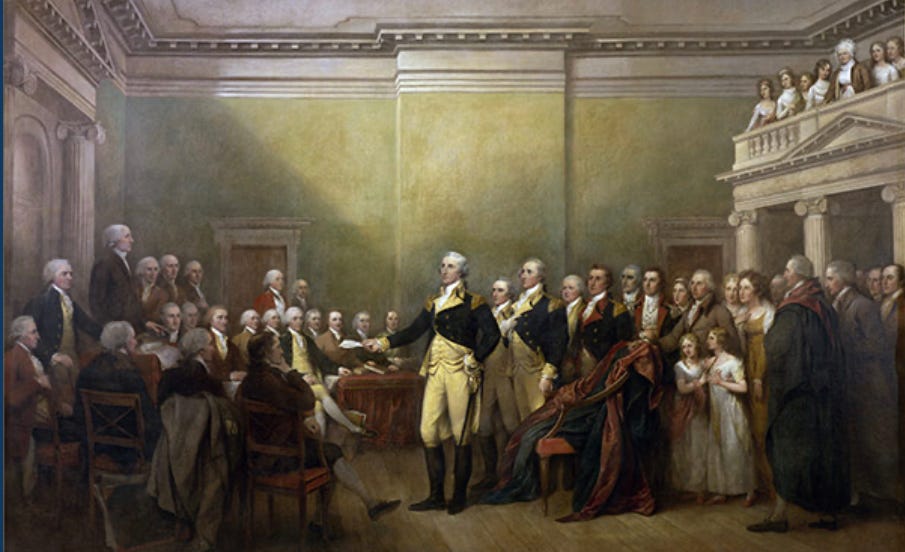
Maybe we wouldn’t have gotten here if there wasn’t so much arrogant disdain for the achievements of our ancestors and the magnificence of their most noble acts. There has never been a just or perfect era in America’s story. Instead, there has been the opportunity for progress and the expansion of justice handed to each generation of free citizens who can all claim the legacy of America’s founding. The unfolding story of American liberty is among mankind’s greatest achievements. Understanding the story and knowing the details is essential to its survival and continuation. Let us talk about George Washington. Washington is America’s most important and wisest teacher. His lessons were about humility. There is great strength through authentic humility. America should remember this:

This painting by John Trumbull of General Washington resigning his commission hangs in the rotunda of the United States Capitol. Notice the chair larger than the rest draped with a cloak. It symbolizes Washington’s act of resigning from his position of power. Turnbull considered this to be amongst the “highest moral lessons ever given to the world.”

Washington entered the chambers of the Maryland State House where the Congress of the Confederation had convened for a highly scripted ceremony that had been meticulously planned down to the last detail. The date was December 23, 1783, and Washington had come to lay down his power. He could have been Caesar. Instead, he became president six years later when his country called him to service again. Washington could have been a tyrant or a king. He chose a different path because of the magnificence of his character.

The Warning with Steve Schmidt is a reader-supported publication. To receive new posts and support my work, consider becoming a free or paid subscriber.

Upgrade to paid

The great tragedy of this moment is that Trump’s delusions simply needed to be repudiated with the truth. Yet there was none to be found on a vast desert of MAGA cowardice, where the essence of the American system was left undefended lest it piss Trump off. The fear of mean tweets is all it took to undo the act of humility that made the nation spring to life.

When Trump sent his mob to reverse Washington’s submission to Congress and make him dictator, they paraded past the old painting of George Washington. The criminals who attacked on Trump’s orders smeared excrement on the walls of the Capitol and urinated on the floors of the US Senate and House. They desecrated America’s capitol and founding with treachery and venom. It was a despicable act, and it was created by Trump. It was his moment. His actions were a declaration of repudiation against what Washington fought to create. Shameful doesn’t begin to describe it.

We the people must not tolerate it any longer. It is time to move on to a new era and leave Donald Trump behind. There is no way to support Trump and maintain loyalty to America. They are antithetical propositions and the hour of choosing has arrived. Soon we will know.

The Boaz Stranger–Chapter 20

I noticed the jacked-up blue truck in my rear-view after I turned right off Highway 431 and passed McDonald’s. It came out of nowhere. I slowed, not wanting to wreck my rental and deal with that hassle. By the time I eased into the curve at five-points, the driver tightened the gap between our vehicles and started blasting his horn. I veered to the right towards Y-Mart to give the idiot all the space he needed to pass. Finally, he jerked his behemoth to the left and pulled next to me. There, he stayed, until we reached Mill Street Deli where he sped ahead, but not for long and not far enough. The right side of his rear bumper clipped my left front fender when he reentered my lane. I barely controlled the steering wheel to avoid leaving the road and barreling into the Domino’s Pizza parking lot. The idiot gave me the middle finger through his opened driver’s side window as he raced west towards downtown.

My hands were shaking, and my brow was sweating. I almost pulled into the Key West Inn to gather myself but didn’t. Although I was running a little early for my 1:00 PM appointment, I was ready to shed the responsibility for managing the pistol I believed had killed my best childhood friend.

I successfully timed two red-lights, crossed the railroad tracks, and turned left into the parking lot Micaden and eight other businesses, including First State Bank of Boaz, shared. I easily found a spot and parked. When I exited the Explorer, I looked around in all directions before removing the plastic-wrapped Smith & Wesson from beneath the floor mat. I quickly secured it inside my briefcase and walked even faster towards the law office, feeling more vulnerable than ever. Tina, the take-charge secretary/paralegal, was standing at the all-glass front door and welcomed me in. I felt safe. It turned out that Micaden had an emergency hearing in Etowah County and wasn’t available to meet. Tina assured me she’d lock the pistol in their safe.

I thanked her and returned to the Explorer. After circling the parking lot, I turned right and re-entered Highway 168. My luck was missing. I hadn’t gone twenty feet beyond the railroad track until the same damn truck slid in behind me; it couldn’t be an inch away from my rear bumper. At least this time, the damn horn wasn’t blasting.

***

The driver slowed when a Boaz Police car eased past us on the left. By the time I made it past five-points, the blue truck had faded to ten car lengths behind. Things stayed the same until I passed Pizza Hut and turned right a block from Walmart. I circled to the front of the Grocery section hoping I’d find a parking spot near the building entrance. Again, luck was on vacation.

Rachel had always advised, even demanded, I make opportunities for exercise. Today, I didn’t have a choice. I assumed Thanksgiving was the cause. I finally found a spot nearly a mile away, or so it seemed.

I exited the Explorer and walked to the rear passenger door to remove a box containing a new crock pot Kyla had asked me to return. The inner pot had cracked. Before removing the box, I checked my wallet to make sure I’d inserted the receipt. The last thing I remember was that it was still lying on the kitchen counter. Lucky for me, luck returned. I found it tucked where I’d put it.

Before I could fold my wallet and return it to my back pocket, I heard the blue behemoth. I turned to my right just enough to see the idiot barreling straight for me at maybe a forty-five-degree angle from where my Explorer was setting. A smothering fear engulfed me a split second before a knife-like pain tore through my left shoulder. I’m not sure, but it seemed the driver veered to his left a second before his bumper slammed into my Explorer’s right side passenger door. Like football, life was a game of inches.

As the driver sped away, my body collapsed to the ground though I was clutching a seat belt to maintain balance. Somehow, I could contort my body into an upright sitting position, squeezed between the still open door and the frame of the now-damaged rental. My shoulder was hurting. Blood pooled inside the palm of my hand after I touched my pounding forehead. I needed to call 911, but I couldn’t access my iPhone. I could see it but didn’t know if I could crawl that far. The impact had knocked it from my left hand, catapulting the needed device a good twenty feet from where I sat. Life isn’t just a game of inches, it’s a game of seconds.

The number of cars that passed within fifty feet surprised me. If the drivers hadn’t seen the accident, they certainly could see a man lying crumbled on the ground next to his car, most likely needing help. I guess everyone had that ‘I-don’t-want-to-get-involved’ attitude, in part because of tomorrow’s holiday. My theory held true for another couple of minutes until a large black SUV pulled within ten feet.

At first, I thought the woman sliding out of the driver’s seat was an angel.

***

“Lee, oh my God, what happened?” The woman who knew my name knelt and lightly re-angled my cheek to inspect my forehead. “That looks bad. Hold on.” She raced back to her vehicle. The perfume scent was faint, memorable I think, but I was woozy, and my eyes were glassy. I closed them and heard her calling 911. I wondered if she found my iPhone.

“Thanks for stopping by.” I whispered to no one as I felt I could pass out at any moment. I opened my eyes and saw an attractive woman, vaguely familiar, standing at the rear of her SUV with head cocked to the side, holding her phone to one ear as she scrounged through what I assumed was a pile of Walmart bags. Again, I closed my eyes, this time wondering if angels wear tight jeans and bulky Christmas sweaters.

The weirdly dressed angel returned, knelt beside me, and nudged my right shoulder, my good one. “The ambulance should be here in a minute or two. They said to keep you still as possible, but that I could wipe the blood from your forehead if it wasn’t too deep a gash.”

“Okay,” I said and looked into the woman’s eyes. They were bluish green. She had a pretty face, high cheekbones, and lips, the lips were.

“Lee. Look at me.” I thought that’s what I’d been doing while she kept wiping my face and forehead with a damp cloth. “You need to stay awake. What am I holding?” She reached to the ground beside her and held up a bottle of water. “Lee, answer my question.”

I wasn’t hearing very good, but it was how she said ‘question’ that I recognized the woman. Well, that and her shape, her face, her eyes, her lips. “Me, you’re holding me.”

“No dufus. This is water, bottled water.” She had brought an entire roll of paper-towels from her SUV, and several bottles of water. She kept pouring more onto clean towels. “Look at me, tell me your name, your full name?” I heard the siren getting closer.

I knew the answer, but I was also traveling to a place I’d never been. It was like I had fallen out of an airplane from thirty thousand feet, without a parachute. I was falling and spinning, and the air was thin. I was out of control, but crazily, I was hopeful. The cool water was keeping me afloat. With eyes closed, I said, “Thanks L, you’re the only one to stop.”

I opened my eyes and met hers. Blue for beautiful. Green for gorgeous. She smiled and caressed my cheek. “Did you call me L?”

The ambulance parked in the lane behind my Explorer. I saw two men and a woman exit. One man and a bulky leather bag were heading my way. The other two were removing a gurney through the opened rear doors. “Yes.” I returned my gaze to L. “You’re Lillian Bryant?”

The attendant arrived. “Please move.” He knelt and removed a stethoscope from his bag.

As L stood and backed away, I heard her say, “yes, I’m Lillian Bryant.”

“USA for God.” I said, still looking up at L while the EMT checked my vitals.

“What? Lee, what are you saying?” She squatted down four feet away.

“Tag number. The blue truck’s license: U S A, the number 4, and G O D.”

“Good, very good. I’ll go write it down.”

***

It was 5:55 pm, and I was semi-comfortable in the front passenger seat of Lillian’s SUV. She was inside, picking up my prescription. Through the side mirror, I stared at Walgreen’s front entrance, estimating how much longer it was going to take.

At straight-up six, she walked through the automatic doors. She was clutching a white paper sack. Assuming no mistakes by the pharmacy, the enclosed pill bottle contained the most powerful painkiller prescribed by U.S. emergency room doctors: Vicodin.

Dr. Claburn had taken an extra five minutes after he’d issued his discharge order to share a funny story about a man who had grossly mistaken the doctor’s home-care instructions. I guess he thought I was smart enough to not make the same mistake. The doctor had told the man he was recommending bananas. Two times the doctor had said he was only joking, that the word ‘bananas’ is street slang for Vicodin, that most powerful painkiller. When the orderly arrived to cart me to Lillian’s car, I’d told Dr. Claburn I would never see another banana unless I thought of him. He smiled and waved me off.

The afternoon visit to Marshall Medical Center South’s ER Department had been long and tiring. About an hour after my delivery, my wooziness had decreased by half, thanks to a covey of nurses and assistants administering an assortment of drugs by injection, intravenous drip, and via swallowing and dissolution under the tongue.

While waiting for x-rays and a nurse to stitch my head, Kyla had appeared. Shaken, especially after Lillian shared what she knew, some of which might have come unintentionally from me. Now, looking back, I’m sure Kyla’s fear had spawned from Lillian’s conclusion: “Someone tried to kill him.”

Lillian had stood watch over me throughout the entire ordeal. After the short ambulance ride, I’d groggily attempted to persuade her to leave. She’d refused and responded, barely above a whisper, something like, “Once is enough.” I didn’t comprehend her words.

I also didn’t understand why I wasn’t riding home with Kyla. “Damn, I’ve never had to wait this long. Your insurance card was out-of-date, and I’m pretty sure they had to call some place in India.”

“Surely not.” I let Lillian get situated and backed up. I didn’t need to cause another wreck. “Question, why did Kyla leave you to do all the dirty work?” I felt high as a kite.

“She told you and so did I. She was doing a lot of baking for tomorrow and was afraid she’d left her oven on. Once she saw you weren’t going to die, she asked if I would bring you home.” Lillian patted my left knee.

My emotions were a roller coaster. I normally keep my gratitude to myself, but not now. “I have a lot to be thankful for. An unbroken shoulder, an unbroken head, and an old friend showing up at the perfect time.”

Lillian turned left on Bruce Road and gave me a head-to-toe inspection, lingering an uncomfortable moment on my eyes. “I’m not old.” We both had a pleasant laugh.

Neither of us said much until she slowed for the stop sign at Beulah Road. I thought an 18-wheeler was about to hit us after she said, “Oh shit.” She paused and looked at her rear-view mirror. “My groceries: ice-cream, milk, hamburger meat, pork chops. They’re ruined.”

I almost told her I’d make it right but didn’t. Instead, my smart-ass mouth activated. “Friendship can be costly.” She pulled her left signal to Kyla’s driveway and rolled her eyes, half looking at me and half at the road.

That had always been a sign she thought I was rather lame.

Our Fragile Freedom

Here’s the link to this article.

DAN RATHER AND ELLIOT KIRSCHNER
AUG 3
(Photo by Drew Angerer)

In an era of unprecedented upheaval, it is difficult to find suitable context and perspective for the latest indictment of Donald Trump. 

After all, this isn’t the first indictment he has faced, or even the first in federal court. It isn’t the first time we have had to grapple with his moral failings, the unleashing of political violence, or the degradation of our constitutional order. 

Much of what is in the document made public on Tuesday we knew before. We saw it unfold on TV. We read the reporting of its aftermath. We heard the gripping public testimony in front of the bipartisan House Select Committee that investigated the insurrection of January 6. 

It wasn’t even that the indictment was a surprise. For a long time, the investigation has been in the public consciousness. After Trump announced that he had been told he was a target, it was mostly a matter of when, not if

It is important to keep in mind that this latest indictment does not charge Trump with arguably the gravest potential crimes, like insurrection or sedition, even though many who watched in horror the events leading up to and cresting on January 6 think it obvious he is guilty of both. 

Randall Eliason, a former chief of the fraud and public corruption section at the U.S. Attorney’s Office for the District of Columbia, argued in a New York Times opinion piece titled “What Makes Jack Smith’s New Trump Indictment So Smart” that the special counsel wisely chose to limit the scope of the case (and the number of defendants) to just Trump despite the six other unnamed but easily identifiable co-conspirators. Smith did this, the piece points out, in order to proceed quickly to trial and yield the best chance at conviction. “Although it might have been psychologically gratifying to see Mr. Trump charged with sedition, the name of the legal charge is less important than the facts that will make up the government’s case,” Eliason wrote. 

In other words, Smith decided not to try to prove too much; keep the charges few and based on what facts he believes are most likely to convince a jury — and whatever part of the public may be open to persuasion. 

Let us stop for a moment to ponder these facts and the narrative they tell. They are chilling, but we must remember the Department of Justice will have to prove them in a court of law. Trump is presumed not guilty until and unless he is proven otherwise. He has every right to mount a vigorous defense. It’s probably best for the country that his lawyers fight hard and smart. The more thoroughly this case is adjudicated, the more its conclusion is likely to be strengthened by the process. 

But in reading the indictment, all who love and care for our precious republic and its democratic traditions should feel a deep shudder of fear that we were driven to such a precipice. The writing itself is not fancy — no stacking of dependent clauses or diving into a thesaurus in search of adjectives. Reading the introduction aloud, it almost has the syncopation of a children’s picture book, even if the story it tells is one of horror: 

The Defendant, DONALD J. TRUMP, was the forty-fifth President of the United States and a candidate for re-election in 2020. 

The Defendant lost the 2020 presidential election.

Despite having lost, the Defendant was determined to remain in power. 

So for more than two months following election day on November 3, 2020, the Defendant spread lies that there had been outcome-determinative fraud in the election and that he had actually won. 

These claims were false, and the Defendant knew that they were false.

But the Defendant repeated and widely disseminated them anyway — to make his knowingly false claims appear legitimate, create an intense national atmosphere of mistrust and anger, and erode public faith in the administration of the election.

The Defendant had a right, like every American, to speak publicly about the election and even to claim, falsely, that there had been outcome-determinative fraud during the election and that he had won. 

He was also entitled to formally challenge the results of the election through lawful and appropriate means, such as by seeking recounts or audits of the popular vote in states or filing lawsuits challenging ballots and procedures. 

Indeed, in many cases, the Defendant did pursue these methods of contesting the election results. 

His efforts to change the outcome in any state through recounts, audits, or legal challenges were uniformly unsuccessful. 

Shortly after election day, the Defendant also pursued unlawful means of discounting legitimate votes and subverting the election result.

What follows that in the indictment is a story we all saw unfold in real time, laid bare in a double-spaced legal document. There is also a lot to read between the lines. Even former Trump Attorney General Bill Barr, who enabled many of Trump’s worst instincts and misled the American public about Trump’s fitness for office, told CNN he thinks prosecutors have more evidence than what they have shared thus far. He called the indictment “very spare” and added, “I think there’s a lot more to come and I think they have a lot more evidence as to President Trump’s state of mind.” 

Be that as it may, these 45 pages comprise one of the most consequential pieces of writing in American history. It does not have the earth-shattering rhetoric of our Declaration of Independence, the poetry of Lincoln’s “Gettysburg Address” or the urgent morality of Dr. Martin Luther King’s “Letter from Birmingham Jail.” But it is a clear statement at one of the most pivotal intersections in our nation’s narrative; that autocracy and the fomenting of political violence to subvert the peaceful transfer of presidential power is not only anathema to our values — it is illegal. 

History is riddled with “what ifs.” We are left to ponder what the worst outcomes might have been if things had turned out differently, from our own revolution, to World War II, to the Cuban Missile Crisis. January 6 should be added to that list. 

As bad as it was, it could have been (and came close to being) much worse. And that reality bursts forth from this indictment. According to what is written in the indictment, violence was expected by Trump and his co-conspirators. They understood that their schemes to steal an election would almost certainly plunge the nation into chaos. That was the plan. 

In the end, their plot was unsuccessful, but the danger has not receded. Trump is running for president. At this point he is the favorite, by far, to win the Republican nomination. And that means he could win reelection. That result would likely usher in chaos, greater and deeper division than even what we now have. It could very well end the country as we know it. 

That may sound to some to be hyperbole, but by any reasonable analysis, that is a lesson to be learned from this indictment. And that is what Jack Smith hopes to prove in federal court. One can make a credible argument that this is one of (if not THE) most consequential criminal cases in American history. 

A former and potentially future president is accused of trying to destroy the United States. His own vice president is a key witness. You couldn’t make this up. But this is the reality of what we face. Democracy is always fragile and must be fought for to survive. A free people must constantly be on alert and working to preserve their liberty.

At the birth of our nation, Benjamin Franklin is said to have quipped that the Framers had produced “a republic, if you can keep it.” Lincoln, in his Gettysburg Address, spoke of how the Civil War was a “test” of whether a nation “conceived in Liberty, and dedicated to the proposition that all men are created equal … can long endure.” We, the people, can take nothing for granted.

This concept of the United States of America, still relatively new in human history, is impossible to maintain without the continual peaceful transfer of power at the top. That is what this new indictment is about. 

In his first inaugural address as governor of California in 1967, Ronald Reagan spoke eloquently of this truth: 

“We are participating in the orderly transfer of administrative authority by direction of the people. And this is the simple magic of the commonplace routine, which makes it a near miracle to many of the world’s inhabitants. This continuing fact that the people, by democratic process, can delegate power, and yet retain the custody of it. Perhaps you and I have lived too long with this miracle to properly be appreciative. Freedom is a fragile thing and it’s never more than one generation away from extinction. It is not ours by way of inheritance; it must be fought for and defended constantly by each generation.”

This is what is at stake for the generations alive today. It is an epic battle that will now take place in federal court as well as at the ballot box.