Drafting–Friday night at Tracey’s apartment, Part 1

It took less than ten minutes to walk to Tracey’s apartment. Although the temperature was in the upper twenties, Millie and Molly decided some exercise would do them good.

They arrived early, like they had at the Woolworth Building last Monday when visiting Bird & Foley, Millie’s new employer. The Stratford Apartments, per Molly’s earlier research, was luxurious, unlike their own place.

As mother and daughter walked the circular drive, they marveled at the bubbling fountains, plentiful trees, and carefully sculpted gardens. Molly imagined, come spring, the landscaped areas would be home to colorful flowers and shrubs, and provide irresistible temptation to prospective tenants eager for high-style living, dining, and entertaining. Needed, of course, would be a flush bank account.

The building’s lobby was equally stunning: marble floors, high ceiling, and wood-paneled walls displaying what had to be expensive paintings. The middle-aged man sitting behind the centrally located, half-circular metallic counter greeted them with a “good evening, welcome to The Stratford.”

After a brief chat about the cooler weather, and signing the register, Millie and Molly rode a gold-plated elevator to the twelfth floor.

Tracey must have been close since she opened the door after Molly’s first knock.

“Hello and welcome, so glad you guys came.” Tracey, tall and slender, was even more beautiful than mother and daughter recalled from their first meeting on the Greyhound bus.

“Thanks for inviting us.” Molly said. Tracey noted that Millie, although smiling, seemed subdued.

“You have a beautiful place.” Millie finally said, peering across a large living room, past two couples sitting on couches, and through an outer wall of windows to a semi-lite balcony. She guessed the room was at least thirty feet long and half that wide. It, alone, seemed as large as her and Molly’s entire apartment.

Molly couldn’t help but stare at Tracey as she took their coats and hung them in the foyer closet. And, Molly couldn’t help but envy her host’s penetrating green eyes and silky Auburn hair, now pulled to the back of her head and secured by an expensive looking silk scarf scrunchie.

The living room design was opposite that of the buildings lobby. It’s floor was covered in what appeared to be solid oak planks. The walls were marble with only two large framed paintings, resting at the same height opposite each other on the two longer walls.

The furnishings were simple, eclectic, minimal. In addition to two couches of different design facing each other, there were two arm chairs—also quite different–at opposite ends of the couches completing the oval space. Missing were any type of side tables. The extra spaces toward the foyer and the balcony were bare and each as large as the center section containing the furnishings.


“Come in. Let me introduce you to my other guests.” Tracey said, motioning for Millie and Molly to follow her into the living room.

As they approached, both couples stood and smiled. One man gave an awkward wave.

Tracey stood between Millie and Molly and reached her arms around their lower backs. “These are my newest friends, Millie Anderson and her daughter Molly.

They’ve just moved to New York City from Chicago.” Tracey pressed their backs moving mother and daughter two steps forward, then withdrew her arms.

“Millie, Molly, that ugly, clumsy man there,” pointing to a guy Molly concluded looked nerdish with his black-rimmed glasses and semi-crumbled shirt, “is my brother, Terrance. Next to him, is his wife, my sister-in law, Lana. He’s the pastor of Faith Haven Baptist Church a few blocks from here. Lana is a social worker for New York City’s public school system. God help her.”

Terrance and Molly exchanged fist-bumps, initiated by him, while Lana and Millie shook hands. He pointed Millie to an arm chair beside him. Lana sat and patted the couch beside her, continuing to look at Molly.

Before sitting, Millie and Molly said hello to the other couple, per Tracey, a Debbie and Vincent Jenkins. Neither offered to shake hands. Tracey added, “Vincent is my business partner. His wife Debbie is our secretary.

Tracey motioned everyone to sit. Molly, at Lana’s insistence, sat with her on the couch. Millie sat in the arm chair beside Terrance with her back toward the balcony doors. Tracey returned to the arm chair closest to the front door.


For the next fifteen minutes, as Tracey went back and forth to the kitchen to check on something that smelled terrific and as the other guests exchanged a few words, Terrance softly quizzed Millie about her and Molly’s recent move. He asked, where are you moving from? What did you do there? Why did you become a paralegal? And finally, why did you move to New York City?

As Millie, seriously disinterested in any sort of conversation, responded with short, innocuous answers, she watched the pastor’s face and body language: penetrating eyes, head cocked upwards, near-perfect diction and posture, frequent hand-movements, and attention focused wholly on her. Clearly, Pastor Terrance Dawson was refined and most likely controlled by a Type A personality. Millie chose three words to represent her newest acquaintance: confident, controlling, and arrogant.

Still disinterested but not to be outdone (or viewed as milk-toast), Millie launched her own volley of questions, including, why did you become a pastor? Terrance’s response came quickly and resolutely, “personal tragedies, sadness, helplessness, and hopelessness with no future except one consumed by depression.”

Millie listened intently to his story, one she’d partially heard from Tracey during their bus ride. The siblings had lost their mother and sister, Tracey’s twin, when Terrance was fifteen. Two separate auto accidents had taken both lives on the very same day. Then, six years later, after a move to New York City, their father had been murdered at a convenience store. It was the night of Tracey’s high school graduation.

After his father’s death, Terrance had dropped out of college and almost died of hopelessness and alcohol. However, he attributed his recovery to an encounter with God, one so vivid and personal he’d never forget. It had changed his life, and had done so without medical intervention from doctors or medicines. Soon afterwards, the ‘miracle’ had revealed his life purpose and led him to The Southern Baptist Theological Seminary in Louisville, Kentucky, and thereafter to his first pastorate.

Before Millie could request further details about Terrance’s encounter with God, Tracey returned from the kitchen and announced dinner would be served in the dining room. This had prompted him to suggest to Millie they get together over coffee in a few days and let him describe how God healed him of his alcoholism and mental collapse, and set him onto a path of promise and purpose.

Molly reached for Millie’s hand as they stood and followed Tracey into the dining room. The pair had previously decided to sit next to each other so they’d have someone to talk to.

“If you don’t mind, I’ve assigned seats. It’ll be a good way to get to know your next door neighbor.” Tracey said using air quotes when she spoke the last three words. She guided Molly to the end of the rectangular table closest to the kitchen. Millie was placed opposite her daughter, at the other end. “You two are my special guests of honor.” Tracey said alternating her gaze between Millie and Molly. The other four guests found their place cards and sat while Tracey stood in front of her chair to Molly’s left.

The food on the table & tracey & terrance’s exchange about praying

Before them were Pesto Bolognese Lasagna, a shredded brussels sprout bacon salad with warm cider vinaigrette, and two loaves of Focaccia Bread. “My sis is an excellent cook.” Terrance announced from Millie’s right, looking directly at Tracey.

She laughed and said, “and that’s my brother’s way of saying he’s ready to pray.” Molly noticed everyone either snickered or rolled their eyes, except for Lana. “But, just a short one.” Tracey added.

Terrance reached out his hands for Vincent to his right and Millie to his left. “Let’s pray.” As requested, it was short, only thanking God for a beautiful day, excellent food, and new friends. His second sentence implored ‘the Almighty’ to guide and bless them ‘along life’s way.’ Terrance ended with, “we ask these things in Jesus holy name.”

While her brother prayed, Tracey’s mind was mixed, torn between the years-long rift between the two of them, and their recent agreement to try their best, for their family’s sake, to restore their relationship. No doubt each would remain unchanged in their deeply-held beliefs, but to honor their dead mother, sister, and father, it was time to spend some quality time together. Tonight’s dinner was the first step.

After everyone passed their dinner plates to Tracey, she served everyone a generous portion of lasagna while Debbie made salads. Victor grabbed two slices of bread from the tray in front of him and handed it to Terrance.

“What’s in the lasagna?” Lana asked, thinking this might impress her husband who was always criticizing her for being too bland in the kitchen, not to mention the bedroom.

“Slow cooked Bolognese sauce with a mix of beef, peppers, sweet tomatoes, and herbs. I layered that combination with basil pesto ricotta, provolone cheese, and lasagna noodles. By the way, I didn’t boil the noodles.”

“Smells and looks great,” Terrance said, accepting his dinner plate from Tracey.

Molly’s nausea from smell of lasagna

Molly had felt her nausea coming on the minute she stepped inside the dining room. Now, with a plate of lasagna in front of her, and the smell attacking her nose, she asked, “I’m sorry, but where’s your bathroom?”

Her eyes met Tracey’s who quickly noticed her young guest’s ashen face. “Follow me. Terrance, please take over the serving.”

Millie excused herself and traipsed behind Molly and Tracey as they headed to the bathroom just off the foyer. “It’s not a stomach bug, not contagious.”

Millie’s statement confused Tracey but she chose not to respond.

Inside the bathroom, alone, Molly dampened several layers of tissue and wiped her face. Surprisingly, her nausea relented after only a few minutes. “I’m much better,” she announced to Millie and Tracey standing, waiting, in the foyer. “I’ll be along in a few minutes. You guys go enjoy a wonderful meal.”

Molly was further surprised when she returned to her seat and ate a few bites of the lasagna. It was the best she’d ever had, flavorful, especially after adding extra Parmesan cheese.

She also enjoyed the bread, focaccia bread per Debbie who’d also told her it originated in Italy and means ‘hearth bread.’ Debbie said she made it all the time, mainly because it could be sliced and used for sandwiches, plus, it didn’t get stale like traditional bread does. It was something to do with the high quantity of olive oil and other herbs.


Literary Problems with the Gospel Accounts of Jesus’ Burial

Here’s the link to this article by Bart Ehrman.

July 23, 2023

Here is a section from my book How Jesus Became God  (HarperOne, 2014) that deals with the question of whether Jesus was actually given a decent burial by Joseph of Arimathea.  At this point of my discussion I am not looking into the question of whether it is plausible that Jesus would be buried on the day of his execution given what we know from other historical sources, about Roman practices, but at general problems with the reporting in the Gospels.

******************************

According to our earliest account, the Gospel of Mark, Jesus was buried by a previously unnamed and unknown figure, Joseph of Arimathea, “a respected member of the council” (Mark 15:43) – that is, a Jewish aristocrat who belonged to the Sanhedrin, which was the ruling body made up of “chief priests, elders, and scribes” (Mark 14:53).  According to Mark 15:43, Joseph summoned up his courage and asked Pilate for Jesus’ body.  When Pilate learned that Jesus was already dead, he granted Joseph his wish, and he took the body from cross, wrapped it in a linen shroud, “laid him in a tomb which had been hewn out of the rock,” and then rolled a stone in front of it (15:44-47).  Mary Magdalene and another woman named Mary saw where this happened (15:48).

Let me stress that all of this – or something very much like it – needs to happen within Mark’s narrative in order to make sense of what happens next, namely that on the day after the Sabbath Mary Magdalene and two other women come to the tomb and find it empty.  If there were no tomb for Jesus, or if no one knew where the tomb was, the bodily resurrection could not viably be proclaimed.   You have to have a known tomb.

But was there one?  Did Joseph of Arimathea really bury Jesus?

General Considerations

There are numerous reasons for doubting the tradition of Jesus’ burial by Joseph.  For one thing, it is hard to make historical sense of this tradition just within the context of Mark’s own narrative.  Joseph’s identification as a respected member of the Sanhedrin should immediately raise questions.   Mark himself indicated that at Jesus’ trial, which took place the previous evening, the “whole council” of the Sanhedrin (not just some or most of them – all of them) tried to find evidence “against Jesus to put him to death” (14:55).  At the end of this trial, because of Jesus’ statement that he was the Son of God (14:62), “they all condemned him as deserving death.”   In other words, according to Mark himself, this unknown person, Joseph, was one of the people who had called for Jesus’ death just the night before he was crucified.  Why now is he suddenly risking himself (as implied by the fact that he had to gather up his courage) and seeking to do an act of mercy by arranging for a decent burial for Jesus’ corpse?   Mark gives us no clue.[1]  My hunch is that the trial narrative is from a different set of traditions inherited by Mark from the burial narrative.  Or did Mark simply invent one of the two traditions himself and overlook the apparent discrepancy?

In any event, a burial by Joseph is clearly a historical problem in light of other passages just within the New Testament.   I pointed out earlier  [in my book, How Jesus Became God] that Paul shows no evidence of knowing anything about a Joseph of Arimathea or a decent burial of Jesus by a “respected member of the council.”  This datum was not included in the very early creed that Paul quotes in 1 Cor. 15:3-5, and if the author of that creed had known such a thing, he surely would have included it, since without naming the person who buried Jesus he has created an imbalance with the second portion of the creed where he does name the person to whom Jesus appeared (Cephas).  Thus this early creed knows nothing about Joseph.  And Paul himself betrays no knowledge of him.

Moreover, there is another tradition of Jesus’ burial that says nothing about Joseph of Arimathea.   As I pointed out earlier, the book of Acts was written by the same author as the Gospel of Luke.  When writing Luke, this unknown author (we obviously call him Luke, but we don’t know who he really was) utilized a number of earlier written and oral sources for his stories, as he himself indicates (Luke 1:1-4).  Scholars today are convinced that one of his sources was the Gospel of Mark, and so Luke includes the story of Joseph of Arimathea in his version of Jesus’ death and resurrection.

When Luke wrote his second volume, the book of Acts, he had yet other sources available to him.   Acts is not about the life, death, and resurrection of Jesus, but about the spread of the Christian church throughout the Roman empire afterward.   About one-fourth of the book of Acts consists of speeches made by its main characters, mainly Peter and Paul; speeches, for example, to convert people to believe in Jesus or to instruct those who already believe.  Scholars have long recognized that Luke himself wrote these speeches – they are not the speeches that these apostles really delivered at one time or another.   Luke is writing decades after the events he narrates, and there was no one at the time who was taking notes.  Ancient historians as a whole made up the speeches of their main characters, as such a stalwart historian as the Greek Thucydides explicitly tells us (Peloponnesian War 1.22.1-2).  They had little choice.

When Luke composed his speeches, however, it appears that he did so, in part, on the basis of earlier sources that had come down to him —  just as his accounts of Jesus’ teachings in the Gospel came from earlier sources (such as Mark).  But if different traditions (speeches, for example) come from different sources, there is no guarantee that they will stand in complete harmony with one another.  If they do not stand in harmony, it is almost always because someone is changing the stories or making something  up .

That makes Paul’s speech in Acts 13 very interesting.   Paul is speaking in a synagogue service in Antioch of Pisidia, and he uses the occasion to tell them that the Jewish leaders in Jerusalem had sinned severely against God by having Jesus killed:

Though they could charge him with nothing deserving death, yet they asked Pilate to have him killed.  And when they had fulfilled all that was written of him, they took him down from the tree and laid him in a tomb.  (Acts 13:28-29)

At first glance this appears to harmonize with what the Gospels say about Jesus’ death and burial, but not on closer examination.  For here it is not a single member of the Sanhedrin who buries Jesus, but the council as a whole.  This is a different tradition.  There is no word of Joseph here, any more than there is in Paul’s own letters.  Does this older (pre-Lukan) tradition represent an older tradition than what is found in Mark about Joseph of Arimathea?  Is the oldest surviving  burial tradition that Jesus was buried by a group of Jews?

It would make sense that this was the older tradition of the two.   Any tradition that is going to lead up to an empty tomb simply has to show that Jesus was properly buried, in a tomb.  But who could do the burial?  According to all the traditions, Jesus did not have any family in Jerusalem, and so there was no possibility of a family tomb in which to lay him or family members to do the requisite work of burial. Moreover, the accounts consistently report that his followers had all fled the scene, so they could not do the job.  The Romans were not about to do it, for reasons that will become clear in later in this chapter.   That leaves only one choice.  If the followers of Jesus knew that he “had” to be buried in a tomb – since otherwise there could be no story about the tomb being empty — and they had to invent a story that described this burial, then the only ones who could possibly do the deed were the Jewish authorities themselves.  And so that is the oldest tradition we have, as embodied in Acts 13:29.  Possibly this is the tradition that lies behind 1 Cor. 15:4 as well: “and he was buried.”

As the tradition came to be told and retold, it possibly became embellished and made more concrete.  Storytellers were apt to add details to stories that previously were vague.  There was a very long-lived tradition to put names on people otherwise left nameless in the tradition, and to add named individuals to stories that originally spoke only of nameless individuals or undifferentiated groups of people.   This is a tradition that lived on long after the New Testament period, as my own teacher Bruce Metzger showed so elegantly in a brilliant article that he called “Names for the Nameless.”[2]  Here he showed all the traditions of people who were unnamed in New Testament stories receiving names later – for example, we get names of the wise men in later traditions, and names of the priests serving on the Sanhedrin when they condemned Jesus, and names of the two robbers who were crucified with him.  In the story of Joseph of Arimathea we may have an early instance of the phenomenon: what was originally a vague statement that the unnamed Jewish leaders buried him becomes a story of one leader in particular, who is named, doing so.

In addition, we have clear evidence in the Gospel traditions that as time went on, and stories were embellished, there was a tendency to find “good guys” among the “bad guys” of the stories.   For example, in Mark’s Gospel both the criminals being crucified with Jesus malign and mock him on the cross; in Luke’s later Gospel only one of the two does so, and the other confesses faith in Jesus and asks him to remember him when he comes into his kingdom (Luke 22:39-43).  In John’s Gospel there is an additional good guy among the Sanhedrin bad guys who wants to help in Jesus’ burial, as Nicodemus accompanies Joseph to do his duties to Jesus’ corpse (John 19:38-42).  Most notable is Pontius Pilate, who condemned Jesus to death in our earliest Gospel Mark, but does so only with great reluctance in Matthew, and only after explicitly declaring Jesus innocent three times in both Luke and John; in later Gospels from outside the New Testament Pilate is portrayed as increasingly innocent, to the point that he actually converts and becomes a believer in Jesus.

In part this ongoing and increasing exoneration of Pilate is enacted in order to show where the real guilt for Jesus’ undeserved death lies.  For these authors living long after the fact, the guilt lies with the recalcitrant Jews.  But the pattern is also part of process of trying to find someone good in the barrel of rotten opponents of Jesus.   Naming Joseph of Arimathea as a kind of secret admirer or respecter or even follower of Jesus may be part of the same process.

In addition to the rather general considerations I have just given for calling into question the idea that Jesus received a decent burial by Joseph of Arimathea, there are three more specific reasons for doubting the tradition that Jesus received a decent burial at all, in a tomb that could later be recognized as emptied.

[1] For someone who wants to take the account as historical, the best solution is that Joseph was acting out of a sense of piety, wanting to provide a decent burial for someone – even an enemy – because that was the “right” thing to do.  But there is nothing in Mark’s account that leads to this suggestion, so that within the narrative itself, when the burial tradition comes on the heels of the trial tradition, it appears to create an anomaly.

[2]Metzger, Bruce, “Names for the Nameless in the New Testament: A Study in the Growth of Christian Tradition,” in Patrick Granfield & Josef A. Jungmann (eds.), Kyriakon: Festschrift Johannes Quasten, 2 vols. (Münster: Verlag Aschendorff, 1970) vol. 1: 79-99.

07/28/23 Biking & Listening

Biking is something else I both love and hate. It takes a lot of effort but does provide good exercise and most days over an hour to listen to a good book or podcast. I especially like having ridden.

Here’s my bike, a Rockhopper by Specialized. I purchased it November 2021 from Venture Out in Guntersville; Mike is top notch! So is the bike, and the ‘old’ man seat I salvaged from an old Walmart bike.

Here’s a link to today’s bike ride.


Something to consider if you’re not already cycling.

I encourage you to start riding a bike, no matter your age. Check out these groups:

Cycling for those aged 70+(opens in a new tab)

Solitary Cycling(opens in a new tab)

Remember,

Photo by Suzy Hazelwood on Pexels.com

I’m listening to The One From The Other by Philip Kerr

Amazon Abstract

In the fourth mystery in Philip Kerr’s New York Times bestselling series, Bernie Gunther—a former policeman and reluctant SS offier—attempts to start over in the aftermath of World War 2 and quickly learns that the past is never far behind you…

Berlin, 1949
. Amid the chaos of defeat, Germany is a place of dirty deals, rampant greed, and fleeing Nazis. For Bernie Gunther, Berlin has become far too dangerous. After being forced to serve in the SS in the killing fields of Ukraine, Bernie has moved to Munich to reestablish himself as a private investigator. 

Business is slow and his funds are dwindling when a woman hires him to investigate her husband’s disappearance. No, she doesn’t want him back—he’s a war criminal. She merely wants confirmation that he is dead. It’s a simple job, but in postwar Germany, nothing is simple—nothing is what it appears to be. Accepting the case, Bernie takes on far more than he’d bargained for, and before long, he is on the run, facing enemies from every side.


Here’s a few photos from along my pistol route:

The Boaz Stranger–Chapter 11

I was only semi-surprised there was no security checkpoint at the entrance to the park. The only sort of inspection was an older man and woman who stood ten feet inside the open gate. They stared at me warily. From head to toe. I guess they didn’t approve of my outfit. Neither did I, other than for 58 Ansonia Road, New Haven, Connecticut, aka home.

After my plane landed in Birmingham, I tired of my suit. I found a men’s restroom and changed into my favorite jogging shorts and a Bella’s tee-shirt the owner had given me for my faithful patronage. I didn’t know how Charlie and Jeannette (per their name tags) viewed my Yale Law School hooded jacket, the one I’d pulled on in the Piggly Wiggly parking lot.

Finally, Jeannette spoke, “welcome weary traveler.” I don’t know how she knew. “Are you here for the gospel singing or to assist with the Nativity scene?” Charlie turned toward the amphitheater when a band started, ‘Love Lifted Me.’ He quickly drifted away.

“Thanks, but I’m looking for my sister. Kyla Harding’s her name. She’s working the refreshments table.”

“Never heard of her.” At least the woman had good ears.

Before I could ask for directions, Jeannette revealed her skills as a food critic. “Try the Deviled Egg Pie. Brenda’s the bomb.” There was too much here to unpack, so I ignored it other than making a mental note to ask sis about Brenda’s infatuation with the Devil.

I finally clawed directional help from the delightful blue-haired Jeannette.

As I walked away, she literally hollered at me, “hey hiker.” I’d forgotten I’d changed into my comfortable brogans. “Here’s your ticket.”

Long story short. I retraced my steps. The sleek looking red and green ticket offered free admittance to the community wide Thanksgiving meal hosted by First Baptist Church of Christ. The green side, in bold, simply said: “Community Celebration. God is Good.” On the bottom right corner, not so big and bold, were the words, “See over.”

On the red side were details concerning the day and time (Thanksgiving Day, 12:00 noon), location (the Family Life Center at the corner of Sparks and Elm streets), clothing requirements (long slacks, a loose-fitting shirt or blouse, and clean shoes), cost (zero), and one request (after eating, please stay for a short devotional).

I smiled and tucked the ticket inside my coat pocket, thinking I’d give it to Kyla. Maybe she would invite someone, but that didn’t seem likely, although she could ask that nice man who had brought her those five Nubian goats. The goat man.

Thankfully, I’d be alone, eating my pre-ordered meal from Bella’s, sitting comfortably in my Lazy Boy, watching the Detroit Lions mangle the Houston Texans. The Lions? Not likely. That was before I remembered my promise to Kent.

***

There were two pavilions. Given the crowd, I could see the rooftops of both, but Jeanette hadn’t been clear which one was the refreshments site. I passed several vendor tables on my left and quickly decided each of them was promoting a particular church organization: WMU (Women’s Mission Union); GA’s (Girl’s in Action); RA’s (Royal Ambassadors); Awana (Approved Workmen Are Not Ashamed), and on and on.

A new band was being introduced at the amphitheater. This caused several people blocking the sidewalk to sidle onto the grass in anticipation of their brand of music. Now, I could see the first pavilion. Not my target. From a hundred feet away, it appeared to be the work base for the nativity scene project. One man was using a skill saw to rip a sheet of plywood while another held it. Two other men were supervising, with backs leaning against brick columns.

I continued toward the second pavilion and recalled Wednesday’s conversation with Micaden Tanner after his secretary had emailed final approval of my motion. His willingness to talk had come as a surprise, given our earlier encounters.

He’d opened the door by stating, “Lee, I hope you’ve not set your sights too high. It’s doubtful your motion will do much good. At most, it might delay the inevitable for a couple of weeks.”

I’d asked why he felt that way. Funny, his explanation had started with these two damn pavilions. Initially, the plans had called for true pavilions, not the two tiny structures that housed male and female restrooms with a porch out front, maybe a twenty-four-foot square. Hardly big enough for a family reunion.

Micaden had said the same thing had happened with the amphitheater. “You know it’s not truly an amphitheater.” Again, what started out in the architectural plans as a sloping, semicircular seating gallery had dwarfed into a small concrete stage maybe two feet off the ground, with no sloping, and no seating. It required fans to bring their own lawn chairs to sit on the level ground in front of the little stage.

By now I could see sis buzzing back and forth behind three long tables, handing out cellophane-wrapped brownies, fudge squares, and peanut brittle. The Deviled Egg Pie was nowhere in sight.

I waved when she looked my way and kept walking, still in disbelief at what Micaden had claimed: Ray Archer had made a million dollars on Old Mill Park. Somehow, he had gained ownership of the real estate that once housed Boaz Spinning Mill. This had taken place just a few months before the groundbreaking. Micaden supposedly had a keen nose for rats. He believed the City of Boaz was in dire financial straits, mainly because Ray Archer was a double-dipper, one enabled by an untrustworthy mayor.

***

Kyla saw me staring when I was ten feet away. She was in process of handing a very obese middle-aged woman a small paper sack stuffed with goodies she certainly didn’t need. Sis gave me a circular wave and asked, “are you planning on sleeping in the barn?”

I kept walking, laughed, then reached out my right hand to shake since she was standing behind the tables. It was best since I wasn’t much of a hugger. “I didn’t expect to come to the revival when I changed clothes in Birmingham.”

“You look tired. Here, have a cookie.” She held out a rice Krispie square wrapped in cellophane. I guess ‘cookie’ covers a lot of ground. “Oh, before I forget. Your key.” Kyla said, reaching into her tight blue jeans. I took it and stuffed it inside my jacket beside the red and green ticket.

Kyla had put on some weight since I’d seen her a year ago at Rachel’s funeral. But my tall, red-headed, younger sister was still cute, not pretty, just cute. I’d always loved her freckles.

Suddenly, “Victory in Jesus” exploded from the stage. The voices were vaguely familiar. “How long do you have to work?” I asked, gathering data to estimate when I needed to be home. Per my iPhone, it was nearly 8:30 PM.

“Ten, I think.” I could barely hear above the ramped-up sound system. Kyla pressed her emerald eyes into mine and asked, “do you remember Mountain Top Trio?”

I thought for a minute. I semi-yelled, “from high school. A few years younger than us?”

Kyla nodded affirmatively and walked around to the front of the table beside me. The sweet seekers had suddenly disappeared after ‘the old, old story’ began. We exchanged hugs, me reluctantly, and she whispered in my ear, “the group singing is second generation, sons of the three we knew.” We both slowly spun toward the stage, each leaving a hand around the other’s waist. I was rarely this chummy.

Then I heard a voice behind us. It was one I’d never forget. “Kyla, where’s the last box of peanut brittle?” Again, sis and I made 180 degree turns, this time without the sibling affection. Standing behind pie slices, fudge squares, cookies, and a dozen other sweet delectables stood Lillian Bryant. For a second, I saw the younger version, the silky brown-haired girl with bluish-green eyes, built better than any fashion model. In my imagination, L (that’s what I called her during the second half of high school) was seventeen and we’d exchanged our first kiss.

After what seemed like an hour, a man I hadn’t noticed asked, “do you have any more peanut brittle or not?” My mind quickly slotted the well-dressed man into the impatient category.

I reentered earth’s atmosphere, now aware that Kyla had walked behind the tables and was scavenging through a stack of boxes piled haphazardly on yet another makeshift table.

Until sis found the missing Brittle, the two-way staring between L and me didn’t stop. I guess it was our way of digesting the past half-century.

Kyla gave L a nudge and said, “that Brittle-seeker wants to know if you’ve seen Ray.”

Lillian finally gathered herself, turned, and responded. “I thought he was with you. Didn’t you two eat at The Shack?”

“We did, but he said he was coming here to the festival.” The man dressed himself in an expensive navy-blue suit and a still tight-around-the-neck yellow and green-striped tie. He was wearing a pair of black, high-priced shoes. I think they were Oxford Leather’s.

“Mr. Ted, you should know by now Ray Archer is a little unpredictable. He might be out evangelizing.” I couldn’t tell if L was being sarcastic. Years ago, that had been a favorite past-time.

The exchange between Mr. Ted and L got heated. I was glad Kyla suggested we take a walk. “That was Mayor King. If you were wondering.”

“I take it they’re not best of friends.”

“Right on.”

The inmates are running the congressional asylum

Here’s the link to this article.

STEVE SCHMIDT

JUL 26, 2023


Marjorie Taylor Greene is a living symbol of national decay. Her prominence is fueled by the preeminence of dimwittedness, ignorance and idiocy over intelligence, wisdom and common sense within the United States Congress.

Let’s watch:

Truly, there are no words. Serious political parties from serious nations do not elevate people like this. She is a fool and a hypocrite of such stupendous dimensions that it is almost impossible to comprehend the totality of it all. MTG is a conspiracy theorist. Yet in 2023, she is a GOP front runner to be Trump’s vice presidential running mate.

Tommy Tuberville is another MAGA politician who is unfit for a position of public responsibility as a senator in the United States Senate. The vapid former Auburn football coach seems like he was cooked up in a boiling pot of cliches about southern football coaches who can barely read, function or think off of the gridiron. Here is how Wikipedia describes the addled airhead from Alabama:

Tuberville invested $1.9 million in GLC Enterprises, which the Securities and Exchange Commission called an $80 million Ponzi scheme.[122] He lost about $150,000 when the business closed in 2011.[123]

At Auburn, Tuberville participated in the Auburn Church of Christ.[124]

Tuberville’s interests include “NASCAR, golf, football, hunting and fishing, [and] America’s military”. He enjoys country and western music.[125]

It is most unfortunate for hundreds of America’s most senior career military officers that the “coach” has taken an interest in their careers and the institutions they have served for most of their adult lives. Tuberville is currently holding up the promotions of more than 265 senior military officers, and has the potential to instruct the promotions of more than 650 military officers by the end of the year. It is quite an accomplishment for a man who has repeatedly lied and exaggerated about his father’s World War II service, from making up stories about his five Bronze Star and Purple Heart decorations to his involvement in the liberation of Paris. 

Here is how Stars and Stripes has framed the issue, and the outrage of hundreds of military families whose lives have been thrown into chaos as part of the collateral damage from Tuberville’s war on the US military:

Hundreds of military spouses are demanding Senate leaders find a way to end an Alabama Republican senator’s single-handed blockade of more than 280 senior officer promotions.

Roughly 500 spouses in a petition delivered Monday on Capitol Hill blasted Sen. Tommy Tuberville’s procedural hold on all general and admiral promotions as an “inappropriate and unpatriotic” political maneuver that harms the impacted officers and their families. Tuberville has blocked the Senate from confirming batches of general and admiral nominations by voice vote since February in protest of a Pentagon policy that reimburses service members for travel expenses incurred to seek certain reproductive health care banned in several states, including abortions, and allows them to use their personal leave to do so.

“No matter your political beliefs, we must agree that service members and military families will not be used as political leverage,” the Secure Families Initiative, a nonpartisan, nonprofit group that advocates for military spouses and families, wrote in the letter to Sens. Chuck Schumer, D-N.Y., and Mitch McConnell, R-Ky., the upper chamber’s majority and minority leaders, respectively. “It’s time to end this political showmanship and recommit to respect the service and sacrifice of those who pledge to defend this nation.”

Secretary of Defense Lloyd Austin had this to say about the matter, which was also reported by Stars and Stripes:

Defense Secretary Lloyd Austin told reporters at the Pentagon that he expected Tuberville’s hold on military promotions was making U.S. adversaries “pretty happy that we create this kind of turbulence [and] put that on our force.”

It is an incredible comment. The Secretary of Defense is remarking that hostile powers are delighted with the chaos a US Senator from Alabama is causing in the US military. It is frightening, unacceptable and infuriating.

There is a simple truth about this rancid age. Atop the list of national threats are many of America’s politicians who reside in a spectrum of craziness, ignorance, certitude and arrogance that is unbound by concepts such as patriotism, duty, obligation or responsibility. The American people deserve better. However, in order to get it, they are going to have to care a lot more than they do now. Looking at MTG and Tommy Tuberville, it is clear that the inmates are running the congressional asylum. 

That’s a bad thing — for all of of us.  


On Sunday, I shared my thoughts after seeing ‘Oppenheimer.’ I haven’t stopped thinking about it as it serves as a perfect reminder of the dangers of electing someone as corrupt and evil as Donald Trump, and giving them the ability to start a nuclear war. In this commentary, I also talk about how sycophants like Kevin McCarthy and others only serve to increase the danger we all face by submitting to Trump’s every whim:

Teach your kids about propaganda, or someone else will

Here’s the link to this article.

Avatar photoby ADAM LEE

JUN 26, 2023

A dense field of American flags | Teach your kids about propaganda, or someone else will
Credit: Pixabay

Overview:

Keeping kids isolated from viewpoints you disagree with is a parenting strategy that never works. A better one is to teach them how to recognize propaganda and toxic memes when they see them.

Reading Time: 6 MINUTES

My son, going on seven years old, is boundlessly curious. That’s the natural state of childhood, and it’s one of the sublime joys of parenthood to nurture that curiosity and encourage it to grow.

He’s taken to reading on his own, and he wants to know about everything. He likes learning about animals and plants, space, mythology and religion, and world history. He’s also interested in American history, which my wife and I are trying to present in a nuanced way.

It was Flag Day this month, and his first-grade class did a lesson about it. When he came home, he wanted to learn more. I didn’t have any books on the subject, so I opened YouTube—which has its hazards, but can be an invaluable source of information—and searched for videos about Flag Day.

One of the top results was a video from PragerU Kids, a slick right-wing channel packed with jingoistic politics and regressive morality. The thumbnail caught his eye, but I kept scrolling past it.

I told him, “That one’s not good to watch. Let’s find something else.”

He insisted, “No, daddy, that one is fine! I watched it in school!”

Record scratch. Freeze frame.

My values, your propaganda

Admittedly, “propaganda” is a loaded term. Every story conveys values, implicitly or explicitly. No one calls a show propaganda when it has a moral they agree with.

A kids’ show like Hilda, which we watched together, uses magic and adventure to convey a powerful message about resisting the siren song of fear and xenophobia that empowers bigotry. Kids’ shows like Captain Planet (which I watched when I was my son’s age), or Wild Kratts (which he watches now), teach the importance of valuing nature and protecting the planet from despoilment. Mr. Rogers’ Neighborhood taught children about kindness and radical self-love (for which reason the modern right despises him).

Just the same way, the right has its own set of values. They teach their followers to believe in a cruel and angry god who will hurt them if they disobey orders or question what they’re told. They teach that men act one way and women act another way and it’s sinful and evil to step outside these rigid gender roles. They teach a simplistic version of history where America is always right and has never made any mistakes or committed any wrongs that need to be redressed.

PragerU, and its offshoot PragerU Kids, embody the latter set of values. Despite what the name suggests, it’s not a “university” in any sense. It doesn’t have classes, exams or professors, and it doesn’t grant degrees. It’s a media channel created by Dennis Prager, a right-wing political commentator. Prager is slightly unusual in that he’s Jewish rather than Christian, but in all other respects, he perfectly reflects the intolerant, anti-science, anti-rational outlook of the modern conservative movement.

Among other things, PragerU videos assert:

PragerU Kids teaches the same ideas, except it uses cartoons and animation aimed at children. One of the most disgusting examples is their video about Christopher Columbus, which argues that we should continue to celebrate Columbus Day, notwithstanding the horrendous atrocities that Columbus committed:

YouTube video

Although PragerU would never call it that, this video is an endorsement of moral relativism. It argues that we can’t condemn Columbus because it’s wrong to judge the past by the standards of the present. But if they believe that, how can they simultaneously argue that he’s deserving of a holiday in his honor?

Either we can pass judgment on figures of the past, or we can’t. If we can’t, then we can’t say anything positive or negative about them. If we can, then we can judge them worthy of condemnation, just as we can judge them worthy of fame. As with their renewable-energy videos or their Islam-versus-the-Bible videos, PragerU concocts a double standard to get to the conclusion they decided on in advance.

What is PragerU doing in public school?

So, as you can imagine, I was alarmed to hear that my son had watched a PragerU video in his public school classroom.

I didn’t think his teacher was engaged in a sinister plot to indoctrinate students. On the contrary, I was pretty sure it was an innocent mistake by a teacher who was looking for educational content, just as I was, and who didn’t realize the source of the material she found.

PragerU’s channel is designed to encourage this kind of confusion. Many of its videos aren’t political at all. They’re ordinary tutorials on topics like how to make a pinata, or how insurance works. The explicitly political videos are hidden among them like tigers lurking in tall grass.

To be sure, PragerU is clear enough about its agenda if you know what to look for. For example, its website denounces “[w]oke agendas… infiltrating classrooms, culture, and social media” and proudly declares itself to be the answer to “all the propaganda that the state is mandating be taught.” In its YouTube video descriptions, the channel says that they’re “protecting [kids] from leftist indoctrination occurring in schools”. But if you’re not on the lookout for these giveaways, they’re easy to miss.

The Flag Day video is in an intermediate category. It’s not explicitly political like the Columbus video, but it is implicitly political. It’s a fundamentally conservative view of American history: one-sided, purely laudatory, and strictly backward-looking. It praises the courage and sacrifice of the revolutionaries, hails the wisdom of the founders, and cheers for America because it won the space race and planted a flag on the Moon. It closes by encouraging kids to always love, respect and salute the flag.

There’s nothing in this video you could point to that’s false. However, it promotes an uncritical, rah-rah view of history that contradicts the nuanced, thoughtful perspective I want to raise my son with.

How would I have done it differently? Obviously, I wouldn’t expect a Flag Day video aimed at kids to recount evils like slavery or Native American genocide. However, if I had written the script, I would have featured people who fought to make America better, like Susan B. Anthony or Martin Luther King, Jr. I would have made sure to say that symbols like the flag or the Statue of Liberty represent ideals which America is still trying to live up to, and that every generation has an opportunity to help make the nation better and to uphold the promise of liberty and justice for all.

You’ve got to catapult the propaganda

Innocent mistake or not, I couldn’t let this pass. I didn’t want my son’s class, or another class, seeing more of these videos. So I wrote the teacher a letter—a polite one!—explaining what PragerU is and making some of the same points I’ve made here. I said that I didn’t blame her, but wanted to make her aware that the channel isn’t neutral educational content. It has a disguised political agenda that’s inappropriate for public schools serving children of diverse backgrounds.

The teacher wrote back, saying that she had reviewed the video beforehand but didn’t review the entire channel, and thanked me for bringing it to her notice. That was what I expected. Hopefully, she’ll share this so all the teachers at that school will be forewarned.

However, there was one more thing I had to do.

I’m not a Christian fundamentalist homeschooler. I’m not trying to keep my son ignorant of everything I disagree with. I’d rather teach him to recognize propaganda and learn how to spot and deconstruct the assumptions it smuggles in. That way, when he encounters these ideas out in the world, he’ll be able to identify them for what they are and reject them without my help.

To that end, we watched the PragerU Flag Day video again, together. We talked about what this channel wants kids to think, and how it conflicts with ideas we’ve already taught him about, like protests and civil disobedience. We talked about people who take a knee at the flag instead of saluting it, why they do that, and why that makes other people angry.

I hope and trust that we’ve equipped my son to think for himself the next time he encounters disguised propaganda. And there will be a next time, because this stuff is insidious. The propaganda mills that crank it out are everywhere, and they try their best to seem aspirational, cool or innocuous.

If we nonbelievers and progressives don’t raise our kids right, we’re leaving them vulnerable. Teaching them critical thinking early on is essential. It’s like an intellectual vaccination, giving them a defense against all the toxic memes in the wilderness of the world.

Postscript: These two videos from Big Joel’s YouTube channel were a helpful resource: PragerU for Kids: The Worst Propaganda and PragerU for Kids: A Horrible YouTube Channel. They both informed the letter I sent to my son’s school.

The Boaz Stranger–Chapter 10

Until I boarded Flight 2867, I hadn’t realized how tired I was. The past three days had been a whirlwind. Besides the all-nighter I’d pulled Tuesday to draft and refine the motion for a preliminary injunction in Rob and Rosa’s case, I’d completed dozens of tasks to prepare for my trip to my hometown. Planning my travel was anything but simple.

Initially, I was shocked by Micaden’s news that Judge Broadside required my physical presence in his courtroom next Tuesday. The shock turned sickening when I learned a Friday flight from my local airport to Birmingham would take fourteen hours, including a six-hour layover in Philadelphia and five hours in Charlottesville. That had been unacceptable, which precipitated a two hour plus drive to Boston Logan Airport for a fifty-six-minute stop and layover in Charlotte, North Carolina.

Thankfully, I’d slept during most of the flight time and didn’t have any trouble navigating Birmingham’s airport or at Enterprise picking up the Ford Explorer I’d previously booked. My drive to Boaz was uneventful, almost pleasant, as a twinge of mental excitement evolved as I expected to see Kyla and visiting Harding Hillside, my home for the first eighteen years of my life.

***

In Boaz, I turned left at McDonald’s and drove west on Hwy. 168. A mile further, I found Piggly Wiggly. The grocery store was a landmark in my hometown, although it moved across the street to its present location a few years ago. In fact, I started my work life in the old building, bagging groceries. That was the fall of my junior year. I lasted three days but cannot recall why I quit. It might have had something to do with Lillian Bryant, the gorgeous classmate who made me forget the equally gorgeous Rachel Kern.

I parked and walked inside for chips, bread, Bologna, milk, cereal, and a large box of Pop Tarts. Something had forever addicted Kyla to brown sugar. A few groceries were the least I could do since my little sister had offered to house me during my five-day stay. When I phoned her yesterday, her initial surprise turned to quasi-anger when I announced my plan to stay in Guntersville at the Hampton Inn. I changed my mind two minutes into her sermon on why brothers stay with sisters when they come to town and hadn’t seen each other for a year.

I paid the cashier and returned to the Explorer. I laughed to myself when I recalled I had seriously considered driving from New Haven to Boaz. As often happens, one memory leads to another. The last time I’d made the thousand-mile, eighteen-hour drive was in 2002 with Rachel to my thirty-year high school reunion. We’d left a day early, stopped halfway in Charlottesville, Virginia, and spent several hours the next morning exploring our college day haunts.

I popped the hatch and stored the groceries. The blare of gospel music erupted from across the street. It quickly became distracting, even disconcerting, probably because that’s where Rosa had said she and Rob would be when I arrived. One of the many calls I’d made yesterday had included my mother-in-law. It was our second conversation. Rob, on speaker, had consumed the first, thanking me for filing the motion and then quizzing me about my plans if Judge Broadside rejected our request.

During mine and Rosa’s second call, I shared my idea of visiting the Hunt House when I arrived. I’d asked about a key. That’s when Rosa said she’d leave it on the front porch under a flowerpot containing a yellow mum. She’d also said she and Rob would be at Old Mill Park. The City of Boaz and First Baptist Church of Christ, Rob and Rosa’s home church, were hosting a dual-purpose event: a gospel concert at the amphitheater while the Keenagers, assisted by the Fusion youth group, were constructing the largest Nativity Scene in Boaz history.

An old and decaying document came to mind: the U.S. Constitution. I would find no wall of separation between church and state in this north Alabama Jerusalem.

***

I drove to the Hunt House on Thomas. Thankfully, Rosa, maybe Rob, left the driveway gate open. It felt like I’d just driven inside a prison. The thick, equally spaced steel rods were at least ten feet tall. I stopped before entering the carport.

I exited the Explorer and realized how close I was to the park and the raging music. It was one small city block south of where I was standing.

It was crazy in a way for me to be here, especially tonight. Why couldn’t it wait until tomorrow? Or never? Even though I’d made some phone calls during my drive from the Birmingham airport, Rachel’s diaries were front and center of my mind. 

Of course, that wasn’t the main reason I’d come to Alabama. I hadn’t made that decision at all. Judge Broadside was the reason I was here. Unjustified and unnecessary. There simply was no good reason to take me a thousand miles to say a few words to support Rob’s motion. If it had been up to me, I would have waited until Christmas and visited Kyla under the ruse I wanted to see what she’d done with our home place.

Then, it hit me. I couldn’t wait until Christmas. I had to be here for Thanksgiving, well, the Friday after Thanksgiving.

I looked under the flowerpot. No key. Oh, that’s just swell. Luckily, there were other mums positioned on each of the five front porch steps. I wondered why Barbara had left them.

Around noon yesterday, Gina had checked my law school email and noticed one from Kent Bennett asking me if I’d speak at Kyle’s memorial. Two other things were happening around that time. I was engaged in completing the motion for temporary injunctive relief (sorry Micaden; I was late), and Bert Stallings had appeared inside my office. Midst everything, I’d told Gina to tell Kent I would be honored. Dang, I’m not as sharp as I used to be.

And there was no key anywhere. I started over with my search, thinking I could have missed it. Again, even being extra careful, no key. “Damn,” I said aloud. Sorry Rachel.

I did what I should have done to begin with. I tried the front doorknob. No luck.

The same resulted when I walked around the house to the back door. I stood at the top of the stairs and looked over the large backyard, almost completely shrouded in darkness even though there were a couple of back porch lights shining from the houses facing Sparks Avenue.

Even though I had always wanted to visit this place, there had never been a good time. Barbara McReynolds had operated her bed-and-breakfast from before I graduated high school. After Rachel and I married, I’d suggested a few times we make reservations and come spend a weekend as guests. She had acted as though I wanted to travel to North Korea.

As I started walking back to the front porch, around the opposite side of the house from before, my iPhone vibrated. I removed it from my pocket. It was Kyla.

“Hey sis.” The first thing I heard was “Amazing Grace” in the background.

“Where are you?” Even a rather dull person would put this simple puzzle together. Kyla had to be at the park.

“I’m at the Hunt House. I thought you would wait for me at home.”

“Lillian wouldn’t take no for an answer. She threatened to drag me here if I didn’t come, kept saying she needed my help to serve refreshments.” I didn’t buy my sister’s excuse.

“You haven’t by chance seen Rosa, have you?” I said, surrounded by darkness other than the soft glow spawned by my iPhone. I had tried to call and remind my sweet mother-in-law she had forgotten to leave the key. But the call had gone to voice mail.

“That’s why I’m calling you. She and Rob had to leave, rather quickly. She gave me a key to give you when you arrived.” I hadn’t heard the voice in the background asking Kyla who she was talking to since my freshman year at college. It was Lillian Bryant, Archer.

“Well, I’m here and need that key. Can you walk it over?”

“Sorry bro, I’m a little busy. You wouldn’t believe how Baptists like their sweets, including tea.” I could only imagine.

The last place I wanted to go was Old Mill Park. Not that I had anything particular against it. If it was desolate. But moping around with a bunch of church folks wasn’t my idea of an enjoyable evening. “That’s okay. I’ll just head home. You left me a way in?”

“Dang, I knew there was something I needed to do before leaving.”

“No problem. I’ll sit on the front porch and wait. You stay out as late as you want.”

“Don’t be that way. Come. Do it for me. You will see some folks you haven’t seen in years, probably decades. You remember Jane Fordham, don’t you?” Kyla’s voice lowered to a whisper, “And, I’m sure you’d enjoy seeing Lillian.”

I doubt I’ll ever know why Kyla’s last statement was so appealing. There was no way I was interested in another woman. Heck, I’d never be ready. Rachel was my one and only, even though she had lied about having an abortion when she was still a kid. More to the point, why in God’s name would I give a second thought to Lillian Bryant? I quickly thought of two reasons not to. She’s married and she dumped me half-a-century ago.

***

I almost crawled inside the SUV and drove away, forgetting the key and my desire to visit Rachel’s room. But I didn’t. I walked past the silver Explorer and to the sidewalk. Before I turned left, I stopped and looked across the street.

Now, there were eight small townhouses facing Thomas Avenue. Then, in 1969, when I was in high school, two-thirds of the entire block was consumed by Young Supply Company. The warehouse the Jenkins’ had loaned my tenth-grade class to build our Christmas Parade float was long gone, except in my memory. The Company sold construction materials from a building beside the railroad track: Mann Avenue and Brown Street. I can still see stacks of cement blocks scattered about between the warehouse my class borrowed and a two-story building within the same block. Then, it was an office. I think, recalling the Company operated a concrete plant. But I’m not sure. I turned back to my left and walked. My thoughts returned to float-building, Kyle, Rachel, and Ray Archer.

After fifty feet, I looked both ways and crossed Thomas Avenue. My route to Old Mill Park was easy. I’d turn right in front of where Dr. Hunt had his medical office and walk Darnell Street to East Mann.

“Hey, can I have a word?” To my left, I saw a man much younger than me headed my way. He was coming from a vehicle parked in the rear of Julie Street Methodist Church.

“What do you need?” Boaz wasn’t New Haven, but there were no boundaries for evil people and sinister scams.

“Is that your vehicle?” He was pointing toward the Explorer as he crossed the street, walking faster now. I’d already concluded the man would be much stronger than me. He was about six feet tall and weighed at least two hundred pounds, likely more. I could tell his midsection was flat, even with his loose-fitting jacket.

“It is. What’s that to you?” Rachel always said, ‘it’s not always what you say, but how you say it.’ My six words likely fell within both what and how categories.

At first, I thought the man was about to give me the middle finger as his arm rose and semi-pointed. Fortunately, his action transformed into a ‘come on over’ invitation followed by announcing his name and position. “I’m Dan Brasher, pastor of Julia Street Methodist Church.” He was calm, collected, and polite. After he mentioned Barbara McReynolds and her departure yesterday, I filled him in on who I was. It didn’t hurt that Dan knew Rob and Rosa. After we shook hands, he said, “It will be unfortunate for the city to lose the Hunt House.”

I assumed I knew where Dan was going, so I changed the subject. “From what I hear, what’s happening with this block is a godsend to you and your flock.” I admit, the ‘God’ phrase was sort of tease, a test to see how deeply delusional Dan was. Rachel would be disappointed.

“It couldn’t have come at a better time. Our hundred-year-old building is almost dead.” He eased his hands inside his coat pocket. The air was chilly, and the wind was picking up. I stayed silent. And waited. “You think the others will take the deal or walkaway?”

Dan’s question confused me. “Uh, what are you saying? I thought everything was a done deal. Except for Rob and Rosa and the Hunt House.” A loud, jacked-up truck approached from Brown Street. Dan and I stepped out of the way and onto the sidewalk towards Dr. Hunt’s old office.

“The closings took place last Monday. Mine, I mean the church’s deal, is complete. Money is in the bank. New building plans are almost complete. The other nine sales are contingent.”

“Contingent on what?” I doubted if the city had paid those sellers.

“It was a strange deal. You may not know but before the city got involved, Ray Archer, the developer.” Dan paused. “Do you know Ray Archer?”

“No.” I lied. Sort of.

“Anyway, Mr. Archer approached everyone on the block and made an offer. Let me just say, offers that were significantly higher than any local realtor could imagine. But here’s the kicker, no one except us, the church, accepted Archer’s offer.”

“Why?” I asked, knowing that money is the most persuasive invention of all time.

“I don’t know how other locals feel, but folks on this block don’t like Ray Archer.”

“Why?” These three letters were always relevant.

“You can thank your father-in-law for that.”

“Why?” This didn’t make sense. Seemed like it would be the opposite.

“I don’t know, exactly, but he single-handedly soured the deal. I would love to know what he told them.” The same loud truck returned. This time going in the opposite direction. It slowed but didn’t stop.

I fast-forwarded our conversation. Kyla was waiting. Christmas was coming. “And that’s when the city got involved.”

“Yep.”

“But I’m still confused. What is the contingency?”

“Folks on this block are ignorant of a lot of things, like the rest of us, but they certainly aren’t stupid. However, we can’t say that about city officials. For a reason I don’t understand, the mayor and council gave the landowners an out. To be frank, I smell a rat.” A car horn blared from the Church’s parking lot. “I better go. My wife’s probably freezing. I have the keys.”

I wanted to encourage, maybe even insist, Dan take care of his wife like he never had before, but I withheld my thoughts. “Nice to meet you.”

“Same to you. I enjoyed our talk.” Dan turned to leave, as did I. In three steps, he semi-yelled. “Oh Lee, I know that Ray Archer is still working the crowd. He’s privately making higher offers, tempting the property owners to walk away from the city’s offer.”

Without speaking, I acknowledged Dan’s statement with a thumbs-up.

Survey: Belief in God, Heaven, Hell, angels, and the devil is lower than ever before

Here’s the link to this article.

While a majority of Americans still believe in supernatural entities, Gallup found declines over the past two decades

HEMANT MEHTA

JUL 20, 2023

This newsletter is free, but it’s only able to sustain itself due to the support I receive from a small percentage of regular readers. Would you please consider becoming one of those supporters? You can use the button below to subscribe to Substack or use my usual Patreon page!

Upgrade to paid


Belief in the supernatural is at an all-time low, according to a new survey from Gallup. While the majority of Americans still believe in God, angels, Heaven, Hell, and Satan, those majorities continue to dwindle, which could be bad news for the religious institutions that treat fiction as fact.

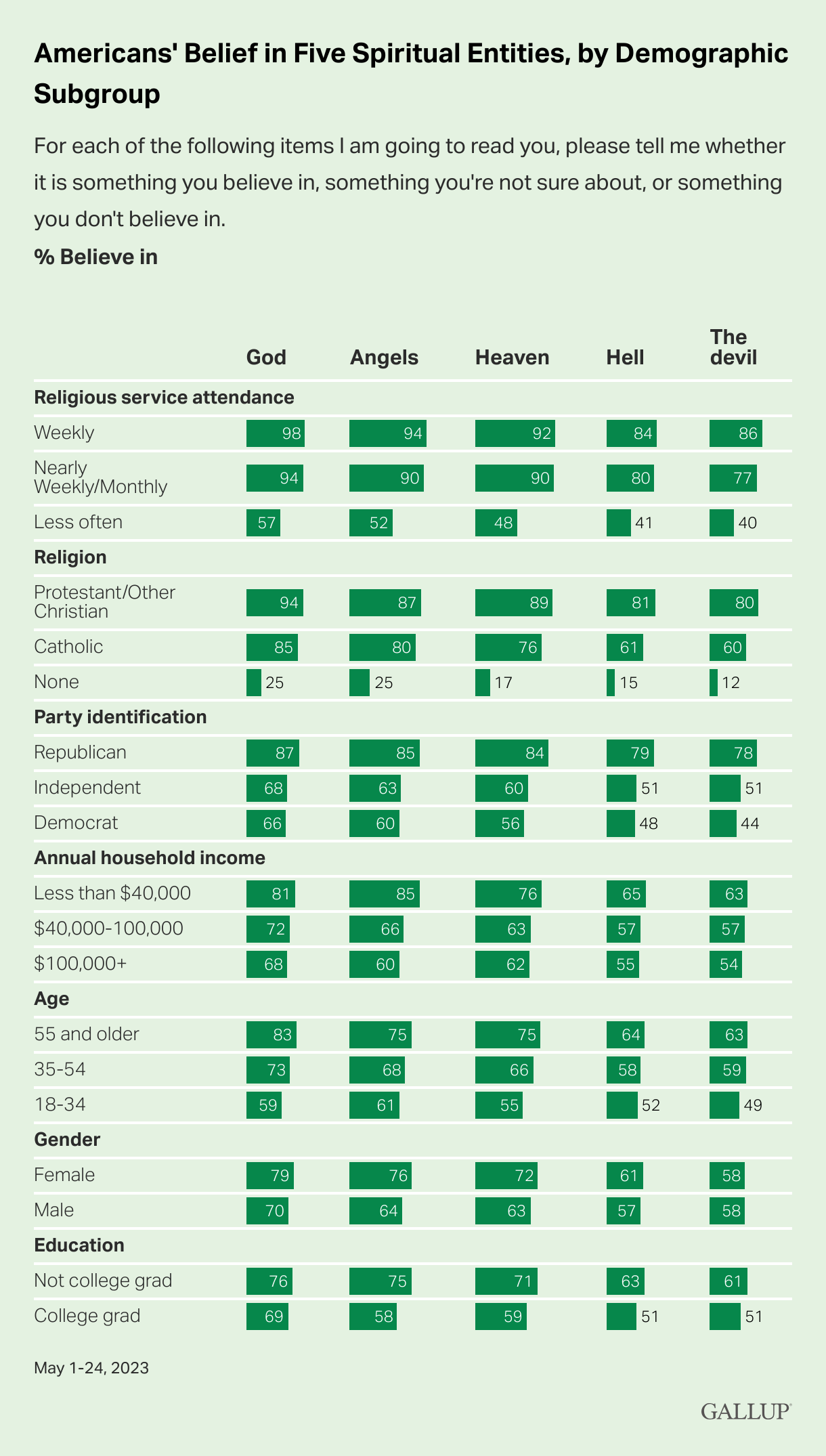
Since 2001, belief in God has gone from 90% to 74%—which implies more than a quarter of Americans are either unsure or reject the idea of God altogether. The percentage of believers has not gone up in the past two decades.

Meanwhile, while belief in the devil saw a slight rise during the George W. Bush administration, that number has also seen a drop from a high of 70% to 58% today. (Ironically, 69% of Americans still believe in angels. People seem to prefer their spiritual entities in a “glass half full” sort of way.)

51% of Americans believe in all five of those spiritual entities. 7% of Americans are “unsure” about all five. 11% reject all five. (Those 11% are correct.)

All of this is happening while plenty of other surveys have found a dramatic rise in non-belief. The Pew Research Center has found that 29% of Americans have no religious affiliation at all.

So how many atheists believe in these spiritual entities? (How many people are full of logical inconsistencies?) That’s a little harder to say. While Gallup doesn’t address the issue in this particular survey, Pew found in 2017 that 9% of people who didn’t believe in God did believe in some “higher power.” There’s a flip side to that too. There are a lot of Americans in this survey who say they believe in God but reject the concepts of Heaven, Hell, or the beings that supposedly live in them. What the hell is going on there? It suggests many Americans take a cafeteria-style approach to religion, picking and choosing the parts they like instead of purchasing the entire package.

Gallup found (perhaps not surprisingly) that believers in all of the Big Five include Protestants more than Catholics, frequent churchgoers more than casual ones, people without a college degree more than college graduates, Republicans more than Democrats, people in households that make under $40,000 a year more than those making over $100,000, adults 55 and older more than younger ones, and women more than men (except when it comes to the devil, when both numbers are the same).

All of this is bad news for church leaders that use these beliefs to bring in and control members. When fewer people believe in the devil, it’s a lot harder to scare them straight. When fewer people believe in Heaven or Hell, it raises questions about why people need to follow religious rules that don’t make sense.

Many atheists could tell you that their belief in God didn’t fade away in a split second. Rather, there was some aspect of religion that stopped making sense to them. That led to them questioning other ones. Once that first domino fell, the others followed in succession until even God couldn’t stand up to scrutiny.

What these survey results show us is that the dominoes are falling. It’ll take a while for the entire chain to go down, but religious leaders should be worried.

07/27/23 Biking & Listening

Biking is something else I both love and hate. It takes a lot of effort but does provide good exercise and most days over an hour to listen to a good book or podcast. I especially like having ridden.

Here’s my bike, a Rockhopper by Specialized. I purchased it November 2021 from Venture Out in Guntersville; Mike is top notch! So is the bike, and the ‘old’ man seat I salvaged from an old Walmart bike.

Here’s a link to today’s bike ride.


Something to consider if you’re not already cycling.

I encourage you to start riding a bike, no matter your age. Check out these groups:

Cycling for those aged 70+(opens in a new tab)

Solitary Cycling(opens in a new tab)

Remember,

Photo by Suzy Hazelwood on Pexels.com

I’m listening to Don’t Let Go by Harlan Coben

Amazon Abstract

FROM THE BESTSELLING AUTHOR AND CREATOR OF THE HIT NETFLIX DRAMA THE STRANGER

With unmatched suspense and emotional insight, Harlan Coben explores the big secrets and little lies that can destroy a relationship, a family, and even a town in this powerful new thriller.

Suburban New Jersey Detective Napoleon “Nap” Dumas hasn’t been the same since senior year of high school, when his twin brother Leo and Leo’s girlfriend Diana were found dead on the railroad tracks—and Maura, the girl Nap considered the love of his life, broke up with him and disappeared without explanation. For fifteen years, Nap has been searching, both for Maura and for the real reason behind his brother’s death. And now, it looks as though he may finally find what he’s been looking for. 

When Maura’s fingerprints turn up in the rental car of a suspected murderer, Nap embarks on a quest for answers that only leads to more questions—about the woman he loved, about the childhood friends he thought he knew, about the abandoned military base near where he grew up, and mostly about Leo and Diana—whose deaths are darker and far more sinister than Nap ever dared imagine.


Here’s a few photos from along my pistol route: