Human harms should require forgiveness to come from human victims. With belief in God, believers can end up being morally lazy.
Crimes or harm to others can take on many different forms, but some can be particularly heinous. Far be it for me to constrain your imagination in detailing any such horrible harms. Instead, let us more closely consider the ramifications of causing harm to others.
Forgiveness is often defined as something like “a conscious, deliberate decision to release feelings of resentment or vengeance toward a person or group who has harmed you, regardless of whether they actually deserve your forgiveness.”
The problem for believers is that God is at the center of everything. Everything.
So when a harm is leveled against another human, it’s really leveled against God. Ultimately. A “sin” against a human is more importantly a sin against God, and it’s God from whom we supposedly want forgiveness. As a typical apologetics website claims:
To be forgiven by God means that your sins have been removed, and restoration has taken place. By God’s gracious gift of forgiveness through Christ, any wrong you have done is not held against you. God is eager to forgive and provides forgiveness to you through faith in Jesus Christ. It’s your choice to receive it.
Rape, murder, genocide, racial abuse…whatever the harm, it is not to the victims or their families that we turn to for forgiveness, but to the real victim: God.
Seeking forgiveness from God, then, is arguably a cop-out and morally lazy…
There is something thoroughly distasteful in this. The concern for what God thinks rather than the real and tangible victim seems rather unsavory. And this is made all the worse by the fact that, if we did believe in such a deity, we would still never know if it had actually forgiven us. Instead we ourselves, or the local priest, would assure us that God had done so to assuage us of guilt and make right the horrific harm we might have done.
To another human. That harm, sin, crime, wrong, was done to a fellow human. Who might still be suffering and far from being in a place to forgive us themselves.
Seeking forgiveness from God, then, is arguably a cop-out and morally lazy because it essentially involves making stuff up. And it can also excuse habitually uncorrected behaviors, “It’s okay, God will forgive me.”
I often wonder about sex-abusing priests: Do they really believe in God given that they continually commit such crimes? Most probably, because forgiveness is easy when it is essentially the perpetrator deciding by proxy that God has given them forgiveness. This then excuses the harmer from ever properly facing their crimes in the form of their victim. The “real victim” is God—that abstract entity that exists in their mind.
Thus, seeking God’s forgiveness can act as an excuse for not having to deal with the human realities of causing pain and harm to others.
Joshua Butler recently published a book explaining evangelicals’ extended metaphor about sex and marriage. It has caused an absolute uproar in evangelicalism due to its shoddy theology, its obsession with men’s pleasure, and the ease with which its message can be used to rationalize abuse.
Reading Time: 14 MINUTES
Recently, evangelical pastor Joshua Butler resigned from his church position. This resignation was sparked by his new book about marriage. And that book’s caused an absolute uproar. Now, with evangelicals’ current nonstop sex and sex-abuse scandals, you’d think someone might have stopped him before the book ever came close to publication. You’d think someone might have told the guy much earlier that his ideas perpetuated some really sickening and toxic dynamics between spouses.
But nobody did. Really, nobody even could have. Here’s why nobody stopped him, and why Joshua Butler isn’t backing down at all.
Everyone, meet Joshua Butler—and his weird sex book
I first ran across Joshua Butler in an evangelical book, Before You Lose Your Faith (2021). It’s a collection of evangelical talking points, strawmen, and fallacious arguments that its creators hope will short-circuit deconstruction and deconversion. Butler’s chapter of the book poorly addressed dealbreaker questions involving Hell.
Butler first rose to prominence through his first church, Imago Dei Community in Portland, Oregon. He’s exactly that kind of evangelical that evangelicals envision as best-case examples of their faith: a socially-conscious culture warrior who embraces evangelical misogyny and bigotry as the most perfect plan a god could possibly devise for humanity. They think he makes their vast cruelty sound divinely loving and compassionate.
In 2018, Butler wrote movingly of his decision to accept an offer to be the co-lead pastor of Redemption Church of Tempe, Arizona. Naturally, he couched the decision as a divine order. In his post, Butler repeatedly asserted that he thought Jesus was calling him there—and that his wife, a real live prophet, had foreseen this major change.
He lasted in Arizona for about five years.
Incidentally, neither his old church nor his new one appears on the master list of Southern Baptist member churches. Redemption certainly seems to be generally of the same mind on a lot of topics, though. In particular, they share the same alarming view of church discipline that all too many Southern Baptist church leaders like to push on their flocks.
This past March, Butler’s newest book, Beautiful Union, came out. Its subtitle reveals that it offers the usual standard-issue evangelical talking points about sex: “How God’s Vision for Sex Points Us to the Good, Unlocks the True, and (Sort of) Explains Everything.”
An introduction to evangelicals’ beloved marriage metaphor: the Bride of Christ
Many hardline evangelical authors offer sites like The Gospel Coalition (TGC) teaser excerpts from their upcoming books. TGC always seems happy to print them. This particular author was no exception to that rule, either. The site published his teaser excerpt on March 1st, 2023.
I want need to stress this point beyond all possible others:
Nothing Joshua Butler says about sex is new or unique. Evangelicals have pushed all of these talking points for decades. All Butler did was regurgitate these tired old talking points back to an audience well-used to hearing them. He just did it in a way they really liked, and then he went into way more detail than that audience is used to hearing.
Evangelicals like to imagine that married-people sex is a metaphor for Jesus Christ and his Church, which is Christianese for the collective group of Christians everywhere. Often, they also describe the Church as a body, and yes, they really do think of it like that. It’s like Voltron: there’s all these separate machines that can do stuff completely separately, but then they can also come together to do the Christian equivalent of kicking some giant monster’s ass into the next galaxy.
(Feel free to speculate about the rabidly anti-gay nature of evangelicals while their men are apparently completely okay with being the Bride of Christ. Over the years, a lot of folks certainly have.)
So Christians are the bride in the marriage, and Jesus is the husband. That’s how evangelical men rationalize their insistence on virginal brides, and also how they rationalize their extremely misogynistic treatment of those brides. After all, Jesus doesn’t take orders from Christians, now does he?
If you’ve never been evangelical or tangled much with evangelicals, you likely have no idea just how deep this metaphor goes. (<– Pun very much intended.) But it is integral to evangelicalism. It goes all the way from the nitty gritty sticky act of sex itself all the way to parenting and household chore distribution. Evangelicals like to imagine this metaphor as governing every single facet of marriage.
Of course, this metaphor also governs how churches operate. But here, we’re just looking at its treatment of marriage.
Joshua Butler’s ideas about sex aren’t unique at all, nor even new
If you read Butler’s post over at TGC, you will find nothing new there. He offers the usual testimony format:
Act I: He had unapproved sex. Alas, that kind of sex failed to make him happy.
Act II: Moment of epiphany. He figured out that evangelicals’ rules for sex are perfect for all humans.
Act III: A cosmic reversal of Act I. He discovers that evangelicals’ version of sex is awesome!
Here is the climax of the essay (<– Pun unintended, but I’m letting it ride):
This is a picture of the gospel. Christ arrives in salvation to be not only with his church but within his church. Christ gives himself to his beloved with extravagant generosity, showering his love upon us and imparting his very presence within us. Christ penetrates his church with the generative seed of his Word and the life-giving presence of his Spirit, which takes root within her and grows to bring new life into the world.Joshua Butler, TGC
The next two paragraphs detail how the Bride of Christ anticipates and responds to this divine penetration. In the last, we learn: “Their union brings forth new creation.”
Interestingly, the essay doesn’t actually tell us that Butler began following those rules and finally experienced joyful, satisfying sex for the first time. Instead, he pushes a very typical evangelical narrative line: Correct behavior and great results always follow correct beliefs, as the night the day. His implication is that now that he knows exactly what sex means in religious metaphor form, he is now prepared to have satisfying, loving sex with his wife.
I want to stress once again that absolutely nothing in this essay was new to me as an ex-Christian and ex-Pentecostal. It’s gross, but it’s definitely not new. Indeed, these were all standard-issue marriage teachings in the 1980s and 1990s. In somewhat sanitized form, I even heard versions of all of this stuff preached at wedding ceremonies.
All Butler did was take that tired metaphor way, way, way further than evangelicals were used to hearing. As Ph.D scholar Laura Robinson asked in her Twitter thread:
So… that’s it? In conclusion, sex is all about marriage, female purity, and male sexual gratification?
But that’s literally exactly what every other pastor says about sex! Why did Josh write an ENTIRE NEW BOOK about this? He adds nothing!Laura Robinson, Twitter thread, March 1
Indeed. I think Butler managed to make even evangelical men who’d grown up hearing this metaphor their entire lives feel uncomfortable.
Joshua Butler must have thought the world was now his oyster…
Even more amazingly, we learn in that archived post, TGC had already tapped him to lead a special seven-week-long online course called “The Beauty of the Christian Sexual Ethic.”
I’m not that surprised that they seemed to like this guy so much. After all, they’ve hosted Butler’s bad arguments about other topics for a while now, and they’re the ones who organized and published Before You Lose Your Faith.
If we imagine the thing this way, I’ll wager most men will insist on continuing to imagine themselves, not as the bride, but as Jesus. And there’s the first problem. If we forget the limits of the analogy, men are going to think they’re like Jesus in a way that women are not like Jesus. And men may also think that Jesus is like whatever sinful twisting of masculinity their culture upholds. [. . .]
It’s a euphoric ode to the glories of ejaculation, which the article characterizes as “gift” and “sacrificial offering.”Beth Felker Jones, March 5
Meanwhile, Laura Robinson neatly summarized it:
In sex, a man is generous by providing semen. Correspondingly, a woman is hospitable by providing a place for semen. [. . .]
Josh apparently thinks the analogy between atoning blood, the Holy Spirit, Jesus Christ, revelation, and semen is so clear it does not require elaboration.@LauraRbnsn, March 1
Jones also noted the potential for abuse within this metaphor:
The giver/receiver paradigm carries dangerous baggage. Giver/receiver can easily be rephrased as “active/passive” or “Lord/subject.” This can be weaponized; we’re sinners, after all. The built-in asymmetry of power lends itself to abuse, too often telling women to submit in inhuman situations.Beth Felker Jones, March 5 (Archive)
This is absolutely correct. And it’s exactly why evangelical leaders push this metaphor so hard. Indeed, a large number of evangelical women pointed out that their husbands and churches had used this exact metaphor as their permission slip to abuse anyone under their power. All that separate but equal, complementary spheres blahblah evangelicals spout breaks down once anybody remembers why that concept is no longer acceptable under law.
Eventually, TGC realized they’d made a drastic mistake with Butler’s excerpt
If you go to the original URL of Butler’s TGC post now, you won’t see a single bit of Butler’s excerpt. (So I thank you, quick-witted archivist, whoever you are.)
Instead, you’ll see an abject apology from TGC’s president, Julius Kim—and the news that Butler has resigned from the Keller Center and that the planned online sex course won’t be happening at all.
However, it’s unlikely that theology arguments and women’s pain had much, if anything, to do with TGC’s decision-making. Evangelicals have faced both of those for decades now, and it hasn’t had any impact on their misogyny.
Instead, one Christian site, Dissenter, claims that TGC only began to second-guess the wisdom of running that excerpt after they began getting tons of pushback from evangelicals who found the metaphors a little too extended for comfort (<– Pun sort of intended).
Dissenter also notes that some of the big-name Christians who contributed endorsements to Butler’s book have publicly withdrawn those endorsements. Given how endorsements work in the evangelical publishing world, it’s almost certain that those folks hadn’t even read the book. Some of those Christians were also associated with TGC, meaning they’re likely hardline, ultraconservative, Calvinist culture-warrior evangelicals like the site itself is.
TGC might have a fight ahead of them to reestablish their reputation with evangelicals. This incident has even earned a mention at a site that lists examples of “Deception in the Church.” Considering TGC’s positioning, that’s got to smart.
Joshua Butler is not backing down, either
In response to the furor, Joshua Butler resigned last week from his co-lead pastor position at Redemption Church. (They’ve already removed his photo from their staff page.) Butler sent his former congregation a letter about his decision that speaks volumes about why he resigned—and what he plans to do next:
We have found ourselves in an impossible situation. On the one hand, I feel called to step more into these public conversations. I desire to be humble, charitable, winsome, and wise. There are some mistakes I’ve made I wish to own but also deep convictions I hold that I wish to contribute to the broader conversation. [. . .]
I want to affirm that I am committed to a process of repair with any members of Redemption who desire it. For some of you, my lack of greater pastoral nuance in areas of the excerpt evoked pain, particularly for some women with histories of sexual abuse. I want to apologize for not showing greater consideration for how my words in this section could be heard from within your shoes. I’m truly sorry.
I’ve worked with the publisher to make revisions to the excerpt based on a dozen additional sensitivity reviews I commissioned this last month from women (including sexual abuse survivors, counselors, and those who grew up in purity culture). These revisions will be incorporated into the next printing of my book.From Joshua Butler’s resignation letter, presented by this Tweeter (archive)
There is a lot of Christianese in this letter, and it’s doing a lot of heavy lifting. Let’s unpack it like a radioactive knapsack to see what Joshua Butler is telling his former congregation.
The Christianese that tells us everything
Christianese is a context-heavy language that uses jargon and group-specific memes to convey loads of information in few words. We find it mostly in hardline Catholic and evangelical circles. (I’ve noticed that the more off-limits and objectively-false the group’s beliefs, behavior, and goals are, the more Christianese they use.)
“I felt called” is a blatant appeal to authority. Evangelicals believe that Jesus Christ himself hands them assignments, which they term callings. The process of handing them the assignment is Jesus calling them. When evangelicals say they “felt called,” they mean Jesus has asked them to do something. So Jesus told Butler to talk more about his weird evangelical sex ideas. If someone disagrees, then they are disagreeing with the wisdom and judgment of their Savior.
“… humble, charitable, winsome, and wise.” I award him a Miss Congeniality point for using an Oxford comma. However, these are all beloved evangelical self-descriptions. “Winsome,” especially, is seen as a very Jesus-y attribute. To evangelicals, it means presenting ideas in a way that wins people’s hearts. Butler, then, is pushing hard on the purity of his motivations.
“There are some mistakes I’ve made I wish to own…” Evangelicals love to hype up how totally accountable they are for their behavior (and by contrast, how much they think heathens hate to be accountable). When they talk like this, they mean accountability to Jesus, not to people. In reality, no evangelical wants to really own their mistakes. It’d open them to attacks. In this case, real accountability would require a lot more than gaining buy-in from a bunch of sensitivity readers and a carefully-couched not-pology worded in the most ego-defending way imaginable.
“Deep convictions” are related to callings. Evangelicals think that Jesus himself hands certain opinions to his best, most dedicated followers. They call these divinely-given opinions convictions. Similarly, when they talk about feeling convicted, they mean that Jesus has personally made them feel guilty about something.
“Pastoral nuance” is what most other people would call empathy and common sense. In this case, Butler concedes that as a pastor, he perhaps should have known better than to push the particular ideas he did without tons and tons of qualifications and asterisked conditions.
What this Christianese means
Dude’s coming out swinging.
He’s not sorry for what he wrote, only in how he worded it. The basic concepts remain, in his opinion, completely correct. He just forgot to make the usual evangelical mouth-noises about not taking Jesus’ metaphor as permission to abuse—which I guarantee every abusive evangelical husband has already heard and enthusiastically supports, because they would never.
Or a really, really big umbrella. This diagram often made the rounds in my Pentecostal church in the 80s and 90s.
However, Butler’s church isn’t willing to go down fighting with him. They clearly don’t want any part of the media firestorm that has already come Butler’s way.
And I’m guessing that they most especially don’t want to be known as a church that implicitly signs off on, condones, or agrees with Butler’s extremely extended metaphor about the divine power and cosmic value of men’s orgasms or their ejaculate and ejaculation.
That said, I’ve no doubt in the world that Butler’s message to evangelical men will find a receptive audience. (<– Pun unintended, but c’mon.)
Why evangelical marriage metaphors break down so spectacularly in real life
Joshua Butler is not the first person whose attempt to wrestle with evangelical metaphors has run afoul of reality. With great regularity, evangelical marriage and sex books do exactly the same thing.
[Blogger Sheila Wray] Gregoire says she’s heard from hundreds of women who say one of the book’s main themes — that giving a husband “unconditional respect” can lead to a happy marriage — contributed to abuse in their marriages. She wants Focus on the Family, which originally published the book in partnership with Integrity Publishing, to drop its endorsement.Religion News Service
Please note that evangelicals often slide between two completely different meanings of “respect.” Often, they do this within the same sentence. The word can mean either complete deference or polite civility. Context alone will show you which flavor of the word is meant; in this case, it’s obvious that “unconditional respect” means complete deference.
In the case of power-hungry evangelical men, they deserve next to no deference. But most of them ache for it, thanks to their membership in an extremely toxic, dysfunctional authoritarian system. Deference means safety as well as personal power that can be flexed at will. These men all believe that the women around them should show them this deference, which they have earned simply by accident of birth. Their wives should show them even more deference.
Unwarranted power is a poison that rots the spirit. Power without real accountability is a curse to everyone who comes into contact with the person holding it. And the power given to evangelical men in marriage is both of these.
How evangelicals rationalize the abuse caused by their teachings
In response, Eggerichs simply said that, gosh, any book’s advice could be misused by bad-faith actors. His publisher, Focus on the Family, issued a statement along similar lines:
“The fact of the matter is that we believe Mrs. Gregoire has seriously misread and misjudged various aspects of Love & Respect, and we further maintain that its central message aligns both with Scripture and with the common-sense principles of healthy relationships.”Religion News Service
They further stated that the examples of abuse that Gregoire and other women described were clear examples of “one or both spouses misapplying the text, not as the result of the book’s actual message.”
Of course. I’d expect them to say nothing else.
Evangelicalism is a broken system. Its groups long ago lost their ability to achieve their own stated goals. Instead, evangelical leaders use this system as a means of amassing power at members’ expense.
In broken systems, their message is always perfect. It can’t be questioned or criticized. If anyone has trouble with making the message work the way the system’s masters say it should work, that never reflects a problem with the message. People are the only weak link in that entire sequence, so they must have done something wrong in applying the message.
So naturally, if any woman faces spousal abuse after her husband absorbs messages like the ones found in Butler’s and Eggerichs’ books, her husband just misapplied the message.
Real accountability requires the examination of the message that keeps getting used to rationalize abuse. If it’s so easy to misapply even by the very most devout and pious of all real true Christians, then it can’t possibly be all that divine.
But the evangelical world is facing unprecedented scrutiny and pressure
Joshua Butler didn’t tell evangelicals anything new in his book. However, the evangelical world has changed significantly in the last five years, and I don’t think Butler ever got that memo.
Between the nonstop sex scandals and the abuse crises being revealed, evangelicals are more sensitive these days to misogyny and doctrines that encourage abuse. They’re not sensitive enough to question their broken system as a whole yet, but they have begun to realize that concepts like “the Bride of Christ” only open the door to abuse within marriage. They’re starting to understand why representation at all levels of power is so important in preventing abuse and encouraging real accountability. And they’re noticing that in systems like theirs, powerful networks exist to prevent that accountability from ever striking too close to home.
An entire book about how women perform hospitality for men by acting as receptive receptacles for men’s divine gift of semen might have been a bridge too far even for some of the extremists among them. Even TGC regulars couldn’t stomach that.
And the things evangelicals will never, ever ask Joshua Butler
As we’ve already read in his 2018 essay about heading for Arizona, Butler prays about all of his decisions. He even tells us that his wife is a real live “prophet,” which means in Christianese that she gets divine messages straight from Jesus. I’m assuming that every other person associated with his sex book prayed about getting involved with it. And I’m assuming that Julius Kim and TGC pray about their hiring and publishing decisions.
In The Hunt for Red October, there’s a line in it that perfectly describes evangelicals. Admiral Painter listens to Jack Ryan’s excited chatter about intercepting Captain Ramius in his state-of-the-art submarine. Then, he asks a direct question:
Painter means that a man like Ramius wouldn’t even have begun his trip without knowing ahead of time exactly what he’d be doing with the crew, the sub, the route, and everything else. The Americans don’t need to worry about any of that stuff, because Ramius has already figured it all out. All they have to do is help him with his plan.
Evangelicals are much the same way. Though I don’t think they pray nearly as often as they claim to do, I do think that they pray before every major decision. We’ve got TGC, publishers, endorsement writers, editors, proofreaders, family members, church congregations, and who even knows who else—and not one of those hundreds, even maybe thousands of people heard a peep out of their ceilings about this book’s serious flaws.
So why did Jesus fail to tell a single one of these praying Christians that this sex book and its TGC excerpt would be such a stunning disaster? How is it even possible that so many people in so many different organizations utterly failed to notice how easily Butler’s writing could be bent toward rationalizing abuse?
I mean, non-believers already know why. Evangelicals, however, might consider wondering a bit about the matter.
Biking is something else I both love and hate. It takes a lot of effort but does provide good exercise and most days over an hour to listen to a good book or podcast. I especially like having ridden.
Here’s my bike, a Rockhopper by Specialized. I purchased it November 2021 from Venture Out in Guntersville; Mike is top notch! So is the bike, and the ‘old’ man seat I salvaged from an old Walmart bike.
Here’s what I’m listening to: The Moral Arc, by Michael Shermer
Amazon abstract:
Bestselling author Michael Shermer’s exploration of science and morality that demonstrates how the scientific way of thinking has made people, and society as a whole, more moral
From Galileo and Newton to Thomas Hobbes and Martin Luther King, Jr., thinkers throughout history have consciously employed scientific techniques to better understand the non-physical world. The Age of Reason and the Enlightenment led theorists to apply scientific reasoning to the non-scientific disciplines of politics, economics, and moral philosophy. Instead of relying on the woodcuts of dissected bodies in old medical texts, physicians opened bodies themselves to see what was there; instead of divining truth through the authority of an ancient holy book or philosophical treatise, people began to explore the book of nature for themselves through travel and exploration; instead of the supernatural belief in the divine right of kings, people employed a natural belief in the right of democracy.
In The Moral Arc, Shermer will explain how abstract reasoning, rationality, empiricism, skepticism–scientific ways of thinking–have profoundly changed the way we perceive morality and, indeed, move us ever closer to a more just world.
“Everything depends on the individual human being, regardless of how small a number of like-minded people there is… on each person… creatively making the meaning of life a reality in his or her own being.”
BY MARIA POPOVA
“To decide whether life is worth living is to answer the fundamental question of philosophy,” Albert Camus wrote in his classic 119-page essay The Myth of Sisyphus in 1942. “Everything else… is child’s play; we must first of all answer the question.”
Sometimes, life asks this question not as a thought experiment but as a gauntlet hurled with the raw brutality of living.
That selfsame year, the young Viennese neurologist and psychiatrist Viktor Frankl (March 26, 1905–September 2, 1997) was taken to Auschwitz along with more than a million human beings robbed of the basic right to answer this question for themselves, instead deemed unworthy of living. Some survived by reading. Some through humor. Some by pure chance. Most did not. Frankl lost his mother, his father, and his brother to the mass murder in the concentration camps. His own life was spared by the tightly braided lifeline of chance, choice, and character.
Viktor Frankl
A mere eleven months after surviving the unsurvivable, Frankl took up the elemental question at the heart of Camus’s philosophical parable in a set of lectures, which he himself edited into a slim, potent book published in Germany in 1946, just as he was completing Man’s Search for Meaning.
As our collective memory always tends toward amnesia and erasure — especially of periods scarred by civilizational shame — these existential infusions of sanity and lucid buoyancy fell out of print and were soon forgotten. Eventually rediscovered — as is also the tendency of our collective memory when the present fails us and we must lean for succor on the life-tested wisdom of the past — they are now published in English for the first time as Yes to Life: In Spite of Everything (public library).
Frankl begins by considering the question of whether life is worth living through the central fact of human dignity. Noting how gravely the Holocaust disillusioned humanity with itself, he cautions against the defeatist “end-of-the-world” mindset with which many responded to this disillusionment, but cautions equally against the “blithe optimism” of previous, more naïve eras that had not yet faced this gruesome civilizational mirror reflecting what human beings are capable of doing to one another. Both dispositions, he argues, stem from nihilism. In consonance with his colleague and contemporary Erich Fromm’s insistence that we can only transcend the shared laziness of optimism and pessimism through rational faith in the human spirit, Frankl writes:
We cannot move toward any spiritual reconstruction with a sense of fatalism such as this.
Liminal Worlds by Maria Popova. (Available as a print.)
Today every impulse for action is generated by the knowledge that there is no form of progress on which we can trustingly rely. If today we cannot sit idly by, it is precisely because each and every one of us determines what and how far something “progresses.” In this, we are aware that inner progress is only actually possible for each individual, while mass progress at most consists of technical progress, which only impresses us because we live in a technical age.
Insisting that it takes a measure of moral strength not to succumb to nihilism, be it that of the pessimist or of the optimist, he exclaims:
Give me a sober activism anytime, rather than that rose-tinted fatalism!
How steadfast would a person’s belief in the meaningfulness of life have to be, so as not to be shattered by such skepticism. How unconditionally do we have to believe in the meaning and value of human existence, if this belief is able to take up and bear this skepticism and pessimism?
[…]
Through this nihilism, through the pessimism and skepticism, through the soberness of a “new objectivity” that is no longer that “new” but has grown old, we must strive toward a new humanity.
Sophie Scholl, upon whom chance did not smile as favorably as it did upon Frankl, affirmed this notion with her insistence that living with integrity and belief in human goodness is the wellspring of courage as she courageously faced her own untimely death in the hands of the Nazis. But while the Holocaust indisputably disenchanted humanity, Frankl argues, it also indisputably demonstrated “that what is human is still valid… that it is all a question of the individual human being.” Looking back on the brutality of the camps, he reflects:
What remained was the individual person, the human being — and nothing else. Everything had fallen away from him during those years: money, power, fame; nothing was certain for him anymore: not life, not health, not happiness; all had been called into question for him: vanity, ambition, relationships. Everything was reduced to bare existence. Burnt through with pain, everything that was not essential was melted down — the human being reduced to what he was in the last analysis: either a member of the masses, therefore no one real, so really no one — the anonymous one, a nameless thing (!), that “he” had now become, just a prisoner number; or else he melted right down to his essential self.
In a sentiment that bellows from the hallways of history into the great vaulted temple of timeless truth, he adds:
Everything depends on the individual human being, regardless of how small a number of like-minded people there is, and everything depends on each person, through action and not mere words, creatively making the meaning of life a reality in his or her own being.
Frankl then turns to the question of finding a sense of meaning when the world gives us ample reasons to view life as meaningless — the question of “continuing to live despite persistent world-weariness.” Writing in the post-war pre-dawn of the golden age of consumerism, which has built a global economy by continually robbing us of the sense of meaning and selling it back to us at the price of the product, Frankl first dismantles the notion that meaning is to be found in the pursuit and acquisition of various pleasures:
Let us imagine a man who has been sentenced to death and, a few hours before his execution, has been told he is free to decide on the menu for his last meal. The guard comes into his cell and asks him what he wants to eat, offers him all kinds of delicacies; but the man rejects all his suggestions. He thinks to himself that it is quite irrelevant whether he stuffs good food into the stomach of his organism or not, as in a few hours it will be a corpse. And even the feelings of pleasure that could still be felt in the organism’s cerebral ganglia seem pointless in view of the fact that in two hours they will be destroyed forever. But the whole of life stands in the face of death, and if this man had been right, then our whole lives would also be meaningless, were we only to strive for pleasure and nothing else — preferably the most pleasure and the highest degree of pleasure possible. Pleasure in itself cannot give our existence meaning; thus the lack of pleasure cannot take away meaning from life, which now seems obvious to us.
He quotes a short verse by the great Indian poet and philosopher Rabindranath Tagore — the first non-European to win the Nobel Prize, Einstein’s onetime conversation partner in contemplating science and spirituality, and a man who thought deeply about human nature:
I slept and dreamt that life was joy. I awoke and saw that life was duty. I worked — and behold, duty was joy.
In consonance with Camus’s view of happiness as a moral obligation — an outcome to be attained not through direct pursuit but as a byproduct of living with authenticity and integrity — Frankl reflects on Tagore’s poetic point:
So, life is somehow duty, a single, huge obligation. And there is certainly joy in life too, but it cannot be pursued, cannot be “willed into being” as joy; rather, it must arise spontaneously, and in fact, it does arise spontaneously, just as an outcome may arise: Happiness should not, must not, and can never be a goal, but only an outcome; the outcome of the fulfillment of that which in Tagore’s poem is called duty… All human striving for happiness, in this sense, is doomed to failure as luck can only fall into one’s lap but can never be hunted down.
At this point it would be helpful [to perform] a conceptual turn through 180 degrees, after which the question can no longer be “What can I expect from life?” but can now only be “What does life expect of me?” What task in life is waiting for me?
Now we also understand how, in the final analysis, the question of the meaning of life is not asked in the right way, if asked in the way it is generally asked: it is not we who are permitted to ask about the meaning of life — it is life that asks the questions, directs questions at us… We are the ones who must answer, must give answers to the constant, hourly question of life, to the essential “life questions.” Living itself means nothing other than being questioned; our whole act of being is nothing more than responding to — of being responsible toward — life. With this mental standpoint nothing can scare us anymore, no future, no apparent lack of a future. Because now the present is everything as it holds the eternally new question of life for us.
Frankl adds a caveat of tremendous importance — triply so in our present culture of self-appointed gurus, self-help demagogues, and endless podcast feeds of interviews with accomplished individuals attempting to distill a universal recipe for self-actualization:
The question life asks us, and in answering which we can realize the meaning of the present moment, does not only change from hour to hour but also changes from person to person: the question is entirely different in each moment for every individual.
We can, therefore, see how the question as to the meaning of life is posed too simply, unless it is posed with complete specificity, in the concreteness of the here and now. To ask about “the meaning of life” in this way seems just as naive to us as the question of a reporter interviewing a world chess champion and asking, “And now, Master, please tell me: which chess move do you think is the best?” Is there a move, a particular move, that could be good, or even the best, beyond a very specific, concrete game situation, a specific configuration of the pieces?
What emerges from Frankl’s inversion of the question is the sense that, just as learning to die is learning to meet the universe on its own terms, learning to live is learning to meet the universe on its own terms — terms that change daily, hourly, by the moment:
One way or another, there can only be one alternative at a time to give meaning to life, meaning to the moment — so at any time we only need to make one decision about how we must answer, but, each time, a very specific question is being asked of us by life. From all this follows that life always offers us a possibility for the fulfillment of meaning, therefore there is always the option that it has a meaning. One could also say that our human existence can be made meaningful “to the very last breath”; as long as we have breath, as long as we are still conscious, we are each responsible for answering life’s questions.
The fact, and only the fact, that we are mortal, that our lives are finite, that our time is restricted and our possibilities are limited, this fact is what makes it meaningful to do something, to exploit a possibility and make it become a reality, to fulfill it, to use our time and occupy it. Death gives us a compulsion to do so. Therefore, death forms the background against which our act of being becomes a responsibility.
[…]
Death is a meaningful part of life, just like human suffering. Both do not rob the existence of human beings of meaning but make it meaningful in the first place. Thus, it is precisely the uniqueness of our existence in the world, the irretrievability of our lifetime, the irrevocability of everything with which we fill it — or leave unfulfilled — that gives our existence significance. But it is not only the uniqueness of an individual life as a whole that gives it importance, it is also the uniqueness of every day, every hour, every moment that represents something that loads our existence with the weight of a terrible and yet so beautiful responsibility! Any hour whose demands we do not fulfill, or fulfill halfheartedly, this hour is forfeited, forfeited “for all eternity.” Conversely, what we achieve by seizing the moment is, once and for all, rescued into reality, into a reality in which it is only apparently “canceled out” by becoming the past. In truth, it has actually been preserved, in the sense of being kept safe. Having been is in this sense perhaps even the safest form of being. The “being,” the reality that we have rescued into the past in this way, can no longer be harmed by transitoriness.
In the remainder of the slender and splendid Yes to Life, Frankl goes on to explore how the imperfections of human nature add to, rather than subtract from, the meaningfulness of our lives and what it means for us to be responsible for our own existence. Complement it with Mary Shelley, writing two centuries ago about a pandemic-savaged world, on what makes life worth living, Walt Whitman contemplating this question after surviving a paralytic stroke, and a vitalizing cosmic antidote to the fear of death from astrophysicist and poet Rebecca Elson, then revisit Frankl on humor as lifeline to sanity and survival.
“Life is wasted when we make it more terrifying, precisely because it is so easy to do so.”
BY MARIA POPOVA
In a world pocked by cynicism and pummeled by devastating news, to find joy for oneself and spark it in others, to find hope for oneself and spark it in others, is nothing less than a countercultural act of courage and resistance. This is not a matter of denying reality — it is a matter of discovering a parallel reality where joy and hope are equally valid ways of being. To live there is to live enchanted with the underlying wonder of reality, beneath the frightful stories we tell ourselves and are told about it.
Having lost his mother to suicide, having lived through two World Wars, the Belgian surrealist artist René Magritte (November 21, 1898–August 15, 1967) devoted his life and his art to creating such a parallel world of enchantment.
The Lovers II by René Magritte, 1928
In a 1947 interview included in his Selected Writings (public library) — the first release of Magritte’s manifestos, interviews, and other prose in English, thanks to the heroic efforts of scholar Kathleen Rooney — he reflects:
Experience of conflict and a load of suffering has taught me that what matters above all is to celebrate joy for the eyes and the mind. It is much easier to terrorize than to charm… I live in a very unpleasant world because of its routine ugliness. That’s why my painting is a battle, or rather a counter-offensive.
Magritte revisits the subject in his manifesto Surrealism in the Sunshine, indicting the cultural tyranny of pessimism and fear-mongering — a worldview we have been sold under the toxic premise that if we focus on the worst of reality, we are seeing it more clearly and would be prepared to protect ourselves from its devastations. A quarter century before the great humanistic philosopher and psychologist Erich Fromm insisted that “pessimism [is] an alienated form of despair,” Magritte writes:
We think that if life is seen in a tragic light it is seen more clearly, and that we are then in touch with the mystery of existence. We even believe that we can reach objectivity thanks to this revelation. The greater the terror, the greater the objectivity.
This notion is the result of philosophies (materialist or idealist), that claim that the real world is knowable, that matter is of the same essence as mind, since the perfect mind would no longer be distinct from the matter it explains and would thus deny it. The man on the street is unknowingly in harmony with this idea: he thinks there is a mystery, he thinks he must live and suffer and that the very meaning of life is that it is a dream-nightmare.
Our mental universe (which contains all we know, feel or are afraid of in the real world we live in) may be enchanting, happy, tragic, comic, etc.
We are capable of transforming it and giving it a charm which makes life more valuable. More valuable since life becomes more joyful, thanks to the extraordinary effort needed to create this charm.
Life is wasted when we make it more terrifying, precisely because it is so easy to do so. It is an easy task, because people who are intellectually lazy are convinced that this miserable terror is “the truth”, that this terror is knowledge of the “extra-mental” world. This is an easy way out, resulting in a banal explanation of the world as terrifying.
Creating enchantment is an effective means of counteracting this depressing, banal habit.
Biking is something else I both love and hate. It takes a lot of effort but does provide good exercise and most days over an hour to listen to a good book or podcast. I especially like having ridden.
Here’s my bike, a Rockhopper by Specialized. I purchased it November 2021 from Venture Out in Guntersville; Mike is top notch! So is the bike, and the ‘old’ man seat I salvaged from an old Walmart bike.
Here’s what I’m listening to: The Moral Arc, by Michael Shermer
Amazon abstract:
Bestselling author Michael Shermer’s exploration of science and morality that demonstrates how the scientific way of thinking has made people, and society as a whole, more moral
From Galileo and Newton to Thomas Hobbes and Martin Luther King, Jr., thinkers throughout history have consciously employed scientific techniques to better understand the non-physical world. The Age of Reason and the Enlightenment led theorists to apply scientific reasoning to the non-scientific disciplines of politics, economics, and moral philosophy. Instead of relying on the woodcuts of dissected bodies in old medical texts, physicians opened bodies themselves to see what was there; instead of divining truth through the authority of an ancient holy book or philosophical treatise, people began to explore the book of nature for themselves through travel and exploration; instead of the supernatural belief in the divine right of kings, people employed a natural belief in the right of democracy.
In The Moral Arc, Shermer will explain how abstract reasoning, rationality, empiricism, skepticism–scientific ways of thinking–have profoundly changed the way we perceive morality and, indeed, move us ever closer to a more just world.
About 8,000 people gather at Brown Chapel and begin to march from the town of Selma to the city of Montgomery, Alabama. The demonstrators are predominantly African-American and they’re marching on the capitol for one reason. Justice. They want simply to be given the right to vote. But they’re not alone in their struggle. Demonstrators of “every race, religion, and class,” representing almost every state, have come to march with their black brothers and sisters.[1] And at the front of the march is the Reverend Dr. Martin Luther King Jr., Nobel Prize winner, preacher, and civil rights activist leading the march like Moses leading his people out of Egypt.
In the teeth of racial opposition backed by armed police and riot squads, they had tried to march twice before, but both times were met with violence by state troopers and a deputized posse. The first time—known as Bloody Sunday—the marchers were ordered to turn back but refused and, as onlookers cheered, they were met with tear gas, billy clubs, and rubber tubing wrapped in barbed wire. The second time they were again met by a line of state troopers and ordered to turn around, and after asking for permission to pray, King led them back.
But not this time. This time President Lyndon B. Johnson, finally having seen the writing on the wall, ordered that the marchers should be protected by 2,000 National Guard troops and federal marshals. And so they marched. For five days, over a span of 53 miles, through biting cold and frequent rain, they marched. Word spread, the number of demonstrators grew, and by the time they reached the steps of the capitol in Montgomery on March 25, their numbers had swelled to at least 25,000.
But King wasn’t allowed on the steps of the capitol—the marchers weren’t allowed on state property. Sitting in the capitol dome like Pontius Pilate, Alabama Governor George Wallace refused to come out and address the marchers, and Dr. King delivered his speech from a platform constructed on a flatbed truck parked on the street in front of the building.[2] And from that platform, King delivered his stirring anthem to freedom, first recalling how they had marched through “desolate valleys,” rested on “rocky byways,” were scorched by the sun, slept in mud, and were drenched by rains.
The crowd, consisting of freedom-seeking people who had assembled from around the United States listened intently as Dr. King implored them to remain committed to the nonviolent philosophy of civil disobedience, knowing that the patience of oppressed peoples wears thin and that our natural inclination is to hit back when struck. He asked, rhetorically, “How long will prejudice blind the visions of men, darken their understanding, and drive bright-eyed wisdom from her sacred throne?” And “How long will justice be crucified and truth bear it?” In response, Dr. King offered words of counsel, comfort, and assurance, saying that no matter the obstacles it wouldn’t be long before freedom was realized because, he said, quoting religious and biblical tropes, “truth crushed to earth will rise again,” “no lie can live forever,” “you shall reap what you sow,” and “the arc of the moral universe is long, but it bends toward justice.”[3]
Skeptic is a reader-supported publication. Paid subscriptions go to the Skeptics Society, a 501(c)(3) nonprofit educational organization. Please consider becoming a paid subscriber.
Upgrade to paid
It was one of the greatest speeches of Dr. King’s career, and arguably one of the greatest in the history of public oratory. And it worked. Less than five months later, on August 6th, 1965, President Johnson signed the voting rights act into law. It was just as Dr. King had said—the arc of the moral universe is long but it bends toward justice. The climatic end of the speech can be seen on YouTube:
Dr. King’s reference—the title inspiration for my 2015 book The Moral Arc—comes from the 19th-century abolitionist preacher Theodore Parker, who penned this piece of moral optimism in 1853, at a time when, if anything, pessimism would have been more appropriate as America was inexorably sliding toward civil war over the very institution Parker sought to abolish:
I do not pretend to understand the moral universe; the arc is a long one, my eye reaches but little ways; I cannot calculate the curve and complete the figure by the experience of sight; I can divine it by conscience. And from what I see I am sure it bends towards justice.[4]
The aim of my book is to show that the Reverends Parker and King were right—that the arc of the moral universe does indeed bend toward justice. In addition to religious conscience and stirring rhetoric, however, we can trace the moral arc through science with data from many different lines of inquiry, all of which demonstrate that in general, as a species, we are becoming increasingly moral. As well, I argue that most of the moral development of the past several centuries has been the result of secular, not religious forces, and that the most important of these that emerged from the Age of Reason and the Enlightenment are science and reason, terms that I use in the broadest sense to mean reasoning through a series of arguments and then confirming that the conclusions are true through empirical verification. (You can order The Moral Archere.)
Further, I demonstrate that the arc of the moral universe bends not merely toward justice, but toward truth and freedom, and that these positive outcomes have largely been the product of societies moving toward more secular forms of governance and politics, law and jurisprudence, moral reasoning and ethical analysis. Over time it has become less acceptable to argue that my beliefs, morals, and ways of life are better than yours simply because they are mine, or because they are traditional, or because my religion is better than your religion, or because my God is the One True God and yours is not, or because my nation can pound the crap out of your nation. It is no longer acceptable to simply assert your moral beliefs; you have to provide reasons for them, and those reasons had better be grounded in rational arguments and empirical evidence or else they will likely be ignored or rejected.
Historically, we can look back and see that we have been steadily—albeit at times haltingly—expanding the moral sphere to include more members of our species (and now even other species) as legitimate participants in the moral community. The burgeoning conscience of humanity has grown to the point where we no longer consider the wellbeing only of our family, extended family, and local community; rather, our consideration now extends to people quite unlike ourselves, with whom we gladly trade goods and ideas and exchange sentiments and genes, rather than beating, enslaving, raping, or killing them (as our sorry species was wont to do with reckless abandon not so long ago). Nailing down the cause-and-effect relationship between human action and moral progress—that is, determining why it’s happened—is the other primary theme of this book, with the implied application of what we can do to adjust the variables in the equation to continue expanding the moral sphere and push our civilization further along the moral arc. Improvements in the domain of morality are evident in many areas of life:
governance (the rise of liberal democracies and the decline of theocracies and autocracies)
economics (broader property rights and the freedom to trade goods and services with others without oppressive restrictions)
rights (to life, liberty, property, marriage, reproduction, voting, speech, worship, assembly, protest, autonomy, and the pursuit of happiness)
prosperity (the explosion of wealth and increasing affluence for more people in more places; and the decline of poverty worldwide in which a smaller percentage of the world’s people are impoverished than at any time in history)
health and longevity (more people in more places more of the time live longer healthier lives than at any time in the past)
war (a smaller percentage of people die as a result of violent confict today than at any time since our species began)
slavery (outlawed everywhere in the world and practiced in only a few places in the form of sexual slavery and slave labor that are now being targeted for total abolition)
homicide (rates have fallen precipitously from over 100 murders per 100,000 people in the Middle Ages to less than 1 per 100,000 today in the Industrial West, and the chances of an individual dying violently is the lowest it has ever been in history)
rape and sexual assault (trending downward, and while still too prevalent, it is outlawed by all Western states and increasingly prosecuted)
judicial restraint (torture and the death penalty have been almost universally outlawed by states, and where it is still legal is less frequently practiced)
judicial equality (citizens of nations are treated more equally under the law than any time in the past)
civility (people are kinder, more civilized, and less violent to one another than ever before).
In short, we are living in the most moral period in our species’ history.
I do not go so far as to argue that these favorable developments are inevitable or the result of an inexorable unfolding of a moral law of the universe—this is not an “end of history” argument—but there are identifiable causal relationships between social, political, and economic factors and moral outcomes. As Steven Pinker wrote in The Better Angels of Our Nature, a work of breathtaking erudition that was one of the inspirations for my book:
Man’s inhumanity to man has long been a subject for moralization. With the knowledge that something has driven it down we can also treat it as a matter of cause and effect. Instead of asking “Why is there war?” we might ask “Why is there peace?” We can obsess not just over what we have been doing wrong but also what we have been doing right. Because we have been doing something right and it would be good to know what exactly it is.[5]
For tens of millennia moral regress best described our species, and hundreds of millions of people suffered as a result. But then something happened half a millennium ago. The Scientific Revolution led to the Age of Reason and the Enlightenment, and that changed everything. As a result, we ought to understand what happened, how and why these changes reversed our species historical trend downward, and that we can do more to elevate humanity, extend the arc, and bend it ever upwards.
* * *
During the years I spent researching and writing The Moral Arc, when I told people that the subject was moral progress, to describe the responses I received as incredulous would be an understatement; most people thought I was hallucinatory. A quick rundown of the week’s bad news would seem to confirm the diagnosis.
The reaction is understandable because our brains evolved to notice and remember immediate and emotionally salient events, short-term trends, and personal anecdotes. And our sense of time ranges from the psychological “now” of three seconds to the few decades of a human lifetime, which is far too short to track long-term incremental trends unfolding over centuries and millennia, such as evolution, climate change, and—to my thesis—moral progress. If you only ever watched the evening news you would soon have ample evidence that the antithesis of my thesis is true—that things are bad and getting worse. But news agencies are tasked with reporting only the bad news—the ten thousand acts of kindness that happen every day go unreported. But one act of violence—a mass public shooting, a violent murder, a terrorist suicide bombing—are covered in excruciating detail with reporters on the scene, exclusive interviews with eyewitnesses, long shots of ambulances and police squad cars, and the thwap thwap thwap of news choppers overhead providing an aerial perspective on the mayhem. Rarely do news anchors remind their viewers that school shootings are still incredibly rare, that crime rates are hovering around an all-time low, and that acts of terror almost always fail to achieve their objective and their death tolls are negligible compared to other forms of death.
News agencies also report what happens, not what doesn’t happen—we will never see a headline that reads…
ANOTHER YEAR WITHOUT NUCLEAR WAR
This too is a sign of moral progress in that such negative news is still so uncommon that it is worth reporting. Were school shootings, murders, and terrorist attacks as commonplace as charity events, peacekeeping missions, and disease cures, our species would not be long for this world.
As well, not everyone shares my sanguine view of science and reason, which has found itself in recent decades under attack on many fronts: right-wing ideologues who do not understand science; religious-right conservatives who fear science; left-wing postmodernists who do not trust science when it doesn’t support progressive tenets about human nature; extreme environmentalists who want to return to a pre-scientific and pre-industrial agrarian society; anti-vaxxers who wrongly imagine that vaccinations cause autism and other maladies; anti-GMO (genetically modified food) activists who worry about Frankenfoods; and educators of all stripes who cannot articulate why Science, Technology, Engineering, and Math (STEM) are so vital to a modern democratic nation.
Evidence-based reasoning is the hallmark of science today. It embodies the principles of objective data, theoretical explanation, experimental methodology, peer review, public transparency and open criticism, and trial and error as the most reliable means of determining who is right—not only about the natural world, but about the social and moral worlds as well. In this sense many apparently immoral beliefs are actually factual errors based on incorrect causal theories. Today we hold that it is immoral to burn women as witches, but the reason our European ancestors in the Middle Ages strapped women on a pyre and torched them was because they believed that witches caused crop failures, weather anomalies, diseases, and various other maladies and misfortunes. Now that we have a scientific understanding of agriculture, climate, disease, and other causal vectors—including the role of chance—the witch theory of causality has fallen into disuse; what was a seemingly moral matter was actually a factual mistake.
This conflation of facts and values explains a lot about our history, in which it was once (erroneously) believed that gods need animal and human sacrifices, that demons possess people and cause them to act crazy, that Jews cause plagues and poison wells, that African blacks are better off as slaves, that some races are inferior or superior to other races, that women want to be controlled or dominated by men, that animals are automata and feel no pain, that Kings rule by divine right, and other beliefs no rational scientifically-literate person today would hold, much less proffer as a viable idea to be taken seriously. The Enlightenment philosopher Voltaire explicated the problem succinctly: “Those who can make you believe absurdities, can make you commit atrocities.”[6]
Thus, one path (among many) to a more moral world is to get people to quit believing in absurdities. Science and reason are the best methods for doing that. As a methodology, science has no parallel; it is the ultimate means by which we can understand how the world works, including the moral world. Thus, employing science to determine the conditions that best expand the moral sphere is itself a moral act. The experimental methods and analytical reasoning of science—when applied to the social world toward an end of solving social problems and the betterment of humanity in a civilized state—created the modern world of liberal democracies, civil rights and civil liberties, equal justice under the law, open political and economic borders, free markets and free minds, and prosperity the likes of which no human society in history has ever enjoyed. More people in more places more of the time have more rights, freedoms, liberties, literacy, education, and prosperity than at any time in the past. We have many social and moral problems left to solve, to be sure, and the direction of the arc will hopefully continue upwards long after our epoch so we are by no means at the apex, but there is much evidence for progress and many good reasons for optimism.
* * *
Three years after Dr. King’s “How Long” speech, on April 3, 1968, the civil rights crusader delivered his final speech, I’ve Been to the Mountaintop, in Memphis, Tennessee in which he exhorted his followers to work together to make America the nation its founding documents decreed it would be, foreseeing that he might not live to see the dream realized. “I’ve seen the Promised Land. I may not get there with you,” he hinted ominously. “But I want you to know tonight, that we, as a people, will get to the promised land!” The next day Dr. King was assassinated.
It is to his legacy, and the legacies of all champions of truth, justice, and freedom throughout history, that we owe our allegiance and our efforts at making the world a better place. “Each of us is two selves,” Dr. King wrote. “The great burden of life is to always try to keep that higher self in command. And every time that old lower self acts up and tells us to do wrong, let us allow that higher self to tell us that we were made for the stars, created for the everlasting, born for eternity.”
We are, in fact, made from the stars. Our atoms were forged in the interior of ancient stars that ended their lives in spectacular paroxysms of supernova explosions that dispersed those atoms into space where they coalesced into new solar systems with planets, life, and sentient beings capable of such sublime knowledge and moral wisdom. “We are stardust, we are golden, we are billion-year old carbon…” (from the lyrics of “Woodstock”, by Joni Mitchell).
Morality is something that carbon atoms can embody given a billion years of evolution—the moral arc.
Skeptic is a reader-supported publication. Subscriptions go to the Skeptics Society, a 501(c)3) nonprofit educational organization. Please consider becoming a paid subscriber.
[1] King, Coretta Scott. 1969. My Life With Martin Luther King Jr. New York: Holt, Rinehart, and Winston. 267.
[2] Many accounts describe King as being either at the top of the capitol steps, on the steps, or at the bottom of the steps. There are eyewitnesses accounts in which it is claimed that King delivered his famous speech from the steps. For example, John N. Pawelek recalls: “When we arrived at the state capitol, the area was filled with throngs of marchers. Martin Luther King was on the steps. He gave a fiery speech which only a Baptist minister can give.” The Alabama Byways site tells its patrons reliving the Selma to Montgomery march to “walk on the steps of the capitol, where King delivered his ‘How Long, Not Long’ speech to a crowd of nearly 30,000 people. In his book Getting Better: Television and Moral Progress (Transaction Publishers, 1991, p. 48), Henry J. Perkinson writes: “By Thursday, the marchers, who now had swelled to twenty-five thousand, reached Montgomery, where the national networks provided live coverage as Martin Luther King strode up the capital [sic] steps with many of the movement’s heroes alongside. From the top of the steps, King delivered a stunning address to the nation.” Even the Martin Luther King Encyclopedia puts him “on the steps.”
This is incorrect. The BBC reports of the day, for example, say that King “has taken a crowd of nearly 25,000 people to the steps of the state capital” but was stopped from climbing the steps and so “addressed the protesters from a podium in the square.” The New York Times reports that “The Alabama Freedom March from Selma to Montgomery ended shortly after noon at the foot of the Capitol steps” and that “the rally never got on to state property. It was confined to the street in front of the steps.” The original caption to the aerial photograph included in the text, from an educational online source, reads: “King was not allowed to speak from the steps of the Capitol. Can you find the line of state troopers that blocked the way?” This is confirmed by these firsthand accounts: “A few state employees stood on the steps. They watched a construction crew building a speaker’s platform on a truck bed in the street.” And: “The speakers platform is a flatbed truck equipped with microphones and loudspeakers. The rally begins with songs by Odetta, Oscar Brand, Joan Baez, Len Chandler, Peter, Paul & Mary, and Leon Bibb. From his truck-bed podium, King can clearly see Dexter Avenue Baptist Church.”
[3] The speech is commonly known as the “How Long, Not Long” speech (or sometimes “Our God is Marching On”) and is considered one of King’s three most important and impactful speeches, along with “I Have a Dream” and the tragically prescient “I’ve Been to the Mountaintop.” It can be read in its entirety at http://mlk-kpp01.stanford.edu/index.php/kingpapers/article/our_god_is_marching_on/
[4] Parker, Theodore. 1852/2005. Ten Sermons of Religion. Sermon III: Of Justice and Conscience. Ann Arbor: University of Michigan Library.
[5] Pinker, Steven. 2011. The Better Angels of Our Nature: Why Violence Has Declined. New York: Viking, xxvi.
[6] Voltaire, 1765. “Question of Miracles.” Miracles and Idolotry. Penguin.
The sin script may have gotten seriously rolling in the late 1980s. Since then, it’s been honed razor-sharp. It helps evangelical leaders who are mired in scandal to keep their jobs—and their followers’ trust and love. But it sure doesn’t help any of the people victimized by these leaders.
Reading Time: 12 MINUTES
When abusive evangelical pastor Christian Watts tried to downplay his grooming of a teenager decades earlier, he described his predation as ‘my past sin.’ That’s a time-honored tactic for people caught in his exact circumstances. Let’s take a closer look at this tactic to see why it works so well in evangelical culture.
Those who are without sin, cast the first stone
In the Bible, a famous passage describes Jesus’ defusing of a very sensitive situation. Jewish leaders in Jerusalem asked him to adjudicate the case of a woman caught committing adultery. By Jewish law, the community was now compelled to stone her to death. (That means throwing rocks at her until she died. God of love, everybody!) But the city leaders wanted to “test” Jesus by seeing how he’d handle the situation.
Instead of answering them, Jesus knelt and wrote in the ground with his finger. The story does not relate what he wrote. But when they pressed him, he finally told them something that’s so famous that even non-Christians usually know it:
“Let him who is without sin among you be the first to cast a stone at her.”John 8:7
Apparently, that suggestion so embarrassed the city leaders that they left the scene. Finally, only Jesus was left with the woman. And he told her he wasn’t going to condemn her. Instead, he released her, telling her to “go and sin no more.”
We never learn anything else about the woman. She simply drops out of the story.
Christians love to quote that one line from it, though, especially when defending one of their own who has been caught doing something illegal or distasteful.
Not too illegal or distasteful, of course. If one of the flock does something completely beyond the pale, that person becomes a fake Christian. The rest of the flock strips the label of “Christian” from them just like the Skeksis strip the Chamberlain’s clothes from him after he loses the duel in The Dark Crystal, and for the same reasons.
However, it takes a lot to move an evangelical pastor across that line.
What evangelicals mean by ‘sin’
In Christianese, the word sin does a lot of heavy lifting. First and foremost, it means the commission of any deed, word, or thought that offends Jesus.
Second, it means any deed, word, or thought that didn’t happen but needed to, thus offending Jesus. You’ll often hear this second meaning expressed as “missing the mark,” an allusion to 1 Timothy 1:6. In this verse, evangelicals learn that “mark” means a shooting target. And their god, of course, is the one who sets the target up for them to hit. When people talk about “sins of omission,” this is what they mean.
You might notice that sin has nothing to do with hurting other people, however. Sin only concerns evangelicals insofar as it offends their god. His opinion is the only one that matters to them.
As a result of this focus, sins are often completely victimless. Consensual sex between two adults who are not married is utterly sinful. Even if they marry, if they are of the same sex then it’s still sinful. Almost all evangelicals regard masturbation as sinful as well.
And because Jesus’ opinion is the only one that truly matters to them, evangelical abusers tend to be curiously callous toward their victims—just like their god.
Because victims get swept aside in the rush to seek Jesus’ forgiveness, evangelicals tend only to focus on that forgiveness above all. Thankfully for them, Jesus is quick to forgive literally anything. Once he forgives, he forgets. And so must everyone else, or they risk Jesus’ wrath for remembering what he has already forgotten.
Most importantly, evangelicals believe that all sins are equal in Jesus’ eyes.
I could not design a better system for shielding abusers and perpetuating abuse—not even if I had ten years, a million dollars, and a mission statement etched in gold above my throne.
How abusers use sin to minimize predatory behavior
I know these past several weeks have been difficult and I am so sorry for the pain and hurt many of you have experienced as a result of my past sin.From a screengrab of Christian Watts’ November 2nd post
His “past sin,” of course, was grooming a 13-year-old in the youth group he led as a married Southern Baptist youth pastor, then initiating sex with her once she turned 16. This abuse lasted until she left town for college. To my knowledge, he’s never apologized to his victim. He insists that because it was technically legal at the time for him to have sex with a 16-year-old, he’s done nothing really wrong. But here he is apologizing to his congregation for having sinned.
They’d already forgiven him, though, if their own comments to his earlier statements are anything to go by. One even specifically referred to the stone-throwing story from the Gospels.
And why wouldn’t they fully support him? He’d invoked the S-word. They’ve been primed since birth to respond exactly like this. Evangelical leaders have taught them for decades how to react to their leaders’ confessions of sin.
“I do not plan in any way to whitewash my sin or call it a mistake,” he told his tearful but apparently forgiving congregation. “I call it a sin.”The Crimson, 1988
If confessions exactly like his weren’t already a template, they sure became so afterward.
After Ted Haggard got exposed for drug-fueled sexcapades with another man, he drew upon the sin template to write a 2013 blog post criticizing evangelicals’ focus on “image management and damage control”:
My sin never made me suicidal, but widespread church reaction to me did. [. . .]
Jesus has been faithful to all of us in the midst of our pain, our suffering, and our disappointments. Why don’t we tell that? Every one of us have had sin horribly intrude in our lives after being saved and filled with the Holy Spirit, and God is faithfully healing us or has healed us. Why don’t we tell that?“Suicide, Evangelicalism, and Sorrow,” Ted Haggard’s blog, 2013
He’s ostensibly talking about two children of major evangelical figures who had recently died by suicide. But he can’t help but link the parents’ anguish and their children’s own shortcomings to his own sin, meaning the drug-fueled sexcapades. He’s got something to say on that score:
Everyone I’ve mentioned here has fallen because of obvious sin. But I did not mention the proud, envious, gluttonous, angry, greedy, blamers and scrutinizers in the body of Christ who have equally fallen but their sins are acceptable in our culture so they do not even realize their sin or need for repentance. Why? They are too busy with the sins of others.“Suicide, Evangelicalism, and Sorrow,” Ted Haggard’s blog, 2013
And that, he insists, is what actually “stimulates sin,” especially in evangelicals.
Very quickly, evangelicals learned to accept this template
Haggard’s comments are filled with Christians who agree completely with him:
JohnR: We are all sinners, it makes no difference what the sin is, it’s still sin, and we will continue to sin until we all meet at Jesus’ feet.
Eric Cowley: Our Lord Jesus said, he that has not sinned cast the first stone. I have friends in the ministry who have committed adultery and I will not judge them as it is by the grace of God we go. I am thankful you bring up the point that what is the difference between sexual sin and other sins.
laurakthompson: Pastor Ted could easily have disappeared from public life after his tragedy. Goodness knows that there were enough people who wanted him to do just that. But his message of hope for the hurting, grace for the sinners (read: every single one of us), and restoration for the fallen is so powerful and true, I am thankful he chose to heed the voice of God instead of the voice of the Pharisees.
Yolie Parsons: We are ALL sinners saved by grace by a loving God. Why are we surprise when somebody sins? Why don’ we have each other’s back?
Scott Helsel: Three and a half years ago my wife and i left a church that we planted because of my sin. We had been married 17 years and I hid my unfaithfulness from early in our marriage. . . I know that it was my inability to face my fears of exposure and my intense need to be pleasing in the sight of man that kept me in hiding.Various comments to Ted Haggard’s blog post
They’ve learned well.
Just call it sin, and watch the criticism fade!
In December 2016, Clayton Jennings decided to issue a confession of sin. The handsome, puppy-dog-eyed evangelist and author’s timing was impeccable. At the time, six different women were accusing him of manipulating them into “sexual behavior.” One even claimed he told her to take a morning-after pill after they’d had sex, because “his entire ministry would be ruined if [she] were to get pregnant.” Once he’d gotten what he wanted from these women, he ghosted them with claims that he was dying or had to tend to a sick relative.
These are devastating claims, but Jennings used the usual sin script to get out of them:
“I never claimed to be perfect and I never said I was sinless. Presenting you with a fake facade of greatness is never why I got in this,” he said in the video. “I want you to know this: I’ve sinned—a lot.”
“I could tell you stories of my past sin, but I wouldn’t know when to stop.”“Promiscuous Preacher Caught in Sex Scandal Aims for New Year Comeback Despite Elders’ Counsel.” Reprinted at Bishop Accountability. Originally from Christian News Network, December 30, 2016.
At the time, he attended his dad’s church. That church’s elders strongly urged Jennings to take a break from ministry for a while to focus on “repentance,” which is the process of getting forgiveness-and-forgetting from Jesus. Jennings chose to ignore this good advice. Instead, he scooted across to another church that had offered him a ministry position despite the scandal. In relaying that news, Jennings wrote in an email:
“I understand that being a public figure comes with attacks from people and the press. I also understand that I am guilty of certain sins in the past that I wish I could take back. Thankfully, God forgives and forgets, even when others try to hold it over your head and gossip/lie about it.”“Promiscuous Preacher Caught in Sex Scandal Aims for New Year Comeback Despite Elders’ Counsel.” Reprinted at Bishop Accountability. Originally from Christian News Network, December 30, 2016.
Like jeez, why was everyone still talking about him preying on young women? That was, like, months ago!
But I’m not sure he’s been doing much since then. He has a very sparse Facebook presence and a YouTube channel containing some old “spoken word” evangelical poetry of his. If he holds any public-facing ministry positions, I haven’t found anything about it.
In May this year (2022), an Indiana pastor named John Lowe II resigned his position at New Life Christian Church and World Outreach. Twenty years earlier, he told his congregation, he’d “committed adultery.” He left out exactly how, though. He took a 16-year-old girl’s virginity on his office floor after apparently grooming her for a while. Once it began in earnest, the sexual abuse continued for many years, according to her husband. It was witnessed at least once by her brother.
My personal guess is that Lowe realized the jig was up and he was about to be exposed. So he chose to proactively resign. To do it, he used Jimmy Swaggart’s sin script, telling his congregation:
“I committed adultery. It was nearly 20 years ago. It continued far too long. It involved one person, and there has been no other nor any other situations of unbecoming conduct for the last 20 years. I will not use the Bible to defend, deflect, protect my past sin. I have no defense. I committed adultery,” Lowe said without sharing any specifics.Christian Post, May 2022
But he didn’t commit adultery, as that Christian Post article points out. He committed an actual crime against a child. In Indiana, the age of consent is 16, yes. But if an adult “in a position of supervision or trust” engages in any kind of sexual activity with someone that old, that’s a crime. Unfortunately, because of how long ago it happened, he probably won’t ever face justice for abusing that girl.
But this time, the sin script went pear-shaped
After Lowe finished his statement, the victim and her husband came to the microphone to set the record straight. To the church’s credit, they overwhelmingly supported the victim.
Once the victim and her husband had finished revealing exactly what Lowe had done to her, Lowe went back to the microphone to try to sweet-talk the congregation into not throwing stones at him:
Lowe took the microphone and confirmed that he began having sex with the victim when she was a teenager.
“You should have went to prison,” a voice shouted back at him.
“It was wrong. … I can’t make it right,” Lowe said. “All I can do is ask your forgiveness. … I’m doing what the biblical process is. I am stepping down, stepping aside. … I deeply hurt them, I deeply hurt you. I ask you to forgive me.”Christian Post, May 2022
It’s refreshing to see an evangelical church take abuse seriously.
What’s happening when an evangelical leader uses the sin script
When an evangelical leader reaches for the tribe’s sin script, it’s not being done accidentally. These leaders know exactly how this script manipulates the flocks’ minds and hearts.
First, it zings them with the entire force of their indoctrination. They only know one punishment for sin, after all: Hell. Only Jesus’ forgiveness-and-forgetting prevents this penalty from landing on their own heads.
Further, all sins are considered equal to Jesus. When I was just a little Catholic girl, my aunt-the-nun taught me that even if I’d been the only human ever born, my sins would have been enough to make Jesus need to die for them.
At the time, I was mightily dubious. I mean, I was eight years old. I knew that I hadn’t ever done anything that bad. But my aunt insisted. Just being born meant inheriting the full weight of humans’ sins against Jesus.
Later, in evangelicalism, I heard exactly the same teachings. All sin made Jesus sad and unhappy with us. And everybody sinned.
It’s not hard to find evangelicals trying to amend this shoddy teaching. Even Billy Graham’s site tries, bless its cotton socks. But for the sin script to work, that’s how it must be. The person using it needs their audience to put their offenses on the same scale as the sins they themselves commit/omit.
And a quick yank of the leash before anyone thinks twice
The idea of Jesus’ forgiveness always looms large in these scripts, too. It must. Once Jesus has forgiven a sin, he forgets it. It’s washed away by his blood, as the macabre evangelical saying goes. So refusing to forgive a sinner, or refusing to forget about the sin, becomes sinful in and of itself. It’s like slapping Jesus in the face.
That’s why Clayton Jennings specifically referred to how Jesus “forgives and forgets.” He contrasted that sublime state to how sinful evangelicals refused to do that. Instead, they were “holding it over [his] head.” They were “gossiping/lying” about what he’d done.
You’ll look in vain for any explanation of exactly what such critics are gossiping or lying about. Same for Christian Watts, who claimed that a news site’s article about him contained “gross inaccuracies.” He’s never specified what wasn’t accurate. Somehow, that info never seems to make it into an abuser’s defiant statements. But he, too, praised Christians who “see [him] through the eyes of Jesus.”
It’s also why John Lowe specifically invoked “the biblical process” for confessing his sins to his congregation. He wasn’t really following it at all, but that’s not the point. By yanking his congregation’s attention to the Bible (probably Matthew 18, which contains a set of instructions beloved of evangelical abusers), Lowe hoped to jump-start their obedience to their indoctrination. Thankfully, it did not work.
When one’s myths revere the forgiven, forgiveness becomes mandatory
For centuries, Christians have thrilled to stories of sweeping personality changes induced by Jesus’ forgiveness. They love hearing about the guy who made the song “Amazing Grace,” even if their mythology differs from reality in some key respects. The point, they think, is that Jesus totally changes people who put their faith in him. Even if that offer contains a lot of asterisked terms and conditions, and even though it fails to happen more often than not, they still take it as a canonical belief.
That’s why so many of Christian Watts’ congregation referred to this myth in their replies to his social media posts. One replied, “Obviously the publication doesn’t understand God’s redemptive and restorative power.” Another thought that Watts’ past had better prepared him to be a better leader for their church. Their meaning is clear: Jesus had clearly forgiven-and-forgotten what their pastor did. They felt that he’d learned from his sinful past. And they refused to throw stones at him.
But it wasn’t their stones that Watts should have feared.
It was those of his victim.
Why sin is such an evil concept
Christian Watts’ congregation had nothing to forgive him for doing.
Neither did Jesus.
The person he’d really offended was his victim.
Only her forgiveness has ever mattered here.
And even if she ever forgives him, evangelicals still have a moral duty to keep abusers out of ministry positions. No matter what this guy claims to have learned through his abuse of her, no matter what divine grace he claims to feel after appealing to Jesus for forgiveness, he has permanently disqualified himself from ministry forever. He needs to find something to do that will keep him well away from future victims for the rest of his life. He needs to begin a new career in, I dunno, drain cleaning.
[Note: That’s what Watts has actually been doing lately for money.]
By cutting his victim out of his entire sin narrative, Christian Watts—like his fellow predatory evangelical peers—was able to forgive-and-forget the harm he’d done to her. As long as he kept that abuse secret, it might as well not have happened at all.
Even after the news reached the public, he tried to use the evangelical sin script to avoid repercussions for his decision to abuse a child. He tried to minimize what he did. To manipulate his flock into embracing him and keeping him firmly ensconced in his pulpit.
I’ve never heard a single word from him or his congregation about the person he abused. I’ve looked. Nobody has expressed a single word of concern for her or her well-being. She might as well be a character from a morality play starring Christian Watts as Everyman. When all that happened to her is Sin, then the solution is just more Jesus-ing for her and her abuser both.
We need to pay attention when evangelicals ascribe their criminal, predatory, hypocritical, and most execrable behavior as sin. They always do it for a reason.
Biking is something else I both love and hate. It takes a lot of effort but does provide good exercise and most days over an hour to listen to a good book or podcast. I especially like having ridden.
Here’s my bike, a Rockhopper by Specialized. I purchased it November 2021 from Venture Out in Guntersville; Mike is top notch! So is the bike, and the ‘old’ man seat I salvaged from an old Walmart bike.
Here’s what I’m listening to: The Moral Arc, by Michael Shermer
Amazon abstract:
Bestselling author Michael Shermer’s exploration of science and morality that demonstrates how the scientific way of thinking has made people, and society as a whole, more moral
From Galileo and Newton to Thomas Hobbes and Martin Luther King, Jr., thinkers throughout history have consciously employed scientific techniques to better understand the non-physical world. The Age of Reason and the Enlightenment led theorists to apply scientific reasoning to the non-scientific disciplines of politics, economics, and moral philosophy. Instead of relying on the woodcuts of dissected bodies in old medical texts, physicians opened bodies themselves to see what was there; instead of divining truth through the authority of an ancient holy book or philosophical treatise, people began to explore the book of nature for themselves through travel and exploration; instead of the supernatural belief in the divine right of kings, people employed a natural belief in the right of democracy.
In The Moral Arc, Shermer will explain how abstract reasoning, rationality, empiricism, skepticism–scientific ways of thinking–have profoundly changed the way we perceive morality and, indeed, move us ever closer to a more just world.
Biking is something else I both love and hate. It takes a lot of effort but does provide good exercise and most days over an hour to listen to a good book or podcast. I especially like having ridden.
Here’s my bike, a Rockhopper by Specialized. I purchased it November 2021 from Venture Out in Guntersville; Mike is top notch! So is the bike, and the ‘old’ man seat I salvaged from an old Walmart bike.
Here’s what I’m listening to: The Believing Brain, by Michael Shermer
Amazon abstract:
The Believing Brain is bestselling author Michael Shermer’s comprehensive and provocative theory on how beliefs are born, formed, reinforced, challenged, changed, and extinguished.
In this work synthesizing thirty years of research, psychologist, historian of science, and the world’s best-known skeptic Michael Shermer upends the traditional thinking about how humans form beliefs about the world. Simply put, beliefs come first and explanations for beliefs follow. The brain, Shermer argues, is a belief engine. From sensory data flowing in through the senses, the brain naturally begins to look for and find patterns, and then infuses those patterns with meaning. Our brains connect the dots of our world into meaningful patterns that explain why things happen, and these patterns become beliefs. Once beliefs are formed the brain begins to look for and find confirmatory evidence in support of those beliefs, which accelerates the process of reinforcing them, and round and round the process goes in a positive-feedback loop of belief confirmation. Shermer outlines the numerous cognitive tools our brains engage to reinforce our beliefs as truths.
Interlaced with his theory of belief, Shermer provides countless real-world examples of how this process operates, from politics, economics, and religion to conspiracy theories, the supernatural, and the paranormal. Ultimately, he demonstrates why science is the best tool ever devised to determine whether or not a belief matches reality.

 by JONATHAN MS PEARCE
 by
by 


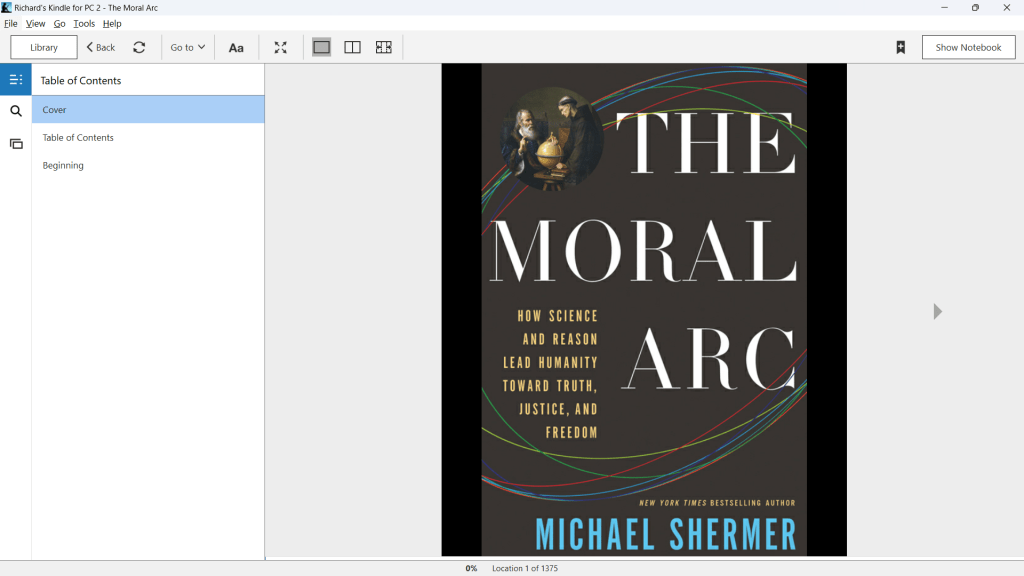



























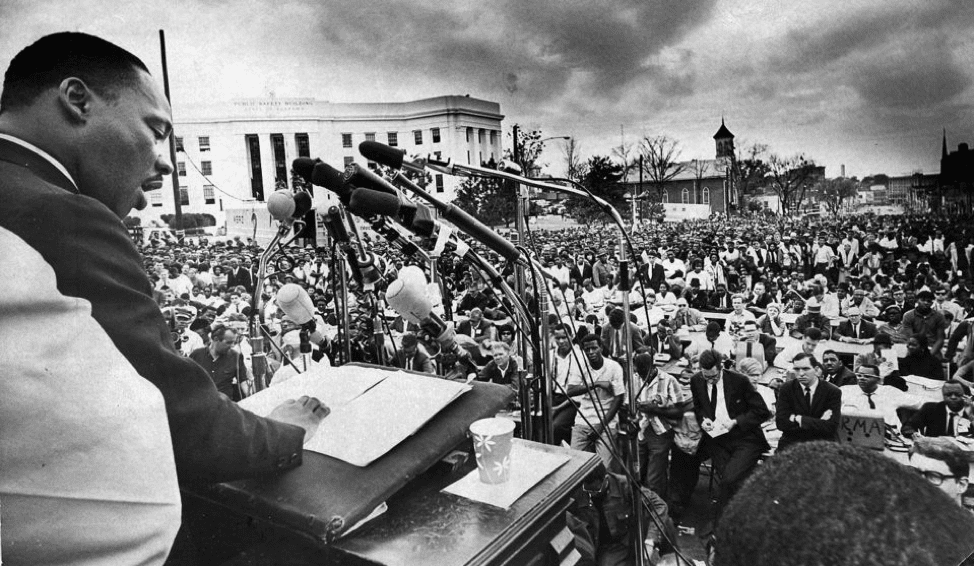
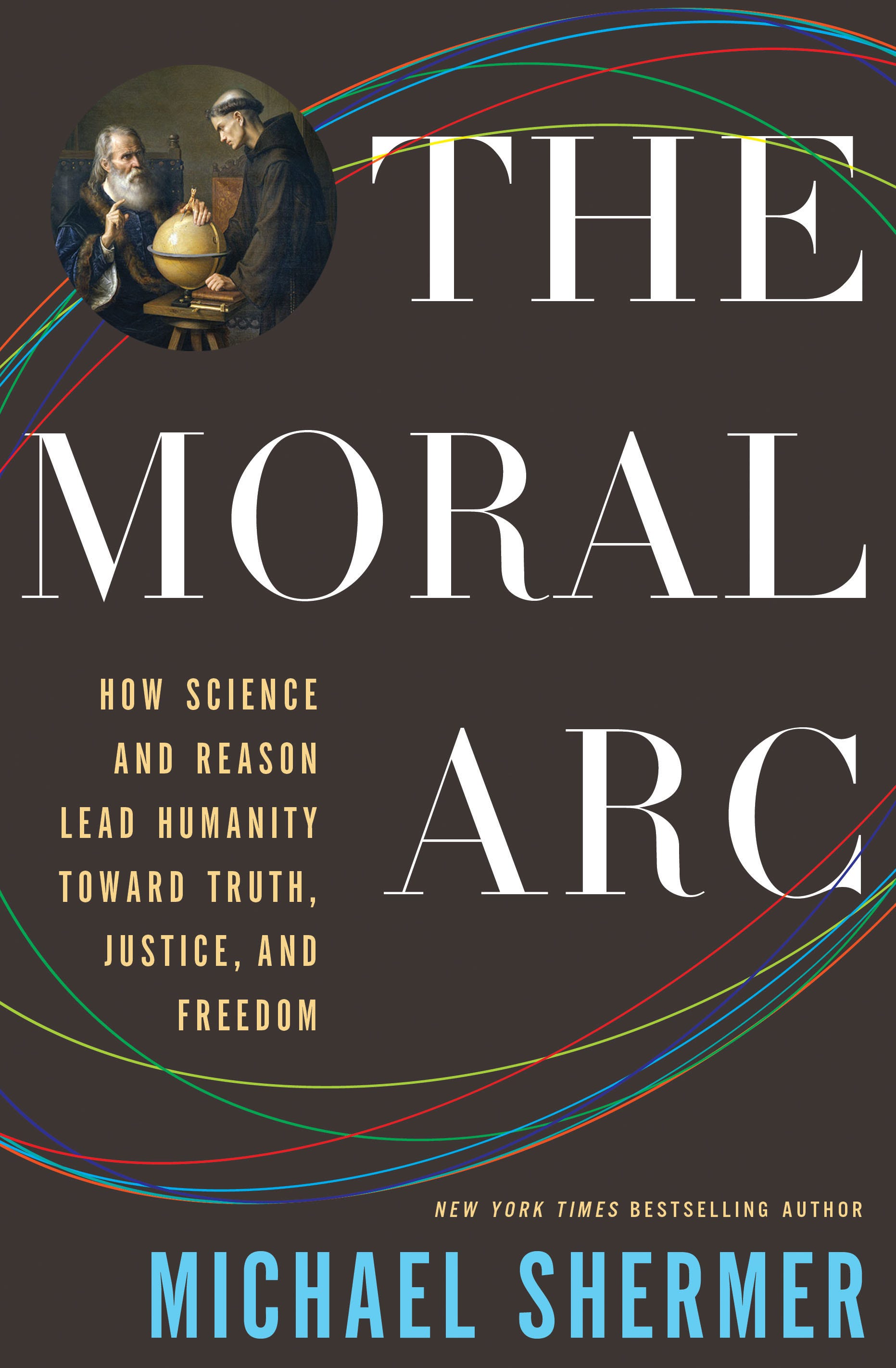
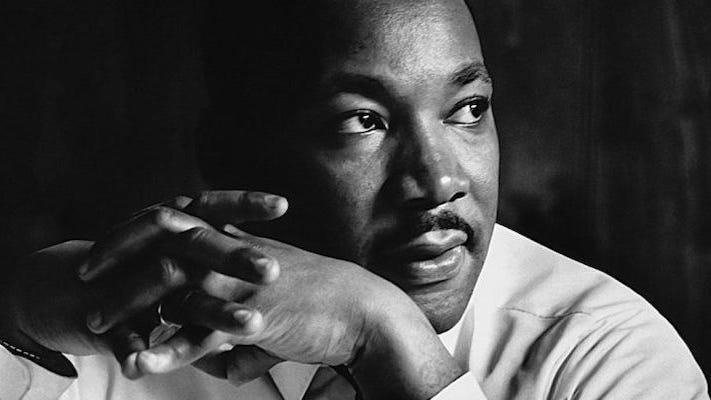
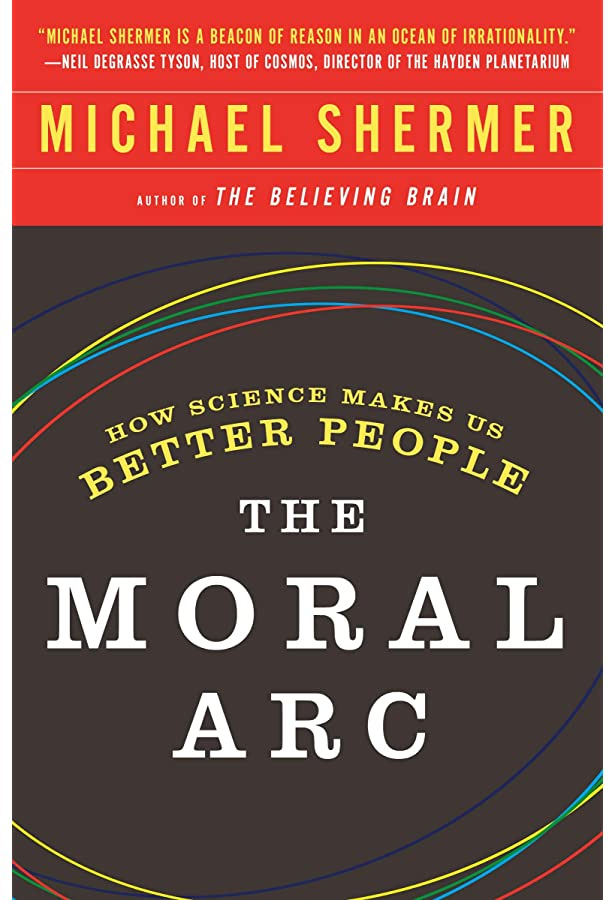


 Richard L. Fricks