Biking is something else I both love and hate. It takes a lot of effort but does provide good exercise and most days over an hour to listen to a good book or podcast. I especially like having ridden.
Here’s my bike, a Rockhopper by Specialized. I purchased it November 2021 from Venture Out in Guntersville; Mike is top notch! So is the bike, and the ‘old’ man seat I salvaged from an old Walmart bike.
Here’s what I’m listening to: The Dictionary of Lost Words, by Pip Williams
Amazon abstract:
NEW YORK TIMES BESTSELLER • REESE’S BOOK CLUB PICK • “Delightful . . . [a] captivating and slyly subversive fictional paean to the real women whose work on the Oxford English Dictionary went largely unheralded.”—The New York Times Book Review
“A marvelous fiction about the power of language to elevate or repress.”—Geraldine Brooks, New York Times bestselling author of People of the Book
Esme is born into a world of words. Motherless and irrepressibly curious, she spends her childhood in the Scriptorium, an Oxford garden shed in which her father and a team of dedicated lexicographers are collecting words for the very first Oxford English Dictionary. Young Esme’s place is beneath the sorting table, unseen and unheard. One day a slip of paper containing the word bondmaid flutters beneath the table. She rescues the slip and, learning that the word means “slave girl,” begins to collect other words that have been discarded or neglected by the dictionary men.
As she grows up, Esme realizes that words and meanings relating to women’s and common folks’ experiences often go unrecorded. And so she begins in earnest to search out words for her own dictionary: the Dictionary of Lost Words. To do so she must leave the sheltered world of the university and venture out to meet the people whose words will fill those pages.
Set during the height of the women’s suffrage movement and with the Great War looming, The Dictionary of Lost Words reveals a lost narrative, hidden between the lines of a history written by men. Inspired by actual events, author Pip Williams has delved into the archives of the Oxford English Dictionary to tell this highly original story. The Dictionary of Lost Words is a delightful, lyrical, and deeply thought-provoking celebration of words and the power of language to shape the world.
“Human being, vegetables or cosmic dust, we all dance to an invisible tune, intoned in the distance by a mysterious player.”
BY MARIA POPOVA
We are accidents of biochemistry and chance, moving through the world waging wars and writing poems, spellbound by the seductive illusion of the self, every single one of our atoms traceable to some dead star.
In the interlude between the two World Wars, days after the stock market crash that sparked the Great Depression, the German-American poet and future Nazi sympathizer George Sylvester Viereck sat down with Albert Einstein (March 14, 1879–April 18, 1955) for what became his most extensive interview about life — reflections ranging from science to spirituality to the elemental questions of existence. It was published in the Saturday Evening Post on October 29, 1929 — a quarter century after Einstein’s theory of relativity reconfigured our basic understanding of reality with its revelation that space and time are the warp and weft threads of a single fabric, along the curvature of which everything we are and everything we know is gliding.
Albert Einstein by Lotte Jacobi. (University of New Hampshire Museum of Art.)
Considering the helplessness individual human beings feel before the immense geopolitical forces that had hurled the world into its first global war and the decisions individual political leaders were making — decisions already inclining the world toward a second — Einstein aims in his sensitive intellect at the fundamental reality of existence:
I am a determinist. As such, I do not believe in free will. The Jews believe in free will. They believe that man shapes his own life. I reject that doctrine philosophically. In that respect I am not a Jew… I believe with Schopenhauer: We can do what we wish, but we can only wish what we must. Practically, I am, nevertheless, compelled to act is if freedom of the will existed. If I wish to live in a civilized community, I must act as if man is a responsible being.
When asked about any personal responsibility for his own staggering achievements, he points a steadfast finger at the nonexistence of free will:
I claim credit for nothing. Everything is determined, the beginning as well as the end, by forces over which we have no control. It is determined for the insect as well as for the star. Human being, vegetables or cosmic dust, we all dance to an invisible tune, intoned in the distance by a mysterious player.
For Einstein, the most alive part of the mystery we live with — the mystery we are — is the imagination, that supreme redemption of human life from the prison of determinism. With an eye to his discovery of relativity, he reflects:
I believe in intuitions and inspirations. I sometimes feel that I am right. I do not know that I am. When two expeditions of scientists, funded by the Royal Academy, went forth to test my theory of relativity, I was convinced that their conclusions would totally tally with my hypothesis. I was not surprised when the eclipse of May 29, 1919, confirmed my intuitions. I would have been surprised if I had been wrong.
[…]
I am enough of an artist to draw freely from the imagination. Imagination is more important than knowledge. Knowledge is limited. Imagination encircles the world.
This newsletter is free, but it’s only able to sustain itself due to the support I receive from a small percentage of regular readers. Would you please consider becoming one of those supporters? You can use the button below to subscribe to Substack or use my usual Patreon page!
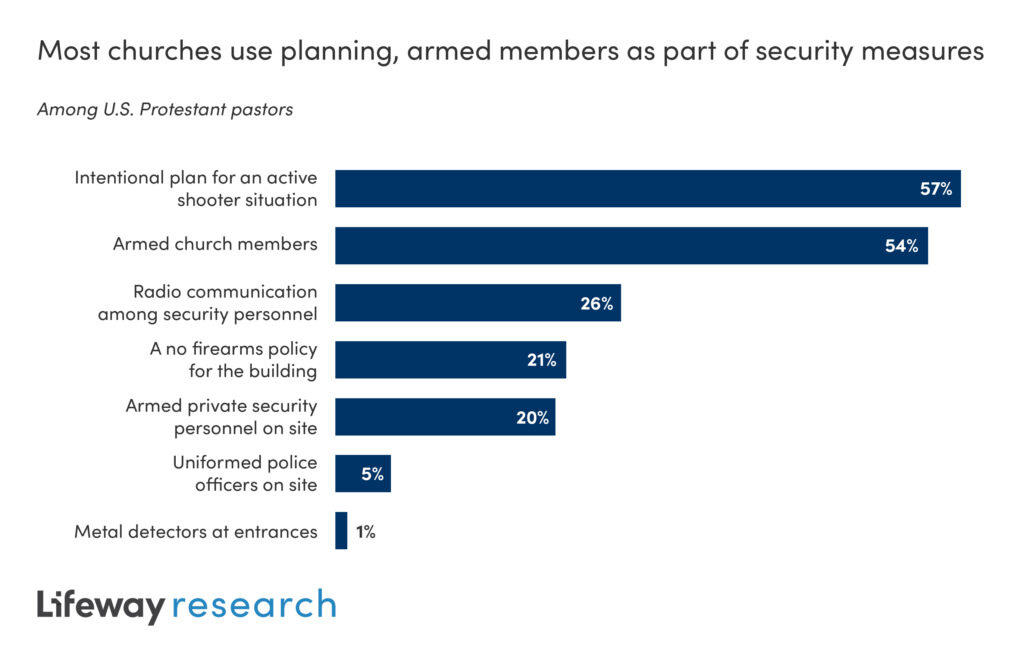
A recent survey from Lifeway Research, an arm of the Southern Baptist Convention, found that most Protestant pastors (54%) plan to thwart a potential church shooting by having armed members of the congregation. (In 2019, that number was 45%.)
Only 5% of those pastors said their safety measures involve having a uniformed cop on site while only 20% have “armed private security personnel.” Shockingly, for people who seem to think a shootout could occur on any given Sunday, only 1% of pastors bother with metal detectors at the entrance.
It might make sense if smaller churches with less money felt like hiring security wasn’t a viable option so they relied on their own armed members… but that’s not the case at all. In fact, it’s the larger churches (with over 250 attendees each week) that are more likely to have armed members.
That means more pastors think they’re better off having random church members with weapons on them instead of hiring private or public police officers with presumably more training in those situations.
None of the security measures involves praying more. Which is telling since that’s the typical response from Christian leaders whenever there’s a shooting in a public school. Thoughts and prayers are the default conservative responses after mass shootings, but conservative Christians refuse to let Jesus take the wheel when it comes to their own safety. They want action. They’re wrong about which action to take, but they know something needs to change, and a Higher Power won’t help.
It’s also noteworthy that so many of these pastors have just accepted that their places of worship could become actual battlegrounds. Apparently God can’t protect them as much as an assault weapon could.
There is, of course, nothing wrong with having a plan in place in the event of a mass shooting, even in church, and there are legitimate debates to be had about the best ways to stop someone with the intention of harming others. Arming “good guys” isn’t always the best option. We’ve unfortunately seen multiple situations, like in Parkland and Uvalde, where armed cops did nothing significant to stop the shooters.
Given all that, it would be nice if these pastors put an ounce of thought into why gun violence is on the rise.
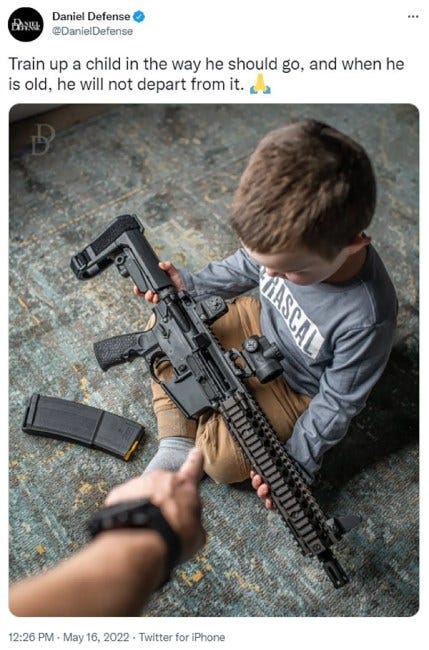
You may recall that, shortly after the Uvalde shooting, a (now-deleted) tweet from a gun manufacturer called Daniel Defense went viral. That was the company that made the weapon used to kill 19 children and two adults. The tweet featured a child holding a weapon, justified with a Bible verse (Proverbs 22:6).
That wasn’t an accident. Daniel Defense is a Christian company that mixes religion and death for an audience that eats it all up. That company also created the weapon used in the mass shooting in Las Vegas, which killed another 60 people and injured literally hundreds more.
Conservative Christians think guns are the solution to a gun culture they helped create. Just as God is their solution to another problem they created (sin), they see more weapons as the response to a society made worse by more weapons.
Last year, historian Peter Manseaupublished an essay in the New York Times(gift article)in which he linked the conservative Christian obsession with guns and God:
In Florida, Spike’s Tactical (“the finest AR-15s on the planet”) makes a line of Crusader weapons adorned with a quote from the Psalms. Missouri-based CMMG (“the leading manufacturer of AR15 rifles, components and small parts”) advertises its employees’ “commitment to meet each and every morning to pray for God’s wisdom in managing the enormous responsibility that comes with this business.” And in Colorado, Cornerstone Arms explains that it is so named because “Jesus Christ is the cornerstone of our business, our family and our lives” and the “Second Amendment to our Constitution is the cornerstone of the freedom we enjoy as American citizens.”
For many American Christians, Jesus, guns and the Constitution are stitched together as durably as a Kevlar vest.
There’s a reason those companies exist. White evangelical Christians have a higher rate of gun ownership than any other religious (or explicitly non-religious) demographic in the country. The people who loudly and proudly declare themselves to be “pro-life” are also the most eager to put a bullet in a theoretical enemy. And the companies that profit from their gun fetish have helped create a culture where mass shootings are commonplace and citizens are falsely led to believe more guns are the solution to any safety issue—even though other countries are well aware that fewer guns and more restrictions on them are the way to go.
Manseau also (correctly) pointed out that this created another obstacle to gun safety measures: Anything politicians do to keep weapons off the streets and out of the hands of people who might use them for evil is inherently seen by these zealots as anti-Christian.
To imagine yourself as a Good Guy With a Gun… may inspire action-movie day dreams, but it is ultimately a religious vision of a world in which good and evil are at war, where God and firepower make all the difference.
Some of us want to see guns regulated like cars. Owners should have to go through a registration process that involves significant training and insurance and a license that could be taken away if you’re irresponsible. But the conservative Christians who see guns as an extension of their faith—and the solution to a potential shooting in church—refuse to accept any kind of sensible restriction on them. They couldn’t handle attendance restrictions or mask mandates in church during the pandemic, and they can’t handle red flag laws or mandatory registration on their weapons.
They believe freedom involves their ability to hurt as many strangers as possible. (It’s what Jesus would have wanted.) And they apparently also think freedom means having people in their churches who spend at least a part of Sunday morning thinking about how they might have to kill someone that morning in case of an emergency.
Obviously, #NotAllChristians are on board with this belief. Many side with progressives on gun safety and understand what all the data in the world has repeatedly told us about what we need to do to save lives. They are victims and first responders and as troubled by the right-wing obsession with guns as the rest of us. But unless they acknowledge the role their religion has played in creating this increasingly dangerous environment Americans currently live in, it’ll be virtually impossible to create change from within. That means pastors with a spine need to speak out against the Second Amendment extremists even if that means denouncing their fellow Christian leaders.
Disarming the church doesn’t mean putting their congregations in harm’s way. Disarming everyone means more safety for more people. At the very least, weapons should be limited to the hands of trained professionals as opposed to anyone who can get his hands on a weapon and wants to cosplay as a hero.
The 2023 Book of Reports contains several key takeaways: a devastating membership drop, huge losses of member churches, and nowhere near enough bounceback in their baptism metrics.
Of note, the report also provides a little information about an ongoing federal investigation into possible criminal charges over their ongoing sex abuse crisis, as well as some distressing information about their summer recruitment drives for children.
Reading Time: 14 MINUTES
Despite its troubles, the Southern Baptist Convention remains the largest Protestant denomination in America. Every year ahead of its big Annual Meeting, their leaders release a sneak peek at the previous year’s metrics. And this year, that sneak peek has been spectacular. Let’s go over the numbers they’ve just released in their 2023 Book of Reports to see what this beleaguered denomination behemoth is dealing with nowadays.
(Author’s note: The figures I’m citing in this post come from Southern Baptist Convention Annual Reports, which are all available here. Each report covers the previous year’s performance.)
Takeaway 1: The worst-ever Southern Baptist Convention membership drop
Most of the significant metrics can be found on page 8 of their 2023 Book of Reports (page numbers reflect the pages of the PDF file itself). As with all Southern Baptist Annual Reports, these figures cover the previous year.
And last year, their total membership fell from 13,680,493 to 13,223,122. That is a drop of 457,371. That number represents the biggest drop in total membership in the entire history of the Southern Baptist Convention. Since their decline began in earnest in the 2000s, they’ve usually faced drops of about 200k. For example, from 2014 to 2015, they lost 204,409 members. Their previous contender for biggest drop ever came in 2020, when they lost 435,632 people from the previous year’s count.
The last time they stood at 13.2M members was around 1979, when they recorded 13.3M. But those were their halcyon days of explosive growth, as we’ll see in a moment.
Takeaway 2: Baptisms
The 2023 Book of Reports does contain smidgens of good news for Southern Baptists, and their small bounce-back on baptisms is one of those smidgens. Long ago, Southern Baptist leaders decided that their most important focus would be on recruitment. And they’d measure recruitment effectiveness by baptisms. With baptism, new members make a formal statement of affiliation and obedience to both Southern Baptist Convention rules and ideology.
So when baptism metrics falter, Southern Baptist folks get twitchy.
Of course, the pandemic completely destroyed most churches’ and denominations’ performance metrics. This one is no different. Indeed, in 2019 they claimed 235,748 baptisms. But in 2020, they record only 123,160—a precipitous drop indeed. In the two years since, they’ve bounced back by inches: 154,701 in 2021, and now 180,177 in 2022. They are still nowhere near the slow-but-inexorable decline in baptisms that they’ve seen over the past 15-ish years, but they’re hyping this slight increase with all the gusto they can muster.
With baptism, new SBC members make a formal statement of affiliation and obedience. So when baptism metrics falter, Southern Baptist folks get twitchy.
I’d really love to know exactly who’s getting dunked here. Around 2014, a Southern Baptist baptism task force admitted that 80% of their churches weren’t baptizing more than 1 young adults (age 18-29) per year, and that “the only consistently growing age group in baptisms is age 5 and under.” I also know that evangelicals do love to be re-baptized for various reasons (joining a new church, sliding from one denomination to another, wanting to reconfirm their vows to Jesus after periods of laxity, etc).
Takeaway 3: The all-important Southern Baptist baptism ratio
Ever since they began calling themselves the Southern Baptist Convention, these evangelicals have tracked what they call their baptism ratio. This is their ride-or-die, make-or-break statistic. It’s simply a ratio that expresses how effective Southern Baptist recruitment attempts are: the number of baptisms according to the total number of Southern Baptist members overall. It tells us how many Southern Baptist members’ resources it takes to bag one baptism.
If someone doesn’t understand this ratio’s drastic importance, not much else about Southern Baptists will make sense. It’s how J.D. Greear could claim that the Southern Baptist Convention has been in decline for forty years: Their baptism ratio began to tank in the mid-1980s. Even though their membership continued to grow by leaps and bounds, their baptism ratio told the true story: their recruitment simply wasn’t as effective as it’d once been.
Southern Baptist leaders used to really like seeing that ratio in the 1:20 range, but 1:30 was okay in a pinch. It ranged in the 1:20s until the mid-1960s. Then, it ranged in the 1:30s all the way until 1985, when it hit 1:41 for the first time. The denomination flirted with the high 1:30s and low 1:40s until 2001. After that point, they never saw the 1:30s ever again.
If you’re now suspecting that this ratio’s decline is accelerating, you’re quite right. In 2012, it hit 1:50. At the time, I saw a lot of Southern Baptist leaders fretting hard about that and spilling great amounts of digital ink lamenting it. None of it mattered, though, because it just kept getting worse. In 2018, it hit 1:60 (and Southern Baptist leaders were generally silent about it this time). Then, the pandemic walloped them with 1:114 in 2020. They clawed their way back to 1:88 in 2021, and now it sits at 1:73 in 2022.
To put this into perspective, remember that 1979 membership figure, 13.3M? That year, they recorded 368k baptisms for a ratio of 1:36. Had they been operating with 1:73, as they did this past year, that would have given them only about 172k baptisms. That’s less than half what they managed in 1979 with far more effective recruitment. And even then, they already knew their baptism ratio told a story of dwindling effectiveness.
So yes, the denomination’s leaders are trying very hard to celebrate a small bounce back. I don’t think it’ll bounce much further back; most evangelicals seemed to forget all about the pandemic last year and were living life on normal mode again. So I think Southern Baptist leaders will be very lucky indeed if they ever see the high end of the 1:60s ever again.
Takeaway 4: Possibly the biggest-ever drop in Southern Baptist member churches as well
In 2022, the Southern Baptist Convention went from 47,614 to 47,198 member churches. That’s a net loss of 416 churches.
I’ve never seen such a huge drop in member churches. Most reports proudly point to an increase there, not a decrease. In 2018, they lost 88 churches, but normally they gain a few hundred. Even in the sheer chaos of 2020, they added 62 new churches. In 2021, they added only 22, but that’s still a teeny tiny bit of growth.
As I said, this is, of course, a net total. Churches always open and close in the Southern Baptist Convention. Even during their last schism, the Conservative Resurgence that saw almost 2000 churches leave the denomination in 1990, they consistently saw their member church totals do nothing but rise. In the past, I’ve even found specific strategies used by this denomination’s leaders to keep the number of churches growing overall by flinging new churches everywhere to keep pace with closures. Keeping that number rising is a big priority for them.
But this past year, nobody could work around or massage that tally into positive net growth.
That drop tells us quite a story on its own
Back in 1979, 13.3M Southern Baptist members squeezed into 35,605 member churches. Now, 13.2M Southern Baptist members spread out comfortably among 47,198 churches. We don’t know what attendance looked like in 1979, since the denomination wasn’t tracking it in their Annual Reports. But since they started recording it around 1992, attendance has fallen from 40-45% of membership to about 35% of it. That’s all perfectly normal. Even the most devout evangelicals can barely be arsed to show up in church every few Sundays. (It’s probably for the best. If the number of Christians claiming rock-solid every-Sunday attendance actually did it, churches couldn’t possibly hold all of them.)
At least, that’s how things looked until the pandemic.
The pandemic decimated attendance figures. In-person counts dropped from 5.2M in 2019 (36.1%) to 4.4M in 2020 (31.5%). So for their 2022 report, Southern Baptist leaders decided to wrap online church participation in with in-person headcounts for their 2021 figure. That got them 3.6M in-person attendees plus 1.4M claimed online participation, for a total of 5.05M (36.9%). For 2022’s counts, they got 3.8M in-person attendees and 1.06M online attendees, for a total of 4.86M (36.7%).
For the past couple of years, though, I’ve been hearing about how the pandemic has destroyed church finances across the board. At the same time, it’s crushed the spirits of many evangelical pastors who began seeing a darker side of their flocks that they really hadn’t known existed. So it’s not just the Southern Baptist Convention’s twin crises of racism and sex abuse that are alienating evangelicals en masse. It’s also the general toxicity of evangelicals and the sheer financial difficulty of operating a church—even with the incredible tax breaks churches get from our secular government.
When a Southern Baptist church closes, then, all of its claimed members vanish along with it. The denomination’s leaders have known for years that large numbers of churches are closing, and their go-to solution has always been to drown out that truth with tons of new church plants. This time, there’s no drowning out a voice that loud and insistent. Even with them adding 917 new congregations to their member rolls (as we see on p. 93), they ended up with that net loss of 416 this past year.
And one interesting omission from the 2023 Book of Reports
Various news articles online about this year’s reports cite an increase in “undesignated receipts.” And yes, they did rise somewhat over last year, from $9.7B to $9.9B.
What’s so strange is that the 2023 Book of Reports doesn’t list total receipts.
They’ve always listed both together before. Even in the 2022 report, we see total receipts ($11.8B) right under undesignated receipts (again, $9.7B). As far back as I can find, they’ve listed total receipts. Even with the pandemic’s devastation, they’ve listed both amounts.
But for some weird reason, the 2023 report doesn’t include total receipts. It’s not happening because this isn’t the full Annual Report, either. In 2021, we had a similar situation with the Book of Reports coming out ahead of the formal Annual Report released after the Annual Meeting. However, Total Receipts is definitely in that report in several places.
Page 77 indicates that total receipts increased by $304M in 2021. That is true. They recorded it in the 2022 Annual Report. But they also don’t tell us what last year’s total receipts were in this current year’s report.
We can make some educated guesses here. If Southern Baptist reports omit figures they usually include, there’s usually only one reason for it.
Also, on page 7 of the PDF in the 2023 report, we can see that Total Cooperative Program donations fell about $500k from the previous year. Though it’s a tiny drop (.11%) percentage-wise, that drop could function as an editorial comment or vote of no confidence, since churches have in the past threatened to withhold funds from that program over squabbles.
So yes, I am intensely curious about this total receipts situation.
Other interesting takeaways
Back in 2013, Southern Baptist leaders realized that almost no members left anything to their churches in their wills. They dearly wanted to get some of that free money. Page 47 of the 2023 Book of Reports proudly reveals that their action in this area has produced luscious fruit. The Southern Baptist Convention went from $23M in future gifts in wills in 2013 to $628M in 2022.
On page 50 of the PDF, we learn that their Ministers’ Financial Assistance program paid out $11.6M in assistance in 2022. That’s a sharp rise from $8.8M in 2021. That money goes to retired ministers in financial distress, as well as their spouses and widows. About 2/3 of recipients are pastors’ widows. This program sets age and tenure requirements, as well as poverty income requirements for larger amounts of help. Someone living under the program’s poverty level cutoff with 25+ years of ministerial service (or marriage to someone who had it) gets a whopping $550/month if single.
However, at the same time, 748 fewer people participated in their personal life insurance plans and 400 fewer participated in their medical and disability insurance plans. Group employee life insurance plans saw an increase in participants.
These are all absolutely awful numbers. Group employee life insurance plans had about 30k members covered. The personal plans cover almost 13k more members. But with 47,198 member churches and who even knows how many paid ministers and staffers beyond just pastors and their spouses to consider, I’d guess that barely 1/3 of Southern Baptist ministers and spouses are covered by any life insurance plans. The medical insurance plans fare even worse, covering about 25k members between group and personal plans.
I also note that most of their seminaries are struggling with declines in enrollment.
A bright spot of better news from Lifeway
On the plus side, Lifeway’s new president, Ben Mandrell, reports that the organization had “revenue growth” last year (p. 62). After how much Thom Rainer, the previous president, apparently mucked things up, I bet Southern Baptist Convention folks will be glad to hear that news.
On page 69, we also learn that Southern Baptist denominational and church leaders unabashedly consider Vacation Bible Schools to be evangelism opportunities. That means they are completely okay with indoctrinating and recruiting children, especially the children of unaffiliated adults who clearly don’t know that these recruitment events are far more than fun, supervised summer activities with a slight frosting of Jesus-ness to keep their kids busy.
The only moral recruitment is their recruitment. And every accusation is a confession. I hope non-evangelical parents are paying attention here.
Personally, I find Southern Baptists’ eagerness to hard-sell their religion to defenseless little kids to be downright sinister. I know they sense that 4-14 window closing fast on Gen Alpha, the children coming up next after Gen Z. However, that doesn’t excuse their desires. There’s nothing divine at all in Christianity, but there’s even less divine about the sheer Machiavellian nature of evangelicals’ intense focus on childhood indoctrination.
And a letter addressing that federal investigation
On page 11, we find a section titled “Significant actions of the SBC Executive Committee.” The Executive Committee is the denomination’s top-ranking group. They make the day-to-day decisions of the denomination all year long, as well as crafting budgets for the various denominational endeavors (like seminaries). In addition, the presidency of this committee has become the most recent battleground between the two current political factions of the Southern Baptist Convention.
Every year, this section runs after the metrics page. In previous years, it offered staffing news. It talked about people retiring, people getting hired or elected. It recounted lists of who occupied the committee’s top roles. Very rarely, we see important votes recorded—like in 2020, when the report discusses the vote the committee held in March 2020 to cancel that year’s Annual Meeting due to COVID-19.
But this year, the #1 item on the list concerns the Department of Justice’s decision to investigate the Southern Baptist Convention for possible crimes committed in its shielding and shuffling-around of sexual predators in ministry.
I looked, but have seen absolutely nothing about this investigation since August last year. But if the January 6 situation has taught me anything, it is that the wheels of justice grind very slowly—but exceedingly fine.
Of course, the letter in the report expresses complete cooperativeness with the federal investigation, as well as ongoing dedication to fully implement reforms to prevent future sex abuse. I’d expect nothing less, though I wonder how they’ll explain that their sweeping investigation has so far seen only one Southern Baptist church (Freedom Church of Vero Beach, Florida) kicked out of the denomination recently for not cooperating with a sex abuse investigation.
(By contrast, between Fall 2022 and early 2023 they also kicked out one church for being too nice to gay people, as well as five churches for being okay with women pastors. And that first church had voted to leave the Southern Baptist Convention back in 1999. So they were surprised to hear that the denomination had formally kicked them out last year.)
Interestingly, this letter is not signed by any Executive Committee members—except for Willie McLaurin, its Interim President. Since the list is arranged alphabetically, he appears near the end. Drowning out his name, we see various other big-name Southern Baptist officers: seminary presidents, missionary organization presidents, the president of their financial planning group, leaders of important groups like Lifeway, and even the president of the Southern Baptist Convention himself, Bart Barber.
I understand why the denomination felt it was important to show their biggest names supporting the investigation to the hilt, but it’s still such a strange look.
About that Southern Baptist sound bite going around
It’s easy to see why even secular news sites have talked about the 2023 Book of Reports. All of them mention a sound bite mentioned in Lifeway’s article about the report:
The 457,371 members lost is the largest single year numerical drop in more than 100 years.Lifeway, May 9, 2023
That little bit of info appears in almost every article I’ve seen on the topic.
However, I genuinely don’t know where they’re getting that information. All of their Annual Reports are right online. Anybody can look at them and compile information from them. (In fact, every year I do exactly that.) So I went back over their reports from 1920-1925.
There was no membership dip. They grew from about 2.9M members (from the 1920 report) to 3.5M members recorded in 1925, all without a hiccup.
At most, they lost about 800 churches in 1924, 700ish of which were dropped due to an ongoing lack of contact for three year, they said. That same year, they recorded almost 30k fewer baptisms. Otherwise, it was another typical growth year in terms of membership and donations.
That said, I don’t think they’re lying. They’re just not being very specific. Maybe they’re thinking further back, around when a similar pandemic, this time of influenza, decimated communities around the world. If Lifeway mentioned that 100-years figure hoping people would connect their current difficulties to the pandemic we face now, it was a clever move—but I’m not sure that most people would make that connection.
Besides, their Annual Reports from 1916-1920 don’t record anything but membership growth, so that can’t be whatever they’re using as an example.
I’m really curious about what their biggest drop was, if 2022 wasn’t the gold-medal winner there.
I don’t think this Southern Baptist membership drop is just recordkeeping ‘finally catching up’
The director of Lifeway’s research division, Scott McConnell, theorizes that the drop in membership happened because “the record keeping is finally catching up” with long-inactive members. I’m not so sure that’s the reason.
In reality, several factors are contributing to that alarming drop.
First and foremost, churches are closing like whoa. As I said, when a church closes, all of its members leave the rolls. Churches are the ones reporting all of these numbers to each Annual Report. If nobody’s at the church to report those figures, their previous count zeroes out.
Second and almost as important, reporting is purely voluntary and seems to be entirely done on the honor system. The Southern Baptist Convention gathers these numbers through their Annual Church Profile (ACP), which isn’t at all mandatory. Entire state conventions don’t even ask for some of the information appearing in their summary tables.
For example, the Florida Baptist Convention didn’t ask for a total membership count in their ACP, while the state conventions of Florida, Oklahoma, Arkansas, Georgia, Kentucky, the Pacific Northwest, and one of the Texas conventions didn’t ask about online worship participation. Moreover, if a church has nothing but bad news to report, nothing stops them from deciding maybe not to report it.
Even back in 2014, that baptism task force lamented that “[m]ore of our SBC churches in recent years fail to see the value of the annual reporting of statistics (Annual Church Profile),” which makes accurate assessment much more difficult. (However, they’re quick to add that their “statisticians” said there was still a baptism decline even if churches weren’t reporting.)
Third, yes indeed, churches are disaffiliating from the Southern Baptist Convention. In the vast majority of cases, they aren’t leaving over the denomination’s entrenched racism (as happened in 2020) or its slow response to its sex abuse crisis. (That said, I’ve found one former Southern Baptist church that appears to have disaffiliated in fear of its abusive pastor being discovered.)
However, the current Southern Baptist stronghold of ultraconservatism, the Conservative Baptist Network (CBN), still fights hard for control over the denomination. Their officially-stated reason for fighting is simple:
The Conservative Baptist Network believes the United States follows the SBC, seeing the SBC as “one of the few remaining roadblocks keeping liberalism from overtaking the United States.”Editorial in Baptist Standard, April 20, 2022
What a hilariously overblown sense of narcissistic importance! But I’d sure like to learn their second reason, because I’m certain they are even more motivated by the $10B+ dollars the Southern Baptist Convention still rakes in every year.
The upshot of the 2023 Southern Baptist Book of Reports
In this age of Christianity’s decline, the Southern Baptist Convention remains one of the few denominations issuing reports like this every year. They aren’t actually humanity’s Designated Adults except in their dreams, but they do act as a bellwether indicating future priorities and strategies of the Christian Right in general. That’s why I find it useful to keep an eye on them.
With this year’s firecracker of a report, we see a still-failing denomination struggling to find good news to report. Its leaders are trying their hardest to put a brave face on endless waves of bad news. They still haven’t recovered from the pandemic, and they probably won’t ever see their pre-pandemic numbers again.
But at the same time, they’re squeezing more money out of fewer churches. They can also look forward to way more money from dead Southern Baptist members’ estates. All of that extra money helps them stay hyper-politicized. It also helps them fling more and more money at recruitment efforts. They need to be spending more there, too. As their recruitment efforts become less and less effective, it takes ever-increasing amounts of resources to bag each baptism.
Amid it all, though, their factions are still at each other’s throats, there’s that scary federal investigation to look forward to, and they’ve got almost a half million fewer members and over 400 fewer churches total to deal with it all.
Their Annual Meeting next month is going to be interesting. I have no doubt about it.
Here’s the link to this article. I admit it might be a little late since several local churches have just their indoctrination week’s.
Article was written by Bruce Gerencser.
It is summertime, a time when school children spend their waking hours in leisure pursuits. I have many fond memories of the warm days of summer, three months of freedom from the rigors of the classroom. I spent countless hours at the swimming pool, riding bikes, playing baseball, going to Kings Island/Cedar Point, overnight camping, and aimless hanging out with friends. I suspect children today do many of the things I did half a century ago.
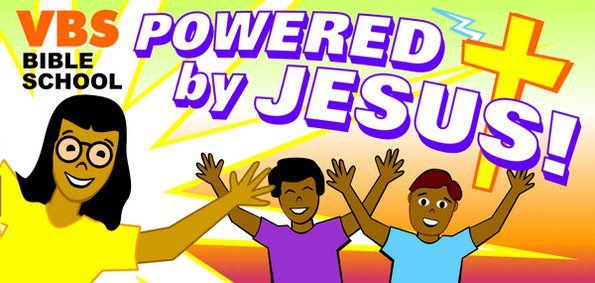
Evangelical churches know that they will have numerous opportunities over the summer months to — through coercive means — win boys, girls, and teenagers to Jesus. Church members are encouraged to scour their neighborhoods in search of children to invite to their church’s Vacation Bible School (VBS), Backyard Bible Club, or Day Camp. Non-Christian parents, unaware of the ulterior motive of Evangelicals, readily allow their children to attend programs that serve no other purpose than to turn children into Evangelical Christians.
Evangelical churches are quite savvy when it comes to methods used to attract children to what can only be described as indoctrination camps/meetings. Years ago, Vacation Bible School was the main tool used by churches to evangelize neighborhood children. While many churches still use this method, other Evangelical churches use day camps to draw children to their lair. These camps are fun-filled weeks sure to thrill most children. Some of these camps focus on sports. Regardless of the theme or focus, the end game is always the same — evangelizing children and teenagers.
Most of the time at these events will be spent doing fun activities. Fun! Fun! Fun!, says advertising material. What’s never stated is that the fun is a means to an end — making sure every attendee has an opportunity to ask Jesus into their heart/get saved/become a Christian. Some churches even baptize youthful converts at special services at the end of the week.
Sadly, many non-Christian (and Christian) parents are way too trusting. If Evangelical neighbor Susie stops by to invite their children to VBS or day camp, many parents quickly say yes. After all, the events are being held at churches, parents think. What harm could possibly come from allowing my children to go? As those of us who follow closely the machinations and shenanigans of Evangelical churches know, churches are NOT safe havens for children and teenagers. I would never advise parents to send their children to church unattended. The risk is too great, especially now that we know that sexual predators and child abusers are often fine, upstanding church members, pastors, deacons, youth group leaders, and Sunday school teachers. No parents in their right minds would allow their children to spend time with neighborhood registered sex offenders. Doing so would warrant a visit from child protective services. Yet, these very same parents don’t think twice about letting their children attend church activities that are magnets for predators. (Churches rarely do criminal background checks on summer program workers or the ministry teams that go from church to church holding camps/meetings.)
Evangelical churches should state very clearly their motives when inviting neighborhood children to VBS or day camps. Imagine what the response would be if advertising material contained the following:
VACATION BIBLE SCHOOL
We are Wonderful Baptist Church 666 Salvation St Defiance, Ohio 43512 419-956-Jesus
Come Join Us June 13-17 6:00-9:00 P.M.
Lots of Fun and Games Crafts and Snacks Too
And while your children are with us we plan to use coercive means to evangelize them. We plan to scare the hell out of your children, teaching them that if they do not repent, they will spend eternity being tortured by God.
Disclaimer: We plan to use workers who have not been thoroughly vetted. It’s too darn expensive to do a background check on everyone. Besides, we are Christians. Everyone knows Christians would never hurt children.
Something tells me that doing so would drastically reduce VBS/day camp attendance. Maybe not. Surely the fine folks down at First Baptist Church would never, ever do anything to harm children, right? People need to open their eyes and pay attention to the nefarious methods used by Evangelical churches (and some mainline churches) to evangelize and indoctrinate unchurched children. Just remember, it’s never just about fun, food, and fellowship. The ultimate goal is always to win wicked, sinful children to saving faith in Jesus Christ.
In any other setting such methods would be roundly criticized and condemned. Churches, however, get a free pass because they are considered depositories of morality and ethics. Until people realize that churches do not warrant such trust, children will continue to be targeted for evangelization and indoctrination.
Bruce Gerencser, 66, lives in rural Northwest Ohio with his wife of 45 years. He and his wife have six grown children and thirteen grandchildren. Bruce pastored Evangelical churches for twenty-five years in Ohio, Texas, and Michigan. Bruce left the ministry in 2005, and in 2008 he left Christianity. Bruce is now a humanist and an atheist.
Biking is something else I both love and hate. It takes a lot of effort but does provide good exercise and most days over an hour to listen to a good book or podcast. I especially like having ridden.
Here’s my bike, a Rockhopper by Specialized. I purchased it November 2021 from Venture Out in Guntersville; Mike is top notch! So is the bike, and the ‘old’ man seat I salvaged from an old Walmart bike.
Here’s what I’m listening to: The Dictionary of Lost Words, by Pip Williams
Amazon abstract:
NEW YORK TIMES BESTSELLER • REESE’S BOOK CLUB PICK • “Delightful . . . [a] captivating and slyly subversive fictional paean to the real women whose work on the Oxford English Dictionary went largely unheralded.”—The New York Times Book Review
“A marvelous fiction about the power of language to elevate or repress.”—Geraldine Brooks, New York Times bestselling author of People of the Book
Esme is born into a world of words. Motherless and irrepressibly curious, she spends her childhood in the Scriptorium, an Oxford garden shed in which her father and a team of dedicated lexicographers are collecting words for the very first Oxford English Dictionary. Young Esme’s place is beneath the sorting table, unseen and unheard. One day a slip of paper containing the word bondmaid flutters beneath the table. She rescues the slip and, learning that the word means “slave girl,” begins to collect other words that have been discarded or neglected by the dictionary men.
As she grows up, Esme realizes that words and meanings relating to women’s and common folks’ experiences often go unrecorded. And so she begins in earnest to search out words for her own dictionary: the Dictionary of Lost Words. To do so she must leave the sheltered world of the university and venture out to meet the people whose words will fill those pages.
Set during the height of the women’s suffrage movement and with the Great War looming, The Dictionary of Lost Words reveals a lost narrative, hidden between the lines of a history written by men. Inspired by actual events, author Pip Williams has delved into the archives of the Oxford English Dictionary to tell this highly original story. The Dictionary of Lost Words is a delightful, lyrical, and deeply thought-provoking celebration of words and the power of language to shape the world.
“Nothing is more unbearable, once one has it, than freedom.”
BY MARIA POPOVA
We, none of us, choose the century we are born in, or the skin we are born in, or the chromosomes we are born with. We don’t choose the incredibly narrow band of homeostasis within which we can be alive at all — in bodies that die when their temperature rises above 40 degrees Celsius or drops below 20, living on a planet that would be the volcanic inferno of Venus or the frigid desert of Mars if it were just a little closer to or farther from its star.
And yet, within these narrow parameters of being, nothing appeals to us more than the notion of freedom — the feeling that we are free, that intoxicating illusion with which we blunt the hard fact that we are not. The more abstract and ideological the realm, the more vehemently we can insist that moral choice in specific situations within narrow parameters proves a totality of freedom. But the closer the question moves to the core of our being, the more clearly and catastrophically the illusion crumbles — nowhere more helplessly than in the most intimate realm of experience: love. Try to will yourself into — or out of — loving someone, try to will someone into loving you, and you collide with the fundamental fact that we do not choose whom we love. We could not choose, because we do not choose who and what we are, and in any love that is truly love, we love with everything we are.
James Baldwin (August 2, 1924–December 1, 1987) was a young man — young and brilliant and aflame with life, blazing against society’s illusion of stability and control — when he composed his stunning semi-autobiographical novel Giovanni’s Room (public library), making the paradox of freedom its animating theme.James Baldwin
Baldwin writes:
Nothing is more unbearable, once one has it, than freedom.
To bear the unbearable, Baldwin intimates, we construct and cling to artificial structures of choice, personal and social — habits, routines, the contractual commitment of marriage, the moralistic frameworks that indict one kind of love as good and another as bad. Today, Giovanni’s Room is celebrated as a pioneering liberation and representation of LGBTQ+ love — a term that did not exist in Baldwin’s day, for it speaks to a cultural silence so deep then that there was no adequate language for it. (The language we use today is hardly adequate — but language is always a placeholder for a culture’s evolving understanding of itself, the space in which we work out our concepts as we learn how to think about them in learning how to speak of them.) Baldwin rose against a tidal force of cowardice from publishers at a time when the Bible of psychiatry — the Diagnostic Manual of Mental Disorders — classified love as so many of us know it as a “sociopathic personality disturbance.” At the center of his act of courage and resistance is the recognition that the experience of love is our most primal confrontation with the illusion of freedom.
People can’t, unhappily, invent their mooring posts, their lovers and their friends, anymore than they can invent their parents. Life gives these and also takes them away and the great difficulty is to say Yes to life.
In the final years of his life, he would look back on the crucible of these ideas, describing Giovanni’s Room as a book not about one kind of love or another but “about what happens to you if you’re afraid to love anybody.” In his most intimate interview, he would recount the best advice he ever received on the transcendent, terrifying choicelessness of love and the implicit, seemingly paradoxical demand for choice within it — advice given him by an old friend:
You have to go the way your blood beats. If you don’t live the only life you have, you won’t live some other life, you won’t live any life at all.
Trump’s hoarding of official secrets is both breathtakingly careless and utterly calculated.
June 10, 2023
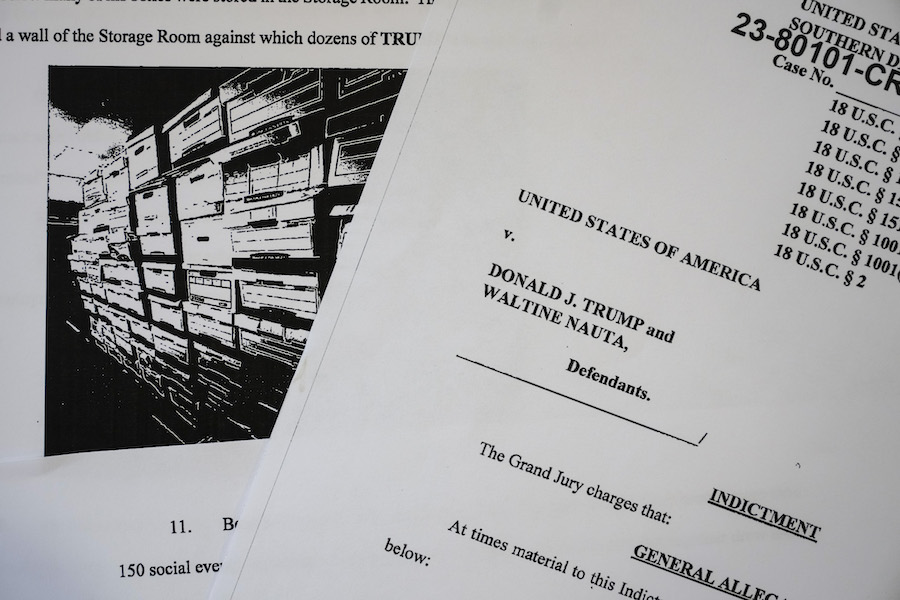
Department of JusticePhotographs from 2021 of boxes of documents in storage at Mar-a-Lago, included in the Justice Department’s indictment of Donald Trump
Secrets are a kind of currency. They can be hoarded, but if kept for too long they lose their value. Like all currencies, they must, sooner or later, be used in a transaction—sold to the highest bidder or bartered as a favor for which another favor will be returned. To see the full scale of Donald Trump’s betrayal of his country, it is necessary to start with this reality. He kept intelligence documents because, at some point, those secrets could be used in a transaction. What he was stockpiling were the materials of treason. He may not have known how and when he would cash in this currency, but there can be little doubt that he was determined to retain the ability to do just that.
Before the publication of the grand jury’s indictment, it was possible to believe that Trump’s retention of classified documents was reckless and stupid. The indictment reveals that recklessness and stupidity are the least of his sins. With Trump, it’s always a mistake to equate anarchy with purposelessness or to think that the farce is not deadly serious. Trump’s hoarding of official secrets is both breathtakingly careless and utterly calculated. At the heart of that calculation is a cold resolve to not give up the power that access to highly restricted information had given him.
The most immediately striking parts of the indictment may, in this regard, be something of a distraction. The photographs that show boxes of papers at Mar-a-Lago, piled high on a ballroom stage, in a bathroom, and spilling out onto the floor of a storage room, convey an almost comic sense of chaos. If comedy is generated by incongruity, what could be more incongruous than nuclear plans or details of “potential vulnerabilities of the United States and its allies to military attack” sitting beside a toilet?
It all seems random and haphazard, an impression greatly magnified by the knowledge that Mar-a-Lago, in the eighteen months after Trump took the documents from the White House, was, as the indictment states, the venue for “more than 150 social events, including weddings, movie premieres and fundraisers that together drew tens of thousands of guests.” The New York Times has published photographs, scraped from social media, of people in party dresses or casual summer clothes around the Mar-a-Lago pool. We can see that, behind them, the door that leads to the storeroom, which was packed with boxes of official papers, is wide open. In those boxes, when the FBI opened them in August 2022, were eleven documents marked Top Secret, thirty-six marked Secret, and twenty-eight marked Confidential. It would have been the least thrilling spy thriller ever made. No James Bond high-tech gadgets or George Smiley ingenuity—just turn up in a cocktail dress, slip through an open door, and help yourself to the US military’s contingency plans for invading Iran.
Yet this ludicrous vulnerability to foreign spies is both remarkable and somewhat beside the point. The slapdash storage of classified papers is shocking—but also misleading. It defines the scandal as, in the words of Alan Feuer and Maggie Haberman in The New York Times, “Mr. Trump’s indifference toward the country’s most sensitive secrets.” But this is not a tale of indifference. Trump cared a great deal about the value of the documents. He cared enough, per the indictment, to suggest that his attorney lie to the FBI and a grand jury about what papers he did or did not have. Even Trump does not engage in a criminal conspiracy purely for its own sake. The retention of those boxes mattered to him because he understood the market value of what they contained.
It is important to bear in mind that chaos is Trump’s natural element. It is the medium in which his narcissism thrives. When there is no plan, the only law is his own desire. He alone knows at any given moment what he will do. In this light, the apparent disorderly storage of the boxes at Mar-a-Lago does not signify a lack of concern with what they contained. It is just the norm of Trumpworld. Derangement is his modus operandi.
The indictment makes clear that Trump knew very well that he was breaking the law. He was repeatedly warned by the National Archives and Records Administration that if he did not hand over the missing records, he would be referred to the Department of Justice. He had, of course, made a very big point in his attacks on Hillary Clinton of the need for zero tolerance for any lack of rigor in the handling of classified documents. He fully understood that the laws applied to everyone, including the president. As he declared in September 2016, before that year’s election, “We can’t have someone in the Oval Office who doesn’t understand the meaning of the word confidential or classified.” As president, in July 2018, he issued a statement saying that “as the head of the executive branch and Commander-in-Chief, I have a unique constitutional responsibility to protect the nation’s classified information, including by controlling access to it.”
More specifically, Trump knew that he was taking huge risks when he allegedly instructed his lawyer to lie to the FBI and the grand jury. That lawyer, quoted in the indictment, recalls that when Trump told him to take a folder of documents to his hotel room, he made a silent “plucking motion,” as if to say, “if there’s anything really bad in there, like, you know, pluck it out.” Precisely because Trump knew that he was committing a crime, he preferred not to utter the incriminating words. There is nothing thoughtless or accidental in all of this. He clearly believed that the risks were worth taking.
This does not suggest that he was holding these documents merely as souvenirs. It’s quite possible to believe that part of his motivation lay in his fantasy that he was still the real president: retaining the intelligence briefings he received as POTUS would make him still, at some level of self-delusion, potent. The two known occasions, cited in the indictment, when Trump produced some of the documents to outsiders while explicitly referring to them as secret and confidential have this air of showing off—perhaps as much to himself as to those he was trying to impress. It is also quite reasonable to think of him experiencing a tingle of pure pleasure in imagining his own impunity—knowing that he was committing the ultimate transgression and thrilling to the idea that he would get away with it because he had always in his life gotten away with everything.
Drew Angerer/Getty ImagesPages from the Justice Department’s indictment of Donald Trump, June 9, 2023
But these elements of twisted psychology can coexist with a more rational impulse: to keep hold of secrets that could be traded at some point for his personal gain. Trump sees himself above all as a deal-maker: “The nation’s classified information” is a potentially lucrative part of one or many deals.
This intent would be treasonous. Trump may not have actually committed treason, but he was consciously putting himself in a position to be able to do so. For what is not secret is the identity of the foreign countries that would be most interested in acquiring the details of the military plans and vulnerabilities of the US and its allies. The indictment states that the documents also included information that could identify US agents and informants in some of those countries and “the continued viability of sensitive intelligence collection methods.” This is worth underlining: Trump went to great lengths to retain for himself, as a private citizen, the power to reveal to any foreign power not just US military secrets but the workings of US intelligence-gathering in those countries. It is impossible to believe that he did this accidentally or without considering that he might at some time use that power in return for some financial or other benefits.
Which makes it all the more astonishing that most of the Republican Party is fine with this. Much of the history of the right in America is bound up with paranoia about the possible existence of traitors at high levels of government. Here is stark evidence of the existence of one at the very highest level of government, and Republicans are rushing to defend him. The Elizabethan courtier Sir John Harington famously asked, “Treason doth never prosper: what’s the reason?” and answered, “For if it prosper, none dare call it Treason.” If the hoarding of state secrets as valuable currency cannot be called treason, the concept has gone the way of honor, truthfulness, and respect for law. It has ceased to exist for the Republican Party.
Fintan O’Toole is the Advising Editor at The New York Review, a columnist for The Irish Times, and the Leonard L. Milberg Professor of Irish Letters at Princeton. His most recent book, We Don’t Know Ourselves: A Personal History of Modern Ireland, was published in the US last year. (June 2023)
At 3:45 PM Molly was lying in her bed reading one of her new novels when she heard Millie’s cellphone vibrating on the end-table beside the couch. Her mother didn’t move. She’d been asleep on the couch since the two of them ended their conversation about Tracey.
“Mom, Mom.” Molly semi-yelled. Thankfully, she didn’t have to get up.
Her mother roused and saw that it was the DA calling. She quickly grabbed the phone and said, “hello.” First thing yesterday morning she’d called Mr. Hook’s office but had to leave a message since he was on holiday until Monday. Millie had explained that it was an emergency and begged the call-taker to notify him as soon as possible.
“Ms. Anderson, this is District Attorney George Hooks. I’m sorry but I just got your message. How may I help you?” The DA knew that Millie and Defendant Colton lived together but that he had never talked to her, nor had one of his investigators. But, that wasn’t because they hadn’t tried. Millie had hidden behind Colton’s attorney, per Colton’s demand. However, the DA had learned during last Monday’s hearing that Millie could provide an alibi for both Colton and Sandy.
“Thanks for returning my call. I need to report a rape, the rape of my twelve-year-old daughter by Colton Atwood.” The first thing DA Hook’s thought was, ‘well that could dampen one’s motivation to provide an alibi.’
“Oh my goodness. I’m so sorry. That reaffirms that bastard is pure evil.” The DA paused a second or two and continued when Millie didn’t respond. “I know this is difficult but can you give me some details, like, when this happened, where it happened, and, sorry for having to be so insensitive, how do you know this is true?”
At first, the DA’s last question triggered Millie’s anger, but then she realized he wasn’t her best friend here; he had a job to do. “We’re pretty certain, Molly and I, that she’s pregnant. Right now all we have, other than my daughter’s word, which I fully believe, is the positive result from an over-the-counter pregnancy test. We have an appointment with an OB/GYN on Monday.”
“I see.” The DA thought about his Monday schedule. “What time is Molly’s appointment?”
“Ten AM.”
“Okay, after that I need the two of you to come to my office. We’ll meet, along with Todd Lacey, my chief investigator, and, again forgive me for my insensitivity, if justified, we’ll swear out a warrant for Mr. Atwood’s arrest.” Millie really didn’t want to tell the DA where she and Molly were, and that they couldn’t come to his office on Monday. But, she had little choice, especially as to the latter. “We can’t come, I’m sorry. We’re no longer in Chicago. Last Friday, we ran away. We weren’t safe.”
“I’m sorry to hear that, but we’ll still need to meet. We can use Zoom. Will that be a problem?”
“No, that’ll work.” Millie was relieved. She admitted she’d return to Chicago if absolutely necessary. She’d do anything for Molly, and to punish Colton.
“Ms. Anderson, I need to tell you that Mr. Atwood and his co-defendant, Sanford Brown, are AWOL. They failed to appear in court last Monday.”
Millie wasn’t aware Colton had any scheduled court dates. “What was that about? The court appearance?”
“I earlier filed a motion to revoke their bonds. Apparently, they realized Judge Rhodes might put them in jail so they didn’t show.”
A wave of nausea erupted in Millie’s stomach. She knew how cunning and relentless Colton could be. “So, he’s free to do as he pleases?”
“Until we find and arrest him.” Millie heard a child in the background pleading for her father to play with her. “Before I go, I need to give you an update. I have a report that the defendants are driving a dark gray Mercedes van. It’s a Sprinter model.”
Millie quickly jumped in. “How do you know this?”
“I’m sorry but I cannot divulge my source right now but he tells me the defendants were seen at Colton’s house on Princeton Avenue.”
“It’s my home. Colton lived with me and Molly.”
“I see. Anyway, they were seen there last Tuesday. After they departed my source searched the garbage can and found cold items, apparently from your refrigerator.”


























 by
by 





 Richard L. Fricks
