My sketch–Baptist fundamentalism on full display.
Southern Baptists Vote to Further Expand Restrictions on Women as Leaders


I encourage you to read these articles (and watch the videos) to gain understanding and perspective concerning the historical federal case of United States of America vs. Donald J. Trump.
Jack Smith Changed My Mind On Prosecuting Trump, by Tom Gingsburg.
Donald Trump Wants To Be Putin
Here’s the link to this article.

“There is no love of life without despair of life,” wrote Albert Camus — a man who in the midst of World War II, perhaps the darkest period in human history, saw grounds for luminous hope and issued a remarkable clarion call for humanity to rise to its highest potential on those grounds. It was his way of honoring the same duality that artist Maira Kalman would capture nearly a century later in her marvelous meditation on the pursuit of happiness, where she observed: “We hope. We despair. We hope. We despair. That is what governs us. We have a bipolar system.”
In my own reflections on hope, cynicism, and the stories we tell ourselves, I’ve considered the necessity of these two poles working in concert. Indeed, the stories we tell ourselves about these poles matter. The stories we tell ourselves about our public past shape how we interpret and respond to and show up for the present. The stories we tell ourselves about our private pasts shape how we come to see our personhood and who we ultimately become. The thin line between agency and victimhood is drawn in how we tell those stories.
The language in which we tell ourselves these stories matters tremendously, too, and no writer has weighed the complexities of sustaining hope in our times of readily available despair more thoughtfully and beautifully, nor with greater nuance, than Rebecca Solnit does in Hope in the Dark: Untold Histories, Wild Possibilities (public library).

Expanding upon her previous writings on hope, Solnit writes in the foreword to the 2016 edition of this foundational text of modern civic engagement:
Hope is a gift you don’t have to surrender, a power you don’t have to throw away. And though hope can be an act of defiance, defiance isn’t enough reason to hope. But there are good reasons.
Solnit — one of the most singular, civically significant, and poetically potent voices of our time, emanating echoes of Virginia Woolf’s luminous prose and Adrienne Rich’s unflinching political conviction — originally wrote these essays in 2003, six weeks after the start of Iraq war, in an effort to speak “directly to the inner life of the politics of the moment, to the emotions and preconceptions that underlie our political positions and engagements.” Although the specific conditions of the day may have shifted, their undergirding causes and far-reaching consequences have only gained in relevance and urgency in the dozen years since. This slim book of tremendous potency is therefore, today more than ever, an indispensable ally to every thinking, feeling, civically conscious human being.
Solnit looks back on this seemingly distant past as she peers forward into the near future:
The moment passed long ago, but despair, defeatism, cynicism, and the amnesia and assumptions from which they often arise have not dispersed, even as the most wildly, unimaginably magnificent things came to pass. There is a lot of evidence for the defense… Progressive, populist, and grassroots constituencies have had many victories. Popular power has continued to be a profound force for change. And the changes we’ve undergone, both wonderful and terrible, are astonishing.
[…]
This is an extraordinary time full of vital, transformative movements that could not be foreseen. It’s also a nightmarish time. Full engagement requires the ability to perceive both.

With an eye to such disheartening developments as climate change, growing income inequality, and the rise of Silicon Valley as a dehumanizing global superpower of automation, Solnit invites us to be equally present for the counterpoint:
Hope doesn’t mean denying these realities. It means facing them and addressing them by remembering what else the twenty-first century has brought, including the movements, heroes, and shifts in consciousness that address these things now.
Enumerating Edward Snowden, marriage equality, and Black Lives Matter among those, she adds:
This has been a truly remarkable decade for movement-building, social change, and deep, profound shifts in ideas, perspective, and frameworks for broad parts of the population (and, of course, backlashes against all those things).
With great care, Solnit — whose mind remains the sharpest instrument of nuance I’ve encountered — maps the uneven terrain of our grounds for hope:
It’s important to say what hope is not: it is not the belief that everything was, is, or will be fine. The evidence is all around us of tremendous suffering and tremendous destruction. The hope I’m interested in is about broad perspectives with specific possibilities, ones that invite or demand that we act. It’s also not a sunny everything-is-getting-better narrative, though it may be a counter to the everything-is-getting-worse narrative. You could call it an account of complexities and uncertainties, with openings.
Solnit’s conception of hope reminds me of the great existential psychiatrist Irvin D. Yalom’s conception of meaning: “The search for meaning, much like the search for pleasure,” he wrote, “must be conducted obliquely.” That is, it must take place in the thrilling and terrifying terra incognita that lies between where we are and where we wish to go, ultimately shaping where we do go. Solnit herself has written memorably about how we find ourselves by getting lost, and finding hope seems to necessitate a similar surrender to uncertainty. She captures this idea beautifully:
Hope locates itself in the premises that we don’t know what will happen and that in the spaciousness of uncertainty is room to act. When you recognize uncertainty, you recognize that you may be able to influence the outcomes — you alone or you in concert with a few dozen or several million others. Hope is an embrace of the unknown and the unknowable, an alternative to the certainty of both optimists and pessimists. Optimists think it will all be fine without our involvement; pessimists take the opposite position; both excuse themselves from acting. It’s the belief that what we do matters even though how and when it may matter, who and what it may impact, are not things we can know beforehand. We may not, in fact, know them afterward either, but they matter all the same, and history is full of people whose influence was most powerful after they were gone.

Amid a 24-hour news cycle that nurses us on the illusion of immediacy, this recognition of incremental progress and the long gestational period of consequences — something at the heart of every major scientific revolution that has changed our world — is perhaps our most essential yet most endangered wellspring of hope. Solnit reminds us, for instance, that women’s struggle for the right to vote took seven decades:
For a time people liked to announce that feminism had failed, as though the project of overturning millennia of social arrangements should achieve its final victories in a few decades, or as though it had stopped. Feminism is just starting, and its manifestations matter in rural Himalayan villages, not just first-world cities.
She considers one particularly prominent example of this cumulative cataclysm — the Arab Spring, “an extraordinary example of how unpredictable change is and how potent popular power can be,” the full meaning of and conclusions from which we are yet to draw. Although our cultural lore traces the spark of the Arab Spring to the moment Mohamed Bouazizi set himself on fire in an act of protest, Solnit traces the unnoticed accretion of tinder across space and time:
You can tell the genesis story of the Arab Spring other ways. The quiet organizing going on in the shadows beforehand matters. So does the comic book about Martin Luther King and civil disobedience that was translated into Arabic and widely distributed in Egypt shortly before the Arab Spring. You can tell of King’s civil disobedience tactics being inspired by Gandhi’s tactics, and Gandhi’s inspired by Tolstoy and the radical acts of noncooperation and sabotage of British women suffragists. So the threads of ideas weave around the world and through the decades and centuries.
In a brilliant counterpoint to Malcolm Gladwell’s notoriously short-sighted view of social change, Solnit sprouts a mycological metaphor for this imperceptible, incremental buildup of influence and momentum:
After a rain mushrooms appear on the surface of the earth as if from nowhere. Many do so from a sometimes vast underground fungus that remains invisible and largely unknown. What we call mushrooms mycologists call the fruiting body of the larger, less visible fungus. Uprisings and revolutions are often considered to be spontaneous, but less visible long-term organizing and groundwork — or underground work — often laid the foundation. Changes in ideas and values also result from work done by writers, scholars, public intellectuals, social activists, and participants in social media. It seems insignificant or peripheral until very different outcomes emerge from transformed assumptions about who and what matters, who should be heard and believed, who has rights.
Ideas at first considered outrageous or ridiculous or extreme gradually become what people think they’ve always believed. How the transformation happened is rarely remembered, in part because it’s compromising: it recalls the mainstream when the mainstream was, say, rabidly homophobic or racist in a way it no longer is; and it recalls that power comes from the shadows and the margins, that our hope is in the dark around the edges, not the limelight of center stage. Our hope and often our power.
[…]
Change is rarely straightforward… Sometimes it’s as complex as chaos theory and as slow as evolution. Even things that seem to happen suddenly arise from deep roots in the past or from long-dormant seeds.

And yet Solnit’s most salient point deals with what comes after the revolutionary change — with the notion of victory not as a destination but as a starting point for recommitment and continual nourishment of our fledgling ideals:
A victory doesn’t mean that everything is now going to be nice forever and we can therefore all go lounge around until the end of time. Some activists are afraid that if we acknowledge victory, people will give up the struggle. I’ve long been more afraid that people will give up and go home or never get started in the first place if they think no victory is possible or fail to recognize the victories already achieved. Marriage equality is not the end of homophobia, but it’s something to celebrate. A victory is a milestone on the road, evidence that sometimes we win, and encouragement to keep going, not to stop.
Solnit examines this notion more closely in one of the original essays from the book, titled “Changing the Imagination of Change” — a meditation of even more acute timeliness today, more than a decade later, in which she writes:
Americans are good at responding to crisis and then going home to let another crisis brew both because we imagine that the finality of death can be achieved in life — it’s called happily ever after in personal life, saved in politics — and because we tend to think political engagement is something for emergencies rather than, as people in many other countries (and Americans at other times) have imagined it, as a part and even a pleasure of everyday life. The problem seldom goes home.
[…]
Going home seems to be a way to abandon victories when they’re still delicate, still in need of protection and encouragement. Human babies are helpless at birth, and so perhaps are victories before they’ve been consolidated into the culture’s sense of how things should be. I wonder sometimes what would happen if victory was imagined not just as the elimination of evil but the establishment of good — if, after American slavery had been abolished, Reconstruction’s promises of economic justice had been enforced by the abolitionists, or, similarly, if the end of apartheid had been seen as meaning instituting economic justice as well (or, as some South Africans put it, ending economic apartheid).
It’s always too soon to go home. Most of the great victories continue to unfold, unfinished in the sense that they are not yet fully realized, but also in the sense that they continue to spread influence. A phenomenon like the civil rights movement creates a vocabulary and a toolbox for social change used around the globe, so that its effects far outstrip its goals and specific achievements — and failures.
Invoking James Baldwin’s famous proclamation that “not everything that is faced can be changed, but nothing can be changed until it is faced,” Solnit writes:
It’s important to emphasize that hope is only a beginning; it’s not a substitute for action, only a basis for it.
What often obscures our view of hope, she argues, is a kind of collective amnesia that lets us forget just how far we’ve come as we grow despondent over how far we have yet to go. She writes:
Amnesia leads to despair in many ways. The status quo would like you to believe it is immutable, inevitable, and invulnerable, and lack of memory of a dynamically changing world reinforces this view. In other words, when you don’t know how much things have changed, you don’t see that they are changing or that they can change.

This lack of a long view is perpetuated by the media, whose raw material — the very notion of “news” — divorces us from the continuity of life and keeps us fixated on the current moment in artificial isolate. Meanwhile, Solnit argues in a poignant parallel, such amnesia poisons and paralyzes our collective conscience by the same mechanism that depression poisons and paralyzes the private psyche — we come to believe that the acute pain of the present is all that will ever be and cease to believe that things will look up. She writes:
There’s a public equivalent to private depression, a sense that the nation or the society rather than the individual is stuck. Things don’t always change for the better, but they change, and we can play a role in that change if we act. Which is where hope comes in, and memory, the collective memory we call history.
A dedicated rower, Solnit ends with the perfect metaphor:
You row forward looking back, and telling this history is part of helping people navigate toward the future. We need a litany, a rosary, a sutra, a mantra, a war chant for our victories. The past is set in daylight, and it can become a torch we can carry into the night that is the future.
Hope in the Dark is a robust anchor of intelligent idealism amid our tumultuous era of disorienting defeatism — a vitalizing exploration of how we can withstand the marketable temptations of false hope and easy despair. Complement it with Camus on how to ennoble our minds in dark times and Viktor Frankl on why idealism is the best realism, then revisit Solnit on the rewards of walking, what reading does for the human spirit, and how modern noncommunication is changing our experience of time, solitude, and communion.
Here’s the link to this article.
 by ADAM LEE
APR 20, 2023

Millennials are defying long-established patterns by getting older without becoming more religious or voting more conservative. It’s an unpleasant surprise for the American religious right.
Reading Time: 5 MINUTES
You get more conservative as you get older. Everyone knows that.
As you age, you settle into the world. Your youthful passions cool, and the fire of rebellion fizzles out. You get a corporate job, a steady paycheck, a pension, and a house in the suburbs. The reckless fantasies of your younger self become fond memories of the good old days. As old age creeps up, you get used to things as they are, and you instinctively become suspicious of change.
It happened to the Boomers. Those rebellious beatniks and peace-loving hippies became retirees, churchgoers, Trump supporters. It happened to Gen X too. Now, as the Millennials approach middle age, it’s their turn. It’s the way of things, as natural and inevitable as the seasons.
There’s just one problem. It’s not happening this time.
It’s true, historically speaking, that people tend to be liberal in their youth and to become more conservative as they age. As John Burn-Murdoch writes in the Financial Times, summing up a trend that applies to the U.K. and the U.S.:
The pattern has held remarkably firm. By my calculations, members of Britain’s “silent generation”, born between 1928 and 1945, were five percentage points less conservative than the national average at age 35, but around five points more conservative by age 70. The “baby boomer” generation traced the same path, and “Gen X”, born between 1965 and 1980, are now following suit.“Millennials are shattering the oldest rule in politics.” John Burn-Murdoch, Financial Times, 30 December 2022.
With this evidence on their side, conservatives might have had an excuse for complacency. However, the Millennial generation has broken the pattern. Not only did we start out more liberal than average, we’re staying that way as we age. In fact, we’re getting even more liberal:
If millennials’ liberal inclinations are merely a result of this age effect, then at age 35 they too should be around five points less conservative than the national average, and can be relied upon to gradually become more conservative. In fact, they’re more like 15 points less conservative, and in both Britain and the US are by far the least conservative 35-year-olds in recorded history.
This chart shows just how dramatic the trend lines are:
Speaking as a Millennial, I can add an anecdote to confirm this data. I’m 41 now, middle-aged by any measure, and I’m a homeowner with a family. But I haven’t become the slightest bit more conservative. I haven’t become any less of a ferocious atheist, nor have my highest priorities become lower taxes and lawn care. I’m as bright-blue liberal as I ever was—maybe more.
This is a looming apocalypse for the religious right. Until recently, their voter pool was steadily replenished as people joined the ranks of the elderly. But if Millennials aren’t aging into conservatism, that means their voters are dying off with no replacement. It’s no wonder that Republicans are resorting to increasingly aggressive gerrymandering, vote suppression, legislating from the bench by far-right judges, and other anti-democratic measures. Once they lose their grip on power, they may never get it back.
As welcome as this news is, it shouldn’t have come as a surprise. This isn’t the first precedent Millennials have shattered.
In our heyday, Millennials were the least religious generation in American history up to that point (although Gen Z surpassed us). As poll after poll confirmed this result, Christian apologists were dismayed and bewildered.
They made some half-hearted suggestions about how to evangelize to us, but they were confident that their best ally was time. They insisted that we were just having a secular rumspringa, sowing some wild oats, and that we’d come back to Christianity as we settled down and grew older.
That didn’t happen. Instead, Millennials have been growing less religious with time.
Are these trends related? It’s very likely. Frequent church attendance and self-reported religiosity both map to political conservatism. You can debate which direction the arrow of causality points, but the connection is there. Since the Millennials are less religious than older generations, it’s to be expected that we’d also be less conservative.
There’s another explanation that Burn-Murdoch’s article suggests. Conservatism often accompanies wealth, stability, and a sense of security—in short, the things that make you feel like your life is going well and you’d like to keep it that way. However, younger generations haven’t had that same opportunity to build wealth.
In the U.S., the post-war generation enjoyed unprecedented prosperity. Rather than pass on those opportunities to the young, they’ve done their best to pull up the ladder behind them. Over the last few decades, conservative legislators have crippled union power, kept the minimum wage frozen at a pittance, taken a chainsaw to tax rates at the top, allowed college tuition to skyrocket, stonewalled the construction of affordable housing, and done their utmost to block universal health care.
Republicans have even proposed getting rid of (“sunsetting”) Social Security and Medicare. Nothing could be more emblematic of the conservative desire to yank away welfare programs after benefiting from them.
The predictable result is that a tiny minority has accumulated vast wealth, whereas life for everyone else has become harder and more precarious than ever. The Millennial generation has been pinched between recessions. Many of us can’t afford to buy houses. We have far lower rates of stock ownership.
All of this has left a lasting mark on Millennials’ political views. We never had the chance to become invested in the system the way our parents and grandparents did. It’s the least surprising thing imaginable that we’re in favor of a stronger safety net, higher taxes on the rich and other progressive economic policies.
As Millennials and Gen Z grow older, their opinions become a bigger part of the national mix. That’s probably why “the importance of patriotism and faith has dropped like a rock”, according to a Fox News take on this poll from the Wall Street Journal:
The Monday poll questioned U.S. respondents about the importance of patriotism, religious faith, having children and other traditional U.S. metrics. The poll found that just 39% of Americans say their religious faith is very important to them, and just 38% say patriotism is very important. The WSJ compared those numbers to the first time it ran the poll in 1998 when 62% of Americans said religion was very important to them, and 70% said patriotism was very important.
Needless to say, these results have occasioned hand-wringing among the American right. However, they’ve got no one to blame for it but themselves.
For decades, conservatives have sought to weld both religion and patriotism to their own brand of politics. They wanted to convince people that the only way of being patriotic was to be a right-wing Christian. Arguably, they succeeded. But instead of forcing everyone into their mold, as they intended, all they achieved was to turn off everyone who didn’t identify with their brand and send them rushing for the exits.
That’s a major factor behind the decline of Christianity, and the same thing is happening with patriotism. Younger Americans are less inclined to identify with a country that ignores their desires and devalues their lives, just as they’re less inclined to identify with a religion that ignores their views on LGBTQ rights, climate change, gun control, and racial justice. It’s the ultimate reaping-the-whirlwind moment for the religious right.
Here’s the link to this article.
June 13, 2023 by Jami Gold

Journalism writing often uses the 5W1H structure. The first few paragraphs of a news article should answer 6 basic questions (which start with 5 Ws and an H): Who, What, When, Where, Why, and How.
While fiction writing doesn’t try to cram the essentials into the beginning paragraphs, those same questions are important for our storytelling. In fact, we can use specific questions from that structure to understand the big picture—or essence—of our story, plot, and theme.
First, though, we need to understand that our story and our plot are not the same. A story is about our characters’ struggle, while a plot is the events that reveal the characters and choices explored in the story.
Let’s illustrate the difference with an example plot idea: An asteroid is coming to smash the Earth to smithereens.
Yikes! Okay, but what about it? Who’s doing the struggling against those consequences?
Without characters, that asteroid’s just going to do its thing, same as it would on an uninhabited planet. Boom, crash, the end. There’s no story there because there’s no story problem there—no characters attempting to overcome the obstacles of the plot.
To have a story, we need characters who face a problem. And it’s only when we decide who our characters are or the choices they’ll face that we’ll know what our asteroid story is:
Each of those character examples defines a story problem—they want to destroy, debate, or heal. In turn, the story problem defines the story, as the characters attempt to solve their problem.
On the other hand, if the asteroid is only big enough to cause a few cloudy days, our characters would have no reason to make big changes or choices. That’s where plot comes in: Plot events are the triggers forcing choices and changes in our characters.
Now back to that 5W1H structure…
As a story is about a struggle or an attempt to solve a story problem, we can begin to define the layers of our story with questions that focus on that struggle or problem:

We can further define our story with other questions, especially in certain genres such as historical or science fiction (When? 1892 or the distant future, Where? England or outer space), but the two bullets above are generally the most important.
As a plot is about the events that force choices and changes, we can begin to define the layers of our plot with questions that focus on those events:
Note that it may seem like additional questions would help us further define the plot:
But those are all just other ways of getting at the How, defining the triggers that force the changes and choices in our story.
Theme is usually said to be a story’s “message,” but what does that mean in practice? How can we define what the theme of a particular story might be, especially when…
In other words, we might not know what our story’s themes are—or should be. Even if we brainstorm from “theme idea” lists, those nouns or short phrases (war vs. peace, coming of age, love, survival, etc.) aren’t themes until we figure out what we’re trying to say about that topic.
To figure out what we’re trying to say with our story, we can begin to define the layers of our themes with big-picture questions:

Our Why answers help us narrow down what we’re trying to say with our story, which then helps us define our intended themes. Our protagonist could learn to not take life for granted. Our plot events could present reasons and opportunities for our protagonist to give up, but they believe in the importance of their actions and make choices revealing their persistence. And so on.
Taking a page from journalism writing to identify the most important aspects of our story can help us see the big picture as we plan, draft, or edit our story. Using the 5W1H questions forces us to focus on the essence of our story, especially:
Those answers give us direction as we attempt to get our big-picture thoughts onto the page for our readers to enjoy. *smile*
Have you ever struggled to see your story’s big picture or to identify/develop your story’s themes? Does this framework of using specific questions to define our story’s essence make sense to you? Do you have any questions about story vs. plot vs. theme or how to apply these questions?

JAMI GOLD – Resident Writing Coach
Jami Gold, after muttering writing advice in tongues, decided to become a writer and put her talent for making up stuff to good use, such as by winning the 2015 National Readers’ Choice Award in Paranormal Romance for her novel Ironclad Devotion.
To help others reach their creative potential as well, she’s developed a massive collection of resources for writers. Explore her site to find worksheets—including the popular Romance Beat Sheet with 80,000+ downloads—workshops, and over 1000 posts on her blog about the craft, business, and life of writing. Her site has been named one of the 101 Best Websites for Writers by Writer’s Digest.
Biking is something else I both love and hate. It takes a lot of effort but does provide good exercise and most days over an hour to listen to a good book or podcast. I especially like having ridden.
Here’s my bike, a Rockhopper by Specialized. I purchased it November 2021 from Venture Out in Guntersville; Mike is top notch! So is the bike, and the ‘old’ man seat I salvaged from an old Walmart bike.

Here’s a link to today’s bike ride.
I encourage you to start riding a bike, no matter your age. Check out these groups:
Cycling for those aged 70+(opens in a new tab)
Solitary Cycling(opens in a new tab)
Remember,


NEW YORK TIMES BESTSELLER • REESE’S BOOK CLUB PICK • “Delightful . . . [a] captivating and slyly subversive fictional paean to the real women whose work on the Oxford English Dictionary went largely unheralded.”—The New York Times Book Review
“A marvelous fiction about the power of language to elevate or repress.”—Geraldine Brooks, New York Times bestselling author of People of the Book
Esme is born into a world of words. Motherless and irrepressibly curious, she spends her childhood in the Scriptorium, an Oxford garden shed in which her father and a team of dedicated lexicographers are collecting words for the very first Oxford English Dictionary. Young Esme’s place is beneath the sorting table, unseen and unheard. One day a slip of paper containing the word bondmaid flutters beneath the table. She rescues the slip and, learning that the word means “slave girl,” begins to collect other words that have been discarded or neglected by the dictionary men.
As she grows up, Esme realizes that words and meanings relating to women’s and common folks’ experiences often go unrecorded. And so she begins in earnest to search out words for her own dictionary: the Dictionary of Lost Words. To do so she must leave the sheltered world of the university and venture out to meet the people whose words will fill those pages.
Set during the height of the women’s suffrage movement and with the Great War looming, The Dictionary of Lost Words reveals a lost narrative, hidden between the lines of a history written by men. Inspired by actual events, author Pip Williams has delved into the archives of the Oxford English Dictionary to tell this highly original story. The Dictionary of Lost Words is a delightful, lyrical, and deeply thought-provoking celebration of words and the power of language to shape the world.
WINNER OF THE AUSTRALIAN BOOK INDUSTRY AWARD

























I encourage you to read these articles (and watch the videos) to gain understanding and perspective concerning the historical federal case of United States of America vs. Donald J. Trump.
Chickens Come Home to Roost, by Joyce Vance
“Donald Trump Under Arrest, in Federal Custody,” by Heather Cox Richardson
Donald Trump arraigned on his criminal indictment BUT judge imposes NO conditions on his release
Here’s the link to this article.

“Progress is never permanent, will always be threatened, must be redoubled, restated and reimagined if it is to survive,” Zadie Smith wrote in her spectacular essay on optimism and despair. The illusion of permanent progress inflicts a particularly damning strain of despair as we witness the disillusioning undoing of triumphs of democracy and justice generations in the making — despair preventable only by taking a wider view of history in order to remember that democracy advances in fits and starts, in leaps and backward steps, but advances nonetheless, on timelines exceeding any individual lifetime. Amid our current atmosphere of presentism bias and extreme narrowing of perspective, it is not merely difficult but downright countercultural to resist the ahistorical panic by taking such a telescopic view — lucid optimism that may be our most unassailable form of resistance to the corruptions and malfunctions of democracy.
That is what Walt Whitman (May 31, 1819–March 26, 1892) insisted on again and again in Specimen Days (public library) — the splendid collection of his prose fragments, letters, and diary entries that gave us his wisdom on the wisdom of trees, the singular power of music, how art enhances life, and what makes life worth living.
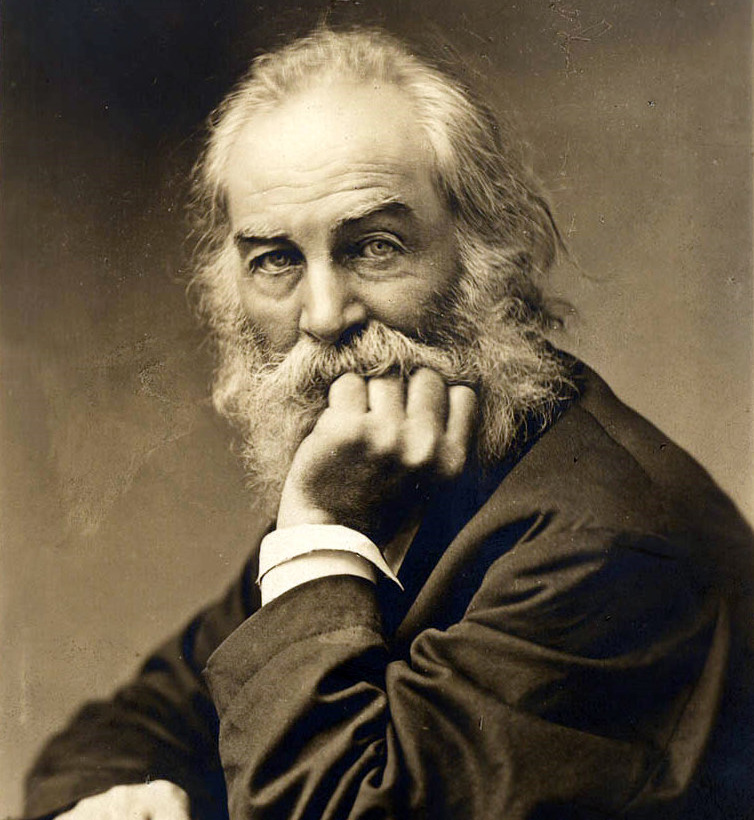
Shortly before his sixtieth birthday and a decade after issuing his immensely prescient admonition that “America, if eligible at all to downfall and ruin, is eligible within herself, not without,” exhorting his compatriots to “always inform yourself; always do the best you can; always vote,” Whitman writs under the heading “DEMOCRACY IN THE NEW WORLD”:
I can conceive of no better service in the United States, henceforth, by democrats of thorough and heart-felt faith, than boldly exposing the weakness, liabilities and infinite corruptions of democracy.
Having lived and saved lives through the Civil War, having seen the swell of “vast crops of poor, desperate, dissatisfied, nomadic, miserably-waged populations,” having witnessed the corrosion of idealism and the collapse of democratic values into corruption and complacency, Whitman still faces a dispiriting landscape with a defiant and irrepressible optimism — our mightiest and most countercultural act of courage, then and now and always:
Though I think I fully comprehend the absence of moral tone in our current politics and business, and the almost entire futility of absolute and simple honor as a counterpoise against the enormous greed for worldly wealth, with the trickeries of gaining it, all through society in our day, I still do not share the depression and despair on the subject which I find possessing many good people.
Zooming out of the narrow focus of his cultural moment — as we would be well advised to do with ours — Whitman takes a telescopic perspective of time, progress, and social change, and considers what it really takes to win the future:
The advent of America, the history of the past century, has been the first general aperture and opening-up to the average human commonalty, on the broadest scale, of the eligibilities to wealth and worldly success and eminence, and has been fully taken advantage of; and the example has spread hence, in ripples, to all nations. To these eligibilities — to this limitless aperture, the race has tended, en-masse, roaring and rushing and crude, and fiercely, turbidly hastening — and we have seen the first stages, and are now in the midst of the result of it all, so far. But there will certainly ensue other stages, and entirely different ones. In nothing is there more evolution than the American mind. Soon, it will be fully realized that ostensible wealth and money-making, show, luxury, &c., imperatively necessitate something beyond — namely, the sane, eternal moral and spiritual-esthetic attributes, elements… Soon, it will be understood clearly, that the State cannot flourish, (nay, cannot exist,) without those elements. They will gradually enter into the chyle of sociology and literature. They will finally make the blood and brawn of the best American individualities of both sexes.
Three years later, and ten presidencies before a ruthless government began assaulting and exploiting nature as a resource for commercial and political gain, Whitman revisits the subject under the heading “NATURE AND DEMOCRACY—MORTALITY”:
American Democracy, in its myriad personalities, in factories, work-shops, stores, offices — through the dense streets and houses of cities, and all their manifold sophisticated life — must either be fibred, vitalized, by regular contact with out-door light and air and growths, farm-scenes, animals, fields, trees, birds, sun-warmth and free skies, or it will morbidly dwindle and pale. We cannot have grand races of mechanics, work people, and commonalty, (the only specific purpose of America,) on any less terms. I conceive of no flourishing and heroic elements of Democracy in the United States, or of Democracy maintaining itself at all, without the Nature-element forming a main part — to be its health-element and beauty-element — to really underlie the whole politics, sanity, religion and art of the New World.
Specimen Days remains one of the most timelessly insightful books I have ever encountered. Complement this particular portion with Iris Murdoch on why art is essential for democracy, Rebecca Solnit on lucid optimism in dark times, and Amanda Palmer and Neil Gaiman’s animated tribute to Leonard Cohen’s anthem to democracy, then revisit Whitman on the essence of happiness and his advice on the building blocks of character.
Here’s the link to this article.
I suppose it keeps them out of trouble, but it won’t do much to save their ailing denomination.
NOV 06, 2022

Over the past couple of years, the SBC’s newest schism has centered around the question of women pastors.
After decades of decline, the hardline ultraconservative faction has swung into action to cast out one megachurch for appointing three women pastors.
Though hundreds of SBC churches have women pastors, suddenly it’s a big deal. They’re ignoring all of the denomination’s problems to focus on this one extremely secondary issue—the hill they will die upon.
Reading Time: 10 MINUTES
The argument over women pastors is heating up for the Southern Baptist Convention (SBC). They’ve been in decline for many decades now, by their own reckoning, with a protracted and uninterrupted drop in membership for the last 15 years or so. And yet their current strategy involves attacking anyone who’s even sympathetic to the notion of women pastors. To outsiders, this newest strategy might not make a whole lot of sense. But to Southern Baptist leaders, it’s the hands-down most important question of their day.
When I said the SBC has been in decline for decades, I referred to what they call their baptism ratio. This is the number of baptisms they score compared to their overall membership: 1 person baptized per however many existing members. It’s a measure of their recruitment effectiveness more than anything else, a marker of how well their resources function to draw in new SBC-lings.
Many years ago, SBC leaders decided that recruitment is their ride-or-die mission. That makes their baptism ratio their ride-or-die statistic.
They’ve kept track of this ratio for a long time through their Annual Reports. From the late 1800s to the 1970s, sometimes it’d dip as low as 1:20, or it might rise as high as 1:31. But after 1975, it never dipped below 1:30 again. In 1986, it reached the 40s for the first time. By 2002, it stayed in the 40s for good.
After hovering in the 40s for a while, the 2013 report reveals it hitting 1:50 for the first time. By 2019, they’d dipped to 1:60, and would never see the 50s again. And the pandemic walloped them clear to 1:114. They’ve only slightly recovered from that drop by rising back up to 1:88. They might recover a bit more this year, but I doubt they’ll ever see the 60s again.
Membership has also struggled mightily. After reporting 16M members in the 2002 report and swelling to 16.3M by 2007, that figure, too, began to drop: 15M by 2012, 14M by 2019, and finally 13M in 2022, its most recent report. The last time they had 13M members was in 1983.
As you can tell from the numbers, the SBC’s decline has been accelerating in recent years. Various scandals and crises, like the 2019 “Abuse of Faith” crisis detailing the pervasiveness of sex abuse and cover-ups in pastoral ranks, have shattered the flocks’ confidence in their leaders. The SBC has also proven singularly incapable of responding well to Americans’ growing secularization.
Instead of finding recruitment or retention methods that work, they continue to rely on their old manipulative methods that only alienate them from the youngest generations.
One might think that a denomination that is in a decline this marked might be concentrating on retention, at least. But no.
They’re arguing about women pastors.
As in, pastors who are women. Specifically as in, SBC pastors who are women. And the SBC church leaders that have hired them, or might one day potentially hire them, or are even halfway sympathetic to the idea of some other SBC church potentially hiring them one day.
Back in the 1980s and 1990s, the SBC underwent a schism that its victors now call the Conservative Resurgence. By planting ultraconservative allies in key positions throughout the denomination, and capturing its presidency for a set period of time, a small cabal of plotters drove out every church and church leader who was even vaguely non-conservative. Then, they set about progress-proofing the SBC for what they hoped would be all time.
And the entire official reason why they did all that, why they drove away literally thousands of member churches, literally why they went to all this trouble and planning and scheming, was to prevent women from becoming SBC pastors.
In the heyday of women’s rights advances, a number of women were making tracks toward pastor jobs in SBC churches. This development deeply alarmed the schemers.
Here is how Al Mohler, one of the earliest cronies and lickspittles of the takeover, put it:
Albert Mohler, president of Southern Baptist Theological Seminary in Louisville, Ky., recalled in a seminary chapel sermon the reaction when the Southern Baptist Convention in 1984 for the first time adopted a resolution declaring the office of pastor is restricted to men qualified by Scripture.
“That incited one of the most incredible denominational controversies — in the midst of that great controversy of the ’70s and the ’80s and the ’90s — that one could imagine.”Baptist News Global, 2010
He’d been a student aching for power back then, and initially he was very sympathetic to the idea of women pastors. But his Dear Leaders soon humiliated him into line.
It’s not an exaggeration to say that women pastors became the singular doctrinal crisis that drove the takeover of the SBC. The winners might claim it was over literalism and inerrancy, sure. But it was literalism and inerrancy in the service of barring women from pastorships.
So yes, it’s sort of like the role slavery played in the American Civil War.

In the case of women pastors during the Conservative Resurgence, those ultraconservative schemers won that fight.
By the year 2000, the deed was done—at which point SBC leaders brought forth the Baptist Faith and Message 2000, or BFM2k. It’s like their Constitution. Here is what Article VI says about how a church ought to be structured:
Its scriptural officers are pastors and deacons. While both men and women are gifted for service in the church, the office of pastor is limited to men as qualified by Scripture.BFM2k, Article VI
For the past 20ish years, SBC-lings have considered this dictate to be as binding as the Bible itself. (Well, at least the parts that aren’t too uncomfortable to follow literally, like all those strange-seeming dietary laws.) In short, SBC churches aren’t allowed to have women pastors—and the BFM2k wrote that rule in stone.
But then, something happened along the way to the Annual Meeting a few years ago:
That’s the name that secular journalists gave the SBC’s sex-abuse crisis. Back in 2019, those journalists uncovered and publicly revealed decades of sex abuse and cover-ups in the SBC’s (male) pastoral ranks. This abuse and its cover-ups infested the entire denomination, and it reached all the way up to the SBC’s highest ranks.
As outraged SBC-lings wrestled with this crisis, new calls for women pastors rang out. Perhaps more and more SBC-lings had begun to notice that when demographic groups are disenfranchised from power, they become powerless—and then they become prey for the powerful. After all, the same thing had happened with Black people under “separate but equal” laws. (That’s why our government abolished the entire legal fiction of separate-but-equal. And here, it’s worth noting that the SBC has another long and very troubled history with racism.)
Or maybe SBC-lings just saw women pastors as part of an overarching move toward progress.
Whatever the case, more and more ultraconservative SBC-lings and leaders became alarmed over the new inroads SBC women were making toward positions of power.
It was like the Conservative Resurgence hadn’t even happened!
It’s interesting to me to note that the SBC’s top leaders have fought like three cats in a pillowcase over how to handle Abuse of Faith.
One faction, which I’ve dubbed the Old Guard, wants to do basically nothing about it: let churches handle it however they see fit, but they insist that it’s not the denomination’s responsibility at all. (That worked great for decades, right? At least for the most powerful men in the SBC.) The other faction, which I call the Pretend Progressives, want to tackle it in only slightly more meaningful ways.
The Old Guard viciously attacks their enemy faction for focusing on abuse rather than recruitment. Meanwhile, the Pretend Progressives seem focused on fixing the problem without doing anything too invasive or extensive. As well, both factions are deeply concerned about recruitment levels and tanking retention rates. But each has its own strategy for dealing with those: the Old Guard wants everyone to just Jesus harder, while the Pretend Progressives introduce endless cringey evangelism campaigns that quickly fizzle and fade away.
At least, that’s how things have been going for several years.
But now, women pastors have overtaken the sex-abuse crisis as the factions’ main argument.
It’s like watching a particularly-bad reboot of an old movie franchise. Women pastors have become the new argument, the new political football, the new scapegoat for everything that each faction views as wrong with the SBC today.
Last year, at the SBC’s 2021 Annual Meeting, each faction presented a number of initiatives for the denomination to work on during the next year. One of these involved tackling the question of the growing numbers of women pastors in the SBC. This was a solidly Old Guard initiative. But both factions’ leaders officially oppose women pastors. (In the 2021 President’s Address in the Annual Report on page 115, J.D. Greear—a solid Pretend Progressive—states that the SBC’s rules are “crystal clear” regarding no women pastors.)
On page 169 of the 2021 Annual Report, we see an initiative from 2019 that requested the addition of “and function” to Article VI. Its proposer wanted it to read:
While men and women are gifted for service in the church, the office and function of pastor is limited to men as qualified by scripture.2021 Annual Report, p. 169
That “and function” is very important right now. SBC ultraconservatives do not want women as pastors. But in addition, they also don’t want women doing anything that even smells like pastoral work.
So during the 2022 Annual Meeting, the question arose again. This time, the initiative’s proposer asked for even more sweeping language in the BFM2k:
“That Article III, Section 1, of the SBC Constitution be amended to add ‘(6) Does not
affirm, appoint, or employ a woman as a pastor of any kind.’”2022 Annual Report, p. 57
And that bit about “affirm[ing]” isn’t accidental, either.
Ultraconservatives don’t just want to attack churches that hire women pastors. They want to destroy anyone who even thinks that idea is fine by Jesus.
Right now, that means Saddleback Church.
Rick Warren is the former head pastor of Saddleback Church. He wrote the popular Purpose-Driven Life series.
Saddleback Church itself is a megachurch. Like most of its breed, it is so large that its leaders employ a large flotilla of sub-pastors.
And in May 2021, Saddleback hired three women pastors to be part of that flotilla.
Now, Saddleback Church isn’t the first SBC church to do this. Not by a longshot. The SBC, and in particular Al Mohler, likes to pretend otherwise, but Saddleback isn’t alone here at all. As a hardline Old Guard site pointed out in 2020, the SBC contains hundreds of churches that are pastored by women.
Of course, that’s hundreds of churches out of 47,614 churches (as of 2021). But as those hardliners point out, they tend to be the biggest churches in the SBC:
One writer gave us a list of a whole bunch of churches with pastors without the Y chromosome, but we likewise did a big expose on this too last year, when we discovered that 10% of the biggest churches in the Southern Baptist Convention have women pastors on staff, and another 15% have women functioning in the role of pastor, just without the title. 47 of them based on 466 churches. Add another 35,000 churches to the list, and it doesn’t take much to know we have a problem.Pulpit & Pen
THE HORROR!
They went on to name some of those “biggest churches,” too. (Part of me wonders if their flocks even know they attend an SBC-branded church. Some SBC churches seem to try very hard to obscure that connection.)
But the biggest, best-recognized name in the list is arguably Saddleback. And so Saddleback has become the newest scapegoat in this newest schism.
Dysfunctional authoritarians, like those we find at the rotted heart of evangelicalism, tend to retaliate brutally hard against dissenters and heretics. However, in modern evangelicalism there are simply so many of those that the tribe has to focus its efforts on those who stand out from the rest. By being such a high-prominence, well-known megachurch, Saddleback has lifted itself into prime position as a perfect retaliation target.
So in the 2021 Annual Report (p. 74), we find someone requesting that the SBC “break fellowship” with Saddleback.” (In Christianese, “break fellowship” means kicking out and ostracizing someone until they mend their ways.) The requester specifically names, as his reason for this request, the ordination of those three women pastors.
In 2022’s Annual Report (p. 60-61), the SBC’s leaders render their verdict. Or rather, their non-verdict:
The Credentials Committee reports. . . that it is unable to form an opinion regarding the relationship of Saddleback Church to the Southern Baptist Convention, until clarity is provided regarding the use of the title “pastor” for staff positions with different responsibility and authority than that of the lead pastor.2022 Annual Report, page 61
Then, they punted to the future. They asked their fellow SBC leaders to appoint yet-another-committee this year to study the all-important question of exactly what the words “office of pastor” mean, then report back at the 2023 Annual Meeting. Then, they can figure out how to handle women pastors. Only then can they decide upon Saddleback’s fate.
The attacks on Saddleback are already just incredible in their animosity, as are the arguments around women pastors. I cannot imagine how that’s going to heat up over the coming months.
Rick Warren himself has pronounced the issue “secondary.” He’s right—at least in the grand scheme of things, and for the SBC itself. But in another way, this issue is not only primary but possibly the most important argument in the entire denomination’s recent history.
Here’s why:
Nobody in the entire SBC has ever managed to figure out any way to end their hemorrhage of members, much less to reverse their decline. Nor has anybody in the SBC ever come up with any reliable method of recruitment that actually works, much less any method that their increasingly confrontation-averse flocks are actually willing to do. Every proposal evangelicals have ever put into action on the evangelism front has failed, often hilariously. And cracking down harder on authoritarianism to improve retention has led only to new abuse scandals.
Adding to those woes, now they’ve got this huge sex-abuse crisis that’s now three years old, almost four. It began in February 2019. In those almost-four-years, the SBC has barely managed to fully identify the problem. Addressing it meaningfully might take another four!
For most of those almost-four-years, the Old Guard have simply denied they have any duty to handle the problem, while the Pretend Progressives have either dragged their feet or introduced ridiculous busy-work like Caring Well as a substitute for meaningful action.
In situations like this one, I can easily imagine the sheer relief the leaders of both factions felt when the topic of women pastors crossed their paths.
In a lot of ways, this fight must feel like a welcome distraction from all those other problems that neither faction can adequately address.
It is also a shorthand, dogwhistle-loaded battle that each faction’s leaders are using to highlight their own imagined superiority over their enemies.
The Old Guard’s leaders sneer: THEY want to “reinterpret the BFM 2000” just like “classic liberal[s]” always do. Stop letting these liberalism-infected elites mangle TRUE CHRISTIANITY™!
The Pretend Progressives piously respond: Oh yeah? Well, THEY want to deny the important historical role of evangelical women serving in ministry, thus rejecting Jesus’ decision to call women to these roles! Stop letting ultraconservatives wreck Jesus’ ineffable plan!

And while the factions wrangle over this question, gaining followers and votes and swaying decisions as best they can, the actual real problems of the SBC—retention, recruitment, and that still-almost-entirely-unaddressed abuse crisis—continue to fester.
I’m absolutely positive that both factions’ leaders hope that by the time any of those three problems become completely unavoidable dealbreakers, they’ll be long retired and living out their sunset years in luxury.
But in the meanwhile, they have a football in play that is clearly acceptable to both factions. The battle over women pastors is, unlike all three of those other problems, a winnable battle.
Whoever wins this fight will control the SBC for the foreseeable future, just as the people who won the last fight won the Conservative Resurgence. It is a proxy fight masking the real priorities of those who fight the battle for ownership over what is still the biggest Protestant denomination in America.

 by
by  Richard L. Fricks