02/25/23 Biking & Listening

Biking is something else I both love and hate. It takes a lot of effort but does provide good exercise and most days over an hour to listen to a good book or podcast. I especially like having ridden.

Here’s my bike, a Rockhopper by Specialized. I purchased it November 2021 from Venture Out in Guntersville; Mike is top notch! So is the bike, and the ‘old’ man seat I salvaged from an old Walmart bike.

Here’s a link to today’s bike ride. This is my pistol ride.

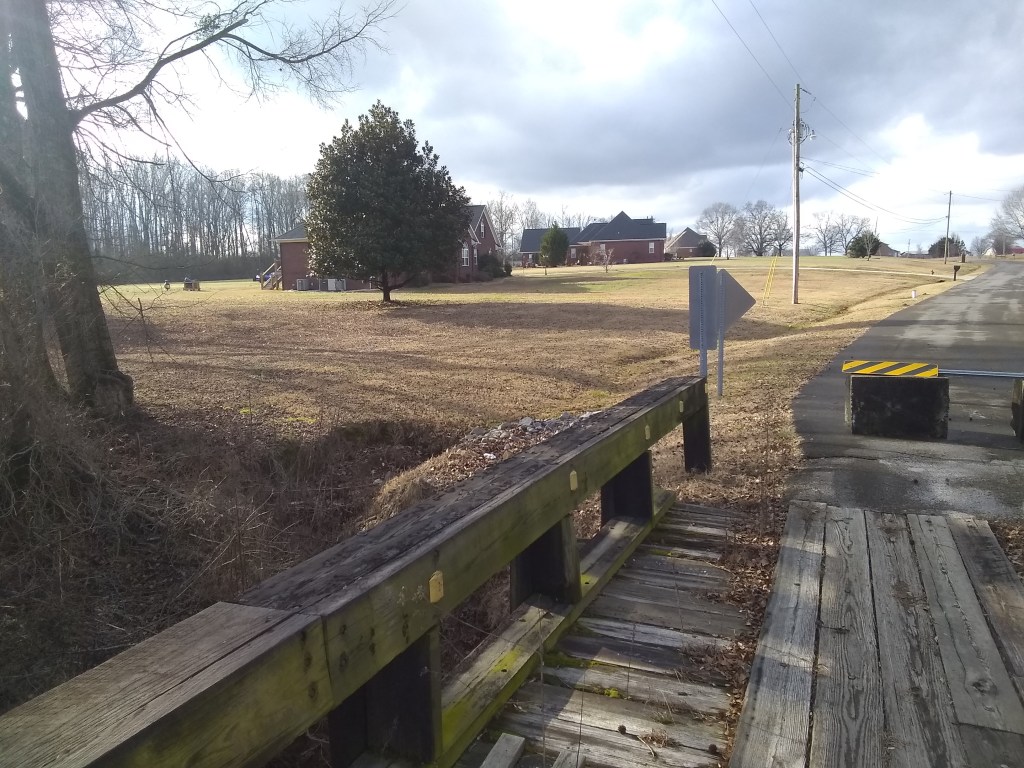
Here’s a few photos taken along my route:

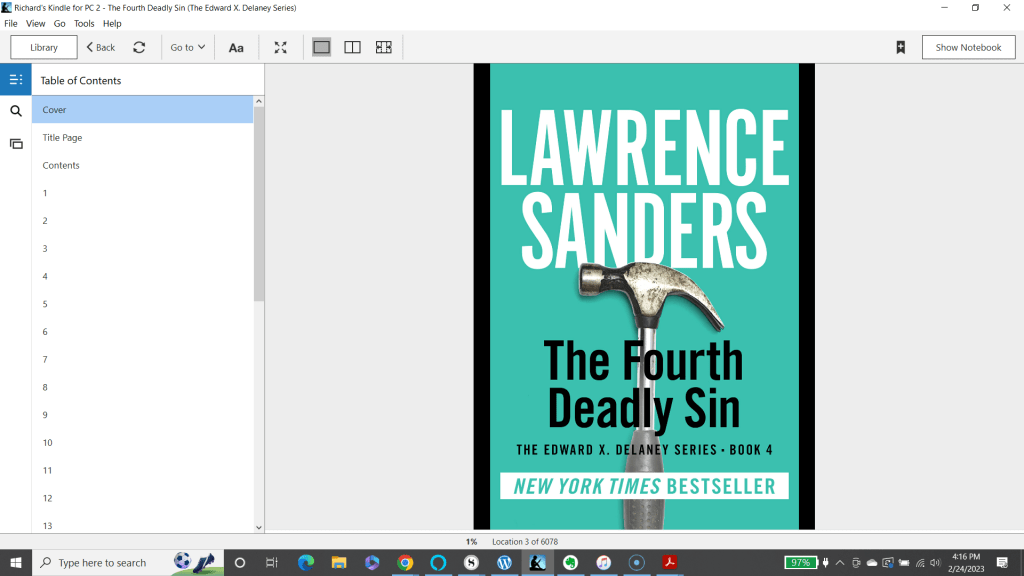
Here’s what I’m currently listening to: The Fourth Deadly Sin, by Lawrence Sanders

Sanders was a tremendously talented writer.

Amazon abstract:

When a Manhattan psychiatrist is murdered, a retired detective returns to the job, in a thriller by the #1 New York Times–bestselling “master of suspense” (The Washington Post).

On a rainy November night, Dr. Simon Ellerbee stares out the window of his Upper East Side psychiatry office, miserably wishing he could seek counseling for the problems in his seemingly perfect life. He hears the door buzzer and goes to answer it, but flinches when he sees his unexpected guest. Minutes later, he’s dead, his skull crushed by repeated blows from a ball-peen hammer. Once the doctor was down, the killer turned over the body and smashed in Ellerbee’s eyes.  With no leads and a case getting colder by the hour, the New York Police Department calls in former chief Edward Delaney. His search for the truth raises more questions than answers: Who had Ellerbee let into his office? Why were there two sets of wet footprints on the carpeting of the doctor’s townhouse? What caused Ellerbee’s odd personality transformation over the past year? And who murdered, then symbolically mutilated, the prominent Manhattan psychiatrist?

A Sample Five Star Review

Errol Mortland

5.0 out of 5 stars The Best Bubble Gum Ever!

Reviewed in the United States on August 6, 2017

If you’re tired of streaming or cleaning for the moment and need to pass some time, you won’t go wrong with the four Deadly Sins series from Lawrence Sanders. I zip through all of them every other year, in sequence. They’re great reads, and I’ve always pictured George C. Scott as Edward X. Delaney (Frank Sinatra in the movie version of the First in pretty insipid, but apparently he owned the rights).

The Fourth is the murder is Dr Simon Ellerbee, you get the usual palette of suspects, and retired Chief of Detectives gets his crew and does his stuff. If Hemingway wrote crime suspense set in NYC, it’d be like this. I love short descriptive sentences. Not sure I recall seeing “ears like slabs of veal” in this one. If you love New York, Mr Sanders captures its essence like a great musical conductor. The “Sins” series is the best, followed by the “Commandments.” The Arch McNally stuff which followed that is okay, even though they kept the series going after Mr Sanders died in 1998. I just find that disrespectful. I only regret there wasn’t a Fifth Deadly Sin.

Is there life after death?

Here’s the link to this article by Merle Hertzler on November 30, 2022.

[A slightly modified version of this article is also available on the author’s The Mind Set Free blog.]

You may have been told that you will live forever, but that seems quite unlikely to me. For our brains will one day be gone. Throughout our life those brains have been the seat of our thoughts, emotions, and memories. So when the brain is gone, then the lights must go out. Surely then it is all over.

But some will tell me that something else lives on even after the brain has disintegrated. They often call this the soul. And ultimately, they say, the soul is the seat of the mind. And so, even if the brain is gone, the mind can continue as a function of a soul that survives death.

If the soul is really in charge, though, why do you even need a brain? If thinking is done by the soul, what is left for the brain to do? Some propose that the brain is simply an interface to the body. It gathers information from the senses and feeds it to the soul. There the soul processes the incoming data, saves memories, and makes decisions. The soul then somehow directs the brain to drive the muscles of the body. The soul is in charge, they say, and the brain handles the interface with the body.

But science has shown that it is truly the brain that is in charge. We think with our brains, not with immaterial souls.

Have You Got Soul?

Let’s look at some of the evidence that the brain is in charge, and that there is no separate, nonmaterial soul.

First, there is the evidence of amnesia. When elderly people suffer a stroke, or when trauma occurs to the brain, patients often lose the ability to remember things that happen after that tragic event. The person loses an important mental function, the ability to remember new things. But it was not the soul that had been damaged. The brain was damaged. Somehow damage to the brain causes that person to lose the ability to efficiently store new memories. If memories are actually a function of the soul, why would damage to the brain affect the functioning of the soul? Since damage to the brain affects the ability to store memories, then it must be the brain that stores the memories.

You might argue that what happened is that the brain stopped giving the soul new data. Thus, the soul has nothing to remember. But that is clearly not what is happening in such cases. The essence of the person is still communicating with us. That person sees us, recognizes us, and communicates. The mind’s senses are still working. The mind is still able to observe, but the person forgets what was observed. Why? The brain is damaged. And this damage hinders memory storage. So it must be the brain that is remembering. When the brain is affected, the mind is affected.

Second, when conditions prevent a brain from developing properly, the personality does not reach maturity. If the soul is distinct from the brain, why wouldn’t the soul go on to maturity?

A third kind of evidence that the brain is doing the thinking is the fact that, if the brain slows down and goes to sleep at night, the soul also sleeps. Suppose that your soul is something different from the brain. Why does the soul go to sleep when the brain sleeps? Why can’t it just keep on being your soul, wide awake, even though the brain goes to sleep and has stopped giving the soul input from the world? It doesn’t work that way. When the brain is affected, the mind is affected.

The effect is even more pronounced under anesthesia. In such procedures, one loses virtually all contact with the world and does not sense even severe pain. After waking up, one is not even aware of the passage of time while he was unconscious. If the soul was distinct from the brain, one would think that you could simply start counting as you go under and keep on counting into the thousands in your soul while contact with the world goes blank. It would be like losing the connection while on a Zoom call. The soul would still be awake. The person whose brain is sleeping would still be able to count or plan his next day, but the incoming sensations of the world would temporarily be blank. This is not what happens.

Fourth, evidence shows that we inherit our basic personality through our genes. How is it that genes can affect our personality? Genes must surely be directing the brain’s physical development, which then influences personality development. How could genes also change a separate, immaterial soul? That makes no sense. Personality must therefore be a function of the brain, not of a separate entity known as the soul. How else could genes have such a significant effect on the personality?

Fifth, a patient with Alzheimer’s disease enters a period of altered mental capability due to brain disease. Is the soul of the Alzheimer’s victim also changed by his physical condition? That makes no sense. The disease affects the brain, not the soul. But if the soul is working normally, why are the thoughts so confused?

You may argue that the soul is still normal, but that the connection of the brain to the soul is blurred. And that we can still communicate with the essence of the Alzheimer’s victim, with the part that you would call the soul. That spark of the inner person is still there, you might think. The communication still works. But we can see that the very essence of the inner person is changing. The part that you would call the soul is deteriorating. Why? The brain is being altered. Since the mind is a function of the brain, it too becomes altered.

Are we to believe that death does for the Alzheimer’s victim what no medicine can do? Does death suddenly restore the mind to full functioning? How could that be? The disease gradually destroys the brain, and this deteriorates the mind. How then could the full destruction of the brain at death cause the mind to become restored?

Sixth, if the soul is separate from the brain, exactly how does a soul interface with the brain? As far as we can tell, brain function consists of movements of electrons and chemicals. How could our soul communicate with this brain? Does the soul somehow start moving electrons around in our brains so that the brain knows to move a certain muscle or to command the mouth to say a certain word? How can the stuff of the soul push matter? Wouldn’t a soul push right through an electron, just like spirits supposedly pass through walls?

And if souls actually push molecules or electrons around, why can’t they push the molecules that are outside of the brain? If your soul can push molecules in your brain, why can’t it push molecules in my brain?

None of this can be observed in nature. Nowhere do we find evidence for souls deflecting molecules. So how can a nonphysical soul affect the movements of the body? It can’t. I conclude that the mind is simply a function of the brain.

Seventh, as I’ve discussed elsewhere, we have evolved from other animals. Do apes have souls? Do reptiles, fish, and germs have souls? If not, exactly when was a soul inserted into the animal kingdom for the first time? Was the first being to have a soul raised by someone without a soul? It is easy to see how mind functions could develop incrementally through many generations as we evolved. It is difficult to see how an evolved creature would somehow suddenly get a separate, immaterial soul for the first time. And if apes don’t have souls, how do their brains partially duplicate some of the functions that we require a soul to do?

For all of these reasons, I conclude that it is the brain, not an immaterial soul, that stores memories and does our thinking. For more on mind-brain dependence, see “The Case Against Immortality” by Keith Augustine, “Mind-Brain Dependence as Twofold Support for Atheism” by Steven J. Conifer, and section III.6 of Sense and Goodness without God: A Defense of Metaphysical Naturalism by Richard Carrier.

Consciousness

Yes, I know—you look inside, and you see that your conscious mind is in there telling the body what to do. Your consciousness is in charge, or so it seems to you. And you equate that consciousness with a soul that is separate from the body. So how can you be perceiving this soul inside of you to be directing the show, when actually it is brain molecules that are doing the heavy lifting? Good question.

Science has shown that the brain decides to do things before the person is aware that he made the decision. One experiment that verified this involved subjects who were told to decide to bend their wrist while watching a slowly spinning disk. They were told to tell the experimenters exactly where the disk was when they decided to bend their wrist. The experimenters used this information to determine when the subject was aware that he was making the decision. The subjects were also hooked up to sensors that could detect brain activity that occurred when the subjects decided to act.

It turns out that the brainwaves started before the subjects were aware that they were deciding. If you asked the subjects, they would tell you that they made the decision consciously at the moment that they were aware of it. But the instruments they were wired to indicate otherwise. The brain cells had begun to fire and started the process of commanding the hand to move before the person was consciously aware of the decision.[1]

Could it be that our brain cells are running the show, and that what we call the conscious mind comes along later and fills in the story after the fact? This kind of after-the-fact consciousness has been demonstrated in another experiment. Here is how it worked. A red dot was projected onto a screen. Then the red dot was turned off and, a split second later, a green dot was projected near the spot where the red dot had been. When people saw this, they reported that they saw the red dot start to move to the side, then change suddenly to a green dot as it moved along, and then continue to the new location as a green dot. Obviously, this is not what they saw. There was no moving dot that changed colors. The dot had never been in the middle. But the conscious mind told the story that the dot had traveled, and that the dot’s color had changed from red to green at the middle. The conscious mind was convinced that it had observed this happen. It was mistaken.[2]

And so, in that experiment, we find that minds rewrote history, just like the historians in the novel 1984 rewrote history to reflect what Big Brother wanted. A similar thing must have happened in the minds of the subjects. Their minds had known that objects don’t usually just disappear and immediately show up in a new location. They knew that, in such instances, the object probably moved from point A to point B. And if it changed colors, it had to change somewhere. The mind makes up the story that it observed the dot changing color when it was in the middle of its movement. The subject’s minds rewrote their memories, and did it so well that they were confident that the revised story was true.

Their conscious memory of seeing the dot change color as it moved was a sheer fabrication. The subjects “remember” it, but it never happened.

You have probably observed the mind rewriting memories. A significant event may happen to somebody, and immediately he tells us what happened. Ten minutes later you hear him tell the same story again, but it is a little different this time. An hour later, the story has been modified further. We hear the same story the next day and the next week. Each time we hear it, it is a little different. And often we can observe a trend in the rewrite. What the person thinks he should have said becomes a memory of what he did say.

True, sometimes the person modifying the story may be deliberately deceptive. But often the person is not trying to lie to us. He is an honest person, and yet his mind is changing the story.

Folks have probably observed a similar thing in you and me. Our minds gradually and unconsciously change the memories of the past so that they conform to what makes sense to us. Thus, we end up with memories of being conscious of something in the past, even though we never actually experienced it that way.

Notice that the memories of the person who saw a dot disappear and another dot appear are just like the memories of the person who truly saw a dot move. One memory reflects what was consciously observed. One is a fabrication. We cannot tell the difference. Our minds are being misinformed about what we consciously experienced. We believe the lies that are being written to our memories.

Notice also that it is our memory of past events that is fundamental to our consciousness. Suppose that you had no ability to remember anything. You would be constantly aware of your current state at each moment, but you would be totally unaware of anything that had happened a microsecond earlier. It would be like listening to a music CD that was stuck on the same chord. Now that would not be real music. Music requires change, and so does consciousness. To really mean anything, our consciousness must consist of an awareness of the narrative that has brought us to the current state.

But as we have seen, this narrative is often freely being changed. We think that we have conscious memories of how the story has unfolded, but somehow what we call our conscious memory is only the modified story that our minds create. What we call consciousness is just the story of how we got to where we are. The problem is that this story is somewhat illusory, for our minds are constantly revising that story, sometimes incorrectly.

So perhaps this explains how we can deceive ourselves into believing that there is a soul inside of us that is making the decision, even though experiments show that such decisions were made before we were aware of them. Perhaps our minds continuously create the story that we call consciousness and write it in such a way that we think that consciousness is making the decisions.

Where Do Your Words Come From?

Think about it. Where do your decisions come from? When you decide to speak, for instance, where do those words come from? You really don’t know, do you?

Think about all that is involved in creating spontaneous speech. Your brain contains information about the thousands of thoughts that you could express. You have a vocabulary of thousands of words that you can use, and your mind knows the definition of each. And these words must be put together according to the syntax of your language. But you don’t remember sorting through your mental dictionary to look up the meanings of all of the relevant words to select the proper words to express the thought. No, you just speak, and the right words present themselves to you. And you and your listeners both hear the sentence from your mouth at the same time. But where did the words come from?

If your soul is the speechwriter, why isn’t the soul aware of how the words came into your consciousness? Why isn’t your soul aware of looking up the meanings of all of the words that it could have used? Instead, behind the scenes, something must be working to look up available words and form those sentences for you. I contend that this something is nothing more than the millions of neurons in your brain. They must be working behind the scenes to write your speech for you. You and I think that our conscious mind is speaking, but the conscious mind isn’t even aware of how the speech is being written.

Even when we slowly deliberate, weighing every word carefully before speaking, we cannot tell where those word options originated. The words just present themselves to us. Something looked through our mental dictionary and pulled those words up for us.

Many Christians seem to recognize that thoughts come to us fully formed. I have heard some ascribe different authors to the thoughts that stream through their minds. It is interesting to hear them describe the experience. They will tell me that Satan was saying something in their minds, and then they responded, and then God said something, and then the old nature argued, and then Jesus said something, and so on. It must be interesting being them! There are enough people inside to have great conversation. But perhaps they are mistaken. Perhaps various thoughts originate, not from various competing spirit beings inside the mind, but from various competing coalitions of neurons in the brain.

Science indicates that there are millions of neurons working in our brains, and that this activity produces thoughts. It is a cacophony of voices, with many different ideas competing for dominance. But somehow the winning thoughts come to the top and present themselves as a string of conscious ideas. The real work, however, is done among all these competing neurons.

Often our language betrays the fact that things are going on outside of our direct conscious control. We say things like “I didn’t mean to do that,” “The words wouldn’t come,” “I couldn’t help myself,” or “I don’t know why I did that.” In such statements there is a subtle recognition that our consciousness is not really in charge.

The consciousness is along for the ride, observing the finished work that the neurons have put together. And the consciousness rewrites its memories in such a way that it seems to us that our consciousness is making the decisions.

For more on how our brains create consciousness, see Consciousness Explained by Daniel C. Dennett and my essay “How Can Molecules Think?

I conclude that thinking is done by the brain, and these thoughts produce our consciousness. Consciousness does not come from an immaterial soul.

Life after Death

We know that brain activity stops when we die. If our memories are in the brain, how could they remain after death? And how can the inherited personality survive if the very brain that produced it is destroyed? It seems that it too must be gone. If my memories and personality are gone, how can I still be said to exist?

Some will agree that the brain is doing the thinking here on Earth, but posit that there is a soul in there also. And the soul just so happens to want the same thing that the brain wants, and stores the same memories that the brain stores. So, though the brain is gone at death, a soul that works in parallel supposedly remains. How convenient! Since this seems implausible to me, I won’t waste time hoping that it is so.

Ah, but someone might counter: “Couldn’t God just make a copy of all that we had experienced in our brain? When we die, perhaps God restores everything from the backup, just like we would do on a computer. Our mind would literally be backed up in the cloud.”

If there is a backup of my mental database that will be used to drive a new body someday, how do we know that it won’t be instantiated in two bodies, or even a thousand? Will there be thousands of copies of me out there running off of the same backup database of me? It is difficult to see how we could refer to any of those backups as “me.” They are copies, not me. The same thing can be said, then, about the first copy made from a backup database of my memories. It’s not really me. Would it be fair to punish or reward a copy of me for what I have done here on Earth?

Is it possible that God is making a backup copy of me that can live forever? Perhaps, but I can make hundreds of similar wild guesses as to what might happen someday. For instance, is there a possibility that aliens will land on Jupiter, transform it into a paradise for humans, and then offer free shuttle service back and forth to Earth? Perhaps. But I don’t spend long hoping for that to happen. Nor do I spend long hoping that some backup copy of me lives forever.

So it appears that neither a soul nor a copy of the brain’s database survives death.

But what about bodily resurrection? Perhaps the brain lies dormant until God puts it back together and resurrects the body. But how could that happen? What about the bodies of people that died a thousand years ago? Their bodies have disintegrated, and the constituent atoms are spread throughout the world. Some of those particles could be in your brain now. Some atoms may have been part of many people’s brains throughout history. To which brain will they go in the resurrection?

If, on the other hand, I am reconstructed from a new set of molecules, is not such a reconstructed me just one of many possible copies of me that could be made? We are left with a copy, or even multiple copies, not a continued existence of my mind. A copy of me is not the same thing as me.

So, it appears that our minds will not survive death. Your mind is a function of your brain, and your brain will someday die. If you and I are going to find the good life, we will need to make the most of what we have here. Let us make this life count.

Notes

[1] Daniel C. Dennett, Consciousness Explained (Boston, MA: Back Bay Books, 1991), pp. 162-163.

[2] Dennett, Consciousness Explained, p. 114.

Mental Meanderings—A Look-Back at Yesterday (Friday–022423)

Yesterday we moved the carryall it had been sitting on the ground beside the box trailer for well over a year I really dont know how long im not sure it needed to be moved what was the purpose it wasn’t in the way and the platform is built out of steel and treated lumber. By the way, I’m freewriting and dont’ reall ycare to tell you who the we is. Obviously it includes me


And I’ll start a new paragraph here. I was glad we didn’t have to air up the right rear of the old john deere tractor. Snead ag, actually that’s the name of thee company back in 2010 when we built the runway and rented equipment, like a bulldozier and a giant eight wheel tractor pulling pans

I found a pallet and dragged it to the edge of the woods, along the same line as our other equipment including a disc, some call it a cutting harrow I think, there’s also a box blade and a boon, an old inoperable bushhog, the newest one is behind the box trailer which is before we move it beside the carryall. We intend to set the carryall onto the pallet to keep it off the ground.

It takes several minutes to hook the tractor to the carryall. You have to align things just right. Once it is set on the pallet we disconnect the two lower arms and then the top arm. The carryall leans forward with me in between the rear of the tractor and the front, or back, according to your view, of the carryall, thankfully I wasn’t hurt. I have jon stand along the back edge to balance it. We obviously have not centered the carryall on the pallet. It’s off by a little less than jon’s weight. I make my way out of the bind and move the tractor forward a few feet. I walk to the fire ring further east of the farm equipment and grab two pieces of firewood and insert under the front, or back, according to your view, of the carryall. This provides the needed balance and the job is complete.
I return the tractor to the barn and now don’t remember what I was thinking, nor do I recall what I was thinking as we were engaged in the task.

We wait in the barn, the task complete, I’ve already said the latter. Jared at johnson’s builders should call sometime today—that’s yesterday—declaring he has our metal order. The day before yesterday I had called and order enough metal to cover the rear wall, eighteen feet by 109 1/2 inches of the smoker room at the restaurant. When it was built, early 2013, we used cedar and never sealed or painted it (not sure if you paint cedar wood), and now it is in poor condition, a couple of lower runs are nearly rotten. Our intent is to improve that back wall with the berry colored metal.

Last night I dreamed that I’d bought some type of watch, it certainly wasn’t an Apple watch because it wouldn’t do anything but play some little short song when you pressed a side button. Why robin, a friend from law school in the early 90’s was there asking me what all the watch would do and where I’d purchased it, I don’t know. I vaguely recall a mobile home supplier had something to do with it, or was it an automobile junk yard.

I know, my freewriting will be hard to read. I bet it does a poor job of capturing what all was going on in my head yesterday. Disclaimer. These are my thoughts this morning of a small portion of yesterday’s activities and thoughts. I’m not sure if their totally accurate, some may simply be the slant I’m superimposing on them today.

Try freewriting. And by the way. The capitalization at the beginning of each sentence is done automatically as I write this in scrivener and that I I just wrote is the same. But, I’m adding some punctuation.

Oh well freewriting I’m not adding punctuation here but you do see the I in I’m was automatic

enough enough

Writing Journal—Saturday writing prompt

While on a vacation, your character runs into the one that got away. The electrifying spark is still there, as strong as ever, only your character is no longer single. Write the scene, from the character’s point of view, as all these old feelings surface and mix with guilt.

One Stop for Writers

Guidance & Tips

Write the scene of discovery (i.e., tell a story), or brainstorm and create a list of related ideas.

Here’s five story elements to consider:

  • Character
  • Setting
  • Plot
  • Conflict
  • Resolution

Never forget, writing is a process. The first draft is always a mess.

The first draft of anything is shit.

Ernest Hemingway

02/24/23 Biking & Listening

Biking is something else I both love and hate. It takes a lot of effort but does provide good exercise and most days over an hour to listen to a good book or podcast. I especially like having ridden.

Here’s my bike, a Rockhopper by Specialized. I purchased it November 2021 from Venture Out in Guntersville; Mike is top notch! So is the bike, and the ‘old’ man seat I salvaged from an old Walmart bike.

Here’s a link to today’s bike ride. This is my pistol ride.

Here’s a few photos taken along my route:

Here’s what I’m currently listening to: The Fourth Deadly Sin, by Lawrence Sanders

Sanders was a tremendously talented writer.

Amazon abstract:

When a Manhattan psychiatrist is murdered, a retired detective returns to the job, in a thriller by the #1 New York Times–bestselling “master of suspense” (The Washington Post).

On a rainy November night, Dr. Simon Ellerbee stares out the window of his Upper East Side psychiatry office, miserably wishing he could seek counseling for the problems in his seemingly perfect life. He hears the door buzzer and goes to answer it, but flinches when he sees his unexpected guest. Minutes later, he’s dead, his skull crushed by repeated blows from a ball-peen hammer. Once the doctor was down, the killer turned over the body and smashed in Ellerbee’s eyes.  With no leads and a case getting colder by the hour, the New York Police Department calls in former chief Edward Delaney. His search for the truth raises more questions than answers: Who had Ellerbee let into his office? Why were there two sets of wet footprints on the carpeting of the doctor’s townhouse? What caused Ellerbee’s odd personality transformation over the past year? And who murdered, then symbolically mutilated, the prominent Manhattan psychiatrist?

A Sample Five Star Review

Errol Mortland

5.0 out of 5 stars The Best Bubble Gum Ever!

Reviewed in the United States on August 6, 2017

If you’re tired of streaming or cleaning for the moment and need to pass some time, you won’t go wrong with the four Deadly Sins series from Lawrence Sanders. I zip through all of them every other year, in sequence. They’re great reads, and I’ve always pictured George C. Scott as Edward X. Delaney (Frank Sinatra in the movie version of the First in pretty insipid, but apparently he owned the rights).

The Fourth is the murder is Dr Simon Ellerbee, you get the usual palette of suspects, and retired Chief of Detectives gets his crew and does his stuff. If Hemingway wrote crime suspense set in NYC, it’d be like this. I love short descriptive sentences. Not sure I recall seeing “ears like slabs of veal” in this one. If you love New York, Mr Sanders captures its essence like a great musical conductor. The “Sins” series is the best, followed by the “Commandments.” The Arch McNally stuff which followed that is okay, even though they kept the series going after Mr Sanders died in 1998. I just find that disrespectful. I only regret there wasn’t a Fifth Deadly Sin.

Mental Meanderings—A Look-Back at Yesterday (Thursday–022323)

It’s early and I’m thinking about Eddie. He’s our Lab look-alike, all black other than a short, thin stretch of white on his neck. I rescued him last May while on a bike ride; then, he was around six or seven months old.

Shortly after his arrival, Jonathan named him Special Edward, Eddie for short, although I often call him the Black Tornado. You see, Eddie is powerfully destructive. Just yesterday, he half-destroyed a deck rug. By the way, the name Special Edward is a take off from Special Education which simply means he often needs extra help, especially with how he learns to cope with learning and living.

Late yesterday afternoon was a good time to take Eddie on a car ride (we’ve done this for a few months now, not every day but at least a couple of times per week). He loves riding in our old Sentra. Maybe because there’s a couple of bed sheets I’ve left in the back seat for him to rip to shreds. I have to say, he’s done quite a good job.

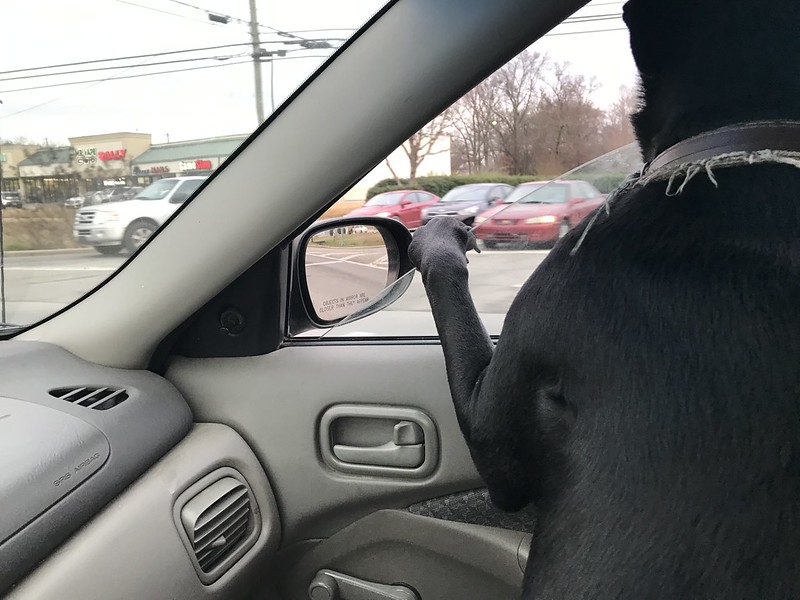
Our destination was Walgreen’s to pick up a prescription for Donna. Per Eddie’s suggestion, we took the back roads. He’s learned that’s where he’ll see the most animals: cows, horses, dogs, and cats. His favorite thing to do is hang out the passenger side window. I lower the hand crank enough for him to slip his head and shoulders outside, into the wind, with his front paws balancing him on the arm rest and the top of the door frame. Eddie is very agile.

When he sees another animal, especially a dog along the side of the road or traversing a lawn, Eddie will stare and maintain eye contact by turning his head as we pass. Unfortunately, if the animal is on my side of the car, Eddie will do his best to maneuver himself into my seat, which is a no-no since his big body blocks my view of the road ahead. Sometimes, he’ll move from the front seat to the rear to extend his time staring at the other creature.

At Walgreen’s I thought about seeing what would happen if I put Eddie on a leash (I keep one in the Sentra) and go inside to the pharmacy. Of course, I wasn’t serious. That scene wouldn’t have been pretty, for anyone. I have mentioned Eddie is also known as the Black Tornado haven’t I?

I chose the drive-through lane instead. There were four cars ahead of us. And, wholly unsurprising, the first car in line either had a complicated prescription, or had a long and thrilling story to share with the pharmacist, since it stayed planted for at least fifteen minutes. Before car one moved, the Tacoma in front of us abandoned his spot. Now we’re down to three.

Eddie was busy in the back seat with the bed sheets so I started listening to a podcast on my iPhone. I guess there was something magnetic about Sam Harris’ voice given Eddie’s reaction. He was in my lap in an instant, licking both my phone and my face. The only car I could see now was the one approaching from the rear.

Finally, something, maybe the voice of one of Sam’s guests, changed Eddie’s mind and he lay in the passenger seat with his head on my right thigh. For a good two minutes, he lay still and looked up at me with those beautiful sparkling deep-golden eyes. It was as though he was thanking me for rescuing him in the first place, providing him a newly constructed two-room dog house (note: the inner room is insulated, and the house is for nights only), and for these special times together, just the two of us where we, most times silently, share our hopes and dreams for the future.

As it was finally ‘our turn’ at the window, the youngish female assistant said, “may I help you?” Well, you may have guessed. Eddie thought she was talking to him. In a flash he was hanging his head out my lowered driver’s side window. The girl laughed and I managed to speak. Now, I wish I’d said, “Eddie needs his Ritalin,” or something to that affect. Instead, I provided the needed information, and encouraged my wonderful companion to slip between the seats and continue his bed sheet ripping.

Again, we took the back roads home. Eddie occupied himself, switching between his back seat activities and looking for four-legged friends while hanging out the passenger side window. I drove and imagined what life would have been like if this rambunctious but sweet puppy hadn’t appeared out of no where and stood beside my parked bike that sunny day last May.

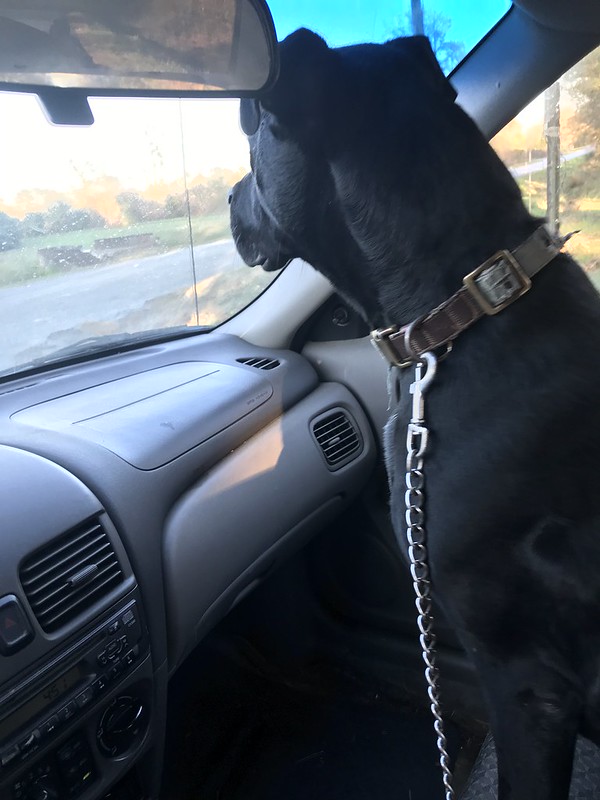
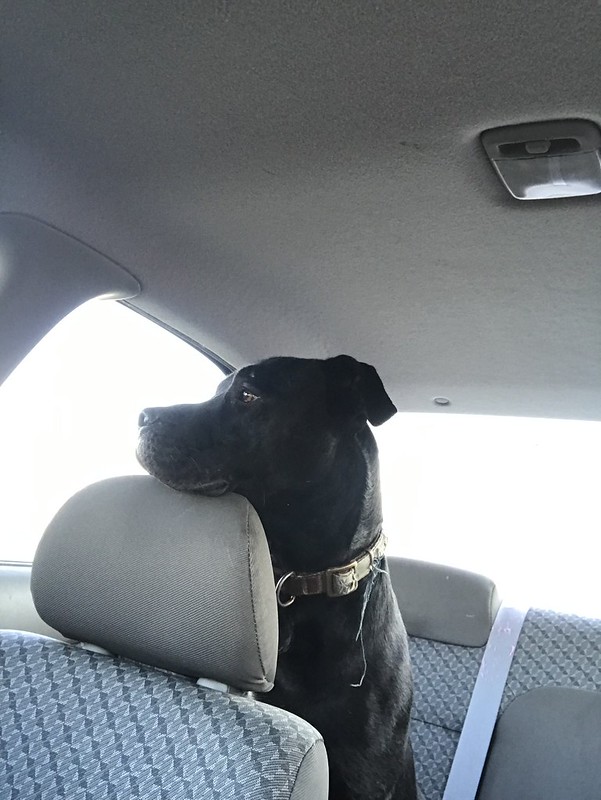
Here’s a few more photos of Special Edward:

Writing Journal—Friday writing prompt

Your character is a substitute teacher for a grade four class and slowly comes to realize something unusual is going on. As impossible as it seems, some of her students are reading her mind. Write the scene. 

One Stop for Writers

Guidance & Tips

Write the scene of discovery (i.e., tell a story), or brainstorm and create a list of related ideas.

Here’s five story elements to consider:

  • Character
  • Setting
  • Plot
  • Conflict
  • Resolution

Never forget, writing is a process. The first draft is always a mess.

The first draft of anything is shit.

Ernest Hemingway

Seeing the Problem of Suffering as a PROBLEM

Here’s the link to this article written by Bart Erhman on February 23, 2023. Click here to read the first article in this series.

In my previous post I began to talk about how thinkers in the Jewish and Christian traditions have wrestled with the problem of suffering.  I indicated that the technical term for this “problem” is “theodicy,” and it is often said to involve the status of three assertions which all are typically thought to be true by those in these two religions, but if true appear to contradict one another.  The assertions are these:

God is all-powerful.

God is all-loving.

There is suffering.

How can all three be true at once?  If God is all powerful, then he is able to do whatever he wants (and can therefore remove suffering).  If he is all loving, then he obviously wants the best for people (and therefore does not want them to suffer).  And yet people suffer.  How can that be explained?   As I pointed out some thinkers have tried to deny one or the other of the assertions: either God is not actually all powerful, or he is not all loving, or there is no suffering.

But as I explain in the introduction to my book God’s Problem (Oxford Press, 2008) …

******************************

Most people who wrestle with the problem want to say that all three assertions are true, but that there is some kind of extenuating circumstance that can explain it all.  For example, in the classical view of the prophets of the Hebrew Bible, as we will see at length in the next couple of chapters, God is certainly all powerful and all loving; one of the reasons there is suffering is because his people have violated his law or gone against his will, and he is bringing suffering upon them in order to force them to return to him and lead righteous lives.

This kind of explanation works well so long as it is the wicked who are the ones who suffer.  But what about the wicked who prosper while the ones who try to do what is right before God are wracked with interminable pain and unbearable misery?  How does one explain the suffering of the righteous?  For that other explanations need to be used (for example, that it will all be made right in the afterlife – a view not found in the prophets but in other biblical authors) (there are, as I’m suggesting, other explanations as well in the Bible and in popular thinking).

Even though a scholar of the Enlightenment – Leibniz – came up with the term “theodicy,” and even though the deep philosophical problem has been with us only since the Enlightenment, the basic “problem” has been around since time immemorial.  This was recognized by the intellectuals of the Enlightenment themselves.  One of them, the English philosopher David Hume, pointed out that the problem was stated some twenty-five hundred years ago by one of the great philosophers of ancient Greece, Epicurus:

Epicurus’s old questions are yet unanswered:

Is God willing to prevent evil but not able?  Then he is impotent.

Is he able but not willing?  Then he is malevolent.

Is he both able and willing?  Whence, then, evil?[i]

As I was teaching my course on biblical views of suffering at Rutgers, over twenty years ago (well… thirty-five now!!), I began to realize that the students seemed remarkably, and somewhat inexplicably, detached from the problem.  It was a good group of students: smart and attentive.  But they were for the most part white, middle-class kids who had not experienced a lot of pain in their lives yet, and I had to do some work in order to help them realize that the problem of suffering was in fact a problem.

This was the time of one of the major Ethiopian famines.  In order to drive home for my students just how disturbing suffering could be, I spent some time with them dealing with the problem of the famine.  It was an enormous problem.  In part because of the political situation, but even more because of a massive drought, there were eight million Ethiopians who were confronted with severe shortages and who, as a result, were starving.  Every day there were pictures in the papers of poor souls, famished, desperate, with no relief in sight.  Eventually one out of every eight died the horrific death of starvation.

That’s some two million people, starved to death, in a world that has far more than enough food to feed all its inhabitants, a world where American farmers are paid to destroy their crops, a world where most of us in this country ingest far more calories than our bodies need or want.  To make my point, I would show pictures of the famine to the students, pictures of emaciated Ethiopian women with famished children on their breasts, desperately sucking to get nourishment that would never come, both mother and children eventually destroyed by the ravages of hunger.

Before the semester was over, I think my students got the point.  Most of them did learn to grapple with the problem.  When the course had started, many of them had thought that whatever problem there was with suffering could be fairly easily solved.

The most popular solution they had was one that I would judge most people in our (Western) world today still hold on to.  It has to do with free will.  According to this view, the reason there is so much suffering in the world is that God has given humans free will.  Without the free will to love and obey God, we would simply be robots doing what we were programed to do.  But since we have the free will to love and obey, we also have the free will to hate and disobey, and this is where suffering comes from.  Hitler, the Holocaust, Idi Amin, corrupt governments throughout the world, corrupt humans inside government and outside of it – all of these are explained on the grounds of free will.

As it turns out, this was more or less the answer given by some of the great intellectuals of the Enlightenment, including Leibniz, who argued that humans have to be free in order for this world to be the best world that could come into existence.  For Leibniz, God is all powerful and so was able to create any kind of world he wanted; and since he was all loving he obviously wanted to create the best of all possible worlds.  This world – with freedom of choice given to its creatures – is therefore the best of all possible worlds.

Other philosophers rejected this view – none so famously, vitriolically, and even hilariously as the French philosopher Voltaire, whose classic novel Candide tells the story of a man (Candide) who experiences such senseless and random suffering and misery, in this allegedly “best of all worlds,” that he abandons his Leibnizian upbringing and adopts a more sensible view, that we can’t know the whys and wherefores of what happens in this world, but should simply do our very best to enjoy it while we can.[ii]  Candide is still a novel very much worth reading – witty, clever, and damning.  If this is the best world possible – just imagine what a worse one would be.

******************************

I will continue my reflections on the matter starting at this point, in the next post.

[i].  David Hume, Dialogues Concerning Natural Religion (the sentiments are those expressed by his fictitious caracter named Philo). Xxx?

[ii]. Voltaire.  Candide: or Optimism.  Tr. Theo Cuffe (New York: Penguin, 2005).

02/23/23 Biking & Listening

Biking is something else I both love and hate. It takes a lot of effort but does provide good exercise and most days over an hour to listen to a good book or podcast. I especially like having ridden.

Here’s my bike, a Rockhopper by Specialized. I purchased it November 2021 from Venture Out in Guntersville; Mike is top notch! So is the bike, and the ‘old’ man seat I salvaged from an old Walmart bike.

Here’s a link to today’s bike ride. This is my pistol ride.

Here’s a few photos taken along my route:

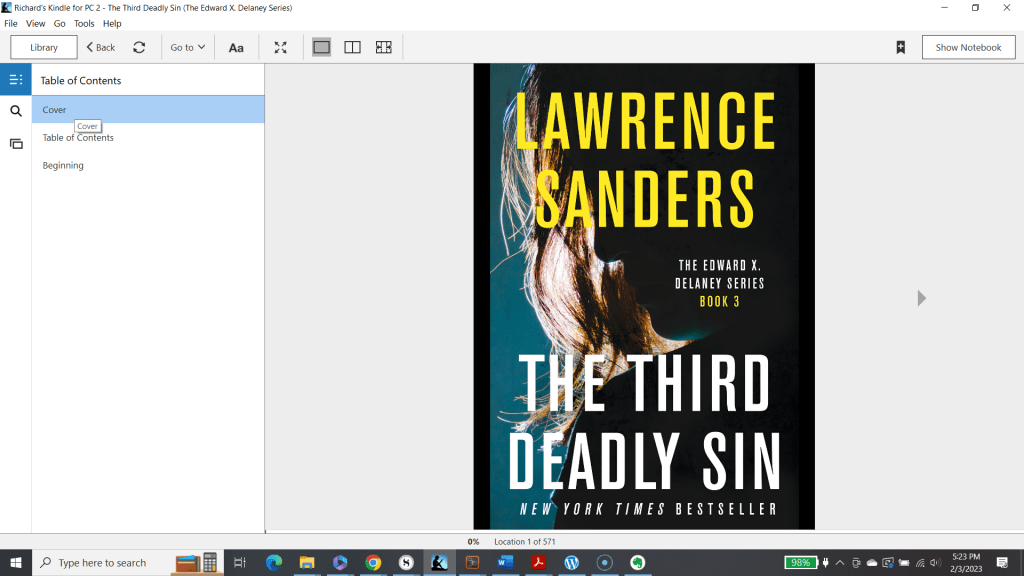
Here’s what I’m currently listening to: The Third Deadly Sin, by Lawrence Sanders

Sanders was a tremendously talented writer.

Amazon abstract:

New York Times Bestseller: A retired cop hunts for a female serial killer no one would suspect in this “first-rate thriller . . . as good as you can get” (The New York Times).

By day, she’s a middle-aged secretary no one would look at twice. But by night, dressed in a midnight-black wig, a skin-tight dress, and spike heels, she’s hard to miss. Inside her leather shoulder bag are keys, cash, mace, and a Swiss Army knife. She prowls smoky hotel bars for prey. The first victim—a convention guest at an upscale Manhattan hotel—is found with multiple stab wounds to the neck and genitals. By the time retired police detective chief Edward Delaney hears about the case from an old colleague, the Hotel Ripper has already struck twice. Unable to resist the puzzle, Delaney follows the clues and soon realizes he’s looking for a woman. As the grisly slayings continue, seizing the city in a chokehold of panic, Delaney must stop the madwoman before she kills again.

A Sample Five Star Review

M. G Watson

VINE VOICE

5.0 out of 5 stars Third Time’s the Charm

Reviewed in the United States on May 15, 2015

Verified Purchase

It is arguable that Lawrence Sanders never rose to greater heights as a prose stylist, suspense-writer or storyteller than he did with THE THIRD DEADLY SIN, the penultimate novel in his “deadly sin” series of books and the fourth of five to feature crusty, sandwich-obsessed Edward X. Delaney as a protagonist. Though once referred to as “Mr. Bestseller” and nearly as prolific in his day as Stephen King, Sanders seems to be forgotten now, except for his “McNally” series which was hardly representative of his best work; but at his best he was both compulsively readable and immensely satisfying, and this novel is both.

Zoe Kohler is the world’s most boring woman. Hailing from a small town somewhere in the Midwest, divorced from a husband who treated her like she was invisible, virtually friendless, and stuck in a mindless, dead-end job in the security office of an old hotel in Manhattan, she worries incessantly about her health and indulges in only one hobby: murder. Sexing herself up every Friday night, Zoe picks up unsuspecting businessmen attending conventions in different hotels around town, and delivers to each the same grisly fate: a Swiss Army knife, first to the throat and then to the jewels. But because nobody ever notices the world’s most boring woman, nobody suspects her, leaving Zoe free to indulge her hobby — over and over and over again.

Edward X. Delaney used to be a cop — and not just any cop, but the NYPD’s Chief of Detectives. Now, of course, he’s just a bored retiree, living in a Manhattan brownstone with this second wife. So when his former “rabbi” in the Department, Deputy Commissioner Ivar Thorsen, asks him to help investigate a series of baffling murders being committed in hotels around the city, Delaney agrees, but has little idea what he’s getting into: a search for a faceless, motiveless “repeater” (1970s slang for serial killer) whose vicious talents with a short-bladed knife are wreaking havoc with New York’s once-thriving convention trade. Acting as an unofficial adviser to the “Hotel Ripper” task force, Delaney begins to suspect that male prejudices, including his own, may be blinding his fellow detectives to the possibility of that the Ripper may not be a man. But he has no suspects, no witnesses, no fingerprints, and no hard evidence. Only instincts. And a growing pile of victims.

THE THIRD DEADLY SIN is a very attractive suspense novel for many reasons. Aside from Sanders prose style, which is beautiful, memorable and incredibly evocative, it works on multiple levels. Firstly, the character of Zoe Kohler. She is at once both a pitiable loser, struggling with health problems and sexist attitudes at work a burgeoning relationship with a sweet and unsuspecting man…and a remorseless, relentless killer, who hunts men for the sheer thrill of it. Second, Edward X. Delaney. This crusty, hard-nosed, sandwich-obsessed detective is neither sexy, flashy, nor gifted with any great deductive genius: he’s simply like a boulder that, starting slowly, gathers investigative momentum until he crushes just about everyone in his path, yet at the same time possesses a sensitivity — largely through his wife’s softening influence — that allows him more nuances than a typical, cigar-chewing, old school detective. And this leads me to the books third major strength, which is its examination of sexual attitudes, gender roles and (unintentionally) police procedure during the period it was written — about 35 years ago. At that time the pathology of serial killers was scarcely understood, forensic science still in its infancy, and the idea of gender equality more of a punchline than a serious idea. Delaney, an aging Irish cop with flat feet, is both brimming with cheauvanistic, patronizing, old-school attitudes and open to the possibility that those attitudes may be wrong.

No novel is perfect, of course, and this one is no exception. Sanders sometimes makes small but basic errors in matters of police procedure, slang and etiquette; the sort of mistakes which are the result of never having been a cop himself. Occasionally he tries too hard to make characters colorful, giving them a contrived rather than a naturalistic feel; and sometimes his dialogue and description betray his overwhelming love of the English language and end up sounding pretentious or, coming out of the mouths of certain characters, simply unrealistic. (This also leads him to over-write scenes with minor characters, such as Zoe’s doctor.) Most of the criticisms I can mount a this book, however, fall in the “nitpicking” category, and even when taken in the aggregate fail to outweigh all of its many pleasures.

THE THIRD DEADLY SIN may or may not have been Sanders’ best book (you could make a case for THE SIXTH COMMANDMENT or THE SECOND DEADLY SIN or THE ANDERSON TAPES or various others). It may not even be his best suspense novel. But for my money it is not merely a good read but equally satisfying upon each subsequent reading, which is about the highest praise I can give to an author’s work. So: buy it, make yourself a sandwich, and sit down to this half-forgotten but deservedly remembered author. Murder and mayhem have never been so fun.

Arizona House GOP passes bill forcing kids to say Pledge in school

Here’s the link to this article by Hemant Mehta written 02/23/23.

State Rep. Barbara Parker claimed the bill was legal because church/state separation wasn’t in the Constitution

Hemant Mehta

I would greatly appreciate it if you became a full subscriber! You can use the button below to subscribe to Substack or use my usual Patreon page!


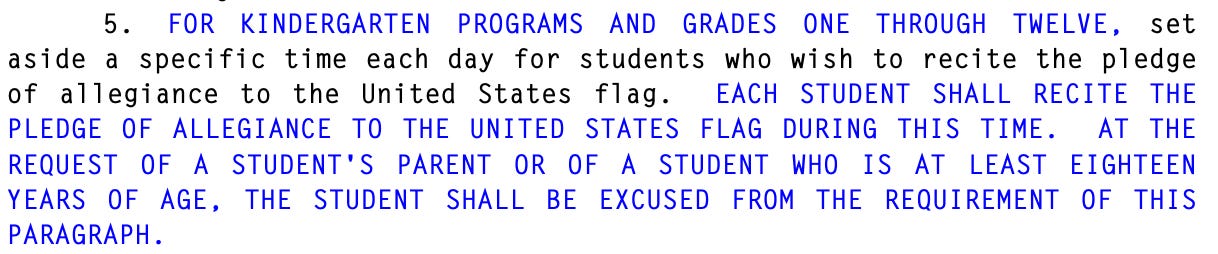
On a straight party-line vote, Arizona Republicans have backed a bill forcing public school students to say the Pledge of Allegiance. While no penalty is specified for those who disobey, the illegal bill offers no exceptions for students who refuse to participate in the religious ritual.

HB2523, which passed by a slim 31-29 vote, says that all K-12 students “shall recite the Pledge of Allegiance to the United States Flag.” The only exceptions apply to students who are at least 18 or who have the explicit permission of their parents to sit out. But students who oppose saying the Pledge on principle would have no recourse here unless their parents were on their side.

I’ve made an entire podcast series about the history of the Pledge, but just to go over the biggest concerns…

The phrase “under God” pushes religion onto people who may not be religious. Even without that phrase, the very notion of pledging allegiance to a flag violates the religious beliefs of some students who believe only God deserves allegiance.

The Pledge also falsely suggests that we have “liberty and justice for all,” which is one reasons students of color have opposed it in recent years.

The Pledge was originally written to promote anti-immigrant sentiment.

And frankly, our country doesn’t always deserve admiration. Why would we want to “pledge allegiance” to a nation that is so often a global embarrassment? If Saudi Arabia forced students to say a pledge to their country every day, we’d immediately call it a form of brainwashing.

Those are all reason not to say the Pledge in a normal situation, but forcing students to participate in the religious ritual against their will, unless their parents feel the same way they do, is undoubtedly a violation of students’ civil rights.

That means this bill is illegal and would provoke a lawsuit if it ever became law. In fact, the Supreme Court ruled in Barnette in 1943 that students couldn’t be forced to salute the flag or say the Pledge. (That decision overturned a notoriously awful ruling from 1940 which said the opposite.) While “Under God” wasn’t in the Pledge at the time, the justices said the government could not compel speech, with one justice famously writing, “If there is any fixed star in our constitutional constellation, it is that no official, high or petty, can prescribe what shall be orthodox in politics, nationalism, religion, or other matters of opinion or force citizens to confess by word or act their faith therein.”

None of that mattered to the bill’s sponsor, first-term Republican State Rep. Barbara Parker, who, in a speech just before the vote took place, implied that church/state separation was a myth and that the 1943 Supreme Court decision was irrelevant.

Hemant Mehta @hemantmehta

Arizona House Republicans just passed a bill *forcing* kids to say the Pledge of Allegiance in school. Rep. Barbara Parker, the bill’s sponsor, defended it by claiming church/state separation wasn’t in the Constitution. Details: friendlyatheist.substack.com/p/arizona-hous…

2:40 PM ∙ Feb 23, 2023

First of all, a couple of things. One is: It’s really important that we clear up a few things that should never be said again from lawmakers in a legislature.

One: The separation of church and state is in the Constitution. That was never said in the Constitution. It was written in a letter years later. The separation clause was therefore the government couldn’t form a religion or couldn’t force a state religion. So let’s never hear that again.

A second thing is that: Everybody tends to quote the Barnette ruling from 1943. First of all, “Under God” wasn’t put in in 1943. It was put in in 1954. And nobody’s really ever opposed that.

Furthermore, we stand and say the Pledge of Allegiance everyday on this floor. What’s good for us is good for the children.

Separation of church and state emerges from the First Amendment and has repeatedly been interpreted that way by the courts. To pretend the government can therefore promote religion is nothing more than willful ignorance by someone who has plenty to spare.

More importantly, Parker is flat-out wrong about the Barnette case. She cited it because a Democrat mentioned it just before she spoke, but Parker seemed to think the case was being used to push back against “Under God.” It wasn’t. It was cited to point out that government cannot force students to say or do something political against their will. (And, yes, plenty of people and judges have opposed both mandatory recitation of the Pledge and the inclusion of “Under God.”)

Parker also thinks that if her legislative colleagues do it, it should be okay for kids to follow suit. Again, she has no clue what she’s talking about. Just to give one example, the Supreme Court has permitted invocation prayers at city council meetings, but the same privilege doesn’t extend to school board meetings or graduations where children may be present.

Just because Republicans in the Arizona legislature want to use their majorities to inflict Christianity on their colleagues doesn’t mean they have any right to force that on children.

The Arizona Senate, where the bill now heads, also has a slim Republican majority of 16-14. Even if it passes there, though, Gov. Katie Hobbs, a Democrat, can thankfully veto it. If and when that happens, Hobbs would be saving taxpayers from a costly lawsuit they would inevitably lose.

The government cannot force children to say a prayer in school no matter how much misinformation Christians like Barbara Parker want to spread.