To read my private blog, Read to Death, click here and request access.
The blog’s goal is share how reading leads a person to discover & dispel false opinions & beliefs, and to replace them with the truth.
This is a membership blog where I share my reading on a number of topics, including politics (sparingly), religion, and science.
The main question Read to Death attempts to answer is whether there is sufficient, credible evidence the Christian God exists. For the first sixty years of my life I would have answered with a definitive yes. Now, some eight years later, my response is the opposite, a definitive no.
However, I remain willing to change my mind when presented with sufficient, credible evidence. This is why reading, researching, relating, and recording is vital when one’s guiding star is following the evidence whereever it leads.
Humanity has had a long fascination with blood sacrifice. In fact, it has been by no means uncommon for a child to be born into this world only to be patiently and lovingly reared by religious maniacs, who believe that the best way to keep the sun on its course or to ensure a rich harvest is to lead him by tender hand into a field or to a mountaintop and bury, butcher, or burn him alive as offering to an invisible God. The notion that Jesus Christ died for our sins and that his death constitutes a successful propitiation of a “loving” God is a direct and undisguised inheritance of the superstitious bloodletting that has plagued bewildered people throughout history. . .
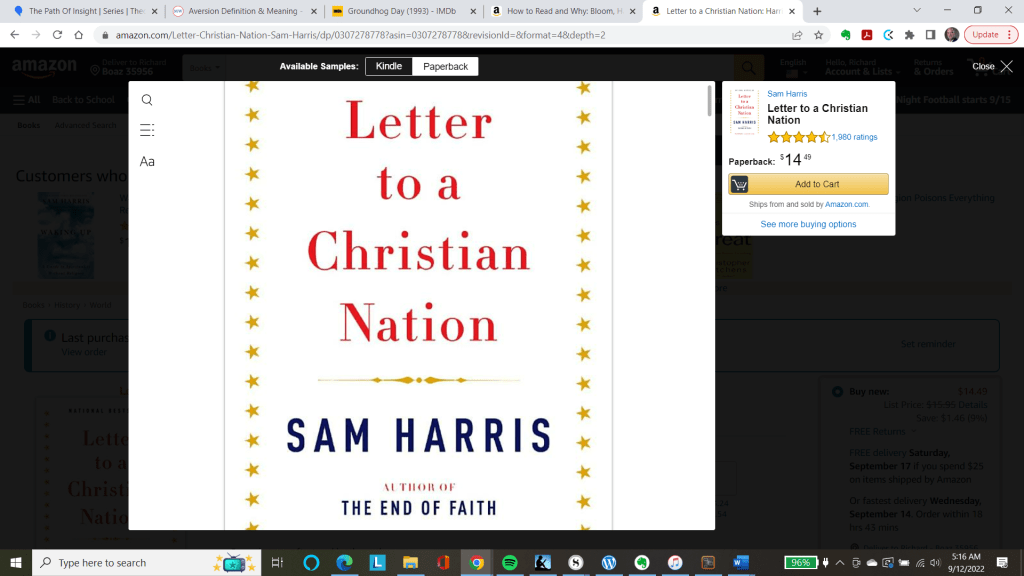
First few pages from Kindle version
YOU BELIEVE that the Bible is the word of God, that Jesus is the Son of God, and that only those who place their faith in Jesus will find salvation after death. As a Christian, you believe these propositions not because they make you feel good, but because you think they are true. Before I point out some of the problems with these beliefs, I would like to acknowledge that there are many points on which you and I agree. We agree, for instance, that if one of us is right, the other is wrong. The Bible is either the word of God, or it isn’t. Either Jesus offers humanity the one, true path to salvation (John 14:6), or he does not. We agree that to be a true Christian is to believe that all other faiths are mistaken, and profoundly so. If Christianity is correct, and I persist in my unbelief, I should expect to suffer the torments of hell. Worse still, I have persuaded others, and many close to me, to reject the very idea of God. They too will languish in “eternal fire” (Matthew 25:41). If the basic doctrine of Christianity is correct, I have misused my life in the worst conceivable way. I admit this without a single caveat. The fact that my continuous and public rejection of Christianity does not worry me in the least should suggest to you just how inadequate I think your reasons for being a Christian are.
Harris, Sam. Letter to a Christian Nation (pp. 3-4). Knopf Doubleday Publishing Group. Kindle Edition.
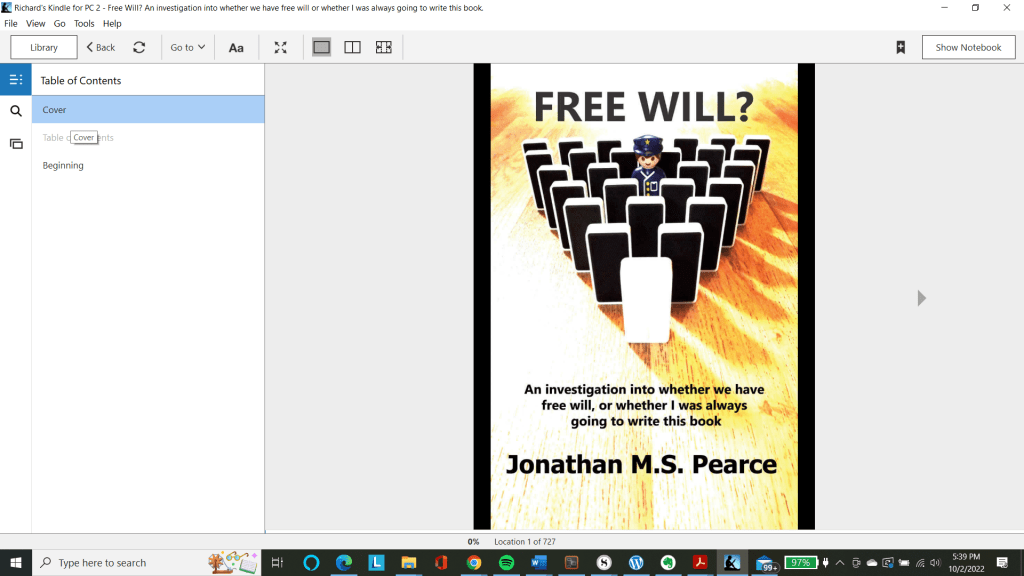
This book is a fine introduction into the age-old philosophical debate as to whether we have free will, or whether we live determined lives. Pearce approaches the subject in a lively manner, explaining terms clearly and using anecdotes to break down some of the heavier philosophy so that it is available to the popular philosophy reader. Now that we are understanding our genetic heritage and our neurology better, can we account for all our characteristics and decisions? The author also looks at how theories of free will and determinism integrate with religion, particularly Christianity. If we live under the illusion of free will, do religions need reassessing? How does free will work when God knows what we are doing in advance? Does God have free will? How does prophecy interfere with free will? How is our justice system affected if we know exactly why people commit crimes? These and other crucial questions are investigated with a deft touch, and the author uses recent and important scientific findings to support the text supplying a valuable overview to the subject.
“The world’s otherness is antidote to confusion [and] standing within this otherness — the beauty and the mystery of the world, out in the fields or deep inside books — can re-dignify the worst-stung heart.”
BY MARIA POPOVA
“There are perhaps no days of our childhood that we lived as fully,” Proust wrote in contemplating why we read, “as the days we think we left behind without living at all: the days we spent with a favourite book.” And yet childhoods come in varied hues, some much darker than others; some children only survive by leaving the anguish of the real world behind and seeking shelter in the world of books.
Looking back on her barely survivable childhood, ravaged by pain which Oliver has never belabored or addressed directly — a darkness she shines a light on most overtly in her poem “Rage” and discusses obliquely in her terrific On Being conversation with Krista Tippett — she contemplates how reading saved her life:
Adults can change their circumstances; children cannot. Children are powerless, and in difficult situations they are the victims of every sorrow and mischance and rage around them, for children feel all of these things but without any of the ability that adults have to change them. Whatever can take a child beyond such circumstances, therefore, is an alleviation and a blessing.
Rebecca Solnit, in her beautiful meditation on the life-saving vanishing act of reading, wrote: “I disappeared into books when I was very young, disappeared into them like someone running into the woods.” Oliver disappeared into both. For her, the woods were not a metaphor but a locale of self-salvation — she found respite from the brutality of the real world in the benediction of two parallel sacred worlds: nature and literature. She vanished into the woods, where she found “beauty and interest and mystery,” and she vanished into books. In a sentiment that calls to mind Kafka’s unforgettable assertion that “a book must be the axe for the frozen sea inside us,” Oliver writes:
The second world — the world of literature — offered me, besides the pleasures of form, the sustentation of empathy (the first step of what Keats called negative capability) and I ran for it. I relaxed in it. I stood willingly and gladly in the characters of everything — other people, trees, clouds. And this is what I learned: that the world’s otherness is antidote to confusion, that standing within this otherness — the beauty and the mystery of the world, out in the fields or deep inside books — can re-dignify the worst-stung heart.
Oliver approached her new sacred world not just with the imaginative purposefulness typical of children aglow with a new obsession, but with a survivalist determination aimed at nothing less than self-salvation:
I learned to build bookshelves and brought books to my room, gathering them around me thickly. I read by day and into the night. I thought about perfectibility, and deism, and adjectives, and clouds, and the foxes. I locked my door, from the inside, and leaped from the roof and went to the woods, by day or darkness.
[…]
I read my books with diligence, and mounting skill, and gathering certainty. I read the way a person might swim, to save his or her life. I wrote that way too.
Art by Oliver Jeffers and Sam Winston from A Child of Books, an illustrated love letter to reading
In literature, she had her fill of the “clear and sweet and savory emotion” absent from the reality of her ordinary world, until reading alone was no longer enough — writing beckoned as the mighty world-building force that it is. Oliver recalls:
I did not think of language as the means to self-description. I thought of it as the door — a thousand opening doors! — past myself. I thought of it as the means to notice, to contemplate, to praise, and, thus, to come into power.
[…]
I saw what skill was needed, and persistence — how one must bend one’s spine, like a hoop, over the page — the long labor. I saw the difference between doing nothing, or doing a little, and the redemptive act of true effort. Reading, then writing, then desiring to write well, shaped in me that most joyful of circumstances — a passion for work.
With an eye to how the enlivening power of this “passion for work” slowly and steadily superseded the deadening weight of her circumstances, Oliver issues an incantation almost as a note to herself whispered into the margins:
You must not ever stop being whimsical. And you must not, ever, give anyone else the responsibility for your life.
Echoing young Sylvia Plath’s insistence on writing as salvation for the soul, Oliver takes a lucid look at the nuanced nature of such self-salvation through creative work and considers what it means to save one’s own life:
I don’t mean it’s easy or assured; there are the stubborn stumps of shame, grief that remains unsolvable after all the years, a bag of stones that goes with one wherever one goes and however the hour may call for dancing and for light feet. But there is, also, the summoning world, the admirable energies of the world, better than anger, better than bitterness and, because more interesting, more alleviating. And there is the thing that one does, the needle one plies, the work, and within that work a chance to take thoughts that are hot and formless and to place them slowly and with meticulous effort into some shapely heat-retaining form, even as the gods, or nature, or the soundless wheels of time have made forms all across the soft, curved universe — that is to say, having chosen to claim my life, I have made for myself, out of work and love, a handsome life.
[…]
And now my old dog is dead, and another I had after him, and my parents are dead, and that first world, that old house, is sold and lost, and the books I gathered there lost, or sold — but more books bought, and in another place, board by board and stone by stone, like a house, a true life built, and all because I was steadfast about one or two things: loving foxes, and poems, the blank piece of paper, and my own energy — and mostly the shimmering shoulders of the world that shrug carelessly over the fate of any individual that they may, the better, keep the Niles and the Amazons flowing. And that I did not give to anyone the responsibility for my life. It is mine. I made it. And can do what I want to with it. Live it. Give it back, someday, without bitterness, to the wild and weedy dunes.
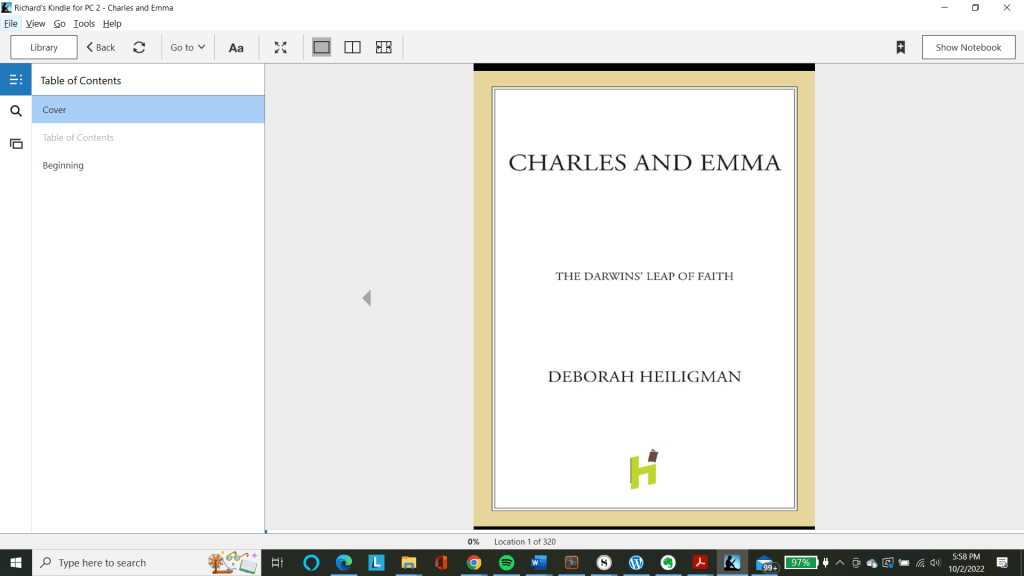
Charles Darwin published The Origin of Species, his revolutionary tract on evolution and the fundamental ideas involved, in 1859. Nearly 150 years later, the theory of evolution continues to create tension between the scientific and religious communities. Challenges about teaching the theory of evolution in schools occur annually all over the country. This same debate raged within Darwin himself, and played an important part in his marriage: his wife, Emma, was quite religious, and her faith gave Charles a lot to think about as he worked on a theory that continues to spark intense debates.
Deborah Heiligman’s new biography of Charles Darwin is a thought-provoking account of the man behind evolutionary theory: how his personal life affected his work and vice versa. The end result is an engaging exploration of history, science, and religion for young readers.
Charles and Emma is a 2009 National Book Award Finalist for Young People’s Literature.
The God of classical theism, that which Jonathan MS Pearce calls “OmniGod”, is in the crosshairs in the collection of arguments against such a god’s existence. Omnipotence, omniscience (including full divine foreknowledge of every event that will come to pass), and omnibenevolence make for difficult bedfellows. In fact, OmniGod’s characteristics are so flawed when employed together, and when seen in light of design, heaven, hell, and Satan, that belief in such a being is almost certainly irrational.
This is what Pearce takes aim at – all of these ideas supposedly working in coherent unison – in this book aimed at a popular audience. The book packs a punch as he handily deconstructs these ideas to show that either God does not exist, or that God is not all-knowing, all-powerful, and all-loving.
“…since believers aren’t usually reasoned out of a faith that they were never reasoned into, the prolific Pearce expertly throws the book at them. I’m a fan of his. Highly recommended reading!”- John W. Loftus, philosopher and counter-apologist with 12 books, including The Case against Miracles and God and Horrendous Suffering.
“A concise but very philosophically sophisticated presentation of thirty evergreen problems for both theism in general and Abrahamic religions specifically. A must for the bookshelves of both atheists (to quickly reference powerful arguments) and theists (to understand the strongest and most commonly-used points of their opposition).”- Gunther Laird, author of The Unnecessary Science: A Critical Analysis of Natural Law Theory
“Jonathan MS Pearce is a talented writer with a thoroughly enjoyable conversational style. While I tend to abhor philosophy, this little book provides a very nice, easy-to-read and comprehensive overview of a number of key philosophical issues pertaining to topics of God, religion and theology. This is an essential read for anyone with an interest in the viability of faith, whether it be theirs or another.”- Dr. Kipp Davis, author of Dead Sea Scrolls Fragments in the Museum Collection
Here’s a taste from Chapter 1
1 – Why Would God Create at All? This is one of those arguments that I have often used in one form or another in my previous work. It is important, though, because it cuts right to the heart of everything – or anything – in existence.
The question we perhaps need to ask of God is why did it create anything at all? I mean, really, why? What is the point? What is the point of us? Of the universe, including black holes and tsunamis, malaria and debilitating mental health? Humans are left – at least, those still clinging onto belief in a supposedly supreme being – trying to desperately work out what the answers to these questions might be without even the slightest peep out of the creator itself.
Indeed, God appears to have been on holiday for 2,000 years and has disconnected the phone. Why indeed. We can but guess. The problem – and, for this, return to previous ideas of a necessary, immutable, perfect God – is the idea that God is, indeed, perfect. Okay, that might make no sense, but let’s grant the theist at least this much for the sake of the argument. I like the idea that they might be “hoist by their own petard”.[7]
Something that is sheer perfection will not be lacking anything. And some entity not lacking anything will not have a need for anything. No lacking, no needs, no desires. If God exists, causally prior to creation, in some scenario of perfection, then there is no rationale for God “deciding” to create anything. Simply put, OmniGod wouldn’t create because creation would invalidate its omni-characteristics and ideas of perfection.
This can be formulated into a syllogism:
(1) If the Christian God exists, then GodWorld is the unique best possible world.
(2) If GodWorld is the unique best possible world, then the Christian God would maintain GodWorld.
(3) GodWorld is false because the Universe (or any non-God object) exists.
(4) Conclusion: Therefore, the Christian God, as so defined, does not exist.
Pearce, Jonathan MS (2022-03-05T22:58:59.000). 30 Arguments against the Existence of “God”, Heaven, Hell, Satan, and Divine Design . Onus Books. Kindle Edition.
Great book from my favorite fiction author. I confess, this time, my second ‘reading,’ I listened to the audio version while riding my bike–took a couple of weeks on and off.
Abstract from Amazon
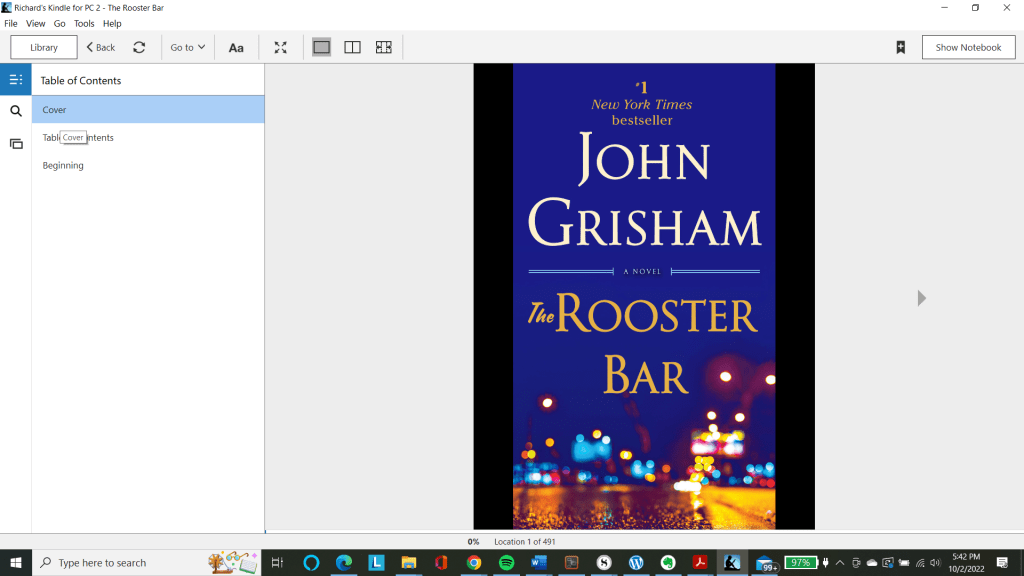
#1 NEW YORK TIMES BESTSELLER•John Grisham’s newest legal thriller takes you inside a law firm that’s on shaky ground.
Mark, Todd, and Zola came to law school to change the world, to make it a better place. But now, as third-year students, these close friends realize they have been duped. They all borrowed heavily to attend a third-tier, for-profit law school so mediocre that its graduates rarely pass the bar exam, let alone get good jobs. And when they learn that their school is one of a chain owned by a shady New York hedge-fund operator who also happens to own a bank specializing in student loans, the three know they have been caught up in The Great Law School Scam.
But maybe there’s a way out. Maybe there’s a way to escape their crushing debt, expose the bank and the scam, and make a few bucks in the process. But to do so, they would first have to quit school. And leaving law school a few short months before graduation would be completely crazy, right? Well, yes and no …
Pull up a stool, grab a cold one, and get ready to spend some time at The Rooster Bar.




 Richard L. Fricks