Keeping the Folks in the Pews in the Dark

By David Madison at 10/21/2022

Here’s the link to this article.

What the church doesn’t want them to think about

Worship services are a form of show business, at which some Christian brands excel especially. How much does the Vatican spend every year on its worship costumes alone? But most denominations, while not so extravagant, do their best to “put on the show,” which includes music, liturgy, ritual, props, sets—those stained-glass depictions of Bible stories—and the trained actors, i.e., the clergy. All this is designed to promote the beliefs and doctrines of each denomination. But there are so many different denominations: who is getting Christianity right? Is there any denomination that urges its followers to look beyond the liturgies? What’s behind it all? What are the origins of the beliefs celebrated in liturgies?
 

John Loftus, in The Christian Delusion: Why Faith Fails, has correctly noted how the church—of whatever brand—tries to win and keep converts:

“New converts in different social contexts have no initial way of truly investigating the proffered faith. Which evangelist will objectively tell the ugly side of the Bible and of the church while preaching the good news? None that I know of. Which evangelist will tell a prospect about the innumerable problems Christian scholars must solve? None that I know of.” (p. 90)

Indeed, it might be argued that the worship spectacle—it really is a show—is meant to divert attention from truly distressing realities that are best ignored—for the sake of keeping faith intact. 

Here are four of these distressing realities:

1.     The Bible doesn’t qualify as divinely inspired

The Bible has been hyped for centuries as a source of information about a god. A splendid edition of the Bible is commonly found on the church altar, and no Christian home would be complete without at least one copy. Presidents are sworn in using the Bible as a prop. One Christian sect has footed the bill for placing more than a billion copies of it in hotel rooms. It has been translated into hundreds of languages, not doubt because of Jesus-script in Matthew 28:19, “Go therefore and make disciples of all nations…”

Yet with all this, how embarrassing that many Christians pay so little attention to it, maybe because they’ve tried reading it, and given up. They grasp—but would rarely admit—that Hector Avalos’ analysis is correct: going line by line, 99% of the Bible would not be missed. After trying to wade through much of the Old Testament or the letters of the apostle Paul, they’re happy with the feel-good verses read from the pulpit. Moreover, they are largely unaware that intense scholarly study of the Bible—for the last two centuries—has revealed how deficient the Bible is from the perspectives of morality, history, or even what might reasonably be called sane religion. 

This is the distressing reality, for which I make a full case in my essay, “Five Inconvenient Truths that Falsify Biblical Revelation,” in John Loftus’ 2019 anthology, The Case Against Miracles. I’ll offer one specific example here. In January 2018, on this blog, I published an article, Getting the Gospels Off on the Wrong Foot, in which I discussed several bizarre features of Mark’s gospel—specifically about Jesus. Hence my warning to those Christians who want to believe that Mark’s gospel was divinely inspired: “If you accept the Jesus of Mark’s gospel, you are well on the way to full-throttle crazy religion. No slick excuses offered by priests and pastors—none of their pious
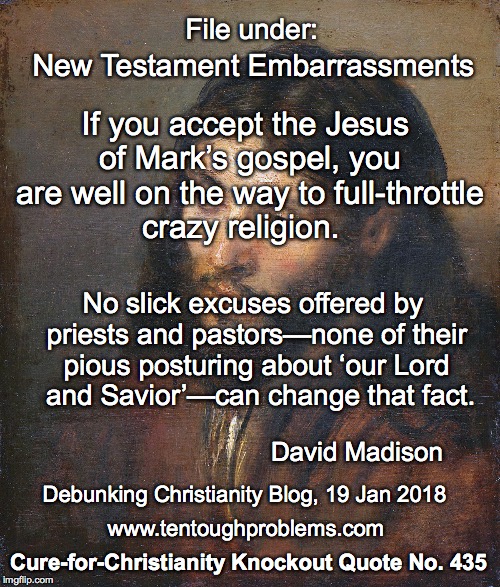
posturing about ‘our Lord and Savior’—can change that fact.” 

Christian apologists have written countless books and articles trying to rescue the Bible, to hold on to it as divinely inspired scripture. For the most part, they convince only each other.

2.     Christian origins scuttle its claim to be the One True Religion

It is common to celebrate the heroism and determination of the apostle Paul, especially as he is portrayed in the Book of Acts. But then we hit a brick wall: this apostle, whose writings are the first we have about Jesus Christ, never met or knew Jesus—and bragged that he didn’t learn anything about Jesus from those who had followed him: “For I want you to know, brothers and sisters, that the gospel that was proclaimed by me is not of human origin, for I did not receive it from a human source, nor was I taught it, but I received it through a revelation of Jesus Christ.”   (Galatians 1:11-12) Paul had no problem claiming it was “a revelation,” but we can be properly skeptical about getting messages from the spiritual realm: where is the reliable, verifiable data that this actually happens?  A better explanation is that Paul suffered from hallucinations. So this is not good: the Christian religion received a major primary boost from the hallucinations of a man who never met Jesus. This must qualify as a distressing reality.

Nor can Christians fall back on the gospels as a firm anchor for the truth about Jesus. There is scant evidence that they were written by eyewitnesses. The broad consensus among Christian scholars—outside of fundamentalist/evangelical circles—is that the gospels were written after the destruction of Jerusalem by the Romans in 70 CE during the First Jewish-Roman War. This ferocious conflict brought widespread devastation; it is highly improbable that anyone in the original Jesus-sect, i.e., eyewitnesses, would have survived. Thus one of the agonizing dilemmas in New Testament scholarship: there is no way to verify any of the words and deeds of Jesus reported in the gospels. Especially since the gospels read so much like fantasy literature. Devout readers may think this is okay—after all, they believe in miracles. But each miracle story, each bit of folklore and magical thinking, forces historians to concede that the gospels fail as history. They qualify rather as propaganda literature for the early Jesus cult. And they worked so well in this capacity for centuries, until critical, skeptical analysis of the gospels began to take over.

The fact that the gospels were written in Greek points to even more complications in figuring out Christian origins. Dennis MacDonald has shown, in several of his books, that the gospel writers were influenced by Greek literature in creating their stories about Jesus. Thus it’s no surprise that themes common in other religions were grafted onto the Jesus narratives, e.g., a hero or divine son born of a virgin, a dying-and-rising god bringing salvation to followers; so many of the wonders attributed to Jesus are similar to miracle folklore found in other religious traditions. 

Yet all these factors that influenced the birth and evolution of Christianity remain outside the awareness of those who show up for church—for the worship experience. Many priests and preachers may be in the dark themselves. They were trained to “spread the gospel,” not to encourage probing, skepticism, and doubt. The literature on the complex origins of the Christian faith is now vast; scholars have been studying it for a long time. But almost none of this has filtered down to the laity. 

3.     Christians have fought and killed each other over theological differences

What a sorry history this is, a distressing reality indeed. Even in the New Testament itself, we find the beginnings of Christian dissention. The apostle Paul was blunt: “But when Cephas [Peter] came to Antioch, I opposed him to his face because he stood self-condemned…” (Galatians 2:11) And in I Corinthians 1:10-13 we read: 

“Now I appeal to you, brothers and sisters, by the name of our Lord Jesus Christ, that all of you be in agreement and that there be no divisions among you but that you be knit together in the same mind and the same purpose. For it has been made clear to me by Chloe’s people that there are quarrels among you, my brothers and sisters.  What I mean is that each of you says, ‘I belong to Paul,’ or ‘I belong to Apollos,’ or ‘I belong to Cephas,’ or ‘I belong to Christ.’ Has Christ been divided?” 

This tendency of Christians to disagree has resulted in the endless—and continuing—splintering of this religion, with now well over 30,000 different denominations, divisions, sects, and cults: because they cannot agree on theology and worship practice. Which doesn’t seem to bother the faithful, and is even piously denied: “In Christ there is no east or west, in him no south or north, but one great fellowship of love throughout the whole wide earth.” (Hymn lyrics by John Oxenham, 1908)  

Philip Jenkins came up with one of the best titles ever: Jesus Wars: How Four Patriarchs, Three Queens, and Two Emperors Decided What Christians Would Believe for the Next 1,500 Years. (2010) This is one of his observations: “By the year 500 or so, the churches were in absolute doctrinal disarray, a state of chaos that might seem routine to a modern American denomination, but which in the context of the time

seemed like satanic anarchy.” (p. 242)

The Thirty Years’ War (1618-1648) is an appalling example (four to eight million dead) of Christians killing other Christians. Consider also World War I, Christian nations locked in mutual slaughter for four years. 

One more example—a less terrifying one—of Christians not being able to get along. In this case, Catholics. There are Catholic women who want to become priests, convinced this is their vocation because of they’ve been called to it by the Holy Spirit. But the patriarchy will have none of it, saying, in effect, that the holy-spirit-experience of these devout women is not valid. The male priests, anchored in their own theological certainties, don’t want to admit women to their fellowship of love. 

4.     Small and epic episodes of horrendous suffering cancel belief in a good, powerful god

This is a distressing reality that is perhaps ignored the most. The spectacle of worship is a way for the devout to hold on to their belief that the Cosmos is friendly, that a caring father-god is accessible, and can be influenced by flattery, i.e., “How great thou art!” “Hallowed be thy name!” etc. Even a little reflection shows that this doesn’t bring the desired results. We live in a dangerous world, and even the most fervent believers are not exempt from ssuffering. Just look at the way the world works—if you’re religious, look at the way your god allows the world to work: school shootings, church shootings (one in particular, in which hundreds of women and children were machine-gunned to death), endless warfare for millennia (all that aggression…god couldn’t have done better designing the human brain?), thousands of genetic diseases, the agony of mental illness, plagues, pandemics, cancers; our brutal planet, i.e., earthquakes, tsunamis, hurricanes, floods, tornadoes, wildfires.

The faithful need to reflect on the implications of these horrors. But critical thinking doesn’t come easily. We’ve all heard the stories of houses burning down, people killed, but wow: a Bible was left untouched by the flames. A miracle! A plane crashes, hundreds die, but wow one person somehow survived. A miracle! Such nonsense is encouraged by clerical explanations for small and epic episodes of horrendous suffering:

“God works in mysterious ways.”

“God has a bigger plan that we don’t know about.”

These are guesses, speculation. To take them seriously we need to know where we can find the reliable, verifiable, objective data upon which they’re based. No such luck, these are evasive tactics, cowardly dodges: “We don’t want to think about issues that might damage our faith.” And so many of the laity follow. Other excuses are even worse:

“God is testing us, punishing us.”

Of course, the clergy can turn to the Bible to back up this excuse. Bible-god threatens repeated—in both the Old and New Testaments—to destroy people for their sins. Believers who nod approval apparently don’t notice their descent into bad theology, oblivious to a god who qualifies as a moral monster. On the other hand, I suspect that some church folks shy away from Bible reading because the abusive theology is all too obvious, e.g., in this Jesus-script: “I tell you, on the day of judgment you will have to give an account for every careless word you utter…” (Matthew 12:36) 

The ministry requires certain skills for spreading the good news, preaching the standard creeds, but at the same time suppressing curiosity: “It’s better not to think about the things we don’t want you to think about. Take what we say on faith—please.” 

David Madison was a pastor in the Methodist Church for nine years, and has a PhD in Biblical Studies from Boston University. He is the author of two books, Ten Tough Problems in Christian Thought and Belief: a Minister-Turned-Atheist Shows Why You Should Ditch the Faith (2016; 2018 Foreword by John Loftus) and Ten Things Christians Wish Jesus Hadn’t Taught: And Other Reasons to Question His Words (2021). His YouTube channel is here. He has written for the Debunking Christianity Blog since 2016.

The Cure-for-Christianity Library©, now with more than 500 titles, is here. A brief video explanation of the Library is here

Why Even Conservative Christians Should Accept Evolution: Blog Anniversary Guest Post by Michael Shermer (part 2)

September 8, 2022

Here is the link to this article.

For several months now I have been posting Guest Posts that were generoulsly provided by others in honor of the blog’s tenth anniversary.  These posts have been wide-ranging in their content and the intriguing , each pbased on the posters’ unique backgrounds and expertise.  This now is the final one in the series, the second of two posts by Michael Shermer, to continue what he was saying in his post of Sept. 3.

This one is particularly significant.  Why is it in conservative Christians’ (and everyone else’s) own best interest to accept evolution as a reality of the past?   He makes some compelling points.  Read and see!

*************************

To counter the doubts I mentioned in my previous post, I argue that, in fact, Christians and conservatives should accept the theory of evolution for at least eight reasons (again, for brevity, truncated here):

  1. Evolution happened.

The theory describing how evolution happened is one of the most well-founded in all of science. Christians and conservatives embrace the value of truth-seeking as much as non-Christians and liberals do, so evolution should be accepted by everyone because it is true. In this sense, evolution is no different than any other scientific theory already fully accepted by both Christians and conservatives, such as Big Bang cosmology, heliocentrism, gravity, continental drift and plate tectonics, the germ theory of disease, the genetic basis of heredity, the aerodynamics of flight, and more.

  1. Evolution makes for good theology.

Christians believe in a God who is omniscient, omnipotent, and eternal. Compared to eternity, what difference does it make when God created the universe—10,000 years ago or 10,000,000,000 years ago? The glory of the creation commands reverence regardless of how many zeroes there are in the age. And compared to omniscience and omnipotence, what difference does it make how God created life—spoken word or natural forces? The grandeur of life’s complexity elicits awe regardless of what creative processes were employed. Christians should embrace evolutionary theory (and cosmology) for what it has done to reveal the magnificence of the divinity in a depth and detail unmatched by ancient texts. Darwin himself made this argument in response to his critics in the 2nd edition of On the Origin of Species:

I see no good reason why the views given in this volume should shock the religious feeling of any one. It is satisfactory, as showing how transient such impressions are, to remember that the greatest discovery ever made by man, namely, the law of the attraction of gravity, was also attacked by Leibnitz, ‘as subversive of natural, and inferentially of revealed, religion.’ A celebrated author and divine has written to me that ‘he has gradually learnt to see that it is just as noble a conception of the Deity to believe that He created a few original forms, capable of self-development into other and needful forms, as to believe that He required a fresh act of creation to supply the voids caused by the actions of His laws.

Surely God has more important things to do than to track the fall of every sparrow (Matthew 10:29).

  1. Intelligent Design makes for bad theology.

ID creationism reduces God to an artificer, a divine watchmaker piecing together life out of available parts in a cosmic warehouse. If God is a being in space and time, it means that He is restrained by the laws of nature and the contingencies of chance, just like all other being of this world. An omniscient and omnipotent God must be above such constraints and not subject to law and chance. God as creator of heaven and earth and all things visible and invisible would need necessarily to be outside such created objects. If He is not, then God is like us, only smarter and more powerful; but not omniscient and omnipotent. Calling God a watchmaker is delimiting.

  1. Evolution explains Christian family values and social harmony.

The following characteristics are shared by humans and other social mammals: attachment and bonding, cooperation and mutual aid, sympathy and empathy, direct and indirect reciprocity, altruism and reciprocal altruism, conflict resolution and peace-making, community concern and reputation caring, and awareness of and response to the social rules of the group. As a social primate species we evolved the capacity for positive moral values because they enhance the survival of both family and community. Evolution created these values in us, and religion identified them as important in order to accentuate them. “The following proposition seems to me in a high degree probable,” Darwin theorized in The Descent of Man (1871, 1:71-72), “namely, that any animal whatever, endowed with well-marked social instincts, the parental and filial affections being here included, would inevitably acquire a moral sense or conscience, as soon as its intellectual powers had become as well, or nearly as well developed, as in man.” The evolution of the moral sense was a stepwise process, “a highly complex sentiment, having its first origin in the social instinct, largely guided by the approbation of our fellow-men, ruled by reason, self-interest, and in later times by deep religious feelings, confirmed by instruction and habit, all combined, constitute our moral sense and conscience.”

  1. Evolution explains evil, original sin, and the Christian model of human nature.

We may have evolved to be moral angels, but we are also immoral beasts. Whether you call it evil or original sin, humans have a dark side. Individuals in our evolutionary ancestral environment needed to be both cooperative and competitive, for example, depending on the context. Cooperation leads to more successful hunts, food sharing, and group protection from predators and enemies. Competition leads to more resources for oneself and family, and protection from other competitive individuals who are less inclined to cooperate, especially those from other groups. Thus, we are by nature, cooperative and competitive, altruistic and selfish, greedy and generous, peaceful and bellicose; in short, good and evil. Moral codes, and a society based on the rule of law, are necessary not just to accentuate the positive, but especially to attenuate the negative side of our evolved nature. Christians would find little to disagree with in this observation by Thomas Henry Huxley, Darwin’s chief defender of evolutionary theory in the nineteenth century, in his 1894 book Evolution and Ethics: “Let us understand, once for all, that the ethical process of society depends, not on imitating the cosmic process, still less in running away from it, but in combating it.”

  1. Evolution explains the origin of Christian morality.

Religions designed moral codes based on our evolved natures. For the first 90,000 years of our existence as fully modern humans, our ancestors lived in small bands of tens to hundreds of individuals. In the last 10,000 years, these bands evolved into tribes of thousands; chiefdoms of tens of thousands; states of hundreds of thousands; and empires of millions. With those increased populations came new social technologies for governance and conflict resolution: politics and religion.

The moral emotions, such as guilt and shame, pride and altruism, evolved in those tiny bands of 100 to 200 people as a form of social control and group cohesion. One means of accomplishing this was through reciprocal altruism—“I’ll scratch your back if you’ll scratch mine.” But as Madison noted, men are not angels. People defect from informal agreements and social contracts. In the long run, reciprocal altruism works only when you know who will cooperate and who will defect. This information is gathered in various ways, including through stories about other people—more commonly known as gossip. Most gossip is about relatives, close friends, those in our immediate sphere of influence and members of the community or society who have high social status. It is here we find our favorite subjects of gossip: sex, generosity, cheating, aggression, social status and standings, births and deaths, political and religious commitments, and the various nuances of human relations, particularly friendships and alliances.

When bands and tribes gave way to chiefdoms and states, religion developed as a social institution to accentuate amity and attenuate enmity. It did so by encouraging altruism and selflessness, discouraging excessive greed and selfishness, and especially by revealing the level of commitment to the group through social events and religious rituals. If I see you every week participating in our religion’s activities and following the prescribed rituals, this is signal that you can be trusted. As organizations with codified moral rules and the power to enforce the rules and punish their transgressors, religion and government responded to a need.

Consider the biblical command to “Love thy neighbor.” In the Paleolithic social environment in which our moral sentiments evolved, one’s neighbors were family, extended family, and community members who were either related to or knew well to everyone else. To help others was to help oneself. In chiefdoms, states, and empires, the decree meant one’s immediate in-group. Out-groups were not included. This explains the seemingly paradoxical nature of Old Testament morality, where on one page high moral principles of peace, justice and respect for people and property are promulgated, and on the next page killing, raping, and pillaging people who are not one’s “neighbors” are endorsed. The cultural expression of this in-group morality is not restricted to any one religion, nation, or people. It is a universal human trait common throughout history, from the earliest bands and tribes to modern nations and empires. Christian morality was designed to help us overcome these natural tendencies.

  1. Evolution explains specific Christian moral precepts.

Much of Christian morality has to do with human relationships, most notably sexual fidelity and truth-telling, because the violation of these causes a severe breakdown in trust, and once trust is gone there is no foundation on which to build a family or a community. Evolution explains why.

We evolved as pair-bonded primates for whom monogamy is the norm (or, at least, serial monogamy—a sequence of monogamous marriages). Adultery is a violation of a monogamous relationship and there is copious scientific data showing how destructive adulterous behavior is to a monogamous relationship. (In fact, one of the reasons that serial monogamy best describes the mating behavior of our species is that adultery typically destroys a relationship, forcing couples to split up and start over with someone new.) This is why most religions are unequivocal on the subject. Consider Deuteronomy 22:22: “If a man is found lying with the wife of another man, both of them shall die, the man who lay with the woman, and the woman; so you shall purge the evil from Israel.” Most religions decree adultery to be immoral, but this is because evolution made it immoral. How?

Adultery does have some evolutionary benefits. For the male, sexual promiscuity increases the probability of his genes making it into the next generation. For the female, it is a chance to trade up for better genes, greater resources, and higher social status. The evolutionary hazards of adultery, however, often outweigh the benefits, as David Buss detailed in two books, The Dangerous Passion and When Men Behave Badly. For males, revenge by the adulterous woman’s husband can be extremely dangerous, if not deadly—some nontrivial percentage of homicides involve love triangles. And while getting caught by one’s own wife is not likely to result in death, it can result in loss of contact with children, loss of family and security, and risk of sexual retaliation, thus decreasing the odds of one’s mate bearing one’s own offspring. For females, being discovered by the adulterous man’s wife involves little physical risk, but getting caught by one’s own husband can and often does lead to extreme physical abuse and even death (the primary perpetrator of homicide against women is an intimate partner). So evolutionary theory explains the origins and rationale behind the religious precept against adultery.

Likewise for truth-telling and lying. Truth telling is vital for building trust in human relations, so lying is a sin. Unfortunately, research shows that all of us lie every day, but most of these are so-called “little white lies,” where we might exaggerate our accomplishments, or lies of omission, where information is omitted to spare someone’s feelings or save someone’s life—if an abusive husband inquires whether you are harboring his terrified wife it would be immoral for you to answer truthfully. Such lies are usually considered amoral. Big lies, however, lead to the breakdown of trust in personal and social relationships, and these are considered immoral. As Robert Trivers argues in The Folly of Fools: The Logic of Deceit and Self-Deception in Human Life, evolution created a system of deception detection because of the importance of trusting social relations to our survival and fecundity. Although we are not perfect lie detectors (and thus you can fool some of the people some of the time), if you spend enough time and have enough interactions with someone, their honesty or dishonesty will be revealed, either through direct observation or by indirect gossip from other observers.

Ultimately, as I argued in The Science of Good and Evil, it is not enough to fake doing the right thing in order to fool our fellow group members, because although we are good liars, we are also good lie detectors. The best way to convince others that you are a moral person is not to fake being a moral person but to actually be a moral person. Don’t just pretend to do the right thing, do the right thing. Such moral sentiments evolved in our Paleolithic ancestors living in small communities. Subsequently, religion identified these sentiments, labeled them, and codified rules about them.

  1. Evolution explains conservative free market economics.

Charles Darwin’s theory of natural selection is precisely parallel to Adam Smith’s theory of the invisible hand. Darwin showed how complex design and ecological balance were unintended consequences of individual competition among organisms. Smith showed how national wealth and social harmony were unintended consequences of individual competition among people. The natural economy mirrors the artificial economy. Conservatives embrace free market capitalism. In fact, they are against excessive top-down governmental regulation of the economy because they understand that it is a complex emergent property of bottom-up design in which individuals are pursuing their own self-interest without awareness of the larger consequences of their actions. As Smith wrote in his 1776 book On the Nature and Causes of the Wealth of Nations:

It is not from the benevolence of the butcher, the brewer, or the baker that we expect our dinner, but from their regard to their own interest. We address ourselves, not to their humanity but to their self-love, and never talk to them of our own necessities but of their advantages.

By allowing individuals to follow their natural inclination to pursue their self-love, the country as a whole will prosper, almost as if the entire system were being directed by…yes…an invisible hand. It is here where we find the one and only use of the metaphor in The Wealth of Nations:

Every individual is continually exerting himself to find out the most advantageous employment for whatever capital he can command. … He generally, indeed, neither intends to promote the public interest, nor knows how much he is promoting it. He intends only his own security; and by directing that industry in such a manner as its produce may be of the greatest value, he intends only his own gain, and he is in this, as in many other cases, led by an invisible hand to promote an end which was no part of his intention. By pursuing his own interest he frequently promotes that of the society more effectually than when he really intends to promote it.

This brings us back to Darwin and his description of what happens in nature when organisms pursue their self-love, with no cognizance of the unintended consequences of their behavior:

It may be said that natural selection is daily and hourly scrutinising, throughout the world, every variation, even the slightest; rejecting that which is bad, preserving and adding up all that is good; silently and insensibly working, whenever and wherever opportunity offers, at the improvement of each organic being in relation to its organic and inorganic conditions of life. We see nothing of these slow changes in progress, until the hand of time has marked the long lapses of ages, and then so imperfect is our view into long past geological ages, that we only see that the forms of life are now different from what they formerly were.

By providing a scientific foundation for the core values shared by most Christians and conservatives, the theory of evolution may be fully embraced along with the rest of science. When it is, the needless conflict between science and religion—currently being played out in curriculum committees and public courtrooms over evolution and creationism—must end now, or else, as the book of Proverbs (11:29) warned:

“He that troubleth his own house shall inherit the wind.”

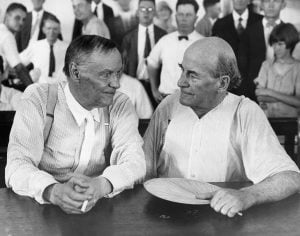
Clarence Darrow, a famous Chicago lawyer, and William Jennings Bryan, defender of Fundamentalism, have a friendly chat in a courtroom during the Scopes evolution trial. Darrow defended John T. Scopes, a biology teacher, who decided to test the new Tenessee law banning the teaching of evolution. Bryan took the stand for the prosecution as a bible expert. The trial in 1925 ended in conviction of Scopes.

Why Christians and Conservatives Should Accept Evolution: Blog Anniversary Guest Post by Michael Shermer (part 1)

September 3, 2022

Here’s the link to this article.

I have been publishing guest posts in celebration of the blog’s tenth anniversary, and am pleased to conclude the series now with two posts by Michael Shermer, whom many of you will know from his writings and media appearances discussing (especially) religion and science.  Michael was a one-time committed fundamentalist turned outspoken skeptic.   Here is the first of his two-parter, on an issue of particular cultural and religious importance.

US public acceptance of evolution is growing but is still low compared to other countries. Why? Religion and politics. Here’s why that need not be.

As a career-long student of the century-long evolution-creationism debate I was encouraged to read the results of a new study on “Public Acceptance and Rejection of Evolution in the United States, 1985-2020” by Jon Miller, Eugenie Scott, Mark Ackerman, and Belén Laspra, published in the journal Public Understanding of Science. “Using data from a series of national surveys collected over the last 35 years, we find that the level of public acceptance of evolution has increased in the last decade after at least two decades in which the public was nearly evenly divided on the issue,” the authors write. That sounds encouraging, and the uptick of the blue line of acceptance and downward slope of the orange line of rejection in this graph appears encouraging, until one glances over at the vertical axis showing that progress here is defined as breaking the 50 percent barrier! That’s not especially encouraging for a robust science that began 162 years ago with the publication of Charles Darwin’s On the Origin of Species and accepted by 97 percent of all scientists.

What is the cause in the recent increase (however modest) in the acceptance of the theory? According to the study’s authors:

A structural equation model indicates that increasing enrollment in baccalaureate-level programs, exposure to college-level science courses, a declining level of religious fundamentalism, and a rising level of civic scientific literacy are responsible for the increased level of public acceptance.

Those of us in academia, and especially in the science education business, should find this especially encouraging, but I want to drill down into that variable of “religious fundamentalism,” which the authors defined and quantified as belief in a personal God who hears prayers, reading the Bible as literal truth, frequency of church attendance, frequency of prayer, and agreement with the statement “We depend too much on science and not enough on faith.” There was an inverse correlation between religious fundamentalism and acceptance of evolution: 32 percent acceptance on the high end of the scale compared 91 percent on the lowest end of the scale (and 54 percent of the entire sample). That 30 percent of Americans self-identify as religious fundamentalists goes a long way to explaining their doubt. As does their political affiliation. While 83 percent of liberal Democrats accept the theory of evolution, the researchers found that only 34 percent of conservative Republicans do so.

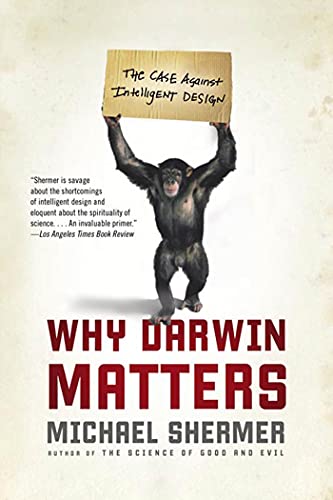
Why do Christians and conservatives doubt evolution? My 2006 book Why Darwin Matters (my only book with full frontal nudity) attempts to answer this question. For brevity here, I will outline four reasons:

          1. Belief that evolution is a threat to specific religious tenets. If one believes that the world was created within the past 10,000 years, that will be in direct conflict with the geological evidence for a 4.6 billion-year old Earth. If one insists on the findings of science squaring true with religious doctrines, this can lead to conflict between science and religion.
          2.  Misunderstanding of evolutionary theory. Many cognitive studies show, such as those by Andrew Shtulman and others in his book Scienceblind: Why Our Intuitive Theories About the World Are So Often Wrong, that most people—both religious believers and secularists alike—have a poor understanding of the theory, mixing in some Lamarckian notions of the inheritance of acquired characteristics (giraffes got their long necks by stretching), a misunderstanding of population genetics, and a fumbled explanation of what, exactly, natural selection is selecting for (not the good of the species or the group, not future environments, not structural or cognitive progress).
          3.  The fear that evolution degrades our humanity. After Copernicus toppled the pedestal of our cosmic centrality, Darwin delivered the coup de gr­ace by revealing us to be “mere” animals, subject to the same natural laws and historical forces as all other animals.
          4.  The equation of evolution with ethical nihilism and moral degeneration. This sentiment was expressed by the neo-conservative social commentator Irving Kristol in 1991: “If there is one indisputable fact about the human condition it is that no community can survive if it is persuaded—or even if it suspects—that its members are leading meaningless lives in a meaningless universe.” Similar fears were raised by Nancy Pearcey, a fellow of the Discovery Institute in a briefing on Intelligent Design before a House Judiciary Committee of the United States Congress. She cited a popular song urging “you and me, baby, ain’t nothing but mammals so let’s do it like they do on the Discovery Channel.” Pearcey went on to claim that since the U.S. legal system is based on moral principles, the only way to generate ultimate moral grounding is for the law to have an “unjudged judge,” an “uncreated creator.”

When Does Human Life Begin?

By Rich Prendergast, 10/25/22

Here is the link to this article.

The essence of the pro-life argument against abortion is their belief that “life begins at conception”. They declare that this isn’t just their opinion; science itself says so. They claim that biologists are in broad agreement on this fact. And if we’re simply talking about the organism itself, they’re 100% correct. When an egg is fertilized, and becomes a zygote, it is unquestionably a new life – one that (if all goes well for it) will eventually develop into a living, breathing person.

So, since the zygote is alive, and since we’re talking about human zygotes, they reason that the zygote is a human life, and that abortion is therefore the intentional taking of a human life (i.e. murder).

But this argument pretends that there is no significant qualitative difference between the “humanity” of the zygote, and that of a living, breathing person, when in fact, the differences are enormous and profound. So the more critical question is whether the zygote is truly a “person”. That’s a question that science alone can’t answer, because determining what truly defines a person, is a philosophical, not a scientific question. Science can only describe the qualities and nature of a zygote (or embryo or fetus).

Pro-lifers will argue that our humanity/personhood is defined by our DNA. Our DNA IS different from all other species, but some fairly significant mutations can occur, and the person is still considered to be human. But at conception, the function of DNA is to manage the workings of the cell, but more significantly, it provides the instructions that will cause this cell to eventually develop into a baby. The DNA is not the person, it’s the instructions for creating the person.

Humans are complex beings, with numerous traits that distinguish us from other animal species. Many, of course, are physical traits. Our bodies have a variety of features that are obviously different from even our closest related species, but those physical traits don’t define our personhood. We could lose all our limbs, and have numerous internal organs transplanted (sometimes with animal parts) or have organs replaced with mechanical substitutes, and few, if any, would argue that we are no longer persons.

Carrying that to the extreme, there is only one feature that is inextricably linked to our personhood – our minds. If a person suffered severe trauma, such that most of the body could not survive, but we could transplant their brain into a machine which could keep it alive, allowing it to interact with the outside world, that PERSON would still be alive. Conversely, we already have numerous examples today in which a person may lose all brain function, with their body otherwise unharmed. We can keep that body alive through the use of machines, but unless there is some reasonable hope of recovery, we don’t. Instead, we decide that their human lives have effectively ended, and we unplug them.

A person is the sum total of their experiences, memories, personality, intelligence, emotions, values, etc. When someone loses all brain function, those things are lost with it. The “person” is gone.

I’ll note that this is not the case for someone who is unconscious or in a temporary vegetative state. They may no longer be aware of their environment, potentially being temporarily non-sentient. But in this case, the “person” still exists within the unresponsive brain.

So if personhood ends with the loss of the mind, it follows that personhood doesn’t begin until the mind exists. So when does that happen? Unfortunately there is no black and white answer to that. On one extreme, the zygote clearly has no mind. On the other extreme, a newborn baby clearly DOES have one, as evidenced by (among other things) the fact that it’s capable of learning.

The fetal brain begins to develop at about 3 weeks, with the first neurons forming. At 5 weeks, a neural tube has formed. Electrical activity in the brain begins at about 8 weeks, which begin to initiate involuntary muscle movements in the womb. By 10 weeks, there is a recognizable brain structure, but it’s smooth, without the characteristic folds of a fully-formed brain. The fetus still has no cerebral cortex, and is non-sentient (i.e. unaware of either itself or its environment). While it may respond to external stimuli, the reactions are purely reflexive. It can feel no pain.

The onset of sentience occurs around 24 weeks. It is only then, that the fetus begins to become AWARE of external stimuli, including feeling pain, etc. But while the fetus is sentient, it is not yet sapient. It can feel, but it cannot think. It has no memories, no emotions, no personality, etc. It is still not yet a “person”. For that, the fetus requires not only sentience, but some degree of sapience.

And this is where things become VERY gray. Gradually over about the next 16 weeks, the fetus evolves from being merely sentient to becoming sapient. That evolution continues after birth, and in fact, the brain takes decades to fully mature. There is no single moment that defines the transition to sapience. Therefore there is no clear-cut moment at which we can say that the fetus’ human life (aka its personhood) has begun. But we know it’s not before about 24 weeks,

In my discussions with abortion opponents, they will commonly argue that these aren’t the same. If someone is in a persistent vegetative state, and it’s determined that there is little to no hope of recovery, that’s entirely different from the fetus, which has a pretty good chance of becoming a fully functioning person. While that’s true, that doesn’t change the fact that the early term fetus is NOT YET a person. Terminating the pregnancy does not kill a person, just as terminating life support for one who is brain dead, does not kill a person (that person is already gone).

Between the 1973 Roe v Wade and the 2022 Dobbs v. Jackson Women’s Health Organization decisions, the various states allowed unrestricted abortions until around 24 weeks (give or take, depending on the state), with later exceptions for severe fetal abnormalities, or to protect the life/health of the woman. The 24 week threshold is not entirely a coincidence. Those laws have typically been based on fetal viability, but it’s not surprising that fetal viability would be correlated in part to brain development. While advances in medical technology will likely continue to improve the viability for younger (earlier-term) fetuses, these are unlikely to accelerate the onset of sentience.

But given those laws, my perception is that they gave plenty of time in the overwhelming majority of cases, for women to become aware of a pregnancy, to decide if they wanted to carry it to term, and to get an abortion if not.

At the risk of inviting the “no uterus, no opinion” reactions from women, I personally think those laws were pretty good, and I’m uncomfortable with suggestions that abortion ought to be completely unrestricted, because I agree with abortion opponents, that the personhood status (from a philosophical and scientific perspective) isn’t materially changed when a baby leaves the womb and takes its first breath. (Though obviously the LEGAL personhood status DOES change at that moment).

A primary argument from many pro-choicers, is the right of women to bodily autonomy. I absolutely agree with it, but I think the argument becomes weaker as the pregnancy continues. The woman has that right, but early in the pregnancy there is, as yet, no “person” in the womb that could have any competing rights. Late in pregnancy, however, that’s not the case. At that point, there are valid ethical questions as to whether bodily autonomy should take precedence over protecting the life of a sentient being.

I draw an analogy to a situation in which I’m holding onto someone to prevent them from falling off a cliff. At that moment, the other person is completely dependent on me for their survival. But do I have an obligation to give up my own autonomy, and continue holding them? If I can do so without risking my own safety, most people would agree that it would be unethical to let that person fall to their death.

It’s really not much different than if one is driving along, and a person walks in front of your vehicle. Even though you have the legal right of way, you also have a legal obligation to attempt to avoid hitting that person, IF you can do so without significantly endangering yourself or others.

These competing interests were overtly recognized in the Roe decision, and resulted in laws that adopted a reasonable balance between those interests. Since the Dobbs decision, many states have abandoned that balance, and rejected any notion of a right to bodily autonomy, while absurdly granting rights to a single cell.

It is my opinion that we need to restore the balance that was established by Roe. I believe that women should have an unrestricted right to abortion for about the first 24 weeks, with later exceptions for cases of severe fetal abnormality, and to protect the life and health of the woman. The approximate 24 week threshold is not based on viability considerations, but rather the criterion of sentience discussed above.

I do not support unrestricted abortions throughout pregnancy. And for what it’s worth, I believe that those who push for this are hurting the greater cause, by shifting the debate to that extreme position, rather than focusing energy on the more moderate position that has pretty widespread support. I see little chance that pro-lifers will be persuaded by any argument that denies personhood considerations for late term fetuses, or declares that those considerations are completely irrelevant in the face of rights to bodily autonomy.

Questioning the Resurrection, Part 3

By David Madison 

06/29/2019

By Robert Conner, with interpolations by David Madison[Note from David Madison: This article was written by Robert Conner, who asked me to review it and add whatever comments I wanted. I contributed about 15 percent of what you’re about to read.]

Here’s the link to this article.

Part 1 is here.

Part 2 is here.

In the era in which Christianity appeared, a clear majority accepted visions and the appearance of ghosts as real events, and lived in the expectation of omens, prophetic dreams, and other close encounters of the supernatural kind. Like many people of the present, they were primed for self-delusion, expecting the inexplicable, accepting the uncanny. Given the mass of contradictions and implausibility in the resurrection stories, who bears the greater burden of proof, the apologist who claims the gospels record eyewitness history or the skeptic who can point to modern “sightings” such as apparitions of the Virgin Mary?


The first mention of Jesus’ resurrection comes, not from the gospels, but from a letter written decades before by Paul of Tarsus. Paul appears to have had no interest whatsoever in the historical Jesus, Jesus “according to the flesh.” “Even though we have known Christ according to the flesh, we know him so no more.” (2 Corinthians 5:16) Paul’s surviving letters never once mention any of Jesus’ many exorcisms and healings, not even the raising of Lazarus or Jesus’ virgin birth, and barely allude to Jesus’ teaching. For Paul, Jesus only gets interesting after he’s dead, but even here Paul’s attention to detail is sketchy. Paul says Jesus “was raised on the third day according to the Scriptures,” (1 Corinthians 15:4) but there are no scriptures that foretell the Jewish Messiah would at long last appear only to die at the hands of Gentiles, much less that the Messiah would then be raised from the dead after three days.

After his visionary conversion on the road to Damascus—an event Paul never describes in his letters—Paul didn’t immediately hie himself to Jerusalem to meet with Jesus’ family, retrace Jesus’ steps, or sit at the feet of Jesus’ apostles. Au contraire, “I did not go up to Jerusalem to see those who were apostles before I was, but I went to Arabia. Later I returned to Damascus.” (Galatians 1:17) When, after a number of years, Paul decided he’d been born to preach Jesus, he says in no uncertain terms, “I want you to know, brothers and sisters, that the gospel I preached is not of human origin. I did not receive it from any man, nor was I taught it; rather, I received it by revelation from Jesus Christ.” (Galatians 1:11-12, NIV) In short, like other early Christian writers, Paul appears to have had a casual relationship at best with historical details. That said, here is Paul’s summary of Jesus’ resurrection: “I passed on to you as of primary importance what I also received, that Christ died for our sins according to the scriptures, and that he was buried, and that he was raised on the third day according to the scriptures, and that he appeared to Cephas [Peter], then to the Twelve, then he appeared to more than five hundred brothers at one time, the greater number of whom remain until now, but some have died. Then he appeared to James, then to all the apostles. Last of all he appeared to me, as to one born before his time.” (1 Corinthians 15:3-8)

Paul makes no mention of the empty tomb, no women witnesses, no Men in White. Instead “more than five hundred brothers”—who do not appear in the gospels—see Jesus “at one time.” Apologists have cranked out a veritable mountain of verbiage attempting to paper over the various cracks in this narrative and to harmonize it with the gospels, but the opinion of George Riley summarizes the conclusion of mainstream scholarship: “a simple comparison of the Gospels and 1 Corinthians 15 shows the two traditions cannot be reconciled.” (Resurrection Reconsidered, 89.) Even apologetic writers are forced to admit, “Paul’s list of appearances in 1 Corinthians and the resurrection narratives in the gospels are remarkably—and puzzlingly—ill-matched.” (Richard Bauckham, The Laing Lecture at London Bible College, 2.)

That the folks in the pews can be impressed by I Corinthians 15—“then he appeared to more than five hundred brothers at one time”—is evidence enough that critical thinking has been suspended. Who would believe a neighbor who came back from a church healing service bragging that five hundred people had witnessed the preacher restore an amputated arm? Our polite reply might be, “Oh, that’s nice,” while thinking, “What a load of rubbish.” Yet Paul’s report is taken at face value, although we suspect that he was passing along cult folklore. Moreover, anybody who knows the gospel accounts of Jesus’ betrayal—which Paul obviously didn’t—should wonder why Paul reports that Jesus appeared “to the Twelve.” Hmmm….hadn’t Judas dropped out? Or was Paul copying a formula?

The core of the 1 Corinthians passage—“that Christ died…that he was buried…that he was raised…that he appeared”—is almost certainly a piece of early liturgy like a similar passage falsely attributed to Paul: “[Jesus] was manifest in the flesh, vindicated by the spirit, seen by angels, preached among the nations, believed on by the world, taken up in glory.” (1 Timothy 3:16)

The phrasing of the text in 1 Corinthians raises several questions. First, did Paul even write it? Citing “tensions” between the passage and its context, Hans Conzelmann concluded the “language is not Paul’s.” (Interpretation: A Journal of Bible and Theology 20 (1966), 22.) Scholars have proposed as many as seven instances of interpolated text in 1 Corinthians—a forged passage planted in a genuine text, or a marginal note included in the text due to careless copying. (Jerome Murphy-O’Connor, Catholic Biblical Quarterly 43 (1981), 582-589.) Robert Price has identified several reasons for regarding the 1 Corinthians passage with suspicion, among them Paul’s dependence on “revelation” rather than historical sources, the absence of the five hundred witnesses in the gospels, and the speculative and unconvincing efforts by apologists to harmonize Paul’s account with the gospel material. (The Empty Tomb: Jesus Beyond the Grave, 69-104.)

The inconclusive debate over what, if any, part of the five-hundred-witness story can be traced back to Paul raises the possibility that none of it was written by Paul and that it’s an interpolation, a pious forgery inserted into a genuine letter to bolster belief in the resurrection. As Peter Kearney observed, the mention that “some have died” means the letter was addressed to “a community moving toward an expectation of fulfillment, but already marked by death.” (Novum Testamentum 22 (1980), 282.) First Corinthians 15 may address acute anxiety provoked by the death of believers who expected an imminent Parousia in their own lifetime as a comparison with a similar passage in 1 Thessalonians 4:15-17 suggests.

There is no way to guarantee that the texts of the New Testament reliably represent what the authors—whoever they were—originally wrote. Eldon Epp, a noted textual scholar, calls the surviving form of the New Testament text the “interpretive text-form,” noting that “it was used in the life, worship, and teaching of the church” and therefore subject to “reformulations motivated by theological, liturgical, ideological, historical, stylistic, or other factors.” (Harvard Theological Review 92 (1999), 277.) Anyone who doubts this was the case can take a gospel parallel in hand and compare how Matthew and Luke alter Mark, adding, subtracting, and editing Mark’s text to suit their whim even while preserving much of Mark’s original wording and timeline.

This raises a second question: assuming Paul wrote 1 Corinthians 15:3-8, was he making a theological claim or a historical claim? Samuel Brandon, in “The Historical Element in Primitive Christianity,” concluded, “the Eucharist, as set forth by Paul, in effect lifts the historical event of the death of Jesus completely out of its setting in time and space and confers upon it that transcendent significance that characterizes…the various mystery cults.” (Numen 2 (1955), 167.) That Paul was writing theology, not history, is clear and the verdict of historian Robert Grant remains secure: “No word in this account [1 Corinthians 15:3-8] suggests that the appearances of Jesus were other than ‘spiritual’: it was not the ‘flesh and blood’ of Jesus which the witnesses saw…what [Paul] saw, and what he believes other Christians saw was the ‘spiritual body’ of Jesus.” (Journal of Religion 28 (1948), 125.) Except for the level of sophistication, what is the difference between a “spiritual body” and a ghost, or is it a distinction without a difference?

It’s a good bet that Christians today want an honest-to-goodness physical body that walked out of the tomb: a body that came to life—breathing resumed, blood started pumping again—and this revived Jesus invited Thomas to poke his finger in the sword-wound in his side, John 20). Laypeople may find Paul’s poetry lovely, i.e., in I Corinthians,

“… we will all be changed, in a moment, in the twinkling of an eye, at the last trumpet. For the trumpet will sound, and the dead will be raised imperishable, and we will be changed. For this perishable body must put on imperishability, and this mortal body must put on immortality.”

And indeed everyone who hopes to go to heaven assumes that their twinkling souls, not their bodies, are heaven-bound. But the Risen Jesus himself had better not have been a soul, ghost, phantom, apparition—or, god forbid, a product of Paul’s temporal lobe epilepsy. The body missing from the tomb assures precisely that. But it is so commonly overlooked that this also cancels the reality of a physical resurrection: What do you do with the body once it’s up and walking around again? The Book of Acts has a simple answer: after forty days Jesus ascended to heaven; he vanished into the clouds. Which means that the New Testament is guilty of a cover-up.

We can be one hundred percent certain that the body of Jesus never left planet earth; those who protest “Oh yes, it did happen,” have to be okay with Jesus remaining in orbit to this day. “It’s a symbol or metaphor” doesn’t work either, unless resurrection itself is a symbol or metaphor. Christianity is caught in a terrible bind here: if Jesus did indeed come back to life, then he must have died again, and was buried again. So what exactly did resurrection accomplish? Paul’s Risen Jesus didn’t stay Risen all that long. But Jesus was alive in Paul’s visions, hence he had no use for the story of the Empty Tomb, which probably hadn’t been invented yet at the time he wrote his letters. He would have deemed it a worthless tale.

But what a jumble the gospel stories are. How can we explain the bald contradictions? Are the disciples to meet Jesus in Galilee after the resurrection (Matthew 26:32; 28:17) or stay in Jerusalem? (Luke 24:49) Why does Mark say Judas betrayed Jesus with a kiss (Mark 14:44) while John has Jesus repeatedly identify himself while Judas stands by? (John 18:6, 8) There is a broad consensus that the gospels were written decades after the death of Jesus, forty to seventy years after, and that they contain no direct eyewitness testimony. Several key figures from the New Testament, James, the brother of Jesus, Peter, and Paul, were all long dead before the first gospel was written.

The average pew sitter may assume that following Jesus’ death, life in Palestine chugged along just as before, but that was not the case. Increasing unrest and confrontations with Roman authorities finally exploded in the First Jewish-Roman War (66-73 CE). Remarkable both for its savagery and for atrocities committed by both sides, the conflict began when the Roman army invaded Jesus’ home province of Galilee and moved south toward Jerusalem, culminating in the destruction of the city and its environs in 70 CE. By some estimates, over a million people died during the war, nearly 100,000 were taken captive, and many thousands more became refugees. The original community of Jesus’ disciples, like the Jewish sect of the Sadducees, was a likely casualty of the war, its members dead, scattered, or enslaved. The gospels were not even composed in Palestine where the events they purport to relate took place.

Inconsistent and internally contradictory, the resurrection accounts are by turns hallucinatory and almost comically improbable, reading more like folklore and ad hoc invention than history. The original “witness” of the women at the tomb, unmentioned by Paul, potentially our earliest source, is disbelieved and dismissed. Jesus suddenly appears and disappears, yet is palpable to the touch. The disciples mistake Jesus for someone else, but even when they recognize him they continue to doubt and react with fear. Jesus repeatedly and clearly foretells his resurrection, but the disciples have to be reminded of his prediction, and when confronted with the evidence, they don’t know what to make of it. If this potpourri of contradiction is really the sine qua non of the Christian faith, we must ask if Jesus’ current disciples are as befuddled as Peter was, faux naïve, or just not paying attention.


Robert Conner’s most recent book is Apparitions of Jesus: The Resurrection as Ghost Story.

The Cure-for-Christianity Library© is here.

Questioning the Resurrection, Part 2 (of 3)

By David Madison

[Note from David Madison: This article was written by Robert Conner, who asked me to review it and add whatever comments I wanted. I contributed about 15 percent of what you’re about to read.]

06/28/2019

Here’s the link to this article.


Part 1 is here.

If you still have questions, that’s understandable. For starters, if a hoard of dead men proved Jesus had risen, why didn’t Jesus His Own Damn Self just show up in Jerusalem? What could have been more convincing than Jesus Himself back from the dead, clothed in shining raiment, appearing to the Jewish and Roman leaders? After all, when the high priest asked Jesus, “Are you the Christ, the son of the Blessed One?” didn’t Jesus finally break silence and tell the court, “I am! And you (plural) will see the son of man seated at the right hand of power and coming with the clouds of heaven!” (Mark 14:61-62) Whatever happened to all that I’ll-show-you-and-then-you’ll-be-sorry blow and jive from Jesus’ trial? Why didn’t Jesus appear post mortem to his persecutors and settle the question of his resurrection then and there, once and for all, as he promised at his trial?

There can be no doubt whatever that even Christians cringe when they stumble upon the holy zombies episode in Matthew 27:50-53—and stumble they do, since these bizarre verses are rarely read from the pulpit. They’re just too embarrassing, as if the intent had been to merge Easter with Halloween. Matthew missed his calling by about 2,000 years: he would have done well writing for supermarket tabloids. Imagine his headline: “Hundreds of Dead People Sighted Wandering the City.” We can see the comical aspect of it all, but, in fact, this text by itself scuttles all attempts to take resurrection seriously.

Good Christian folk may give it a wink—“Well, of course, that’s a tall tale”—but that only begs the question: why isn’t every resurrection story a tall tale? These three verses cancel the possibility of taking resurrection seriously. And the case for resurrection is not helped by the ‘more respectable’ raising of Lazarus described in John 11. Shrewd Bible students suspect that this scene is John’s recasting of Luke’s parable of Dives and Lazarus (chapter 16:19-31), in which Dives begs Abraham to bring the poor beggar Lazarus back to life, to warn his relatives about the torments of Hades. John’s extravagant talent for invention is well known, and he is at his best here. He needed this stunt to provide occasion for Jesus to say, “I am the resurrection and the life.

” Lazarus rising after four days could be taken at face value because people coming back from the dead was part of the superstition of the time. Why would the resurrection of Jesus be an exception? And yet a major world religion hangs on it. The details of the Jesus Resurrection Event serve only to undermine the concept further.

Even when Jesus Himself does appear, believers initially mistake him for someone else! Mary Magdalene thinks he’s the gardener, (John 20:14-15) Peter and his buddies don’t recognize him at first in Galilee, (John 21:1-13) and the disciples on the road to Emmaus think he’s just another traveler. (Luke 22:13-21) And when Jesus Himself appears on a hill in Galilee to give his eleven remaining apostles their mission to convert the world, we’re told, “when they saw him, they fell to their knees before him, but some doubted.” (Matthew 28:17) If you don’t think the “some doubted” part still has Christian heads spinning like tops, just Google it: when I did I got 17,800,000 hits, which seems like a lot of Jesusplaining over something Christians are supposed to be absolutely certain about.

By the time Matthew wrote his moonbat revision of Mark, Jewish opponents of Christianity had apparently already proposed the “stolen body hypothesis” to explain the resurrection, hence Matthew’s inclusion of this narrative gem:

The next day, which is after Preparation, the high priests and the Pharisees assembled before Pilate and they said, “Sir, we remember that fraudster said while still alive, ‘After three days I will be raised.’ Therefore order the tomb be made secure for three days so his disciples won’t come and steal his body and tell the people he’s been raised from the dead. This final deception will be worse than the first.”

Pilate told them, “Take a guard and go make the tomb as secure as you know how.” So they left and secured the tomb by sealing the stone and posting a guard.

…While [the women] were on their way, some of the guard went to the city and reported everything that had happened to the high priests. After meeting with the elders, they hatched a plan to give the soldiers a sum of money, telling them, “Say his disciples came by night and stole him while we were sleeping and if this gets back to the governor, we’ll cover for you so you won’t have to worry.” So the soldiers took the money and did as they were told and this story spread among the Jews up till now. (Matthew 27:62-64; 28:11-15)

There is at least one glaring problem with this story: Matthew has already established that the stone covering the entrance to the tomb was so heavy it required an able-bodied man or even an angel to move it. So who would believe the soldiers managed to stay asleep while a gaggle of Galilean hillbillies removed the seals from the stone in the dead of night, rolled it aside, and made off with the body the soldiers were guarding, all without awakening a single soldier? And if the Jewish elders paid the soldiers to keep quiet, how did the story ever get out?

Another problem that would have occurred to any literate person in the Roman era concerns the identity of the soldiers. Although the Temple had a police force under the command of the High Priest, the force described by Matthew ultimately answered to Pilate, the Roman governor. The soldiers—the Greek text uses stratiōtēs, the usual term for soldier—formed a picket, a guard placed around the tomb. The gospel uses a Latin loanword, koustōdia, from the Latin custodia, a “military guard,” and since the term is derived from Latin, logically a Roman military guard.

Would a Roman military detachment really have reported back to a Jewish priest? And what fate would have awaited a Roman soldier who reported to his commander that he’d been asleep on watch? After all, the Roman army practiced decimation as a punishment for insubordination and dereliction of duty—his fellow soldiers killed every tenth man in a unit selected for the punishment of decimation. Given the stringent discipline of Roman forces, stationed in a hostile province, what are the odds a detachment of Roman soldiers would lie to their commanding officer, and by extension to the governor of the province, in return for a bribe if discovery would result in summary execution? Clearly, as pointed out by Roman critics, the gospels were written for the edification of credulous yokels eager to be titillated by pious fairy tales. And Matthew delivered.

Back in 2005, while researching material for a book on magic in the career of Jesus, Robert read Daniel Ogden’s sourcebook, Magic, Witchcraft, and Ghosts in the Greek and Roman Worlds, surprised by how closely ghost stories from the era resemble the post mortem appearances in the gospels of Luke and John. His initial search of the New Testament studies literature turned up nothing that specifically addressed the similarities, but nevertheless convinced of the parallels, he included a chapter, “The Resurrection as Ghost Story,” in his survey, Jesus the Sorcerer: Exorcist and Prophet of the Apocalypse, released in 2006.

Why would elements of ghost stories end up in the gospels? What could possibly motivate the author of a resurrection story to compose a narrative that sounds like a ghost story? As it turns out, there are several reasons.

First of all, people of the first century took the existence of ghosts for granted:

Shortly before dawn, Jesus went out to them, walking on the sea. When the disciples saw him walking on the sea, they were terrified. “It’s a ghost!” they said, and cried out in fear. (Matthew 14:25-26)

Besides the belief in ghosts, the people of the era accepted the fantastic at face value. In fact, they expected it. Even Jesus complained, “Unless you see signs and wonders, you will never believe.” (John 4:48) For most ancient listeners, sexing up a story with elements of the supernatural made it more believable, not less. Besides, who wants to read a ho-hum Bible story in which nothing incredible happens?

In addition, decades passed between the events of Jesus’ life and the writing of the gospels and there is little evidence the gospels contain direct eyewitness testimony. For reasons we will touch on later, the institutional memory of the early church appears to have been patchy at best or completely missing—all the more reason for the gospel writers to simply make up stories using the cultural elements available to them. As everyone knows, the gospels quote frequently, freely—and often inaccurately—from the Old Testament, but the writers evidently borrowed supernatural elements from the wider culture as well, features of stories of figures who came back from the dead, namely ghosts.

Eventually Robert decided the topic of ghost belief in the New Testament warranted book-length treatment, the first ever to the best of his knowledge, so after doing more extensive research, he found a publisher and Apparitions of Jesus: The Resurrection as Ghost Story appeared. But if anyone thinks he was the first to notice the uncanny similarities between ghost stories and the resurrection stories, it turns out they’d be off by eighteen centuries. The first writer to compare Jesus’ post resurrection appearances to spectral visitations was a Greek philosopher and critic of Christianity named Celsus who wrote a lengthy work, Alēthēs Logos, or True Doctrine, that refuted aspects of the Christian cult. Noticing the phantasmal quality of the resurrection appearances, Celsus said that Jesus manifested to his disciples “like a ghost hovering before their perception.” (Contra Celsum, VII, 35)—his vocabulary suggests something insubstantial drifting before one’s vision. As historian J. D. Crossan would later remark, “apparitions of Jesus do not constitute resurrection. They constitute apparitions, no more and no less.” (Neotestamentica 37 (2003, 47.)

What specific features of the resurrection stories read like ghost stories? As it happens, there are several—then, as now, ghosts often suddenly appeared and disappeared: “[Jesus] became invisible to them.” (Luke 24:31) Lucian turned the sudden disappearance of a ghost to comic effect when the household dog frightens off Eucrates’ wife, returned from the grave to reclaim a golden sandal: “she vanished because of the barking.” (Lover of Lies, 27)

Paradoxically, ghosts could also assume solid, tactile form, momentarily indistinguishable from the living:

While they were talking about these things, [Jesus] stood in their midst and said to them, “Peace be with you.” But they were alarmed and afraid, thinking they were seeing a spirit. He said to them, “Why are you terrified and why do doubts arise in your hearts? Touch me and see, because a spirit does not have flesh and bones as you see I have.” And after saying this, he showed them his hands and feet.

But even in their joy they did not believe him, and while they were wondering, he said to them, “Do you have anything here to eat?” They gave him a piece of fish and he took it and ate it in front of them. (Luke 24:36-43)

The disciples responded to Jesus’ appearance just as they responded earlier when they thought they’d seen a ghost walking on the Sea of Galilee: they were terrified.

That ancient ghosts could appear from nowhere, eat, and then disappear is conspicuously proven by Phlegon’s gruesome tale of the ghost of Polykritos, a man who returns from the dead after the ill-omened birth of his hermaphroditic child.

The people had gathered together and were arguing about the portent when the ghost took hold of the child, forced most of the men back, hastily tore the child limb from limb, and began to devour him…he consumed the entire body of the boy except his head and then suddenly disappeared. (William Hansen, Phlegon of Tralles’ Book of Marvels, 30-31, RC’s translation.)

Ghosts easily pass through barriers the living can’t breach, a recurring theme in ghost lore. Jesus’ nighttime manifestations in the gospel of John—“in the evening of the first day of the week” (John 20:19)—occur even though “the doors were locked.” (John 20:19, 26) The Greek text uses kleiō, “to lock,” from kleis, “key,” to convey the astounding fact that despite the doors being locked, “Jesus came and stood in their midst.” Ancient Mediterranean cultures regarded doorways with a high degree of anxiety; the Romans had no fewer than three minor deities associated with doors, Cardea, the goddess of hinges, Forculus, the good of the door itself, and Limentinus, god of the threshold. A tomb is also a doorway of sorts: “because of the presence of these spirits of the dead, the threshold, like the cross-roads, was a spot particularly adapted to the performance of magic rites, just as such rites were often performed on graves.” (Marbury Ogle, American Journal of Philology 32 (1911), 270.)

The timing of Jesus’ appearances and disappearances are also reminiscent of ghost stories. He tends to appear at night or in the evening, (Matthew 28:1; Mark 16:2; Luke 24:29; John 21:4) a time particularly associated with hauntings. Liminal times and places, doorways, rivers, crossroads, dawn, dusk, as well as the transition from sleep to waking, are suited to the manifestation of ghosts. Given our differing cultural assumptions, Westerners living in the 21st century read the New Testament rather differently from Mediterranean people living in the 1st century. Appreciating why Celsus and his contemporaries read the resurrection accounts like ghost stories requires that we step back into the mindset of their era and read the gospels in the light of their cultural expectations, not of ours.

Interestingly, Celsus had another insight that anticipated modern thinking on apparitions by many centuries. Besides being the first to comment on the spectral qualities of the resurrection accounts, Celsus appears to be the first to advance a psychological explanation for Jesus’ apparitions.

“While [Jesus] was alive he did not help himself, but after death he rose again and showed the marks of his punishment and how his hands had been pierced. But who says this? A hysterical female, as you say, and perhaps some other one of those who were deluded by the same sorcery, who either dreamt in a certain state of mind and through wishful thinking had a hallucination due to some mistaken notion (an experience which has happened to thousands), or, which is more likely, wanted to impress the others by telling this fantastic tale, and so by this cock-and-bull story to provide a chance for other beggars.” (Henry Chadwick, Origen: Contra Celsum, 109.)

Historian Robin Lane Fox notes the likelihood that “women were a clear majority” in the early church, and of the writing of pagan critics, observes, “It was a well-established theme…that strange teachings appealed to leisured women who had just enough culture to admire it and not enough education to exclude it.” (Robin Lane Fox, Pagans and Christians, 310) Classical scholar Catherine Kroeger approaches the issue from the point of view of “the socio-religious world of [Greco-Roman] women” that addresses the social strata of Christian women specifically: “Neither is it surprising that women who lacked any sort of formal education flocked to the cults that were despised by the intellectuals.” (Journal of the Evangelical Theological Society 30 (1987), 25-26, 28.)

According to Luke, the male disciples who went to the tomb “did not see Jesus.” (Luke 24:24) The tactile Jesus who later appears to them is apparently an attempt to “counter the idea that the risen Jesus was some type of ghost or phantasm.” (Gregory Riley, Resurrection Reconsidered, 53.) So who or what, exactly, did the women see? From the standpoint of the wider pagan culture and from ours as well, the ambiguous nature of Jesus’ manifestations, the fact that no male disciples are initially reported to have seen them, and that subsequent appearances are met with fear and doubt, are major points of narrative weakness. Christian women in the ancient world “were expressly targeted as unreliable witnesses, possessed, fanatical, sexual libertines, domineering of or rebellious toward their husbands,” (Wayne Kannaday, Apologetic Discourse and the Scribal Tradition, 141) and by the end of the first century Christian estimation of women was little better: “I do not permit a woman to teach or exercise authority over a man…[Younger women] get into the habit of being idle and gadding about from house to house. Not only do they become idlers, but also busybodies who talk nonsense, saying things they ought not.” (1 Timothy 2:12, 5:13) In Paul’s list of resurrection witnesses, which predates the gospels by decades, women are notable for their absence. (1 Corinthians 15:3-8)

Celsus’ suggestion that at least some early “witnesses” were imagining the experience or actively hallucinating has modern support. Seeing or otherwise sensing the presence of the recently dead is surprisingly common. In one study, fifty percent of widowers and forty-six percent of widows “reported hallucinatory experiences of their dead spouses in a clearly waking state” and in several instances another person shared the bereaved individual’s experience. (Haraldsson Erlandur, Omega: Journal of Death and Dying 19 (1988-1989), 104, 111.) In one study of modern mystical experiences that specifically addressed Jesus’ post-resurrection appearances as examples of “after-death communication,” the survey found “2.5% [of apparitions] involved multiple witnesses.” (Ken Vincent, Journal of Near-Death Studies 30 (2012), 142.)

While doing background research on Apparitions of Jesus, Conner discovered an extensive and rapidly growing literature on the connections between religion and mental aberration, delusional belief based on mere proximity to a religious site—commonly known as “Jerusalem syndrome”—and “visionary” experiences as a symptom of temporal lobe micro-seizures without overt physical components such as facial tics or convulsions. Hallucinatory experience and delusion is predictably determined by culture and situation: evangelicals touring holy sites identify with John the Baptist, Portuguese schoolgirls see the Virgin Mary, British soldiers in the trenches see visions of Saint George or the archers of Agincourt, indigenous people see spirits compatible with their cultures, and the women at the tomb saw Men in White as well as Jesus. In short, hallucinations and delusions are downstream from previous cultural conditioning.

To be continued…

Robert Conner’s most recent book is Apparitions of Jesus: The Resurrection as Ghost Story.

The Cure-for-Christianity Library© is here.

Drafting novel #12. Day 95 (102322)

Why am I doing this? Find the answer here.

Today’s live, onscreen recording:

Click the following link to view and listen to today’s recording (sorry I ran into some time restraints that prevented me from offering my storyboarding idea I’ve been working on–and mentioned in the video below).

https://screencast-o-matic.com/watch/c360FoVujPs


Fiction writing websites I’ve found helpful

Angela Ackerman & Becca Puglisi’s, One Stop for Writers

Angela & Becca’s, Writers Helping Writers

H.R. D’Costa’s website, Scribe Meets World

My own website, Fiction Writing School

Anne Rainbow’s website, Scrivener Virgin

Scrivener website, Literature and Latte

John Truby’s website, Truby’s Writers Studio

K.M. Weiland’s website, Helping Writers Become Authors

Questioning the Resurrection. Part 1 (of 3)

By David Madison

By Robert Conner, with Interpolations by David Madison[Note from David Madison: This article was written by Robert Conner, who asked me to review it and add whatever comments I wanted. I contributed about 15 percent of what you’re about to read.]

06/27/2019

Here’s the link to this article.

Chronologically speaking, the first person in history to mention a certain Joshua from Nazareth is Paul of Tarsus. These days Joshua of Nazareth is better know as Jesus—Jesus is the Latinized form of Iēsous, the Greek rendering of Yehoshua, Joshua, meaning “Yahweh delivers.” Joshua, the hero of the conquest of Canaan, embodied the hope that Gentile overlords would be overthrown, so Joshua was understandably a popular name among the Jews in Roman-occupied Palestine. In point of fact, archaeologists have discovered over 70 occurrences of the name Joshua/Jesus in Judean burials.

The conviction that Jesus had risen from the dead was the basis of Paul’s belief, the essential element upon which all other claims rested, as Paul himself made clear: “If Christ has not been raised, our preaching is useless and so is your faith.” (1 Cor. 15:14, NIV) For Paul, the resurrection was the pivotal event of all time, the hinge on which history turned, the source of humanity’s eternal salvation: “…if you confess with your mouth that Jesus is Lord and believe in your heart that God raised him from the dead, you will be saved.” (Rom. 10:9, ESV) Indeed, according to Paul, Jesus “was appointed the Son of God in power by his resurrection from the dead.” (Rom. 1:4, NIV)

In a sense, we’re fortunate that Paul drops enough clues for us to see what was going on in his head. Galatians 1:11-12 is an important text—and we’ll return to it later for other insights—but it should give pause to those who so sure that Paul can be trusted: “I want you to know, brethren, that the gospel I preached is not of human origin. I did not receive it from any man, nor was I taught it; rather, I received it by revelation from Jesus Christ.”

Think on this: Paul’s message was not of human origin; he didn’t receive it from any man and wasn’t taught it. He didn’t think it was important—at all—to talk to the disciples who knew Jesus. He got all that he needed to know about Jesus through his visions of this dead man. Of course, his visions were a guarantee that Jesus wasn’t dead at all. Why do believers take Paul’s word for it? Cult fanatics have made similar claims forever.

The science behind this is known. Dr. David E. Comings (MD) has stated: “Temporal lobe epilepsy and its spiritual manifestations may have played a major role in the religious conversions of many historical figures and in the origin of several religions.” And: “If the role of TLE in Paul’s conversion is correct, it could be argued that without TLE Christianity would never have become the dominant religion of the Western world.” (Did Man Create God? Is Your Spiritual Brain at Peace with Your Thinking Brain?, pp. 366 & 364) So, epilepsy or contact with the spirit world? This is not a tough call for those who don’t put much store in séances. However, to have any hope of convincing believers that resurrection is an aspect of fantasy literature, it’s best not to breathe the word “science.” The Bible itself, in fact, provides all the evidence we need to abandon the idea.

Given the crucial importance of the resurrection, the most important act of God since creation as well as the cornerstone of salvation, one would expect—at a bare minimum—multiple attestations from contemporaries and a clear and internally coherent account consistent with other sources. In the pages that follow we’ll be examining the resurrection accounts to see if they meet these criteria.

According to Mark, Jesus repeatedly foretold his humiliation, crucifixion, and resurrection.

He began to teach them that it was necessary for the son of man to suffer many things and be rejected by the elders and the high priests and the experts in the law and be killed and rise [from the dead] after three days. (Mark 8:31)*

He taught his disciples, telling them, “The son of man is to be delivered into men’s hands and they will kill him and three days after being killed, he will rise. (Mark 9:31)

He again began to say to the Twelve, “The son of man will be handed over to the chief priests and the experts in the law and they will condemn him to death and hand him over to the Romans. They will ridicule him and spit on him and flog him and kill him and after three days he will rise.” (Mark 10:32b-34)

The apostles witness the very public resurrection of the son of the widow of Nain, (Luke 7:11-17) the more private raising of Jairus’ daughter, (Luke 8:49-57) the dramatic resurrection of Lazarus after three days in the tomb, (John 11:1-44) as well as the crowds that subsequently gathered as a result, hoping to see Lazarus whom Jesus had raised from the dead. (John 12:9) Jesus even declares, “I am the resurrection and the life.” (John 11:25) Yet in spite of all these predictions and all this alleged first-hand experience, the apostles remain the Twelve Stooges, thicker than two short planks, the dumbest yokels in all of yokeldom—they can’t understand what Jesus means by ‘rising from the dead’ (Mark 9:32) even after the Master calls them aside and Jesusplains it all. (Mark 10:32)

Peter is an example of this terminal cluelessness. Jesus heals Peter’s mother-in-law, (Mark 1:29-31) Peter witnesses Jesus’ glorious transfiguration, (Mark 9:2) and Peter even walks with Jesus on water. (Matthew 14:22-33) Peter sees Jesus miraculously multiply loaves and fishes to feed a multitude, cast out demons, calm a storm, heal the lame and blind, and Peter declares of Jesus, “You are the Christ, the Son of the living God.” (Matthew 16:16) So when the women—not the apostles—discover Jesus’ tomb is empty and Peter runs to see it for himself, (John 20:3-4) you’ll never guess what Peter and his pals do next:

“I’m going fishing,” Simon Peter told them, and they said, “We’ll go with you.” (John 21:3)

Because what else would you do after the long-anticipated appearance of God’s Very Own Messiah who heals your mother-in-law, performs miracles galore right before your very eyes, gets transfigured along with Moses and Elijah as God’s voice speaks out of a cloud, predicts his own resurrection, and three days later, sure enough, you find the tomb empty? Well, go fishing apparently. And so begins a series of mind-boggling non-sequiturs, contradictory reports, unlikely scenarios, and “proofs” that read suspiciously like thinly disguised folklore.

Given the crucial role of Jesus’ resurrection, wouldn’t we expect plenty of witnesses—at least as many as witnessed the raising of Lazarus or the Transfiguration? Well then, we have bad news and even worse news. Let’s start with the worse news: according to the canonical gospels—Matthew, Mark, Luke, and John—no one actually sees Jesus rise from the dead. Cook on that for a minute. Despite the repeated predictions that he will rise from the dead after three days, (Mark 8:31; 9:31; 10:32-34) not a single one of his apostles shows up to see it happen. Let’s hear that again, just to be sure: No. One. Sees. Jesus. Leave. The. Tomb.

If you think that’s already about as bad as it can get, brace yourself. When some of the women who followed Jesus visited the tomb and discovered it empty, Mark, the earliest gospel, tells us, “And they left the tomb running, for they were trembling and beside themselves, and they said nothing to anyone because they were afraid.” (Mark 16:8) And for whatever reason, that’s how the first gospel account left matters—with no prior belief, stated or implied, that his disciples expected to find Jesus had risen from the dead. Now clearly Matthew, Luke, and John couldn’t let the story end that way, but when they buffed it up theologically they just introduced even more incoherence, confusion, and contradiction.

First, let’s go back to the women who found the empty tomb. Recall that Jesus taught “plainly,” “openly”—the word Mark uses is parrhēsia, which mean “unambiguously” (Mark 8: 32)—that he would die and rise from the dead after three days and when Peter tries to tell him that’s nonsense, Jesus rebukes Peter in the strongest possible terms, the famous “Get behind me, Satan!” logion. (Matthew 16:23) But when John retells the resurrection tale, the women propose a natural—not a supernatural—explanation for the missing corpse: “They’ve taken my Lord away and I don’t know where they’ve put him!” (John 20:13) So in short, the iconic “empty tomb,” Men in White notwithstanding, was not proof that Jesus had risen from the dead; according to Mark and John it’s instead a source of confusion and fear.

Much has been written, mostly by feminists, about the women “witnessing” the resurrection, but as we’ve already noted, no one saw the resurrection according to the canonical gospels. Moreover, the men, who “have left everything” to follow Jesus, (Mark 10:28) weren’t impressed with the women’s “witness.” According to Luke, the Eleven Amigos were having none of it: “After returning from the tomb they reported all these things to the eleven and all the others. The women were Mary Magdalene, Joanna, and Mary, the mother of James, and the other women with them who told the apostles these things. But their words seemed like nonsense to them and they didn’t believe the women. However Peter stood up and ran to the tomb, and stooping down, he saw only the linen binding cloth, and he left, wondering what had happened.” (Luke 24:9-12) Wondering what had happened?! Just how dumb is this guy Peter?

If Jesus taught emphatically that he’d be back among the living three days after his crucifixion, to say nothing of having raised others as proof that he was “the resurrection and the life,” (John 11:25) why didn’t the disciples gather at Jesus’ tomb in expectation of his resurrection? And why, given the witness of the women and the discovery of the empty tomb, were they still not convinced? What if Jesus’ predictions of his death and resurrection are apologetic back-formations designed to account for an unexpected event, his execution?

According to the gospel of John, this is what happened immediately after Jesus expired:

“Later, Joseph of Arimathea, who was a secret disciple of Jesus for fear of the Jews, asked Pilate if he might take Jesus’ body and Pilate consented, so he came and took his body. Nicodemus, who earlier had come to see Jesus by night, brought a mixture of myrrh and aloes, around seventy-five pounds. Then they took Jesus’ body and wrapped it in linen cloth together with the spices, as is the Jewish burial custom. There was a garden in the place he was crucified and in the garden was a new tomb in which no one had ever been laid. Because it was the Jewish Preparation Day, and because the tomb was nearby, they laid Jesus there.” (John 19:38-42)

Several features of this brief account are either improbable, flatly contradict the version of events in other gospels, or raise even more questions. We might as well start with Joseph of Arimathea who Mark describes as a respected bouleutēs, or “council member,” (Mark 15:43) a voting member of the Sanhedrin, the Jewish court that condemned Jesus for blasphemy. (Mark 14:64) According to Mark, the vote to hand Jesus over to the Romans, essentially a death sentence, was unanimous as required by Jewish law: “they all judged him deserving of death.” (Mark 14:64) So did Joseph of Arimathea, a member of the court, vote to condemn Jesus to death despite being a secret disciple?

And if, as John claims, Joseph and Nicodemus wrapped Jesus’ corpse in linen on the Jewish day of Preparation, the day before Passover, then their contact with a dead body made them ceremonially unclean, disqualified from celebrating Passover—“But some of them could not celebrate the Passover on that day because they were ceremonially unclean on account of a dead body.” (Numbers 9:6, NIV) For that matter, how likely is it Joseph would enter Pilate’s praetorium, the judgment hall, to ask for Jesus’ body if contact with a Gentile would also make him ceremonially unclean and prevent him from participating in a major Jewish festival? (John 18:28) If the gospel accounts are accurate, Joseph was doubly disqualified from celebrating Passover. How probable is it a prominent Jewish figure, a member of the Sanhedrin, would disregard an Old Testament command? “[Passover] is a day you are to commemorate; for the generations to come you shall celebrate it as a festival to the Lord—a lasting ordinance.” (Exodus 12:14, NIV)

John’s resurrection story introduces a further problem, a glaring calendar discrepancy. If Jesus was arrested, tried, and crucified before Passover began—the trial occurred on “the day of Preparation of the Passover; it was about noon” (John 19:14)—then it was clearly impossible for Jesus to eat Passover with his disciples as described by Mark: “The disciples left, went to the city, and found everything just as Jesus had told them, and they prepared the Passover meal.” (Mark 14:16) Jesus may have worked miracles, but he can’t have died the day before Passover and still have celebrated Passover—dead in one version of the story but still alive in another.

Scholars who have examined these accounts in the light of Roman and Jewish law have identified additional problems: Rome “typically denied burial to victims of crucifixion” and “Rabbinic law specifies that criminals may not be buried in tombs.” (Jeffery Lowder, Journal of Higher Criticism 8 (2001), 254-255) For whatever it’s worth, despite historical records claiming many thousands were executed in Judea by crucifixion, archaeologists have unearthed a single example of the burial of a crucified man, a heel bone pierced by a nail, physical evidence that suggests the crucified were denied burial and were tossed into mass graves or their bodies left hanging to rot and be picked over by carrion birds.

An additional discordant note is heard when comparing the story as Luke tells it with Matthew’s account. In Luke’s resurrection story the Men in White have to remind the noodle-brained women of Jesus’ prediction: “Remember, as he said to you when he was in Galilee, the son of man must be betrayed into the hands of sinful men and be crucified and on the third day be raised.” (Luke 24:6-7) Oddly enough, the “sinners” who crucified Jesus easily recall his prediction without being reminded by the Men in White: “Sir, we remember that fraudster said while still alive, ‘After three days I will rise.’ Therefore order the tomb be made secure so his disciples don’t come and steal him and tell the people he’s risen.” (Matthew 27:63-64) Why do Jesus’ enemies recall his predictions better than his own disciples?

Which brings us around yet again to the women who came to the tomb. Mark informs us the women came to the tomb, now three days after Jesus’ death, “to anoint Jesus’ body.” (Mark 16:1) But according to John’s account, Joseph and Nicodemus had already embalmed Jesus’ body and wrapped it in linen in compliance with Jewish burial custom. (John 19:40) Within a similar time frame Lazarus’ body had started to stink. (John 11:39) Were the women really intending to unwrap Jesus’ bloating corpse and smear ointment on it? After all, Jesus’ body was in the ground, in Palestine, in the springtime, not in a refrigerated morgue supervised by a medical examiner.

In Matthew, ancient Christianity’s favorite gospel, the author abandons all pretense of historical reportage, crashes through the guardrail, and takes his readers off-roading through the wild and wooly wilderness of the imagination. Who the author of this high-on-Jesus joy ride really was is unknown, but for convenience we’ll follow convention and call him “Matthew.” A hint of how crazy this is about to get is provided by Matthew’s reworking of Mark’s story of the women at the tomb—Matthew uses Mark as a primary source, quoting or paraphrasing around 95% of Mark. Here’s Mark’s description of the women at the tomb: “They began saying to one another, ‘Who will roll away the stone from the entrance of the tomb for us?’” (Mark 16:3)

Here’s Matthew’s solution to the women’s doorman dilemma:

Behold! A great earthquake occurred because an angel of the Lord descended from heaven, and approaching them, he rolled the stone away and sat on it. His appearance was like lightening and his clothing as white as snow. (Matthew 28:12-13)

Matthew’s moment of Jesus’ death is no less dramatic:

After crying out once more, he gave up his spirit. And behold! The curtain in the Temple was torn in half from top to bottom, and the earth shook, and the rocks were split, and the tombs were opened, and the bodies of many holy people who had died were raised, and when they came out of the tombs after his resurrection, they went into the holy city and were seen by many. (Matthew 27:50-53)

Did you behold all that? Included among the seismic prodigies that accompanied Jesus’ final moments on Friday, the tombs opened up and “the bodies of many holy people who had died were raised,” but they obligingly hung out in their tombs until Sunday, “after his resurrection,” before walking into Jerusalem where they “were seen by many.” Oddly enough, this electrifying event, holy zombies no less, is unmentioned either by the other gospels or by any histories of the era.

* Unless otherwise noted, all New Testament citations are my own translation (RC).

To be continued….


Robert Conner’s most recent book is The Apparitions of Jesus: The Resurrection as Ghost Story.

The Cure-for-Christianity Library© is here.

16 Life-Learnings from 16 Years of The Marginalian

Here’s the link to this article. It’s a must read.

Reflections on keeping the soul intact and alive and worthy of itself.

BY MARIA POPOVA

16 Life-Learnings from 16 Years of The Marginalian

The Marginalian was born as a plain-text newsletter to seven friends on October 23, 2006, under the outgrown name Brain Pickings. Substack was a decade and a half beyond the horizon of the cultural imagination. The infant universe of social media was filled with the primordial matter of MySpace. I was a college student still shaken with the disorientation of landing alone in America at the tail end of my teens, a world apart from my native Bulgaria, still baffled by the foreignness of fitted sheets, brunch, and “How are you?” as a greeting rather than a question. I was also living through my first episode of severe depression and weaving, without knowing it, my own lifeline to survival out of what remains the best material I know: wonder.

Once a week, I dispatched my ledger of curiosity — a brief digest of interesting, inspiring, or plainly wondrous things I had encountered on the internet, at the library, or in the city, from exquisite sixteenth-century Japanese woodblocks to a fascinating new neuroscience study to arresting graffiti on the side of a warehouse.

It was sweet, at first, when my friends kept asking to add their girlfriends or parents to the list, who in turn asked to add their own friends, until it exceeded the time I had for such administration.

I had the obvious idea to make a website of it, so that anyone who wanted to read could just visit it without any demands on my time. The only trouble was that I didn’t know how to make a website. (Blogging platforms as we now know them were not a thing, and even the rudimentary options that existed required some HTML proficiency.) We have a way of not always knowing whether the hard way is the easiest way or vice versa. In addition to my full college course load and the four jobs I was working to pay for it, I decided to take a night class and learn to code — it seemed the simplest solution for maximal self-reliance. I calculated that if I replaced two meals a day with canned tuna and oatmeal — the white label brand from the local grocery store in West Philly — in a few weeks I could pay for the coding class. And so I did. A crude website was born, ugly as a newborn aardvark.

Eventually, when email newsletter delivery services became available and affordable to my bootstrapped budget, the website got a newsletter, coming full circle. To this day, it goes out weekly, carrying into a far vaster digital universe a spare selection of the writings I publish on the website throughout the week.

In those early years, working my banal day jobs hostage to my visa and the demands of my metabolism, not once did it occur to me that this labor of love would become both the pulse-beat of my life and the sole source of my livelihood. And yet, in a baffling blur of time and chance — the anthropocentric term for which is luck — the seven friends somehow became several million readers without much effort on my behalf beyond the daily habit of showing up for the blank page. (There is, of course, nothing singular or surprising about this — Earth carves canyons into rock with nothing more than a steadfast stream. Somehow we keep forgetting that human nature is but a fractal of nature itself.)

Several years in, I thought it would be a good exercise to reflect on what I was learning about life in the course of composing The Marginalian, which was always a form of composing myself. Starting at year seven, I began a sort of public diary of learnings — never revising those of the previous years, only adding some newly gleaned understanding with each completed orbit, the way our present selves are always a Russian nesting doll containing and growing out of the irrevisible selves we have been.

And now, at year sixteen, here they all are, dating back to the beginning.

Art by Debbie Millman for The Marginalian

1. Allow yourself the uncomfortable luxury of changing your mind. Cultivate that capacity for “negative capability.” We live in a culture where one of the greatest social disgraces is not having an opinion, so we often form our “opinions” based on superficial impressions or the borrowed ideas of others, without investing the time and thought that cultivating true conviction necessitates. We then go around asserting these donned opinions and clinging to them as anchors to our own reality. It’s enormously disorienting to simply say, “I don’t know.” But it’s infinitely more rewarding to understand than to be right — even if that means changing your mind about a topic, an ideology, or, above all, yourself.

2. Do nothing for prestige or status or money or approval alone. As Paul Graham observed, “prestige is like a powerful magnet that warps even your beliefs about what you enjoy. It causes you to work not on what you like, but what you’d like to like.” Those extrinsic motivators are fine and can feel life-affirming in the moment, but they ultimately don’t make it thrilling to get up in the morning and gratifying to go to sleep at night — and, in fact, they can often distract and detract from the things that do offer those deeper rewards.

3. Be generous. Be generous with your time and your resources and with giving credit and, especially, with your words. It’s so much easier to be a critic than a celebrator. Always remember there is a human being on the other end of every exchange and behind every cultural artifact being critiqued. To understand and be understood, those are among life’s greatest gifts, and every interaction is an opportunity to exchange them.

4. Build pockets of stillness into your life. Meditate. Go for walks. Ride your bike going nowhere in particular. There is a creative purpose to daydreaming, even to boredom. The best ideas come to us when we stop actively trying to coax the muse into manifesting and let the fragments of experience float around our unconscious mind in order to click into new combinations. Without this essential stage of unconscious processing, the entire flow of the creative process is broken. Most important, sleep. Besides being the greatest creative aphrodisiac, sleep also affects our every waking momentdictates our social rhythm, and even mediates our negative moods. Be as religious and disciplined about your sleep as you are about your work. We tend to wear our ability to get by on little sleep as some sort of badge of honor that validates our work ethic. But what it really is is a profound failure of self-respect and of priorities. What could possibly be more important than your health and your sanity, from which all else springs?

5. As Maya Angelou famously advised, when people tell you who they are, believe them. Just as important, however, when people try to tell you who you are, don’t believe them. You are the only custodian of your own integrity, and the assumptions made by those that misunderstand who you are and what you stand for reveal a great deal about them and absolutely nothing about you.

6. Presence is far more intricate and rewarding an art than productivity. Ours is a culture that measures our worth as human beings by our efficiency, our earnings, our ability to perform this or that. The cult of productivity has its place, but worshipping at its altar daily robs us of the very capacity for joy and wonder that makes life worth living — for, as Annie Dillard memorably put it, “how we spend our days is, of course, how we spend our lives.”

7. “Expect anything worthwhile to take a long time.” This is borrowed from the wise and wonderful Debbie Millman, for it’s hard to better capture something so fundamental yet so impatiently overlooked in our culture of immediacy. The myth of the overnight success is just that — a myth — as well as a reminder that our present definition of success needs serious retuning. The flower doesn’t go from bud to blossom in one spritely burst and yet, as a culture, we’re disinterested in the tedium of the blossoming. But that’s where all the real magic unfolds in the making of one’s character and destiny.

8. Seek out what magnifies your spirit. Patti Smith, in discussing William Blake and her creative influences, talks about writers and artists who magnified her spirit — it’s a beautiful phrase and a beautiful notion. Who are the people, ideas, and books that magnify your spirit? Find them, hold on to them, and visit them often. Use them not only as a remedy once spiritual malaise has already infected your vitality but as a vaccine administered while you are healthy to protect your radiance.

9. Don’t be afraid to be an idealist. There is much to be said for our responsibility as creators and consumers of that constant dynamic interaction we call culture — which side of the fault line between catering and creating are we to stand on? The commercial enterprise is conditioning us to believe that the road to success is paved with catering to existing demands — give the people cat GIFs, the narrative goes, because cat GIFs are what the people want. But E.B. White, one of our last great idealists, was eternally right when he asserted half a century ago that the role of the writer is “to lift people up, not lower them down” — a role each of us is called to with increasing urgency, whatever cog we may be in the machinery of society. Supply creates its own demand. Only by consistently supplying it can we hope to increase the demand for the substantive over the superficial — in our individual lives and in the collective dream called culture.

10. Don’t just resist cynicism — fight it actively. Fight it in yourself, for this ungainly beast lays dormant in each of us, and counter it in those you love and engage with, by modeling its opposite. Cynicism often masquerades as nobler faculties and dispositions, but is categorically inferior. Unlike that great Rilkean life-expanding doubt, it is a contracting force. Unlike critical thinking, that pillar of reason and necessary counterpart to hope, it is inherently uncreative, unconstructive, and spiritually corrosive. Life, like the universe itself, tolerates no stasis — in the absence of growth, decay usurps the order. Like all forms of destruction, cynicism is infinitely easier and lazier than construction. There is nothing more difficult yet more gratifying in our society than living with sincerity and acting from a place of largehearted, constructive, rational faith in the human spirit, continually bending toward growth and betterment. This remains the most potent antidote to cynicism. Today, especially, it is an act of courage and resistance.

11. A reflection originally offered by way of a wonderful poem about piQuestion your maps and models of the universe, both inner and outer, and continually test them against the raw input of reality. Our maps are still maps, approximating the landscape of truth from the territories of the knowable — incomplete representational models that always leave more to map, more to fathom, because the selfsame forces that made the universe also made the figuring instrument with which we try to comprehend it.

12. Because Year 12 is the year in which I finished writing Figuring (though it emanates from my entire life), and because the sentiment, which appears in the prelude, is the guiding credo to which the rest of the book is a 576-page footnote, I will leave it as it stands: There are infinitely many kinds of beautiful lives.

13. In any bond of depth and significance, forgive, forgive, forgive. And then forgive again. The richest relationships are lifeboats, but they are also submarines that descend to the darkest and most disquieting places, to the unfathomed trenches of the soul where our deepest shames and foibles and vulnerabilities live, where we are less than we would like to be. Forgiveness is the alchemy by which the shame transforms into the honor and privilege of being invited into another’s darkness and having them witness your own with the undimmed light of love, of sympathy, of nonjudgmental understanding. Forgiveness is the engine of buoyancy that keeps the submarine rising again and again toward the light, so that it may become a lifeboat once more.

14. Choose joy. Choose it like a child chooses the shoe to put on the right foot, the crayon to paint a sky. Choose it at first consciously, effortfully, pressing against the weight of a world heavy with reasons for sorrow, restless with need for action. Feel the sorrow, take the action, but keep pressing the weight of joy against it all, until it becomes mindless, automated, like gravity pulling the stream down its course; until it becomes an inner law of nature. If Viktor Frankl can exclaim “yes to life, in spite of everything!” — and what an everything he lived through — then so can any one of us amid the rubble of our plans, so trifling by comparison. Joy is not a function of a life free of friction and frustration, but a function of focus — an inner elevation by the fulcrum of choice. So often, it is a matter of attending to what Hermann Hesse called, as the world was about to come unworlded by its first global war, “the little joys”; so often, those are the slender threads of which we weave the lifeline that saves us.

Delight in the age-salted man on the street corner waiting for the light to change, his age-salted dog beside him, each inclined toward the other with the angular subtlety of absolute devotion.

Delight in the little girl zooming past you on her little bicycle, this fierce emissary of the future, rainbow tassels waving from her handlebars and a hundred beaded braids spilling from her golden helmet.

Delight in the snail taking an afternoon to traverse the abyssal crack in the sidewalk for the sake of pasturing on a single blade of grass.

Delight in the tiny new leaf, so shy and so shamelessly lush, unfurling from the crooked stem of the parched geranium.

I think often of this verse from Jane Hirshfield’s splendid poem “The Weighing”:

So few grains of happiness
measured against all the dark
and still the scales balance.

Yes, except we furnish both the grains and the scales. I alone can weigh the blue of my sky, you of yours.

15. Outgrow yourself.

16. Unself. Nothing is more tedious than self-concern — the antipode of wonder.