Write to Life blog

A Brief History of Creative Writing

I’m currently taking a writing and blogging sabbatical due to family health issues. For now, I’ll repost selected articles from my Fiction Writing School.

Here is the link to this article.

A Brief History of Creative Writing

by Matt Herron | 19 Comments

Today’s the last day to enter our Typewriter Giveaway. Join the fun and enter here »

There are hundreds of new programs, websites, and apps to help with your creative writing, but it might help you put them into perspective by examining the history out of which these technologies have emerged.

A Brief History of Creative Writing

Pin

Like all technology, new tools are built on the foundation of the ones that came before them. Let’s take a quick journey through the history of creative writing tools so that we can evaluate modern creative writing tools in a historical context.

Oral Storytelling

Originally, stories were passed from generation to generation through oral storytelling traditions.

In these traditions, the primary “writing” tool was the storyteller’s memory and voice, though stories were often augmented by instruments and dance. Stories were imbued with the personality of the teller, and took on color in the creative exchange with the audience.

Stories  evolved over time through the retelling. They improved, were embellished, or were transformed into myth and legend.

The Written Word

It wasn’t until (relatively) recently, with the invention of the written word (archaeologists place its formation around 3200 BC, depending on location) that we started writing stories down.

This is where the history of creative writing really begins.

Some of the earliest examples of written stories in the Western tradition are the Bible and Homer’s Odyssey; in the Eastern Tradition, the Indian Vedas and Sanskrit poems; in central America, the Mayan Codices.

It’s likely that many of these early texts were simply being transcribed from the oral tradition. The legend that Homer was blind—whether it’s true or not—gives us a symbolic link connecting the oral and written storytelling traditions.

In any case, storytellers started writing their stories down. Once that happened, the process of creative writing evolved.

Instead of telling and retelling stories orally and making them better over time, written language gave storytellers the ability to tell themselves the story over and over again using a drafting process. It gave them a way to record more stories by providing them a physical extension of their memory: ink and paper.

The art of writing was an esoteric discipline for a long time. At first, only monks and the rich and educated classes were taught how to write. Inks and quills were expensive. Paper was hard to come by and difficult to make. World literacy skyrocketed in the second half of the 20th century. As late as 1950, world literacy was estimated at a mere 36%.

Today, 83% of people can read and write.

The Printing Press

Apart from the expense of writing in ancient times, many obstacles to distribution had to be surmounted. The Bible is an example of a collection of stories that found early success and popularity. But access was limited. Bibles were copied out by hand and manually bound.

This laborious process continued for several hundred years, until Gutenberg came along in 1450 and invented the printing press. Though it was not the first printing press (the Chinese are often given credit for inventing the first moveable type), it changed everything.

The printing press made the first mass production of books possible. It’s important to understand that Gutenberg’s press led not to an improvement of the writing process, but to the distribution process. This is an important distinction. Writing a story was still laborious as ever, but now a writer could reach their readers in a more affordable way.

Typewriters

Around the late 1800s, the invention of the typewriter began to develop the creative writing process in earnest.

The typewriter quickly became an indispensable tool for writers. Instead of writing a story by hand, then having it typeset by a printing press, a writer could now push buttons to get their words printed directly on the page. It made the writing process faster and more efficient, and the wide and rapid adoption of the typewriter proved its worth.

It’s not a novel thing to you and I that a writer can push buttons and see their words appear before them—we grew up with computers. Yet, to writers at the tail end of the 19th century, it must have been a magical experience.

Computers

A hundred years later, computers were invented and another dramatic shift in the writing process was made possible. Instead of typing a story on paper, writers could type it on a screen—no more white out, no more wasted paper.

The invention of computers, and the writing software developed for them, marks the next evolutionary step in writing tools. A Brief History of Word Processing explains: “With the screen, text could be entered and corrected without having to produce a hard copy. Printing could be delayed until the writer was satisfied with the material.”

This was followed by increased storage capacity, which upped the volume and number of works which could be edited or worked on simultaneously, spell check, instantly accessible dictionaries, and other innovations.

Non-Linear Word Processing Software

This brief history of creative writing tools brings us to the present day.

And yet, word processing software has not changed all that much in recent years. Modern versions of Microsoft Word, for example, are almost identical to the version from 1997 on which I first learned word processing. That annoying paperclip fellow is gone, but the interface of the software and its core functionality remains the same. Namely, the writer is presented with a single vertical column of digital “pages” on which to type. In most word processing software, that linear structure cannot be changed.

The well-informed among you are now thinking about the exceptions to this rule, or what I like to call the next milestone in creative writing tool history: non-linear creative writing programs like Scrivener and Ulysses.

Instead of trying to imitate the typewriter, these programs approach writing from a structural angle.  They allow you to write out of order and rearrange components (pages, scenes, chapters, etc.) in a hierarchical tree structure. They also give you the ability to apply meta-data to your work—things like point of view, draft status, etc.—in an effective, tangible way that increases understanding and, if used correctly, productivity and enjoyment in the writing process.

In the history of creative writing tools, non-linear word processing software is the cutting edge.

Digital Publishing

Modern authors also need tools that gives them a leg up on the digital first approach. Anyone who has ever tried to convert a Microsoft Word document into an ebook will sympathize with this challenge—Word has a penchant for adding hidden formatting tags and making it difficult for writers to convert their stories into publishable digital formats.

Tools like Scrivener help remove that pain by giving you a compile process that is designed to export for all the modern e-book formats.

I don’t want you to struggle with out-dated linear word processing software anymore. I want you to be an evolved writer.

I want you to think digital first. I want you to write in a way that’s natural to you—whether that’s out of order or linearly—using a modern piece of software that’s designed for both.

When you write, think about digital publishing from the beginning.

Tweet this

Tweet

Scrivener is my tool of choice, and I’ve already written several articles about how to use it. Over the coming weeks, I’ll continue to cover the writing process with Scrivener in detail, from planning a story all the way through compiling to publication-ready formats.

I hope that with this historical context, you’ll be able to see the benefits of working with the most modern creative writing tools. And if the learning curve of a program like Scrivener intimidates you, you’re not alone. Stay tuned, and I’ll walk you through it from beginning to end.
Characters and their external problems

I’m currently taking a writing and blogging sabbatical due to family health issues. For now, I’ll repost selected articles from my Fiction Writing School.

Here is the link to this article.

The external problem may be a predicament the character suddenly finds him or herself in or a mission set to her or him. In stories, characters tackle problems. These tend to come in two types: 1) problems that already exist, but that only become relevant when the story starts; 2) new problems that hit the character from out of nowhere. The former are character inherent such as a weakness or a wish and are therefore not “external”. The latter come out of left field, external to the character, and tend get the action of the plot going. They are a disturbance to the normal order of the character’s world and mark the one instance that coincidence in story is not only forgivable, but virtually a necessity. Whatever the external problem, the character wants to solve it. The external problem therefore triggers what the story is outwardly, on the surface, all about.

In stories, characters solve problems. This is the basic principle of story.

Problems come in all shapes and sizes. What’s more, in storytelling they come from within and without. The problems that come from within are hidden, internal, and it is quite possible for a character not to be aware of them. They are typically character flaws or shortcomings.

But they are not usually what gets the story going. Most stories begin with the protagonist being confronted with an external problem.

Beemgee_ExternalProblem

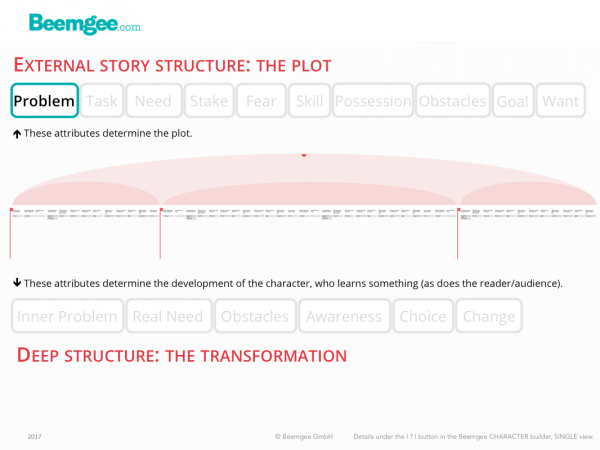
The external problem of the main character triggers the plot. It is shown to the audience as the incident which eventually incites the protagonist to action. 

In some genres this is easy to see. In crime or mystery fiction, the external problem is almost by definition the crime or mystery that the protagonist has to deal with. So at the beginning of the story there is a murder, the detective is called in to investigate and solve the crime. The case of the murder is the external problem – it has nothing to do with the protagonist until the call to investigate it. In adventure or quest stories the external problem is usually the task of attainment of a precious thing (the Lost Ark, the Maltese Falcon), or the destruction of a dangerous one (the dragon, the ring in Lord Of The Rings). So the external problem arises when the protagonist is assigned a mission to find, protect, accompany, destroy, etc. something or someone either valuable or dangerous.

By suggesting the story question, the external problem on the level of plot sets up what the story is about. Will Indiana Jones find the Lost Ark? Will Sam Spade retrieve the Maltese Falcon? Will Marty make it Back to the Future?

While in other genres the external problem may not be as sensational or spectacular, there is nonetheless likely to be one. Meeting a potential partner might be the external problem in a love story.


We are defining the external problem per character, so it is not completely synonymous with the term inciting incident, which is usually used to pinpoint one particular scene in the narrative. It is quite possible, even likely, that different events present the external problems of various characters. For example, in The Godfather, the external problem for the Godfather is conveyed in the scene of his meeting with Sallozzo. For Tom, the moment comes when he is kidnapped. For Sonny it is when he gets the phone call about the shooting. For Michael it is when Kay points out the headline in the newspaper to him. 


Wanting the Solution

The external problem creates a desire in the character, i.e. to solve the problem. That’s why it is necessary as a component of story: to provide the reason for the story to begin now. The external problem acts as trigger, or starting gun, for each character. In many cases, the concept of external problem is directly related to the scene that is often called inciting incident. In this sense, the external problem is the prime mover of the plot of the story. It is the first domino that falls, the first cause of a string of events that affect the character.

That plots are built around the external problem is not new, by any means. It’s classical. Odysseus’ problem is that he is lost. Oedipus’ problem is the plague, which he learns was sent by the gods because of an unsolved murder.

The external problem causes the character’s motivation, i.e. to solve the problem. The protagonist wants a situation which is freed of the problem, which typically means reaching a goal. Attaining the goal will, in the character’s mind, solve the problem. In many stories, the goal is reached near the end of the story. What happens at the goal is the story’s climax.

But in some stories, the goal is reached much sooner, perhaps round about half way through. Then the story becomes about the consequences for the character of attaining the situation he or she wanted. This can mean that the external problem is replaced by another, often its opposite. Stories that work like this are said to have a midpoint or peripeteia. Sophocles’ Oedipus Rex works like this, so does Nabokov’s Lolita, or the oldest of the Star Wars movies.

However soon the protagonist’s problem is solved, each major character must have his or her own problem in order to create conflicting interests. In some cases, the problem and resulting want may be the same for several or all characters. Almost everyone in Raiders Of The Lost Ark wants the Ark, in the same way that the Maltese Falcon is the object of desire for each person in that book and film. Whether the characters have the same or different problems, the most important thing in the story is that the wants resulting from their respective problems result in conflicts of interest between the characters.

Why? Because conflict is a driving force of stories. Where does it come from? It boils down to the external problems the characters have. That’s why it is important for the author to be aware of each major character’s external problem at an early stage in the creative process of thinking up a story.

Character Sketch Template: How to Sketch Characters in Scrivener

I’m currently taking a writing and blogging sabbatical due to family health issues. For now, I’ll repost selected articles from my Fiction Writing School.

Here is the link to this article.

Character Sketch Template: How to Sketch Characters in Scrivener

by Matt Herron | 16 Comments

Are you looking for a character sketch template that will make your character building easier and more fun?

Scrivener has an amazing character sketch  tool that you can use to develop better characters.

character sketch template

Pin

In this article, you’ll learn how to sketch a fictional character and cast that will make you proud. Read on for a hands-on walkthrough of how to use Scrivener to create characters, from character profiles to their physical descriptions, and then some.

Characters Can Make Your Book: Here’s How to Create Them

Nothing is born in a vacuum. Characters don’t emerge fully formed. Character development is a process of getting to know your characters and working to make them come to life. They’re developed through character sketches, through the writing process itself, through lots feedback, and diligent revision.

When you’re going through the character development process, it’s helpful to have some tools at your disposal, and one of the most helpful tools for writers, especially when it comes to working on your characters, is Scrivener.

What is a character sketch, what is Scrivener, and how can it help you create compelling characters? Read on to learn more!

Full disclosure: some of the links to Scrivener below are affiliate links. That means if you order Scrivener and use it to write your books, I will earn a few dollars to help me keep writing. That being said, this didn’t affect my opinion of Scrivener (which I personally use in my own writing).

What is Scrivener?

Scrivener is a writing program and word processor designed specifically by writers, for writers. If you’re working on a book, I’ve found that Microsoft Word and other word processors just don’t cut it.

Having a tool like Scrivener that’s designed specifically for books can save you hundreds of hours and help you write a better book.

If you’re interested in learning more about Scrivener, read my Scrivener review here.

Or you’re ready to purchase scrivener now, you can get the Mac, PC, and iOS version all here:Download Scrivener here »

What Is a Character Sketch?

Think of a character sketch as the rough draft of your character. It’s a place where you can freely experiment, where you can tell yourself (or your writing partner) who your characters are, how they look, and where they come from.

You can type out their whole backstory, or just the parts of the timeline that inform your character’s identity. Their inner and external conflicts will be crucial to your story, so be sure to include those, too.

Most importantly, use character sketches as a tool to discover your characters’ key motivations and goals, because those are the engine that drives your story forward.

Creating characters has never been easier with Scrivener’s character sketch template sheets. Learn how to use them in this article.

Tweet this

Tweet

How to Use Template Sheets in Scrivener

Template Sgeets

Scrivener has a template sheets function that makes building out character sketches easy. If you started using one of their document templates, like the novel template that comes with Scrivener, there should already be a Template Sheets folder in the your project document that looks like the screenshot to the right.

If not, you can make a Template Sheets folder by creating a new folder in the Binder (the left hand column), and then from the top menu selecting Project > Set Selection as Templates Folder.

Once you have the folder, you can add as many templates as you like!

Sidenote: I reference Scrivener’s features and include screenshots of the software, but you can still use these methods without Scrivener. Simply create a separate text file for each character and keep them in a folder named “My Story – Character Sketches.” If you’re interested in Scrivener, Joe reviewed it here.

Visualize Your Characters Using Scrivener’s Corkboard

Now that you have your template sheets folder, you can generate character sketches by creating new files from the template sheets you have.

Fortunately, we live in a digital age and Scrivener’s digital corkboard interface gives us the power of notecards in a way that allows us to drill down from the card view into the character sketch itself.

The notecard system is well documented and has been made famous by a dead authora living authorWriter’s Digest, and teenagers writing research papers everywhere. Scrivener simply digitizes this time-tested method.

In the screenshot below, you’ll see that I have several characters in view. They’ve all been generated from the Character Sketch template sheet we created previously.

What’s great about this is that you have a card for each character, with optional visuals or text description.

All the characters

Pin

I go for visuals out of the gate, as it helps me ground my character in an image. Having a visual on hand makes writing about them easier, at first, because the photos jog my imagination. Once I’m really entrenched and know my characters (i.e. about twenty-five percent of the way through the first draft), I don’t need to look at the visuals at all.

You’ll notice that some characters don’t have photos—I added those characters during the story and didn’t bother going back to find photos for them.

That’s okay. One of the most important things to remember about your planning or pre-production phase (to borrow a film term), including character sketches, is that none of it is set in stone.

Your story will evolve, and so will your characters.

For the images I’ve picked a few actors and photos I found on Google Images.

To add a photo to a Character Sketch in Scrivener, click on the character’s card, open the Notes column on the right hand side, and drag your image into the image area where the instructions are:

Image Drop

Pin

To insert a photo inline with the text, first click where you want the photo, and then go to  Edit > Insert > Image from File…

Individual Character Sketches

Here’s a screenshot of an individual sketch of one of my characters:

Character Sketch - Scriv Default

Pin

This sketch was created using the character sketch template that comes with Scrivener. I’ve since abandoned Scrivener’s defaults in favor of my own compilation, which follows.

An Alternative Character Sketch Template

As you learn more about character sketches, you’ll probably want to customize your character sketch template and make it your own.

Personally, I find Scrivener’s default sketch sheets superficial. When sketching characters, I like less structure, and less prescriptive fields around the character’s physical appearance and personality.

If you’re just starting out and you don’t have a character sketch template, here’s one I put together based on my own experimentation.

This is what my character sketch template looks like in Scrivener:

Mr. Miyagi

Pin

And here’s the full text, which you can feel free to use or modify as you see fit:

[photo]

FULL NAME

One Sentence Synopsis This character in a single sentence.

Summary This is a paragraph summary of your character. Include physical attributes, habits, mannerism. Sketch your character.

Motivations & Goals What do they want?

Conflicts What makes them human?

Narrative What happens to them in the story? What else is important?

Why Character Sketches Work

There are practical reasons to do character sketches. For one, developing characters is a process. Paving the way with character sketches, along with setting sketches in the following article, are a great way to give the gel of the story time and space to set.

Yes, they’re extra work, and yes they can be difficult. But that’s part of the process.

If you feel like you really know the character and can write the story, run through this checklist to make sure before you move on:

  • What is your character’s primary motivation? What are their hopes and dreams?
  • How does your character change in the course of the story?
  • What does your character look like? How do they act around their parents? Their friends? Their boss?
  • How does your character act under stress?
  • What is your character’s weakness, their kryptonite?
  • What will your character die for?
  • What is your character’s biggest hypocrisy?

If you can answer all of these questions with confidence, congratulations, you’re probably ready for setting sketches, which we’ll cover next week.

Ready to Develop Your Characters With Scrivener?

Now that you’ve learned how to do character development in Scrivener, put it to use!

You can get the Mac, PC, and iOS version all here and start creating your character sketches now:Download Scrivener here »

Or if you’re still wondering if Scrivener can help you finish your books, read my Scrivener review here.

Then, continue to the practice section for a writing exercise to help you get started.

Does your method for sketching characters line up with how I do things? What are your tricks for helping bring your characters to life? Share in the comments section.

PRACTICE

Here’s a creative writing prompt to help you get started with character sketches.

Set aside a block of time (no more than thirty minutes to one hour) to sketch some characters in your latest work of fiction, whether it’s a short story, a novel, or a ten book series.

No characters coming to mind? Try sketching some of these characters and see how it goes!

  • A disciplined, medal-winning Jui Jitsu practitioner whose sister just died
  • A mother of three on a Thursday morning
  • A soldier who has returned home after being a prisoner of war in Iraq
  • A journalist covering the derailing of a local train that killed four passengers

Naming them is just the beginning. Don’t be afraid to get personal with the characters you create. When you’re finished, share a few paragraphs about one of your characters in the practice box below. We’d love to see who you come up with!

If you’re up for it, share your feedback with another writer in the comments.

Happy writing!

Enter your practice here:

Enter your practice here

0 of 2000 max characters

View Practice (0 practices) About the author Related Posts

Matt Herron

Website

Matt Herron is the author of Scrivener Superpowers: How to Use Cutting-Edge Software to Energize Your Creative Writing Practice. He has a degree in English Literature, a dog named Elsa, and an adrenaline addiction sated by rock climbing and travel. The best way to get in touch with him is on Twitter @mgherron.

Emotion and The Setting: A Powerful Story Combo

I’m currently taking a writing and blogging sabbatical due to family health issues. For now, I’ll repost selected articles from my Fiction Writing School.

Here is the link to this article.

Emotion and The Setting: A Powerful Story Combo

By Guest Angela Ackerman

An interesting thing happens when setting and character come together, something writers don’t fully realize, or if they do, may not use to its full advantage: combined with intent, these two elements produce emotion. 

What do I mean by that? Well, think about us in the real world. Are there places you choose to vacation again and again? Is there a specific route you like to walk the dog, or areas in the city you enjoy visiting? Do you have a favorite restaurant, room in the house, coffeeshop, or park to sit in? I’m betting you do. Spaces we return to are special in some way, causing us to experience positive emotions. We may enjoy them for their beautiful scenery, their energy or solitude, because they remind us of the comforts of home, or some other meaningful reason. 

Just as we gravitate to places that make us feel good or safe, we also make emotional decisions about locations to avoid: that dark ally shortcut, the friend’s car that smells like spoiled milk, the high school football field where we were humiliated in front of the entire senior class. These spaces make us feel unsafe, vulnerable, or unhappy.

Our characters are just like us, so they will also have a catalog of places that hold personal meaning, good and bad.

The difference between the real world and the fictional one? Rather than shield our characters from uncomfortable emotions, we want to encourage them.

I know, it sounds a bit sadistic but exposing them to settings that trigger a range of emotions, some of which they desperately want to avoid, will not only produce conflict (a necessary ingredient in story), it will help to reveal their hidden layers. 

Beneath the surface of any character is a dark underside: insecurities, fears, and pain caused by negative past experiences and unresolved emotional trauma. This baggage is costly to lug around, causing unhappiness and steering the character’s life off course. This is usually how readers find them at the start of a story: incomplete, adrift, and hurting. And, if the writer has chosen a change arc for the character, it’s even more important to pull this pain to the surface where it can finally be acknowledged and dealt with. Only then can the character move forward toward happiness and hope, fulfilling the change arc and achieving their goal. 

Positive and negative, emotions are the lifeblood of a story. The setting we choose for each scene is a vehicle to bring out a wider range of emotions, including those that provide a window for readers to see inside the character and the struggle going on within. Here are three ways you can deliberately use the setting to bring out your character’s deeper emotions. 

Choose Specific Settings for a Reason

With each scene, think about the actions that will unfold and what each character’s emotional state will be. If you can, find a setting location that will amplify these emotions, perhaps by choosing one that holds personal meaning (good or bad). For example, what location would be a better choice for revealing a parent’s betrayal to her adult son: in the car on the way to the airport at the end of a visit, or at the playground where the character and his mother would come every day after school? The setting itself can trigger powerful emotions in the right circumstance.

Provide Obstacles

If your character is under so much pressure they’re struggling to function or they are on their final frayed nerve, use the setting to plant a natural obstacle in their path (a nosy security guard, a locked door, a car that dies halfway to their destination) that pushes them past their limits to cope. This new difficulty will trigger powerful, raw emotions whether they break under the strain, or find inner strength to prevail. 

Resurrect a Ghost

When it comes to the painful past, characters want it to stay there: in the past. So instead, we writers should dig around in that old suitcase of pain and resurrect a ghost: a person, thing, situation, or experience that will act as an echo of that past trauma. It might be a setting itself, or something that can be inserted into the setting. Maybe the character’s alcoholic dad shows up unannounced to her child’s graduation party at a restaurant, or a couple planning a honeymoon trip arrive at their appointment to discover the travel agent is a bitter ex-girlfriend. Perhaps the character is ill and is forced to pull into a roadside stop, a place she normally avoids at all costs as she was carjacked at one once.

What does the character feel in this moment? What will they do? Choose settings and setting elements specifically to awaken complicated emotions and possibly force them to deal with something from the past. 

Becca and I love to think about how we can push description to work harder in our stories. The possibilities are endless, so we encourage you to always think deeper, combining elements and experimenting with ways to increase tension, personalize story moments, and especially to deepen emotion. 

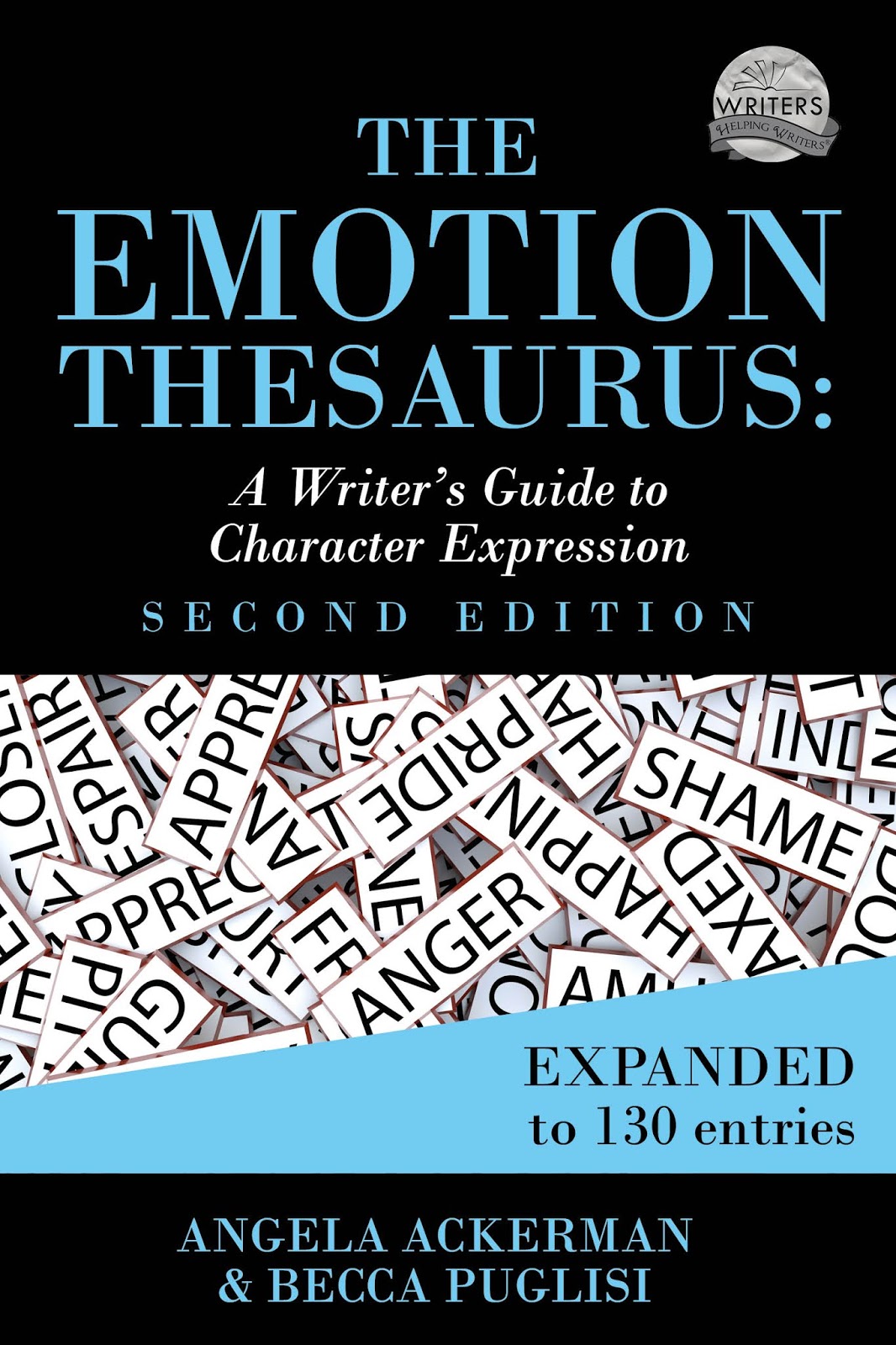
If you ever need help, visit our website or check out our books. And if you happen to be a fan of our work, you might be interested to know there is now a Second Edition of The Emotion Thesaurus. We’ve added 55 new emotions to the original 75 and have made a lot of other improvements. We also have a free webinar on Using Emotion to Wow Readers that we’ve made available until the end of February. If this is an area of struggle, visit this post to grab the link!

Angela Ackerman is a writing coach, international speaker, and co-author of the bestselling book, The Emotion Thesaurus: A Writer’s Guide to Character Expression, (now an expanded 2nd edition!) as well as six others. Her books are available in six languages, are sourced by US universities, and are used by novelists, screenwriters, editors, and psychologists around the world. Angela is also the co-founder of the popular site Writers Helping Writers, as well as One Stop for Writers, an innovative online library built to help writers elevate their storytelling. Find her on FacebookTwitter, and Instagram.

How to Know When You’re a Successful Author?

I’m currently taking a writing and blogging sabbatical due to family health issues. For now, I’ll repost selected articles from my Fiction Writing School.

Here is the link to this article.

How to Know When You’re a Successful Author?

by K.M. Weiland

How to know when you’re a successful author? I suppose almost every writer asks this at some point—and very likely at frequent points. There are multiple ways to define and measure the answer. For many of us, the answer seems come down to commercial success. And yet because commercial success is sometimes elusive, this metric often seems at least vaguely unsatisfactory.

Recently, Wordplayer Rhonda Denise Johnson emailed me the following thoughts on the topic:

If you haven’t already, would you be interested in doing an article on how to know when you’re a successful author? What is the sine qua non of a professional success? When you land a deal with a big publishing house? So, should indie authors count themselves out? When your aunt Harriet stops asking you when you’re going to get a job? To paraphrase a writer is not without honor except in his own house.

I sometimes feel discouraged because I’ve been disappointed by the quality of writing in one too many so-called best sellers. It leaves me feeling like excellence doesn’t matter in this industry as long as your books sell. What we do when we craft a novel seems too precious to be measured in dollars and cents like merchandise, vacuum cleaners, and cheeseburgers. How then should an author measure herself, and how does he know when he’s “made it” as an author?

Rhonda’s email reminded me that I did, in fact, write a post on this topic: How to Tell if Your Book Is a Success. I wrote it at a time when my own career was relatively young and when I was earnestly asking the same questions of myself. My personal take on the subject remains pretty much the same as when I wrote that post, but since it’s been ten years (!), I decided it might be worth revisiting the topic, for myself as much as anyone.

Why Do We Feel It’s So Important to Be a Successful Author?

Taken at face value, the question of “how to know when you’re a successful author?” offers some pretty basic and obvious answers:

  • When you’re published.
  • When you’re a bestseller.
  • When you make at least a comfortable amount of money.
  • When you’re famous.
  • When you achieve critical acclaim.

However, as soon as we drill down to any depth, what is also obvious is that all these answers speak to entirely different experiences within the publishing journey. For instance, just because you’re published does not mean your book will sell, provide you a living, or be widely read. And as Rhonda pointed out, just because you’re a widely-read millionaire does not mean you will necessarily achieve universal critical acclaim.

Right away, we can see that perhaps one of the reasons “how to know if you’re a successful author” is such an unceasing question for writers is that there really isn’t a solid answer. That said, the one thing that all these answers have in common is that they are pointing to the experience of writing something that finds external validation. At first glance, we might think this simply points to the need for ego gratification, but I think if we go down yet another layer, we find that what writers are really seeking from these forms of external validation is simply a sense that what we’re doing has meaning.

We all write for many different reasons. But mostly I’d venture that, under it all, we write for two reasons:

1. To share ourselves.

2. To impact others.

Both of these objectives, however unconsciously measured, are foundational to the human’s need to feel that who we are and what we do has meaning—that our time in this life matters in some way. But both of these are highly abstract and thus difficult to measure. You may write something that changes my entire life, but you’ll probably never know it. In fact, I may not even know it. I may read your words, internalize them unconsciously, and never realize they were the fulcrum on which my future just turned. But it doesn’t matter if either one of us fully realizes what just happened. What you wrote—who you are—just mattered. I’d say that makes you a successful author. And yet… you may never know it. Certainly, you can’t measure it.

And so, we usually turn to more concrete measures of success, as defined by whether others are willing to read our work, publish our work, pay us for our work, and praise us for our work.

These are all entirely legit metrics of success, particularly if our abstract motivations are also driving eminently practical goals such as making or supplementing a living. But if we focus our definitions of what it means to be a successful author entirely on practical metrics, it can be easy to discount our true and deeply personal definitions of success.

My Evolving Definitions of What It Means to Me to Be a Successful Author

Outlining Your Novel: Map Your Way to Success by K.M. Weiland

Outlining Your Novel (Amazon affiliate link)

When I wrote my original article, pondering what it meant to be a successful author, I was about four years into the biz of being an indie author. I’d published two novels, neither of which had gone gangbusters, and my first writing-craft book, Outlining Your Novel, which had done well. It was a time when I was beginning to find the culmination of some of the more practical definitions of success, while also coming to terms with areas in which my career was not looking like the poster version. I was just starting to make enough money to be able to write full-time, and yet indie authors were still largely viewed as “less than.” Particularly since I wanted to be a full-time novelist, not a full-time non-fic writer, I sometimes felt conflicted.

Time went on, and the website continued to grow. I published more novels that met with only moderate sales and more writing guides that continued to sell solidly and allow me to launch into being a full-time writer. By most practical metrics, I could view myself, at least as an entrepreneur and non-fiction writer, as successful.  I had accomplished many my goals, and yet the “success” finish line always seemed out of reach. I began to realize that continuing to measure my success by outside metrics was a never-ending treadmill. There were always better sales rankings to achieve, a higher income to chase, more awards to seek. Wherever “there” was, I’d never reach it. There was always more external validation to seek.

In short, my experience has been that defining success is a slippery thing. Even if you reach the baseline of what popular consensus agrees is “successful,” this doesn’t automatically mean you will have found either personal or perpetual success.

So how do I define a successful author—both for myself and others?

Certainly I factor in external metrics. By most commonly agreed-upon definitions, success does entail publication and decent sales. If I see an author who checks those boxes, there’s a little “success” light that goes on in the back of my brain. But the light also goes on when I read a little-known indie work or an unpublished novel and it’s awesome. And that light also goes on when I hear from writers who by their own definition have reached success, whether this means finishing a first draft, self-publishing, or even simply writing something for themselves that helped them find personal healing or happiness.

In short, I believe the single most important metric in knowing whether or not you’re a successful author is first and foremost getting super-clear on your definition of “success.”

How to Define Your Own Success as an Author

Why are you writing? It’s a question with a multiplicity of answers. But if you can dig down to the root, you’ll probably discover the essence of your own definition of success.

Most of us write primarily because it scratches a deep-down itch. But you are also likely writing because you want external validation.

For you, maybe it’s enough just hearing that a reader had fun reading your story or was moved by it. Or maybe, for any number of reasons, you want writing to be a lifestyle—and you need it to pay for itself. Or maybe you just want to feel your own joy and excitement about your story mirrored back to you in excited reviews.

Whatever the case, try to get as specific about your reasons as possible. Then create a personal metric that can act as both your mission statement and your measuring rod as you journey forth to seek success. Most likely, you will find that you have many layers of metrics, some of which will evolve with you as time passes. Examine not just your own goals (i.e., finish the first draft, get published, get 10 reviews, sell 1,000 copies), but also how you define other writers as successful. In your view, are only the super-famous such as Stephen King successful? Are only books about serious topics successful? Are only traditionally-published authors successful?

There are no wrong answers. There are only your answers. For instance, if you realize you need the stamp of a traditional publisher in order to feel successful, that’s probably a sign that, at least at this point, you should steer clear of publishing your book independently. If you realize you feel a certain dollar sign is your definition of success, then you can distill your goals to help you leverage your marketing. If your primary reason for writing is simply self-expression, this may help you feel successful even if external validation is lacking.

For me, two realizations are paramount in helping me define my own success.

One is that success is a moving target. At one point, selling 1,000 books seems like success, but after you’ve reached that, the definition may change into selling 10,000 books, 100,000, even 1,000,0000 or more.

Second, “success” is only the point insofar as it offers a reward. That reward may be simply the sheer practicality of keeping the electricity turned on. Or it may be the need to prove something to yourself—that you can write a book, publish a book, sell a book, share a book that matters to people. When whatever it is ceases to offer personal validation, it can no longer be used as a benchmark.

The pitfall to be avoided is identifying ourselves with any one definition of success—and especially if that definition comes from someone other than ourselves. Success, in the end, doesn’t matter. It comes and it goes. Only a few of the authors you now see ranking on Amazon will be remembered past their own lifetimes. To use metrics such as sales, reviews, etc., to calibrate our goals is one thing, but to define our identities as “successful” or “unsuccessful” based on these things misses the true heart of what it means to live a meaningful life as an author.

Character Voice: How to Actually Listen to Your Protagonist

I’m currently taking a writing and blogging sabbatical due to family health issues. For now, I’ll repost selected articles from my Fiction Writing School.

Here’s the link to this article.

Today’s guest post is by Sarah Bradley. Sarah is a freelance writer, creative writing instructor, and the founder of Pen to Paper Creative Writing Services. You can find her offering instruction for beginning writers on the Pen to Paper blog, posting motivational tips and resources on Facebook, and sharing the inspiration behind her own creative process on Instagram (@pentopaperwriting).

Anyone who has dipped their toes into the world of writing novels knows how crucial character development is to telling strong stories. Plotsetting, and dialogue are necessary building blocks of fiction, but your characters are the foundation that your story is resting on—without dynamic characters, no amount of plot twists, fantastical settings, or authentic dialogue will magically transform into a novel that people want to read.

Character Voice: How to Actually Listen to Your Protagonist

If the success of your novel is in fact riding on the strength of your characters, you need to know who they are, inside and out. More importantly, you need a character with a strong voice, one that can reveal the emotional depths of your story to the reader. That character voice will support your novel—and without it, your story will crumble.

That’s a lot of pressure, for both you and your character. How do you develop a compelling protagonist who can carry your entire story on his or her imaginary back?

The Dizzying World of Character Sketching

When I first started putting my ideas for a novel onto paper, the plot points and setting fell into place somewhat easily. What was more elusive was a sense of familiarity with my protagonist, a young girl who was still grieving a deeply traumatic loss from her childhood. Aside from still being fuzzy on the details of her physical appearance and personality, I felt like I didn’t really know her.

As a creative writing instructor, I knew what my options were. I counsel students all the time on the various writing prompts and exercises that exist to help writers learn more about their characters.

Fill out a character sketch outline! Take your character out to lunch! Put her in an unfamiliar location or time period! Force him to do something normal, like change a tire or go grocery shopping!

The intent behind many of these tactics is meaningful: you can’t really bring a character to life on the page if you have no clear vision of him or her in your head.

But I worried that spending time working out this character’s full rap sheet of qualities wasn’t going to get me any closer to the one thing that was going to help me write this novel: developing her voice.

I was planning on writing a first-person narrative. As a young girl, this character’s perspective on the events of the novel was just as valuable as the events themselves. I didn’t want to assign her a bevy of random character traits. I wanted to hear her.

Let Them Tell You Who They Are

I decided to take a different approach. I tried to imagine myself putting on this character’s persona, the way one might slip into a stranger’s coat or pair of shoes. Then I blocked out all of my preconceived notions about what she looked like, how she behaved, and what she might want.

I forced myself to be quiet and listen to her. Who was she, in her own words? What did she have to say about herself? How did she view the events that had shaped her childhood? Was she funny or serious? Was she self-aware, or innocently naive?

What did she want? Why? How did she plan to get it?

An hour later, I was stunned by what had come out of this simple exercise. This character told me things about herself that I would have never imposed upon her in a traditional character sketching exercise. She was determined. She was strong. But she was also scared, and her fears were constantly threatening to cripple her.

For the first time since the idea for this novel came into existence, I finally knew who this girl really was, because she had told me herself.

Be Quiet and Listen: The Character Monologue Method

Without realizing it, what I had done was write a character monologue. In an effort to simply hear my character speak in her own voice, I had harkened back to the days of Shakespeare and written her a monologue summarizing who she is at the imagined start of my novel.

It was the single best thing I’ve done to kickstart my writing process. Prior to completing the monologue, I was stalling. I had a loose plan for the novel, but where and how did I really get started?

After the monologue, those fears (nearly!) went away. I was reinvigorated—this character was someone I cared deeply about. Her story was worth telling. It was the exact exercise I needed to find my motivation for writing.

Was this a character who could carry my story on her back? Absolutely.

Embrace Your Inner Shakespeare

Maybe you have a story, but no protagonist. Maybe you have a protagonist, but she is as unfamiliar to you as the waitress who served your lunch yesterday. Maybe you think you know who your protagonist is, but you doubt his ability to effectively convey the story you want to tell.

Whatever your scenario is, writing a character monologue could be the answer. It worked well for me as an initiation exercise, but you can create one at any point during your writing process.

Here’s how:

  1. You have to be quiet. This exercise is about giving your character a voice, an opportunity to be heard. Don’t tell him who he is. Let him tell you.
  2. A little bit of play-acting goes a long way. Put yourself in your character’s shoes, but think beyond simply writing in first person. Remember that a monologue is considered dialogue, so this is about more than uncovering your character’s personality. It’s about what she has to say.
  3. Assume that nothing you write will make it into your novel. Just like every other character sketch exercise, this is a chance to write without expectations. Don’t filter or edit or try to write something useful that you can transpose into your novel later. Give your character permission to tell you things he never tells anyone.

When you give your characters the freedom to speak, you might be surprised at what they reveal about themselves. If given the chance, what would your protagonist decide to tell you?

How to Write a Book When You Have No Idea What You’re Doing

I’m currently taking a writing and blogging sabbatical due to family health issues. For now, I’ll repost selected articles from my Fiction Writing School.

Here’s the link to this article.

How to Write a Book When You Have No Idea What You’re Doing

by Angela Ackerman

I want to write a book.

You remember when this big idea first hit, right? Maybe you were browsing for books, waiting for an author’s autograph, or sitting in stupefied awe after finishing a great novel. The idea took root and then, bam, you’re rushing to a stationary store to gear up, buying all the notebooks, pens, sticky notes, and highlighters you can carry. You browse online for writerly things—a cute laptop sticker or a mug that says, “Writer at Work.” The moment that mug arrives, you’re filling it with something or other, setting it next to your stack of notebooks, and pulling the keyboard closer, because IT’S TIME.

You open a new document. Your hands flutter to the keyboard. This is it—the magic is about to happen.

Onscreen, the cursor blinks. And blinks.

Boy, the page is so white. How did you not notice before? And that infernal flickering cursor… is it just you, or does it seem kind of judge-y?

And that’s when you realize your big idea has a second part to it:

I want to write a book…but I have no idea where to start.

Thankfully, this truth, while inconvenient, doesn’t have to stop any of us from writing. It may seem daunting at first, and doubts might try to sway us (What was I thinking? I can’t do this!), but I’m here to tell you that, yes, you can write a book.

7 Tips for How to Write a Book When You Have No Idea What You’re Doing

Not knowing where to start is a problem countless writers before us have faced and figured out, so if you are feeling a bit lost when it comes to your big dream, these seven things can help you move forward and better yet, jumpstart your writing career.

1. Write

Sure, this seems obvious, but starting can be paralyzing. We worry about committing our ideas to the page because what if they resemble some four-year-old’s Cheerios-and-glue “masterpiece”? Well, guess what? They might, and that’s okay. Great storytelling takes time, and if that didn’t put off Stephen King, Susanne Collins, or Nora Roberts, it shouldn’t stop us, either.

Outlining Your Novel Workbook software logo 228 250

Outlining Your Novel Workbook software

To begin, try dreamzoning. Jot down your ideas, or try outlining the story you envision using one of these methods or this outlining software. Or start with something small, like a short story or scene. At the start, our goal should be getting comfortable with putting words on the page and have fun, not pressuring ourselves into penning the next Game of Thrones.

2. Read and Reread

Reading is so enjoyable we tend to forget how each story is a treasure trove of education on what makes a book good, bad, or off-the-charts great. So read widely, thinking about what makes each story compelling. Look for characters that stand out, story worlds that seem so real you feel part of them, and plots that keep you flipping pages long into the night. Ask yourself questions:

  • What made certain characters larger than life?
  • Did their personalities, complex motives, or a truth they live by pull you to them?
  • What scenes and situations seemed the most real to you?

Studying where you fell under the storyteller’s spell can help you see how you can do the same for your readers.

3. Join a Writing Group

One of the best things you can do at the start of this journey is find others on the writer’s path. A community of writers puts you in touch with those who have the same goal, meaning you can learn from and support one another. Plus, having creatives in your circle helps to keep you accountable, meaning your butt stays in the chair and words get written.

4. Collect a War Chest of Knowledge

We all start with some talent and skill, but to write well we need to train up. Visit Amazon to find writing books with high reviews so you can judge which might be most helpful for your development. Make note of the title or ISBN and order them at your favorite bookstore.

Another way to build your knowledge is by subscribing to helpful writing blogs. Bite-sized learning can be perfect for a time-crunched writer. I recommend exploring Katie’s sidebars because Helping Writers Become Authors is full of storyteller gold. Visit this page on outlining, and this one on story structure because understanding how a story works will help you get your first ideas off the ground so much easier. And the Story Structure Database is a great way to see all this plot and structure information in action.

You should also make learning about characters a priority because they drive the story. Getting to know who the people in our stories are and what makes them tick helps us understand what’s motivating them, and that makes writing their actions and behavior easier. Once you have a better handle on plot and character, turn to other storytelling elements and techniques. There’s so much great stuff to learn!

5. Take a Course or Workshop

Investing in guided or self-guided learning can also kickstart your progress. The community is packed with great teachers. Below are some good options, but first, if you belong to a writing organization, check to see if they offer members classes for free or at a discount.

6. Look For Step-by-Step Help

As any writer will tell you, the road from an idea to a publish-ready novel is a long one, and it’s easy to get lost along the way. It’s no fun when we don’t know what to write next, or we don’t know how to solve a problem in the story. And, if we get too frustrated or our writing stalls for too long, we might end up quitting. Having an expert offer guidance as you write can keep you on track.

Some writers like to partner with a writing coach so they get personal feedback and support as they go. If this is something you might like, here’s a list to start with. A benefit is that you’ll learn a lot about writing as you go, but depending on how long you need coaching for it can get a bit costly. So another option might be the Storyteller’s Roadmap at One Stop for Writers. This roadmap breaks the novel-writing process into three parts: planning, writing, and revising. It has step-by-step instructions on what to do as you go, and points you to tools, resources, and articles that will make the job easier.

The Storyteller’s Roadmap also has built-in solutions for the most common writing problems, so whether you need to overcome Writer’s Block, Impostor’s Syndrome, or stop new ideas from derailing your story, the Code Red section keeps you on track.

7.  Above All Else, Be Fearless

Starting a book can seem like a monumental undertaking, and sometimes with big dreams, we have the tendency to try and talk ourselves out of them. We fear failing, because we think that’s worse than never trying at all. If you feel the passion to write, don’t let fear stop you. The world needs great stories!

Related Posts

About Angela Ackerman

Angela Ackerman is a writing coach, international speaker, and co-author of The Emotion Thesaurus: A Writer’s Guide to Character Expression and its many sequels. Her bestselling writing guides are available in eight languages, and are sourced by U.S. universities, recommended by agents and editors, and are used by novelists, screenwriters, and psychologists around the world. To date, this book collection has sold 750,000 copies. Angela is also the co-founder of the popular site Writers Helping Writers as well as One Stop for Writers, a portal to game-changing tools and resources that enable writers to craft powerful fiction. Come nerd out about writing with her on FacebookTwitter, and Instagram.

Writing Better Dialogue

I’m currently taking a writing and blogging sabbatical due to family health issues. For now, I’ll repost selected articles from my Fiction Writing School.

January 12, 2021 by BECCA PUGLISI

Here’s the link to this article.

Have you ever read a book or watched a movie where the dialogue has been so beautifully written that you are in that moment, experiencing the character’s emotions and hanging on to their every word? Or you know exactly what the character is feeling or thinking because of their lack of dialogue? Great dialogue can make stories and characters shine and, in novels, it’s a valuable tool to break away from writing too much internal monologue and a wonderful way to show readers the relationships between your characters and reveal important information. 

Popular culture is full of memorable movie lines that are quoted the world over. See if you can figure out which movies the following lines are from (extra points if you can name the character!):

A/ Frankly my dear, I don’t give a damn. 

B/ Here’s looking at you, kid …

C/ Show me the money!

How did you do? A was Gone with the Wind, B Casablanca and C Jerry McGuire. It doesn’t matter if you didn’t know them (as we can’t see every movie ever made!) but chances are you’ve heard at least one. 

Screenwriters are masters of dialogue. They rarely have the opportunity to include a character’s innermost thoughts on the screen so they rely heavily on dialogue to drive the story forward, develop characters and convey a range of emotions. By studying the art of dialogue through reading screenplays and watching movies or TV shows, it will help you develop your own characters and stories.

There’s an array of movie and TV scripts available on the internet for you to read and I recommend you start with the screenplay of one of your favorite movies. I will add that screenplays available on the internet are not pirated, as screenwriters and film production companies often make them available for the public to read after a movie or TV show has been produced. 

When studying dialogue, here are some points for you to consider:

What Isn’t Said

Humans rarely say everything we’re thinking and feeling and neither should your characters. If we’re talking about something that scares us or we’re in danger of being found out or simply too embarrassed to talk about a subject, we change topics or do something that helps us avoid talking about something we don’t want. 

The Coen Brothers are brilliant at holding back dialogue that creates tension so that when a character does speak, we’re mesmerized by their words and really want to know what they have to say. The movie No Country for Old Men is a great example. 

No Two Characters Should Sound the Same

They way in which a character speaks is a culmination of their experience, upbringing and beliefs and no two people should ever sound the same. Listen to the way your friends and family talk. People have favorite words and expressions, some interrupt conversations while others sit quietly and wait until they’re asked a question or think a long time before saying how they feel. Others avoid talking about their emotions all together. Imagine a conversation between a teenager and someone in their mid-forties. They’re likely to use different idioms and expressions the other may not understand.

Look at each of your characters and figure out what kind of person they are. Are they a leader, follower, questioner, peacemaker or a troublemaker? How would this be reflected in the way they speak? Their traits will greatly influence their conversations with others. 

Read the Dialogue Out Loud

The best way to discover if dialogue is working is to read it out loud. You can do it yourself or enlist a friend or family member to be the other character or you can use one of the many available reading programs that will read what’s on the page to you. Does the dialogue sound natural or stilted? Are they using the other character’s name too much in the dialogue (a mistake nearly every writer does!)? Are they too wordy? Remember, most conversations between people are short and simple. Most of us don’t use big words and opt for the simpler version to get our message across. We also don’t speak for great lengths of time without being interrupted and neither should your character. 

Don’t Tell Us Something We Already Know

If an event has happened the reader has been privy to, we don’t need our characters to relate the same event to another character. It could be briefly referenced in a way such as “Like what happened last Thursday” and we’ll instantly know what the character is talking about. If you have information to give the reader or another character, do so in an organic way, just like you would inform a friend in real life. 

Be a Screenwriter for a Day

Try writing an entire scene only with dialogue. Then read through and see how the conversation unfolds. Does it sound realistic? Does it flow like a conversation between real people would? You may find this makes it easier to pinpoint the areas of dialogue that need addressing. Of course, once you’re happy with the dialogue you can add in the inner thoughts and descriptions like you would in the rest of your manuscript. 

Get Creative!

There’s a classic scene in Before Sunrise where the two main characters manage to convey how they feel in dialogue but in a unique way. I won’t elaborate here, as you can watch it unfold in the video below. Are there any ways you can creatively use dialogue in your scenes? 

One of the best screenwriters of our time is Aaron Sorkin. He’s written The West WingSteve JobsThe Social Network and A Few Good Men among other TV shows and movies. He’s a master at dialogue and I highly recommend you read at least one of his screenplays. The website Script Slug gives you access to scripts he has written. You can find it here: https://www.scriptslug.com/scripts/writer/aaron-sorkin

Learning how to write effective dialogue can be one of the most interesting and fun aspects of the craft. What’s your favorite movie or TV show that has great dialogue? 

Alli Sinclair

Resident Writing Coach

Alli is an Australian multi-award winning and bestselling author whose fact-based fiction explores little-known historical events. Alli’s books have been voted into the Top 100 Australian novels of all time and when she’s not writing novels, Alli is working on international film and TV projects as a screenwriter and producer. 
 
Alli hosts the Writers at Sea cruise retreat for writers, presents writing workshops internationally, and volunteers as a role model for Books in Homes. Alli is an experienced manuscript assessor and loves to work with writers to help their manuscripts shine.
Website | Newsletter | Facebook | Twitter | Instagram | Goodreads

Share this:

Why Scripts Are Rejected: 10 Screenwriting Errors To Avoid

February 16, 2016

In “Agents”

Writing Backstory Through Dialogue

February 28, 2019

In “Backstory”

Talk Amongst Yourselves: Realistic Dialogue

Saturday was Date Night (woohoo!) and while we were out, I realized a few things. First, I recognized that while going out to eat pre-baby was merely fun, it’s now necessary to my sanity. Secondly, as nice as it was to eat someone else’s cooking, having a real conversation with…September 16, 2008

In “Characters”

Filed Under: CharactersDialogueResident Writing CoachVoiceWriting CraftWriting Lessons

About BECCA PUGLISI

Becca Puglisi is an international speaker, writing coach, and bestselling author of The Emotion Thesaurus and its sequels. Her books are available in five languages, are sourced by US universities, and are used by novelists, screenwriters, editors, and psychologists around the world. She is passionate about learning and sharing her knowledge with others through her Writers Helping Writers blog and via One Stop For Writers—a powerhouse online library created to help writers elevate their storytelling. You can find Becca online at both of these spots, as well as on Facebook and Twitter.

Deep Dive: Joseph Campbell’s “Hero’s Journey”

I’m currently taking a writing and blogging sabbatical due to family health issues. For now, I’ll repost selected articles from my Fiction Writing School.

Hannah Yang

Speculative Fiction Author

Published Aug 10, 2021

Joseph Campbell's Hero's Journey

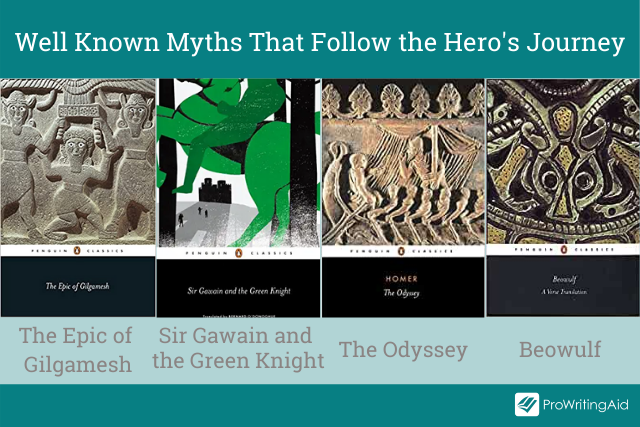
What do Star Wars, the legend of Prometheus, and the epic tale Beowulf have in common? They all follow the stages of Joseph Campbell’s hero’s journey.

Whether you’re working on a novel or a short story, you can use the hero’s journey to plot and outline your work. If you’re new to the hero’s journey, start with our guide to using the hero’s journey as the backbone for your story.

The hero’s journey is so commonly used that it’s become an important narrative structure for any writer to understand. However, the idea that the hero’s journey is truly a “monomyth” is actually a myth of its own.

Understanding this narrative structure is important if you want to use it in your stories—but it’s also important if you want to subvert it and create something new.

Read on to see an analysis into how Joseph Campbell came up with the concept of the hero’s journey, as well as the common counterarguments to this well-known literary archetype.

Contents:

  1. What Is Joseph Campbell’s Hero’s Journey?
  2. How Did Joseph Campbell Develop the Concept of the Hero’s Journey?
  3. What Are the Three Stages of the Hero’s Journey?
  4. What Were the Original Seventeen Steps of the Hero’s Journey?
  5. What Are the Counterarguments to Joseph Campbell’s Hero’s Journey?
  6. How Can You Use the Hero’s Journey in Your Writing Without Making Your Story Feel Formulaic?

What Is Joseph Campbell’s Hero’s Journey?

The hero’s journey is an archetypal narrative structure found in stories from cultures all over the world. Because it’s such a universal narrative structure, the hero’s journey is also known as the “monomyth”—the single great story with many variations.

The term was coined by Joseph Campbell, an American writer and editor who was fascinated by myths from various cultures and literary traditions. He noticed that many heroic stories follow the same narrative stages, no matter which culture or time period they come from.

Since 1949, countless stories have used the hero’s journey archetype, from George Lucas’s Star Wars to Disney’s The Lion King.

How Did Joseph Campbell Develop the Concept of the Hero’s Journey?

Joseph Campbell was born in New York City in 1904. As a child, he took frequent trips to Buffalo Bill’s Wild West exhibition and to the American Museum of Natural History, where he became fascinated by the Native American exhibits.

He began noticing parallels between stories from the Christian Bible and stories from Native American religions, which made him wonder whether other mythologies might also share those commonalities.

As an adult, Campbell studied English literature at Columbia University. He read and analyzed classic religious and mythological texts, such as those of the Buddha, Moses, Mohammed, Jesus, and countless others. Over time, he became convinced that mythologies worldwide have many similarities, and that they shared a universal narrative backbone—a “monomyth.”

Well know myths that use the hero's journey

Besides studying classic stories, Campbell also studied the work of early 20th-century analytical psychologists. In particular, he became fascinated with the work of Sigmund Freud and Carl Jung. This was crucial to the development of the hero’s journey, as the transformative aspect of the structure closely resembles Jung’s theory of death and rebirth.

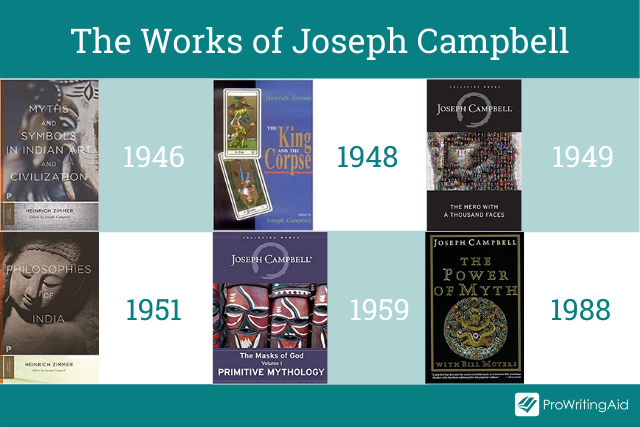
Campbell first coined the term “hero’s journey” in 1949, in his comparative mythology book The Hero with a Thousand Faces, which was later adapted into the TV show The Power of Myth. In this book, Campbell outlined the hero’s journey in three basic stages and seventeen detailed steps.

He wrote and edited many other texts on comparative mythology and storytelling. Aside from The Hero with a Thousand Faces (1949), his other major works include Myths and Symbols in Indian Art and Civilization (1946), The King and the Corpse (1948), Philosophies of India (1951), The Masks of God (1959–68), and The Power of Myth (1988).

Joseph's Campbell's works

What Are the Three Stages of the Hero’s Journey?

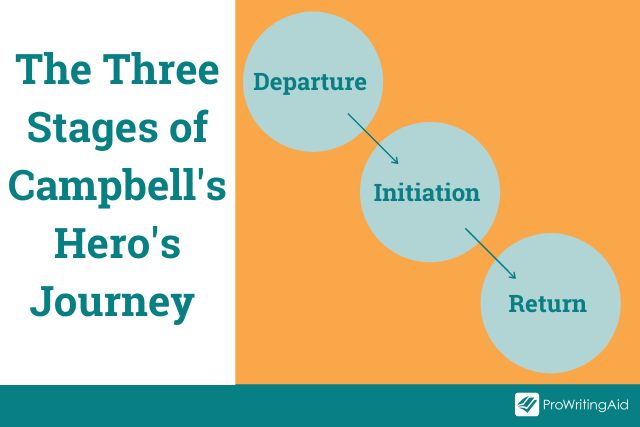
In its simplest form, the hero’s journey can be described in three stages: departure, initiation, and return.

  1. Departure: the hero leaves his home community to go on a quest.
  2. Initiation: the hero faces trials and tribulations until he achieves victory on his quest.
  3. Return: the hero goes home to his community with gifts and boons.

This is how Joseph Campbell summarized the hero’s journey in The Hero with a Thousand Faces (1949):

“A hero ventures forth from the world of common day into a region of supernatural wonder: fabulous forces are there encountered and a decisive victory is won: the hero comes back from this mysterious adventure with the power to bestow boons on his fellow man.”

Consider Star Wars, one of the most commonly cited examples of the hero’s journey.

In the departure stage, Luke Skywalker leaves his home planet of Tatooine with the goal of helping the rebellion defeat the Galactic Empire.

In the initiation stage, Luke undergoes various trials and tribulations on his heroic journey. He trains with Obi-Wan Kenobi to learn how to use the Force, rescues Princess Leia from the Death Star, and retrieves the Death Star plans and delivers them to the rebellion base. At last, he finally uses the Force to destroy the Death Star, fulfilling the purpose of his quest.

Finally, in the return stage, Luke returns to the rebellion base and wins a medal to commemorate his victory. He has helped his home world defeat the oppressive empire and gets to live as a hero.

The three stages of the hero's journey

What Were the Original Seventeen Steps of the Hero’s Journey?

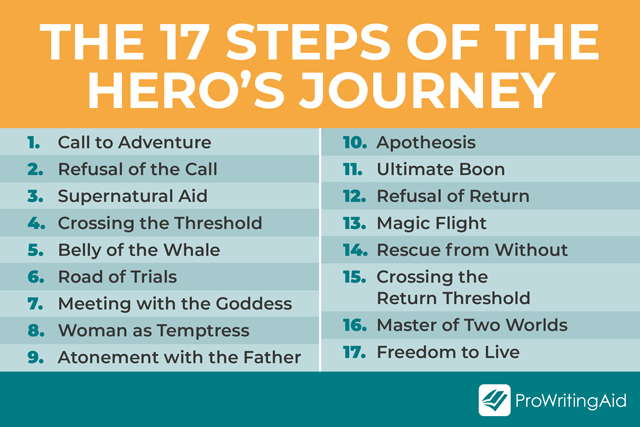
In The Hero with a Thousand Faces, Joseph Campbell outlined seventeen detailed steps of the hero’s journey.

These seventeen steps were later simplified to twelve steps by Christopher Vogler, a successful Hollywood consultant, in his book The Writer’s Journey (1992). These twelve steps are more commonly studied by writers today, since they’re easier to learn and remember than Campbell’s seventeen steps.

A grammar guru, style editor, and writing mentor in one package.

Try it for free!

ProWritingAid

Here is Campbell’s original hero’s journey structure:

Stage 1: Departure

  1. Call to Adventure: The hero receives an invitation to go on a quest.
  2. Refusal of the Call: At first, the hero hesitates to accept the invitation, either because the journey is too dangerous, or because they have other obligations at home.
  3. Supernatural Aid: Someone the hero looks up to inspires them to accept the call to adventure, or gives them tools that will help them on their quest.
  4. Crossing the Threshold: The hero begins their quest and leaves the ordinary world and their everyday life.
  5. Belly of the Whale: The hero encounters the first real danger in their quest, and wonders whether or not to turn back—but ultimately pushes forward.

Stage 2: Initiation

  1. Road of Trials: The hero undergoes several trials and learns from their mistakes.
  2. Meeting With the Goddess: The hero meets a mentor figure or ally, who offers help or advice.
  3. Woman as Temptress: The hero encounters temptations that threaten to steer them away from their heroic journey, which they must nobly avoid.
  4. Atonement with the Father: The hero undergoes a personal metamorphosis by confronting an aspect of their own character that has been preventing them from achieving success, such as their own fear, greed, or self-doubt.
  5. Apotheosis: The hero transforms into a better person, and goes forward with new insight and clarity on what they must do to win.
  6. Ultimate Boon: The hero achieves victory in their quest.

Stage 3: Return

  1. Refusal of Return: At first, the hero is reluctant to go back to the familiar world after their exciting journey and transformation.
  2. Magic Flight: Even though the hero has achieved victory on their quest, they still face dangers as they try to return home.
  3. Rescue from Without: An outside ally or mentor helps guide the hero safely home.
  4. Crossing the Return Threshold: The hero returns to the familiar world, and tries to adjust to their old life.
  5. Master of Two Worlds: The hero finds a balance between their home life and the person they become on their quest.
  6. Freedom to Live: The hero gets used to their normal life and lives peacefully.
The 17 Steps of the Hero's Journey

What Are the Counterarguments to Joseph Campbell’s Hero’s Journey?

In the past seventy years, many writers and editors have criticized Joseph Campbell’s monomyth. After all, Campbell lived in a society that strongly valued heroic individualism, and his theories were a product of his time. Our society has evolved since 1949, but the hero’s journey archetype has failed to evolve with it. 

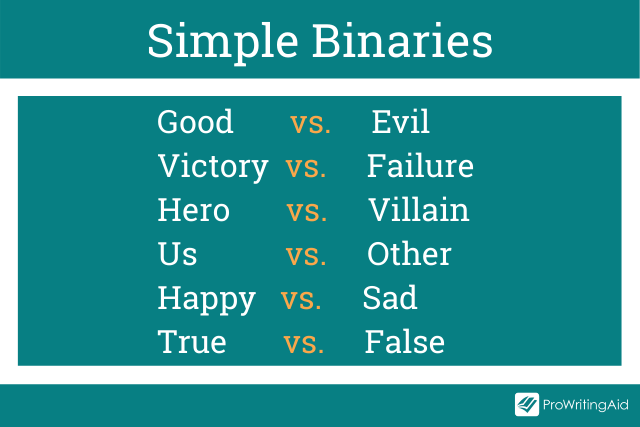
One of the most common criticisms of the hero’s journey is that it reduces the world to simple binaries: good and evil, victory and failure. If all stories followed the hero’s journey, writers wouldn’t be able to express a nuanced perspective of the world.

Simple binary examples

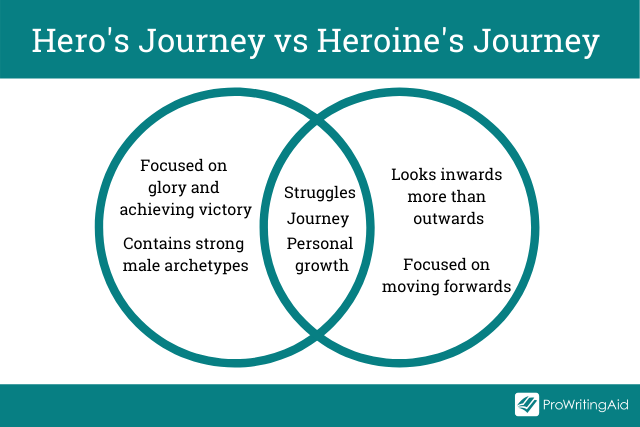
Another criticism is that the hero’s journey favors male protagonists, a tale about a hero leaving home to seek adventure in the outside world. In contrast, stories about women often involve looking inward, instead of looking outward, because of the domestic roles that women have traditionally been expected to fulfill.

The concept of the “heroine’s journey,” also known as the female hero’s journey, was developed in 1990 by Maureen Murdock, a psychotherapist and a student of Joseph Campbell, in her book The Heroine’s Journey: Woman’s Quest for Wholeness.

Murdock wrote:

“The feminine journey is about going down deep into soul, healing and reclaiming, while the masculine journey is up and out, to spirit.” 

The Hero's journey versus the Heroine's Journey

Similarly, stories about people of color or marginalized groups within our society sometimes follow different story archetypes. Joseph Campbell’s hero’s journey focuses on an individual hero, rather than a broader social context.

Stories about marginalized groups might center on communities reacting to oppression and navigating the rules set by the majority, instead of highlighting a single individual who proactively seeks adventure.

How Can You Use the Hero’s Journey in Your Writing Without Making Your Story Feel Formulaic?

There’s nothing wrong with using the hero’s journey in your own work. After all, it’s been spectacularly successful for thousands of years—there’s a timeless appeal to this story of adventure and spiritual transformation.

However, the hero’s journey can be a useful tool even if you don’t use it the way Joseph Campbell originally intended. Readers who recognize these classic tropes can appreciate an unexpected twist. Innovative literary fiction often plays with traditional narrative structures in new ways.

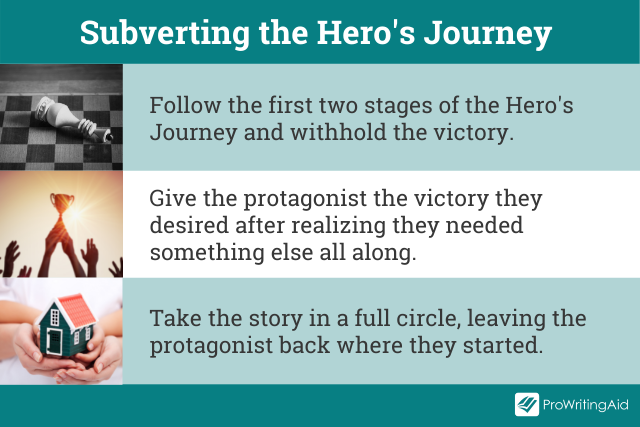
Many writers have subverted the hero’s journey archetype to better reflect the stories they want to tell. For example, you can follow the hero’s journey throughout the first two stages, then withhold the hero’s victory in the third stage.

Maybe the protagonist realizes they needed something else all along, rather than victory in their quest. Or maybe the story comes full circle and returns the protagonist back to where they started.   Ideas for subverting the hero's journey

For more ideas, check out Steve Seager’s article on how to design a narrative more fitting to our contemporary context.

If it fits the needs of your story, consider changing up the hero’s journey in your own writing. You can build on Joseph Campbell’s time-honored literary tradition while also adding new twists of your own.