
Watch this video and read the source article.
Write to Life blog
Richard Dawkins Religion vs. Reality
Fundamentalism and the Truth of the Bible
Here’s the link to this article by Bart Ehrman. It covers something I’d never really thought about. Interesting. Makes sense that it’s non-sense to believe that a Bible with errors precludes someone remaining/becoming a Christian.
May 15, 2017
I have recently received a number of inquiries about why realizing there may be mistakes in the Bible might lead someone to become an agnostic. Here is one that came a few days ago:
QUESTION:
I want to thank you for your extensive work in explaining … your journey from believing that the bible contained no errors to proving the bible is not inerrant and simply the work of human writers. What I would like to be explained is the necessary logic to go from believing that the bible is not inerrant or the “word of God” to believing there is no God.
RESPONSE
My view of the matter may seem odd to a lot of people, but it is nonetheless held by most critical scholars of the Bible and trained theologians. What is the “necessary logic to go from believing that the bible is not inerrant … to believing there is no God? There is no necessary logic at all.
I have never thought that …
To See The Rest of this Post you need to Belong to the Blog. If you’re not a member, JOIN! It won’t cost much, you’ll get a lot of bang for your buck, and every buck goes to fight poverty. So no one loses and everyone wins — including you. So JOIN!I have never thought that recognizing the historical and literary problems of the Bible would or should lead someone to believe there is no God. The only people who could think such a thing are either Christian fundamentalists or people who have been convinced by fundamentalists (without knowing it, in many instances) that fundamentalist Christianity is the only kind of religion that is valid, and that if the assumptions of fundamentalism is flawed, then there could be no God. What is the logic of that? So far as I can see, there is no logic at all.
Christian fundamentalism insists that every word in the Bible has been given directly by God, and that only these words can be trusted as authorities for the existence of God, for the saving doctrines of Christianity, for guidance about what to believe and how to live, and for, in short, everything having to do with religious truth and practice. For fundamentalists, in theory, if one could prove beyond a shadow of a doubt that any word in the original manuscripts of the Bible was an error, than the entire edifice of their religious system collapses, and there is nothing left between that and raw atheism.
Virtually everyone who is trained in the critical study of the Bible or in serious theology thinks this is utter nonsense. And why is it that people at large – not just fundamentalists but even people who are not themselves believers – don’t realize it’s nonsense, that it literally is “non-sense”? Because fundamentalists have convinced so much of the world that their view is the only right view. It’s an amazing cultural reality. But it still makes no sense.
Look at it this way. Suppose you could show beyond any doubt that the story of Jesus walking on the water was a later legend. It didn’t really happen. Either the disciples thought they saw something that really occur, or later story tellers came up with the idea themselves as they were trying to show just how amazing Jesus was, or … or that there is some other explanation? What relevance would that have to the question of whether there was a divine power who created the universe? There is *no* necessary relevance. No necessary connection whatsoever. Who says that God could not have created the universe unless Jesus walked on water? It’s a complete non sequitur.
The vast majority of Christians throughout history – the massively vast majority of Christians – have not been fundamentalists. Most Christians in the world today are not fundamentalists. So why do we allow fundamentalists to determine what “real” Christianity is? Or what “true” Christianity is? Why do we say that if you are not a fundamentalist who maintains that every word in the Bible is literally true and historically accurate that you cannot really be a Christian?
Suppose Jesus did not walk on water. Does that lead to the conclusion that he must not have died for the sins of the world? Why would it lead to that? The only connection you can make between the two assertions – Jesus walked on water; Jesus died for the sins of the world – is extremely torturous. Sure, there are people on the blog right now who are probably concocting some kind of logical connection between these two statements. But think about it for a second. What is the necessary connection? There is none.
If Mark made a mistake when he said that Abiathar was the high priest when David and his men ate the showbread in the Temple, that has absolutely no bearing on the question of whether God exists as a Trinity. No connection.
You should not think: yes, but the only reason we believe that God is a Trinity (if “we” believe that) is because it’s what the Bible says, and if the Bible contains errors, then it must be erroneous in *that* as well. Here are several key points:
First, of all, there is no necessary reason why if the Bible makes mistake about one thing it is mistaken in everything. Even if there are mistakes in the Bible (there are) that doesn’t mean that everything in it is wrong (it is not).
Second, the doctrine of the Trinity is not actually taught in the Bible in the form that theologians came to develop it later and that is believed on by people today.
Third, in fact there are non-trinitarian ways to read the entire Bible, including *all* of the Old Testament and *most* of the New Testament. What we think of the doctrine of the Trinity was developed on the basis of logical, philosophical argumentation that used scattered verses of the Bible as proof texts for views that developed on other grounds. There were, and are, non-Trinitarians who base their views on proof texts as well. It is not a necessary teaching of Scripture.
Fourth, there were Christian believers for centuries before we even had a Bible (the 66 book canon we have today). Were they not believers because they did not believe in the Bible? They didn’t have a Bible. In fact there are millions of Christians in the world today who don’t have the Bible.
Fifth, more important, there are all sorts of Christian denominations, Christian theologians, and just regular ole Christians – in fact, the majority who are walking the earth – who do not think that fundamentalist Christianity is right, or anywhere near right.
So, is there a logical and necessary connection between the idea that there are mistakes in the Bible and the belief in God. No, no necessary connection at all.
So why did I become an agnostic once I came to think there are mistakes in the Bible. Short answer: I didn’t. Realizing that there are problems in the Bible had almost nothing to do with my becoming an agnostic. I’ll explain all that in later posts.
The Six Motives of Creativity: Mary Gaitskill on Why Writers Write
Here’s the link to this article.
The art of integrating the ego and the impulse for empathy in a dynamic call and response.
BY MARIA POPOVA
Why do writers — great writers — write? George Orwell attributed it to four universal motives. Joan Didion saw it as access to her own mind. For David Foster Wallace, it was about fun. Michael Lewis ascribes it to the necessary self-delusions of creativity. Joy Williams found in it a gateway from the darkness to the light. For Charles Bukowski, it sprang from the soul like a rocket. Italo Calvino found in writing the comfort of belonging to a collective enterprise. For Susan Orlean, it comes from immutable love.
But one of literary history’s most beautiful answers comes from Mary Gaitskill in her essay “The Wolf in the Tall Grass,” titled after Nabokov’s famous meditation on the art of storytelling and published in the 1998 anthology Why I Write: Thoughts on the Craft of Fiction (public library) — an altogether fantastic collection, featuring David Foster Wallace’s famous essay “The Nature of the Fun” and other notable reflections on writing from Ann Patchett, Elizabeth Gilbert, Rick Bass, Norman Mailer, Rick Moody, and more.
1. To satisfy a basic, fundamental need. I think all people have this need. It’s why children like to draw pictures of houses, animals, and Mom; it’s an affirmation of their presence in the corporeal world. You come into life, and life gives you everything your senses can bear: broad currents of animal feeling running alongside the particularity of thought. Sunlight, stars, colors, smells, sounds. Tender things, sweet, temperate things, harsh, freezing, hot, salty things. All the different expressions on people’s faces and in their voices. For years, everything just pours into you, and all you can do is gurgle or scream until finally one day you can sit up and hold your crayon and draw your picture and thus shout back, Yes! I hear! I see! I feel! This is what it’s like! It’s dynamic creation and pure, delighted receptivity happening on the same field, a great call and response.

Her second motive reflects Susan Sontag’s assertion that “a writer is someone who pays attention to the world — a writer is a professional observer.” Gaitskill continues:
2. To give form to the things we can sense but not see. You walk into the living room where your father is lying on the couch, listening to music. You are small, so he doesn’t hear or see you. His face is reacting to the music, and his expression is soft, abstract, intensely inward. It is also pained. It is an expression that you have never seen. Then he sees you and smiles, but the music still fills the room with that other expression…
Quoting Nabokov’s famous words — “Between the wolf in the tall grass and the wolf in the tall story there is a shimmering go-between. That go-between, that prism, is the art of literature.” — Gaitskill reflects on that ability to give shape to the ineffable as the essence of storytelling:
Stories mimic life like certain insects mimic leaves and twigs. Stories are about all the things that might’ve, could’ve, or would’ve happened, encrowded around and giving density and shape to undeniable physical events and phenomena. They are the rich, unseen underlayer of the most ordinary moments.
Gaitskill contrasts this intense outrospection and sensitivity to the world’s unseen layers with her third reason — which coincides with Orwell’s first motive — and writes:
3. To feel important, in the simplest egotistical sense. … Strong thoughts and feelings about what you see and feel require a distinct point of view and an ego. If you are frequently told that your point of view is worthless, invalid, or crazy, your ego will get really insulted. It will sulk like a teenager hunched in her room muttering, “No one ever listens. No one cares. One day they’ll see!” To make them all see — i.e., see how important I am — was once a big part of why I wrote stories. As a motivation, it’s embarrassing, it’s base, and it smells bad, but it’s also an angry little engine that could: it will fight like hell to keep your point of view from being snatched away, or demeaned, fighting even when there’s no apparent threat.
But just as one begins to raise a skeptical eyebrow and summon Alan Watts for a counterpoint, Gaitskill herself acknowledges the existential paradox therein:
The only problem is, the more your ego fights, the smaller your point of view gets. For a while, I needed to take great pains to make myself feel safe, to the point of extreme social isolation, so I wouldn’t feel like I had to fight. The angry engine quieted down a bit, and I began to learn about other points of view.
Indeed, this impulse for empathy and for giving voice to the marginalized realities of others brings us to Gaitskill’s fourth motive:
4. To reveal and restore things that I feel might be ignored or disregarded. I was once at a coffee shop eating breakfast alone when I noticed a woman standing and talking to a table of people. She was young but prematurely aged, with badly dyed hair and lined skin. She was smiling and joking, but her body had a collapsed, defeated posture that looked deeply habitual. Her spine was curled, her head was slightly receded, and her shoulders were pulled down in a static flinch. She expressed herself loudly and crudely, but also diffidently. She talked like she was a joke. But there was something else to her, something pushing up against the defeat, a sweet, tough, humorous vitality that I could almost see running up her center. I realized that if I hadn’t looked closely, I would not have really seen this woman, that I would not have seen what was most human and lively in her. I wondered how many people saw it, or even if she herself saw it…
That kind of small, new, unrecognized thing is very tender to me, and I hate it when it gets ignored or mistaken for something ugly. I want to acknowledge and nurture it, but I usually leave it very small in the stories. I do that because I think part of the human puzzle is in the delicacy of those moments or phenomena, contrasted with the ignorance and lack of feeling we are subject to.
Gaitskill moves on to her fifth reason, echoing Oscar Wilde’s famous emphasis on receptivity and reflecting on the osmosis of reading and writing:
5. To communicate. … To read well is an act of dynamic receptivity that creates a profound sense of exchange, and I like being on both ends of it.

Citing one of her favorite passages in literature, from Saul Bellow’s The Victim, she captures the highest potentiality of literature:
It opens life up down to the pit; when I read that, I can’t ignore how extraordinary it is to be alive.
In her sixth and final reason, Gaitskill returns to Nabokov:
6. To integrate; to love. One of Nabokov’s early novels, Laughter in the Dark, has an apparently simple, almost hackneyed plot: a foolish, wealthy middle-aged man (Albinus) falls in love with a vulgar, heartless sixteen-year-old girl (Margot). She and her lover, Rex, proceed to destroy Albinus and his family in a ruthless, ultimately grotesque fashion. On the face of it, it’s a soap opera, but what makes it extraordinary, aside from the beauty of the prose, is the author’s gift for inhabiting every energetic strain of his breathing animal creations. Rex and Margot are absolutely evil, but they are also full of fierce life, with, and supple, eel-like charm. Nabokov can step inside their cruelty and vitality almost as if it were an electrical current, then step out again and enter the much slower, cooler ambience of their poor stooge Albinus, or the person of Albinus’s bland, taffy-sweet wife, and emerge again, all in a flash. … The ability to do this requires a great understanding of and regard for life that is, I think, a kind of love.
Gaitskill concludes by reflecting on this “kind of integration [that] requires holding many disparate elements together in a fluid mosaic” in her own experience of writing, from the depths of which emerges the light of the creative impulse:
When I start writing a story, I don’t feel like I’m integrating anything; I feel like I’m marching through mud. But at least some of the time when there comes a moment when I feel I’m carrying all the elements I’ve just described and more in a big, clear bowl. It doesn’t feel like I’m containing them. It feels like I’m bringing them into being and letting them be, exactly as they are. My perplexity and upset may still be there, but they are no longer the main event. I feel sadness because much of what is in that bowl is sad. But because of that tender sadness, I also feel humility and joy and love. It’s strange because much of what I write about does not seem loving. But to write it makes me feel love.
Why I Write, while out of print, is still findable and very much worth the hunt. Complement it with its contemporary counterpart, one of 2013’s best books on writing, then revisit famous writers’ advice on writing.
Commentary on D. James Kennedy’s book Why I Believe–Chapter 7
Here’s the link to this article.
(Contradiction)
Note: At this point, my hard-working little laptop computer died for good. Fortunately, I had backups of my finished work (chapters 1 through 6 and the Appendices), and work-in-process (chapter 7). However, all of my references and my collection of notes covering subsequent chapters, painstakingly gathered over four months, were lost. I will combine into a single essay the chapters remaining after this one.
This chapter of Why I Believe is probably the strongest one in the book. Dr. Kennedy does a decent job describing various moral systems, and he makes a fairly good case, with only a few glaring weaknesses, for the moral system offered by Christianity. He is right to criticize Christians for failing to bother their heads with an understanding of various moral philosophies, including their own. I would recommend a study of diverse philosophies to anyone, especially nonbelievers, for such a study provides firm ground to stand on when confronted by the onslaughts of fanatical religious zealots.
The chapter.
Kennedy gives adequate, if brief, descriptions of some of the prevalent ethical systems, but his interpretation of them leaves something to be desired. He rails against astrology and behavioristic psychology as being deterministic systems, without realizing that his own ethical system includes an omniscient god, which arguably makes his system deterministic by setting up God as an outside controlling force, trivializing the free will Kennedy venerates. In his description of the teleological ethical system (which emphasizes the goodness of the end result of an action) Kennedy blames evolutionary thought on a Christian giving Darwin a geology book (implying, essentially, that learning science is somehow evil). Evolutionary thought was prevalent before Darwin, and his conclusions were based on evidence collected during his voyages, not from a geology book. Kennedy also shows he misunderstands situational ethics with his example that equates a motive of love with a casual affair calculated to improve the emotional well-being of a lonely woman.
I was happy to see that Kennedy seems to hold a low opinion of altruism, a practice which many Christians believe should be an integral part of their lives. He rightfully recognizes altruism, which is seeking the good of others through self-sacrifice, as a basis for communism and socialism. Nevertheless, Christians practice altruism because this was also an element of the teachings of Jesus. Altruism is a basis of many religions, including Christianity. It is an evil system embodying the concept of human sacrifice. The altruistic ethics of giving value through sacrifice contradict the moral ethics of providing value to others through productivity.
Having touched upon different ethical systems, Kennedy then gives the reader three flawed items of cautionary advice, which I will address here:
1. Speculative, rationalistic systems reject revelation and base the weight of their support upon the conceptions of the human mind. Therefore, their limitations should be obvious at once.
My response to this is, “Revelational systems reject reason, and base the weight of their support upon divine enlightenment from some mythical being. Therefore, their limitations should be obvious at once.”
What else is there besides the human mind, if we are unconvinced of God’s existence? Morality results from objective reasoning that determines whether a given thing is either inherently good for the conscious human organism or inherently bad for the conscious human organism. A truly complete rational system automatically takes into account the universal interconnecting relationships between all humans in their social organism to arrive at mutually beneficial ethical decisions.
2. Rationalist systems are all man-centered. God is banished from his universe and has no right to tell his creations what to do.
That sounds like a Good Thing to me. Besides, rationalist systems don’t “banish” God anywhere. How can you banish something which is either nonexistent or irrelevant?
3. All human ethical systems are willful rebellion against the Almighty God.
This is redundant. Again, one cannot rebel against something whose existence is questionable or irrelevant.
Kennedy also divides, wrongly, the whole matter of ethics into two groups: speculative and revelational. He completely ignores objective ethics. The philosophy of Objectivism, conceived by Ayn Rand, is a strict, logical, moral system that gives meaning and fulfillment to the lives of many people, meeting all human needs without requiring a god, and without the internal contradictions and conflicts associated with religious systems. Much literature has been written by and about Ayn Rand and Objectivism. For a rewarding background study of this philosophy, read one of her novels, notably the literary classic Atlas Shrugged.
Morality.
In this chapter, Kennedy makes the following incredible declaration: In the Scriptures we have a perfectly balanced ethical system that meets all human needs, and in the Hebrew-Christian tradition, good is inevitably connected with God. These are lies. Human needs do not include, for example, sex with guilt, or the threat of damnation. And for God’s goodness, refer back to the section on God’s moral’s and manners in the commentary on chapter 3. We can look at what Christians call morality, based on the edicts from their God, and then ask “Are the actions of God consistent with the morality that he prescribes?” and we find that the answer is no. The usual argument from Christians is: “We cannot understand why God appears to be inconsistent with his morality, because we are finite beings, incapable of God’s infinite understanding.” This strikes most nonbelievers as a convenient excuse for not having a good retort.
Why assume God has a higher claim to morality? Christians make that leap by assuming he has more knowledge. Let’s examine an analogy. We could assume that Newt Gingrich has more political answers than we do, since he has spent his whole life immersed in politics. We could assume the same of Bill Clinton. Yet, the answers they provide do not match up, and are on occasion wholly contradictory. It therefore falls upon each individual to examine what is truly right and wrong, and not take the word of any one being just because he is a self-described expert. The Bible portrays a God who acted as a moral judge, yet found such things as slavery, racism, genocide, rape, and xenophobia occasionally acceptable. Humanity has since decided otherwise, and in a similar fashion will probably even change God’s mind regarding homosexuals over the next several decades.
If one considers that we seem to have evolved as social creatures, then many of those behavioral norms that Kennedy attributes to Christianity are actually biological imperatives. Imagine how long a social species would survive if its members were free to kill each other at will. Not long! Animals do compete with each other, in limited ways, and within set rules – those who willfully destroy their rivals find themselves ostracized.
It is likely that the capabilities of the human mind actually result from natural selection developing our ability to distinguish others’ intentions, good from bad. Evidence for this can be found in a study (from Scientific American) in which subjects were asked to solve two comparable sets of logic/math problems, one in pure, abstract form and the other within a social context. Guess which ones people found easier? Our brains are designed to solve problems within contexts, especially the social context in which we evolved.
Morality does not have to derive from God. The source of Christian ethics, now as always, is the ethical/moral system of the society in which we live. These values have evolved along with society. They’re simply the rules that have enabled our society to survive. Our comprehension of Revealed Truth guides our reactions and modifications to the Christian ethical system, which is rooted in human nature, society, and history. Except for the possible role as creator of human nature, God is quite unnecessary in this scheme as a “foundation” of morality.
You don’t need religion for a complete ethical system. Ethical values should not rely on belief in mythical beings. The supposition that you must act ethically to please some invisible, unknowable God is a pretty weak basis for “morality,” especially since the supposed God’s moral codes are not only provided indirectly through handed-down legends, but are also of questionable value, considering his behavior as described in the Bible.
In the absence of religion, we form a moral belief system by opening our conscience to the needs and desires of others. A Christian acts according to the demands of his or her deity; a nonreligious person acts out of compassion. Remember the empathy principle? Feel as others feel in response to your actions.
Moral absolutes.
Atheists, humanists, or nonreligious people in general, have ethical systems based on relationships with people. That’s pretty absolute. No one out there will come and save us; we need human solutions to human problems. No mythical being is out there to “love” everyone; we need to care for ourselves.
Take a morality from God. Why act in a particular way? “God said so.” This is morality from authority. Dr. Kennedy believes in moral absolutes, but authority is, of course, relative, not absolute! Stanley Milgram’s experiments demonstrated this quite well. Participants would accept the authority of the “experimenter” and promptly 42% would shock an unwilling “subject” (actually an actor) screaming in pain, pleading to be released and eventually not responding. Those who accept morality from the authority of God, over the connections between them and other human beings, may form immediate followings behind any alternate authorities, because they don’t understand morality and how it relates to other people. So, if the leader of a country says that certain people are sub-human vermin, they follow the leader. Just like God, he must be right. He’s authority.
Let’s look at a few moral absolutes that don’t require religion. These are things I consider to be black-and-white absolutes. Everyone has unique values, but certain basic actions never change in terms of rightness or wrongness; they do not vary according to opinion, personality, age, or culture. Objectively good or bad actions are definable in absolute terms; other actions cannot be judged as good or bad because they are determined by individual personal preferences or feelings. As with actions, objective morals are also independent of anyone’s opinions or proclamations. They are not created nor determined by anyone. It is important to remember that a person’s feelings, lifestyle, desires, and needs can vary greatly without altering that person’s character. Objective, natural moral absolutes exist according to the following criteria:
- A chosen action that is objectively good for the human organism is morally good or right.
- A chose action that is objectively bad for the human organism is morally bad or wrong.
Note that “human organism” does not necessarily equate to “self.” This is important. These criteria lead to the following basic moral absolutes:
- Honesty and Truth. Conscious striving for self-honesty, uncompromising loyalty to truth, integrating honesty into one’s life for knowing truth and reality, are essential for human well-being, happiness, and prosperity (for individuals and society). Pragmatic compromise, evasion of truth (for example, acceptance of dogma), and parasitical laziness are immoral.
- Self-Esteem. Productive and creative actions that increase effectiveness in dealing with reality are moral essentials to the self-esteem of an individual. Nonproductive actions that diminish this effectiveness, and diminish the use of one’s mind (for example, as with blind faith or narcotics usage), are immoral.
- Individual Rights. Recognition of the inalienable right each individual has to his or her life and property, is moral. Actions that violate the life or plunder the property of others are immoral.
- Refusal To Sacrifice. Sacrifice, the basis of altruism, occurs when a value is diminished or destroyed for a lesser value or nonvalue. Refusal to sacrifice is life-enhancing, and morally right. “Noble” sacrifice for a “higher” cause or no cause is morally wrong.
- Prohibiting Use of Force. Prohibition of the initiation or threat of force, coercion, or fraud against any individual for any reason is the foundation of morality. Note that actions of self-defense or protection do not qualify as the initiation or threat of force. Use of force (especially by governments or religions) against individuals, especially if the result serves the social “good” or a “higher” cause, is immoral.
- Ends do not justify means. This is true especially with respect to the use of force. All moral actions are based on principles prohibiting initiatory force, threat of force, coercion, or fraud as a means to accomplish ends, no matter how noble. On the other hand, pragmatic use of force or coercion, violation or sacrifice of individual rights for the “good” of society for “noble” ends, is immoral.
Throughout human history, ethical systems based on religions have been oriented against some or all of these absolute moral principles. Many find that adhering to these principles requires liberating oneself from religious binds by casting religious dogmas out from one’s life.
The Bible does not present a highly advanced moral code. In fact, despite positive aspects, it presents a primitive, crude, suspicious, sexist moral code that is becoming, to the dismay of fundamentalists, ignored more and more in modern society, and for good reasons. Perhaps this ethical system suited people in Biblical times; but they were mistaken. Sexism, racism, slavery, genocide, and superstition are always immoral tools with which to run a society. We’ve had the benefit of history and fine examples of poorly-run societies (the rise of Christianity coincided with the decay of the Roman empire, Christianity reached its peak of power in the Dark Ages, and today we see religion-controlled governments, like Iran, floundering with unhappy and disturbed populations); we should know better than to follow a failed moral code.
Conclusion.
In my view, faith constipates the mind. It restrains people from much cerebral activity they might otherwise be capable of. You don’t need a God for an ethical system. In the end, the answer is simple: You should be good because it is good to be so.
Writing Journal—Thursday writing prompt

Your protagonist and her friend are enjoying a hot air balloon ride when the burner malfunctions. Describe their harrowing journey to the ground.
One Stop for Writers
Here’s five story elements to consider:
- Character
- Setting
- Plot
- Conflict
- Resolution
Never forget, writing is a process. The first draft is always a mess.
The first draft of anything is shit.
Ernest Hemingway
03/15/23 Biking & Listening

Biking is something else I both love and hate. It takes a lot of effort but does provide good exercise and most days over an hour to listen to a good book or podcast. I especially like having ridden.
Here’s my bike, a Rockhopper by Specialized. I purchased it November 2021 from Venture Out in Guntersville; Mike is top notch! So is the bike, and the ‘old’ man seat I salvaged from an old Walmart bike.

Here’s a link to today’s bike ride. This is my pistol ride.
Here’s a few photos taken along my route:


























Here’s what I’m currently listening to: McNally’s Secret, by Lawrence Sanders
He was a tremendously talented writer.

Amazon abstract:
First in the series starring the sleuthing Palm Beach playboy from the #1 New York Times–bestselling and Edgar Award–winning author.
Inveterate playboy Archy McNally gets paid to make discreet inquiries for Palm Beach’s power elite. But keeping their dirty little secrets buried will take some fancy footwork in McNally’s latest case. A block of priceless 1918 US airmail stamps has gone missing from a high-society matron’s wall safe. Lady Cynthia Horowitz, now on her sixth husband, is a nasty piece of work who lives in a mansion that looks like Gone With the Wind’s Tara transplanted to southern Florida. McNally’s search takes him into a thickening maze of sex, lies, scandal, and blackmail. When passion erupts into murder and McNally must dig even deeper to uncover the truth, he unearths a shocking secret that could expose his own family’s skeletons.
Top reviews from the United States

5.0 out of 5 stars Cure Cultural Volcanics with Bubbling Champagne. Design Life To Suit Taste & Times.
Reviewed in the United States on May 21, 2006
This book didn’t merely capture my reading interest. It became a book of my heart…
In McNally’s SECRET, the pilot to this series, we’re informed that the pater McNally is not an “old-money” man. Okay. I get that and I like it. (That’s not the secret.)
Having reviewed 4 of the original 7 McNally books by Lawrence Sanders, I had accepted the face value (not realizing the facade) of the Palm Beach mansion and the genteel lifestyle of pater Prescott McNally, Yale graduate, leather-bound-Dickens-reading, attorney-at-law. Upon reading (in McNally’s Secret) the illuminating passages of Archy’s grandparent’s ways into money, I began to wonder what other Secrets this novel might expose.
Usually, if possible, I prefer to read a series in order, pilot first. I can’t explain why, but, in this case I’m glad I read 4 of the original 7 McNally’s prior to reading SECRET (though I believe this series can be satisfyingly read in any order).
The opening of this novel was classic, and felt to be the initiation of what Sanders was born and itching to write, beyond the sagas of his other fine works. The introductory remarks were exquisite in mapping the reasons for, “Can’t you ever be serious, Archy?” I’d love to quote that paragraph, but maybe I should allow you to read it with the book in hand. I will quote a few other passages, however, which might serve as appropriate appetizers to this banquet of a book.
Comparing himself to S. Holmes, Archy says:
“I can’t glance at a man and immediately know he’s left-handed, constipated, has a red-headed wife, and slices lox for a living. I do investigations a fact at a time. Eventually they add up – I hope. I’m very big on hope.”
Archy’s description of the start up of the Pelican Club were the best type of soul food. This is how and why such a club should be started (then survive through a near hit of Chapter 7). Of course you really should read the book to get the whole of that brief history, but here’s a prime paring:
“We were facing Chapter 7 when we had the great good fortune to hire the Pettibones, an African-American family who had been living in one of the gamier neighborhoods of West Palm Beach and wanted out.”
They “wanted out” and they deserved a chance where their skills could and would save not only themselves, but those who hired them. Isn’t that the type of win/win the world needs now?
I almost sobbed at the below passage, I felt such a deep surge of “right on” (definitely did a breath-catch hiccup and heart moan):
“… we formed a six-piece jazz combo (I played tenor kazoo), and we were delighted to perform, without fee, at public functions and nursing homes. A Palm Beach critic wrote of one of our recitals, `Words fail me.’ You couldn’t ask for a better review than that.”
Yep. This is a book of my heart. Words don’t often fail me in reviews; too much the contrary. But I’m getting better at refraining from using my critic hat with a steel-studded-bat accessory, which is what Archy was getting at.
Some might wonder why a person in my position, with my un-hidden agendas, would take so much time to write raves on a series by a deceased author. Mostly, I love Archy. But, possibly the live spirits of the dead are sometimes more able to be helpful than dead souls of the living? Keeping my tongue in cheek, I might add that freed spirits probably have better connections for helping an author into the right publishing contacts for a character series with ironic assonance with this one.
Moving quickly onward and upward, though not with wings attached yet…
In contrast to the other 4 I’ve read, I noticed that this Archy is less bubbly-buffoonish (though the buffoon is always endearing) and slightly more serious, sensitive, and quietly contemplative. I like both versions of Archy, though I prefer the slight edge of peaceful acquiescence in the pilot, and I can’t help but wonder, as I do with all series, how much reader feedback, and editor/agents’ interpretation of it, directed the progression of balance of certain appealing or potentially irritating qualities. I wonder how each series would have progressed if the feedback had been balanced and pure (as a species, we’re not there yet, but forward motion is perceptible), rather than inevitably polluted by the “life happens” part of the sometimes perverted, capricious tastes of us squeaky wheels, and the healthy ego needs of professionals in positions of swallow and sway.
I’m still trying to understand why honesty is the most appealing human quality to me, yet honest criticism does not speak to my heart, nor to my soul, not even to my head. Often, though, it does speak in perfect pitch to my funny bone. And, of course true Honesty (with the capital “H”) leaps beyond speaking the “truth” as one happens to “see” it on a good or bad day. Cultural honesty, of the type dramatized by Stephen King, Lawrence Sanders, Tamar Myers, Barbara Workinger, Joanne Pence, Sue Grafton, (and others) is what most often pushes me to stand up and cheer.
Somewhere.
One of the best spots I’ve found is on the edge of the clear cliff of ozone found in Amazon’s sacred forum of Customer Reviewers.
Of course the first lines in SECRET, the sipping of champagne from a belly button would snag the attention of even the most sexually skittish reader of the nose-raised, neck-cricked, personality persuasion. But, truly and honestly, what sunk me with every hook were the few lines exposing why Archy could never be serious. I know I said I wouldn’t, but I have to quote this passage, beginning on page 1 chapter 1. For me, it’s one of the main selling points of the series:
“I had lived through dire warnings of nuclear catastrophe, global warming, ozone depletion, universal extinction via cholesterol, and the invasion of killer bees. After a while my juices stopped their panicky surge and I realized I was bored with all these screeched predictions of Armageddon due next Tuesday. It hadn’t happened yet, had it? The old world tottered along, and I was content to totter along with it.”
I’d bet my fortune (which is based on a skill of “make do”; there are no bananas in it) that the above passage is what captured a collection of readers so absolutely in a “right on” agreement that this series spanned the grave of the author and is still spewing pages and stretching shelves. And, of course, this attitude of “if you can’t lick `em; flick `em” which Archy aimed toward “kvetch-ers” as he terms them, continues from the above, with relish accumulating, throughout the book.
Archy is a rare sane person swimming along nicely within the insanity of a last-gasp-culture (which is “drowning in The Be Careful Sea” as I described and termed that syndrome in one of my sci fi manuscripts titled MORNING COMES).
To Jennifer, of the champagne sea in her belly button, Archy answered why he wasn’t an attorney:
“Because I was expelled from Yale Law for not being serious enough. During a concert by the New York Philharmonic I streaked across the stage, naked except for a Richard M. Nixon mask.”
That answer brought to mind the bright side of Howard Roark (from Ayn Rand’s FOUNTAINHEAD, see my review posted 10/14/05) who was arrogantly unconcerned about his and the Dean’s reasons for Roark’s being expelled from architectural school. You’d be right to wonder where I got that comparison, since Roark could never be accused of being anything but serious. Syncopated irony? Assonance?
You be the judge. Get the SECRET of the McNally collection.
As I relished the final chapters and pages of SECRET, I had a thought about the beauty, warmth, lovely literary melancholy, and subtly complex richness radiating from those concluding textual treasures:
In retrospect, this novel doesn’t feel like a planned pilot to a mystery series. It feels to be a singular novel, like but not like, the ones Sanders had written prior to it. What it feels like to me is that Lawrence hit upon a “soul speak” story which couldn’t halt the cultural conversation it had initiated, however serendipitous that initiation may have been.
Yes, I do recall that in some of my other reviews (“reveries” according to my Amazon Friend, L.E. Cantrell) I speculated on something which could seem contradictory to the above mentioned “thought.” I had wondered if Parker’s Senser series might have been somehow a spark for this McNally series. I continued to see references to Boston in this book (as in other McNally’s I’ve reviewed), which, of course, is the city for which Spenser did the Walkabout. So possibly SECRET was somewhat an antithetical homage to Spenser, possibly even a hat “doff” with a friendly, competitive “one-better” attempt, meant only to be a single novel rather than a never-die series.
Based on Agatha Christie’s official web site, Miss Marple was not originally intended to be another Poirot, and look what happened there (see my Listmania of the Miss Marple series).
To me, Archy appears to be a gatekeeper for pure and primal, hidden wishes and dreams. Living home comfortably, guiltlessly at 37, on the top floor of his parent’s mansion in Palm Beach; eating drool-food from a house chef; having established a club like The Pelican as a side atmosphere to partake in daily; working at a cushy, just challenging enough, engaging career for discreet inquiries … If an author’s (or reader’s) going to retire that would be da place (or at least an entertaining option).
It’ll be interesting to see if/how I’m able to bridge the gap from Lawrence Sanders’s Archy to Vincent Lardo’s. I’d love to know how that bridge was built and continues to be maintained.
Though a perfectly acceptable, gorgeous reprint in a mass market paperback was (probably still is) available on Amazon’s Super Saver Special, I felt lucky to find a vender on Amazon (a-bookworm2) holding a used G. P. Putnam’s Sons hardcover of this novel, a first printing of the 1992 copyright. What an honor it will be to have this version of the pilot of such an auspicious series from such a life-perceptive author, Lawrence Sanders. The glossy-black jacket provides a luscious background for the name and title printed in thick, gleaming, copper ink, with the artwork of an antique magnifying glass and fancy-brass scissors weighing down the million-dollar-valued, 1918 US Stamp of the Inverted Jenny.
This pilot is a rare find in a rare series.
Linda G. Shelnutt
Christian lawmaker cites Bible to defend hitting special needs students
Here’s the link to this article by Hemant Mehta.
State Rep. Jim Olsen helped defeat a bill that would’ve banned the use of corporal punishment against students with special needs
This Substack newsletter is free, but it’s only able to sustain itself due to the support I receive from a small percentage of regular readers. Would you please consider becoming one of those supporters? You can use the button below to subscribe to Substack or use my usual Patreon page!
Republicans in Oklahoma had the chance to ban corporal punishment against students with disabilities… but failed to pass the bill today, in part because one legislator said beating kids with special needs was biblical.
Oklahoma currently permits corporal punishment in public schools. That’s a problem in and of itself, but the law at least has a carve-out exempting students with “the most significant cognitive disabilities.” Teachers can theoretically spank kids but a handful of students are off-limits.
House Bill 1028, sponsored by Republican State Rep. John Talley, was designed to broaden that exemption so that it applied to all students with disabilities. GOP State Rep. Anthony Moore signed on as a co-sponsor of the bill specifically because he thought this would be an easy vote. “There’s going to be nobody who’s for corporal punishment on students with disabilities,” he said.
He must have forgotten that he’s surrounded by other Republicans from Oklahoma.
They will always find a way to defend abuse in the name of Jesus.
State Rep. Jim Olsen argued earlier today that the Bible permits hitting a child as a form of discipline—therefore that option must be available to teachers.
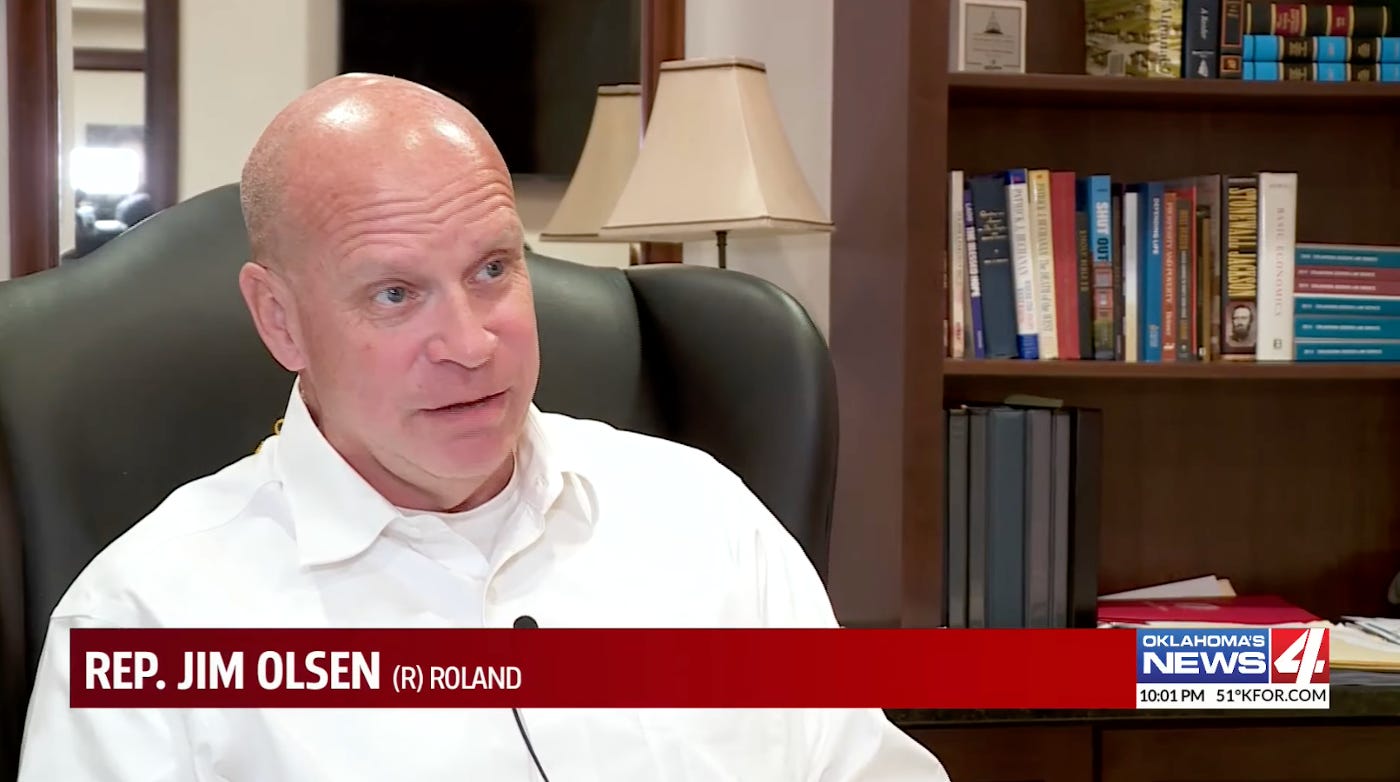
You know, several scriptures could be read here. Let me just read just one: Proverbs 29: “The rod and reproof give wisdom, but a child left to himself bringest his mother to shame.”
So that would seem to endorse the use of corporal punishment.
So how would you reconcile this bill with scriptures…?
Who cares. It’s the Bible and he’s a legislator. We don’t need to run policy ideas through his favorite book.
Olsen later cited Proverbs 13:24, the infamous verse that gave us, “Spare the rod, spoil the child.” Kudos to the Tulsa World for including this line in its article:
Olsen did not turn to Deuteronomy 21:18-21, which is usually translated as God ordering that “stubborn and rebellious” sons be stoned to death.
And what about the American Academy of Pediatrics, which supports banning any form of physical discipline against children because there’s plenty of evidence showing the harm it causes in the long term?
Olsen didn’t care.
“God’s counsel is higher than the American Academy of Pediatrics,” said Olsen. “God’s word is higher than all the so-called experts.”
To paraphrase a famous line, Olsen acts like he placed his hand on the Constitution and swore to uphold the Bible. It’s supposed to be the other way around.
But the Bible wasn’t the only way a Republican defended hitting kids with disabilities. Another one said teachers needed the threat of discipline in order to coerce kids to do their bidding.
Rep. Randy Randleman, R-Eufaula, made a different argument from Olsen’s against HB 1028. A child psychologist who often infuses religion into his medical opinions on the House floor, Randleman this time said spanking is almost always inappropriate but is sometimes called for. And he said teachers need the threat of corporal punishment to maintain classroom order.
“‘You can’t touch me.’ I hear that over and over. I don’t want to hear that in school,” said Randleman.
If your classroom is so chaotic that physical discipline is your only solution, you shouldn’t be a teacher. And if you’re someone who thinks threatening children—special needs children!—with abuse is the only way to maintain order, you shouldn’t be anywhere in a position of power. Yet here we are.
Today’s vote in the House was 45-43 in favor of exempting kids with disabilities from physical punishment in schools. That sounds like good news… but because there are 101 members of the State House, 51 votes are needed for a bill to pass. That’s why the bill was technically defeated. More than a dozen legislators were absent for the vote.
Because neither side had the majority, the bill may come up for a vote later in the legislative session. 10 Republicans have yet to cast a vote on this matter. At least a few of them would have to do the right thing for the bill to pass.
Democratic State Rep. Forrest Bennett put today’s vote bluntly:
Forrest Bennett @ForrestBennett
Good morning from the Oklahoma House Chamber, where a pastor and a psychiatrist (who are also legislators) are fighting *AGAINST* a bill that would ban corporal punishment for students with special needs. It’s 2023 outside; it’s 1880 in here.2:45 PM ∙ Mar 14, 2023872Likes211Retweets
“It’s 1880 in here” should really be Oklahoma’s State Motto.
Incidentally, hitting kids has long been a core belief among fundamentalist Christians. Years ago, Michael and Debi Pearl wrote an infamous guide to faith-based abuse called To Train Up a Child. It’s a book that tells adults how to properly hit their kids, and it’s as awful as it sounds, recommending that Christian parents physically discipline kids as young as six months with “the same principles the Amish use to train their stubborn mules.”
In Oklahoma, this isn’t just theoretical. Corporal punishment is legal in the state and school officials take advantage of that:
Oklahoma educators reported using physical discipline 3,968 times during the 2017-18 school year, according to the most recent federal data available from the Office of Civil Rights of the U.S. Department of Education. The federal government reported that corporal punishment was administered at more than 1,800 Oklahoma schools.
Ultimately, the Sunday School teacher who routinely cites the Bible to defend horrible policies used his power to defeat a bill so that more vulnerable students could be hurt just a little more. He’s the sort of guy who wants to protect kids from learning about systemic racism while making sure teachers have the option to beat students with disabilities.
All because his Christian faith taught him that abuse is more important than compassion.
Christopher Hitchens: Why Religion is Morally Corrupt
Watch, listen, think.
Does God Punish Those Who Do *Right*?
Here’s the link to this article by Bart Ehrman.
March 15, 2023
In my last post I began discussing the dialogues at the heart of the book of Job, where Job’s friends declare that hs is simply getting what he deserves because he is so sinful, and he defending himself by saying he has done nothing to deserve this. It turns out he’s right. But why then is he suffering. Here is how the dialogue continues, as the “friends” intensify their attacks on his morals and Job stands firm in declaring his righteousness.
******************************
Sometimes the friends bar no holds in accusing Job, wrongly, of great sin before God, as when Eliphaz later declares:
Is it for your piety that he reproves you,
and enters into judgment with you?
Is not your wickedness great?
There is no end to your iniquities.
For you have … stripped the naked of their clothing.
You have given no water to the weary to drink,
and you have withheld bread from the hungry…
You have sent widows away empty handed,
and the arms of the orphans you have crushed.
Therefore snares are around you,
and sudden terror overwhelms you. (22:4-7, 9-10)
That word “therefore” in the final couplet is especially important. It is because of Job’s impious life and unjust treatment of others that he is suffering, and for no other reason.
For Job, it is this charge itself that is unjust. He has done nothing to deserve his fate, and to maintain his personal integrity he has to insist on his own innocence. To do otherwise would be to lie to himself, the world, and to God. He cannot repent of sins he has never committed and pretend that his suffering is deserved, when in fact he has done nothing wrong. As he repeatedly tells his friends, he knows full well what sin looks like – or rather, tastes like — and he would know if he had done anything to stray from the paths of godliness:
Teach me and I will be silent;
make me understand how I have gone wrong.
How forceful are honest words!
But your reproof, what does it reprove?…
But now be pleased to look at me;
for I will not lie to your face.
Is there any wrong on my tongue?
Cannot my taste discern calamity? (6:24-25, 28, 30)
In graphic and powerful images Job insists that despite his innocence, God has lashed out at him and attacked him and ripped into his body like a savage warrior on the attack:
I was at ease, and he broke me in two;
he seized me by the neck and dashed me to pieces;
he set me up as his target;
his archers surround me.
He slashes open my kidneys, and shows no mercy;
he pours out my gall on the ground.
He bursts upon me again and again;
he rushes at me like a warrior….
My face is red with weeping,
and deep darkness is on my eyelids,
though there is no violence in my hands,
and my prayer is pure. (16:12-14, 16-17)
With violence he seizes my garment;
he grasps me by the collar of my tunic.
He has cast me into the mire,
and I have become like dust and ashes.
I cry to you and you do not answer me;
I stand, and you merely look at me.
You have turned cruel to me;
with the might of your hand you persecute me. (30:18-21)
Job constantly feels God’s terrifying presence, which he cannot escape even through sleep at night. He pleads with God to relieve his torment, to leave him in peace just long enough to allow him to swallow:
When I say, “My bed will comfort me,
my couch will ease my complaint,”
then you scare me with dreams
and terrify me with visions,
so that I would choose strangling
and death rather than this body.
I loathe my life; I would not live forever.
Let me alone, for my days are a breath….
Will you not look away from me for a while,
Let me alone until I swallow my spittle? (7:13-16, 19)
In contrast, however, those who are wicked prosper, with nothing to fear from God:
Why do the wicked live on,
reach old age, and grow mighty in power?
Their children are established in their presence,
and their offspring before their eyes.
Their houses are safe from fear,
and no rod of God is upon them…
They sing to the tambourine and the lyre,
and rejoice to the sound of the pipe.
They spend their days in prosperity,
and in peace they go down to Sheol. (21:7-9, 12-13)
This kind of injustice might be considered fair, if there were some kind of afterlife in which the innocent were finally rewarded and the wicked punished, but for Job (as for most of the Hebrew Bible) there is no justice after death either:
As waters fail from a lake,
and a river wastes away and dries up,
so mortals lie down and do not rise again;
until the heavens are no more, they will not awake
or be roused out of their sleep. (14:11-12)
Job realizes that if he tried to present his case before the Almighty, he would not have a chance: God is simply too powerful. But that doesn’t change the situation: Job is in fact innocent, and he knows it:
God will not turn back his anger…
How then can I answer him,
choosing my words with him?
Though I am innocent, I cannot answer him;
I must appeal for mercy to my accuser.
If I summoned him and he answered me,
I do not believe that he would listen to my voice.
For he crushes me with a tempest,
and multiplies my wounds without cause…
If it is a contest of strength, he is the strong one!
If it is a matter of justice, who can summon him?
Though I am innocent, my own mouth would condemn me;
though I am blameless, he would prove me perverse. (9:13-20)
In this, Job is prescient. For at the end of the poetic dialogues God does appear before Job – who is innocent and blameless – and cows him into submission by his fearful presence as the Almighty Creator of all. Still, though, Job insists on presenting his case before God, insisting on his own righteousness and his right to declare his innocence: “[M]y lips will not speak falsehood; … until I die I will not put away my integrity from me” (27:3-4). He is sure that God must agree, if only he could find him to present his case:
Oh that I knew where I might find him,
that I might come even to his dwelling!
I would lay my case before him,
and fill my mouth with arguments.
I would learn what he would answer me,
and understand what he would say to me.
Would he contend with me in the greatness of his power?
No; but he would give heed to me.
There an upright person could reason with him,
and I should be acquitted forever by my judge. (23:3-7)
Would that it were so. But unfortunately, Job’s earlier claims turn out instead to be true. God doesn’t listen to the pleas of the innocent; he overpowers them by his almighty presence. Still, at the end of the dialogues Job throws down the gauntlet and demands a divine audience:
O that I had one to hear me!
(Here is my signature! Let the Almighty answer me!)
O that I had the indictment written by my adversary!
Surely I would carry it on my shoulder;
I would bind it on me like a crown;
I would give him an account of all my steps;
like a prince I would approach him.” (31:35-37)
This final demand receives a divine response. But not before another “friend” appears to state still more forcefully the “prophetic” case against Job, that he is being punished for his sins. Elihu son of Barachel appears out of nowhere and enters into the discussion, delivering a speech that separates Job’s demand for a divine audience and the appearance of God himself on the scene. In this speech Elihu rebukes Job in harsh terms and exalts God’s goodness in punishing the wicked and rewarding the righteous.
My next and final post on Job will discuss the denouement of these back-and-forths, one of the most stunning passages of the entire Bible.
 Richard L. Fricks