
Write to Life blog
The problem of polygamy: how to refurbish the Bible’s good reputation?
Here’s the link to this article by Bob Seidensticker.
Refuting the Irrefutable Proof of God–part I
Must watch series.
The Martyrdom of Perpetua and the Rise of Purgatory
Here’s the link to this article by Bart Ehrman.
April 1, 2023
I was recently asked about “purgatory, a concept misunderstood by most people I’ve ever met, including nearly every Protestant (!) but also some lifelong Catholics. I had done a series of posts on the issue years ago, while I was doing research for my book on Heaven and Hell. I had just read an interesting book that dealt with the “Rise and Function” of the idea of “Purgatory” by Adreas Merkt, Das Fegefeuer: Entstehung und Funktion einer Idee. Purgatory itself did not become as solid idea until the 12th and 13th centuries, but there were antecedents to it in much earlier times, including in one of the most intriguing accounts of a Christian martyrdom from the early 3rd century.
That is how I started my thread:
******************************
Purgatory never made it big in Protestant Christian circles. But it is an age-old doctrine, the idea that a person needs to suffer for their sins before allowing into heaven for a blessed eternity. It is kind of a temporary hell. No one can get off scot-free. But the saved will be saved. First, though, for most people, there will be suffering.
To make sense of the origin of the idea, I have to talk about the dreams of the woman martyr Perpetua, who was executed for her faith in 203 CE in Carthage, North Africa. And to do that, I need to give you some information on the surviving account of her last days and martyrdom, a book called the Passion of Perpetua.
This a flat-out fascinating book, for all sorts of reasons. The issue of purgatory is very much a secondary issue for the book. Less than that. It’s a tertiary issue. But since it’s what I want to talk about, I have to say a few things about the book first.
Here I give the Introduction to the text found in my book After the New Testament, and the first few chapters of the book in a modern translation (the book is written in Latin), just to give you a taste of what it is like. (This opening section does not involve purgatory – the part I’ll be dealing with next does.)
******************************
Introduction
An account filled with gripping pathos, “The Martyrdom of Perpetua and Felicitas” records the arrest, imprisonment, trials, and execution of a young Roman matron, Perpetua, and her female slave, Felicitas. Remarkably, the first part of the account claims to be based on Perpetua’s own diary, kept while she was in prison and edited by the anonymous author who provided the concluding story of the martyrdom itself. The action takes place in Carthage in 202–203 CE, during the reign of the emperor Septimius Severus. Among the notable features of the report are (a) Perpetua’s familial relations, especially with her infant child whom she must relinquish, her anguished (non-Christian) father who begs her to relent, and her dead brother whom she sees twice in dreams; (b) her vivid night visions, which she narrates as divine predictions of her fate but which also reveal a good deal about her understanding of the world and her own internal struggles; and (c) the explicit details of her prison life and, especially, of the martyrdom she endures along with her slave, Felicitas, who herself has just recently given birth.
The translation I am using is “The Martyrdom of Perpetua and Felicitas,” from The Acts of the Christian Martyrs, trans. Herbert Musurillo. © Oxford University Press, 1972.
Translation
2 A number of young catechumens were arrested, Revocatus and his fellow slave Felicitas, Saturninus and Secundulus, and with them Vibia Perpetua, a newly married woman of good family and upbringing. Her mother and father were still alive and one of her two brothers was a catechumen like herself. She was about twenty-two years old and had an infant son at the breast. (Now from this point on the entire account of her ordeal is her own, according to her own ideas and in the way that she herself wrote it down.)
3 While we were still under arrest (she said) my father out of love for me was trying to persuade me and shake my resolution. “Father,” said I, “do you see this vase here, for example, or waterpot or whatever?” “Yes, I do,” said he. And I told him: “Could it be called by any other name than what it is?” And he said: “No.” “Well, so too I cannot be called anything other than what I am, a Christian.” At this my father was so angered by the word “Christian” that he moved towards me as though he would pluck my eyes out. But he left it at that and departed, vanquished along with his diabolical arguments. For a few days afterwards I gave thanks to the Lord that I was separated from my father, and I was comforted by his absence. During these few days I was baptized, and I was inspired by the Spirit not to ask for any other favor after the water but simply the perseverance of the flesh. A few days later we were lodged in the prison; and I was terrified, as I had never before been in such a dark hole. What a difficult time it was! With the crowd the heat was stifling; then there was the extortion of the soldiers; and to crown all, I was tortured with worry for my baby there.
4 Then my brother said to me: “Dear sister, you are greatly privileged; surely you might ask for a vision to discover whether you are to be condemned or freed.” Faithfully I promised that I would, for I knew that I could speak with the Lord, whose great blessings I had come to experience. And so I said: “I shall tell you tomorrow.” Then I made my request and this was the vision I had. I saw a ladder of tremendous height made of bronze, reaching all the way to the heavens, but it was so narrow that only one person could climb up at a time. To the sides of the ladder were attached all sorts of metal weapons: there were swords, spears, hooks, daggers, and spikes; so that if anyone tried to climb up carelessly or without paying attention, he would be mangled and his flesh would adhere to the weapons. At the foot of the ladder lay a dragon of enormous size, and it would attack those who tried to climb up and try to terrify them from doing so. And Saturus was the first to go up, he who was later to give himself up of his own accord. He had been the builder of our strength, although he was not present when we were arrested. And he arrived at the top of the staircase and he looked back and said to me: “Perpetua, I am waiting for you. But take care; do not let the dragon bite you.” “He will not harm me,” I said, “in the name of Christ Jesus.” Slowly, as though he were afraid of me, the dragon stuck his head out from underneath the ladder. Then, using it as my first step, I trod on his head and went up. Then I saw an immense garden, and in it a grey-haired man sat in shepherd’s garb; tall he was, and milking sheep. And standing around him were many thousands of people clad in white garments. He raised his head, looked at me, and said: “I am glad you have come, my child.” He called me over to him and gave me, as it were, a mouthful of the milk he was drawing; and I took it into my cupped hands and consumed it. And all those who stood around said: “Amen!” At the sound of this word I came to, with the taste of something sweet still in my mouth. I at once told this to my brother, and we realized that we would have to suffer, and that from now on we would no longer have any hope in this life.
Biblical Prophecy and the Coming Destruction of the Dome of the Rock
Here’s the link to this article. Here’s the link to the first article concerning this subject.
March 30, 2023
I continue here my post from yesterday, explaining the Christian background to U.S. Support of Israel, taken from my recently-published book Armageddon: What the Bible Really Says About the End
******************************
It is important to stress that evangelicals think God is faithful to Israel even if Jews are not faithful to God. He has fulfilled and will continue to fulfill his promises that Israel will have the Promised Land. But Jews who reject his messiah cannot possibly be saved. That is not God’s fault. He is not the one who broke the eternal covenant. Jews did when they rejected their own messiah. Therefore, they will be punished.
To evangelical readers that is clear from the book of Revelation, which describes “the End” as standing in straight continuity with and in fulfillment of “the Beginning.” As we have seen, according to Revelation, the only inhabitants of the earth who will be saved are those who refuse the mark of the beast and instead receive the seal of God. In Revelation 7 the two groups of these divinely sealed saints are discussed. The larger group is “a great multitude that no one could count, from every nation, from all tribes and peoples and languages” (Revelation 7:9). These are explicitly not the people of one nation (such as Israel); they are from around the world, everyone made pure because “they have washed their robes and made them white in the blood of the Lamb” (Revelation 7:14). The other group is smaller, but still sizeable: 144,000 Jews who receive the “seal of God” on their head and so become “slaves of God” – twelve thousand “people of Israel” from each of the twelve tribes (7:4-8).
Thus, God is faithful to the end. A large, symbolic number of Jews will be saved by converting to become slaves of God through their faith in Jesus. But the number is not only significantly large; it is also significantly small. Think about the global population of Jews. Even at the time John was writing, there were nearly four million Jews in the world. He would certainly not have known this exact number, but even so: if 144,000 are saved, that would be only 4% of just the Roman world. Evangelical Christians, as one would expect, take this too to be a fulfillment of Scripture, where God repeatedly says that salvation will come to only a remnant of Israel (Romans 9:27-28).
Why Israel Must Rebuild the Temple
Thus, for evangelical thinkers the entire arc of the biblical narrative from beginning to end shows that prophecies are being fulfilled in our own day. But there’s more to it than that. Ezekiel indicated that the Temple in Jerusalem had to be rebuilt. That hasn’t happened yet. It has to happen before Jesus can return. The clearest indication comes not in Ezekiel but in a seemingly obscure passage in the New Testament book of 2 Thessalonians, which I’ll discuss in greater detail shortly: Israel not only has to exist as a sovereign state in the Promised Land, it also has to have full control of Jerusalem and, in particular, the Temple Mount. The problem, of course, is that that the Temple Mount is a sacred site for Islam as well, home to the Dome of the Rock for the past thirteen centuries. The Dome is located over the site of the original Jerusalem Temple. For the prediction of 2 Thessalonians to be fulfilled, the Temple needs to be rebuilt there, which means the Dome has to go.
It has long been debated whether Paul was the author of 2 Thessalonians; many historical scholars think the book was written by a later Christian in Paul’s name.[1] Whoever wrote it, the book tries to explain to readers that the end of the age will not come right away, nor will it happen without warning (contrary to what Paul himself says in First Thessalonians, 4:13-5:11). A fore-ordained sequence of events must happen first. The events involve a mysterious figure, “the lawless one,” who will rise to a position of power. This figure is often identified by readers as the “Antichrist” and the “beast” of Revelation (666), even though he is not called either in the passage:
Let no one deceive you in any way; for that day [the “coming of our Lord Jesus Christ”] will not come unless the rebellion comes first and the lawless one is revealed, the one destined for destruction. He opposes and exalts himself above every so-called god or object of worship, so that he takes his seat in the temple of God, declaring himself to be God. (2 Thess. 2:3-4)
The author then indicates that this figure cannot appear yet because a restraining force is keeping him at bay (2:6). When that is removed, “the lawless one will be revealed, whom the Lord Jesus will destroy with the breath of his mouth, annihilating him by the manifestation of his coming” (2:8). That sounds very much like the Final Battle between Christ and the Beast as described in Revelation 19:17-20.
What matters most, though, is that before this destruction takes place, the Antichrist figure will take “his seat in the temple of God,” declaring himself to be God. That obviously cannot happen until the temple is rebuilt. Jesus therefore cannot return until Israel assume full control of the Temple Mount. There can be no question, then, about whether or not to support Israel to expand its reach into the Palestinian territories; that was what was promised Abraham “in the beginning.” And there can be no question about whether or not to support Israel in the heart of Jerusalem itself. It must destroy the Dome of the Rock and rebuilt the temple for foreordained “the end” to come.
Since American Christians who support Israeli control of Jerusalem far outnumber American Jews, it is no wonder that Israeli politicians have long pushed for evangelical support, starting in the 70’s at just the time the evangelical prophecy movement reached a fevered pitch – when Hal Lindsey, Jack van Impe, and Timothy LaHaye were all preaching that the end was almost here. For these modern-day prophets, one piece left in the puzzle remains: the temple has to be rebuilt and Israel cannot face the opposition alone.
This is not a marginal religious belief held by a tiny slice of American Christendom. It is held by millions, all of them able and encouraged to vote. And this is far from the only way that a belief in an imminent apocalypse influences our government.
[1] See Bart Ehrman, Forged: Writing in the Name of God – Why the Bible’s Authors Are Not Who We Think They Are (San Francisco: HarperOne, 2011) pp. 19-21, 105-08.
03/31/23 Biking & Listening

Biking is something else I both love and hate. It takes a lot of effort but does provide good exercise and most days over an hour to listen to a good book or podcast. I especially like having ridden.
Here’s my bike, a Rockhopper by Specialized. I purchased it November 2021 from Venture Out in Guntersville; Mike is top notch! So is the bike, and the ‘old’ man seat I salvaged from an old Walmart bike.

Here’s a link to today’s bike ride. This is my pistol ride.
Here’s a few photos taken along my route:


























Currently, I splitting my biking time listening to two books. Here they are:
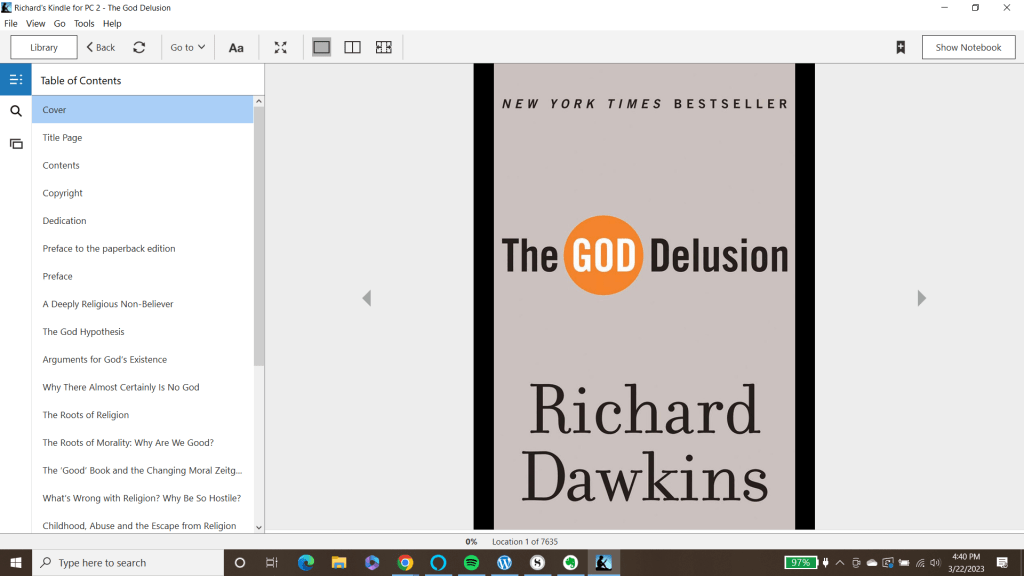
The God Delusion, by Richard Dawkins.
Amazon Abstract
A preeminent scientist — and the world’s most prominent atheist — asserts the irrationality of belief in God and the grievous harm religion has inflicted on society, from the Crusades to 9/11.
With rigor and wit, Dawkins examines God in all his forms, from the sex-obsessed tyrant of the Old Testament to the more benign (but still illogical) Celestial Watchmaker favored by some Enlightenment thinkers. He eviscerates the major arguments for religion and demonstrates the supreme improbability of a supreme being. He shows how religion fuels war, foments bigotry, and abuses children, buttressing his points with historical and contemporary evidence. The God Delusion makes a compelling case that belief in God is not just wrong but potentially deadly. It also offers exhilarating insight into the advantages of atheism to the individual and society, not the least of which is a clearer, truer appreciation of the universe’s wonders than any faith could ever muster.
The Remains of the Day, by Kazuo Ishiguro

Amazon Abstract
BOOKER PRIZE WINNER • From the winner of the Nobel Prize in Literature, here is “an intricate and dazzling novel” (The New York Times) about the perfect butler and his fading, insular world in post-World War II England.
This is Kazuo Ishiguro’s profoundly compelling portrait of a butler named Stevens. Stevens, at the end of three decades of service at Darlington Hall, spending a day on a country drive, embarks as well on a journey through the past in an effort to reassure himself that he has served humanity by serving the “great gentleman,” Lord Darlington. But lurking in his memory are doubts about the true nature of Lord Darlington’s “greatness,” and much graver doubts about the nature of his own life.
How My Mind Was Set Free
Here’s the link to this article by Merle Hertzler.
I learned early that I was not to question my religion. I was to simply have faith. And yet somehow the questions would still come. I would sometimes question the Bible. How did we know it was God’s Word? I would sometimes question Jesus. How did we know he was God? I never dared to ask these questions out loud, but in my own mind, yes, I asked these questions often.
The questions demanded attention. But simultaneously, there was always the nagging fear of what would happen if I died while I was in a state that questioned the faith. I simply could not take that chance. The consequences of dying in doubt could well be unimaginable.
So, I asked questions, yes, but I always knew what the answer needed to be. The side of my mind that argued for Christ had to beat out the side that argued against.
It is as if my mind included an advocate for the faith, an advocate against the faith, and a referee. The referee always sided with the advocate for the faith. And so, the advocate for the faith always won, two to one.
Those times were never fun. I longed to be free from doubts. And so, by sheer willpower, I pushed those questions aside.
But my mind was not really free.
Many years later, the dam would break. The questions would come out–gradually at first, then with a rush. And when it was all over, my mind was free.
I grew up in a conservative Mennonite home. We didn’t listen to secular music, watched only a select few TV shows, and centered our lives on conservative religion.
When I was 14 years old, my family and I joined a fundamentalist church, one that did not question the Bible. Fundamentalism became a way of life for me. Everything that entered my mind had to come through its filter. I soaked it all in.
I was terrified of hell and would often lie awake at night worrying about it. Even in social settings, I would be sitting there thinking about hell. Fundamentalism offered a solution. It said that all one had to do was accept Jesus. So, I did it. Did I do it right? I didn’t know. So, I did it again. I still wasn’t sure that I had done it right. And so, I did it again and again in my mind. I prayed that God would be merciful to me a sinner. I invited Jesus into my heart. Over and over, I accepted him in any way I could think to accept Christ.
One day I read the tract, What Must I Do to Be Saved, by John R Rice. It told me I did not need to concentrate on getting the act of believing right or saying the right words. I just needed to choose to believe. That’s it? All I needed to do was choose to believe? Fine. I chose to believe. Case closed. Let’s move on.
And so, I proceeded in life as though the case was closed. What a relief! I thought that everybody else surely had similar worries and needed to know this news of deliverance from hell.
“Grace, my fears relieved”, the old song says, but before that, “It was grace that taught my heart to fear.” Religion offered a cure for my fears. But what had caused the fears? Religion. Does Christianity invent the fears it then relieves? Is it solving a problem that it created?
I found relief from my fears. But to tell you the truth, faith did not do a really good job of it. The fear of hell had finally become manageable, yes, but it was always in the background.
As a Fundamentalist Baptist
In college, I joined an Independent Fundamentalist Baptist church, which then controlled every aspect of my life. I went door to door on the streets of the Bible belt, witnessing to those who may have missed God’s plan of salvation. Everybody at this church was told to be a soul winner. The pastor boomed his message from the pulpit, yelling at those who stayed home on visitation night. We had to be out there winning souls.
We didn’t want anybody to die and go to hell without knowing the way of salvation. If somebody didn’t know, then we needed to tell them. I wonder now, why did God need us to tell that story? Didn’t he have all the resources he needed? If we failed to tell somebody, and as a result that person suffered for eternity without ever having known the escape plan, how could a loving God let that happen? I never asked those questions back then. I was winning souls.
The pastor also yelled at those that listened to rock music, gave less than 10% of their income to the church, had the wrong haircut, or attended a movie theater. We were told exactly how to live our lives, and we obediently followed. It was the only life we knew.
In my senior year of college (1978) the pastor [1] moved to another church, and the church [2] deteriorated into disarray. I was confused. This was all I had to live for, and it had fallen apart. I saw the dark side of the church. There was chaos at some church functions. Once when we were singing Just as I Am over and over as an alter call, people became so bored that the song died in the middle and we never finished it. I had thought that we were saving the world. Now I looked at the lives that had been saved and wondered if it had meant anything.
Meanwhile, I watched as the story of Jim Jones and the mass suicide in Guyana appeared on TV. The story of those poor people following every command of their leader seemed all too real to me. I had been living my life much like they had. I could understand why they followed so obediently. Religion can do that to a person. Had I been deluded also?
There was something else that bothered me. I had been reading through the Bible every year since I was in 11th grade–every word of every verse–and was disturbed about what I was reading. Have you ever read the tales of killing, greed, and arrogance that fill the Old Testament? Do you ever question their relevance? I was not sure that I could trust the Bible any longer. As my confidence in the Bible withered, apathy set in.
Despair
I graduated from college with no meaning to life. My Christian hope had gone. I cannot begin to describe the despair that filled my life for the first two years after graduation. There was nothing to live for. I wanted to be happy, but I didn’t know why that would matter. Two hundred years from now, who would ever care if the bones left behind had supported a happy person or a sad person? Probably nobody would ever care.
But somehow, I cared. And I wasn’t sure why. I wanted to be happy. But instead, I knew apathy, bitterness, struggle, frustration, anger and confusion.
When my Christian hope had faded, why didn’t I look for something else? I didn’t know there was another way. I had grown up in Christian schools, Sunday schools, and Bible studies. The Bible was the only hope I knew, and it now seemed so inadequate. I never thought to look elsewhere–such is the grip that religion can have. I wish now that somebody had told me how to live the good life without the Bible. But I would not learn that until many years later.
Digging out
In desperation, I turned to Christian books. I had no intention of going back to my Independent Fundamentalist Baptist days. I thought that perhaps a milder brand of Christianity could help. As I read, I felt encouraged. Was God leading me back to himself? I thought that he was. And so, I made a commitment to walk close to the Lord again. I found that Christianity worked much better for me than apathy.
I would often go to a park and find a forsaken place alone with God where I could pray. I would pour out my heart to God, and I would leave refreshed. I took this as proof that Christianity was true.
I was soon to find the writings of C. S. Lewis. I found them fascinating. He did not just quote Bible verses. He used reason. I liked that. I read his books with enthusiasm and formed a new outlook on life.
I was back to seeing myself and others as rebellious sinners against God. I believed that I had rebelled against God, and that this had brought on the two years of depression. It was all my fault.
I saw others also in the same light as I saw myself. If somebody did something that hurt me, then I figured they must be doing it because they had given in to their evil, sinful nature. I would get bitter at those who had followed their inner sinful self in ways that hurt me. Sometimes I snapped at people and let them know how bad they were. That wasn’t good.
But I also found that religion helped me to keep my mouth shut. If inside I was bad, then I needed to keep that bad anger inside. It came from my fallen nature. I would not want my fallen nature to express itself like this. I wanted only my new positive nature, as produced by the Holy Spirit, to come out. So, the old, angry words were constrained. I set out to surrender my basic wants and desires to God.
I now was turning back to faith, not because I feared hell, but because I needed to avoid the despair associated with depression. I was no longer following the Independent Baptist tradition, but one thing I knew, I had had purpose and hope in those college days. And that was certainly better than the depression that had followed. So even if I was not convinced that my Independent Baptist days were on the right path, I figured that at least my life back then had been better. So I thought I needed faith to have purpose in this life. I just needed to make a few adjustments.
The Problem of Pain
I had a low view of human nature. Such views may look strange in light of what many now say in today’s Evangelical churches. These churches have often adopted a feel good, psychological approach to life that seeks to build our self-esteem and encourages us to accept ourselves and our feelings. Many Evangelicals do this in spite of the doctrine of human depravity that is still in Evangelical theology.
It was not long ago that the view of humanity as totally depraved was dominant, not only in fundamentalist churches, but in mainstream Protestant sources like the writings of C.S. Lewis. Since Lewis’s views were so foundational to me at that time, I will digress here to discuss the view of humanity that appears in his book, The Problem of Pain. He writes:
A recovery of the old sense of sin is essential to Christianity. Christ takes it for granted that men are bad. Until we really feel this assumption of His to be true, though we are part of the world He came to save, we are not part of the audience to whom his words are addressed, [3]
Lewis thought that we are bad people, and that God was angry with us for being bad. Lewis thought that Christianity offered no hope to those who did not share this view.
He went on to say that some Christians might ask, “What call has God, of all beings, to be angry with us?” Lewis responded to his own rhetorical question, declaring it to be a blasphemous question:
Now at the moment when a man feels real guilt–moments too rare in our lives–all of these blasphemies vanish away… At such a moment we really do know that our character, as revealed in [some sinful] action, is, and ought to be, hateful to all good men, and, if there are powers above man, to them. A God who did not regard this with unappeasable distaste would not be a good being…When we merely say that we are bad, the “wrath” of God seems a barbarous doctrine; as soon as we perceive our badness, it appears inevitable, a mere corollary from God’s goodness. [4]
Guilt is far too rare? Really? Lewis was not merely telling us that our actions are bad, but also that our very character is something that God hates with unappeasable distaste. He was saying that God is justified in having wrath toward us. For after all, at our very core, we are guilty, bad people.
Why are we so bad? Lewis contended that it is because of Adam’s sin. Can God then blame us for Adam’s sin? Lewis responds to this question:
Theoretically, I suppose, we might say “Yes, we behave like vermin, but then that is because we are vermin. And that, at any rate, is not our fault.” But the fact that we are vermin, so far from being felt as an excuse, is a greater shame and grief to us than any of the particular acts which it leads us to commit. [5]
So we find that we are born as vermin. And Lewis says that it is a shame and grief to us that we are vermin. What is the Christian to do? He continues,
Now the proper good of a creature is to surrender itself to its Creator… In the world as we know it, the problem is how to recover this self-surrender. We are not merely imperfect creatures who must be improved: we are, as Newman said, rebels who must lay down our arms…Hence the necessity to die daily: however often we think we have broken the rebellious self we shall still find it alive…The human spirit will not even begin to surrender self-will as long as all seems to be well with it. [6]
Do you get the picture? Lewis describes us all as inherently depraved descendants of Adam, as evil rebels. We need to die to our own internal wants. Suffering, he claims, is the tool that God uses to effect this change. His books were the biggest influence in my philosophy of life at that time. I also knew of a number of scripture verses to support this low view of humanity (e.g. Job 42:6, Is 64:6, Lu.17:10, and Rom. 3:10-19).
I look at it now, and do not think that I had a very healthy perspective. But this philosophy was mild compared with the Independent Fundamentalist Baptist tradition that I had come out of. And it certainly worked better than apathy. This outlook gave me a reason to live. At the time I assumed that it worked because it was right. Now, I think that it worked because it gave me a purpose. Other ways would have worked better.
C. S. Lewis showed me that life was rough, yes, but that was because we needed pain to change us from vermin to what we should be. Fine. Life is hard, but there was a reason for it. God was dealing with the old me, the vermin. I pushed onwards. And it seemed to be working.
I had found this one great pillar to support my rebuild of faith: Christianity is worthwhile because the path that I had found within Christianity works, at least it works for me.
That pillar would one day collapse on me when it was shown to be inadequate. The observation that faith made me feel better is simply not a good reason to say that the faith is true. But at that time the reasoning seemed solid.
Creationism
There was a second great pillar on which I based my faith. This pillar had stood firm even during the days of despair. I was quite familiar with the teachings of Henry Morris and the young Earth creationists. I thought that this was the most logical explanation for how life began. They argued that the Earth was created by God a few thousand years ago, just as the Bible said. During the time of Noah, a great flood covered the Earth. This flood buried many animals, I was told, and these became the fossils we see today. Creationists argued that all this was supported by scientific findings.
Creationists argued that evolution was impossible. They said that creationism was consistent with true science, but evolution was pseudoscience. I listened to this side only and was convinced.
Other things in the Bible may perhaps be wrong. I was finding simply too many problems with the Bible. But I had these two great pillars of my faith: a belief that Christianity as I knew it worked; and a belief that Genesis was the best explanation of origins.
Exposure to Enlightened Views
In 1987 I moved to the suburbs of Philadelphia and found an exciting Evangelical church. I met many wonderful people and quickly became involved in many aspects of the program. I had found a home and was happy.
Some of the Christians at this church came from a range of religious backgrounds. This was new to me. Some people disagreed with the way I understood Christianity. Some did not agree with me that the Earth was only a few thousand years old, for instance, or that the fossils had come from Noah’s flood.
Others told me that my religious philosophy did not work, that other philosophies worked better. There were big differences. I thought that we should despise our evil inner self; they thought that we should love ourselves. I thought that we must work hard to keep the evil anger inside of us from coming out; they thought that anger was there because we had not vented our anger. I thought that the big problem was overestimating oneself and overconfidence; they thought that the big problem was low self-esteem and a lack of self-confidence. I thought that we needed to die to ourselves; they thought that we need to discover ourselves and self-actualize. I thought that God made us feel guilty about our evil feelings; they thought it was the devil that wanted us to feel guilty about natural feelings. I thought that God allowed people to mistreat us because that was his way of molding our character; they thought that mistreatment damaged our psyche, often requiring counseling to overcome the effects. They thought my philosophy was depressing.
Do you understand why this was a difficult pill for me to swallow? This was a main pillar of my Christian faith–the belief that my Bible-supported views worked. Now here were Christians telling me that my version did not work well. What did they mean it didn’t work well? It absolutely did work. It worked far better for me than the apathy and the depression I had been in. And I had scripture to back it up.
It was not easy for me to accept that my way did not work well and was not based on truth. So, I prayed about it and read the Bible. And what do you think happened when I prayed? That’s right. I was convinced that God was telling me I was right. Seriously, who was I to go against what God was saying to me?
My friends and I all agreed that Christianity had the best answers to life. My experience and prayers told me that my version worked better. Their experiences and prayers told them that their version worked better. Who was right?
Computer Debates
I was soon to have my eyes opened to many other philosophies that supposedly worked best. I would soon meet believers in Mormonism, Islam, Bahai, Judaism, Wicca, and Atheism. Each was sure that his way had worked for him, thus showing that it was the best.
I was going to also hear of many psychological solutions, again with testimonials for each claiming that it was better than other techniques. I was not the only one who had claimed that my experience proved that I was right. Lots of people were claiming that they had tried something, and this made them feel better. Do all philosophies work? Some researchers had looked at the conflicting cures within psychology and wrote, “Is it true that ‘Everyone has won, and all must have prizes’?” [7] Indeed!
I met these people of many religions in the CompuServe debate forum, back in the days when one used a modem to dial into a computer instead of using the Internet. I began to participate in the religion section. I actively debated religion and psychology with anybody that wanted to discuss them. This was to become an important focus of my life.
The biggest lesson I learned during these debates was how to form an argument. It was not enough for me to state that Jay Adams, C. S. Lewis, or Thomas Szasz had written something that agreed with me on a particular point. After all, one can find somebody who will agree with almost any religious viewpoint that he expresses. I needed a more effective argument.
My favorite resource was the Psychoheresy Awareness Ministry of Martin and Deidre Bobgan. They referred to psychological experiments to support their arguments, and often quoted scientific journals. I found that when I described experiments people often listened to what I had to say and were less likely to attack my writings. I developed a love for scientific experiments and the scientific journals that described them.
And so began a regular series of trips to the Philadelphia Public Library, and later, a university library. I would make lists of articles that favored my positions and would go to the library to get more ammunition for my side.
Cracks in the Foundation
These trips became time-consuming, and so, in 1992, I subscribed to my favorite journal, The Journal of Personality and Social Psychology. At $247 a year, this represented a major desire to learn the truth. Having made the commitment, I was determined to learn something from each issue. I began to read papers whether I thought they agreed with my position or not. This was a change for me. I was not merely reading to prove I was right. I was reading to learn.
I read some papers that were enlightening. I read that trying to suppress thoughts can make them stronger. [8] Were my efforts to keep my true thoughts under control making those repressed thoughts stronger? I learned more about the function of self-esteem. Was my viewpoint of myself as an evil sinner harmful? Did my Christianity really not work as well as I had persuaded myself it had? Slowly, microscopic cracks began to develop in this great pillar of my faith. It was slow and subtle, but the cracks were beginning.
The Creationism Pillar Caves
Meanwhile, a strange twist of fate put me right into the middle of the creation-evolution debate. That was not where I wanted to be, for these fights were often quite nasty. I couldn’t believe that I was there in the middle of it all. But I was not about to leave a good debate. I decided to let people know that evolution could not possibly happen.
I made some progress arguing that the complexity of genes made evolution difficult, but somebody wanted to know where all of those fossils had come from, if not from hundreds of millions of years of evolution. I suggested they might have been caused by Noah’s flood. My argument was defeated in one round. I was asked to explain how it is that we find rocks made of wind-blown sand in the midst of all these rocks under the earth. I had no answer. Wind certainly wouldn’t be blowing sand around under the floodwaters. I told myself the problem was that I was not familiar enough with that issue. So, I avoided the flood altogether until I could find better answers.
I never did find a satisfactory answer to this simple question, nor to many of the other problems with Noah’s flood. So, I concentrated instead on problems that I perceived with the mechanism of evolution.
To make a long story short, this led me to a moment of epiphany in which I found myself in a library completely overwhelmed with the evidence for evolution. In shock, it dawned on me that I had no convincing case for my young Earth Creationism.
After the dust had settled, 18 months later, I had switched to arguing for evolution. I describe this transition elsewhere, and won’t repeat it here.
It was a complete change. Many people have survived the switch to evolution, and they still have faith. But the switch to evolution was traumatic for me. For I had two strong pillars left in my faith, the supposed evidence for creationism, and the understanding that Christianity works. The creationism pillar was now gone. The building above was resting on one unstable column.
The Second Pillar Caves
Meanwhile the other pillar of my faith–the one that said conservative Christian philosophy worked–was severely cracking. When I had met people offering all kinds of psychological cures for the condition of the human heart, I had argued that some researchers had found that it was not just the specifics of the cure that helped people, but that it was the caring, nurturing relationship with a friendly helper that was doing more to build hope, and thus help troubled people. [9] I argued that, therefore, others could not force a view on me that they found had worked for them. Perhaps the fact that they felt better had nothing to do with their method. Perhaps they were feeling better only because they were making a cooperative effort with others to address the problem.
One day somebody turned that argument on its end. He asked me how I knew that Christianity worked. Perhaps people were helped within Christianity because they were in a nurturing relationship with caring people, not because of the specifics of the Bible. I had been caught by my own argument, and I had no answer. I knew I could not be sure that it was Christianity that made the difference.
As this was happening, I was also needing to deal with the errors in the Bible. I had known about these problems for years, ever since I had read through the entire Bible six times in my youth. But I had found those two great pillars of my faith, and thus could ignore the Bible’s problems. Those pillars were now in shambles. And I was seeing skeptics on the forum arguing that the Bible commanded massacres (e.g. 1 Samuel 15); praised terrorism (e.g. Psalm 137); and allowed slavery (e.g. Exodus 21). They pointed out contradictions in the Bible. I knew I had no chance against their arguments. It was no longer possible to ignore what the Bible said. My faith was crumbling.
What should I do?
I began to rapidly incorporate new ideas into my mind. I did my best to piece together a progressive philosophy of life that would keep my faith in spite of these problems. I experimented with ways to include evolution, an obviously errant Bible, a higher view of the self, and even Humanism into my Christianity.
Meanwhile, I moved on to other interests: country dancing, movies, and romance. Ah yes, romance. I fell in love with a very special lady, who has become my best companion in life. She has supported me through some tough times, and I am very grateful to her. She has a compassion and concern for others that I can only dream about. I had found somebody that I could love with all of my heart. We were soon to be married. She has not agreed with where my skepticism has finally led me, but she is always my best friend.
I had drifted away from participation in church. I now made one last effort to find my place again. There had been a radical change in my thought process. I was no longer the most conservative thinker on the block. Now I was perhaps the most liberal thinker at church. I persuaded myself that I could still fit in–after all it was the progressive element at church that started me on my journey–but I found it increasingly hard to identify with the church program. And I asked questions that surprised everyone.
There is no stopping the mind set free. It is like that first leak of water through the dam. It reaches a critical size, and then bursts free. My thoughts refused to stop. The dam had been broken. I read books that were critical of the Bible. I read the Bible from a whole new viewpoint. I found skeptical sites on the Internet. I asked many questions–many of which are on my website. I found it harder and harder to identify myself as a Christian.

Even the label of Liberal Christian was losing its appeal. I could no longer believe the basics of Christianity. If I still identified as a Christian, while sidestepping the problems, was I committing the sin of silence?
| The Sin of Silence by Gerald A. Larue What’s the Harm? Why Religious Belief Is Always Bad by Richard Carrier |
Liberal Christianity Links
Where it All Led
In 2002 I decided that I could no longer identify myself as a Christian. What am I? I am now an Ex-Christian, an Agnostic, a Humanist, and a Freethinker. In September 2002 I created the website Questioning: An Examination of Christian Belief to discuss my questions and to explain what had happened to me.
I have not chosen an easy path. It is not easy to tell people that I no longer believe that this message is true. But I find the evidence overwhelming. If the weight of the evidence were marginal, I would follow the believing crowd and not raise the issue. I do not like to be different. I prefer to follow the crowd. All of my life I have been a follower. I have always wanted to fit in. But there are just too many problems with the Bible. I simply cannot unlearn what I have learned. Knowing what I know, I cannot be a Christian. So, I choose the road less traveled.
I am not asking you to follow me. You have a mind of your own. You can decide for yourself. But perhaps you could learn from me.
I now have a different perspective in life. I wrote earlier of how I once saw people that hurt me as being evil. If somebody hurts me now, I think they must do it because, from their perspective and current knowledge, it seems best for them to do what they do. Years ago, it was hard to forgive hateful vermin who did hateful things. It is much easier to forgive confused but well-meaning individuals. This change in perspective works wonders. Instead of concentrating on bridling the tongue, one can concentrate on understanding the person who did hurtful things. Rational questioning changes perspectives, and changed perspectives change lives.
I find that I am far happier without the bonds of a preset religion. My mind has been set free. I am free to explore the world without the need to fit everything into a predefined religious bias.
It is fine to question. It is safe to explore. There is always more to learn. I hope that neither you nor I will ever stop questioning.
The above is an edited copy of the story I shared on the web in 2002. Since then, I have enjoyed a life that is truly free. This story had been part of my Questioning: An Examination of Christian Belief website that was on the Internet until 2017. I have now brought that site back online with a major facelift. I have rebranded it as The Mind Set Free.
by Merle Hertzler, June 11, 2022
Is There Happiness without Jesus?
Here’s the link to this article by Merle Hertzler.

Perhaps to you, Christ is the only hope in this world. Your life is centered on him. He is your purpose in life. I understand. I have been there. I accepted Jesus Christ as my personal savior many years ago. I have read the Bible from cover to cover six times–every chapter, every verse, and every line. I have spent literally hours a week in prayer, as I grew in my personal relationship with the Lord. In college, I never drank alcohol. Instead, I attended prayer meetings and went door-to-door witnessing to get my thrills. I have taught Sunday school, sung in the choir, and worked in the children’s ministry. I have been there and done that. I know what it is like to discuss all the details of my life with the Lord, believing that he was right there in my heart listening to me.
I know the excitement of doing God’s work all day Sunday. And I also know the emptiness that would come on Monday. I used to wonder why a person that was so committed to the Lord would feel that way on Monday. It seemed that the more I allowed myself to get excited on Sunday, the worse I would feel on Monday.
I am no longer a believer. I have found something different. I have learned to question, to explore, to think, to be free, to be me. I have the freedom to freely grasp life without the restraint of religion. I have found a purpose that is as good on Monday as it is on Sunday. Life without Christianity can be far more fulfilling than anything that I had ever found inside. And there are hundreds of others who testify to the same thing.
| Religious Beliefs and Societal Health, By Matthew Provonsha Into the Clear Air by Adam Lee Why are these people so happy? When You Feel Like a Loser by Merle Hertzler Sad? Discouraged? I offer some advice. The Crazy-Making in Christianity by Marlene Winell What faith can do to you, and how to recover. Justin Brierley and the Folly of Christianity by Richard Carrier The Bible and Self Esteem by Merle Hertzler |
Happiness links
Have you found joy in Christ? I am glad that you are happy. But tell me something, please: Why do so many Christians struggle to find that joy? Where is their peace? Why are they so discouraged? Why are they so sad?
How do I know that many Christians are sad? Here is one way to see it: Fire up your search engine and search for “sad discouraged depressed Christians.” As I write this I find 9,570,000 hits.[1 ] Sure, not all of those sites are relevant, but most of the top sites are. They are written by Christians to help sad, depressed Christians. Why are all these people trying to help discouraged Christians? It seems that there is a problem. There must be many thousands of sad, depressed Christians out there.
Let’s look at the solutions offered on these sites. What are Christians depending on to give them hope? Some Christians look to Christ alone as their source of happiness. Others look to other sources also, such as psychology, to help them find their way. What do the top Christian sites propose? I found the usual smattering of Bible verses, and then I found suggestions such as these:
- Replace negative with positive thoughts
- Keep a journal of what you think and feel
- Give yourself affirmations
- Listen to relaxing music
- Get more light or less heat
- Change your normal routine
- Seek professional help
- Take St. John’s Wort
- Try cognitive therapy [2]
We see here a variety of techniques. It would appear to me that these suggestions have little to do with Jesus. Can no freethinker ever listen to relaxing music? Can no atheist go into the sunlight or affirm himself? These things apply to unbelievers as well as Christians. The unbeliever is not missing out on any of this. In fact, many have found that it is easier to enjoy the good life without religion.
Does Jesus really give his followers peace and joy? Then why must Christians walk around giving themselves affirmations to avoid depression?
Do you see the hypocrisy here? Non-Christians are told that they need to accept Christ to have peace and joy in their life. Yet many believers are missing peace and joy, and Christians recommend that these believers turn to therapies such as cognitive therapy, a treatment that was developed in the secular world. Is this consistent? If cognitive therapy is the cure for the troubled mind, why do evangelists tell us that Jesus is the cure?
Psychology vs Faith links
Do you need to give yourself pep talks to avoid discouragement? Do you have a daily struggle trying to find peace and joy? Then you cannot tell me that I need what you have to be happy. It seems to me that it would be hypocritical to claim on Sunday that one has peace and joy in life, and then visit the psychiatrist to deal with a life in despair on Monday. Wouldn’t it be better to face the facts? Wouldn’t it be better for one to admit that, in spite of religion, he is not really happy? Wouldn’t it be better for such a person to say that his Christianity has not really satisfied him?
Perhaps you have indeed found genuine happiness in Christianity. I am glad for you. I hope you understand that others have found happiness elsewhere. You may not need what I have to be happy, and I may not need what you have.
But not all Christians are happy. Many are very sad. Some tell me that it is only weak, carnal Christians who experience such prolonged sadness. They will tell me that mature Christians overcome and are happy. Then why is it that there are sites dedicated to helping depressed missionaries?
| Missionary Care A mental health ministry for Christian missionaries. Psychiatric Wards for Born-Again Christians Only by Edmund D. Cohen |
Christian Depression links
With so many missionaries in need of recovery from depression, it seems that one can be totally dedicated to Christ and not be happy. It is difficult for me to see that they can claim that their faith alone has the way to peace and joy in life.
Some will tell me that depression, as a medical condition, is outside the scope of the Bible. Fine, but psychologists commonly treat depression with Cognitive Behavior Therapy, which originated from humanists such as Albert Ellis. If you turn to Cognitive Behavior Therapy in severe cases of depression, why would not quite similar principles used by humanists be good for mild discouragement?
There are many ways to happiness. As for me, I have found no greater joy than that of being free–free from the need to believe a religion that my mind has found to be false. I can explore the world around me and learn without the need to force my observations into a preconceived mold.
There is no experience quite like setting the mind free.
Albert Einstein once wrote,
The important thing is to not stop questioning. Curiosity has its own reason for existing. One cannot help but be in awe when he contemplates the mysteries of eternity, of life, of the marvelous structure of reality. It is enough if one tries merely to comprehend a little of this mystery every day. Never lose a holy curiosity.Source: https://www.inspiringquotes.us/author/3804-albert-einstein/about-curiosity
Do you have that holy curiosity? Are you free to ask questions–even about your faith? Are you free to take intellectual journeys away from the path that you have been taught? I think you will be happier if you choose to be free.
Robert Ingersoll describes that experience:
When I became convinced that the Universe is natural– that all the ghosts and gods are myths– there entered into my brain, into my soul, into every drop of my blood, the sense, the feeling, the joy of freedom. The walls of my prison crumbled and fell, the dungeon was flooded with light and all the bolts, and bars, and manacles became dust. I was no longer a servant, a serf or a slave. There was for me no master in all the wide world — not even in infinite space. I was free — free to think, to express my thoughts — free to live to my own ideal — free to live for myself and those I loved — free to use all my faculties, all my senses — free to spread imagination’s wings — free to investigate, to guess and dream and hope — free to judge and determine for myself…
For the first time I was free. There were no prohibited places in all the realms of thought — no air, no space, where fancy could not spread her painted wings — no chains for my limbs — no lashes for my back — no fires for my flesh — no master’s frown or threat — no following another’s steps — no need to bow, or cringe, or crawl, or utter lying words. I was free. I stood erect and fearlessly, joyously, faced all worlds.Source: Why I Am Agnostic – Robert Green Ingersoll, offsite
I agree. I am glad that folks like Ingersoll have taught me how to have a good life. They have taught me how to be free. And now I am passing the baton to you.
| Exuberance, an Affirmative Philosophy of Life by Paul Kurtz 20 Atheist Quotes about Joy and Meaning by Valerie Tarico The Promise Of Humanism by Frederick Edwords |
Links on the Good Life
I hope I have helped you to ask questions, that those questions lead you to answers, and that through it all, your mind is set free.
Random reading/listening–03/30/23
Here’s the link to Adam Lee’s must read article: “New York is a City of Freedom, Not a City of God.
03/30/23 Biking & Listening
Biking is something else I both love and hate. It takes a lot of effort but does provide good exercise and most days over an hour to listen to a good book or podcast. I especially like having ridden.
Here’s my bike, a Rockhopper by Specialized. I purchased it November 2021 from Venture Out in Guntersville; Mike is top notch! So is the bike, and the ‘old’ man seat I salvaged from an old Walmart bike.
Here’s a link to today’s bike ride. This is my pistol ride.
Here’s a few photos taken along my route:
Currently, I splitting my biking time listening to two books. Here they are:
The God Delusion, by Richard Dawkins.
Amazon Abstract
A preeminent scientist — and the world’s most prominent atheist — asserts the irrationality of belief in God and the grievous harm religion has inflicted on society, from the Crusades to 9/11.
With rigor and wit, Dawkins examines God in all his forms, from the sex-obsessed tyrant of the Old Testament to the more benign (but still illogical) Celestial Watchmaker favored by some Enlightenment thinkers. He eviscerates the major arguments for religion and demonstrates the supreme improbability of a supreme being. He shows how religion fuels war, foments bigotry, and abuses children, buttressing his points with historical and contemporary evidence. The God Delusion makes a compelling case that belief in God is not just wrong but potentially deadly. It also offers exhilarating insight into the advantages of atheism to the individual and society, not the least of which is a clearer, truer appreciation of the universe’s wonders than any faith could ever muster.
The Remains of the Day, by Kazuo Ishiguro
Amazon Abstract
BOOKER PRIZE WINNER • From the winner of the Nobel Prize in Literature, here is “an intricate and dazzling novel” (The New York Times) about the perfect butler and his fading, insular world in post-World War II England.
This is Kazuo Ishiguro’s profoundly compelling portrait of a butler named Stevens. Stevens, at the end of three decades of service at Darlington Hall, spending a day on a country drive, embarks as well on a journey through the past in an effort to reassure himself that he has served humanity by serving the “great gentleman,” Lord Darlington. But lurking in his memory are doubts about the true nature of Lord Darlington’s “greatness,” and much graver doubts about the nature of his own life.
 Richard L. Fricks