Write to Life blog

Character Type and Trope Thesaurus: Explorer

Here’s the link to this article.

May 13, 2023 by ANGELA ACKERMAN 1 Comment

In 1959, Carl Jung first popularized the idea of archetypes—”universal images that have existed since the remotest times.” He posited that every person is a blend of these 12 basic personalities. Ever since then, authors have been applying this idea to fictional characters, combining the different archetypes to come up with interesting new versions. The result is a sizable pool of character tropes that we see from one story to another.

Archetypes and tropes are popular storytelling elements because of their familiarity. Upon seeing them, readers know immediately who they’re dealing with and what role the nerd, dark lord, femme fatale, or monster hunter will play. As authors, we need to recognize the commonalities for each trope so we can write them in a recognizable way and create a rudimentary sketch for any character we want to create.

But when it comes to characters, no one wants just a sketch; we want a vibrant and striking cast full of color, depth, and contrast. Diving deeper into character creation is especially important when starting with tropes because the blessing of their familiarity is also a curse; without differentiation, the characters begin to look the same from story to story.

But no more. The Character Type and Trope Thesaurus allows you to outline the foundational elements of each trope while also exploring how to individualize them. In this way, you’ll be able to use historically tried-and-true character types to create a cast for your story that is anything but traditional.

Explorer Archetype

DESCRIPTION
Explorers thrive on adventure and discovery. These trailblazers are unafraid of new experiences or challenges, and boldly moving into the unknown is a part of their identity.

FICTIONAL EXAMPLES: Indiana Jones (Indiana Jones Series), Captain Picard (Star Trek), Lara Croft (Tomb Raider), Evelyn O’Connell (The Mummy Franchise)

COMMON STRENGTHS
Adaptable, Adventurous, Ambitious, Appreciative, Bold, Confident, Curious, Decisive, Focused, Idealistic, Independent, Observant, Passionate, Persistent, Resourceful, Spontaneous, Wise

COMMON WEAKNESSES
Abrasive, Cocky, Impatient, Impulsive, Macho, Manipulative, Obsessive, Possessive, Rebellious, Reckless, Selfish, Stubborn, Temperamental, Withdrawn, Workaholic

ASSOCIATED ACTIONS, BEHAVIORS, AND TENDENCIES
Nomadic tendencies (being on the move, never staying too long in one place)
Not needing much in the way of creature comforts
Having fewer attachments (to things, people, places)
Having a broad understanding of people, cultures, and customs
Knowing more than one language
Being highly spontaneous
Being a ‘figure it out as I go’ sort of person
Having a strong sense of purpose and a clear goal at all times
Able to think on their feet and adapt to changing circumstances
Being able to learn the rules of a new environment quickly
Excellent survival and navigation skills
Recovering from disappointments quickly and moving on
Being drawn in by stories
Being curious about people, places, and experiences
A desire to see and experience things first hand
Always being up for a trip, outing, or adventure
Being unafraid of new circumstances or challenges
Being a thrill-seeker
Not being turned off by danger or risk
More likely to act on instinct rather than through a deep analysis
The ability to size people up quickly
Needing to be talked out of things, rather than talked into them
Preferring their own company to the company of others
A tendency to believe the ends justify the means (when they believe in the cause)
Being a lifelong learner
Focusing on the journey, not the goal
A tendency to push to find their own limits (and then push to challenge them further)
Fearing a boring life more than anything else

SITUATIONS THAT WILL CHALLENGE THEM
Having no choice but to wait because another is in control of when things happen
Having to adhere to a routine
Being unable to travel (due to illness, legal restrictions, an injury, family responsibilities, etc.)
Being anchored by duty (becoming a caregiver to an elderly parent, having to run a family business, raising a child, etc.)
Being bound by rules and limitations
Having to give up personal freedom to serve the greater good
Being stuck in a single place for too long
Finding time for healthy, two-way relationships
Finding someone to talk through their feelings or struggles because while they may know a lot of people, few are close enough for those type of conversations
Being around people who are closed-minded and see the world in absolutes

INNER STRUGGLES TO GIVE THEM DEPTH
Feeling selfish for wanting to be out discovering new things when it means others must stay behind and pick up the slack
Wanting to have relationships but knowing the other party will only end up feeling neglected
Feeling guilt for abandoning people when the next adventure calls
Guilt over risk-taking that impacts others negatively
Regret over what they chose to give up (possibly a place to call home, close family bonds, a life partner, etc.)
Knowing the personal growth they seek may come at the price of a lonely life

TWIST THIS TROPE WITH A CHARACTER WHO…
Finds ways to be dependable while making room for adventure
Gives back as a teacher or leader who encourages others to embrace open-mindedness
Becomes a role model to someone who is dependent or insecure, showing them how to become more independent
Is an explorer who is unselfish, putting the needs of others first

CLICHÉS TO BE AWARE OF

  • The “lone wolf” adventurer
  • The explorer who inspires deep loyalty despite never being around to nurture relationships
  • The adventurer who only travels to far off, obscure places
  • Being a collector of antiquities and objects when the lifestyle doesn’t support materialism

Other Type and Trope Thesaurus entries can be found here.

Need More Descriptive Help?

While this thesaurus is still being developed, the rest of our descriptive collection (16 unique thesauri and growing) is accessible through the One Stop for Writers THESAURUS database.

If you like, swing by and check out the video walkthrough for this site, and then give our Free Trial a spin.

ANGELA ACKERMAN

ANGELA ACKERMAN

Angela is a writing coach, international speaker, and bestselling author who loves to travel, teach, empower writers, and pay-it-forward. She also is a founder of One Stop For Writers, a portal to powerful, innovative tools to help writers elevate their storytelling.

Practical Mysticism: Evelyn Underhill’s Stunning Century-Old Manifesto for Secular Transcendence and Seeing the Heart of Reality

Here’s the link to this article.

“Because mystery is horrible to us, we have agreed for the most part to live in a world of labels; to make of them the current coin of experience, and ignore their merely symbolic character, the infinite gradation of values which they misrepresent.”

BY MARIA POPOVA

Practical Mysticism: Evelyn Underhill’s Stunning Century-Old Manifesto for Secular Transcendence and Seeing the Heart of Reality

The great paradox of consciousness is that it constitutes both our entire experience of reality and our blindfold to reality as it really is. Forever trapped within it, we mistake our concepts of things for the things themselves, our theories for the universe, continually seeing the world not as it is but as we are. The supreme frontier of human freedom may be the ability to accept that something exists beyond understanding, that understanding is a machination of the mind and not a mirror of the world — that the world simply is, and our consciousness is a participant in its being but not a creator of it.

The English poet, novelist, mystic, and peace activist Evelyn Underhill (December 6, 1875–June 15, 1941) explores how to do that in her 1914 book Practical Mysticism (public library | public domain) — a field guide to mystical experience that is secular rather than religious, the product of “ordinary contemplation” springing from the very essence of human nature, available to all.

Evelyn Underhill

Acknowledging what modern cognitive scientists well know — that our attention is “an intentional, unapologetic discriminator” — Underhill observes that “only a few amongst the wealth of impressions we receive are seized and incorporated into our picture of the world,” and reflects on the spiritual significance of this tendency to mistake representation for reality:

The distinction between mystic and non-mystic is not merely that between the rationalist and the dreamer, between intellect and intuition. The question which divides them is really this: What, out of the mass of material offered to it, shall consciousness seize upon — with what aspects of the universe shall it “unite”?

It is notorious that the operations of the average human consciousness unite the self, not with things as they really are, but with images, notions, and aspects of things. The verb “to be,” which [the self] uses so lightly, does not truly apply to any of the objects amongst which the practical man supposes himself to dwell. For him, the hare of Reality is always ready-jugged [jugged hare is a traditional English dish of hare marinated in wine and juniper berries, cooked in the animal’s blood]: he conceives not the living, lovely, wild, swift-moving creature which has been sacrificed in order that he may be fed on the deplorable dish which he calls “things as they really are.” So complete, indeed, is the separation of his consciousness from the facts of being, that he feels no sense of loss. He is happy enough “understanding,” garnishing, assimilating the carcass from which the principle of life and growth has been ejected, and whereof only the most digestible portions have been retained.

This, Underhill observes, is the opposite of the mystical orientation, which opens us up to a kind of knowledge beyond understanding — the kind that Elizabeth Bishop invoked in her astonishing poem “At the Fishhouses,” consonant with the notion of adaequatio and kindred to Maurice Bucke’s notion of cosmic consciousness.

Plate from An Original Theory or New Hypothesis of the Universe by Thomas Wright, 1750. (Available as a print and as stationery cards.)

Five years earlier, Underhill had voiced these existential reckonings through the heroine of her novel The Column of Dust:

She had seen, abruptly, the insecurity of those defences which protect our illusions and ward off the horrors of truth. She had found a little hole in the wall of appearances; and peeping through, had caught a glimpse of that seething pot of spiritual forces whence, now and then, a bubble rises to the surface of things.

That bubble, she intimates in Practical Mysticism, is what mysticism as “the art of union with Reality” surfaces in us. She writes:

Because mystery is horrible to us, we have agreed for the most part to live in a world of labels; to make of them the current coin of experience, and ignore their merely symbolic character, the infinite gradation of values which they misrepresent. We simply do not attempt to unite with Reality. But now and then that symbolic character is suddenly brought home to us. Some great emotion, some devastating visitation of beauty, love, or pain, lifts us to another level of consciousness; and we are aware for a moment of the difference between the neat collection of discrete objects and experiences which we call the world, and the height, the depth, the breadth of that living, growing, changing Fact, of which thought, life, and energy are parts… Then we realise that our whole life is enmeshed in great and living forces; terrible because unknown… The more sacred plane of life and energy which seems to be manifested in the forces we call “spiritual” and “emotional” — in love, anguish, ecstasy, adoration — is hidden from us too. Symptoms, appearances, are all that our intellects can discern: sudden irresistible inroads from it, all that our hearts can apprehend. The material for an intenser life, a wider, sharper consciousness, a more profound understanding of our own existence, lies at our gates. But we are separated from it, we cannot assimilate it; except in abnormal moments, we hardly know that it is.

Art by Kay Nielsen from East of the Sun and West of the Moon, 1914. (Available as a print and as stationery cards.)

Those who bridge the separation, Underhill argues, are the mystics. Pointing to Walt Whitman as one such secular mystic — a person who “has achieved a passionate communion with deeper levels of life than those with which we usually deal” — she invites a layered understanding of what this notion of practical mysticism means:

The visionary is a mystic when his vision mediates to him an actuality beyond the reach of the senses. The philosopher is a mystic when he passes beyond thought to the pure apprehension of truth. The active man is a mystic when he knows his actions to be a part of a greater activity. Blake, Plotinus, Joan of Arc, and John of the Cross — there is a link which binds all these together: but if he is to make use of it, the inquirer must find that link for himself.

This practical mysticism, she argues as she contrasts it with an “indolent and useless mysticality,” is available to the ordinary person as an invitation “to a training of his latent faculties, a bracing and brightening of his languid consciousness, an emancipation from the fetters of appearance, a turning of his attention to new levels of the world.” She offers a sentiment of winged assurance:

As the beautiful does not exist for the artist and poet alone — though these can find in it more poignant depths of meaning than other men — so the world of Reality exists for all; and all may participate in it, unite with it, according to their measure and to the strength and purity of their desire.

The Dove No. 1 by Hilma af Klint. (Available as a print and as stationery cards.)

Underhill considers the ultimate reward of practical mysticism:

Mysticism [is] the art of union with Reality [and], above all else, a Science of Love. Hence, the condition to which it looks forward and towards which the soul of the contemplative has been stretching out, is a condition of being, not of seeing. As the bodily senses have been produced under pressure of man’s physical environment, and their true aim is not the enhancement of his pleasure or his knowledge, but a perfecting of his adjustment to those aspects of the natural world which concern him — so the use and meaning of the spiritual senses are strictly practical too. These, when developed by a suitable training, reveal to man a certain measure of Reality: not in order that he may gaze upon it, but in order that he may react to it, learn to live in, with, and for it; growing and stretching into more perfect harmony with the Eternal Order, until at last, like the blessed ones of Dante’s vision, the clearness of his flame responds to the unspeakable radiance of the Enkindling Light.

Indeed, she places the ability — the willingness — to “look with the eyes of love” at heart of this practice of seeing reality clearly — a practice containing “the whole art of spiritual communion.” In a passage consonant with Dostoyevsky’s insistence that “nature, the soul, love, and God, one recognizes through the heart, and not through the reason,”, and evocative of Hilton Als’s notion of love as the art of receptivity, Underhill writes:

The attitude which it involves is an attitude of complete humility and of receptiveness; without criticism, without clever analysis of the thing seen. When you look thus, you surrender your I-hood; see things at last as the artist does, for their sake, not for your own. The fundamental unity that is in you reaches out to the unity that is in them: and you achieve the “Simple Vision” of the poet and the mystic — that synthetic and undistorted apprehension of things which is the antithesis of the single vision of practical men. The doors of perception are cleansed, and everything appears as it is. The disfiguring results of hate, rivalry, prejudice, vanish away. Into that silent place to which recollection has brought you, new music, new colour, new light, are poured from the outward world. The conscious love which achieves this vision may, indeed must, fluctuate… But the will which that love has enkindled can hold attention in the right direction. It can refuse to relapse to unreal and egotistic correspondences; and continue, even in darkness, and in the suffering which such darkness brings to the awakened spirit, its appointed task, cutting a way into new levels of Reality.

Complement these fragments of Underhill’s wholly revelatory Practical Mysticism with the poetic physicist Alan Lightman on transcendence for the science-spirited, then revisit Emerson on nature, transcendence, and how we become our most authentic selves.

05/14/23 Biking & Listening

Biking is something else I both love and hate. It takes a lot of effort but does provide good exercise and most days over an hour to listen to a good book or podcast. I especially like having ridden.

Here’s my bike, a Rockhopper by Specialized. I purchased it November 2021 from Venture Out in Guntersville; Mike is top notch! So is the bike, and the ‘old’ man seat I salvaged from an old Walmart bike.

Here’s a link to today’s bike ride. This is my pistol ride.

Here’s a few photos taken along my route:

Here’s what I’m listening to: It Ends With Us, by Colleen Hoover

Amazon abstract:

In this “brave and heartbreaking novel that digs its claws into you and doesn’t let go, long after you’ve finished it” (Anna Todd, New York Times bestselling author) from the #1 New York Times bestselling author of All Your Perfects, a workaholic with a too-good-to-be-true romance can’t stop thinking about her first love.

Lily hasn’t always had it easy, but that’s never stopped her from working hard for the life she wants. She’s come a long way from the small town where she grew up—she graduated from college, moved to Boston, and started her own business. And when she feels a spark with a gorgeous neurosurgeon named Ryle Kincaid, everything in Lily’s life seems too good to be true.

Ryle is assertive, stubborn, maybe even a little arrogant. He’s also sensitive, brilliant, and has a total soft spot for Lily. And the way he looks in scrubs certainly doesn’t hurt. Lily can’t get him out of her head. But Ryle’s complete aversion to relationships is disturbing. Even as Lily finds herself becoming the exception to his “no dating” rule, she can’t help but wonder what made him that way in the first place.

As questions about her new relationship overwhelm her, so do thoughts of Atlas Corrigan—her first love and a link to the past she left behind. He was her kindred spirit, her protector. When Atlas suddenly reappears, everything Lily has built with Ryle is threatened.

An honest, evocative, and tender novel, It Ends with Us is “a glorious and touching read, a forever keeper. The kind of book that gets handed down” (USA TODAY).

God’s Bad Habit of Oversleeping

Here’s the link to this article.

By David Madison, 04/14/23.

And the Christian bad habit of being OKAY with it

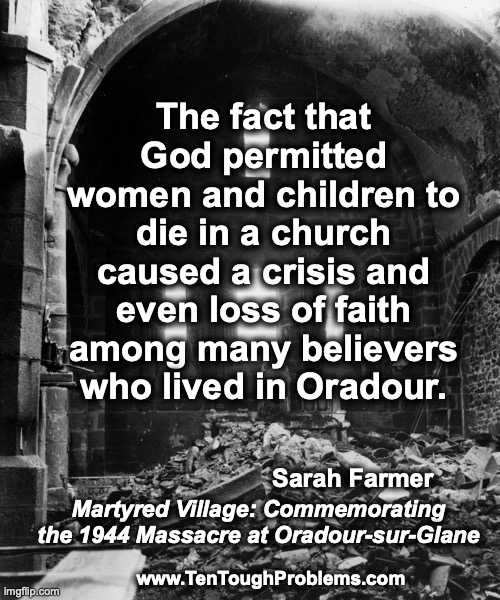
On Saturday, 10 June 1944—four days after the Allied landing at Normandy—the rural village of Oradour-sur-Glane, in Vichy occupied France, was surrounded by an SS Panzer division of German soldiers. They rounded up all of the residents, forced the men into barns and stables, the women and children into the church. Then, with machine guns and fire-bombs, they murdered all 643 of them: 462 women and children were killed in the church. The women had felt safe in the church, because, of course, that’s where God is paying the closest attention to those who worship him. So how could a caring, attentive, powerful, competent god have allowed this savagery to happen? “God is good, God is great, but since he works in mysterious ways, he allowed the German soldiers to do their job that day.” Such a response illustrates the all-too-common incoherence of Christian theology: it doesn’t make sense.

How to explain this god’s failure to act? These victims were in his church

Fast forward 52 years: One of the first shootings at a school to attract worldwide attention happened in Dunblane, Scotland, 13 March 1996. Sixteen kids and their teacher were killed. A few days later, among the many bouquets of flowers left outside the school, one included a Teddy Bear holding a message: “13 March 1996: the day God overslept.” Not: “…the day we realized there is no god,” or “…the day we found out that god too is dead…” 

Overslept actually made the point pretty well. There has been a meme floating around on Facebook for a while: “How did you sleep last night? Oh very well, thank you, just like God during the Holocaust.” 

Belief in the Christian god took a huge hit in western European countries in the wake of two world wars. The catastrophe of Oradour-sur-Glane no doubt contributed to this trend. There were devout folks who regarded the few Oradour survivors as “miracles of god,” but…

“This is not to say that the survival of certain individuals is seen in an unambiguously positive religious light. If anything, the fact that God permitted women and children to die in a church caused a crisis and even loss of faith among many believers who lived in Oradour.” (Sarah Farmer, Martyred Village: Commemorating the 1944 Massacre at Oradour-sur-Glane, p. 103) 

Louise Bardet was the mother of a schoolteacher who died in the church. She was interviewed in 1988, and was asked if she was a believer: “Oh, a little. But not like some you’ll find. But yes, at bottom I’m a believer. I’m Catholic, so to speak.” Did her faith help her cope with the death of her children? “No, I don’t think that it helped me. Because I really didn’t deserve that. Oh no, I don’t think that it helped me.” (Farmer, Martyred Village, p. 243)

Robert Pike’s book, Silent Village: Life and Death in Occupied France, includes many photos and profiles of those who lost their lives that day—and witness testimonies.

René Hyvernaud, a resident of Oradour who had escaped, described what he found the next day at the church:

“‘I was met with an horrific spectacle. Inside several meters from the main entrance, I saw the body of a woman laid out, completely unclothed. It looked as though her clothes had caught fire.’ Further into the church about 4 or 5m in, he saw a pile of bodies, around one and a half meters high and 2 to 3m in diameter. The whole thing was a reddish blaze from which smoke bellowed. You could still definitely make out the forms of bodies due to the skeletal structures. Other bodies, mainly children and half burnt, were strewn across the nave.’ He went further into the church where he saw two children both shot dead, legs intertwined. He wanted to separate them but he could not stand the thick smoke and the ‘nauseating odour which suffocated me.’ Before leaving he saw that ‘the floor of the sacristy had crumbled and that, below, fire was still blazing.’” (Robert Pike, Silent Village, p. 299) 

Another survivor, Aimé Faurgeras, made a discovery in the toilet behind the church: “At the back of one of the stalls Faugeras found the body of a baby, wrapped in its swaddling. The baby, a boy, had received mortal gunshot wounds.” (Pike, Silent Village, p. 309

The god worshipped at that church in Oradour-sur-Glane was the one derived from the Old Testament, and given a boost in the New Testament: a god who could be found above the clouds, able to spy on everyone, with a throne next to his own for Jesus. It is virtually impossible to reconcile this concept of god with what we now know about the Cosmos. There are hundreds of billions of galaxies, and trillions of stars with planets. No amount of theologizing—and, Oh how the apologists have tried! —enables us to accept that there is a god paying close attention to every planet and to every being on those planets. There are now eight billion humans on Earth: there’s a god monitoring each one of us? How can anyone make the case for this when 462 women and children were murdered in that village church? —where god should have been paying close attention. 

Events such as these should prompt theologians to just give it up

Maybe, on 10 June 1944, a god with billions of galaxies under management, was just too busy somewhere else, e.g. a few planets in the Andromeda Galaxy had collided, leaving a major mess to clean up. But that’s a lot to wrap our minds around. Let’s just accept that on 10 June 1944—as was the case on 13 March 1996—god overslept. God exists, but wasn’t paying attention. Perhaps this god isn’t even aware of what’s happening on the scattered cosmic debris that we call planets.

Apologists, in fact, must use the same excuses to account for other major lapses on god’s part. It can hardly escape notice that our brains are not perfectly, optimally designed—that is, for the pursuit of peace and love. The history of humanity is the story of ongoing warfare and barbarism. Aggression, territoriality, tribalism appear to be imbedded our brains. It was a delusional theologian who wrote Genesis 1:31: God saw everything that he had made, and indeed, it was very good.” 

Believers have a choice here: 

(1) Accept that god created man from the “dust of the ground” (Genesis 2:7), and did a pretty poor job of it, given what we know of the very dark side of human behavior. This wasn’t a matter of oversleeping. This was incompetence, which another theologian seems to admit in Genesis 6:5-6, i.e., the “very good” verdict didn’t hold up:

“Yahweh saw that the wickedness of humans was great in the earth and that every inclination of the thoughts of their hearts was only evil continually. And the Lord was sorry that he had made humans on the earth, and it grieved him to his heart.” Well, wasn’t it his own damn fault that he had created such an inferior product?     

(2) Accept that our brains are the result of evolution, which accounts for many of the flaws in our brains and bodies (see Abby Hafer’s book, The Not-So-Intelligent Designer: Why Evolution Explains the Human Body and Unintelligent Design Does Not). Some theists have accepted evolution as the “way god created life on earth,” but that doesn’t help much. Then god seems to have overslept over vast stretches of time: he wasn’t paying attention to the mess evolution was making of things, leaving humans endowed with aggression, territoriality, tribalism—and, by the way, mental illness, another grievous affliction that so often impacts our brains.

Our tribalism has wrought so much havoc. The countries that came to blows in World War I, e.g., England, France, Germany, Italy, the US, considered themselves Christian nations, worshipping Jesus as their lord and savior. But the leaders of these nations exploited love of country—tribalism—to rally their troops and citizenry to fight Christians in the enemy nations. So the Christian god just watched all this go on, with so much horrendous suffering for four years? Or maybe not: he overslept, or was caught up in business in other galaxies. The aggression and tribalism came out in extreme form on 10 June 1944 at Oradour. The brains of those who planned the operation and the brains of the soldiers—who did as they were told—were so badly damaged by biology, nationalism, tribalism, and propaganda.   

Another common attempt to exonerate god for so much evil and suffering is the claim that he gave us free will, so the fighting and wars are the fault of humans. But this really doesn’t work at all for a god who is supposedly supremely watchful, aware of what is happening to every human being, every minute of the day. Folks go to confession because their god knows what they’ve been up to. There have been countless times when god should have overridden/dismissed free will, because the evil about to happen was too horrible. Surely god especially can see that the free will excuse makes him look bad. Didn’t god have options?

[Essential reading on Free Will: the article that John Loftus published on this blog, 26 March 2023: “I Seek to Prove: Free Will Is Impossible and Immoral.” For so long we have heard the human Free Will argument to moderate god’s accountability for evil, but our choices are not what we think they are.]

It is a very common Christian belief that there are countless angels who help with the divine workload, and thousands of saints who have assigned tasks as well. The Catholic Church is sure that the Virgin Mary appears in visions throughout the world. God could have assigned her to intervene whenever and wherever a priest is about to rape a child. As soon as his pants are down, Mary could into pop into view to scream threats and painfully disable his genitals. If there is a god—especially one who ordains priests—how is it remotely conceivable that he doesn’t intervene when children are being harmed by his priests

And how is it remotely conceivable that this god couldn’t have found some way to rescue those women and children killed in the church on 10 June 1944? Couldn’t he have found a way to stop the Holocaust, to have softened Hitler’s heart in his savage hatred of Jews (the Bible tells us that he hardened the pharaoh’s heart), to have prevented the 2004 Indian Ocean tsunami that killed 225,000 people—including newborns and toddlers? 

“The massacre is, and in its own way and on a smaller scale, no less shocking than the Holocaust. The soldiers that came that day had no intention of leaving any survivors, so 643 people were killed, including 255 women and 207 children, locked in the church where some would still have been alive when the flames engulfed them. The remains were unrecognizable to family members who survived them…” (Pike, Silent Village, p. 342-343)

If you are a Christian who is okay with all of these horrors—because you’re confident, as the clergy have assured you—god must have his reasons, then you are worshipping a pathetically inept god. If you had been in that church, and god whispered in your ear, “I have my reasons for letting you die this horrible way,” would you have been okay with it? 

Oversleeping doesn’t begin to explain it. It’s an alternative to admitting that there is no god, or that god is dead. The absence of god(s) is the best explanation for the world of massive, horrendous suffering we see around us.

David Madison was a pastor in the Methodist Church for nine years, and has a PhD in Biblical Studies from Boston University. He is the author of two books, Ten Tough Problems in Christian Thought and Belief: a Minister-Turned-Atheist Shows Why You Should Ditch the Faith (2016; 2018 Foreword by John Loftus) and Ten Things Christians Wish Jesus Hadn’t Taught: And Other Reasons to Question His Words (2021). The Spanish translation of this book is also now available. 

His YouTube channel is here. He has written for the Debunking Christianity Blog since 2016.

The Cure-for-Christianity Library©, now with more than 500 titles, is here. A brief video explanation of the Library is here

Henry James on Losing a Mother

Here’s the link to this article.

“These are hours of exquisite pain; thank Heaven this particular pang comes to us but once.”

BY MARIA POPOVA

Henry James on Losing a Mother

“Every man or woman who is sane, every man or woman who has the feeling of being a person in the world, and for whom the world means something, every happy person, is in infinite debt to a woman,” the visionary psychoanalyst Donald Winnicott wrote as he considered the mother as a pillar of society. Having a mother is a lifelong complexity. Losing a mother, no matter the nature or duration of the relationship, is the cataclysm of a lifetime.

That is what Henry James (April 13, 1843–February 28, 1916) reckoned with in his thirty-ninth year, recording the loss in a breathtaking diary entry found in The Complete Notebooks of Henry James (public library).

Henry James and his mother, Mary Robertson Walsh James

James writes:

I came back from Washington on the 30th of last month (reached Cambridge the next day), to find that I should never again see my dear mother. On Sunday, Jan. 29th, as Aunt Kate sat with her in the closing dusk (she had been ill with an attack of bronchial asthma, but was apparently recovering happily), she passed away. It makes a great difference to me! I knew that I loved her — but I didn’t know how tenderly till I saw her lying in her shroud in that cold North Room, with a dreary snowstorm outside, and looking as sweet and tranquil and noble as in life. These are hours of exquisite pain; thank Heaven this particular pang comes to us but once.

After making funeral arrangements with his father and his sister Alice — herself a writer of genius and consummate wisdom on the art of dying — he reflects on the kaleidoscopic nature of the loss:

It is impossible for me to say — to begin to say — all that has gone down into the grave with her. She was our life, she was the house, she was the keystone of the arch. She held us all together, and without her we are scattered reeds. She was patience, she was wisdom, she was exquisite maternity. Her sweetness, her mildness, her great natural beneficence were unspeakable, and it is infinitely touching to me to write about her here as one that was.

Kinship by Maria Popova. (Available as a print.)

One of the greatest betrayals of our illusion of permanence, one of the sharpest daggers of loss, is the retroactive recognition of lasts — the last time you sat across from a person you now know you will never see again, the last touch of a hand that is no more, the last kiss of lips that shall never part again — lasts the finality of which we can never comprehend in the moment, lasts we experience with sundering shock in hindsight. James shudders with this recognition, then finds in it an exhale of relief, of reconciliation with reality that borders on sanctity:

When I think of all that she had been, for years when I think of her hourly devotion to each and all of us — and that when I went to Washington the last of December I gave her my last kiss. I heard her voice for the last time — there seems not to be enough tenderness in my being to register the extinction of such a life. But I can reflect, with perfect gladness, that her work was done — her long patience had done its utmost. She had had heavy cares and sorrows, which she had borne without a murmur, and the weariness of age had come upon her.

I would rather have lost her forever than see her begin to suffer as she would probably have been condemned to suffer, and I can think with a kind of holy joy of her being lifted now above all our pains and anxieties. Her death has given me a passionate belief in certain transcendent things — the immanence of being as nobly created as hers — the immortality of such a virtue as that… She is no more of an angel today than she had always been; but I can’t believe that by the accident of her death all her unspeakable tenderness is lost to the things she so dearly loved. She is with us, she is of us — the eternal stillness is but a form of her love. One can hear her voice in it — one can feel, forever, the inextinguishable vibration of her devotion.

In a bittersweet reminder that we must never hold back our tenderness, for we never know how many chances to share it are left us, he adds:

I can’t help feeling that in those last weeks I was not tender enough with her — that I was blind to her sweetness and beneficence. One can’t help wishing one had only known what was coming, so that one might have enveloped her with the softest affection.

Complement with My Mother’s Eyes — a soulful animated short film about loss and the unbreakable bonds of love — and Mary Gaitskill on how to move through life when your parents are dying — some of the simplest, most redemptive advice for those who have the chance-granted luxury of choosing it — then revisit James on how to stop waiting and start living.

HT Diaries of Note

When Christians confuse an explanation with an argument

Here’s the link to this article.

Avatar photoby BOB SEIDENSTICKER

APR 18, 2023

argument - shroud of turin
Credit: public domain / Wikimedia

Overview:

Explanations and arguments: we come across both, but they’re quite different. An explanation is, “Here’s how I see it,” and an argument is, “Here’s how YOU should see it.” Don’t confuse one for the other.

Reading Time: 5 MINUTES

Years ago, I came upon a fascinating psychological experiment. Like the best of these, it was very simple.

It’s called the Copy Machine study. In 1977, when giant copy machines were shared office equipment, psychologist Ellen Langer had her research assistants try to cut into the line of people waiting to make copies. They tried three ways. The first approach was to say, “Excuse me, I have five pages. May I use the Xerox machine?” It was polite but minimal, and it worked 60 percent of the time.

Next, they added a reason: “Excuse me, I have five pages. May I use the Xerox machine, because I’m in a rush?” This worked 94 percent of the time.

But the final approach was a surprise. They asked, “Excuse me, I have five pages. May I use the Xerox machine, because I have to make copies?” It worked 93 percent of the time. It had the form of the second one, with the “because” clause, but there’s no real reason here.

Langer concluded that the form of the request was the trick, and having a “because” clause is important. It satisfies the subconscious need for a reason, regardless of whether there’s a good reason in there or not.

We find something like this empty “because” clause in many Christian arguments.

Explanation vs. argument

There’s a difference between (1) explaining how you see things or how your worldview fits together and (2) making an argument with evidence to convince me to adopt your worldview. Said another way, the two options are explaining how you see it (explanation) vs. how I should see it (argument). Apologists sometimes focus on (1) and forget that the words coming out of their mouths are backed by zero evidence.

The Strange Notions blog has an example of a Christian explanation.

[Atheist objection:] God is supposed to be all good. But he both permits evil to exist and even causes it through punishments. So God must not be all good.

[Catholic reply:] God is so good and so perfect that he permits evil to exist, and brings greater good out of it.

This reply is Catholic dogma. It’s how Catholics are supposed to think about the problem, and, as an atheist, it may be helpful for me to understand. But use it as an argument, and questions surge forward. How do we know God is good? Why should we think that all the evil in the world is there for a greater good? Why is this the best a perfect God can do? How do we even know he exists? And so on.

As “Here is how I see things,” it does the job. As an explanation that resolves reasonable questions, it fails.

“God did it” is the premiere example of an explanation rather than an argument. It explains part of someone’s worldview, but it’s no convincing argument.

The best explanations are prefaced with something like, “Okay, here’s how it makes sense to me.” For example, “Here’s how it makes sense to me: there is evil in the world, but God permits it and uses it to create a greater good” or “Here’s how it makes sense to me: God did it.” The Christian is making clear that this isn’t intended as a convincing argument.

An explanation has its place, and it may help you understand how something makes sense in a Christian’s mind. But it can be dismissed without consideration if it’s given instead of an argument.

Example 2: Trinity

Another example is the Trinity. The Athanasian Creed explains the incompatible properties that the Trinity must have. That creed is an explanation, not an argument. Imagine trying to explain to a Muslim, who shares the same god of the Old Testament, that the Trinity is not polytheism.

Example 3: consciousness

Apologist Sean McDowell insists that human consciousness must be explained.

Any honest atheist or naturalist would say at least minimally they don’t know the mechanism of how consciousness or mind can emerge from matter. But this actually isn’t a problem for a Christian or a theistic worldview, because God, who is a mind, exists before matter. We’re made body and soul, mind and matter. So it makes sense, if God is spirit, that we would be beings with spirit (@21:45).

God is a mind. God existed before matter. Humans are body and soul. I need to make copies.

Explanations are not arguments.

Example 4: providing evidence

At the “There’s no hate like Atheist love” Facebook page is a meme that reads, “Science is the study of God’s Creation. Therefore, if it doesn’t acknowledge His handiwork in all things it’s not science—it’s pseudoscience.”

In the comments beneath was this (abbreviated) exchange between Carl, who created the meme, and Alec:

Alec: Nice claim. Where is the evidence?

Carl: This is an axiom of science.

Alec: You claim there is a god and it is the work of said god. So, where is the evidence?

Carl: Everywhere

In an open exchange, in response to Alec’s request for evidence, Carl would’ve said, “Hold on—let me be clear. I’m not claiming to make an argument. I’m just explaining how it fits together in my mind. I’m making no demands on you.” In other words, he’d clarify that he was giving an explanation only, not an argument. And, of course, if Carl didn’t feel this way but was presenting the meme as an argument, then it can be dismissed without consideration.

Example 5: illusionist

This example comes from Barry Goldberg’s Common Sense Atheism blog.

Suppose you see a stage magic show with some friends. Everyone loves it. Afterwards, you mention your favorite trick and say that it seemed completely impossible.

One of your friends says that he is something of an amateur illusionist himself and can explain the trick. Everyone leans in.

He says, “The magician used real magic. He cast a spell.”

Is this satisfactory? Of course not—again, it’s an explanation where an argument is expected. To be an argument, it would need to resolve the questions it provokes. Is all stage magic real magic? How did the illusionist get magical powers? How does spell casting work from the standpoint of physics? And so on.

It’s like “God did it”—a claim that generates more questions than it resolves. How did God do it? What laws of physics (both known and unknown) were used or violated?

Another example is the Shroud of Turin, the claimed burial cloth that holds a faint image of Jesus as he was supernaturally zapped back to life. “God did it,” of course, but the same questions are unanswered.

Conclusion

We see Christianity’s explanation-over-argument problem everywhere. Jesus needed to die for humanity’s sins. Why? How does this make sense to someone outside your worldview?

Only with faith can you please God. Why?

Every human is tainted by Adam’s sin. Why?

Next time you read a Christian apologetic, be careful to separate it into explanation and argument. Discard any explanation pretending to be an argument and see if any substance remains.

“God did it” isn’t an argument. It’s just an explanation. You might as well say, “I need to make copies.”

See also: Stupid Argument #20a: Science can’t explain everything; therefore, God

05/13/23 Biking & Listening

Biking is something else I both love and hate. It takes a lot of effort but does provide good exercise and most days over an hour to listen to a good book or podcast. I especially like having ridden.

Here’s my bike, a Rockhopper by Specialized. I purchased it November 2021 from Venture Out in Guntersville; Mike is top notch! So is the bike, and the ‘old’ man seat I salvaged from an old Walmart bike.

Here’s a link to today’s bike ride. This is my pistol ride.

Here’s a few photos taken along my route:

Here’s what I’m listening to: It Ends With Us, by Colleen Hoover

Amazon abstract:

In this “brave and heartbreaking novel that digs its claws into you and doesn’t let go, long after you’ve finished it” (Anna Todd, New York Times bestselling author) from the #1 New York Times bestselling author of All Your Perfects, a workaholic with a too-good-to-be-true romance can’t stop thinking about her first love.

Lily hasn’t always had it easy, but that’s never stopped her from working hard for the life she wants. She’s come a long way from the small town where she grew up—she graduated from college, moved to Boston, and started her own business. And when she feels a spark with a gorgeous neurosurgeon named Ryle Kincaid, everything in Lily’s life seems too good to be true.

Ryle is assertive, stubborn, maybe even a little arrogant. He’s also sensitive, brilliant, and has a total soft spot for Lily. And the way he looks in scrubs certainly doesn’t hurt. Lily can’t get him out of her head. But Ryle’s complete aversion to relationships is disturbing. Even as Lily finds herself becoming the exception to his “no dating” rule, she can’t help but wonder what made him that way in the first place.

As questions about her new relationship overwhelm her, so do thoughts of Atlas Corrigan—her first love and a link to the past she left behind. He was her kindred spirit, her protector. When Atlas suddenly reappears, everything Lily has built with Ryle is threatened.

An honest, evocative, and tender novel, It Ends with Us is “a glorious and touching read, a forever keeper. The kind of book that gets handed down” (USA TODAY).

How To Think About the Resurrection

Here’s the link to this article.

Was Jesus really raised from the dead?

MICHAEL SHERMER

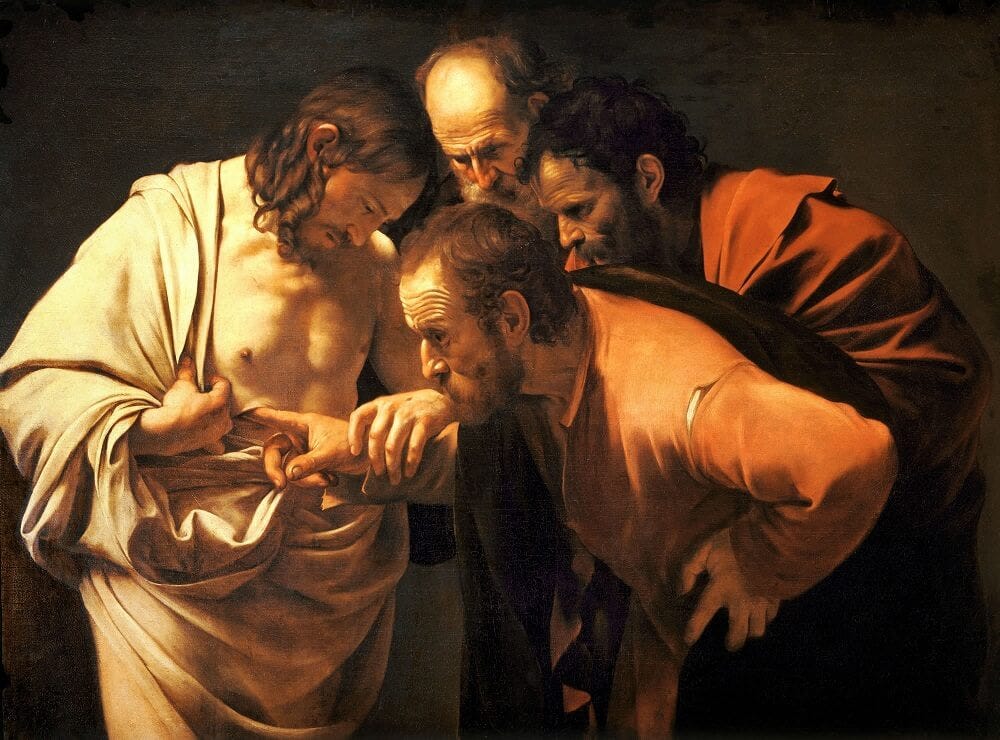
On this Easter 2023, let us reflect on what is arguably the greatest miracle ever performed—the raising from the dead the body, life, and person known as Jesus of Nazareth. This miracle is believed by over 2.6 billion people—a third of humanity—to be true. Is it? Was Jesus really raised from the dead? Like the apostle Thomas, I have my doubts.

First, let me note that what we’re talking about here is the claim of an empirical objective truth: that there was a man named Jesus who was put to death by crucifixion and resurrected from the dead three days later, after which he ascended to heaven. The claim under consideration here is not just a literary truth, as when U.S. Presidential candidate William Jennings Bryan, a deeply religious man, in his 1896 Democratic National Convention “Cross of Gold” speech, famously pronounced “we shall answer their demands for a gold standard by saying to them, you shall not press down upon the brow of labor this crown of thorns. You shall not crucify mankind upon a cross of gold.” Nor is this claim merely a metaphorical or mythic truth, in which readers might be inspired to “bear your own cross” or admonished not to be “crucified” by your enemies, or warned not to “resurrect” bad habits, or encouraged to become “born again” through good habits, or to forgive those who sin against us as God forgives us for our sins through the death and resurrection of his only begotten son.

Nor does this have to do with the proposition that Jesus died for our sins, which is a faith-based truth claim with no purchase on valid knowledge. Such a central tenet of the Christian faith cannot be tested or falsified. It cannot be confirmed or disconfirmed. It can only be believed or disbelieved based on faith or the lack thereof. It is in the realm of religious truths, which are different from empirical truths. Such literary, mythic, and metaphorical truths play a central role in human culture and learning through the arts, literature, and religion, but that is not how most Christians think about the crucifixion and resurrection of Jesus. They believe it is literally true. I know because I have debated a number of theologians and biblical scholars on this and related topics, and when they speak of the death and resurrection of Jesus they are not channeling Joseph Campbell’s “power of myth”. They accept the apostle Paul’s challenge (in 1 Cor. 15:13-19) that: “if there is no resurrection of the dead, then Christ is not risen. And if Christ is not risen, then our preaching is empty and your faith is also empty. For if the dead do not rise, then Christ is not risen. And if Christ is not risen, your faith is futile; you are still in your sins!”

The proposition that Jesus was crucified may be true by historical validation, inasmuch as a man named Jesus of Nazareth probably existed, the Romans routinely crucified people for even petty crimes (recall that the two other people crucified with Jesus that day were impenitent thieves), and most biblical scholars—even those who are atheists, such as the renowned University of North Carolina at Chapel Hill Religious Studies professor Bart Ehrman—assent to this fact. In between these propositions is Jesus’s resurrection, which is not impossible but would be a miracle if it were true. How big a miracle would it be?

Skeptic is a reader-supported publication. Paid subscriptions go to the Skeptics Society, a 501(c)(3) nonprofit. To receive new posts and support my work, consider becoming a free or paid subscriber.Subscribe

Let’s begin our analysis with the Scottish Enlightenment philosopher David Hume, and Section XII of his book Philosophical Essays Concerning the Human Understanding, titled “Of the Academical or Sceptical Philosophy.” Here Hume distinguishes between “antecedent skepticism”, such as Descartes’s method of doubting everything, that has no “antecedent” infallible criterion for belief, which means we can’t really know anything; and “consequent skepticism,” the method Hume employed that recognizes the “consequences” of our fallible senses but corrects them through reason so that we can have confidence that we can know some things with confidence. As he advised: “A wise man proportions his belief to the evidence.”

Let’s call this the principle of proportionality, better known as the ECREE principle—extraordinary claims require extraordinary evidence. Carl Sagan made famous the principle, but he was quoting the lesser-known sociologist of science Marcello Truzzi (thereby confirming the observation that pithy and oft-quoted statements migrate up to the most famous person who said them). Let’s see how this principle cashes out for a miracle like the resurrection and whether or not we should believe it.

How extraordinary a claim is the resurrection? Let’s put some numbers on it. Demographers estimate that throughout all of human history approximately 100 billion people have lived before the 8 billion people alive today. Not one of those 100 billion people has died and returned from the dead, except maybe one—Jesus of Nazareth. So the claim that one person out of those 100 billion people who died came back from the dead would be extraordinary indeed. How extraordinary? 100 billion to 1. That is about as extraordinary a claim as one will ever find. Is the evidence proportional to the conviction? No. Not even close.

According to the University of Wisconsin-Madison philosopher Larry Shapiro in his 2016 book The Miracle Myth, “evidence for the resurrection is nowhere near as complete or convincing as the evidence on which historians rely to justify belief in other historical events such as the destruction of Pompeii.” Because miracles are far less probable than ordinary historical occurrences like volcanic eruptions, “the evidence necessary to justify beliefs about them must be many times better than that which would justify our beliefs in run-of-the-mill historical events.” But, says Shapiro, it isn’t. In fact, it’s not even as good as ordinary historical events.

What about the eyewitnesses? Maybe, Shapiro suggests, they “were superstitious or credulous” and saw what they wanted to see. “Maybe they reported only feeling Jesus ‘in spirit,’ and over the decades their testimony was altered to suggest that they saw Jesus in the flesh. Maybe accounts of the resurrection never appeared in the original gospels and were added in later centuries. Any of these explanations for the gospel descriptions of Jesus’s resurrection are far more likely than the possibility that Jesus actually returned to life after being dead for three days.”

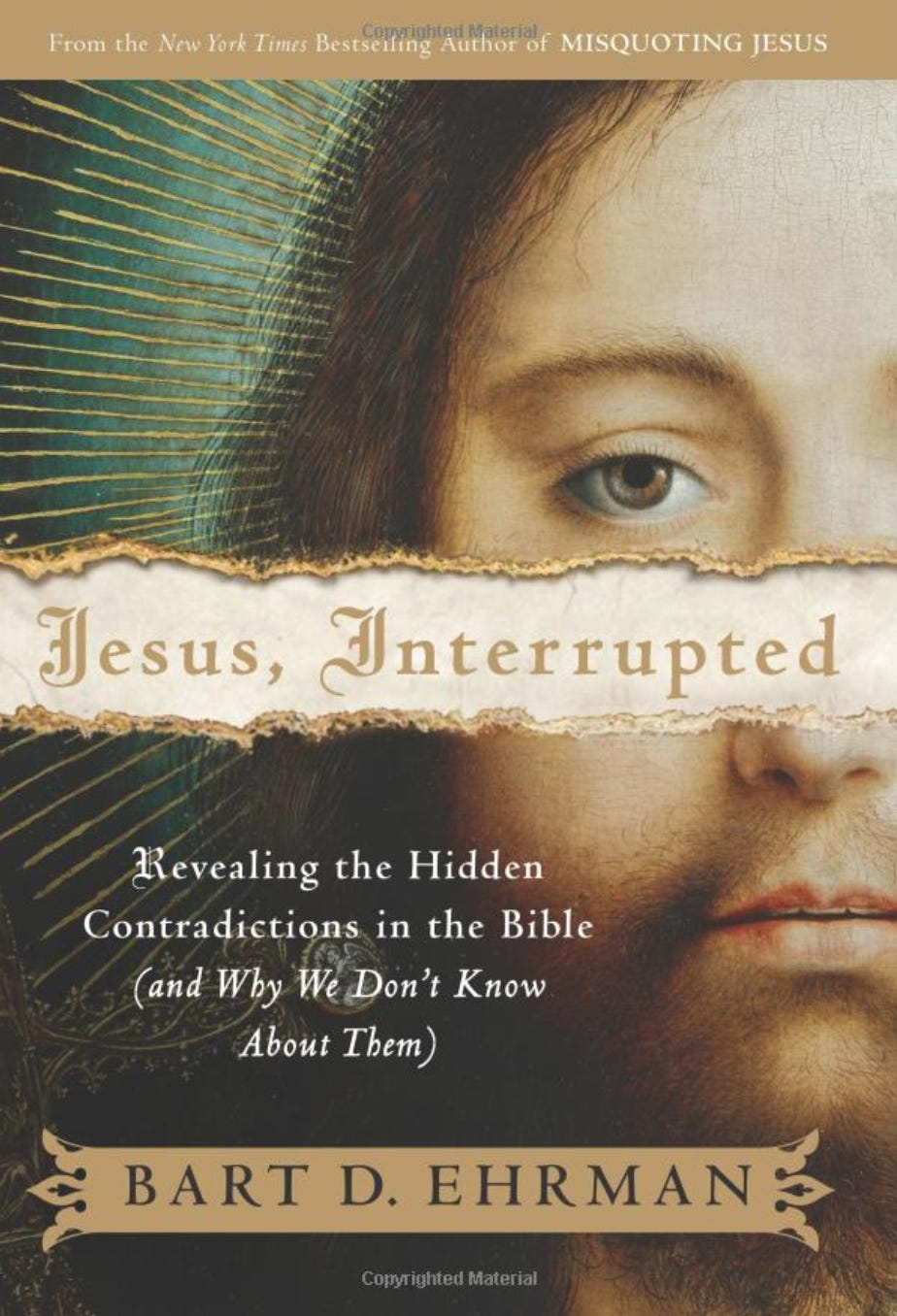
The principle of proportionally also means we should prefer the more probable explanation over the less, which these alternatives surely are. And this is a splendid example of Bayesian reasoning, in which the priors of non-Christians is low for their credence that the resurrection really happened, and to date no new evidence has come forth to change those priors, and so our credence in the verisimilitude of the resurrection remains low. Here’s a model example of Bayesian reasoning from the aforementioned biblical scholar and historian Bart Ehrman in his book Jesus, Interrupted:

Our very first reference to Jesus’ tomb being empty is in the Gospel of Mark, written forty years later by someone living in a different country who had heard it was empty. How would he know? Anyhow, suppose that it was empty. How did it get that way? Suppose…that Jesus was buried by Joseph of Arimathea in Joseph’s own family tomb, and then a couple of Jesus’ followers, not among the twelve, decided that night to move the body somewhere more appropriate. … But a couple of Roman legionnaires are passing by, and catch these followers carrying the shrouded corpse through the streets. They suspect foul play and confront the followers, who pull their swords as the disciples did in Gethsemane. The soldiers, expert in swordplay, kill them on the spot. They now have three bodies, and no idea where the first one came from. Not knowing what to do with them, they commandeer a cart and take the corpses out to Gehenna, outside town, and dump them. Within three or four days the bodies have deteriorated beyond recognition. Jesus’ original tomb is empty, and no one seems to know why.

Is this scenario likely? Not at all. Am I proposing this is what really happened? Absolutely not. Is it more probable that something like this happened than that a miracle happened and Jesus left the tomb to ascend to heaven? Absolutely! From a purely historical point of view, a highly unlikely event is far more probable than a virtually impossible one.

The number of gospel inconsistencies and incompatibilities doesn’t help the credence of the resurrection. For example, the gospels do not agree on: how many women came to the tomb (1, 2, or 3 plus “others”); when they came (“while it was still dark” or “just after sunrise”); why they came (“to look at the tomb” or “to anoint the body with spices”); who they saw (one angel, two angels, a man dressed in white, or Jesus himself); what was said, who said what, who else came (Peter, or both Peter and John); who saw the resurrected Jesus first (Peter or Mary Magdalene); or what they did as they left the tomb (“they said nothing to anyone” or “they ran to tell his disciples”).

Matthew seems to imply the stone was rolled away in the presence of the women who came to the tomb, while Mark, Luke, and John say the women arrived to discover the stone had already been rolled away. Matthew and Mark have the resurrected Jesus on his way to Galilee by the time the women arrive at the tomb, while Luke and John have the risen Messiah in Jerusalem on the night of first Easter Sunday. The Q document, thought to be the source for Matthew, does not even mention the resurrection. The Gospel of Thomas, discovered near Nag Hammadi, Egypt, in December 1945 and dated to the early 2nd century CE, also fails to mention the resurrection. The earliest reliable written testimony of the resurrection of Jesus is by Paul and the anonymous author of Mark’s Gospel. It is important to note, in the context of the propensity of human memory to forget, conflate, confabulate, edit, redact, and falsify events that happened in the past, that the earliest Gospel of Mark was circa 66-70 CE, many decades after the events in question, with the rest of the gospels written even later.

So the extraordinary resurrection miracle claim hangs on just two early testimonies, from two ancient authors, neither of whom actually saw Jesus rise up from the dead, and neither of whom touched him, or sat down with him for a face to face conversation. We have nothing written by the Romans—or the Jews for that matter!—about Jesus, the content of his preaching, why he was killed, or what they thought about claims that he had been resurrected. You would think some Roman would have exclaimed “Et tu Again, Jesus?” or some Jew would have snapped “Oy Vey!” And the accounts from Josephus, Pliny the Elder, and Tacitus that Christians cite in evidentiary support, were from the 2nd century, and they reference Christ the Messiah, not Jesus, and they too don’t mention the resurrection.

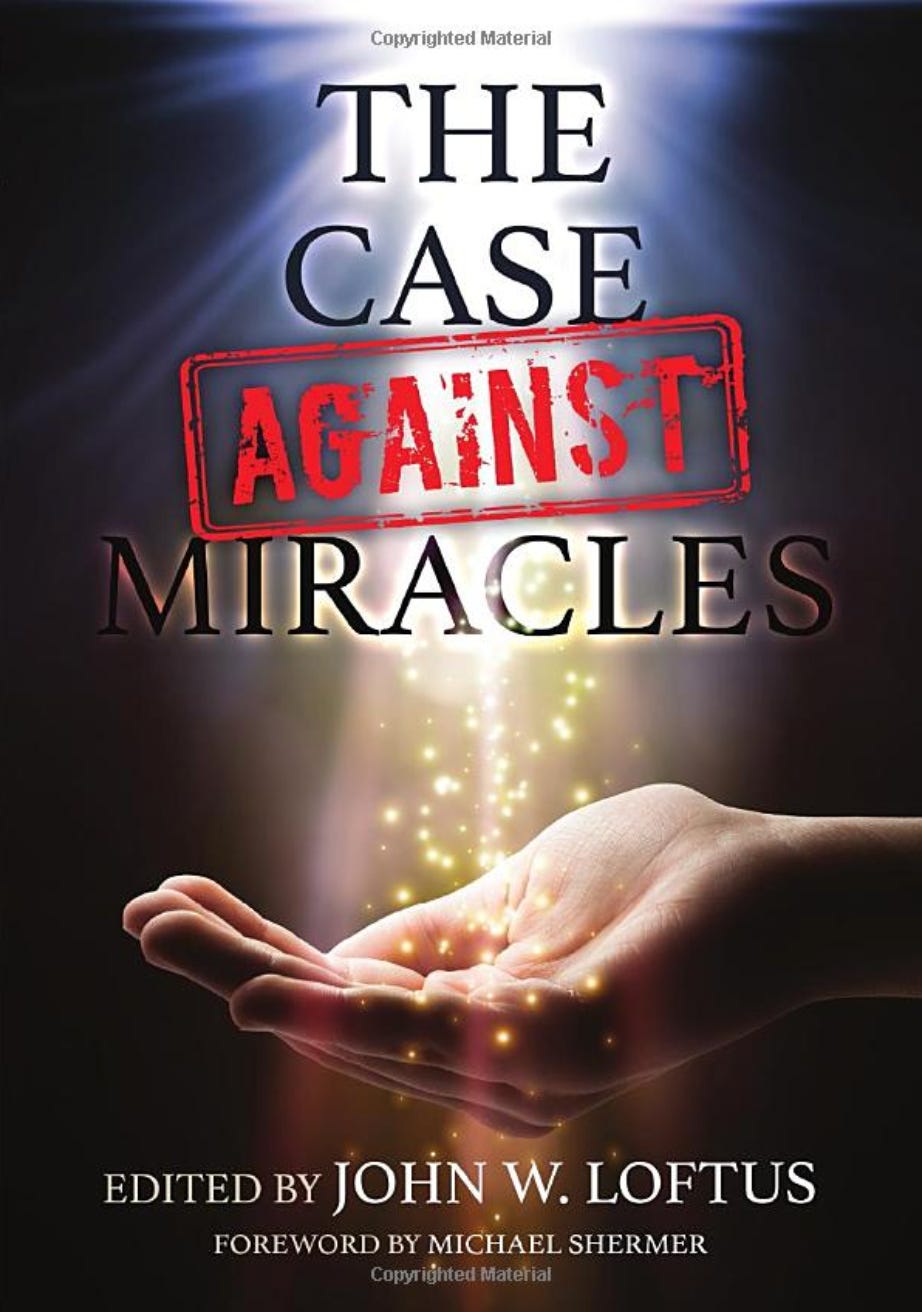
What’s more, in his book The Case Against Miracles, the biblical scholar John W. Loftus notes that “we have no independent corroboration of the Star of Bethlehem at the birth of Jesus, or that the veil of the temple was torn in two at Jesus’ death (Mark 15:38), nor that darkness came ‘over the whole land’ from noon until three in the afternoon (Mark 15:33), or that ‘the sun stopped shining’ (Luke 23:45), nor that there was an earthquake at his death (Matt. 27:51, 54), or another ‘violent’ one the day he arose from the grave (Matt. 28:2).” Could such notable events as these really have occurred without any corroborating evidence? Surely some Roman scribe would have made a note about a three-hour midday eclipse of the sun, not to mention the other miracles. No such extra-biblical evidence exists. Here, the absence of evidence is evidence of absence.

What about the 500 people the apostle Paul says saw the risen Jesus? People often interrupt this to mean that there were 500 independent eyewitness accounts of seeing Jesus after the crucifixion. Not so. We have one account saying there were 500 witnesses, by an evangelist who was highly motivated to write a history in support of his new-found religion—recall that Paul was previously Saul, who converted to Christianity from Judaism after his vision on the road to Damascus.

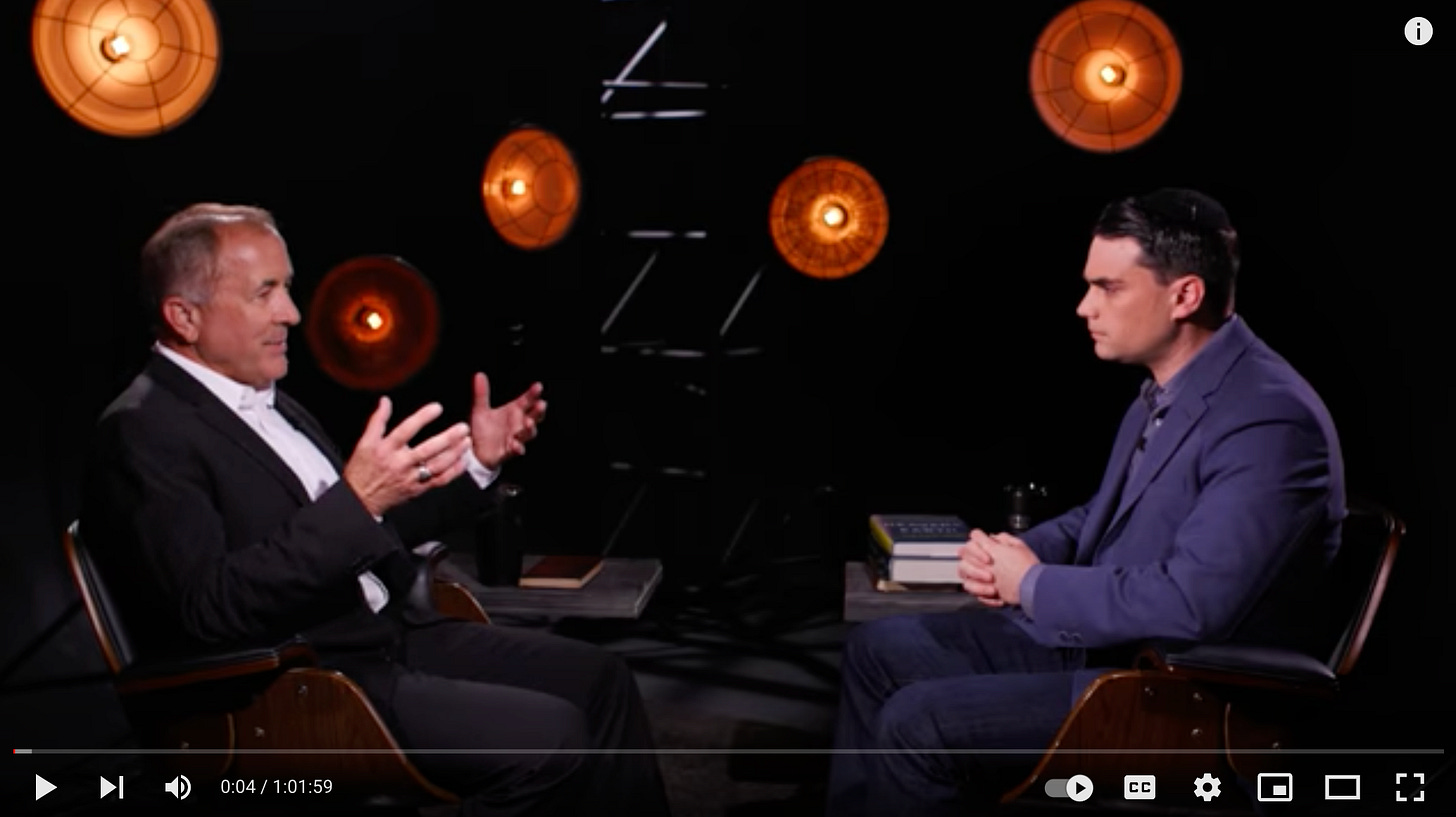
To that end, a challenge to the resurrection miracle that I often employ is that Jews do not accept it as real, neither in Jesus’ time nor in ours. Think about that: Jews believe in the same God as Christians. They accept the Old Testament of the Bible like Christians do. They even believe in the Messiah. They just don’t think Jesus of Nazareth was him. Jewish rabbis, scholars, philosophers, and historians all know the arguments for the resurrection as well as Christian apologists and theologians making the arguments, and still they reject them. Why? If the arguments and evidence for the resurrection is so solid, in time the community most expert in that field would reach a consensus about it. They haven’t. Christians believe it. Jews don’t. Ben Shapiro explains why here, in our conversation on his Sunday Special show.

Finally, it is important to put the resurrection into historical context, which Bart Ehrman does when he notes that in an ancient view of the divine realm “gods could sometimes be or become humans, and humans could sometimes be or become gods.” Ehrman outlines three models of “divine men” that were common in the ancient world:

  1. Sometimes it was understood that gods could and would come down to earth in human form to make a temporary visit for purposes of their own.
  2. Sometimes it was understood that a person was born from the sexual union of a god and a mortal; thus, that the person was, in some sense, part divine and part human.
  3. Sometimes it was understood that a human was elevated by the gods to their realm, usually after death, and at that point divinized, made into a god.

As Ehrman documents, there are many stories in ancient myths about gods temporarily assuming human form to meet, speak, and interact with humans, and that these stories in many ways are similar to later Christian beliefs about Christ being a preexistent divine being who came to earth as a human, only later to return to the heavenly realm.

Perhaps this is why Jesus was silent when Pilate asked him (John 18:38) “What is truth?”

Skeptic is a reader-supported publication. All monies go to the Skeptics Society, a 501(c)(3) nonprofit. To receive new posts and support my work, consider becoming a free or paid subscriber.Subscribe

Michael Shermer is the Publisher of Skeptic magazine, the host of The Michael Shermer Show, and a Presidential Fellow at Chapman University. His many books include Why People Believe Weird ThingsThe Science of Good and EvilThe Believing BrainThe Moral Arc, and Heavens on EarthHis new book is Conspiracy: Why the Rational Believe the Irrational.