Write to Life blog

Happy Birthday, Brain Pickings: 7 Things I Learned in 7 Years of Reading, Writing, and Living

Here’s the link to this essay.

Reflections on how to keep the center solid as you continue to evolve.

BY MARIA POPOVA

UPDATE: The fine folks of Holstee have turned these seven learnings into a gorgeous letterpress poster inspired by mid-century children’s book illustration.

On October 23, 2006, I sent a short email to a few friends at work — one of the four jobs I held while paying my way through college — with the subject line “brain pickings,” announcing my intention to start a weekly digest featuring five stimulating things to learn about each week, from a breakthrough in neuroscience to a timeless piece of poetry. “It should take no more than 4 minutes (hopefully much less) to read,” I promised. This was the inception of Brain Pickings. At the time, I neither planned nor anticipated that this tiny experiment would one day be included in the Library of Congress digital archive of “materials of historical importance” and the few friends would become millions of monthly readers all over the world, ranging from the Dutch high school student who wrote to me this morning to my 77-year-old grandmother in Bulgaria to the person in Wisconsin who mailed me strudel last week. (Thank you!) Above all, I had no idea that in the seven years to follow, this labor of love would become my greatest joy and most profound source of personal growth, my life and my living, my sense of purpose, my center. (For the curious, more on the origin story here.)

Illustration by Maurice Sendak from ‘I’ll Be You and You Be Me’ by Ruth Krauss, 1954. Click image for more.

Looking back today on the thousands of hours I’ve spent researching and writing Brain Pickings and the countless collective hours of readership it has germinated — a smile-inducing failure on the four-minute promise — I choke up with gratitude for the privilege of this journey, for its endless rewards of heart, mind and spirit, and for all the choices along the way that made it possible. I’m often asked to offer advice to young people who are just beginning their own voyages of self-discovery, or those reorienting their calling at any stage of life, and though I feel utterly unqualified to give “advice” in that omniscient, universally wise sense the word implies, here are seven things I’ve learned in seven years of making those choices, of integrating “work” and life in such inextricable fusion, and in chronicling this journey of heart, mind and spirit — a journey that took, for whatever blessed and humbling reason, so many others along for the ride. I share these here not because they apply to every life and offer some sort of blueprint to existence, but in the hope that they might benefit your own journey in some small way, bring you closer to your own center, or even simply invite you to reflect on your own sense of purpose.

Illustration from ‘Inside the Rainbow: Russian Children’s Literature 1920-35.’ Click image for more.
  1. Allow yourself the uncomfortable luxury of changing your mind. Cultivate that capacity for “negative capability.” We live in a culture where one of the greatest social disgraces is not having an opinion, so we often form our “opinions” based on superficial impressions or the borrowed ideas of others, without investing the time and thought that cultivating true conviction necessitates. We then go around asserting these donned opinions and clinging to them as anchors to our own reality. It’s enormously disorienting to simply say, “I don’t know.” But it’s infinitely more rewarding to understand than to be right — even if that means changing your mind about a topic, an ideology, or, above all, yourself.
  2. Do nothing for prestige or status or money or approval alone. As Paul Graham observed, “prestige is like a powerful magnet that warps even your beliefs about what you enjoy. It causes you to work not on what you like, but what you’d like to like.” Those extrinsic motivators are fine and can feel life-affirming in the moment, but they ultimately don’t make it thrilling to get up in the morning and gratifying to go to sleep at night — and, in fact, they can often distract and detract from the things that do offer those deeper rewards.
  3. Be generous. Be generous with your time and your resources and with giving credit and, especially, with your words. It’s so much easier to be a critic than a celebrator. Always remember there is a human being on the other end of every exchange and behind every cultural artifact being critiqued. To understand and be understood, those are among life’s greatest gifts, and every interaction is an opportunity to exchange them.
  4. Build pockets of stillness into your life. Meditate. Go for walks. Ride your bike going nowhere in particular. There is a creative purpose to daydreaming, even to boredom. The best ideas come to us when we stop actively trying to coax the muse into manifesting and let the fragments of experience float around our unconscious mind in order to click into new combinations. Without this essential stage of unconscious processing, the entire flow of the creative process is broken.Most importantly, sleep. Besides being the greatest creative aphrodisiac, sleep also affects our every waking momentdictates our social rhythm, and even mediates our negative moods. Be as religious and disciplined about your sleep as you are about your work. We tend to wear our ability to get by on little sleep as some sort of badge of honor that validates our work ethic. But what it really is is a profound failure of self-respect and of priorities. What could possibly be more important than your health and your sanity, from which all else springs?
  5. When people tell you who they are, Maya Angelou famously advised, believe them. Just as importantly, however, when people try to tell you who you are, don’t believe them. You are the only custodian of your own integrity, and the assumptions made by those that misunderstand who you are and what you stand for reveal a great deal about them and absolutely nothing about you.
  6. Presence is far more intricate and rewarding an art than productivity. Ours is a culture that measures our worth as human beings by our efficiency, our earnings, our ability to perform this or that. The cult of productivity has its place, but worshipping at its altar daily robs us of the very capacity for joy and wonder that makes life worth living — for, as Annie Dillard memorably put it, “how we spend our days is, of course, how we spend our lives.”
  7. “Expect anything worthwhile to take a long time.” This is borrowed from the wise and wonderful Debbie Millman, for it’s hard to better capture something so fundamental yet so impatiently overlooked in our culture of immediacy. The myth of the overnight success is just that — a myth — as well as a reminder that our present definition of success needs serious retuning. As I’ve reflected elsewhere, the flower doesn’t go from bud to blossom in one spritely burst and yet, as a culture, we’re disinterested in the tedium of the blossoming. But that’s where all the real magic unfolds in the making of one’s character and destiny.
One of Maurice Sendak’s vintage posters celebrating the joy of reading. Click image for more.

Then, just for good measure, here are seven of my favorite pieces from the past seven years. (Yes, it is exactly like picking your favorite child — so take it with a grain of salt.)

05/19/23 Biking & Listening

Biking is something else I both love and hate. It takes a lot of effort but does provide good exercise and most days over an hour to listen to a good book or podcast. I especially like having ridden.

Here’s my bike, a Rockhopper by Specialized. I purchased it November 2021 from Venture Out in Guntersville; Mike is top notch! So is the bike, and the ‘old’ man seat I salvaged from an old Walmart bike.

Here’s a link to today’s bike ride. This is my pistol ride.

Here’s a few photos taken along my route:

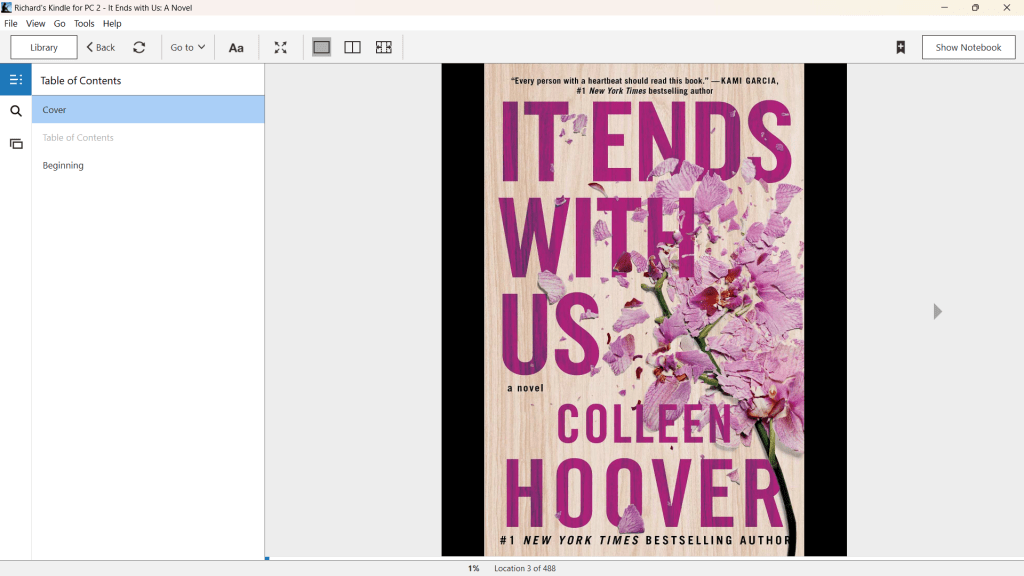
Here’s what I’m listening to: It Ends With Us, by Colleen Hoover

Amazon abstract:

In this “brave and heartbreaking novel that digs its claws into you and doesn’t let go, long after you’ve finished it” (Anna Todd, New York Times bestselling author) from the #1 New York Times bestselling author of All Your Perfects, a workaholic with a too-good-to-be-true romance can’t stop thinking about her first love.

Lily hasn’t always had it easy, but that’s never stopped her from working hard for the life she wants. She’s come a long way from the small town where she grew up—she graduated from college, moved to Boston, and started her own business. And when she feels a spark with a gorgeous neurosurgeon named Ryle Kincaid, everything in Lily’s life seems too good to be true.

Ryle is assertive, stubborn, maybe even a little arrogant. He’s also sensitive, brilliant, and has a total soft spot for Lily. And the way he looks in scrubs certainly doesn’t hurt. Lily can’t get him out of her head. But Ryle’s complete aversion to relationships is disturbing. Even as Lily finds herself becoming the exception to his “no dating” rule, she can’t help but wonder what made him that way in the first place.

As questions about her new relationship overwhelm her, so do thoughts of Atlas Corrigan—her first love and a link to the past she left behind. He was her kindred spirit, her protector. When Atlas suddenly reappears, everything Lily has built with Ryle is threatened.

An honest, evocative, and tender novel, It Ends with Us is “a glorious and touching read, a forever keeper. The kind of book that gets handed down” (USA TODAY).

Creation Stories of the Ancient World (Part 1): On Enuma Elish and Genesis 1 Guest Post by Joseph Lam

Here’s the link.

March 16, 2023

My colleague Joseph Lam is an expert on the languages and texts of the Ancient Near East, including the Hebrew Bible.  In terms of languages, he not only teaches ancient Hebrew, but also (brace yourself), Ugaritic, Akkadian, Syriac, Semitic linguistics, and, well, so on.  He is particularly expert in the relationship of the texts and myths other Ancient Near Eastern religions with those of the Hebrew Bible.

Joseph is also a superb teacher, and so he was invited to to a course for the Great Courses (Wondrium) called “Creation Stories of the Ancient World.”  The course just came out, and so I have asked Joseph to do a couple of blog posts for us, to introduce all of you to the kinds of things he covers there.   Here are the links to his course and, then, his first post:

Wondrium link: https://www.wondrium.com/creation-stories-of-the-ancient-world

The Great Courses link: https://www.thegreatcourses.com/courses/creation-stories-of-the-ancient-world

******************************

Creation stories tell us who we are, where we came from, and where we are going. They not only describe the origins of the world in a distant past, but they encapsulate a culture’s self-understanding in story form, offering insight into how different societies made sense of the human condition across history. In my new course for Wondrium/The Great Courses, titled “Creation Stories of the Ancient World,” I explore a range of creation stories from the great literate civilizations of the ancient Near East and the Mediterranean world in order to illuminate the underlying conceptions they describe—from the nature of reality, to the identity of the gods, to the role of humans in the created order. Among the texts I discuss are myths from Mesopotamia, such as the Babylonian Creation Epic (Enuma Elish) and the Atrahasis Epic; literary traditions from ancient Egypt, including the Pyramid Texts, Coffin Texts, and the Memphite Theology; an early Greek view of creation as represented in Hesiod’s Theogony; lesser known texts such as the Hurro-Hittite Kumarbi Cycle and the Ugaritic Baal Cycle; and, of course, the biblical creation accounts of Genesis 1 and 2.

As an example of the kinds of insights that one can glean from these stories, consider the opening lines of the Babylonian Creation Epic, known in antiquity as Enuma Elish (translation is mine):

When the heavens above had not been named,

nor the earth beneath been called by name,

there was Apsu, the pre-eminent, their begetter,

and creator Tiamat, who bore them all;

they mixed their waters together,

before pastures had formed and reed thickets had appeared.

When none of the gods had been made manifest,

nor been called by name, nor destinies decreed,

the gods were created in the midst of them.

Those who are familiar with the biblical account of creation in seven days (Genesis 1) may already recognize certain broad similarities, such as the pairing of “heaven” and “earth,” the idea of naming as synonymous with creation itself (compare how God speaks things into existence and names them in Genesis 1), and the presence of water in the initial state of the universe. Indeed, on this last point, the two primordial deities in this tale, the male god Apsu and the female goddess Tiamat, are both personifications of water, with Apsu representing the fresh waters and Tiamat representing the salt waters. Note that the name “Tiamat” is actually related to the Hebrew word for “deep” or “abyss” in Genesis 1:2 (Hebrew tehom).

Dr. Joseph Lam

But, while these similarities might suggest that the Mesopotamian and Israelite accounts share a common cultural vocabulary for speaking about creation, they do not imply that the same story is being told. In Enuma Elish, after the gendered pair of Apsu and Tiamat begins the process of procreation of the gods, the story proceeds to describe the two major rounds of conflict that take place among the gods. The resulting battles lead to the deaths of both Apsu and Tiamat—the latter at the hand of Marduk (technically their great-great-grandson), the patron god of Babylon who is proclaimed supreme over the divine pantheon. After Tiamat’s defeat, Marduk severs Tiamat’s body in two in order to make heaven and earth respectively; he also establishes the stars and planets to mark time as well as the other familiar features of the physical world, from mountains to springs to the weather. Most importantly, creation culminates in the founding of the city of Babylon itself as an earthly abode for the gods to be venerated regularly. Humankind is then formed from the body of a sacrificed god—specifically, the god who induced Tiamat to confront Marduk to begin with—in order to alleviate the work of the gods and to maintain the activities of divine worship. Finally, as thanks to Marduk for his lordship, the rest of the gods build the Esagila, Marduk’s temple, in the midst of Babylon. In these ways, Enuma Elish can be seen as an encapsulation of the major points of ancient Babylonian religious and political ideology. It is not surprising, then, that we have evidence that this text was recited as part of the most important festival in Babylon, the spring New Year celebration called the Akitu festival.

By contrast, Genesis 1 describes creation not as a series of battles between the gods but rather as the activity of a single god (Hebrew elohim) establishing an ordered world over the course of six days. Any potentially competing divine forces—whether the “waters” or the “deep” in 1:2, or the sun/moon/stars in 1:16, or the “great sea monsters” in 1:21—are subordinated to this one creator god. In modern times, by virtue of its prominent placement at the beginning of the Bible, this text is often read as a timeless description of how the world came to be. But it would be a mistake to overlook the strong polemical force of the story. I would argue that Genesis 1 is just as historically situated as Enuma Elish, and that its historical setting goes a long way toward explaining the emphases of the story itself. In particular, if we posit the time of the Babylonian exile to be the background for the story, two major features of the text come into alignment. First, its many allusions to Enuma Elish can be explained not only as general reflections of common ancient Near Eastern creation imagery (though that is still a useful fundamental assumption) but specifically as an effort by the Judean literary elite, living as exiles in Babylonia, to articulate an alternative vision of creation in line with their traditions. Second, the lack of an overt mention of a temple in Genesis 1 could be seen as an attempt to make sense of the aftermath of the destruction of the Jerusalem Temple: the Israelite Elohim does not necessarily need a temple, for the entirety of heaven and earth are Elohim’s abode! Moreover, just as every ancient Mesopotamian temple had a cult image of the deity residing in it, so human beings are the “image” (Gen. 1:26-27) of Elohim in the newly-established cosmos.

In my next blog entry, I will introduce another ancient Near Eastern creation text that has often been compared with Genesis 1—the Egyptian text known as the Memphite Theology.

Montaigne and the Double Meaning of Meditation

Here’s the link to this essay.

“There is no exercise that is either feeble or more strenuous … than that of conversing with one’s own thoughts.”

BY MARIA POPOVA

“We all have the same inner life,” beloved artist Agnes Martin said in a wonderful lost interview“The difference lies in the recognition. The artist has to recognize what it is.” But in an age where we compulsively seek to optimize our productivity, the art of presence with and recognition of our inner lives, while infinitely more rewarding, is one fewer and fewer of us are able or willing to master. Of those who seek to cultivate it despite the cultural current, many turn to meditation. And yet meditation itself has an ambivalent history that reflects this tug-of-war between productivity and presence.

Among the timeless trove of musings collected in his Complete Essays (public librarypublic domain) is the following passage Michel de Montaigne penned sometime in the second half of the 16th century:

Meditation is a rich and powerful method of study for anyone who knows how to examine his mind, and to employ it vigorously. I would rather shape my soul than furnish it. There is no exercise that is either feeble or more strenuous, according to the nature of the mind concerned, than that of conversing with one’s own thoughts. The greatest men make it their vocation, “those for whom to live is to think.”

Portrait of Michel de Montaigne by Salvador Dalí, 1947. Click image for details.

“Meditation,” here, is taken to mean “cerebration,” vigorous thinking — the same practice John Dewey addressed so eloquently a few centuries later in How We Think. This conflation, at first glance, seems rather antithetical to today’s notion of meditation — a practice often mistakenly interpreted by non-practitioners as non-thinking, an emptying of one’s mind, a cultivation of cognitive passivity. In reality, however, meditation requires an active, mindful presence, a bearing witness to one’s inner experience as it unfolds. In that regard, despite the semantic evolution of the word itself, Montaigne’s actual practice of meditation was very much aligned with the modern concept and thus centuries ahead of his time, as were a great deal of his views.

In How to Live: Or A Life of Montaigne in One Question and Twenty Attempts at an Answer (public library) — that remarkable distillation of timeless lessons on the art of living from the godfather of “blogging,” explored more closely here — British philosophy scholar Sarah Bakewell points to Montaigne’s oft-quoted aphorism — “When I dance, I dance; when I sleep, I sleep.” — noting that he “achieved an almost Zen-like discipline” and remarking on his “ability to just be,” the essence of meditation:

It sounds so simple, put like this, but nothing is harder to do. This is why Zen masters spend a lifetime, or several lifetimes, learning it. Even then, according to traditional stories, they often manage it only after their teacher hits them with a big stick — the keisaku, used to remind meditators to pay full attention. Montaigne managed it after one fairly short lifetime, partly because he spent so much of that lifetime scribbling on paper with a very small stick… Observing the play of inner states is the writer’s job. Yet this was not a common notion before Montaigne, and his peculiarly restless, free-form way of doing it was entirely unknown.

Meditation, then, isn’t merely the product of solitude — that increasingly endangered art of learning how to be alone — but is also aided by an active record of one’s inward gaze, the very practice that makes keeping a diary so spiritually and creatively beneficial, particularly for writers.

1947 illustration for the essays of Montaigne by Salvador Dalí. Click image for details.

How to Live is revelational in its entirety, full of Montaigne’s timeless and ever-timely wisdom on the most central questions of leading a meaningful life.

05/18/23 Biking & Listening

Biking is something else I both love and hate. It takes a lot of effort but does provide good exercise and most days over an hour to listen to a good book or podcast. I especially like having ridden.

Here’s my bike, a Rockhopper by Specialized. I purchased it November 2021 from Venture Out in Guntersville; Mike is top notch! So is the bike, and the ‘old’ man seat I salvaged from an old Walmart bike.

Here’s a link to today’s bike ride. This is my pistol ride.

Here’s a few photos taken along my route:

Here’s what I’m listening to: It Ends With Us, by Colleen Hoover

Amazon abstract:

In this “brave and heartbreaking novel that digs its claws into you and doesn’t let go, long after you’ve finished it” (Anna Todd, New York Times bestselling author) from the #1 New York Times bestselling author of All Your Perfects, a workaholic with a too-good-to-be-true romance can’t stop thinking about her first love.

Lily hasn’t always had it easy, but that’s never stopped her from working hard for the life she wants. She’s come a long way from the small town where she grew up—she graduated from college, moved to Boston, and started her own business. And when she feels a spark with a gorgeous neurosurgeon named Ryle Kincaid, everything in Lily’s life seems too good to be true.

Ryle is assertive, stubborn, maybe even a little arrogant. He’s also sensitive, brilliant, and has a total soft spot for Lily. And the way he looks in scrubs certainly doesn’t hurt. Lily can’t get him out of her head. But Ryle’s complete aversion to relationships is disturbing. Even as Lily finds herself becoming the exception to his “no dating” rule, she can’t help but wonder what made him that way in the first place.

As questions about her new relationship overwhelm her, so do thoughts of Atlas Corrigan—her first love and a link to the past she left behind. He was her kindred spirit, her protector. When Atlas suddenly reappears, everything Lily has built with Ryle is threatened.

An honest, evocative, and tender novel, It Ends with Us is “a glorious and touching read, a forever keeper. The kind of book that gets handed down” (USA TODAY).

Sam Harris on the Paradox of Meditation and How to Stretch Our Capacity for Everyday Self-Transcendence

Here’s the link to this essay.

“Positive emotions, such as compassion and patience, are teachable skills; and the way we think directly influences our experience of the world.”

BY MARIA POPOVA

Montaigne believed that meditation is the finest exercise of one’s mind and David Lynch uses it as an anchor of his creative integrity. Over the centuries, the ancient Eastern practice has had a variety of exports and permutations in the West, but at no point has it been more vital to our sanity and psychoemotional survival than amidst our current epidemic of hurrying and cult of productivity. It is remarkable how much we, as a culture, invest in the fitness of the body and how little, by and large, in the fitness of the spirit and the psyche — which is essentially what meditation provides.

In Waking Up: A Guide to Spirituality Without Religion (public library), neuroscientist and philosopher Sam Harris argued that cultivating the art of presence is our greatest gateway to true happiness. After his extensive, decades-long empirical romp through the world’s major religious traditions and humanity’s most potent psychedelic substances, Harris returns again and again to meditation as the holy grail of self-transcendence, the single most promising practice for slicing through the illusion of the ego to reveal what Jack Kerouac so memorably called “the Golden Eternity.”

Harris writes:

Although the insights we can have in meditation tell us nothing about the origins of the universe, they do confirm some well-established truths about the human mind: Our conventional sense of self is an illusion; positive emotions, such as compassion and patience, are teachable skills; and the way we think directly influences our experience of the world.

We know that the self is a social construct and the dissolution of its illusion, Harris argues, is the most valuable gift of meditation:

The conventional sense of self is an illusion [and] spirituality largely consists in realizing this, moment to moment. There are logical and scientific reasons to accept this claim, but recognizing it to be true is not a matter of understanding these reasons. Like many illusions, the sense of self disappears when closely examined, and this is done through the practice of meditation.

[…]

The feeling that we call “I” seems to define our point of view in every moment, and it also provides an anchor for popular beliefs about souls and freedom of will. And yet this feeling, however imperturbable it may appear at present, can be altered, interrupted, or entirely abolished.

Such abolition may seem unnerving in the context of personal identity, something to which we are invariably attached, but as soon as we begin to understand just how mutable that identity is, dissolving the self illusion becomes not a punishing negation of free will but a promise of freedom. Harris writes:

The self that does not survive scrutiny is the subject of experience in each present moment — the feeling of being a thinker of thoughts inside one’s head, the sense of being an owner or inhabitant of a physical body, which this false self seems to appropriate as a kind of vehicle. Even if you don’t believe such a homunculus exists — perhaps because you believe, on the basis of science, that you are identical to your body and brain rather than a ghostly resident therein — you almost certainly feel like an internal self in almost every waking moment. And yet, however one looks for it, this self is nowhere to be found. It cannot be seen amid the particulars of experience, and it cannot be seen when experience itself is viewed as a totality. However, its absence can be found — and when it is, the feeling of being a self disappears.

And yet, and yet, this is where the essential paradox of meditation arises — if meditation is about cultivating the capacity to accept the present moment exactly as it is, then the notion of a meditation practice or of mindfulness training, which implies progress toward a future goal, seems at odds with the very concept of such pure presence. Harris captures this elegantly:

We wouldn’t attempt to meditate, or engage in any other contemplative practice, if we didn’t feel that something about our experience needed to be improved. But here lies one of the central paradoxes of spiritual life, because this very feeling of dissatisfaction causes us to overlook the intrinsic freedom of consciousness in the present. As we have seen, there are good reasons to believe that adopting a practice like meditation can lead to positive changes in one’s life. But the deepest goal of spirituality is freedom from the illusion of the self — and to seek such freedom, as though it were a future state to be attained through effort, is to reinforce the chains of one’s apparent bondage in each moment.

The solution to the paradox, Harris suggests, is in approaching mindfulness not as a compulsively productive practice of self-improvement — there is the “self” creeping up again — but as a state of active presence with everyday life:

The ultimate wisdom of enlightenment, whatever it is, cannot be a matter of having fleeting experiences. The goal of meditation is to uncover a form of well-being that is inherent to the nature of our minds. It must, therefore, be available in the context of ordinary sights, sounds, sensations, and even thoughts. Peak experiences are fine, but real freedom must be coincident with normal waking life.

He cautions against treating meditation as another to-do item:

Those who begin to practice in the spirit of gradualism often assume that the goal of self-transcendence is far away, and they may spend years overlooking the very freedom that they yearn to realize.

Reflecting on his training with the Burmese spiritual master Sayadaw U Pandita, who teaches meditation as an “explicitly goal-oriented” practice — mindfulness is approached not as freedom from the self illusion in the present moment but as a means of attaining the “cessation” of that illusion in the future — Harris writes:

[This approach] encourages confusion at the outset regarding the nature of the problem one is trying to solve. It is true, however, that striving toward the distant goal of enlightenment (as well as the nearer goal of cessation) can lead one to practice with an intensity that might otherwise be difficult to achieve. I never made more effort than I did when practicing under U Pandita. But most of this effort arose from the very illusion of bondage to the self that I was seeking to overcome. The model of this practice is that one must climb the mountain so that freedom can be found at the top. But the self is already an illusion, and that truth can be glimpsed directly, at the mountain’s base or anywhere else along the path. One can then return to this insight, again and again, as one’s sole method of meditation — thereby arriving at the goal in each moment of actual practice.

Despite the paradoxes of the practice, however, Harris considers it our most promising access point to a fulfilling spiritual life:

It is very difficult to imagine someone’s not being able to see her reflection in a window even after years of looking — but that is what happens when a person begins most forms of spiritual practice. Most techniques of meditation are, in essence, elaborate ways for looking through the window in the hope that if one only sees the world in greater detail, an image of one’s true face will eventually appear. Imagine a teaching like this: If you just focus on the trees swaying outside the window without distraction, you will see your true face. Undoubtedly, such an instruction would be an obstacle to seeing what could otherwise be seen directly. Almost everything that has been said or written about spiritual practice, even most of the teachings one finds in Buddhism, directs a person’s gaze to the world beyond the glass, thereby confusing matters from the very beginning.

But one must start somewhere. And the truth is that most people are simply too distracted by their thoughts to have the selflessness of consciousness pointed out directly. And even if they are ready to glimpse it, they are unlikely to understand its significance.

Harris reframes the paradox with an admonition and an assurance:

Embracing the contents of consciousness in any moment is a very powerful way of training yourself to respond differently to adversity. However, it is important to distinguish between accepting unpleasant sensations and emotions as a strategy — while covertly hoping that they will go away — and truly accepting them as transitory appearances in consciousness. Only the latter gesture opens the door to wisdom and lasting change. The paradox is that we can become wiser and more compassionate and live more fulfilling lives by refusing to be who we have tended to be in the past. But we must also relax, accepting things as they are in the present, as we strive to change ourselves.

[…]

Happiness and suffering, however extreme, are mental events. The mind depends upon the body, and the body upon the world, but everything good or bad that happens in your life must appear in consciousness to matter. This fact offers ample opportunity to make the best of bad situations — changing your perception of the world is often as good as changing the world — but it also allows a person to be miserable even when all the material and social conditions for happiness have been met. During the normal course of events, your mind will determine the quality of your life.

In a conversation with Tim Ferriss on the altogether excellent The Tim Ferriss Show, Harris argues that the mindfulness meditation cultivates — a quality of mind that allows you to pay attention to whatever arises without being lost in thought — is the most useful way to explore the phenomenon of self-transcendence “without believing anything on insufficient evidence.” He adds:

The human nervous system is plastic in a very important way — which means your experience of the world can be radically transformed. You are tending who you were yesterday by virtue of various habit patterns and physiological homeostasis and other things that are keeping you very recognizable to yourself, but it’s possible to have a very different experience… It’s possible to do it through a deliberate form of training, like meditation, and I think it’s crucial to do — because we all want to be as happy and as fulfilled and as free of pointless suffering as can possibly be. And all of our suffering, and all of our unhappiness, is a product of how our minds are in every moment. So if there’s a way to use the mind itself to improve one’s capacity for moment-to-moment wellbeing — which I’m convinced there is — then this should be potentially of interest to everybody.

Milton, it turns out, was not only philosophically but also neuropsychologically right when he penned his famous verse: “The mind is its own place, and in itself / Can make a Heaven of Hell, a Hell of Heaven.”

If you are looking for a good place to start with meditation, or would like slow-burning fuel for your existing practice, I highly recommend Tara Brach, who has truly transformed my life — her teachings and guided meditations are available as a reliably excellent free podcast, and her four-part primer on meditation is indispensable for beginners. (If you are moved and enriched by her generously offered free teachings, consider making a donation — Brach’s work, like my own, is supported by direct patronage, and I am a proud monthly donor.)

Harris has also written about how to begin a meditation practice himself.

Waking Up, which you can sample further here, is a superb read in its entirety, quite possibly the best thing written on this ecosystem of spiritual subjects since Alan Watts’s treatise on the taboo against knowing who you really are.