Evernote sketching at laptop with mouse.

Here’s a previous sketch–Unbalanced waiter
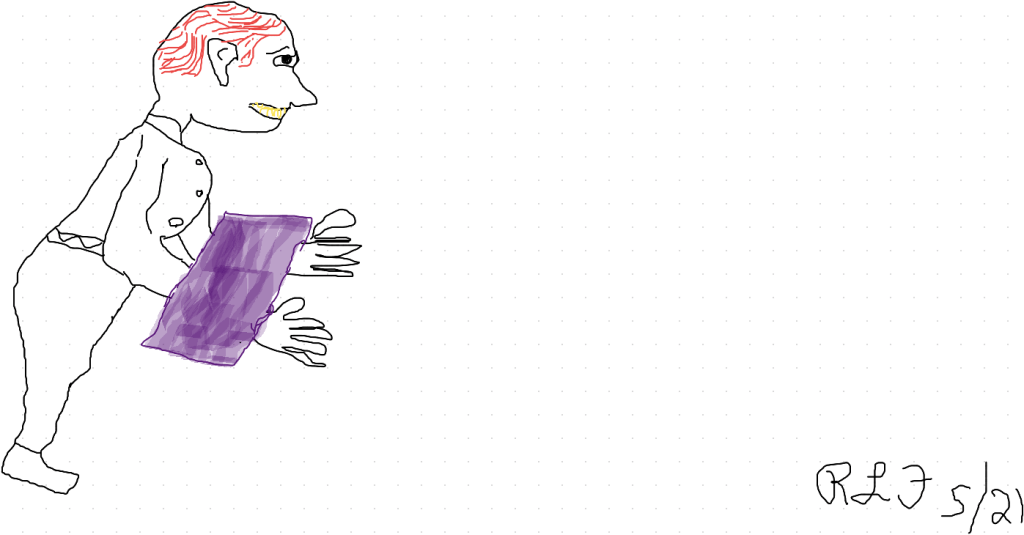

Because every one of these churches allows and supports adultery.
Ninety percent of the 12,700 SBC delegates were heard chanting: “we must obey scripture.”
[Jesus] said to them, “Whoever divorces his wife and marries another commits adultery against her; and if she divorces her husband and marries another, she commits adultery.” (Mark 10:11-12, NRSV)
“In a review of both religious and general population data, researchers concluded that divorce rates among Christians are similar to those of the general population, indicating that marital dissolution is not necessarily due to a particular faith commitment.” From Google search: comparison of rate of divorce between Christians and non-christians.
Conclusion: it’s reasonable to conclude every one of these 47,000 churches has at least one man or woman member who has committed adultery.
I. The Scriptures
The Holy Bible was written by men divinely inspired and is God’s revelation of Himself to man. It is a perfect treasure of divine instruction. It has God for its author, salvation for its end, and truth, without any mixture of error, for its matter. Therefore, all Scripture is totally true and trustworthy. It reveals the principles by which God judges us, and therefore is, and will remain to the end of the world, the true center of Christian union, and the supreme standard by which all human conduct, creeds, and religious opinions should be tried. All Scripture is a testimony to Christ, who is Himself the focus of divine revelation.
Disclaimer–This is satire; there was no such vote. But, it seems, there should have been based on the SBC’s scriptural premise of ousting churches with female pastors.
I’ve just created a new page at readtodeath.com. It contains complete copies of current indictments against Donald J. Trump.
I’ve just created a page dedicated to Donald J. Trump’s current indictments. There likely will be more. If so, I’ll add them. It’s imperative that every person take the time to read and digest these documents. You can read them on my page or download them to your computer.
Here’s the link to this essay.
UPDATE: The fine folks of Holstee have turned these seven learnings into a gorgeous letterpress poster inspired by mid-century children’s book illustration.
 On October 23, 2006, I sent a short email to a few friends at work — one of the four jobs I held while paying my way through college — with the subject line “brain pickings,” announcing my intention to start a weekly digest featuring five stimulating things to learn about each week, from a breakthrough in neuroscience to a timeless piece of poetry. “It should take no more than 4 minutes (hopefully much less) to read,” I promised. This was the inception of Brain Pickings. At the time, I neither planned nor anticipated that this tiny experiment would one day be included in the Library of Congress digital archive of “materials of historical importance” and the few friends would become millions of monthly readers all over the world, ranging from the Dutch high school student who wrote to me this morning to my 77-year-old grandmother in Bulgaria to the person in Wisconsin who mailed me strudel last week. (Thank you!) Above all, I had no idea that in the seven years to follow, this labor of love would become my greatest joy and most profound source of personal growth, my life and my living, my sense of purpose, my center. (For the curious, more on the origin story here.)

Looking back today on the thousands of hours I’ve spent researching and writing Brain Pickings and the countless collective hours of readership it has germinated — a smile-inducing failure on the four-minute promise — I choke up with gratitude for the privilege of this journey, for its endless rewards of heart, mind and spirit, and for all the choices along the way that made it possible. I’m often asked to offer advice to young people who are just beginning their own voyages of self-discovery, or those reorienting their calling at any stage of life, and though I feel utterly unqualified to give “advice” in that omniscient, universally wise sense the word implies, here are seven things I’ve learned in seven years of making those choices, of integrating “work” and life in such inextricable fusion, and in chronicling this journey of heart, mind and spirit — a journey that took, for whatever blessed and humbling reason, so many others along for the ride. I share these here not because they apply to every life and offer some sort of blueprint to existence, but in the hope that they might benefit your own journey in some small way, bring you closer to your own center, or even simply invite you to reflect on your own sense of purpose.


Then, just for good measure, here are seven of my favorite pieces from the past seven years. (Yes, it is exactly like picking your favorite child — so take it with a grain of salt.)
Here’s the link to this article.
May 13, 2023 by ANGELA ACKERMAN 1 Comment
In 1959, Carl Jung first popularized the idea of archetypes—”universal images that have existed since the remotest times.” He posited that every person is a blend of these 12 basic personalities. Ever since then, authors have been applying this idea to fictional characters, combining the different archetypes to come up with interesting new versions. The result is a sizable pool of character tropes that we see from one story to another.
Archetypes and tropes are popular storytelling elements because of their familiarity. Upon seeing them, readers know immediately who they’re dealing with and what role the nerd, dark lord, femme fatale, or monster hunter will play. As authors, we need to recognize the commonalities for each trope so we can write them in a recognizable way and create a rudimentary sketch for any character we want to create.
But when it comes to characters, no one wants just a sketch; we want a vibrant and striking cast full of color, depth, and contrast. Diving deeper into character creation is especially important when starting with tropes because the blessing of their familiarity is also a curse; without differentiation, the characters begin to look the same from story to story.
But no more. The Character Type and Trope Thesaurus allows you to outline the foundational elements of each trope while also exploring how to individualize them. In this way, you’ll be able to use historically tried-and-true character types to create a cast for your story that is anything but traditional.

DESCRIPTION
Explorers thrive on adventure and discovery. These trailblazers are unafraid of new experiences or challenges, and boldly moving into the unknown is a part of their identity.
FICTIONAL EXAMPLES: Indiana Jones (Indiana Jones Series), Captain Picard (Star Trek), Lara Croft (Tomb Raider), Evelyn O’Connell (The Mummy Franchise)
COMMON STRENGTHS
Adaptable, Adventurous, Ambitious, Appreciative, Bold, Confident, Curious, Decisive, Focused, Idealistic, Independent, Observant, Passionate, Persistent, Resourceful, Spontaneous, Wise
COMMON WEAKNESSES
Abrasive, Cocky, Impatient, Impulsive, Macho, Manipulative, Obsessive, Possessive, Rebellious, Reckless, Selfish, Stubborn, Temperamental, Withdrawn, Workaholic
ASSOCIATED ACTIONS, BEHAVIORS, AND TENDENCIES
Nomadic tendencies (being on the move, never staying too long in one place)
Not needing much in the way of creature comforts
Having fewer attachments (to things, people, places)
Having a broad understanding of people, cultures, and customs
Knowing more than one language
Being highly spontaneous
Being a ‘figure it out as I go’ sort of person
Having a strong sense of purpose and a clear goal at all times
Able to think on their feet and adapt to changing circumstances
Being able to learn the rules of a new environment quickly
Excellent survival and navigation skills
Recovering from disappointments quickly and moving on
Being drawn in by stories
Being curious about people, places, and experiences
A desire to see and experience things first hand
Always being up for a trip, outing, or adventure
Being unafraid of new circumstances or challenges
Being a thrill-seeker
Not being turned off by danger or risk
More likely to act on instinct rather than through a deep analysis
The ability to size people up quickly
Needing to be talked out of things, rather than talked into them
Preferring their own company to the company of others
A tendency to believe the ends justify the means (when they believe in the cause)
Being a lifelong learner
Focusing on the journey, not the goal
A tendency to push to find their own limits (and then push to challenge them further)
Fearing a boring life more than anything else
SITUATIONS THAT WILL CHALLENGE THEM
Having no choice but to wait because another is in control of when things happen
Having to adhere to a routine
Being unable to travel (due to illness, legal restrictions, an injury, family responsibilities, etc.)
Being anchored by duty (becoming a caregiver to an elderly parent, having to run a family business, raising a child, etc.)
Being bound by rules and limitations
Having to give up personal freedom to serve the greater good
Being stuck in a single place for too long
Finding time for healthy, two-way relationships
Finding someone to talk through their feelings or struggles because while they may know a lot of people, few are close enough for those type of conversations
Being around people who are closed-minded and see the world in absolutes
INNER STRUGGLES TO GIVE THEM DEPTH
Feeling selfish for wanting to be out discovering new things when it means others must stay behind and pick up the slack
Wanting to have relationships but knowing the other party will only end up feeling neglected
Feeling guilt for abandoning people when the next adventure calls
Guilt over risk-taking that impacts others negatively
Regret over what they chose to give up (possibly a place to call home, close family bonds, a life partner, etc.)
Knowing the personal growth they seek may come at the price of a lonely life
TWIST THIS TROPE WITH A CHARACTER WHO…
Finds ways to be dependable while making room for adventure
Gives back as a teacher or leader who encourages others to embrace open-mindedness
Becomes a role model to someone who is dependent or insecure, showing them how to become more independent
Is an explorer who is unselfish, putting the needs of others first
CLICHÉS TO BE AWARE OF
Other Type and Trope Thesaurus entries can be found here.

While this thesaurus is still being developed, the rest of our descriptive collection (16 unique thesauri and growing) is accessible through the One Stop for Writers THESAURUS database.
If you like, swing by and check out the video walkthrough for this site, and then give our Free Trial a spin.

Angela is a writing coach, international speaker, and bestselling author who loves to travel, teach, empower writers, and pay-it-forward. She also is a founder of One Stop For Writers, a portal to powerful, innovative tools to help writers elevate their storytelling.

 Richard L. Fricks