Jorge Luis Borges on Writing: Wisdom from His Most Candid Interviews

I’m currently taking a writing, blogging, and coaching sabbatical due to family health issues. For now, I’ll repost selected articles from my Fiction Writing School. I encourage you to take the time to read these powerful, awe-inspiring words.

Here is the link to today’s article. It’s taken from Timeless Advice on Writing: The Collected Wisdom of Great Writers.

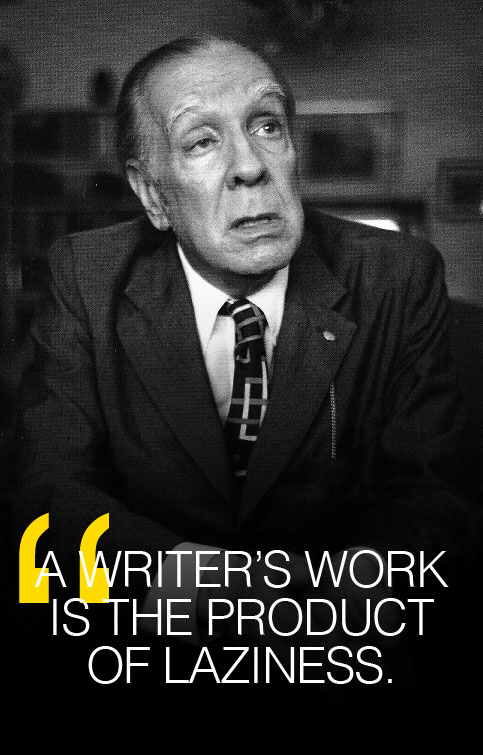
“A writer’s work is the product of laziness.”

BY MARIA POPOVA

Jorge Luis Borges (August 24, 1899–June 14, 1986) is the most celebrated and influential Latin-American author of the twentieth century, his literary legacy resounding loud as ever and exuding far-reaching philosophical reverberations. In 1972, when Borges was in his seventies and completely blind, a bright and earnest young Argentinian man of letters by the name of Fernando Sorrentino, only thirty at the time, sat down with the beloved author for seven afternoons in a tiny, secluded room in the National Library and recorded their conversations — “low-key, casual chats, free from any bothersome adherence to a rigid format” — on tape. Published in 1974 as Seven Conversations with Jorge Luis Borges (public library), the conversations, spanning everything from literature to politics, couldn’t be commercially distributed until the overthrow of Isabel Perón in 1976 due to the author’s anti-establishment political convictions and the frankness with which he discussed them with Sorrentino.

Culled here from the seven lengthy and meandering conversations is Borges’s wisdom on writing — a fine addition to famous writers’ collected advice on the craft.

On why, as Joyce Carol Oates elegantly put it, it’s toxic to imagine an ideal reader, defying Michael Lewis’s assertion that the awareness of an audience’s existence exerts “invisible pressures” on the writer:

An absurd statement; how is a person going to write better or worse because he’s thinking about who’s going to read him?

On finding one’s purpose and trusting the “intuition pumps” of life, and the yin-yang of reading and writing:

Before I ever wrote a single line, I knew, in some mysterious and therefore unequivocal way, that I was destined for literature. What I didn’t realize at first is that besides being destined to be a reader, I was also destined to be a writer, and I don’t think one is less important than the other.

On literature as a gateway to the human condition:

I believe in psychological literature, and I think that all literature is fundamentally psychological.

On not mistaking anonymous authorship for lack of creative exertion, and why fairy tales exemplify the refinement of storytelling:

Each year a person hears four or five anecdotes that are very good, precisely because they’ve been worked on. Because it’s wrong to suppose that the fact that they’re anonymous means they haven’t been worked on. On the contrary, I think fairy tales, legends, even the offcolor jokes one hears, are usually good because having been passed from mouth to mouth, they’ve been stripped of everything that might be useless or bothersome. So we could say that a folk tale is a much more refined product than a poem by Donne or by Góngora or by Lugones, for example, since in the second case the piece has been refined by a single person, and in the first case by hundreds.

On not getting lost in movements:

I no longer believe in literary schools now; I believe in the individual.

On the advantage of writing about history:

I believe that a writer should never attempt a contemporary theme or a very precise topography. Otherwise people are immediately going to find mistakes. Or if they don’t find them, they’re going to look for them, and if they look for them, they’ll find them. That’s why I prefer to have my stories take place in somewhat indeterminate places and many years ago.

On Shakespeare’s singular gift, echoing Virginia Woolf’s timeless meditation on craftsmanship, and the limitations of translation:

I think of Shakespeare above all as a craftsman of words. For example, I see him closer to Joyce than to the great novelists, where character is the most important thing. That’s the reason I’m skeptical about translations of Shakespeare, because since what is most essential and most precious in him is the verbal aspect, I wonder to what extent the verbal can be translated.

On why free verse is more challenging to write than metered poetry, the former embodying Bukowski’s poetic admonition that the only worthwhile writing is the kind that “comes out of your soul like a rocket”:

I find it harder to write free verse. Because if there isn’t some kind of inner drive it can’t be done. On the other hand, using a regular meter is a matter of patience, of application . . . Once you’ve written one line, you’re forced to use certain rhymes, the number of rhymes is not infinite; the rhymes that can be used without incongruity are few in number . . . That is, when I have to fabricate something, I fabricate a sonnet, but I wouldn’t be able to fabricate a poem in free verse.

Touching on Italo Calvino’s meditation on what makes a classic, Borges defines what makes a book timeless:

A timeless book … would be just as admirable if it had been published a hundred years before or if it were published a hundred years later. A book that can only be defined by its perfection.

On why the explicit pursuit of prestige warps the integrity of writing and how commercial pressures commodify literature:

It’s possible that the fact that literature has been commercialized now in a way it never was before has had an influence. That is, the fact that people now talk about “bestsellers,” that fashion has an influence (something that didn’t use to happen). I remember that when I began to write, we never thought about the success or failure of a book. What’s called “success” now didn’t exist at that time. And what’s called “failure” was taken for granted. One wrote for oneself and, maybe, as Stevenson used to say, for a small group of friends. On the other hand, one now thinks of sales. I know there are writers who publicly announce they’ve had their fifth, sixth, or seventh edition released and that they’ve earned such and such an amount of money. All that would have appeared totally ridiculous when I was a young man; it would have appeared incredible. People would have thought that a writer who talks about what he earns on his books is implying: “I know what I write is bad but I do it for financial reasons or because I have to support my family.” So I view that attitude almost as a form of modesty. Or of plain foolishness.

On trusting your inner compass for merit, in literature and in life:

I believe that whenever one does wrong, he knows he’s doing wrong. Still, he does it. I believe that no one thinks his own behavior is exemplary. And this holds true in literary matters as well.

On writing and aging:

To reach the point of writing in a more or less uncluttered manner, a more or less decorous manner, I’ve had to reach the age of seventy.

On the advice his father gave him about when not to take advice:

My father gave me that advice. He told me to write a lot, to discard a lot, and not to rush into print, so that the first book I had published, Fervor de Buenos Aires, was really my third book. My father told me that when I had written a book I judged to be not altogether unworthy of publication, he would pay for the printing of the book, but that it was each man for himself and I shouldn’t ask anyone for advice.

On the metric of literary merit:

A writer should always be judged by his or her best pages.

On his distaste for novels, a form Borges believed would eventually die out, and the advantage of short stories over them:

I never thought of writing novels. I think if I began to write a novel, I would realize that it’s nonsensical and that I wouldn’t follow through on it. Possibly this is an excuse dreamed up by my laziness.

[…]

The essential advantage I see in it is that the short story can be taken in at a single glance. On the other hand, in the novel the consecutive is more noticeable. And then there’s the fact that a work of three hundred pages depends on padding, on pages which are mere nexuses between one part and another. On the other hand, it’s possible for everything to be essential, or more or less essential, or — shall we say — appear to be essential, in a short story. I think there are stories of Kipling’s that are as dense as a novel, or of Conrad’s too. It’s true they’re not too short.

When Sorrentino pushes back against Borges’s self-alleged laziness — an incongruous notion given his prolific literary output — the author replies with a sublime affirmation that creative labor never feels like work and, to the extent that “laziness” is the avoidance of work, the best way to avoid work is by making a living out of what you love:

A writer’s work is the product of laziness, you see. A writer’s work essentially consists of taking his mind off things, of thinking about something else, of daydreaming, of not being in any hurry to go to sleep but to imagine something . . . And then comes the actual writing, and that’s his trade. That is, I don’t think the two things are incompatible. Besides, I think that when one is writing something that’s more or less good, one doesn’t feel it to be a chore; one feels it to be a form of amusement. A form of amusement that doesn’t exclude the use of intelligence, just as chess doesn’t exclude it, and chess is a game I’m very fond of and would like to know how to play — I’ve always been a poor chess player.

Towards the end of the final interview, Borges offers his counterpart to H. P. Lovecraft’s advice to aspiring writers and shares his own bit of wisdom:

I would advise that imaginary young man to study the classics; let him not try to be modern, because he already is; let him not try to be a man of a different epoch, to be a classical writer, because, indubitably, he cannot be this, since he is irreparably a young man of the twentieth century.

His parting words reflect on creativity, aging, hope, and legacy:

I believe one must not lose hope after fifty years. Besides, one learns by hard knocks, isn’t that so? I think I’ve committed all the literary errors possible and that this fact will allow me to succeed some day.

[…]

The image that I shall leave when I’m dead — we’ve already said that this is part of a poet’s works — and maybe the most important — I don’t know exactly what it will be, I don’t know if I’ll be viewed with indulgence, with indifference, or with hostility. Of course, that’s of little importance to me now; what does matter to me is not what I’ve written but what I am writing and what I’m going to write. And I think this is how every writer feels. Alfonso Reyes said that one published what he had written in order to avoid spending his life correcting it: one publishes a book in order to leave it behind, one publishes a book in order to forget it.
Seven Conversations with Jorge Luis Borges is a treasure trove of insight in its entirety, its magic best captured by Borges himself in the prologue, penned on July 13, 1972:

Paradoxically, the dialogues which take place between a writer and a journalist bear less resemblance to a question-and-answer session than to a kind of introspection. For the interviewer, they can be a chore which is not entirely free of fatigue and tedium; for the interviewee, they are like an adventure in which the hidden and the unforeseeable lie in wait. Fernando Sorrentino knows my work — let us use that term — much better than I do; this is due to the obvious fact that I have written it one single time and he has read it many times, a fact which makes it less mine than his. As I dictate these lines, I do not wish to slight his kindly perspicacity: how many afternoons, speaking face to face, has he guided me, as though it were unintentional, to the inevitable answers which later astonished me and which he, no doubt, had prepared.

Fernando Sorrentino is, in a word, one of my most generous inventors. I wish to take advantage of this page to tell him of my gratitude and the certainty of a friendship that will not be erased by the years.

Complement with Susan Sontag’s transcendent letter to Borges.

Neil Gaiman’s Advice to Aspiring Writers

I’m currently taking a writing, blogging, and coaching sabbatical due to family health issues. For now, I’ll repost selected articles from my Fiction Writing School. I encourage you to take the time to read these powerful, awe-inspiring words.

Here is the link to today’s article. It’s taken from Timeless Advice on Writing: The Collected Wisdom of Great Writers.

“You have to finish things — that’s what you learn from, you learn by finishing things.”

BY MARIA POPOVA

Neil Gaiman knows a thing or two about the secret of the creative life. In this mashup of Gaiman’s Nerdist podcast interview and scenes from films about writers, video-monger Brandon Farley captures the essence of Gaiman’s philosophy on writing and his advice to aspiring writers — a fine addition to celebrated authors’ collected wisdom on the craft. Transcript highlights below.

Echoing E. B. White, who famously scoffed that “a writer who waits for ideal conditions under which to work will die without putting a word on paper,” and like Chuck Close, who declared that “inspiration is for amateurs — the rest of us just show up and get to work,” and like Tchaikovsky, who admonished that “a self-respecting artist must not fold his hands on the pretext that he is not in the mood,” Gaiman argues that the true muse of writing lies not in divine inspiration but in unrelenting persistence of effort and force of will:

If you’re only going to write when you’re inspired, you may be a fairly decent poet, but you will never be a novelist — because you’re going to have to make your word count today, and those words aren’t going to wait for you, whether you’re inspired or not. So you have to write when you’re not “inspired.” … And the weird thing is that six months later, or a year later, you’re going to look back and you’re not going to remember which scenes you wrote when you were inspired and which scenes you wrote because they had to be written.

On the exhilarating joy of writing and the stalwart showing up that makes it possible:

The process of writing can be magical — there times when you step out of an upper-floor window and you just walk across thin air, and it’s absolute and utter happiness. Mostly, it’s a process of putting one word after another.

On grit as the driving force of creative growth, reiterating the third of his 8 rules of writing:

You have to finish things — that’s what you learn from, you learn by finishing things.

On why true creativity requires eclectic influenceswide interests, and cross-disciplinary dot-connecting:

If you like fantasy and you want to be the next Tolkien, don’t read big Tolkienesque fantasies — Tolkien didn’t read big Tolkienesque fantasies, he read books on Finnish philology. Go and read outside of your comfort zone, go and learn stuff.

Gaiman’s most important piece of advice, for the writer who has mastered basic technique and is ready to begin writing, echoes the fifth of Kurt Vonnegut’s 8 keys to the power of the written word:

Tell your story. Don’t try and tell the stories that other people can tell. Because [as a] starting writer, you always start out with other people’s voices — you’ve been reading other people for years… But, as quickly as you can, start telling the stories that only you can tell — because there will always be better writers than you, there will always be smarter writers than you … but you are the only you.

For more notable wisdom on the written word, see Elmore Leonard’10 rules of writingWalter Benjamin’thirteen doctrinesH. P. Lovecraft’advice to aspiring writersF. Scott Fitzgerald’letter to his daughterZadie Smith’10 rules of writingKurt Vonnegut’8 keys to the power of the written wordDavid Ogilvy’10 no-bullshit tipsHenry Miller’11 commandmentsJack Kerouac’30 beliefs and techniquesJohn Steinbeck’6 pointers, and Susan Sontag’synthesized learnings.

Why Emotional Excess is Essential to Writing and Creativity

I’m currently taking a writing, blogging, and coaching sabbatical due to family health issues. For now, I’ll repost selected articles from my Fiction Writing School. I encourage you to take the time to read these powerful, awe-inspiring words.

Here is the link to today’s article. It’s taken from Timeless Advice on Writing: The Collected Wisdom of Great Writers.

“Something is always born of excess: great art was born of great terrors, great loneliness, great inhibitions, instabilities, and it always balances them.”

BY MARIA POPOVA

The third volume of Anaïs Nin’s diaries has been on heavy rotation in recent weeks, yielding Nin’s thoughtful and timeless meditations on lifemass movementsParis vs. New Yorkwhat makes a great city, and the joy of handicraft.

The subsequent installment, The Diary of Anais Nin, Vol. 4: 1944-1947 (public library) is an equally rich treasure trove of wisdom on everything from life to love to the art of writing. In fact, Nin’s gift shines most powerfully when she addresses all of these subjects and more in just a few ripe sentences.

Anais Nin

Such is the case with the following exquisite letter of advice she sent to a seventeen-year-old aspiring author by the name of Leonard W., whom she had taken under her wing as creative mentor. Nin writes:

I like to live always at the beginnings of life, not at their end. We all lose some of our faith under the oppression of mad leaders, insane history, pathologic cruelties of daily life. I am by nature always beginning and believing and so I find your company more fruitful than that of, say, Edmund Wilson, who asserts his opinions, beliefs, and knowledge as the ultimate verity. Older people fall into rigid patterns. Curiosity, risk, exploration are forgotten by them. You have not yet discovered that you have a lot to give, and that the more you give the more riches you will find in yourself. It amazed me that you felt that each time you write a story you gave away one of your dreams and you felt the poorer for it. But then you have not thought that this dream is planted in others, others begin to live it too, it is shared, it is the beginning of friendship and love.

[…]

You must not fear, hold back, count or be a miser with your thoughts and feelings. It is also true that creation comes from an overflow, so you have to learn to intake, to imbibe, to nourish yourself and not be afraid of fullness. The fullness is like a tidal wave which then carries you, sweeps you into experience and into writing. Permit yourself to flow and overflow, allow for the rise in temperature, all the expansions and intensifications. Something is always born of excess: great art was born of great terrors, great loneliness, great inhibitions, instabilities, and it always balances them. If it seems to you that I move in a world of certitudes, you, par contre, must benefit from the great privilege of youth, which is that you move in a world of mysteries. But both must be ruled by faith.

The Diary of Anais Nin, Vol. 4 is brimming with such poetic yet practical sagacity on the creative life and is a beautiful addition to other famous advice on writing like Kurt Vonnegut’s 8 rules for a great story, David Ogilvy’s 10 no-nonsense tips, Henry Miller’s 11 commandments, Jack Kerouac’s 30 beliefs and techniques, John Steinbeck’s 6 pointers, and Susan Sontag’s synthesized learnings.

Neil Gaiman’s 8 Rules of Writing

I’m currently taking a writing, blogging, and coaching sabbatical due to family health issues. For now, I’ll repost selected articles from my Fiction Writing School. I encourage you to take the time to read these powerful, awe-inspiring words.

Here is the link to today’s article. It’s taken from Timeless Advice on Writing: The Collected Wisdom of Great Writers.

“Perfection is like chasing the horizon. Keep moving.”

BY MARIA POPOVA

In the winter of 2010, inspired by Elmore Leonard’s 10 rules of writing published in The New York Times nearly a decade earlier, The Guardian reached out to some of today’s most celebrated authors and asked them to each offer his or her commandments. After Zadie Smith’s 10 rules of writing, here come 8 from the one and only Neil Gaiman:

  1. Write
  2. Put one word after another. Find the right word, put it down.
  3. Finish what you’re writing. Whatever you have to do to finish it, finish it.
  4. Put it aside. Read it pretending you’ve never read it before. Show it to friends whose opinion you respect and who like the kind of thing that this is.
  5. Remember: when people tell you something’s wrong or doesn’t work for them, they are almost always right. When they tell you exactly what they think is wrong and how to fix it, they are almost always wrong.
  6. Fix it. Remember that, sooner or later, before it ever reaches perfection, you will have to let it go and move on and start to write the next thing. Perfection is like chasing the horizon. Keep moving.
  7. Laugh at your own jokes.
  8. The main rule of writing is that if you do it with enough assurance and confidence, you’re allowed to do whatever you like. (That may be a rule for life as well as for writing. But it’s definitely true for writing.) So write your story as it needs to be written. Write it ­honestly, and tell it as best you can. I’m not sure that there are any other rules. Not ones that matter.

For more timeless wisdom on writing, see Kurt Vonnegut’8 rules for a great storyDavid Ogilvy’10 no-bullshit tipsHenry Miller’11 commandmentsJack Kerouac’30 beliefs and techniquesJohn Steinbeck’6 pointers, and Susan Sontag’synthesized learnings.

Image by Kimberly Butler

10 Tips on Writing from Joyce Carol Oates

I’m currently taking a writing, blogging, and coaching sabbatical due to family health issues. For now, I’ll repost selected articles from my Fiction Writing School. I encourage you to take the time to read these powerful, awe-inspiring words.

Here is the link to today’s article. It’s taken from Timeless Advice on Writing: The Collected Wisdom of Great Writers.

“Don’t try to anticipate an ideal reader — or any reader. He/she might exist — but is reading someone else.”

BY MARIA POPOVA

In a recent tweeting spree, the inimitable Joyce Carol Oates offered ten tips on writing — a fine addition to this master-list of famous authors’ wisdom on the craft.

  1. Write your heart out.
  2. The first sentence can be written only after the last sentence has been written. FIRST DRAFTS ARE HELL. FINAL DRAFTS, PARADISE.
  3. You are writing for your contemporaries — not for Posterity. If you are lucky, your contemporaries will become Posterity.
  4. Keep in mind Oscar Wilde: “A little sincerity is a dangerous thing, and a great deal of it is absolutely fatal.”
  5. When in doubt how to end a chapter, bring in a man with a gun. (This is Raymond Chandler’s advice, not mine. I would not try this.)
  6. Unless you are experimenting with form — gnarled, snarled & obscure — be alert for possibilities of paragraphing.
  7. Be your own editor/critic. Sympathetic but merciless!
  8. Don’t try to anticipate an ideal reader — or any reader. He/she might exist — but is reading someone else.
  9. Read, observe, listen intensely! — as if your life depended upon it.
  10. Write your heart out.

This wonderful micro-documentary from the New Yorker offers a peek inside Oates’s life, work, and creative process:

Anything I’ve encountered in the world is never as interesting as a novel… What you find out there is never as exciting as your own creation.

For more wisdom on writing, see Walter Benjamin’thirteen rulesH. P. Lovecraft’advice to aspiring writersF. Scott Fitzgerald’letter to his daughterZadie Smith’10 rules of writingKurt Vonnegut’8 keys to the power of the written wordDavid Ogilvy’10 no-bullshit tipsHenry Miller’11 commandmentsJack Kerouac’30 beliefs and techniquesJohn Steinbeck’6 pointersNeil Gaiman’8 rules, and Susan Sontag’synthesized learnings.

The Quartet of Creativity: 28-Year-Old Susan Sontag on the Four People a Great Writer Must Be

I’m currently taking a writing, blogging, and coaching sabbatical due to family health issues. For now, I’ll repost selected articles from my Fiction Writing School. I encourage you to take the time to read these powerful, awe-inspiring words.

Here is the link to today’s article. It’s taken from Timeless Advice on Writing: The Collected Wisdom of Great Writers.

“A great writer has all 4 — but you can still be a good writer with only 1 and 2.”

BY MARIA POPOVA

The most recently released volume of Susan Sontag’s diaries, As Consciousness Is Harnessed to Flesh: Journals and Notebooks, 1964-1980 — which was among the best psychology and philosophy books of 2012 — gave us the author’s collected insights on writing.

But the journals of Sontag’s younger self, Reborn: Journals and Notebooks, 1947-1963 (public library), offer another fine addition to the collected wisdom of history’s greatest authors.

Susan Sontag, 1964

In an entry dated December 3, 1961, twenty-eight-year-old Sontag itemizes:

The writer must be four people:

  1. The nut, the obsédé
  2. The moron
  3. The stylist
  4. The critic

1 supplies the material; 2 lets it come out; 3 is taste; 4 is intelligence*.

A great writer has all 4 — but you can still be a good writer with only 1 and 2; they’re most important.

(* A bit of a redundancy between 3 and 4, since Sontag once observed, “Intelligence … is really a kind of taste: taste in ideas.”)

Pair this list with Ezra Pound on the 6 types of writers — even though Sontag famously listed Pound among her dislikes.

Reborn — which has given us Sontag’s insights on artmarriage, and life, as well as her 10 rules for raising a child, her duties for being 24, and her list of beliefs at ages 14 vs. 24 — is full of such wonderful meditations, at once irreverent and profound.

The Writer’s Technique in Thirteen Theses: Walter Benjamin’s Timeless Advice on Writing

I’m currently taking a writing, blogging, and coaching sabbatical due to family health issues. For now, I’ll repost selected articles from my Fiction Writing School. I encourage you to take the time to read these powerful, awe-inspiring words.

Here is the link to today’s article. It’s taken from Timeless Advice on Writing: The Collected Wisdom of Great Writers.

“The more circumspectly you delay writing down an idea, the more maturely developed it will be on surrendering itself.”

BY MARIA POPOVA

“Write with the door closed, rewrite with the door open,” Stephen King advised“Do back exercises,” Margaret Atwood suggested“Know everything about adjectives and punctuation, have moral intelligence,” Susan Sontag counseled. Each accomplished author seems to have a different secret to the craft of writing, but some of the most enduring advice comes from legendary German literary critic, philosopher, and essayists Walter Benjamin. Under a section titled “Post No Bills” in his 1928 treatise One-Way Street, found in his indispensable Reflections: Essays, Aphorisms, Autobiographical Writings (public library), Benjamin offers thirteen essentials of the writer’s technique, touching on familiar themes like the value of keeping a notebook (Virginia Woolf), the incubation period of ideas (T. S. Eliot), the role of discipline (Henry Miller), and the distinct stages of writing (Malcolm Cowley):

THE WRITER’S TECHNIQUE IN THIRTEEN THESES

  1. Anyone intending to embark on a major work should be lenient with himself and, having completed a stint, deny himself nothing that will not prejudice the next.
  2. Talk about what you have written, by all means, but do not read from it while the work is in progress. Every gratification procured in this way will slacken your tempo. If this regime is followed, the growing desire to communicate will become in the end a motor for completion.
  3. In your working conditions avoid everyday mediocrity. Semi-relaxation, to a background of insipid sounds, is degrading. On the other hand, accompaniment by an etude or a cacophony of voices can become as significant for work as the perceptible silence of the night. If the latter sharpens the inner ear, the former acts as a touchstone for a diction ample enough to bury even the most wayward sounds.
  4. Avoid haphazard writing materials. A pedantic adherence to certain papers, pens, inks is beneficial. No luxury, but an abundance of these utensils is indispensable.
  5. Let no thought pass incognito, and keep your notebook as strictly as the authorities keep their register of aliens.
  6. Keep your pen aloof from inspiration, which it will then attract with magnetic power. The more circumspectly you delay writing down an idea, the more maturely developed it will be on surrendering itself. Speech conquers thought, but writing commands it.
  7. Never stop writing because you have run out of ideas. Literary honour requires that one break off only at an appointed moment (a mealtime, a meeting) or at the end of the work.
  8. Fill the lacunae of inspiration by tidily copying out what is already written. Intuition will awaken in the process.
  9. Nulla dies sine linea [‘No day without a line’] — but there may well be weeks.
  10. Consider no work perfect over which you have not once sat from evening to broad daylight.
  11. Do not write the conclusion of a work in your familiar study. You would not find the necessary courage there.
  12. Stages of composition: idea — style — writing. The value of the fair copy is that in producing it you confine attention to calligraphy. The idea kills inspiration, style fetters the idea, writing pays off style.
  13. The work is the death mask of its conception.

Reflections is the companion volume to Benjamin’s equally essential Illuminations. Complement his wisdom with H. P. Lovecraft’advice to aspiring writersF. Scott Fitzgerald’letter to his daughterZadie Smith’10 rules of writingKurt Vonnegut’8 keys to the power of the written wordDavid Ogilvy’10 no-bullshit tipsHenry Miller’11 commandmentsJack Kerouac’30 beliefs and techniquesJohn Steinbeck’6 pointersNeil Gaiman’8 rules, and Susan Sontag’synthesized learnings.

Raymond Chandler on Writing: A Lifetime of Wisdom on the Craft from His Private Letters

I’m currently taking a writing, blogging, and coaching sabbatical due to family health issues. For now, I’ll repost selected articles from my Fiction Writing School. I encourage you to take the time to read these powerful, awe-inspiring words.

Here is the link to today’s article. It’s taken from Timeless Advice on Writing: The Collected Wisdom of Great Writers.

“Writers … have to fight the impulse to live up to someone else’s idea of what they are.”

BY MARIA POPOVA

Last week, while researching this omnibus of what famous authors wrote about their beloved pets in their letters and journals, I came upon the irresistible 1981 anthology Selected Letters of Raymond Chandler (public library). Among Chandler’s many musings, exchanged with his agents, publishers, and literary friends are a number of timeless insights on writing, culled here as a fine addition to this master-list of famous writers’ advice on writing.

In a 1937 letter to the editor of The Fortnightly Intruder, Chandler echoes Virginia Woolf’s case for the evolution of language:

That you should have pride in your purer American heritage of language seems to me a slight thing. Latin became corrupt, but French is a sharper language than Latin ever was. The best writing in English today is done by Americans, but not in any purist tradition. They have roughed the language around as Shakespeare did and done it the violence of melodrama and the press box. They have knocked over tombs and sneered at the dead. Which is as it should be. There are too many dead men and there is too much talk about them.

In a 1948 letter to Hamish Hamilton, Chandler’s English publisher, he revisits the subject:

If I hadn’t grown up on Latin and Greek, I doubt if I would know so well how to draw the very subtle line between what I call a vernacular style and what I should call an illiterate or faux naif style. There’s a hell of a lot of difference, to my mind.

In a vital meditation on defining one’s own success, Chandler admonishes against pursuing prestige rather than authenticity, which for him is a serious creative block:

I can’t seem to get started on doing anything. Always very tough for me to get started. The more things people say about you the more you feel as if you were writing in an examination room, that it didn’t belong to you any more, that you had to protect critical reputations and not let them down. Writers even as cynical as I have to fight the impulse to live up to someone else’s idea of what they are.

In a 1951 letter to his agent, Carl Brandt, Chandler once again shares his creative block but, like Rilke, welcomes the state of creative doubt and uncertainty, which Keats famously called “negative capability”:

I am having a hard time with the book. Have enough paper written to make it complete, but must do all over again. I just didn’t know where I was going and when I got there I saw that I had come to the wrong place. that’s the hell of being the kind of writer who cannot plan anything, but has to make it up as he goes along and then try to make sense out of it. If you gave me the best plot in the world all worked out I could not write it. It would be dead for me.

In March of 1957, at the age of 69 and critically acclaimed, Chandler revisits this state of creative restlessness and uncertainty as a pillar of his identity as a writer:

I am the same man I was when I was a struggling nobody. I feel the same. I know more, it is true, break all the rules and get away with it, but that doesn’t make me important. I may have written the most beautiful American vernacular that has ever been written (some people think I have), but if it is so, I am still a writer trying to find his way through a maze. Should I be anything else? I can’t see it.

In the closing lines of a letter dated May 5, 1939, Chandler offers a meta-observation full of that typical writerly self-awareness bordering on self-consciousness:

And here I am at 2:30 A.M. writing about technique, in spite of a strong conviction that the moment a man begins to talk about technique, that’s proof he is fresh out of ideas.

On October 17, 1939, he comments on the ever-elusive alignment of lucrative and fulfilling work, the disconnect between authentic work and popular taste:

I have never made any money on writing. I work too slowly, throw away too much, and what I write that sells is not at all the sort of thing I really want to write.

In a delightfully curmudgeonly 1944 letter to Charles Morton, editor of The Atlantic Monthly, Chandler casually grumbles that “the civilized intelligence is pretty rare out west” where “very few people … are not half-baked in one way or another,” then delivers his exquisite critique of literary pompousness:

I never really had a great urge to write fiction, which is becoming more and more of a pseudo-art. … But you guys have an obligation … to avoid pompously bad writing and the kind of dullness that comes from letting flatulent asses pontificate about things they know no more about than the next man, if as much. There is a (to me) shocking example of this in the November Harper’s, called “Salute to the Litterateurs.” Consider:

“For writers are people of peculiar sensitivity to the winds of doctrine which blow with especial violence in a time of rapid change — some more so than others, but none, except the outright hacks, completely immune.”

I regard that sentence as a disgrace to English prose. It says nothing and says it ponderously, in a cliched manner, and without syntax.

[…]

Is there anything said here that could not be said better with a simple after-dinner belch?

In another letter to fellow detective novelist Earle Stanley Gardner, dated January 29, 1946, Chandler dives even deeper into his distaste for such writing and shares in Susan Sontag’s sentiments about literary criticism, voicing a concern about popular taste that David Foster Wallace would come to echo some half a century later:

I probably know as much about the essential qualities of good writing as anybody now discussing it. I do not discuss these things professionally for the simple reason that I do not consider it worthwhile. I am not interested in pleasing the intellectuals by writing literary criticism, because literary criticism as an art has in these days too narrow a scope and too limited a public, just as has poetry. I do not believe it is a writer’s function to talk to a dead generation of leisured people who once had time to relish the niceties of critical thought. …. The reading public is intellectually adolescent at best, and it is obvious that what is called “significant literature” will only be sold to this public by exactly the same methods that are used to sell it toothpaste, cathartics and automobiles.

(One can only imagine how the era of Fifty Shades of Grey might stir Chandler’s indignation.)

He then articulates beautifully the essence of a book:

When a book, any sort of book, reaches a certain intensity of artistic performance, it becomes literature. That intensity may be a matter of style, situation, character, emotional tone, or idea, or half a dozen other things. It may also be a perfection of control over the movement of a story similar to the control a great pitcher has over the ball.

And though his opinion of “the public” might appear dismal, Chandler shares in E.B. White’s belief in the responsibility of the writer to “lift people up, not lower them down.” In a 1951 letter, he writes:

My theory has always been that the public will accept style provided you do not call it style either in words or by, as it were, standing off and admiring it. There seems to me to be a vast difference between writing down to the public (something which always flops in the end) and doing what you want to do in a form which the public has learned to accept.

In a March 1947 letter to the editors of Harper’s, Chandler seconds H. P. Lovecraft’s defiance to the distinction between “amateur” and “professional” writers, something all the more timely today in the age of democratized publishing:

There is not much point in all this pseudo-elaborate differentiation between the professional and the amateur. No such difference exists, or ever did.

[…]

All this talk about “pros” is itself sheer amateurism. There is no such thing as professionalism in writing.

In June of 1949, he shares with Hamilton a reflection on literary gimmickry and the secret of great fiction:

To say little and convey much, to break the mood of the scene with some completely irrelevant wisecrack without entirely losing the mood — these small things for me stand in lieu of accomplishment. My theory of fiction writing … is that the objective method has hardly been scratched, that if you know how to use it you can tell more in a paragraph than the probing writers can tell in a chapter.

In September of 1957, approaching his seventieth birthday, in a letter to Helga Greene, Chandler’s last literary agent and subsequent heir, Chandler lists all his gripes about the superficialities of the literary world and concludes with what’s perhaps his most poignant meditation on writing:

I haven’t seen the New Yorker for months, just got tired of it. … But I think I may have become a bit crotchety from loneliness, worry, illness and physical suffering. My ideas of what constitutes good writing are increasingly rebellious. I may even end up echoing Henry Ford’s verdict on history, and saying to unlistening ears: “Literature is bunk.”

[…]

I may satisfy myself with Richard II or a crime novel and tell all the fancy boys to go to hell, all the subtle-subtle ones that they did us a service by exposing the truth that subtlety is only a technique, and a weak technique at that; all the stream-of-consciousness ladies and gents, mostly the former, that you can split a hair fourteen ways from the deuce, but what you’ve got left isn’t even a hair; all the editorial novelists that they should go back to school and stay there until they can make a story come alive with nothing but dialogue and concrete description: oh, we’ll allow them one chapter of set-piece writing per book, even two, but no more; and finally all the clever-clever darlings with the fluty voices that cleverness, like perhaps strawberries, is a perishable commodity. The things that last — or should — I admit they sometimes miss — come from deeper levels of a writer’s being, and the particular form used to frame them has very little to do with their value. The test of a writer is whether you want to read him again years after he should by the rules be dated.

And here we are today, reading Selected Letters of Raymond Chandler. Pair his wisdom with more insights on the written word from Kurt VonnegutSusan SontagHenry MillerStephen KingF. Scott FitzgeraldSusan OrleanErnest Hemingway, and Zadie Smith.

Jack Kerouac’s List of 30 Beliefs and Techniques for Writing and Life

I’m currently taking a writing, blogging, and coaching sabbatical due to family health issues. For now, I’ll repost selected articles from my Fiction Writing School. I encourage you to take the time to read these powerful, awe-inspiring words.

Here is the link to today’s article. It’s taken from Timeless Advice on Writing: The Collected Wisdom of Great Writers.

“No fear or shame in the dignity of yr experience, language & knowledge.”

BY MARIA POPOVA

In the year of reading more and writing better, we’ve absorbed David Ogilvy’s 10 no-bullshit tips, Henry Miller’s 11 commandments, John Steinbeck’s 6 pointers, and various invaluable advice from other great writers. Now comes Jack Kerouac (March 12, 1922–October 21, 1969) — cultural iconsymbolism sageexquisite idealist — with his 30-point list, entitled Belief and Technique for Modern Prose. With items like “No fear or shame in the dignity of yr experience, language & knowledge” and “Accept loss forever,” the list is as much a blueprint for writing as it is a meditation on life. It was eventually included in The Portable Jack Kerouac (public library) — the same treasure trove of stories, poems, letters, and essays on Buddhism that gave us Kerouac on kindness, the self illusion and the “Golden Eternity” and the crucial difference between genius and talent.

Jack Kerouac
  1. Scribbled secret notebooks, and wild typewritten pages, for yr own joy
  2. Submissive to everything, open, listening
  3. Try never get drunk outside yr own house
  4. Be in love with yr life
  5. Something that you feel will find its own form
  6. Be crazy dumbsaint of the mind
  7. Blow as deep as you want to blow
  8. Write what you want bottomless from bottom of the mind
  9. The unspeakable visions of the individual
  10. No time for poetry but exactly what is
  11. Visionary tics shivering in the chest
  12. In tranced fixation dreaming upon object before you
  13. Remove literary, grammatical and syntactical inhibition
  14. Like Proust be an old teahead of time
  15. Telling the true story of the world in interior monolog
  16. The jewel center of interest is the eye within the eye
  17. Write in recollection and amazement for yourself
  18. Work from pithy middle eye out, swimming in language sea
  19. Accept loss forever
  20. Believe in the holy contour of life
  21. Struggle to sketch the flow that already exists intact in mind
  22. Dont think of words when you stop but to see picture better
  23. Keep track of every day the date emblazoned in yr morning
  24. No fear or shame in the dignity of yr experience, language & knowledge
  25. Write for the world to read and see yr exact pictures of it
  26. Bookmovie is the movie in words, the visual American form
  27. In praise of Character in the Bleak inhuman Loneliness
  28. Composing wild, undisciplined, pure, coming in from under, crazier the better
  29. You’re a Genius all the time
  30. Writer-Director of Earthly movies Sponsored & Angeled in Heaven

The list was allegedly tacked on the wall of Allen Ginsberg’s hotel room in North Beach a year before his iconic poem “Howl” was written — which is of little surprise, given Ginsberg readily admitted Kerouac’s influence and even noted in the dedication of Howl and Other Poems that he took the title from Kerouac.

As Charles Eames might say, “to be realistic one must always admit the influence of those who have gone before.”

E. B. White on the Role and Responsibility of the Writer

I’m currently taking a writing, blogging, and coaching sabbatical due to family health issues. For now, I’ll repost selected articles from my Fiction Writing School. I encourage you to take the time to read these powerful, awe-inspiring words.

Here is the link to today’s article. It’s taken from Timeless Advice on Writing: The Collected Wisdom of Great Writers.

“Writers do not merely reflect and interpret life, they inform and shape life.”

BY MARIA POPOVA

Recently, heading to Columbia to take part in a symposium on the future of journalism — a subject that feels at once on some great cusp and under the weight of a myriad conflicting pressures — I found myself revisiting E.B. White’s spectacular 1969 conversation with The Paris Review’s George Plimpton and sidekick Frank H. Crowther, included in the altogether superb interview, included in the altogether unputdownable The Paris Review Interviews, vol. IV (public library).

White — who has also voiced strong opinions on the free press and, of course, the architecture of language — shares some timeless yet strikingly timely insights on the role and the responsibility of the writer:

A writer should concern himself with whatever absorbs his fancy, stirs his heart, and unlimbers his typewriter. I feel no obligation to deal with politics. I do feel a responsibility to society because of going into print: a writer has the duty to be good, not lousy; true, not false; lively, not dull; accurate, not full of error. He should tend to lift people up, not lower them down. Writers do not merely reflect and interpret life, they inform and shape life.

One important reflection is that in 1969, implicit to the very nature of print was a kind of accountability, a truth standard that engendered in White this sense of “responsibility to society.” As news and opinion have shifted online, a medium much more fluid and dynamic, this notion of baked-in accountability no longer holds true and, one might observe, has allowed journalistic laziness that would never have been acceptable in White’s heyday. What standards and expectations we adopt and instill in writers and publishers today will “inform and shape life.”

When asked how he sees the role of the writer in an era “increasingly enamored of and dependent upon science and technology” — bear in mind, this is 1969 — White answers:

The writer’s role is what it has always been: he is a custodian, a secretary. Science and technology have perhaps deepened his responsibility but not changed it. In ‘The Ring of Time,’ I wrote: ‘As a writing man, or secretary, I have always felt charged with the safekeeping of all unexpected items of worldly or unworldly enchantment, as though I might be held personally responsible if even a small one were to be lost. But it is not easy to communicate anything of this nature.’

A writer must reflect and interpret his society, his world; he must also provide inspiration and guidance and challenge. Much writing today strikes me as deprecating, destructive, and angry. There are good reasons for anger, and I have nothing against anger. But I think some writers have lost their sense of proportion, their sense of humor, and their sense of appreciation. I am often mad, but I would hate to be nothing but mad: and I think I would lose what little value I may have as a writer if I were to refuse, as a matter of principle, to accept the warming rays of the sun, and to report them, whenever, and if ever, they happen to strike me. One role of the writer today is to sound the alarm. The environment is disintegrating, the hour is late, and not much is being done. Instead of carting rocks from the moon, we should be carting the feces out of Lake Erie.

I love this notion of a custodian, or secretary, or interpreter, of culture. Though the word “curator” is tragically flawed, the ideals at its heart — to shine a light on the meaningful, to frame for the reader or viewer what matters in the world and why — remain an important piece of the evolution of authorship. What White describes as the role of the writer is very much the role of the cultural custodian today, in the broadest, most platform-agnostic sense of the role possible.

But perhaps most brilliantly, in one swift sentence White captures everything that’s wrong with the sensationalism that permeates media today, from the HuffPostification of headlines to the general linkbait alarmism of language designed to squeeze out another barely-monetized pageview:

Shocking writing is like murder: the questions the jury must decide are the questions of motive and intent.

Complement with White on the future of readingwhat makes a great citywhy he wrote Charlotte’s Webthe two faces of discipline and his warm letter of assurance to a man who had lost faith in humanity, then plunge into this evolving library of wisdom on writing from some of humanity’s greatest writers.