I’m currently taking a writing, blogging, and coaching sabbatical due to family health issues. For now, I’ll repost selected articles from my Fiction Writing School. I encourage you to take the time to read these powerful, awe-inspiring words.
“I want my stories to move people … to feel some kind of reward from the writing.”
BY MARIA POPOVA
When Alice Munro won the 2013 Nobel Prize in literature, she was too ill to travel and receive the prestigious accolade in person, so instead of delivering the customary Nobel acceptance speech in Stockholm, she was interviewed by the Swedish Academy in her home. The conversation — a wide-ranging dance across the spectrum of literature and life — reveals Munro’s sharp, dimensional, highly self-ware mind driven by equal parts confidence and doubt, and above all by an unflinching faith in literature’s capacity to change us.
It’s rather unnerving and anachronistic — though befitting the Achilles heel of the Nobel Prize — that the interviewer seems so bent on asking Munro questions about “women writers” and what it’s like to be one, but she pushes back beautifully and touches on many other aspects of writing not encumbered by the dated and unnecessary gender narrative. Highlights below.
The Little Mermaidis dreadfully sad. . . . As soon as I had finished the story, I got outside and I walked around and around the house where we lived … and I made up a story with a happy ending — because I thought that was due to the Little Mermaid.
I never thought of myself as anythingbuta woman. . . . When I was a young girl, I had no feeling of inferiority at all for being a woman. And this may have been because I lived in a part of Ontario where … women did most of the reading, women did most of the telling of stories — the men were outside doing “important” things and they didn’t go in for the stories. So I felt quite at home.
On the gift of ignorance and growing up in a small town and using the seemingly mundane as material for literature:
I thinkanylife can be interesting — I think any surrounds can be interesting. I don’t think I would’ve been nearly so bold as a writer if I had lived in a [bigger] town and if I had gone to school with other people who were interested in the same things I was … what you might call a “higher cultural level.” I didn’t have to cope with that — I was the only person I knew who wrote stories. . . . I was, as far as I knew, the only person who could do this in the world!
On the parallel universe of the writer’s life:
When you’re a writer, you’re never quite like other people — you’re doing a job that other people don’t know you’re doing and you can’t talk about it, really, and you’re just always finding your way in the secret world and then you’re doing something else in the “normal” world.
On her highest aspiration for her writing, echoing Tolkien’s notion that there are no special audiences in literature when the interviewer asks how she hopes her writing would impact “women especially”:
I want my stories to move people — I don’t care if they’re men or women or children. I want my stories to be something aboutlifethat causes people not to say, “Oh, isn’t that the truth,” but to feel some kind of reward from the writing. And that doesn’t mean that it was to have a happy ending or anything — but just that everything the story tells moves [you] in such a way that you feel you’re a different person when you finish.
I’m currently taking a writing, blogging, and coaching sabbatical due to family health issues. For now, I’ll repost selected articles from my Fiction Writing School. I encourage you to take the time to read these powerful, awe-inspiring words.
“Longest way around is the shortest way home,” James Joyce wrote in one of the most memorable lines in literature — so memorable and impactful perhaps because it harnesses so exquisitely the ineffable yet enthralling role of place in writing. That’s precisely what Eudora Welty (April 13, 1909–July 23, 2001) explores in an extended 1956 meditation found in On Writing (public library) — an indispensable handbook on the art of mastering the most important pillars of narrative craft, from language to memory to voice, and a fine addition to the collected wisdom of great writers.Eudora Welty
Welty begins by considering how place shapes the “goodness” of good writing:
As soon as we step down from the general view to the close and particular, as writers must and readers may and teachers well know how to, and consider what good writing may be, place can be seen, in her own way, to have a great deal to do with that goodness, if not to be responsible for it. How so?
First, with the goodness — validity — in the raw material of writing. Second, with the goodness in the writing itself — the achieved world of appearance, through which the novelist has his whole say and puts his whole case. … Third, with the goodness — the worth — in the writer himself: place is where he has his roots, place is where he stands; in his experience out of which he writes, it provides the base of reference; in his work, the point of view.
Mutual understanding in the world being nearly always, as now, at low ebb, it is comforting to remember that it is through art that one country can nearly always speak reliably to another, if the other can hear at all. Art, though, is never the voice of a country; it is an even more precious thing, the voice of the individual, doing its best to speak, not comfort of any sort, indeed, but truth. And the art that speaks it most unmistakably, most directly, most variously, most fully, is fiction; in particular, the novel.
She offers a beautiful metaphor, delightful in its object’s datedness yet timeless in its sentiment, for how fiction works its illuminating magic:
Some of us grew up with the china night-light, the little lamp whose lighting showed its secret and with that spread enchantment. The outside is painted with a scene, which is one thing; then, when the lamp is lighted, through the porcelain sides a new picture comes out through the old, and they are seen as one. A lamp I knew of was a view of London till it was lit; but then it was the Great Fire of London, and you could go beautifully to sleep by it. The lamp alight is the combination of internal and external, glowing at the imagination as one; and so is the good novel. Seeing that these inner and outer surfaces do lie so close together and so implicit in each other, the wonder is that human life so often separates them, or appears to, and it takes a good novel to put them back together.
This fusion of the separateness of human life, she argues, is the core responsibility of the writer, who upholds it by separating the meaningful from the meaningless through a series of choices — a concept curiously similar to French polymath Henri Poincaré’s assertion that “to invent is to choose” in his 1908 description of how the inventor’s mind works. Welty writes:
This makes it the business of writing, and the responsibility of the writer, to disentangle the significant — in character, incident, setting, mood, everything — from the random and meaningless and irrelevant that in real life surround and beset it. It is a matter of his selecting and, by all that implies, of changing “real” life as he goes. With each word he writes, he acts — as literally and methodically as if he hacked his way through a forest and blazed it for the word that follows. He makes choices at the explicit demand of this one present story; each choice implies, explains, limits the next, and illuminates the one before. … What tells the author his way? Nothing at all but what he knows inside himself: the same thing that hints to him afterward how far he has missed it, how near he may have come to the heart of it. In a working sense, the novel and its place have become one: work has made them, for the time being, the same thing, like the explorer’s tentative map of the known world.
In noting that “establishing a chink-proof world of appearance” is the primary responsibility of the writer, Welty returns to the power of place, which she argues is the writer’s best way of reconciling the quest for truth with the awareness of the deliberate construction of this world of appearance:
Place being brought to life in the round before the reader’s eye is the readiest and gentlest and most honest and natural way this can be brought about, I think; every instinct advises it. The moment the place in which the novel happens is accepted as true, through it will begin to glow, in a kind of recognizable glory, the feeling and thought that inhabited the novel in the author’s head and animated the whole of his work.
Inevitably, we get to the g-word: Place, Welty insists, plays into genius, for place helps us focus and focus helps us love, much like attention anchors us to reality:
Feelings are bound up in place, and in art, from time to time, place undoubtedly works upon genius. . . . It may be that place can focus the gigantic, voracious eye of genius and bring its gaze to point. Focus then means awareness, discernment, order, clarity, insight — they are like the attributes of love. The act of focusing itself has beauty and meaning; it is the act that, continued in, turns into mediation, into poetry. Indeed, as soon as the least of us stands still, that is the moment something extraordinary is seen to be going on in the world.
Place, above all, is an instrument of the imagination, which at once shrouds things in fruitful illusion and strips them to their bare essence:
Place, to the writer at work, is seen in a frame. Not an empty frame, a brimming one. Point of view is a sort of burning-glass, a product of personal experience and time; it is burnished with feelings and sensibilities, charged from moment to moment with the sun-points of imagination. It is an instrument — one of intensification; it acts, it behaves, it is temperamental. … The writer must accurately choose, combine, superimpose upon, blot out, shake up, alter the outside world for one absolute purpose, the good of his story. To do this, he is always seeing double, two pictures at once in his frame, his and the world’s, a fact that he constantly comprehends; and he works best in a state of constant and subtle and unfooled reference between the two. It is his clear intention — his passion, I should say — to make the reader see only one of the pictures — the author’s — under the pleasing illusion that it is the world’s; this enormity is the accomplishment of a good story. I think it likely that at the moment of the writer’s highest awareness of, and responsiveness to, the “real” world, his imagination’s choice (and miles away it may be from actuality) comes closest to being infallible for his purpose. For the spirit of things is what is sought. No blur of inexactness, no cloud of vagueness, is allowable in good writing; from the first seeing to the last putting down, there must be steady lucidity and uncompromise of purpose.
Welty adds to this a point of advice to aspiring writers:
One of the most important things the young writer comes to see for himself is that point of view is an instrument, not an end in itself, that is useful as a glass, and not as a mirror to reflect a dear and pensive face. Conscientiously used, point of view will discover, explore, see through — it may sometimes divine and prophesy. Misused, it turns opaque almost at once and gets in the way of the book.
And so we return to the chief responsibility of art and the artist, which swings reader and writer into an intimate dance of believing and being believed:
Making reality real is art’s responsibility. It is a practical assignment, then, a self-assignment: to achieve, by a cultivated sensitivity for observing life, a capacity for receiving its impressions, a lonely, unremitting, unaided, unaidable vision, and transferring this vision without distortion to it onto the pages of a novel, where, if the reader is so persuaded, it will turn into the reader’s illusion. How bent on this peculiar joy we are, reader and writer, willingly to practice, willingly to undergo, this alchemy for it!
This alchemy, Welty argues, is the alchemy of place:
The sense of place is as essential to good and honest writing as a logical mind; surely they are somewhere related. It is by knowing where you stand that you grow able to judge where you are. Place absorbs our earliest notice and attention, it bestows on us our original awareness; and our critical powers spring up from the study of it and the growth of experience inside it. It perseveres in bringing us back to earth when we fly too high. It never really stops informing us, for it is forever astir, alive, changing, reflecting, like the mind of man itself. One place comprehended can make us understand other places better. Sense of place gives equilibrium; extended, it is sense of direction too. Carried off we might be in spirit, and should be, when we are reading or writing something good; but it is the sense of place going with us still that is the ball of golden thread to carry us there and back and in every sense of the word to bring us home.
For the artist to be unwilling to move, mentally or spiritually or physically, out of the familiar is a sign that spiritual timidity or poverty or decay has come upon him; for what is familiar will then have turned into all that is tyrannical.
Indeed, this vital willingness to move toward the unfamiliar is entwined with our willingness to take risks, which is what keeps us moving, if not spatially, then at least spiritually. Welty ends with a beautiful reflection:
No art ever came out of not risking your neck. And risk — experiment — is a considerable part of the joy of doing, which is the lone, simple reason all [writers] are willing to work as hard as they do.
The open mind and the receptive heart — which are at last and with fortune’s smile the informed mind and the experienced heart — are to be gained anywhere, any time, without necessarily moving an inch from any present address.
I’m currently taking a writing, blogging, and coaching sabbatical due to family health issues. For now, I’ll repost selected articles from my Fiction Writing School. I encourage you to take the time to read these powerful, awe-inspiring words.
Writing as “Your Correspondent,” abbreviated to “Y.C.,” Hemingway addresses the archetypal aspiring author, nicknamed “Mice” — short for “Maestro,” which is what he called the real-life young man who inspired the piece and who played the violin — and offers this characteristically no-nonsense wisdom on becoming a writer:
MICE: How can a writer train himself?
Y.C.: Watch what happens today. If we get into a fish see exactly what it is that everyone does. If you get a kick out of it while he is jumping remember back until you see exactly what the action was that gave you the emotion. Whether it was the rising of the line from the water and the way it tightened like a fiddle string until drops started from it, or the way he smashed and threw water when he jumped. Remember what the noises were and what was said. Find what gave you the emotion; what the action was that gave you the excitement. Then write it down making it clear so the reader will see it too and have the same feeling that you had. That’s a five finger exercise.
MICE: All right.
Y.C.: Then get in somebody else’s head for a change. If I bawl you out try to figure what I’m thinking about as well as how you feel about it. If Carlos curses Juan think what both their sides of it are. Don’t just think who is right. As a man things are as they should or shouldn’t be. As a man you know who is right and who is wrong. You have to make decisions and enforce them. As a writer you should not judge. You should understand.
MICE: All right.
Y.C.: Listennow. When people talk listen completely. Don’t be thinking what you’re going to say. Most people never listen. Nor do they observe. You should be able to go into a room and when you come out know everything that you saw there and not only that. If that room gave you any feeling you should know exactly what it was that gave you that feeling. Try that for practice. When you’re in town stand outside the theatre and see how the people differ in the way they get out of taxis or motor cars. There are a thousand ways to practice. And always think of other people.
I’m currently taking a writing, blogging, and coaching sabbatical due to family health issues. For now, I’ll repost selected articles from my Fiction Writing School. I encourage you to take the time to read these powerful, awe-inspiring words.
Find the best writers, pay them to write, and avoid typos at all costs.
BY MARIA POPOVA
Recent discussions of why writing for free commodifies creative work reminded me of an old letter Ernest Hemingway sent to his friends Ernest Walsh and Ethel Moorhead when they were about to launch This Quarter — the influential experimental Paris-based literary journal that would go on to publish work by such greats as James Joyce, Ezra Pound, Kay Boyle, William Carlos Williams, Marcel Duchamp, Rainer Maria Rilke, Herman Hesse, Thomas Mann, and Hemingway himself over the course of its run between 1925 and 1932.
Dated January 7, 1925 and found in The Letters of Ernest Hemingway: Volume 2, 1923–1925 (public library) — the impressive sequel to the first volume, which also gave us young Papa’s thoughts on how New York can drive you to insanity — the letter rings with remarkable prescience in today’s publishing microcosm where major publications expect writers to work for free in exchange for “exposure.” The result, unsurprisingly, is mediocre writing at best — not because good writing is motivated by money, but because nothing demotivates a writer more than feeling like her writing is vacant filler for pages meant not to delight or enrich the reader but to sell advertising.
Hemingway counsels Walsh and Moorhead:
One of the most important things I believe is to get the very best work that people are doing so you do not make the mistake the Double Dealer and such magazine made of printing 2nd rate stuff by 1st rate writers.
I see by your prospectus that you are paying for [manuscripts] on acceptance and think that is the absolute secret of getting the first rate stuff. It is not a question of competing with the big money advertizing magazines but of giving the artist a definite return for his work. For his best work can never get into the purely commercially run magazines anyway but he will always hold on to it hoping to get something for it and will only give away stuff that has no value to any magazine or review.
Before closing the letter, he adds a timeless admonition that, despite his own meta-violation, stands all the timelier in today’s age of rapid-fire publishing:
And watch proof reading and typography — there is nothing can spoil a persons appreciation of good stuff like typographical errors.
I’m currently taking a writing, blogging, and coaching sabbatical due to family health issues. For now, I’ll repost selected articles from my Fiction Writing School. I encourage you to take the time to read these powerful, awe-inspiring words.
“We have such a young culture that there is an opportunity to contribute wonderful new myths to it, which will be accepted.”
BY MARIA POPOVA
Kurt Vonnegut endures not only as one of the most beloved writers of the past century, but also as a kind of modern sage, with wisdom ranging from his insight on the shapes of stories to his 8 rules for writing with style to his life-advice to his children. In June of 1974, Walter James Miller, host of WNYC’s Reader’s Almanac program, sat down with the celebrated author shortly after the publication of Breakfast of Champions, the tale of “two lonesome, skinny, fairly old white men on a planet which was dying fast,” for an interview recently uncovered by William Rodney Allen, editor of the fantastic 1988 anthology Conversations with Kurt Vonnegut (public library).
In this wide-ranging and wonderful conversation from the WNYC archives, Vonnegut talks to Miller about everything from the novel to Hemingway and Twain to the responsibility of writers and the origin of the universe. Transcribed highlights below — enjoy:
It’s only recently that I’ve come to understand that writers are not marginal to our society, that they, in fact, do all our thinking for us, that we are writing myths and our myths are believed, and that old myths are believed until someone writes a new one.
[…]
I think writers should be more responsible than they are, as we’ve imagined for a long time that it really doesn’t matter what we say. I also often have First-Amendment schizophrenia — there’s a lot that I wish wasn’t popular and in circulation, I think there is a lot of damaging material in circulation. . . I think it’s a beginning for authors to acknowledge that they are myth-makers and that if they are widely read, will have an influence that will last for many years — I don’t think that there’s a strong awareness of that now, and we have such a young culture that there is an opportunity to contribute wonderful new myths to it, which will be accepted.
I do have a strong idea about the limitations of the computer in our skulls — it’s just large enough to take care of our lives and must ignore an awful lot of what is going on around us. . . . I have a very primitive approach to science — I wonder how the universe originated, how could it have originated … how could you make something out of nothing … and sophomoric ideas like that. And so, after having banged around with that — how do you make a universe out of nothing — I have decided, just logically, that it can’t be done and therefore it must always have existed. And so, from that, I get a sense of permanence and, also, an annoyance with the limitations of my head. And I really do think that what we perceive as time is simply a processing device in our heads to let us consider a little of reality at a time — we couldn’t let it all come in at once.
For more of Vonnegut’s undying wisdom, do track down a copy of the (sadly) out-of-print Conversations with Kurt Vonnegut — it spans the practical and the philosophical, and lives up to Vonnegut’s promise:
I’ve worked with enough students to know what beginning writers are like, and if they will just talk to me for twenty minutes I can help them so much, because there are such simple things to know. Make a character want something — that’s how you begin.
I’m currently taking a writing, blogging, and coaching sabbatical due to family health issues. For now, I’ll repost selected articles from my Fiction Writing School. I encourage you to take the time to read these powerful, awe-inspiring words.
“In the marginalia … we talk only to ourselves; we therefore talk freshly — boldly — originally — with abandonment — without conceit.”
BY MARIA POPOVA
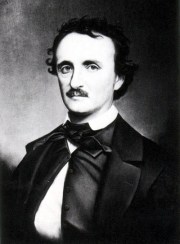
“Reading a book should be a conversation between you and the author,” Mortimer Adler wrote in his timeless 1940 meditation on marginalia as the yin-yang of reading and writing, adding: “Marking a book is literally an expression of your differences or your agreements with the author. It is the highest respect you can pay him.” As a prolific and meticulous marginalian myself, I have paid tomes’ worth of respect to my beloved authors over the years. Billy Collins even dedicated a beautiful poem to the mesmerism of marginalia, and medieval monks used the medium, long before the coinage of the term in 1819, as a canvas for entertaining complaints. But history’s greatest champion of marginalia was arguably Edgar Allan Poe (January 19, 1809–October 7, 1849).
In 1844, the godfather of the detective story began a column for The Democratic Review titled Marginalia, collecting his fragmentary reflections on writing and celebrating the joy of conversing with literature in its margins. It ran for five years and was later included in The Collected Writings of Edgar Allan Poe, Vol. 2 (public library).
It’s hard not to grieve the loss of this peculiar form of personal critical commentary as we transition to digital text — which is yet to solve the question of annotation — so it pays to consider what it is, exactly, that we’re losing. In the inaugural installment of his column, Poe captures the allure of transacting thoughts with an author in the margins of his work:
In getting my books, I have been always solicitous of an ample margin; this not so much through any love of the thing in itself, however agreeable, as for the facility it affords me of penciling suggested thoughts, agreements and differences of opinion, or brief critical comments in general. Where what I have to note is too much to be included within the narrow limits of a margin, I commit it to a slip of paper, and deposit it between the leaves; taking care to secure it by an imperceptible portion of gum tragacanth paste.
But more than a mere personal indulgence or quirk, Poe argues that marginalia are a playground for ideas and for intellectual discourse — with the author, as well as with one’s own mind at its most uninhibited:
All this may be whim; it may be not only a very hackneyed, but a very idle practice; — yet I persist in it still; and it affords me pleasure; which is profit. . . . This making of notes, however, is by no means the making of mere memoranda — a custom which has its disadvantages, beyond doubt. . . . In fact, if you wish to forget anything upon the spot, make a note that this thing is to be remembered.
But the purely marginal jottings, done with no eye to the Memorandum Book, have a distinct complexion, and not only a distinct purpose, but none at all; this it is which imparts to them a value. They have a rank somewhat above the chance and desultory comments of literary chit-chat — for these latter are not infrequently “talk for talk’s sake,” hurried out of the mouth; while the marginalia are deliberately penciled, because the mind of the reader wishes to unburden itself of a thought; — however flippant — however silly — however trivial — still a thought indeed, not merely a thing that might have been a thought in time, and under more favorable circumstances. In the marginalia, too, we talk only to ourselves; we therefore talk freshly — boldly — originally — with abandonment — without conceit…
In line with the notion that constraints fuel creative thought, Poe asserts that the very medium to which marginalia are confined causes our ideas to coalesce into cohesion:
The circumscription of space, too, in these pencilings, has in it something more of advantage than of inconvenience. It compels us (whatever diffuseness of idea we may clandestinely entertain), into Montesquieu-ism, into Tacitus-ism (here I leave out of view the concluding portion of the “Annals”) — or even into Carlyle-ism — a thing which, I have been told, is not to be confounded with your ordinary affectation and bad grammar. I say “bad grammar,” through sheer obstinacy, because the grammarians (who should know better) insist upon it that I should not. But then grammar is not what these grammarians will have it; and, being merely the analysis of language, with the result of this analysis, must be good or bad just as the analyst is sage or silly…
In a later meditation, Poe considers — curmudgeonly, nitpickerly, with a charming blend of sincerity and cynicism — marginalia’s most necessary vehicle: handwriting — yet another gravely endangered species in the age of digital text. Asserting that personal script, even when only intended for oneself, should answer to the era’s standards for epistolary etiquette, Poe argues that handwriting is a window into one’s core attributes of character:
I am far more than half serious in all that I have ever said about manuscript, as affording indication of character.
The general proposition is unquestionable — that the mental qualities will have a tendency to impress the MS [manuscript]. The difficulty lies in the comparison of this tendency, as a mathematical force, with the forces of the various disturbing influences of mere circumstance. But — given a man’s purely physical biography, with his MS., and the moral biography may be deduced.
The actual practical extent to which these ideas are applicable, is not sufficiently understood. For my own part, I by no means shrink from acknowledging that I act, hourly, upon estimates of character derived from chirography. The estimates, however, upon which I depend, are chiefly negative. For example: a man may not always be a man of genius, or a man of taste, or a man of firmness, or a man of any other quality, because he writes this hand or that; but then there are MSS. which no man of firmness, or of taste, or of genius, ever did, will, or can write. There is a certain species of hand-writing, — and a quite “elegant” one it is, too; although I hesitate to describe it, because it is written by some two or three thousand of my personal friends, — a species of hand-writing, I say, which seems to appertain, as if by prescriptive right, to the blockhead, and which has been employed by every donkey since the days of Cadmus, — has been penned by every gander since first a grey goose yielded a pen.
Now, were any one to write me a letter in this MS., requiring me to involve myself with its inditer in any enterprise of moment and of risk, it would be only on the score of the commonest civility that I would condescend to send him a reply.
I’m currently taking a writing, blogging, and coaching sabbatical due to family health issues. For now, I’ll repost selected articles from my Fiction Writing School. I encourage you to take the time to read these powerful, awe-inspiring words.
“Composition is for the most part an effort of slow diligence and steady perseverance, to which the mind is dragged by necessity or resolution, and from which the attention is every moment starting to more delightful amusements.”
BY MARIA POPOVA
English poet, essayist,literary critic, biographer, editor and lexicographer Samuel Johnson (September 18, 1709–December 13, 1784) endures as one of the most influential figures in literary history. His Dictionary of the English Language, originally published in 1755, is celebrated as one of the highest achievements of Western scholarship. A brilliant man yet a confounding figure in his lifetime, his peculiar tics and quirky gestures were only posthumously diagnosed as Tourette’s syndrome.
Composition is for the most part an effort of slow diligence and steady perseverance, to which the mind is dragged by necessity or resolution, and from which the attention is every moment starting to more delightful amusements.
Do not fancy that an intermission of writing is a decay of kindness. No man is always in a disposition to write, nor has any man at all times something to say.
It is one of the common distresses of a writer to be within a word of a happy period, to want only a single epithet to give amplification its full force, to require only a correspondent term in order to finish a paragraph with elegance and make one of its members answer to the other: but these deficiencies cannot always be supplied; and after a long study and vexation, the passage is turned anew, and the web unwoven that was so nearly finished.
The production of something, where nothing was before, is an act of greater energy than the expansion or decoration of the thing produced. Set down diligently your thoughts as they rise in the first words that occur; and, when you have matter, you will easily give it form: nor, perhaps, will this method always be necessary; for by habit your thoughts and diction will flow together.
I’m currently taking a writing, blogging, and coaching sabbatical due to family health issues. For now, I’ll repost selected articles from my Fiction Writing School. I encourage you to take the time to read these powerful, awe-inspiring words.
Writing isn’t work at all… And when people tell me how painful it is to write I don t understand it because it’s just like rolling down the mountain you know. It’s freeing. It’s enjoyable. It’s a gift and you get paid for what you want to do.
I write because it comes out — and then to get paid for it afterwards? I told somebody, at some time, that writing is like going to bed with a beautiful woman and afterwards she gets up, goes to her purse and gives me a handful of money. I’ll take it.
I never type in the morning. I don’t get up in the morning. I drink at night. I try to stay in bed until twelve o’clock, that’s noon. Usually, if I have to get up earlier, I don’t feel good all day. I look, if it says twelve, then I get up and my day begins. I eat something, and then I usually run right up to the race track after I wake up. I bet the horses, then I come back and Linda cooks something and we talk awhile, we eat, and we have a few drinks, and then I go upstairs with a couple of bottles and I type — starting around nine-thirty and going until one-thirty, to, two-thirty at night. And that’s it.
I’m currently taking a writing, blogging, and coaching sabbatical due to family health issues. For now, I’ll repost selected articles from my Fiction Writing School. I encourage you to take the time to read these powerful, awe-inspiring words.
“To have a specific style is to be poor in speech.”
BY MARIA POPOVA
Today’s abundance of advice on the art and craft of writing makes the phenomenon appear a modern meta-trope of the written word. And yet it is anything but new. In his 1852 treatise The Philosophy of Style (public library; public domain), Victorian-era philosopher, scientist, and liberal political theorist Herbert Spencer sets out to create a structural framework for good composition, guided by the emergent groundswell of formalist writing. Only 32 years old at the time, he defines language as “an apparatus of symbols for the conveyance of thought” and proceeds to map out its essential machinery.
Like Alexander Graham Bell, Spencer believes that engaging with good writing on a regular basis helps one internalize the secrets of the craft:
There can be little question that good composition is far less dependent upon acquaintance with its laws, than upon practice and natural aptitude. A clear head, a quick imagination, and a sensitive ear, will go far towards making all rhetorical precepts needless. He who daily hears and reads well-framed sentences, will naturally more or less tend to use similar ones. And where there exists any mental idiosyncrasy — where there is a deficient verbal memory, or an inadequate sense of logical dependence, or but little perception of order, or a lack of constructive ingenuity; no amount of instruction will remedy the defect. Nevertheless, some practical result may be expected from a familiarity with the principles of style. The endeavour to conform to laws may tell, though slowly. And if in no other way, yet, as facilitating revision, a knowledge of the thing to be achieved — a clear idea of what constitutes a beauty, and what a blemish — cannot fail to be of service.
A scientist at heart, he proposes an empirical approach to literary dogma:
However influential the truths thus dogmatically embodied, they would be much more influential if reduced to something like scientific ordination. In this, as in other cases, conviction will be greatly strengthened when we understand the why. And we may be sure that a comprehension of the general principle from which the rules of composition result, will not only bring them home to us with greater force, but will discover to us other rules of like origin.
Like Kurt Vonnegut, Spencer recognizes that the writer ought to pity the demands placed on the reader. One of his key concepts is thus the principle of economy of attention:
On seeking for some clue to the law underlying these current maxims, we may see shadowed forth in many of them, the importance of economizing the reader’s or hearer’s attention, To so present ideas that they may be apprehended with the least possible mental effort, is the desideratum towards which most of the rules above quoted point. … A reader or listener has at each moment but a limited amount of mental power available. To recognize and interpret the symbols presented to him, requires part of this power; to arrange and combine the images suggested requires a further part; and only that part which remains can be used for realizing the thought conveyed. Hence, the more time and attention it takes to receive and understand each sentence, the less time and attention can be given to the contained idea; and the less vividly will that idea be conceived.
One of his key aims is to liberate writing from “friction and inertia”:
Language must be regarded as a hindrance to thought, though the necessary instrument of it … Hence, carrying out the metaphor that language is the vehicle of thought, there seems reason to think that in all cases the friction and inertia of the vehicle deduct from its efficiency; and that in composition, the chief, if not the sole thing to be done, is, to reduce this friction and inertia to the smallest possible amount.
He cautions against the perilous burden the direct style — a technique that “conveys each thought into the mind step by step with little liability to error [and] gets the right thought conceived by a series of approximations” — places upon the reader’s attention, rendering it unfit for communicating complex or abstract ideas:
So long as the mind has not much to do, it may be well able to grasp all the preparatory clauses of a sentence, and to use them effectively; but if some subtlety in the argument absorb the attention — if every faculty be strained in endeavouring to catch the speaker’s or writer’s drift, it may happen that the mind, unable to carry on both processes at once, will break down, and allow the elements of the thought to lapse into confusion.
In a related aside, Spencer offers an apt aphorism:
What is bombast but a force of expression too great for the magnitude of the ideas embodied?
The same principle of economy of attention, Spencer argues, holds true of the creation of powerful imagery:
Not only in the structure of sentences, and the use of figures of speech, may economy of the recipient’s mental energy be assigned as the cause of force; but that in the choice and arrangement of the minor images, out of which some large thought is to be built up, we may trace the same condition to effect. To select from the sentiment, scene, or event described those typical elements which carry many others along with them; and so, by saying a few things but suggesting many, to abridge the description; is the secret of producing a vivid impression.
[…]
Whatever the nature of the thought to be conveyed, this skillful selection of a few particulars which imply the rest, is the key to success. In the choice of component ideas, as in the choice of expressions, the aim must be to convey the greatest quantity of thoughts with the smallest quantity of words.
Spencer uses this attention economy to admonish against saturation and advises on the proper sequence to achieve literary climax, advocating for variety:
As immediately after looking at the sun we cannot perceive the light of a fire, while by looking at the fire first and the sun afterwards we can perceive both; so, after receiving a brilliant, or weighty, or terrible thought, we cannot appreciate a less brilliant, less weighty, or less terrible one, while, by reversing the order, we can appreciate each.
[…]
The sensitiveness of the faculties must be continuously husbanded — includes much more than has been yet hinted. … We must progress from the less interesting to the more interesting; and why not only the composition as a whole, but each of its successive portions, should tend towards a climax. … [As] the easiest posture by and by becomes fatiguing, and is with pleasure exchanged for one less easy, so, the most perfectly-constructed sentences will soon weary, and relief will be given by using those of an inferior kind. … We may infer … not only that we should avoid generally combining our words in one manner, however good, or working out our figures and illustrations in one way, however telling; but that we should avoid anything like uniform adherence, even to the wider conditions of effect. … We must subordinate the component effect to the total effect.
The ideal form for a poem, essay, or fiction, is that which the ideal writer would evolve spontaneously. One in whom the powers of expression fully responded to the state of feeling, would unconsciously use that variety in the mode of presenting his thoughts, which Art demands. … To have a specific style is to be poor in speech.
The predominant feelings have by use trained the intellect to represent them. But while long, though unconscious, discipline has made it do this efficiently, it remains from lack of practice, incapable of doing the same for the less active feelings; and when these are excited, the usual verbal forms undergo but slight modifications. Let the powers of speech be fully developed, however — let the ability of the intellect to utter the emotions be complete; and this fixity of style will disappear. The perfect writer will express himself as Junius, when in the Junius frame of mind; when he feels as Lamb felt, will use a like familiar speech; and will fall into the ruggedness of Carlyle when in a Carlylean mood. Now he will be rhythmical and now irregular; here his language will be plain and there ornate; sometimes his sentences will be balanced and at other times unsymmetrical; for a while there will be considerable sameness, and then again great variety. His mode of expression naturally responding to his state of feeling, there will flow from his pen a composition changing to the same degree that the aspects of his subject change. He will thus without effort conform to what we have seen to be the laws of effect. And while his work presents to the reader that variety needful to prevent continuous exertion of the same faculties, it will also answer to the description of all highly organized products, both of man and of nature: it will be not a series of like parts simply placed in juxtaposition, but one whole made up of unlike parts that are mutually dependent.
I’m currently taking a writing, blogging, and coaching sabbatical due to family health issues. For now, I’ll repost selected articles from my Fiction Writing School. I encourage you to take the time to read these powerful, awe-inspiring words.
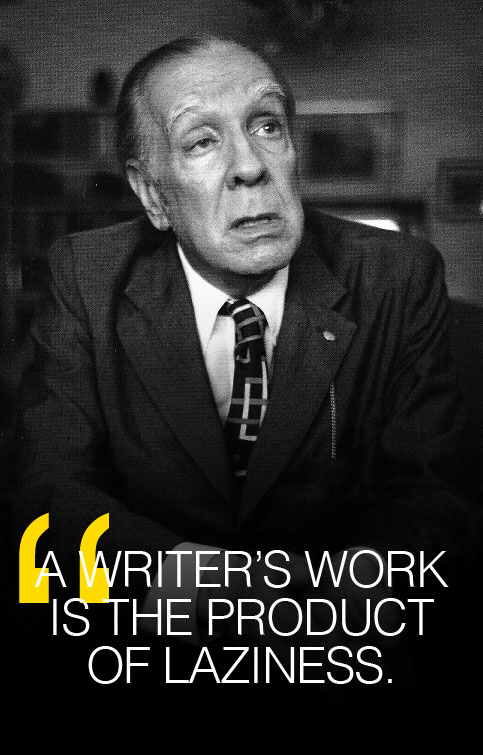
Jorge Luis Borges (August 24, 1899–June 14, 1986) is the most celebrated and influential Latin-American author of the twentieth century, his literary legacy resounding loud as ever and exuding far-reaching philosophical reverberations. In 1972, when Borges was in his seventies and completely blind, a bright and earnest young Argentinian man of letters by the name of Fernando Sorrentino, only thirty at the time, sat down with the beloved author for seven afternoons in a tiny, secluded room in the National Library and recorded their conversations — “low-key, casual chats, free from any bothersome adherence to a rigid format” — on tape. Published in 1974 as Seven Conversations with Jorge Luis Borges (public library), the conversations, spanning everything from literature to politics, couldn’t be commercially distributed until the overthrow of Isabel Perón in 1976 due to the author’s anti-establishment political convictions and the frankness with which he discussed them with Sorrentino.
Before I ever wrote a single line, I knew, in some mysterious and therefore unequivocal way, that I was destined for literature. What I didn’t realize at first is that besides being destined to be a reader, I was also destined to be a writer, and I don’t think one is less important than the other.
On literature as a gateway to the human condition:
I believe in psychological literature, and I think that all literature is fundamentally psychological.
On not mistaking anonymous authorship for lack of creative exertion, and why fairy tales exemplify the refinement of storytelling:
Each year a person hears four or five anecdotes that are very good, precisely because they’ve been worked on. Because it’s wrong to suppose that the fact that they’re anonymous means they haven’t been worked on. On the contrary, I think fairy tales, legends, even the offcolor jokes one hears, are usually good because having been passed from mouth to mouth, they’ve been stripped of everything that might be useless or bothersome. So we could say that a folk tale is a much more refined product than a poem by Donne or by Góngora or by Lugones, for example, since in the second case the piece has been refined by a single person, and in the first case by hundreds.
On not getting lost in movements:
I no longer believe in literary schools now; I believe in the individual.
On the advantage of writing about history:
I believe that a writer should never attempt a contemporary theme or a very precise topography. Otherwise people are immediately going to find mistakes. Or if they don’t find them, they’re going to look for them, and if they look for them, they’ll find them. That’s why I prefer to have my stories take place in somewhat indeterminate places and many years ago.
I think of Shakespeare above all as a craftsman of words. For example, I see him closer to Joyce than to the great novelists, where character is the most important thing. That’s the reason I’m skeptical about translations of Shakespeare, because since what is most essential and most precious in him is the verbal aspect, I wonder to what extent the verbal can be translated.
On why free verse is more challenging to write than metered poetry, the former embodying Bukowski’s poetic admonition that the only worthwhile writing is the kind that “comes out of your soul like a rocket”:
I find it harder to write free verse. Because if there isn’t some kind of inner drive it can’t be done. On the other hand, using a regular meter is a matter of patience, of application . . . Once you’ve written one line, you’re forced to use certain rhymes, the number of rhymes is not infinite; the rhymes that can be used without incongruity are few in number . . . That is, when I have to fabricate something, I fabricate a sonnet, but I wouldn’t be able to fabricate a poem in free verse.
A timeless book … would be just as admirable if it had been published a hundred years before or if it were published a hundred years later. A book that can only be defined by its perfection.
It’s possible that the fact that literature has been commercialized now in a way it never was before has had an influence. That is, the fact that people now talk about “bestsellers,” that fashion has an influence (something that didn’t use to happen). I remember that when I began to write, we never thought about the success or failure of a book. What’s called “success” now didn’t exist at that time. And what’s called “failure” was taken for granted. One wrote for oneself and, maybe, as Stevenson used to say, for a small group of friends. On the other hand, one now thinks of sales. I know there are writers who publicly announce they’ve had their fifth, sixth, or seventh edition released and that they’ve earned such and such an amount of money. All that would have appeared totally ridiculous when I was a young man; it would have appeared incredible. People would have thought that a writer who talks about what he earns on his books is implying: “I know what I write is bad but I do it for financial reasons or because I have to support my family.” So I view that attitude almost as a form of modesty. Or of plain foolishness.
On trusting your inner compass for merit, in literature and in life:
I believe that whenever one does wrong, he knows he’s doing wrong. Still, he does it. I believe that no one thinks his own behavior is exemplary. And this holds true in literary matters as well.
On writing and aging:
To reach the point of writing in a more or less uncluttered manner, a more or less decorous manner, I’ve had to reach the age of seventy.
My father gave me that advice. He told me to write a lot, to discard a lot, and not to rush into print, so that the first book I had published, Fervor de Buenos Aires, was really my third book. My father told me that when I had written a book I judged to be not altogether unworthy of publication, he would pay for the printing of the book, but that it was each man for himself and I shouldn’t ask anyone for advice.
On the metric of literary merit:
A writer should always be judged by his or her best pages.
On his distaste for novels, a form Borges believed would eventually die out, and the advantage of short stories over them:
I never thought of writing novels. I think if I began to write a novel, I would realize that it’s nonsensical and that I wouldn’t follow through on it. Possibly this is an excuse dreamed up by my laziness.
[…]
The essential advantage I see in it is that the short story can be taken in at a single glance. On the other hand, in the novel the consecutive is more noticeable. And then there’s the fact that a work of three hundred pages depends on padding, on pages which are mere nexuses between one part and another. On the other hand, it’s possible for everything to be essential, or more or less essential, or — shall we say — appear to be essential, in a short story. I think there are stories of Kipling’s that are as dense as a novel, or of Conrad’s too. It’s true they’re not too short.
A writer’s work is the product of laziness, you see. A writer’s work essentially consists of taking his mind off things, of thinking about something else, of daydreaming, of not being in any hurry to go to sleep but to imagine something . . . And then comes the actual writing, and that’s his trade. That is, I don’t think the two things are incompatible. Besides, I think that when one is writing something that’s more or less good, one doesn’t feel it to be a chore; one feels it to be a form of amusement. A form of amusement that doesn’t exclude the use of intelligence, just as chess doesn’t exclude it, and chess is a game I’m very fond of and would like to know how to play — I’ve always been a poor chess player.
I would advise that imaginary young man to study the classics; let him not try to be modern, because he already is; let him not try to be a man of a different epoch, to be a classical writer, because, indubitably, he cannot be this, since he is irreparably a young man of the twentieth century.
His parting words reflect on creativity, aging, hope, and legacy:
I believe one must not lose hope after fifty years. Besides, one learns by hard knocks, isn’t that so? I think I’ve committed all the literary errors possible and that this fact will allow me to succeed some day.
[…]
The image that I shall leave when I’m dead — we’ve already said that this is part of a poet’s works — and maybe the most important — I don’t know exactly what it will be, I don’t know if I’ll be viewed with indulgence, with indifference, or with hostility. Of course, that’s of little importance to me now; what does matter to me is not what I’ve written but what I am writing and what I’m going to write. And I think this is how every writer feels. Alfonso Reyes said that one published what he had written in order to avoid spending his life correcting it: one publishes a book in order to leave it behind, one publishes a book in order to forget it.
Seven Conversations with Jorge Luis Borges is a treasure trove of insight in its entirety, its magic best captured by Borges himself in the prologue, penned on July 13, 1972:
Paradoxically, the dialogues which take place between a writer and a journalist bear less resemblance to a question-and-answer session than to a kind of introspection. For the interviewer, they can be a chore which is not entirely free of fatigue and tedium; for the interviewee, they are like an adventure in which the hidden and the unforeseeable lie in wait. Fernando Sorrentino knows my work — let us use that term — much better than I do; this is due to the obvious fact that I have written it one single time and he has read it many times, a fact which makes it less mine than his. As I dictate these lines, I do not wish to slight his kindly perspicacity: how many afternoons, speaking face to face, has he guided me, as though it were unintentional, to the inevitable answers which later astonished me and which he, no doubt, had prepared.
Fernando Sorrentino is, in a word, one of my most generous inventors. I wish to take advantage of this page to tell him of my gratitude and the certainty of a friendship that will not be erased by the years.
 When Alice Munro won the 2013 Nobel Prize in literature, she was too ill to travel and receive the prestigious accolade in person, so instead of delivering the customary Nobel acceptance speech in Stockholm, she was interviewed by the Swedish Academy in her home. The conversation — a wide-ranging dance across the spectrum of literature and life — reveals Munro’s sharp, dimensional, highly self-ware mind driven by equal parts confidence and doubt, and above all by an unflinching faith in literature’s capacity to change us.


 “Reading a book should be a conversation between you and the author,” Mortimer Adler wrote in his timeless 1940 meditation on


 English poet, essayist,literary critic, biographer, editor and lexicographer Samuel Johnson (September 18, 1709–December 13, 1784) endures as one of the most influential figures in literary history. His Dictionary of the English Language, originally published in 1755, is celebrated as one of the highest achievements of Western scholarship. A brilliant man yet a confounding figure in his lifetime, his peculiar tics and quirky gestures were only posthumously diagnosed as Tourette’s syndrome.