The authors of the four New Testament gospels had a simple goal: to promote belief in the Christ they worshipped. Scholar Charles Guignebert, in his 1935 classic work Jesus, wrote:
“It was not the essence of Jesus that interested the authors of our Gospels, it was the essence of Christ, as their faith pictured him. They are exclusively interested, not in reporting what they know, but in proving what they believe.”
In other words, they were not historians, but propagandists. In fact, intensive criticalstudy of the gospels has demonstrated that these documents do not qualify as history. Their authors don’t identify their sources, but it’s even worse than that. Matthew and Luke copied major portions of Mark’s gospel without mentioning that’s what they’d done, i.e., they plagiarized—and changed Mark’s text to suit their own agendas.
As I pointed out in my article here last week, the author of John’s gospel is, by far, the worst offender. This would be obvious to any churchgoer—no matter how devout—who bothers to carefully compare the gospels. John imagined a theologically obsessed Jesus. I have often pointed out that this author is guilty of theology inflation, and in this article I invite readers to study John 14-17, with critical thinking skills fully engaged. In these four chapters, this author created a Religious Fanatic’s Training Manual, a prototype cult playbook for making sure that followers remain dedicated to the holy hero who commands their loyalty.
These four chapters come at the end of the last supper. Jesus has washed the feet of the disciples, but omitted any mention of the famous eucharist scene found in the earlier gospels. He has also predicted that Peter will deny him three times. Then this extensive theology monologue begins. A critical reader—a curious reader—would want to know: how did the author of this gospel know that any of this is true? To the devout who might object, “But he was inspired by God to write these words,” the same question applies: How do you know this is true? You may have been taught this from your earliest years, but by what means can it be verified? “I take it on faith” comes right out of the cult playbook, by the way. Countless cults have kept people in their thrall with this mindless advice. We also have to ask: Why did the earlier gospel writers fail to include this major Jesus monologue—weren’t they inspired too? Was there a flaw in their inspiration?
Chapter 14
At the outset, the author wants his readers to know that their holy hero is the real thing—in fact, the only real thing, 14:6: “Jesus said to [Thomas], ‘I am the way and the truth and the life. No one comes to the Father except through me.’” Other cults, other religions, are useless. Fear of death has always been a motivator for attaching oneself to a set of beliefs, to a religious icon, hence that promise is here too, 14:2-3, KJV: “In my Father’s house are many mansions: if it were not so, I would have told you. I go to prepare a place for you. And if I go and prepare a place for you, I will come again, and receive you unto myself; that where I am, there ye may be also.”
This chapter is big on promises, 14:9, “Whoever has seen me has seen the Father”, 14:11: “Believe me that I am in the Father and the Father is in me,” 14:13: “I will do whatever you ask in my name, so that the Father may be glorified in the Son.”
And this major promise, tied to the hero’s ego, 14:19-21:
“In a little while the world will no longer see me, but you will see me; because I live, you also will live. On that day you will know that I am in my Father, and you in me, and I in you. They who have my commandments and keep them are those who love me, and those who love me will be loved by my Father, and I will love them and reveal myself to them.”
There is also a text that no doubt played a role in development of trinitarian theology—“god in three persons”—14:25-26: “I have said these things to you while I am still with you. But the Advocate, the Holy Spirit, whom the Father will send in my name, will teach you everything and remind you of all that I have said to you.” This sounds great, but it would seem that the Holy Spirit has done a sloppy job of “teaching everything,” given the long, painful history of Christians
disagreeing with each other—sometimes to the point of warfare and bloodshed. Dan Barker has pointed out that Christians today are deeply divided on a huge range of social and political issues, so much so, as Barker puts it, “there is either a multitude of gods handing out conflicting moral advice, or a single god who is hopelessly confused” (Losing Faith in Faith: From Preacher to Atheist, 1992).
Chapter 15
Full-blown cult fanaticism is obvious here—and well as the holy hero’s full-blown ego, 15:1-4: “I am the true vine, and my Father is the vine grower.He removes every branch in me that bears no fruit. Every branch that bears fruit he prunes to make it bear more fruit. You have already been cleansed by the word that I have spoken to you.Abide in me as I abide in you.”
Those who are in the cult have “been cleansed”—and a grim fate is in store for anyone who isn’t fully, enthusiastically devoted to the cult, 15:6: “Whoever does not abide in me is thrown away like a branch and withers; such branches are gathered, thrown into the fire, and burned.”
Cults are often despised, because of the weird beliefs and behavior—publicly displayed—of those who belong. This author expected such rejection, but that’s a consequence of being selected by the holy hero—so it’s actually a good thing, 15:18-21:
“If the world hates you, be aware that it hated me before it hated you.If you belonged to the world, the world would love you as its own. Because you do not belong to the world, but I have chosen you out of the world, therefore the world hates you…If they persecuted me, they will persecute you; if they kept my word, they will keep yours also. But they will do all these things to you on account of my name, because they do not know him who sent me.”
Chapter 16
By far the vast majority of Jews at the time of Jesus did not believe claims of the breakaway sect that Jesus was the messiah. Thus it’s no surprise that the author of John’s gospel portrays Jews as the enemy—even accusing them of being children of the devil (see 8:44—a text that has caused so much damage). He begins this chapter with a warning, 16:2: “They will put you out of the synagogues. Indeed, an hour is coming when those who kill you will think that by doing so they are offering worship to God.And they will do this because they have not known the Father or me.” And more ego, 16:15: “All that the Father has is mine. For this reason I said that he will take what is mine and declare it to you.”
The cult is assured that suffering and pain will be annulled:
“So you have pain now, but I will see you again, and your hearts will rejoice, and no one will take your joy from you.On that day you will ask nothing of me. Very truly, I tell you, if you ask anything of the Father in my name, he will give it to you. Until now you have not asked for anything in my name. Ask and you will receive, so that your joy may be complete.”
The disciples buy into it all—they set the example for other cult members to follow— 16:30: “Now we know that you know all things and do not need to have anyone question you; by this we believe that you came from God.” There is no need to ask questions: classic cult propaganda.
But to avoid being fooled, duped, the opposite approach is necessary: question everything.
Chapter 17
Now back to the crucial promise, the eternal life gimmick, expressed in Jesus’ prayer, 17:1-3: “Father, the hour has come; glorify your Son so that the Son may glorify you,since you have given him authority over all people, to give eternal life to all whom you have given him. And this is eternal life, that they may know you, the only true God, and Jesus Christ, whom you have sent.” Yes, this cult is tuned in to the “only one true God.”
This is the essence of cult fanaticism, that god himself gave this cult to Jesus, 17:6-8:
“I have made your name known to those whom you gave me from the world. They were yours, and you gave them to me, and they have kept your word.Now they know that everything you have given me is from you, for the words that you gave to me I have given to them, and they have received them and know in truth that I came from you, and they have believed that you sent me.”
I challenge churchgoers: please read John 14-17 carefully, analyzing every sentence, every claim, and answer honestly: “Is this what your Christian faith looks like?” And go beyond this: question everything. Are these chapters based on revelation, imagination, or hallucination? How would you know? The apostle Paul bragged in his letters that he learned nothing about Jesus from the people who had known him—everything he knew about Jesus came to him through visions/hallucinations.
Did the author of John’s gospel operate any differently? There is no evidence whatever—none at all—that he had any way of knowing the “real words” of Jesus. He claims at the very end of the gospel, 21:24, that the “beloved disciple” is the one who witnessed and reported all the events described. But this disciple is not mentioned at all in the earlier gospels; we suspect that he is an invented character, also derived from the author’s active imagination—active decades after the death of Jesus.
Cold, hard, blunt fact: there is no contemporaneous documentation (e.g., letters, diaries, transcriptions contemporary with Jesus) by which we can verify any of the words of Jesus found in the four gospels. That’s why, for a long time now, I’ve used the term Jesus-script. In the ancient world it was common for writers to make up the speeches attributed to leaders and heroes.
It was also common for theologians to wildly imagine the wonders of the gods they adored. The New Testament is an example of that, and there are many chapters—such as John 14-17—that make us wonder why a good, wise god couldn’t have intervened to put a stop to excessively bad, manipulative theology.
If we approach the phenomenon of religious life through the lens of brainwashing and indoctrination, or what is more commonly called undue influence, a rich organizer opens up for study. Undue influence is the most established term used in the legal system for brainwashing-type phenomena. I look at these ideas through the lens of Steven Alan Hassan’s doctoral dissertation “The Bite Model of Authoritarian Control: Undue Influence, Thought Reform, Brainwashing, Mind Control, Trafficking and the Law” (2020).
One of the most important lenses to see cultic undue influence is “illusion of choice,” where it feels like you are making choices, but really you aren’t. We see a prime example of this in Christianity with the idea of “Christ in you,” and “he (Christ) who is in you is greater than he who is within the world.” We can see a full expression of this with Jehovah’s Witnesses, where it is not the individual thinking, but the individual as a vehicle for the ideology. Hassan comments:
Businesses are penalized by law for fraudulent claims or omitting vital information, but religions are exempt from this fundamental obligation. For example, the Watchtower Society’s members have to spend time every month proselytizing, and they do so by offering to study the Bible. However, those approached may be unaware that the Bible the Jehovah’s Witnesses use is denounced by Jewish and Christian scholars as theologically unsound. They should be warned. Jehovah’s Witnesses use their own “New World Translation” which lacks Biblical scholarship (Phillips, 2015). Furthermore, potential recruits are urged to be baptized by the Watchtower Society yet are seldom informed that the group forbids blood transfusions and has a practice of disfellowshipping (shunning). Members may be shunned if the elders believe a member has sinned, even for petty acts like sending a birthday card to a nonmember. Researchers assert that if an organization is to have the benefits of non-profit status, it should be required to be transparent and practice informed consent. Deceptive recruitment violates people’s religious freedom and should be illegal, and the organization’s leadership penalized. This means that a way to legally define and measure undue influence must be found. Members should have the freedom to question the leaders, the doctrine, and the policies and have the freedom to leave the religion with harassment, threats, or experiencing trauma (2020, p. 9).
Cults operate by deconstructing one’s sense of self and belief systems to then create the person anew out of that fertile soil, which Hassan characterizes as “to drastically reinterpret their life’s history, radically alter their world view, accept a new version of reality and causality, and develop a dependency on the organization, thereby being turned into a deployable agent of the organization operating the thought reform program” (Hassan, 2020, p. 3). And this is exactly how religions work—in Christianity’s case demonizing what the apostle Paul called your fleshly/worldly nature, seeing that nature as evil and replacing it with a new spiritual nature.
The replacement religious ideology is arbitrary, but because the mind is usually on autopilot, it is not scrutinized as such and so remains intact. In Thinking, Fast and Slow Daniel Kahneman, who won the Nobel Prize in Behavior Economics, says with Amos Tversky that it was “demonstrated that most human beings depend on unconscious heuristics to make fast decisions and, only when necessary, use slow, conscious data analysis” (Hassan, 2020, p. 13). Thoughtful critique necessitates going to the core of the religious beliefs of the individual, not getting weighed down in the periphery, or with random insults.
Hassan points out we can see analogous cases where people have been subjected to undue influence in other areas:
The Brandle/Heisler/Steigel model:
This model is based on domestic violence relationships, stalking, and sexual assault. It assumes that undue influence parallels these other religious situations.
There are eight factors:
The victim was kept unaware.
The victim was isolated from others and information.
The Influencer tried to create fear.
The influencer preyed on vulnerabilities.
The influencer tried to create dependencies.
The influencer attempted to make victims lose faith in their own beliefs.
The influencer tried to induce shame and secrecy.
The influencer performed intermittent acts of kindness.
(Hassan, 2020, p. 18)
It should be obvious to anyone that this is the very heart of Christianity. The potential convert is supposed to do a thorough self-inventory until they come to see how broken they are, which then provides the ground for the reconstructive starting point: the Sinner’s prayer. Religious self-help groups function in the same way, like through the 12 Steps of Alcoholics Anonymous (AA) getting you to start alcohol abstinence by admitting that you are completely lost in an addiction that you can’t fight unless you let God transform you.
There is no difference between a religion and a cult, just that religion is a cult grown larger. In this way, we can see the features of the brainwashed cult member achieved in religion. Hassan comments:
The “thought reform” or “cult” model of Margaret Thaler Singer, PhD developed from her work on the tactics used by cults and cult leaders and has been widely referenced. The model proposes six stages: creating isolation, fostering a siege mentality, inducing dependency, promoting a sense of powerlessness, manipulating fears and vulnerabilities, and keeping the victim unaware and uninformed. The model also specifies certain tactics as follows:
keeping the victim unaware of what is going on and what changes are taking place;
controlling the victim’s time and, if possible, physical environment;
creating a sense of powerlessness, covert fear, and dependency;
suppressing much of the person’s old behavior and attitudes;
instilling new behavior and attitudes; and
putting forth a closed system of logic, allowing no real input or criticism.
Hassan argues that Robert J. Lifton has been instrumental in identifying the most effective look-fors in identifying environments of brainwashing/undue influence. To begin with, we can see the hallmark of the religious mindset in the first of the eight concepts below: that the in-group has the only way to view reality.
(1) Milieu Control
Milieu control involves seeing the group way as the correct and only way: “I am the way and truth and life: No one comes to the father but through me,” Jesus says. “There is often a sequence of events, such as seminars, lectures, and group encounters, which becomes increasingly intense and increasingly isolated, making it extremely difficult both physically and psychologically for one to leave” (Lifton, 1961 p. 421).
(2) Mystical Manipulation
One only needs to watch Steve Martin’s movie Leap of Faith (1992) to see the lengths to which the divine is created out of whole cloth. This can range from overt lies to overemphasizing the importance of coincidence. Yes, it’s unlikely that you will experience a healing that defies medical explanation, but in a planet of 8 billion, it’s not odd that someone will hit the lottery. Really illustrating this is that the probability of you existing at all comes out to 1 in 102,685,000—yes, that’s a 10 followed by 2,685,000 zeroes! The odds of you being alive are basically zero, but we know that there is nothing miraculous about you existing. Ali Binazir explains that there is an extremely unlikely chain of events that would have to occur for you to exist (Spector, 2012).
Typical with religions and cults is to identify specific persons as being mouthpieces for God, such as Billy Graham, and cultists trust the “prophet’s” revelations infinitely more than that of the next person, as the cult leader is said to be a mediator for God. Hassan adds:
This can be understood as a misattribution error in the person influenced—that he or she wrongly attributes “divine” forces to what is basically trickery. The person thinks the influencer is reading their mind, or that there are magical forces at work, for why things happened the way they did. Another example is a person who comes to a cult “Bible study” but does not realize that the person who invited him was instructed to learn all about his background and report it to the leader. So, when the Bible study is conducted, key teachings would be made, designed to give the new person the subjective feeling that God knew “all about him” and his struggles and was directing him to become involved. (2020, p. 29)
(3) Demand for Purity
Historically, one of the traits that has been useful for control is inspiring guilt. A culture of purity thus fosters dependence and obedience. Cults specifically target the weak and broken because they are more open to the idea that they are fundamentally flawed, and so are ripe soil in which to plant the new ideology. This is what Jesus means when he says “blessed are the poor in spirit,” which has nothing to do with money, but rather with the blessednes of those who feel spiritually broken and destitute and who thus crave a new approach to life. The apostle Paul talks about how the law was given to make the hidden sin nature conspicuous, for this would awaken the Law written on our hearts and inspire repentance. Hassan comments: “Establishing impossible standards for performance, creates an environment of guilt and shame. No matter how hard a person tries, he always falls short, feels bad, and works even harder” (2020, p. 29).
(4) The Cult of Confession
Religion is egotism, such as the idea that my being tempted by someone who isn’t my wife is part of a cosmic battle for a tug of war between God and the Devil for my soul. For what’s the alternative? The alternative is that I am an insignificant evolutionary accident. The cult is interested in every aspect of the person’s life and sees the person’s thoughts and deeds as very important and in need of cultivation. Hassan says there is “a breakdown of healthy boundaries of self/group where the cult or controller believes it is their right to know absolutely everything about the individual’s life, and this person has no right to keep any secrets which includes negative thoughts and feelings about the controller” (2020, p. 31).
(5) Sacred Science
Of course, it is obvious that religions were once cults, and cults are bizarre and silly, so you see the increased drive in religion to legitimize themselves as real science. Hassan says: “The belief that the group’s dogma is absolutely scientifically and morally true, with no room for questions or alternative viewpoints, sacred science can offer considerable security to young people because it greatly simplifies the world” (2020, p. 31).
(6) Loading the Language
A large part of entrenching someone in the religious mindset is to orient the language about it. We see this, for instance, in politicians working God into their speeches, as though it legitimized them to admit that they were superstitious. Hassan comments:
Unlike a healthy use of a large vocabulary to help navigate the world, a person influenced by thought reform has a vastly reduced set of words and concepts. The term loading the language refers to a reification of language—words or images becoming sacred or divine. A much-simplified language may seem cliché-ridden but can have enormous appeal and psychological power in its very simplification. Because every issue in one’s life—and these are often very complicated young lives—can be reduced to a single set of principles that have an inner coherence, one can claim the experience of truth and feel it. (2020, p. 32)
Stephen Colbert famously satirized “truthiness,” the idea that the truth value of something comes from its sounding true rather than being true. Jacques Derrida called this the metaphysics of presence.
(7) Doctrine over Person
Ultimately, what happens to many religious people is that their experience contradicts religious dogma and predictions, which births doubt. Talk of an all-loving and all-powerful God who has a plan for your life is fine and nice, but it is also egotism, and hardly squares with a world where 3-year-old children regularly die from cancer and starvation. The argument to God from beauty—”How can you look at the beauty of a sunset and there not be a divine artist?”—is analogous, and we can ask if a spider finds the sunset beautiful, too. Likewise, doubts are placed in the mind of a schizophrenic about his delusion that he is in a secret relationship with Drew Barrymore when he goes to the bar expecting to meet up with her and she doesn’t show up. Hassan comments: “The pattern of doctrine over person occurs when there is a conflict between what one feels oneself experiencing and what the doctrine or dogma says one should experience” (2020, p. 33).
(8) Dispensing of Existence
I’ve always wondered about Christian women dating secular men. What are they going to do without them in the afterlife? (Of course, Jesus responds that there is no marriage in the afterlife!) Members of the out-group, especially former members of the cult, are seen as being a defective use of a human life, and so are demonized, which can inspire all forms of negative responses from cult members.
Analysis
Deconstructing or deprogramming an underlying narrative is neither true nor false. A child being a good friend in school is neither correct nor incorrect, it’s just that the individual and the system functions in a healthier manner (to use Friedrich Nietzsche’s model) if the child is being friendly. So, if a child is being a problem, it may be that the underlying narrative is that the child sees naughty children get more attention from the teacher than well-behaved children and so becomes the center of attention. Deconstruction here involves identifying and challenging the underlying narrative. The naughty child is “correct” in that his underlying narrative yields the results that he wants (attention from the teacher and peers), but his approach is unhealthy and causes systemic (classroom) and individual stress. The child needs to be deprogrammed of his unhealthy attention-seeking narrative and taught that there are healthy ways to get attention. The same holds true for religion. The Christian approach is predicated on the assumption that the Christian interpretation of the evidence makes the most sense, and alternative interpretations are trivialized. So it’s a kind of egotism, which we already knew because the individual has to believe that the author of all reality cares what little insignificant you thinks and does, and there is a war between the forces of good and the forces of darkness to win what you believe.
To see the interpretive underlying narrative, the believer has to assume his religion is correct, because otherwise every act of worship could be angering the true deity (Pascal’s wager be damned!). But there is a deeper internal underlying narrative. Who’s to say? Since we’re only guessing without evidence, perhaps God sent Jesus to preach love of meekness, poverty, master (God), and enemy as a test to see who has the true warrior spirit of wealth and power, so that whoever follows Jesus fails the test and goes to Hell, while whoever maintains warrior values despite Jesus’ empty threats of Hell actually proves their warrior hearts and gains paradise. There are no uninterpreted facts from the point of view of deconstruction/deprogramming, and so weight needs to be restored to other possible interpretations to lessen the force of the popular narrative. Derrida wasn’t just being a jerk or obscure, he was arguing that restoring weight to marginalized interpretations is the way to justice—for example, when we see the violence the previously valued traditional definition of marriage does to LGBTQ+ rights, it’s an occasion to deconstruct the traditional definition and reconstruct it in a more just, inclusive way.
Religiosity is fundamentally irrational, guessing without sufficient evidence, and apologists often point to gaps in scientific knowledge to insert God in that gap, though 100% of the mysteries of reality that have been solved, have been solved by science, not God. To believe in theism means to believe that God can do anything—except appear and say hi and remove all doubt!
Because religion ultimately rests on a foundation of superstition, the secularist needs to be like a sleuth with liberal theists, wading through the theists’ “naturalistic smokescreen” to get to the superstitious elements, frameworks, and foundations. If the liberal theist does not believe in life after death, this is not an issue to focus on. Remember, religion always needs to legitimize itself, because unconsciously it knows that it is illegitimate, and so will bend over backward to present itself as a science. We should not infer that someone is wise about the existential religious questions just because they are a liberal theistic critical historian of religion. To give an analogy: someone can be competent on the piano, but not on the violin. Regarding liberal theists, Richard Carrier comments:
But even liberal-minded, progressive Christians like Justin Brierley are still echoing ancient anti-empirical sentiments. Of course the reason the “response” to this observed defect in Christianity is still never to promote actually reliable methods is that that erodes faith—for reasons only obvious to atheists. Reliable methods + correct information + time = atheism…. That this is fundamental to Christianity is proved by how it infects even its liberals. As I just noted, even Justin Brierley “lets his Bible tell him to consider as ‘blessed’ those who choose to believe things without evidence,” explicitly citing John 20:2, thus demonstrating that the ancient Christian Bible’s anti-intellectualism is corrupting the minds even of its most liberal of devotees. And that’s a problem. This is why all religion is bad for us. As I wrote before, Brierley’s “religion has literally taught him to praise the rejection of evidence-based reasoning,” which is “dangerous as all hell,” a “disastrously bad effect” of his religion on his mind. And we see this across the whole of modern Christendom. It still preaches hostility to sound inductive logic, and elevates in its place completely unempirical deductive systems of logic instead, the ones most easily corrupted to sell anything as true. And even when Christians pay lip service to sound methods of inductive logic, they completely misuse them, rendering them totally unsound. (Carrier, 2022)
In an era of unprecedented upheaval, it is difficult to find suitable context and perspective for the latest indictment of Donald Trump.
After all, this isn’t the first indictment he has faced, or even the first in federal court. It isn’t the first time we have had to grapple with his moral failings, the unleashing of political violence, or the degradation of our constitutional order.
Much of what is in the document made public on Tuesday we knew before. We saw it unfold on TV. We read the reporting of its aftermath. We heard the gripping public testimony in front of the bipartisan House Select Committee that investigated the insurrection of January 6.
It wasn’t even that the indictment was a surprise. For a long time, the investigation has been in the public consciousness. After Trump announced that he had been told he was a target, it was mostly a matter of when, not if.
It is important to keep in mind that this latest indictment does not charge Trump with arguably the gravest potential crimes, like insurrection or sedition, even though many who watched in horror the events leading up to and cresting on January 6 think it obvious he is guilty of both.
Randall Eliason, a former chief of the fraud and public corruption section at the U.S. Attorney’s Office for the District of Columbia, argued in a New York Times opinion piece titled “What Makes Jack Smith’s New Trump Indictment So Smart” that the special counsel wisely chose to limit the scope of the case (and the number of defendants) to just Trump despite the six other unnamed but easily identifiable co-conspirators. Smith did this, the piece points out, in order to proceed quickly to trial and yield the best chance at conviction. “Although it might have been psychologically gratifying to see Mr. Trump charged with sedition, the name of the legal charge is less important than the facts that will make up the government’s case,” Eliason wrote.
In other words, Smith decided not to try to prove too much; keep the charges few and based on what facts he believes are most likely to convince a jury — and whatever part of the public may be open to persuasion.
Let us stop for a moment to ponder these facts and the narrative they tell. They are chilling, but we must remember the Department of Justice will have to prove them in a court of law. Trump is presumed not guilty until and unless he is proven otherwise. He has every right to mount a vigorous defense. It’s probably best for the country that his lawyers fight hard and smart. The more thoroughly this case is adjudicated, the more its conclusion is likely to be strengthened by the process.
But in reading the indictment, all who love and care for our precious republic and its democratic traditions should feel a deep shudder of fear that we were driven to such a precipice. The writing itself is not fancy — no stacking of dependent clauses or diving into a thesaurus in search of adjectives. Reading the introduction aloud, it almost has the syncopation of a children’s picture book, even if the story it tells is one of horror:
The Defendant, DONALD J. TRUMP, was the forty-fifth President of the United States and a candidate for re-election in 2020.
The Defendant lost the 2020 presidential election.
Despite having lost, the Defendant was determined to remain in power.
So for more than two months following election day on November 3, 2020, the Defendant spread lies that there had been outcome-determinative fraud in the election and that he had actually won.
These claims were false, and the Defendant knew that they were false.
But the Defendant repeated and widely disseminated them anyway — to make his knowingly false claims appear legitimate, create an intense national atmosphere of mistrust and anger, and erode public faith in the administration of the election.
The Defendant had a right, like every American, to speak publicly about the election and even to claim, falsely, that there had been outcome-determinative fraud during the election and that he had won.
He was also entitled to formally challenge the results of the election through lawful and appropriate means, such as by seeking recounts or audits of the popular vote in states or filing lawsuits challenging ballots and procedures.
Indeed, in many cases, the Defendant did pursue these methods of contesting the election results.
His efforts to change the outcome in any state through recounts, audits, or legal challenges were uniformly unsuccessful.
Shortly after election day, the Defendant also pursued unlawful means of discounting legitimate votes and subverting the election result.
What follows that in the indictment is a story we all saw unfold in real time, laid bare in a double-spaced legal document. There is also a lot to read between the lines. Even former Trump Attorney General Bill Barr, who enabled many of Trump’s worst instincts and misled the American public about Trump’s fitness for office, told CNN he thinks prosecutors have more evidence than what they have shared thus far. He called the indictment “very spare” and added, “I think there’s a lot more to come and I think they have a lot more evidence as to President Trump’s state of mind.”
Be that as it may, these 45 pages comprise one of the most consequential pieces of writing in American history. It does not have the earth-shattering rhetoric of our Declaration of Independence, the poetry of Lincoln’s “Gettysburg Address” or the urgent morality of Dr. Martin Luther King’s “Letter from Birmingham Jail.” But it is a clear statement at one of the most pivotal intersections in our nation’s narrative; that autocracy and the fomenting of political violence to subvert the peaceful transfer of presidential power is not only anathema to our values — it is illegal.
History is riddled with “what ifs.” We are left to ponder what the worst outcomes might have been if things had turned out differently, from our own revolution, to World War II, to the Cuban Missile Crisis. January 6 should be added to that list.
As bad as it was, it could have been (and came close to being) much worse. And that reality bursts forth from this indictment. According to what is written in the indictment, violence was expected by Trump and his co-conspirators. They understood that their schemes to steal an election would almost certainly plunge the nation into chaos. That was the plan.
In the end, their plot was unsuccessful, but the danger has not receded. Trump is running for president. At this point he is the favorite, by far, to win the Republican nomination. And that means he could win reelection. That result would likely usher in chaos, greater and deeper division than even what we now have. It could very well end the country as we know it.
That may sound to some to be hyperbole, but by any reasonable analysis, that is a lesson to be learned from this indictment. And that is what Jack Smith hopes to prove in federal court. One can make a credible argument that this is one of (if not THE) most consequential criminal cases in American history.
A former and potentially future president is accused of trying to destroy the United States. His own vice president is a key witness. You couldn’t make this up. But this is the reality of what we face. Democracy is always fragile and must be fought for to survive. A free people must constantly be on alert and working to preserve their liberty.
At the birth of our nation, Benjamin Franklin is said to have quipped that the Framers had produced “a republic, if you can keep it.” Lincoln, in his Gettysburg Address, spoke of how the Civil War was a “test” of whether a nation “conceived in Liberty, and dedicated to the proposition that all men are created equal … can long endure.” We, the people, can take nothing for granted.
This concept of the United States of America, still relatively new in human history, is impossible to maintain without the continual peaceful transfer of power at the top. That is what this new indictment is about.
In his first inaugural address as governor of California in 1967, Ronald Reagan spoke eloquently of this truth:
“We are participating in the orderly transfer of administrative authority by direction of the people. And this is the simple magic of the commonplace routine, which makes it a near miracle to many of the world’s inhabitants. This continuing fact that the people, by democratic process, can delegate power, and yet retain the custody of it. Perhaps you and I have lived too long with this miracle to properly be appreciative. Freedom is a fragile thing and it’s never more than one generation away from extinction. It is not ours by way of inheritance; it must be fought for and defended constantly by each generation.”
This is what is at stake for the generations alive today. It is an epic battle that will now take place in federal court as well as at the ballot box.
A recent post by Russell Moore in ‘The Atlantic’ reveals the standard-issue advice that evangelicals keep giving each other about how to reverse their decades-long decline.
It’s not that it’s terrible advice. It’s that almost nobody will do it. Any evangelicals still sticking around this dysfunctional flavor of Christianity are there for a reason. And this advice conflicts with that reason.
Reading Time: 13 MINUTES
Acouple of years ago, Russell Moore made a name for himself as the earnest leader of the Southern Baptist Convention’s (SBC) Ethics and Religious Liberty Commission (ERLC). Eventually, his fellow SBC leaders got sick of him taking his job seriously and drove him out of not just the job, but the entire denomination.
He found a soft landing, though. And now he’s written an opinion piece for The Atlantic about how evangelicals can totally reverse their ongoing decline. Let’s review that advice—and see why it won’t work in the increasingly toxic and dysfunctional culture of evangelicalism.
Russell Moore: A Southern Baptist without a denominational country
The ERLC is an interesting office. The SBC’s Cooperative Program finances it with a budget set by the top-ranked Executive Committee. It or something like it has existed in the SBC for over a century, but a huge reorganization in 1997 gave it its current name and mission:
The ERLC is dedicated to engaging the culture with the gospel of Jesus Christ and speaking to issues in the public square for the protection of religious liberty and human flourishing.“About the ERLC,” ERLC.com
In practical terms, the ERLC encourages evangelicals to vote (Republican), wages the evangelical culture wars in the media, and convinces evangelicals to toe the party line on those culture wars. In essence, the ERLC is supposed to help evangelicals regain their lost dominance over America—and other Americans’ lives.
From 1988-2013, Richard Land led the ERLC. He turned out to be quite a handful. After saying some shockingly racist things about the Trayvon Martin case, the SBC allowed him to quit-before-he-was-fired. Now, Land had been a quintessential SBC good ol’ boy—plugged into their crony network at the hip. He’d understood what his position required and involved. Under him, the ERLC operated as a freewheeling, rollicking display of casual dominance.
But the SBC needed to make a major statement about Land’s gaffes. They chose to make it by hiring Russell Moore as his replacement.
Out of every other officer the SBC has ever had in the past 20 years, Moore might just be one of the only ones who really wanted to do the actual job he’d accepted. By that, I don’t mean he’s a wonderful—or even good—person. But he always demonstrated a certain charming sincerity about the ERLC.
It’s quite clear that the very last thing the SBC’s top leaders wanted was someone who genuinely wanted to help evangelicals win their war for lost dominance. But that is precisely what they got.
Russell Moore declares that ‘there is only one way out’ for American evangelicals
On July 25, Russell Moore penned quite a dramatic post for The Atlantic. Its title and subtitle say it all:
The American Evangelical Church Is in Crisis. There’s Only One Way Out. Evangelicals can have revival or nostalgia—but not both.The Atlantic
Indeed, The Atlantic has provided a home for posts just like this for years now. From almost the start of Russell Moore’s time at the ERLC, The Atlantic liked the cut of his jib. In 2015, a writer for the site praised his attempts to end Southern Baptist structural racism. In 2019, another praised his opposition to Donald Trump as a political candidate. Evangelicals might be a noxious bunch, but Moore at least seemed to want to steer them in a slightly more wholesome direction.
And now, he wants to try to do that again. His post concerns evangelicals’ ongoing decline. It is, as Moore puts it, a “crisis.” He perceives only one way to reverse that decline and end that crisis:
Evangelicals must step up their Jesusing.
In other words, they must stop pining for their glory days, whatever that phrase might mean to them. Instead, they must seek revival. And not just any kind of revival, but the real-deal revival.
Revivals are very important to evangelicals
Evangelicals love the idea of revival. Revival is a Christianese word. It means a period of great zeal and rowdiness that leads to tons of new conversions and generally increased piety for years to come. Often, lots of miracle claims multiply during the initial outbreak of revival.
Many evangelicals pray at least sometimes for small-scale revivals in their churches—and larger-scale ones across their countries. Earlier this year, they hoped that that recent shindig in Kentucky would become such a large-scale revival, but it petered out before it could get that far. It also sparked vanishingly few new converts, which is a requirement for the label of revival.
(That’s why the Toronto Blessing is called a blessing and not a revival. As spectacularly important as it was for evangelicals, most normies at the time barely even knew it was happening.)
So when evangelicals talk about revivals, they’re talking about an unmistakable show of power from their god. And that show of power always leads directly to them gaining both lots of new converts and more cultural power.
What a real-deal revival means to Russell Moore
In his post, Russell Moore also wants a large-scale revival. But he frets that evangelicals might be yearning for the wrong kind of revival.
If you’re wondering what that even looks like, you’re in luck:
The Christian Church still needs an organic movement of people reminding the rest of us that there’s hope for personal transformation, for the kind of crisis that leads to grace. [. . .]
Churches must stop the frantic rhetoric and desperate lack of confidence that seek to hold on to the Bible Belt of the past. Instead, those worthy of the word evangelical should nurture the joyous and tranquil fullness of faith that prays for something new, rooted in something very old—namely a commitment to personal faith and to the authority of the Bible.
That starts not with manifestos and strategic road maps, but with small-scale decisions to reawaken the awe of the God evangelicals proclaim. We must refocus our attention on conversion rather than culture wars and actually read the Bible rather than mine it for passages to win arguments.The Atlantic
Still confused? I wouldn’t blame you if you were.
Yes yes, but what did that even mean?
Evangelicals have this maddening habit of writing tons of words, words, words that don’t mean much in concrete terms. When they’re done, we don’t know what they actually mean, or what their suggestions look like in the real world, or how we’d know if someone were enacting their suggestions correctly or incorrectly. I’ve even caught evangelical ministers lamenting this unfortunate tendency. So I will translate:
Russell Moore thinks many evangelicals want a huge revival, but they want the wrong kind of revival. They want a revival that will result in them returning to their former dominance over America. For some evangelicals, that means a return to 2015:
Many mainstream evangelicals assumed that we were all just waiting out a moment of disorder: If we can just get through the 2016 presidential election, the pandemic, the racial-reckoning protests and backlashes, the 2020 presidential election, and the seemingly constant evangelical-leadership sex-and-abuse scandals, we’ll end up safely back in 2015. That’s clearly not happening.The Atlantic
That date is specific and very important. You see, 2015 was the last year evangelicals could still delude themselves into thinking that they were not, in fact, years into an unending decline of members and cultural power. That was the year that Pew Research released their 2015 Religious Landscape Study. This study revealed what some observers had been saying for years: People were leaving Christian churches by the truckload, and they were not coming back.
Other evangelicals, Moore asserts, want a revival will land them back in the 1950s:
Some evangelical Christians have confused “revival” with a return to a mythical golden age. A generation ago, one evangelical leader said that the goal of the religious right should be 1950s America, just without the sexism and racism.The Atlantic
I couldn’t figure out which evangelical leader he means in that quote, but it doesn’t surprise me. Even when I was Pentecostal in the 1980s-1990s, everyone I knew idolized that decade as the last great period of evangelical dominance. Looking back, it was like they all wanted to LARP a Jesus-themed Mad Men TV show.
However, Christian leaders in the 1950s sure didn’t feel that way about their time. They lamented what they saw as a rising tide of secularism and disobedience to Christian demands. Back then, those leaders wanted a revival that would get them back to the Victorian Age. They were certain that Victorian-era evangelicals knew exactly how to Jesus correctly, and that nobody had dared refuse them anything they wanted. And as with the 1950s, the Victorian Age was far from that ideal as well.
No, Moore tells us, evangelicals should not crave a revival that ends with a return to dominance:
The idea of revival as a return to some real or imagined moment of greatness is not just illusory but dangerous. In the supposedly idyllic Christian America of the post–World War II era, the evangelical preacher A. W. Tozer wrote: “It is my considered opinion that under the present circumstances we do not want revival at all. A widespread revival of the kind of Christianity we know today in America might prove to be a moral tragedy from which we would not recover in a hundred years.” Tozer knew that the confusion of revival with nostalgia could amount to exactly what contemporary psychologists tell us about trauma: What is not repaired is repeated.The Atlantic
Instead, Moore wants a revival that ends with evangelicals Jesusing like they’ve never Jesused before.
Russell Moore wants the right kind of revival here
Here’s what the right kind of revival looks like, according to Russell Moore:
The answer to the crisis of credibility facing evangelical America is not fighting a battle for the “soul of evangelicalism,” with one group winning and exiling the losers. [. . .]
The answer is instead what it has always been: Those who wish to hold on to the Old Time Religion must recognize that God is doing something new. The old alliances and coalitions are shaking apart. And the sense of disorientation, disillusionment, and political and religious “homelessness” that many Christians feel is not a problem to be overcome but a key part of the process. [. . .]
The Christian Church still needs an organic movement of people reminding the rest of us that there’s hope for personal transformation, for the kind of crisis that leads to grace.The Atlantic
Oh, okay. So evangelicals need “an organic movement” that focuses on “personal transformation.” That will, in turn, result in showers of divine grace upon them and the entire nation.
And how, you might be wondering now, shall evangelicals do that?
Out with the old, in with the new (again), sort of
To accomplish this miraculous change of priorities, evangelicals must stop doing all the stuff that Russell Moore doesn’t like and start doing the stuff he prefers. He doesn’t like social media fights, so evangelicals must stop doing that. Nor does he like “manifestos and strategic road maps,” so those must stop as well. Instead, evangelicals must talk up how awe-inspiring their god is, which will inevitably lead to conversions and increased piety.
He even, shockingly, appears to suggest that evangelicals exit the culture wars to focus like lasers on recruitment instead. Here it is again:
We must refocus our attention on conversion rather than culture wars and actually read the Bible rather than mine it for passages to win arguments.The Atlantic
Oh, that was such a sly, devious little bit. Bravo, Russell Moore!
The first time I read his post, I completely missed it. A friend had linked it to me and mentioned the culture wars line specifically, and I seriously thought they’d linked the wrong URL. What culture wars? He didn’t talk about culture wars. When I reread it (since that person’s not prone to such mistakes), I finally caught it. It’s just buried in there.
What the culture wars encompasses and what its warriors want
Right now, evangelicals fight culture wars on three main fronts:
Anti-trans legislation
Anti-LGBT efforts, generally
Complete opposition to elective abortion
But those aren’t their only culture wars. Here are some others:
Blocking gun control efforts
Sneaking indoctrination in front of non-evangelical children without their parents’ knowledge or approval
Destroying the social safety net
Enshrining Christian—particularly extremist evangelical—privilege into law at all levels of government and throughout its three branches
As well as these culture wars, evangelicals also have begun to perceive some looming schisms over racism, sex abuse, and women pastors.
None of this stuff is coincidental, either. For the most part, all of their wars and schisms boil down to sheer, blithering authoritarian panic over lost power. And they’re losing that power thanks to increasing regard for and awareness of human rights and civil liberties. Abortion care, in particular, draws upon an impressive number of recognized human rights. When it is restricted and criminalized, human rights in that society erode for everyone who isn’t in power, not just women. It cannot be restricted or criminalized without jeopardizing human rights generally.
Their other culture wars run along similar lines. They all attack human rights and civil liberties at some level. These attacks seek to weaken America’s dedication to protecting both. After all, a society that robustly protects rights and liberties certainly won’t allow evangelicals to graciously appoint themselves everyone’s Designated Adult and start unilaterally making big sweeping personal decisions for others.
And authoritarian evangelicals fall apart if they stop feeling like they own everything around themselves—or are at least in the process of seizing that ownership.
Did Russell Moore seriously suggest that evangelicals stop fighting their culture wars?
I shall not be breaking Betteridge’s Law of Headlines today: No, he did not. The guy who once led the ERLC with rock-solid conviction is not about to drop evangelicals’ ongoing war for dominion over America.
He just wants it done more nicely.
If evangelicals stop pursuing the culture wars, they will implode on themselves like a star collapsing into a black hole. The entire thrust of their end of Christianity is like America’s so-called Manifest Destiny: A sense of permission to take control of something that did not actually belong to them. As it was then, their permission slip happens to be totally signed by Jesus himself.
The church is an environment of extremes. The trouble with extremes is that they always contain a seed of truth, making them look and sound plausible to the careless bystander. By virtue of this fact, the church is also often full of susceptible bystanders ready to lap-up the latest and greatest fad.Reformation 21
It’s always nice to hear evangelicals concede that as a group, they have absolutely no way to discern dangerous lies from divine demands.
As outraged authoritarians suffering a group-wide narcissistic injury, evangelicals can no more abandon the culture wars than they could stop breathing.
The only moral culture wars are Russell Moore’s culture wars
Russell Moore has always wanted authoritarian evangelicalism, just without the sexism and racism. In his post, he may gently criticize an unnamed previous evangelical leader for using that exact phrase, but it’s his own heart’s desire as well. It always has been.
He thinks he can have dysfunctional authoritarian evangelicalism, but somehow strip away all the bad stuff that always happens with systems like this. That never works. Dysfunctional authoritarian systems absolutely depend on everyone in power acting only in good faith. But groups created under these systems have absolutely no way to ensure that—much less to prevent bad-faith actors from achieving power, much less to remove such bad-faith actors when they become aware of ’em.
So Moore’s always been perfectly happy to wade into the culture wars himself. He still is. In just the past year or so, he’s written a slew of anti-abortion articles for Christianity Today alone. In fact, at no point have I seen him suggesting that evangelicals should back off from their attempts to restrict and criminalize this care.
Instead, he just wants evangelicals to adopt a more simpering paternalistic tone while they trample human rights in America. You know, explain things to death. That way, women in evangelical-controlled states will completely understand why they no longer have access to the same human rights that men enjoy without even thinking about it. That’s always worked before.
Though Russell Moore also wants a strengthening of the social safety net, this is pure wishful thinking. Evangelicals despise helping the poor and disadvantaged, and always have. Worse, that desire takes second place to maintaining abortion as a heavily-restricted, criminalized form of health care. It’d be nice if the social safety net thing happens, he implies, but that legal stuff is staying regardless. That legal stuff is mandatory. The rest is just him begging evangelicals to at least pretend that they care about something besides power, dominance, and control of others’ lives. And they won’t, because nobody is making them.
Dude’s as much a culture warrior as the evangelicals he’s begging to leave the culture wars behind. It sounds a lot like he just wants the faction warfare to die down. And that ain’t gonna happen for the exact same reasons that evangelicals will continue to refuse to strengthen the social safety net.
He just wants other evangelicals to adopt his priorities instead of caring about their own.
Why Russell Moore’s suggestions will not become the new face of evangelicalism
I’ve mentioned already that I had to reread the post to find his buried reference to ending the culture wars (that he doesn’t like). Well, I also had to double-check the date of the post because this exact suggestion crops up constantly in evangelical writing. I’ve double-double-checked it a couple of times already because I keep thinking I might have misread the date and it really came out in 2021 or something.
Evangelicals constantly exhort each other to Jesus harder as a way to fix any problem they perceive anywhere. This advice has been a constant since well before I began writing. When Ronald Sider published his famous book The Scandal of the Evangelical Conscience in 2005, he suggested that Jesusing harder would make evangelicals finally stop being such hypocrites. Since then, any number of evangelicals have made this exact same suggestion.
But they didn’t take this advice then, and they’re not about to start now for Russell Moore.
The sad truth about Jesusing harder
Anyone loudly involved in right-wing evangelicalism right now is there because they like how things work right now. They’re not there to Jesus harder. They’re there to climb the power ladder of a dysfunctional authoritarian political movement that claims to derive its mandate to rule from nothing less than the god of the entire universe.
This exact combination of factors makes evangelicalism extremely dangerous to the rest of us. Jesusing harder should theoretically keep evangelicals so busy they wouldn’t possibly have time to grab for temporal power. But evangelicals imagine that it would do the opposite by bestowing upon them all the power in the world. And since Russell Moore has a demonstrated affection for C.S. Lewis, let me offer a word of advice from the man himself about what would happen then:
Of all tyrannies, a tyranny sincerely exercised for the good of its victims may be the most oppressive. It would be better to live under robber barons than under omnipotent moral busybodies. The robber baron’s cruelty may sometimes sleep, his cupidity may at some point be satiated; but those who torment us for our own good will torment us without end for they do so with the approval of their own conscience.C.S. Lewis
If they were thinking straight about this thing, even evangelicals would not want a world where super-hard-Jesusing evangelicals rule over everyone.
But we’re all in luck, because it won’t ever happen. If some evangelical leader ever somehow did manage to force this fractious, restive tribe to Jesus harder, they’d leave immediately to remake this current version of evangelicalism elsewhere. This is the only version that suits their needs and seems likely to fulfill their dreams of rulership.
And since it requires only lip service to Jesusing harder, then that is all they shall give it.
Donald Trump tried to overthrow the American republic because he lost an election. Nearly every single Republican member of Congress helped him do it by suborning his ceaseless and premeditated lies. They stoked the fires of incitement that led to Trump’s coup as his collaborators and partners. Ambition and fear overwhelmed their duty and patriotism.
The wretched truth is that with scant exceptions the entirety of the Republican Party from its elected officials, party officials, donors, activists and volunteers abandoned America in favor of their faction. George Washington’s fears had come to pass just as his warnings went unheeded by this generation of Americans. In his farewell address on September 17, 1796, he said the following:
However [political parties] may now and then answer popular ends, they are likely in the course of time and things, to become potent engines, by which cunning, ambitious, and unprincipled men will be enabled to subvert the power of the people and to usurp for themselves the reins of government, destroying afterwards the very engines which have lifted them to unjust dominion.
Every American has an absolute obligation and duty to read the details of the most important criminal indictment in American history carefully and thoroughly. The language is stark, vivid and declarative. The indictment rejects the jaundiced notion that there is dispute around the details of the election. Instead, it boldly embraces reality in a way that the overwhelming majority of the American media has refused to do so on a consistent basis. It declares flatly and directly:
He absolutely did lose the 2020 presidential election. Yet, he wanted power. What he did was try and take it through a conspiracy of lies and thuggery. Though he knew he lost, he didn’t care. What followed was the most reprehensible actions in American history by an American president. They represent a betrayal of stupendous dimensions. What Donald Trump did was amoral, illegal and nearly cataclysmic.
The Warning with Steve Schmidt is a reader-supported publication. To receive new posts and support my work, consider becoming a free or paid subscriber.
Upgrade to paid
Donald Trump desecrated the sacrifices and patriotism of the men and women who laid down their lives so America could endure and survive. He tried to take America away from all of us. Donald Trump isn’t just a failed and seditious president and an accused criminal, he is an abomination and every loyal citizen should be enraged by what he did. He assaulted our ancestors and our descendants, while trying to burn down our way of life and taking our right to choose our leaders from us. It cannot be forgiven, excused, rationalized or minimized. The propaganda of Fox News and all of its derivative media cannot hide the simple truth. Trump tried to destroy the United States. He is a domestic enemy.
We must not allow the ambitions of one man and his cabal to destroy the American way of life. It cannot happen. It must be fiercely opposed. Donald Trump and his cause are a national cancer, and it remains deeply embedded in our politics. This age of extremism must yield, or democracy will be lost.
The only thing that matters is that the Republican frontrunner doesn’t believe in democracy. He is running on a platform of revenge and retribution.
Everything is on the line in 2024. Will it be America’s last election not decided in advance?
Let’s hope not, and let’s work very hard to make sure it isn’t.
Keeping kids isolated from viewpoints you disagree with is a parenting strategy that never works. A better one is to teach them how to recognize propaganda and toxic memes when they see them.
Reading Time: 6 MINUTES
My son, going on seven years old, is boundlessly curious. That’s the natural state of childhood, and it’s one of the sublime joys of parenthood to nurture that curiosity and encourage it to grow.
He’s taken to reading on his own, and he wants to know about everything. He likes learning about animals and plants, space, mythology and religion, and world history. He’s also interested in American history, which my wife and I are trying to present in a nuanced way.
It was Flag Day this month, and his first-grade class did a lesson about it. When he came home, he wanted to learn more. I didn’t have any books on the subject, so I opened YouTube—which has its hazards, but can be an invaluable source of information—and searched for videos about Flag Day.
One of the top results was a video from PragerU Kids, a slick right-wing channel packed with jingoistic politics and regressive morality. The thumbnail caught his eye, but I kept scrolling past it.
I told him, “That one’s not good to watch. Let’s find something else.”
He insisted, “No, daddy, that one is fine! I watched it in school!”
Record scratch. Freeze frame.
My values, your propaganda
Admittedly, “propaganda” is a loaded term. Every story conveys values, implicitly or explicitly. No one calls a show propaganda when it has a moral they agree with.
A kids’ show like Hilda, which we watched together, uses magic and adventure to convey a powerful message about resisting the siren song of fear and xenophobia that empowers bigotry. Kids’ shows like Captain Planet (which I watched when I was my son’s age), or Wild Kratts (which he watches now), teach the importance of valuing nature and protecting the planet from despoilment. Mr. Rogers’ Neighborhood taught children about kindness and radical self-love (for which reason the modern right despises him).
Just the same way, the right has its own set of values. They teach their followers to believe in a cruel and angry god who will hurt them if they disobey orders or question what they’re told. They teach that men act one way and women act another way and it’s sinful and evil to step outside these rigid gender roles. They teach a simplistic version of history where America is always right and has never made any mistakes or committed any wrongs that need to be redressed.
PragerU, and its offshoot PragerU Kids, embody the latter set of values. Despite what the name suggests, it’s not a “university” in any sense. It doesn’t have classes, exams or professors, and it doesn’t grant degrees. It’s a media channel created by Dennis Prager, a right-wing political commentator. Prager is slightly unusual in that he’s Jewish rather than Christian, but in all other respects, he perfectly reflects the intolerant, anti-science, anti-rational outlook of the modern conservative movement.
Among other things, PragerU videos assert:
that atheists have no good reason not to murder people, because if there is no god, all moral claims are mere opinion (even if God existed, why would his preferences not just be another opinion?);
that creationism is true, using classic pseudoscience like the argument from design;
that climate change is nothing to worry about, waving off the overwhelming consensus of scientists in favor of a few isolated cranks and oil-industry spokespeople;
that fossil fuels are good because cheap energy increases life expectancy (focusing only on the benefits, while ignoring the downsides)—and that renewable energy is bad because the raw materials have to be mined, which causes environmental damage (focusing only on the downsides, while ignoring the benefits). This is as clear an example of a double standard as you’ll ever see.
PragerU Kids teaches the same ideas, except it uses cartoons and animation aimed at children. One of the most disgusting examples is their video about Christopher Columbus, which argues that we should continue to celebrate Columbus Day, notwithstanding the horrendous atrocities that Columbus committed:
Although PragerU would never call it that, this video is an endorsement of moral relativism. It argues that we can’t condemn Columbus because it’s wrong to judge the past by the standards of the present. But if they believe that, how can they simultaneously argue that he’s deserving of a holiday in his honor?
Either we can pass judgment on figures of the past, or we can’t. If we can’t, then we can’t say anything positive or negative about them. If we can, then we can judge them worthy of condemnation, just as we can judge them worthy of fame. As with their renewable-energy videos or their Islam-versus-the-Bible videos, PragerU concocts a double standard to get to the conclusion they decided on in advance.
What is PragerU doing in public school?
So, as you can imagine, I was alarmed to hear that my son had watched a PragerU video in his public school classroom.
I didn’t think his teacher was engaged in a sinister plot to indoctrinate students. On the contrary, I was pretty sure it was an innocent mistake by a teacher who was looking for educational content, just as I was, and who didn’t realize the source of the material she found.
PragerU’s channel is designed to encourage this kind of confusion. Many of its videos aren’t political at all. They’re ordinary tutorials on topics like how to make a pinata, or how insurance works. The explicitly political videos are hidden among them like tigers lurking in tall grass.
To be sure, PragerU is clear enough about its agenda if you know what to look for. For example, its website denounces “[w]oke agendas… infiltrating classrooms, culture, and social media” and proudly declares itself to be the answer to “all the propaganda that the state is mandating be taught.” In its YouTube video descriptions, the channel says that they’re “protecting [kids] from leftist indoctrination occurring in schools”. But if you’re not on the lookout for these giveaways, they’re easy to miss.
The Flag Day video is in an intermediate category. It’s not explicitly political like the Columbus video, but it is implicitly political. It’s a fundamentally conservative view of American history: one-sided, purely laudatory, and strictly backward-looking. It praises the courage and sacrifice of the revolutionaries, hails the wisdom of the founders, and cheers for America because it won the space race and planted a flag on the Moon. It closes by encouraging kids to always love, respect and salute the flag.
There’s nothing in this video you could point to that’s false. However, it promotes an uncritical, rah-rah view of history that contradicts the nuanced, thoughtful perspective I want to raise my son with.
How would I have done it differently? Obviously, I wouldn’t expect a Flag Day video aimed at kids to recount evils like slavery or Native American genocide. However, if I had written the script, I would have featured people who fought to make America better, like Susan B. Anthony or Martin Luther King, Jr. I would have made sure to say that symbols like the flag or the Statue of Liberty represent ideals which America is still trying to live up to, and that every generation has an opportunity to help make the nation better and to uphold the promise of liberty and justice for all.
You’ve got to catapult the propaganda
Innocent mistake or not, I couldn’t let this pass. I didn’t want my son’s class, or another class, seeing more of these videos. So I wrote the teacher a letter—a polite one!—explaining what PragerU is and making some of the same points I’ve made here. I said that I didn’t blame her, but wanted to make her aware that the channel isn’t neutral educational content. It has a disguised political agenda that’s inappropriate for public schools serving children of diverse backgrounds.
The teacher wrote back, saying that she had reviewed the video beforehand but didn’t review the entire channel, and thanked me for bringing it to her notice. That was what I expected. Hopefully, she’ll share this so all the teachers at that school will be forewarned.
However, there was one more thing I had to do.
I’m not a Christian fundamentalist homeschooler. I’m not trying to keep my son ignorant of everything I disagree with. I’d rather teach him to recognize propaganda and learn how to spot and deconstruct the assumptions it smuggles in. That way, when he encounters these ideas out in the world, he’ll be able to identify them for what they are and reject them without my help.
To that end, we watched the PragerU Flag Day video again, together. We talked about what this channel wants kids to think, and how it conflicts with ideas we’ve already taught him about, like protests and civil disobedience. We talked about people who take a knee at the flag instead of saluting it, why they do that, and why that makes other people angry.
I hope and trust that we’ve equipped my son to think for himself the next time he encounters disguised propaganda. And there will be a next time, because this stuff is insidious. The propaganda mills that crank it out are everywhere, and they try their best to seem aspirational, cool or innocuous.
If we nonbelievers and progressives don’t raise our kids right, we’re leaving them vulnerable. Teaching them critical thinking early on is essential. It’s like an intellectual vaccination, giving them a defense against all the toxic memes in the wilderness of the world.
This newsletter is free, but it’s only able to sustain itself due to the support I receive from a small percentage of regular readers. Would you please consider becoming one of those supporters? You can use the button below to subscribe to Substack or use my usual Patreon page!
Upgrade to paid
Belief in the supernatural is at an all-time low, according to a new survey from Gallup. While the majority of Americans still believe in God, angels, Heaven, Hell, and Satan, those majorities continue to dwindle, which could be bad news for the religious institutions that treat fiction as fact.
Since 2001, belief in God has gone from 90% to 74%—which implies more than a quarter of Americans are either unsure or reject the idea of God altogether. The percentage of believers has not gone up in the past two decades.
Meanwhile, while belief in the devil saw a slight rise during the George W. Bush administration, that number has also seen a drop from a high of 70% to 58% today. (Ironically, 69% of Americans still believe in angels. People seem to prefer their spiritual entities in a “glass half full” sort of way.)
51% of Americans believe in all five of those spiritual entities. 7% of Americans are “unsure” about all five. 11% reject all five. (Those 11% are correct.)
All of this is happening while plenty of other surveys have found a dramatic rise in non-belief. The Pew Research Center has found that 29% of Americans have no religious affiliation at all.
So how many atheists believe in these spiritual entities? (How many people are full of logical inconsistencies?) That’s a little harder to say. While Gallup doesn’t address the issue in this particular survey, Pew found in 2017 that 9% of people who didn’t believe in God did believe in some “higher power.” There’s a flip side to that too. There are a lot of Americans in this survey who say they believe in God but reject the concepts of Heaven, Hell, or the beings that supposedly live in them. What the hell is going on there? It suggests many Americans take a cafeteria-style approach to religion, picking and choosing the parts they like instead of purchasing the entire package.
Gallup found (perhaps not surprisingly) that believers in all of the Big Five include Protestants more than Catholics, frequent churchgoers more than casual ones, people without a college degree more than college graduates, Republicans more than Democrats, people in households that make under $40,000 a year more than those making over $100,000, adults 55 and older more than younger ones, and women more than men (except when it comes to the devil, when both numbers are the same).
All of this is bad news for church leaders that use these beliefs to bring in and control members. When fewer people believe in the devil, it’s a lot harder to scare them straight. When fewer people believe in Heaven or Hell, it raises questions about why people need to follow religious rules that don’t make sense.
Many atheists could tell you that their belief in God didn’t fade away in a split second. Rather, there was some aspect of religion that stopped making sense to them. That led to them questioning other ones. Once that first domino fell, the others followed in succession until even God couldn’t stand up to scrutiny.
What these survey results show us is that the dominoes are falling. It’ll take a while for the entire chain to go down, but religious leaders should be worried.
We atheists are asked to imagine what would convince us that Christianity is true. The short answer is this: We need sufficient objective evidence that can transform the negligible amount of human testimony found in the Bible into verified eyewitness testimony. But it does not exist. Given the extraordinary nature of the miracle tales in the Bible, this requirement means the past has to be changed and that can’t be done. Let’s explore this.
Consider the Christian belief in the virgin-birthed deity. Just ask for the objective evidence. There is no objective evidence to corroborate the Virgin Mary’s story. We hear nothing about her wearing a misogynistic chastity belt to prove her virginity. No one checked for an intact hymen before she gave birth, either. After Jesus was born, Maury Povich wasn’t there with a DNA test to verify Joseph was not the baby daddy. We don’t even have first-hand testimonial evidence for it since the story is related to us by others, not by Mary or Joseph. At best, all we have is second-hand testimony by one person, Mary, as reported in two later anonymous gospels, or two people if we include Joseph, who was incredulously convinced Mary was a virgin because of a dream–yes, a dream (see Matthew 1:19-24).[1] We never get to independently cross-examine Mary and Joseph, or the people who knew them, which we would need to do since they may have a very good reason for lying (pregnancy out of wedlock, anyone?).
Now one might simply trust the anonymous Gospel writers who wrote down this miraculous tale, but why? How is it possible they could find out that a virgin named Mary gave birth to a deity? Think about how they would go about researching that. No reasonable investigation could take Mary’s word for it, or Joseph’s word. With regard to Joseph’s dream, Thomas Hobbes tells us, “For a man to say God hath spoken to him in a Dream, is no more than to say he dreamed that God spake to him; which is not of force to win belief from any man” (Leviathan, chap. 32.6). So the testimonial evidence is down to one person, Mary, which is still second-hand testimony at best. Why should we believe that testimony?
Christian believers accept ancient 2nd 3rd 4th 5th handed-down testimony to the virgin birth of Jesus, but they would never believe two people who claimed to see a virgin give birth to an incarnate god in today’s world!
On this fact, Christian believers are faced with a serious dilemma. If this is the kind of research that went into writing the Gospel of Matthew–by taking Mary’s word and Joseph’s dream as evidence–then we shouldn’t believe anything else we find in that Gospel without corroborating objective evidence. The lack of evidence for Mary’s story speaks directly to the credibility of the Gospel narrative as a whole. There’s no good reason to believe the virgin birth myth, so there’s no good reason to believe the resurrection myth either, since the claim of Jesus’ bodily resurrection is first told in that Gospel.[2]
In a recent online discussion fundamentalist apologist Lydia McGrew suggested I got it wrong. Her knee jerk reaction to me was that the author of Matthew’s gospel merely reported that Joseph’s dream convinced him Mary’s tale was true, and nothing more. But if so, why is Joseph’s dream included in Matthew’s gospel at all? It doesn’t do anything to lead reasonable people to accept Mary’s story, as her testimony would still stand alone without any support. It would be tantamount to showing that Joseph was incredulously convinced by less than what a reasonable person should accept. So what? It would also encourage readers to consider their own dreams as convincing on other issues.
So let us imagine what could have been…
If an overwhelming number of Jews in first-century Palestine had become Christians that would’ve helped. They believed in their God. They believed their God did miracles. They knew their Old Testament prophecies. They hoped for a Messiah/King based on these prophecies.[3] We’re even told they were beloved by their God! Yet the overwhelming majority of those first-century Jews did not believe Jesus was raised from the dead.[4] They were there and they didn’t believe. So why should we?
If I could go back in time to watch Jesus coming out of a tomb that would work. But I can’t travel back in time. If someone recently found some convincing objective evidence dating to the days of Jesus, that would work. But I can’t imagine what kind of evidence that could be. As I’ve argued, uncorroborated testimonial evidence alone wouldn’t work, so an authenticated handwritten letter from the mother of Jesus would be insufficient. If a cell phone was discovered and dated to the time of Jesus containing videos of him doing miracles, that would work. But this is just as unlikely as his resurrection. If Jesus, God, or Mary were to appear to me, that would work. But that has never happened even in my believing days, and there’s nothing I can do to make it happen either. Several atheists have suggested other scenarios that would work, but none of them have panned out.[5]
Believers will cry foul, complaining that the kind of objective evidence needed to believe cannot be found, as if we concocted this need precisely to deny miracles. But this is simply what reasonable people need. If that’s the case, then that’s the case. Bite the bullet. It’s not our fault it doesn’t exist. Once honest inquirers admit the objective evidence doesn’t exist, they should stop complaining and be honest about its absence. It’s that simple. Since reasonable people need this evidence, God is to be blamed for not providing it. Why would a God create us as reasonable people and then not provide what reasonable people need? Reasonable people should always think about these matters in accordance to the probabilities based on the strength of the objective evidence.
Believers will object that I haven’t stated any criteria for identifying what qualifies as extraordinary evidence for an extraordinary miraculous claim. But I know what does not count. Second-, third-, or fourth-hand hearsay testimony doesn’t count. Nor does circumstantial evidence. Nor does anecdotal evidence as reported in documents that are centuries later than the supposed events, which were copied by scribes and theologians who had no qualms about including forgeries. I also know that subjective feelings, private experiences, or inner voices don’t count as extraordinary evidence. Neither do claims that one’s writings are inspired, divinely communicated through dreams, or were seen in visions. That should be good enough. Chasing the definitional demand for specific criteria sidetracks us away from that which matters. Concrete suggestions matter. But if Christians want more they should learn to examine the miracle claims in the Bible from the perspective of a historian.[6]
If nothing else, a God who desired our belief could have waited until our present technological age to perform miracles, because people in this scientific age of ours need to see the evidence. If a God can send the savior Jesus in the first century, whose death supposedly atoned for our sins and atoned for all the sins of the people in the past, prior to his day, then that same God could have waited to send Jesus to die in the year 2023. Doing so would bring salvation to every person born before this year, too, which just adds twenty centuries of people to save.
In today’s world it would be easy to provide objective evidence of the Gospel miracles. Magicians and mentalists would watch Jesus to see if he could fool them, like what Penn & Teller do on their show. There would be thousands of cell phones that could document his birth, life, death, and resurrection. The raising of Lazarus out of his tomb would go viral. We could set up a watch party as Jesus was being put into his grave to document everything all weekend, especially his resurrection. We could ask the resurrected Jesus to tell us things that only the real Jesus could have known or said before he died. Photos could be compared. DNA tests could be conducted on the resurrected body of Jesus, which could prove his resurrection, if we first snatched the foreskin of the baby Jesus long before his death. Plus, everyone in the world could watch as his body ascended back into the heavenly sky above, from where it was believed he came down to earth.
Christian believers say their God wouldn’t make his existence that obvious. But if their God had wanted to save more people, as we read he did (2 Peter 3:9), then it’s obvious he should’ve waited until our modern era to do so. For the evidence could be massive. If nothing else, their God had all of this evidence available to him, but chose not to use any of it, even though with the addition of each unit of evidence, more people would be saved.
It’s equally obvious that if a perfectly good, omnipotent God wanted to be hidden, for some hidden reason, we should see some evidence of this. But outside the apologetical need to explain away the lack of objective evidence for faith, we don’t find it. For there are a number of events taking place daily in which such a God could alleviate horrendous suffering without being detected. God could’ve stopped the underwater earthquake that caused the 2004 Indian Ocean tsunami before it happened, thus saving a quarter of a million lives. Then, with a perpetual miracle God could’ve kept it from ever happening in the future. If God did this, none of us would ever know that he did. Yet he didn’t do it. Since there are millions of clear instances like this one, where a theistic God didn’t alleviate horrendous suffering even though he could do so without being detected, we can reasonably conclude that a God who hides himself doesn’t exist. If nothing else, a God who doesn’t do anything about the most horrendous cases of suffering doesn’t do anything about the lesser cases of suffering either, or involve himself in our lives.[7]
In any case, imagining some nonexistent evidence that could convince us Mary gave birth to a divine son sired by a male god in the ancient superstitious world is a futile exercise, since we already know there’s no objective evidence for it. One might as well imagine what would convince us that Marshall Applewhite, of the Heaven’s Gate suicide cult, was telling the truth in 1997 that an extraterrestrial spacecraft following the comet Hale-Bopp was going to beam their souls up to it, if they would commit suicide with him. One might even go further to imagine what would convince us that he and his followers are flying around the universe today! Such an exercise would be utter tomfoolery, because faith is tomfoolery.
Anthropology professor James T. Houk has said, “Virtually anything and everything, no matter how absurd, inane, or ridiculous, has been believed or claimed to be true at one time or another by somebody, somewhere in the name of faith.”[8] This is exactly what we find when Christians believe on less than sufficient objective evidence.
——–
[1] Joseph’s dream is used in the Gospel of Matthew’s narrative to help explain why Mary was not put to death for dishonoring him because of adultery. There are five other dreams in this gospel account which were all intended to save someone’s life. So, Joseph’s dream was probably meant to save Mary’s life too (Matthew 1:19-23; 2:12; 2:19-23; & 27:19). Matthew J. Marohl shows in Joseph’s Dilemma: “Honor Killing” in the Birth Narrative of Matthew (Wipf & Stock Publisher, 2008), that “Joseph’s dilemma involves the possibility of an honor killing. If Joseph reveals that Mary is pregnant, she will be killed. If Joseph conceals Mary’s pregnancy, he will be opposing the law of the Lord. What is a ‘righteous’ man to do?” Marohl: “Early Christ-followers understood Joseph’s dilemma to involve an assumption of adultery and the subsequent possibility of the killing of Mary.” This was part of their culture. Honor killings were justified in both the Old and New Testaments. Jesus even agreed with the Mosaic Law (Exodus 21:17; Leviticus 20:9) against his opponents on behalf of honor killings of children who dishonored their parents (Mark 7:8-13). The tale of the woman caught in adultery, where Jesus exposes the hypocrisy of her accusers, doesn’t change what Jesus thinks of the law either (John 8; Matthew 5:18).
Don’t be surprised by the possibility of honor killings. Jesus affirmed their legitimacy. The Pharisees accused Jesus of being too lenient in his observance of the law. So Jesus counterpunches them in Mark 7:9-12: “You have a fine way of setting aside the commands of God in order to observe your own traditions! For Moses said, ‘Honor your father and mother,’ and, ‘Anyone who curses their father or mother is to be put to death.’ But you say that if anyone declares that what might have been used to help their father or mother is Corban (that is, devoted to God) then you no longer let them do anything for their father or mother.” (NIV) Corban is an Aramaic word that refers to a sacrifice, oath, or gift to God. The Pharisees allowed for this loophole so someone could make an oath to offer a gift to the temple, like one would set up a trust fund, in order to avoid giving it for the care of one’s aging parents.
Jesus’ first scriptural quote to “Honor your father and mother” is one of the Ten Commandments. Jesus’ second scriptural quote that “Anyone who curses (literally dishonors) their father or mother is to be put to death”, is found in Ex. 21:17 and Lev. 20:9. Jesus says the Corban loophole sets aside these two commands of God. For such a son would be disobeying a direct command of God by dishonoring his parents, while the Pharisees would be disobeying God’s command by not putting him to death. Deuteronomy 21:18-21 elaborates (i.e., the second law): “If someone has a stubborn and rebellious son who does not obey his father and mother and will not listen to them when they discipline him, his father and mother shall take hold of him and bring him to the elders at the gate of his town. They shall say to the elders, ‘This son of ours is stubborn and rebellious. He will not obey us. He is a glutton and a drunkard.’ Then all the men of his town are to stone him to death.”
In this Jesus is affirming the Old Testament law of honor killings by stoning, for only if both of the laws Jesus cites are to be obeyed can his analogy succeed, that the Pharisees have set aside the laws of God in order to observe their traditions. For more on the harms of Christianity see my anthology, Christianity is not Great (Amherst, NY: Prometheus Books, 2014).
[2] On the resurrection, see Loftus, The Case against Miracles (United Kingdom: Hypatia Press, 2019), chapter 17.
[3] To see how early Christian’s misused Old Testament prophecy, see Robert J. Miller’s excellent book, Helping Jesus Fulfill Prophecy (Eugene, OR: Cascade Books, 2015).
[4] The most plausible estimate of the first-century Jewish population comes from a census of the Roman Empire during the reign of Claudius (48 CE) that counted nearly 7 million Jews. See the entry “Population” in Encyclopedia Judaica, vol. 13. In Palestine there may have been as many as 2.5 million Jews. See Magen Broshi, “Estimating the Population of Ancient Jerusalem.” Biblical Archaeological Review Vol. 4, No. 2 (June 1978): 10-15. Despite these numbers, Catholic New Testament scholar David C. Sim shows that “Throughout the first century the total number of Jews in the Christian movement probably never exceeded 1,000.” See How Many Jews Became Christians in the First Century: The Failure of the Christian Mission to the Jews.Hervormde Teologiese Studies Vol. 61, No. 1/2 (2005): 417-440.
[8] James T. Houk, The Illusion of Certainty (Amherst, NY: Prometheus Books, 2017), p. 16.
————–
John W. Loftus is a philosopher and counter-apologist credited with 12 critically acclaimed books, including The Case against Miracles, God and Horrendous Suffering, and Varieties of Jesus Mythicism. Please support DC by sharing our posts, or by subscribing,donating, or buying our books at Amazon. As an Amazon Associate John earns a small amount of money from any purchases made there. Buying anything through them helps fund the work here, and is greatly appreciated!
What follows comes from an online book by Rob J. Hyndman, titled Unbelievable. He says of himself: “I was a Christian for nearly 30 years, and was well-known as a writer and Bible teacher within the Christadelphian community. I gave up Christianity when I no longer thought that there was sufficient evidence to support belief in the Bible. This is a personal memoir describing my journey of deconversion….In this book, I reflect on how I was fooled, and why I changed my mind.”
On Thanking God for Cruel Randomness
The practice of thanking God for safety and protection, for food and drink, for health and well-being, or for any other “blessings”, might appear to be a commendable habit, but it is actually deeply troubling because of what it implies.
A miraculously intervening God is an unjust capricious God, sparing some and saving others, apparently on a whim.
If God really was selecting people to protect on the basis of some bigger picture, then you would not expect the number of people who are killed in various ways to be subject to the rules of probability. However, I can predict with remarkable accuracy the road toll each year, the number of people who will be struck by lightning, the number of people who will be killed by shark attacks, and so on. Each of these causes of death has a certain rate of occurrence that is quite predictable.
It is not just the number of deaths that is predictable, it is the whole probability distribution of deaths that is predictable. If you know the average number of deaths by car accidents in a city, then it is possible to calculate all the percentiles for that city. For example, you can estimate the numbers of deaths that would be exceeded only once every ten years. When you do this for many cities, you find that the 1-in-10-year extremes are exceeded in approximately 10% of cities each year. This is exactly what you would expect if the world was random, but not what you would expect if anyone was in control.
Car accidents, diseases, and industrial accidents all follow the same probability distribution, known as the “Poisson distribution”. The Poisson probability distribution is based on the assumption that accidents happen randomly. It is simply not possible for tragedies to appear to follow the Poisson probability distribution while actually being controlled by God. Any interventions of God that interfere in the random processes would be detectable. If they are not detectable, then they are random and God is not involved.
If we accept that the world is random, and that bad things happen to everyone by chance, where does that leave God? Either he does not exist, or he has no power, or he does not care. Whichever of those answers you prefer, God does not deserve our thanks
If I were asked to debate a flat-earther, Holocaust denier, or someone who is convinced the moon landings were faked, I would decline the invitation. Nor would I debate an astrologer, the local store-front medium who tells futures using a crystal ball, or anyone who believes in chem-trails. All of these folks have been groomed in one way or another, by various kooks and quacks.
They haven’t done/ refuse to do /don’t know howtodo the study/research to find out how wrong they are.
Then there are those who have been groomed to believe in ancient superstitions about a god who keeps a close watch on every person, and whose anger about human sin was modified by a human sacrifice—who, in fact, was this god’s only son, “the lamb of God who takes away the sins of the world.” (John 1:29)
How can we get people to just say NO? This is pathetic magical thinking, that derives from the belief that killing an animal was a method for making a god less angry that you’ve done something wrong. This practice is on full view in the Old Testament. Check out the first chapter of Leviticus, vv. 4-5:
“You shall lay your hand on the head of the burnt offering, and it shall be acceptable on your behalf as atonement for you. The bull shall be slaughtered before the Lord, and Aaron’s sons the priests shall offer the blood, dashing the blood against all sides of the altar…”
Before the Jerusalem temple was destroyed in 70 CE, this was still common practice, as we find in Jesus-script in Mark 1:44. After Jesus had healed a man with a skin disease, he ordered him:
“See that you say nothing to anyone, but go, show yourself to the priest, and offer for your cleansing what Moses commanded as a testimony to them.”
This ancient superstition thrives today because there’s a huge bureaucracy dedicated to keeping it going, with one big change. The early Jesus cult was convinced that a single human sacrifice had replaced animal sacrifices. Among other things, this bureaucracy has been obsessed with building, and many of these structures are filled with splendid works of art, e.g., paintings, sculpture, stained glass—truly, wonders to behold. But the rituals practiced in these places of worship often represent the worst of ancient superstitions: drinking the blood and eating the flesh of the human sacrifice. Religion thriving on magic potions as well as magical thinking. (John 6:53-57) When I was growing up, this was communion—across town at the Catholic church it was the miracle of the Mass. It was naïvely accepted. We had been trained to be gullible.
Another example of Christian magical thinking: if the thoughts bouncing around in your head are the right thoughts—well, guess what: you win eternal life! Belief in Jesus happens to be one of those right thoughts, but woe to you if you’ve not been convinced:
John 3:18: “Those who believe in him are not condemned, but those who do not believe are condemned already because they have not believed in the name of the only Son of God.”
John 3:36: “Whoever believes in the Son has eternal life; whoever disobeys the Son will not see life but must endure God’s wrath.”
Mark 16:16: “The one who believes and is baptized will be saved, but the one who does not believe will be condemned.”
Romans 10:9: “…if you confess with your mouth that Jesus is Lord and believe in your heart that God raised him from the dead, you will be saved.”
In Meredith Wilson’s classic show, The Music Man, the con man professor Harold Hill was finally held accountable on his promise to teach the kids how to play the instruments he sold. Under duress, he takes the conductor’s podium, and pleads with those seated in front of him, holding their instruments: “Now, think men, think.” He has bragged about his Think System: if you think hard about the tune, it’ll just happen when you blow into the instrument. But the result is noise.
Christian theology is a variation on the Think System: If you’ve got it in your head that Jesus is lord and savior, you’ll produce the perfect result—the most pleasing tune imaginable—salvation. Harold Hill’s version of magical thinking didn’t work. There is no reason whatever to suppose theology’s version actually does the trick.
The ecclesiastical bureaucracy employs professional apologists ( = excuse makers) who work hard to position these ancient superstition in a positive light, to make them appear intellectually respectable. Their task is especially difficult because (1) In our modern world—if you’re trying to make the case with people who think—magical thinking is hard to defend; (2) the theology of the New Testament is incoherent, i.e., there is so much disagreement in these documents about how to get right with god; (3) the supposed teachings of Jesus include so many quotes that are bad, mediocre, and alarming (here’s a list of 292 of them). Yes, there are Christians who seek to downplay human sacrifice, and ask people to focus on the wonderful life of Jesus, their great moral teacher. But when people actually read the gospels, the wonderful great moral teacher turns out to be pretty elusive.
Why do the apologists even try? For one thing, it’s how they make a living. But more critically, belief in Jesus is their way to secure eternal life: they want their think system to work. Hence the supreme effort to convince others as well as themselves. But to the extent that magical thinking survives and thrives, human well-being is in jeopardy.
In my article here last week, I mentioned John’s Loftus’ high praise for Daniel Bastian’s 2013 essay, What Would Convince You? in which Bastian lists twenty reasons for not taking Christianity seriously. “Read ’em and weep Christians,” Loftus said, “Ya got nothing. You’ll have to whine about something else from now on.” Christianity is perfect storm of magical thinking, a giant mess of bad theology. Bastian’s essay is indeed essential homework. Study it carefully, ponder all of the issues he describes in detail.
Consider especially his issue Number 11: Infant Mortality Rates. This alone is a fatal blow to theism. How can it possibly be argued that god is paying attention to what’s going on? So much heartache for parents throughout millennia. God couldn’t be bothered? Bastian points out:
“Two hundred years ago, there was a 50 percent chance of your child not surviving past its first year. By 1850, IMR for babies born in America was 217 per 1,000 for whites and 340 for African Americans. By 1950, global IMR was down to 152 per 1,000 babies born (15.2 percent).
“It is thanks to advancements in medicine and biomedical science that these numbers have been reduced to 4.3 percent today and continue to fall…New life is still shuttered at staggering rates across the third world from malnutrition, infectious diseases, and a miscellany of genetic factors. One can only imagine how high these numbers have climbed historically, prior to when these types of records were kept. Salvation of these newborns has clearly been delivered by the hands of science, not by any god or goddess.”
Tim Sledge, in his book, Four Disturbing Questions, with One Simple Answer: Breaking the Spell of Christian Belief, has a chapter titled, “The Germ Warfare Question.” How can believers not be stumped that, in a thousand-age book of revealed truths, the god who supposedly inspired it decided it was okay not to mention germs? Instead of the tedious book of Leviticus, why not a long lesson on how to detect and fight germs? Sledge notes the irony: “Not only did Jesus fail to mention germs, but he steered his listeners in the wrong direction when he told him not to worry about washing their hands” (p. 41). And Jesus healed a blind man by smearing mud on the guy’s eyes. Yet another example of magical folklore—and shame on god for presenting this as a way to cure blindness.
In his issue Number 17, Bastian notes a major flaw in the argument that the Bible qualifies as the word of God:
“Most Christians assume their nicely printed and bound book, conveniently translated into modern English idiom, contains the pure, unvarnished words passed down from their time of origin. This could not be further from the truth…What survives are copies of the originals several centuries removed from their point of provenance…these texts have been edited, revised, and redacted down through the centuries, often by way of mistake but also for theological and political motives…If God deemed it prudent to deliver us a textbook of instruction, then why was the same care not taken in preserving it for us?”
Save the link to Bastian’s essay, keep it handy to pass on to devout folks who show a willingness to study and learn. He ends with an appropriate summary of the twenty issues he describes:
“A god that has made itself impossible to detect—that, indeed, has ostensibly crafted a universe using processes indistinguishable from nature itself—and neglected to act on our behalf when and where such intercession was most desperately needed, undercuts our expectations of a cosmos governed by a benevolent watchman.”



 by
by 


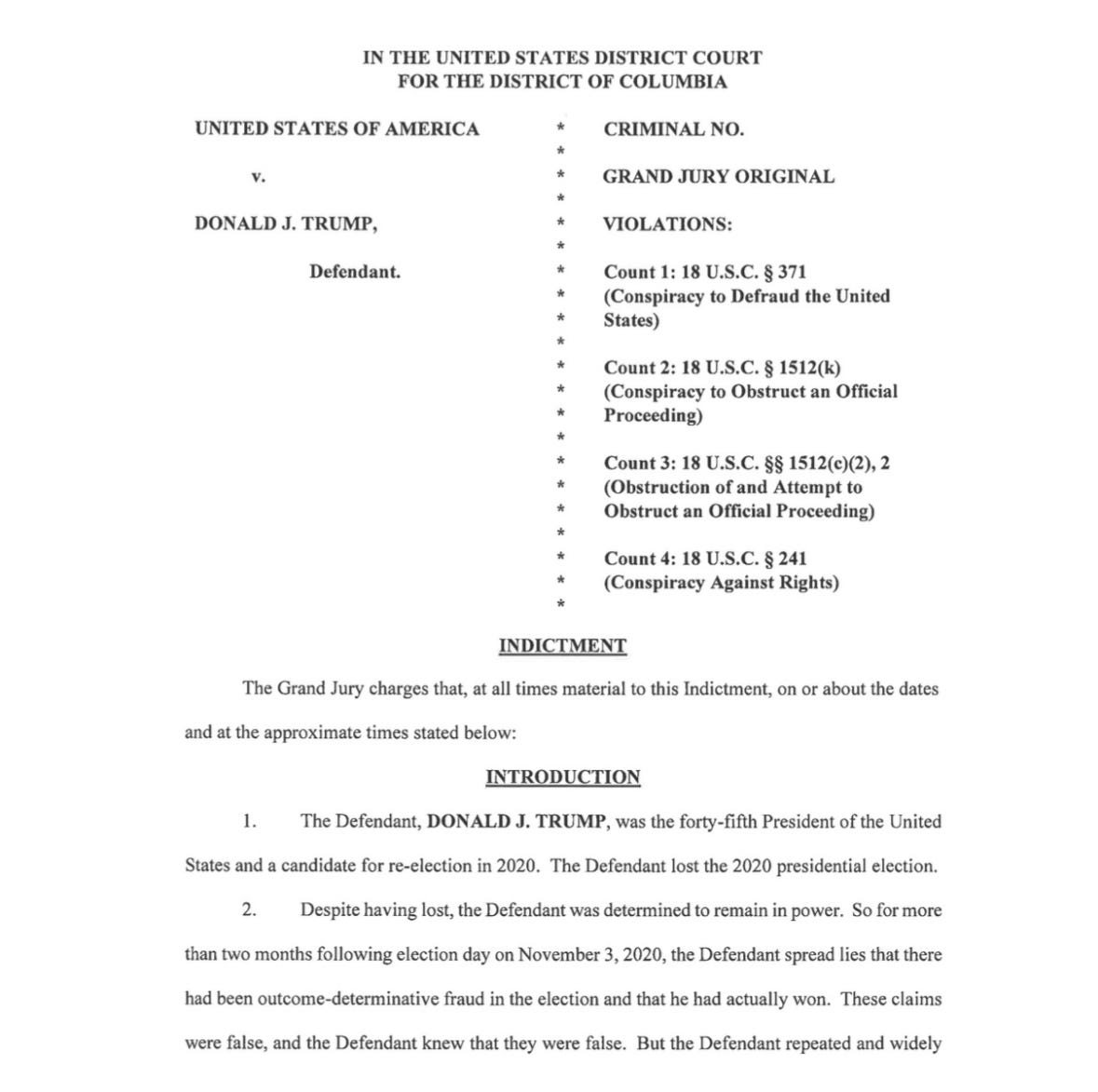
 by
by 



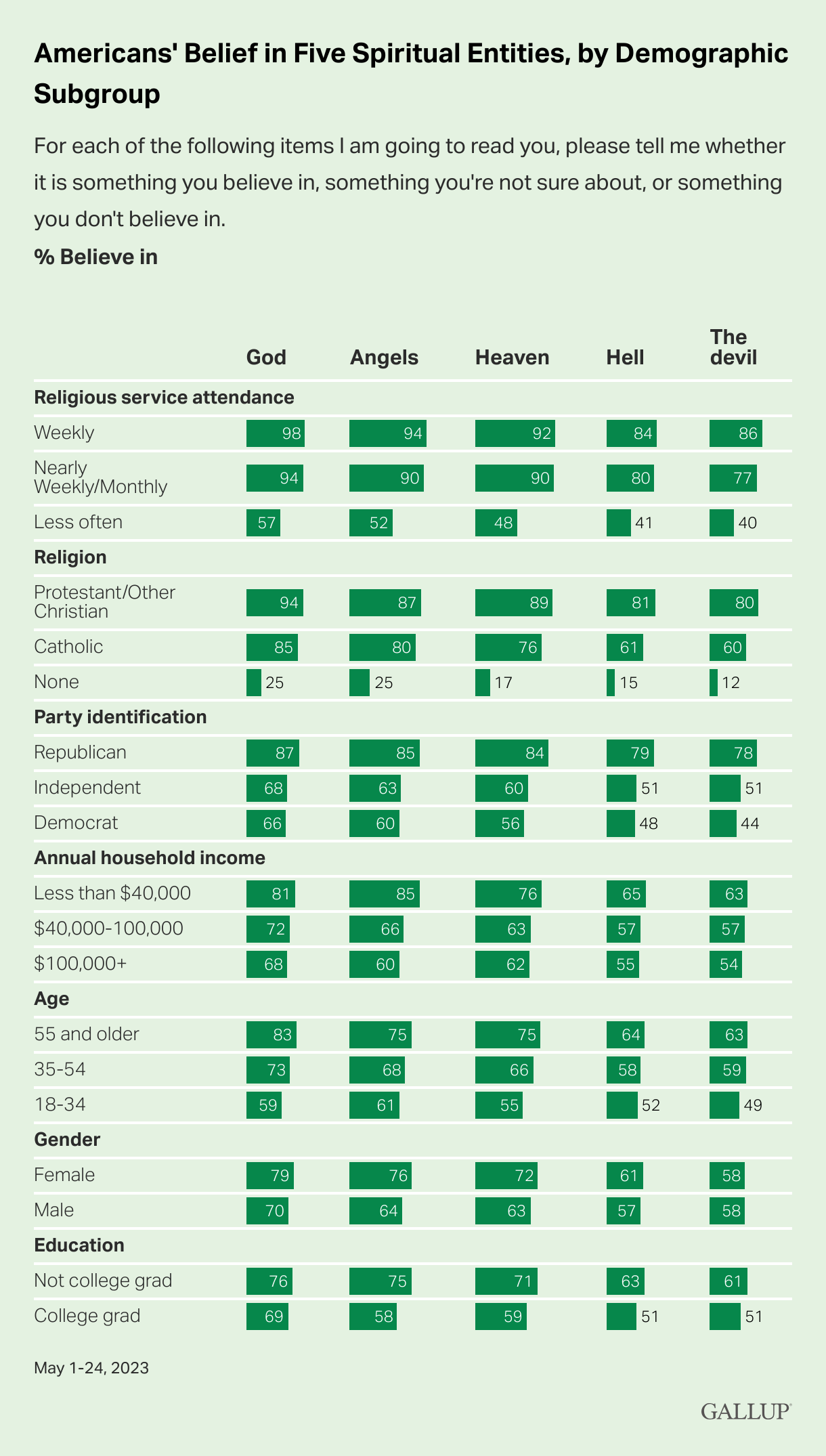
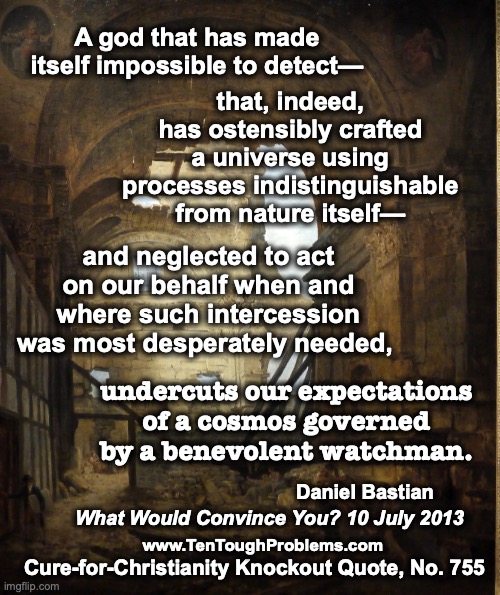
 Richard L. Fricks
