
Category: Reality
Is the Death of Christian Belief Coming Soon?
Here’s the link to this article.
By David Madison at 8/25/2023
Cheap knockoff superstitions are taking over

This really is a puzzle: why haven’t decent devout believers—by the millions—founded an organization called Christians Against Televangelism? They should be so appalled/enraged that televangelists have turned the faith into a showbusiness money-grab, enabling so many of them to become multi-millionaires. They’ve reimagined Jesus as big business, exploiting magical thinking found in the New Testament: believe in Jesus to get eternal life. This turned out to be a major made-for-TV gimmick.
But televangelism is actually the crass culmination of the church’s centuries-long embrace of show business. Millions of churches have been built, the theatres—the stages—for performances. Among these are the spectacular cathedrals, with magnificent stained glass, paintings and sculptures. No one has been able to surpass the Catholic church, in terms of costuming, props, and ritual. All this makes it so easy to get away with magical thinking.
How long can this last? In his new book, The Death of Christian Belief, Robert Conner makes this point:

“If the history of religion teaches anything, it teaches that religions die. In the imagination of their adherents, religions are eternal, but they obviously aren’t—the world is strewn end to end with the temples, shrines, megalithic dolmens and stone circles, pyramids, inscriptions and images of hundreds of dead religions. No matter how completely religious belief and ritual command the present, there is never any guarantee they will command the future.” (Kindle, p. 68)
In my article here last week I commented on the first half of this excellent book, now let’s look at the last half.
Chapter 4 is titled, Certifiably Crazy for Jesus, and at the outset, Conner observes:
“Speculation about the intersection of religion and insanity has obviously been around for a while and the connections (or lack thereof) continue to be vigorously debated in the present. Whether religious belief technically qualifies as psychosis we can leave to the professionals to thrash out, but it is beyond dispute that religious belief is—as often as not—functionally insane.”
Then he cites the horrible news from Kenya earlier this year that a cult had convinced people that starving to death for Jesus was a way to earn eternal life. Within a month it was determined that 201 people had died, and that 600 were missing. It’s not hard to figure out “…that literally anything—no matter how comically absurd, abysmally stupid, completely unhinged, or easily disproved—can be asserted under the aegis of ‘sincerely held religious belief’ clearly refutes any notion that religious belief is the product of common sense.” (p. 106, Kindle)
Conner notes that so many Jesus-believers “couldn’t pass a basic quiz about what the gospels say about Jesus.” (p. 106, Kindle) He points out that “the New Testament is a cookbook of crazy,” a primary example being Jesus-script in Matthew 18:3: “Truly I tell you, unless you change and become like children, you will never enter the kingdom of heaven.” This is typical cult technique: please don’t think about what we’re telling you—just take our word for it. One result of this approach is that so many laypeople don’t bother to read the gospels, and remain unaware of so much in the cookbook of crazy.
Here’s a sample: In Mark, Jesus transfers (presumably by a magic spell) demons from a man into pigs; he glows on a mountaintop while god speaks from water vapor (a cloud); in Matthew, at the moment Jesus died, dead people came alive in their tombs, then on Easter morning walked around Jerusalem; in Luke, the resurrected Jesus appeared to two of his followers on their way to Emmaus—but they didn’t recognize him. At dinner, as he broke bread, they suddenly knew who he was, and—poof—he vanished. (See Conner’s book, Apparitions of Jesus: The Resurrection as Ghost Story) Luke also has the extreme cult teaching that hatred of family, and of life itself, is required for Jesus followers. In John, we find the ghoulish pronouncement that eternal life happens when cult members eat the flesh of Jesus, and drink his blood.
This is just a sampling—and many more examples will jump out—the more folks read the gospels carefully, confirming Conner’s verdict that the New Testament offers “crazy with a side order of extra-crazy crazy.” (p. 120, Kindle)
Maybe the death of Christian belief is on the horizon because people are reading the cookbook of crazy. “In 2022, polling showed that ‘among all U.S. adults, only 20% say the Bible is the literal word of God, which is a historic low… A record 29% of Americans say the Bible is a collection of ‘fables, legends, history and moral precepts recorded by man.’ Only 30% of Protestants and 15% of Catholics currently believe the Bible is literally true.” (p. 114, Kindle)
In Chapter 5, Where Christianity Goes to Die, Conner provides a brutal dose of reality about the state of humanity. I remember reading, some twenty years ago, the prediction that by 2025 there would be a billion Pentecostals in the world. Much of the growth that it has experienced has been at the expense of the Catholic church. Conner quotes an article by David Masci of Pew Research:
“The music that you hear in Pentecostal churches has the same rhythms that people enjoy outside of church. In fact, in only a century, Pentecostalism has become indigenous, or ‘Latin Americanized,’ to a greater extent than Roman Catholicism has in four centuries in Latin America… And the Pentecostal preachers tend to sound more like their congregants. They are often unlettered, and they speak to their flock in the same way that people in Latin America speak to each other. They also tend to look like their congregants. So in Guatemala, many preachers are Mayan, and in Brazil they are Afro-Brazilian.” (pp. 122-123, Kindle)
They are often unlettered. This is emotion-based religion, fed by the cookbook of crazy. The crazy isn’t even noticed. I am reminded of Josiah Hesse’s experience, growing up in apocalyptic evangelism (my article here on 11 August was about his painful childhood):
“I would say that some of the most emotionally rapturous moments of my life were had in Pentecostal church services, where the loud and hypnotic music, speaking in tongues, primal dancing, shaking and collapsing to the ground, caused explosions of sensory transcendence in my little body. I’ve since had glimmers of these moments on a dance floor, a rock concert, or moments of exceptional sexual climax, but nothing has come close to the indescribable high of a frenetic religious service laced with an uncut dose of pure belief.”
But indescribable highs count for nothing when we’re trying to figure out how the cosmos works. For that we need reliable, verifiable, objective evidence.
Earlier I mentioned Jesus transferring demons from a man to pigs—which we find in Mark 5. In fact, Mark’s gospel could be subtitled, Jesus and the Demons. Pentecostalism thrives on such superstitions. Conner describes the widespread belief in witch children, and the horrors they’ve suffered at the hands of exorcists. He quotes from an article by Cosima Lumley:
“Thousands of children every day are being branded witches and consequently tortured into confessing non-existent crimes, forced to undergo horrific ‘exorcisms’ by preachers, and even abandoned or killed by their own families or communities…The practice of branding children witches has also become a very lucrative one for Pentecostal preachers who are able to ‘exorcize’ children of the influence of Satan for a price, or as they call it, ‘enact deliverance.’” (p. 130, Kindle)
Conner also discusses the role that homophobia plays in the promoting of fanatical religion. American evangelicals have played a major role in stoking these hatreds in Africa especially. “Queerbaiting as a political tactic never seems to age. Fomenting hatred and violence is not a measure of last resort in societies where national politics is driven by religious fundamentalism. It’s their first move. It’s their path to power. To the extent this tactic loses traction in democratic countries, it must move to more hospitable climates to survive.” (p. 142, Kindle)
One of the major themes of Chapter 6, The Valley of Death, is the assumption among fanatics that climate change is real because it fits with apocalyptic doom scenarios. In other words, we shouldn’t even try to resist god’s plan—as outlined by the cookbook of crazy. Is such foolishness the fate of Christian belief? At the outset I asked why aren’t Christians furious with the corruption of their religion by televangelists. Likewise, Conner wants to know:
“When priests by the hundreds molest children and bishops cover it up, why aren’t Christians stunned? When Irish nuns raffle off the babies of unwed mothers, why aren’t Christians stunned? When unmarked graves of children are discovered around Canadian religious ‘schools,’ why aren’t Christians stunned? When embezzlement and sexual assault by preachers gets reported on an almost daily basis, why aren’t Christians stunned? When evangelical leaders gather to lay hands on figures like Donald Trump and Jair Bolsonaro, why aren’t Christian’s stunned?” (pp. 106-107, Kindle)
Given its ongoing degeneration, we can be sure that Christian belief will end up on the scrapheap of history:
“In the developed world, Christianity is losing traction for reasons that are now familiar: churches are dying because elderly Christians are dying, and Christian belief increasingly incorporates toxic elements of sexism, racism, and reactionary nationalism. But more importantly, the Christian gospel is simply irrelevant—thoughts and prayers don’t address poverty, discrimination, gun violence, failing government, or climate change.” (pp. 150-151, Kindle)
Here is the link to an interview that Robert Conner and I did together, with Derek Lambert of MythVision.
David Madison was a pastor in the Methodist Church for nine years, and has a PhD in Biblical Studies from Boston University. He is the author of two books, Ten ToughProblems in Christian Thought and Belief: a Minister-Turned-Atheist Shows Why You Should Ditch the Faith, now being reissued in several volumes, the first of which is Guessing About God (2023) and Ten Things Christians Wish Jesus Hadn’t Taught: And Other Reasons to Question His Words (2021). The Spanish translation of this book is also now available.
His YouTube channel is here. At the invitation of John Loftus, he has written for the Debunking Christianity Blog since 2016.
The Cure-for-Christianity Library©, now with more than 500 titles, is here. A brief video explanation of the Library is here.
Can Christianity Survive—With So Many Problems and Scandals?
Here’s the link to this article.
By David Madison at 8/18/2023
2,000 years of momentum probably can’t save it
Surely the clergy, those most in tune with God, must be the happiest people on the planet: they enjoy a personal relationship with their creator, nurtured through years of prayer and pious study. How can their constant refrain not be, “This is the day which the Lord hath made; we will rejoice and be glad in it”? (Psalm 118:24) But this doesn’t seem to be the way things are working out. A few weeks ago I published an article here titled, The Morale of Christian Clergy Is Taking a Big Hit,
based partially on a study that many clergy aren’t doing so well. Then I came across this article, United Methodist pastors feel worse and worry more than a decade ago:
“A survey of 1,200 United Methodist clergy found that half have trouble sleeping, a third feel depressed and isolated, half are obese, and three-quarters are worried about money…[they] feel worse and worry more than they did a decade ago.”
I suspect that the vulnerability of Christianity might be a contributing factor—and its weaknesses had not been so openly discussed just a decade ago, although that discussion had been stimulated in 2001 with the publication of Richard Dawkins’ The God Delusion. Sam Harris followed in 2004 with The End of Faith, and Christopher Hitchens in 2009 with God Is Not Great: How Religion Poisons Everything. Never before had the Christian faith been critiqued so publicly, so devastatingly—and other secular authors have been encouraged to add their insights. There are now well more than five hundred books—most published since 1999—that explain, in detail, the falsification of theism, Christianity especially. And, of course, the Internet has provided a platform for atheist/secular thinkers to spread the word that belief in god(s) is hard to justify.

And the books keep coming. A few days ago, Robert Conner’s new book, The Death of Christian Belief was published. Do a search on Amazon for Robert Conner books to see his full output. I recommend especially The Jesus Cult: 2000 Years of the Last Days (2022) and Apparitions of Jesus: The Resurrection as Ghost Story (2018).
In this new book, Conner describes Christianity as we find it in the world today, but it’s not a pretty picture. In his opening chapter, Fade to Black—a theatrical term meaning that the lights go out at the end—Conner describes the struggle, the losing battle, of Christianity to survive in its traditional strongholds. In Europe, above all. This is hardly a mystery, since Europe was devastated by two world wars, with tens of millions of people killed—six million of whom were brutally murdered during the Holocaust. How can god-is-good theology maintain its grip in the face of such horrors?
Conner mentions watching the funeral of Queen Elizabeth II, with all the pageantry, ritual, and costuming that royal funerals entail—and the pious assurances that she must now be with God:
“Yet as I watched these solemn ceremonies, I wondered how many of those gathered really believed the queen had entered the Pearly Gates. Based on recent polling, almost certainly less than half—including the child choristers—at best. Some 2000 churches in the UK have closed in the past ten years and a recent survey paints a bleak picture of current Christian belief…church membership in the UK has plunged to less than ten percent…” (p. 7, Kindle)
Conner notes that, “Across most of western Europe the numbers are similarly grim.” (p. 8, Kindle) He provides statistics about the situation in Belgium, France, Spain, Ireland. Even in super-Catholic Poland there is slippage in belief. He also mentions the hit Catholicism has taken in Canada, in the wake of the residential schools scandal, which even prompted a papal visit to apologize for what had happened: “Priests and nuns from various religious orders systematically brutalized and sometimes raped these children, some 3000 of whom died of disease and neglect while in the custody of the Church.” (p. 11, Kindle) Connor mentions the dramatic decline in church membership and attendance in America as well.
In Conner’s giant Chapter Two, Death by a 1000 Cuts, he describes the really ugly manifestations of Christian belief. He lists the Seven Deadly Gospels, i.e., the gospels of hate, grift, lawlessness, lies, division, submission, and violence. Given the wealth of information that Conner provides here, it can surely come as no surprise to devout nice Christians that their church and their faith are in deep trouble.
For example, the gospel of hate has been horrifying, in our modern era demonstrated by Fred Phelps, founder of the Westboro Baptist Church:
“The Westboro Baptist’s ministry of hate rose to national attention in 1998 when Westboro members picketed the funeral of Matthew Shepard, a gay university student abducted, tortured, and left tied to a fence outside Laramie, Wyoming. Shepard died of his injuries in a hospital in Fort Collins, Colorado. Westboro Baptist, which preaches that AIDS represents God’s righteous judgment against homosexuals, often picketed the funerals of AIDS victims where members held up placards that displayed their trademark, GOD HATES FAGS.” (pp. 16-17, Kindle)
Just one more example, from the gospel of violence. There is quite enough in the New Testament to fuel violent behavior, including Jesus-script: “Do not think that I have come to bring peace to the earth; I have not come to bring peace but a sword.” (Matthew 10:34) This results in “Onward Christian soldiers, marching as to war…” and worse, as Conner notes:
“Gospel Jesus told his disciples, ‘You are the light of the world.’ (Matthew 5: 14) Sadly, there is little evidence from history to support that claim. Indeed, the history of Christianity is a nearly unbroken history of moral darkness. In the 1930s, Das Licht der Welt in Germany united behind an authoritarian regime that unleashed the darkest era in world history. The leading German theologians of the day threw their support behind Hitler’s rise to power, and soon German forces invaded their Christian neighbors, repeating a slogan from the Thirty Years War, Gott mit uns, ‘God with us.’” (p. 59, Kindle)
Perhaps Christianity has been losing ground because there is growing awareness that theology can manifest in such destructive ways. But die-hard believers tend to shy away from facing realities. And one of the major realities is that the New Testament itself is failed theology.
Conner deals with this in his Chapter 3: The Clothes Have No Emperor, which opens with the heading, “The New Testament isn’t history.” There is commonly a knee-jerk reaction among the pious to such an assertion: “Yes, it is—who in his right mind would make such a claim?” The blunt answer is: New Testament scholars themselves, many of them devout Christians. Conner traces some of the history of critical analysis of the gospels. He mentions Bart Ehrman, who has published so many books describing the faults and failures of the gospels especially (check out his list of books on Amazon).
For a long time, devout scholars have been trying to justify taking the gospels as history, but without much success. The first three gospels share so much in common, because Matthew and Luke copied so much from Mark. Conner points out that the author of John’s gospel added
“…a thick layer of theology to the stories, but we’re still left with a question that has no answer: where did Mark get his information? If Mark was written about 70 C.E. and Jesus died around 30 C.E., at least a generation passed before anyone thought to collect the stories about Jesus and put them into a gospel. To make matters worse, in the years between Jesus’ death and the writing of the first gospel we know a destructive war supervened that devastated the cities of Galilee and Judea, killed thousands, and scattered the survivors which presumably included potential witnesses to the career of Jesus.” (p. 73, Kindle)
Conner also discusses the confusion added by the apostle Paul, who never met Jesus, and bragged that he didn’t find out anything about Jesus from the disciples. His knowledge of Jesus came from his visions (= hallucinations). This undermines the claim that the New Testament is history.
The very helpful information in Chapter 3 is precisely what Christians don’t want to hear, acknowledge, or think about. When I was working on my first book (Ten Tough Problems in Christian Belief), I asked a few devout believers to review and critique a few of the chapters. Oh, no, they couldn’t do that! They had to focus on strengthening their faith. I sensed their doubts lurked just below the surface—and they didn’t want to check below the surface. I gave copies of my 2022 book, Ten Things Christians Wish Jesus Hadn’t Taught, to several Christian friends. The response was silence. They didn’t want to think about the issues I raised.
But they’re not alone, as Conner notes:
“In many cases the problem with Jesus Studies begins with scholars merely seeking confirmation for their presuppositions, but arguably in every case a related problem lies in the very nature of the evidence, evidence that has passed through multiple hands, is possibly (or definitely) corrupted, or evidence that it was simply a pious story to begin with.” (p. 81, Kindle)
I would say that Conner’s Chapter 3 is a must read—but I fear that devout readers will consider it a must not read.
In my article here next week, we’ll take a look at Conner’s next three chapters: Certifiably Crazy for Jesus, Where Christianity Goes to Die, and The Valley of Death.
By the way, I suggest that Conner’s book can be paired nicely with Tim Sledge’s book, Four Disturbing Questions with One Simply Answer: Breaking the Spell of Christian Belief. Of all the hundreds of books out there that make powerful cases against belief in the Jesus cult, these two deserve high ranking.
Full disclosure, by the way: I wrote the Foreword for The Death of Christian Belief, at Robert Conner’s invitation. He and I were interviewed together by Derek Lambert for a MythVision podcast. In his Chapter 3, he recommends my book, Ten Things Christians Wish Jesus Hadn’t Taught—as well as Seth Andrews’ brilliant Christianity Made Me Talk Like an Idiot.
No, not even 2,000 years of momentum can save the faith!
I’ll close today with this insight from Conner:
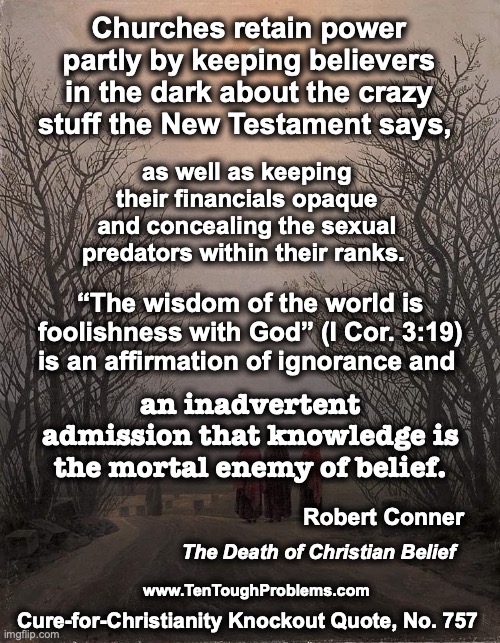
“Churches retain power partly by keeping believers in the dark about the crazy stuff the New Testament says, as well as keeping their financials opaque and concealing the sexual predators within their ranks. “The wisdom of the world is foolishness with God” (I Cor. 3:19) is an affirmation of ignorance and an inadvertent admission that knowledge is the mortal enemy of belief.” (p. 104, Kindle)
David Madison was a pastor in the Methodist Church for nine years, and has a PhD in Biblical Studies from Boston University. He is the author of two books, Ten ToughProblems in Christian Thought and Belief: a Minister-Turned-Atheist Shows Why You Should Ditch the Faith, now being reissued in several volumes, the first of which is Guessing About God (2023) and Ten Things Christians Wish Jesus Hadn’t Taught: And Other Reasons to Question His Words (2021). The Spanish translation of this book is also now available.
His YouTube channel is here. At the invitation of John Loftus, he has written for the Debunking Christianity Blog since 2016.
The Cure-for-Christianity Library©, now with more than 500 titles, is here. A brief video explanation of the Library is here.
Victory in Ohio: Issue 1 goes down in flames
Here’s the link to this article.
 by ADAM LEE
AUG 17, 2023

Overview:
Issue 1, a cynical attempt to persuade Ohioans to vote away their own power, goes down to resounding defeat. The way is cleared for reproductive autonomy to become a protected right in the Buckeye State.
Reading Time: 3 MINUTES
[Previous: When you can’t win, change the rules]
Abortion rights extended their winning streak in Ohio this summer. Progressives and freethinkers have reason to cheer as Issue 1 went down to defeat.
In 2019, Ohio governor Mike DeWine signed a total ban on abortion, which went into effect when the right-wing Supreme Court repealed Roe. It’s this law that gave rise to the infamous case of a pregnant 10-year-old rape victim who had to go to Indiana for an abortion.
(When this story was first reported, right-wingers angrily insisted it must be a fabrication intended to make them look bad. When it was proven to be true, they went silent.)
Since then, Ohio’s abortion ban has been ping-ponging between state courts. It’s currently blocked again. However, pro-choice groups saw no reason to leave the final outcome up to the discretion of a judge. Polls show that abortion rights enjoy support from a majority of Ohio residents. So they gathered signatures to put a constitutional amendment on the ballot which would make reproductive choice a human right. It will go before the voters in November, and polls say it should pass easily.
Cynical and contemptuous tactics
Sensing their looming defeat, Ohio Republicans tried to cut it off at the knees. The legislature proposed their own constitutional amendment, Issue 1, which would have raised the threshold for passing future amendments from a simple majority to a 60% supermajority. It also would have made the process for getting an amendment on the ballot more arduous.
That was a cynical tactic, since polls showed support for abortion rights at just under 60% (literally, 59%). However, what they did next showed even more contempt for voters.
The legislature hastily scheduled Issue 1 for an August special election—historically, a time of rock-bottom turnout. As recently as January, those same legislators moved to outlaw August special elections on the grounds of low turnout, only to do an about-face. Clearly, Ohio Republicans were hoping that no one would pay attention and only their backers would show up.
Instead, in a classic case of the Streisand Effect, their efforts to ensure a low-turnout election ensured massive publicity and voter interest. It shone a spotlight on their scheme, and voters responded. It didn’t hurt that pro-choice advocates had tapes of Issue 1’s sponsors, including Ohio Secretary of State Frank LaRose, admitting that it was intended to forestall the abortion amendment.
More than 3 million voters cast ballots. That’s staggering turnout for a special election in the dog days of summer. It’s almost double the number of people who typically vote in Ohio primaries, and five times the number that showed up for the last August election.
When the votes were all in, Issue 1 lost by a resounding margin, 57% to 43%. As it turns out, citizens don’t want to vote away their own power. It’s a stinging rebuke to conservatives who are angling for permanent minority rule.
More dirty tricks thwarted
This wasn’t the only dirty trick that anti-choicers pulled to try to thwart the will of the people. They also filed a lawsuit to get the pro-abortion amendment stricken from the ballot on a technicality, arguing it should have explicitly listed the laws it would repeal. The Ohio Supreme Court unanimously rejected this argument. (The court answered one technicality with another: a constitutional amendment doesn’t “repeal” an existing law, it voids it.)
The defeat of Issue 1 is a bellwether for reproductive freedom in Ohio. It’s a sign to right-wing legislators that, for all their gerrymandering and voter suppression, they’re not above the will of the voters. They can’t expect to have their own way forever without the majority getting a chance to have its say.
It also clears the way for more progressive constitutional amendments. Next on tap in Ohio, there’s one to raise the minimum wage and another to create a bipartisan redistricting commission to fix gerrymandered congressional maps.
And more pro-choice constitutional amendments are coming soon in other states. From Politico:
Similar efforts to put abortion rights to a popular vote are also brewing in Arizona, Florida, Missouri, Nevada and South Dakota. Activists in many of these states are hoping to get the issue before voters in 2024, in which turnout will be especially high due to the presidential election.“Abortion rights won big in Ohio. Here’s why it wasn’t particularly close.” Madison Fernandez, Alice Ollstein and Zach Montellaro. Politico, 8 August 2023.
It’s now very clear that abortion is a winning issue for Democrats, even in red states. According to a PRRI poll from February 2023, almost two-thirds of Americans say abortion should be legal in all or most cases, including majorities in many traditionally red states. What’s more, abortion is a motivating issue. It energizes voters and drives huge turnout.
In their single-minded drive to ban abortion at all costs, Republicans are running directly against the will of the majority. They’re setting themselves up to lose in states where by all rights they should win. If they were willing to moderate their beliefs, they’d likely be able to win many of these voters back. Instead, they’re becoming more and more anti-democratic.
“My overdosing on religion was becoming a serious problem”
Here’s the link to this article.
By David Madison at 8/11/2023
It’s a problem for the world as well
When Christopher Hitchens died in December 2011, a volcano of Christian hate erupted. Devout folks who’d never heard of him suddenly found out that he’d written a book (2009) titled, God Is Not Great: How Religion Poisons Everything. They spewed rage and invective on social media, savoring the idea that Hitchens was suffering—and would suffer forever—in the fires of hell. “Love your enemy” (Jesus-script, Matthew 5:44) has probably rarely been so widely ignored. Ironically, their fury probably drove sales of the book—which even now, fourteen years later, has a high Amazon sales ranking.
It is my suspicion that most of these outraged folks are also unaware of the extensive role religion has played in poisoning the human experience. The gospel of John fueled anti-Semitism, no doubt inspiring Martin Luther’s murderous rage against the Jews, which in turn helped provide the Nazi rationale for the Holocaust. The Crusades were religion-motivated wars. Slavery was easily championed by good Christians who took their Bibles seriously. Our democracy is in jeopardy because obsessive-compulsive believers want to impose their understanding of god on everyone. The evidence of religious poison is on the news every day.
And notice this as well. Just as “love your enemy” was ignored, religious fervor stoked rage, at the same time that it has suppressed curiosity. What percentage of those enraged believers paused to consider what Hitchens meant by those two claims in his title?
God Is Not Great and
How Religion Poisons Everything
Yes, the poison has manifested in such major killing events as the crusades and slavery, but the poison infects individual human minds, stimulating rage, blunting curiosity. Not too long ago, a devout Catholic woman told me that the priests and nuns had told them not to think about what they learned in catechism. Protestants can claim no superiority in this regard. Churches do not thrive on curiosity and skepticism.
When parents are fully committed to this close-minded approach to religion, the poison is sometimes administered full strength. I recently came across an article, written in 2016 by Josiah Hesse, titled Apocalyptic Upbringing: How I Recovered from My Terrifying Evangelical Childhood.
He opens with an account of his retreat to the basement—he was ten years old—during a terrifying storm. Awareness of his sin was uppermost in his mind: “My parents were home late and my first thought was that they’d been raptured up to heaven. I was a sinner who had been left behind to face the Earth’s destruction.”
“Thunder boomed as I opened my Bible to the Book of Revelation, a passage I knew well after years spent on my dad’s knee as he read it aloud to his kids…I would have to hide from the antichrist, who would force all those left on Earth to renounce Christ and receive the mark of the beast on their right hand or forehead. Anyone found with the beast’s mark after death would be thrown into the lake of fire.”
Is there any better example of religious poison? Richard Carrier has described the book of Revelation as “a veritable acid trip, an extended hallucination of the bizarrest kind, an example of the kind of thing going on all the time in the early churches…” (p. 136, On the Historicity of Jesus: Why We Might Have Reason for Doubt). There is such a feast of bad theology in the Bible, with the book of Revelation ranking pretty high in that category. It’s no surprise that some denominations choose to focus on these sick texts. Nor is it a surprise that parents who have been groomed to teach such religion to their children are actually guilty of abuse.
I was raised by a very devout mother who, even so, had a high quotient of common sense. Thus I never suffered the way Josiah Hesse did:
“…my childhood was filled with more biblical prophecy than Sesame Street good times. The urgency of avoiding hell surpassed any trivial education the world had to offer. After all, if you’re staring down the barrel of eternal torment, who has the time for algebra?
“Salvation was attached to belief, and in order to protect my belief I had to censor my thoughts. The book of Mark says that ‘whoever blasphemes against the Holy Spirit never has forgiveness, but is guilty of an eternal sin.’ So I was careful to never even think a thought that could be considered blasphemous. This was profoundly exhausting; and while I was mostly successful at repressing my intellectual curiosity during the day, once sleep came I lost all security clearance to my own mind.
“My dreams were terrorized by a wide-eyed witch who worked for the devil.”
Hesse was born in 1982, so he was a teenager as the year 2,000 drew near.
“As 2000 approached, my panic attacks grew more severe. I pondered the nature of eternity nearly every minute of the day. Whether torture or paradise, the concept itself filled me with existential dread. Eternity. As in, forever. And ever. And then more. And more. I just couldn’t wrap my head around it.”
From his adult perspective now—yes, there’s a mostly happy ending—he saw that “…my overdosing on religion was becoming a serious problem.”
Eventually curiosity kicked in, at least at the level of trying to find outside verification for the Bible. He even read works by “those who despised Christianity’—and this included Christopher Hitchens, whose severe critique of religion is hard to refute. So Hesse was one of those Christians who gave curiosity as much space as rage. And he finally snapped out of it:
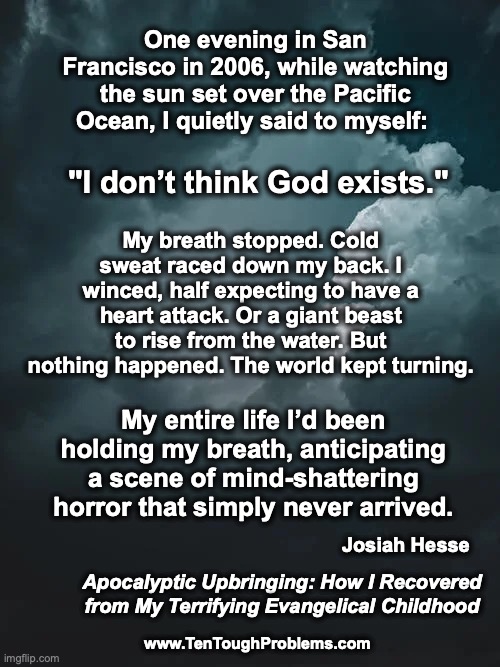
“Then one evening in San Francisco in 2006, while watching the sun set over the Pacific Ocean, I quietly said to myself: ‘I don’t think God exists.’ My breath stopped. Cold sweat raced down my back. I winced, half expecting to have a heart attack. Or a giant beast to rise from the water. But nothing happened. The world kept turning…My entire life I’d been holding my breath, anticipating a scene of mind-shattering horror that simply never arrived.”
Looking back, Hesse is generous in his assessment of his parents. “…little of the blame belongs on my parents’ shoulders. They were young, idealistic Christians when they had me, and like so many religious parents, only had the best of intentions of rearing me in their faith.” And had little understanding of how much damage can be caused by religious fervor. “I asked my dad if he’d known about the intense anxiety I’d suffered throughout my childhood. ‘I knew you were afraid. You were such a scared little boy. I didn’t know what to do.’”
Not knowing what to do can be expected when the devout are discouraged from thinking about what they’ve been taught by clergy and parents. They are sheltered from the wide world of ideas and knowledge outside the narrow religious mindset (they could learn, for example, that the book of Revelation shouldn’t be taught to children). Sometimes the abused kids descend into fear—as Josiah Hesse describes his situation. But in other cases, the result is rage, radicalization, and terrorism. Christopher Hitchens, referring to the 9/11 attacks, notes:
“The nineteen suicide murderers of New York and Washington and Pennsylvania were beyond any doubt the most sincere believers on those planes. Perhaps we can hear a little less about how ‘people of faith’ possess moral advantages that others can only envy” (p. 32, God Is Not Great).
Nor do the people of faith possess advantages in the realm of ideas, in their understanding of how the world works. They usually are bound to ancient superstitions—and Christianity is quite a bundle of them. But this is the case for religions in general, as Hitchens states so persuasively:
“How much effort it takes to affirm the incredible! The Azteks had to tear open a human chest cavity every day just to make sure that the sun would rise. Monotheists are supposed to pester their deity more times than that, perhaps, lest he be deaf. How much vanity must be concealed—not too effectively at that—in order to pretend that one is the personal object of a divine plan? …How many needless assumptions must be made, how much contortion is required, to receive every new insight of science and manipulate it so as to ‘fit’ with the revealed words of ancient man-made deities?” (p. 7, God Is Not Great)
Billions of humans still overdose on religion, and thus remain unaware of what science has discovered about the world, and how the cosmos works. These discoveries provide far more awe and wonder than ancient superstitions and magical thinking ever could. But the awe and wonder delivered by science can be too scary, and prompts many to cling to religious fantasies construed as reality. “Our place in the cosmos,” Hitchens notes, “is so unimaginably small that we cannot,

with our miserly endowment of cranial matter, contemplate it for long at all” (p. 91, God Is Not Great).
Earlier I noted that, for Josiah Hesse, it was mostly a happy ending. By which I mean that he did manage to put god-belief behind him. But, as of 2016 when he wrote the article, he was still plagued by horrible nightmares. However, he has made his way as a journalist and writer. This is his website, and a link to a recent podcast interview.
He has moved beyond overdosing on religion—and is a much better, happier person because he managed to do it. He can still be haunted by the frightful apocalyptic imagery of his youth:
“Then I take a deep breath, reminding the frightened child inside me that he is safe, that the world may be full of uncertainty and pain and confusion, but we are here, now, and there are no locusts with the heads of lions likely to come out of the Earth any time soon.”
David Madison was a pastor in the Methodist Church for nine years, and has a PhD in Biblical Studies from Boston University. He is the author of two books, Ten ToughProblems in Christian Thought and Belief: a Minister-Turned-Atheist Shows Why You Should Ditch the Faith, now being reissued in several volumes, the first of which is Guessing About God (2023) and Ten Things Christians Wish Jesus Hadn’t Taught: And Other Reasons to Question His Words (2021). The Spanish translation of this book is also now available.
His YouTube channel is here. At the invitation of John Loftus, he has written for the Debunking Christianity Blog since 2016.
The Cure-for-Christianity Library©, now with more than 500 titles, is here. A brief video explanation of the Library is here.
Do you ever think about the Boomers?
Here’s the link to this article. A must read. Be sure and watch each video clip.


Do you ever think about the Boomers? I don’t very often, but I suspect I do more than most — which is barely at all. I wonder why the overwhelming majority of Americans never think about them and their potential. It’s almost as if they don’t exist at all. But of course they do.
Boomers, of course, are the nickname for America’s fleet of nuclear-powered ballistic missile submarines, which are the most powerful weapons of war in the history of human civilization. Here are their names:
USS Henry M. Jackson (SSBN 730), Bangor, WA
USS Alabama (SSBN 731), Bangor, WA
USS Alaska (SSBN 732), Kings Bay, GA
USS Nevada (SSBN 733), Bangor, WA
USS Tennessee (SSBN 734), Kings Bay, GA
USS Pennsylvania (SSBN 735), Bangor, WA
USS West Virginia (SSBN 736), Portsmouth, VA
USS Kentucky (SSBN 737), Bangor, WA
USS Maryland (SSBN 738), Kings Bay, GA
USS Nebraska (SSBN 739), Bangor, WA
USS Rhode Island (SSBN 740), Kings Bay, GA
USS Maine (SSBN 741), Bangor, WA
USS Wyoming (SSBN 742), Kings Bay, GA
USS Louisiana (SSBN 743), Bangor, WA
Aboard them are men and women from all 50 US states and territories. They are US Navy sailors, and are in the business of deterrence, which means they will be the first to know if Armageddon is at hand. After that, they will be the first to wonder what happens next.
The Warning with Steve Schmidt is a reader-supported publication. To receive new posts and support my work, consider becoming a free or paid subscriber.
Upgrade to paid
Let’s watch Commanding Officer John Gage of the USS Pennsylvania contemplate the end of human civilization and what it would be like aboard the ship that fired the missiles after the fact. Before watching though, are you at all interested in the personality type of the man who is wearing the silver oak leaves on his collar? What makes him tick? What is unique about his character, judgement and intellect that would interest the US Navy in turning over the keys to the most potent weapon that ever existed and the lives of those under his command?
Let’s watch:
Here is a remarkable scene from the fire control room aboard the ship. Notice the ages of the crew and the diversity. For those unfamiliar with naval rank, the Black man with two silver bars on his collar is in charge. He is a lieutenant. Look at the bridge of the ship and the faces. Right now, at this exact second, there is a crew of Americans in a ballistic missile submarine lurking, hidden, in each of the world’s oceans. They are training, preparing and readying. They are preparing to execute an order they simultaneously pray they will never receive. Let’s watch the captain explain the process by which he would launch nuclear weapons from his ship via ballistic missiles:
The commander in chief is the president of the United States. The crew will follow his orders and they will fire the missiles. The American people choose the person who can give that order. Why don’t we ever talk about that? Why aren’t politicians ever asked about it? It is real.
Let’s watch Martha Raddatz of ABC News talk to some of the women crew aboard the USS Maine. Listen to her describe the deadliest weapon in the world:
When you see the young Lieutenant Jg Erin Chandler handle the nuclear launch key what do you see?
What is it that a citizen owes her and her shipmates? How should we think about the young people who will hand the keys to the captain, who will launch the missiles that will annihilate civilization? Don’t we owe them wisdom and circumspection in our voting choice? Don’t we owe ourselves, our children and their descendants someone more stable, secure and trustworthy than Donald Trump?
Here is another question raised by the broad indifference Americans seem to have towards the country in which our descendants will live. When do we stop caring at all about what happens, and when? Is it after our grandkids? We don’t care what happens to their kids and their grandkids? Is it too far forward after that? Never let it be said that selfishness doesn’t kill in America.
Marjorie Taylor Greene thinks she might be vice president in the next Trump administration. She told The Atlanta Constitution-Journal about her ambitions, saying the following about potentially running for the Senate:
I haven’t made up my mind whether I will do that or not. I have a lot of things to think about. Am I going to be a part of President Trump’s Cabinet if he wins? Is it possible that I’ll be VP?
Now watch the captain talk about how the hidden submarine communicates with the commander in chief, receives its orders and prepares to fire. Lest there be any doubt around whether the order to fire would be disobeyed the captain will put your mind to rest. The missiles will be fired:
Donald Trump controls the Republican Party at an institutional level. Fully. He is unambiguously the boss. He is an accused felon facing nearly 100 criminal charges that include being at the center of the greatest criminal conspiracy in American history. He is running on a platform of retribution, revenge, threat and division. His intimations toward violence and chaos will inspire the results he hopes for.
We should all think about Boomers and the awesome responsibility of their crews and officers. We should think about their commander in chief. We live in an age of disgrace and unfitness that is both epic and conquerable. Moving past it requires zero tolerance for the extremism and cult of personality that has broken faith with American values in the name of Donald Trump. They have betrayed an idea for a person, and the surrender of a political party’s elected members to the whims of a despot has been as pathetic as it had been despicable. Whatever cowardice it represents, it will be viewed as unpardonable by history. The harsh judgement ahead will scorn the cowardice that allowed a fascist movement to plant, root and thrive on American soil in the first quarter of the twenty-first century.
America’s politics is covered as a game by much of the American media, which brings the same slimy touch to the endeavor of politics that wife beater and Trump fanboy Dana White brings to the UFC. It’s not a game. It’s life and death. This era must end. It is dangerous beyond any measure.
We should all think about our Boomers. We should think about the young men and women aboard them. They will survive the first wave. It is said that when the missiles launch, the survivors will envy the dead. In the end, there is only one American who is ever given the power and discretion to launch the weapons of extinction. That person is the president of the United States of America. What type of sick society would ever invest that power again in a man like Donald Trump.? What type of broken media would pretend the powers of the office don’t exist? What type of people are we?
In the end, we will know. America gets the chance to vote on its own euthanasia.
No, it’s not ‘workism’ that’s killing the church
Here’s the link to this article.
by ADAM LEE
AUG 14, 2023

Overview:
Americans are overworked and overly devoted to the hustle, but that’s not why organized religion is declining. Church apologists trying to explain their decline always look outward, never inward at themselves.
Reading Time: 6 MINUTES
[Previous: Church isn’t the answer to hustle culture]
Christianity in America is suffering an unprecedented decline.
Once-thriving congregations are shrinking and graying. Parishes are being consolidated. Closed-down churches are being reborn as bookstores and breweries, concert halls and apartments.
Surveys find that nonreligious Americans—or “nones”—now constitute about 30% of the population, outnumbering every single Christian denomination. If current trends continue, nones could be a majority by 2070.
The decline has become so obvious that even Christian propagandists can’t sweep it under the carpet. So they’re in search of explanations, preferably explanations that absolve them of blame. In the Atlantic, orthodox apologist Jake Meador proposes one:
Contemporary America simply isn’t set up to promote mutuality, care, or common life. Rather, it is designed to maximize individual accomplishment as defined by professional and financial success. Such a system leaves precious little time or energy for forms of community that don’t contribute to one’s own professional life or, as one ages, the professional prospects of one’s children. Workism reigns in America, and because of it, community in America, religious community included, is a math problem that doesn’t add up.“The Misunderstood Reason Millions of Americans Stopped Going to Church.” Jake Meador, The Atlantic, 29 July 2023.
Meador paints a picture of a society that worships work above all else. He argues that high-stress jobs, inflexible schedules, and the capitalist drive to use every moment “productively” have severed the bonds of community. People are isolated, stressed, and exhausted. They’re so immersed in the hustle mindset that they drift away from religion because they can’t conceive of spending time on something that doesn’t make money.
To the churches and their defenders, this is a comforting story. It allows them to tell themselves that they haven’t been rejected. They’ve merely been pushed aside by the hustle and bustle of modern life. It holds out the promise that, if they can cut through the noise and make themselves heard, they can persuade young people to come back.
However, this face-saving explanation has a flaw.
The evidence, drawn from polls and interviews, paints a different picture. It’s not the case that young people have drifted away from church because they’re too busy with their side hustles and their TikToks. Rather, millions have chosen to cut ties with organized religion because they have stark disagreements with its moral teachings—and because the churches allow no room for dissent or difference of opinion.
The churches’ problem isn’t that they’re drowned out in the din and can’t make themselves heard. On the contrary, we hear them loud and clear.
A case in point is Charles Chaput, the archbishop of Philadelphia. In 2016, he urged liberal Catholics to quit the church. According to Chaput, people who call themselves Catholic but support abortion, contraception or LGBTQ rights are faithless liars. He declared that the church would be better off without them. Like other conservatives, he prefers a smaller, more ideologically pure church to a larger one with more diversity of opinion.
And young people are taking him at his word. According to a Pew survey, two-thirds of former Catholics left the church, not because they’re too busy, but because they stopped believing in its teachings.
Sixty years behind the times and going backward
On issue after issue, the pattern is the same. The churches’ problem isn’t that they’re drowned out in the din and can’t make themselves heard. On the contrary, we hear them loud and clear. The problem is that they’ve doubled down on moral stances that are the polar opposite of what young people believe and care about.
The second wave of feminism was more than sixty years ago, yet many churches still reject the most basic notions of gender equality. America’s two largest Christian denominations, Roman Catholic and Southern Baptist, refuse to allow women to take any leadership role. Just this year, the Southern Baptist Convention expelled two churches—including Rick Warren’s Saddleback Church—for the sin of hiring women as pastors. Women who speak out against this gross inequality have been flooded with harassment and hate mail.
To appease the religious minority that believes this, Christian churches have set themselves against the vast majority.
Above all else is the question of abortion. The repeal of Roe was a painful wake-up call, jolting women with the realization that their right to control their own bodies is slipping away. Young people recognize that opposition to abortion is motivated by religion. The churches have been loud and proud in their support of abortion bans, whereas nonbelievers are almost unanimously pro-choice.
And the religious right isn’t planning to stop there. They’re pushing for even more radical restrictions of women’s rights. Their next frontier is trying to scrap no-fault divorce, which would keep people trapped in abusive or unhappy marriages. Almost 70% of divorces are initiated by women, so this is another anti-feminist idea in thin disguise.
Putting people back in boxes
You can tell a similar story about LGBTQ rights. Millennials like me, who came of age in the early 2000s, remember the Christian crusade against gay and lesbian rights, especially same-sex marriage. The Nashville Statement, signed by more than 150 evangelical leaders, declared their eternal opposition to LGBTQ rights in every form.
Of course, they didn’t win that battle. Marriage equality is a reality, delivered by the Supreme Court and reinforced by Congressional legislation. Americans support LGBTQ rights by enormous majorities. More than two-thirds of Americans support marriage equality, including majorities in 47 of 50 states. Three-quarters say LGBTQ people should be protected from discrimination.
However, anti-gay Christians haven’t given up. They’re still fighting a rearguard action, claiming a religious right to discriminate against LGBTQ people. In red states, Christian legislators are banning books with gay characters and passing Don’t Say Gay laws.
READ: The Atlantic accidentally reveals Christianity’s growing irrelevance
In fact, the Christian opposition to gay rights has only grown more vicious. A tragic example was Urban Christian Academy, a private Christian school in Kansas City that provided underprivileged children with a tuition-free education. When the school updated its mission statement to affirm LGBTQ rights, angry religious donors pulled their support. The school lost nearly all its funding and was forced to close its doors.
Transgender people face even more brutal persecution. Wherever they have power, religious conservatives want to police their bathroom use; deny them access to gender-affirming medical care; even take away children from transgender families. So virulent is their opposition to anything and everything that smacks of weakening the gender binary, a Christian university fired two (cisgender) employees merely for putting their pronouns in their e-mail signatures.
As with women’s rights and gay rights, attacks on transgender people are rooted in a religious belief that sex and gender are strictly binary and fixed at birth, and for people to want to break out of these boxes goes against the will of God. However, to appease the religious minority that believes this, Christian churches have set themselves against the vast majority. An April 2023 poll—by Fox News, no less!—finds that 86% of Americans say political attacks on transgender kids are a serious problem.
Insular and hostile
The root cause of these culture-war clashes is that most churches, especially evangelical churches, have turned insular and hostile. They’re dens of conservatism—and not traditional small-government conservatism, but radical, norm-breaking Trumpian conservatism.
Russell Moore, a former top official of the Southern Baptist Congregation, made waves recently when he spoke about pastors whose congregants scorn the literal teachings of Jesus as “liberal talking points” and “weak”.
As churches grow more fanatical, they’re also receding further from objective reality. Many pastors complain that QAnon and other noxious conspiracy theories are swallowing up their congregations. Surveys find that as many as 50% of white evangelicals are QAnon believers.
Most churches, especially evangelical churches, have turned insular and hostile.
The few prominent Christians who aren’t caught up in the tide of conspiracies have lamented how gullible their fellow believers are. Evangelical author Ed Stetzer said in 2017 that “the spreading of these conspiracies are hurting our witness and making Christians look, yet again, foolish.”
However, no one heeded him. The plague of conspiracy beliefs only got worse—so much so that by 2020, he was pleading, “If you still insist on spreading such misinformation, would you please consider taking Christian off your bio so the rest of us don’t have to share in the embarrassment?”
Looking in the mirror
Is hustle culture a real problem? Yes. Have some people stopped attending church because they’re too busy? Almost certainly.
However, Christian apologists use this as a way to avoid looking in the mirror. They want to believe that Christianity’s decline isn’t their fault. That way, they don’t have to do anything differently. Or, at worst, the problem is that they haven’t been faithful enough—so they need to do what they’ve always been doing, just more and harder. (In his column, Meador follows suit: “[A] vibrant, life-giving church requires more, not less, time and energy from its members.”)
This inability to introspect is a widespread problem in institutional Christianity. The arrow of causality is fixed pointing outward; they never turn it back upon themselves. For all they talk about repentance, they’re consistently unwilling to consider that they might have made any mistakes of their own that they need to atone for.
None of this means that there aren’t any other problems in American society. As a culture, we do work too much—some of us by choice, others very much not by choice—and overvalue wealth and success at the expense of everything that makes life meaningful.
If Christians are serious about resisting hustle culture, their help would be welcome. They could join atheists in calling for a stronger safety net, an expanded sense of mutuality, and more guarantees for workers’ rights and leisure time. It would go a long way to repair their reputation; it might even reverse their decline.
But for the churches to truly commit to this goal, rather than merely using it to shift the blame, would require real change on their part. It would require more compassion, more tolerance, and a greater willingness to reconsider long-held dogmas than they’ve displayed until now.
Trying to Make a Horrible Jesus Quote Look Good
Here’s the link to this article.
By David Madison at 8/04/2023
But wishful thinking and tortured logic can’t make it happen

The high-profile, very wealthy televangelists—Kenneth Copeland and Joel Osteen come to mind—make us wonder if they really do believe in Jesus. They have played major roles in turning Jesus into big business. Their lifestyles don’t seem compatible with the ancient preacher portrayed in the gospels. Jesus, so we’re told, championed the poor and condemned the rich, e.g., Mark 10:25 (KJV): “It is easier for a camel to go through the eye of a needle, than for a rich man to enter into the kingdom of God.” Luke 6:20 (NRSVUE): “Blessed are you who are poor, for yours is the kingdom of God.” Matthew 19:21 (KJV): “Jesus said unto him, ‘If thou wilt be perfect, go and sell that thou hast, and give to the poor, and thou shalt have treasure in heaven, and come and follow me.’”
So pardon our suspicion that Copeland and Osteen—and many others—are phonies. They’re in it for the money.
But what about the thousands of Christian apologists—who draw ordinary salaries? They’re not in it for the money. They know for sure that belief in Jesus is the one true faith and they’ve taken on the challenge of proving it. Their intense emotional investment—without Jesus, there’s no eternal life, being saved from hell—has put their brains into feverish defense mode. They have to prove that ancient superstitions and magical thinking (of course, they don’t use these terms!) deserve a place in our modern world view. Thus Jesus-on-the-cross (a human sacrifice to divert a god’s anger about sin) has to be made to look logical and respectable. Magnificent church décor helps with this.
However, the gospels present other challenges. I’ve often said they’re a minefield, because there are so many Jesus quotes that don’t sound right at all (here’s a list of 292 of them). So the apologists have to make Jesus himself look good. Who would have thought! In fact, this can be an even bigger challenge than making human sacrifice look legitimate.
The Jesus quote that probably causes the most angst to apologists is Luke 14:26: hatred of family is required if you want to follow Jesus. I’ve come across churchgoers who don’t even know this verse exists, and they get flustered when it’s brought to their attention. Which means that apologists have to do their best to make it go away.
I recently came across an article by a devout fellow named Nathan Cook, titled, A Radical Call: The Challenge of Discipleship in Luke 14:26. Cook is described as “Mission Pastor” for Christ Church Memphis, with a twenty-year career in “church planting and missionary work.” Apparently this focus has enabled him to master double-speak—and to remain ignorant of the work of mainstream Bible scholars.
According to Cook, the Jesus of Luke’s gospel “emphasizes the need for self-sacrifice, service, and a transformed heart in order to participate in God’s kingdom.” And: “Jesus is inviting His followers to join Him in His mission of bringing hope and healing to a broken world.” Just how does hating your family bring healing to a broken world? Cook’s solution—he is so in sync with Jesus that he can read his mind: “It’s hyperbole”!
“This verse does not mean that we should literally hate our family members or ourselves. Instead, Jesus is using hyperbole to emphasize the importance of putting Him first in our lives. Our love and devotion to Jesus should be so great that, in comparison, our affection for our families and ourselves seems like hatred.”
Really? Is this how most devout Christians make their way in life? Loving Jesus so much that their feelings for family “seem like hatred”? Does Cook actually believe this himself? Moreover, Luke 14:26 stipulates that followers of Jesus must hate life itself. Most of the Christians I know are happy to be alive, and want to enjoy the experience. When we come across people who hate life, our impulse it to get them into therapy. Luke 14:26 collides with reality in too many ways.
I suspect that Cook’s study of the gospels has been limited to what other apologists say, to what evangelical/fundamentalist interpreters have written. He should consider the work of scholar Hector Avalos instead. There’s a 40-page chapter titled, “The Hateful Jesus: Luke 14:26” in Avalos’ 2015 book, The Bad Jesus: The Ethics of New Testament Ethics. It would be hard to find a more thorough analysis of Luke 14:26, and it’s clear that some devout scholars, as Avalos puts it,
“…do not fully reckon with the nature of the linguistic evidence. Often these discussions reflect theological rationales that are being substituted for linguistic and historical ones…Although the text seems as clear an expression of literal hate as any text found anywhere, Christian apologists have attempted to erase or lessen its negative connotations.” (p. 51)
The hyperbole excuse doesn’t work. Cook’s essay should get a prize for resorting to theological rationales—and a prize for dishonesty. Translators who delete or disguise the word hate also deserve a dishonesty prize.
Avalos bluntly calls attention to the bad theology here:
“How would we judge a modern religious leader who said that we should prefer him over our families? Why would we not treat such a person as an egomaniacal cult leader who does what all cult leaders do: transfer allegiance from one’s family to him or her. In other words, that demand would be viewed as unethical in itself” (p. 89).
What great moral teacher resorts to such grim hyperbole to make a point? Hate your family. If your eye causes you so sin, pluck it out.
Cook’s ignorance of mainstream New Testament scholarship is also obvious from his claim that this gospel was “composed by the physician Luke around AD 60-61.” The consensus of NT scholars is that we don’t know the authors of any of the gospels: the traditional names were attached to them in the second century. But Luke the physician is mentioned in Colossians 4:14 and Luke is also mentioned in 2 Timothy 4:11. There is no evidence whatever that this is the Luke who wrote the gospel. This is speculation, wishful thinking. In fact, if this Luke, a companion of Paul, later wrote the gospel, how is it possible that Paul didn’t hear about any of the details about Jesus that we find in the gospel? In all his letters, Paul doesn’t refer at all to the teachings or miracles of Jesus—nor is there any mention of the empty tomb.
And where did Cook come up with AD 60-61? Mark is commonly dated by scholars at around 70, and Luke copied major portions of it.
The context of Luke 14:26 helps us grasp the author’s motivation for including this verse. Jesus has just told the Parable of the Great Dinner. The host had invited many people to his table, but at the last minute they all decline, offering a variety of excuses. So the host ordered his slaves to “Go out at once into the streets and lanes of the town and bring in the poor, the crippled, the blind, and the lame”… “compel people to come in, so that my house may be filled.” (v. 21 & v. 23) The point seems to be that there are no restrictions on those who are welcome in the Jesus cult—no matter social standing or position in life.
But there is a major requirement: you’re not welcome if you have divided loyalties. If you put family first, don’t bother.
In fact, Luke’s author might have been trying to heighten the severity of Matthew 10:37-39:
“Whoever loves father or mother more than me is not worthy of me, and whoever loves son or daughter more than me is not worthy of me, and whoever does not take up the cross and follow me is not worthy of me. Those who find their life will lose it, and those who lose their life for my sake will find it.”
Both Matthew and Luke emphasized the demands of the Jesus cult, and Nathan Cook is doing exactly the same thing:
“Pray for the wisdom and courage to make the necessary sacrifices to put Jesus first in your life. As you grow in your relationship with Him, seek out opportunities to deepen your commitment and demonstrate your love for Him, even when it requires personal sacrifice. Remember, the cost of discipleship may be high, but the reward of a life devoted to Jesus is priceless.”
But please, back to reality: at any given moment there may be a million devout Christians claiming that they feel Jesus in their hearts, confident that their intense emotions about Jesus are ignited by the holy spirit. Non-believers don’t buy it—nor would most devout Muslims and Jews, who dismiss the hype about Jesus. Those who have been groomed since their earliest years to feel Jesus and the holy spirit fail to see that these feelings—no matter how intense—don’t qualify as reliable, verifiable, objective evidence about Jesus.

Back to reality includes this candid statement by Tim Sledge:
“Faith in Jesus produces inconsistent results because Jesus was an apocalyptic prophet who is now deceased” (Four Disturbing Questions with One Simple Answer: Breaking the Spell of Christian Belief, p. 76). This apocalyptic prophet shows up full strength in Mark’s gospel, especially in the frightful chapter 13 (also see John Loftus’ essay, “At Best Jesus Was a Failed Apocalyptic Prophet,” in his 2010 anthology, The Christian Delusion: Why Faith Fails). This ancient superstition champions the idea that the human sacrifice came back to life, and ascended through the clouds to join his god in the sky. In Mark 14:62, Jesus promised those at his trial that they would see him descending from the clouds to set up his kingdom. This is fantasy literature.
Back to reality:
“If Jesus were still alive—indwelling and empowering every individual who has believed in him and made a commitment to him—we would see consistent and compelling evidence that the Christian life is supernaturally powered. And it would be clear that Christianity —unlike every other religion—is the way that God lives through human individuals. But the opposite is true (Sledge, Four Disturbing Questions, pp. 80-81).
Nathan Cook does everything he can to sustain belief that Jesus is alive and craves devotion. He ends his essay—in which he fails utterly to make Luke 14:26 fit into even a semi-rational Christian faith—with a flattering prayer to boost his god’s ego: “Heavenly Father, we adore You for Your holiness and grandeur, for You are the sovereign Creator of all things. You are perfect in all Your ways, and Your love for us is unfailing” … “As we journey on this path of discipleship, help us to resist the temptation to live for ourselves, to seek our own pleasure, or to derive meaning from the world’s standards.”
Back to reality: It’s just a fact that the “world’s standards” include loving family and loving life—and overcoming the obstacles that work against these ideals. Our planet and humanity are much more likely to survive if we can move beyond superstitions, fantasies, and magical thinking. I hope there are common sense Christians who are alarmed and disgusted by Luke 14:26, and appalled by attempts of apologists, in the most pathetic ways imaginable, to use this text to encourage devotion to a long-dead apocalyptic prophet.
David Madison was a pastor in the Methodist Church for nine years, and has a PhD in Biblical Studies from Boston University. He is the author of two books, Ten ToughProblems in Christian Thought and Belief: a Minister-Turned-Atheist Shows Why You Should Ditch the Faith, now being reissued in several volumes, the first of which is Guessing About God (2023) and Ten Things Christians Wish Jesus Hadn’t Taught: And Other Reasons to Question His Words (2021). The Spanish translation of this book is also now available.
His YouTube channel is here. He has written for the Debunking Christianity Blog since 2016.
The Cure-for-Christianity Library©, now with more than 500 titles, is here. A brief video explanation of the Library is here.
‘That’s why we have an Insurrection Act’
Here’s the link to this article.
by ADAM LEE AUG 07, 2023

Overview:
Special Counsel Jack Smith’s indictment reveals how far Donald Trump and his cronies were willing to go to overturn the election. American democracy had a very narrow escape indeed in 2020.
Reading Time: 5 MINUTES
Throughout his long life of wealth and privilege, Donald Trump has dodged consequences time and again. Could this finally be the case that brings him to heel?
At the start of 2023, progressives could have been forgiven for feeling cynical. At that point, it had been over two years since the election, and despite his numerous and well-documented acts of criminality, he was facing no charges. It seemed a foregone conclusion that, yet again, he would thumb his nose at the law and get off scot-free.
However, that pessimism was premature. While it took an unacceptably long time, the machinery of the justice system is finally creaking into action.
In the last few months, Trump has been hit with a flurry of indictments. He’s now facing criminal charges in New York (for his hush-money payments to a sex worker, in violation of election law); in federal court in Florida (for stealing classified documents and refusing to return them); and possibly soon in Georgia (for his felonious attempt at strong-arming the Secretary of State to “find” more votes for him).
But this is the big one. Special Counsel Jack Smith has filed felony charges against Trump for his attempts to overturn the 2020 election, including his role in inciting the deadly January 6 insurrection.
What’s in the indictment
There’s little in this indictment we didn’t already know. Most of it recounts the evidence gathered by the Congressional January 6 Commission. But it’s both informative and terrifying to see it in one place.
In late 2020, when it was clear that he had lost, Trump started spreading lies that the election was fraudulent, despite being told by his own advisors that there was no basis for believing this. A Trump campaign advisor complained about having to defend “conspiracy shit beamed down from the mothership”.
He filed a blizzard of groundless lawsuits, all of which were thrown out, and pressured Republican legislatures in swing states to override their own voters and award him the election. This effort failed as well.
The crux of the scheme, and of Jack Smith’s criminal charges, is this: When his other strategies to steal the election floundered, Trump came up with a last-ditch plan to rig the Electoral College. He conspired with his supporters to draw up fake electoral-vote certificates, hand them to Vice President Mike Pence on the floor of Congress, and have him reject the real electoral votes and count the fake ones.
Conspiracy against rights
To be perfectly clear: This isn’t free speech; this is a crime. It’s a scheme to use forged versions of official documents to change the outcome of a legal proceeding. This is like printing counterfeit dollar bills and trying to use them in a store, or forging a dead person’s will and giving it to a lawyer to read to the heirs because you don’t like what’s in the real one.
(Fittingly, one of the charges stemming from this plan is “conspiracy against rights”, first passed into law in the Ku Klux Klan Act of 1870.)
However, Pence wouldn’t go along with the plan. He insisted that the Vice President had no power to arbitrarily pick and choose electoral votes (because of course he doesn’t—if he did, no incumbent president would ever lose reelection). Trump berated him for being “too honest”, but Pence didn’t give in.
I despise Pence for being a soulless theocrat whose heart pumps sour milk instead of blood, but I have to grudgingly give him credit for this. He refused to go along with Trump’s lawbreaking, and he held firm on that stance despite enormous pressure.
However, not everyone in Trump’s circle was so principled. The most hair-raising line of the indictment is a transcript of a conversation between White House deputy counsel Patrick Philbin and a person identified as “Co-conspirator #4″—widely believed to be Jeffrey Clark, a Trump crony in the Justice Department.
Philbin argued that if Trump succeeded with his scheme, there would be riots in every major American city. Clark/Co-conspirator 4 said:
“…that’s why there’s an Insurrection Act.”
Sit with these words for a minute.
We know—even if it’s come to seem less shocking through sheer repetition—that the president of the United States schemed to steal an election, in plain sight, and remain in office against the will of the voters. We now know, in addition, that the conspirators expected mass protest from the American people, and that they were at least considering calling out the military to put the protests down by force.
A second Civil War
As I said at the time, it’s no exaggeration to say that a competent fascist could have overthrown the United States government in 2020. We came right up to the edge of killing democracy and turning the country over to a military junta.
It’s possible the military would have refused to follow these orders if Trump had given them—but at minimum, we’d have been plunged into a massive constitutional crisis. And what would have happened if some branches of the military had gone along with the scheme while others refused? Blue states claiming Trump wasn’t president while red states claimed he was? It could have ignited a second Civil War.
Either way, we escaped by the skin of our teeth. We know the next and final act of the drama: when everything else failed, Trump gathered a mob of his followers in Washington, D.C., riled them up with more lies about a stolen election, and incited them to assault the Capitol. The mob overwhelmed the Capitol police, broke into the building while Congress fled in a panic, and ransacked the halls of government until law enforcement regrouped and chased them out. They failed to disrupt the election, but if they had captured Pence or any member of Congress, we know what they intended. They built a gallows.
A norm not to be broken lightly
There’s good reason not to prosecute former presidents. It’s not a norm to be broken lightly. Otherwise, we risk becoming a banana republic where every new president persecutes and jails his opposition. It’s not hyperbole to say that this norm has helped America have smooth handovers of power for the last two centuries, something other nations have struggled with.
But there have to be limits to what we’re willing to tolerate. Otherwise, a president could commit crimes with impunity. There may still be reason to overlook minor offenses, but extraordinary crimes demand an extraordinary response.
We approached this precipice once before, with a different Republican president. However, with Nixon, it mattered that the entire political apparatus was united against him. He resigned because Congressional Republicans made it clear to him that they’d support impeachment. Without the party behind him, he had no prospect of political survival. Rightly or wrongly, Ford’s decision to pardon him was likely motivated by the belief that there was no further harm he could do.
The situation we’re facing is very different. With a handful of principled exceptions—many of whom have already lost their seats in primaries—the Republican Party has fallen into line behind Trump. They’re still excusing his flagrant lawbreaking and his attempted coup. Even his political rivals, who’d benefit most if he were removed from the board, continue to attack and denounce Democrats for prosecuting him. Whatever the outcomes of the criminal trials, he’s all but certain to be the 2024 nominee.
Can our democracy survive when one of its two major parties has embraced insurrection and authoritarianism? Perhaps, but only if it’s apparent to everyone that there will be consequences. The United States has to deliver a strong message that attacks on the fabric of our society will be punished. Otherwise, he and others like him will just be emboldened to try again.
There’s no question about whether Trump committed the acts he’s charged with. Of course, the real hurdle is finding a jury willing to convict him. But that’s no reason not to try. On the contrary, justice demands we make the attempt. To give up before we start would be to concede that the rich and politically influential are above the law, whereas if we try him, there’s at least a chance. And if the prosecutors succeed, they may just save American democracy in the bargain.
Newsom-DeSantis debate is about the future of America
Here’s the link to this article.
AUG 5, 2023

I’m going to make a prediction.
The forthcoming debate between Gavin Newsom and Ron DeSantis, hosted by Sean Hannity on Fox News, will humiliate Ron DeSantis. It will demonstrate how extreme Florida politics has become, and effectively end Ron DeSantis’s life in national politics.
Gavin Newsom, on the other hand, will emerge from the Fox lion’s den unscathed and victorious with his national stature cemented.
MAGA extremists have no idea how to handle California’s razor sharp and habitually underestimated second term governor, who is a first rate communicator, fearless on issues of liberty and freedom, and aggressive on the debate stage. Newsom will maintain an affable bearing and friendly smile, while skewing the absurdities and delusions of the Tallahassee Mussolini, who seeks the presidency of the United States to “slit throats.”
Gavin Newsom has a very different temperament and character. Here is a true story about Gavin Newsom. He gave me the best parenting advice anyone has ever given me, and I will always be grateful to him for that:
James Redford produced and directed an HBO documentary called ‘The Big Picture: Rethinking Dyslexia,’ in which Governor Newsom is featured. Newsom subsequently created a brilliant children’s book about dyslexia that has helped multitudes of American parents and kids deal with the challenges and opportunities facing dyslexic kids.
Many years ago, I found myself having a conversation with Newsom about my then five-year-old son, who had just been diagnosed as dyslexic. There was a room full of people who were eager to talk to the Lt. Governor, but he didn’t excuse himself from the conversation. He said there would definitely be obstacles to face and overcome, but that, in the end, my son would come to realize that his learning difference was “his great gift.” Whatever anyone else may think of what he told me, I regard it as brilliant, and more importantly, true. More than that, on every occasion I have seen him since, he has asked how my son is doing.
He is a good man. He is decent, and he cares about leaving the world better off. He cares about leaving America stronger for our descendants. He understands the concepts of obligation and responsibility that defend liberty that Ron DeSantis disdains and denigrates with his actions and performative cruelties. This will all come through during the Hannity debate. Newsom’s fearlessness of the MAGA mob will give courage to decent Americans — even those who disagree with him on some issues — to take a stand against the smallness, vindictiveness, and appalling disregard for the American way of life that DeSantis demonstrates through word and deed.
The American creed and the MAGA creed are oppositional, irreconcilable and diametrically opposed. The MAGA creed is a grotesquerie that imposed a dogma of obedience and submission upon the weak-minded who believe jingoism is patriotism and progress is revanchism. The concept of individual responsibility has been replaced by a gospel of grievance and resentment. It is accompanied by a shrill chorus of victimization and whining that has abandoned grit, perseverance, duty, responsibility and self-respect in favor of their opposites.
Today, the taker reigns supreme inside of the MAGA delusion-sphere in which a vast audience of brittle sheep have been coddled in their hallucinations, as opposed to being confronted directly with reality through a medium that used to be called “The News.” The world that Gavin Newsom is entering believes the lies they have been fed. The propaganda has been ceaseless and effective. Generally speaking, there have been few antidotes offered against it, and it has spread far and wide.
The Hannity audience is as deluded as it gets. No doubt vast segments believe Portland and Seattle were destroyed as thoroughly as Hiroshima by Black Lives Matter and Antifa. They have been primed to be abused with lies, lies, lies and more lies. It is tragic, but also predictable because the lie is a feature of every autocratic system and movement there has ever been. The lie is to the tyrant what gravity is for everyone else. It anchors everything. Everything is touched by gravity, as all things are touched by the lie — until the moment the veil is pierced with the truth. In this regard, Gavin Newsom is playing the role of a Cold War president speaking directly to the Soviet people without the filter of state propagandists interfering. What Hannity’s audience will hear is a profound moral choice laid out. Gavin Newsom will be making the case for America.
A twisted theology has taken root in America over the Trump era. Its despicable apostles have become the everyday voices of extremism to which we have become desensitized, at our peril. The rhetoric of fascist Charlie Kirk calling for prison or the death penalty for President Biden isn’t just a federal crime, but an inherently political proposition. The MAGA right is now explicitly embracing the murder, assassination, mayhem, street violence, and disorder that it had previously intimated. Listen:
Revenge. Intimidation. Threats. Retribution. Death. Is this what we want? Is it possible this is what the American people will choose on the eve of the 250th anniversary of American independence? Does the coalition of the extreme and apathetic outnumber the patriotic, tolerant and decent? Is thuggery appealing? If not, why are Biden and Trump running even in the polls? Shouldn’t we the people talk about such things?
Ron DeSantis may be the worst presidential candidate of the last 50 years who has received any attention whatsoever from the national media. He is a most peculiar man — to say the least.
Rarely, if ever, is the sheltered Fox crowd exposed to the concept of complexity and pragmatism. The governor of California is afforded no such luxuries, given that he has one of America’s most complicated jobs. He will be a worthy messenger from the world where there isn’t much appetite for civil war, shooting protesters, locking up political opponents, or excusing the most reckless and depraved behavior possible as essential to protecting America.
This debate will be one worth watching. It is always worth watching when America is being defended against treachery and corruption. The argument matters. The principles matter. I can’t wait to watch.
 Richard L. Fricks